In this article…
- What is COB LED? A clear definition
- How COB LED technology works
- COB LED vs SMD LED vs DIP LED: the real differences
- The advantages of COB LED
- COB LED strips: why they are changing professional lighting design
- Applications of COB LED lighting
- How to choose the right COB LED: a buyer’s checklist
- COB LED answers for every professional profile
- Technology and recent innovations in COB LED
- Environmental impact and sustainability of COB LED
- Market data: adoption, growth and search trends
- Frequently asked questions
- Conclusion
What is COB LED? A clear definition
Before comparing products or specifying a project, it helps to have one precise, shared definition of COB LED in mind, because the term is used loosely across the lighting industry and this creates confusion at the point of purchase. In the sections below we define the technology from first principles, explain the manufacturing process, and clarify how it differs from the acronyms it is most often confused with.
What does COB stand for in LED?
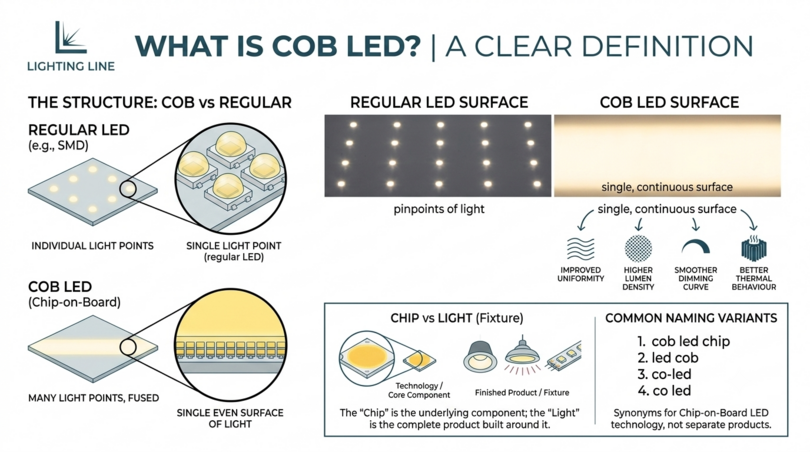
COB stands for Chip on Board, and it describes a specific way of packaging LED chips rather than a specific product. In a COB LED, the bare semiconductor chips (the actual light-emitting diodes) are mounted directly onto a ceramic or metal-core printed circuit board, wired together, and then covered with a single, continuous layer of phosphor. This is the direct answer to one of the most searched questions on the topic, “what does COB in LED mean”: it is a chip-mounting technique, and the “LED” part simply confirms that the light source underneath is a light-emitting diode array rather than a fluorescent, halogen or incandescent source.
What is a COB LED, physically?
Physically, a COB LED chip is a small module (anywhere from a few millimetres to several centimetres across) on which dozens or even hundreds of individual diode dies are packed tightly together. Because the phosphor coating sits over the whole cluster as one sheet rather than as hundreds of tiny individual domes, the human eye perceives the output as a single, even surface of light instead of many separate pinpoints. This is the physical reason COB is described as a “COB LED chip” in technical datasheets, and it is the root cause of nearly every practical advantage discussed later in this guide.
What is a COB light?
A COB light is any finished luminaire, module or LED strip that uses COB chips as its light source: a COB downlight, a COB grow light, a COB LED strip, or a COB LED headlight bulb, for example. The chip itself is the underlying component: the “light” is the complete product built around it, including the driver, the housing or profile, the diffuser or lens, and the wiring. It is worth being precise about this distinction because many buyers search for “cob light” and “cob led” almost interchangeably, when in fact one refers to the finished fixture and the other to the core technology inside it.
COB LED vs a regular LED: the one-sentence version
If you only remember one line from this whole guide, make it this one: a regular LED is a single point of light, while a COB LED is many points of light fused, optically, into one continuous surface. Everything else (the improved uniformity, the higher lumen density, the smoother dimming curve, the different thermal behaviour) follows directly from that single structural difference.
Common naming variants you might encounter
Because “Chip on Board” is a mouthful, the market has produced a handful of shorthand and even misspelt variants that all point to the same technology: cob led chip, led cob, co-led, and the frequently “co led“. If you come across any of these in a supplier’s spec sheet or in a search result, treat them as synonyms for chip-on-board LED rather than as a separate product category.
How COB LED technology works
Understanding the internal construction of a COB module is not just an academic exercise: it directly explains why COB LED strips behave differently on a dimmer, why they need a specific type of aluminium profile, and why their driver requirements differ from a standard SMD strip. This section walks through the anatomy of a COB chip layer by layer.
The substrate layer
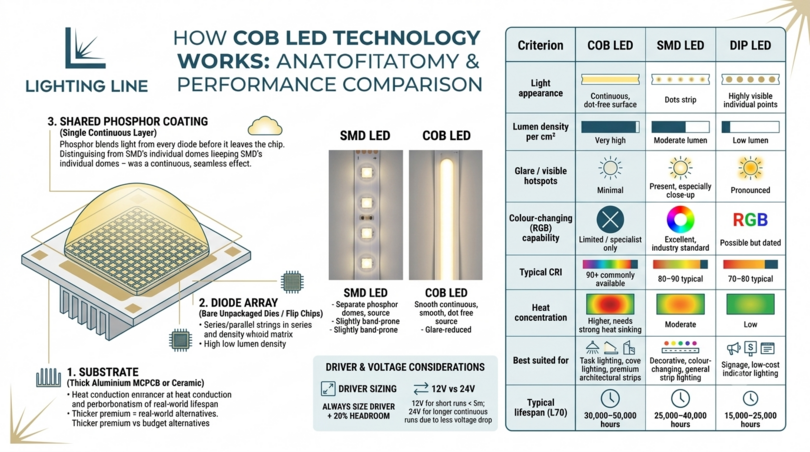
At the base of every COB module is a substrate, typically an aluminium-core PCB (MCPCB) or a ceramic board, chosen specifically for its ability to conduct heat away from the diode dies. Thermal conductivity of the substrate is one of the single biggest predictors of a COB product’s real-world lifespan, which is why premium COB LED strips use thicker, higher-grade aluminium bases than budget alternatives.
The diode array
On top of the substrate, bare LED dies (unpackaged semiconductor chips, sometimes called “flip chips”) are bonded in a tightly packed grid or matrix, wired in series and parallel strings to reach the target voltage and current. Packing the chips this closely is what creates the high lumen-per-square-centimetre density that COB is known for, but it is also what makes thermal management non-negotiable: pack too much light output into too small an area without adequate heat sinking, and both efficiency and lifespan fall sharply.
The shared phosphor coating
Once the diode array is wired, a single, continuous layer of phosphor is applied across the entire chip cluster. This is the step that fundamentally distinguishes COB from SMD: in an SMD LED, each individual diode has its own small phosphor dome, so you see a strip of small distinct light sources; in a COB LED, the phosphor layer blends the output of every diode underneath it before the light even leaves the chip, so what reaches your eye is already a single, smooth, glare-reduced source.
Driver and voltage considerations
COB LED strips are commonly available in 12V and 24V constant-voltage formats, and understanding which one your project needs is essential before ordering. A cob led 12v strip is generally the right choice for shorter runs (up to around 5 metres per run, depending on wattage per metre) and for retrofit projects using existing 12V driver infrastructure, while 24V variants suit longer continuous runs because voltage drop is less pronounced over distance. Selecting the wrong driver, or an underpowered one, is the most common cause of premature COB strip failure reported by installers, so always size the driver with at least 20% headroom above the calculated wattage of the run.
COB LED vs SMD LED vs DIP LED: the real differences
The question “which is better, COB or LED” is technically a category error, since COB is itself a type of LED, but it reflects a genuine and very common point of confusion in the market: people are really asking how COB compares to the more familiar SMD (Surface Mounted Device) format, and sometimes to the older DIP (Dual In-line Package) format. The table below lays out the comparison the way a specifier would actually use it, decision by decision.
| Criterion | COB LED | SMD LED | DIP LED |
|---|---|---|---|
| Light appearance | Continuous, dot-free surface | Visible individual points | Highly visible individual points |
| Lumen density per cm² | Very high | Moderate | Low |
| Glare / visible hotspots | Minimal | Present, especially close-up | Pronounced |
| Colour-changing (RGB) capability | Limited / specialist only | Excellent, industry standard | Possible but dated |
| Typical CRI | 90+ commonly available | 80–90 typical | 70–80 typical |
| Heat concentration | Higher, needs strong heat sinking | Moderate | Low |
| Best suited for | Task lighting, cove lighting, premium architectural strips | Decorative, colour-changing, general strip lighting | Signage, low-cost indicator lighting |
| Typical lifespan (L70) | 30,000–50,000 hours | 25,000–40,000 hours | 15,000–25,000 hours |
Is COB LED brighter than SMD?
For a given board area, yes: because a COB chip packs more diodes into the same footprint, COB LED strips typically deliver a higher lumen output per metre than a comparable SMD strip at the same wattage, which is why COB is the preferred choice whenever a project genuinely needs more usable light rather than more decorative colour-changing effects.
Is COB LED better than SMD LED for colour quality?
In terms of colour rendering and visual uniformity, generally yes. Because the phosphor is applied as one continuous coating, colour temperature is far more consistent along the length of a COB strip than along an SMD strip, where minor manufacturing variance between individual diodes can create faint colour-temperature banding, sometimes visible as subtle patches of warmer or cooler light.
What is the difference between COB LED and DOB LED?
DOB (Driver on Board) is a related but distinct concept describing where the driver electronics sit, not how the chips are packaged; a DOB LED integrates the AC-DC driver circuit directly onto the same board as the LEDs, often to eliminate a separate external driver box, whereas COB refers strictly to how the diodes themselves are mounted. A product can technically be both COB and DOB at once, since the two terms describe different parts of the same fixture.
The advantages of COB LED
Once the structural difference between COB and other LED formats is clear, the practical advantages follow logically. This section breaks them down individually, because different professional audiences care about different benefits: an installer cares about reliability and driver compatibility, while a designer cares about visual uniformity and dimming quality.
Uniform, glare-free light output
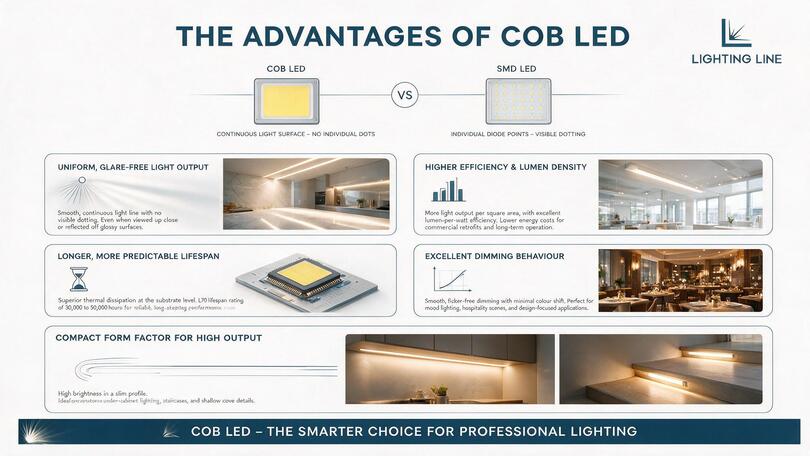
The single most cited reason professionals choose COB over SMD is uniformity. Because the light source is a continuous surface rather than a row of points, COB LED strips produce a smooth line of light with no visible dotting, even when viewed up close or reflected off a glossy surface such as a countertop or a mirrored ceiling — a common failure point for standard SMD strips in high-end interior design.
Higher efficiency and lumen density
COB LED chips generally achieve a higher lumen output for a given board area and, in well-engineered products, a competitive lumen-per-watt efficiency compared with SMD alternatives, which is one of the reasons COB is frequently recommended to reduce energy costs in commercial retrofits. Efficiency gains compound over the operating life of a fixture, so a small percentage improvement in lumens-per-watt translates into a meaningful reduction in the electricity bill over years of continuous commercial use.
Longer, more predictable lifespan
Because COB chips are engineered with more attention to thermal dissipation at the substrate level, quality COB products often reach an L70 lifespan rating of 30,000 to 50,000 hours, meaning the light has dropped to 70% of its original output after that many hours of use — a threshold most manufacturers treat as end of useful life. That figure answers one of the most frequent buyer questions directly: yes, well-made COB LEDs do generally last longer than comparable SMD products, provided the driver and installation are correct.
Excellent dimming behaviour
COB LED strips generally dim more smoothly and with less visible colour shift than SMD alternatives, because the continuous phosphor layer avoids the flickering or uneven dimming that can occur when individually packaged diodes respond very slightly differently to a lowered current. This makes COB the preferred choice for mood lighting, hospitality dimming scenes, and any application where the dimming curve itself is part of the design experience.
Compact form factor for high output
Because a COB chip concentrates so much lumen output in a small footprint, COB LED products can achieve high brightness in slim profiles, which is why COB downlights and COB LED strips are so widely used in low-clearance applications such as under-cabinet lighting, staircases and shallow cove details, where a bulkier SMD board simply would not fit.
COB LED strips: why they are changing professional lighting design
Nowhere are the advantages of COB technology more visible, quite literally, than in strip lighting, which is why LightingLine has built out a dedicated range of COB LED strips for professional and residential projects alike. This section looks specifically at what a COB LED strip is, how it differs from a conventional strip, and why designers increasingly specify it as the default rather than the premium option.
What is COB LED strip Lighting?
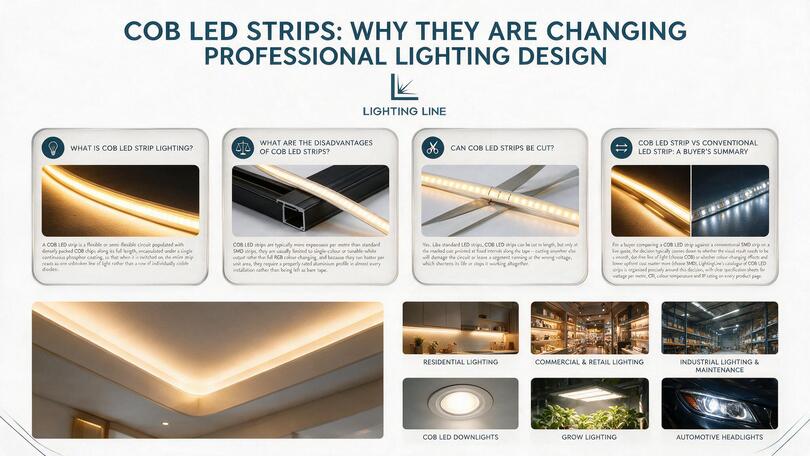
A COB LED strip is a flexible or semi-flexible circuit populated with densely packed COB chips along its full length, encapsulated under a single continuous phosphor coating, so that when it is switched on, the entire strip reads as one unbroken line of light rather than a row of individually visible diodes. This is a direct definition of “strip lights” as applied to COB technology, and it is the feature that most clearly separates COB from every earlier generation of tape lighting.
What are the disadvantages of COB LED strips?
Fair evaluation requires acknowledging the trade-offs too. COB LED strips are typically more expensive per metre than standard SMD strips, they are usually limited to single-colour or tunable-white output rather than full RGB colour-changing, and because they run hotter per unit area, they require a properly rated aluminium profile in almost every installation rather than being left as bare tape. None of these are disqualifying for the applications COB is designed for, but they matter when comparing quotes line by line.
Can COB LED strips be cut?
Yes. Like standard LED strips, COB LED strips can be cut to length, but only at the marked cut points printed at fixed intervals along the tape — cutting anywhere else will damage the circuit or leave a segment running at the wrong voltage, which shortens its life or stops it working altogether.
COB LED strip vs conventional LED strip: a buyer’s summary
For a buyer comparing a COB LED strip against a conventional SMD strip on a live quote, the decision typically comes down to whether the visual result needs to be a smooth, dot-free line of light (choose COB) or whether colour-changing effects and lower upfront cost matter more (choose SMD). LightingLine’s catalogue of COB LED strips is organised precisely around this decision, with clear specification sheets for wattage per metre, CRI, colour temperature and IP rating on every product page.
Applications of COB LED lighting
COB LED technology is no longer a niche, premium option confined to museum lighting; it has moved into mainstream residential, commercial and industrial specification. This section surveys the sectors where COB LED is now the default recommendation, and explains, for each one, why the technology’s specific strengths matter.
Residential lighting
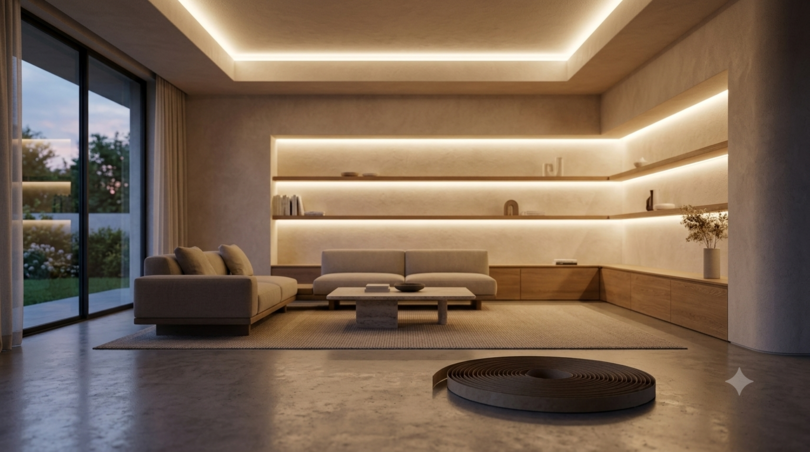
In homes, COB LED strips are widely used for under-cabinet kitchen lighting, staircase lighting, cove lighting around ceiling perimeters, and wardrobe or shelf lighting, precisely because the dot-free light output looks intentional and finished rather than like a visible string of components. Homeowners increasingly ask installers for COB specifically once they have seen the difference in person, which is a pattern installers report repeatedly when quoting SMD as the default.
Commercial and retail lighting
Retail environments — from boutique storefronts to supermarket shelf edges — rely on COB LED strips to render merchandise colour accurately and consistently along a run, since a single patch of slightly warmer or cooler light along a shelf edge is immediately noticeable to shoppers and can visibly affect how products are perceived. High-CRI COB strips are now a standard specification in premium retail fit-outs for this reason.
Industrial lighting and maintenance
For facilities managers, the case for COB is primarily about total cost of ownership rather than aesthetics: a longer L70 lifespan directly reduces the frequency of replacement and the associated labour cost, which matters enormously in industrial settings where lighting is often mounted at height and replacement requires scaffolding, lifts or scheduled downtime. Reduced maintenance visits are frequently the single largest line item justifying a COB LED retrofit budget in industrial reports.
COB LED downlights
A COB LED downlight uses a single COB chip behind a reflector or lens to produce a controlled, glare-reduced beam, and is one of the most common finished products built on COB technology, widely specified in offices, hospitality and retail ceilings where a clean, shadow-free wash of light is required.
Grow lighting
COB LED grow lights are valued in horticultural applications because the concentrated, high-lumen-density output from a small chip area allows growers to achieve high light intensity at the canopy level from a compact fixture, and full-spectrum COB variants are widely used to support different growth stages.
Automotive headlights
The automotive sector has also adopted COB LED headlight technology, where the compact, high-output chip allows headlight housings to be made slimmer while still producing the beam intensity required for safe road illumination, a use case that has driven significant recent innovation in COB thermal design given the extreme temperature range automotive components must tolerate.
How to choose the right COB LED: a buyer’s checklist
With the technology and the use cases established, the practical question becomes: how do you actually select the right COB LED product for a specific project, and avoid the common mistakes that lead to early failure or a disappointing visual result? This section is written as a working checklist for procurement.
Lumens: how much light do you actually need?
Start every specification with the required lumen output for the space, not with wattage, since lumens measure the actual light produced while watts only measure the power consumed — two COB products with identical wattage can differ meaningfully in lumen output depending on chip quality and driver efficiency. For general guidance, task areas such as kitchen worktops typically need higher lumens-per-metre than ambient cove lighting.
Colour temperature
Colour temperature, measured in Kelvin, should be matched to the mood and function of the space: warmer temperatures around 2700K–3000K suit residential and hospitality settings, while cooler temperatures around 4000K–5000K are typically specified for task-focused commercial and industrial areas. Mixing colour temperatures within the same sightline is one of the most common specification errors, so always check the Kelvin rating across every COB product used in a single visible run.
CRI (Colour Rendering Index)
CRI measures how accurately a light source renders colours compared with natural daylight, and it is one of the clearest quality differentiators between budget and premium COB products. A CRI of 90 or above is generally recommended for retail, hospitality and any application where colour accuracy matters, while a CRI in the 80s may be acceptable for purely functional, non-visual spaces such as storage areas.
IP rating for environment
Match the IP (Ingress Protection) rating to the installation environment: an IP20 COB strip is suitable only for dry indoor use, an IP65-rated strip can tolerate splashing water and is commonly specified for kitchens and bathrooms, and an IP67-rated product is required for direct water exposure such as outdoor or submerged applications. Skipping this check is one of the most frequent causes of premature product failure reported in warranty claims.
Voltage and driver compatibility
Confirm whether the product is a 12V or 24V system before ordering a driver, since a mismatched voltage will either underpower the strip or, in the worst case, damage it outright. As covered earlier, 12V systems suit shorter runs and retrofit projects, while 24V systems are generally preferable for longer continuous installations due to reduced voltage drop.
Certifications and safety
Look for recognised safety certifications (such as CE marking within the EU) and request the manufacturer’s test documentation for thermal performance and lumen maintenance, particularly for commercial and industrial projects where compliance is a contractual requirement rather than a nice-to-have.
Aluminium profile and heat sinking
Because COB strips concentrate more heat per metre than SMD alternatives, always pair a COB LED strip with an appropriately rated aluminium profile rather than leaving it unmounted, since the profile is doing real thermal work, not just providing a decorative finish.
COB LED answers for every professional profile
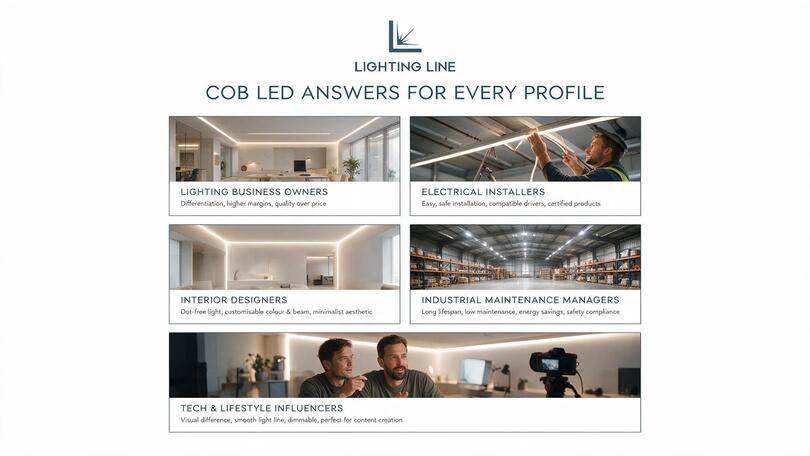
Different professional readers arrive at this guide with different priorities, so this section speaks directly to five profiles that regularly specify or recommend COB LED products, addressing the specific questions each one brings to a project.
For the lighting business owner
If you run a lighting business, the advantages of COB LED over other LED types come down to differentiation and margin: offering a visibly superior, dot-free product lets you compete on quality rather than purely on price. Integrating COB into your project range typically starts with a small core selection of colour temperatures and CRI grades rather than trying to stock every variant, and the average cost of high-quality COB LED sits above standard SMD but is generally offset by lower warranty-claim rates and stronger client retention. To ensure durability and reliability, favour suppliers who publish full L70 lifespan and thermal test data rather than just headline lumen figures, and keep an eye on innovations such as improved phosphor formulations and higher-density chip layouts, which continue to push efficiency upward year over year.
For the electrical installer
For installers, the best COB LED products for domestic installations are generally 12V, pre-terminated strips with a matching, correctly-sized driver, since this minimises on-site wiring errors. Correct installation for maximum efficiency means respecting the marked cut points, using the specified aluminium profile for heat dissipation, and never exceeding the maximum run length stated by the manufacturer for that wattage. Safety certifications to check for include CE marking and, where relevant, IP-rating test certificates; reducing installation costs is best achieved by standardising on one or two driver types across projects rather than sourcing bespoke drivers per job. Current trends worth tracking include tunable-white COB strips and DALI-compatible drivers, both of which are increasingly requested by commercial clients.
For the interior designer
Interior designers integrating COB LED into design projects typically use it for cove lighting, furniture lighting and feature walls where the dot-free finish supports a minimalist aesthetic. Customisation options include a wide range of colour temperatures, tunable-white systems that shift Kelvin value on a dimmer, and various beam angles for downlight products. Choosing the most sustainable and efficient COB LEDs generally means prioritising higher lumen-per-watt figures and longer L70 ratings, since a longer-lived product reduces the embodied carbon of replacement over the life of the interior. Current lighting trends for residential and commercial spaces increasingly favour warmer, layered lighting schemes built around COB strips rather than single ceiling-mounted fixtures, and the strongest argument for convincing clients to choose LED — COB in particular — is almost always the combination of lower running costs and a visibly higher-quality finished look.
For the industrial maintenance manager
The benefits of COB LED for industrial lighting centre on total cost of ownership: longer lifespan directly reduces both the frequency and the labour cost of replacement, particularly at height. Monitoring and managing LED lighting efficiently is increasingly done through centralised building-management systems that track runtime hours against the manufacturer’s rated lifespan, allowing planned rather than reactive replacement. The most durable and reliable lighting solutions for industrial settings are typically those with the highest IP ratings and the most conservative thermal design margins, and ensuring safety during installation means following lockout-tagout procedures and manufacturer torque and mounting specifications. Relevant safety regulations to observe include local electrical codes and, within the EU, applicable CE and RoHS compliance requirements.
For the tech and lifestyle influencer
If you cover lighting technology for an audience, the most interesting angle on COB LED is usually visual: filming the difference between a dotted SMD strip and a smooth COB strip up close is one of the simplest ways to demonstrate the technology’s advantage without needing technical language. The most innovative COB LED products on the market right now include tunable-white and high-CRI strip variants aimed at content creators’ own studio lighting, and the environmental angle worth highlighting is the reduced replacement frequency and lower energy draw of well-made COB fixtures compared with older lighting technology. The features most worth showing to followers are the dot-free light line itself, the dimming smoothness, and the compact profile, and collaboration with LED lighting brands typically starts with a straightforward product review or before-and-after installation comparison.
Technology and recent innovations in COB LED
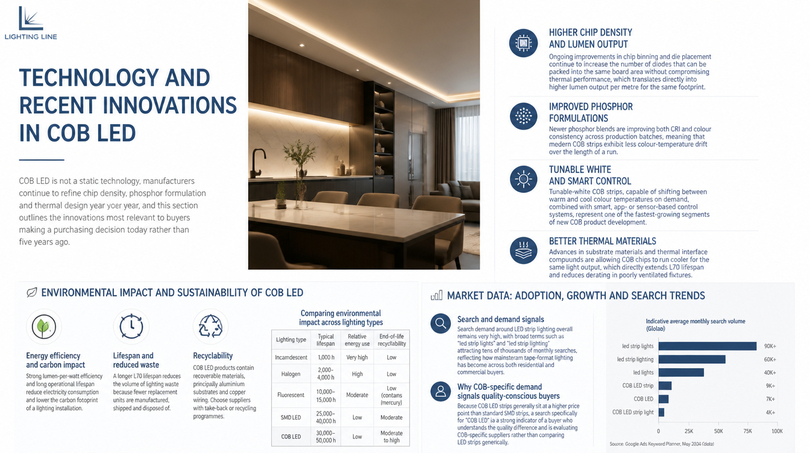
COB LED is not a static technology; manufacturers continue to refine chip density, phosphor formulation and thermal design year over year, and this section outlines the innovations most relevant to buyers making a purchasing decision today rather than five years ago.
Higher chip density and lumen output
Ongoing improvements in chip binning and die placement continue to increase the number of diodes that can be packed into the same board area without compromising thermal performance, which translates directly into higher lumen output per metre for the same physical footprint.
Improved phosphor formulations
Newer phosphor blends are improving both CRI and colour consistency across production batches, meaning that modern COB strips exhibit less colour-temperature drift over the length of a run than earlier generations of the technology, addressing one of the historical criticisms of chip-on-board products.
Tunable white and smart control
Tunable-white COB strips, capable of shifting between warm and cool colour temperatures on demand, combined with smart, app- or sensor-based control systems, represent one of the fastest-growing segments of new COB product development, driven largely by commercial and hospitality demand for adaptive lighting scenes.
Better thermal materials
Advances in substrate materials and thermal interface compounds are allowing COB chips to run cooler for the same light output, which directly extends L70 lifespan and reduces the derating that occurs in poorly ventilated fixtures.
Environmental impact and sustainability of COB LED
Sustainability is now a genuine specification criterion, not an afterthought, particularly for commercial and public-sector projects, so this section addresses the environmental profile of COB LED directly and honestly, including where the technology still has room to improve.
Energy efficiency and carbon impact
Because COB LED products generally achieve strong lumen-per-watt efficiency and a long operational lifespan, the largest environmental benefit of COB LED lighting comes from reduced electricity consumption over the product’s lifetime compared with older lighting technologies, and this efficiency gain is the single biggest lever available to reduce the carbon footprint of a lighting installation.
Lifespan and reduced waste
A longer L70 lifespan does more than reduce maintenance cost; it directly reduces the volume of lighting waste generated over the life of a building, since fewer replacement units are manufactured, shipped and eventually disposed of. This is a frequently overlooked component of the sustainability case for COB LED.
Recyclability
COB LED products contain recoverable materials, principally aluminium substrates and copper wiring, and specifying manufacturers with a stated end-of-life recycling programme is the most direct way for a buyer to improve the recyclability profile of a project, since recycling infrastructure and take-back schemes still vary significantly between suppliers.
Comparing environmental impact across lighting types
| Lighting type | Typical lifespan | Relative energy use | End-of-life recyclability |
|---|---|---|---|
| Incandescent | 1,000 hours | Very high | Low |
| Halogen | 2,000–4,000 hours | High | Low |
| Fluorescent | 10,000–15,000 hours | Moderate | Low (contains mercury) |
| SMD LED | 25,000–40,000 hours | Low | Moderate |
| COB LED | 30,000–50,000 hours | Low | Moderate to high |
Market data: adoption, growth and search trends
Purchasing decisions are increasingly informed by market direction as much as by individual product specifications, so this section summarises the broader adoption trend for COB LED lighting and LED strip lighting generally.
Search and demand signals
Search demand around LED strip lighting overall remains very high, with broad terms such as “led strip lights” and “led strip lighting” attracting tens of thousands of monthly searches, reflecting how mainstream tape-format lighting has become across both residential and commercial buyers, while more specific COB-related terms show consistently strong commercial intent, indicating that buyers searching for COB technology are typically further along in an active purchasing decision rather than casually browsing.
Why COB-specific demand signals quality-conscious buyers
Because COB LED strips generally sit at a higher price point than standard SMD strips, a search specifically for “COB LED” rather than generic “LED strip” terms is a strong indicator of a buyer who already understands the quality difference and is evaluating COB-specific suppliers rather than comparing LED strips generically: a pattern that is highly relevant to how lighting businesses should structure their own product pages and content.
Frequently asked questions
| Question | Answer |
|---|---|
| What is a COB LED? |
Show answerA COB LED (Chip on Board LED) is a light source made by mounting multiple bare LED chips directly onto one substrate and covering them with a single, shared phosphor layer, so the whole array reads as one continuous surface of light rather than separate points. |
| What does COB stand for in LED? |
Show answerCOB stands for Chip on Board, describing the manufacturing method of bonding multiple LED chips directly to a board under one shared coating, rather than packaging each chip individually as SMD does. |
| Is COB LED better than SMD LED? |
Show answerNeither is universally better. COB delivers smoother, more uniform, glare-reduced light with higher lumen density, ideal for task and premium strip lighting, while SMD offers colour-changing flexibility and a lower price per metre. |
| Are COB LED strips good? |
Show answerYes, COB LED strips are widely specified by lighting professionals for their dot-free, high-CRI output, making them well suited to cove lighting, furniture lighting and retail display applications. |
| How long do COB LEDs last? |
Show answerQuality COB LED products typically reach an L70 lifespan of 30,000 to 50,000 hours, provided the driver, thermal management and installation are all correctly specified. |
| Do COB LEDs get hot? |
Show answerYes, more heat is generated per unit area than a single SMD chip because more diodes are packed together, so proper heat sinking through an aluminium profile is essential to preserve lumen output and lifespan. |
| Is COB LED dimmable? |
Show answerYes, when paired with a compatible driver, COB LED strips and fixtures dim smoothly via 0-10V, PWM, TRIAC or DALI control depending on the product. |
| Can COB LED strips be cut? |
Show answerYes, but only at the marked cutting points spaced along the tape; cutting elsewhere damages the circuit or leaves a segment at the wrong voltage. |
| What is the difference between COB LED and regular LED strip? |
Show answerA regular SMD strip has visibly separate diodes, producing distinct dots of light, while a COB strip has densely packed chips under one continuous phosphor coating, producing an unbroken line of light. |
| What is COB LED strip lighting used for? |
Show answerIt is used for architectural cove lighting, under-cabinet and shelf lighting, furniture and staircase lighting, and retail or museum display lighting wherever a smooth, high-CRI line of light is required. |
COB LED: light without dot
COB LED earns its growing share of professional specifications for a straightforward reason: it solves the visual and qualitative shortcomings of earlier LED formats while matching or exceeding them on lifespan and efficiency. Whether the priority is a dot-free architectural finish, a longer maintenance interval on an industrial site, or simply a more premium result for a client, COB LED strip lighting consistently delivers measurable advantages over standard SMD alternatives, provided the buying criteria in this guide (lumens, CRI, colour temperature, IP rating, voltage and driver compatibility) are checked carefully before ordering.
Explore LightingLine’s full range of COB LED stripsto compare specifications directly and find the right product for your next project.
This article was developed with the support of artificial intelligence and subsequently reviewed, corrected, and validated by the LightingLine.eu technical team, which guarantees its reliability and compliance with official sources.