In this article…
- What are LED strip lights?
- The LED strip lighting market: data and trends
- Types of LED strip lights
- Materials and components explained
- How to choose the right LED strip lights: the buying guide
- Installation and mounting: step-by-step
- Control and customisation: remotes, apps, voice assistants
- Common uses and applications
- LED strips for creators, designers, students and retailers
- Pricing and running costs
- Maintenance and lifespan
- Safety, certifications and regulations
- Why choose LightingLine LED strips
- Frequently asked questions
- Conclusion
1. What are LED strip lights?
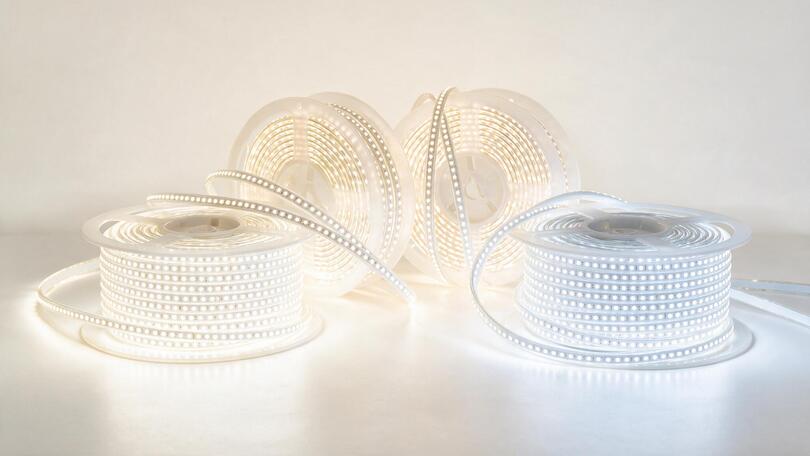
A LED strip light (also called LED tape, led ribbon or led tape light) is a flexible circuit board, usually made of copper-coated FPC (flexible printed circuit) or FR4 material, populated with small surface-mounted LED chips spaced at regular intervals along its length. The whole assembly is thin, flexible enough to bend around corners and curves, and coated on the back with an adhesive layer so it can be stuck directly onto almost any clean, dry surface. Unlike a traditional bulb, a led strip produces a continuous, even line of light rather than a single point source, which is exactly why it has become the go-to solution for accent lighting, coving, under-cabinet lighting and architectural effects.
How do LED strip lights work?
Electrically, a strip is divided into short repeating segments (usually every 3 to 6 LEDs) that can be cut along marked lines without damaging the rest of the strip. Each segment is wired in parallel to the two power rails running the length of the tape, so current from the power supply reaches every LED at a similar voltage regardless of where it sits on the reel. This is why voltage matters so much: a 5-metre reel of 12V strip and a 5-metre reel of 24V strip will look identical, but the higher voltage strip suffers less voltage drop over distance, which means more even brightness from the first LED to the last.
The core characteristics that define any led strip lighting product (and the specifications you should always check before buying) are: LED chip type and density (LEDs per metre), voltage (12V, 24V or mains 220-240V), colour temperature or RGB/RGBW capability, luminous output in lumens per metre, Colour Rendering Index (CRI), IP rating for moisture resistance, and the width and thickness of the tape itself (important for aluminium profile compatibility). We break every one of these down in detail in the buying guide section below.
Why LED strips replaced traditional strip lighting
Older strip lighting technology (fluorescent tubes, neon tubing, rope lights) required bulky housings, generated significant heat, and offered no real colour flexibility. Modern led lighting strips solved all three problems at once: LEDs run cool enough to be handled safely seconds after switching off, the tape itself is only 1–3mm thick, and a single rgb led strip can now produce over 16 million colour combinations from one remote or app. This is the single biggest reason led strips have displaced fluorescent and neon strip lighting in virtually every new commercial and residential installation since the early 2020s.
2. The LED strip lighting market: data and trends
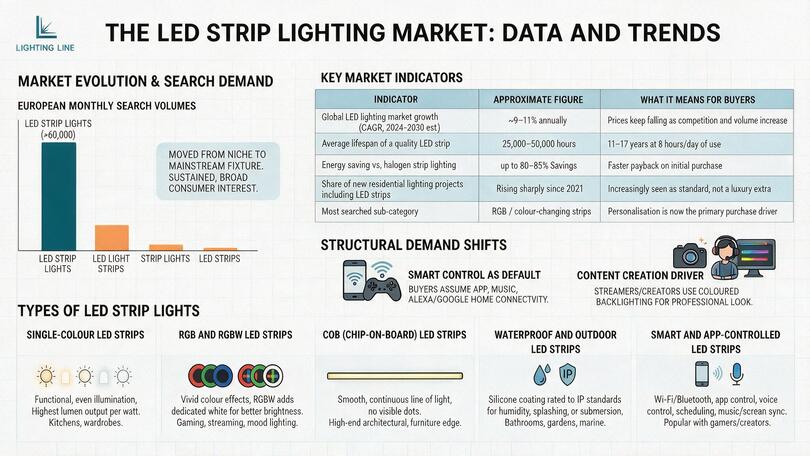
The numbers behind this category help explain why LED strip lighting has moved from a niche hobbyist product to a mainstream fixture in homes, retail and hospitality design. Search demand alone tells part of the story: analysis of European search volumes shows led strip lights generating over 60,000 monthly searches, with tightly related terms like led light strips, strip lights and led strips each adding several thousand more: a strong signal of sustained, broad consumer interest rather than a passing trend.
| Indicator | Approximate figure | What it means for buyers |
|---|---|---|
| Global LED lighting market growth (CAGR, 2024–2030 est.) | ~9–11% annually | Prices keep falling as competition and volume increase |
| Average lifespan of a quality LED strip | 25,000–50,000 hours | 11–17 years at 8 hours/day of use |
| Energy saving vs. halogen strip lighting | up to 80–85% | Faster payback on the initial purchase |
| Share of new residential lighting projects including LED strips | Rising sharply since 2021 | Increasingly seen as standard, not a luxury extra |
| Most searched sub-category | RGB / colour-changing strips | Personalisation is now the primary purchase driver |
Two structural shifts are worth understanding if you want to buy with confidence rather than guesswork. First, smart control has become the default expectation, not an add-on: buyers increasingly assume a strip can be controlled from a phone app, synced to music, or connected to Alexa or Google Home, and products that can’t do this are starting to look dated. Second, content creation has become a genuine demand driver for this category: streamers, YouTubers and TikTok creators use coloured backlighting as a low-cost way to make a set look professional on camera, which has pushed demand for dynamic, app-controllable RGB strips specifically, separate from the traditional home-decor buyer.
3. Types of LED strip lights
Not all led strips are built for the same job, and choosing the wrong type is the single most common regret buyers report. Below is a breakdown of the main categories you will encounter while shopping the LED strips range on LightingLine.eu, along with what each is genuinely best suited for.
Single-colour LED strips
These are the simplest and most efficient option: every LED on the strip emits the same fixed colour temperature, typically expressed in Kelvin (2500K warm white through to 6500K cool daylight). Single-colour led tape is the right choice whenever the goal is functional, even illumination rather than a decorative effect: under kitchen cabinets, inside wardrobes, along stair treads, or as general task lighting in a workspace. Because there is no colour-mixing circuitry, single-colour strips generally deliver higher lumen output per watt than RGB equivalents, and they are the cheapest category to buy and run.
RGB and RGBW LED strips
RGB led strips combine red, green and blue LED chips within each segment, allowing a controller to mix them electronically to produce essentially any colour in the visible spectrum. RGBW variants add a fourth, dedicated white chip, which solves the biggest weakness of pure RGB strips: mixing red, green and blue to fake white light never looks as clean or as bright as a true white LED. If you want both vivid colour effects and the ability to switch to a crisp white for everyday use, RGBW is worth the modest price premium over standard RGB. Newer RGBIC or “dream colour” strips take this further, allowing different sections of the same strip to display different colours simultaneously, which is what produces the moving rainbow and chase effects popular in gaming and streaming setups.
COB (Chip-on-Board) LED strips
COB strips pack LED chips so densely (often 200+ per metre) that the individual light points are no longer visible to the eye, producing a smooth, continuous line of light rather than the visible “dotting” of standard SMD strips. This makes COB the preferred choice for high-end architectural coving, furniture edge lighting, and anywhere the strip itself will be visible rather than hidden behind a diffuser.
Waterproof and outdoor LED strips
Standard indoor strips have no protection against moisture and will corrode or short-circuit if exposed to humidity, splashing or rain. Led waterproof variants add a silicone or epoxy coating rated to an IP (Ingress Protection) standard: IP65 protects against water jets and is the minimum sensible standard for kitchens, bathrooms and covered outdoor areas, while IP67 or IP68 rated strips can be fully submerged and are used for pond lighting, garden features and marine applications. We cover IP ratings in full detail in the safety section below.
Smart and app-controlled LED strips
These strips integrate a Wi-Fi or Bluetooth module directly into the controller, allowing control through a dedicated smartphone app rather than (or alongside) a physical remote. Most current smart strips also support voice control through Alexa or Google Assistant, scheduling, scene presets, and music or screen-sync modes that shift colour and brightness in time with sound or on-screen content — a feature especially popular with gamers and content creators.
4. Materials and components explained
Understanding what a strip is actually made of helps you judge quality at a glance, rather than relying on marketing copy alone. A complete led strip lighting kit is built from five components, each of which affects performance, lifespan and safety.
The flexible circuit (nastro LED)
The base of any strip is a flexible printed circuit, typically 8–20mm wide, carrying copper traces that distribute power to each LED segment. Thicker copper traces handle higher current with less voltage drop, which is one reason higher-end strips can maintain even brightness over longer runs than budget alternatives.
LED chips
The chip designation you’ll see on spec sheets (2835, 5050, 5630, 3014, and so on) refers to the physical dimensions of the chip package in tenths of a millimetre: a 5050 chip is 5.0mm x 5.0mm. Larger chips can house three diodes internally (which is how RGB strips work) or run at higher wattage for greater brightness, while smaller, densely packed chips such as 2835 are typically used in high-CRI, high-density single-colour tape.
Controllers
A controller is the small unit that sits between the power supply and the strip, translating remote, app or voice commands into the correct electrical signal to change colour, brightness or effect. Basic controllers offer on/off, dimming, and a handful of preset colours or chase effects, smart controllers add Wi-Fi/Bluetooth connectivity, app control and voice assistant integration.
Power supplies
Every low-voltage LED strip (12V or 24V) needs a dedicated power supply that converts mains electricity down to the correct DC voltage. Undersizing the power supply is the most common cause of strips that flicker, dim unevenly, or fail early: the golden rule is to add roughly 20% headroom above the strip’s calculated wattage draw to protect the driver’s lifespan and account for inrush current.
Connectors and accessories
Solderless clip connectors, corner connectors, extension cables and aluminium mounting profiles complete a professional installation. Aluminium channels in particular serve two purposes: they dissipate heat away from the LEDs (extending lifespan) and diffuse the light source so individual LED points are not visible, giving a much more polished finished look than tape stuck directly onto a surface.
5. How to choose the right LED strip lights: the buying guide
With the fundamentals covered, here is the practical decision framework professionals use when specifying led strip lights for a project, whether that project is a single bedroom or a full retail fit-out.
Step 1: decide on voltage
For runs under 5 metres, 12V strips are perfectly adequate. For anything longer, or for continuous runs feeding from a single point, 24V led strip lighting is the better choice because it suffers significantly less voltage drop, meaning the far end of a long run stays just as bright as the end closest to the power supply.
Step 2: set your brightness target
Brightness is measured in lumens per metre. As a rough guide: 300–500 lm/m suits ambient accent lighting, 800–1,200 lm/m suits general room lighting, and 1,500+ lm/m is appropriate for task lighting such as kitchen worktops or workshop benches. Buying based on wattage alone is a common mistake, since efficiency (lumens per watt) varies significantly between chip types.
Step 3: choose colour temperature or RGB capability
Warm white (2700–3000K) suits living rooms, bedrooms and hospitality spaces where a relaxed atmosphere matters. Neutral white (4000K) works well in kitchens and bathrooms. Daylight (5000–6500K) is best for workshops, garages and task-focused areas. If the goal is mood, gaming, streaming or event lighting, an RGB or RGBW strip with app control is the better investment.
Step 4: check the CRI rating
Colour Rendering Index measures how accurately a light source reveals true colours compared to natural daylight, on a scale up to 100. For kitchens, wardrobes, makeup mirrors, retail displays and any space where colour accuracy matters, look for a CRI of 90 or above while anything below CRI 80 can make food, fabric and skin tones look flat or slightly off.
Step 5: match the IP rating to the environment
IP20 (no protection) is fine for dry indoor use only. IP65 handles kitchens, bathrooms and covered outdoor areas. IP67/IP68 is required for full outdoor exposure, gardens, or anywhere the strip might contact standing water.
Step 6: confirm cuttable segment length and total run
Always check the cut-line spacing (commonly every 5cm or every 3 LEDs) against the exact length you need, and confirm the maximum single-run length recommended by the manufacturer before voltage drop becomes visible as dimming toward the far end.
You can compare all of these specifications side by side across the current range on the LightingLine LED strips catalogue, where voltage, IP rating, CRI and lumen output are listed for each product rather than buried in a generic description.
6. Installation and mounting: step-by-step
One of the most searched questions on this topic is simply how to install a strip without it falling off the wall six months later or looking messy once it’s up. Here is the process professionals follow.
Tools you’ll need
A tape measure, isopropyl alcohol and a lint-free cloth (for surface prep), sharp scissors for cutting at the marked lines, a screwdriver if you’re using mounting clips or aluminium profile, and (for anything connecting to mains wiring rather than a plug-in transformer) a qualified electrician.
Step-by-step installation
- Clean the surface thoroughly with isopropyl alcohol. Dust, grease or residue is the number one cause of adhesive failure, far more often than the adhesive itself being weak.
- Measure and plan your run, marking where corners, cuts and the power supply connection will sit before you peel any backing.
- Cut only at the marked cut lines — cutting between them will damage the circuit and can disable the entire segment or run beyond it.
- Fit an aluminium profile first if you’re using one, then press the strip into the channel, rather than sticking it directly to the wall and trying to add a profile afterward.
- Connect to the power supply and controller, double-checking polarity on solderless connectors, then test the full run before committing to final adhesive placement.
- Secure with mounting clips every 15–20cm in addition to the adhesive backing, particularly on vertical surfaces, ceilings, or anywhere temperature fluctuates (adhesive alone tends to soften and fail over time in warm environments).
Can you cut LED strip lights and still use them? Yes, this is one of the most common questions buyers have, and the answer is yes, but only at the marked cut points, which are spaced at regular intervals (commonly every 3–6 LEDs) along the tape. Cutting anywhere else breaks the circuit for that segment. Reputable strips clearly mark cut lines with a scissor icon or dotted line printed directly on the tape.
7. Control and customisation: remotes, apps, voice assistants
Control is where led strip lighting has evolved the most in recent years. A basic IR remote still ships with most budget kits and covers on/off, brightness, static colours and a handful of preset chase effects: perfectly adequate for simple use cases. Where the category has moved fastest, though, is app and voice control: a Wi-Fi or Bluetooth-enabled controller lets you set schedules, create custom scenes, group multiple strips together, and sync colour changes to music or on-screen content in real time.
Are LED strip lights compatible with smart home systems? Most current smart strips controllers support Amazon Alexa and Google Assistant natively through their companion app, and a growing number now support Apple HomeKit and Matter, the newer cross-platform smart home standard designed to make different brands interoperate. If smart home compatibility matters to your purchase, always check the specific ecosystem support listed on the product page rather than assuming: this varies significantly between models even from the same manufacturer.
For content creators specifically, music and screen-sync modes have become a genuine differentiator: strips with a built-in microphone or software-based audio analysis can shift colour and pulse intensity in time with a track, which is widely used behind streaming and gaming setups to add movement and energy to a shot without any manual programming.
8. Common uses and applications
LED strip lighting has moved well beyond its original niche of under-cabinet kitchen lighting. Below are the applications driving the bulk of current demand.
Home and living spaces
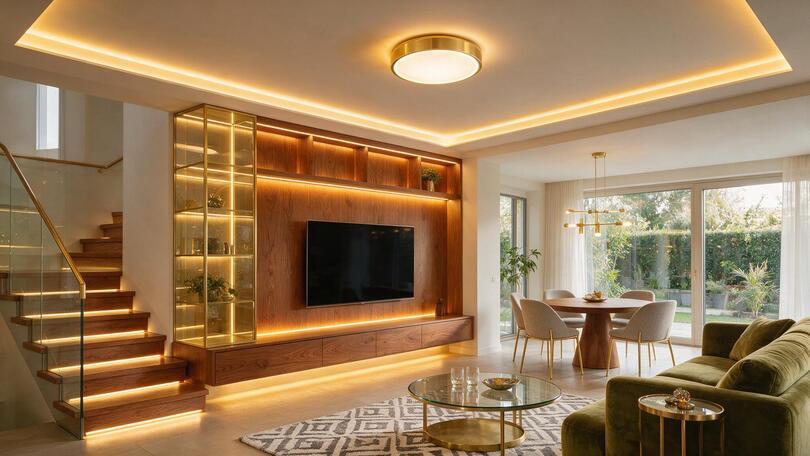
Behind TVs (bias lighting reduces eye strain and improves perceived contrast), along skirting boards and coving for ambient uplighting, inside wardrobes and cabinets, under stairs, and increasingly along bed frames and headboards as a design feature in their own right.
Kitchens and bathrooms
Under-cabinet task lighting remains one of the highest-volume use cases, typically specified in neutral or daylight white with CRI 90+ so food preparation surfaces show true colour, combined with an IP65 rating given the proximity to sinks and hobs.
Gaming, streaming and content creation
RGB strips positioned behind a monitor or along a desk edge have become close to standard in gaming and streaming setups, both for the visual effect on camera and for the reduced eye strain that comes from softening the contrast between a bright screen and a dark room.
Retail and commercial spaces
Shop owners increasingly use strip lighting to highlight product displays, define window installations, and create a distinct in-store atmosphere that differentiates a physical space from browsing the same products online: a point we expand on below.
Outdoor and garden lighting
Waterproof strips along decking, garden pathways, pergolas and outdoor kitchens have grown quickly as IP67/IP68 rated products have become more widely available at accessible prices.
9. LED strips for creators, designers, students and retailers
Different buyers arrive at this category with genuinely different priorities, and it’s worth addressing the most common ones directly.
For content creators and streamers
If your goal is a set that looks polished and consistent on camera, prioritise an RGB or RGBIC strip with app control and music-sync, positioned behind the monitor and along the desk edge rather than pointed directly at the camera lens (which causes glare and blown-out highlights). A colour temperature around 5600K for daylight-balanced footage, or fully dynamic RGB for a stylised look, both work well: the key specification to check is smooth dimming without visible flicker on camera, since cheap drivers can introduce a strobing effect that is invisible to the eye but very visible on video.
For interior designers
Clients increasingly expect lighting proposals to include LED strip integration as standard, not as an optional extra. RGBW strips with a high CRI white channel give the flexibility to present both a warm, inviting scheme for evenings and a crisp, functional white for daytime use from the same fixture: a detail that photographs well in portfolio work and demonstrates technical range to clients.
For students
Budget and ease of removal (particularly in rented accommodation) tend to be the deciding factors. A simple 12V RGB kit with a basic remote or Bluetooth app, mounted with removable adhesive strips rather than permanent adhesive backing, delivers most of the visual impact at a fraction of the cost of a full smart-home installation, and can be taken down cleanly at the end of a tenancy.
For retail and shop owners
Strip lighting used to frame product displays, shelf edges and window installations is one of the most cost-effective ways to make a small retail space feel considered and current. Warm white strips (2700–3000K) with CRI 90+ tend to flatter clothing and skin tones far better than cooler or lower-CRI alternatives, which matters directly for fitting-room and mirror lighting where customers are making purchase decisions.
10. Pricing and running costs
Price varies significantly by chip density, IP rating and control features, but understanding the running cost side of the equation is just as important as the upfront price when comparing options.
| Strip type | Typical price range per metre | Best suited for |
|---|---|---|
| Basic single-colour, IP20 | Entry-level | Wardrobes, cabinets, dry indoor accents |
| Standard RGB with remote | Low-mid range | Bedrooms, gaming setups, casual use |
| Smart RGBW/RGBIC, app + voice control | Mid range | Living rooms, content creation, full smart-home integration |
| High-CRI, IP65+, professional grade | Higher range | Kitchens, retail, architectural and commercial projects |
Are LED strip lights cheaper to run than traditional lighting? Yes, substantially LED strips typically use 75–85% less energy than equivalent fluorescent or halogen strip lighting for a comparable light output, and because the diodes themselves rarely fail outright (gradual lumen depreciation is the more common end-of-life pattern), the effective cost per hour of light over the product’s lifespan is considerably lower than older technologies, even where the upfront purchase price is similar.
11. Maintenance and lifespan
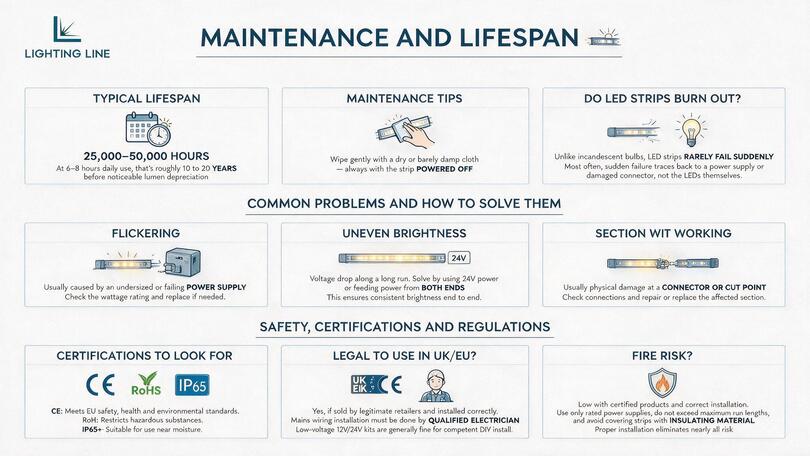
A well-specified led strip from a reputable manufacturer typically rates for 25,000–50,000 hours of use: at a typical 6–8 hours of daily use, that translates to roughly 10 to 20 years before noticeable lumen depreciation. Maintenance is minimal but not zero: dust and grease buildup on the strip surface gradually reduces light output, so an occasional wipe with a dry or barely damp cloth (strip powered off) keeps output consistent over time.
Do LED strip lights burn out? Unlike incandescent bulbs, LED strips rarely fail suddenly. Instead they experience gradual lumen depreciation: the light output slowly dims over many years of use. Sudden failure, when it does happen, is almost always traceable to a failed power supply or a damaged connector rather than the LEDs themselves, which is why buying a properly rated power supply matters as much as the strip itself.
Common problems and how to solve them: flickering is most often caused by an undersized or failing power supply rather than the strip; uneven brightness along a long run points to voltage drop, solved by switching to 24V or feeding power from both ends of the run; and a strip that has stopped working in one section only, while the rest still functions, usually indicates physical damage at a connector or a cut point rather than a fault with the LEDs further down the tape.
12. Safety, certifications and regulations
Electrical safety is not optional, and it’s worth understanding the certifications that separate a genuinely safe product from one that merely looks similar. CE marking confirms a product meets EU health, safety and environmental protection standards. RoHS compliance confirms the product is free of specific hazardous substances such as lead and mercury. The IP (Ingress Protection) rating, covered earlier, is a two-digit code where the first digit rates protection against solid particles and the second against liquid: IP65 and above is the minimum sensible standard for any strip near moisture.
Are LED strip lights legal in the UK and EU?
LED strip lighting sold through legitimate retailers must meet CE and, in the UK specifically, UKCA marking requirements confirming compliance with electrical safety regulations. The legal consideration that trips up more DIY installers is not the product itself but the connection method: low-voltage strips (12V/24V) powered through a certified plug-in transformer are generally fine for a competent DIYer to install, but any strip wired directly into a home’s mains lighting circuit should be installed or at minimum signed off by a qualified electrician, in line with domestic wiring regulations.
Can LED strips cause a fire?
The risk is low with certified products used correctly, but it is not zero: the most common causes of LED strip-related electrical faults are using an underrated or uncertified power supply, running strips beyond their maximum rated length from a single power feed, or covering strips with insulating material that prevents normal heat dissipation. Buying CE/RoHS certified products from a traceable supplier and following the manufacturer’s maximum run-length guidance removes the vast majority of this risk.
13. Why choose LightingLine LED strips
LightingLine.eu’s dedicated LED strips catalogue is built specifically to solve the comparison problem this guide has focused on: every product listing specifies voltage, IP rating, lumen output, colour temperature or RGB capability and CRI clearly, rather than requiring buyers to dig through PDFs or contact support for basic specifications. Whether you need a single-colour, high-CRI strip for a kitchen fit-out, a waterproof IP67 strip for an outdoor project, or a full RGBW smart strip for a content creation setup, the range is organised so you can filter by exactly the specification that matters for your project rather than by marketing category alone. For anyone who has read this guide and now knows which voltage, IP rating and CRI they need, the LED strips catalogue is the natural next step to compare current, in-stock options against those requirements.
14. Frequently asked questions
| Question |
|---|
Can you cut LED strip lights to length?Yes, but only at the marked cut lines printed on the tape, typically spaced every 3 to 6 LEDs (commonly every 5–10cm). Cutting anywhere else will damage the circuit for that segment. |
Are LED strip lights worth it?For most homes and businesses, yes — the combination of low running costs, long lifespan (25,000–50,000 hours), flexible installation and strong design impact makes them one of the better returns in the lighting category, provided you buy a certified product matched correctly to voltage, IP rating and CRI for the intended use. |
Do LED strip lights use a lot of electricity?No — LED strips are highly efficient, typically using 75–85% less energy than equivalent fluorescent or halogen strip lighting for a comparable light output. |
Can I leave LED strip lights on all night?Generally yes for certified, correctly installed products, since LEDs run cool and are designed for continuous operation — but using a timer or smart scheduling is recommended both to save energy and to slightly extend long-term lumen retention. |
How long do LED strip lights last?Quality strips typically rate for 25,000 to 50,000 hours of use — at 6–8 hours of daily use, that’s roughly 10 to 20 years before noticeable dimming. |
Are LED strip lights flexible?Yes — the flexible circuit board they’re built on allows most strips to bend around corners and gentle curves, though very tight bends can stress the copper traces, so an aluminium corner connector is recommended for sharp 90-degree turns. |
Do LED strip lights need a plug, or can they be hardwired?Both options exist. Most residential kits come with a plug-in power supply for simple installation; strips can also be hardwired into a home’s electrical system, but this should be done or verified by a qualified electrician in line with local wiring regulations. |
What is the difference between LED strip lights and LED tape lights?Nothing functionally significant — “LED tape” and “LED strip lights” are used interchangeably across the UK and European markets to describe the same flexible LED product. |
Are LED strip lights compatible with smart home systems?Most current smart strips support Amazon Alexa and Google Assistant through a companion app, and a growing number support Apple HomeKit and the Matter standard — always check the specific ecosystem listed for the exact product you’re considering. |
What power supply do I need for a LED strip?Calculate the strip’s total wattage (watts per metre multiplied by total length), then choose a power supply rated at least 20% above that figure to protect the driver’s lifespan and account for inrush current. |
15. The right led strip light to have the maximum of results
Choosing the right LED strip lights comes down to matching a small handful of specifications (voltage, brightness, colour temperature or RGB capability, CRI and IP rating) to the specific space and purpose you have in mind, then following a few straightforward installation and safety practices to make sure the result lasts for years rather than months. Whether the goal is a flawless streaming setup, a warm and inviting living room, a functional kitchen worktop, or a retail display that pulls customers in from the street, the fundamentals covered in this guide apply equally. When you’re ready to compare real, currently available products against the specifications you now know to look for, the LED strips catalogue on LightingLine.eu is organised specifically to make that comparison straightforward.
This article was developed with the support of artificial intelligence and subsequently reviewed, corrected, and validated by the LightingLine.eu technical team, which guarantees its reliability and compliance with official sources.