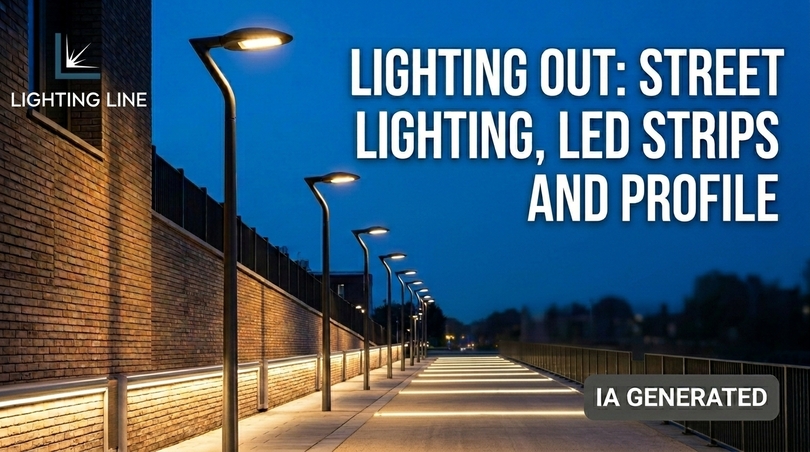
Lighting out a street is no longer just about tall columns and orange sodium lamps. Councils switch lights off after midnight to save money, residents report a “light out” on their road and expect a fix within days, and designers are asked to make underpasses, steps and footbridges safe without flooding the night sky. In the middle of all this sits a quiet, versatile tool: the LED strip inside an aluminium profile. This guide explains what lighting out means in plain English, what the standards in the UK, Italy and the main world markets actually require, and how installation companies can use LED profiles to win and deliver better street lighting projects.
We wrote it for people who install, specify and maintain outdoor lighting for a living. You will find definitions, standard tables, worked examples, a voltage-drop table, a tender checklist and a full FAQ. Where a product helps, we link to the real item in the LightingLine profile catalogue, so you can check dimensions and versions in a second window while you read.
Short answer for busy readers: lighting out (from the phrasal verb light out) means leaving somewhere quickly, lights out means the time when lights are switched off, a light out is a lamp that has failed and street lighting cut out is the planned switch-off of public lights at night. LED strips in aluminium profiles do not replace road luminaires on columns, but they are the best tool for low-level, glare-free lighting of paths, steps, handrails, underpasses and street furniture the places where people actually walk.
In this article…
- Street lighting cut out: part-night lighting and the “lights out” debate
- Street lighting in numbers: market data and trends
- Standards and regulations: UK, Italy, EU and the world
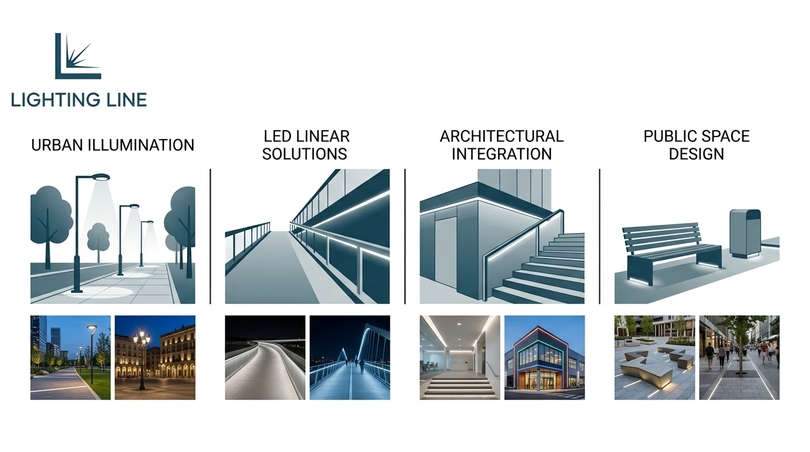
- Where LED strips and profiles belong in street lighting
- Choosing the aluminium profile
- Choosing the LED strip
- Design workflow for street lighting installers
- Installation best practice outdoors
- Controls, dimming and planned lighting out
- Maintenance: preventing a light out
- Dark skies, wildlife and sustainability
- Costs, TCO and return on investment
- Three project scenarios
- Tender and handover checklist
- Climate, context and inclusive design
- Growing your business: lighting out as a service
- FAQ
- Lighting out the street, one line at a time
Street lighting cut out: part-night lighting and the lights out debate
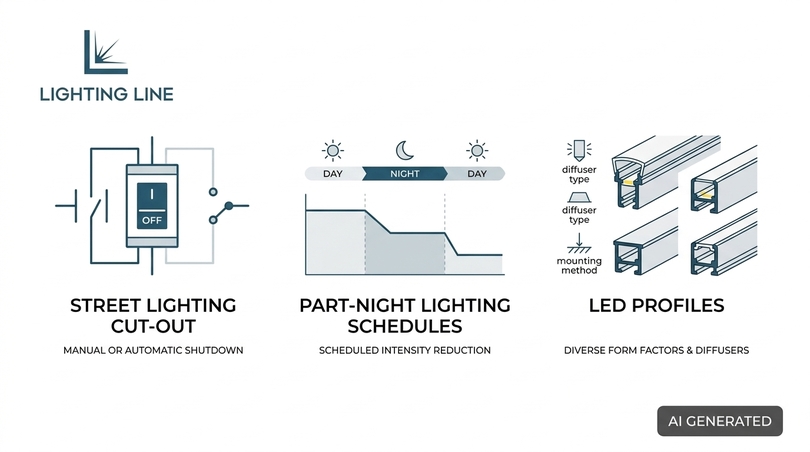
“Street lighting cut out” is an expanding business line for installers. It covers three different practices: full switch-off of selected lights, part-night lighting (lights off for some hours in the middle of the night) and dimming. Each has technical, legal and social implications that a contractor must understand before quoting.
What street lighting cut out means
Street lighting cut out (or part-night lighting) is the planned switching off of public lights for part of the night, typically from around midnight to 5 or 6 am, on roads and paths where traffic and pedestrian activity are low. Many UK highway authorities introduced it during the 2010s to reduce energy costs and carbon emissions, and the energy price shock of 2022 brought renewed interest across Europe. In Italy and other EU countries the same principle appears as spegnimento parziale notturno or, more often, as adaptive dimming of LED luminaires.
Is lighting out at night safe? What the evidence says
The question everybody asks is whether switching lights off increases crashes or crime. A large study by the London School of Hygiene and Tropical Medicine, published in 2015 in the Journal of Epidemiology and Community Health, examined data from 62 local authorities in England and Wales and found no evidence that switch-off, part-night lighting, dimming or white-light conversion were associated with increases in road traffic collisions or crime at area level. The authors stressed that local decisions still need local risk assessment and that is the key point for installers: blanket policies are rarely the answer; targeted design is.
Where part-night lighting is usually avoided
- Junctions, roundabouts and pedestrian crossings.
- Areas with CCTV that relies on lighting.
- Steps, ramps, subways (underpasses) and footbridges.
- Locations with a record of night-time collisions or crime.
- Routes to hospitals, care homes, transport hubs and night-shift workplaces.
Notice that several of these exceptions (steps, ramps, underpasses and footbridges) are exactly the places where LED profiles excel. A common hybrid strategy is to switch off or deeply dim the column lights on a quiet residential street, while keeping a low-power, low-level linear light on the steps, handrails and underpass walls. The route stays legible and safe for a fraction of the energy.
How long do lights go out? Typical schedules
| Strategy | Typical schedule | Energy saving vs all-night full output | Typical application |
|---|---|---|---|
| Full switch-off | All night, permanent | 100% (for those points) | Redundant lights on rural roads, duplicated lamps |
| Part-night lighting | Off approx. 00:00-05:30 | Roughly 40-50%, depending on season and latitude | Residential streets, rural village roads |
| Fixed dimming | e.g. 50% output 22:00-06:00 | Roughly 25-40% | Distributor roads, mixed-use streets |
| Presence-based (adaptive) | Low base level, full on detection | Often 50-70% on low-traffic paths | Cycle paths, parks, footbridges, underpasses |
| Wayfinding-only lighting | Very low-power linear light all night | Large, because installed power is tiny | Steps, handrails, kerbs with LED profiles |
Savings are indicative ranges for planning; real values depend on burning hours, control gear consumption and the baseline.
Reporting a light out: what installers and maintainers should know
In the UK, residents report a faulty street light to the council or highway authority responsible for the road, usually through an online form; motorways and trunk roads are managed by national agencies. In Italy, faults go to the comune or to the company holding the public lighting service contract. For a maintenance contractor, every “light out” report is a performance metric: response times, repair times and repeat-failure rates are often written into service-level agreements. Systems that fail less often – sealed LED profiles with quality drivers and surge protection – protect margins as much as they protect pedestrians.
Street lighting in numbers: market data and trends
Before choosing products it helps to understand the scale and direction of the market. The figures below are rounded, widely cited estimates and engineering ranges; use them for orientation and always check current data from your national energy agency or lighting association before putting them in a proposal.
Key figures
| Indicator | Typical value / estimate | Why it matters to installers |
|---|---|---|
| Public lights in the UK | Several million (commonly cited around 7 million+) | Huge retrofit and maintenance base |
| Public lighting points in Italy | Commonly estimated around 9-10 million | One of the largest stocks in Europe, still partly non-LED |
| Share of municipal electricity used by street lighting | Often cited between 20% and 40% | Councils are highly motivated to cut consumption |
| Energy saving: LED vs high-pressure sodium or mercury | Typically 40-70% before controls | Main business case for retrofits |
| Additional saving with dimming / CMS | Typically a further 20-40% | Upsell opportunity for controls |
| Rated life of quality LED systems | 50,000-100,000 h (L70-L80) | Fewer “light out” call-outs |
| Annual burning hours (all-night lighting) | About 4,000-4,200 h in Europe | Basis for every energy and TCO calculation |
Five trends shaping street lighting in 2026
- From replacement to optimisation. The first wave of LED retrofits is largely complete in many UK authorities; the focus is shifting to controls, dimming profiles and targeted lighting.
- Warmer colour temperatures. The early 4000-5000 K conversions drew complaints; specifications now favour 2700-3000 K in residential and heritage areas.
- Pedestrian and cycle infrastructure. Active-travel funding creates demand for lighting of paths, bridges and underpasses rather than carriageways.
- Dark-sky and biodiversity rules. Obtrusive light limits and wildlife guidance increasingly appear in planning conditions.
- Low-level, integrated lighting. Lighting is designed into handrails, walls, steps and benches – the natural territory of LED strips and aluminium profiles.
For an installation company, the opportunity is clear: the margin is moving from “swapping lanterns” to “designing the night-time experience” of public space. Lighting out a footbridge, a pedestrian street or a set of public steps with integrated linear light is a design-and-build job with higher added value than a one-for-one lantern swap.
Standards and regulations: UK, Italy, EU and the world
Every street lighting job is a compliance job. A beautiful handrail light that fails an illuminance check, an obtrusive-light condition or an electrical inspection is a liability, not a reference project. This section summarises the standards that matter most when lighting out roads, paths and public spaces, starting with the European framework and moving to the UK, Italy and the main markets worldwide. Always work from the current edition purchased from the national standards body; this summary is a map, not a substitute.
The European framework: EN 13201
EN 13201 is the European family of standards for road lighting, adopted in every CEN member country (and still used in the UK as BS EN 13201). It is structured in five parts:
| Part | Title (short) | What it does |
|---|---|---|
| CEN/TR 13201-1 | Guidelines on selection of lighting classes | Method to choose the class from traffic, speed, environment and use |
| EN 13201-2 | Performance requirements | Defines classes M, C and P (plus SC, EV, HS) and their minimum values |
| EN 13201-3 | Calculation of performance | Grids, observer positions and methods for software calculations |
| EN 13201-4 | Methods of measuring | How to verify on site |
| EN 13201-5 | Energy performance indicators | PDI (power density indicator) and AECI (annual energy consumption indicator) |
M classes: motorised traffic
M classes are based on road surface luminance and apply to carriageways for motorised traffic at medium to high speed. LED strips in profiles are not the tool for M-class carriageway lighting; we list the values so that installers can see why columns and road luminaires remain essential.
| Class | Average luminance L (cd/m²) min | Overall uniformity U0 min | Longitudinal uniformity Ul min | Threshold increment TI max (%) | Edge illuminance ratio REI min |
|---|---|---|---|---|---|
| M1 | 2.00 | 0.40 | 0.70 | 10 | 0.35 |
| M2 | 1.50 | 0.40 | 0.70 | 10 | 0.35 |
| M3 | 1.00 | 0.40 | 0.60 | 15 | 0.30 |
| M4 | 0.75 | 0.40 | 0.60 | 15 | 0.30 |
| M5 | 0.50 | 0.35 | 0.40 | 15 | 0.30 |
| M6 | 0.30 | 0.35 | 0.40 | 20 | 0.30 |
C classes: conflict areas
C classes use horizontal illuminance and apply to conflict areas such as junctions, roundabouts, shopping streets and areas where vehicles and pedestrians mix.
| Class | Average horizontal illuminance Ē (lx) min | Uniformity U0 min |
|---|---|---|
| C0 | 50 | 0.40 |
| C1 | 30 | 0.40 |
| C2 | 20 | 0.40 |
| C3 | 15 | 0.40 |
| C4 | 10 | 0.40 |
| C5 | 7.5 | 0.40 |
P classes: pedestrians and cyclists – the home of LED profiles
P classes cover footways, cycle tracks, pedestrian streets, parks, emergency lanes and other areas for pedestrians and slow traffic. This is where linear LED lighting in aluminium profiles can contribute directly to compliance, alone on short structures (bridges, underpasses, stairs) or as a complement to post-top and bollard luminaires.
| Class | Average horizontal illuminance Ē (lx) min (maintained) | Minimum point illuminance Emin (lx) maintained | Typical use |
|---|---|---|---|
| P1 | 15 | 3.0 | Busy pedestrian precincts, city-centre squares |
| P2 | 10 | 2.0 | Busy footways, important cycle routes |
| P3 | 7.5 | 1.5 | Residential footways with moderate use |
| P4 | 5.0 | 1.0 | Residential streets, low use |
| P5 | 3.0 | 0.6 | Rural paths, low-use residential areas |
| P6 | 2.0 | 0.4 | Very low use, dark environments |
EN 13201-2 also defines additional criteria where facial recognition matters – semi-cylindrical illuminance (SC classes) and vertical illuminance (EV classes) – and limits on maximum illuminance to preserve uniformity. Low-level linear light along handrails and walls is particularly effective at raising vertical and semi-cylindrical values at face height, which is often the hardest criterion to meet with widely spaced columns.
United Kingdom: BS 5489-1, BS EN 13201, BS 7671 and ILP guidance
In the UK, road lighting design follows BS 5489-1:2020 (code of practice for the design of road lighting – lighting of roads and public amenity areas), which explains how to select BS EN 13201 classes in a UK context, including the risk-assessment approach that allows lower classes or switch-off where justified. The standard is available from the BSI Knowledge portal.
Key UK documents for lighting out public spaces
- BS 5489-1:2020 – selection of lighting classes, consideration of environmental zones, adaptive lighting and risk assessment.
- BS EN 13201-2/-3/-4/-5 – performance, calculation, measurement and energy indicators.
- BS 7671 (IET Wiring Regulations) – electrical installation requirements, including the section on outdoor lighting installations and requirements for protection against electric shock, RCD protection and earthing.
- ILP Guidance Note GN01/21 – reduction of obtrusive light, with environmental zones E0–E4 and limits on sky glow, light into windows and luminaire intensity. Published by the Institution of Lighting Professionals.
- BS 8300 and Approved Document M – accessibility: visual contrast on step nosings, handrail design and lighting for people with visual impairments, highly relevant to illuminated handrails and steps.
- UKCA / CE marking – products placed on the GB market must meet the relevant product safety and EMC legislation.
Street lighting cut out under UK rules
There is no general legal duty in the UK requiring highway authorities to light every road, lighting is largely a discretionary power, which is why part-night lighting is possible. However, authorities must manage risk and duties of care, and BS 5489-1 expects decisions to be documented through a risk assessment. For contractors, this means switch-off or dimming projects should come with a written design rationale, not just a timer setting.
Italy: UNI 11248, UNI EN 13201, CEI 64-8, CAM and regional laws
Italy has one of the most detailed regulatory environments in Europe for public lighting, combining national technical standards, mandatory green public procurement criteria and regional light-pollution laws.
Technical standards
- UNI 11248:2016 – selection of lighting categories (the Italian counterpart of CEN/TR 13201-1), including the risk analysis that can lower or raise the category based on actual conditions. Available from UNI – Ente Italiano di Normazione.
- UNI EN 13201-2, -3, -4, -5:2016 – performance requirements, calculation, measurement and energy indicators.
- UNI 11630 – criteria for drafting the lighting design project (contents of the progetto illuminotecnico).
- CEI 64-8 – low-voltage electrical installations, including the part dedicated to outdoor lighting installations, CEI 64-7 remains a reference for public lighting systems.
CAM: minimum environmental criteria
For public contracts, Italian contracting authorities must apply the Criteri Ambientali Minimi (CAM) for public lighting: one decree covers the purchase of light sources, luminaires and the design of installations (DM 27 September 2017), another covers the public lighting service (DM 28 March 2018). They set requirements on luminaire efficiency, light distribution, colour temperature, dimming capability, documentation and end-of-life. Any LED strip and profile system offered in an Italian public tender must come with the documentation needed to demonstrate compliance.
Regional light-pollution laws
Most Italian regions have laws against light pollution, often stricter than national rules. Examples include Lombardy (LR 31/2015), Veneto (LR 17/2009) and Emilia-Romagna (LR 19/2003 and its implementing directive). Common requirements include near-zero upward light emission, limits on luminance of surfaces, mandatory night-time dimming and preference for warm colour temperatures. Low-level linear lighting that points downwards or is shielded inside a profile is generally easier to comply with than decorative uplighting.
Other European countries
| Country | Main references | Notable points |
|---|---|---|
| Germany | DIN EN 13201 series, DIN 13201-1 | National guidance on class selection, strong focus on energy and insect protection under federal nature conservation rules |
| France | NF EN 13201; Arrêté of 27 December 2018 on light nuisance | Limits on upward light, colour temperature caps (generally 3000 K in built-up areas), switch-off times for some lighting types |
| Spain | UNE-EN 13201; Real Decreto 1890/2008 (energy efficiency in outdoor lighting) | Energy efficiency classes for installations, mandatory energy labelling of outdoor installations |
| Netherlands / Belgium | NEN/NBN EN 13201, NPR 13201 (NL) | Strong culture of dimming and light on demand for cycle paths |
| Nordic countries | EN 13201 national adoptions | Long nights in winter make controls and durability critical |
EU product legislation that applies to every system
- Ecodesign Regulation (EU) 2019/2020 – requirements for light sources and separate control gear, including efficiency and information requirements.
- Low Voltage Directive 2014/35/EU and EMC Directive 2014/30/EU – safety and electromagnetic compatibility of drivers and luminaires.
- RoHS Directive 2011/65/EU – restriction of hazardous substances.
- Energy labelling Regulation (EU) 2019/2015 – labelling of light sources.
United States and Canada
In North America the main reference is ANSI/IES RP-8 (Recommended Practice for Design and Maintenance of Roadway and Parking Facility Lighting), published by the Illuminating Engineering Society, together with state DOT manuals and city specifications. Pedestrian areas, bikeways and walkways are covered by illuminance and vertical illuminance criteria similar in spirit to EN 13201 P classes. The joint IES/IDA Model Lighting Ordinance provides a template for local obtrusive-light rules. Electrical work follows the National Electrical Code (NFPA 70) in the US and the Canadian Electrical Code in Canada, and products typically need listing to UL or CSA standards (for example UL 8750 for LED equipment and UL 2108 for low-voltage lighting systems). In Canada, the Transportation Association of Canada (TAC) publishes guidance used alongside IES documents.
Australia, New Zealand and Asia
| Market | Main references | Notes for linear LED lighting |
|---|---|---|
| Australia / New Zealand | AS/NZS 1158 series (AS/NZS 1158.3.1 for pedestrian area “P” category lighting) | Detailed P categories for pathways and public spaces; strict IP and UV requirements due to climate |
| Japan | JIS Z 9111 (road lighting) | Emphasis on glare control and high reliability |
| China | CJJ 45 (urban road lighting design standard) | Rapid smart-city deployment with centralised controls |
| India | IS 1944 (lighting of public thoroughfares) | Large LED street light replacement programmes |
| Gulf states | Authority-specific road lighting manuals, often based on CIE/BS EN | High ambient temperature: thermal management of profiles is critical |
| International reference | CIE 115 (lighting of roads for motor and pedestrian traffic) | Basis for many national standards |
Product standards installers should check on every datasheet
| Standard | What it covers | What to look for |
|---|---|---|
| IEC/EN 60598-1 and 60598-2-3 | Luminaire safety; part 2-3 for road and street lighting luminaires | Declared compliance of the complete luminaire assembly |
| IEC/EN 60529 | IP (ingress protection) code | IP65, IP66, IP67, IP68 – and test conditions for IP68 |
| IEC/EN 62262 | IK code (impact resistance) | IK08–IK10 for vandal-prone locations |
| IEC/EN 62471 | Photobiological safety | Risk group (RG0 or RG1 preferable for low-level lighting) |
| IEC/EN 61347 and 62384 / 61347-2-13 | Control gear safety and performance | SELV output, protection features |
| IEC/EN 61547 and EN 55015 | EMC immunity and emissions | Compliance of driver and system |
| IEC 62386 (DALI) / D4i | Digital control interface | Compatibility with the authority’s CMS |
A practical rule: a strip, a profile and a driver that are each compliant do not automatically make a compliant luminaire. When an installer assembles a linear luminaire on site or in a workshop, the assembler takes responsibility for the result. Use matched components, follow the manufacturer’s instructions and keep the technical file – this is where a supplier with technical support saves real time and risk.
Where LED strips and profiles belong in street lighting
Honesty builds authority, so let us be clear: an LED strip in an aluminium profile is not a road lantern. It cannot throw light 30 metres along a carriageway from a 10-metre column, and it should never be offered as a substitute for M-class road lighting. Its strength is the opposite: close-range, continuous, low-glare light integrated into the architecture of the street. Used in the right places, it solves problems that columns handle badly – dark steps, glaring underpasses, invisible kerbs and handrails that disappear at night.
The physics in one paragraph
A point source on a column follows the inverse-square law: illuminance drops rapidly with distance, so uniformity between columns depends on spacing and optics. A line source close to the target behaves differently – illuminance falls roughly with distance, not distance squared, and the light is spread evenly along its length. That is why a handrail-integrated strip can produce excellent uniformity on a footbridge deck with very little power, and why a recessed wall line in an underpass can eliminate the dark corners that make people anxious.
Applications where linear LED lighting excels
| Application | Problem with conventional lighting | Linear LED solution | Suggested profile family |
|---|---|---|---|
| Public steps and stairs | Shadows on treads, glare from columns, poor nosing visibility | Line under each nosing or in the side wall, marking every edge | Wall profiles, recessed profiles |
| Footbridges and ramps | Columns on bridges are costly, heavy and glaring | Light integrated into the handrail, aimed at the deck | Aluminium handrail profile |
| Pedestrian underpasses (subways) | Dark corners, vandalised ceiling fittings, poor perceived safety | Continuous wall or cornice lines, high vertical illuminance | Wall profiles, corner profiles |
| Pedestrian streets and plazas | Columns clutter heritage streetscapes | Recessed walkable lines in paving to guide movement | Walkable floor-recessed profiles |
| Kerbs, cycle-lane edges, retaining walls | Edges invisible in rain or at low light levels | Low-level edge marking with very low power | PVC profile for cement, floor profiles |
| Bus shelters, benches, street furniture | Separate fittings, vandalism, glare | Integrated lines under seats and canopies | Surface profiles, furniture profiles |
| Facades and public building edges | Floodlights cause sky glow and glare | Grazing lines close to the surface, shielded upward | Architectural profiles |
| Signage and wayfinding | Signs unreadable at night | Backlighting and edge lighting of panels | Surface and round profiles |
Where not to use LED strips
- Main carriageway lighting for M classes or high-speed roads.
- Tunnel threshold zones for vehicles, which need very high luminance from dedicated tunnel luminaires (linear light may help as guidance or emergency marking only).
- Locations with standing water or regular immersion, unless the complete system is rated and installed for immersion.
- Any place where the system cannot be maintained – if a drainage channel or vehicle wheel can damage the line, choose a different position or a more robust profile.
The winning approach is hybrid: columns for the carriageway, linear light for the human-scale details. When councils apply part-night lighting, the linear elements can stay on at a few watts per metre, keeping the route legible while the big lanterns are off. This is lighting out done intelligently.
A quick lighting out decision guide
When a client asks “should we use a column, a bollard or a linear profile here?”, run through these questions in order. They take less than five minutes on site and make every lighting out recommendation easy to defend in front of a council engineer or a heritage officer.
- Is it a carriageway for motor vehicles? If yes, the carriageway needs road luminaires designed for M or C classes; linear light can only complement it at the edges.
- Is it a pedestrian or cycle route? If yes, P classes apply, and linear lighting becomes a serious option.
- Is there a structure to integrate into – a handrail, a wall, a step, a bench, a canopy? If yes, a profile can usually do the job without new poles.
- Is the route long and open, with nothing to mount on? If yes, post-top luminaires or bollards are usually more economical, with linear light reserved for steps and bridges.
- Must the route stay lit during street lighting cut out hours? If yes, low-power linear lighting is the most efficient way to keep it legible all night.
- Are there ecological, heritage or obtrusive-light constraints? If yes, low-level, shielded, warm linear light usually scores best.
- Can it be maintained safely and cheaply? If not, change the position or the product before going further.
If the answers point to linear lighting, move on to the profile and strip selection below. If they point to columns, use linear lighting for the details: the result will still be a better lighting out of the whole route than columns alone could achieve.
Choosing the aluminium profile
The profile is not just a housing. It is the heat sink, the mechanical protection, the optical system and the visual signature of the installation. For outdoor public spaces, the selection follows a simple logic: mounting surface first, mechanical risk second, optics third, aesthetics last. Below we walk through the profile families in the LightingLine catalogue that are most relevant to street and public-space projects.
Walkable floor-recessed profiles for pedestrian streets and plazas
When light must sit in the ground – along a pedestrian street, at the edge of a plaza or across a public entrance – you need a profile designed to be walked on. LightingLine offers three walkable floor-recessed aluminium profiles, each 2 metres long and compatible with LED strips up to 10 mm wide:
- 20×11 mm walkable floor-recessed aluminium profile (FL01-21-S2) – the slimmest option, ideal for discreet lines in stone or tiled paving.
- 25×11 mm walkable floor-recessed aluminium profile (FL03-21-S2) – a wider visible line for stronger wayfinding.
- 20×26 mm walkable floor-recessed aluminium profile (FL02-21-S2) – deeper body for more distance between strip and diffuser, giving a more uniform line.
Installer notes for floor profiles outdoors
- Drainage is everything. Water will reach the channel; plan a fall and a path for it to leave. Never install at the lowest point of the paving.
- Use an IP67 or IP68 strip inside the profile; the profile and diffuser protect against mechanical stress, while the strip’s own encapsulation protects against water.
- Check the load class on the product datasheet: pedestrian walkable is not the same as drivable. Keep floor profiles out of vehicle wheel paths unless the product is specifically rated.
- Specify low glare. Light pointing upward into people’s eyes is uncomfortable; use opal diffusers and modest output (a few hundred lumens per metre is often enough for wayfinding).
Wall profiles for underpasses, retaining walls and steps
Wall-mounted linear light is the workhorse of public-space lighting. It raises vertical illuminance, lights faces and makes enclosed spaces feel larger and safer. The LightingLine wall range includes:
- 48×18 mm aluminium profile for wall installation (WL01-03) – a broad, shallow profile for wash and grazing effects along walls.
- 24×24 mm aluminium profile for wall installation (WL02-03) – compact, suitable for step risers and low retaining walls.
- 30×29 mm aluminium profile for wall installation (WL03-01-S2) – a robust section with good heat dissipation for higher-output strips.
- 31×70 mm aluminium profile with dual light emission for wall mounting (WL04-05) – up and down emission from one line; outdoors, use the downward channel for the path and keep the upward component very low or shielded to respect obtrusive-light limits.
- 34×34 mm aluminium profile for wall installation (WL05-05) – a square section for continuous lines along corridors and subways.
In underpasses, a continuous wall line at 2-2.5 m height, aimed downward and slightly across the walkway, typically gives better perceived safety than a row of ceiling fittings, because it lights faces and walls rather than just the floor.
The aluminium handrail profile for bridges, ramps and public stairs
Handrail lighting is one of the most elegant answers to lighting out footbridges, ramps and outdoor stairs. The aluminium handrail profile (HR01) is supplied in 6-metre lengths and accepts strips up to 12 mm wide. It puts the light source at hand height, close to the walking surface, with no additional poles.
Why handrail lighting wins bridge projects
- No columns on the structure – less weight, fewer foundations, fewer penetrations in the deck.
- Excellent uniformity on narrow decks thanks to the continuous line source.
- Minimal light spill on watercourses and wildlife corridors below, because the light is aimed down at the deck.
- Accessibility: an illuminated handrail is easier to find for people with low vision, supporting BS 8300 and similar accessibility guidance.
- Lower glare for cyclists and pedestrians compared with lanterns at eye level.
Remember that handrails are structural and safety elements: the lighting integration must not compromise the handrail’s strength, grip or required height. Coordinate with the structural engineer and follow the handrail specification for the project.
The PVC profile for cement: lines cast into concrete
For new concrete works – kerbs, steps, walls, benches cast in situ – the PVC profile for cement (CC01-06-G3), 3 metres long and compatible with strips up to 12 mm, creates a clean channel for the strip directly in the casting. Concrete-embedded lines are almost impossible to vandalise and give a truly integrated look, but they demand careful planning: cable routes, access for maintenance and a strip replacement strategy must be decided before the pour, not after.
Surface, recessed, corner and round profiles
Beyond the specialised families, many public-space details are solved with general-purpose profiles:
- Surface profiles – under canopies, bus shelters, benches and kiosks.
- Recessed profiles – flush lines in walls, soffits and step faces.
- Corner profiles – 45° emission from the angle between wall and ceiling in subways and covered passages.
- Round profiles – 360° emission for signage poles and decorative elements.
- Suspension profiles – under covered walkways and station canopies.
Diffusers, end caps and brackets: the details that decide durability
Outdoor failures rarely start in the aluminium; they start at the ends, the joints and the diffuser. Choose components as a system:
- Diffusers: opal for uniform lines and glare reduction, clear for maximum output. Outdoors, prefer UV-stabilised materials and check impact resistance where vandalism is possible; polycarbonate generally offers higher impact strength than PMMA, while PMMA tends to resist UV yellowing well.
- End caps: use the caps designed for the specific profile, with cable entry where needed, and seal them.
- Mounting brackets: stainless or coated fixings, correct spacing and allowance for thermal expansion of aluminium on long runs.
Profile selection matrix
| Situation | Mounting | Mechanical risk | Recommended profile | Max PCB width |
|---|---|---|---|---|
| Pedestrian street wayfinding line | Floor, recessed | Foot traffic | 20×11 or 25×11 mm walkable | 10 mm |
| Plaza edge, more uniform line | Floor, recessed | Foot traffic | 20×26 mm walkable | 10 mm |
| Footbridge, ramp, public stairs | Handrail | Hand contact, vandalism | Aluminium handrail HR01 | 12 mm |
| Underpass walls | Wall | Vandalism | 30×29 or 34×34 mm wall profile | 12 mm |
| Step risers, low walls | Wall / recessed | Kicks, cleaning | 24×24 mm wall profile or recessed | 12 mm |
| New concrete kerbs and steps | Cast in concrete | High | PVC profile for cement | 12 mm |
| Bus shelters and canopies | Surface / suspension | Moderate | Surface or suspension profiles | Per datasheet |
Always confirm dimensions, versions, finishes and compatible accessories on the individual product page and in the profiles catalogue.
Choosing the LED strip
The strip determines light output, colour quality, efficiency and (above all outdoors) resistance to water, UV and temperature cycles. Outdoors, the strip must be chosen for the environment first and for the light second. The LightingLine LED strip range covers both SMD and COB technologies, and the production unit can customise strips for specific projects.
SMD vs COB for public spaces
| Feature | SMD strips | COB strips |
|---|---|---|
| Appearance without diffuser | Visible dots | Continuous, dot-free line |
| Typical efficacy | Often higher at the same output | Good, slightly lower in many products |
| Best for | Deeper profiles with diffuser, higher outputs | Shallow profiles, walkable lines, visible light lines |
| Thermal behaviour | Heat spread across discrete packages | Heat concentrated on a continuous line, needs good contact with aluminium |
| Typical outdoor use | Handrails, underpass walls, canopies | Floor lines, step edges, visible architectural lines |
Protection: IP65, IP67, IP68 explained
The IP code (IEC 60529) has two digits: the first for solids, the second for water. For outdoor street lighting work, the second digit is what usually decides the product choice.
| Rating | Water protection | Typical construction | Suitable for |
|---|---|---|---|
| IP20 | None | Bare strip | Indoor only |
| IP65 | Water jets | Silicone coating or sleeve | Sheltered outdoor locations: canopies, under handrails with cover |
| IP66 | Powerful water jets | Sleeve or extrusion with sealed ends | Exposed walls, areas cleaned with pressure washers |
| IP67 | Temporary immersion (test conditions defined by the standard) | Full silicone extrusion or filled sleeve | Floor profiles, steps, exposed handrails |
| IP68 | Continuous immersion under conditions declared by the manufacturer | Solid silicone extrusion, potted ends | Ground-level lines with risk of water accumulation |
The IP rating of the strip is only as good as its weakest joint. Factory-sealed ends and cable entries are far more reliable than field-cut and field-sealed ones. For public projects, order strips cut to length and sealed at the factory wherever possible: a service that a manufacturer with in-house production can provide.
Voltage, run length and voltage drop
Long runs are normal in street projects: a footbridge handrail can be 40 metres or more. Voltage drop along the strip causes the far end to be dimmer than the near end, which ruins uniformity. The table gives indicative maximum single-feed lengths, always follow the specific datasheet.
| Strip type | Power per metre | Indicative max run from one end | Strategy for longer runs |
|---|---|---|---|
| 12 V | Any | Short (often under 5 m) | Avoid for street projects |
| 24 V constant voltage | 4.8-10 W/m | About 5-10 m | Feed both ends or every 5-10 m with parallel supply cables |
| 24 V constant voltage | 14-20 W/m | About 5 m | Centre feed and end feeds, heavier cable |
| 24 V with integrated current regulation | Low-medium | Often 10-20 m with uniform output | Check datasheet for guaranteed length |
| 48 V | Low-medium | Often 15-30 m | Fewer feed points, lighter cabling |
Quick voltage-drop check for the supply cable
For the cable between driver and strip, use the classic formula for two-wire DC circuits: ΔV = 2 × L × I × ρ / S, where L is the one-way length in metres, I the current in amperes, ρ the resistivity of copper (about 0.0175 Ω·mm²/m) and S the cross-section in mm². Example: a 10 m, 24 V strip at 10 W/m draws about 4.2 A. With 12 m of 2.5 mm² cable, ΔV ≈ 2 × 12 × 4.2 × 0.0175 / 2.5 ≈ 0.71 V, about 3% of 24 V – acceptable. With 1.5 mm² the drop would be about 1.2 V (5%), visible as dimming. Keep total drop (cable plus strip) within the manufacturer’s recommendation, typically a few percent.
Colour temperature, CRI and lumen output
- Colour temperature: 2700-3000 K for residential streets, heritage centres and dark-sky areas, 3000-4000 K only where the authority specifies it (e.g. for CCTV or matching existing white light). Amber or very warm sources near bat roosts and sensitive habitats.
- Colour rendering: CRI ≥ 80 is standard, CRI ≥ 90 helps in pedestrian precincts, heritage facades and where facial recognition matters.
- Output: wayfinding lines need 100-400 lm/m, handrail and underpass lighting typically 400-1,200 lm/m depending on mounting height, optics and target class. Verify with calculation.
- Efficacy: compare lumens per watt of the strip inside the profile with the diffuser, not just the bare strip.
Temperature and thermal management
Outdoor strips face cold winters and hot summers, plus solar gain on exposed metal. Heat is the number-one enemy of LED life: every significant rise in junction temperature shortens lifetime and shifts colour. Bond the strip properly to the aluminium, avoid running high-power strips inside closed, sun-exposed profiles, and derate the output in hot climates. In Southern Europe and the Gulf, a well-dimensioned aluminium section is not a luxury but a lifetime guarantee.
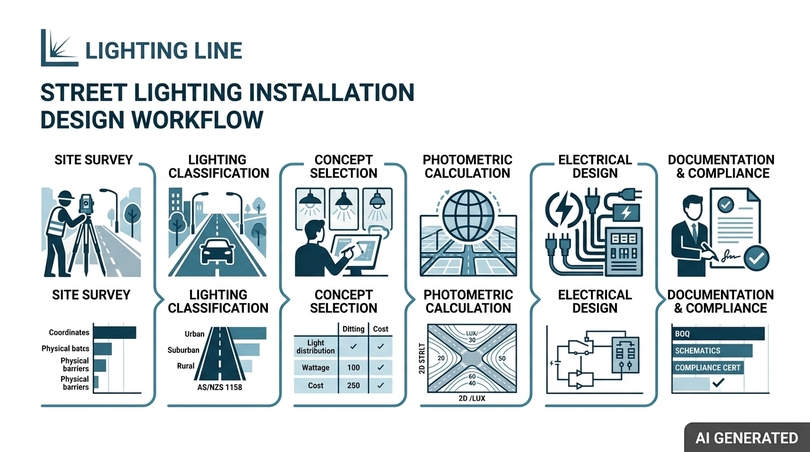
Design workflow for street lighting installers
Installation companies win the best projects when they bring design competence, not just labour. The workflow below turns a request such as if can you light a footbridge into a documented, compliant and profitable lighting out project. Each step produces a document you can attach to your quote and documents are what clients and councils recognise as expertise.
Step 1: survey and brief
Visit the site at night as well as by day. Record existing lighting levels with a calibrated lux meter, the condition of surfaces, the presence of trees and wildlife, the position of windows that could suffer from light trespass, power availability and access for maintenance. Ask the client the questions that change the design:
- Who uses the route at night, and when? Commuters, students, night-shift workers, cyclists?
- Is the area part of a part-night lighting or street lighting cut out scheme?
- Is there CCTV that relies on the lighting?
- Are there heritage, conservation or ecological constraints?
- What is the maintenance regime and who will own the asset?
Step 2: classification
Select the lighting class with the authority using CEN/TR 13201-1, BS 5489-1 (UK) or UNI 11248 (Italy). Document the risk assessment: why P3 and not P2, why dimming to P5 after 23:00 is acceptable, why steps need a higher local level. In Italy this goes into the lighting project prepared according to UNI 11630: in the UK, into the design statement required by BS 5489-1.
Step 3: concept and product selection
Decide which elements carry the light. A typical hybrid concept for a pedestrian route includes post-top luminaires for open sections, handrail lighting on the bridge, wall lines in the underpass and floor lines at the steps. Choose profiles and strips using the matrices above and request datasheets and photometric files (LDT/IES) for the combination of strip, profile and diffuser.
Step 4: photometric calculation
Model the scene in a recognised calculation tool such as DIALux or Relux, following the grid rules of EN 13201-3. For linear sources, model the line as a series of short segments or use the manufacturer’s linear photometric data. Check average and minimum illuminance, uniformity, vertical or semi-cylindrical illuminance where required, and obtrusive light at nearby windows. Apply a realistic maintenance factor for outdoor conditions: dirt on floor diffusers and handrails is unavoidable.
Maintenance factor guidance
| Location | Pollution / dirt exposure | Indicative luminaire maintenance factor | Notes |
|---|---|---|---|
| Handrail, downward emission | Low-medium | 0.85-0.90 | Diffuser faces down, less dirt accumulation |
| Underpass wall line | Medium-high (graffiti, dust) | 0.75-0.85 | Plan cleaning cycles |
| Floor-recessed line | High (footfall, mud, de-icing salt) | 0.65-0.80 | Use high output with dimming headroom |
| Canopy / shelter | Low | 0.85-0.90 | Protected from rain |
Combine with the lumen maintenance of the LED (for example L80 at the end of the design life) to obtain the overall maintenance factor.
Step 5: electrical design
- SELV wherever possible: 24 V or 48 V DC on the strip side reduces electric shock risk in public areas.
- Driver location: accessible, ventilated and protected – ideally in a cabinet or chamber, not inside a damp ground channel.
- Surge protection: outdoor installations are exposed to lightning-induced surges; specify protective devices at the supply and at the driver.
- RCD and earthing: follow BS 7671 or CEI 64-8 for outdoor lighting installations.
- Cable selection: UV-resistant, suitable for burial or ducting as needed, sized for voltage drop.
- Controls: DALI-2/D4i drivers if the authority uses a central management system (CMS); otherwise astronomical timers and presence sensors.
Step 6: documentation and approval
Prepare drawings, calculation reports, datasheets, a declaration of conformity for the assembled luminaire, the maintenance plan and the energy indicators (PDI and AECI according to EN 13201-5). In Italian public tenders, add CAM compliance evidence. A complete technical file shortens approval times and is a powerful differentiator in tenders.
Worked example: lighting out a 40 m pedestrian underpass
Here is a simplified example showing how the pieces fit. Values are illustrative; a real project needs a full calculation.
| Parameter | Value |
|---|---|
| Underpass length / width / height | 40 m / 4 m / 2.6 m |
| Target | Day: higher adaptation level near entrances; night: P2-equivalent on floor plus good vertical illuminance on walls |
| Concept | Two continuous wall lines at 2.3 m, one per side, aimed downward across the walkway |
| Profile | 34×34 mm wall profile with opal diffuser and sealed end caps |
| Strip | IP67, 24 V, 3000 K, CRI 80+, around 10 W/m, factory-cut in 10 m sections |
| Feeding | 8 sections of 10 m, each fed from a driver cabinet; double-end feeding where calculation shows drop |
| Installed power | About 800 W for 80 m of line |
| Controls | Constant output by day near entrances; 50% at night; presence boost to 100% |
| Expected result | Uniform floor illuminance, high wall luminance, faces visible from the entrance, no dark corners |
Compare this with a traditional solution of 12 bulkhead fittings on the ceiling: the bulkheads light the floor in pools, leave the walls dark and are easy targets for vandals. The linear solution makes the whole volume readable, exactly the opposite of the darkness the horror films exploit.
Installation best practice outdoors
Most outdoor linear lighting failures are installation failures. Water enters at a badly sealed end cap, a cable is pinched by a bracket, a driver overheats in a closed box, or a floor channel fills with water because nobody thought about drainage. Ten minutes of extra care on each joint saves a light out call-out later. This section collects the practices that experienced contractors apply on every job.
Preparation
- Check that profile, diffuser, end caps, brackets and strip are compatible and that the PCB width fits the profile.
- Store strips dry and at moderate temperature; silicone-encapsulated strips are sensitive to sharp bending and crushing.
- Pre-plan cable entry points and junction boxes; avoid improvisation on site.
- Cut aluminium with appropriate tools, deburr every edge and clean chips that could damage the strip.
Mounting and sealing
- Clean and degrease the profile channel before applying the strip’s adhesive tape, outdoor adhesives perform only on clean, dry surfaces at suitable temperatures.
- Use mechanical retention where vibration or temperature cycling may peel the adhesive (clips or the profile’s own retention).
- Seal end caps with a sealant compatible with the strip encapsulation (silicone with silicone) and with the profile material.
- Use proper cable glands and drip loops so that water running along the cable does not reach the strip.
- Allow for expansion on long aluminium runs; aluminium expands roughly 2.3 mm per 10 m for a 10 °C rise, so a 40 m bridge rail exposed to sun moves noticeably between winter night and summer afternoon.
- Bond the diffuser or lock it mechanically where vandalism is likely.
Floor and ground installations
- Install on a free-draining bed; never let a recessed channel become a gutter.
- Keep the top of the profile flush with or very slightly below the finished surface to avoid trip hazards.
- Specify IP68 strips and potted connections where there is any chance of water accumulation.
- Protect against de-icing salts in cold climates: choose suitable finishes and seal carefully.
Drivers and electrical components
- Use outdoor-rated drivers (typically IP66/IP67) or install standard drivers in ventilated, weatherproof enclosures.
- Size drivers with headroom (commonly 70-80% of rated load) to extend life.
- Fit surge protection devices; outdoor lighting is a frequent victim of indirect lightning effects.
- Label every circuit and record it on as-built drawings – the maintenance team will thank you at 2 am.
Testing and commissioning
- Insulation resistance and continuity tests according to BS 7671 or CEI 64-8.
- Functional test of every section, including dimming and sensor response.
- Night-time measurement of illuminance at representative points (EN 13201-4).
- Visual check for hot spots, dark spots, colour differences between batches.
- Handover with as-built drawings, product data, test certificates and maintenance plan.
Common installation mistakes and how to avoid them
| Mistake | Consequence | Prevention |
|---|---|---|
| Field-cutting IP67 strips and resealing with general-purpose silicone | Water ingress, corrosion, early failure | Order factory-cut and sealed lengths |
| Feeding a 20 m 24 V run from one end | Visible dimming at the far end | Multiple feed points or 48 V strip |
| Driver inside the floor channel | Driver flooding and failure | Driver in accessible, dry chamber |
| Cool white 5000 K in a residential street | Complaints, obtrusive light, poor acceptance | 2700-3000 K as default |
| No expansion allowance on long rails | Diffusers popping out, end caps cracking | Expansion joints and sliding fixings |
| No maintenance access to concrete-cast lines | Impossible repairs | Removable diffuser and access points planned before pouring |
Controls, dimming and planned lighting out
Lighting that is always at full power is lighting that wastes money. Controls turn a static installation into an adaptive system that follows real use, which is the modern answer to the lights out debate: not darkness, but the right amount of light at the right time. LED strips are particularly well suited because they dim smoothly and switch instantly, with no restrike delay.
Control strategies
- Astronomical timers: switch on at dusk and off at dawn according to the date and location, without photocells that get dirty.
- Time-based dimming: reduce output after a set time (e.g. 23:00) to a lower class allowed by the risk assessment.
- Presence detection: keep a low base level and increase output when pedestrians or cyclists approach; ideal for paths and bridges.
- Central management system (CMS): remote monitoring and control of each point via D4i/DALI nodes, with automatic fault reporting.
- Part-night operation: switch off large luminaires in the middle of the night while keeping low-level linear wayfinding on.
Example: energy comparison of lighting out strategies on a 100 m footpath
| Scenario | Installed power | Operating profile | Indicative annual energy |
|---|---|---|---|
| A. Legacy lanterns, all night | 8 × 70 W SON + gear ≈ 650 W | 4,100 h at 100% | ≈ 2,670 kWh |
| B. LED lanterns, all night | 8 × 25 W ≈ 200 W | 4,100 h at 100% | ≈ 820 kWh |
| C. LED lanterns with dimming | 200 W | Full until 23:00 (≈1,700 h), 50% after (≈2,400 h) | ≈ 580 kWh |
| D. Hybrid: LED lanterns part-night + low-level line all night | 200 W + 100 m × 1.5 W/m = 350 W | Lanterns off 00:00-05:30 (≈2,100 h on); line full until 23:00, 50% after | ≈ 850 kWh |
| E. Linear-only route (bridge or ramp, handrail lighting) | 100 m × 4 W/m = 400 W | Presence-based, base 30%, average ≈ 40% | ≈ 650 kWh, with no columns |
Figures are rounded illustrations to compare strategies, not design values. The key insight: the hybrid scenario keeps the route continuously legible all night for about the energy of LED lanterns burning at full power (scenario B), and less than a third of the legacy installation, which is a compelling argument when a council is considering street lighting cut out but residents fear darkness.
Integration with smart-city systems
Many authorities now manage lighting through a CMS that reports faults automatically. Automatic fault detection turns the reactive light out phone call into a planned maintenance task. When specifying drivers for linear lighting on bridges and underpasses, check compatibility with the authority’s control protocol so that the low-level lines appear in the same dashboard as the column lights.
Maintenance: preventing a light out
Every installer knows the economics: the installation is paid once, the reputation is earned every night for the next fifteen years. A “light out” on a bridge handrail or in an underpass is more visible (and more politically sensitive) than a failed lantern on a quiet road. Designing for maintenance is designing for profit. This section covers failure modes, inspection intervals and how to structure a maintenance offer around linear LED systems.
Why linear LED systems fail outdoors
| Failure mode | Typical cause | Early sign | Prevention |
|---|---|---|---|
| Water ingress | Poor end sealing, damaged sleeve, standing water | Flickering, colour shift, sections out | Factory sealing, drainage, IP68 where needed |
| Driver failure | Heat, surges, overloading | Whole circuit out | Derating, surge protection, ventilated enclosure |
| Connector failure | Corrosion, vibration, poor crimping | Intermittent sections | Soldered or potted joints, strain relief |
| Thermal degradation | Insufficient heat sinking, solar gain | Gradual dimming, yellowing | Correct profile size, moderate W/m |
| Mechanical damage | Vandalism, vehicle impact, cleaning machines | Broken diffuser, exposed strip | IK-rated diffusers, protected positions |
| UV and chemical attack | Sunlight, salts, cleaning agents | Brittle or cloudy diffusers | UV-stabilised materials, compatible cleaning |
Inspection and maintenance schedule
| Interval | Activity |
|---|---|
| Monthly (or via CMS alarms) | Night-time visual patrol or automated fault check: any light out, flicker or dark section |
| Every 6 months | Cleaning of floor-recessed diffusers and drainage channels, check of end caps and seals |
| Annually | Electrical tests on circuits, check of drivers, surge protectors and enclosures, review of dimming schedules |
| Every 3-5 years | Photometric spot check against design values; replacement plan for diffusers showing UV ageing |
| End of design life | Planned strip and driver renewal using the same profiles |
The spare-parts strategy
Order spare strip sections, diffusers and end caps from the same production batch at installation time. LED binning and diffuser material can vary slightly between batches, and a replacement section that looks different is itself a complaint. Keeping 3-5% spare stock for public projects is a simple, inexpensive insurance and an attractive line item in a maintenance contract.
A light out response protocol
- Log the report with location, time and description (“whole handrail dark”, “one metre flickering”).
- Diagnose remotely where a CMS is available: driver alarm, circuit breaker trip or communication loss.
- Make safe if the failure creates a hazard – a dark staircase may need temporary lighting.
- Repair with matching parts; replace whole factory-sealed sections rather than attempting field splices outdoors.
- Close the report with root cause and preventive action, so the same light out does not return.
Dark skies, wildlife and sustainability
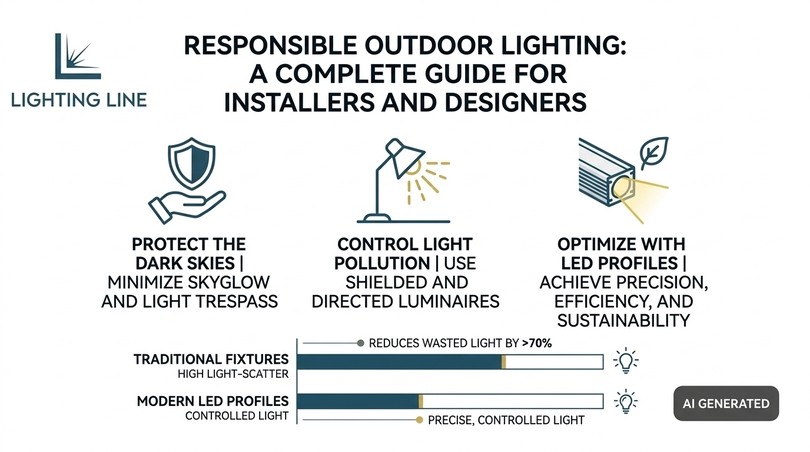
Lighting out a street responsibly means thinking about who else uses the night: residents trying to sleep, astronomers, bats, moths and migrating birds. Regulations increasingly require it, and clients increasingly ask for it. The good news is that well-designed low-level linear lighting is one of the most dark-sky-friendly ways to light a pedestrian route.
Principles of responsible outdoor lighting
Organisations such as DarkSky International summarise good practice in a few simple principles that align closely with UK ILP guidance, Italian regional laws and the French 2018 decree:
- Useful: light only where it has a clear purpose.
- Targeted: direct light only where needed, with no upward spill.
- Low level: no brighter than necessary.
- Controlled: on only when useful, with dimming and switch-off.
- Warm-coloured: limit short-wavelength (blue) light where possible.
How LED profiles help
- Close-range light needs less output – a handrail line 1 m from the deck needs far fewer lumens than a lantern at 5 m.
- Profiles shield the source – the strip sits inside the aluminium, so light goes where the diffuser points.
- Warm and amber strips are readily available, including custom colour temperatures from manufacturers with in-house production.
- Dimming is smooth and instant, enabling deep night-time reduction without the problems of older lamp types.
Wildlife-sensitive lighting out
Near rivers, hedgerows, parks and known roosts, ecologists often recommend keeping light off the habitat corridor, using warm or amber light and minimising night-time operation. Handrail lighting on bridges over watercourses is a textbook example: the light stays on the deck and does not spill onto the water, where bats forage. Always follow the ecologist’s recommendations and local planning conditions.
Carbon and circularity
Aluminium profiles are durable and recyclable, and they can outlive several generations of LED strips. Designing the profile as permanent infrastructure and the strip as a replaceable component extends the life of the installation, reduces waste and aligns with the life-cycle approach of Italian CAM criteria and similar green public procurement rules elsewhere in Europe.
Costs, TCO and return on investment
Clients rarely buy lighting on aesthetics alone; they buy on total cost of ownership (TCO), risk and political acceptability. Installers who can present a clear TCO comparison win more lighting out projects. The example below compares two approaches for a 60 m pedestrian footbridge. All figures are illustrative and must be replaced with your local prices, energy tariffs and labour rates.
Illustrative TCO comparison: 60 m footbridge, 20-year horizon
| Item | Option 1: 6 LED columns on the bridge | Option 2: handrail-integrated LED line both sides |
|---|---|---|
| Structural works | Column bases, deck penetrations, structural checks | Minimal: handrail already part of the structure |
| Installed power | 6 × 30 W = 180 W | 120 m × 3 W/m = 360 W (at full), typically dimmed |
| Operating profile | Dimmed after 23:00 | Presence-based, base 30% |
| Indicative annual energy | ≈ 500 kWh | ≈ 600 kWh |
| Glare and obtrusive light | Higher; spill onto water and sky | Very low; light kept on deck |
| Vandalism exposure | Low (heads out of reach) | Moderate; mitigated by robust diffuser and mounting |
| Maintenance access | Elevated platform, possible lane or path closure | Ground level, no access equipment |
| Visual impact | Columns visible by day | Invisible by day, integrated design |
| Typical outcome | Lower energy, higher civil and access costs | Slightly higher energy, lower civil and maintenance costs, higher user comfort |
The point is not that one option always wins, but that a contractor who can present both options with numbers looks like a consultant, not a supplier. On many bridges, the saving on structural works and access equipment outweighs the small difference in energy for decades.
How to build your own TCO model
- Capital cost: products, civil works, cabling, labour, design, testing.
- Energy: installed power × operating hours × dimming factor × tariff.
- Maintenance: cleaning, inspections, expected failures × repair cost, access equipment.
- Renewal: strip and driver replacement at end of life; profiles reused.
- Discounting: apply the client’s discount rate for public-sector comparisons.
- Non-energy benefits: safety, accessibility, reduced complaints, ecological compliance – describe them even when they cannot be monetised.
Three project scenarios
Theory is useful; scenarios are memorable. The three examples below are composite, illustrative projects based on common situations in the UK, Italy and North America. They show how the same building blocks – profiles, strips, controls and standards – combine differently depending on context. Each scenario is a template you can adapt for your next lighting out proposal.
Scenario 1 – UK: a footbridge over a railway in a part-night lighting area
Context: a district council applies street lighting cut out from midnight to 5:30 am on the surrounding residential streets. Residents complain that the footbridge to the station becomes frightening after the last trains.
Solution: handrail-integrated LED lighting on both sides using the aluminium handrail profile, IP67 strips at 3000 K, presence detection with a 30% base level that stays on all night. The column lights on the approach streets continue with part-night operation.
Compliance: class selected with BS 5489-1 risk assessment; calculations to BS EN 13201-3; obtrusive light checked against ILP GN01/21 for the nearby houses; electrical installation to BS 7671; handrail design coordinated with the structural engineer and BS 8300 accessibility guidance.
Outcome: the bridge is never dark, the energy added is a few hundred kWh per year, and the council can keep its street lighting cut out policy on the residential streets with fewer complaints.
Scenario 2 – Italy: a pedestrian street in a historic centre
Context: a comune in Emilia-Romagna pedestrianises a medieval street. The heritage authority does not want new columns or wall brackets on historic facades; the regional light-pollution law requires minimal upward light and night-time dimming.
Solution: a continuous walkable line along one side of the new stone paving using the 25×11 mm walkable floor-recessed profile with a low-output, warm COB strip for wayfinding, combined with a small number of discreet heritage-approved luminaires for the horizontal illuminance requirement. Steps at the street’s end are marked with 24×24 mm wall profiles under the nosings.
Compliance: UNI 11248 category selection, UNI EN 13201-2 verification, project documented according to UNI 11630, CAM documentation for the public contract, CEI 64-8 for the electrical installation, regional law for upward emission and dimming.
Outcome: the street reads as a guided path at night, facades are untouched, and the installation demonstrates compliance on every front – a strong reference for the installer’s next public tender.
Scenario 3 – North America: a university campus path and underpass
Context: a campus wants to improve perceived safety on a path that runs through a short pedestrian underpass beneath a road. Students report that the underpass feels like “lights out” territory after 10 pm.
Solution: continuous wall lines in the underpass using the 30×29 mm wall profile, high vertical illuminance at face height, 3000 K, CRI 90 for better facial recognition on security cameras, integration with the campus control system for fault alerts.
Compliance: design to IES recommended practice for pedestrian facilities, local campus standards, NEC wiring and listed components.
Outcome: perceived safety improves dramatically because faces and walls are visible from the entrance; the “light out” alerts arrive automatically in the facilities dashboard.
Tender and handover checklist
Use this checklist when preparing a quote or a handover pack for any project that involves lighting out a public route with LED strips and profiles. It doubles as a quality-control list for your site teams.
| Area | Check | Done |
|---|---|---|
| Brief | Users, hours of use, part-night policy, CCTV, heritage and ecology constraints recorded | ☐ |
| Classification | Lighting class selected and justified (CEN/TR 13201-1, BS 5489-1, UNI 11248, IES RP-8 or local equivalent) | ☐ |
| Concept | Hybrid strategy defined: what columns do, what linear lines do | ☐ |
| Profiles | Profile chosen for surface and mechanical risk; diffuser, end caps and brackets matched | ☐ |
| Strips | IP rating, voltage, W/m, lm/m, CCT, CRI and PCB width confirmed | ☐ |
| Calculation | Photometric report with maintenance factor, uniformity and obtrusive light checks | ☐ |
| Electrical | SELV, driver location, surge protection, RCD, cable sizing and voltage drop verified | ☐ |
| Controls | Dimming profile, presence sensors, CMS compatibility, part-night schedule | ☐ |
| Compliance | Declarations of conformity, CE/UKCA, CAM (Italy), energy indicators (EN 13201-5) | ☐ |
| Installation | Drainage, sealing, expansion joints, fixings, access for maintenance | ☐ |
| Testing | Electrical tests, functional tests, night-time illuminance measurements | ☐ |
| Handover | As-built drawings, test certificates, datasheets, maintenance plan, spare parts | ☐ |
Glossary of terms used in street lighting projects
| Term | Meaning |
|---|---|
| Illuminance (lx) | Light falling on a surface, measured in lux |
| Luminance (cd/m²) | Brightness of a surface as seen by the eye; basis of M classes |
| Uniformity (U0) | Ratio of minimum to average illuminance or luminance |
| Semi-cylindrical illuminance | Measure of light on faces, important for recognising people |
| Threshold increment (TI) | Measure of disability glare for drivers |
| Maintenance factor | Allowance for light loss over time due to dirt and LED depreciation |
| Part-night lighting | Switching lights off for part of the night (street lighting cut out) |
| CMS | Central management system for remote control and monitoring |
| SELV | Safety extra-low voltage, e.g. 24 V or 48 V DC supply for strips |
| IP / IK | Codes for protection against water/solids and against impacts |
| PDI / AECI | Energy performance indicators defined in EN 13201-5 |
| ULOR | Upward light output ratio – share of light emitted above the horizontal |
Climate, context and inclusive design: adapting the lighting out plan
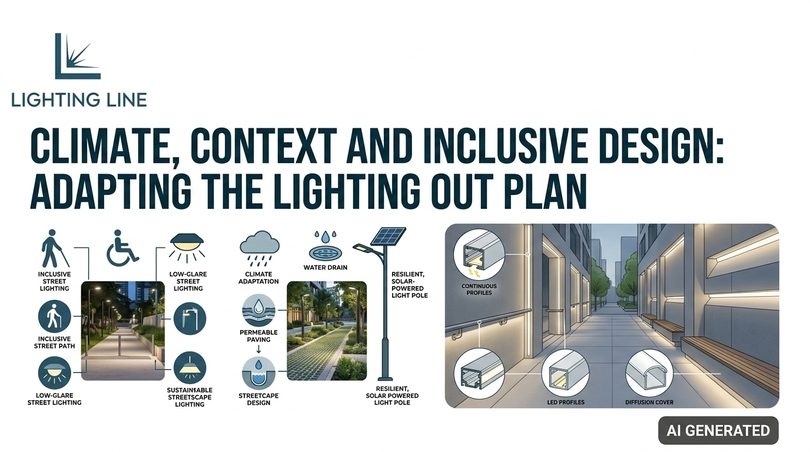
A design that works in Manchester may fail in Palermo, Dubai or Oslo. Temperature, humidity, salt, snow and the people who use the space all change the right answer. This section shows how to adapt a lighting out plan to its environment and to every user, including people with reduced mobility or vision. The best specification is always local: same principles, different details.
Cold and wet climates: UK, Ireland, Northern Europe
Long, wet winter nights mean many burning hours and constant moisture. Sealing and drainage matter more than output. Choose IP67 or IP68 strips, factory-sealed ends and drivers in dry, ventilated enclosures. In areas where de-icing salt is spread, keep floor-recessed lines away from the salted carriageway edge and check the chemical resistance of diffusers and seals. Snow can cover floor lines completely, so never rely on them as the only light on a route that must stay usable in winter – combine them with handrail or wall lighting.
Hot and sunny climates: Southern Europe, Middle East, Australia
High ambient temperatures and strong sunlight attack the LED and the diffuser. Thermal management becomes the first design criterion: choose larger aluminium sections, moderate W/m, and avoid closed profiles exposed to direct afternoon sun where possible. Specify UV-stabilised diffusers and check that adhesives are rated for the expected surface temperatures – a dark-coloured handrail in summer can be much hotter than the air. In Italy’s south and in the Gulf, derating the strip output by 20–30% often costs little light and buys years of life.
Coastal and marine environments
Salt spray corrodes connectors, fixings and poorly protected aluminium. Use finishes and fixings suitable for marine exposure, seal every cable entry and plan more frequent inspections. On seafront promenades and harbour bridges, potted connections and stainless fixings are not an upgrade, they are the minimum.
Historic centres and conservation areas
Heritage authorities usually prefer invisible light sources and warm colour temperatures. Linear profiles hidden under handrails, step nosings or in paving joints let the architecture speak for itself by day and guide people by night. Lighting out a historic street with integrated lines often gains approval where new columns would be refused. Prepare mock-ups at night for the heritage officer, a one-metre sample of the real profile and strip is more persuasive than any rendering.
Inclusive and accessible design
Public lighting must serve everyone: older people, people with low vision, wheelchair users, parents with buggies, cyclists and people who feel vulnerable at night. Accessibility guidance such as BS 8300 in the UK and national equivalents elsewhere emphasise visual contrast, consistent lighting levels and the absence of glare. Linear LED lighting supports these goals in several ways:
- Illuminated step nosings make each tread edge visible, reducing trip and fall risk on public stairs.
- Illuminated handrails are easier to locate and follow, especially for people with low vision.
- Uniform light without pools and shadows helps people who need more time to adapt to changing brightness.
- Low glare from shielded, diffused sources is more comfortable for older eyes, which scatter light more.
- Good vertical illuminance makes faces readable, improving the sense of personal security and supporting lip-reading for people with hearing loss.
Avoid sudden transitions from bright to dark, for example at the exit of a brightly lit underpass into an unlit park. Grade the levels so the eye can adapt, and make sure wayfinding lines lead somewhere meaningful: a crossing, a stop, an entrance. Consult local access groups early: their feedback often identifies the one dark step that the calculation missed.
Lighting out and perceived safety: designing for people, not only for lux
Meeting the numbers is necessary but not sufficient. People judge safety by what they can see ahead: the end of the path, the exit of the tunnel, the face of the person approaching. Design for long sightlines, lit vertical surfaces and visible destinations, and use linear light to connect them. A route where you can see the next lit point from the current one feels continuous and controlled, a route with gaps feels like lights out, whatever the average lux value says. This is the most practical lesson that installers can take from the long debate on street lighting cut out: the night does not need to be bright, it needs to be readable.
Growing your business: lighting out as a service
For installation companies, the shift from “replacing lanterns” to “lighting out public spaces” is a strategic opportunity. Councils, universities, transport operators, housing associations and private estate managers all need someone who can combine standards knowledge, design, products and installation in one offer. The contractor who speaks the client’s language (risk, compliance, energy, complaints) wins the framework agreement, not just the job.
Five service lines to add
- Lighting out audits: night-time surveys of paths, bridges and underpasses with measured lux levels, photos and a prioritised improvement list. A low-cost entry point that leads to installation work.
- Part-night lighting support: helping authorities implement street lighting cut out safely, with targeted low-level lighting on steps, bridges and subways where switch-off is not appropriate.
- Integrated handrail and step lighting: design-and-build packages for footbridges, ramps and public stairs, coordinated with structural and accessibility requirements.
- Retrofit of underpasses: replacing vandalised bulkheads with robust wall lines that raise perceived safety.
- Maintenance contracts: scheduled cleaning, testing and rapid response to every light out, ideally linked to a CMS.
Why the supplier matters
Street lighting projects punish improvisation. Strips must arrive cut to length and sealed, profiles must be available in consistent finishes, and technical questions must be answered before the tender deadline, not after. Working with a manufacturer that controls its own strip production and offers technical support reduces risk at every stage: from the first calculation to the spare parts ten years later. LightingLine combines Italian-designed aluminium profiles with customisable LED strips, matched PCB connectors and accessories: a coherent system for professional lighting out projects.
How to present a lighting out proposal that wins
- Start with the problem the client feels complaints, fear, accidents, energy bills – not with the product.
- Show the standard and the class you are designing to, with a one-page summary of the calculation.
- Offer two options (for example columns versus handrail lighting) with an honest TCO comparison.
- Include the maintenance plan and the response time for any light out.
- Add before-and-after visualisations or night photos of a similar completed project.
- Close with the documentation pack you will deliver at handover.
FAQ: lighting out, lights out and street lighting
These are the questions installers, specifiers, students and residents ask most often about lighting out, lights out meaning and LED solutions for street lighting. Click on each question to open the answer.
What does lighting out mean?Lighting out is the -ing form of the informal phrasal verb light out, which means to leave a place quickly, often to escape or to start a new life elsewhere. It is mainly American English and has nothing to do with switching lights off. In this guide we also use lighting out as a working label for the job of lighting outdoor routes such as streets, paths and bridges. |
What is the difference between light out, lighting out and lights out?Light out is a phrasal verb meaning to leave fast; lighting out is its -ing form. Lights out is a noun phrase or command meaning the time when lights are switched off, usually for sleep, and figuratively the end of something or a knockout. A light out, in maintenance language, is simply a lamp that has stopped working. |
What does lights out mean?Lights out means the moment when lights must be turned off, especially at bedtime in a dormitory, boarding school, military barracks or prison. It can also mean the end of something, being knocked unconscious, or, in American sports slang, playing extremely well. In motor racing, lights out signals the start of a Formula 1 race. |
Does lights out mean sleep?Usually, yes. In everyday use lights out signals that it is time to go to sleep, because the lights are switched off for the night. Strictly speaking the expression only describes switching the lights off, but in schools, camps and the military the two go together. |
Is it lights out or lights off?Both are correct but they are used differently. Lights out is a fixed expression for a scheduled switch-off or bedtime, as in lights out at ten. Lights off describes the state or the action, as in the lights are off or turn the lights off. Light off on its own is not a standard idiom. |
What is the origin of the light out phrase?Light out comes from an older sense of the verb light meaning to descend or to move nimbly, as in alight. It became American slang for leaving quickly in the nineteenth century. Mark Twain made it famous at the end of Adventures of Huckleberry Finn, where Huck plans to light out for the Territory to escape being civilised. |
How do you translate lighting out into Italian?Translate by context, never literally. For escape or quick departure use andarsene di corsa, darsela a gambe, filarsela or scappare. For lights out at bedtime use luci spente or spegnere le luci. For public lighting switch-off use spegnimento notturno dell’illuminazione pubblica. |
What is street lighting cut out?Street lighting cut out, also called part-night lighting, is the planned switching off of public lights for part of the night, typically from around midnight to 5 or 6 am, on roads and paths with low night-time use. Authorities use it to cut energy costs and carbon emissions, usually after a risk assessment. |
Is part-night street lighting safe?A 2015 study by the London School of Hygiene and Tropical Medicine covering 62 local authorities in England and Wales found no evidence that switch-off, part-night lighting or dimming increased road collisions or crime at area level. Local risk assessment is still essential, and steps, bridges, underpasses and junctions are usually kept lit. |
How long do street lights go out at night in part-night schemes?Most UK part-night schemes switch lights off for about five to six hours, commonly from midnight to around 5:30 am, although times vary by authority and season. Dimming schemes reduce output instead of switching off, often by 30 to 50 percent after 10 or 11 pm. |
How do I report a street light out?Report it to the authority responsible for the road: in the UK, usually the local council or highway authority through an online form; in Italy, the comune or the company managing the public lighting service; in the US, the city or the electric utility. Give the exact location, the column number if visible and a short description. |
Can LED strips be used for street lighting?LED strips should not replace road luminaires for vehicle carriageways, which need powerful, precisely aimed optics on columns. They are excellent for pedestrian areas, steps, handrails, footbridges, underpasses, kerbs and street furniture, where close-range, low-glare linear light gives better uniformity and comfort with very low power. |
Which standards apply to street lighting in the UK?The main references are BS 5489-1:2020 for design and class selection, the BS EN 13201 series for performance, calculation, measurement and energy indicators, BS 7671 for electrical installations, ILP Guidance Note GN01/21 for obtrusive light, and BS 8300 for accessibility on steps and handrails. |
Which standards apply to street lighting in Italy?Italian projects follow UNI 11248 for selecting lighting categories, UNI EN 13201-2, -3, -4 and -5 for performance and verification, UNI 11630 for the lighting design document, CEI 64-8 for electrical installations, the CAM decrees for public contracts and the regional light-pollution laws, which are often stricter than national rules. |
What are the EN 13201 P classes?P classes are lighting classes for pedestrians and cyclists. They range from P1, with a maintained average of 15 lux and a minimum of 3 lux, to P6, with 2 lux average and 0.4 lux minimum. Footways, cycle tracks, parks and pedestrian streets are normally designed to P classes. |
What IP rating do outdoor LED strips need?Use IP65 only in sheltered positions such as under canopies. Use IP67 for exposed handrails, walls and steps, and IP68 where water can accumulate, such as floor-recessed lines. Remember that the rating of the whole system depends on sealing of end caps, cable entries and connections. |
Which LED profiles are best for footbridges and public stairs?For footbridges and ramps, a handrail profile puts the light close to the deck with no extra columns, such as the LightingLine aluminium handrail profile in 6 m lengths. For stairs, wall or recessed profiles under the nosings or in side walls mark every step clearly and reduce shadows. |
Can I install LED profiles in walkable paving?Yes, using profiles designed to be walked on, such as walkable floor-recessed aluminium profiles, combined with IP67 or IP68 strips and a good drainage design. Check the load rating, keep them out of vehicle wheel paths unless rated for traffic, and keep the output moderate to avoid glare. |
What colour temperature is best for street lighting?For residential streets, historic centres and dark-sky areas, 2700 to 3000 K is the recommended default. Some regulations, such as French rules in built-up areas, cap colour temperature at around 3000 K. Near sensitive habitats, amber or very warm light is often recommended by ecologists. |
Should I use 24 V or 48 V LED strips outdoors?For long runs, such as footbridge handrails, 48 V strips or strips with integrated current regulation reduce voltage drop and the number of feed points. 24 V strips work well for shorter sections up to about 5 to 10 metres per feed. Avoid 12 V strips for public projects. |
How do I avoid voltage drop on long LED strip runs?Feed the strip from both ends or at intermediate points, use higher-voltage strips, choose adequate cable cross-sections and keep the driver close to the load. Calculate cable drop with delta V equals 2 times length times current times copper resistivity divided by cross-section, and keep the total within the manufacturer’s limit. |
How long do outdoor LED strips last?Quality strips are typically rated for tens of thousands of hours to a defined lumen maintenance, but real outdoor life depends on temperature, sealing, driver quality and surge protection. Good heat sinking in an aluminium profile, factory-sealed ends and derated drivers are the main factors that extend life. |
How can linear LED lighting support part-night lighting policies?Low-power linear lighting can stay on all night on steps, handrails, bridges and underpasses while column lights are switched off or dimmed. This keeps routes legible and safe for a small fraction of the energy, helping authorities keep their energy savings while reducing residents’ concerns. |
What does playing lights out mean?Playing Lights Out refers to the electronic puzzle released by Tiger Electronics in 1995. It has a grid of lit buttons; pressing one toggles it and its neighbours, and the goal is to switch all the lights off. In sports slang, playing lights out instead means playing exceptionally well. |
Is Lights Out a true story?No. The 2016 horror film Lights Out, directed by David F. Sandberg and produced by James Wan, is fiction based on Sandberg’s 2013 short film. Its entity, Diana, appears only in darkness, which is why the film is often mentioned in discussions about fear of the dark. |
Where can I buy LED profiles and strips for outdoor projects?You can browse LightingLine walkable floor profiles, wall profiles, the aluminium handrail, the PVC profile for cement, diffusers, end caps, brackets and SMD or COB LED strips in the online catalogue at catalogue.lightingline.eu, and contact the technical team for project support and custom strip lengths. |
Lighting out the street, one line at a time
We started with words and we end with light. Lighting out means leaving quickly; lights out means switching off; a light out is a fault; street lighting cut out is a policy. For the people who install and maintain public lighting, all four meanings meet on the same street every night: residents who fear the dark, councils that must save energy, standards that demand uniformity and limits on obtrusive light, and maintenance teams that must keep every point working.
Columns and road luminaires remain the backbone of carriageway lighting. But the human-scale details – the steps, the handrails, the bridges, the underpasses, the edges and the benches – are where people decide whether a route feels safe. That is where LED strips inside well-chosen aluminium profiles deliver the best result for the least energy: continuous, glare-free, warm light, integrated into the architecture and easy to control.
If you are preparing a project now, start from the class and the standard, choose the profile for the surface and the risk, choose the strip for the environment, verify with calculation and plan maintenance from day one. Then explore the walkable floor profiles, the wall profiles, the aluminium handrail, the PVC profile for cement and the full LED strip catalogue, and ask the LightingLine technical team for help with strip lengths, sealing and compatibility. Good lighting out is not about more light; it is about the right light, in the right place, at the right time.
This article was developed with the support of artificial intelligence and subsequently reviewed, corrected, and validated by the LightingLine.eu technical team, which guarantees its reliability and compliance with official sources.