In this article…
- Why bathroom wall lighting matters more than any other layer
- Market data: what people search for and what it tells us
- Types of bathroom wall lights: sconces, bars, mirror lights, profiles
- Trends 2026: are wall lights and sconces still in style?
- Regulations and IP ratings: UK, Italy, Europe, USA and the world
- Placement: height, spacing, mirrors, showers and small bathrooms
- Mirror and vanity lighting without shadows or glare
- Colour Temperature, CRI, Lumens and beam angle
- LED strips and aluminium profiles for bathroom walls
- Styles, materials and finishes
- Dimmable, smart and sensor-controlled bathroom wall lights
- Layered lighting: combining wall, ceiling and accent light
- Sizing the scheme: small, medium and large bathrooms
- Bathroom wall lighting ideas: five project scenarios
- Professional playbooks: designers, electricians, architects, hotels, homeowners, DIY
- Installation and maintenance step by step
- Common bathroom wall lighting mistakes
- Price bands and buying criteria
- Technical specification template for a bathroom lighting plan
- Final checklist
- Frequently asked questions
- Sources and further reading
Why bathroom wall lighting matters more than any other layer
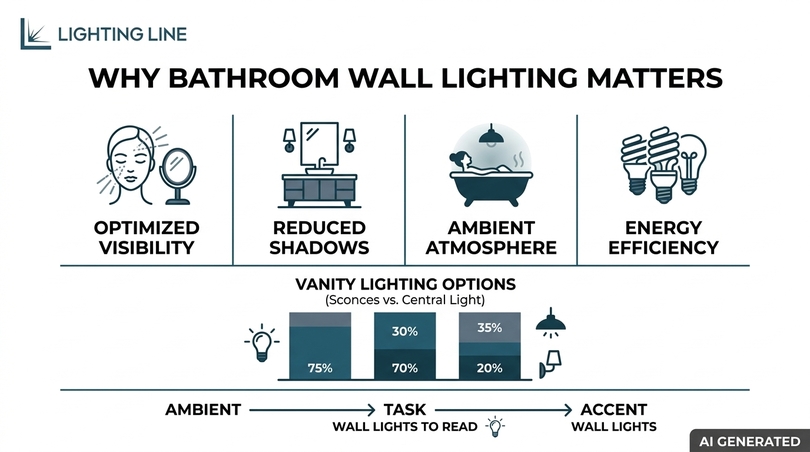
Most bathrooms are lit from the ceiling only. It is the cheapest approach and the least effective one. This section explains, in practical and physiological terms, why wall lighting for bathrooms changes visibility, comfort, atmosphere and safety, and why professionals now treat it as the primary layer rather than an optional extra.
The geometry of a face: why ceiling light fails at the mirror
Light from a downlight above your head travels almost vertically. It hits the brow, the nose and the cheekbones, and it leaves the eye sockets, the area under the nose and the jaw line in shadow. In a mirror, those shadows are doubled: you see them on your face and you see them reflected. That is why people complain they look tired in hotel bathrooms with only recessed downlights.
Wall-mounted bathroom lights work the other way round. A source at eye height, on both sides of the mirror, sends light horizontally onto the face. Shadows from one side are filled by the other. The result is even, frontal illumination: the same principle used in theatre dressing rooms and professional make-up studios.
Vertical illuminance: the metric that matters
Lighting designers distinguish horizontal illuminance (lux on a floor or worktop) from vertical illuminance (lux on a vertical plane, such as a face). Ceiling lighting delivers horizontal illuminance; bathroom wall lighting delivers vertical illuminance. For grooming you need vertical illuminance on the face of roughly 300–500 lux. A standard ceiling layout in a residential bathroom often delivers under 150 lux on the face, even when the floor reads 250 lux.
Benefits of bathroom wall lighting at a glance
| Benefit | What it means in practice | Who benefits most |
|---|---|---|
| Shadow-free grooming | Make-up, shaving, contact lenses and skincare become accurate | Homeowners, hotel guests |
| Perceived space | Lit walls make small rooms read larger; the eye judges room size by wall brightness | Architects, small en-suites |
| Atmosphere | Dimmed wall light turns a functional room into a relaxing space | Interior designers, spa projects |
| Night safety | Low-level wall light guides night-time visits without waking the household | Families, care homes, hotels |
| Energy efficiency | Light placed where it is needed means fewer total lumens | Hotel operators, property managers |
| Architectural integration | Profiles recessed into tiles, plasterboard or mirrors leave clean surfaces | Architects, contractors |
Comfort, mood and the human factor
Bathrooms are used at both ends of the day. In the morning we need alertness and accuracy. In the evening we need to wind down. A good bathroom wall lighting scheme serves both moods with the same fittings, using dimming and, where the budget allows, tunable white. Warm, low, diffused light from the walls signals rest; bright neutral light at the mirror signals work. That flexibility is impossible with a single ceiling circuit.
Wall light also changes how materials look. Grazing light along a tiled wall reveals texture in stone, zellige or fluted ceramics. Washing light across a smooth plaster wall makes it glow. Designers use bathroom wall lights not just to see, but to sculpt the room.
Safety and the functional case
Bathrooms combine water, hard surfaces and electricity. Poor visibility increases the risk of slips, poor fittings increase the risk of electrical faults. A planned scheme of wall lights for bathrooms, with the correct IP ratings and RCD protection, improves both. We explain the rules in detail in the regulations section.
Bathroom lighting design principles in one paragraph
Light the face from the front. Light the room from the walls. Keep the sources diffused. Match colour temperature across fittings. Respect the zones. Separate circuits for task, ambient and night light. Those six principles answer most bathroom lighting questions before you open a catalogue.
Market data: what people search for and what it tells us
Before writing this guide, the LightingLine.eu team analysed a content-gap dataset of more than 11,800 lighting keywords from UK and European search markets. The goal was simple: understand what buyers and professionals actually ask about bathroom wall lighting, and answer it better than anyone else. The figures below are monthly search volumes from that dataset.
Search demand for bathroom lighting topics
| Search term | Monthly searches | Keyword difficulty (0-100) | Average CPC (€) |
|---|---|---|---|
| bathroom lighting | 49,500 | 57 | 0.72 |
| bathroom lights | 33,100 | 65 | 1.01 |
| mirror with lights | 22,200 | 65 | 0.53 |
| bathroom ceiling lights | 9,900 | 56 | 0.93 |
| bathroom wall lighting | 6,600 | 48 | 1.22 |
| bathroom wall lights | 6,600 | 63 | 1.22 |
| bathroom mirror lighting | 3,600 | 44 | 1.39 |
| led bathroom lighting | 3,600 | 49 | 1.06 |
| led lighting profiles | 3,600 | 32 | 1.43 |
| bathroom zones | 2,900 | 31 | 1.25 |
| ip44 rating | 1,600 | 27 | 1.67 |
| shower lighting | 1,300 | 48 | 0.74 |
| bathroom niche | 1,300 | 42 | 0.70 |
| bathroom wall lights uk | 1,000 | 54 | 0.96 |
| zone 1 bathroom lights | 480 | 38 | 0.86 |
| bathroom strip lighting | 390 | 34 | 0.78 |
| bathroom lights regulations | 260 | 33 | 1.84 |
Four insights from the data
1. Mirrors drive the market
Mirror with lights and its variants generate more searches than any wall-light term. People do not want a lamp; they want to see themselves clearly. Any bathroom wall lighting strategy must start from the mirror.
2. Regulations are a real anxiety
“Bathroom zones”, “ip44 rating”, “zone 1 bathroom lights” and “bathroom lights regulations” together exceed 5,000 searches a month, with some of the highest cost-per-click values in the dataset (up to €3.05 for “bathroom zones uk”). High CPC on an informational query means advertisers know that the person asking is close to buying. Clarity on compliance converts.
3. LED profiles are an underserved, high-value niche
“Led lighting profiles” has 3,600 monthly searches with a difficulty of just 32 and one of the highest CPCs in the set. Professionals are actively looking for profile-based solutions, and few publishers explain how to use them in bathrooms. This guide fills that gap.
4. Wall lighting is searched as a design decision
Modifiers such as modern, brass, black, chrome, vintage, industrial and art deco recur throughout the dataset. Buyers judge bathroom wall lights on style first and specification second, which is why we treat aesthetics and technical performance together in every section.
Industry context: why LED dominates
The US Department of Energy reports that residential LEDs, especially ENERGY STAR rated products, use at least 75% less energy and last up to 25 times longer than incandescent lighting. In the European Union, the Ecodesign Regulation (EU) 2019/2020 and the Energy Labelling Regulation (EU) 2019/2015 have progressively removed inefficient halogen and fluorescent sources from the market. For any new bathroom wall lighting project in 2026, LED is not an option, it is the default. The real choice is between integrated LED fittings, replaceable LED lamps, and LED strips in aluminium profiles. We compare all three below.
Types of bathroom wall lights: sconces, bars, mirror lights, profiles
“Bathroom wall light” covers a wide family of products. Each type solves a different problem, and the best schemes often combine two or three of them. This section describes every main category, its strengths and its limits, so you can choose deliberately rather than by habit.
1. Bathroom wall sconces
A sconce is a wall-mounted fitting with a shade, globe or diffuser, usually installed in pairs beside a mirror. Bathroom wall sconces are the classic answer to the question what is the best type of bathroom wall light and when they use opal glass or a fully diffused shade. Clear glass with an exposed lamp looks attractive in photographs but produces glare in the mirror.
When sconces work best
Sconces suit traditional, transitional and boutique-hotel interiors, where the fitting itself is a decorative object. Brass, brushed nickel, chrome and black finishes coordinate with taps and accessories. They work best when the mirror is no wider than about 90-100 cm, so the two sources can reach the centre of the face.
Limits of sconces
A sconce is a point source. Even with an opal globe, it produces a bright spot surrounded by dimmer light. It projects from the wall, typically 10-25 cm, which can be a problem in narrow cloakrooms. And many decorative sconces are rated only IP20 or IP44, which limits where they can go.
2. Bathroom vanity wall lights and light bars
A vanity bar is a horizontal fitting mounted above the mirror. It is popular in North America and in compact European bathrooms. Used alone, an over-mirror bar behaves like a ceiling light that has moved closer: better, but still casting shadows under the brows and nose. Combined with side lighting, it becomes an excellent fill light.
3. Illuminated mirrors and mirror-integrated lighting
Mirrors with integrated LED bands, often backlit or front-lit, are the highest-volume search in the category. They save wall space and wiring points. Quality varies enormously: cheap mirrors use low-CRI strips, visible dots and drivers that cannot be replaced. A professional alternative is to build the mirror lighting with an aluminium profile designed for the purpose, such as theLighting Line aluminium profile for mirror MR01-03 (58 × 30 mm), combined with a high-CRI LED strip you choose yourself.
4. Recessed bathroom wall lighting and linear LED profiles
This is where bathroom wall lighting has moved fastest. A linear aluminium profile, recessed into plasterboard or tiles and closed by an opal diffuser, produces a continuous line of light with no visible LEDs. Profiles turn light into architecture: a vertical slot beside the mirror, a horizontal line under a floating vanity, a glowing reveal around a shower niche.
Relevant Lighting Line families include:
- Tiling profiles, designed to sit flush between tiles: the TI02-10 profile for 8 mm tiles (39.6 × 8.8 mm, frosted diffuser, designed for bathroom wall applications), theTI03-10 profile for 11 mm tiles and the TI01-11 waterproof profile for 12 mm tiles.
- Drywall (plasterboard) profiles, which plaster in for a trimless, seamless line of light.
- Recessed profiles for routing into furniture panels, wall cladding or mirror frames.
- Wall profiles, surface-mounted bodies such as the 31 × 70 mm dual-emission profile WL04-05 that throws light both up and down the wall.
5. Bathroom wall spotlights
Adjustable wall spotlights are useful for accent lighting: a piece of art, a textured wall, a freestanding bath. They are a poor choice for the mirror, because a directional beam aimed at the face creates glare and hard shadows. Use them sparingly and keep the beam away from eye level.
6. Shower wall lights and niche lighting
Shower wall lighting is a specialised category. Fittings inside or near the shower must withstand direct spray and, in the UK and IEC-based countries, carry at least IPX4, more often IP65 or IP67. The most elegant solution is a waterproof LED strip inside a profile set into the shower niche, which lights shampoo shelves and the wall surface without any fitting in the line of spray. Lighting Line offers IP65 silicone-extruded COB LED strips and the 21 × 16 mm waterproof aluminium profile SL10-13 for exactly this kind of detail.
7. Bathroom cabinet and furniture lights
Light under a wall-hung vanity, inside a mirror cabinet, or along open shelving adds depth and doubles as a night light. Small surface profiles such as the 8 × 5 mm profile SL13-02 or the dedicated furniture profiles fit where no conventional fitting could.
Comparison: which type of bathroom wall light suits which job?
| Type | Light quality at mirror | Typical IP | Design flexibility | Maintenance | Best use |
|---|---|---|---|---|---|
| Opal-shade sconces | Very good (in pairs) | IP20-IP44 | Medium | Lamp or module replacement | Traditional and boutique schemes |
| Over-mirror bar | Fair alone, good with side light | IP44 | Low–medium | Usually integrated LED | Compact bathrooms, fill light |
| Illuminated mirror | Variable (depends on CRI) | IP44 | Low | Often whole-unit replacement | Quick refurbishments |
| Recessed LED profile + strip | Excellent (vertical lines of light) | IP20-IP67 (strip/profile dependent) | Very high | Strip and driver replaceable separately | Architect-led and hotel projects |
| Wall spotlights | Poor (glare) | IP44-IP65 | Medium | Lamp replacement | Accent only |
| Shower niche profile | Not for grooming | IP65-IP67 | High | Strip replaceable | Showers, wet rooms |
The most effective schemes combine a high-quality vertical source at the mirror with a profile-based ambient or accent layer. That combination is what the rest of this guide builds towards.
Trends 2026: are wall lights and sconces still in style?
Designers and homeowners ask the same question in many forms: are wall sconces outdated, are wall lights still fashionable, are sconces still in style? The short answer is yes, but the form has changed. This section explains what is current, what is fading, and why.
What is the current trend in bathroom lighting?
The dominant trend is integration: light that is part of the architecture rather than an object attached to it. Linear profiles in tile joints, glowing shower niches, backlit mirrors with soft halos and floating vanities with under-lighting define the contemporary bathroom. Alongside them, a counter-trend values sculptural, artisanal sconces in brass, ribbed glass or alabaster-effect resin as jewellery for the wall.
Five trends shaping bathroom wall lighting
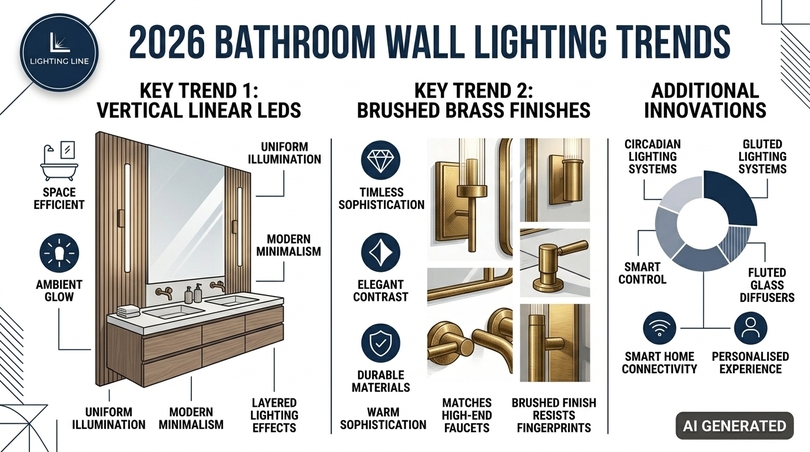
- Vertical linear lighting beside mirrors. Slim LED bars or recessed profiles 60–90 cm long, mounted either side of the mirror, replace round sconces in modern schemes.
- Warm-dim and tunable white. Fittings that move from 4000K for grooming to 2200–2700K for evening use.
- Dot-free light. COB LED strips and deep profiles with opal diffusers eliminate visible LED points, a hallmark of cheap installations.
- Dark and warm metal finishes. Black, bronze, brushed brass and gunmetal continue to replace polished chrome in premium projects.
- Wellness lighting. Spa-style bathrooms use low, indirect wall light and circadian-aware controls.
Are wall sconces dated?
No. What dates quickly is a specific look: frosted tulip shades, bulky polished-brass fittings from the 1990s, exposed bare lamps. Sconces with clean geometry, quality materials and diffused LED light are timeless. In heritage properties, a well-chosen traditional sconce remains the right answer.
Are wall lights a good idea in modern homes?
Yes, especially in bathrooms. Wall lights deliver the vertical illuminance a face needs, they free the ceiling from clutter, and they create the soft, layered atmosphere people now expect. The question is no longer whether to use wall lights, but whether to use them as objects or as architecture.
Are rechargeable wall lights any good in bathrooms?
Rechargeable, battery-powered wall lights avoid wiring and are popular in rentals. They are acceptable as decorative or night-light sources outside the wet zones, provided their IP rating suits the location. They are rarely bright, consistent or long-lasting enough to be the main grooming light, and repeated charging cycles in humid air shorten battery life. For permanent installations, hard-wired or 24V SELV solutions are more reliable.
Trend comparison: then and now
| Element | Fading | Current in 2026 |
|---|---|---|
| Main mirror light | Single over-mirror spotlight bar | Vertical side lighting or profile-framed mirror |
| Light source | Halogen G9 or GU10 | Integrated LED, COB strips |
| Finish | Polished chrome everywhere | Black, brushed brass, bronze, anodised aluminium |
| Ceiling | Grid of 6-9 downlights | Fewer, better-placed downlights plus wall light |
| Shower | No light or one downlight | Illuminated niche with IP65 strip |
| Control | One switch | Scenes, dimming, motion-activated night light |
Regulations and IP Ratings: UK, Italy, Europe, USA and the World
Compliance is where most bathroom wall lighting questions begin, and where most mistakes are made. This section explains IP ratings in plain language, then walks through the rules in the UK, Ireland, Italy, Germany, France, Spain, the United States, Canada and Australia. It is a practical summary, not a substitute for the current edition of your national wiring regulations or for a qualified electrician.
IP ratings explained
The IP (Ingress Protection) code is defined by IEC 60529 (EN 60529 in Europe). It has two digits. The first digit rates protection against solids (0–6); the second rates protection against water (0–9). An “X” means the digit was not tested. Wikipedia keeps a clear reference table of the IP code.
| Rating | Solids | Water | Typical bathroom use |
|---|---|---|---|
| IP20 | Fingers (>12.5 mm) | No protection | Outside zones, away from steam, behind closed covers |
| IP44 | Wires and tools (>1 mm) | Splashing from any direction | Zones 1 and 2, most bathroom wall lights |
| IPX5 / IP65 | Dust-tight (6) | Low-pressure water jets | Zone 1 near showers, areas cleaned with hoses; hotels, gyms |
| IP67 | Dust-tight | Temporary immersion (up to 1 m, 30 min) | Zone 0 (with SELV), shower trays, niches with heavy spray |
| IP68 | Dust-tight | Continuous immersion (manufacturer-specified) | Pools, steam rooms, submerged details |
Is IP44 or IP65 better for bathrooms?
IP44 is the regulatory minimum for zones 1 and 2 in most IEC-based countries, IP65 is the better choice anywhere the fitting may be hit by shower spray or cleaned with a jet. IP65 also keeps dust and the fine aerosols of cleaning products out of the optics, which preserves light output over time. For wall lights beside a basin, IP44 is normally sufficient. For anything inside a shower enclosure or in a wet room, specify IP65 or higher.
Do I need IP44 or IP65 for a bathroom?
Use this rule of thumb: beside the mirror, IP44, in or next to the shower, IP65, inside the bath or shower tray, IP67 at SELV voltage. Outside the zones there is no mandatory IP requirement in the UK, but many professionals specify IP44 everywhere in a bathroom because steam travels.
Are IP44 lights suitable for bathrooms?
Yes, in zones 1 and 2 and outside the zones, provided the fitting is otherwise suitable for the location and installed as the manufacturer instructs. IP44 protects against splashing; it does not protect against direct jets.
Bathroom zones in the UK (BS 7671, Section 701)
In Great Britain, electrical installations follow BS 7671, the IET Wiring Regulations. Section 701 covers “locations containing a bath or shower”. The IET BS 7671 information page lists the current edition and amendments. The zones are:
| Zone | Where it is | Minimum IP for fixed equipment | Notes for wall lighting |
|---|---|---|---|
| Zone 0 | Inside the bath or shower tray | IPX7 | Only SELV equipment (max 12V AC rms or 30V ripple-free DC) with the safety source outside the zones |
| Zone 1 | Above zone 0, up to 2.25 m from finished floor (or the highest fixed shower head if higher), for a walk-in shower without a tray, within 1.2 m horizontally of the fixed water outlet | IPX4 (IPX5 where water jets are used for cleaning) | Fixed luminaires allowed if suitable for the zone; 24V or 12V SELV strips are the cleanest option |
| Zone 2 | 0.6 m horizontally beyond zone 1, up to 2.25 m height | IPX4 (IPX5 where jets are used) | Typical location of mirror lights beside a basin close to the bath |
| Outside the zones | The rest of the room | No specific requirement | Good practice: IP44 because of steam; still within the RCD-protected special location |
Key UK requirements beyond IP ratings
- RCD protection: all low-voltage circuits serving the location, or passing through zones 1 and 2 without serving it, must be protected by an RCD with a rated residual operating current not exceeding 30 mA.
- Switches: switches and controlgear must not be installed in zones 0, 1 or 2, except switches of SELV circuits within the permitted voltage limits. Pull-cord switches with the switch mechanism outside the zones remain the classic UK solution, wall switches outside the bathroom door are equally common.
- Socket outlets: not permitted within 3 m horizontally of the boundary of zone 1, except shaver supply units to BS EN 61558-2-5 and SELV sockets.
- Supplementary bonding: may be omitted when specific conditions on RCD protection and main bonding are met, check the current regulation wording.
Building Regulations Part P (England and Wales)
In England, Approved Document Pmakes some domestic electrical work “notifiable”. Adding or altering circuits within the zones of a bathroom is notifiable, as is installing any new circuit. Work must be carried out by a registered competent person or notified to Building Control. Replacing a like-for-like fitting is generally not notifiable. Wales applies its own version of Part P; Scotland and Northern Ireland have separate building standards. When in doubt, use a registered electrician.
Can you put a wall light switch in a bathroom?
In the UK, yes, but only outside zones 0, 1 and 2 (in practice, outside the 0.6 m boundary of zone 2), unless it is a SELV switch or a pull cord. Most UK bathrooms therefore use a pull cord inside or a switch outside the door. In many other European countries, standard wall switches are allowed inside the bathroom provided they are outside the zones defined by national rules.
Ireland (I.S. 10101)
Ireland’s National Rules for Electrical Installations, I.S. 10101, follow the same IEC structure as BS 7671 for locations containing a bath or shower: zones 0, 1 and 2, IPX4 minimum in zones 1 and 2, 30 mA RCD protection and strict limits on switches and sockets. Work is normally certified by a Registered Electrical Contractor.
Italy (CEI 64-8, Part 7, Section 701)
In Italy, the reference standard is CEI 64-8, Part 7, Section 701, published by the Comitato Elettrotecnico Italiano and harmonised with IEC 60364-7-701. The bathroom is divided into zones 0, 1 and 2 with protection requirements essentially aligned with the UK: IPX7 and SELV in zone 0, at least IPX4 in zones 1 and 2, IPX5 where water jets are used. Older Italian installations may refer to a zone 3, which no longer exists in the current harmonised approach.
Italian administrative requirements
- DM 37/2008: electrical work in homes must be carried out by a qualified company, which issues a Dichiarazione di Conformità (declaration of conformity) at the end of the job.
- Differential protection: 30 mA residual current devices are standard practice for bathroom circuits.
- Accessories: switches and sockets are not allowed in zones 0, 1 and 2, except SELV devices within the limits of the standard.
Germany (DIN VDE 0100-701)
Germany applies DIN VDE 0100-701, again based on IEC 60364-7-701. Zones 0, 1 and 2 follow the familiar pattern, with IPX4 in zones 1 and 2, IPX5 where jets are used, and RCD protection not exceeding 30 mA for bathroom circuits. German practice is conservative: many installers specify IP44 or better for every fitting in the room.
France (NF C 15-100)
France uses “volumes” instead of zones under NF C 15-100. Volume 0 is inside the bath or shower; volume 1 is above it; volume 2 extends 0.6 m beyond. French rules are stricter in volume 1: luminaires there must be very low voltage (TBTS, 12V), and in volume 2 luminaires are typically Class II with at least IPX4. A revised edition of NF C 15-100 has been published; check the edition applicable to your project’s permit date.
Spain (REBT, ITC-BT-27)
Spain’s Low Voltage Electrotechnical Regulation, instruction ITC-BT-27, defines volumes around baths and showers with IP requirements that decrease with distance from the water, plus mandatory high-sensitivity differential protection. Installers must hold the appropriate authorisation and register the installation where required.
United States (NEC) and Canada (CEC)
North America does not use zones. Under the US National Electrical Code (NFPA 70), no parts of cord-connected luminaires, chain-, cable- or cord-suspended luminaires, track lighting or pendants may be located within 3 ft (900 mm) horizontally and 8 ft (2.5 m) vertically from the top of a bathtub rim or shower threshold. Luminaires within that space must be listed for damp locations, or for wet locations where subject to shower spray. Bathroom receptacles require GFCI protection. Canada’s CEC applies comparable damp- and wet-location rules with CSA-certified products. Local amendments vary by state and province.
Australia and New Zealand (AS/NZS 3000)
The Wiring Rules AS/NZS 3000 define classified zones around baths and showers, with IP and RCD requirements and restrictions on switches and accessories. Work must be performed by a licensed electrician.
Global summary table
| Country / region | Reference | Zone system | Minimum near bath/shower | Residual current protection |
|---|---|---|---|---|
| United Kingdom | BS 7671 Section 701; Part P | Zones 0-2 | IPX4 (IPX5 with jets), zone 0 IPX7 + SELV | 30 mA RCD |
| Ireland | I.S. 10101 | Zones 0-2 | IPX4 | 30 mA RCD |
| Italy | CEI 64-8/7 Sez. 701; DM 37/2008 | Zones 0-2 | IPX4 (IPX5 with jets), zone 0 IPX7 + SELV | 30 mA RCD |
| Germany | DIN VDE 0100-701 | Zones 0-2 | IPX4 (IPX5 with jets) | 30 mA RCD |
| France | NF C 15-100 | Volumes 0-2 | Volume 1: TBTS 12V, volume 2: Class II, IPX4 | 30 mA |
| Spain | REBT ITC-BT-27 | Volumes | IP decreasing with distance | High-sensitivity differential |
| USA | NEC 410.10(D), 210.8 | 3 ft / 8 ft envelope | Damp-listed, wet-listed if in spray | GFCI for receptacles |
| Canada | CEC, CSA | Damp / wet locations | Damp- or wet-location rated | GFCI |
| Australia / NZ | AS/NZS 3000 | Classified zones | IP by zone | 30 mA RCD |
| International baseline | IEC 60364-7-701 | Zones 0-2 | IPX4 | 30 mA |
Product standards that apply to every bathroom wall light
- EN/IEC 60598 for luminaire safety, including marking of IP rating and protection class.
- EN/IEC 60529 for the IP code.
- EN 61347 and EN 61547 for LED drivers (control gear) and immunity.
- CE marking in the EU and UKCA marking in Great Britain, under the Low Voltage and EMC frameworks.
- Ecodesign (EU) 2019/2020 and Energy Labelling (EU) 2019/2015 for light sources.
Why SELV LED strips simplify compliance
A 24V DC LED strip powered by a certified SELV driver located outside the zones operates at a voltage well within the SELV limit for zones 1 and 2. That is why many professionals choose LED strips in waterproof profiles for shower and bath walls: the voltage at the wet end is extra-low, and the mains-voltage driver sits safely in a ventilated, accessible void outside the zones. In zone 0, BS 7671 and CEI 64-8 set a lower limit (12V AC or 30V ripple-free DC) and require IPX7, check the strip’s rating carefully. Lighting Line COB strips include 24V IP65 silicone-extruded versions for zones 1 and 2.
Bottom line for installers: choose the IP rating by zone, keep the driver outside the zones, protect the circuit with a 30 mA RCD, and document everything. That approach satisfies the core of every IEC-based regulation discussed here.
Placement: height, spacing, mirrors, showers and small bathrooms
The best fitting in the wrong position performs badly. Placement decides whether bathroom wall lighting flatters or fails. This section gives exact heights, spacings and layouts for the mirror, the basin, the shower, the bath and the small bathroom, with the reasoning behind each number.
How high should wall lights be installed beside a bathroom mirror?
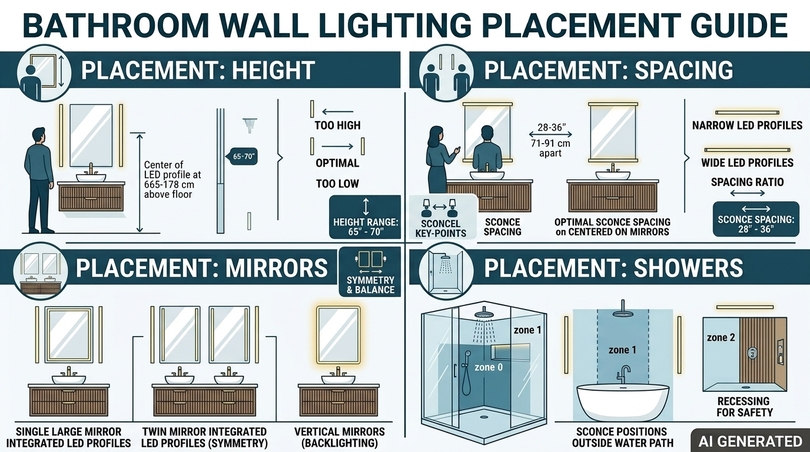
Mount side lights so that the centre of the light source sits at roughly eye height: 1.50-1.70 m above the finished floor, with 1.60 m a reliable default for mixed-height households. For vertical linear fittings or profiles, centre the line at the same height and choose a length of 60-90 cm so it lights the face whether the user stands tall or leans forward.
| Element | Recommended position | Reasoning |
|---|---|---|
| Side sconces (centre) | 1.50-1.70 m AFF | Aligns light with eyes and cheeks |
| Vertical LED profile beside mirror | 60-90 cm long, centred at 1.55-1.65 m | Covers seated and standing users |
| Distance between side lights | 75-100 cm (approx. 30-40 in) | Light reaches the centre of the face from both sides |
| Distance from mirror edge | 5-15 cm | Close enough to cross-light, far enough to avoid reflections of the fitting body |
| Over-mirror bar | 1.90-2.00 m AFF, or 5-10 cm above mirror top | Fill light from above, never alone |
| Under-vanity profile | Hidden under the front lip, aimed at floor | Night light and floating effect |
| Shower niche profile | Top or side of niche, recessed | Lights wall and shelf, out of direct spray path |
Where to place bathroom sconces: side, top or both?
Side lighting is first choice, top lighting is second choice; both together is best. If the mirror is very wide (above about 120 cm) or the wall layout prevents side lighting, use a top light with a broad opal diffuser and complement it with a vertical profile or a backlit mirror halo to soften shadows.
Double vanities
For two basins, treat each basin as its own mirror zone. A common layout uses three vertical lights: left, centre (shared) and right. The centre light serves both users. Keep a minimum of 75 cm between light centres for each user position.
Should bathroom wall lights face up or down?
This is one of the most searched questions about bathroom wall lighting. The honest answer: for grooming, the ideal wall light faces neither up nor down; it glows towards the user through a diffuser. When you must choose a directional fitting:
- Up-facing fittings bounce light off the ceiling for ambient light and reduce glare. Good for atmosphere, weaker for task light.
- Down-facing fittings concentrate light on the basin but cast shadows on the face. Acceptable for an over-mirror bar, poor for side lights.
- Up-and-down (dual emission) fittings, such as theWL04-05 dual-emission wall profile, wash the wall in both directions and create a soft architectural glow ideal for ambient bathroom wall lighting.
Shower and bath wall lighting placement
Inside the shower, the goal is not grooming light but visibility and atmosphere. Place the source where water hits it least: the top of a niche, a horizontal reveal at 2.0-2.2 m, or a vertical slot on the wall opposite the shower head. Avoid placing any light directly in front of the head’s spray pattern.
Beside a bath, a low horizontal line of light at 30-50 cm above the rim, or a wall-wash from a recessed profile above, creates the spa effect. Remember that this area is usually zone 1 or 2 and needs IPX4 at minimum, IP65 recommended.
Where do you put lights in a small bathroom?
In small bathrooms and cloakrooms every centimetre counts, and projecting sconces can block movement. The best light for a small bathroom is a flush or recessed linear source beside or around the mirror, combined with one ceiling light or a cove. Lit walls make a compact room feel bigger; a single central downlight makes it feel like a box.
Small bathroom placement rules
- Use the mirror as the main light source: frame it with a profile or install vertical profiles either side.
- Choose flush or near-flush fittings (projection under 3 cm) where people pass.
- Light at least one full wall from top to bottom to expand perceived depth.
- Keep colour temperature identical across all fittings; mixing temperatures shrinks space visually.
- Add a low-level night light under the basin or along the skirting.
Bathroom lighting layout examples
| Room | Mirror | Ambient | Accent / night | Shower |
|---|---|---|---|---|
| Cloakroom 1.2 × 1.8 m | One vertical profile each side or framed mirror | None needed or one IP44 downlight | Under-basin strip | – |
| En-suite 2.0 × 2.5 m | Two side lights at 1.60 m | Two IP65 downlights or a ceiling cove | Under-vanity profile | Niche profile IP65 |
| Family bathroom 2.5 × 3.0 m | Side lights + over-mirror fill | Wall-wash profile along long wall | Skirting or shelf profile | Niche and ceiling IP65 |
| Master bathroom 3.5 × 4.0 m | Two mirror zones with shared centre light | Dual-emission wall profiles | Bath-side grazing light | Wet-room linear lighting IP67 |
Mirror and vanity lighting without shadows or glare
Bathroom mirror lighting is the highest-stakes part of any scheme. It decides how people see themselves every day. This section explains how to eliminate shadows and reflections, how to design mirror lighting with LED profiles, and how to combine decorative and functional light.
What is the best lighting for a bathroom mirror?
The best lighting for a bathroom mirror is diffused, high-CRI light from both sides at eye level, at 3000–4000K, delivering 300–500 lux on the face. Everything else is a compromise. Below is how to achieve it with different products.
How to avoid shadows in a bathroom mirror
- Cross-light: two sources on opposite sides fill each other’s shadows.
- Enlarge the source: a 70 cm vertical profile is a much larger luminous area than a 10 cm globe, so shadows are softer.
- Diffuse: opal diffusers spread light and hide LED points. Lighting Line goniophotometer tests show opal covers absorb roughly a quarter to almost half of the strip’s output depending on the profile, so plan lumens accordingly.
- Bring light forward: a light-coloured basin counter acts as a reflector and lifts light under the chin.
- Do not rely on downlights above the mirror: a downlight directly over the user’s head is the main cause of mirror shadows.
How to prevent glare in bathroom lighting
Glare comes from seeing a bright, small source directly or in reflection. Keep luminance low and area large. In practice: choose opal over clear diffusers, recess strips deep enough that the LEDs are not visible at normal viewing angles, avoid spotlights aimed towards eye level and use dimming in the evening. With a profile, a deeper body (for example 15–20 mm between strip and diffuser) gives a more uniform, dot-free line than a shallow one with the same strip.
Building mirror lighting with aluminium profiles
A profile-based mirror solution gives designers control that ready-made illuminated mirrors rarely offer: choice of strip, CRI, colour temperature, length, finish and driver. The Lighting Line mirror profile MR01-03 (58 × 30 mm, for strips up to 12 mm wide) is designed specifically for this application, holding the mirror and the light line in one aluminium body.
Three proven mirror configurations
- Vertical side profiles: two recessed or surface profiles beside the mirror, 60-90 cm long, opal diffuser, 3000–4000K, CRI ≥ 90. The best grooming light.
- Backlit halo: a profile on the back of a floating mirror throwing light onto the wall. Beautiful ambient glow; add front light for grooming.
- Framed mirror: a profile on all four sides or on the two long sides. Even light, very contemporary, ideal for small bathrooms.
Bathroom mirror lighting problems and fixes
| Problem | Cause | Fix |
|---|---|---|
| Dark eye sockets | Light only from above | Add side light at eye level |
| Visible dots in reflection | Low-density strip in shallow profile | COB strip or deeper profile with opal diffuser |
| Skin looks grey or green | Low CRI, poor R9 | CRI Ra ≥ 90 strip, R9 > 50 |
| Glare | Clear glass, exposed lamp | Opal diffuser, dimming |
| Uneven colour between fittings | Mixed suppliers, poor binning | Same product family, MacAdam ≤ 3 SDCM |
| Mirror fogging over lights | Steam and cold surfaces | Ventilation, heated demister pad, IP-rated fittings |
How can I combine decorative wall lights with functional mirror lighting?
This question comes up in almost every interior design brief. Separate the jobs: let the profile do the work, let the sconce do the talking. A practical scheme uses recessed vertical profiles beside the mirror for grooming, on their own dimmable circuit, while a pair of decorative sconces further along the wall, or a statement fitting above a bath, provides character. Match the colour temperature of both layers exactly, and choose a profile finish (silver, white or black anodised aluminium) that coordinates with the decorative metalwork.
Which wall light designs work best with recessed bathroom mirrors?
Recessed mirrors and mirror cabinets sit flush with the wall, so projecting sconces look like an afterthought. Plaster-in drywall profiles or tile profiles set in the same plane as the mirror create a single, seamless surface. Lighting Line drywall profiles are designed to be skimmed into plasterboard so that only the diffuser line remains visible.
Colour Temperature, CRI, lumens and beam angle
The numbers on a datasheet decide how a bathroom feels and how accurately people see their skin. This section turns colour temperature, colour rendering, lumens, lux and beam angle into clear choices for each part of the room.
What is the best colour temperature for bathroom lighting?
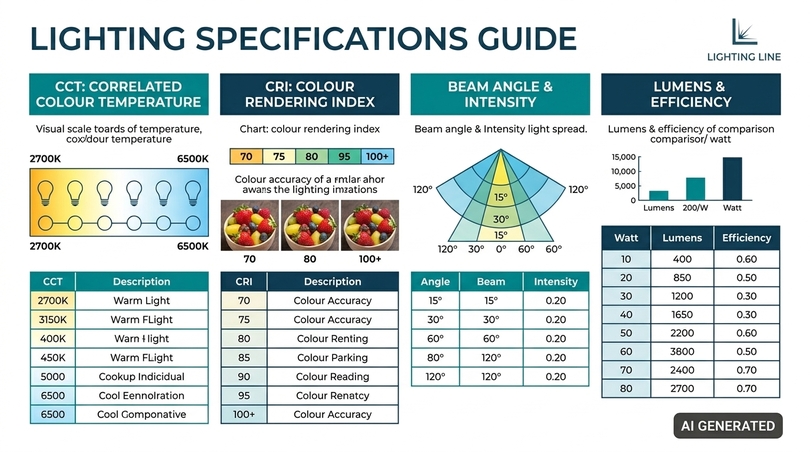
| Colour temperature | Appearance | Best use in the bathroom |
|---|---|---|
| 2200-2700K | Very warm, candle-like | Evening relaxation, bath accent, night light |
| 3000K | Warm white | Ambient wall lighting in homes and hotels; flattering, relaxing |
| 3500K | Soft neutral | All-round compromise at the mirror |
| 4000K | Neutral white | Precise grooming, make-up checks, commercial washrooms |
| 5000–6500K | Cool to daylight | Rarely recommended, harsh and clinical in residential bathrooms |
For most homes, 3000K throughout is the safest choice, for serious grooming, 3500–4000K at the mirror with dimming. Tunable-white (CCT) strips let users switch between both.
Warm vs cool bathroom lighting: what is most relaxing yet practical?
Warm light (2700-3000K) lowers perceived intensity and suits evening routines. Cool light improves contrast for detailed work. The best compromise for a relaxing yet practical bathroom is 3000K at full brightness for daily use, dimmed in the evening, with a 4000K option at the mirror if users apply make-up professionally.
What type of lighting is most flattering for a bathroom?
Flattering light has three properties: it comes from the front at face height, it is diffused, and it renders skin tones faithfully. Diffused, warm-neutral (3000-3500K), high-CRI (≥ 90) light from both sides of the mirror is the most flattering bathroom lighting. Hotels use this formula because guests remember how they looked in the mirror.
Bathroom lighting CRI: why 90+ matters
CRI (Colour Rendering Index, Ra) measures how faithfully a light source shows colours compared with a reference source. Ra is an average of eight pastel samples. For bathrooms, also check R9, the saturated red sample, which governs how skin, lips and blush look. A strip with Ra 80 can have an R9 close to zero, which makes skin look dull.
| CRI (Ra) | Result on skin | Recommendation |
|---|---|---|
| < 80 | Greyish, flat | Avoid |
| 80-89 | Acceptable for ambient light | Ambient and accent only |
| 90-94 | Natural, accurate | Mirror and task lighting |
| ≥ 95 | Near-reference | Make-up studios, luxury hotels |
Lighting LineCOB LED stripsinclude a 24V IP65 warm-white (3000K) version with CRI Ra > 93, around 790 lm/m and 11 W/m, cuttable every 2 cm, which suits mirror lighting and wet-area details. See the full LED strip range for other colour temperatures and outputs.
Colour consistency: MacAdam steps
Two strips both labelled 3000K can look different. Specify a colour consistency of 3 SDCM (MacAdam steps) or better and buy all strips for one room from the same batch to avoid visible colour shifts between the left and right sides of a mirror.
Bathroom wall light lumens: how much light do you need?
| Task / area | Target illuminance | Typical lumen budget |
|---|---|---|
| Face at the mirror (vertical) | 300-500 lux | 800-1,500 lm total from mirror lights |
| General bathroom (horizontal) | 150-250 lux | Approx. 60-100 lm per m² of floor, depending on reflectances |
| Shower | 150-200 lux | 300-600 lm |
| Night light | 5-20 lux at floor | 50-150 lm |
| Hotel and commercial washrooms | 200 lux general (EN 12464-1 reference for toilets and washrooms) | Calculate per project |
A simple lumen calculation for LED profiles
Example: two vertical profiles beside a mirror, each 70 cm long, with a 790 lm/m strip and an opal diffuser that absorbs about 30%.
Per profile: 0.7 m × 790 lm/m × 0.70 = approx. 387 lm. Two profiles: approx. 774 lm, close to the lower end of the mirror budget. To reach the upper range, use a higher-output strip, a clearer diffuser, a longer profile, or add an over-mirror fill light. Always calculate with the diffuser loss included; it is the most common reason profile lighting ends up too dim.
What beam angle is ideal for balanced bathroom wall illumination?
- Mirror and face lighting: fully diffused, effectively 120° or wider. Opal diffusers deliver this.
- Wall washing: wide or asymmetric optics placed 20-30 cm from the wall give even washes. Lighting Line offers asymmetric and double-asymmetric lens covers for selected profiles.
- Grazing texture: narrow distance (2-5 cm) from the wall, wide beam; reveals tile and stone texture.
- Accent spots: 24-36° for art or niches, never aimed towards eye level.
LED strips and aluminium profiles for bathroom walls
LED strips in aluminium profiles are the most flexible tool available for bathroom wall lighting. They can be any length, follow any line, sit flush in tiles or plaster, and be specified to the exact colour temperature, CRI and IP rating a zone requires. This section explains why they work, how to choose the components, and which Lighting Line profiles fit which bathroom detail.
Are LED lights good for bathrooms?
Yes. LEDs are the best light source for bathrooms: they produce little radiant heat, switch on instantly at full brightness (unlike older fluorescent lamps in cold rooms), last tens of thousands of hours, and are available in sealed, high-IP versions. They are also fully dimmable with the right driver. The real question is not whether LED works, but which LED format.
Are LED lights safe for showers?
Yes, when the product’s IP rating matches the zone, it runs at SELV voltage in the wet area, the driver is outside the zones, and the circuit has 30 mA RCD protection. Silicone-extruded or fully encapsulated strips (IP65-IP67) inside a waterproof profile, sealed with the correct end caps, are designed for this environment.
Are all LED lights suitable for bathrooms?
No. An IP20 strip with exposed components or a standard LED lamp in an open fitting must stay outside the zones and away from steam. Always check the IP rating of the whole assembly, not just the strip: a waterproof strip in an open profile with unsealed ends behaves very differently from a sealed system.
Why use an aluminium profile at all?
- Heat management: aluminium draws heat away from the LEDs, preserving output and lifetime.
- Optics: diffusers and lenses shape the light, from dot-free opal lines to asymmetric washes.
- Protection: the profile shields the strip from impact, cleaning and moisture.
- Finish: anodised silver, white-painted or black profiles become part of the design.
- Installation: profiles are clipped, screwed, glued, tiled in or plastered in, with matching end caps and brackets.
Choosing the right Lighting Line profile for each bathroom detail
| Bathroom detail | Recommended profile family | Example product | Why it works |
|---|---|---|---|
| Light line flush between wall tiles | Tiling | TI02-10, for 8 mm tiles | Designed for bathroom wall tiling; decorative or main light depending on strip |
| Thicker tiles or stone | Tiling | TI03-10, for 11 mm tiles | Matches tile depth for a flush result |
| Wet floor or shower base edge | Tiling, waterproof | LLP-TI01-11 waterproof, for 12 mm tiles | Waterproof construction for wet-room details |
| Mirror lighting | Mirror | MR01-03 (58 × 30 mm) | Purpose-designed for mirror integration |
| Shower niche, splash areas | Surface, waterproof | SL10-13 (21 × 16 mm) waterproof | Waterproof profile with opal diffuser, PCB up to 12 mm |
| Plastered vertical slot beside mirror | Drywall | Drywall range | Trimless, seamless architectural line |
| Up/down wall wash | Wall | WL04-05 dual emission | Soft ambient glow both ways |
| Compact wall-mounted line | Wall | WL02-03 (24 × 24 mm), WL05-05 (34 × 34 mm) | Wall-mounted bodies for linear sconce effects |
| Wider wall feature | Wall | WL01-03 (48 × 18 mm), WL03-01 (30 × 29 mm) | Larger luminous area, softer light |
| Under-vanity, shelves, cabinets | Surface / Furniture | SL13-02 (8 × 5 mm), SL17-03 (17 × 7 mm) | Minimal size for tight spaces |
| Ceiling or wall corners | Corner | Corner range | 45° emission into the room |
Complete the system with matching diffusers, end caps andmounting brackets. In wet areas, the end caps and cable entry are where water gets in: never skip them.
Choosing the LED strip
| Parameter | Bathroom recommendation |
|---|---|
| Type | COB for dot-free lines in shallow profiles; high-density SMD (≥ 120 LED/m, ideally 240 LED/m) for deeper profiles |
| Voltage | 24V DC (lower current than 12V, less voltage drop, longer runs), 12V where national rules require it in the innermost zone |
| Power | 8–15 W/m for mirror and wall lighting; 4–8 W/m for accent and night light |
| CRI | Ra ≥ 90 at the mirror, ≥ 80 acceptable for accent |
| Colour temperature | 3000K standard, 4000K or tunable at the mirror |
| IP | IP20 inside sealed profiles outside the zones, IP65 in zones 1-2, IP67/IP68 for zone 0 or immersion risk |
| Cut length | Short cut intervals (COB strips can be cut every 2 cm) for precise fits |
Lighting Line also manufactures customised LED strips to project specifications, see the strip LED catalogue and the profiles catalogue for the full technical data, including photometric tests performed with a goniophotometer.
Drivers, voltage drop and wiring
- Size the driver at about 120-125% of the strip load (e.g. 2 m × 11 W/m = 22 W, choose a 30 W driver).
- Keep 24V runs within the strip manufacturer’s maximum continuous length (often about 5 m), feed longer runs from both ends or in parallel.
- Place the driver outside the zones, in a ventilated, accessible location such as a ceiling void, an adjacent cupboard or a service panel.
- Use a dimmable driver matched to the control system (phase-cut, 0-10V, DALI, PWM receiver).
- Seal every cable entry into waterproof profiles with the appropriate gland or sealant.
Integrated LED vs replaceable bulbs: which is easier to install and maintain?
Integrated LED fittings and strip systems are usually easier and faster to install, because they arrive with fixed optics and need no lamp choice. The risk is that a failed integrated fitting must be replaced whole. Profile systems solve this: the strip and driver are separate, replaceable components, while the profile, the most visible part, stays in place for decades.
Are LED bathroom wall lights worth it?
Yes. Lower energy use, long life, no hot lamps near damp surfaces, instant full output, precise colour control and slim form factors make LED bathroom wall lights the clear choice for homes, hotels and commercial washrooms alike.
Styles, materials and finishes
Style is the first filter most clients apply. A perfectly specified fitting in the wrong finish will be rejected. This section matches bathroom wall lighting styles to interiors, explains which materials survive humidity, and shows how to coordinate lights with taps, mirrors and hardware.
Modern bathroom wall lighting
Modern bathroom wall lights favour clean geometry, slim profiles, integrated LEDs and hidden light sources. Vertical linear lights beside the mirror, profiles set into tile joints and backlit mirrors define the style. Finishes: matt black, matt white, anodised aluminium, brushed steel.
Contemporary and minimalist bathroom lighting ideas
Minimalism goes one step further: the light source disappears entirely. A plaster-in profile beside a flush mirror, a light slot under a floating vanity and an illuminated shower niche can light an entire bathroom with no visible fitting. This is the language of contemporary architecture, and profile systems are its natural tool.
Industrial bathroom wall lighting
Industrial schemes use black metal, cage guards, exposed fixings and filament-style LED lamps. They suit lofts and warehouse conversions. Watch the IP rating: many industrial-style fittings are IP20 and must stay outside the zones. A black anodised linear profile can echo the industrial palette while delivering better mirror light.
Brass, chrome, brushed nickel and black finishes
| Finish | Character | Coordinates with | Care in humid rooms |
|---|---|---|---|
| Chrome | Bright, classic, reflective | Chrome taps, white sanitaryware | Very durable, shows water spots |
| Brass (polished or brushed) | Warm, luxurious | Brass or gold taps, marble, dark tiles | Lacquered brass resists tarnish; unlacquered patinates |
| Brushed nickel | Soft, understated | Brushed nickel or stainless taps | Hides marks well |
| Matt black | Graphic, contemporary | Black taps, concrete, terrazzo | Shows limescale, wipe dry |
| Anodised aluminium (silver) | Technical, neutral | Stainless steel, glass, white tile | Anodising resists corrosion |
| White painted aluminium | Disappears into walls | White plaster and tiles | Easy to clean |
Vintage, retro, art deco and traditional bathroom lights
Period properties call for period character: fluted glass, opal globes, art deco geometry, swan-neck arms. Choose reproduction fittings with integrated or LED-lamp light sources and a stated IP44 rating so that heritage style does not compromise safety. Pair them with a discreet profile for task light if the decorative fittings are too dim for grooming.
How do I coordinate bathroom wall sconces with taps, mirrors and other fixtures?
- Pick one metal and repeat it across taps, light fittings and accessories; a second metal is fine if repeated at least twice.
- Align heights: the centre of side lights, the top of the mirror and tile courses should relate to a common grid.
- Scale to the mirror: side lights roughly one-third to one-half of mirror height look proportionate.
- Match light tone to material: warm 2700-3000K enhances brass and wood, 3500-4000K suits chrome and white marble.
- Let profiles disappear: choose white profiles in white walls, black profiles in black frames.
Sustainable materials and energy-efficient technologies
Aluminium is infinitely recyclable without loss of properties. Choosing a durable aluminium profile with a replaceable strip and driver extends the life of the installation far beyond that of a sealed disposable fitting. Combine it with high-efficacy strips, presence sensors and dimming to minimise operating energy.
Dimmable, smart and sensor-controlled bathroom wall lights
Controls turn good bathroom wall lighting into great bathroom wall lighting. This section covers dimming technologies, smart systems, voice control and motion sensors, and how to apply them safely in a wet room.
Can bathroom wall sconces be connected to a dimmer switch?
Yes, if both the fitting (or its LED driver) and the dimmer are compatible. Check the datasheet for dimmable and the dimming method. In the UK, the dimmer must be outside zones 0-2 (or be a SELV device), which usually means outside the bathroom door. Mismatched dimmers cause flicker, buzzing or limited range.
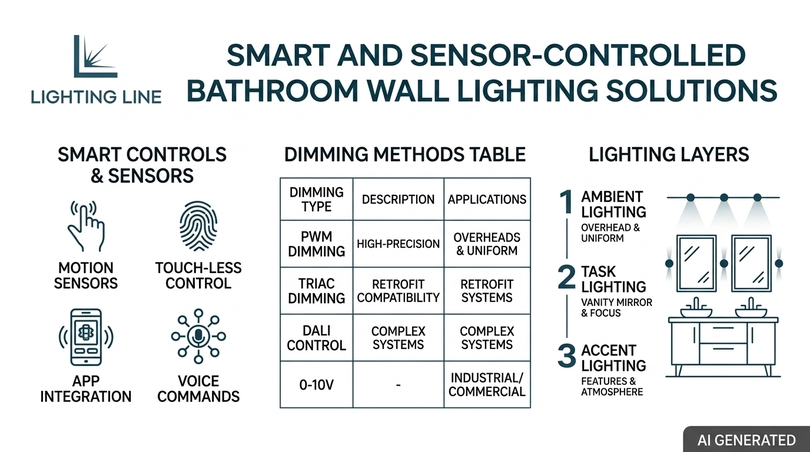
| Dimming method | How it works | Best for |
|---|---|---|
| Phase-cut (leading/trailing edge) | Dims the mains supply to the driver | Retrofits with existing wall dimmers |
| 0-10V / 1-10V | Low-voltage control signal to the driver | Commercial projects |
| DALI / DALI-2 | Digital addressable control | Hotels, large residential, scene control |
| PWM receiver (RF, Zigbee, Bluetooth mesh) | Dims the 24V output to the strip | Smart homes, tunable white strips |
Are dimmable LED bathroom wall lights suitable for luxury residential projects?
They are essential. Luxury is not brightness; it is control. A morning scene at full output, an evening scene at 30% and 2700K, and a night scene at 5% under the vanity are what clients experience as quality.
Smart bathroom lighting and voice assistants
Smart LED controllers for strips, and smart drivers or relays for fittings, integrate with common ecosystems via Zigbee, Matter-compatible hubs, Bluetooth mesh or Wi-Fi. Are smart bathroom wall lights compatible with voice assistants? Yes, through the controller or hub, not the luminaire itself. Install the controller outside the zones and make sure the manual switch still works if the network fails.
Motion sensor bathroom wall lights
Presence and absence sensors save energy and improve safety at night. Use a sensor to trigger a low-level night scene (under-vanity or skirting profile) rather than the full mirror lighting to avoid dazzling people at 3 a.m. In hotels and commercial washrooms, absence detection with time-outs reduces wasted hours of operation.
Bathroom lighting automation scenes
| Scene | Mirror lights | Ambient wall light | Accent / niche | Night light |
|---|---|---|---|---|
| Morning | 100%, 4000K | 80% | Off | Off |
| Everyday | 80%, 3000-3500K | 60% | 40% | Off |
| Relax / bath | Off or 10% | 30%, 2700K | 60% | Off |
| Night | Off | Off | Off | 5-10%, sensor-triggered |
| Cleaning | 100% | 100% | 100% | On |
Layered lighting: combining wall, ceiling and accent light
No single fitting can do everything. A balanced bathroom lighting design combines several layers, each with its own job and ideally its own circuit. This section explains how wall lights, ceiling lights, spotlights and accent light work together.
The four layers
- Task: light on the face at the mirror. Provided by bathroom wall lighting.
- Ambient: general illumination for moving around and cleaning. Ceiling lights, coves or wall-wash profiles.
- Accent: highlights for niches, textures, art. Profiles, small spots.
- Decorative / night: visible fittings with character, and low-level guidance light.
How to combine bathroom wall lights and ceiling lights
Let wall lights handle the face, and use the ceiling for the room. Avoid placing a downlight directly above the user’s head at the mirror, set ceiling lights at least 40–60 cm in front of the mirror plane so their light reaches the face at an angle, or skip that position altogether. In showers, an IP65 downlight complements a niche profile.
Are LED ceiling lights OK for bathrooms? Are spotlights good for bathrooms?
Yes, both are fine when rated for their zone. Spotlights are safe in a bathroom if their IP rating suits the zone and they are fire-rated where they penetrate a ceiling, but they should provide ambient or accent light, not mirror light. Too many downlights create a “Swiss cheese” ceiling and uneven pools of light, wall light reduces the number you need.
Are sconces enough lighting for a bathroom?
In a small bathroom or cloakroom, two good side lights can be enough. In anything larger than about 4 m², add an ambient layer, from the ceiling or a wall-wash profile, so that the room is lit evenly beyond the mirror zone.
Example of a balanced bathroom lighting plan
| Layer | Product | Circuit / control |
|---|---|---|
| Task (mirror) | Two vertical profiles, COB 3000K CRI > 90, opal diffuser | Circuit 1, dimmable |
| Ambient | Dual-emission wall profile along long wall | Circuit 2, dimmable |
| Accent (shower) | Waterproof profile in niche, IP65 strip | Circuit 3 |
| Night | Under-vanity profile, 2700K | Sensor, low output |
Sizing the scheme: small, medium and large bathrooms
How many bathroom wall lights do you need? It depends on floor area, mirror width, ceiling height and surface colours. This section gives a practical sizing guide.
Bathroom lighting size guide
| Bathroom size | Mirror lighting | Ambient lumens (approx.) | Typical wall-light count |
|---|---|---|---|
| Cloakroom (< 2 m²) | Framed mirror or 1-2 vertical profiles | 200-400 lm | 1-2 |
| Small bathroom (2-4 m²) | 2 side lights | 400-800 lm | 2-3 |
| Medium (4-8 m²) | 2 side lights + fill | 800-1,500 lm | 3-5 |
| Large (8-15 m²) | Per basin: 2 side lights (shared centre) | 1,500-3,000 lm | 5-8 |
| Master suite / spa | Per basin zone, plus decorative | Calculated per zone | 8+ |
Dark tiles absorb light: increase lumens by 30-50% for dark stone, black tiles or deep colours. High ceilings (above 2.7 m) also need more output or wall-based light closer to the user.
Small bathroom vanity lighting
For a compact vanity (50-60 cm basin), a mirror of 50-70 cm with a vertical profile each side, or a framed mirror, gives professional results in a tiny footprint. Flush profiles avoid the elbow-knocking problem of projecting sconces.
Large bathroom wall lighting ideas
- Wash the longest wall with a dual-emission profile to give the room a luminous backbone.
- Light a feature wall behind a freestanding bath with grazing light from a recessed floor or ceiling profile.
- Use tile profiles to draw horizontal lines that tie basin, bath and shower together.
- Add statement sconces as decorative punctuation, not as the only light.
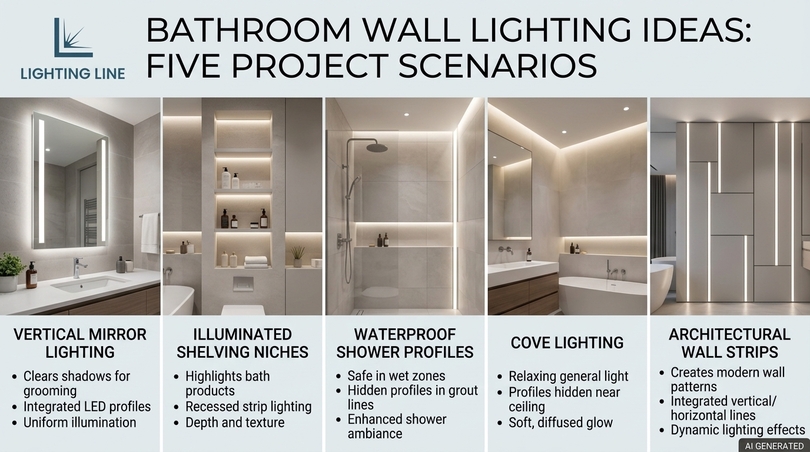
Bathroom wall lighting ideas: five project scenarios
Principles become clear when you see them applied. This section walks through five realistic bathroom wall lighting projects, from a London cloakroom to a luxury hotel suite, with the reasoning and the product choices behind each. Use them as starting points for your own bathroom wall lighting ideas.
Scenario 1: small bathroom wall lighting in a London cloakroom
Brief: a 1.1 × 1.6 m downstairs WC, white tiles to 1.2 m, a 45 cm basin and a 50 × 70 cm mirror. The owner wants it to feel bigger and to stop looking “like a cupboard”.
Solution: two vertical light lines either side of the mirror, each 60 cm long, using a slim wall-mounted profile with opal diffuser and a 3000K CRI 90+ strip. A short profile under the basin acts as a night light. The ceiling light is removed entirely. The two vertical lines become the bathroom side lights, the main light and the decoration at once.
Why it works: lit vertical surfaces widen the room visually; the face is evenly lit; there are no projecting fittings in a space where people turn round. Outside the zones there is no IP requirement, but IP44 components were chosen anyway because the room has no window.
Scenario 2: modern bathroom wall lighting in a family bathroom
Brief: a 2.4 × 2.8 m family bathroom with a bath-shower, a 120 cm vanity and large-format porcelain tiles. The family wants modern bathroom wall lights, easy cleaning and a calm evening mood.
Solution:
- Mirror: 100 cm wide mirror with vertical tile-integrated profiles each side, flush with the porcelain, 80 cm long, centred at 1.60 m.
- Bath and shower wall: an illuminated niche using a waterproof profile with an IP65 COB strip, driver in the loft space above.
- Ambient: two IP65 downlights placed in front of the mirror plane, not above the user’s head.
- Night: under-vanity profile on a motion sensor at 10% output.
Why it works: every light line sits flush with the tiles, so there is nothing to dust and nothing to knock; the shower niche turns bath time into an event; compliance is straightforward because only SELV strips sit near the water.
Scenario 3: luxury bathroom wall lighting in a master suite
Brief: a 3.8 × 4.2 m master bathroom with a freestanding bath, double vanity, walk-in shower and Calacatta marble. The client asks for luxury bathroom wall lighting with “hotel-level” mirror light.
Solution:
- Double vanity: three vertical drywall profiles (left, shared centre, right) at 4000K CRI 95 for grooming, on a dimmable DALI circuit.
- Decorative layer: a pair of brushed-brass sconces with opal glass flanking the bath, 2700K, as jewellery for the wall.
- Feature wall: marble behind the bath grazed from a recessed floor profile, revealing the veining.
- Walk-in shower: a continuous IP67 light line in the tile joint at 2.1 m height, SELV supply.
- Scenes: morning, Spa, night and clean, recalled from a keypad outside the room.
Why it works: the profiles do the work and the sconces do the talking; colour temperatures change by scene, not by fitting; every driver is in an accessible service void.
Scenario 4: boutique hotel bathroom wall lighting in Italy
Brief: 40 rooms, compact bathrooms of about 4 m², a mid-to-premium positioning, low maintenance and compliance with CEI 64-8 and DM 37/2008.
Solution: a standard mirror kit repeated in every room: a mirror framed by a dedicated aluminium mirror profile, one strip specification (3000K, CRI > 90), one driver model, one diffuser type. Shower niches use one waterproof profile type. Spares: one box of strips, five drivers, end caps.
Why it works: standardisation cuts maintenance time and inventory, guests see a consistent, flattering mirror; the installer issues one type of declaration of conformity per room template.
Scenario 5: DIY refresh of an existing bathroom
Brief: a homeowner wants better mirror light without retiling. There is one lighting point above the mirror.
Solution: an electrician installs a SELV driver in the ceiling void connected to the existing point. The homeowner fits two surface-mounted wall profiles beside the mirror using mounting brackets, routes the thin 24V cables in slim white trunking, and seals the profile ends. Total disruption: one afternoon.
Why it works: one mains connection, made by a professional; everything else is low-voltage assembly the homeowner can do; the bathroom wall lights for mirrors are now on both sides, which solves the shadow problem completely.
More bathroom wall lighting ideas
- Backlit shelf: a profile under a floating stone shelf above the WC washes the wall and lights the shelf contents.
- Light behind a slatted panel: timber or composite slats with a strip behind create a warm, Scandinavian glow.
- Glowing skirting: a baseboard profile around the room floats the floor visually and serves as a night light.
- Vertical light in a corner: a corner profile from floor to ceiling turns an awkward corner into a feature.
- Light above a tall cabinet: an up-light on top of a tall unit bounces soft ambient light off the ceiling.
- Illuminated mirror cabinet: a small profile inside the cabinet so that contents are visible when the door opens.
Choosing between wall lamps, wall sconces and wall mounted bathroom lights
Terminology varies by market. In the UK people say bathroom wall light fittings or bathroom wall lights; in North America, wall sconces for bathroom or vanity wall lights; elsewhere, wall lamps for bathroom. Whatever the name, judge every wall mounted bathroom light by the same four tests: IP rating for the zone, diffused output, CRI, and position relative to the mirror. A fitting that passes all four is good bathroom wall lighting, whatever it is called in the catalogue.
Bathroom wall lights with a switch
Some bathroom wall lights include an integral switch or pull cord. They are convenient for retrofits where adding a wall switch is impractical. In the UK, switches are not permitted in zones 0, 1 and 2 except SELV switches and the insulating cords of pull-cord switches, so a fitting with an integral mains switch should be installed outside the zones. Shaver lights with integral switches are a typical example, mounted away from the bath and shower. Always check the manufacturer’s instructions and the current edition of BS 7671.
Professional playbooks: designers, electricians, architects, hotels, homeowners, DIY
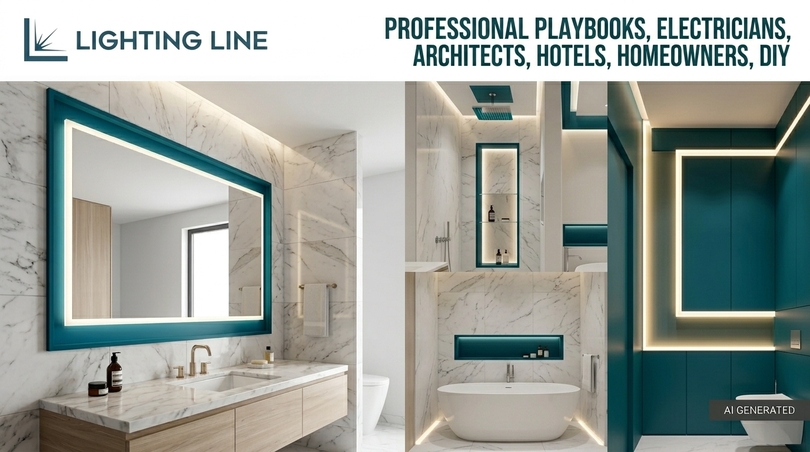
Different people ask different questions about bathroom wall lighting. An electrician worries about cable entries; a hotelier worries about maintenance budgets; a homeowner worries about looking good at 7 a.m. This section answers each group directly, so you can jump to your own role and leave with a plan.
For interior designers
Your brief: bathroom wall lighting that elevates the project, performs functionally and satisfies demanding clients. Design the light first, then choose the objects.
What type of bathroom wall lighting works best in a contemporary interior design project?
Linear vertical light at the mirror, delivered by recessed profiles or slim wall-mounted bars, is the current benchmark. It gives the best face lighting and the cleanest look. Add one decorative element, a sculptural sconce or a glowing niche, to give the room personality.
Which bathroom wall lights provide accurate colour rendering for make-up and grooming?
Specify CRI Ra ≥ 90 with R9 > 50 and a 3000-4000K colour temperature. Request the photometric datasheet; reputable suppliers publish CRI and colour consistency. The Lighting Line COB 3000K strip rated CRI Ra > 93 is a strong baseline for mirror profiles.
What IP rating should I choose near a sink or shower?
Beside the basin, IP44 is normally sufficient. Near or in the shower, IP65. Inside a bath or shower tray, IP67 with SELV supply. When the client’s cleaning routine involves hand showers or jets, specify IP65 even at the basin.
Designer’s specification tips
- Show light lines on elevations, not just on ceiling plans.
- Specify finish, diffuser type, colour temperature, CRI, IP and dimming for every light line.
- Coordinate profile lengths with tile modules to avoid cut tiles at the ends.
- Request a sample of the profile with diffuser lit at site to approve the effect.
For electrical installers
Your brief: reliable products, simple installation, compatibility with modern installations and full compliance in wet locations. Treat every bathroom wall lighting job as a special location from the first site visit.
What IP rating is required for bathroom wall lighting installations?
UK and IEC-based markets: IPX7 (plus SELV) in zone 0, IPX4 in zones 1 and 2, IPX5 where jets are used for cleaning; no specific IP outside the zones, though IP44 is good practice. See the full table in the regulations section.
How do I install LED wall lights safely in a bathroom?
- Isolate the circuit, lock off and prove dead.
- Confirm the zone of each light position and select the matching IP rating.
- Confirm 30 mA RCD protection on the circuit.
- Locate LED drivers outside the zones, accessible and ventilated.
- Use appropriately rated cable, glands and sealed connections; maintain the fitting’s IP rating at the cable entry.
- Test insulation resistance, continuity, polarity and RCD operation; certify and notify where required.
What wiring and mounting requirements should I check before installation?
- Wall construction (tile on board, block, plasterboard) and fixing method.
- Depth available for recessed profiles and back boxes.
- Cable route avoiding safe-zone conflicts in walls, especially behind tiled surfaces.
- Driver location, access for replacement and heat dissipation.
- Dimming protocol compatibility between switch, driver and strip.
- Earthing requirements: Class I fittings need a protective conductor; Class II fittings do not.
How can I prevent condensation and moisture from damaging bathroom wall lights?
Ventilation first: an extractor fan sized to the room, with an overrun timer, prevents more lighting failures than any gasket. Then: choose the correct IP rating, seal cable entries, fit end caps properly on profiles, avoid installing fittings on cold external walls without insulation, and orient cable entries downward where possible so water cannot run in.
For architects
Your brief: discreet, high-performance fittings that balance aesthetics, visual comfort and compliance. Profiles are architecture’s native lighting language.
How can minimalist bathroom wall lighting enhance a small architectural space?
Lit vertical surfaces expand perceived volume. A single plaster-in vertical light line beside a flush mirror can double the apparent depth of a narrow en-suite. Remove visual clutter, keep one colour temperature and let the walls glow.
How do I avoid glare when positioning wall lights around a bathroom mirror?
Use large, low-luminance sources (opal diffusers, long profiles), keep spotlights out of the field of view, set side lights 5–15 cm from the mirror edge and avoid clear or prismatic covers at eye level. Dim to 30–50% in evening scenes.
What technical specifications should be included in a bathroom lighting plan?
See the specification template below. At minimum: zone drawing, luminaire schedule with IP, CCT, CRI, lumen output, dimming method, driver location, circuit allocation, control scenes and maintenance access.
For hotel operators and property managers
Your brief: durability, low maintenance, low consumption and a guest experience consistent with your brand. In hospitality, bathroom wall lighting is a revenue asset: guests judge rooms by the bathroom mirror and post the photos.
What bathroom wall lighting is best for hotels and high-traffic properties?
Integrated LED or profile-based systems with IP44–IP65 ratings, high CRI, robust aluminium bodies and standardised drivers. Standardise one strip specification and one driver model across all rooms to simplify spares.
How can I reduce maintenance costs with commercial bathroom wall lights?
- Choose systems where the strip and driver can be replaced without removing the visible profile.
- Keep drivers in accessible service voids, not sealed behind tiles.
- Specify long-life LEDs and drivers with appropriate warranties.
- Avoid decorative glass that breaks easily or traps insects and dust.
- Use absence sensors to reduce operating hours.
Which LED wall lights offer the best energy efficiency for hotel bathrooms?
Look at system efficacy (lumens per watt after diffuser and driver losses), not just strip efficacy. Combine an efficient strip with a clear-to-opal diffuser chosen to the minimum diffusion that still hides the dots, plus dimming and presence control. The energy saved by control often exceeds the difference between two efficient strips.
What lighting designs create a premium guest experience?
Flattering mirror light, a soft night light that guests can find in the dark, an illuminated shower niche and a relaxing evening scene. Premium is felt in the mirror and in the dark.
Are bathroom wall lights available with replaceable components?
Yes. Profile systems are modular by nature: profile, diffuser, end caps, strip and driver are separate parts. Lighting Line supplies every component individually, fromdiffusers to end caps and PCB connectors.
How can I ensure bathroom wall lighting meets commercial safety and durability standards?
Require CE/UKCA documentation, EN 60598 compliance, stated IP and IK ratings, and installation by qualified contractors with certification. Keep the documentation in the building’s operation and maintenance file.
For homeowners
Your brief: elegant, practical, affordable light that makes the mirror useful without major works. The single most effective upgrade is replacing one over-mirror light with lighting on both sides of the mirror.
What is the best bathroom wall lighting for applying make-up?
Diffused light on both sides of the mirror at eye height, 3000–4000K, CRI 90+. A profile-framed mirror or two vertical light bars achieve this in any style.
Can I install bathroom wall lighting without rewiring the entire room?
Often yes. If there is already a lighting point above the mirror, an electrician can usually extend it to both sides, or fit a mirror lighting system fed from the existing point. A 24V strip system needs only one mains connection for the driver; the low-voltage cables to the profiles are thin and easier to route. Any work inside the zones in England is notifiable, so use a registered electrician.
Are LED bathroom wall lights energy-efficient and long-lasting?
Yes. Quality LEDs typically last tens of thousands of hours and use a fraction of the energy of halogen. In a bathroom used two to three hours a day, that is many years of operation.
How do I choose bathroom wall lights that match a modern vanity?
Match the finish of the vanity’s handles or the tap, keep shapes linear if the vanity is linear, and align the light’s height with the mirror. A black or silver profile echoing the vanity frame looks intentional.
For DIY and renovation enthusiasts
Your brief: a project you can do safely, affordably and beautifully. The rule is simple: you can plan, buy, cut and assemble; a qualified electrician should make the mains connection and certify work in the zones.
What is the easiest bathroom wall lighting to install as a DIY project?
A plug-free, low-voltage profile under a vanity or on a shelf outside the zones, powered by a driver an electrician connects to an existing circuit. Surface profiles that clip onto mounting brackets are the simplest to fit.
Can I install a bathroom wall light over an existing electrical box?
Yes, if the box is in a suitable position and zone, is securely fixed, and the new fitting’s base covers it and keeps its IP rating. Check that the fitting’s mounting plate matches the box fixing centres.
What tools do I need to install bathroom wall sconces safely?
Voltage tester (two-pole), insulated screwdrivers, drill with tile and masonry bits, spirit level, tape measure, wall plugs and screws suited to the substrate, cable strippers, silicone sealant suitable for bathrooms, and for profiles a fine-tooth saw or mitre saw with an aluminium blade. Always isolate the circuit first.
How do I choose a moisture-resistant wall light for a small bathroom?
Check the IP rating against the zone, prefer sealed integrated LED or IP65 strip-in-profile solutions, and choose corrosion-resistant finishes (anodised aluminium, chrome, lacquered brass).
What mistakes should I avoid when installing wall lighting near a bathroom mirror?
Placing lights too high, using only top light, mixing colour temperatures, choosing clear glass, leaving profile ends unsealed and hiding drivers where they cannot be reached. The full list follows in the mistakes section.
Installation and maintenance step by step
A well-chosen product installed carelessly will fail in a humid room. This section gives a general installation sequence for sconces and for LED profile systems, followed by maintenance routines that keep bathroom wall lights looking and performing like new. It is guidance for planning, not a replacement for a qualified electrician.
How to install bathroom sconces
- Plan positions using the heights in the placement section, mark centres with a level.
- Check zones and IP for each position.
- Isolate and prove dead the lighting circuit.
- Route the cable to each position within permitted wall zones; in tiled walls, plan before tiling.
- Fix the mounting plate with plugs and screws suited to the substrate; seal penetrations through tiles.
- Connect live, neutral and protective conductor (for Class I) in the fitting’s terminal block; keep the gasket in place.
- Mount the body and diffuser, tightening to compress gaskets evenly.
- Test operation, RCD trip and dimming; certify.
How to install an LED profile for bathroom wall lighting
- Measure and cut the profile and diffuser to length with a fine-tooth aluminium blade; deburr.
- Prepare the strip: cut only at marked points; solder or use the correct PCB connector.
- Clean the inside of the profile with isopropyl alcohol and apply the strip’s adhesive tape along the centre.
- Feed the cable through the end cap; in wet areas use a sealed cable entry.
- Install the profile: clips or brackets for surface types, tile adhesive for tiling types, plaster or filler for drywall types, following the product drawing.
- Insert the diffuser and fit the end caps,; seal with neutral-cure silicone where required for IP.
- Connect to the driver, located outside the zones, observing polarity.
- Test and check for uniformity and colour match before finishing surrounding surfaces.
Tile and plaster tips for recessed profiles
- Set tiling profiles before the tiles, aligned with tile courses, use spacers to keep the gap constant.
- Protect diffusers with masking tape during grouting and plastering.
- Leave a service loop of cable at the driver end.
- For drywall profiles, use the recommended filler and a scrim tape to prevent hairline cracks along the edges.
Bathroom lighting wiring guide: the essentials
| Item | Good practice |
|---|---|
| Circuit protection | 30 mA RCD (RCBO preferred for discrimination) |
| Switching | Outside zones 0-2 (UK) or pull cord; SELV switches where permitted |
| Drivers | Outside zones, ventilated, accessible, sized at 120-125% of load |
| Low-voltage cable | Sized for current and voltage drop; separate from mains where required |
| Connections | In accessible enclosures or maintenance-free connectors rated for the location |
| Documentation | Zone drawing, circuit chart, product datasheets, certificates |
Bathroom light fixture maintenance
Cleaning bathroom wall lights
- Isolate before cleaning fittings that must be opened.
- Use a soft cloth with mild, pH-neutral detergent, avoid abrasive pads and solvent cleaners on diffusers.
- Wipe limescale from metal finishes regularly, diluted vinegar is effective on chrome but test on brass and black finishes first.
- Never spray cleaning products directly into fittings or profile ends.
Periodic checks
- Every year: inspect gaskets, end caps and silicone seals; reseal where cracked.
- Every year: check for condensation inside diffusers (a sign of a seal failure or poor ventilation).
- Every five years or at change of occupancy: electrical inspection of the installation.
Replacing lamps and strips
With replaceable-lamp fittings, use the same lamp type, wattage and colour temperature. With profile systems, remove the end cap and diffuser, peel the old strip and install a new one of identical specification. Keep a short spare length of strip from the original batch for colour-matched repairs.
Common bathroom wall lighting mistakes
Most failed bathroom lighting schemes fail in the same ways. This section lists the most frequent design and installation errors, why they matter and how to avoid them.
| Mistake | Consequence | Fix |
|---|---|---|
| Only a ceiling light above the mirror | Shadows under eyes, nose and chin | Add side lighting at eye height |
| Wall lights mounted too high | Behave like downlights | Centre at 1.50-1.70 m |
| Clear glass or exposed lamps at the mirror | Glare in reflection | Opal diffusers |
| Wrong IP for the zone | Non-compliance, failure, risk | Select IP by zone, IP65 near showers |
| Driver hidden behind tiles | Costly replacement; overheating | Accessible, ventilated location outside the zones |
| Mixed colour temperatures | Disjointed, smaller-looking room | One CCT per scene, same product family |
| Low-CRI strips at the mirror | Dull, unnatural skin tones | CRI ≥ 90 |
| Ignoring diffuser losses | Scheme too dim | Calculate lumens after diffuser |
| Visible dots in mirror reflection | Cheap appearance | COB or high-density strip, deeper profile |
| Unsealed profile ends in wet areas | Water ingress, corrosion | Correct end caps and sealing |
| No night light | Dazzle and falls at night | Low-level sensor-controlled light |
| Poor ventilation | Condensation in fittings | Extractor with overrun timer |
| Incompatible dimmer | Flicker, buzz, limited range | Match dimmer and driver |
Nine out of ten of these mistakes are decided at the drawing stage, not on site. A lighting plan with heights, zones and a product schedule prevents nearly all of them.
Price bands and buying criteria
Bathroom wall lights range from budget fittings sold by DIY sheds to bespoke architectural systems. This section compares the price bands and lists the criteria that actually determine value over the life of an installation.
Retail fittings vs profile systems
Many buyers start by browsing mass-market ranges: bathroom wall lighting IKEA collections, screwfix bathroom lighting and wickes bathroom lighting aisles, homebase bathroom lighting, Next bathroom lights, wayfair bathroom lighting listings and bathroom wall lights on Amazon. These channels are convenient for standard, off-the-shelf fittings. Their limitation is choice of geometry and specification: fixed lengths, fixed colour temperatures, CRI rarely declared, and components that cannot be replaced separately. When a project needs a light line that fits a specific mirror, tile module or niche, or a verified CRI and IP rating, a profile-and-strip system is the professional alternative.
Bathroom wall lighting price ranges
| Band | Typical products | What you get | What to check |
|---|---|---|---|
| Entry | Basic IP44 sconces and bars | Compliance, basic function | CRI, flicker, glare, finish durability |
| Mid-range | Branded integrated LED fittings, illuminated mirrors | Better design, dimming options | Replaceability, warranty, colour consistency |
| Professional | Aluminium profiles with selected LED strips and drivers | Custom lengths, high CRI, any IP, replaceable components | Diffuser loss, driver quality, sealing |
| Luxury / bespoke | Designer sconces, custom-made profiles and strips | Unique design, top materials | Lead times, spares, documentation |
Bathroom wall lights buying guide: ten criteria
- IP rating matched to the zone.
- CRI ≥ 90 at the mirror.
- Colour temperature and colour consistency (≤ 3 SDCM).
- Lumen output after diffuser losses.
- Dimming method and compatibility.
- Replaceability of LED module, strip and driver.
- Certifications: CE / UKCA, EN 60598.
- Materials and finish suitable for humidity.
- Installation method suited to the wall build-up.
- Technical support and documentation from the supplier.
Best value bathroom lighting
Value is cost per year of good light, not purchase price. A profile system that lasts the life of the bathroom, with a strip changed once in fifteen years, often costs less over time than replacing two sealed fittings twice. Ask Lighting Line’s technical team for a project quotation through the online catalogue, the team supports professionals in selecting the most suitable profile, diffuser and strip for each application.
Technical specification template for a bathroom lighting plan
Architects, designers and contractors can copy this template into a project specification. It captures every parameter that affects performance and compliance of bathroom wall lighting.
| Field | Example entry |
|---|---|
| Location / zone | Wall beside basin, zone 2 (BS 7671 Section 701) |
| Luminaire / system | Recessed aluminium profile + LED strip + opal diffuser |
| Profile code and finish | e.g. LLP-MR01-03, anodised silver |
| Length and mounting | 2 × 700 mm vertical, centred at 1,600 mm AFF, 100 mm from mirror edge |
| LED strip | COB, 24V, 3000K, CRI Ra > 90, approx. 790 lm/m |
| IP rating of assembly | IP44 minimum (IP65 if within spray) |
| Driver | SELV, dimmable, 30 W, located in ceiling void outside zones |
| Control | Dimmer outside bathroom, scene “Morning” / “Evening” |
| Circuit | Lighting circuit 3, 30 mA RCBO |
| Target performance | ≥ 300 lux vertical on face at 1,600 mm |
| Maintenance access | Driver via ceiling hatch, strip via removable end cap |
| Documentation | Datasheets, photometric test, installation certificate |
Final checklist
Before you order, before you install and before you sign off, run through this bathroom wall lighting checklist. It summarises the essential criteria for safe, functional, efficient and stylish results.
| # | Check | Done |
|---|---|---|
| 1 | Zones drawn on plan and elevation | ☐ |
| 2 | IP rating chosen per zone (IP44 / IP65 / IP67 + SELV) | ☐ |
| 3 | Side lighting at the mirror, centred 1.50-1.70 m | ☐ |
| 4 | CRI ≥ 90 at the mirror, one colour temperature per scene | ☐ |
| 5 | Lumen budget calculated after diffuser losses | ☐ |
| 6 | Ambient, accent and night layers defined | ☐ |
| 7 | Dimming method matched across switch, driver and strip | ☐ |
| 8 | Drivers outside zones, accessible, ventilated | ☐ |
| 9 | 30 mA RCD protection confirmed | ☐ |
| 10 | Switch positions compliant | ☐ |
| 11 | End caps, glands and seals specified | ☐ |
| 12 | Finishes coordinated with taps and hardware | ☐ |
| 13 | Ventilation adequate to prevent condensation | ☐ |
| 14 | Certification and notification arranged | ☐ |
| 15 | Spare strip from the same batch stored | ☐ |
If every box is ticked, your bathroom wall lighting will be compliant, flattering and built to last. To turn the plan into a product list, browse the Lighting Line aluminium profiles and LED strips, or contact the technical team at [email protected] with your drawings.
Frequently Asked Questions
These are the questions people ask most often about bathroom wall lighting, answered briefly and precisely. Click a question to open the answer.
What is the best type of wall lighting for a bathroom?Diffused light on both sides of the mirror at eye height, with CRI 90+ and 3000–4000K. Opal-shade sconces or vertical LED profiles with opal diffusers deliver it best, supported by a separate ambient layer. |
What type of lighting is best for a bathroom overall?Layered lighting: task light at the mirror from the walls, ambient light from the ceiling or wall-wash profiles, accent light in niches, and a low night light. Each layer ideally on its own control. |
What is the general rule for lighting in a bathroom?Light the face from the front and sides, light the room from walls and ceiling, keep sources diffused, match colour temperatures and respect the IP requirements of each zone. |
What is the current trend in bathroom lighting?Integrated linear light: vertical bars or recessed profiles beside mirrors, illuminated shower niches, backlit mirrors, warm-dim control and dark or warm metal finishes. |
What type of lighting is most flattering for a bathroom?Diffused, warm-neutral (3000–3500K), high-CRI light from both sides of the mirror at face height. It removes shadows and renders skin tones naturally. |
Are there special lights for bathrooms and showers?Yes. Bathroom and shower lights carry IP ratings (IP44, IP65, IP67) that suit wet zones, and shower fittings or strips often operate at SELV voltage (12V or 24V DC) with the driver outside the zones. |
Are wall lights still fashionable? Are wall sconces outdated?Wall lights are firmly in fashion. Dated designs look old, not the idea itself. Slim linear lights, integrated profiles and sculptural sconces are all current. |
Are wall sconces good for bathroom lighting?Yes, in pairs beside the mirror with diffused shades and a suitable IP rating. A single sconce, or clear glass, gives uneven light and glare. |
Are sconces enough lighting for a bathroom?In small bathrooms and cloakrooms, often yes. In larger rooms add ambient light from the ceiling or a wall-wash profile. |
Are LED lights good, safe and suitable for bathrooms?Yes. LEDs run cool, switch on instantly, last long and are available in sealed high-IP versions. Safety depends on matching the IP rating to the zone, using RCD protection and keeping drivers outside the zones. |
Are LED lights safe in a shower?Yes, if rated for the location (IP65 or higher in spray, IP67 with SELV in zone 0), fed at extra-low voltage and installed on an RCD-protected circuit by a qualified electrician. |
Are lights allowed in showers?Yes, provided they meet the zone requirements of your national rules. In the UK: IPX7 and SELV in zone 0, IPX4 minimum in zone 1 (IPX5 if water jets are used). |
Are all LED lights suitable for bathrooms?No. IP20 strips and open fittings must stay outside the zones and away from steam. Check the IP rating of the whole assembly, including end caps and cable entries. |
Are spotlights good, safe and suitable for bathrooms?Yes for ambient and accent light, if rated for their zone and fire-rated where required. Avoid using them as mirror lights because of glare and hard shadows. |
Are LED ceiling lights OK for bathrooms?Yes, with the right IP rating. Avoid placing one directly above the user at the mirror; use wall light for the face. |
Are IP44 lights suitable for bathrooms?Yes, in zones 1 and 2 and outside the zones. Use IP65 where the fitting may receive direct spray or jets. |
Is IP44 or IP65 better for bathrooms?IP44 meets the minimum for zones 1 and 2; IP65 is better near showers, in wet rooms and wherever jets or hand showers are used for cleaning. |
Do I need IP44 or IP65 for a bathroom?IP44 beside the basin; IP65 in or next to the shower; IP67 plus SELV inside the bath or shower tray. |
Can you put wall lights in a bathroom?Yes. Wall lights are recommended in bathrooms, provided their IP rating and electrical class suit the zone and the installation complies with national rules. |
Can you use normal wall lights in a bathroom?Only outside the zones and away from steam, and even there IP44 is good practice. In zones 1 and 2 you need at least IPX4. |
Do you need special wall lights in a bathroom?In the zones, yes: IP-rated fittings. Outside the zones, standard fittings are legally possible in the UK, but humidity makes IP-rated products the better choice. |
Can you have a wall-mounted light switch in a bathroom?In the UK, only outside zones 0–2, unless it is a SELV switch or pull cord. Many UK bathrooms use a pull cord or a switch outside the door. Other countries have their own limits. |
Should bathroom wall lights face up or down?For grooming, choose diffused fittings that glow towards the user. Up-light suits ambience; down-light alone creates shadows. Dual-emission profiles combine both for wall washing. |
How high should bathroom wall lights be?Centre at roughly 1.50–1.70 m above finished floor beside the mirror, 75–100 cm apart. Over-mirror bars at about 1.90–2.00 m. |
What is the best light for a small bathroom?Flush vertical light beside the mirror or a framed mirror profile, plus one ambient source. Lit walls make small rooms feel larger. |
Where do you put lights in a small bathroom?Beside or around the mirror first, then a ceiling or cove light, then a low night light under the basin. |
What colour temperature is best for a bathroom?3000K for a relaxing yet practical bathroom; 3500–4000K at the mirror for detailed grooming; tunable white for both. |
What CRI do I need for make-up lighting?CRI Ra 90 or higher, with R9 above 50 for accurate skin tones. |
Are LED bathroom wall lights worth it?Yes: lower energy use, long life, sealed construction, precise colour and slim designs. |
Are rechargeable wall lights any good?Useful for rentals and decorative or night light outside the wet zones; rarely sufficient as main grooming light. |
Can bathroom wall lights be dimmed?Yes, with a compatible dimmable driver and dimmer. In the UK, the dimmer must be outside the zones unless it is a SELV device. |
What is zone 1 in a UK bathroom?The area above the bath or shower tray up to 2.25 m from the floor (or the shower head height if higher). Fixed equipment there needs at least IPX4. |
Can I use LED strips in a bathroom?Yes. Use IP65 or higher strips in sealed profiles within the zones, 24V or 12V SELV supply, and drivers outside the zones. Lighting Line offers IP65 COB strips and waterproof aluminium profiles. |
Which Lighting Line profiles are designed for bathrooms?The mirror profile LLP-MR01-03, tiling profiles LLP-TI01-11, LLP-TI02-10 and LLP-TI03-10, the waterproof surface profile LLP-SL10-13, plus wall, drywall and furniture profiles for vanities and niches. |
Do I need an electrician to install bathroom wall lights?For mains connections and any work in the zones, yes. In England, additions or alterations within the zones are notifiable under Part P. In Italy, DM 37/2008 requires a qualified company and a declaration of conformity. |
Sources and further reading
This guide draws on international and national standards, regulatory guidance and Lighting Line’s own photometric testing. For the full text of each standard, consult the publishing body.
- IET, BS 7671 Wiring Regulations, Section 701 (locations containing a bath or shower).
- UK Government, Approved Document P: Electrical safety in dwellings.
- Comitato Elettrotecnico Italiano,CEI 64-8, Part 7, Section 701.
- IP code (IEC 60529) reference.
- US Department of Energy, LED Lighting.
- IEC 60364-7-701, DIN VDE 0100-701, NF C 15-100, REBT ITC-BT-27, NFPA 70 (NEC); AS/NZS 3000, I.S. 10101, EN 60598, EN 12464-1, Regulations (EU) 2019/2020 and 2019/2015.
- Lighting Line,profiles catalogueand LED strip catalogue, including goniophotometer test data.
Light the face, light the walls, respect the zones
Great bathroom wall lighting comes down to three decisions: put diffused, high-CRI light beside the mirror at eye height; use walls, not just ceilings, to light the room; and choose every product by the zone it sits in. LED strips in aluminium profiles give designers, architects and installers the freedom to do all three with one coherent system, in any length, any finish and any IP rating the project needs. Start with the mirror profile, add tiling profilesfor the walls and a waterproof profile for the shower, and your bathroom wall lighting will be as compliant as it is beautiful.
This article was developed with the support of artificial intelligence and subsequently reviewed, corrected, and validated by the LightingLine.eu technical team, which guarantees its reliability and compliance with official sources.