Supermarket lighting LED linear systems combine continuous aluminium profiles and high-CRI LED strips to light ceilings, shelves and refrigerated cases from one modular family. A typical sales floor needs 300-500 lux on the floor, 300-750 lux on vertical shelf faces and up to 1,000 lux on fresh-food counters, with CRI 90+ and UGR ≤ 22.
Walk into any well-run supermarket and you rarely notice the lighting. You notice the strawberries that look freshly picked, the price labels you can read without squinting, the aisle that seems to invite you further in. That invisible effect is engineered, and in most modern stores it is engineered with linear light. For installation companies, and in particular for the many contractors who have built their business on street and outdoor lighting and now want to move into retail interiors, supermarket lighting is a natural next step: the photometric logic is familiar, the projects are large and repeatable, and the margins reward specialists who understand standards, optics and controls.
This guide is written for those installers, and for the people they work with: store owners, retail chain buyers, lighting designers, visual merchandisers, facility managers and sustainability consultants. It explains how to light a supermarket with linear LED profiles and strips, how many lux each department really needs, which regulations apply in the UK, Italy, the rest of Europe and the main markets worldwide, and how to turn all of that into a project that saves energy, sells more and stays easy to maintain. Every recommendation is linked to real products from the Lightingline catalogue of aluminium profiles and LED strips, so you can move from theory to a bill of materials in a single read.
In this article…
- Why supermarket lighting matters: sales, perception and behaviour
- Design objectives and lighting requirements for retail
- Types of lighting used in supermarkets and retail stores
- How many lux is a supermarket? Illuminance levels by area
- Supermarket lighting standards and regulations worldwide
- Anatomy of a supermarket lighting LED linear system
- Ceiling lighting: continuous lines, recessed and suspended profiles
- Shelf and gondola lighting: vertical illuminance done right
- Refrigeration lighting: chillers, freezers and cold rooms
- Department by department: entrance to checkout
- Colour temperature and colour rendering for food
- Uniformity, glare, flicker and visual comfort
- Smart controls, DALI and why supermarkets leave lights on at night
- Energy efficiency, sustainability and ESG reporting
- Costs, ROI, total cost of ownership and financing
- Installation guide: how to get supermarket lights together
- Multi-store rollouts, tenders and choosing a supplier
- Maintenance and lifecycle management
- Small, independent and luxury supermarket lighting ideas
- The newest trends in supermarket lighting
- Common supermarket lighting mistakes to avoid
- Best practices and a worked project example
- Final design checklist
- Frequently asked questions
- Illuminating the future of retail
1. Why supermarket lighting matters: sales, perception and behaviour
Before we talk about lux, profiles and drivers, it is worth answering the question every client eventually asks: why spend serious money on light when the shelves are full and the doors are open? The short answer is that light is the one merchandising tool that touches every product, every square metre and every minute of opening hours at the same time. It shapes what shoppers see first, what they trust, how long they stay and how tired the staff feel at the end of a shift. This section explains the mechanisms behind that effect so that installers can talk about value, not just fittings.
How lighting shapes the shopping experience
Shopping is overwhelmingly visual. A shopper scans a shelf in a fraction of a second, and the eye is drawn first to contrast and brightness. When vertical surfaces are lit evenly and the products are rendered with natural colour, the shopper reads the shelf faster, finds what they came for and has more attention left for things they did not plan to buy. When the shelf is dim at the bottom, glaring at the top and tinted by a poor light source, the shopper works harder, decides faster and leaves sooner.
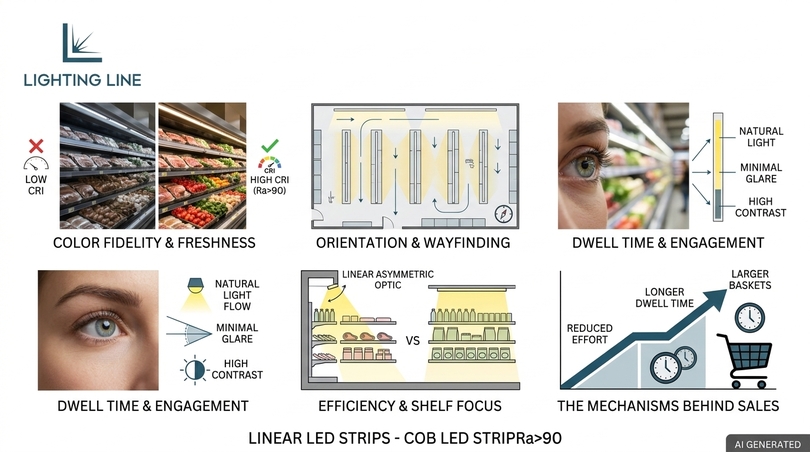
Good supermarket lighting reduces the effort of shopping, and reduced effort translates into longer dwell time and larger baskets. Retail research has consistently associated better-lit, more legible displays with longer browsing and higher engagement with products, although the size of the effect varies widely between studies and store formats. For an installer, the practical lesson is simple: sell the client on legibility and freshness, not on “more light”.
Perceived quality and freshness
Food is judged by colour. Shoppers read the redness of meat, the green of leafy vegetables, the golden crust of bread and the gloss of fish as signals of freshness. A light source with a poor red component (low R9) makes beef look brown and tomatoes look dull; an overly cool light makes bread look stale. Linear LED strips with CRI above 90, such as the 2700K COB LED strip with CRI Ra>90 and 120 lm/W, render these colours faithfully while staying efficient.
Orientation and wayfinding
Continuous lines of light are natural guides. A line that runs along an aisle tells the shopper where the aisle goes; a change in brightness or colour temperature tells them they have entered a different department. Linear light is the most legible wayfinding tool a supermarket has, and it costs nothing extra once the ceiling lines are installed.
Why are supermarket lights so bright?
Supermarkets use bright light for several overlapping reasons. First, the work of the space is reading: labels, prices, use-by dates and nutrition panels all require good vertical illuminance. Second, bright, even light signals cleanliness and safety, which matters enormously for food retail. Third, high vertical brightness on shelves increases the visibility of the merchandise compared with the floor and ceiling, pulling the eye towards products. Finally, many stores were historically lit with fluorescent batten grids designed to deliver high horizontal illuminance cheaply, and shoppers came to associate that bright, flat look with “supermarket”.
Modern design challenges the last point. A supermarket can feel bright while using less energy if the light lands on the shelves rather than the floor. That is exactly what asymmetric linear optics do, and we look at them in detail in the shelving section.
Lighting, consumer behaviour and the store as a brand
Lighting is also a brand statement. A discount format typically uses higher, cooler and flatter light to communicate efficiency and value. A premium or organic grocer uses warmer light, stronger contrast and more accent lighting to communicate care and quality. Neither is wrong; the mistake is applying the wrong one to the wrong brand. Installers who ask the client “what should your store feel like?” before quoting tend to win projects and keep them.
| Lighting decision | What the shopper perceives | Business effect |
|---|---|---|
| High vertical illuminance on shelves | Products are easy to find and read | Faster navigation, more time for impulse purchases |
| CRI 90+ with good R9 | Food looks natural and fresh | Higher trust in fresh departments, less waste from “tired-looking” stock |
| Warm accents on bakery and deli | Inviting, artisanal atmosphere | Supports premium pricing |
| Even, glare-free ceiling lines | Calm, clean, organised store | Longer dwell time, better staff comfort |
| Brightness contrast on promotions | Promotions stand out | Higher sell-through of promoted lines |
| Uncontrolled glare and dark spots | Tiring, cheap or unsafe store | Shorter visits, more complaints |
Where the energy goes: lighting in the supermarket energy balance
Lighting is one of the largest electrical loads in a supermarket after refrigeration. Industry and government energy-efficiency programmes have commonly estimated that refrigeration accounts for roughly 40–50% of a food store’s electricity and lighting for around 15–25%, depending on format, opening hours and how much lighting is already LED. In older stores still running T5 or T8 fluorescent grids, the lighting share sits at the top of that range. Lighting inside refrigerated cabinets counts twice: once as electricity for the light and again as heat that the refrigeration system has to remove. That double effect is one of the strongest arguments for low-power LED strips in chillers and freezers.
2. Design objectives and lighting requirements for retail
Every supermarket lighting project balances functional and aesthetic objectives. Functional objectives come from standards and safety law: enough light to work, move and read safely, limited glare, emergency escape lighting. Aesthetic and commercial objectives come from the brand: product presentation, atmosphere, promotion. A third group of objectives, increasingly important, comes from the finance and sustainability teams: energy use, maintenance cost and measurable carbon reduction. The best supermarket lighting LED linear designs satisfy all three groups with the same set of fittings, rather than adding separate systems for each.
Functional objectives
Safety and visual tasks
Staff in a supermarket stock shelves, operate tills, cut meat and fish, handle pallets and clean. Customers walk, reach, read and push trolleys. The European standard EN 12464-1 (lighting of indoor workplaces) sets minimum maintained illuminance, uniformity, glare and colour-rendering values for sales areas, tills and storage, and national laws in the UK, Italy and elsewhere refer to it either directly or through workplace health and safety guidance. Meeting those values is the floor, not the target.
Visual comfort
Shoppers look along aisles, often towards the ceiling line, and staff look up to high shelves. Bare LED points, unshielded high-power downlights and reflections in glossy floors or glass doors all create discomfort. Diffused linear light with a controlled optic is inherently more comfortable than a grid of point sources at the same illuminance.
Orientation and safety in emergencies
Escape routes, exits and fire equipment must be lit even when the mains fails. In most jurisdictions, emergency lighting is designed to its own standard (EN 1838 in Europe, BS 5266-1 in the UK), and linear systems can include emergency modules in selected runs or be complemented by dedicated emergency luminaires.
Commercial and aesthetic objectives
- Product presentation: high vertical illuminance and good colour rendering on the merchandise.
- Hierarchy: brighter or warmer zones for fresh food, promotions and premium categories; calmer light in circulation.
- Brand coherence: the same colour temperature, finish and line language across every store in a chain.
- Architectural quality: clean lines that align with gondolas, ceilings and signage instead of a random grid.
Economic and environmental objectives
- Low installed power density (W/m²) while meeting illuminance targets.
- Long life with predictable lumen maintenance, ideally L80 or better at 50,000 hours.
- Controls that reduce consumption during low-traffic periods, restocking and cleaning.
- Serviceability: strips, drivers and diffusers that can be replaced without replacing the whole run.
What lighting is required for retail stores?
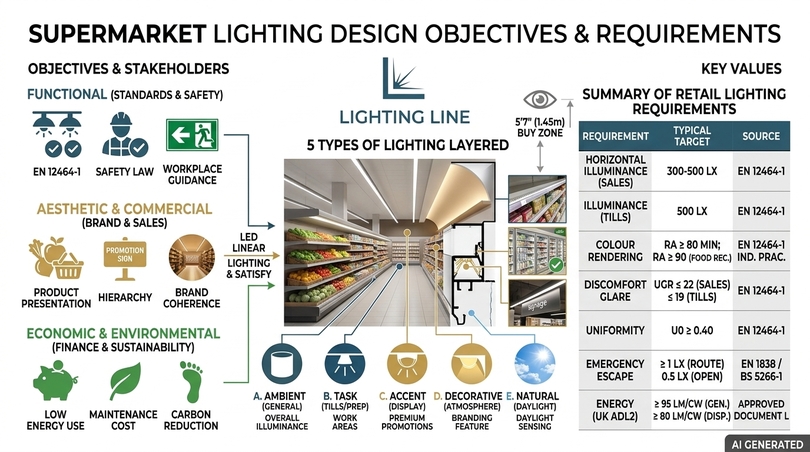
In plain terms, a retail store needs four things. It needs general lighting that meets the workplace standard for sales areas (typically 300–500 lux maintained on the horizontal plane, with good uniformity). It needs vertical lighting on merchandise, because shoppers look at shelves, not floors. It needs task lighting at tills, counters and preparation areas (around 500 lux or more). And it needs emergency lighting that meets fire-safety law. Everything else, from accent lighting to dynamic colour, is a commercial choice layered on top.
| Requirement | Typical target | Source |
|---|---|---|
| Horizontal illuminance, sales area | 300 lx (small store) to 500 lx (large store), maintained | EN 12464-1:2021, retail premises |
| Illuminance, till / checkout area | 500 lx | EN 12464-1:2021 |
| Colour rendering | Ra ≥ 80 minimum; Ra ≥ 90 recommended for food | EN 12464-1 minimum; industry practice for fresh food |
| Discomfort glare | UGR ≤ 22 (sales area), ≤ 19 (tills) | EN 12464-1 |
| Uniformity on task area | U0 ≥ 0.40 (sales area) | EN 12464-1 |
| Emergency escape lighting | ≥ 1 lx on centre line of escape routes; 0.5 lx open areas | EN 1838 / BS 5266-1 |
| Energy (UK new build and major works) | ≥ 95 luminaire lm per circuit-watt, general lighting, ≥ 80 light-source lm per circuit-watt, display lighting | Approved Document L, Volume 2 (2021) |
Values in the table are typical references; always check the current edition of the standard and local law for your project.
3. Types of lighting used in supermarkets and retail stores
Ask a lighting designer what kind of lighting is used in supermarkets and you will get an answer in layers. Ask a shopper and you will get “bright”. Both are right. This section unpacks the vocabulary, from the classic five types of lighting to the trade terms used in grocery, and shows where linear LED profiles fit into each layer. Understanding the layers is the fastest way to explain a supermarket lighting design to a client who is not a lighting specialist.
What are the five types of lighting?
Most retail lighting guides group light into five types. They are not separate products so much as separate jobs, and one linear system can do several of them.
| Type | Job in the store | Typical linear solution |
|---|---|---|
| Ambient (general) | Overall illuminance for safe movement and a uniform look | Continuous suspended or recessed lines with opal diffuser |
| Task | Light for working: tills, counters, preparation areas | Recessed or surface profiles above counters, 4000K, high CRI |
| Accent | Highlighting products, promotions and premium zones | Narrow-beam lenses, shelf-edge strips, warm COB in display niches |
| Decorative | Atmosphere, branding, architectural features | Cove lighting, coloured or tunable strips, signage backlighting |
| Natural (daylight) | Free light from skylights and façades | Daylight sensors dimming the nearest linear runs |
What is grocery store lighting called?
In the trade, you will hear several names. “General lighting” or “ambient lighting” describes the ceiling layer. “Merchandise lighting”, “shelf lighting” or “gondola lighting” describes light aimed at the vertical faces of shelving. “Case lighting” or “cabinet lighting” refers to the strips inside refrigerated display cases. “Accent” or “display lighting” refers to highlighting. The overall discipline is usually called retail lighting or visual merchandising lighting, and the specific approach of using continuous lines of light is called linear lighting or continuous-row lighting. Lighting in stores generally, whether supermarkets or fashion, falls under the same retail lighting umbrella.
What type of lighting is used in supermarkets today?
Today almost every new or refurbished supermarket uses LED. The main families are:
- Continuous linear LED lines suspended above aisles or recessed into the ceiling, often running parallel to the gondolas.
- LED trunking systems, a rail with clip-in light modules, common in large hypermarkets.
- LED strips in aluminium profiles used for shelf edges, refrigerated cases, counters, coves and signage.
- Track spotlights and downlights for accents on fresh food, wine and promotions.
- High-bay LED luminaires in warehouse-style formats with high ceilings and in back-of-house storage.
Fluorescent tubes, once the default, are being phased out by law in Europe and the UK, which is driving a wave of retrofits. Metal halide, once common for accent lighting, has largely disappeared because LED offers comparable punch with far better efficiency and colour stability.
Which lamps are used for malls and supermarkets, and why?
Malls and supermarkets use LED because it is the only technology that combines high efficacy (often above 120–150 lm/W at source level), long life (50,000 hours or more), instant start, full dimmability, no UV content near food and no mercury. For supermarkets specifically, LED’s low heat radiation towards the product and its excellent performance at low temperatures make it the obvious choice for refrigerated displays. Fluorescent output drops sharply in the cold; LED output actually tends to rise slightly as junction temperature falls.
What type of lamp is best suited for general lighting of a supermarket?
For general lighting, the best choice is a continuous linear LED luminaire with a controlled optic: either an opal diffuser for soft, low-glare ambient light or a lens (60°, 90° or asymmetric) to direct light where it is needed. Linear systems produce fewer, longer, lower-luminance light sources than point fittings, so they spread light more evenly and with less glare. They also align with the store’s geometry, which point grids rarely do. Built from modular profiles such as the 36x75mm suspension aluminium profile, a linear line can house two 10mm strips, a slim power supply and a choice of diffusers or lenses.
What are the 4 C’s of lighting?
There is no single official definition of the “4 C’s of lighting”, and different authors use the phrase differently. A useful version for supermarket work is:
- Colour: colour temperature and colour rendering (CCT and CRI/R9).
- Contrast: the ratio between highlighted products and their surroundings.
- Coverage: illuminance levels and uniformity on floors and, above all, on vertical shelf faces.
- Control: glare control through optics, and energy control through dimming, sensors and scheduling.
If a design gets these four right, it is very rarely wrong.
What is the 5’7″ (5–7) lighting rule?
The “5’7″ rule” (sometimes written as “57-inch rule” or “5 7 rule”) comes from galleries and interior design: the centre of a picture is hung at about 57 inches, or roughly 1.45 m, which corresponds to average adult eye height. In retail, the same idea applies to the eye-level shelf zone, roughly 1.2 to 1.6 m above the floor, often called the “buy zone”. Products placed there sell best, so it is the zone where vertical illuminance and colour rendering matter most. When you choose an asymmetric lens for a ceiling line or a shelf-edge strip, check the vertical illuminance curve specifically at this height.
What type of lighting is best for retail and for a shop?
The best lighting for a retail store or shop is layered: a calm ambient layer, strong vertical light on merchandise, and accents on what you want to sell. For grocery, add high colour rendering and efficient case lighting. For a showroom, which also answers the question “what lights are used in showrooms?”, the accent layer grows and the ambient layer shrinks, because the products are fewer and more valuable. For a small workshop or back-of-house work area, the priority is task light: 500 lux or more on the work plane, 4000K, CRI 80+ and good glare control.
4. How many lux is a supermarket? Illuminance levels by area
This is the most searched question in supermarket lighting, and also the one most often answered badly. A single number is never enough, because a supermarket is not one space but a dozen: entrance, aisles, shelf faces, checkouts, fresh counters, refrigerated cases, storage and offices. The right question is not “how many lux is a supermarket?” but “how many lux, on which plane, in which area, maintained over how many years?” This section gives clear numbers and explains the logic behind them.
The standard lux for a supermarket under EN 12464-1
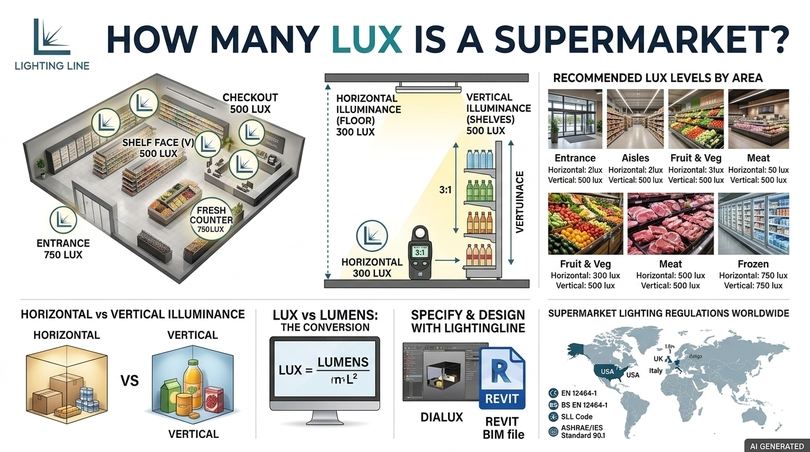
EN 12464-1:2021, the European standard for indoor workplace lighting adopted in the UK as BS EN 12464-1 and in Italy as UNI EN 12464-1, distinguishes between small and large retail sales areas. As a general reference, the standard gives 300 lux maintained for sales areas in small shops and 500 lux for large retail premises such as supermarkets, with 500 lux at till areas and wrapping tables. The 2021 edition also introduced “modified” illuminance values, higher figures that designers should apply when visual tasks are critical, when errors are costly or when occupants are older. For many supermarkets, using the modified values on fresh-food counters and checkouts is good practice.
Horizontal versus vertical illuminance
The 300–500 lux values refer to the horizontal reference plane (typically the floor or a working height). But in a supermarket, shoppers look at shelves. Vertical illuminance on shelf faces is the metric that actually sells products, and a good design typically targets 300–750 lux on the vertical, with a ratio of top-shelf to bottom-shelf illuminance no worse than about 3:1. EN 12464-1:2021 also gives explicit attention to vertical and cylindrical illuminance, reflecting how people really see spaces.
Recommended lux levels by supermarket area
| Area | Horizontal (lux) | Vertical on merchandise (lux) | CCT | CRI |
|---|---|---|---|---|
| Entrance and lobby | 500-750 (daytime transition) | 300-500 on promotional displays | 3000-4000K | ≥ 80 |
| Main aisles, dry grocery | 500 | 300-500 | 3500-4000K | ≥ 80, preferably 90 |
| Small store sales floor | 300-500 | 300-500 | 3000-4000K | ≥ 80 |
| Fruit and vegetables | 500-750 | 750-1,000 | 3000-4000K | ≥ 90 |
| Meat counter | 500 | 750-1,000 on product | 2700-3000K or meat-specific spectrum | ≥ 90, high R9 |
| Fish counter | 500 | 750-1,000 on product | 4000-5000K | ≥ 90 |
| Bakery | 500 | 500-750 | 2700-3000K | ≥ 90 |
| Dairy and chilled cases | – | 500-1,000 inside cabinet | 4000K | ≥ 80-90 |
| Frozen food cabinets | – | 500-1,000 inside cabinet | 4000-5000K | ≥ 80 |
| Checkout / tills | 500 (modified up to 750) | – | 4000K | ≥ 80 |
| Promotional and seasonal areas | 500-750 | 1.5-3× surrounding level | As brand | ≥ 90 |
| Storage and back-of-house | 100-300 | – | 4000K | ≥ 60-80 |
| Meat and fish preparation rooms | 500 | – | 4000K | ≥ 80-90 |
Ranges combine EN 12464-1 minimums with common industry practice for food retail. Use them as design targets, then verify with a calculation.
What is the lux level for a supermarket in the US and other markets?
In North America, the Illuminating Engineering Society (IES) provides recommended practice for retail lighting, with target illuminances in a similar range to Europe for general merchandise areas and higher values for feature displays. Australia and New Zealand use AS/NZS 1680, Japan uses JIS Z 9110, and many other countries either adopt EN 12464-1 directly or base their national codes on it. Across markets, the answer converges: roughly 300–500 lux of ambient light, 500 lux at checkouts, and two to three times that on featured fresh products.
Lux versus lumens: the conversion installers keep asking about
Lumens describe how much light a source emits; lux describes how much light falls on a surface (one lux equals one lumen per square metre). A strip rated at 1,260 lm/m does not give 1,260 lux; how many lux it produces depends on distance, optic, room reflectances and maintenance. A quick average estimate uses the lumen method:
Average illuminance (lux) = total lumens × utilisation factor × maintenance factor ÷ area (m²)
For supermarkets with light-coloured floors and ceilings, a utilisation factor of 0.5–0.7 for linear lines and a maintenance factor of 0.8 are reasonable starting assumptions. For anything beyond a budget estimate, use photometric data in DIALux or Relux. Lightingline publishes photometric tests and offers a lux calculation for specific installations, together with BIM files for Revit to drop profiles straight into the design model.
Measuring illuminance on site
Commissioning should include measurements with a calibrated lux meter on a grid, a routine that street lighting installers already know well from road lighting surveys. Measure horizontal values at floor level in aisles, vertical values on shelf faces at 0.3 m, 1.0 m, 1.5 m and top-shelf height, and record values at checkouts and counters. A simple commissioning report with measured values is one of the strongest trust signals you can hand to a retail client.
5. Supermarket lighting standards and regulations worldwide
Regulation shapes supermarket lighting in three ways: workplace standards set how much light is needed, energy rules limit how much electricity may be used to produce it, and product rules decide which light sources may be sold at all. Food-safety law adds a fourth dimension specific to grocery. For installers working across borders, and for chains rolling out one concept in several countries, the details matter. The good news is that the technical core is remarkably similar worldwide; the differences lie in energy limits, documentation and enforcement. What follows is an overview, not legal advice: always check the current text and any local amendments for your project.
European Union: the common framework
EN 12464-1:2021, indoor workplaces
The core European standard for lighting levels, uniformity, glare (UGR) and colour rendering in workplaces, including retail premises. It is a technical reference rather than a law in itself, but national workplace safety rules point to it, so in practice it defines compliance.
Ecodesign and the new lighting legislation
When people ask “what is the new lighting legislation?”, in Europe they usually mean a group of linked changes. The Ecodesign Regulation (EU) 2019/2020 on light sources and separate control gears sets minimum efficiency and functional requirements, including limits on flicker (Pst LM) and stroboscopic effect (SVM), and has applied since September 2021. Alongside it, the energy labelling regulation (EU) 2019/2015 introduced the rescaled A–G label for light sources, which is why many perfectly efficient LED strips show classes such as E, F or G: the new scale is deliberately demanding. Finally, the revised RoHS exemptions ended the placing on the market of most T5 and T8 fluorescent tubes in 2023, which made fluorescent maintenance stock harder to source and pushed many supermarkets into LED retrofits.
Emergency lighting: EN 1838 and EN 50172
EN 1838 sets illuminance and duration for escape route and open-area (anti-panic) emergency lighting; EN 50172 covers system design and testing. Supermarkets, with large open sales floors and many occupants, typically need both escape-route and anti-panic lighting.
Energy performance of buildings
The Energy Performance of Buildings Directive, transposed into national law, drives lighting energy limits and calculation methods such as LENI (Lighting Energy Numeric Indicator, EN 15193-1). The recast directive pushes the existing building stock towards zero-emission performance, which keeps lighting upgrades on the agenda for every large retail portfolio.
United Kingdom
Since leaving the EU, the UK has kept most of the same technical standards under BS EN numbering, with its own energy and product legislation running in parallel.
- Workplace lighting: the Workplace (Health, Safety and Welfare) Regulations 1992 require suitable and sufficient lighting; HSE guidance HSG38 and the CIBSE Society of Light and Lighting’s Code for Lighting provide the practical benchmarks, closely aligned with BS EN 12464-1.
- Energy: Approved Document L, Volume 2 (Buildings other than dwellings), in force in England since June 2022, requires general lighting to achieve an average of 95 luminaire lumens per circuit-watt (or meet the LENI route) and display lighting to achieve 80 light-source lumens per circuit-watt, or stay within 0.3 W/m² per space, or meet LENI. Wales, Scotland and Northern Ireland have equivalent rules. Consultations on the next uplift have proposed tighter values, so check the edition in force when you quote.
- Fluorescent phase-out: Great Britain ended the sale of most T5 and T8 fluorescent tubes in September 2023 under its own ecodesign and RoHS rules.
- Emergency lighting: BS 5266-1 and the Regulatory Reform (Fire Safety) Order 2005 (England and Wales), with equivalents elsewhere in the UK.
A practical warning for UK projects: Part L counts luminaire lumens per circuit-watt for general lighting. If you build a continuous line from a 120 lm/W strip, a lens that absorbs about 19% and a driver that is 92% efficient, the system delivers roughly 120 × 0.81 × 0.92 ≈ 89 luminaire lm per circuit-watt, which falls short of 95. For general lighting in new UK builds or controlled refurbishments, either specify higher-efficacy strips, choose the optic with the lowest loss, or demonstrate compliance via the LENI route with controls. For display lighting, which is measured at light-source level, the same strip at 120 lm/W with a 92% efficient driver delivers about 110 lm per circuit-watt, comfortably above 80.
Italy
- Workplace lighting: D.Lgs. 81/2008 (Testo Unico sulla sicurezza) requires adequate natural and artificial lighting in workplaces; UNI EN 12464-1 provides the technical values.
- Emergency lighting: UNI EN 1838 and UNI 11222 (periodic checks and maintenance), together with fire prevention rules for commercial activities, which for larger stores fall under the national fire-prevention code and its technical rule for retail activities.
- Energy and public procurement: the Criteri Ambientali Minimi (CAM) set environmental criteria for lighting in public works and influence private specifications too; energy-efficiency incentives such as the Conto Termico and the Transizione 5.0 plan have, at various times, supported LED upgrades for businesses, subject to their specific conditions and deadlines.
- Light pollution: many Italian regions have strict laws on outdoor lighting, relevant to supermarket car parks and façades, a familiar area for street lighting installers.
Germany, France and Spain
- Germany: the Workplace Ordinance (ArbStättV) and the technical rule ASR A3.4 define lighting at work, aligned with EN 12464-1. The Building Energy Act (GEG) covers energy performance, using DIN V 18599 calculations for lighting energy.
- France: the Labour Code (articles R4223-1 and following) sets minimum workplace lighting. The “décret tertiaire” requires large commercial buildings to cut final energy consumption progressively (−40% by 2030 compared with a reference year). France also regulates night-time lighting: rules on light nuisance require illuminated advertising and shop-window lighting to be switched off during night hours, with local exceptions.
- Spain: Royal Decree 486/1997 sets minimum workplace lighting, and the Technical Building Code (CTE DB-HE3) limits lighting energy using the VEEI indicator (W/m² per 100 lux) and installed power per area, with specific limits for commercial spaces.
United States and Canada
- Energy codes: ASHRAE/IES Standard 90.1 and the International Energy Conservation Code (IECC) set maximum lighting power densities for retail sales areas and require automatic shut-off, occupancy and daylight controls. California’s Title 24, Part 6 is among the strictest codes. Values change with each edition, so always use the version adopted by your state.
- Recommended practice: IES publications provide target illuminances for retail and food stores.
- Safety: NFPA 101 (Life Safety Code) and local fire codes govern emergency lighting; products are typically listed to UL standards (UL 2108 for low-voltage lighting systems, UL 8750 for LED equipment).
- Canada: the National Energy Code of Canada for Buildings and provincial codes set lighting power limits; CSA standards cover product safety.
Australia, Japan, China, India and the Middle East
| Country / region | Lighting levels reference | Energy / product rules |
|---|---|---|
| Australia & New Zealand | AS/NZS 1680 series (interior lighting) | National Construction Code Section J (lighting power limits); MEPS for lighting products |
| Japan | JIS Z 9110 (lighting levels) | Top Runner programme for lighting efficiency |
| China | GB 50034 (standard for lighting design of buildings) | Lighting power density limits within GB 50034; national efficiency standards |
| India | National Building Code, Part 8 (lighting) | Energy Conservation Building Code (ECBC) lighting power limits |
| Gulf states | Often EN 12464-1 or CIBSE references | Local green building codes (e.g. Estidama in Abu Dhabi, Dubai Green Building Regulations) |
What are the lighting standards for the food industry?
Food law adds requirements that general retail does not have. In the EU and UK, Regulation (EC) 852/2004 on food hygiene requires food premises to have adequate natural or artificial lighting. In practice, food-safety schemes such as BRCGS and IFS, and national inspectors, expect shatter-protected or non-glass luminaires in areas where food is handled or exposed, cleanable surfaces, and lighting sufficient for inspection and cleaning. Polycarbonate or PMMA diffusers on aluminium profiles meet this need far better than bare tubes.
A second food-specific issue is honest presentation. EU food information law (Regulation 1169/2011) prohibits misleading consumers about the characteristics of food. Food authorities in several countries have challenged lighting that makes meat or fish look fresher than it is, for example strongly red-biased light on meat. The safe professional position is to use high-CRI light that flatters food by rendering it accurately, not by distorting its colour.
Global summary for installers
| Topic | UK | Italy / EU | USA |
|---|---|---|---|
| Lighting levels | BS EN 12464-1, SLL Code | UNI EN 12464-1 | IES recommended practice |
| Energy limits | Approved Document L (lm/W or LENI) | EPBD transpositions, national rules, CAM (public) | ASHRAE 90.1 / IECC / Title 24 (LPD) |
| Product efficiency and flicker | GB ecodesign rules | Ecodesign Reg. (EU) 2019/2020 | DOE rules, ENERGY STAR / DLC (voluntary) |
| Emergency lighting | BS 5266-1 | EN 1838, EN 50172, UNI 11222 | NFPA 101, local fire codes |
| Food hygiene | Retained Reg. 852/2004, FSA guidance | Reg. (EC) 852/2004 | FDA Food Code |
6. Anatomy of a supermarket lighting LED linear system
A linear LED luminaire is not a single product but a kit: an aluminium profile, one or more LED strips, a diffuser or lens, end caps, mounting accessories, connectors and a power supply. Installers coming from street lighting are used to buying a sealed luminaire with a known photometry. With linear systems, the installer, or the designer, effectively assembles the luminaire, which means every choice affects light output, efficiency, thermal life and compliance. Understanding each component is what separates a professional supermarket lighting LED linear installation from a DIY one.
The aluminium profile
The profile does three jobs: it holds the strip, it dissipates heat, and it shapes the look of the line. Aluminium is the material of choice because it conducts heat well and extrudes into precise, rigid shapes. The Lightingline range includes more than a hundred profiles in families that map neatly onto supermarket applications:
| Profile family | Supermarket use | Example products |
|---|---|---|
| Suspension | Continuous lines above aisles, fresh-food islands and checkouts | 36x75mm, 50x75mm, 60x73mm |
| Recessed | Flush lines in false ceilings, counters and furniture | 67x22mm, 32x25mm, 37x15mm |
| Drywall | Seamless lines plastered into plasterboard ceilings and walls | Trimless profiles for premium formats |
| Surface | Shelf edges, counters, signage, refrigerated case canopies | 36x26mm, 21x25mm, 17x7mm |
| Corner | 45° light on shelves and display niches from an internal corner | Corner profiles for gondola and wall units |
| Furniture | Integrated lighting in shelving, counters and display cabinets | Furniture-integrated profiles |
| Architectural | Coves, feature walls, entrances and brand zones | Architectural profiles |
The LED strip: SMD versus COB
Lightingline offers both SMD LED strips and COB LED strips. SMD strips use discrete LED packages; they are efficient and available in many outputs. COB (chip-on-board) strips use a dense line of tiny chips under a continuous phosphor layer, producing a dot-free line with a wide 180° beam, ideal for shallow profiles, shelf edges and glossy surfaces where reflections of individual dots would look cheap. Key parameters to check on every strip are voltage (24V is the professional standard for runs of several metres; 48V allows longer runs), power per metre, lumens per metre, efficacy (lm/W), CRI and R9, cut length and IP rating.
Diffusers and lenses: the optic decides the result
The optic is where most of the lighting design happens. Lightingline’s photometric tests on the 36x75mm suspension profile give a clear, original picture of the trade-off between comfort and efficiency:
| Optic | Measured loss of output | Best supermarket use |
|---|---|---|
| Opal or frosted diffuser, position 1 (outer) | −32% | Soft ambient light, low glare in low ceilings |
| Opal or frosted diffuser, position 2 (flat) | −41% | Maximum uniformity and visual comfort |
| Narrow lens (60° range) | −17% | High ceilings, focused light on fresh islands |
| 90° lens | −19% | General aisle lighting with good efficiency |
| Asymmetric lens | −21% | Throwing light onto one shelf face from a line off-centre |
| Double-asymmetric lens | −14% | Lighting both shelf faces of an aisle from a central line |
The double-asymmetric lens is the standout result for supermarkets: it loses the least light (−14%) and sends it exactly where shoppers look, onto the two facing gondolas. Lenses for the CL01-06 profile are available as double-asymmetric, asymmetric, 90° and 60° versions, used with a dedicated heat sink inside the profile. You can browse all diffusers in the catalogue.
End caps, brackets, junctions and connectors
Small parts make or break a long line. End caps close the profile and often provide the cable entry, mounting brackets and springs fix it, suspension kits with adjustable wire hang it, metal junctions, 90° horizontal junctions and 120° junctions let you build continuous lines, L-shapes and geometric patterns, PCB LED strip connectors join strips without soldering.
Power supplies and drivers
Constant-voltage drivers (24V or 48V DC) feed the strips. For supermarkets, choose drivers with high efficiency (above 90%), a high power factor, low ripple to avoid flicker, a DALI or DALI-2 interface where dimming is required, and a long warranty. Several Lightingline suspension profiles, including the 36x75mm, are designed to house a slim power supply inside the profile, which keeps ceilings clean and simplifies installation.

7. Ceiling lighting: continuous lines, recessed and suspended profiles
The ceiling layer is where most of the installed power, and most of the installation labour, sits. It is also where linear lighting delivers its biggest advantages over a grid of downlights or panels: fewer suspension points per lumen, cleaner alignment with gondolas, better vertical light on shelves and a strong architectural identity. In a supermarket lighting LED linear project, the ceiling layout is the first decision and the one that drives every other choice. This section explains how to choose between suspended, recessed and plaster-in lines, how to lay them out, and how to size them.
Suspended supermarket lighting LED linear lines for open ceilings
Many supermarkets, especially big-box and hypermarket formats, have open ceilings with exposed services at 4–7 m. Suspended linear lines bring the light source down to a useful height (typically 2.8–4 m above the floor), hide the clutter above and give the store a defined “ceiling” of light. Profiles such as the 36x75mm, the 50x75mm and the 60x73mm are designed for this role, with up to two strips, internal power supply space and modular junctions for continuous runs.
Aisle-aligned versus cross-aisle lines
Lines running parallel to the gondolas, centred over the aisles, are the most efficient way to light shelf faces, especially with a double-asymmetric lens. Lines running across the aisles give a more uniform horizontal light and are less sensitive to future changes in shelving layout, but they light the shelf faces less efficiently. If the shelving plan is stable, align with the aisles; if the client re-merchandises often, consider a cross-aisle or grid layout with diffused optics.
Mounting height and spacing
As a rule of thumb for parallel aisle lines, mount the profile at 2.8-3.5 m with one line per aisle and check vertical uniformity from the top shelf (around 1.8-2.0 m) down to the lowest shelf (0.2-0.3 m). For cross-aisle lines with diffusers, the spacing-to-height ratio usually sits around 1:1 to 1.5:1 to keep horizontal uniformity above 0.4–0.6. Always confirm with photometric software.
Recessed lines: clean ceilings in smaller formats
Convenience stores, urban supermarkets and premium grocers often have suspended ceilings at 2.7–3.2 m. Recessed profiles such as the 67x22mm recessed profile or the 32x25mm recessed profile create flush lines that read as part of the architecture. With lower ceilings, glare control matters more: use deep-set strips with opal diffusers in circulation areas and lenses only where the line runs directly above shelving.
Drywall profiles: seamless premium lines
For premium supermarkets and food halls, drywall profiles are plastered into plasterboard ceilings so that the light appears as a slot with no visible frame. They require coordination with the drylining contractor, but the result is the cleanest possible ceiling, which matters when the store is selling a premium experience.
Geometric layouts and brand zones
Junctions at 90° and 120° allow rectangles, hexagons and continuous patterns over bakery islands, wine departments or entrance areas. These shapes act as landmarks; shoppers navigate by them. A single distinctive light shape over a fresh-food island can do more for brand recognition than any amount of signage.
Worked example: sizing a ceiling line for a dry-grocery aisle
Consider an aisle 2.4 m wide and 20 m long, with gondolas 1.8 m high on both sides, and a target of 500 lux horizontal and around 400-500 lux average vertical on the shelf faces.
- Area: 2.4 m × 20 m = 48 m².
- Required lumens (lumen method): 500 lx × 48 m² ÷ (UF 0.6 × MF 0.8) = 50,000 lm at source.
- Per metre of line: 50,000 lm ÷ 20 m = 2,500 lm/m at source.
- Strip choice: two strips of around 1,260 lm/m (for example a 10.5 W/m, 120 lm/W COB strip) give 2,520 lm/m at about 21 W/m.
- Optic: a double-asymmetric lens (−14%) puts most of that light on the two shelf faces, which is what the shopper sees.
- Installed power: 21 W/m × 20 m ≈ 420 W, plus driver losses, about 455 W, or roughly 9.5 W/m² for the aisle.
This is a simplified estimate: a real calculation with the actual photometric file, room reflectances and shelf geometry will refine it, and controls will cut the energy in use. Lightingline’s comparative product range helps you match profile sizes to strip widths and outputs.
Ceiling profile selection for supermarket lighting LED linear layouts
| Ceiling type | Height | Recommended profile | Optic |
|---|---|---|---|
| Open ceiling, hypermarket | 5–8 m | Suspended 36x75mm / 50x75mm / 60x73mm, hung at 3–4 m | Double-asymmetric or 90° lens |
| Suspended tile ceiling, mid-size store | 3–3.5 m | Recessed 67x22mm or 32x25mm | Opal over circulation, lens over shelves |
| Plasterboard ceiling, premium grocer | 2.8–3.2 m | Drywall profile | Opal diffuser |
| Fresh-food island | Any | Suspended geometric layout with 90° or 120° junctions | Narrow lens for punch, warm CCT |
| Checkout line | Any | Suspended or recessed line parallel to tills | Opal diffuser for UGR ≤ 19 |
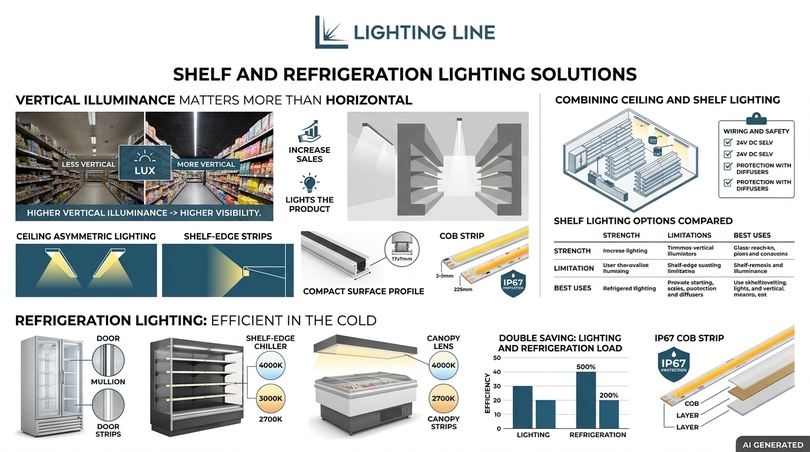
8. Shelf and gondola lighting: vertical illuminance done right
Shelves are where purchases happen, and yet in many stores they are the worst-lit surfaces in the building: bright at the top, dim at the bottom, shadowed by the shelf above. Shelf lighting fixes that. It can come from the ceiling (with asymmetric optics), from the shelves themselves (with shelf-edge strips) or from both. Integrated shelf lighting is the most direct way to raise sales per metre of shelving, because it lights the product rather than the aisle. This section shows how to do it with linear profiles and strips.
Why vertical illuminance matters more than horizontal
A shopper standing in an aisle sees the shelf face, not the floor. If the ceiling layer provides 500 lux on the floor but only 150 lux on the bottom shelf, the products on the bottom shelf are effectively invisible. Shelf-edge lighting evens out the vertical distribution, so every shelf position, not just the eye-level zone, earns its keep.
Ceiling-mounted asymmetric lighting
An asymmetric lens directs light sideways onto a vertical surface. A double-asymmetric lens does this in two directions at once, making it ideal for a line centred over an aisle. The advantage is simplicity: no wiring in the shelving, no interference with merchandising. The limitation is the bottom shelf, which receives the least light from above, especially with deep shelves.
Shelf-edge strips in supermarket lighting LED linear designs
Strips mounted under the front edge of each shelf, facing down and slightly back, light the products on the shelf below. Compact surface profiles such as the 17x7mm, the 27x7mm or the 8x10mm fit under shelf lips, corner profiles fit the angle between shelf and back panel and throw light at 45°. COB strips are preferred here because their dot-free line looks clean even when shoppers see it directly, and their wide beam spreads evenly across the shelf depth.
Recommended power for shelf-edge lighting
Shelf-edge strips do not need much power: typically 5–10 W/m is enough at close range. Higher power risks glare and wastes energy. A 6 W/m COB strip with CRI above 90 is a good starting point for dry grocery; fresh produce shelving may justify 10 W/m or more.
Combining ceiling and shelf lighting
The most effective strategy is to let the ceiling provide the ambient layer and most of the vertical light, and use shelf-edge strips only where they add measurable value: deep shelves, bottom shelves, premium categories and refrigerated multidecks. This avoids paying for shelf lighting where a good ceiling optic already does the job.
Wiring and safety in shelving
- Use 24V DC for all shelf-integrated strips: SELV voltage is safer around customers and staff.
- Route cables through the gondola uprights and use plug-in connectors so shelves can be moved.
- Protect strips with diffusers; shoppers will touch them, and so will cleaning cloths.
- Plan for re-merchandising: shelves change height several times a year.
| Option | Strengths | Limitations | Best for |
|---|---|---|---|
| Ceiling line with double-asymmetric lens | No wiring in shelving, efficient, flexible | Weaker on bottom shelves | Dry grocery, household |
| Shelf-edge COB strip | Even vertical light, product sparkle | Wiring per shelf, needs flexibility | Premium categories, cosmetics, wine |
| Corner profile at back of shelf | Hidden source, 45° light | Depends on shelf construction | Wall units, display niches |
| Canopy light on multideck | Lights upper shelves and branding | Does not reach lower shelves alone | Refrigerated multidecks |
9. Refrigeration lighting: chillers, freezers and cold rooms
Refrigerated displays are some of the most demanding environments for any light source: low temperatures, condensation, frequent door openings, glass reflections and continuous operation. They are also some of the most rewarding to upgrade, because every watt saved in a cabinet saves electricity twice. LED strips in IP-rated profiles have become the standard for refrigerated case lighting because they thrive in the cold, produce little radiant heat and fit into the thin mullions and shelf edges of modern cabinets. This section covers the practical details.
Why supermarket lighting LED linear strips work so well in the cold
Fluorescent tubes lose a large share of their output at low temperatures and take time to reach full brightness. LEDs, by contrast, run more efficiently as temperature drops, start instantly and are unaffected by frequent switching. They also emit very little infrared towards the product, which helps preserve the appearance of sensitive foods.
The double saving: lighting load and refrigeration load
Every watt of lighting inside a refrigerated cabinet ends up as heat that the refrigeration system has to remove. With typical system efficiencies, removing that heat costs an additional fraction of a watt in compressor power, so cutting cabinet lighting from, say, 30 W to 12 W per metre saves both the 18 W of lighting and a further share of compressor energy. Exact numbers depend on the cabinet and plant, but this effect is why refrigeration retrofits often show the fastest payback in the whole store.
IP ratings and materials
Inside chillers and freezers, choose strips with IP65 or IP67 protection. The Lightingline 4000K COB LED strip, 6 W/m, IP67 with extruded silicone tube, and its 3000K and 2700K versions, combine CRI above 90 with a narrow 3mm PCB, a cut point every 2.5 cm and full encapsulation, which suits door mullions and shelf edges in refrigerated cases. Where a profile is needed, waterproof options such as the 32x10mm recessed waterproof profile add mechanical protection.
Condensation and cleaning
Door openings bring warm, humid air into contact with cold surfaces. Seal end caps and cable entries carefully, avoid cable joints inside the cold zone where possible, and choose silicone-encapsulated strips that tolerate regular cleaning with food-safe detergents.
Where to put the light in a refrigerated cabinet
| Cabinet type | Light position | Recommended solution |
|---|---|---|
| Glass-door reach-in chiller or freezer | Vertical door mullions, lighting shelves sideways | IP67 COB strip, 6–10 W/m, 4000K |
| Open multideck chiller | Canopy and shelf edges | Shelf-edge strips + canopy profile with lens |
| Serve-over counter (meat, fish, deli) | Under canopy, aimed at product | High-CRI strip with narrow or asymmetric optic |
| Island freezer | Ceiling line above, sometimes lid frame | Ceiling lens over island + optional IP67 strip in frame |
| Cold room / walk-in | Ceiling | IP65+ linear fitting, 4000K, 200–300 lux |
Colour temperature inside refrigerated cases
Dairy and frozen products are usually lit at 4000K, which gives a clean, fresh impression and makes white packaging look white. Cooler light (5000K and above) emphasises “cold” and can work for frozen and fish, but it can make some packaging look bluish. Meat counters benefit from warmer light with strong red rendering, and bakery cabinets from 2700–3000K. Keep colour temperature consistent within each department so shoppers do not see a patchwork of whites across adjacent cases.
10. Department by department: entrance to checkout
A supermarket is a sequence of experiences, and each one asks something different of the light. The entrance must welcome and adapt the eye; the aisles must be legible; the fresh departments must sell quality; the checkouts must be comfortable for staff working long shifts. Designing zone by zone, rather than applying one fitting everywhere, is what makes a store feel considered rather than merely lit. Here is how linear profiles and strips handle each zone.
Entrance and lobby
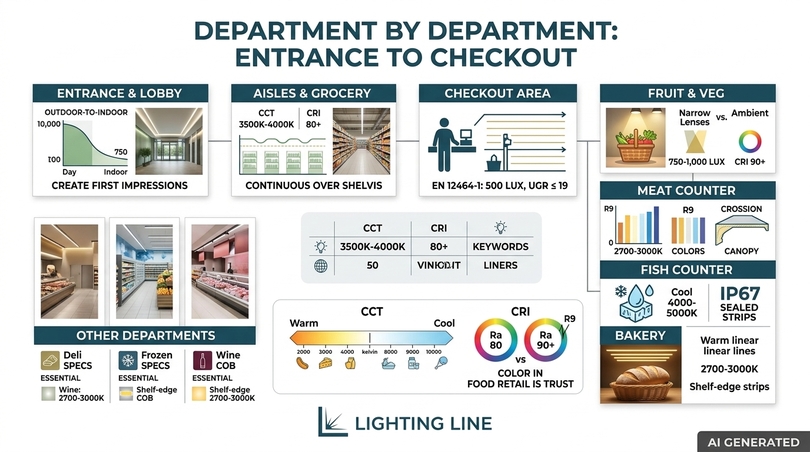
During the day, shoppers arrive from outdoor light levels that can exceed 10,000 lux. A bright entrance (500-750 lux or more by day, dimmed at night) eases the transition and creates a first impression. Supermarket lighting LED linear lines here often take architectural forms, such as geometric patterns or coves, and highlight seasonal displays. Daylight sensors should dim the entrance automatically when daylight falls, which is also when the contrast with outside is lowest.
Aisles and dry grocery: supermarket lighting LED linear at its most efficient
Aisles are about legibility and efficiency. Use continuous lines aligned with the aisles, double-asymmetric optics, 3500-4000K and CRI 80–90. Keep the ceiling line luminance moderate to avoid glare when shoppers look down the aisle. Consider presence-based dimming in low-traffic aisles during off-peak hours.
Checkout area
The checkout combines a task area (tills, scanners, card readers) with the store’s last impression. EN 12464-1 asks for 500 lux and UGR ≤ 19 at tills, stricter than the sales floor. Lines running parallel to the checkout belts with opal diffusers deliver even light without reflections in screens. Remember the cashiers: they look at screens and customers for hours, so glare control here is a health and productivity issue, not just a comfort detail.
Fruit and vegetables
Fresh produce is the department that sets the tone of the whole store. Use high vertical illuminance (750-1,000 lux on the product), CRI 90+, and 3000-4000K. Narrow lenses or accent spotlights over the displays, combined with a slightly lower ambient level in the department, create contrast that makes the produce glow. Avoid excessive heat on the product: linear LED radiates very little infrared.
Meat counter
Meat needs strong red rendering (high R9) and warmer light, typically 2700–3000K, or a specialised meat spectrum that remains within honest colour rendering. Use high-CRI strips under the counter canopy, aimed at the product with a narrow or asymmetric optic, and keep the ambient light around the counter calm to maximise contrast. The 2700K COB strip at 120 lm/W, CRI above 90 is a strong candidate for canopy lighting.
Fish counter
Fish and seafood look freshest under neutral to cool light (4000–5000K), which makes ice look white and scales look bright. High CRI matters for the subtle pinks of salmon and shellfish. Fish counters are wet: use IP65 or IP67 strips and sealed profiles, and make sure all components tolerate humidity and cleaning.
Bakery
Bread and pastry look best under warm light, 2700–3000K, which brings out golden crusts. Linear lines over bakery shelves, warm COB strips inside display cases and shelf-edge strips under wooden shelving create a craft atmosphere. The bakery is also a good place for decorative architectural lighting that signals “fresh, made here”.
Dairy, deli and ready meals
Dairy cases are usually 4000K with even, efficient lighting. The deli and ready-meal counters often borrow from the meat and bakery approach: warmer light, high CRI, accent on the product. Keep cool and warm zones visually separated so the store does not look patchy.
Frozen food
Frozen cabinets need efficient, cold-tolerant lighting, typically 4000K or slightly cooler, delivered by IP67 strips in door mullions. The ceiling above freezer aisles can be slightly dimmer than elsewhere, since the cabinets themselves are lit.
Wine, spirits and premium categories
Premium categories benefit from lower ambient light, warmer colour temperature and accent lighting on shelves. Shelf-edge COB strips make bottles sparkle, and recessed or drywall lines give a boutique look within the supermarket.
Promotional areas and gondola ends
Promotions need contrast: aim for 1.5 to 3 times the surrounding vertical illuminance. Gondola-end lighting with short profile sections and a narrow lens, or a dedicated line above the promotion zone, focuses attention. Tunable or dynamic lighting can support seasonal campaigns.
Back-of-house, storage and preparation rooms
Storage areas need 100–300 lux, presence sensors and robust fittings. Preparation rooms for meat, fish and bakery need 500 lux, 4000K, high CRI for inspection, and shatter-protected, cleanable luminaires that meet food hygiene expectations.
| Department | Key goal | CCT | Linear solution |
|---|---|---|---|
| Entrance | Welcome, transition | 3000-4000K | Architectural lines, daylight dimming |
| Aisles | Legibility | 3500-4000K | Aisle-aligned suspended lines, double-asymmetric lens |
| Checkout | Comfort, accuracy | 4000K | Lines parallel to tills, opal diffuser |
| Produce | Freshness | 3000-4000K | Narrow lenses, high-CRI strips |
| Meat | Accurate red | 2700-3000K | High-R9 strips under canopy |
| Fish | Clean, bright | 4000-5000K | IP67 strips, sealed profiles |
| Bakery | Warmth | 2700-3000K | Warm COB in cases and shelves |
| Frozen | Efficiency | 4000-5000K | IP67 COB strips in mullions |
| Premium | Contrast, sparkle | 2700-3000K | Shelf-edge COB, drywall lines |
11. Colour temperature and colour rendering for food
Colour is where food retail lighting differs most from other retail. A fashion store can forgive a slight colour shift; a supermarket cannot, because shoppers judge freshness, ripeness and quality by colour. Getting colour temperature and colour rendering right is therefore not a matter of taste but of trust, waste reduction and compliance with food information rules. This section explains the metrics and how to choose them.
Colour temperature (CCT) in plain terms
Correlated colour temperature, measured in kelvin, describes whether white light looks warm (around 2700K, like incandescent light), neutral (around 4000K) or cool (5000K and above, like overcast daylight). Warm light flatters bread, wood and meat; neutral light suits general grocery and dairy; cool light suits fish, ice and frozen products.
What is the best colour temperature for grocery stores?
For the general sales floor, 3500–4000K is the most common and safest choice: it feels clean and bright without being clinical, and it renders packaging accurately. Premium stores often choose 3000K for a warmer, more welcoming atmosphere. Departments then deviate from that base where the product needs it.
Colour rendering: CRI, R9 and beyond
The colour rendering index (CRI or Ra) measures how faithfully a light source renders a set of test colours compared with a reference. Ra 80 is the minimum for workplaces under EN 12464-1, but Ra 90 or more is strongly recommended for food retail. Because the standard Ra is an average of eight pastel colours, it can hide poor rendering of saturated red. That is why lighting professionals also check R9 (saturated red), which is crucial for meat, tomatoes, berries and red packaging. Newer metrics such as TM-30 (Rf for fidelity and Rg for gamut) give a fuller picture and are increasingly specified for premium projects.
Tunable white and CCT strips
Tunable white strips allow colour temperature to be adjusted after installation. The Lightingline COB CCT strip 2700–6500K, CRI above 90, 7.7 W/m covers the whole range in one product, useful for flexible zones, seasonal campaigns or stores that want to fine-tune the atmosphere through the day.
Honest colour versus “flattering” colour
Specialised spectra can make food look more appealing. Used moderately, for example a meat spectrum with enhanced red that still has high fidelity, they are accepted practice. Used aggressively, they can mislead shoppers about freshness, which food authorities in several European countries have challenged. The professional rule: enhance, do not disguise.
| Category | CCT | Minimum CRI | Notes |
|---|---|---|---|
| General grocery | 3500-4000K | 80, preferably 90 | Accurate packaging colours |
| Fruit and vegetables | 3000-4000K | 90 | Good R9 for red fruit |
| Meat | 2700-3000K | 90, high R9 | Avoid misleading red-only spectra |
| Fish | 4000-5000K | 90 | Bright, clean appearance |
| Bakery | 2700-3000K | 90 | Golden crusts |
| Dairy, frozen | 4000-5000K | 80-90 | Clean whites |
| Wine, premium | 2700-3000K | 90 | Warm, boutique feel |
12. Uniformity, glare, flicker and visual comfort
Lighting quality is not just how much light there is, but how it is distributed and how it feels. Uneven light creates dark spots and makes the store look poorly maintained; glare tires shoppers and staff; flicker, even when invisible, can cause headaches. These issues are often the difference between a store that feels pleasant and one that customers leave without knowing why. Supermarket lighting LED linear systems, designed correctly, are among the best tools available for even, glare-free and flicker-free light.
Uniformity in supermarket lighting LED linear layouts
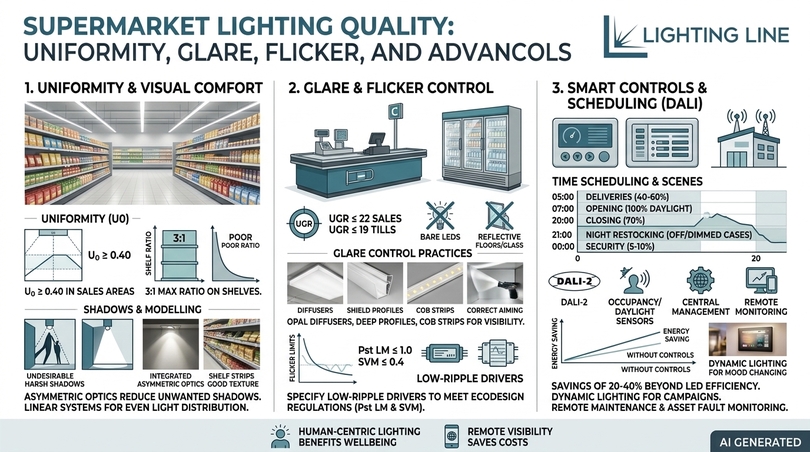
Uniformity (U0) is the ratio of minimum to average illuminance on a surface. EN 12464-1 typically asks for U0 ≥ 0.40 in sales areas and higher values in task areas. On shelves, a practical target is a top-to-bottom ratio no worse than about 3:1. Continuous lines naturally improve uniformity along their length; across the aisle, uniformity depends on the optic and spacing.
Shadows and modelling
Some shadow is good: it gives products shape and texture. Harsh shadows, for example from shelves cutting off ceiling light, are not. Asymmetric optics and shelf-edge strips reduce unwanted shadows on lower shelves.
Glare control in grocery stores
Discomfort glare is evaluated with the Unified Glare Rating (UGR). EN 12464-1 asks for UGR ≤ 22 in sales areas and ≤ 19 at tills. Glare sources in supermarkets include bare LED dots, high-luminance lenses seen along long aisles, reflections in glossy floors and in glass doors of refrigerated cases. Practical controls include:
- Using opal or frosted diffusers in circulation areas and over checkouts.
- Choosing deeper profiles that shield the source from low viewing angles.
- Aiming asymmetric optics at shelves rather than into the aisle.
- Using COB strips where the source can be seen directly, so there are no bright dots.
- Checking reflections in glass doors and floors during design.
Flicker and stroboscopic effects
Poor-quality drivers and some dimming methods can cause flicker, visible or invisible. The EU ecodesign regulation limits flicker (Pst LM ≤ 1.0) and stroboscopic effect (SVM ≤ 0.4 at full load) for mains light sources. For strip-based systems, the driver determines flicker performance, so specify low-ripple drivers with high-frequency PWM or constant-current dimming. Lightingline also offers a COB strip with current control, which keeps output stable along the run.
Human-centric lighting and staff wellbeing
Supermarket staff spend long hours under artificial light, often without windows. Human-centric lighting, adjusting intensity and colour temperature through the day, is increasingly discussed in retail. The evidence for strong biological effects in retail settings is still developing, but the comfort benefits of good uniformity, low glare and no flicker are well established. For staff, the most valuable improvements are usually the simplest: glare-free tills, well-lit back-of-house areas and flicker-free drivers.
13. Smart controls, DALI and why supermarkets leave lights on at night
LED made lighting efficient; controls make it intelligent. A supermarket’s lighting needs change through the day: early-morning deliveries, opening, peak hours, quiet afternoons, evening, closing, night restocking and cleaning. A system that runs at full power for all of them wastes energy. Controls typically cut lighting energy by a further 20-40% on top of the LED saving, depending on opening hours, daylight and how aggressively the scenes are set. For installers, controls are also a way to move from selling hardware to selling a managed service.
Why do supermarkets leave their lights on overnight?
Shoppers often notice supermarkets lit at night and wonder why. There are several practical reasons:
- Night work: restocking, deliveries, cleaning and maintenance usually happen after closing.
- Security: lighting supports CCTV and deters intruders; some insurers expect it.
- Refrigerated cases: cabinet lights are sometimes left on with the refrigeration, although modern controls can switch them off or dim them.
- Legacy habits: old fluorescent systems were often left on because frequent switching shortened tube life and restart was slow.
With LED and controls, there is little justification for full-power overnight lighting. A night scene can keep the aisles being restocked at working level, dim the rest to a security level and switch off case lighting outside opening hours. In some countries, notably France, rules on light nuisance also require shop-window and advertising lighting to be switched off at night, so night scenes are becoming a compliance issue as well as an energy one.
DALI and DALI-2
DALI (Digital Addressable Lighting Interface) is the leading open protocol for professional lighting control. Each driver can be individually addressed, grouped and dimmed, and DALI-2 adds certified interoperability and standardised sensors and push buttons. For supermarket lighting LED linear systems, DALI drivers allow each line or zone to be controlled independently, scenes to be programmed, and driver status to be reported back for maintenance.
Occupancy and daylight sensors
Presence sensors dim low-traffic aisles and back-of-house areas when nobody is there; daylight sensors dim lines near windows and skylights. In stores with large glazed façades or rooflights, daylight harvesting can deliver substantial savings in the perimeter zones. Many energy codes (Part L in the UK, ASHRAE 90.1 and Title 24 in the US) require or reward these controls.
Time scheduling and scenes
| Scene | Time (example) | Sales floor | Refrigerated cases | Back-of-house |
|---|---|---|---|---|
| Deliveries and preparation | 05:00-07:00 | 40-60% in active zones | On in restocked zones | 100%, presence-controlled |
| Opening and peak | 07:00-20:00 | 100% (daylight-dimmed near windows) | 100% | Presence-controlled |
| Quiet hours | Afternoon dips | 80-90%, presence in side aisles | 100% | Presence-controlled |
| Closing | 20:00-21:00 | 70% | 100% | 100% |
| Night restocking | 21:00-24:00 | Working level only where staff are | Off or dimmed | Presence-controlled |
| Night security | 00:00-05:00 | 5-10% security level | Off | Off |
Centralised management and remote monitoring
For chains, centralised lighting management lets facility teams see energy use, burning hours and faults across all stores. DALI gateways, wireless mesh systems and building management system (BMS) integration report failed drivers and abnormal consumption remotely. Yes, supermarket lighting faults can be monitored remotely, and for multi-store operators this is often the single biggest maintenance saving, because engineers arrive with the right part instead of investigating on site.
Dynamic lighting for campaigns
Tunable white and RGB+white strips can change the mood of promotional zones for seasonal campaigns, from warm Christmas tones to bright summer whites. Used sparingly, dynamic lighting refreshes the store without new fixtures.
14. Energy efficiency, sustainability and ESG reporting
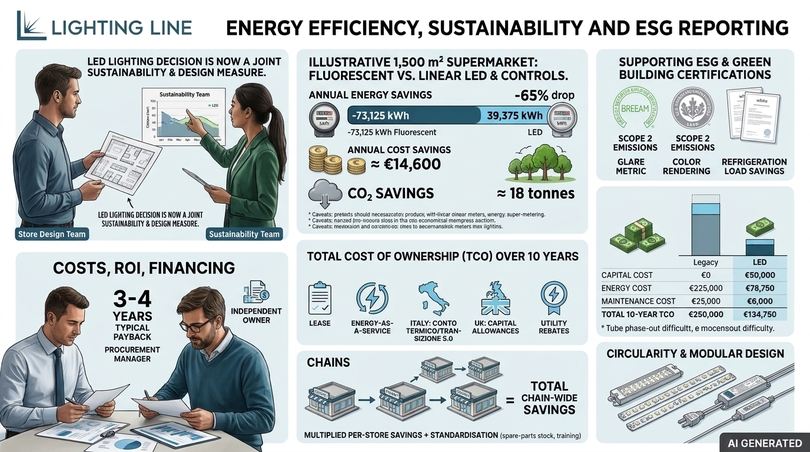
For many retail clients, the lighting decision is now made as much by the sustainability team as by the store design team. Energy prices, carbon targets and ESG reporting obligations have made lighting one of the easiest and most visible levers for reducing emissions. A well-documented supermarket lighting LED linear upgrade is one of the few sustainability measures that pays for itself, can be measured precisely and is visible to every customer. This section explains how to quantify and communicate it.
How much energy can a supermarket save by switching to LED?
Savings depend on the starting point. Replacing older fluorescent grids with modern linear LED and basic controls commonly reduces lighting energy by around 50-70%, and in some cases more, while maintaining or improving light levels. Upgrading from early-generation LED to current high-efficacy LED with smart controls typically saves less, often 20-40%, but still pays back.
Illustrative calculation: a 1,500 m² supermarket
| Parameter | Legacy fluorescent | Linear LED + controls |
|---|---|---|
| Installed power density (sales floor) | 15 W/m² | 7 W/m² |
| Installed power (1,500 m²) | 22.5 kW | 10.5 kW |
| Annual operating hours | 5,000 h | 5,000 h |
| Control saving | 0% | 25% |
| Annual consumption | 112,500 kWh | 39,375 kWh |
| Annual saving | – | 73,125 kWh (-65%) |
| Cost saving at €0.20/kWh | – | ≈ €14,600 per year |
| CO₂ saving at 0.25 kg/kWh | – | ≈ 18 tonnes per year |
Illustrative figures for a hypothetical store. Electricity price and grid emission factors vary by country and year; replace them with the client’s actual data. Additional savings in refrigeration load are not included.
Supporting ESG and green building certifications
Lighting upgrades contribute directly to energy-performance credits in green building schemes such as BREEAM (widely used in the UK and Europe) and LEED (global), and to energy-efficiency targets in national schemes. Lighting quality credits, covering glare, colour rendering, controls and daylight, are also available in most schemes. For ESG reporting, lighting reductions show up in Scope 2 emissions (purchased electricity).
What data should be measured?
To verify the sustainability impact, measure:
- Baseline and post-installation lighting energy (sub-metering, ideally per circuit or via DALI driver data).
- Operating hours and dimming levels by zone.
- Illuminance on key planes before and after, to prove that light quality was maintained.
- Refrigeration energy, where cabinet lighting was replaced.
- Maintenance call-outs and replacement parts.
Data is what turns a lighting upgrade from a cost into an auditable sustainability result. International bodies such as the International Energy Agency’s lighting analysis track how LED adoption contributes to global energy-efficiency goals, and those figures are useful context in ESG reports.
Circularity and product life
Aluminium profiles are durable and recyclable, and modular linear systems allow strips and drivers to be replaced without discarding the housing. Specifying replaceable strips and drivers extends system life and reduces waste, a point increasingly valued in sustainability assessments.
15. Costs, ROI, total cost of ownership and financing
Every lighting project ends with a financial question: what does it cost, what does it save and when does it pay back? Installers who can answer that clearly win more projects, especially with independent supermarket owners and procurement managers. The right comparison is not purchase price against purchase price, but total cost of ownership over the system’s life. This section gives a framework that works for a single store and for a chain.
Components of cost
- Capital cost: profiles, strips, diffusers, drivers, controls, accessories.
- Installation: labour, access equipment, night working premiums, disposal of old fittings.
- Design and commissioning: calculations, programming, measurement and documentation.
- Operating cost: electricity over the life of the system.
- Maintenance: replacements, cleaning, inspections, downtime.
Payback period
Using the illustrative store above, an annual saving of around €14,600 means that a project costing €40,000–€60,000 would pay back in roughly three to four years, before counting refrigeration savings, reduced maintenance or incentives. Retrofits of refrigerated case lighting often pay back faster. Typical LED retrofit payback periods in supermarkets fall between two and five years, depending on energy prices, operating hours and the starting technology.
Total cost of ownership over ten years
| Cost item | Keep legacy fluorescent | Linear LED + controls |
|---|---|---|
| Capital cost | €0 | €50,000 |
| Energy (10 years) | €225,000 | €78,750 |
| Maintenance (10 years) | €25,000 (tube replacement, ballasts) | €6,000 |
| Total 10-year cost | €250,000 | €134,750 |
Illustrative figures, constant energy price, no discounting. Fluorescent tubes are also increasingly difficult to source after the 2023 phase-out.
What is the most affordable supermarket lighting upgrade for a small store?
For a small store on a tight budget, the most affordable route is usually to keep the existing ceiling grid where it still works, replace fluorescent tubes with suitable LED solutions, and invest selectively in linear strips where they have most commercial impact: fresh produce, refrigerated cases and the checkout. This staged approach delivers visible improvement and fast savings without a full refit.
Financing options
Financing schemes change frequently, so check current availability, but common routes include:
- Energy-as-a-service or lighting-as-a-service: the client pays a monthly fee from the savings, with no upfront capital.
- Leasing: spreads the cost over the life of the equipment.
- Government incentives: in Italy, schemes such as the Conto Termico and the Transizione 5.0 plan have supported business energy-efficiency investments, subject to conditions; in the UK, capital allowances can improve the tax position of plant and machinery investments; in many EU countries, white certificates or energy-efficiency obligation schemes may apply.
- Utility programmes: in the US and some other markets, utilities offer rebates for efficient lighting and controls.
How much can LED reduce operating costs across multiple stores?
For chains, the per-store savings multiply, and standardisation adds procurement and maintenance savings. A chain of 50 stores each saving €10,000–€15,000 per year in lighting energy saves €500,000-€750,000 per year, before maintenance and refrigeration effects. Standardising one linear system across the estate also reduces spare-parts stock and training costs.
16. Installation guide: how to get supermarket lights together
Is a surprisingly common question, and it is really two questions: how do you assemble and connect a linear system so it works as one continuous line, and how do you install it in a store that cannot close? Installers from the street lighting world already know how to plan night work, manage access equipment and commission large installations. What changes indoors is the scale of the components and the level of finish expected. A clean, aligned, perfectly continuous line is the visible signature of a professional installer.
Step-by-step: assembling a supermarket lighting LED linear line
- Survey and set out: confirm ceiling heights, structural fixing points, existing circuits and the shelving plan. Mark the line positions with a laser, aligned to the aisle centrelines.
- Install suspension points: fix suspension kits at the spacing recommended for the profile (typically every 1.5–2 m and near each joint). Adjustable wire kits allow fine levelling.
- Join the profiles: use metal junctions to connect profile lengths; for L-shapes and geometric layouts, use 90° or 120° junctions. Check alignment along the full run before tightening.
- Fit the strips: clean the profile or heat sink, then apply the LED strip with its adhesive tape along the centreline. Avoid bending the PCB sharply or touching the LEDs.
- Connect strips: join strips at their marked cut points with solderless PCB connectors or by soldering, following the manufacturer’s instructions. Never cut between cut points.
- Feed power correctly: plan power injection points to limit voltage drop (see below). Run feeders in parallel rather than daisy-chaining very long runs.
- Install drivers: fit drivers inside the profile where designed for it, or in accessible positions above the ceiling, with ventilation and access for maintenance.
- Fit diffusers or lenses and end caps: seal end caps in humid or refrigerated zones.
- Commission: address DALI drivers, program scenes, test emergency functions, measure illuminance and record results.
Cutting and connecting LED strips
LED strips can be cut only at the marked cut points, where the circuit repeats. Lightingline COB strips have cut points every 2-5 cm depending on the model (for example every 2.5 cm on the IP67 COB range), which allows precise lengths to match shelves and cabinet mullions. For IP-rated strips, re-seal cut ends with the appropriate end caps and silicone to maintain protection.
Voltage drop and power injection
At 24V, current is relatively high, and voltage drops along the strip and the feeder cable. The visible symptom is a line that is bright at one end and dimmer at the other, sometimes with a colour shift. As a practical guide, keep 24V runs within the manufacturer’s maximum single-feed length (often around 5-10 m depending on power per metre), feed long runs from both ends or from the middle, and size feeder cables for low voltage drop. For long continuous lines, 48V strips or constant-current strips reduce the problem.
Installing without closing the store
Most supermarkets cannot close for a refit. Experienced installers plan:
- Night working in zones, with temporary lighting and protection for stock.
- Prefabrication: profiles pre-cut, strips pre-fitted and lines pre-wired off site, so on-site work is mostly hanging and connecting.
- Zone-by-zone handover, so each section is fully working before the store opens in the morning.
- Coordination with refrigeration contractors for case lighting, and with the store manager for stock movements.
With prefabricated lines and a well-organised night crew, a mid-size supermarket can typically be relit in a series of overnight shifts without losing a single trading day.
Retrofitting existing fixtures
Can you upgrade existing supermarket lighting fixtures instead of replacing the whole system? Often, yes. Existing trunking or batten housings can sometimes be fitted with LED modules or strips mounted on new heat sinks, and existing suspended lines can be re-lamped with LED strips and new diffusers. The key checks are thermal performance, electrical safety and certification: a modified luminaire may require re-assessment of its conformity. Where the housing is old or damaged, replacement with a modern profile is usually the better long-term choice.
Replacing fluorescent fixtures with LED
Replacing fluorescent fixtures with supermarket lighting LED linear systems is straightforward when the layout is reused: the new lines follow the old positions, use the existing circuits where suitable and add drivers and controls. The opportunity, however, is to rethink the layout: align lines with aisles, add asymmetric optics, and remove unnecessary fixtures, which can reduce installed power further.
Safety reminders for installers
- Work to the national wiring rules (BS 7671 in the UK, CEI 64-8 in Italy, the NEC in the US).
- Use SELV drivers and keep mains and low-voltage wiring separated.
- Check the fire rating of materials in ceiling voids and escape routes.
- Test and document emergency lighting according to the applicable standard.
17. Multi-store rollouts, tenders and choosing a supplier
For retail chains, lighting is a procurement exercise as much as a design one. The buyer needs a system that performs the same in every store, can be ordered and installed predictably, and is supported for years. For installers, chain rollouts are the most valuable projects in the market, but they demand documentation, consistency and supply reliability. The winning formula for a multi-store supermarket lighting LED linear rollout is a standard specification, a modular product family and a supplier who can deliver both.
Can one lighting system be standardised across different stores?
Yes, and it is strongly recommended. Stores differ in size and ceiling height, but a modular family of profiles (suspended, recessed and surface) using the same strips, drivers and controls can adapt to each building while keeping a consistent look and spare-parts list. Standardise:
- Colour temperatures and CRI by department.
- Strip models and binning, to avoid colour differences between batches.
- Driver types and control protocol.
- Profile finishes (silver, white or black) and diffuser types.
- Commissioning procedures and documentation.
What specifications should be included in a supermarket lighting tender?
| Item | What to specify |
|---|---|
| Photometric performance | Maintained illuminance per zone, vertical illuminance on shelves, uniformity, UGR |
| Light quality | CCT per department, CRI ≥ 90 (and R9 value), colour consistency (MacAdam steps) |
| Efficiency | Luminaire efficacy (lm/W at system level), installed power density (W/m²), compliance with local energy rules |
| Lifetime | L80 or L90 at stated hours, driver life and failure rate |
| Flicker | Pst LM and SVM values, driver ripple |
| Controls | DALI-2 or equivalent, sensors, scenes, monitoring, BMS integration |
| Documentation | Photometric files (LDT/IES), datasheets, BIM objects, declarations of conformity |
| Warranty and service | Warranty length, spare parts availability, replacement lead times |
| Installation | Night working, prefabrication, phasing, commissioning report |
Lightingline provides downloadable datasheets, photometric tests and BIM files for its profiles, which simplify the documentation part of a tender.
How to compare supermarket lighting suppliers
Compare suppliers on system performance rather than unit price: lumens delivered per euro, efficacy at system level, colour consistency between batches, availability of complete documentation, lead times and technical support. Ask for samples and test them side by side in a real shelf. A supplier who can provide a complete system (profile, strip, optic, accessories) with tested photometry removes most of the risk from a rollout.
Local or online? “Supermarket lighting near me” and lighting superstores
Many buyers begin with searches such as “supermarket lighting near me”, “lighting superstore near me” or the name of a local showroom, for example a lighting supermarket in Barrowford or a high-street firm trading as “The Lighting Company”. Local lighting retailers are excellent for decorative products and quick purchases. For a supermarket project, however, what matters is not proximity but technical depth: tested photometry, consistent batches, modular systems and installer support. A specialist manufacturer of profiles and strips such as Lightingline ships across Europe and supports installers directly, so the nearest supplier is effectively the one that answers your technical questions fastest. You can reach the technical team through the Lightingline contact page.
Warranty and maintenance services to expect
Expect a clear warranty on strips and drivers (commonly three to five years for professional products), availability of identical replacement strips for the life of the project, and technical support for troubleshooting. For chains, consider a framework agreement with guaranteed stock of the standard components.
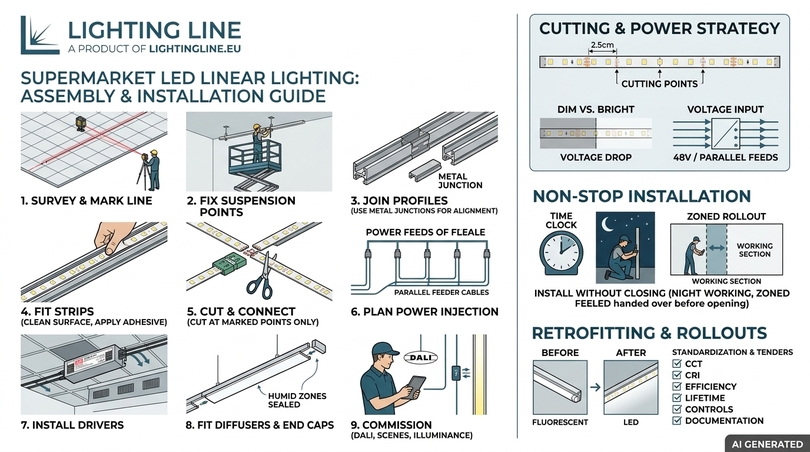
18. Maintenance and lifecycle management
A supermarket lighting system runs for 4,000-6,000 hours a year, often more. Over ten years that is up to 60,000 hours, close to the rated life of many LED products. Maintenance planning determines whether the system still delivers its design values in year eight or whether the store slowly becomes dimmer and patchier. LED dramatically reduces maintenance compared with fluorescent, but “maintenance-free” is a sales myth: planned inspection and cleaning keep the investment performing.
How long do LED supermarket fixtures last?
Quality LED strips and linear luminaires are typically rated for 50,000 hours or more to L70 or L80, meaning they still produce 70% or 80% of their initial output at that point. In practice, the driver is often the component that fails first, which is why accessible, replaceable drivers matter. Thermal management through a well-sized aluminium profile is crucial: the cooler the LED, the longer it lasts.
Maintenance factor in design
The maintenance factor (MF) accounts for lumen depreciation and dirt. A typical value for supermarkets with LED and regular cleaning is 0.8. A design that ignores MF will meet the target on opening day and fall below it within a few years.
Maintenance schedule
| Task | Frequency | Notes |
|---|---|---|
| Visual inspection for failures | Weekly (store staff) or continuous (remote monitoring) | Report dark sections immediately |
| Cleaning of diffusers and lenses | Every 6–12 months; more often near bakery and hot food | Dust and grease reduce output |
| Emergency lighting tests | Monthly function test, annual duration test | As required by EN 50172 / BS 5266-1 / UNI 11222 |
| Illuminance spot checks | Annually | Compare with commissioning values |
| Refrigerated case seals and cables | At each refrigeration service | Check for moisture ingress |
| Controls review | Annually | Adjust scenes to changed opening hours |
Reducing maintenance costs
- Use standard components across all stores to simplify spare parts.
- Choose profiles that allow strips and drivers to be replaced without removing the line.
- Use remote monitoring to diagnose faults before sending an engineer.
- Keep a stock of identical strips from the same production batch for colour consistency.
19. Small, independent and luxury supermarket lighting ideas
Not every supermarket is a hypermarket. Independent grocers, convenience stores, organic shops and premium food halls have different budgets, ceilings and brand stories, and they often benefit more from good lighting than large chains do, because lighting is one of the few areas where a small store can outperform a big one. For an independent store, lighting is a competitive weapon: it can make a 400 m² shop feel more curated and more premium than a 4,000 m² superstore. Here are practical ideas for both ends of the market.
Small supermarket lighting
- Prioritise the fresh departments and the checkout: these are the zones shoppers remember.
- Use recessed or surface profiles in low ceilings to avoid glare and keep the space open.
- Add shelf-edge COB strips on one or two feature gondolas instead of everywhere.
- Light the shopfront and window to be visible from the street in the evening.
- Use simple time controls to avoid paying for light after closing.
How better lighting helps a small supermarket compete
Big chains compete on range and price. Independents compete on experience, freshness and personality. Warm, contrasted lighting on fresh food, a distinctive light feature over the counter and a well-lit window turn a convenience store into a destination. Because the store is small, these improvements are affordable, and because shoppers compare it with the flat light of large formats, the difference is noticed immediately.
Luxury supermarket lighting
Premium food halls and luxury supermarkets borrow from hospitality and fashion retail:
- Lower ambient light and higher contrast, with accent light on products.
- Warmer colour temperature (2700-3000K) and CRI above 90 throughout.
- Drywall and recessed lines for seamless ceilings, and geometric suspended forms as landmarks.
- Integrated furniture lighting in wooden shelving, wine walls and counters, using furniture profiles and dot-free COB strips.
- Black or white profile finishes chosen to disappear into, or contrast with, the interior palette.
Supermarket lighting ideas worth stealing
- A continuous warm line over the bakery counter that continues into the café area.
- Back-lit shelving in the wine department with COB strips behind frosted panels.
- Hexagonal suspended patterns over the produce island, built with 120° junctions.
- Cove lighting above wall units to lift the ceiling height visually.
- Tunable white in seasonal promotion zones.
20. The newest trends in supermarket lighting
The lighting industry moves fast, and supermarkets are one of its biggest testing grounds. Some trends are already mainstream, others are emerging. For installers, knowing the direction of travel helps future-proof today’s installations: a project designed with the right drivers and controls can adopt tomorrow’s features without new wiring. The newest trend in lighting is not a single product but the shift from light as a utility to light as a connected, data-producing service.
Connected and data-driven lighting
Lighting networks with sensors in every line can measure occupancy, traffic patterns and energy use, feeding data into store analytics. Some systems integrate indoor positioning for apps, using visible light communication or Bluetooth beacons in luminaires.
Higher efficacy and better colour at once
LED efficacy keeps rising while colour quality improves, making it easier to meet strict energy codes with CRI 90+ light. Research and market tracking by bodies such as the US Department of Energy’s solid-state lighting programme document how far LED performance has come and where it is heading.
Tunable white and human-centric scenes
Tunable strips allow stores to adjust atmosphere by time of day or season. Expect more stores to use warmer evening scenes and brighter morning scenes.
Circular design and repairability
Regulators and clients increasingly expect repairable, upgradeable lighting. Modular profiles with replaceable strips and drivers fit this trend naturally.
Integration with electronic shelf labels and digital signage
Shelf-edge lighting and electronic shelf labels share the same location. Integrated solutions combine power, data and light at the shelf edge.
Minimalist architectural lines
Design trends favour clean, continuous lines over scattered fittings: thin profiles, trimless drywall slots and geometric suspended forms. Linear LED is the natural tool for this aesthetic.
21. Common supermarket lighting mistakes to avoid
Most poor supermarket lighting is not the result of bad products but of avoidable design and installation errors. The same mistakes appear again and again, from small shops to large chains. Recognising them is the fastest way to improve a design, and pointing them out tactfully during a site survey is one of the best ways for an installer to show expertise. Every mistake in this list costs money, either in lost sales, wasted energy or extra maintenance.
| Mistake | Consequence | Fix |
|---|---|---|
| Designing only for horizontal lux | Dark lower shelves, poor product visibility | Calculate vertical illuminance; use asymmetric optics or shelf-edge strips |
| Low CRI in fresh departments | Food looks dull, waste increases | CRI ≥ 90 with good R9 |
| Mixed colour temperatures across adjacent cases | Patchy, unprofessional look | Standardise CCT per department and use one batch |
| Glare from bare LEDs or lenses along aisles | Discomfort, shorter visits | Diffusers, deeper profiles, COB strips, correct aiming |
| Ignoring voltage drop | Lines dimmer at one end, colour shift | Power injection, 48V or constant-current strips |
| Undersized profiles for high-power strips | Overheating, short life | Match strip power to profile heat dissipation |
| No controls | Full power at night and in quiet hours | Scenes, sensors, scheduling |
| Wrong IP rating in refrigerated or wet areas | Failures from condensation | IP65/IP67 strips, sealed end caps |
| Not checking energy compliance at system level | Failing Part L or local energy codes | Calculate luminaire lm/W including optic and driver losses |
| Ignoring maintenance factor | Underlit store after a few years | Design with MF 0.8 and plan cleaning |
Poor supermarket lighting: what it looks like
Typical signs include a bright ceiling and a dim shelf, brown-looking meat, bluish bread, reflections of tube lights in freezer doors, dark corners at aisle ends and lights blazing at 2 a.m. in an empty store. Each one is fixable with the tools described in this guide.
Troubleshooting existing installations
- Flicker: check driver compatibility and dimming method.
- Uneven brightness: check voltage drop and connections.
- Colour differences: check strip batches and CCT.
- Premature failures: check thermal management and IP rating.
22. Best practices and a worked project example
Best practice in supermarket lighting is a combination of standards, experience and measurement. Professional bodies such as the CIBSE Society of Light and Lighting publish guidance that consolidates this experience, and it is worth every installer’s time. Below, we summarise the principles and illustrate them with a worked project example. The example is illustrative, based on typical values, and shows the thinking process rather than a specific client project.
Best-practice principles for supermarket lighting LED linear projects
- Start with the brand and the shopper journey, then translate them into zones.
- Design for vertical illuminance on merchandise, not just floor lux.
- Use CRI 90+ in all food areas and check R9.
- Align linear lines with the architecture and shelving.
- Choose optics deliberately: double-asymmetric over aisles, opal over checkouts, narrow lenses for accents.
- Integrate controls from the start.
- Check energy compliance at system level.
- Document everything: calculations, products, commissioning measurements.
Worked example: relighting a 1,500 m² neighbourhood supermarket
Starting point
A 1,500 m² supermarket with a 3.2 m suspended ceiling, fluorescent recessed fittings in a regular grid, fluorescent tubes in refrigerated cases, no controls and opening hours of 7:00–21:00, seven days a week. The client wants lower energy bills, a fresher look and no closure.
Design decisions
- Aisles: recessed 67x22mm lines aligned with the aisles, two strips per line, 4000K CRI 90, with lenses directing light to the shelves.
- Produce and bakery: suspended 36x75mm lines in a geometric layout below the ceiling, 3000K, narrow lenses on produce, warm 2700K COB strips in bakery cases.
- Checkouts: recessed lines parallel to tills with opal diffusers, 4000K.
- Refrigerated cases: IP67 4000K COB strips at 6 W/m in door mullions, replacing fluorescent tubes.
- Controls: DALI drivers with time scenes, presence sensors in back-of-house and low-traffic aisles, and daylight sensors near the shopfront.
Installation
Lines were prefabricated off site, and the installation was carried out in zones over a series of night shifts, with each zone commissioned before opening.
Expected results
Following the illustrative calculation in section 14, the lighting energy reduction is in the region of 60–65%, with additional savings in refrigeration load. Vertical illuminance on shelves improves, colour rendering in fresh departments rises to CRI 90+, and maintenance shifts from routine tube replacement to annual cleaning and inspections.
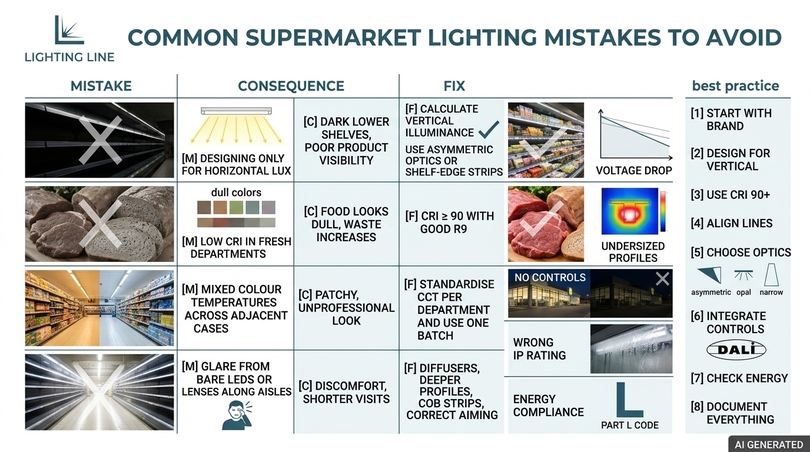
23. Final design checklist
Before you sign off a supermarket lighting design or hand over an installation, run through this checklist. It condenses everything in this guide into a set of questions that cover performance, comfort, energy, compliance, maintenance and budget. A design that passes every item on this list is ready for a demanding client, an energy assessor and a food-safety inspector.
| Area | Check | Done |
|---|---|---|
| Illuminance | Maintained horizontal lux per zone meets EN 12464-1 (or local equivalent) | ☐ |
| Vertical light | Vertical illuminance on shelves calculated; top-to-bottom ratio ≤ 3:1 | ☐ |
| Colour | CCT defined per department; CRI ≥ 90 in food areas; R9 checked | ☐ |
| Glare | UGR ≤ 22 sales floor, ≤ 19 checkouts; reflections in glass checked | ☐ |
| Uniformity | U0 meets standard; no dark spots at aisle ends | ☐ |
| Flicker | Drivers meet Pst LM and SVM limits | ☐ |
| Refrigeration | IP65/IP67 components; seals checked; cold-start tested | ☐ |
| Food hygiene | Shatter-protected, cleanable luminaires in food areas | ☐ |
| Energy | System-level efficacy and W/m² meet local energy rules | ☐ |
| Controls | Scenes, sensors and night mode programmed | ☐ |
| Emergency | Escape and anti-panic lighting designed and tested | ☐ |
| Electrical | Voltage drop checked; wiring to national rules | ☐ |
| Maintenance | MF applied; spare parts and cleaning plan agreed | ☐ |
| Documentation | Datasheets, photometry, commissioning measurements handed over | ☐ |
| Budget | TCO and payback presented to client | ☐ |
Next step: from guide to bill of materials
Ready to turn this guide into a project? Start with the full range of Lightingline aluminium profiles and the LED strip catalogue, download the complete PDF catalogue, request a lux calculation for your installation, or contact the technical team for a quote. Bring your floor plan and shelving layout: the more we know about the store, the more precise the supermarket lighting LED linear proposal we can prepare.
24. Frequently asked questions
These are the questions we hear most often from installers, store owners, buyers and designers. Tap a question to open the answer.
What is supermarket lighting LED linear?Supermarket lighting LED linear refers to continuous lines of light built from aluminium profiles, LED strips and diffusers or lenses. These lines light ceilings, shelves and refrigerated cases with a single modular family, giving even illumination, low glare, high colour rendering and lower energy use than fluorescent grids or scattered point fittings. |
How many lux does a supermarket need?Under EN 12464-1, sales areas in small shops need about 300 lux and large retail premises such as supermarkets about 500 lux maintained, with 500 lux at tills. Fresh-food displays benefit from 750–1,000 lux on the product, and shelf faces from 300–750 lux vertical illuminance. |
What is the best lighting for a supermarket?The best supermarket lighting is layered LED: continuous linear lines for ambient light, asymmetric optics or shelf-edge strips for vertical light on merchandise, high-CRI accents on fresh food and IP67 strips in refrigerated cases, all managed by DALI controls with scenes and sensors. |
Which colour temperature works best for supermarket aisles?Most supermarket aisles use 3500–4000K, which looks clean and renders packaging accurately. Premium stores often prefer 3000K. Departments deviate where the product needs it: 2700–3000K for bakery and meat, 4000–5000K for fish and frozen food. |
Why do supermarkets have such bright lights?Supermarkets use bright light because shoppers need to read labels and prices, because bright and even light signals cleanliness and freshness, and because high vertical brightness on shelves draws attention to products. Modern LED linear systems achieve this impression with much less energy by aiming light at shelves rather than floors. |
Why do supermarkets leave lights on at night?Lights stay on at night for restocking, cleaning, deliveries and security, and sometimes out of habit from the fluorescent era. With LED and controls, stores can keep working light only where staff are, dim the rest to security level and switch off case lighting, saving energy and meeting night-lighting rules. |
What CRI should supermarket lighting have?EN 12464-1 sets Ra 80 as the minimum for workplaces, but food retail should use CRI 90 or higher, with a good R9 value for saturated reds. High CRI makes meat, fruit and vegetables look natural and fresh, which supports shopper trust and reduces waste. |
How much energy can a supermarket save by switching to LED?Replacing fluorescent lighting with modern linear LED and controls commonly cuts lighting energy by around 50–70%. Additional savings come from refrigerated cases, because lower lighting power means less heat for the refrigeration system to remove. Payback is typically two to five years. |
Can LED strips be used inside refrigerated display cases?Yes. LED strips work better in the cold than fluorescent tubes, start instantly and emit little heat. Inside chillers and freezers, use IP65 or IP67 strips, such as silicone-encapsulated COB strips, seal end caps and cable entries carefully, and keep colour temperature consistent across adjacent cases. |
How do you light supermarket shelves evenly?Use a ceiling line centred over the aisle with a double-asymmetric lens to light both shelf faces, and add shelf-edge COB strips where shelves are deep or premium. Check vertical illuminance at the top, eye level and bottom shelves, aiming for a ratio no worse than about 3:1. |
What are the UK lighting regulations for supermarkets?In the UK, BS EN 12464-1 and the SLL Code for Lighting set light levels, Approved Document L requires 95 luminaire lumens per circuit-watt for general lighting and 80 light-source lumens per circuit-watt for display lighting in new work, and BS 5266-1 governs emergency lighting. |
Can a supermarket be relit without closing?Yes. Installers prefabricate lines off site, work in zones during night shifts and commission each zone before opening. With good planning, a mid-size supermarket can be completely relit over a series of nights without losing a trading day. |
How long do LED supermarket lights last?Quality LED strips and linear luminaires are typically rated for 50,000 hours or more to L70 or L80. Drivers often fail first, so choose accessible, replaceable drivers and profiles with good heat dissipation. Regular cleaning and inspections keep the system close to its design values. |
What is the 5’7″ lighting rule in retail?The 5’7″ or 57-inch rule comes from galleries, where artwork is centred at about 1.45 m, average eye height. In supermarkets it translates to the eye-level shelf zone, roughly 1.2–1.6 m, where products sell best and where vertical illuminance and colour rendering matter most. |
25. Illuminating the future of retail
Designing lighting for a supermarket today involves much more than simply installing fixtures: it means creating an environment that guides customers, highlights the freshness of products, reduces energy consumption, and delivers a measurable return on investment. As explored in this guide, linear LED lighting systems offer the definitive solution to the complex demands of modern retail, combining architectural aesthetics, energy efficiency, and compliance with international standards.
Whether you are renovating an existing store, standardizing a retail chain, or optimizing lighting for refrigerated displays, the key to success lies in selecting modular aluminum profiles, high-color-rendering LED strips (CRI 90+), and optics engineered to maximize vertical illuminance on merchandise. By relying on high-quality components, backing your decisions with precise photometric calculations, and integrating smart controls (such as the DALI protocol), you can transform lighting from a mere expense into a powerful strategic tool for marketing and sustainability.
Are you ready to take your next supermarket lighting project to the next level? Explore the Lightingline catalogue to discover our bespoke solutions, request a customized photometric study or contact our technical team to turn your vision into a bright, efficient, and profitable reality.
This article was developed with the support of artificial intelligence and subsequently reviewed, corrected, and validated by the LightingLine.eu technical team, which guarantees its reliability and compliance with official sources.