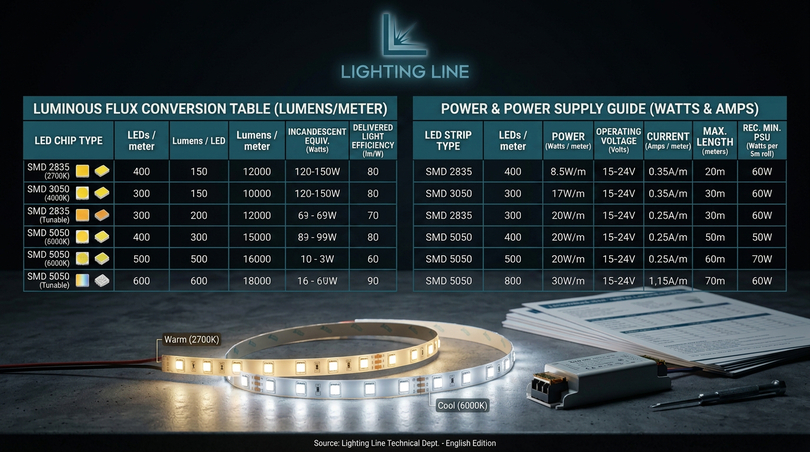
The LED conversion table is the essential tool for anyone wishing to replace traditional lamps (incandescent, halogen, compact fluorescent or fluorescent tube) with modern LED sources, without compromising light quality and without making mistakes of over- or under-illumination. Whether you are a professional electrician carrying out a large-scale relamping project, an interior architect designing the lighting for a premium space, a hotel manager looking to cut energy costs, or a homeowner renovating your home, knowing the exact values of lumens, watts and CRI will allow you to choose the right lamp first time — saving you time, money and costly returns or replacements.
In this guide you will find the most comprehensive LED conversion tables available online, with full equivalence values across all major lighting technologies, detailed explanations of how to read and use conversion factors, precise answers to the most frequently asked questions, and a dedicated section on CRI — a parameter often overlooked but decisive for the perceived quality of light. At Lighting Line, our core expertise lies in aluminium profiles for LED strips and professional LED strips. This guide has been developed to give you all the technical information you could need, enriched with references to the most suitable products for each application, from residential living areas to high-efficiency professional installations.
What is a conversion table?
A conversion table is a mathematical and technical tool that allows you to translate one physical quantity or unit of measurement into an equivalent one, without loss of information and through a simple, immediate operation. In mathematics, conversions underpin the International System of Units (SI): they are fixed relationships between units of the same type (e.g. kilometres to miles, degrees Celsius to Fahrenheit, inches to centimetres) or between quantities linked by known physical laws.
The conversion table in the world of lighting
In the context of lighting, the conversion table answers a very practical question: “If I want to replace a traditional lamp with an LED, what wattage do I need to get the same amount of light?” The answer is not straightforward, because watts and lumens are not the same thing: watts measure the electrical energy consumed, while lumens measure the luminous flux actually emitted.
For decades, consumers were used to thinking in watts: “I want a 60-watt bulb” implicitly meant “I want a certain amount of light.” This mental model worked because all incandescent lamps had a very similar luminous efficacy (around 10–15 lm/W), so watts and light output were broadly proportional. With the advent of LEDs, which can reach 80–160 lm/W, this approach no longer applies: a 10-watt LED lamp produces as much light as a 60–75-watt incandescent lamp.
The conversion table resolves this problem definitively, listing (for each technology9 the power in watts, the luminous flux in lumens, and, where applicable, the CRI. Anyone who can read a conversion table can perform a correct, safe and efficient relamping.
What are conversions in mathematics? The theoretical basis
In mathematics, a conversion is the operation by which a quantity is expressed in a different unit of measurement, using a conversion factor: a number (or ratio between units) that, when multiplied or divided by the original value, gives the equivalent value in the new unit. The principle is very simple:
New_value = Original_value × Conversion_factor
For example, 1 inch = 2.54 centimetres: to convert 10 inches to cm, multiply 10 × 2.54 = 25.4 cm. Equally, to find out how many lumens a 10-watt LED lamp with an efficacy of 100 lm/W produces, multiply 10 × 100 = 1,000 lumens.
What unit of measurement is the inch and why is it relevant in lighting?
The inch is a linear unit of measurement from the Anglo-Saxon imperial system. 1 inch = 2.54 centimetres exactly. In lighting, the inch is still used to indicate the dimensions of certain lamps and supports: LED strips, for example, are often measured in metres, but American installation guides still use inches to indicate segment lengths. The dimensions of MR16 and PAR30/PAR38 bulbs also reference fractions of an inch (e.g. MR16 = 2-inch diameter = 50 mm). Knowing the inch/cm conversion factor (1 inch = 2.54 cm) is therefore useful for anyone working with international LED product catalogues.
The conversion index: what is it?
In the technical language of lighting, the conversion index usually refers to luminous efficacy, the number of lumens produced for each watt consumed (lm/W). This value is the conversion factor between electrical energy and visible light. The higher the conversion index (lm/W), the more efficient the light source: for the same light output, it consumes less energy. The table below shows typical values by technology:
| Technology | Typical efficacy (lm/W) | Notes |
|---|---|---|
| Standard incandescent | 10 – 15 | Obsolete technology, banned in EU |
| Standard halogen | 15 – 25 | Progressive EU phase-out |
| ECO halogen | 18 – 28 | 30% improved efficacy |
| Compact fluorescent (CFL) | 40 – 70 | Contains mercury, special disposal required |
| Fluorescent linear T8 | 70 – 100 | Requires ballast, being phased out |
| Fluorescent linear T5 | 80 – 110 | High efficacy, slimmer than T8 |
| Standard LED (entry-level) | 70 – 100 | Good quality, entry-level market |
| Professional-quality LED | 100 – 130 | Professional standard, high CRI |
| Premium / high-efficacy LED | 130 – 200+ | Advanced chips |
Lumens, watts and CRI: the three fundamental quantities for LED conversion
Before consulting any conversion table, it is essential to thoroughly understand the three quantities that make it up. Lumens, watts and CRI are the three parameters that completely describe a light source from a technical and perceptual standpoint. Anyone who understands them can choose the right lamp for any application, without relying on vague indications such as “warm light” or “60-watt equivalent” printed on the packaging.
The watt (W): energy consumed, not light produced
The watt (symbol W, named after the Scottish engineer James Watt) is the unit of measurement for electrical power in the International System. In the context of lamps, it indicates how much electrical energy the lamp draws from the mains every second of operation. The watt does not measure the amount of light produced: it measures only the energy consumed. A 60W incandescent lamp dissipates most of that energy as heat (around 85–90%), producing light with only the remaining 10–15%. An 8W LED lamp, on the other hand, converts around 40–50% of the energy into visible light, with an efficiency up to 5–7 times greater.
Practical consequence: comparing different lamps on the basis of watts is profoundly misleading. The correct quantity to compare is the luminous flux, measured in lumens.
The lumen (lm): the correct measure of light
The lumen (symbol lm) is the unit of measurement for luminous flux in the International System: it measures the total quantity of visible light emitted by a source in all directions. It is the quantity that truly matters when choosing a lamp: more lumens = more light perceived by the human eye. Unlike watts, lumens are independent of the technology used to produce them: 800 lumens from an LED lamp give the same perceived light as 800 lumens from a halogen lamp.
EU standard EN 60064 and mandatory energy labels require the luminous flux in lumens to be stated on all lamps, precisely so that consumers can correctly compare products from different technologies.
The CRI (Colour Rendering Index): colour fidelity
The CRI (Colour Rendering Index, also indicated as Ra) is a dimensionless index that measures how faithfully a light source reproduces the colours of objects compared to a reference light (sunlight or a black body, depending on colour temperature). It ranges from 0 to 100: a value of 100 indicates perfect colour rendering, identical to natural light.
The CRI is determined by measuring the colour difference perceived on 8 standard colour samples (R1–R8) illuminated by the source under examination compared to the reference light. Extended versions (R9–R15) include saturated red (R9), yellow (R10), green (R11) and skin tones (R13–R15).
| CRI value (Ra) | Colour rendering quality | Typical applications |
|---|---|---|
| CRI ≥ 90 | Excellent | Museums, jewellers, showrooms, surgery, photography |
| CRI 80–89 | Good | Homes, hotels, offices, retail shops |
| CRI 60–79 | Adequate | Corridors, staircases, technical areas |
| CRI 40–59 | Acceptable | Storage areas, warehouses, indoor car parks |
| CRI < 40 | Poor | Sodium vapour street lighting (being phased out) |
Why is CRI important in LED conversion? Many inexpensive LED lamps have a CRI of 70–75: they do provide the same lumen output, but colours appear dull, skin tones look sickly and fabrics lose their vibrancy. Anyone replacing a halogen lamp (CRI ~100) with a CRI 70 LED will end up with light that is technically equivalent in lumens but qualitatively inferior. A complete conversion table must therefore include the CRI, not just watts and lumens.
The LED conversion table
Below you will find the main conversion table, which directly relates the four main lighting technologies — incandescent, halogen, compact fluorescent (CFL) and LED — based on luminous flux expressed in lumens. This is the most complete LED conversion table, designed to be used quickly by both professionals and private users.
Full conversion table: lumens and watts by technology
| Luminous flux (lm) | Incandescent (W) | ECO Halogen (W) | CFL Fluorescent (W) | Standard LED (W) | Premium LED (W) | Typical LED CRI |
|---|---|---|---|---|---|---|
| ~200 lm | 25 W | 18 W | 6–7 W | 2.5–3 W | 1.8–2.5 W | 80–95 |
| ~250 lm | 25–30 W | 20 W | 7 W | 3 W | 2–2.5 W | 80–95 |
| ~300 lm | 30 W | 22 W | 8 W | 3.5–4 W | 2.5–3 W | 80–95 |
| ~400 lm | 40 W | 28 W | 9–10 W | 4–5 W | 3–4 W | 80–95 |
| ~500 lm | 40–50 W | 35 W | 11 W | 5–6 W | 4–5 W | 80–95 |
| ~600 lm | 50–60 W | 40 W | 13 W | 6–7 W | 5–6 W | 80–95 |
| ~806 lm | 60 W | 48 W | 15 W | 8–9 W | 6–7 W | 80–95 |
| ~1,000 lm | 75 W | 55–60 W | 18–20 W | 10–12 W | 8–9 W | 80–95 |
| ~1,100 lm | 75 W | 60 W | 20 W | 11–13 W | 9–10 W | 80–95 |
| ~1,380 lm | 100 W | 77 W | 25 W | 13–16 W | 11–13 W | 80–95 |
| ~2,000 lm | 150 W | 105 W | 35 W | 20–25 W | 16–20 W | 80–95 |
| ~2,600 lm | 200 W | 140 W | 45 W | 26–32 W | 20–26 W | 80–95 |
| ~3,000 lm | 200–230 W | 160 W | 55 W | 30–38 W | 23–30 W | 80–95 |
| ~4,000 lm | 300 W | 210 W | 70 W | 40–50 W | 30–40 W | 80–95 |
| ~5,000 lm | 375 W | 260 W | 90 W | 50–63 W | 38–50 W | 80–95 |
| ~6,000 lm | 450 W | 315 W | 110 W | 60–75 W | 46–60 W | 80–95 |
| ~8,000 lm | 600 W | 420 W | 145 W | 80–100 W | 62–80 W | 80–95 |
| ~10,000 lm | 750 W | 525 W | 180 W | 100–125 W | 77–100 W | 80–95 |
How to read this conversion table: find the desired luminous flux (in lumens) in the first column, then read across the columns to find the required wattage for each technology. For example, to obtain approximately 806 lumens (equivalent to a classic 60-watt bulb), a standard LED requires just 8–9 watts; a premium LED requires only 6–7 watts.
Quick conversion table: incandescent watts → LED
For a rapid lookup, this simplified version lets you instantly find the LED equivalent from the wattage of the old incandescent lamp.
| Incandescent lamp (W) | Lumens produced (approx.) | LED equivalent (W) | Energy saving (%) |
|---|---|---|---|
| 25 W | ~220 lm | 2–3 W | ~88% |
| 40 W | ~410 lm | 4–5 W | ~88% |
| 60 W | ~806 lm | 8–9 W | ~85% |
| 75 W | ~1,055 lm | 10–11 W | ~85% |
| 100 W | ~1,380 lm | 13–15 W | ~85% |
| 150 W | ~2,000 lm | 20–22 W | ~85% |
| 200 W | ~2,600 lm | 26–30 W | ~85% |
| 300 W | ~3,900 lm | 40–46 W | ~85% |
| 500 W | ~6,500 lm | 65–75 W | ~85% |
Conversion table: halogen watts → LED
| Halogen lamp (W) | Lumens produced (approx.) | LED equivalent (W) | Energy saving (%) |
|---|---|---|---|
| 20 W | ~250 lm | 2–3 W | ~85% |
| 35 W | ~500 lm | 5–6 W | ~83% |
| 50 W | ~700–800 lm | 7–8 W | ~84% |
| 75 W | ~1,000 lm | 10–12 W | ~84% |
| 100 W | ~1,400 lm | 14–16 W | ~84% |
| 150 W | ~2,100 lm | 21–24 W | ~84% |
| 250 W | ~3,500 lm | 35–42 W | ~83% |
| 500 W | ~7,000 lm | 70–88 W | ~83% |
Conversion table: CFL fluorescent → LED
| CFL fluorescent (W) | Lumens produced (approx.) | LED equivalent (W) | Energy saving (%) |
|---|---|---|---|
| 5 W | ~250 lm | 2–3 W | ~50% |
| 7 W | ~400 lm | 3–4 W | ~50% |
| 9 W | ~500 lm | 4–5 W | ~50% |
| 11 W | ~600 lm | 5–6 W | ~50% |
| 13 W | ~700 lm | 6–7 W | ~50% |
| 15 W | ~900 lm | 8–9 W | ~47% |
| 18 W | ~1,100 lm | 10–11 W | ~45% |
| 23 W | ~1,400 lm | 12–14 W | ~45% |
| 30 W | ~2,000 lm | 18–20 W | ~40% |
| 36 W | ~2,400 lm | 22–24 W | ~40% |
Conversion table: fluorescent tube (T8) → LED
| T8 fluorescent tube (W) | Length (cm) | Lumens produced (approx.) | Equivalent LED T8 (W) | Saving (%) |
|---|---|---|---|---|
| 18 W | 60 cm | ~1,000 lm | 9–10 W | ~44% |
| 30 W | 90 cm | ~1,800 lm | 14–16 W | ~47% |
| 36 W | 120 cm | ~2,400 lm | 18–20 W | ~47% |
| 58 W | 150 cm | ~4,000 lm | 28–32 W | ~46% |
Conversion factors: how they are derived and how to use them
The conversion factor is the number that allows you to move from one quantity to another directly. In lighting, the most important conversion factor is luminous efficacy (lm/W), which tells you how many lumens each watt consumed by the light source produces. But there are other useful conversion factors as well, which we examine in this section.
How a conversion factor is derived
The principle is simple: start from the physical relationship between the two quantities and calculate the ratio.
- lm/W factor (luminous efficacy): measured empirically on the product in a laboratory (photometry), according to IEC/CIE standards. The value is reported on the datasheet and the energy label.
- Formula: luminous flux (lm) = Power absorbed (W) × Efficacy (lm/W)
- Inverse formula: power (W) = Luminous flux (lm) ÷ Efficacy (lm/W)
Practical example: I have a 12W LED lamp with 110 lm/W efficacy. Luminous flux = 12 × 110 = 1,320 lm. To achieve the same flux with a more efficient LED at 130 lm/W: 1,320 ÷ 130 = 10.15W. Saving: from 12 to ~10W, around 17% more efficient.
The watt-to-lumen conversion factor for each technology
| Technology | Average lm/W factor | Formula: lm = W × | Formula: W = lm ÷ |
|---|---|---|---|
| Incandescent | 12 lm/W | lm = W × 12 | W = lm ÷ 12 |
| Standard halogen | 20 lm/W | lm = W × 20 | W = lm ÷ 20 |
| ECO halogen | 25 lm/W | lm = W × 25 | W = lm ÷ 25 |
| CFL fluorescent | 55 lm/W | lm = W × 55 | W = lm ÷ 55 |
| Standard LED | 90 lm/W | lm = W × 90 | W = lm ÷ 90 |
| Professional LED | 110 lm/W | lm = W × 110 | W = lm ÷ 110 |
| Premium LED | 130 lm/W | lm = W × 130 | W = lm ÷ 130 |
The lux-to-lumen conversion factor
Beyond lumens (total flux), the professional world often uses lux (lx), which measures illuminance — the amount of light falling on a surface of 1 square metre. The relationship is:
1 lux = 1 lumen per square metre (lm/m²)
The conversion factor between lumens and lux depends on the illuminated area: the larger the surface, the more the lumens are spread out and the lower the lux value. In professional lighting design, software such as Dialux or Relux is used to calculate lux at every point in the space, starting from the lumens emitted by the sources.
| Type of environment | Recommended illuminance (lux) | Reference standard |
|---|---|---|
| Residential corridor | 100–150 lux | EN 12464-1 |
| Living room / lounge | 200–300 lux | EN 12464-1 |
| Kitchen | 300–500 lux | EN 12464-1 |
| Bathroom | 300–500 lux | EN 12464-1 |
| Office (workstation) | 500 lux | EN 12464-1 |
| Retail shop | 500–1,000 lux | EN 12464-1 |
| Hospital (operating theatre) | 1,000–10,000 lux | EN 12464-1 |
| Outdoor sunlight | 10,000–100,000 lux | Natural reference |
Quick numerical conversions: from 200 lm to 10,000 lm
Below are the most frequently asked practical questions received daily by our technical team.
200 lumens: how many watts is that?
200 lumens correspond to approximately 2–2.5 watts LED (with efficacy of 80–100 lm/W). For comparison, the same amount of light would require approximately 15–17 watts incandescent or about 5 watts with a CFL. 200 lm is a very low light level, suited to accent lighting, night lights or signage.
250 lumens: how many watts is that?
250 lumens correspond to approximately 2.5–3 watts LED, equivalent to a 25W incandescent or an 18–20W halogen. In practical terms: 250 lm is a soft, discreet light — fine for a bedside lamp or soft accent lighting, but clearly insufficient as the main light source in a room.
300 lumens: how many watts is that?
300 lumens correspond to approximately 3–4 watts LED. This is the output of a 25–30W incandescent lamp. It is suitable for small wall lights, reading spotlights or decorative lighting. In a narrow corridor (e.g. 1×3 metres), 300 lm can be sufficient for an illuminance of around 100 lux.
400 lumens: how much light is that?
400 lumens correspond to approximately 4–5 watts LED, equivalent to a 40W incandescent. They illuminate an area of about 2–4 m² at 100–200 lux, sufficient for transitional spaces. They are not sufficient for a workstation or kitchen, where at least 300–500 lux is needed.
500 lumens: how many watts is that?
500 lumens correspond to approximately 5–6 watts LED, equivalent to a 40–50W incandescent. A light output suitable for small utility areas or as accent lighting in a living room also lit by other sources.
600 lumens: how many watts is that?
600 lumens correspond to approximately 6–7 watts LED, equivalent to a 50–60W incandescent. One of the most common values for standard residential E27 LED bulbs at 6W. Sufficient for small rooms (compact bathroom, small child’s bedroom, bedside lamps).
1 watt LED: how many lumens is that?
A single LED chip has highly variable power. However, when referring to complete lamps:
- 1 watt LED = 80–130 lumens (on average 100 lm/W for good-quality products)
- A standard 1W LED bulb produces approximately 80–100 lm
- A 1W power LED (e.g. for torches or projectors) produces 80–120 lm
10 watts LED: how many lumens is that?
10 watts LED corresponds to approximately 800–1,100 lumens, depending on efficacy (80–110 lm/W). It is the equivalent of a 60–75W incandescent lamp. A 10W E27 LED bulb is one of the most widely used for general residential lighting. Suitable for: a single ceiling lamp in a living room, a bedside light with a wide diffuser, or a small bathroom with a single light point.
12 watts LED: what does that correspond to?
12 watts LED corresponds to approximately 960–1,320 lumens (efficacy 80–110 lm/W), equivalent to a 75–100W incandescent. One of the most versatile wattages for domestic use, ideal for bedrooms, living rooms and medium-sized bathrooms — the classic “100-watt replacement” in many modern applications.
1,000 lumens: how many watts is that?
1,000 lumens correspond to:
- Standard LED: 10–12.5 watts (efficacy 80–100 lm/W)
- Professional LED: 8–10 watts (efficacy 100–125 lm/W)
- Premium LED: 7–8 watts (efficacy 125–150 lm/W)
- Incandescent equivalent: approximately 75–80 watts
- Halogen equivalent: approximately 55–60 watts
- CFL fluorescent equivalent: approximately 18–20 watts
1,000 lumens: how much does that illuminate?
1,000 lumens over a surface of 10 m² gives an illuminance of 100 lux (sufficient for corridors and transitional areas). Over 5 m², it gives 200 lux (adequate for general residential spaces). For a comfortable living room (200–300 lux over 15 m²), approximately 3,000–4,500 lumens in total, distributed over multiple light points, would be needed.
2,000 lumens: how many watts and how much light?
- Standard LED: 20–25 watts
- Professional LED: 16–20 watts
- Incandescent equivalent: ~150 watts
- Halogen equivalent: ~105 watts
Over 15 m², 2,000 lumens gives approximately 133 lux (sufficient for a bright corridor or a living room with supplementary lighting). Over 10 m² it gives 200 lux. In practice: a pendant ceiling fixture in a medium-to-large living room, or an industrial spotlight for small warehouses.
What does 50 watts LED correspond to?
50 watts LED corresponds to approximately 4,000–6,500 lumens, depending on efficacy (80–130 lm/W). It is the equivalent of:
- A 375–500W incandescent lamp
- A 260–330W halogen lamp
- A 90–100W T8 fluorescent tube
50W LED is used for outdoor LED floodlights, commercial area lighting, vehicle headlights and site floodlights. A high wattage for domestic use, typical of professional or light industrial applications.
3,000 lumens: how many watts is that?
- Standard LED: 30–37.5 watts
- Professional LED: 24–30 watts
- Premium LED: 20–25 watts
- Incandescent equivalent: ~200–230 watts
- Halogen equivalent: ~150–160 watts
Over 20 m², 3,000 lm gives 150 lux (adequate base lighting for a living room). Over 15 m² it gives 200 lux. Over 10 m² it gives 300 lux (excellent for kitchens and bathrooms).
4,000 lumens: how many watts and what does it correspond to?
- Standard LED: 40–50 watts
- Professional LED: 32–40 watts
- Incandescent equivalent: ~300 watts
- Halogen equivalent: ~210 watts
4,000 lumens is enough to illuminate an entire 12–15 m² kitchen at 300 lux, or an 8–10 m² office at 400–500 lux. Also the typical output of a site LED floodlight or workshop spotlight.
5,000 lumens: how many watts and how much light?
- Standard LED: 50–62.5 watts
- Professional LED: 40–50 watts
- Incandescent equivalent: ~375 watts
- Halogen equivalent: ~260 watts
Over 25 m², 5,000 lm gives 200 lux (good illumination for a lounge). Over 16 m² it gives 312 lux (excellent for an open-plan kitchen). Over 10 m² it gives 500 lux (ideal for a single high-efficiency office).
10,000 lumens: how many watts is that?
- Standard LED: 100–125 watts
- Professional LED: 77–100 watts
- Premium LED: 62–80 watts
- Incandescent equivalent: ~750–830 watts
- Halogen equivalent: ~525 watts
10,000 lm is a very high luminous output for civil use. Used for: stadium floodlights, warehouse and factory lighting, exterior areas of large hotels or shopping centres, and professional site floodlights.
LED ↔ Incandescent ↔ Halogen ↔ Fluorescent conversion: tables for every application
The conversion tables below have been developed on the basis of real technical datasheets from leading manufacturers, with a focus on real-world applications in residential, hospitality, commercial and industrial contexts. Lighting Line specialises in aluminium profiles and LED strips: where LED strip solutions are available, we indicate them directly.
LED conversion for E27 screw-cap bulbs (standard fitting)
| Incandescent (W) | Lumens | LED E27 (W) | Recommended colour temp. | Recommended CRI | Typical application |
|---|---|---|---|---|---|
| 25 W | ~220 lm | 2–3 W | 2700K | ≥80 | Decorative bulb, bedside |
| 40 W | ~410 lm | 4–5 W | 2700K–3000K | ≥80 | Small wall lights, lamp shades |
| 60 W | ~806 lm | 7–9 W | 2700K–3000K | ≥80 | Ceiling pendants, bathroom |
| 75 W | ~1,055 lm | 10–11 W | 2700K–4000K | ≥80 | Kitchen, main bathroom |
| 100 W | ~1,380 lm | 13–15 W | 3000K–4000K | ≥80 | Kitchen, study, office |
| 150 W | ~2,000 lm | 20–22 W | 3000K–4000K | ≥80 | Large spaces, light industrial |
LED conversion for GU10 and MR16 spotlights (recessed downlights)
| Halogen GU10/MR16 (W) | Lumens | LED GU10/MR16 (W) | Beam angle | CRI | Notes |
|---|---|---|---|---|---|
| 20 W | ~220 lm | 2–3 W | 36°–60° | ≥80 | Accent lighting |
| 35 W | ~380 lm | 4–5 W | 36°–60° | ≥80 | Standard domestic use |
| 50 W | ~500–600 lm | 5–7 W | 36°–60° | ≥80 | Kitchen, bathroom, retail |
| 75 W | ~800–900 lm | 8–10 W | 24°–36° | ≥90 | Shop windows, showrooms |
| 100 W | ~1,200 lm | 12–14 W | 24°–36° | ≥90 | Professional lighting |
LED conversion for fluorescent tubes (T8 and T5) in offices, warehouses and industry
The replacement of T8/T5 fluorescent tubes with LED is one of the most widespread relamping interventions in industrial and commercial environments, with a return on investment often under 2 years. For linear LED solutions that integrate seamlessly into aluminium extrusion profiles, Lighting Line offers a complete range of compatible LED strips.
| Fluorescent tube | Power (W) | Lumens (approx.) | LED replacement (W) | LED lumens | Saving (%) | Installation |
|---|---|---|---|---|---|---|
| T8 – 60 cm | 18 W | ~1,000 lm | 9 W | ~1,000 lm | 50% | Remove starter + ballast |
| T8 – 90 cm | 30 W | ~1,800 lm | 15 W | ~1,800 lm | 50% | Remove starter + ballast |
| T8 – 120 cm | 36 W | ~2,400 lm | 18 W | ~2,400 lm | 50% | Remove starter + ballast |
| T8 – 150 cm | 58 W | ~4,000 lm | 28 W | ~4,000 lm | 52% | Remove starter + ballast |
| T5 – 55 cm | 14 W | ~1,200 lm | 8 W | ~1,200 lm | 43% | Adapter or fixture replacement |
| T5 – 85 cm | 21 W | ~1,800 lm | 12 W | ~1,900 lm | 43% | Adapter or fixture replacement |
| T5 – 115 cm | 28 W | ~2,400 lm | 16 W | ~2,500 lm | 43% | Adapter or fixture replacement |
| T5 – 145 cm | 35 W | ~3,100 lm | 20 W | ~3,200 lm | 43% | Adapter or fixture replacement |
The CRI: Colour Rendering Index in depth
The CRI (Colour Rendering Index), also indicated as Ra, is without doubt the most underestimated parameter in choosing an LED lamp, yet it is the one that has the greatest impact on the perceived quality of light. A conversion table that does not include the CRI is incomplete: you can have the right lumens and the right watts, but if the CRI is low, the light will look artificial, flat and unpleasant.
How the CRI is measured
The CRI is measured according to the CIE 13.3 standard. The method involves illuminating 8 reference colour samples (R1–R8, known as Test Colour Samples or TCS) with both the source under examination and a reference source (black body or daylight, depending on colour temperature). The chromatic difference between the two sets is calculated in the CIE 1964 UCS colour space and converted to an index.
Samples R1–R15 and the importance of R9
| Sample | Colour | Importance |
|---|---|---|
| R1 | Desaturated red | High (general warm tones) |
| R2 | Yellow | High (food lighting) |
| R3 | Saturated green | High (plants, fabrics) |
| R4 | Blue-green | Medium |
| R5 | Light blue | Medium |
| R6 | Blue-violet | Medium |
| R7 | Violet-red | Medium |
| R8 | Saturated red-violet | Medium |
| R9 | Saturated red | Critical (skin tones, meat, red flowers) |
| R10 | Saturated yellow | High (gold, food) |
| R11 | Saturated green | High (vegetables, fabrics) |
| R12 | Saturated blue | Medium (sky, water) |
| R13 | Light skin tone | Critical (fashion retail, surgery, hotels) |
| R14 | Leaf green | High (florists, restaurants) |
| R15 | Asian skin tone | Critical (international hotels) |
Why is R9 so important? The R9 sample (saturated red) is not included in the standard CRI Ra calculation. Yet it is the colour that most influences the rendering of human skin tones, meat on food counters, red flowers and many decorative materials. An LED with CRI Ra = 90 but R9 = 20 will look flat and unnatural on red tones. Always look for the R9 value separately on the technical datasheet and choose products with R9 ≥ 50 (preferably R9 ≥ 80 for critical applications).
CRI and the conversion table: how to combine them
When using the conversion table to move from halogen to LED, keep in mind:
- Standard halogen lamps: CRI ≈ 100 (near-perfect colour rendering)
- Incandescent lamps: CRI = 100 (absolute reference)
- CFL fluorescent: CRI 60–85 (discontinuous spectrum, limited colour rendering)
- Budget LEDs: CRI 70–79 (acceptable for non-critical environments)
- Good-quality LEDs: CRI 80–89 (adequate for most residential and commercial environments)
- High-quality LEDs: CRI 90–95 (excellent, suitable for retail, hotels, museums, hospitals)
- Premium “full spectrum” LEDs: CRI 95–98 (the highest currently available in LED)
Colour temperature (Kelvin)
Alongside watts, lumens and CRI, colour temperature (expressed in Kelvin, symbol K) is the fourth fundamental parameter for a truly complete LED conversion. It describes the shade of the emitted light: from a warm orange-white (similar to candlelight) to a cool bluish-white (similar to overcast daylight). It is not a measure of light quality, but of its tone: neither warm nor cool light is inherently better, but each is more suited to specific environments and uses.
The kelvin scale in lighting
| Colour temperature (K) | Name | Visual impression | Recommended environments |
|---|---|---|---|
| 1,800 – 2,200 K | Ultra-warm white | Orange-amber, flame | Decorative lamps, LED candles, historic buildings |
| 2,700 K | Warm white | Yellow-orange, similar to incandescent | Bedrooms, living rooms, restaurants, hotel spas |
| 3,000 K | Warm white | Slightly warm white | Kitchens, residential bathrooms, hotels |
| 3,500 K | Neutral warm | Neutral-warm white | Small offices, retail, boutiques |
| 4,000 K | Neutral white | Pure white, “daylight” | Offices, professional kitchens, shops, hotel bathrooms |
| 5,000 K | Daylight | Cool white, daylight | Laboratories, hospitals, technical environments |
| 5,500 – 6,500 K | Cool white / Daylight | White-blue, overcast light | Warehouses, workshops, industrial lighting |
Colour temperature and conversion: mistakes to avoid
One of the most common mistakes in relamping is replacing incandescent lamps (2700K) with cool-white LEDs (6500K), with visually jarring results in warm, welcoming environments. A correctly applied conversion table must also specify the target colour temperature:
- Bedroom, living room, restaurant: choose 2700K LED to maintain the same warm atmosphere as the replaced incandescent.
- Kitchen, bathroom, office: 3000K–4000K for a more functional and vibrant light.
- Warehouse, workshop, factory: 4000K–6500K for maximum visual performance in intensive work environments.
- Hotels and hospitality: 2700K–3000K in guest rooms, 4000K in ensuite bathrooms, 3000K–3500K in common areas (lobby, restaurant), 4000K–5000K in kitchens and back-of-house.
Professional relamping: how to carry out the LED conversion correctly
Relamping is the systematic process of replacing obsolete lamps with more efficient LED sources. It is one of the most rewarding energy-saving interventions, especially for commercial, industrial and hospitality businesses that keep lights on for many hours a day. A professional relamping project does not end with simply swapping the lamp: it requires a lighting assessment, the correct selection of LED products (using the appropriate conversion table), verification of installation compatibility and, in many cases, an upgrade of the electrical system itself.
Phases of professional relamping
Phase 1: lighting audit (energy audit)
Before any purchase, a professional surveys the existing installation: lamp types, wattages, daily and annual operating hours, fixture types, presence of ballasts or drivers. This allows the current consumption to be calculated and the post-relamping saving to be estimated.
Phase 2: LED solution design
Using the conversion table, the engineer identifies the LED equivalent for each existing lamp, verifying: equivalent lumens, appropriate colour temperature for the environment, suitable CRI for the intended use, fitting compatibility (E27, GU10, T8, etc.), and compatibility with any existing dimming systems.
Phase 3: electrical system verification
LEDs require adequate drivers or power supplies. Many relamping problems (flickering, drop-outs, dimmer incompatibility) stem from inadequate or incompatible drivers. A qualified electrician must verify:
- Compatibility of the existing dimmer with the chosen LED (only “LED-compatible” or “trailing edge” dimmers)
- The presence and condition of ballasts for fluorescent tubes (often to be removed for direct bypass)
- Circuit power capacity and adequate cable cross-section
- The IP rating of fixtures in damp environments (bathrooms, kitchens, outdoors)
Phase 4: installation and commissioning
Installation must be carried out by qualified personnel (licensed electrician) for anything beyond simple plug-and-play replacement. Commissioning verifies correct operation, absence of flicker (measurement of PF and flicker index) and actual light output (lux measurement with a lux meter).
Phase 5: ROI calculation and documentation
At the end of the relamping, a report is produced covering: energy saving in kWh/year, financial saving in £ or €/year, CO₂ emission reduction, and calculation of the payback period (ROI = Total investment cost ÷ Annual saving).
Practical guide for DIY relamping (residential use)
- Identify the lamps to be replaced: note the brand, wattage and fitting (E27, E14, GU10, GU5.3/MR16, T8, etc.);
- Consult the conversion table: find the lumens produced by your current lamp, then identify the LED equivalent;
- Choose the right colour temperature: 2700K for warm environments, 4000K for functional/office use;
- Check the CRI: choose CRI ≥ 80 as a minimum, CRI ≥ 90 for bathroom, kitchen and reading zones;
- Check dimmer compatibility (if applicable): confirm that the LED is “dimmable” and that the dimmer is LED-compatible.
LED conversion by environment type: practical guide for every context
The correct application of the conversion table varies significantly depending on the type of environment. There is no one-size-fits-all LED: each space has specific requirements for lumens, CRI, colour temperature, IP rating, and in many cases regulatory compliance. Below we analyse the main contexts with technical recommendations for each.
LED lighting for the bathroom
The bathroom is one of the most demanding environments from a lighting perspective. The light must be functional (for grooming and make-up), comfortable (for a relaxing experience), safe (in the presence of humidity and steam), and aesthetically pleasing (especially in premium hotel contexts). Lighting Line’s aluminium profiles with integrated IP-rated LED strips are an ideal solution for bathroom installations — providing diffused, shadow-free light along mirror edges, niches and ceilings.
How many lumens are needed in the bathroom?
EN 12464-1 recommends 300–500 lux on the bathroom work plane (mirror, washbasin). To achieve 300 lux in a standard 5–6 m² bathroom, approximately 1,500–3,000 total lumens are needed, distributed over one or more light points. For a luxury bathroom or one with particularly large mirrors, 4,000–5,000 lumens with dedicated mirror lighting may be appropriate.
What type of LED to choose for the bathroom?
- CRI ≥ 90: essential for faithful colour rendering when applying make-up and during personal care;
- Colour temperature 2700K–3000K for a warm, relaxing atmosphere (hotel rooms, spa bathrooms), 4000K for maximum visual functionality (professional bathrooms, public facilities);
- IP rating ≥ IP44 for fixtures within 60 cm of the shower or bath, IP65 for installations inside the shower enclosure or outdoors;
- No flicker: critical in the bathroom, where flickering light is particularly irritating — choose LEDs with flicker index < 0.1 and Rf (flicker frequency) > 1,000 Hz.
Questions from hotel owners
What are the advantages of LED over traditional lights in hotel bathrooms?
LEDs offer: 80–88% energy saving compared to incandescent, 25,000–50,000 hours’ lifespan (versus 1,000–2,000 hours for halogen), no heat emission (important in small, enclosed spaces), maximum colour rendering with CRI ≥ 90, and the possibility of dimming for personalised atmospheres.
A hotel with 50 rooms, each with 4 × 50W halogen spotlights in the bathroom, spends approximately 1,825 kWh/year on those spotlights alone. Replacing them with 6W LEDs brings consumption down to 219 kWh/year: a saving of over €400 per year on bathrooms alone.
What is the best LED lighting solution for a luxury bathroom?
For a luxury bathroom, the optimal solution combines: main lighting with flat LED panels or recessed downlights at CRI ≥ 95, 3000K; mirror lighting with linear LED aluminium profiles providing direct lateral light (to eliminate shadows on the face) at 4000K, CRI ≥ 95; and optionally, low-brightness 2700K LED strip for accent and night lighting under shelving or along bath edges — installed in Lighting Line’s waterproof aluminium extrusions.
LED conversion table for the bathroom
| Element | Traditional solution | LED equivalent | CRI | Kelvin | IP |
|---|---|---|---|---|---|
| Ceiling fixture 4 m² | 60W incandescent | 9W LED E27 806 lm | ≥90 | 3000K | IP44 |
| Recessed spotlights (×4) | 50W GU10 halogen | 6W GU10 LED (×4) | ≥90 | 3000K | IP44 |
| Mirror wall light | 40W G9 halogen | 5W G9 LED (×2) | ≥95 | 4000K | IP44 |
| Shower LED strip | — | IP65 LED strip 14W/m in aluminium profile | ≥90 | 4000K | IP65 |
| Night light | 4W incandescent | 0.5W sensor LED | ≥80 | 2700K | IP44 |
LED lighting for offices: productivity and visual wellbeing
In an office, lighting directly influences productivity, concentration, visual fatigue and even workers’ circadian rhythms. EN 12464-1 prescribes a minimum illuminance of 500 lux on the work plane (desk) for office activities. This means a 20 m² office requires approximately 10,000 total lumens (500 lux × 20 m²), distributed across LED panels or linear fixtures.
| Office space | Area (m²) | Target lux | Total lumens required | Recommended LED solution |
|---|---|---|---|---|
| Single workstation | 4 m² | 500 lux | 2,000 lm | 1× 600×600 mm LED panel 36W |
| Open plan, 6 people | 30 m² | 500 lux | 15,000 lm | 6× 600×600 mm LED panels 36W |
| Meeting room | 20 m² | 500 lux | 10,000 lm | 4× LED panels + dimmer |
| Reception / entrance | 15 m² | 300 lux | 4,500 lm | LED downlights + decorative strips |
| Corridor | 10 m² | 150 lux | 1,500 lm | LED strip plafoniers or downlights |
LED lighting for hotels: guest experience and ROI
The hospitality industry is one of the sectors with the greatest energy-saving potential through LED relamping. According to IEA data, lighting accounts for on average 25–30% of a hotel’s energy consumption. A complete relamping can reduce this figure by 60–80%, with payback periods of 1–3 years.
LED energy saving in hotels: the real numbers
| Hotel area | Traditional lamps | Consumption/year (kWh) | LED equivalent | LED consumption/year (kWh) | Annual saving (€, 0.25 €/kWh) |
|---|---|---|---|---|---|
| 50 rooms (4 × 60W per room) | 60W × 200 pcs × 6h × 365d | 26,280 kWh | 9W LED | 3,942 kWh | 5,585 € |
| Corridors (20 × 50W spotlights) | 50W × 20 × 12h × 365d | 4,380 kWh | 6W LED | 526 kWh | 964 € |
| Restaurant (40 × 50W spotlights) | 50W × 40 × 10h × 365d | 7,300 kWh | 6W LED | 876 kWh | 1,606 € |
| Lobby (20 × 100W lamps) | 100W × 20 × 16h × 365d | 11,680 kWh | 15W LED | 1,752 kWh | 2,482 € |
| Hotel total | — | 49,640 kWh | — | 7,096 kWh | 10,636 €/year |
LED lighting for industry and warehouses: high power and efficiency
In industrial settings, lights are often on 16–24 hours a day, and choosing the right LED has an enormous economic impact. The most common types are LED high-bay fittings for factories with high ceilings (6–15 m), linear LED fittings for warehouses and supermarkets, and LED floodlights for exterior areas of facilities and car parks.
| Ceiling height | Traditional lamp type | Traditional W | Lumens | LED high-bay (W) | LED efficacy |
|---|---|---|---|---|---|
| 4–6 m | 4× T8 fluorescent | 4×36=144W | ~9,600 lm | 80–100W | ~110 lm/W |
| 6–9 m | 250W HID discharge lamp | 250W | ~18,000 lm | 150–180W | ~110 lm/W |
| 9–12 m | 400W HID discharge lamp | 400W | ~28,000 lm | 200–240W | ~120 lm/W |
| 12–15 m | 600W HID discharge lamp | 600W | ~40,000 lm | 300–360W | ~120 lm/W |
LED lighting for home renovation
The homeowner carrying out a renovation has a unique opportunity: designing an optimised LED lighting system from the outset, avoiding later compromises and adaptations. Key recommendations from Lighting Line for those renovating:
- Choose integrated LED fittings (built-in) rather than adapters: LED ceiling fittings, recessed downlights and panels have superior efficacy and longer lifespan;
- Plan circuits for dimming: install LED-compatible dimmer switches and dedicated cabling from the outset in zones where you want to control intensity (bedroom, living room);
- Consider LED strips as supplementary lighting: under kitchen wall units, along staircase edges, in open niches — mounted in Lighting Line aluminium profiles, they add both functionality and design without high costs;
- Plan your smart home system: Zigbee, Z-Wave or WiFi compatibility for smartphone control and integration with smart home platforms (Amazon Alexa, Google Home, Apple HomeKit).
Energy saving with LED: real numbers, statistics and ROI calculation
Switching to LED lamps is the energy efficiency intervention with the best cost/benefit ratio available today for households, SMEs and large industries alike. Market data and the most recent research confirm this unequivocally.
Statistics and market data on LED lighting in Europe
- LED market share in Europe 2024: according to ZVEI and Lighting Europe data, LED penetration in the European lighting market exceeded 75% by volume in 2024, with a constantly growing trend.
- National energy saving: according to the IEA, the lighting sector accounts for approximately 15–19% of global electricity consumption. Widespread adoption of LED could reduce this figure by 60%, freeing up vast quantities of electrical energy annually.
- EU ErP Directive: EU legislation has progressively banned the manufacture and import of incandescent lamps (from 2012), halogen lamps (from September 2018 for spherical E27, from 2023 for the remainder), and CFL fluorescents (phase-out ongoing). From 2027, the complete elimination of mercury-containing T8 fluorescent tubes is foreseen.
- Average LED lifespan vs. traditional: an LED lasts on average 25,000–50,000 hours, compared to 1,000–2,000 hours for an incandescent and 5,000–15,000 hours for a CFL. This means 25–50 times fewer replacements, with enormous savings on maintenance (especially critical in industrial and hospitality contexts).
Energy saving calculation: formulas and examples
Basic annual energy saving formula:
kWh saving/year = (P_old – P_LED) × Hours_use/day × 365 ÷ 1,000
€ saving/year = kWh saving × Tariff €/kWh
| Replacement | From (W) | To LED (W) | Hours/day | kWh saved/year | € saved/year (0.25€/kWh) |
|---|---|---|---|---|---|
| 60W incand. → 9W LED (×1) | 60 | 9 | 4 | 74.5 kWh | 18.6 € |
| 100W incand. → 13W LED (×1) | 100 | 13 | 4 | 127.4 kWh | 31.9 € |
| 50W halogen GU10 → 6W LED (×4) | 200 | 24 | 6 | 384.7 kWh | 96.2 € |
| 36W T8 tube → 18W LED (×10) | 360 | 180 | 10 | 657 kWh | 164.3 € |
| 250W HID → 150W LED high-bay (×20) | 5,000 | 3,000 | 16 | 11,680 kWh | 2,920 € |
Relamping ROI calculation
ROI (Return on Investment) formula:
Payback period (years) = Total LED investment cost ÷ Total annual saving
Example: relamping a small office with 20 × T8 fluorescent tubes (36W)
| Item | Value |
|---|---|
| Number of lamps | 20 × T8 tubes at 36W |
| Cost of LED tubes (€18 each) | 360 € |
| Installation labour cost | 200 € |
| Total investment | 560 € |
| Annual energy saving (10h/d, 0.25€/kWh) | 328 €/year |
| Annual maintenance saving (fewer replacements) | 50 €/year |
| Total annual saving | 378 €/year |
| Investment payback period | ~1.5 years |
| Saving over 5 years (LED useful life) | 1,890 € – 560 € = 1,330 € |
Standards and safety in LED lighting: IP, ENEC, ErP, IEC
Selecting an LED lamp does not end with converting lumens and watts: safety and regulatory compliance are fundamental aspects, especially for professional installations, damp environments, hotels and public buildings.
IP protection rating: what it means and how to read it
The IP rating (Ingress Protection, according to IEC 60529) indicates the degree of protection of an electrical device against the ingress of solid bodies and liquids. It consists of two digits:
- First digit (0–6): protection against solid bodies (0 = none, 6 = dust-tight)
- Second digit (0–9): protection against water (0 = none, 8 = submersible, 9 = high-pressure jets)
| IP class | Solid protection | Liquid protection | Typical application |
|---|---|---|---|
| IP20 | Fingers and objects >12 mm | None | Dry interior (living room, bedroom) |
| IP44 | Objects >1 mm | Splashing from any direction | Bathroom (zone 2), kitchen, covered exterior |
| IP54 | Partial dust protection | Splashing from any direction | Exterior, industrial areas, garages |
| IP65 | Dust-tight | Direct water jets | Exteriors, shower enclosures, wash areas |
| IP67 | Dust-tight | Temporary immersion (30 min, 1 m) | Pools, fountains, underwater lighting |
| IP68 | Dust-tight | Prolonged immersion | Permanent underwater lighting |
Bathroom safety zones (IEC 60364-7-701)
- Zone 0 (inside the bath/shower): minimum IP67, max 12V SELV;
- Zone 1 (above bath/shower up to 2.25 m): minimum IP44, max 230V with 30 mA RCD;
- Zone 2 (0.6 m beyond zone 1): IP44 recommended;
- Outer zone (remainder of bathroom): minimum IP20 (but IP44 recommended for greater safety).
CE marking and ENEC certification
- CE marking: mandatory for all lighting products sold in Europe. Attests conformity with applicable EU directives (LVD, EMC Directive, ErP Regulation);
- ENEC certification: voluntary certification issued by European notified bodies (IMQ, VDE, KEMA, etc.), attesting independent safety verification of the product. A stronger quality indicator than CE marking alone.
ErP Regulation and EU 2021 energy label
Since 1 September 2021, EU Regulation 2019/2020 (ErP Light Sources) and EU Regulation 2019/2015 (energy labelling) have introduced a new energy label for lamps, with classes from A to G (the old A++/A+ classes have been eliminated for greater transparency). Almost all high-quality LED lamps now fall into classes A or B, while halogens are typically in classes E–G.
The LED conversion table: the starting point for every lighting project
The core message to take away is this: the watt is no longer the unit of measurement for light. It was in the incandescent era, when all lamps had roughly the same efficacy. Today, with LEDs ranging from 70 to 160 lm/W, thinking in watts is misleading and systematically leads to errors of under- or over-illumination.
The conversion table, used correctly — with close attention to lumens, CRI and colour temperature — is the tool that enables informed, professional and optimised choices for every environment and every requirement. Whether you are replacing a single bathroom bulb or planning the relamping of an entire industrial plant, the logic is always the same: start from the lumens needed, choose the LED that generates them with maximum efficiency, and check CRI and colour temperature.
At Lighting Line, we specialise in design aluminium profiles for LED strips and professional LED strips — the ideal solution for built-in, linear and architectural LED lighting in residential, hospitality and commercial projects. Our team is available to help you identify the right profile and strip combination for your specific application, using this conversion table as a technical starting point.