Everything architects, interior designers and electrical contractors need to know about specifying, designing and installing linear LED lighting systems in offices, retail, hospitality, healthcare and industrial environments from lux calculations to DALI control, aluminium profile selection, energy compliance and Human Centric Lighting.
In this article…
3. What is linear LED lighting? Definitions and terminology
4. European standards and regulatory requirements
5. Lux levels by commercial application
6. Aluminium LED profile types for commercial spaces
7. Selecting the right LED strip for commercial applications
8. Control systems for commercial linear LED
9. LED drivers and power supplies for commercial linear systems
10. Energy performance and cost savings
11. Linear lighting by commercial sector
12. Installation guide: aluminium LED profiles in commercial spaces
13. Lighting design principles for commercial spaces
14. LightingLine.eu commercial profile range
15. FAQ: frequently asked questions
16. Conclusions and key recommendations
Why linear LED lighting is now the commercial standard
Linear LED lighting has become the dominant commercial lighting technology across Europe and the world, displacing fluorescent tubes, cold-cathode fixtures and halogen bars in virtually every sector of the built environment. From the gently glowing suspension fittings of a Scandinavian open-plan office to the precision-lit refrigerated aisles of a supermarket, from the warm hospitality wash of a luxury hotel corridor to the clinical white of a hospital ward, linear LED profiles are the architect’s and specifier’s first choice in 2026 and for very good reason. They deliver superior luminous efficacy (120–165 lm/W), unrivalled controllability, exceptional longevity (50,000–100,000 hours), and the aesthetic flexibility to disappear into a ceiling plane or stand as a sculptural centrepiece.
Yet for all their advantages, linear LED systems for commercial use are significantly more complex to specify correctly than their domestic equivalents. Regulatory requirements under EN 12464-1:2021, DALI-2 protocol compliance, Ecodesign Regulation 2021/341/EU, building energy performance codes (EN 15232), UGR glare limits, CRI requirements, IP ratings for food production and wet areas, the professional specifier must navigate all of these before a metre of aluminium profile is cut. Get it wrong and the consequences range from failed inspections and uncomfortable working environments to energy waste, premature driver failure and costly retrofits.
This guide is written for electrical contractors, lighting designers, architects, project managers and facility managers who need the most comprehensive, technically accurate and up-to-date resource available on linear LED lighting for commercial spaces. We draw on European standards, market research, real installation data, and the product expertise accumulated over years of supplying aluminium LED profiles and professional LED strips to commercial projects across Europe. By the end of this guide, you will know exactly how to select the right profile type, the right LED strip, the right driver, and the right control system for any commercial application and why the quality of the aluminium profile itself is a make-or-break factor in the long-term performance of the entire system.
2. Market data and industry statistics 2026
Before specifying a single profile, any commercial lighting professional benefits from understanding the broader market context, not least because client conversations increasingly reference sustainability targets, energy costs, and regulatory timelines that are themselves shaped by market forces.
European market size and growth
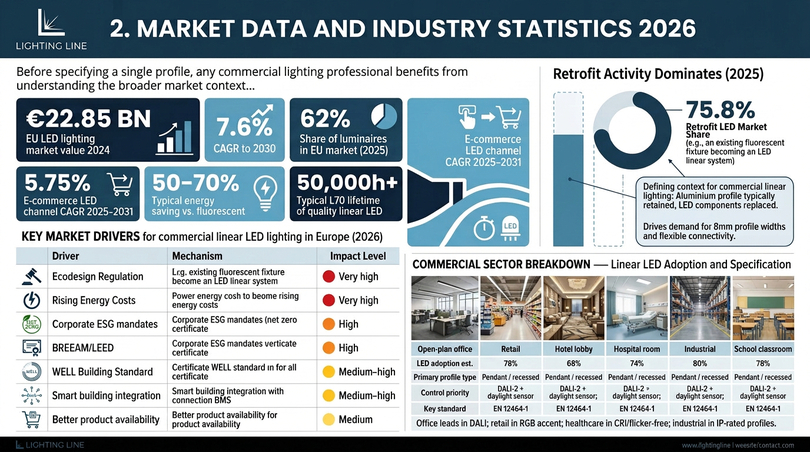
The European LED lighting market was valued at approximately €22.85 billion in 2024 and is projected to grow at a compound annual growth rate (CAGR) of 7.6% through 2030, according to industry research. The commercial sector (offices, retail, hospitality, healthcare, and industry) accounts for the largest share, driven by regulatory pressure, rising energy costs and sustainability commitments from corporate tenants and facility owners alike.
- €22.85 BEU LED lighting market value 2024
- 7.6%CAGR to 2030
- 62% Share of luminaires in EU market (2025)
- 5.75% E-commerce LED channel CAGR 2025–2031
- 50–70% Typical energy saving vs. fluorescent
- 50,000h+ Typical L70 lifetime of quality linear LED
Retrofit activity dominated at 75.8% of the European LED market share in 2025. This is the defining context for commercial linear lighting: the vast majority of installations are not new-build but the replacement of existing fluorescent T8 or T5 fittings with LED linear systems. The aluminium profile is typically retained where geometry permits: the LED strip, driver and diffuser are replaced. This retrofit dynamic drives demand for standardised profile widths (8 mm, 10 mm, 12 mm, 15 mm strip widths) and flexible connectivity solutions.
Key market drivers
Several converging forces are accelerating the commercial transition to linear LED:
| Driver | Mechanism | Impact level |
|---|---|---|
| Ecodesign Regulation 2021/341/EU | Minimum efficacy thresholds phasing out inefficient fluorescent and halogen | 🔴 Very high |
| Rising energy costs | Commercial electricity in EU: avg. €0.25–0.35/kWh; ROI on LED retrofit in 2–4 years | 🔴 Very high |
| Corporate ESG mandates | Net-zero targets push facilities managers to reduce Scope 2 emissions | 🟠 High |
| BREEAM / LEED certification | Green building certification schemes award credits for efficient lighting design | 🟠 High |
| WELL Building Standard | HCL requirements for WELL certification drive tunable white LED adoption | 🟡 Medium–high |
| Smart building integration | BMS integration via DALI-2; IoT occupancy data reducing unnecessary energy use | 🟡 Medium–high |
| Better product availability | Professional-grade LED strips and aluminium profiles now widely available B2B online | 🟡 Medium |
Commercial sector breakdown
Not all commercial sectors are equally advanced in LED adoption, and the specification requirements differ substantially between them. The office sector leads in DALI control system adoption; retail leads in RGB accent and emphasis lighting; healthcare leads in CRI and flicker-free requirements; industrial leads in ruggedised IP-rated profiles.
| Sector | LED adoption est. | Primary profile type | Control priority | Key standard |
|---|---|---|---|---|
| Open-plan office | 78% | Pendant / recessed | DALI-2 + daylight sensor | EN 12464-1 |
| Retail (general) | 82% | Surface / track-mounted | Scene control / DALI | EN 12464-1 + WELL |
| Supermarket / food retail | 88% | IP-rated surface / suspended | On/off zones | IP65+, EN 12464-1 |
| Hospitality (hotel) | 71% | Recessed / cove (indirect) | Scene dimming, tunable white | Brand standards |
| Restaurant / F&B | 69% | Pendant / recessed accent | Scene dimming | Internal standards |
| Healthcare (hospital) | 65% | Recessed hygienic profile | DALI-2 + HCL | EN 12464-1, HTM 08-03 |
| Industrial / warehouse | 74% | IP65+ surface / suspended | Occupancy sensor | EN 12464-2, ATEX (where req.) |
| Education | 72% | Recessed / surface | Daylight harvesting + dimming | BB93, EN 12464-1 |
3. What is linear LED lighting? Definitions and terminology
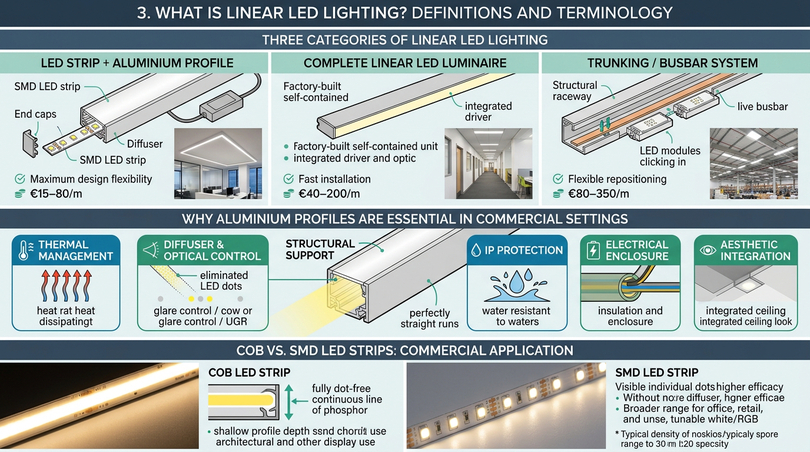
The term “linear lighting” is used loosely in both trade and consumer contexts. For professional specification purposes, it is essential to understand the distinctions between different product categories because the specification implications, installation requirements, and regulatory compliance pathways differ significantly between them.
LED strip vs. linear luminaire vs. trunking system
These three categories represent different points on the spectrum from raw component to complete luminaire.
| Category | Description | Typical application | Regulatory status | Typical cost |
|---|---|---|---|---|
| LED strip + aluminium profile | Flexible LED strip inside an aluminium extrusion profile with diffuser. Driver fitted separately or at end. | Architectural, retail, office, hospitality. Maximum design flexibility. | CE-marked components; combined assembly is installer’s responsibility | €15–80/m (profile + strip + driver) |
| Complete linear LED luminaire | Self-contained factory-built fitting: LED module, driver, housing, optic in one unit. CE-marked as luminaire. | Office, industrial, education. Fast installation. | CE-marked as complete luminaire under EN 60598 | €40–200/m |
| Trunking / busbar system | Structural aluminium raceway with integral live busbar. LED modules click in anywhere along the run. | Retail, warehouse, large open spaces. Very flexible repositioning. | CE-marked system; modules separately certified | €80–350/m (system + modules) |
For the purposes of this guide, we focus primarily on the LED strip + aluminium profile approach, which delivers maximum design flexibility, the widest range of aesthetic outcomes, and the most cost-effective solution for the majority of commercial applications.
Why aluminium profiles are essential in commercial settings
The aluminium profile is not merely a cosmetic housing for an LED strip, it is a critical functional component that determines the long-term performance of the entire system. In domestic applications, running a raw LED strip without a profile may be acceptable for decorative purposes. In commercial spaces, it is professionally and technically unacceptable for any primary or secondary lighting application.
Here is why the aluminium profile matters:
| Function | What it does | Commercial impact |
|---|---|---|
| Thermal management (heat sink) | Aluminium dissipates LED junction heat into the surrounding structure, reducing operating temperature by 10–25°C vs. bare strip | Extends LED life from ~25,000 h (bare strip) to 50,000–100,000 h, critical for commercial running hours |
| Diffuser and optical control | Frosted, opal or micro-prismatic diffuser eliminates visible LED dots, controls glare | Achieves UGR <19 required by EN 12464-1 for office environments, essential for WELL compliance |
| Structural support | Rigid extrusion creates perfectly straight continuous line of light even on long runs | Professional finish, eliminates sag and hot spots on runs up to 3–5 m per section |
| IP protection | IP67/IP68-rated profiles allow use in wet areas (commercial kitchens, car washes, pool areas) | Extends application range, meets hygiene and safety requirements |
| Electrical enclosure | Housings prevent accidental contact with live components, end caps provide ingress protection | Meets IEC/EN electrical safety requirements, reduces liability |
| Aesthetic integration | Anodised aluminium, white powder-coated or black finishes integrate with ceiling systems | Eliminates visible wiring, creates high-value architectural appearance |
COB vs. SMD LED strips for commercial use
The choice between COB (Chip-on-Board) and SMD (Surface-Mounted Device) LED strip technology has significant implications for commercial applications, particularly in terms of dot-free uniformity and colour rendering.
| Parameter | COB LED strip | SMD LED strip (e.g. 2835, 3528) |
|---|---|---|
| Visual uniformity | ✅ Fully dot-free, continuous phosphor line | ⚠️ Individual dots visible without diffuser, requires opal diffuser in tight profiles |
| Minimum diffuser distance | 10–15 mm (can use transparent diffuser) | 25–40 mm for dot-free with frosted diffuser |
| Lm/W efficacy | 120–145 lm/W | 130–165 lm/W (slightly higher) |
| CRI options | CRI 80, 90, 95+ | CRI 80, 90, 95; wider range |
| Colour temperature range | 2700K–6500K (white), limited RGB | Full range: single colour, CCT, RGB, RGBW, TW |
| Best commercial use | Cove, shelf edge, display case, architectural | Office general lighting, retail accent, full RGB/TW |
| Typical wattage range | 6–18 W/m | 4–30 W/m |
| Profile depth required | Shallow (8–12 mm) | Standard (10–18 mm typical) |
For office and retail linear lighting where the strip will be visible through a diffuser, COB is the professional’s choice, the seamless continuous line of light is impossible to replicate with SMD at shallow profile depths. For back-lit displays, tunable white offices, and RGB accent lighting, high-density SMD (e.g. 2835 at 168 LEDs/m, 24V) is the better specification.
4. European standards and regulatory requirements
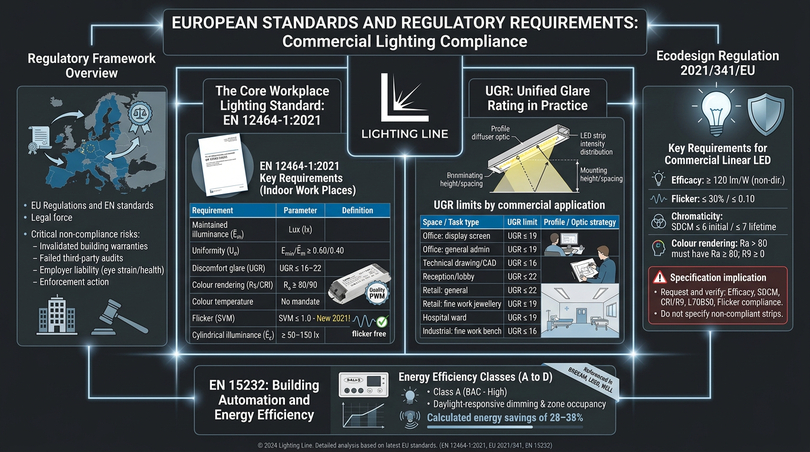
Commercial lighting in Europe is governed by a framework of EU regulations and harmonised EN standards that carry legal force. Non-compliance is not a technicality, it can invalidate building warranties, fail third-party certification audits, create employer liability for eye strain and health issues, and result in enforcement action from building control authorities. Every professional specifier must understand these requirements.
The core workplace lighting standard
EN 12464-1:2021 Light and lighting — Lighting of work places — Part 1: Indoor work places is the primary European standard governing all commercial interior lighting. It replaces the 2011 edition and introduces several important updates relevant to LED linear systems.
| Requirement | Parameter | Definition |
|---|---|---|
| Maintained illuminance (Ēm) | Lux (lx) on working plane | Average horizontal illuminance maintained throughout the life of the installation (not initial value). Measured or calculated at maintenance factor (MF) typically 0.70–0.80. |
| Uniformity (Uo) | Emin/Ēm ≥ 0.60 (task area); ≥ 0.40 (surrounding area) | Ratio of minimum to average illuminance on the working plane. Prevents pools of light and dark. |
| Discomfort glare (UGR) | UGR ≤ 16–22 (task-dependent) | Unified Glare Rating. Most office tasks require UGR ≤ 19. Display screen work requires UGR ≤ 19 specifically. |
| Colour rendering (Ra/CRI) | Ra ≥ 80 (general); Ra ≥ 90 (colour-critical) | Minimum CRI of 80 for all commercial spaces; 90+ for retail fashion, food, healthcare. |
| Colour temperature | No mandate; guidance only | Standard recommends consistency within a space; HCL systems excepted. |
| Flicker (SVM) | SVM ≤ 1.0 (Stroboscopic Visibility Measure) | New in 2021 edition. Critical for avoiding photosensitive epilepsy risk and visual fatigue. Quality LED drivers with proper PWM management essential. |
| Cylindrical illuminance (Ēz) | ≥ 50–150 lx (space-dependent) | Vertical illuminance for face recognition in social spaces; relevant to hospitality and meeting rooms. |
UGR: Unified Glare Rating in practice
UGR is perhaps the most technically demanding requirement for linear LED systems in open-plan offices. Achieving UGR <19 with a linear LED profile system requires careful coordination of three factors: the profile diffuser optic, the luminous intensity distribution of the LED strip, and the geometric spacing and mounting height of the fittings.
| Space / Task type | UGR limit | Profile / Optic strategy |
|---|---|---|
| Office: display screen equipment work | UGR ≤ 19 | Low-brightness diffuser (opal or micro-prismatic), pendant with upward shielding |
| Office: general administration | UGR ≤ 19 | Recessed with deep cell or baffled diffuser |
| Technical drawing, CAD workstations | UGR ≤ 16 | Anti-glare louvre profile, indirect/direct pendant ratio ≥ 60:40 |
| Reception, lobby, circulation | UGR ≤ 22 | Standard opal diffuser, surface profile acceptable |
| Retail: general | UGR ≤ 22 | Surface or track, accent lighting excepted |
| Retail: fine work (jewellery, fashion) | UGR ≤ 19 | High-CRI strip with baffled diffuser |
| Hospital ward | UGR ≤ 19 | Hygienic IP-rated recessed profile, no bare diffuser |
| Industrial: fine work bench | UGR ≤ 16 | Directional optic, baffle louvre profile |
Ecodesign Regulation 2021/341/EU
Commission Regulation (EU) 2021/341 (the Ecodesign Regulation for light sources) sets minimum energy performance requirements for LED products placed on the EU market. The key requirements relevant to commercial linear LED products are:
- Minimum rated luminous efficacy: ≥ 120 lm/W for non-directional LED light sources from September 2021; rising thresholds through 2026.
- Flicker: Percent flicker ≤ 30% and flicker index ≤ 0.10 for mains-frequency operation.
- Chromaticity tolerance: MacAdam ellipse ≤ 6-step (SDCM ≤ 6) at initial lumen output; ≤ 7-step over lifetime.
- Colour rendering: Products claiming Ra > 80 must actually achieve Ra ≥ 80; R9 ≥ 0 mandatory.
- Lifetime declaration: Manufacturers must declare L70B50 lifetime (the hours at which 50% of units have degraded to 70% of initial lumen output).
When sourcing LED strips for commercial projects, always request the technical data sheet and verify declared efficacy (lm/W), SDCM value, CRI/Ra with R9 value, L70B50 lifetime, and flicker compliance. Strips that cannot demonstrate Ecodesign compliance should not be specified for any commercial project in the EU.
EN 15232: building automation and energy efficiency
EN 15232-1:2017 Energy performance of buildings — Impact of Building Automation, Controls and Building Management defines four energy efficiency classes (A through D) for building services including lighting. Class A (BAC — High) requires automatic daylight-responsive dimming and zone occupancy control on all lighting circuits, delivering calculated energy savings of 28–38% compared to non-automated systems. This standard is directly relevant to DALI-2 control system specification and is referenced in BREEAM, LEED and WELL certification schemes.
5. Lux levels by commercial application
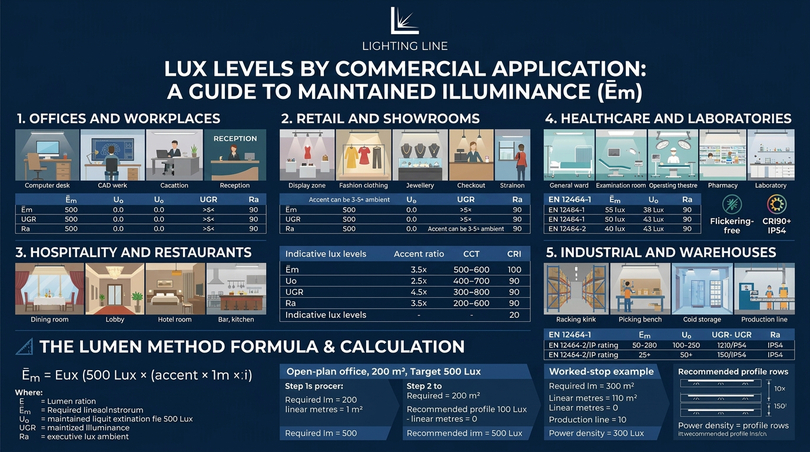
The fundamental design parameter for any commercial lighting project is the maintained illuminance (Ēm), the average lux level on the working plane throughout the life of the installation. These values are not optional targets, EN 12464-1:2021 specifies minimum values that must be achieved and maintained. Specifying too low risks regulatory non-compliance and occupant discomfort, specifying excessively high wastes energy and increases capital cost.
Offices and workplaces
| Space / Task | Ēm (lux) | Uo (min) | UGR (max) | Ra (min) |
|---|---|---|---|---|
| General office, computer work | 500 | 0.60 | 19 | 80 |
| Technical drawing, CAD workstation | 750 | 0.70 | 16 | 80 |
| Conference / meeting room | 500 | 0.60 | 19 | 80 |
| Reception desk / front-of-house | 300 | 0.60 | 22 | 80 |
| Archive / document storage | 200 | 0.40 | 25 | 80 |
| Corridor / circulation | 100 | 0.40 | 28 | 80 |
| Staircase | 150 | 0.40 | 25 | 80 |
| Staff breakroom / canteen | 200 | 0.40 | 22 | 80 |
Retail and showrooms
Retail lighting is uniquely demanding because it must simultaneously serve the functional purpose of safe movement and wayfinding, the commercial purpose of attracting and retaining customer attention, and the brand purpose of creating a specific visual environment. Linear profiles are typically used for general ambient illumination, with track-mounted spotlights providing accent and emphasis lighting on merchandise. The interplay between the two layers determines perceived brightness, colour fidelity, and merchandising impact.
| Retail space / Zone | Ēm (lux) | UGR (max) | Ra (min) | Notes |
|---|---|---|---|---|
| General sales floor (ambient) | 300 | 22 | 80 | Minimum, premium retail typically 500–750 |
| Merchandise display zone | 500–1000 | 22 | 90 | Accent can be 3–5× ambient |
| Fashion / clothing display | 500 | 22 | 90 | High CRI essential for fabric colour |
| Food retail: fresh produce | 500 | 22 | 90 | Specific CCT: 3000K enhances meat/bakery |
| Jewellery / luxury goods | 500–1000 | 19 | 95 | CRI95+ mandatory, R9 ≥ 50 |
| Fitting rooms | 300 | 19 | 90 | Vertical illuminance critical, avoid harsh shadows |
| Checkout / service desk | 500 | 19 | 80 | Task area requirement |
| Supermarket aisle (ambient) | 300 | 22 | 80 | IP65 if above refrigeration units |
Hospitality and restaurants
Hospitality lighting is the most nuanced commercial sector because lux levels are deliberately lower than offices or retail — the primary goal is atmosphere, comfort and social facilitation rather than task performance. However, task areas (menus, food preparation, reception desks) still require adequate illuminance. Linear profiles are primarily used for cove/indirect lighting, perimeter wall washing, and back-of-house areas.
| Space | Ambient Ēm (lux) | Accent ratio | CCT recommendation | CRI |
|---|---|---|---|---|
| Restaurant dining room | 50–150 | 5:1 to 10:1 accent | 2700–3000K | Ra ≥ 90 |
| Hotel lobby / reception | 150–300 | 3:1 accent | 3000K | Ra ≥ 80 |
| Hotel guestroom | 100–200 (relaxing), 300 (reading) | N/A | 2700K (tunable) | Ra ≥ 80 |
| Hotel corridor | 50–100 | — | 2700–3000K | Ra ≥ 80 |
| Bar | 30–100 | High accent on bottles/products | 2700K | Ra ≥ 80 |
| Hotel conference room | 300–500 | — | 4000K (tunable) | Ra ≥ 80 |
| Commercial kitchen | 500 | — | 4000–5000K | Ra ≥ 80; IP65+ required |
| Hotel spa / wellness | 50–200 | — | 2700–3000K (tunable) | Ra ≥ 90 |
Healthcare and laboratories
Healthcare lighting is the most stringently regulated commercial sector, governed not only by EN 12464-1 but also by sector-specific guidance (UK: HTM 08-03; DE: DIN 5035-3; FR: NF EN 12464-1 with healthcare supplement). Key requirements include: flicker-free operation (SVM < 0.4 recommended), high CRI (Ra ≥ 90, R9 ≥ 50), hygienic IP-rated profiles (IP54 minimum in patient areas), and DALI-2 control for circadian rhythm support and night dimming.
| Space | Ēm (lux) | UGR | Ra | Special requirements |
|---|---|---|---|---|
| General ward (day) | 200 | ≤19 | ≥80 | Adjustable, night mode 5 lux |
| Examination room | 1000 | ≤19 | ≥90 | High R9, shadow-free |
| Operating theatre (general) | 1000 | ≤19 | ≥90 | Supplemented by surgical luminaires |
| Nurses’ station | 500 | ≤19 | ≥80 | Computer work |
| Pharmacy / dispensary | 500 | ≤19 | ≥90 | Label reading, Ra ≥ 90 |
| Corridor (day) | 200 | ≤22 | ≥80 | Emergency lighting integrated |
| Radiology / X-ray room | 300 | ≤19 | ≥80 | Dimmable for viewing screens |
| Laboratory (general) | 500 | ≤19 | ≥90 | Task lighting at benches: 750 lux |
Industrial and warehouses
EN 12464-2 governs outdoor and industrial workplace lighting. For linear LED profiles in industrial contexts, the primary considerations are IP rating (IP65 minimum in most industrial environments, IP67+ in wash-down areas), mechanical impact resistance (IK08+), high-temperature tolerance (>50°C ambient), and ATEX rating where explosive atmospheres may be present.
| Area | Ēm (lux) | IP (min) | Notes |
|---|---|---|---|
| General warehouse racking aisle | 200 | IP65 | Occupancy sensor per aisle |
| Picking / packing bench | 500 | IP65 | Task lighting on bench |
| Cold storage (−20°C) | 200 | IP65 | Low-temp rated driver (−30°C) |
| Food processing wash-down | 500 | IP69K | Hygienic white profile, no crevices |
| Assembly / production line | 500–750 | IP54 | High-CRI for quality inspection |
| Loading bay | 150 | IP65 | Emergency lighting integrated |
How to calculate lux: the lumen method
The lumen method (also called the average illuminance calculation) is the standard technique for estimating the number of linear metres of LED profile required to achieve a target lux level in a commercial space.
📐 The Lumen Method FormulaE = (N × F × UF × MF) / A
Where: E = required illuminance (lux) | N = number of luminaires | F = luminous flux per luminaire (lm) | UF = utilisation factor (typically 0.6–0.8 for recessed profiles) | MF = maintenance factor (typically 0.70–0.80) | A = floor area (m²)
Rearranged to find linear metres required: N × F = (E × A) / (UF × MF)
| Parameter | Value | Note |
|---|---|---|
| Floor area (A) | 200 m² | 20 m × 10 m room |
| Target illuminance (E) | 500 lux | EN 12464-1 office requirement |
| LED strip luminous flux (F) | 1,800 lm/m | Typical 24V SMD 2835 at 14 W/m |
| Utilisation factor (UF) | 0.72 | Recessed profile in white ceiling/walls |
| Maintenance factor (MF) | 0.75 | Office environment, 2-year cleaning cycle |
| Required lm (E × A / UF × MF) | 185,185 lm | 500 × 200 / (0.72 × 0.75) |
| Required linear metres | ≈ 103 m | 185,185 / 1,800 lm/m |
| Recommended profile rows | 10 rows × 10 m = 100 m | Spaced at 2 m centres (8 m max spacing for 500 lux uniformity) |
| Total installed power | ≈ 1,400 W | 100 m × 14 W/m |
| Power density | 7 W/m² | Well within EN 15232 Class A target of ≤ 8 W/m² |
🟢 Rule of thumb: for open-plan offices with standard 2.7–3.0 m ceiling heights and recessed linear profiles, plan for approximately 0.50–0.60 linear metres of LED profile per m² of floor area to achieve 500 lux with a high-quality 14–18 W/m LED strip. This can be refined by full DIALux or Relux simulation.
6. Aluminium LED profile types for commercial spaces
Recessed profiles for plasterboard and suspended ceilings
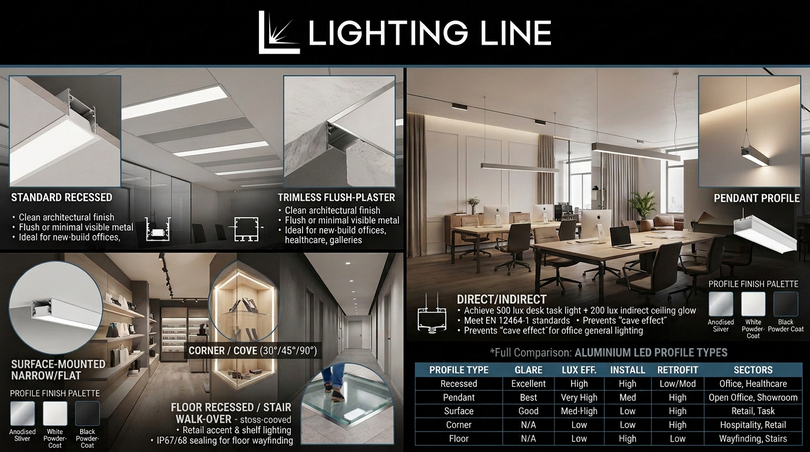
Recessed profiles are set flush or near-flush into the ceiling plane, creating a clean architectural finish where the LED light appears to emerge from the structure itself. They are the premium specification for offices, healthcare, education and high-end retail where visual cleanliness and minimal ceiling complexity are design priorities.
| Sub-type | Installation method | Diffuser flush? | Best for | Profile depth |
|---|---|---|---|---|
| Standard recessed (plasterboard) | Routed slot in 12.5mm plasterboard; profile clips in | Flush or slightly recessed | New-build office, healthcare | 10–14 mm |
| Trimless / flush-plaster | Plaster up to edge; minimal visible metal | Flush with plaster | High-end hotel, luxury retail, art gallery | 8–12 mm |
| Suspended ceiling tile (T-bar) | Sits in suspended ceiling grid like a tile | Flush with ceiling tiles | Office retrofit, education | 12–18 mm |
| Recessed corner (90°) | Installed in wall/ceiling junction | Recessed into corner | Cove, retail perimeter | 20–35 mm |
| In-floor / walkover | Cast into floor screed; toughened glass or polycarbonate cover | Flush with floor | Retail, hospitality, stairs | 20–30 mm |
Surface-mounted profiles
Surface-mounted profiles are fixed directly to the ceiling, wall or furniture surface without requiring any structural integration. They are the most cost-effective and retrofit-friendly option, and they dominate commercial installations where recessing is impractical or where the profile itself is intended as a design feature.
| Sub-type | Dimensions (typical) | Commercial application | IP available |
|---|---|---|---|
| Narrow flat (mini) | 6–10 mm wide, 6–8 mm high | Shelf edge, display case, task under-cabinet | IP20–IP44 |
| Standard flat | 12–20 mm wide, 8–12 mm high | Office under-cabinet, retail shelf | IP20–IP65 |
| Deep U-channel | 14–25 mm wide, 14–20 mm high | Office general, retail ambient | IP20–IP65 |
| Wide surface | 25–45 mm wide, 15–22 mm high | High-power commercial general lighting | IP20–IP65 |
| Hygienic (seamless) | 20–30 mm wide, radiused edges | Commercial kitchen, food processing | IP65–IP69K |
Pendant and suspended profiles
Pendant profiles are suspended from the ceiling by wire, rod or conduit, hanging at a predetermined height above the working plane. They are the premium specification for open-plan offices, combining direct downward task illumination with indirect upward ambient illumination (up/down luminaires), delivering the highest quality lighting environment for sustained computer work.
Why pendant profiles dominate premium office specificationA properly specified direct/indirect pendant LED profile system can achieve 500 lux at desk level (direct component) and 150–200 lux of indirect ceiling uplighting (indirect component), simultaneously meeting EN 12464-1 task requirements and providing the diffuse ambient ceiling glow that prevents the “cave effect” of recessed-only systems.
Corner and angular profiles
Corner profiles (typically 30°–45° or 90° angled aluminium extrusions) are designed for installation at wall/ceiling junctions, inside furniture cavities, and in cove lighting details. They are widely used in hospitality for creating warm perimeter glow effects, and in retail for accent lighting along the tops of display units and shelving systems.
Floor, stair and skirting profiles
Floor-recessed and stair profiles require specific mechanical specifications: walk-over strength (aluminium alloy, not standard grade), toughened polycarbonate or glass diffusers rated for pedestrian loading, and IP67/IP68 sealing to prevent moisture ingress. Skirting profiles combine linear LED with architectural detail, marking the transition between floor and wall with a continuous line of low-intensity light — widely used in hotel corridors, cinema foyers and healthcare corridors for safe night navigation.
Comprehensive profile comparison table
| Profile type | Glare control | Lux efficiency | Install cost | Retrofit ease | Sectors |
|---|---|---|---|---|---|
| Recessed standard | Excellent | High (UF 0.70–0.78) | Medium–High | Moderate | Office, healthcare, education |
| Trimless flush | Excellent | High | High | Low (new-build) | Luxury hotel, gallery, high-end retail |
| Surface narrow | Good | Medium (UF 0.60–0.70) | Low | High | Retail shelf, task, hospitality |
| Surface standard/deep | Good | Medium–High | Low–Medium | High | Office retrofit, retail, industrial |
| Pendant direct/indirect | Best | Very High (UF 0.78–0.85) | Medium | High | Open-plan office, coworking, showroom |
| Corner / cove | N/A (indirect) | Low (indirect, UF 0.40–0.55) | Low | High | Hospitality, retail, architecture |
| Floor recessed / stair | N/A (low level) | Low (wayfinding only) | High | Low | Hospitality, retail, healthcare corridor |
| IP65/IP69K hygienic | Moderate | Medium | High | Medium | Commercial kitchen, food, pharma |
Aluminium LED profiles for commercial specification
LightingLine.eu offers a complete range of Italian-designed aluminium LED profiles covering every commercial installation type: recessed, surface, pendant, corner, cove, floor and IP-rated. All profiles are supplied with matching diffusers, end caps, mounting brackets and connector accessories. Available in silver anodised, white powder-coat and black powder-coat finishes.
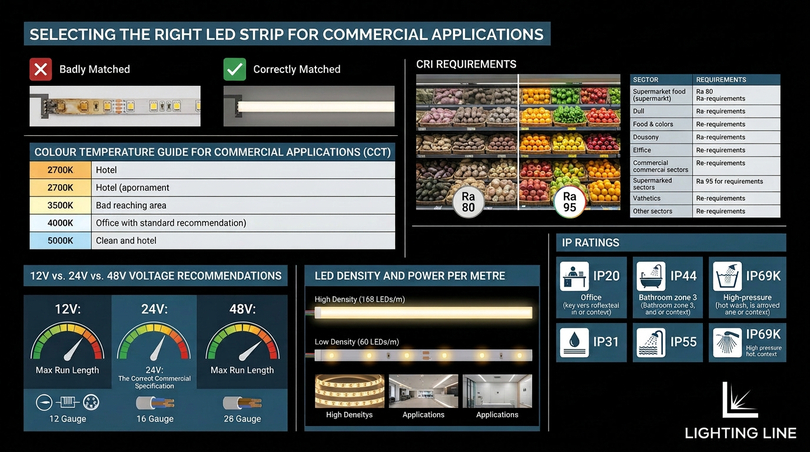
7. Selecting the right LED strip for commercial applications
The LED strip specification is as important as the profile selection and the two must be matched carefully. A premium aluminium profile fitted with a substandard LED strip will deliver poor lumen maintenance, colour shift, and premature failure. A high-quality LED strip in the wrong profile will fail to achieve the optical performance (UGR, uniformity) required by EN 12464-1. The sections below guide specifiers through each key parameter.
Colour Temperature for commercial spaces
| CCT | Appearance | Primary commercial use | Notes |
|---|---|---|---|
| 2700K (Extra Warm White) | Very warm yellow-white, similar to incandescent | Hotel guestroom, luxury restaurant, bar, spa | Low colour discrimination, not for task work |
| 3000K (Warm White) | Warm white, flattering to skin tones | Hospitality ambient, retail fashion/beauty, reception | Excellent CRI achievable, standard in luxury retail |
| 3500K (Neutral Warm) | Between warm and neutral | Retail general, office informal zones | Increasingly popular in European retail 2024–2026 |
| 4000K (Cool White / Neutral) | Clean white, high perceived brightness | Open-plan office, classroom, supermarket, showroom | EN 12464-1 standard recommendation for offices |
| 5000K (Daylight) | Slightly blue-white, energising | Industrial quality control, pharmacy, laboratory | High alertness, not for prolonged customer-facing use |
| 6500K (Cool Daylight) | Blue-white, strong circadian stimulus | Clean-room, technical inspection, specific HCL peak | Harsh for most commercial interiors, use with caution |
| Tunable White (TW) 2700–6500K | Variable, DALI or Casambi controlled | HCL office, premium hotel, healthcare ward | Highest specification, requires dual-channel driver |
Colour Rendering Index (CRI) requirements
CRI (Ra) measures how accurately a light source renders the colours of objects compared to a reference illuminant. In commercial spaces, inadequate CRI does not just compromise aesthetics, it reduces the functional effectiveness of the lighting for its intended purpose. A supermarket with CRI 80 fruit and vegetable display lighting will sell less produce than one with CRI 95 lighting, because the food simply looks less fresh and appealing. A fashion retailer with CRI 80 fitting rooms will have higher return rates, because garments look different under shop lighting than in daylight.
| CRI class | Ra value | R9 (Saturated red) | Applications |
|---|---|---|---|
| Standard | Ra ≥ 80 | R9 ≥ 0 | Office general, warehouse, circulation, back-of-house |
| Good | Ra ≥ 90 | R9 ≥ 50 | Retail general, hospitality, healthcare, exhibition |
| Excellent | Ra ≥ 95 | R9 ≥ 50 | Jewellery, fashion, food premium, art gallery, surgery |
| Museum / Art | Ra ≥ 98 (Sunlike) | R9 ≥ 90 | Museum, conservation, premium art gallery |
12V vs. 24V vs. 48V: which is right for commercial?
Voltage selection has direct implications for maximum run length, voltage drop, wiring gauge and driver selection. For the vast majority of commercial applications, 24V is the correct specification.
| Parameter | 12V | 24V | 48V |
|---|---|---|---|
| Max recommended run length (5% Vdrop) | 3–5 m | 7–10 m | 15–20 m |
| Cable cross-section (10 m at 20 W/m) | 4 mm² (high) | 1.5–2.5 mm² (standard) | 0.75–1.5 mm² (light) |
| Driver availability | Wide | Very wide (widest) | Growing (Mean Well HLG-C series) |
| DALI compatibility | Standard | Full range | Limited; check driver model |
| Commercial use recommendation | Task / under-cabinet only | ✅ Standard commercial spec | Long corridors, linear runs >8 m |
LED density and power per metre
LED density (LEDs per metre) and power per metre determine both luminous flux and visual uniformity within the profile. Higher-density strips with more LEDs per metre produce smoother light and are better suited to profiles where the LED is close to the diffuser, such as shallow recessed profiles. Lower-density strips at high power may create visible hot-spots unless a deep profile with an opal diffuser is used.
| Application | LED type | Min. density | Power/m | Typical lm/m |
|---|---|---|---|---|
| Office ambient (recessed) | SMD 2835 or COB | 160 LEDs/m (2835) or COB | 14–20 W/m | 1,500–2,800 lm/m |
| Retail general ambient | SMD 2835 high-density | 168 LEDs/m | 14–18 W/m | 1,600–2,200 lm/m |
| Cove / indirect | COB or SMD 2835 | Any; COB preferred | 8–12 W/m | 800–1,200 lm/m |
| Under-cabinet task | SMD 2835 or COB | 120 LEDs/m | 8–12 W/m | 800–1,400 lm/m |
| Industrial high-bay | SMD 5730 or 2835 HP | 60–120 LEDs/m | 20–40 W/m | 2,800–5,000 lm/m |
| Pendant direct/indirect | SMD 2835 high-density | 168 LEDs/m | 14–20 W/m per channel | 1,600–2,600 lm/m |
IP ratings for wet areas and food environments
The Ingress Protection (IP) rating system (IEC 60529) defines the degree of protection provided by the casing of an electrical enclosure against solids and liquids. In commercial LED specification, the correct IP rating is a statutory requirement in many applications, not an optional upgrade.
| IP rating | Water protection | Dust protection | Commercial application |
|---|---|---|---|
| IP20 | None | Finger-safe | Dry indoor: office, hotel room, retail (non-wash) |
| IP44 | Splash from any direction | Solid ≥1 mm | Hotel bathroom zone 3, retail wet areas |
| IP65 | Water jets | Dust-tight | Supermarket above refrigeration, commercial kitchen wall |
| IP67 | Immersion to 1 m, 30 min | Dust-tight | Food processing floor, outdoor undercanopy |
| IP68 | Continuous immersion >1 m | Dust-tight | Pool surround, underwater feature lighting, in-floor |
| IP69K | High-pressure hot wash | Dust-tight | Food processing wash-down, abattoir, dairy |
8. Control systems for commercial linear LED
The control system is the intelligence layer of a linear LED installation. For simple domestic or small commercial applications, a basic trailing-edge dimmer may be sufficient. For offices with 50+ luminaires, retail chains with centralised BMS, or healthcare facilities with Human Centric Lighting programmes, the control system becomes as complex, and as costly, as the luminaires themselves. Understanding the options is essential for correct specification.
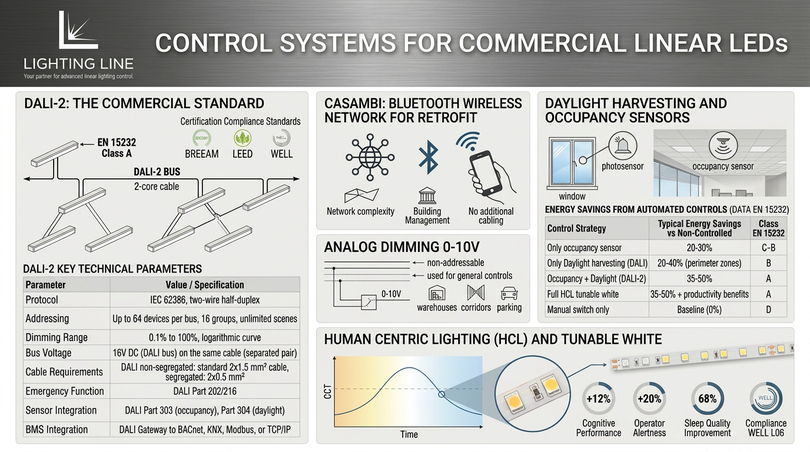
DALI-2: the commercial standard
DALI (Digital Addressable Lighting Interface) is the dominant professional lighting control protocol in European commercial buildings, standardised under IEC 62386. DALI-2 (the updated standard introduced in 2014) is a mandatory requirement for any installation seeking compliance with EN 15232 Class A building energy management, BREEAM credit ENE 06, LEED credit EAc1, or WELL Building Standard Feature L03.
| Parameter | Value / Specification |
|---|---|
| Protocol | IEC 62386, two-wire half-duplex |
| Addressing | Up to 64 gear addresses per bus, 16 group addresses, unlimited scene addresses |
| Dimming range | 0.1% to 100%, logarithmic curve matches human perception |
| Bus voltage | 16V DC (DALI bus), carried on same cable as mains (separate pair) |
| Cable requirement | Unsegregated DALI: standard 2-core 1.5 mm² lighting cable, segregated: 2-core 0.5 mm² signal cable |
| Emergency function | DALI Part 202 / 216 for maintained and non-maintained emergency lighting |
| Sensor integration | DALI Part 303 (occupancy), Part 304 (daylight), sensors on same bus |
| BMS integration | Via DALI gateway to BACnet, KNX, Modbus or TCP/IP |
Casambi: wireless bluetooth mesh for commercial retrofits
Casambi is a Bluetooth Low Energy (BLE) mesh control system specifically designed for professional lighting applications where running DALI wiring is impractical or uneconomical, particularly in retrofit scenarios in heritage buildings or spaces with complex ceiling geometry. A Casambi-enabled LED driver converts any LED profile system into a wirelessly addressable luminaire, controlled via smartphone app, wall switch or automated programme, with no additional wiring beyond the standard power connection.
0–10V analogue dimming
0–10V dimming is an analogue control protocol where a 0–10V DC signal on two additional wires controls LED driver output from off (0V) to full brightness (10V). It is simpler and less expensive than DALI but offers only dimming control (no addressing, no feedback, no sensor integration on the control bus). It remains widely used in commercial spaces where individual addressability is not required, particularly in large uniform spaces like open-plan warehouses, corridors and car parks where all luminaires dim together.
Daylight harvesting and occupancy sensors
Daylight harvesting, automatically dimming LED luminaires in proportion to available daylight from windows and rooflights, is the highest-impact single energy-saving measure in commercial lighting, delivering 20–40% energy savings in perimeter office zones. DALI Part 304 photosensors are now the standard specification, replacing earlier 0–10V analogue daylight sensors. Combined with DALI Part 303 occupancy/presence sensors (passive infrared or ultrasonic), a complete automated lighting system can achieve EN 15232 Class A without any manual intervention from building occupants.
| Control strategy | Typical energy saving vs. non-controlled | EN 15232 class |
|---|---|---|
| Occupancy sensor only (auto off) | 20–30% | C–B |
| Daylight harvesting only (DALI) | 20–40% (perimeter zones) | B |
| Occupancy + daylight (DALI-2) | 35–50% | A |
| Full HCL (tunable white, circadian schedule) | 35–50% + productivity benefit | A |
| Manual switch only | Baseline (0%) | D |
Human Centric Lighting (HCL) and tunable white
Human Centric Lighting (HCL) is the most significant innovation in commercial office and healthcare lighting in the last decade. Based on the Nobel Prize-winning discovery of the intrinsically photosensitive retinal ganglion cell (ipRGC), HCL systems automatically adjust both the correlated colour temperature (CCT) and the intensity of LED lighting throughout the day to support human circadian rhythms, matching the natural blue-enriched cool light of midday with the warm amber tones of dawn and dusk.
HCL is delivered via tunable white (TW) LED strips, which contain two separate channels of warm white (2700–3000K) and cool white (5000–6500K) LEDs on the same strip, inside aluminium linear profiles with dual-channel DALI-2 drivers, controlled by circadian schedule software. The measurable outcomes from peer-reviewed studies include:
- +12% improvement in cognitive performance during peak hours (4000–5000K, high illuminance)
- +20% improvement in alertness scores in shift workers (Viola et al., 2008; confirmed multiple studies)
- Improved sleep quality reported by 68% of office workers in TW pilot programmes
- WELL building standard feature L06 (circadian lighting design) compliance achieved
9. LED drivers and power supplies for commercial linear systems
The LED driver is the power electronics module that converts mains AC voltage to the DC voltage and current required by the LED strip. In commercial installations, driver selection is frequently under-specified, a common and costly mistake. The driver determines the lifetime, efficiency, flicker performance, dimming compatibility and maintenance cost of the entire LED system.
Constant voltage vs. constant current drivers
| Type | Output | Used with | Dimming options | Commercial application |
|---|---|---|---|---|
| Constant voltage (CV) | Fixed DC voltage (12V, 24V, 48V), variable current | Standard LED strips with built-in current-limiting resistors | PWM, DALI, 0–10V, Casambi | Most commercial strip installations |
| Constant current (CC) | Fixed DC current (350mA–1A typical), variable voltage | High-power LED modules, custom-built COB arrays | DALI, 0–10V, phase-cut | High-end retail, museum, industrial high-bay |
Driver sizing and derating
Never load a commercial LED driver above 80% of its rated output wattage. This 80% derating rule is the single most frequently violated specification guideline in commercial LED installation, and it is the primary cause of premature driver failure. At 100% load, internal temperatures rise dramatically, electrolytic capacitors degrade rapidly, and fan-cooled drivers cycle excessively. At 80% load, operating temperatures fall by 15–20°C and driver lifetime can triple.
⚡ Driver sizing formulaDriver rated wattage = (Total LED strip load in Watts) × 1.25
Example: 10 m of 14 W/m strip = 140 W total load → specify 175 W driver minimum → use 200 W driver (next standard size)
Recommended driver brands for commercial installation
| Brand | Best for | DALI-2 | Casambi | Warranty | Notes |
|---|---|---|---|---|---|
| Mean Well (HLG / ELG series) | Most commercial applications, excellent value/quality ratio | ✅ Yes (D variant) | ✅ Yes (CBM-A module) | 5 years | Industry benchmark, IP67 versions available |
| Tridonic (TALEXXdriver) | Premium office, healthcare, DALI-2 complex systems | ✅ Yes (full ecosystem) | ✅ Yes | 5 years | Best DALI-2 ecosystem integration |
| Osram/LEDVANCE Optotronic | Commercial general, wide availability | ✅ Yes | ✅ Yes | 3–5 years | Good mid-range, familiar to EU contractors |
| Inventronics | Industrial, cost-sensitive large projects | ✅ Yes | No | 5 years | Excellent IP67 range, competitive pricing |
| Eaglerise | Retail and hospitality, cost-effective | ✅ Yes | No | 3 years | Popular in European retail fitouts |
10. Energy performance and cost savings
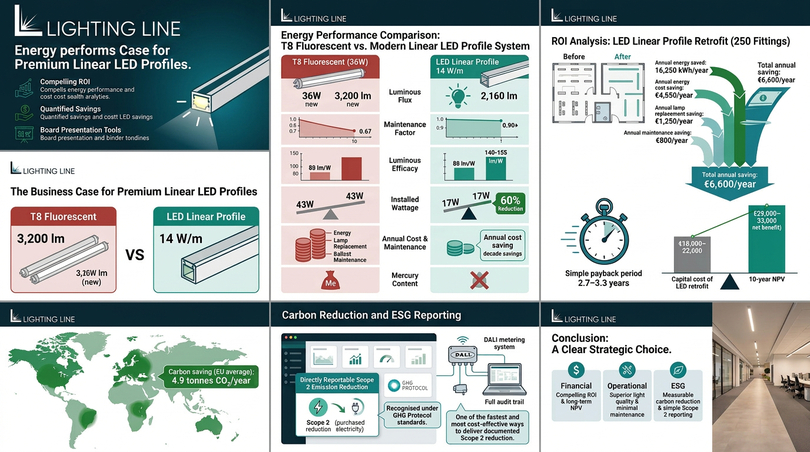
The business case for replacing fluorescent or legacy LED systems with premium linear LED profiles is compelling in virtually every commercial context. The following analysis provides the tools to quantify savings and ROI for client or board presentations.
Calculating energy and cost savings vs. fluorescent
| Parameter | T8 fluorescent (36W) | LED linear profile (14 W/m, 24V) | Improvement |
|---|---|---|---|
| Luminous flux | 3,200 lm (new) | 1,800 lm/m × 1.2 m = 2,160 lm (maintained) | Higher maintained output |
| Luminous efficacy | 88 lm/W (lamp only) / 70 lm/W (with ballast) | 140–155 lm/W | +50–70% |
| Installed wattage (per 1.2 m) | 36W lamp + 7W ballast = 43W | 17W (14 W/m × 1.2 m + driver loss) | −60% |
| Annual energy use (4,000 h) | 172 kWh | 68 kWh | −104 kWh/year |
| Annual cost at €0.28/kWh | €48.16 | €19.04 | −€29.12/year per fitting |
| Lamp replacement (every 12,000 h) | €8–12 per replacement | No lamp replacement (50,000 h L70) | −€30–40 per decade |
| Maintenance factor decay | MF 0.67 at 12,000 h | MF 0.90+ at 50,000 h | Far better lumen maintenance |
| Mercury content | 3–5 mg/tube (WEEE hazardous) | None | Eliminates hazardous waste cost |
Payback period and ROI analysis
| Item | Value |
|---|---|
| Number of fittings (1.2 m each) | 250 |
| Total installed power saving (43W → 17W × 250) | 6,500 W |
| Annual operating hours | 2,500 h (office, with DALI sensors) |
| Annual energy saved | 16,250 kWh/year |
| Annual cost saving at €0.28/kWh | €4,550/year |
| Annual lamp replacement saving (50% of fittings/year) | €1,250/year |
| Annual maintenance saving (reduced call-outs) | €800/year |
| Total annual saving | €6,600/year |
| Capital cost of LED retrofit (profiles + strips + drivers + installation) | €18,000–22,000 |
| Simple payback period | 2.7–3.3 years |
| 10-year NPV (discount rate 5%) | €29,000–33,000 net benefit |
| Carbon saving (EU average grid 300 g CO₂/kWh) | 4.9 tonnes CO₂/year |
Carbon reduction and ESG reporting
Carbon reduction from lighting is now a directly reportable Scope 2 emission reduction for corporate ESG reporting, recognised under GHG Protocol standards. Facilities managers increasingly need to demonstrate measurable Scope 2 reductions in annual sustainability reports. A LED linear lighting retrofit programme is one of the fastest and most cost-effective ways to deliver documented Scope 2 reduction, with full audit trail from DALI metering systems.
11. Linear lighting by commercial sector
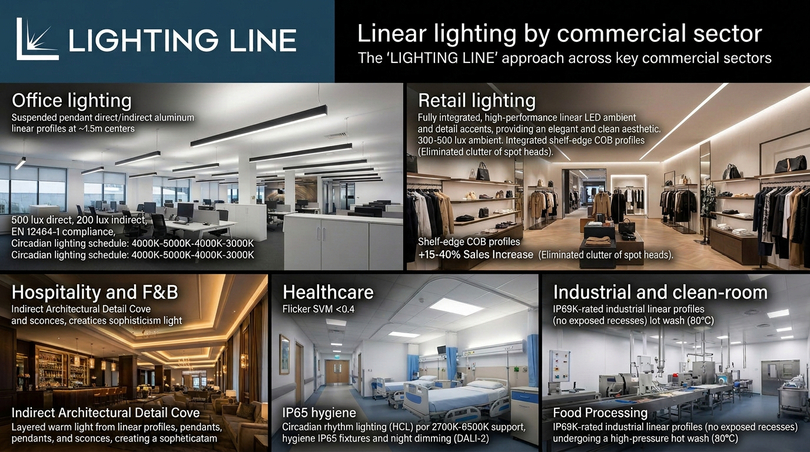
Office lighting
The open-plan office is the proving ground for linear LED technology. The combination of EN 12464-1 compliance requirements, employee wellbeing expectations, sustainability targets, and the aesthetic sensibility of progressive workspace designers has produced the most sophisticated commercial linear LED specifications anywhere in the world. The best practice open-plan office lighting system in 2026 consists of:
- Pendant direct/indirect aluminium LED profiles at 1.2–1.5 m centres, suspended at H = 2.0–2.2 m above finished floor (AFF), delivering 500 lux direct + 200 lux indirect ceiling ambient
- Tunable white LED strip (2700–6500K, 168 LEDs/m, 18 W/m, 24V, CRI90+) with dual-channel DALI-2 driver
- DALI-2 occupancy sensors (10 m coverage each) and photosensors in perimeter zones (within 4 m of glazing)
- Circadian lighting schedule programmed: 4000K at 500 lux (0800–1200), 5000K at 600 lux (1200–1400), 4000K at 500 lux (1400–1700), 3000K at 300 lux (1700–1900)
- Meeting room scenes: presentation (200 lux, 4000K), Video call (300 lux, 4000K), Relaxed (100 lux, 3000K)
Retail lighting
Retail linear LED lighting serves a fundamentally different purpose to office lighting: it must sell. The impact of lighting on retail sales is one of the most consistently documented phenomena in commercial research — studies by Rensselaer Polytechnic Institute and others have demonstrated that targeted high-CRI accent lighting on merchandise can increase sales by 15–40% compared to flat ambient fluorescent illumination. The professional retail lighting specification therefore layers high-quality linear LED ambient (300–500 lux, CRI90, 3000–4000K) with accent track lighting at 5–10× the ambient level.
Key linear profile applications in retail:
- Ceiling grid ambient: recessed linear profiles in suspended ceiling, aligned with display runs
- Shelf-edge accent: narrow surface COB profiles at 8–10 mm width, under each shelf edge
- Perimeter wall wash: corner profiles at wall/ceiling junction, painting product walls with vertical illuminance
- Feature display: recessed profiles surrounding hero product displays
- Fitting room: vertical linear profiles at mirror sides (300–500 lux, CRI90, 3000K), AVOID overhead-only illumination which creates unflattering shadows
Hospitality and F&B
Hospitality is the most design-led commercial sector for lighting. Linear profiles are rarely the primary luminaire in hospitality spaces, they are typically part of an indirect architectural detail (cove, coving, back-lit panels, shelf underlighting) that creates the layered, warm atmosphere essential to a quality guest experience. The primary luminaires are pendants, sconces and decorative fittings; the linear LED profiles contribute the soft ambient wash that ties the composition together.
Healthcare
Healthcare lighting specification demands the highest technical rigour of any commercial sector. Beyond the EN 12464-1 requirements, the specifier must address: flicker (SVM <0.4 recommended for patient environments to avoid photosensitive epilepsy risk), hygiene (IP54 minimum in patient rooms, IP65 in treatment areas, seamless profiles with no exposed crevices), HCL for circadian rhythm support in long-stay wards, and DALI-2 for night dimming, emergency lighting integration and energy audit compliance.
Industrial and clean-room
Industrial linear LED specification is dominated by practical rather than aesthetic considerations: maximum lumen output, maximum durability, maximum IP protection, and minimum maintenance requirement. The premium specification for food processing environments uses IP69K-rated aluminium profiles with seamless stainless steel or powder-coated aluminium bodies, no exposed recesses, and easy-clean polycarbonate diffusers rated for high-pressure hot wash at 80°C. COB LED strips at 18–25 W/m deliver the 500 lux required at bench level from profile-to-workplane distances of 2–3 m.
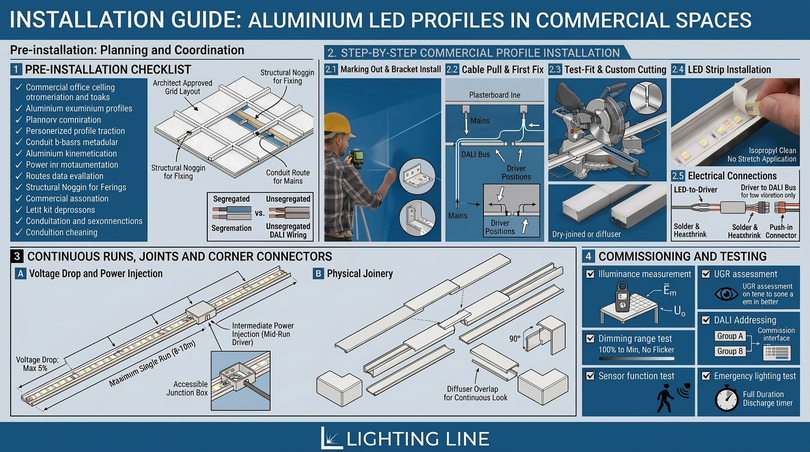
12. Installation guide: aluminium LED profiles in commercial spaces
Pre-installation: planning and coordination
Commercial LED profile installation requires coordination across multiple trades and must be integrated into the building programme from first fix. Unlike domestic installations where LED profiles can be retrofitted at any time, commercial projects require the profile fixing points, cable routes, and driver housing locations to be built in during the ceiling and partition first-fix stage.
Pre-installation checklist:
- Agree profile grid layout with architect and confirm structural fixings in ceiling (noggins, perforated hanger plate, or dedicated profile carriers)
- Confirm conduit or cable tray routes for mains supply cables to driver positions
- Confirm DALI bus cable route (unsegregated: 2-core 1.5 mm² added to lighting circuit cable; segregated: separate 2-core signal cable)
- Confirm driver positions (above suspended ceiling, in ceiling void, in dedicated driver boxes on wall)
- Confirm profile lengths and joining positions (maximum continuous run without mid-run driver: check voltage drop calculation)
- Specify and order profiles, LED strips, diffusers, end caps, connectors, mounting brackets and drivers as a coordinated bill of materials
Step-by-step commercial profile installation
- Mark out the profile grid at the correct centres (typically 2–2.5 m for office ambient; per design for retail/hospitality). Use a chalk line or laser level to ensure perfectly straight runs.
- Install fixing brackets at 500 mm centres minimum (300 mm in high-vibration environments). For recessed profiles: cut slots in plasterboard with an oscillating multi-tool or router at the correct width for the profile flange.
- Pull mains supply cables and DALI bus cables to driver positions before fitting profiles. Test cable continuity.
- Test-fit all profiles dry before applying LED strips. Confirm alignment, confirm end cap positions, confirm joining connector positions for continuous runs.
- Cut profiles to length with a fine-tooth mitre saw or aluminium profile cutter. Deburr cut ends. Cut mating diffusers simultaneously.
- Install LED strips in profiles: clean the aluminium channel with isopropyl alcohol. Peel backing from 3M adhesive tape on LED strip. Apply from one end, do not stretch. Ensure thermal contact between LED PCB and aluminium base.
- Make all electrical connections: LED strip to driver, DALI bus connections, mains supply connections. All connections in commercial installation must be made with appropriate connector blocks or professional solder-and-heatshrink, push-in connectors are acceptable only in low-vibration applications.
- Fit diffusers and end caps. For continuous-run profiles with joining connectors, ensure the diffuser runs continuously across joins.
- Power on and initial test: check all LED strips illuminate; check for polarity reversal (no light = reversed polarity or failed connection); check for visible dark spots or hot spots.
- Commission DALI system: address each DALI gear individually using commissioning software (Tridonic toolbox, DALI Cockpit, or BMS commissioning interface). Assign group addresses and scene levels. Commission daylight sensors and occupancy sensors.
Continuous runs, joints and corner connectors
Commercial linear installations frequently require continuous runs of 10–50+ metres. Voltage drop is the primary technical constraint on continuous LED strip runs. For 24V systems with 14 W/m strips, voltage drop calculation determines maximum run length and mid-run driver injection points. At 5% maximum allowable voltage drop (LEVC standard), the maximum run from a single driver is approximately 8–10 m for 14 W/m 24V strip on a 2.5 mm² cable section. For longer runs, power is injected at intermediate points from additional drivers or from both ends of the run.
Junction boxes must be used at all mid-run driver connection points, all boxes in ceiling voids must be accessible and marked on the as-built drawings for future maintenance.
Commissioning and testing
Commercial LED linear installations must be formally commissioned and tested before practical completion. Testing requirements:
- Illuminance measurement: grid measurement at 0.8 m above floor on 1 m centres, verify Ēm and Uo against design specification
- UGR assessment: visual check for glare at seated workplane level, CIE UGR formula calculation if required by specification
- Dimming range test: verify full dimming range from 100% to minimum setting without flicker, flutter or sudden step
- DALI group addressing test: verify all zones respond correctly to individual and group addressing
- Sensor function test: walk test for all occupancy sensors, shading test for all daylight sensors
- Emergency lighting test: full duration discharge test per EN 62034
13. Lighting design principles for commercial spaces
Layered lighting: ambient, task and accent
Professional commercial lighting design is always layered, never achieved by a single uniform system. The three layers are: ambient (provides general illuminance and sets the visual environment), task (provides local high-illuminance support at workstations, counters, desks), and accent (highlights merchandise, artwork, architectural features). Linear LED profiles contribute primarily to the ambient and task layers; track spotlights and pendant fittings contribute primarily to accent.
Uniformity, contrast and visual comfort
EN 12464-1:2021 specifies uniformity ratio Uo = Emin/Ēm ≥ 0.60 for task areas. In practice, achieving this requires careful attention to profile spacing. The maximum spacing between parallel linear profiles that maintains Uo ≥ 0.60 in a standard office environment is approximately 2.5 × mounting height above working plane. For a 2.8 m ceiling with 0.8 m working plane (effective height 2.0 m), maximum spacing = 5.0 m. Narrower spacing improves uniformity further.
Room surface reflectances and their impact on lux
| Surface | Recommended reflectance | Impact on lux |
|---|---|---|
| Ceiling | 0.70–0.90 (white/off-white) | Very high: low ceiling reflectance is the single biggest energy waster in office lighting |
| Walls | 0.50–0.80 | High: wall reflectance significantly affects cylindrical illuminance and room brightness perception |
| Floor | 0.20–0.40 | Moderate: dark floors absorb light but are widely used for acoustic and aesthetic reasons |
| Work surface | 0.20–0.70 | Direct: reflectance of the task surface determines effective contrast for reading/writing |
14. LightingLine.eu — Commercial profile range
LightingLine.eu is a European specialist supplier of aluminium LED profiles and professional LED strips, combining Italian design heritage with competitive pricing and EU-based stock. The LightingLine.eu commercial profile range is the product of years of collaboration with architects, lighting designers and electrical contractors across Europe, resulting in a portfolio that covers every commercial application scenario with precision-engineered, aesthetically considered solutions.
| Profile category | Strip width compatibility | Key commercial applications | Finishes available |
|---|---|---|---|
| Recessed profiles | 8–20 mm | Office, healthcare, education ceiling | Silver anodised, white, black |
| Surface-mounted profiles (slim) | 8–12 mm | Shelf, display case, under-cabinet task | Silver, white, black |
| Surface-mounted profiles (standard) | 10–18 mm | Office ambient retrofit, retail general | Silver, white, black |
| Pendant / suspended profiles | 12–20 mm | Open-plan office, coworking, showroom | Silver, white, black |
| Angular / corner profiles (45°) | 8–12 mm | Shelf-top, cove detail, retail perimeter | Silver, white, black |
| Stair / walkover profiles | 8–12 mm | Hospitality stair, retail entrance, public building | Silver, brushed aluminium |
| Architectural cove profiles | 10–20 mm | Hotel lobby, restaurant, high-end retail | Silver, white, black, custom RAL |
| IP65 hygienic profiles | 10–18 mm | Commercial kitchen, food retail, healthcare | White, silver |
All LightingLine.eu profiles are supplied with matching diffusers (frosted, opal and transparent options), press-fit end caps, mounting brackets, and compatible connector accessories.
15. FAQ: frequently asked questions about linear lighting for commercial spaces
What lux level is required for commercial office lighting?
What is the difference between linear lighting and LED strip lighting?
How do I calculate how many linear metres of LED profile I need for an office?
What colour temperature is best for commercial spaces?
Can DALI be used with aluminium LED profiles?
What aluminium LED profile types are best for suspended commercial lighting?
How much energy can linear LED lighting save versus fluorescent?
What is Human Centric Lighting (HCL) and how is it achieved with linear profiles?
What CRI is required for retail lighting in Europe?
Do I need to use different profiles for wet commercial areas?
16. Linear LED lighting is not a commodity specification
Linear LED lighting in commercial spaces is not a commodity specification, it is a precision engineering challenge that rewards careful specification with decades of high performance, significant energy savings, measurable occupant wellbeing improvements, and outstanding aesthetic results. The fundamental principles established in this guide provide the framework for correctly specifying any commercial linear LED installation, from a 50 m² retail unit to a 20,000 m² multi-storey corporate campus.
The key recommendations for commercial linear LED specification in 2026 are:
- Always specify the aluminium profile: bare LED strips are never acceptable for commercial primary or secondary lighting. The profile determines thermal performance, glare control, UGR compliance, and system lifetime.
- Match LED strip specification to the profile: COB for shallow dot-free profiles, high-density SMD for deep profiles requiring tunability.
- Specify 24V as standard: it is the correct commercial voltage for run lengths up to 10 m, with 48V for longer continuous runs.
- Target CRI 90+ for all customer-facing commercial spaces: the commercial return on investment in high-CRI lighting (increased sales, reduced returns, improved brand perception) far exceeds the incremental cost premium.
- Specify DALI-2 control for all spaces above 200 m²: it is required for EN 15232 Class A compliance, BREEAM credit, and is the only control protocol that future-proofs the installation against building management system changes.
- Include tunable white specification for offices and healthcare: the productivity and wellbeing return on HCL is now backed by robust peer-reviewed evidence and is required for WELL Building Standard Feature L06.
- Derate all drivers to 80% maximum load: this single specification decision will double or triple driver lifetime.
- Source profiles and LED strips from a specialist European supplier: Italian-designed profiles combine aesthetic quality with technical precision and EU-compliant specifications, backed by full technical documentation for specification and commissioning.
LightingLine.eu supplies the complete commercial linear LED specification package: aluminium profiles, professional LED strips (COB and SMD, CRI 80/90/95+), and full technical documentation. Access B2B pricing, project specification sheets, and DXF drawings in our professional online catalogue.