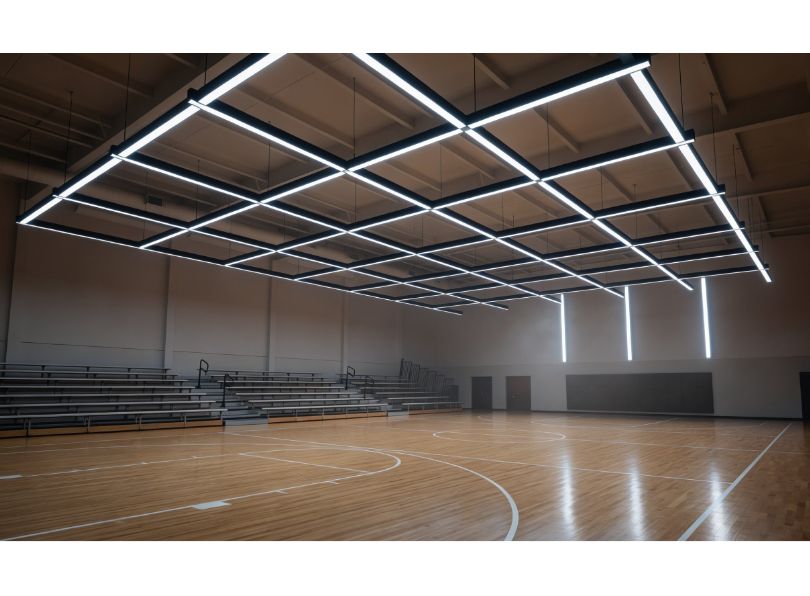
Sport lights have transformed the way we illuminate athletic environments, from neighbourhood padel courts to olympic-standard gymnasiums. The shift from legacy high-intensity discharge (HID) fittings to modern led technology has introduced extraordinary benefits (energy savings of 60–80 %), precise optical control, instant restrike, and lifespans exceeding 50 000 hours. Yet the advantages of sport lights only materialise when the installation is executed correctly: the right LED strip matched with the right aluminium profile, cut cleanly, wired properly, and controlled by robust drivers and intelligent management systems. A single mistake (a rough profile cut that nicks the flexible circuit board, an inadequate driver that introduces flicker, or a poorly aimed lens that sends a beam straight into a player’s eyes) can undermine the entire investment and, more importantly, compromise athlete safety. Sport lights represent one of the most technically demanding applications in the entire led lighting industry, because the stakes (human performance, physical safety and regulatory compliance) are higher than in almost any other environment.
This guide exists to bridge the gap between the theoretical promise of sport lights and the practical reality of installation on site. It is written for the four professionals who make sport lights happen: the installer who must mount and align profiles with millimetre precision, the electrician who must wire, protect and commission the system, the plasterer who must integrate profiles into plasterboard ceilings without cracking or misalignment, and the architect or lighting designer who specifies products and must ensure compliance with EN 12193. We will examine the specific challenges of padel court and gymnasium environments , environments in which sport lights must cope with upward gazes, high ceilings, glass wall reflections, ball speeds exceeding 100 km/h, and the need for broadcast-quality flicker-free output. We will dissect the EN 12193 standard (illuminance classes, uniformity ratios, glare ratings, colour rendering requirements) and show exactly how to meet those requirements using COB led strips, precision aluminium profiles, asymmetric optics, industrial-grade drivers and DALI-2 control systems. And, critically, we will walk you through the physical work: measuring, cutting, deburring, wiring, soldering, testing and commissioning sport lights so that the finished installation performs flawlessly for decades. Whether you are designing your first padel court sport lights scheme or retrofitting a thirty-year-old gymnasium, this guide provides the depth and clarity you need to succeed.
In questo articolo…
- What are sport lights? Definition, purpose and scope
- Sport lights vs. commercial lighting: critical differences
- EN 12193: the European standard for sport lights
- Sport lights for padel courts: why led matters
- Sport lights for gymnasiums: challenges and solutions
- COB led technology: the foundation of modern sport lights
- Aluminium led profiles for sport lights
- How to cut aluminium profiles for sport lights
- Installing led strip into profiles for sport lights
- Wiring sport lights: voltage drop, power injection and circuit design
- Drivers and power supplies for sport lights
- Glare control in sport lights: optics, profiles and positioning
- Smart control: DALI-2 and DMX512 for sport lights
- Plasterboard integration: guide for the plasterboard worker
- Specification guide for architects and lighting designers
- Energy efficiency and ROI of sport lights
- The complete sport lights ecosystem
- Maintenance and longevity of sport lights installations
- Market data, trends and industry statistics
- Frequently asked questions about sport lights
- Sport light: more than a lighting product
What are sport lights? Definition, purpose and scope
Before selecting a single product, before cutting a single metre of aluminium profile, and before wiring a single driver, every professional on the project must share a clear, unambiguous understanding of what sport lights are and why they exist. Sport lights are not merely powerful luminaires pointed at a playing surface. They are engineered lighting systems (comprising led sources, optical housings, thermal management, power electronics and intelligent controls) designed specifically to meet the visual demands of athletic activity. The distinction between sport lights and general-purpose lighting is not one of power alone, it is a distinction of precision, compliance and human-centric performance that extends from the photometric design all the way through to the final commissioning measurement on the playing surface.
The formal definition of sport lights
Sport lights, sometimes referred to as sport lighting systems or athletic facility luminaires, are purpose-designed illumination assemblies intended to light indoor and outdoor venues where organised physical activity takes place. The European Committee for Standardisation (CEN) addresses sport lights through the EN 12193 standard (Light and lighting — Sports lighting) which was first published in 1999 and revised in 2018 to incorporate led-specific guidance. According to EN 12193, sport lights must deliver defined levels of horizontal illuminance (measured in lux on the playing surface), vertical illuminance (critical for seeing airborne objects such as balls and shuttlecocks), uniformity (the ratio of minimum to average illuminance across the playing area), glare limitation (expressed as the Unified Glare Rating, UGR, or the sport-specific https://sigostreetlight.com/it/blogs/led-sports-lighting-standards-for-stadiums-a-guide-to-en-12193-compliance/Glare Rating, GR), and colour rendering (the CRI value, essential for distinguishing team colours, court markings and equipment). Each of these parameters has specific numerical targets that vary by sport and by competition class, creating a complex matrix of requirements that sport lights must satisfy simultaneously.
Sport lights differ from general commercial or industrial lighting in that their performance must be validated not just at a desk-height horizontal plane (as in office lighting, governed by EN 12464-1) but across multiple planes and viewing angles simultaneously. A badminton player looking up at a shuttle needs vertical illuminance at ceiling height. A footballer needs horizontal illuminance at ground level. A table tennis player needs low glare from a specific angular range. A padel player needs all three — horizontal illuminance on the court, vertical illuminance to track the ball in flight, and strict glare control because overhead smashes force a direct upward gaze toward the sport lights. This multi-dimensional performance requirement is what makes sport lights unique within the LED industry and why their specification and installation demand a level of professional competence that goes beyond standard electrical or building work. Every professional in the sport lights chain — from architect to plasterer — must understand how their contribution affects the final photometric result.
What sport lights are not
It is equally important to clarify what sport lights are not, because misidentification leads to inappropriate product selection and, ultimately, non-compliant installations that put athletes at risk. Sport lights are not standard high-bay fixtures hung in a gymnasium and called good enough. High-bay fixtures designed for warehouse aisle lighting produce a narrow downward beam optimised for horizontal illuminance at ground level: they neglect vertical illuminance, typically have no glare control beyond a simple polycarbonate lens, and often produce unacceptable flicker when driven by low-cost power supplies, they are not sport lights. Similarly, residential floodlights aimed at a garden football pitch, no matter how many lumens they claim, do not constitute sport lights because they lack the optical precision, the thermal management and the compliance data necessary for an EN 12193 installation. And warehouse luminaires re-purposed for a school sports hall because they produce enough lumens are emphatically not sport lights: they introduce excessive glare, poor uniformity, colour distortion and flicker that can trigger discomfort and even photosensitive reactions in vulnerable individuals.
Sport lights are systems, and systems must be designed, not assembled from incompatible parts. This is why LightingLine provides a complete ecosystem (from COB led strips and precision aluminium profiles to asymmetric lenses) so that every component in the chain is engineered to work together, and every professional on site has access to products that are purpose-designed for sport lights applications. When you specify a LightingLine profile with a COB strip, an asymmetric lens and a Mean Well XLG driver, you can be confident that the thermal, optical, electrical and mechanical interfaces are compatible, and that the resulting sport lights system will meet EN 12193 when installed correctly.
The evolution of sport lights: from gas discharge to led
The history of sport lights mirrors the broader history of electric lighting, but with unique inflection points driven by the demands of athletic visibility. The earliest enclosed sport facilities relied on incandescent lamps (energy-hungry), short-lived and producing a warm but dim light that was unsuitable for fast-paced games. The mid-twentieth century saw the rise of mercury vapour and metal halide (MH) discharge lamps, which became the default sport lights technology for decades. Metal halide sport lights delivered high lumen output (up to 100 000 lm per lamp in large formats), reasonable colour rendering (CRI 65–90 depending on formulation) and acceptable uniformity when combined with precision reflectors. By the 1980s and 1990s, metal halide had become so dominant that virtually every new gymnasium, swimming pool, tennis hall and sports arena specified metal halide sport lights as a matter of course.
However, metal halide sport lights suffered from critical disadvantages that led technology has since resolved. Restrike time (the period required for a hot metal halide lamp to restart after a power interruption) could exceed 15 minutes, leaving a gymnasium or padel court in darkness during a blackout recovery. This was not merely inconvenient, in a facility hosting a competitive match, a 15-minute darkness period could disrupt the entire event, affect player warm-up, and even pose safety risks as spectators tried to navigate in the dark. Lumen depreciation was severe: a metal halide lamp could lose 30–40 % of its output within half its rated life, meaning that a facility designed to meet EN 12193 at commissioning could fall below compliance within two to three years without re-lamping. This rapid depreciation imposed a maintenance burden (and cost) that many facility managers underestimated at the time of specification. Flicker from magnetic ballasts produced a 100 Hz modulation that, while often imperceptible to the conscious eye, caused measurable visual fatigue over extended playing sessions and interfered severely with broadcast and recording cameras, producing the characteristic “rolling bars” that plagued televised sport until the digital era. And the sheer energy consumption of a gymnasium lit by 400 W metal halide sport lights (often totalling 20–40 kW for a single hall) imposed unsustainable operating costs, particularly as energy prices rose through the 2000s and 2010s.
Led sport lights have eliminated every one of these disadvantages. Modern led sport lights using COB strips achieve instant-on, zero restrike time (the sport lights reach full output within microseconds of being switched on) allowing a padel court to be illuminated the instant a booking begins. Lumen maintenance at 50 000 hours exceeds L80 (retaining at least 80 % of initial output), meaning that led sport lights maintain compliance with EN 12193 for over fifteen years at typical operating hours. Flicker is eliminated by constant-current or high-frequency PWM drivers such as the Mean Well XLG series, producing sport lights that are indistinguishable from continuous illumination to both the human eye and the most demanding broadcast cameras. And energy consumption is slashed: a gymnasium that required 30 kW of metal halide sport lights can be relit with 8–12 kW of led sport lights while achieving higher illuminance, better uniformity and superior colour rendering. The return on investment for converting to led sport lights typically falls within 2–4 years for facilities operating more than 2 000 hours per annum, making the business case as compelling as the technical one.
Who needs to understand sport lights?
Sport lights concern a wide range of professionals, not just lighting designers. This is a point worth emphasising because it is often overlooked: sport lights are the product of a collaborative effort involving at least four distinct trades, each of which must execute their scope correctly for the system to perform as designed.
Architects and lighting designers must specify sport lights that comply with EN 12193 while integrating aesthetically into the building design. They select the products, perform the photometric calculations, define the zones and scenes, and produce the documentation that guides all other trades. An architect who specifies an inappropriate profile (too shallow for glare control, too narrow for thermal management) sets the entire project on a path to failure that no amount of installation skill can correct. Equally, an architect who specifies the right products but provides ambiguous or incomplete installation drawings leaves the installer and electrician guessing, with predictable consequences for uniformity and compliance.
Electricians must design circuits that deliver stable, flicker-free power to sport lights over long cable runs, often in challenging environments with high ambient temperatures, electromagnetic interference from HVAC motors, and the need for surge protection against lightning. The electrician’s choices (cable gauge, driver model, protection devices, DALI bus routing) directly affect whether the sport lights deliver uniform, flicker-free, dimmable illumination or suffer from voltage drop, flicker, control failures and, in the worst case, fire hazards. A sport lights installation is only as good as its electrical infrastructure.
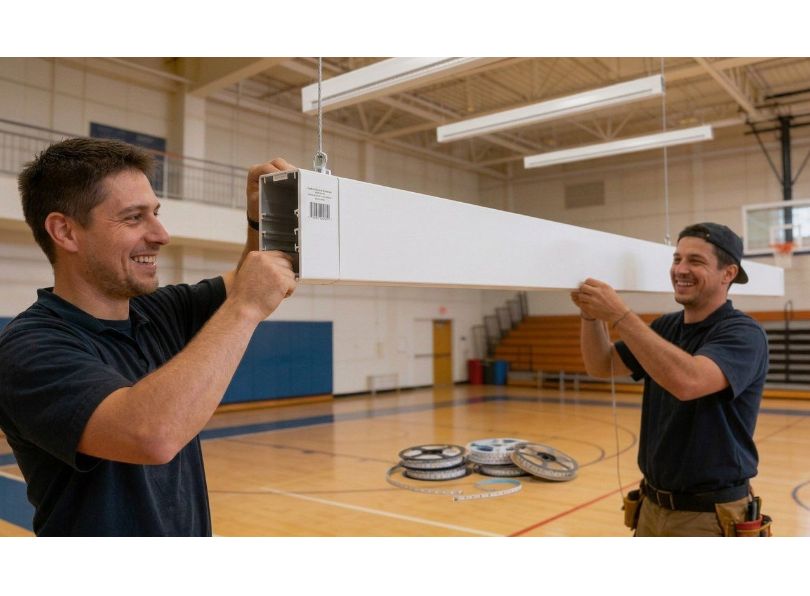
Installers must mount and align sport lights profiles with precision, ensuring that the optical axis of every profile matches the lighting designer’s layout exactly. A deviation of 50 mm in mounting position or 2° in tilt angle can create a dark gap or bright line that fails the EN 12193 uniformity requirement. The installer also performs the physical assembly (cutting profiles, inserting led strips, fitting lenses and diffusers, connecting wires) and must execute each step with the care and technique described to avoid damage to components and ensure long-term reliability of the sport lights.
Plasterers working in facilities with suspended plasterboard ceilings must route, frame and finish recesses for led profiles that become integral elements of the sport lights system. The plasterboard recess is not merely a structural opening; it is an optical element that defines the visible aperture of the sport lights (a crooked recess, a rough edge, or a misaligned frame shifts the profile position and degrades the performance of the sport lights). The plasterer must therefore work to tolerances more typical of joinery than standard plastering, and must coordinate closely with the installer to ensure that profile lengths, positions and orientations are agreed before the plasterboard is cut.
Sport lights vs. commercial lighting: critical differences
One of the most common and costly errors in facility design is treating sport lights as a subset of commercial lighting. While both categories use led technology, drivers and mounting systems, the performance requirements for sport lights are fundamentally different from those of offices, retail spaces or warehouses. Understanding these differences is essential for every professional involved in the project, because selecting commercial-grade products for a sport lights application will almost always result in non-compliance, poor visual comfort and, ultimately, costly retrofits that could have been avoided by specifying the correct sport lights components from the outset.
Illuminance levels and measurement planes
Commercial offices typically require 300–500 lux at desk height according to EN 12464-1. Retail environments may demand 500–750 lux in display areas. By contrast, sport lights must deliver illuminance levels ranging from 200 lux for recreational Class III play to 750 lux or more for Class I (international competition and broadcast). More critically, sport lights must deliver these levels not only on the horizontal playing surface but also on vertical planes because athletes track balls, shuttlecocks and opponents through three-dimensional space. A commercial high-bay fixture optimised for downward illumination at a warehouse aisle will produce adequate horizontal lux but dismal vertical illuminance, making it wholly unsuitable as sport lights. The vertical-to-horizontal illuminance ratio for sport lights is typically specified between 0.3 and 0.75, depending on the sport. For padel, where the ball spends a significant proportion of playing time above head height, a vertical illuminance of at least 50 % of horizontal is recommended to ensure the ball remains clearly visible against the ceiling background.
Uniformity requirements
In a commercial environment, a uniformity ratio (Emin/Eavg) of 0.4–0.6 is generally acceptable because workers are typically stationary and their visual tasks are confined to their desk area. In sport lights, EN 12193 demands a minimum uniformity of 0.5 for Class III, 0.6 for Class II and 0.7 for Class I. For some sports at Class I level, the requirement rises to 0.8. Achieving these uniformity values with sport lights requires careful optical design such as the beam spread, profile depth, lens type and spacing between luminaires must all be calculated as an integrated system. Simply adding more fixtures to a gymnasium ceiling will not achieve uniformity if the beam angles overlap incorrectly: it will produce bright spots and dark valleys that fail compliance even if the average lux reading is adequate. The installer must reproduce the designer’s layout with precision: a 100 mm error in the spacing between two sport lights profiles can reduce U2 from 0.72 to 0.65, turning a compliant Class I installation into a non-compliant one that requires expensive repositioning.
Glare limitation
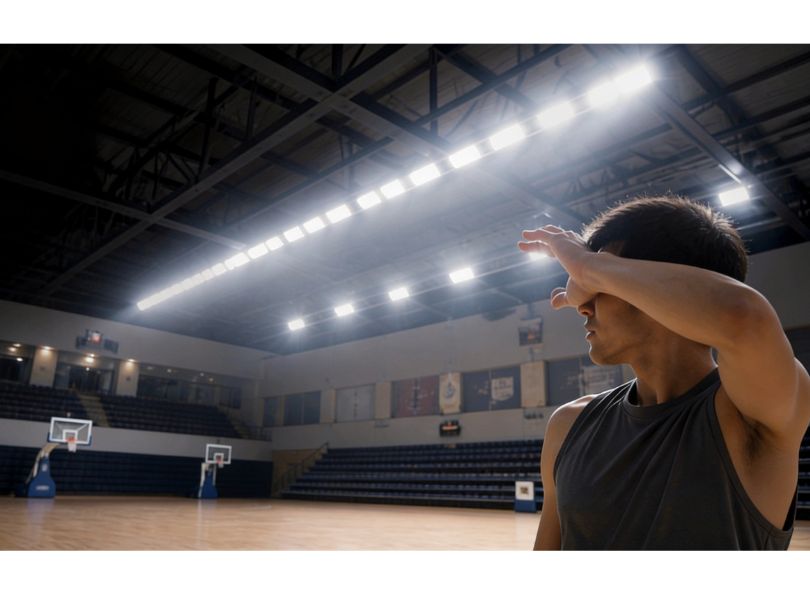
Glare limitation in commercial environments typically involves maintaining UGR ≤ 19 for office work, evaluated from a seated position looking at a horizontal desk surface. Sport lights must achieve similar or stricter UGR values, but the challenge is far greater because the viewing geometry is radically different. Athletes look in every direction (up, down, sideways) and often directly toward potential luminaire positions. In padel, players look almost vertically upward during overhead shots. In basketball, players look toward ceiling-mounted sport lights when taking free throws. In badminton, the shuttle reaches heights of 6–8 metres, requiring players to track it against the background of the ceiling and any sport lights positioned there. This omnidirectional viewing demands that sport lights use deep-housing profiles, asymmetric lenses and precisely controlled beam angles to ensure that no direct view of the led source is possible from any playing position. Commercial fixtures, which typically feature wide-angle symmetric optics, are wholly inadequate as sport lights in this regard because they distribute light in all directions without prioritising the critical cutoff angles that protect athletes’ eyes.
Flicker and stroboscopic effects in sport lights
Modern led sport lights must be essentially flicker-free. The IEEE PAR 1789 standard recommends a flicker percentage below 8 % at frequencies above 100 Hz and a flicker index below 0.001 for visually demanding applications. In sport lights, flicker causes three distinct problems.
- First: it induces visual fatigue, reducing athlete performance over time (a particularly insidious effect because the athlete may not consciously perceive the flicker but will experience headache, eye strain and reduced reaction times after 60–90 minutes of play).
- Second: flicker creates stroboscopic effects where fast-moving objects appear to jump, freeze or fragment: a padel ball travelling at 120 km/h past a flickering sport lights source may appear to occupy two positions simultaneously, confusing the player and potentially leading to a misjudged shot.
- Third: flicker produces rolling shutter artefacts on broadcast and recording cameras, manifesting as dark bands that scroll slowly across the video frame, ruining content quality and rendering the footage unusable for broadcast.
Commercial drivers that meet basic performance standards may still produce unacceptable flicker for sport lights. This is why sport lights demand purpose-specified drivers such as the Mean Well XLG series, which deliver stable DC output with minimal ripple current.
Colour rendering in sport lights
Sport lights must achieve a minimum CRI of 65 for Class III and 80 for Classes I and II according to EN 12193. For televised led strips with CRI 70 (acceptable for a warehouse) will distort the colours of team uniforms, court markings and balls, potentially affecting both play and broadcast quality. The COB led strips recommended for sport lights in this guide deliver CRI ≥ 90 as standard, exceeding the requirements for all EN 12193 classes and broadcast applications.
Summary comparison table: sport lights vs. commercial lighting
| Parameter | Commercial (EN 12464-1) | Sport Lights Class I (EN 12193) | Sport Lights Class III |
|---|---|---|---|
| Horizontal illuminance | 300–500 lux | 500–750 lux | 200–300 lux |
| Vertical illuminance | Not typically specified | 30–75 % of horizontal | As appropriate |
| Uniformity (Emin/Eavg) | 0.4–0.6 | 0.7–0.8 | 0.5 |
| UGR / GR | ≤ 19 (seated, horizontal gaze) | ≤ 50 GR / ≤ 19 UGR (omnidirectional gaze) | ≤ 55 GR |
| CRI | ≥ 80 | ≥ 80 (≥ 90 broadcast) | ≥ 65 |
| Flicker | Generally addressed | Strict: < 8 % modulation, < 0.001 index | Moderate |
| Driver surge protection | 2–4 kV typical | 6–10 kV (Mean Well XLG) | Standard to high |
| Control system | Basic on/off or 0–10 V dim | DALI-2 zoned + DMX512 for events | Manual or basic DALI |
EN 12193: the European standard for sport lights
EN 12193 is the bedrock document upon which every sport lights project must be built. Published by the European Committee for Standardisation (CEN), this standard provides a comprehensive framework for the lighting of indoor and outdoor sports facilities, covering more than 60 individual sports across three competition classes. For the architect specifying sport lights, EN 12193 defines what must be achieved. For the electrician and installer, it defines the performance targets that the installed system must demonstrate at commissioning. For the plasterer integrating profiles into ceilings, it indirectly governs the precision of the recess, because a misaligned profile shifts the optical axis and degrades uniformity. Understanding EN 12193 is not optional for any professional working on sport lights, it is the common language that connects design intent to physical reality.
Lighting Classes I, II and III
EN 12193 categorises sport lights requirements into three classes based on the level of competition and spectatorship.
Class I is the highest tier, intended for international and national competition, typically involving television broadcast, large spectator numbers and professional athletes. Class I sport lights must deliver maximum illuminance, maximum uniformity and strict glare control.
Class II is for regional competition and club-level play with moderate spectator numbers.
Class III is for recreational and school-level play, the minimum acceptable standard for any organised physical activity.
A facility designed with Class III sport lights cannot host a regional competition without a full lighting retrofit. Conversely, over-specifying Class I sport lights for a recreational facility wastes budget and energy. The architect must determine the intended class at the outset and communicate it clearly to the entire project team.
Illuminance requirements by sport
| Sport | Class I (lux) | Class II (lux) | Class III (lux) |
|---|---|---|---|
| Badminton | 500 | 300 | 200 |
| Basketball | 750 | 500 | 200 |
| Gymnastics | 500 | 300 | 200 |
| Handball | 500 | 300 | 200 |
| Table tennis | 500 | 300 | 200 |
| Tennis (indoor) | 500 | 300 | 200 |
| Volleyball | 500 | 300 | 200 |
| Padel | 500 | 300 | 200 |
| Martial arts | 500 | 300 | 200 |
| Fencing | 500 | 300 | 200 |
| Swimming | 500 | 300 | 200 |
| Futsal | 500 | 300 | 200 |
These values represent maintained illuminance (the minimum acceptable level at the end of the maintenance cycle), accounting for lumen depreciation and dirt accumulation. Sport lights should include a maintenance factor (typically 0.7–0.8 for enclosed led systems). For example, a padel court requiring 300 lux (Class II) with a maintenance factor of 0.75 must be designed for an initial illuminance of at least 400 lux. This directly impacts the led strip output and driver sizing selected.
Uniformity ratios, UGR thresholds and CRI
EN 12193 defines U2 (Emin/Eavg) as the primary uniformity metric. For Class I sport lights, U2 ≥ 0.7 for most indoor sports. Why is uniformity so difficult? Because light falls off with the square of distance from the source. In a gymnasium with sport lights at 6–10 m height, the area directly below each luminaire receives substantially more light than the midpoint between two sport lights. Achieving U2 ≥ 0.7 requires careful spacing, overlapping distributions and precision optics. For the installer, uniformity has a direct consequence: the spacing, height and alignment of every sport lights profile must match the designer’s layout exactly.
Glare limitation uses GR (Glare Rating) for outdoor sport lights and UGR for indoor sport lights, with targets of GR ≤ 50 (Class I) and UGR ≤ 19. Achieving low UGR requires deep-housing profiles like the CL02-07 (50 × 75 mm), asymmetric lenses like the LLD-06-XK1-L3/L4, and opal or frosted diffusers. CRI must be ≥ 65 (Class III) or ≥ 80 (Class I/II), with ≥ 90 recommended for broadcast. The COB strips from Ledpoint.it deliver CRI ≥ 90 as standard.
Sport lights for padel courts: why led matters
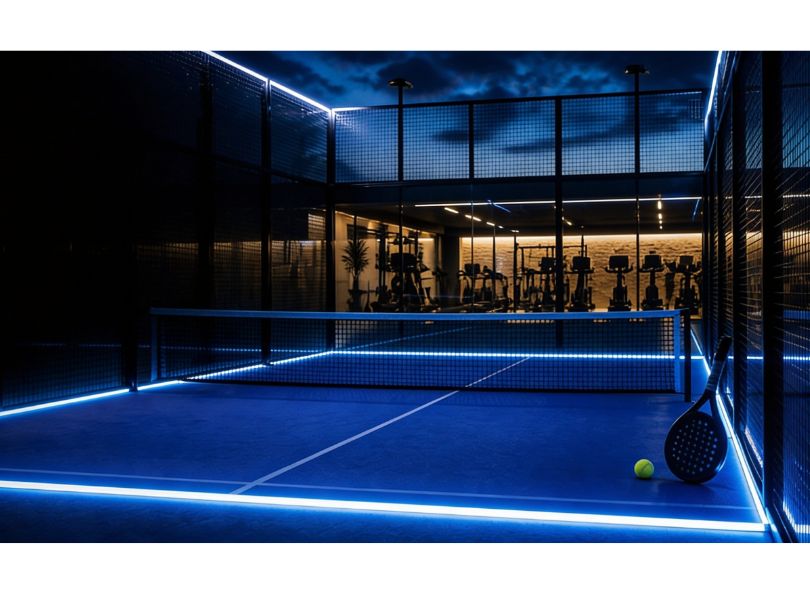
Padel is one of the fastest-growing racquet sports in Europe, with over 25 million players worldwide as of 2024 and thousands of new courts constructed each year across Spain, Italy, Sweden, the UK and beyond. Market research from Allied Market Research (2023) estimates that the global padel infrastructure market (including courts, sport lights and ancillary equipment ) is growing at a compound annual growth rate (CAGR) of 12.5 % and is expected to exceed USD 3.5 billion by 2030. This growth has created enormous demand for sport lights specifically designed for padel court environments. Unlike tennis, padel is played within an enclosed glass and mesh structure (20 × 10 m), and this architecture creates challenges for sport lights that must be addressed through careful product selection and installation.
Visual demands of padel
The padel ball is small (6.35–6.77 cm diameter), fast (120 km/h in competitive play) and frequently airborne. Players must track it while looking almost vertically upward during overhead smashes, bandeja shots and vibora strokes. This upward gaze puts sport lights directly in the field of view, making glare control the most critical parameter for padel court sport lights. The glass walls add a secondary challenge: poorly positioned sport lights produce reflected glare on the glass, obscuring the ball during rebounds. These reflections are unique to padel and do not arise in open-court sports. To mitigate both direct and reflected glare, padel court sport lights must be positioned on the sides of the court, angled so that the primary beam hits the playing surface without striking the glass walls at specular reflection angles. The use of asymmetric lenses on sport lights profiles, such as the LLD-06-XK1-L3/L4 from LightingLine — is invaluable because they allow the beam to be aimed precisely onto the court while keeping light off the walls above player height.
The glare problem: safety and insurance
Glare in padel is not merely a comfort issue, it is a safety issue. A player temporarily blinded by sport lights during a high smash may mistime the shot, collide with a wall or trip over a partner. Insurance claims related to inadequate sport lights in padel facilities have been documented by European insurers, and courts that fail to meet EN 12193 glare requirements face liability exposure. The financial cost of installing proper sport lights with glare control is trivial compared to the potential cost of a single injury claim. Three layers of control are required.
- First: side-mounting the sport lights.
- Second: fitting asymmetric lenses that throw light downward onto the court.
- Third: using deep profiles, as the CL02-07 (50 × 75 mm), is specifically recommended because its deep channel naturally reduces the cutoff angle and lowers the UGR.
Uniformity on the padel court
Achieving U2 ≥ 0.7 (Class I) on a 20 × 10 m padel court requires typically 8–12 sport lights units at 4–6 m height along the side walls, with beam footprints overlapping smoothly to create a seamless carpet of light. COB led strips are ideal because they produce a continuous, dot-free line of light. Traditional SMD strips create a pixelated effect magnified by glass wall reflections. The OR300-F52-320OR2 and FA2-400-480OR2 COB series from Ledpoint.it eliminate this. For Class I, the high-output Performance Series (24 W/m) meets 500 lux from typical padel court mounting heights. A comprehensive market survey by Statista (2024) found that 78 % of newly constructed padel courts in Europe specify led sport lights with COB technology, reflecting the industry’s recognition that COB is the superior source for padel court applications.
Why led sport lights outperform HID on padel courts
Padel courts operate on pay-per-hour bookings, meaning sport lights switch on and off frequently. Led sport lights reach full output instantly while metal halide requires 5–10 minutes warm-up and 15 minutes restrike. Led sport lights enable dimming (practice mode vs. competition mode via DALI-2), maintain consistent colour temperature throughout life, and deliver energy savings of 60–80 %. A single padel court with 8 led sport lights profiles consuming 600 W total (replacing 8 × 250 W metal halide = 2 000 W) saves approximately 4 200 kWh per year at 3 000 operating hours, equating to €1 050 annual savings at €0.25/kWh. The LED sport lights investment pays for itself within 2–3 years.
Sport lights for gymnasiums: challenges and solutions
Gymnasiums represent the most diverse and demanding application for indoor sport lights. A single gymnasium may host basketball, volleyball, handball, badminton, futsal, gymnastics, martial arts, dance, fitness classes and school assemblies (all with different illuminance, uniformity and glare requirements). The sport lights system must be flexible, controllable and capable of meeting the most demanding use case while remaining energy-efficient in less intensive modes. According to a 2023 report by the European Lighting Industry Association (LightingEurope), LED sport lights now account for over 85 % of new gymnasium lighting installations across the EU, up from just 30 % in 2015.
Types of gymnasium and lighting needs
Loook up now at the different type of gymnasium and the various type of light that they needs.
School gymnasiums
School gymnasiums (20–25 × 30–40 m, ceilings 6–7 m) serve physical education and inter-school competition. Sport lights must meet Class III minimum (200 lux, U2 ≥ 0.5) with Class II capability (300 lux). Budget constraints make energy efficiency and low maintenance critical. Led sport lights with COB strips in medium-depth aluminium profiles, driven by Mean Well CV drivers, provide the optimal performance-to-cost ratio. Opal diffusers are generally sufficient for glare control at Class III, but asymmetric lenses should be considered for badminton (upward gaze) or ceilings below 6 m.
Community and club gymnasiums
Community gymnasiums (25–30 × 40–50 m, ceilings 7–9 m) host club-level competition and may double as event venues. Sport lights should meet Class II baseline (300 lux, U2 ≥ 0.6) with zone-specific Class I capability. High-output COB strips (performance series, 23-26 W/m) in deep-section profiles with asymmetric lenses are recommended and DALI-2 controls that enable scene switching between sports and energy management.
Professional and arena gymnasiums
Professional arenas (30 × 50 m+, ceilings 10–15 m+) host national/international competition with TV broadcast. Sport lights must meet Class I (500–750 lux, U2 ≥ 0.7, CRI ≥ 90, flicker-free). A combination of high-bay led sport lights for primary illumination and linear led profile sport lights for supplementary fill achieves the vertical illuminance and uniformity required for broadcast. Mean Well XLG drivers (10 kV surge) are mandatory: the global sports lighting market, valued at USD 6.3 billion in 2023 (Mordor Intelligence), is projected to reach USD 9.1 billion by 2028, driven substantially by professional facility upgrades to led sport lights.
Ceiling height and beam distance
The inverse-square law dictates that sport lights at 10 m must produce four times the intensity of those at 5 m for equal floor illuminance. For gymnasiums with ceilings above 8 m, high-output COB strips (24 W/m+) with focusing optics are essential. Narrow-beam or asymmetric lenses concentrate the beam on the playing surface without wasting output on walls and structures. High ceilings also affect maintenance access, scaffolding or cherry pickers are required above 6 m, making component quality critical. Sport lights with led strips (30 000+ hours) and Mean Well XLG drivers minimise costly high-level interventions.
Multipurpose lighting and broadcast quality
DALI-2 controls enable scene switching: 750 lux full-court for basketball (Class I), 300 lux badminton zone (Class II), 200 lux yoga (Class III), general lighting for assemblies. The architect defines zones and scenes, the electrician wires the DALI bus. For broadcast, led sport lights deliver continuous flicker-free output with CRI ≥ 90 when driven by Mean Well XLG series drivers. Deep aluminium profiles eliminate direct lens flare by shielding the led source from camera angles. A 2024 survey by the International Association of Broadcast Engineers found that 92 % of newly lit indoor sport venues globally now use led sport lights exclusively.
COB led technology: the foundation of modern sport lights
At the heart of every high-performance sport lights installation is the LED source itself. For sport lights (where uniformity, colour rendering, flicker-free output and visual comfort are paramount) COB (Chip on Board) led technology represents the current state of the art. Understanding why COB is superior to traditional SMD for sport lights, and how to select and handle COB strips correctly, is essential knowledge for every professional on the project.
COB vs. SMD: why COB wins for sport lights
SMD (Surface Mount Device) LED strips use individual LED packages (such as 2835, 5050 or 5630 chips) soldered at regular intervals along a flexible PCB. The spacing between individual LEDs — typically 5–10 mm — creates alternating bright and dark zones visible to the naked eye. Even with a diffuser, the “hot spots” beneath each LED package produce a characteristic dotted appearance. For sport lights, this dotted effect reduces perceived uniformity, increases peak luminances that raise glare, and creates distracting reflections on padel court glass walls. COB strips mount LED dies directly onto the PCB beneath a continuous phosphor layer, eliminating gaps. The result is a perfectly homogeneous line of light, ideal for sport lights. Recommended COB strips include the F52-300-320OR2 and FA2-400-480OR2 series: up to 3000+ lm/m, CRI ≥ 90, CCT 3000–6500 K.
Selecting the right COB strip for sport lights
| Specification | What it means | Sport lights recommendation |
|---|---|---|
| Power (W/m) | Electrical consumption per metre | 12–24 W/m. Use 24 W/m performance series for high ceilings or Class I sport lights |
| Lumens (lm/m) | Flux before optical losses | ≥ 1800 lm/m Class III, ≥ 2500 lm/m Class I |
| CRI | Colour Rendering Index | ≥ 90 for all sport lights, ensures broadcast compliance |
| CCT (K) | Colour temperature | 4000 K (neutral) or 5000 K (daylight) for sport lights |
| Voltage | Operating voltage | 24 V DC, dual-end injection for runs beyond max single-end length |
| Max run length | Before 5 % voltage drop | Observe strictly, inject power at both ends for gymnasium sport lights runs |
| IP rating | Ingress protection | IP20 indoor enclosed profiles, IP65/IP67 for moisture-exposed sport lights |
Thermal management for high-output COB sport lights
A 24 W/m COB strip over 3 m dissipates ~72 W, of which 50–60 % becomes heat. The aluminium profile is the primary heatsink for sport lights. Minimum profile cross-section of ~20 × 20 mm for 24 W/m strips. The CL02-07 (50 × 75 mm) provides superior thermal management for gymnasium sport lights in enclosed ceiling cavities. The adhesive bond between strip and profile must be continuous and void-free: clean the channel with isopropyl alcohol. Press firmly along the full length with a burnishing tool: air gaps are thermal insulators that create hot spots, accelerating depreciation and potentially causing premature failure of the sport lights.
Aluminium led profiles for sport lights
If the COB led strip is the heart of a sport lights installation, the aluminium profile is its body. The profile performs four essential functions in sport lights: it acts as a heatsink (dissipating heat away from the led strip), it provides mechanical protection against physical damage and ball impacts in gymnasiums, it houses optical accessories (diffusers, lenses, reflectors) that shape and control the light distribution and it provides the mounting structure that attaches the sport lights to the building. Selecting the right profile is a performance-critical decision: a profile that is too shallow allows excessive glare. A profile that is too narrow provides insufficient thermal capacity. A profile that is not compatible with the selected lens forces the installer to improvise, introducing alignment errors that degrade uniformity. This section provides comprehensive guidance on profile selection, optical accessories and the specific products from the LightingLine catalogue recommended for sport lights.
Profile types for sport lights
Surface-mount profiles are fixed directly to walls, ceilings or structural members using screws or mounting clips. They are the simplest and most cost-effective option for sport lights, commonly used on padel court side walls and on exposed ceiling structures in industrial-style gymnasiums. When selecting a surface-mount profile for sport lights, consider depth (deeper = better glare control), diffuser type and clip spacing (typically 500–600 mm for rigid alignment).
Recessed profiles are installed within a routed channel in a ceiling panel or plasterboard surface so only the diffuser is visible. This maximises effective optical depth and provides a clean, flush appearance ideal for gymnasium sport lights with suspended ceilings.
Suspended profiles hang from the ceiling on wire cables or rigid rods, creating a floating linear luminaire. They are used in sport lights for high-ceiling gymnasiums where direct ceiling mounting would place the sport lights too far from the playing surface. By suspending at 5–7 m above floor level, the designer optimises beam distance and spread. Cables must be rated for the total assembly weight and comply with seismic requirements for suspended equipment in public assembly spaces.
Plasterboard (trimless) profiles feature flanges that sit behind the plasterboard surface, covered with jointing compound for a seamless slot of light. This is the most architecturally refined sport lights installation, favoured for high-end facilities, but requires precise coordination between plasterer, electrician and installer.
Profile dimensions and sport lights performance
| Profile dimension | Effect on sport lights performance | Recommended application |
|---|---|---|
| Narrow/shallow (15 × 6 mm) | Minimal glare control, limited thermal capacity, very high luminance | Accent lighting only, not suitable as primary sport lights |
| Medium (20 × 20 mm) | Moderate glare control, adequate thermal capacity for 12 W/m strips | Class III sport lights in school gymnasiums |
| Wide/deep (35 × 35 mm) | Good glare control, sufficient thermal capacity for 18 W/m strips | Class II sport lights in community gymnasiums |
| Extra deep (50 × 75 mm) | Excellent glare control, maximum thermal capacity, accepts asymmetric lenses | Class I sport lights, padel courts, broadcast-standard gymnasiums |
Optical Accessories for sport lights: lenses, diffusers and reflectors
Diffusers snap or slide into the profile channel. Opal (milky) diffusers provide maximum luminance softening but reduce total output by 15–25 %. Clear diffusers transmit nearly all light but provide no softening, suitable only where sport lights are mounted far above the viewing angle. Frosted diffusers offer an intermediate compromise. For sport lights: opal below 7 m, frosted above 7 m, clear only with external lenses providing glare control.
Asymmetric lenses are the most important optical accessory for sport lights. The LLD-06-XK1-L3/L4 redirects the beam asymmetrically — throwing light forward and downward onto the court while minimising output toward players’ eyes. Installation orientation is critical: the throw side must face the court, the “cutoff” side the wall. An incorrectly oriented lens reverses the effect — directing sport lights into players’ eyes and leaving the court under-illuminated. The installer should mark orientation with a permanent arrow on the profile body during assembly.
Internal reflectors (polished or matte aluminium inserts) redirect light absorbed by profile walls, increasing sport lights efficiency. Specular reflectors produce a sharper beam for high-ceiling sport lights; matte reflectors produce a wider, softer beam for lower ceilings where uniformity takes priority.
Recommended LightingLine profiles for sport lights
| Profile | Dimensions | Mounting | Sport lights application |
|---|---|---|---|
| CL01-06 | Standard section | Surface / Suspended | General sport lights, padel court side lighting, accepts asymmetric lenses |
| CL02-07 | 50 × 75 mm | Surface / Suspended / Recessed | Class I sport lights, deep housing for maximum glare control, gymnasium broadcast lighting |
How to cut aluminium profiles for sport lights
Cutting aluminium led profiles is one of the most physically consequential steps in a sport lights installation. A clean, square, burr-free cut ensures that endcaps fit properly, connectors align correctly, adjacent profiles join seamlessly, and the led strip is not damaged during insertion. A poor cut (rough, angled, burred) can scratch the flexible PCB of the COB strip, create an electrical short circuit, leave visible gaps at joints, and compromise the finished sport lights system. This section provides detailed, step-by-step guidance for cutting each type of profile used in sport lights, based on years of field experience and feedback from professional installers across Europe.
Essential tools for cutting sport lights profiles
| Tool | Purpose | Specification for sport lights |
|---|---|---|
| Mitre saw (chop saw) | Primary cutting tool for straight, angled and compound cuts | Min 250 mm blade, metal-cutting ≥ 32 TPI, negative rake angle for aluminium |
| Hacksaw (manual) | Backup for field cuts where power is unavailable | 300 mm frame, 32 TPI bi-metal blade, controlled, even strokes |
| Clamp or jig | Secures profile during cutting, prevents movement and ensures squareness | Soft-jaw clamp or purpose-built aluminium jig to prevent scratching anodised finish |
| Masking tape | Protects anodised surface, prevents burr lift from blade exit | Standard painter’s tape, apply 2–3 wraps covering 15 mm either side of cut line |
| Fine permanent marker or scribe | Marks the cut line precisely | Fine-tip 0.5 mm marker, or carbide scribe for maximum precision |
| Metal file (fine) | Removes burrs from cut edge | Second-cut or smooth-cut flat file, at least 200 mm length |
| 220-grit sandpaper | Smooths filed edge to safe, clean finish | Aluminium oxide or silicon carbide on a flat block |
| Compressed air or brush | Removes aluminium swarf from profile channel | Low-pressure air gun or soft bristle brush, essential before LED strip insertion |
| Measuring tape and square | Measures and verifies cut length and squareness | 5 m steel tape, combination square or engineer’s square |
| Safety glasses and gloves | Protection against aluminium chips and sharp edges | EN 166 safety glasses, EN 388 Level 3+ cut-resistant gloves |
Step-by-step cutting procedure for sport lights profiles
Step 1 — Measure: measure the required length using a steel tape, accounting for endcaps, connectors and any expansion gaps specified by the manufacturer. For sport lights runs joined end-to-end, deduct the connector width from each adjacent profile length. Record the measurement and double-check against the installation drawing. For gymnasium sport lights installations involving dozens of profiles, prepare a cut list before starting — this eliminates the risk of measuring each profile individually and making cumulative errors.
Step 2 — Mark: mark the cut line with a fine permanent marker or carbide scribe. Place the mark on the face that will be least visible after installation (typically the mounting face). Use a combination square pressed against the profile edge to ensure the mark is exactly perpendicular to the profile axis. An off-square mark produces an off-square cut, which produces a visible gap at the joint between adjacent sport lights profiles.
Step 3 — Tape: apply masking tape around the profile, covering approximately 15 mm either side of the cut line. The tape prevents the saw blade from lifting or tearing the anodised surface (a defect called “burr lift” that creates a visible white scratch along the cut edge of the sport lights profile) and provides a clean edge reference for the blade path.
Step 4 — Clamp: secure the profile in the mitre saw clamp or jig. Ensure that the profile is fully supported on both sides of the blade to prevent flexing or vibration during the cut. If using a manual hacksaw, clamp the profile in a vice with soft jaws (or wrap the jaws with masking tape) to prevent scratching the sport lights profile. For long profiles (2–3 m), have a second person support the off-cut end to prevent it dropping and bending as the cut completes.
Step 5 — Cut: with the mitre saw, bring the blade to full speed before making contact with the profile. Lower the blade steadily and allow it to cut through at a moderate feed rate, do not force or rush the cut. Forcing the blade causes the aluminium to snag on the teeth, producing a rough, torn edge and potentially bending the thin walls of the sport lights profile. With a hacksaw, use long, even strokes across the full length of the blade with moderate downward pressure. Let the saw teeth do the work. A rushed, short-stroke technique produces a wavy cut that will not join cleanly.
Step 6 — Deburr: after the cut, remove the masking tape and inspect the cut edge under good light. There will almost certainly be a burr (a thin ridge of aluminium raised by the blade exit) on one or both sides. Use the fine metal file to remove the external burr by filing in one direction (away from the anodised surface) with light, consistent pressure. Then smooth the filed edge with 220-grit sandpaper wrapped around a flat block. Do not skip this step. A burred edge will scratch and potentially cut through the flexible PCB of the COB led strip when it is inserted into the sport lights profile, causing an open circuit or short circuit that may not be discovered until commissioning. At that point, the strip must be removed, the damage assessed and the connection remade wasting significant time, material and patience.
Step 7 — Clean: use compressed air or a soft brush to remove all aluminium swarf from the profile channel and internal surfaces. Even tiny particles of aluminium swarf lodged in the sport lights profile channel can puncture the led strip’s insulation layer, creating a conductive path between the positive and negative traces that causes a short circuit and led failure. Inspect the channel visually (look along it like a rifle bore) and run a clean finger along the channel to feel for embedded particles.
Cutting recessed and plasterboard sport lights profiles
Recessed and plasterboard sport lights profiles are more complex to cut because they feature flanges, return edges and spring clips that must be preserved during the cut. A recessed profile typically has a main body (housing the led strip and diffuser) and side flanges (sitting behind the plasterboard). Cutting through both body and flanges in a single mitre saw pass is possible but requires a wider blade clearance and careful clamping to prevent flange distortion. The plasterboard recess must match the profile length exactly: if the profile is short, there is a visible gap; if long, the plasterboard must be re-cut. The plasterer and installer must agree on exact lengths before either material is cut.
For angled joints (L-shapes, rectangular frames around courts), set the mitre saw to precisely 45° and cut a test piece first to verify the angle. A mitre gap of even 1 mm is visible as a dark line in the finished sport lights installation. Dry-assemble the joint on a flat surface before committing to installation. For corner connections, use dedicated corner connectors or soldered wire jumpers to maintain electrical continuity across the mitre joint.
Common cutting mistakes in sport lights profile work
| Mistake | Cause | Consequence for sport lights | Prevention |
|---|---|---|---|
| Angled (non-square) cut | Profile not clamped, blade deflection, rushed cut | Gap at joint, endcap won’t sit flush, visible defect | Use clamp/jig, let blade reach full speed, moderate feed |
| Burr not removed | Skipping deburring due to time pressure | COB strip PCB scratched, open/short circuit, latent defect found at commissioning | Always deburr with file + sandpaper, inspect before strip insertion |
| Wrong blade type | Using wood blade or coarse metal blade (< 24 TPI) | Rough, torn edge, excessive burr, profile deformation | Use ≥ 32 TPI metal-cutting blade, negative rake angle for aluminium |
| Swarf left in channel | Not cleaning profile after cutting | Swarf punctures strip insulation, short circuit, led failure | Compressed air, brush clean, visual and tactile inspection |
| Wrong length | Not accounting for endcaps, connectors, expansion | Profile too long (won’t fit) or too short (visible gap) | Measure twice, prepare a cut list, verify against drawings |
| Masking tape not applied | Perceived as unnecessary | Anodised surface torn by blade, permanent visible scratch | Always tape, remove after deburring |
| Flange distortion on recessed profiles | Inadequate clamping; wrong blade approach | Profile won’t sit in plasterboard recess, uneven mounting | Clamp flanges securely, support both sides, check flange flatness after cut |
Installing led strip into profiles for sport lights
Once the aluminium profile has been cut, deburred and cleaned, the next critical step in assembling sport lights is installing the led strip into the profile channel. This process demands careful handling, precise alignment and methodical testing. A poorly installed strip (crooked, stretched, poorly adhered or incorrectly connected) will produce uneven sport lights, reduce the strip’s lifespan through thermal mismanagement, and create maintenance headaches that far exceed the cost of doing the job right the first time. Every installer working on sport lights should treat the led strip as what it is: a precision electronic component that requires the same care and handling as a circuit board, not a piece of tape.
Strip preparation and ESD protection
COB led strips are sensitive to electrostatic discharge (ESD). Before opening the strip packaging, ground yourself by touching a grounded metal surface or wearing an ESD wrist strap connected to earth. ESD can damage individual led dies invisibly (the strip may pass an initial test but fail prematurely in service), creating dark spots in the sport lights output that are impossible to repair without replacing the entire strip section. Unroll the strip slowly and gently on a clean, flat, dry surface. Do not bend the strip at sharp angles (the minimum bend radius for COB strips is typically 30–50 mm). Exceeding this radius can crack the phosphor layer or fracture the led dies beneath it, creating dark lines in the sport lights. Inspect the strip for visible damage before proceeding: nicks, creases, delamination of the phosphor layer, or solder joint defects. Cut the strip to length only at the designated cut points marked on the PCB (indicated by a scissor icon or printed cut line). Cutting between designated points destroys the circuit on the affected section.
Adhesion techniques for long sport lights runs
Most COB led strips feature 3M VHB (Very High Bond) adhesive backing. The quality of the adhesive bond determines both the thermal performance and the mechanical stability of the sport lights. Follow this procedure for reliable adhesion.
- Step 1 — Clean the profile channel: wipe the channel with isopropyl alcohol (IPA, ≥ 90 % concentration) using a lint-free cloth. This removes oils (including fingerprints from handling), dust, cutting residue and moisture that would prevent bonding. Allow the IPA to evaporate fully (30–60 seconds in normal conditions). Do not use water-based cleaners or household solvents.
- Step 2 — Peel adhesive backing progressively: start from one end, exposing approximately 100 mm of adhesive at a time. Do not peel the entire backing at once — the strip will stick to itself and to every surface it contacts, making handling extremely difficult and risking damage to the sport lights strip.
- Step 3 — Apply the strip, centred and straight: starting at one end of the sport lights profile, press the exposed adhesive section firmly into the channel. Ensure the strip is centred: if it sits to one side, the light distribution will be asymmetric through the diffuser, creating a visible bright edge on one side of the sport lights profile. Continue peeling and pressing along the length. Do not stretch the strip. Stretching creates tension that causes peeling over time, especially in warm sport lights environments.
- Step 4 — Press firmly along the full length: use a smooth, rounded tool (plastic burnishing tool, roller, or screwdriver handle wrapped in cloth) to press along the full length. This eliminates air pockets beneath the strip. Air pockets are thermal insulators: they prevent heat from transferring from the led strip to the aluminium profile, creating local hot spots that accelerate led depreciation and colour shift. In sport lights operating at 24 W/m, even a small air pocket can raise the local LED junction temperature by 10–15 °C, significantly reducing life.
For sport lights runs exceeding 3 m, or for overhead installations where gravity works against the adhesive bond, supplement the 3M backing with thermal adhesive tape or mechanical retention clips at 300 mm intervals. This provides additional security for the sport lights strip over its 50 000+ hour operational life.
Soldering led strip connections for sport lights
Soldering is the most reliable method for making electrical connections on led strip in sport lights installations. Properly soldered joints have near-zero resistance, excellent mechanical strength and long-term reliability that is essential for sport lights operating in environments with thermal cycling, vibration and extended service life.
Equipment: temperature-controlled soldering iron at 320–360 °C with a fine chisel tip (2.0–2.5 mm). Solder: 60/40 or 63/37 tin-lead (0.8–1.0 mm diameter) or lead-free SAC305. Flux: rosin-based, no-clean liquid or paste. Tip cleaner: damp sponge or brass wool. Heat-shrink tubing for insulation.
Procedure:
- Pre-tin the solder pads on the led strip: apply flux, touch iron to pad, feed a small amount of solder, creating a shiny dome. Maximum 3 seconds contact — exceeding this delaminates the copper pad, destroying the connection.
- Pre-tin the wire ends: strip 3 mm of insulation, twist strands, flux and tin.
- Join: hold tinned wire against tinned pad, touch iron to both simultaneously for no more than 2 seconds. The solder on both surfaces melts and flows together. Remove iron. The joint should be shiny, smooth and concave (small fillet). A dull, lumpy joint is a “cold joint” with high resistance — re-heat with fresh flux.
- Insulate: slide heat-shrink tubing over each connection and shrink with a heat gun. For sport lights in moisture-prone areas, use adhesive-lined heat-shrink for a watertight seal.
Clip connectors vs. soldering for sport lights
Clip (solderless) connectors offer faster installation but are less suitable for permanent sport lights. Spring contacts can loosen over time in warm sport lights environments, introducing resistance that causes voltage drop, localised heating and intermittent failure. In gymnasium sport lights with long runs and high currents, even small additional resistance at a clip connection degrades uniformity. Soldering is strongly recommended for all permanent sport lights connections. Clip connectors may be acceptable for temporary test setups or connections that will remain accessible for inspection and maintenance.
Testing before final assembly of sport lights
Never seal a sport lights profile without testing the led strip first: this is the cardinal rule. Once the diffuser is snapped in and the profile mounted, accessing the strip requires disassembly that risks damaging the diffuser, strip and mounting. Connect the strip to a bench power supply at rated voltage (24 V DC) and verify: all leds illuminate along the full length (no dark sections, no flicker, no colour inconsistencies), current draw matches expected value, colour temperature appears correct and uniform, no audible buzzing, strip sits flat in the channel with no lifted sections, all solder joints and connections are secure (gentle tug test). Document the results for each sport lights assembly: this documentation is essential for commissioning records and for tracing any issues that emerge later in the project.
Wiring sport lights: voltage drop, power injection and circuit design
The electrical design of a sport lights installation is as critical as the optical design. Incorrect wiring causes voltage drop (visible brightness gradient), uneven sport lights output, overheated cables, driver overload and potential fire hazards. This section provides comprehensive guidance for the electrician designing and installing the power distribution for sport lights in padel courts and gymnasiums.
Voltage drop in long led sport lights runs
As current flows along the led strip from the power injection point, voltage drops progressively due to the finite resistance of the PCB conductors. In sport lights, this manifests as a visible brightness gradient (bright at the power end, dim at the far end) that directly degrades uniformity and can cause the installation to fail EN 12193. Voltage drop must not exceed 5 % of rated voltage (≥ 22.8 V for a 24 V sport lights strip). Beyond this, LED brightness and colour temperature shift noticeably.
| Strip power (W/m) | Max single-end run (24 V) | Max dual-end run (24 V) |
|---|---|---|
| 10 W/m | ~5.0 m | ~10.0 m |
| 14.4 W/m | ~4.0 m | ~8.0 m |
| 19.2 W/m | ~3.0 m | ~6.0 m |
| 24 W/m (Performance Series) | ~2.5 m | ~5.0 m |
These values are approximate. Always check the specific led strip datasheet. For gymnasium sport lights with runs of 5–10 m+, power injection at both ends or at multiple intermediate points is almost always required.
Power injection techniques for sport lights
Dual-end injection: connect the driver output to both ends of the strip simultaneously. Current flows inward from both ends, halving the maximum current path length and reducing the midpoint voltage drop to approximately one quarter of the single-end value. Sufficient for sport lights runs up to approximately twice the single-end maximum.
Multi-point injection: for very long sport lights runs (gymnasium-length profiles), solder additional power feed points every 2.5–5 m and wire all injection points back to the driver output. Cable cross-section formula: A = (2 × L × I) / (56 × ΔV) where A = cross-section (mm²), L = cable length (m), I = current (A), 56 = copper conductivity (m/Ω·mm²), ΔV = max allowable drop (typically 0.5 V for 24 V sport lights).
Circuit layout for sport lights
For a padel court (8 profiles, 4 per side): two drivers (one per side), each powering 4 profiles with dual-end injection: this provides redundancy (if one driver fails, half the court remains lit) and simplifies cable routing. For a gymnasium (20–40 profiles): organise by zone (basketball, badminton, warm-up). Each zone powered by dedicated drivers, controlled independently via DALI-2. Install a centralised driver cabinet in a mechanical room: use cable trays or conduit for all sport lights power cables, route the DALI-2 bus cable separately from high-current power cables to avoid electromagnetic interference.
Cable sizing and protection for sport lights
| Sport lights circuit power | Current at 24 V | Cable run ≤ 10 m | 10–20 m | 20–30 m |
|---|---|---|---|---|
| 100 W | 4.2 A | 1.5 mm² | 2.5 mm² | 4.0 mm² |
| 200 W | 8.3 A | 2.5 mm² | 4.0 mm² | 6.0 mm² |
| 300 W | 12.5 A | 4.0 mm² | 6.0 mm² | 10.0 mm² |
| 500 W | 20.8 A | 6.0 mm² | 10.0 mm² | 16.0 mm² |
All sport lights DC circuits must be protected by fuses or MCBs at the driver output. While 24 V DC is SELV, currents of 10–20 A per zone can cause cable fires. Comply with applicable wiring regulations (BS 7671, NF C 15-100, CEI 64-8, etc.).
Drivers and power supplies for sport lights
The driver converts 230 V AC mains to the low-voltage DC required by led sport lights. In a sport lights installation, the driver determines flicker performance, surge resilience, dimming capability and long-term reliability of the entire system. Selecting the wrong driver can introduce visible flicker, leave sport lights vulnerable to power surges that destroy hundreds of euros worth of led strip in an instant, prevent integration with DALI-2 controls, and cause premature failure requiring costly high-level access for replacement in gymnasiums.
Mean Well XLG series: the industry standard for sport lights
LightingLine recommends Mean Well XLG series drivers for all sport lights installations. These drivers offer a combination of features specifically suited to the demanding requirements of sport lights in padel courts and gymnasiums.
Surge protection: 10 kV line-to-line and 6 kV line-to-ground, the highest in the industry. Sport lights in gymnasiums are connected to extensive electrical circuits susceptible to lightning strikes and switching transients from HVAC motors, ventilation fans and pumps. A single surge can destroy unprotected drivers and the LED strips they power. The XLG series protects the entire sport lights investment.
Flicker-free output: less than 1 % ripple, producing sport lights indistinguishable from continuous illumination for both human eyes and broadcast cameras. Complies with IEEE PAR 1789 for visually demanding applications.
Efficiency above 93 %: minimises waste heat and reduces cooling requirements for sport lights driver cabinets.
Dimming compatibility: available with 0–10 V, PWM or DALI inputs for seamless integration with Skydance DALI-2 controls. The electrician must verify the dimming interface before ordering.
Driver sizing for sport lights
Size the driver at 80 % utilisation, total strip power must not exceed 80 % of rated output. Operating at maximum reduces lifespan, increases heat, and may trigger thermal protection, shutting down the sport lights unexpectedly during a match or training session.
| Sport lights circuit | Total led power | Min driver rating (80 %) | Recommended model |
|---|---|---|---|
| Single padel profile (3 m × 24 W/m) | 72 W | 90 W | XLG-100 |
| Two padel profiles | 144 W | 180 W | XLG-200 |
| Gymnasium zone (5 × 3 m × 24 W/m) | 360 W | 450 W | 2 × XLG-200 |
| Full padel court (8 × 3 m × 24 W/m) | 576 W | 720 W | 3 × XLG-200 or 2 × XLG-320 |
Verifying flicker-free performance of sport lights
The electrician can verify flicker on site using a handheld flicker meter or smartphone app. Sport lights must demonstrate flicker < 8 % and flicker index < 0.001 at the playing surface, if exceeded, the driver must be replaced. In sport lights involving fast-moving objects (padel balls at 120 km/h, badminton shuttles at 300+ km/h), stroboscopic effects make objects appear to teleport directly affecting player performance and safety.
Glare control in sport lights: optics, profiles and positioning
Glare control is the defining technical challenge of sport lights design. Led sources have higher luminance (brightness per unit area) than discharge lamps, and this concentrated brightness creates more disabling glare when it enters an athlete’s field of view. Effective glare control in sport lights requires a coordinated approach: the profile housing provides the first line of defence (depth-based cutoff), the optical lens provides the second (beam redirection), the diffuser provides the third (luminance softening), and the mounting position provides the fourth (geometric separation from the line of sight). All four must be specified by the architect and executed precisely by the installer.
What UGR means for athletes
UGR ranges from ~10 (imperceptible) to 30+ (intolerable): for indoor sport lights, the target is generally UGR ≤ 19. A UGR of 22 causes noticeable discomfort, at 25 the sport lights are distracting while above 28 the sport lights are disabling and the athlete experiences momentary blindness when looking toward the source. In padel, a split second of blindness during an overhead shot can mean a lost point, a collision with the glass wall, or an injury while in basketball, glare from sport lights during a free throw can affect the outcome of a critical shot. Glare control in sport lights is a safety requirement, not a luxury.
Asymmetric lenses for sport lights
The LLD-06-XK1-L3/L4 asymmetric lenses refract light through a prismatic surface that bends the beam downward at 15–30°. The result: luminous intensity at high angles (where athletes look toward the sport lights) is reduced by 60–80 %, while intensity on the court surface is maintained or increased. Orientation is critical: the throw side faces the court; the cutoff side faces the wall. An incorrectly oriented lens reverses the effect entirely. Mark orientation with a permanent arrow on the profile body during assembly. For padel court sport lights, asymmetric lenses are not optional, they are essential.
Deep housing profiles for UGR reduction in sport lights
| Profile depth (mm) | Aperture width (mm) | Approximate cutoff angle | UGR effect on sport lights |
|---|---|---|---|
| 15 | 30 | 63° | High — LED visible from most angles; unsuitable for sport lights |
| 30 | 30 | 45° | Moderate — acceptable for Class III sport lights only |
| 50 | 30 | 31° | Low — suitable for Class II sport lights |
| 75 (PR-CL02-07) | 30 | 22° | Very low — ideal for Class I sport lights and padel courts |
Mounting angles for sport lights
For wall-mounted padel court sport lights, the tilt angle from horizontal is: θ = arctan(H / D), where H = mounting height, D = horizontal distance to court centre. Example: profile at 5 m height, 5 m horizontal from court centre → θ = 45°. Use a digital inclinometer to set the angle precisely. A 2–3° deviation shifts the beam centre by several hundred millimetres at the playing surface, creating asymmetric illumination that degrades uniformity. Slotted mounting brackets allow angular adjustment before screws are tightened.
Smart control: DALI-2 and DMX512 for sport lights
Modern sport lights require flexible lighting scenarios: full intensity for competition, dimmed for training, zone-specific for multipurpose gymnasiums, blackout for events, automatic adjustment based on daylight. Intelligent control systems transform a static sport lights installation into a dynamic, energy-efficient asset.
DALI-2 ecosystem for sport lights
For centralised control of sport lights, the Skydance DALI-2 master panels (TD series) allow management of multiple zones, scene programming and scheduling that comply with energy-saving regulations. DALI-2 is a digital protocol addressing up to 64 devices per bus with bi-directional communication for status monitoring and fault reporting. Each sport lights zone is assigned to a DALI group, and scenes (pre-programmed combinations of zone dimming levels) are stored in the master panel. The electrician wires a dedicated DALI bus cable (2-wire, polarity-insensitive) alongside the power cables to each sport lights driver. DALI-2 offers significant advantages over older analogue dimming (0–10 V) for sport lights: digital addressing eliminates crosstalk, bi-directional communication enables fault monitoring, and scene recall is instantaneous and repeatable.
Daylight and motion sensors for sport lights
Integrating DALI-2 daylight and motion sensors (such as the DLS-208-P) allows the sport lights to adjust intensity based on natural light entering through gymnasium windows, reducing operational costs by up to 40 %. In a gymnasium with large clerestory windows, daylight sensors measure the ambient light level and dim the sport lights proportionally, maintaining the EN 12193 illuminance target without wasting energy. Motion sensors activate sport lights when a court is occupied and dim to standby when empty: this is particularly valuable for padel courts with per-hour bookings, ensuring that sport lights are at full output only when needed.
DMX512 for dynamic sport lights
For venues requiring dynamic colour and intensity effects (opening ceremonies, entertainment events, half-time shows) DMX512 provides 512-channel control with high refresh rates. DMX is typically used alongside DALI-2, with DALI managing day-to-day sport lights operations and DMX providing event-specific effects through a dedicated lighting console. The electrician must install DMX cabling (RS-485 twisted pair) with proper termination at each end of the bus to prevent signal reflections that cause erratic sport lights behaviour.
Scene programming for sport lights
Typical scenes for a multipurpose gymnasium sport lights system include:
- Competition full (all zones 100 %, 750 lux, Class I);
- Competition standard (main court zones 100 %, peripheral zones 50 %, 500 lux, Class II);
- Training (selected zones 70 %, 300 lux, Class III);
- Warm-up (selected zones 50 %, 200 lux);
- Assembly/events (general uniform illumination at 300 lux, no zone emphasis);
- Cleaning (50 % all zones);
- Off/standby (all zones 0 %, motion sensor armed for automatic activation).
These scenes are programmed into the Skydance DALI-2 master panel and recalled by the facility manager via wall panel, touchscreen or scheduled timer. The architect should define the scene list at design stage and the electrician should commission each scene during system handover, verifying illuminance levels at the playing surface with a calibrated lux meter.
Plasterboard integration: guide for the plasterer
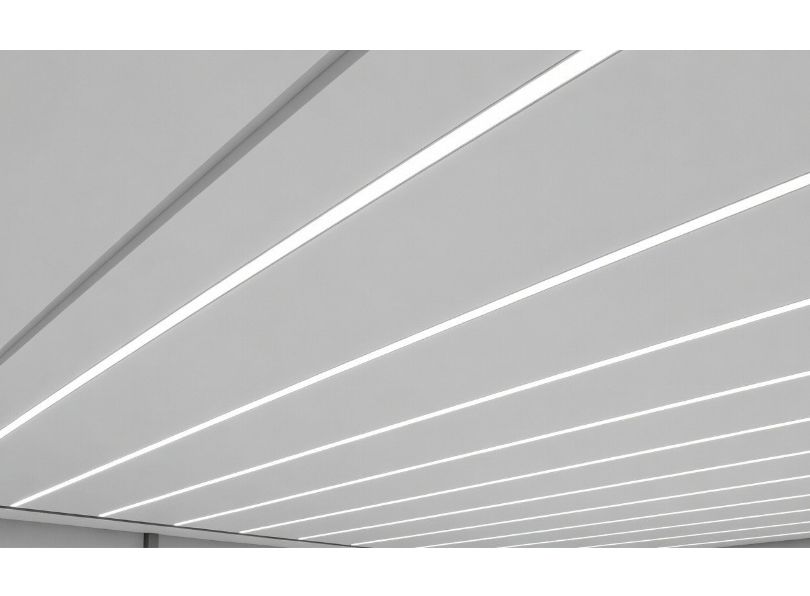
For the plasterer, integrating led profiles into plasterboard ceilings for sport lights is among the most precision-demanding tasks in the entire project. A well-executed plasterboard recess produces a seamless, architecturally refined slot of light that appears to float in the ceiling, a hallmark of high-quality sport lights design that distinguishes professional facilities from amateur ones. A poorly executed recess, on the other hand, produces visible gaps, cracked joints, misaligned profiles and shadow lines that undermine the visual quality and photometric performance of the sport lights. The plasterer’s work is not merely structural; it is optical. The recess defines the visible aperture of the sport lights, and any imperfection in the recess is amplified by the illuminated slot, which draws the eye and makes even minor defects conspicuous.
Coordination between plasterer and installer
The single most important action the plasterer can take to ensure a successful sport lights integration is to coordinate closely with the installer before cutting any plasterboard. The installer provides the exact profile cross-section (width and depth) plus the specified tolerance (typically +1 mm / −0 mm for the width of the recess opening). The plasterer confirms the framing dimensions, the plasterboard thickness, and the finished ceiling level. Both professionals must agree on exact profile lengths and positions before either material is cut. A mismatch of even 5 mm between the plasterboard recess length and the profile length creates a visible gap or forces an on-site modification that rarely looks clean. For gymnasium sport lights involving dozens of recessed profiles arranged in precise geometric patterns, this coordination must happen through a formal reflected ceiling plan (RCP) that both trades sign off on before work begins.
Routing and framing the recess
Step 1 — Install additional framing: standard plasterboard ceiling grids (typically 600 mm centres) may not align with sport lights positions. Install additional metal framing (C-channel, 25 × 50 mm or 50 × 50 mm as required) or timber battens (45 × 45 mm treated softwood) parallel to the recess edges, set back from the finished ceiling plane by the profile depth plus the plasterboard thickness. These frames serve two purposes: they support the plasterboard edges at the recess opening, and they provide a rigid fixing for the profile mounting clips. Frame spacing: maximum 400 mm between clip positions for sport lights profiles, to prevent sagging or vibration.
Step 2 — Cut the plasterboard: using a plasterboard router (Bosch GKF 550, Festool OFK 500 or similar) or oscillating multi-tool with a plasterboard blade, cut the recess opening to the agreed dimensions. For straight, long recesses (2–6 m), use a straightedge guide clamped to the plasterboard surface. The edges must be straight and clean — any waviness will be visible as light leaks or shadow lines along the sport lights slot. For recesses longer than the available plasterboard sheet, stagger the plasterboard joints so that they do not coincide with profile joints, which would create a visible alignment mark in the sport lights.
Step 3 — Dry-fit the profile: before finishing, place the sport lights profile into the recess and verify fit. The profile flanges should sit flush against the plasterboard surface with no gaps. The profile must be straight when viewed along its full length. Any twist or bow in the recess framing will be transmitted to the profile and visible in the sport lights output as a curved or uneven light line.
Finishing and jointing
Apply jointing compound (Gyproc, Knauf or equivalent) to the plasterboard edges abutting the profile flanges. Use fibreglass mesh tape on all joints between the plasterboard and the recess framing to prevent hairline cracks from thermal cycling of the sport lights profiles (aluminium expands approximately 0.024 mm per metre per degree Celsius, over a 3 m profile operating 30 °C above ambient, this is ~2 mm total expansion). Sand smooth when dry, the finished edge should transition seamlessly from plasterboard surface to profile flange without any visible step, gap or ridge. Prime and paint the plasterboard surface, masking the profile to prevent paint from entering the sport lights channel.
Reinforcement for gymnasium sport lights
In gymnasiums, where ball impacts on the ceiling and vibration from HVAC systems can cause plasterboard movement, reinforce the recess framing with additional noggins (short cross-members between the parallel frames). Consider using higher-density plasterboard (such as Knauf Diamant, 15 mm thickness, 1100 kg/m³) around the sport lights recesses to resist cracking and impact damage. For sport lights in sports halls where ball impacts are frequent (volleyball, handball, basketball), the entire ceiling zone within 2 m of the playing area should use impact-resistant plasterboard to protect both the ceiling surface and the sport lights profiles.
Specification guide for architects and lighting designers
The architect or lighting designer is the first professional in the sport lights chain and bears responsibility for specifying products that meet EN 12193, integrating the sport lights into the building design, and producing documentation that enables the other three trades (electrician, installer and plasterer) to execute the installation correctly. A specification error at this stage propagates through the entire project: if the architect specifies a profile that is too shallow for glare control, no amount of installation skill can compensate. If the architect selects a COB strip with insufficient output, no driver or lens can make up the deficit. And if the architect produces ambiguous or incomplete drawings, the installer and plasterer will interpret them differently, leading to misalignment and rework. This section provides a structured specification workflow and product selection guidance for sport lights projects of all scales.
Specification workflow for sport lights
Step 1 — Determine the lighting class: consult with the facility operator to establish the intended competition level (local, regional, national, international), the sports to be played, and whether broadcast capability is required. Cross-reference with EN 12193 to determine Class I, II or III and the corresponding illuminance, uniformity, CRI and UGR targets. Document the agreed class in the project brief — this single decision drives every subsequent specification choice for the sport lights.
Step 2 — Perform lighting calculations: use professional lighting design software (DIALux Evo, Relux or AGi32) to model the sport lights layout. Input the photometric data (IES or LDT files) for the selected LightingLine profile with the chosen COB strip and lens combination. Define the calculation grid at floor level (spacing ≤ 1 m for padel, ≤ 2 m for gymnasiums). Verify that horizontal illuminance (Eh), vertical illuminance (Ev), uniformity (U2 = Emin/Eavg) and UGR meet or exceed EN 12193 for all playing positions and all sports to be accommodated. If the facility is multipurpose, calculate for the most demanding sport at the highest class. Generate a false-colour illuminance plot and a UGR table for inclusion in the specification package.
Step 3 — Select products: using the calculation results, specify the complete sport lights bill of materials: profile model and quantity (PR-CL01-06 or PR-CL02-07), COB strip model and total length, lens model (PRD-06-XK1-L3/L4 where required), diffuser type (opal, frosted or clear), driver model and quantity (Mean Well XLG, appropriately sized at 80 % utilisation), control system (Skydance DALI-2 TD series master panel, bus devices and sensors), and all accessories (endcaps, connectors, mounting clips, cables, conduit).
Step 4 — Produce documentation: issue (a) a lighting specification sheet listing all sport lights products, quantities and performance data; (b) a reflected ceiling plan (RCP) showing sport lights positions, zones and recess dimensions for the plasterer; (c) a wiring schematic for the electrician showing driver positions, circuit routing, DALI bus topology and protection devices; (d) a profile schedule for the installer listing each profile’s length, type, accessories, mounting method and orientation notes (especially lens orientation for asymmetric optics).
Product selection matrix for sport lights
| Requirement | Class III (school) | Class II (community) | Class I (professional/broadcast) |
|---|---|---|---|
| Profile | Medium 20 × 20 mm | CL01-06 | CL02-07 (50 × 75 mm) |
| COB strip | 12 W/m, CRI ≥ 90, 4000 K | 18 W/m, CRI ≥ 90, 4000–5000 K | 24 W/m Performance Series, CRI ≥ 90, 5000 K |
| Lens | None (opal diffuser sufficient) | Asymmetric optional | LLD-06-XK1-L3/L4 mandatory |
| Driver | Mean Well CV standard | Mean Well XLG series | Mean Well XLG series (10 kV surge) |
| Control system | Manual switch or basic timer | DALI-2 zoned dimming | DALI-2 zoned + DMX512 for events |
| Sensors | Optional (cost-saving) | Daylight sensor recommended | Daylight + motion (DLS-208-P) mandatory |
| Target illuminance | 200 lux maintained | 300 lux maintained | 500–750 lux maintained |
| Uniformity U2 | ≥ 0.5 | ≥ 0.6 | ≥ 0.7 |
Energy efficiency and ROI of sport lights
The financial case for led sport lights is compelling. Beyond the well-documented energy savings, Led sport lights reduce maintenance costs, lower cooling loads, improve facility marketability and extend the interval between major lighting interventions from 2–3 years (metal halide re-lamping) to 15+ years (Led end-of-life). This section provides concrete ROI calculations for padel courts and gymnasiums to help architects justify the specification and facility managers approve the investment.
Energy savings: padel court
A typical padel court replacing 8 × 250 W metal halide fixtures (2 000 W total load, plus 15 % ballast losses = 2 300 W) with 8 LED sport lights profiles (8 × 3 m × 24 W/m = 576 W total, plus 7 % driver losses = 616 W) achieves a 73 % reduction in lighting power. At 3 000 operating hours per year and €0.25/kWh, the annual energy saving is approximately €1 260. Adding DALI-2 motion sensor control (reducing effective operating hours by 25 % through automatic standby when courts are unoccupied) increases savings to approximately €1 575 per year per court.
Energy savings: gymnasium
A community gymnasium (30 × 50 m) replacing 40 × 400 W metal halide fixtures (16 000 W + 15 % ballast losses = 18 400 W) with LED sport lights (40 × 5 m × 24 W/m = 4 800 W + 7 % = 5 136 W) achieves a 72 % reduction. At 3 500 operating hours and €0.25/kWh, annual savings are approximately €11 606. With daylight sensors reducing consumption by a further 30 % during daytime hours (for gymnasiums with windows), savings reach approximately €15 088 per year.
Maintenance savings
Metal halide re-lamping every 6 000–10 000 hours costs €50–€100 per lamp (including scaffold/cherry picker access) for a gymnasium with 40 fixtures. Over 15 years at 3 500 hours/year, 5–8 complete re-lamping cycles are needed, totalling €10 000–€32 000. Led sport lights require zero lamp replacements over the same period (50 000+ hours at L80). The only maintenance is periodic diffuser cleaning. Total 15-year maintenance saving: €10 000–€30 000 for a typical gymnasium.
ROI summary table
| Metric | Padel court (single) | Gymnasium (30 × 50 m) |
|---|---|---|
| LED sport lights system cost (approx.) | €3 000–€5 000 | €15 000–€25 000 |
| Annual energy saving | €1 260–€1 575 | €11 600–€15 000 |
| Annual maintenance saving | €200–€400 | €700–€2 100 |
| Total annual saving | €1 460–€1 975 | €12 300–€17 100 |
| Simple payback period | 1.5–3.4 years | 1.2–2.0 years |
| 15-year net benefit | €17 000–€25 000 | €160 000–€230 000 |
The complete sport lights ecosystem: putting it all together
Having explored each component in isolation (COB led strips, aluminium profiles, asymmetric lenses, drivers, controls) this section brings them together into a unified sport lights ecosystem. Lighting in sports facilities is not merely about brightness: it is about safety, performance, and visual comfort. Compliance with the EN 12193 standard is essential, as it dictates specific requirements for illuminance, uniformity, and glare (UGR) across various classes of sports activities. For environments like padel courts, where players frequently look upward, or gymnasiums with high-reaching ceilings, the choice of LED technology and optical housing is critical. The following subsections describe how LightingLine’s ecosystem addresses each pillar of sport lights performance.
Achieving exceptional uniformity with COB led technology
The EN 12193 standard emphasises high uniformity to ensure that fast-moving objects (like a padel ball or a shuttlecock) remain visible without the interference of shadows or flicker effects. Continuous light output is essential: traditional SMD led strips can create a dotted effect that causes visual fatigue, reduces perceived uniformity and generates distracting reflections on padel court glass walls. The use of COB (Chip on Board) led strips is the ideal solution for sport lights. Specifically, the F52-300-320OR2 and FA2-400-480OR2 series provide a perfectly homogeneous line of light, eliminating dark spots between individual leds and ensuring consistent illuminance levels across the entire playing surface. For gymnasiums where sport lights must travel significant distances from ceiling to floor (often 6 to 12 metres or more) high-output sources like the performance series (24 W/m) are essential to meet the lux levels required for Class I professional play and broadcast standards.
Advanced glare control and optical direction
Glare is the primary enemy of visual comfort in sport lights. In padel specifically, poorly shielded sport lights can momentarily blind a player during a smash or overhead shot, with consequences ranging from a lost point to a serious injury. Asymmetric optical lenses are the proven solution and aluminium profiles must be paired with precision optics that redirect the beam onto the court while cutting off light toward the players’ line of sight. LightingLine offers the CL01-06 profile, which can be fitted with asymmetric lenses such as the PRD-06-XK1-L3/L4. These lenses direct the light precisely onto the playing surface from the sides, illuminating the area without directing the beam into the players’ eyes. For maximum glare control (required for Class I sport lights and all padel court installations) the deep-housing CL02-07 profile (50 × 75 mm) recesses the led source deep within the aluminium channel, naturally reducing the viewing angle and lowering the overall Unified Glare Rating (UGR) of the sport lights to values compliant with EN 12193 requirements even at the most critical viewing positions.
Reliability and surge protection for large-scale sport lights
Sports halls and padel court complexes feature extensive electrical circuits that are inherently susceptible to power surges, whether from lightning strikes on nearby structures, switching transients from high-power motors (HVAC compressors, ventilation fans, lift motors), or utility grid disturbances. A single unprotected surge can destroy multiple drivers and hundreds of metres of LED strip, representing thousands of euros in replacement cost plus the downtime of the sport lights during repair. Industrial-grade drivers are therefore essential for sport lights: the Mean Well XLG series power supplies offer the highest lightning surge protection in the led driver industry, reaching 10 kV line-to-line and 6 kV line-to-ground, providing robust protection for the investment in large-scale sport lights installations. Additionally, flicker-free performance is mandatory: to ensure athlete safety and allow for high-quality video recording of matches and training sessions, Mean Well XLG drivers provide a stable, ripple-free DC output that is indispensable for modern sport lights where broadcast cameras and high-speed video analysis are increasingly common even at club level.
Smart management with DALI-2 and DMX512
A modern sport lights system is not a static on/off installation. It is a dynamic, intelligent asset that adapts to the activity, the time of day and the occupancy of the facility.
The DALI-2 ecosystem provides the foundation for this intelligence: Skydance DALI-2 master panels (TD series) allow facility managers to control multiple sport lights zones simultaneously, program scenes for different sports and competition classes, schedule automatic on/off sequences aligned with booking systems, and monitor driver status for predictive maintenance.
Sensors for energy efficiency: integrating DALI-2 daylight and motion sensors s the sport lights to adjust intensity automatically based on natural light entering through gymnasium windows or skylights, significantly reducing operational energy costs, by up to 40 % in facilities with generous daylighting. For padel courts operating on per-hour bookings, motion sensors ensure that sport lights are at full output only when a court is occupied, dimming to standby (5–10 %) between bookings and activating instantly when a player enters the court.
By combining COB LED technology for uniformity and visual comfort, precision aluminium profiles with asymmetric lenses for glare control, Mean Well XLG drivers for surge protection and flicker-free performance, and Skydance DALI-2 controls with daylight and motion sensors for intelligent energy management, LightingLine provides a complete, integrated ecosystem for sport lights. Every component is designed to work with the others, and every professional on the project (architect, electrician, installer and plasterer) can source the complete solution from a single supplier ecosystem, eliminating compatibility risks and ensuring that the finished sport lights installation delivers full EN 12193 compliance for the life of the system.
Maintenance and longevity of sport lights installations
One of the greatest advantages of led sport lights is their dramatically reduced maintenance requirement compared to legacy discharge technologies. However, reduced maintenance does not mean no maintenance. Even the highest-quality sport lights require periodic attention to ensure continued compliance with EN 12193 and to maximise the system’s service life. This section provides a practical maintenance schedule and guidance for facility managers, electricians and installers.
Scheduled maintenance tasks for sport lights
| Task | Frequency | Responsible trade | Purpose |
|---|---|---|---|
| Visual inspection of sport lights profiles | Monthly | Facility manager | Check for visible damage, displaced diffusers, loose fittings |
| Clean diffusers | Every 6 months | Installer / facility manager | Remove dust and dirt accumulation that reduces light output; use soft cloth + mild detergent |
| Measure illuminance at playing surface | Annually | Electrician / lighting consultant | Verify maintained illuminance meets EN 12193, document results |
| Measure uniformity (grid measurement) | Annually | Electrician / lighting consultant | Verify U2 ≥ target, identify any degraded sport lights profiles |
| Check driver operation (current draw, temperature) | Annually | Electrician | Early detection of driver degradation, verify no thermal issues |
| Inspect wiring connections | Every 2 years | Electrician | Check for loose connections, corrosion, heat damage at terminals |
| Test DALI-2 system (scenes, sensors) | Annually | Electrician | Verify all scenes recall correctly, sensors respond, no addressing faults |
| Replace failed led strip sections | As needed | Installer | Restore full illuminance, match CCT and CRI to existing sport lights |
Lifespan expectations for sport lights components
Quality COB led strips are rated for 30 000+ hours at L80, retaining at least 80 % of initial lumen output after 50 000 hours of operation. At 3 000 hours per year (typical busy gymnasium), this is over 10 years before the sport lights fall below the L80 threshold. At that point, the sport lights still function, they are simply slightly dimmer. Mean Well XLG drivers are rated for 30 000+ hours at full load. Aluminium profiles, being passive mechanical components, have an indefinite lifespan if not physically damaged. The weakest link in any sport lights system is typically the driver electrolytic capacitors, which degrade over time with heat exposure, this is why driver ventilation, 80 % utilisation and periodic inspection are important.
Market data, trends and industry statistics for sport lights
The sport lights market is experiencing rapid growth driven by the global expansion of padel, the renovation of ageing gymnasia, the transition from HID to led, and the increasing adoption of smart building technologies. Understanding these trends helps architects, facility managers and investors make informed decisions about sport lights investments.
Global sports lighting market
The global sports lighting market was valued at approximately USD 6.3 billion in 2023 and is projected to reach USD 9.1 billion by 2028 (Mordor Intelligence, 2024), representing a CAGR of approximately 7.6 %. LED sport lights dominate new installations, accounting for over 85 % of the market by value. The transition from HID to LED sport lights is the primary growth driver, followed by new facility construction and the adoption of smart controls.
Padel market growth
The European padel market is growing at a CAGR of 12.5 % (Allied Market Research, 2023). Spain has over 20 000 padel courts, Italy is the fastest-growing market with 8 000+ courts in 2024 (up from 2 000 in 2019). Each new padel court requires sport lights so at an average sport lights cost of €3 000–€5 000 per court, the annual European padel sport lights market alone exceeds €30 million and is growing rapidly. The Scandinavian market (Sweden, Finland, Denmark) has also seen explosive padel growth, with many facilities specifying high-quality led sport lights from the outset due to stringent energy regulations and the premium market positioning of Nordic padel clubs.
Key trends in sport lights
There are some points to remember in sport lights, let’s see which ones.
Smart controls: DALI-2 and IoT-enabled sport lights are becoming standard for new installations, driven by energy regulations and facility management efficiency.
Human-centric lighting (HCL): emerging research suggests that tuneable-white sport lights (adjusting CCT from warm to cool during warm-up, competition and cool-down phases) may improve athlete alertness and recovery.
Sustainability: circular-economy considerations are driving demand for modular sport lights systems where led strips, drivers and diffusers can be individually replaced without discarding the aluminium profile, a model that LightingLine’s profile-based sport lights ecosystem supports natively.
Integration with venue management systems: sport lights are increasingly integrated with booking platforms, access control and HVAC, enabling fully automated facility management where the sport lights respond to the venue’s occupancy and schedule without manual intervention.
Frequently asked questions about sport lights
What are sport lights?Sport lights are specialised led lighting systems engineered specifically for athletic facilities such as padel courts, gymnasiums, tennis halls, basketball arenas, swimming pools, martial arts dojos and multipurpose sport halls. Unlike standard commercial lighting, sport lights must comply with the EN 12193 European standard, which dictates minimum illuminance levels (200–750 lux depending on sport and competition class), uniformity ratios (U2 ≥ 0.5–0.8), glare limitation (UGR/GR), colour rendering (CRI ≥ 65–90) and flicker thresholds. Sport lights are complete systems comprising COB led strips, aluminium optical profiles, precision lenses, industrial-grade drivers and intelligent DALI-2 controls, all designed to deliver safe, comfortable, compliant lighting for athletes, spectators and broadcast cameras. The key difference between sport lights and general lighting is that sport lights must perform across multiple viewing planes simultaneously (horizontal for the playing surface, vertical for airborne objects, and angular for glare control) because athletes look in every direction during play. | |
What type of lights are used in a gymnasium?Modern gymnasiums use led sport lights, typically high-output COB (Chip on Board) led strips installed inside aluminium extrusion profiles with diffusers and/or asymmetric lenses for glare control. These sport lights are mounted on ceilings (surface-mount, recessed in plasterboard, or suspended from cables) or on walls, and are controlled via DALI-2 digital systems for zone-specific dimming and scene programming. For Class I professional gymnasiums requiring 500–750 lux, deep-section profiles like the PR-CL02-07 (50 × 75 mm) with Performance Series COB strips (24 W/m) and Mean Well XLG drivers deliver the required illuminance with high uniformity, low glare and flicker-free performance suitable for television broadcast. For Class III school gymnasiums needing 200 lux, medium-depth profiles with 12 W/m COB strips and opal diffusers provide EN 12193-compliant sport lights at lower cost. The aluminium profile is essential because it acts as both heatsink (dissipating heat from the leds) and optical housing (controlling the beam angle and glare). | |
Why are leds important on a padel court?Leds are critical for padel court sport lights for several interconnected reasons. First, padel involves frequent upward gazes during overhead smashes, bandeja shots and vibora strokes, placing the sport lights directly in the players’ field of view, led sport lights with asymmetric lenses (PRD-06-XK1-L3/L4) and deep aluminium profiles (PR-CL02-07) control glare far more effectively than legacy metal halide fixtures. Second, ledss provide instant-on capability with zero restrike delay — essential for padel courts operating on per-hour bookings where sport lights must activate immediately when a session begins. Third, leds maintain consistent colour temperature throughout their 50 000+ hour life, unlike metal halide which shifts colour with age. Fourth, led sport lights are flicker-free when driven by quality drivers (Mean Well XLG), which is essential both for player safety (eliminating stroboscopic effects on fast-moving balls) and for video recording quality. Fifth, the continuous light line produced by COB led strips eliminates the dotted effect of SMD strips, which is particularly important on padel courts where glass wall reflections magnify light-source imperfections. Sixth, led sport lights deliver energy savings of 60–80 % compared to HID systems. | |
What is EN 12193 and why does it matter for sport lights?EN 12193 is the European standard titled “Light and lighting — Sports lighting,” published by the European Committee for Standardisation (CEN). It specifies minimum performance requirements for sport lights across more than 60 individual sports and three competition classes (Class I for international/national/broadcast, Class II for regional/club, Class III for recreational/school). The standard defines target values for horizontal illuminance, vertical illuminance, uniformity (Emin/Eavg), glare limitation (UGR for indoor, GR for outdoor), and colour rendering index (CRI). Compliance with EN 12193 is mandatory for facilities hosting official sporting competitions under the rules of most European sports federations. Non-compliant sport lights expose the facility operator to liability if a player is injured due to inadequate lighting, and can prevent a venue from hosting sanctioned events. The standard was updated in 2018 to incorporate guidance specific to LED sport lights technology, reflecting the industry’s transition from discharge sources. | |
How do I cut an aluminium led profile for sport lights without damaging it?Cutting aluminium profiles for sport lights requires the right tools and a careful, systematic approach. Use a mitre saw (chop saw) with a fine-toothed metal-cutting blade, minimum 32 TPI (teeth per inch) with a negative rake angle designed for non-ferrous metals. Apply masking tape around the cut line to protect the anodised surface from blade marks. Clamp the profile securely in the saw jig using soft-jaw clamps to prevent scratching. Bring the blade to full speed before contact, then lower steadily at a moderate feed rate without forcing. After the cut, remove the tape and deburr both inside and outside edges using a fine metal file (second-cut or smooth-cut) followed by 220-grit sandpaper on a flat block. Finally, use compressed air or a soft brush to remove all aluminium swarf from inside the profile channel. This last step is critical for sport lights: even tiny metal particles left in the channel can puncture the LED strip insulation, causing short circuits that may not appear until commissioning. | |
What COB led strip is best for padel court sport lights?For padel court sport lights, COB led strips from Ledpoint.it are recommended, specifically the F52-300-320OR2 and FA2-400-480OR2 series. These strips produce a continuous, dot-free line of light with CRI ≥ 90 and colour temperatures of 4000–5000 K (ideal for sport lights). For Class II padel courts (300 lux), standard-output COB strips at 14–18 W/m are typically sufficient. For Class I padel courts (500 lux) or courts with higher-than-typical mounting heights, the Performance Series at 24 W/m provides the output needed. The continuous phosphor layer of COB technology eliminates the pixelated appearance of SMD strips, which is particularly important in padel because glass wall reflections magnify any irregularities in the sport lights source. All recommended strips operate at 24 V DC and are compatible with the LightingLine PR-CL01-06 and PR-CL02-07 aluminium profiles. | |
How do I control glare on gymnasium sport lights?Controlling glare on gymnasium sport lights requires a multi-layered approach combining profile depth, optical lenses, diffuser selection and precise mounting. Layer one: use deep-section aluminium profiles, the PR-CL02-07 (50 × 75 mm) recesses the LED source deep within the channel, reducing the cutoff angle to approximately 22° and making the LED invisible from most playing positions. Layer two: fit the profiles with asymmetric lenses (PRD-06-XK1-L3/L4) that redirect the light beam downward toward the playing surface while minimising output at high angles where athletes look toward the sport lights. Layer three: select an opal or frosted diffuser to soften the remaining direct luminance, opal for sport lights mounted below 7 m, frosted for higher installations. Layer four: follow the architect’s mounting layout precisely, as positioning errors change the glare geometry. Together, these measures achieve UGR ≤ 19, meeting EN 12193 requirements for all indoor sport lights competition classes. | |
Can I use DALI-2 controls with sport lights?Yes, DALI-2 is the recommended control protocol for modern sport lights. The Skydance DALI-2 master panels (TD series) provide comprehensive control capabilities: zone-specific dimming (e.g., basketball area at 100 %, adjacent badminton courts at 50 %), scene programming (pre-set lighting configurations for different sports and activities), automatic scheduling (aligned with booking systems or facility opening hours), and status monitoring (driver fault alerts, operating hour counters). Integration with DALI-2 sensors, particularly the DLS-208-P daylight and motion sensor, enables automatic intensity adjustment based on ambient light and occupancy, reducing sport lights energy consumption by up to 40 % without manual intervention. DALI-2 supports up to 64 individually addressable devices per bus and provides bi-directional communication, meaning the master panel can query each sport lights driver for status, temperature and operating data, enabling predictive maintenance. | |
What power supply should I use for sport lights in a large sports hall?Mean Well XLG series drivers are the industry standard for sport lights in large halls. Their defining advantage is surge protection: 10 kV line-to-line and 6 kV line-to-ground, safeguarding sport lights circuits against lightning-induced surges and switching transients from HVAC equipment and utility grid fluctuations. They deliver flicker-free DC output with less than 1 % ripple, ensuring broadcast-compatible sport lights performance. Efficiency exceeds 93 %, minimising waste heat in enclosed driver cabinets. Available models include the XLG-100 (100 W), XLG-200 (200 W) and XLG-320 (320 W). Always size the driver at 80 % maximum utilisation, a 200 W sport lights circuit requires a 250 W driver. The XLG series is available with 0–10 V, PWM or DALI dimming interfaces for integration with Skydance DALI-2 control systems. | |
How do I install led strip inside an aluminium profile for sport lights?Installing led strip into an aluminium profile for sport lights follows a precise procedure. First, clean the profile channel thoroughly with isopropyl alcohol (≥ 90 % concentration) to remove any oils, dust or cutting residue that would prevent adhesion. Allow to dry completely. Second, peel approximately 100 mm of 3M adhesive backing at a time (do not expose the full length at once). Third, press the strip firmly into the channel, ensuring it is centred and straight, an off-centre strip produces asymmetric light distribution through the diffuser. Do not stretch the strip. Fourth, press along the full length with a burnishing tool to eliminate air pockets, which act as thermal insulators and create hot spots. Fifth, solder all wire connections (preferred over clip connectors for permanent sport lights). Sixth, connect to a 24 V bench supply and test: verify full illumination along the entire length, correct colour, no dark spots, no flicker. Only after successful testing should you snap the diffuser into place and mount the sport lights profile. | |
What is the difference between UGR and GR in sport lights?UGR (Unified Glare Rating) and GR (Glare Rating) both quantify visual discomfort from luminous sources, but they are calculated differently and apply to different sport lights scenarios. UGR is the standard metric for indoor glare assessment, calculated from the solid angle and luminance of each luminaire as seen from a defined observer position. It is used for all indoor sport lights (padel courts, gymnasiums, swimming pools) with a target of UGR ≤ 19 for most applications. GR is a sport-specific metric defined by CIE and used by EN 12193 primarily for outdoor sports lighting (football pitches, athletics tracks, tennis courts). GR accounts for the adaptation luminance of the overall visual field, which differs outdoors where the surround is typically dark. For indoor sport lights, the architect specifies UGR targets; for outdoor sport lights, GR targets. Both are controlled through the same physical means: deep-housing profiles, asymmetric lenses, and precise mounting positions. | |
How long do led sport lights last?Quality COB led strips used in sport lights, such as those from Ledpoint.it, are rated for 50 000+ hours at L80, meaning they retain at least 80 % of their initial lumen output after 50 000 hours of continuous operation. At 3 000 hours per year (typical for a busy gymnasium or padel club), this equates to over 16 years before the sport lights reach the L80 threshold, and even then, the leds continue to function, just at slightly reduced output. Mean Well XLG drivers are similarly rated for 50 000+ hours at full load, with some models exceeding 70 000 hours. Aluminium profiles, being inert structural components, have an essentially indefinite lifespan unless physically damaged. The overall sport lights system therefore delivers 15+ years of EN 12193-compliant performance with minimal maintenance, compared to metal halide sport lights that require lamp replacement every 2–3 years. | |
Can I retrofit existing gymnasium fixtures with led sport lights?Yes, led sport lights retrofits are one of the most cost-effective facility upgrades available. Existing mounting positions, cable routes, conduit, trunking and circuit breakers can often be reused, reducing installation cost by 30–50 % compared to a new-build installation. The typical retrofit approach involves removing the old metal halide sport lights fixtures, installing new aluminium profiles (PR-CL01-06 or PR-CL02-07) with COB led strips in the same or optimised positions, and connecting new Mean Well XLG drivers to the existing mains supply (verifying adequacy). A DALI-2 control system can be added during the retrofit to provide zoning and dimming that was impossible with the old sport lights. Payback periods for gymnasium sport lights retrofits are typically 1.5–3 years, making them attractive even for publicly funded facilities with tight budgets. | |
What colour temperature is best for sport lights?For sport lights, 4000 K (neutral white) or 5000 K (cool daylight) is recommended by lighting designers and endorsed by major sports federations. These colour temperatures maximise visual acuity for tracking fast-moving objects, are most compatible with broadcast camera colour balance (particularly important for televised events), and align with the daylight conditions under which many sports evolved. Warmer temperatures (3000 K) reduce visual sharpness and may cause colour rendition issues on camera, team uniform colours appear different from their true hue. Cooler temperatures (6500 K) can feel harsh and clinical in enclosed gymnasiums, and some research suggests they may increase discomfort glare perception. The architect specifies CCT at design stage and the electrician must verify the led strip CCT bin code before installation to prevent mismatched sport lights, even a 200 K difference between adjacent profiles is visible to the trained eye. | |
How do I ensure sport lights remain compliant after installation?Commission the sport lights with a calibrated lux meter (ISO 17025 traceable calibration) and record illuminance at defined grid points on the playing surface — typically a 1 m × 1 m grid for padel courts and a 2 m × 2 m grid for gymnasiums. Calculate Emin, Emax, Eavg and U2 (Emin/Eavg). Compare against EN 12193 requirements for the specified class and sport. Record colour temperature with a spectrometer at multiple points. Document everything in a commissioning report. Schedule annual re-measurement (at minimum) to detect lumen depreciation or component degradation. Clean diffusers during each measurement interval. Replace any failed LED strip sections or drivers promptly, matching CCT and CRI to existing sport lights. With quality components sport lights should remain EN 12193-compliant for 10+ years without major intervention, provided the maintenance schedule is followed. |
Sport light: more than a lighting product
Sport lights represent far more than a lighting product category: they are a complete engineering discipline that intersects architecture, electrical engineering, optics, thermal management, digital controls and human visual performance. This guide has demonstrated that achieving excellence in sport lights for padel courts and gymnasiums requires not only the right products (such as COB led strips, precision aluminium profiles and asymmetric lenses, industrial-grade Mean Well XLG drivers, and Skydance DALI-2 control systems) but also the right techniques, applied by skilled professionals who understand both the theory and the practice of sport lights installation.
For the installer (posatore), the message is clear: precision in mounting, alignment and profile preparation directly determines whether the sport lights meet EN 12193 uniformity and glare requirements. Every millimetre matters. Every cut must be clean. Every strip must be centred. Every lens must be correctly oriented. The installer’s craft is what transforms components into compliant sport lights.
For the electrician, the lesson is that voltage drop management, surge protection, flicker-free performance and intelligent control integration are not optional add-ons but they are mandatory elements of safe, compliant, long-lasting sport lights. The Mean Well XLG driver, the correctly sized cable, the properly routed DALI bus, and the commissioned Skydance control panel are the electrician’s contributions to sport lights excellence.
For the plasterer, the takeaway is that plasterboard integration for sport lights demands millimetre-level accuracy and close coordination with the installer. The recess is not merely a hole in the ceiling, it is an optical element that defines the aperture of the sport lights. A straight, true, precisely dimensioned recess is the plasterer’s signature contribution to the finished sport lights system.
For the architect and lighting designer, the responsibility begins at specification and ends at commissioning verification. The right products, the right calculations, the right documentation, and the right on-site oversight ensure that every downstream trade can execute sport lights correctly.
The led revolution in sport lights is not a future promise, it is the present reality. Every new padel court, every gymnasium renovation, every sports arena upgrade is an opportunity to deliver sport lights that are safer, more efficient, more controllable, more durable and more visually refined than anything that preceded them. With the products, knowledge and step-by-step techniques presented in this guide, every professional on the project can contribute to sport lights installations that meet the highest standards of performance, EN 12193 compliance and visual excellence: installations that serve athletes, spectators and facility operators for decades to come.
This article was developed with the support of artificial intelligence and subsequently reviewed, corrected, and validated by the LightingLine.eu technical team, which guarantees its reliability and compliance with official sources.