Whether you are an architect designing a flagship retail space, a photographer seeking flicker-free studio illumination, a school teacher looking for glare-free classroom lighting, or simply a homeowner wondering how many lumens do I need for each room, the answer always begins with one fundamental concept: the lux level calculator. Understanding how to calculate lux from lumens, and how to translate those numbers into real, practical LED lighting decisions, is the single most powerful skill you can acquire in modern lighting design. It is the bridge between the abstract photometric data on a product specification sheet and the lived experience of a perfectly lit room, a productive office, or a beautifully illuminated garden path at night.
This guide covers all aspects of lux calculations: the physics of lumens, lux, and candela, formulas used by professional lighting designers, recommended illuminance levels for each room, sample calculations, lumen-to-watt, lux-to-lumen, and watt-to-lumen (LED) conversion tables; and advanced topics such as beam angle calculations, high ceiling lighting, recessed spotlight spacing, and LED wiring diagrams.
The lux level calculator is important because poorly designed lighting costs companies billions of dollars in lost productivity and increased healthcare costs each year. A study by the American Society of Interior Design found that 68% of employees complain about the lighting in their offices, and research published in Ergonomics (2021) showed that proper lighting levels reduce eye strain by up to 45% and increase cognitive performance by up to 26%. Achieving the right light levels, using an appropriate lux level calculator, pays dividends in terms of human well-being, energy efficiency, and architectural quality.
In this article…
- The fundamentals: lumens, lux, watts, and candlepower explained
- The lux level calculator: core formulas and how they work
- Lumens to lux calculator: step-by-step worked examples
- Lux levels reference chart: what different lux values look like
- How many lumens do I need? Room-by-room guide
- Lumens to watts conversion: LED efficiency and lumen-per-watt
- LED profiles and strip lights: lux calculation for linear lighting
- Downlight spacing calculator and recessed lighting layout
- Lighting for high ceilings: lux calculation at different heights
- Recommended lux levels by environment and industry standards
- LED wiring diagrams: installing LED profiles correctly
- Ledpoint LED profiles: product selection and lux output guide
- Lux level calculator for specialist environments
- Advanced lighting calculations: utilisation factor, maintenance factor, and the lumen method
- Lux to luminance conversion and photometric concepts
- Practical tools, apps, and online calculators
- Frequently asked questions
- Market data, industry statistics, and research
- Lux level calculator and product recommendations
The fundamentals: lumens, lux, watts, and candlepower explained
Before you can use any lux level calculator or lumens calculator effectively, you need a solid, accurate understanding of the four key photometric quantities: lumens, lux, watts, and candlepower (candela). These terms are frequently confused, even by experienced specifiers, and that confusion leads directly to over-lit or under-lit spaces, wasted energy, and disappointed clients. This section clears up every ambiguity with precision definitions, historical context, and practical examples drawn from real lighting products.
What is a lumen? The luminous flux unit defined
A lumen (lm) is the SI unit of luminous flux, it measures the total quantity of visible light emitted by a source per unit of time, weighted by the sensitivity of the human eye. The luminous flux unit was formalised in the International System of Units (SI) and is defined in relation to the candela: one lumen is the luminous flux emitted into a solid angle of one steradian by a point source with a luminous intensity of one candela.
In plain language: lumens measure how much light comes out of a bulb or LED strip, regardless of where that light goes or over what area it spreads. A 60-watt incandescent bulb typically emits about 800 lumens. A modern 10-watt LED can emit the same 800 lumens, illustrating how dramatically LED technology has improved energy efficiency compared to incandescent lamps. A standard 150-watt incandescent bulb produces roughly 2,600 lumens, while an equivalent LED achieves the same output with only 20–25 watts.
Why lumens matter more than watts for lighting selection
For decades, consumers selected light bulbs by wattage, a 60-watt bulb, a 100-watt bulb. But watts measure energy consumption, not light output. As LED technology matured, a 10-watt LED began producing the same light as a 60-watt incandescent, making wattage an unreliable indicator of brightness. Today, professionals and informed consumers use lumens to compare light sources accurately. The lumens vs watts distinction is now codified in EU and UK labelling regulations, which require lumen output to be prominently displayed on all lamp packaging.
Understanding this shift is critical for anyone using a lumen calculator or lux level calculator: you are always working with lumen output, not wattage, as the primary measure of a source’s light-producing capability.
What is lux? Light intensity on a surface
Lux (lx) is the SI unit of illuminance, it measures the amount of luminous flux (lumens) falling on a surface per unit area. The defining relationship is elegantly simple:
Lux measures how brightly a surface is lit, not how much light a source emits. Two rooms could each receive 1,000 lumens of light, but if one room is 5 m² and the other is 20 m², the first will have 200 lux (very bright) and the second only 50 lux (dim ambient light). This is why area — the denominator in the lux formula — matters so profoundly in all lighting calculations.
The human eye experiences lux on a logarithmic scale. Outdoors on a bright summer day, illuminance reaches 100,000 lux. A well-lit office typically operates at 300–500 lux. A candle at one metre produces approximately 1 lux. Moonlight contributes about 0.1–1 lux. Understanding this scale is essential for interpreting the output of any lux level calculator and translating the numbers into a meaningful visual experience.
Does 1 lux equal 1 lumen? Clarifying the relationship
This is one of the most frequently asked questions in lighting forums and specification guides. The answer requires care: 1 lux equals 1 lumen per square metre. They are not the same unit, lumen is a measure of total light output (flux), while lux is a measure of light intensity on a surface (illuminance). However, if a light source emitting 1 lumen spreads its light perfectly evenly over exactly 1 square metre of surface, the resulting illuminance is exactly 1 lux.
The distinction becomes critical when you use a lumens to lux calculator: to convert lumens to lux, you must divide by the area in square metres. To convert lux to lumens, you multiply by the area. The formula is:
Lumens = Lux × Area (m²)
For LED profiles and strip lights, where light is distributed along a length rather than a point, the calculation involves the lit area beneath the profile rather than a single point illuminance, which we’ll discuss later in this article.
Candlepower and candela: the directional light measure
Candlepower (now formally expressed as candela, cd) measures the luminous intensity of a light source in a specific direction. While lumens measure total output and lux measures surface illuminance, candela measures how intensely a source shines in one particular direction. One candela is roughly equivalent to the light intensity of one standard wax candle, historically the origin of the unit.
The relationship between candela and lumens depends on the beam angle. A narrow-beam spotlight might have a high candela rating but relatively modest lumens, because all the light is focused in one direction. A wide-beam floodlight might have many lumens but lower peak candela because the light spreads broadly. Converting lumens to candlepower requires the beam solid angle:
For a cone beam: Solid Angle (sr) = 2π × (1 − cos(half-angle))
For a 60° beam angle (half-angle = 30°): Solid Angle = 2π × (1 − cos 30°) = 2π × (1 − 0.866) ≈ 0.842 sr. A source emitting 1000 lumens in this beam would have a peak intensity of approximately 1188 cd. Lumen to candlepower converters online automate this calculation, but understanding the physics helps you interpret results correctly.
Watts: energy consumption vs. light output
Watts (W) measure electrical power consumption, the rate at which a device uses energy. For lighting, what matters is not watts consumed but lumens produced. The ratio of lumens to watts is called luminous efficacy, expressed in lumens per watt (lm/W). Modern high-quality LED strips and profiles from Ledpoint achieve efficacies of 100–200 lm/W, compared to incandescent bulbs at 10–15 lm/W and fluorescent tubes at 50–100 lm/W.
This is why lumen to watt conversions and led watt calculator tools have become so important: they let you verify energy efficiency, estimate running costs, and compare different technologies on a fair, performance-based metric rather than the historical but now-misleading wattage label.
| Light source | Typical wattage | Typical lumens | Efficacy (lm/W) | Lifespan (hours) |
|---|---|---|---|---|
| Incandescent 60W | 60 W | 800 lm | 13 lm/W | 1,000 |
| Halogen 50W | 50 W | 750 lm | 15 lm/W | 2,000 |
| CFL 15W | 15 W | 900 lm | 60 lm/W | 8,000 |
| T8 Fluorescent 36W | 36 W | 3,200 lm | 89 lm/W | 15,000 |
| Standard LED 10W | 10 W | 800–1,000 lm | 80–100 lm/W | 25,000 |
| High-Efficacy LED 10W | 10 W | 1,400–1,600 lm | 140–160 lm/W | 50,000 |
| Ledpoint Premium Strip 24V | 14.4 W/m | 2,000–2,400 lm/m | 140–167 lm/W | 50,000+ |
Colour temperature and its effect on perceived light levels
Two rooms lit to identical lux levels can look dramatically different if the colour temperature of the light sources differs. Colour temperature, measured in Kelvin (K), describes the warmth or coolness of white light. Lower values (2700K–3000K) produce warm, amber-toned light associated with relaxation and domestic settings. Higher values (4000K–6500K) produce cool, blue-white light that enhances alertness and is preferred in offices, medical facilities, and photographic studios.
Crucially, cool-white light at the same lux level often appears brighter to human observers because it stimulates the retinal ganglion cells that govern alertness. When using a lux level calculator, always note the colour temperature of your chosen LED source alongside the photometric data — it will influence both the perceived brightness and the appropriate recommended lux target for the space.
| Colour temperature | Appearance | Recommended application | CRI requirement |
|---|---|---|---|
| 2700K | Warm white | Bedrooms, restaurants, hospitality | CRI ≥ 80 |
| 3000K | Warm white | Living rooms, retail, kitchens | CRI ≥ 80 |
| 4000K | Neutral white | Offices, kitchens, bathrooms | CRI ≥ 80 |
| 5000K | Daylight | Studios, garages, hospitals | CRI ≥ 90 |
| 6500K | Cool daylight | Precision work, photography | CRI ≥ 90 |
The lux level calculator: core formulas and how they work
The lux level calculator is, at its most basic, an application of the fundamental illuminance formula. However, professional lighting design extends this simple equation with correction factors that account for the real-world behaviour of light in enclosed spaces: reflections from walls, ceilings, and floors, luminaire optical efficiency and the gradual depreciation of lumen output over the LED’s lifetime. This section builds the full calculation methodology from the ground up, giving you every formula you need to perform accurate, professional-grade lighting calculations for any environment.
The basic lux formula
The foundational equation for any lux calculation is:
E (lux) = F (lumens) ÷ A (m²)
Where:
E = Illuminance in lux (lx)
F = Luminous flux in lumens (lm)
A = Area of the illuminated surface in square metres (m²)
This formula assumes the light is distributed perfectly evenly across the surface, which is rarely true in practice but provides an excellent starting estimate for any room lighting calculator or light intensity calculation. It is the formula used in most online lux calculators and mobile light calculator apps, and it gives results accurate to within ±20–30% for simple spaces.
How to calculate lux from watts
When you know the wattage of an LED source but not its lumen output, you can estimate lumens using the luminous efficacy of the source, then apply the basic lux formula. The process is:
Step 2: Lux = Lumens ÷ Area (m²)Example: 20W LED, efficacy 120 lm/W, room 15 m²
Lumens = 20 × 120 = 2,400 lm
Lux = 2,400 ÷ 15 = 160 lux
The efficacy assumption is critical here. Always use the manufacturer’s stated lumen output rather than an assumed efficacy value where possible. For LED strips, full photometric data including lumen output per metre, beam angle, and colour temperature are provided in the product datasheets.
The professional lumen method (average illuminance method)
The lumen method, also known as the average illuminance method or the zonal cavity method — is the standard professional technique for calculating the number of luminaires required to achieve a target lux level in a room. It extends the basic formula with two critical correction factors:
N = (E × A) ÷ (F × UF × MF)
Where:
N = Number of luminaires required
E = Target illuminance (lux)
A = Room area (m²)
F = Lumen output per luminaire (lm)
UF = Utilisation Factor (0.4–0.8 typically)
MF = Maintenance Factor (0.7–0.85 typically)
The Utilisation Factor (UF) accounts for the fact that not all emitted lumens reach the working plane, some are absorbed by dark walls, some escape upward past reflective ceilings. The UF depends on the Room Index (RI), also known as the Room Cavity Ratio, and the reflectances of the room surfaces. A bright room (white walls, white ceiling) with a favourable geometry might have a UF of 0.75; a large industrial space with dark surfaces and high ceilings might have a UF of 0.45.
The Maintenance Factor (MF) accounts for the gradual reduction in lumen output over the LED’s lifetime (lumen depreciation) and the accumulation of dust and dirt on luminaire surfaces (luminaire dirt depreciation). A typical value for a well-maintained LED installation in a clean interior environment is 0.80.
Room index (RI) calculation
The Room Index is a dimensionless parameter that characterises the proportions of a room — specifically, the relationship between floor area and the height at which light is distributed. It is calculated as:
RI = (L × W) ÷ [Hm × (L + W)]
Where:
L = Room length (m)
W = Room width (m)
Hm = Mounting height above working plane (m)
A room with RI < 1 is tall and narrow (less efficient light distribution). A room with RI > 3 is wide and low (more efficient). The RI value feeds into published manufacturer tables to find the appropriate Utilisation Factor for the specific luminaire and room combination.
Point illuminance calculation (inverse square law)
For calculating the illuminance at a specific point below a single luminaire, for example, directly below a recessed downlight or at the end of an LED profile, the inverse square law applies:
E = I × cos³(θ) ÷ h²
Where:
E = Illuminance at the point (lux)
I = Luminous intensity toward the point (candela)
θ = Angle of incidence from the vertical (degrees)
h = Perpendicular distance from luminaire to surface (m)
This formula is used in detailed lighting design software and is the basis of the point-by-point calculation method, which produces illuminance contour maps (isocontour plots) showing how light levels vary across a room’s floor plane. For most practical purposes, the lumen method above is sufficient, but point calculation becomes important for accent lighting, display lighting, and anywhere a specific minimum or maximum illuminance must be guaranteed at a defined location.
Lux level calculator: summary of all key formulas
| Formula name | Equation | Use case |
|---|---|---|
| Basic Illuminance | E = F ÷ A | Quick estimate, single-room calculator |
| Lumens Required | F = E × A | How many lumens for a room |
| Lux from Watts | E = (W × eff) ÷ A | Estimating from wattage |
| Lumen Method | N = (E × A) ÷ (F × UF × MF) | Professional fixture count |
| Room Index | RI = (L×W) ÷ [Hm×(L+W)] | Determining UF |
| Point Illuminance | E = I × cos³(θ) ÷ h² | Spot/accent lighting precision |
| Lumens to Candela | cd = lm ÷ sr | Beam intensity from flux |
| Convert Lux to Lumens | lm = lux × m² | Working backwards from lux target |
| Efficacy Check | lm/W = Lumens ÷ Watts | LED efficiency comparison |
Lumens to lux calculator: step-by-step worked examples
Theory becomes useful only when applied to real situations. In this section, we walk through a series of detailed, step-by-step lumens to lux calculator examples drawn from the most common real-world design scenarios: a residential living room, a professional office, a retail shop, a school classroom, a photographic studio, and an outdoor garden pathway. Each example uses realistic dimensions, Ledpoint product data, and appropriate lighting standards. Follow these worked examples and you will be able to replicate the process for any project.
Example 1: residential living room (led strip in profile)
Scenario: a living room measuring 5.0 m × 4.0 m (20 m²), ceiling height 2.7 m, to be illuminated with Ledpoint LED strip mounted in recessed ceiling profiles for ambient lighting. Target: 200 lux average (comfortable ambient level).
F = E × A = 200 × 20 = 4,000 lm (total needed at ceiling plane)Step 2 — Apply Maintenance Factor (MF = 0.80) and Utilisation Factor (UF = 0.65 for white walls, RI ≈ 1.8):
Design Lumens = F ÷ (UF × MF) = 4,000 ÷ (0.65 × 0.80) = 4,000 ÷ 0.52 = 7,692 lm installedStep 3 — Calculate Room Index:
Hm = 2.7 − 0.85 (working plane) = 1.85 m
RI = (5 × 4) ÷ [1.85 × (5 + 4)] = 20 ÷ 16.65 = 1.20Step 4 — Select LED Strip:
Ledpoint 24V strip: 1,800 lm/m. Total metres needed = 7,692 ÷ 1,800 ≈ 4.3 m of stripStep 5 — Verify with perimeter layout:
Room perimeter = 2 × (5 + 4) = 18 m. A 4.3 m cove would use one wall or two short runs.
For full perimeter indirect lighting (cove): use 18 m strip × 1,800 lm/m = 32,400 lm installed → well above target.
For a balanced ambient system, a 4–5 m ceiling centre run plus 2 m accent strips would suffice.
Key takeaway: a single Ledpoint 24V LED strip run of approximately 4.5 metres in a recessed aluminium profile achieves the 200-lux ambient target for a 20 m² living room with comfortable, glare-free lighting.
Example 2: open-plan office (led profile ceiling strips)
Scenario: office space 10 m × 8 m (80 m²), height 3.0 m. Target illuminance 500 lux (EN 12464-1 requirement for office task areas). Ledpoint linear profile luminaires, 3,500 lm each, UF = 0.70, MF = 0.80.
N = (500 × 80) ÷ (3,500 × 0.70 × 0.80)
N = 40,000 ÷ 1,960
N = 20.4 → 21 luminaires (or adjust strip length/intensity)Total installed lumens = 21 × 3,500 = 73,500 lm
Actual average illuminance = 73,500 × 0.70 × 0.80 ÷ 80 = 514 lux ✓
For an open-plan office of this size, a grid of Ledpoint linear LED profiles, perhaps 7 rows of 3 luminaires, spaced 1.4 m apart across the 10 m width — would achieve the required 500-lux level with a uniform distribution ratio (Emin/Eavg) exceeding 0.6, meeting EN 12464-1.
Example 3: converting lumens to lux
| Total lumens | Area (m²) | Lux (Basic formula) | Approximate visual brightness |
|---|---|---|---|
| 400 lm | 5 m² | 80 lux | Dim corridor/night light |
| 800 lm | 10 m² | 80 lux | Soft ambient bedroom |
| 1,600 lm | 10 m² | 160 lux | Comfortable living room ambient |
| 3,000 lm | 10 m² | 300 lux | Good office/kitchen working light |
| 5,000 lm | 10 m² | 500 lux | Bright office/retail standard |
| 10,000 lm | 20 m² | 500 lux | Commercial retail, showrooms |
| 20,000 lm | 50 m² | 400 lux | Large open-plan office |
| 50,000 lm | 100 m² | 500 lux | Industrial workshop standard |
Example 4: how many lumens is a 10,000 lux light?
This question frequently arises in the context of SAD (Seasonal Affective Disorder) therapy lamps and photography studio lighting. A 10,000 lux lamp used at the standard therapeutic distance of 30–40 cm from the face illuminates an effective area of approximately 0.09–0.16 m² (30 cm × 30 cm to 40 cm × 40 cm).
For 10,000 lux over 0.09 m²: 10,000 × 0.09 = 900 lm (minimum at the specified distance)
For 10,000 lux over 0.16 m²: 10,000 × 0.16 = 1,600 lmHowever, accounting for inverse square law losses and beam spread, a SAD lamp claiming 10,000 lux at 30 cm typically has a bare lumen output of 5,000–8,000 lm.A 20,000 lux light at the same geometry requires approximately 10,000–16,000 lm total output.
Example 5: how many lumens for a 12×12 room?
A 12×12 foot room equals approximately 3.66 m × 3.66 m = 13.4 m². In the UK and EU, this is a common bedroom or small living room size. For general ambient lighting at 200 lux:
With UF = 0.65, MF = 0.80:
Design lumens = 2,680 ÷ 0.52 = 5,154 lm installed→ One Ledpoint surface profile with 2,500 lm output plus two accent strips of 1,300 lm each = 5,100 lm total ✓
For a 12×12 room used as a home office (target 300 lux), you would need approximately 4,020 lm basic, or 7,731 lm installed, achievable with a Ledpoint 14.4 W/m strip at 2,000 lm/m running the full 3.66 m room length (7,320 lm) plus supplementary task lighting.
Lux levels reference chart: what different lux values look like
One of the most powerful aids in any lux level calculator workflow is a clear, comprehensive lux reference chart, a table that translates abstract numbers into familiar visual experiences and practical benchmarks. Without such a reference, it is easy to specify a lux target that seems correct on paper but results in a space that is oppressively over-lit or frustratingly dark. This section provides the most comprehensive lux measurement chart available in online lighting resources, with both natural and artificial light comparisons, and specific guidance for the environments most relevant to our readers.
The master lux reference chart
| Lux level | Environment / Source | Human perception | Typical application |
|---|---|---|---|
| 0.001 lux | Starlight (no moon) | Barely visible | Astronomy, night adaptation |
| 0.1–1 lux | Full moon, clear night | Very dim | Outdoor pathway (minimum) |
| 1 lux | Candle at 1 metre | Very dim, intimate | Romantic/mood lighting |
| 10–20 lux | Home corridor, night light | Dim, orientation only | Staircase night lighting |
| 50 lux | Dim room, low evening | Low but comfortable | Relaxation lounge, bars |
| 100 lux | Well-lit corridor | Adequate for movement | Hallways, storage, corridors |
| 150–200 lux | Living room ambient | Comfortable, relaxed | Residential living rooms |
| 200–300 lux | Bright room ambient | Alert but comfortable | Bedrooms, dining rooms |
| 300–500 lux | Office standard | Work-appropriate bright | Offices, kitchens, schools |
| 500–750 lux | Bright office / retail | Clearly bright | Retail floors, workshops |
| 750–1,000 lux | High-precision work | Very bright | Drawing boards, inspection |
| 1,000–2,000 lux | Operating theatre standard | Intense, task-focused | Surgery, dentistry, labs |
| 2,500 lux | Film/TV studio key light | Professionally bright | TV studios, photography |
| 10,000 lux | Overcast sky, SAD lamp | Outdoors-equivalent | Therapy, horticulture, studios |
| 25,000 lux | Sunlight at dawn/dusk | Dazzlingly bright | Outdoor sports facilities |
| 50,000–100,000 lux | Full sunlight | Overwhelming | Natural daylight reference |
How bright is 1 lux?
1 lux is the illuminance produced by one lumen spread over one square metre, roughly equivalent to the light from a single candle at one metre distance. At 1 lux, the human eye can perceive shapes and large objects but cannot read text or perform detailed tasks. It is sufficient for emergency wayfinding but inadequate for any purposeful activity. In residential settings, 1 lux represents the absolute minimum for night lighting in a corridor or staircase.
How bright is 50 lux?
At 50 lux, a space feels dimly lit but not dark, comparable to a candlelit restaurant, a moody hotel bar, or a corridor with low-energy emergency lighting. The eye can adapt comfortably to 50 lux for movement and social interaction, but extended reading or detailed work becomes uncomfortable. In residential design, 50 lux is appropriate for bedroom evening scenes on a dimmable circuit, where the goal is relaxation rather than task performance.
How bright is 500 lux?
500 lux is the benchmark for general office lighting as specified in EN 12464-1 (European standard for workplace lighting). At 500 lux, the environment is clearly bright enough for comfortable screen work, reading, writing, and most tasks without supplementary lighting. It is also the minimum recommended for kitchen worksurfaces and schoolroom desks. Many people find 500 lux in a domestic kitchen somewhat clinical; a warm-white 3000K source at 500 lux will feel more domestic than a cool-white 6500K source at the same level.
How bright is 3,000 lux?
3,000 lux is very bright, beyond typical office or retail requirements. It is appropriate for commercial horticulture (grow room lighting), some surgical environments, colour matching in print production, and high-intensity photographic or video work. Most people would find 3,000 lux uncomfortable for extended occupancy in a domestic space without appropriate shielding and glare control.
How bright is 10,000 lux and 20,000 lux?
10,000 lux is equivalent to standing outdoors on a bright but overcast day. It is the therapeutic benchmark for SAD (Seasonal Affective Disorder) light therapy, the minimum for indoor daylight simulation, and is routinely used in commercial plant growth facilities. A 20,000 lux source is equivalent to very bright outdoor conditions at sunrise or on a lightly cloudy summer day. Both require careful eye protection protocols in direct viewing situations. In terms of lumens, a 10,000-lux SAD lamp at 30 cm requires approximately 900–1,600 lm directed at the target area (see Section 3.4).
How many lumens do I need? The definitive room-by-room guide
The question “how many lumens do I need?” is perhaps the single most common query in online lighting forums, and it is the question that drives most people to search for a lux level calculator or lumens calculator in the first place. The honest answer is that it depends on four variables: the room’s area, the target lux level (which depends on the room’s function), the utilisation factor of the chosen luminaire, and any task lighting that supplements the ambient scheme. This section provides definitive, authoritative guidance for every major room type, based on EN 12464-1, CIBSE Lighting Guide LG3, SLL (Society of Light and Lighting) recommendations, and real-world installation data from LightingLine.eu projects.
Living room lumen requirements
The living room is a multi-function space requiring layered lighting: a lower ambient level for relaxation and television viewing, and higher task lighting for reading and activities. The standard recommendation is:
- ambient lighting: 100–200 lux (warm white, 2700–3000K);
- task/reading lighting: 300–500 lux at reading surface;
- accent lighting: variable, typically 50–100 lux on featured surfaces
| Living room size | Area (m²) | Lumens for 150 lux ambient | Lumens for 300 lux task | Recommended LED strip length |
|---|---|---|---|---|
| Small (9×11 ft) | 9 m² | 1,350 lm | 2,700 lm | 2–3 m strip |
| Medium (12×15 ft) | 16 m² | 2,400 lm | 4,800 lm | 4–5 m strip |
| Large (15×20 ft) | 28 m² | 4,200 lm | 8,400 lm | 7–8 m strip |
| Open plan (25×30 ft) | 70 m² | 10,500 lm | 21,000 lm | 12–15 m strip + downlights |
If you are asking is 2,000 lumens bright enough for a living room? For a small to medium living room (10–15 m²) targeting 150–200 lux ambient, yes — 2,000 lumens provides an excellent ambient level. For larger rooms or higher task-lighting requirements, supplement with floor lamps or task lights. And if are you asking also is 800 lumens bright enough for a living room? As the only light source in a medium room, 800 lumens (≈80 lux over 10 m²) is insufficient for comfortable reading but adequate as mood lighting on a dimmable circuit.
Kitchen lumen requirements
Kitchens demand the highest lumen levels of any domestic space. Worksurfaces must be brightly lit for safe food preparation, the ceiling needs adequate ambient light for general movement, and under-cabinet strips provide additional task illumination directly where food preparation takes place. Ledpoint under-cabinet LED profiles are specifically designed for this application.
| Zone | Recommended lux | Notes |
|---|---|---|
| Worksurface (task) | 400–600 lux | EN 12464-1 minimum 300 lux |
| Hob / cooking area | 500 lux | Safety requirement |
| Sink | 400 lux | Washing up, food rinsing |
| General ambient | 200–300 lux | Movement, ambience |
| Breakfast bar | 300 lux | Eating, casual work |
Is 2,000 lumens bright enough for a kitchen? For a small kitchen (8–10 m²) at 200–250 lux, yes. However, for a working kitchen where EN 12464-1 compliance is desired (300 lux minimum on the working plane), a 10 m² kitchen requires at least 3,000 lm general lighting plus under-cabinet strip lighting. Is 3,000 lumens enough for a kitchen? For kitchens up to 12–15 m², 3,000 lumens of well-directed light achieves 200–250 lux ambient, which is acceptable with under-cabinet supplementation. For larger kitchens or higher standards, 4,000–5,000 lumens is recommended.
Bedroom lumen requirements
Bedrooms require flexible lighting: warm, low-level ambient lighting for relaxation and sleep preparation, and focused task lighting for reading or working from home. Dimmable LED profiles are ideal, as they allow lux levels to be adjusted from high (for dressing and cleaning) to low (for winding down).
| Bedroom size | Area (m²) | Target lux (ambient) | Required lumens | Suitable solution |
|---|---|---|---|---|
| Single (10 m²) | 10 m² | 100–150 lux | 1,000–1,500 lm | 2 m profile + bedside lamps |
| Double (14 m²) | 14 m² | 100–200 lux | 1,400–2,800 lm | 3 m cove profile + reading strips |
| Master (20 m²) | 20 m² | 150–250 lux | 3,000–5,000 lm | Perimeter cove + downlights |
Is 1,000 lumens bright enough for a bedroom? For a 10 m² bedroom targeting 100 lux (relaxed evening light), 1,000 lumens is perfectly adequate.
Is 1,500 lumens bright enough? Yes, for most single or small double bedrooms at comfortable ambient levels.
Is 3,000 lumens too bright for a bedroom? At full output, 3,000 lumens in a 14 m² room produces approximately 214 lux — bright but not excessive for daytime use. On a dimmer (reduced to 30%), this becomes a comfortable 64 lux for evening relaxation.
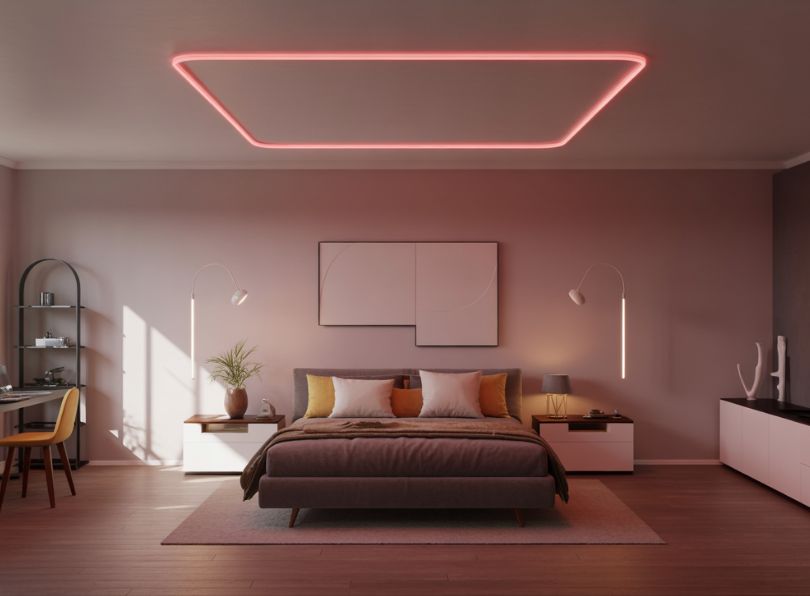
Office and home office lumen requirements
Lighting for offices is one of the most researched areas in applied photometry, because the economic impact of poor workplace lighting is measurable and substantial. The Chartered Institution of Building Services Engineers (CIBSE) and EN 12464-1 specify:
- general office: 500 lux at desk leve;
- CAD/drawing: 500–750 lux;
- computer workstations: 300–500 lux (with glare control);
- conference rooms: 300–500 lux;
- reception areas: 200–300 lux.
For a home office of 9 m² targeting 400 lux: Lumens required = 400 × 9 = 3,600 lm (basic). With UF 0.65, MF 0.80: Design lumens = 3,600 ÷ 0.52 = 6,923 lm. A Ledpoint 14.4 W/m strip at 2,000 lm/m running a total of 3.5 m (two parallel runs of 1.75 m each above the desk area) provides 7,000 lm, an excellent match.
Bathroom lumen requirements
Bathrooms present unique challenges: the combination of moisture, mirror tasks (requiring even face illumination), and relaxation bathing requires layered lighting. IP-rated Ledpoint profiles are available for bathroom and wet-area installations.
| Zone | Recommended lux | IP rating required | Notes |
|---|---|---|---|
| Mirror/vanity (face illumination) | 500–600 lux | IP44 minimum | Vertical illuminance important |
| Shower zone | 300 lux | IP65 minimum | Safety requirement |
| General ambient | 150–300 lux | IP44 | Comfortable movement |
| Bath relaxation | 50–100 lux | IP44 | On dimmer, warm white |
School classroom and educational spaces
Educational lighting is subject to the most demanding standards of any non-specialist environment because poor lighting demonstrably affects learning outcomes. A meta-analysis by the Heschong Mahone Group found that students in classrooms with better daylight and artificial lighting performed up to 26% better on standardised tests. EN 12464-1 specifies:
- classrooms: 300–500 lux (500 lux preferred for mixed-age groups);
- blackboards/whiteboards: 500 lux (vertically measured);
- art rooms: 500 lux, high CRI (≥90);
- computer labs: 300–500 lux with strict glare control (UGR ≤ 19).
Retail and commercial spaces
Retail lighting demands the highest ambient levels of any commercial environment, combined with focused accent lighting to highlight merchandise. Poor retail lighting directly reduces sales — a 2019 study by Philips Lighting Research found that retailers upgrading to optimised LED systems experienced an average 4.7% increase in sales due to improved product presentation. Recommended levels:
- general retail floor: 300–500 lux;
- feature displays / window displays: 1,000–2,000 lux;
- luxury retail: 500–1,000 lux ambient, 3,000+ lux on featured product;
- fitting rooms: 500 lux (high CRI ≥90).
Outdoor and garden lighting lumen requirements
Outdoor lighting serves dual purposes: functional (safety and wayfinding) and aesthetic (landscape enhancement). The lux requirements are considerably lower than interior spaces because the human eye adapts to low ambient light levels outdoors at night.
| Outdoor zone | Recommended lux | Notes |
|---|---|---|
| Entrance path/driveway | 30–70 lux | Safety, wayfinding |
| Patio / seating area | 50–150 lux | Social, ambient |
| Steps and level changes | 50–100 lux | Safety critical |
| Facade uplighting | 20–50 lux on surface | Architectural accent |
| Plant feature lighting | 10–50 lux on plant | Aesthetic highlight |
| Security zones | 50–100 lux | Deterrence and camera operation |
| Sports areas (amateur) | 200–500 lux | BSEN 12193 standard |
Lumens to watts conversion: led efficiency and lumen-per-watt tables
Understanding the relationship between lumens and watts is essential for energy management, cost estimation, and making informed purchasing decisions in any lighting project. The explosion of LED technology over the past decade has completely disrupted the traditional wattage-based language of light bulbs: a modern 10-watt LED outperforms the old 60-watt incandescent, and the highest-efficacy commercial LEDs achieve 200+ lm/W — a level of performance unimaginable with any previous lighting technology. This section provides comprehensive lumens to watts conversion tables, real-world efficacy data from Ledpoint products, and practical guidance on how to use these numbers in your lighting calculations.
Lumens to watts conversion chart
| Lumens (lm) | Incandescent (W) | Halogen (W) | CFL (W) | LED (W) standard | LED (W) high efficacy |
|---|---|---|---|---|---|
| 200 lm | 25 W | 18 W | 5 W | 2–3 W | 1.5 W |
| 450 lm | 40 W | 30 W | 9 W | 5 W | 3 W |
| 600 lm | 50 W | 40 W | 11 W | 7 W | 4.5 W |
| 800 lm | 60 W | 46 W | 13 W | 9–10 W | 6 W |
| 950 lm | 75 W | 55 W | 16 W | 11 W | 7 W |
| 1,200 lm | 75–100 W | 65 W | 20 W | 13–14 W | 8–9 W |
| 1,600 lm | 100 W | 72 W | 23 W | 16–18 W | 10–11 W |
| 2,000 lm | 150 W | 100 W | 28 W | 20–22 W | 13 W |
| 2,600 lm | 150 W | 120 W | 35 W | 26–28 W | 17 W |
| 3,000 lm | 200 W | 150 W | 40 W | 30–35 W | 20 W |
| 4,000 lm | 300 W | 200 W | 55 W | 40–48 W | 27 W |
| 5,000 lm | 350 W | 250 W | 68 W | 50–60 W | 33 W |
How bright is 800 lumens?
800 lumens is the light output of a standard 60-watt incandescent bulb, a benchmark that most people instinctively recognise as “a light bulb.” Over a 10 m² room, 800 lumens produces 80 lux — dim ambient light sufficient for a relaxed lounge or bedroom. Over a 4 m² bathroom, 800 lumens delivers 200 lux, comfortable general illumination. For task lighting (reading, cooking), 800 lumens from a well-directed source can achieve 300–400 lux on the working surface.
Key lumens to watts reference points
| Query | Lumens | LED watts (standard) | LED watts (high efficacy) | Incandescent equivalent |
|---|---|---|---|---|
| 1,500 lumens to watts | 1,500 lm | 15–18 W | 10 W | 100 W incandescent |
| 1,600 lumens to watts | 1,600 lm | 16–20 W | 11 W | 100 W incandescent |
| 2,000 lumens to watts | 2,000 lm | 20–25 W | 13 W | 150 W incandescent |
| 4,000 lumens to watts | 4,000 lm | 40–50 W | 27 W | 300 W incandescent |
| 900 lumens to watts | 900 lm | 10–11 W | 7 W | 60–75 W incandescent |
| 600 lumens to watts | 600 lm | 7 W | 4.5 W | 50 W incandescent |
| 700 lumens to watts | 700 lm | 8 W | 5 W | 50–60 W incandescent |
| 850 lumens to watts | 850 lm | 9–10 W | 6 W | 60 W incandescent |
| 1,200 lumens to watts | 1,200 lm | 13–14 W | 8–9 W | 75–100 W incandescent |
| 1,300 lumens to watts | 1,300 lm | 14–16 W | 9 W | 100 W incandescent |
| 500 watts to lumens | 500 W (incandescent) | ≈ 5,000–9,000 lm equiv. | LED 35–50 W | 500 W = ≈9,000 lm |
LED watt calculator: estimating led requirements from old wattages
When replacing existing incandescent or halogen installations, a simple LED watt calculator formula applies:
LED Watts ≈ Incandescent Watts ÷ 8–10 (for high-efficacy LED)Example: Replacing twelve 50W halogen downlights:
Standard LED replacement: 12 × (50 ÷ 6) = 12 × 8.3 W = 100 W total
High-efficacy LED: 12 × (50 ÷ 9) = 12 × 5.6 W = 67 W total
vs. original: 12 × 50 W = 600 W
Energy saving: 83–89%
Convert lumens to watts: the 13 watt led equivalent
A 13-watt LED at standard efficacy (approximately 80–100 lm/W) produces 1,040–1,300 lumens, broadly equivalent to a 75–100 watt incandescent bulb. At high efficacy (140–160 lm/W), a 13-watt LED produces 1,820–2,080 lumens, equalling a standard 150-watt incandescent. This range illustrates why the “13 watt LED equivalent” question lacks a single definitive answer: LED efficacy varies widely, and always checking the lumen specification (not the wattage) is essential when selecting replacement lamps.
Led profiles and strip lights: lux calculation for linear lighting
LED strip lights installed in aluminium profiles are among the most versatile and design-forward lighting solutions available, and they present some unique challenges for the lux level calculator. Unlike point-source luminaires (downlights, spotlights), LED strips distribute light along a length, creating a linear beam that interacts with the profile’s optical system (diffuser, reflector, or open channel) to produce illuminance patterns that require specialised calculation approaches. This section covers everything you need to know about performing accurate lux calculations for Ledpoint LED strip profiles.
Understanding linear lumen output in led profiles
For LED strip lighting, photometric data is expressed in lumens per metre (lm/m) rather than total lumens per luminaire. When the strip is installed in an aluminium profile, the profile’s diffuser or reflector affects the total light transmission, typically reducing the raw strip lumen output by 10–30% depending on the profile type and diffuser material.
Ledpoint provides photometric data both for bare strip and for strip-in-profile combinations, making it straightforward to use accurate numbers in your led lighting calculator calculations. A typical Ledpoint 24V high-density strip might deliver:
- bare strip: 2,400 lm/m;
- in clear diffuser profile: 2,160 lm/m (10% reduction);
- in opal diffuser profile: 1,800 lm/m (25% reduction, but excellent glare control)
Lux calculation for led strip under-cabinet lighting
Under-cabinet kitchen lighting is one of the most practical applications for Ledpoint LED profiles. The calculation targets the kitchen worksurface (typically 60–90 cm below the underside of the wall cabinets). The illuminated area is the worksurface width (typically 60 cm, the standard kitchen counter depth) multiplied by the length of cabinet above it.
Strip output (in opal profile): 1,800 lm/m;
Total lumen output: 1,800 × 2.4 = 4,320 lmIlluminated area: 2.4 m × 0.6 m = 1.44 m²;
Direct lux on worksurface (basic formula): 4,320 ÷ 1.44 = 3,000 luxAccounting for distance (30 cm mounting height) and beam spread factor (0.6):
effective lux ≈ 3,000 × 0.6 = 1,800 lux on worksurface→ Excellent for task lighting. Typical worksurface target: 400–600 lux. This system exceeds the target substantially — consider reducing strip density or using a lower-output strip for this application.
Led cove lighting: indirect lux calculation
Cove lighting (LED strips installed in an upward-facing recessed channel near the ceiling perimeter) creates indirect, reflected illuminance. The ceiling surface reflects the strip’s lumen output downward into the room, and the effective delivered lux depends on the ceiling reflectance (typically 70–80% for white ceilings), the geometry of the cove, and the room’s overall reflectance.
E_room ≈ (lm/m × L_strip × R_ceiling) ÷ A_roomWhere:
lm/m = Strip lumen output per metre
L_strip = Total strip length (m)
R_ceiling = Ceiling reflectance (typically 0.70–0.80)
A_room = Room floor area (m²)Example: 12 m of Ledpoint 1,800 lm/m strip, 0.75 ceiling reflectance, 20 m² room:
E = (1,800 × 12 × 0.75) ÷ 20 = 16,200 ÷ 20 = 810 lux (ceiling illuminated)
Delivered floor lux ≈ 810 × 0.5 (room absorption factor) ≈ 405 lux ambient
Led profile types and their effect on lux distribution
| Profile type | Light direction | Diffuser effect | Typical application | Lumen transmission |
|---|---|---|---|---|
| Surface mount (down) | Downward | Direct or opal | Task lighting, under-cabinet | 70–90% |
| Recessed (down) | Downward flush | Opal preferred | Ceiling coves, alcoves | 70–85% |
| Corner (45° or 90°) | Angled | Clear or opal | Staircase, furniture edges | 75–88% |
| Suspended linear | Down and/or up | Dual opal | Office, retail pendant | 65–80% |
| Wall-mounted (up) | Upward indirect | Open or frosted | Ambient cove effect | 80–92% |
| Stair-nose profile | Down and forward | Frosted | Step safety illumination | 72–85% |
| Waterproof (IP65+) | Downward | Silicone filled | Bathrooms, outdoor | 60–78% |
How many metres of led strip do I need?
Using the lumens-per-metre data from Ledpoint profiles, the calculation for determining required strip length is:
Required Length (m) = Total Lumens Needed ÷ Lm/m (strip in profile)
Example: 5,000 lm needed, Ledpoint strip = 1,800 lm/m in opal profile:
Length = 5,000 ÷ 1,800 = 2.78 m ≈ 2.8 m of strip required
Remember to order slightly more than calculated to account for cutting losses and any measurement rounding. Ledpoint strips can be cut at defined cut points (typically every 50 mm or every 100 mm depending on the LED pitch), giving fine control over the exact length used.
Downlight spacing calculator and recessed lighting layout
Recessed downlights remain one of the most popular luminaire types for residential and commercial ceiling lighting, and designing a well-spaced, uniformly illuminated grid is a skill that combines the lux level calculator with geometric layout principles. Incorrect downlight spacing is one of the most common lighting design errors, leading to either bright spots with dark patches between (too widely spaced) or an over-bright, visually busy ceiling (too tightly packed). This section provides complete guidance for the led downlight spacing calculator and the recessed lighting layout calculator, including spacing rules of thumb and worked examples.
The basic downlight spacing rule
The standard rule of thumb for recessed downlight spacing in a residential installation is:
Distance from wall = Spacing ÷ 2Example: 2.4 m ceiling:
Spacing = 2.4 ÷ 2 = 1.2 m between downlights
Wall offset = 1.2 ÷ 2 = 0.6 m from wall
This rule works well for downlights with a 60° beam angle, which is the most common. For narrower beams (30–40°), reduce spacing; for wider beams (80–100°), increase spacing.
Downlight spacing calculator: grid layout method
| Room size | Ceiling height | Recommended spacing | Wall offset | Number of downlights (approx.) |
|---|---|---|---|---|
| 3×4 m (12 m²) | 2.4 m | 1.2 m | 0.6 m | 4–6 |
| 4×5 m (20 m²) | 2.4 m | 1.2 m | 0.6 m | 6–9 |
| 5×8 m (40 m²) | 2.7 m | 1.35 m | 0.65 m | 12–16 |
| 6×10 m (60 m²) | 3.0 m | 1.5 m | 0.75 m | 16–24 |
| 8×12 m (96 m²) | 3.5 m | 1.75 m | 0.85 m | 24–32 |
Wiring recessed lights: typical wiring diagram
Understanding how downlights are wired is as important as knowing how many you need. The most common configuration for residential and light commercial LED downlights is a loop-in loop-out (daisy chain) connection at each luminaire. This contrasts with the older junction box (radial) wiring method.
For LED downlights with integral drivers operating at 230V AC (EU) or 120V AC (US): The supply cable enters the first downlight, is connected to the integral LED driver, and a loop-out cable feeds the next downlight in the circuit. Each luminaire is independently connected to Line (L), Neutral (N), and Earth (E).
For 12V or 24V DC LED strip lights in profiles: The wiring topology differs significantly — a low-voltage DC system fed from a centralised LED driver (transformer/power supply). The driver converts mains AC to the required DC voltage, and strips are connected in parallel to the DC output. The maximum cable run length and total load per run are constrained by voltage drop, which is a critical calculation for long strip installations.
Voltage drop calculation for led strip wiring
Voltage Drop (V) = Current (A) × Cable Resistance (Ω/m) × Length (m) × 2
For standard 1.5 mm² twin cable (resistance ≈ 0.0241 Ω/m per conductor):
A 5-metre run of 24V strip drawing 3A:
V_drop = 3 × 0.0241 × 5 × 2 = 0.72 V
Percentage drop: 0.72 ÷ 24 = 3.0% (acceptable; keep below 5%)
Recommended maximum run length for 24V strip (3A load) with 1.5 mm² cable: 8–10 m
For longer runs, Ledpoint 24V systems are significantly more tolerant of voltage drop than 12V systems, one of the primary advantages of 24V strip lighting over 12V. Always use a driver with adequate headroom (minimum 20% above the connected strip load) to ensure stable output over the product’s lifetime.
Lighting for high ceilings: lux calculation at different heights
One of the most technically challenging applications for the lux level calculator is lighting for high ceilings, found in entrance foyers, double-height living spaces, warehouses, sports halls, churches, and luxury retail. The inverse square law (discussed in Section 2.5) means that lux levels fall dramatically as mounting height increases: double the distance from a luminaire and the illuminance falls to one quarter. Compensating for this requires either higher-output luminaires, more luminaires, or strategic optical design, all of which can be informed by careful lux calculation.
Inverse square law in practice: how height affects lux
| Mounting height | Relative illuminance (%) | Luminaire output needed for 500 lux (vs. 2.5 m reference) |
|---|---|---|
| 2.5 m (reference) | 100% | Reference output |
| 3.0 m | 69% | 1.4× reference |
| 4.0 m | 39% | 2.6× reference |
| 5.0 m | 25% | 4.0× reference |
| 6.0 m | 17% | 5.8× reference |
| 8.0 m | 10% | 10.2× reference |
| 10.0 m | 6% | 16.0× reference |
Pendant lights for vaulted ceilings and foyers
For spaces with vaulted ceilings or tall entrance foyers (foyer lights and foyer staircase lighting), the practical solution is often to lower the luminaire on a pendant or suspension cable rather than trying to push enough lumens from a ceiling-mounted fixture. A pendant luminaire suspended to 2.5 m above floor level from a 5 m ceiling delivers 4× the illuminance of the same luminaire ceiling-mounted, at the cost of increased visual prominence. Ledpoint suspended linear profiles offer an elegant solution for these spaces, providing high lumen output in a visually slim, architecturally refined form.
For master bedroom lighting with vaulted or sloped ceilings, the recommended approach is a combination of: a ceiling-mounted cove profile for ambient indirect light, with pendant reading lights or wall-mounted strips at working plane height to supplement task illumination where the inverse square law most significantly reduces ceiling-mounted lux levels.
High-bay lighting calculations for industrial spaces
Industrial and commercial high-bay spaces (ceiling heights 6–15 m) require specialist high-bay LED luminaires with narrow beam optics to concentrate light on the working plane. A typical warehouse at 10 m ceiling height targeting 200 lux (industrial general area standard) requires:
For 200 lux at 10 m height, beam factor = 0.85, spacing = 4 m × 4 m grid (16 m² per fixture):
F_fixture = (200 × 16) ÷ (0.85 × 0.80) = 3,200 ÷ 0.68 = 4,706 lm minimum
Typical high-bay LED for 10 m height: 15,000–30,000 lm output
→ High-bay LEDs have tight beams (30–60°) that concentrate most of their output in a narrow cone, achieving the required lux even at height
Recommended lux levels by environment: industry standards and codes
Professional lighting design is always grounded in published standards and codes that define minimum illuminance requirements for specific task types and environments. These standards protect occupant health and safety, ensure regulatory compliance, and provide the benchmark lux values that feed directly into every lux level calculator workflow. The principal standards relevant to European and UK projects are EN 12464-1 (indoor workplaces), EN 12464-2 (outdoor workplaces), BS EN 12193 (sports lighting), and the CIBSE Lighting Guides. This section provides the most comprehensive reference table of recommended lux levels available outside specialist technical publications.
Comprehensive lux level standards reference table
| Environment | Area/task | Recommended lux (Em) | Uniformity (Uo) | UGR limit | CRI Ra |
|---|---|---|---|---|---|
| Offices | Filing, copying | 300 | 0.40 | 19 | 80 |
| Writing, reading, PC work | 500 | 0.60 | 19 | 80 | |
| Technical drawing | 750 | 0.70 | 16 | 80 | |
| Conference rooms | 500 | 0.60 | 19 | 80 | |
| Educational | Classrooms | 300–500 | 0.60 | 19 | 80 |
| Art rooms | 500 | 0.60 | 19 | 90 | |
| Lecture theatres | 500 | 0.60 | 19 | 80 | |
| Healthcare | Ward/patient rooms | 100–200 | 0.40 | 19 | 80 |
| Examination rooms | 500–1000 | 0.60 | 19 | 90 | |
| Operating theatres (general) | 1,000 | 0.80 | 19 | 90 | |
| Operating field (direct) | 10,000–100,000 | — | — | 90 | |
| Retail | General sales area | 300–500 | 0.40 | 22 | 80 |
| Feature displays | 1,000–2,000 | — | — | 90 | |
| Checkout | 500 | 0.60 | 19 | 80 | |
| Industrial | General heavy work | 200 | 0.40 | 25 | 60 |
| Precision assembly | 500–1,000 | 0.70 | 19 | 80 | |
| Quality inspection | 1,000–2,000 | 0.80 | 16 | 90 | |
| Residential | Living room (ambient) | 100–200 | 0.30 | 22 | 80 |
| Kitchen (worksurface) | 300–500 | 0.50 | 19 | 80 | |
| Bedroom (ambient) | 100–150 | 0.30 | 25 | 80 | |
| Bathroom (mirror/vanity) | 300–500 | 0.50 | 19 | 80 | |
| Outdoor | Pedestrian paths | 15–30 | 0.25 | — | 20 |
| Car parks | 30–75 | 0.25 | — | 20 | |
| Security zones | 50–100 | 0.25 | — | 20 | |
| Sports (BS EN 12193) | Recreational training | 200–500 | 0.50 | — | 65 |
| Televised competition | 2,000+ | 0.80 | — | 80 |
Lighting levels in offices: a deep dive
Lighting levels in offices have been extensively researched, and the body of evidence consistently shows that correct illuminance — and equally important, correct glare control — significantly affects worker productivity, comfort, and health. The key parameters are:
- maintained illuminance (Em): the target average lux level sustained throughout the luminaire’s service life (not just at installation). EN 12464-1 specifies 500 lux Em for general office tasks;
- uniformity (Uo): the ratio of minimum to average illuminance across the task area (minimum 0.6 for offices);
- glare control (UGR): The Unified Glare Rating must not exceed 19 for office environments, this drives the choice of luminaire type (typically louvred or diffused panel rather than bare strip);
- colour rendering (CRI Ra): Minimum 80 for office tasks; CRI ≥90 is recommended for spaces where colour accuracy matters (art direction, quality control, retail).
Led wiring diagrams: installing led profiles correctly
Accurate lux level calculator results are only as good as the installation that delivers them. A beautifully designed lighting scheme with perfectly calculated lux levels will underperform if the LED strips are incorrectly wired, whether due to voltage drop in long runs, incorrect driver sizing, improper parallel connection, or inadequate earthing. This section provides comprehensive guidance on LED strip wiring, including typical wiring diagrams for both simple and complex installations, driver sizing calculations, and practical installation tips based on real Ledpoint installation experience.
Understanding led strip power requirements
Before wiring any LED strip installation, the total power load must be calculated accurately to select the correct driver (power supply). The basic calculation is:
Driver Capacity = Total Load × 1.2 (20% headroom factor)Example: 8 m of Ledpoint 14.4 W/m strip:
Total Load = 14.4 × 8 = 115.2 W
Required Driver = 115.2 × 1.2 = 138.2 W → Select 150 W driver
Parallel vs. series led strip wiring
LED strips operate on constant-voltage DC power (typically 12V or 24V) and are always wired in parallel, never in series. Connecting strips in series increases the total voltage requirement beyond the driver’s output capability, causing under-driving of the LEDs and significant lumen loss. Each parallel branch of the circuit receives the full supply voltage, ensuring consistent lumen output along the entire length.
For multiple strips fed from a single driver, the parallel wiring schematic is straightforward: all positive (+) leads connect to the driver’s positive output terminal, and all negative (−) leads connect to the driver’s negative output terminal. The total current draw is the sum of all individual strip currents.
Typical wiring diagram: single led strip run
│
▼
[SWITCH / DIMMER]
│
▼
[LED DRIVER / POWER SUPPLY]
Input: 230V AC
Output: 24V DC
│
+24V │ ─────────────────────────────────► (+) LED STRIP (+) ─► 0V return
│ │
0V │ ◄────────────────────────────────────────────────────── │
│
Typical wiring diagram: multiple led strips in parallel
+24V ─────┬──────────────────► (+) Strip 1 →
├──────────────────► (+) Strip 2 →
└──────────────────► (+) Strip 3 →
0V ─────┬──────────────────── (−) Strip 1 ←
├──────────────────── (−) Strip 2 ←
└──────────────────── (−) Strip 3 ←
Wiring diagram for dimmable led strip systems
Dimming LED strips requires either a TRIAC/phase-cut dimmer (for dimmable drivers) or a PWM (Pulse Width Modulation) controller on the DC side. PWM dimming is the preferred method for LED strips, as it maintains colour temperature consistency across the dimming range. Phase-cut dimming through a mains-side dimmer is acceptable for dimmable LED drivers, but compatibility must always be verified.
│
[PHASE-CUT DIMMER] (mains side, use dimmable driver only)
│
[DIMMABLE LED DRIVER]
24V DC output
│
[PWM CONTROLLER] (optional, for 0–10V or DALI control)
│
[LED STRIPS] (parallel)
For intelligent building systems (DALI, KNX, DMX), Ledpoint drivers with compatible control interfaces are available through LightingLine.eu, enabling complete addressable control of individual LED profile zones for maximum design flexibility.
Wiring downlights (recessed lighting): loop-in loop-out method
For 230V AC LED downlights wired in a loop-in loop-out configuration (the most common method in modern European installations):
│
[CIRCUIT BREAKER]
│
[SWITCH] ──── to L of downlight 1
│
Downlight 1 (L, N, E) ──loop-out──► Downlight 2 (L, N, E) ──► Downlight 3…N: continuous from CU to all downlights
E: continuous from CU to all downlights (PE)
L (switched): from switch to first downlight, then looped to subsequent downlights
Always comply with local wiring regulations (BS 7671 in the UK, IEC 60364 in Europe). LED downlights with integral LED drivers require no separate transformer on 230V AC supplies and are directly compatible with standard residential circuit protection (typically 6A or 10A MCB).
Led profiles: product selection and lux output guide
This section provides a comprehensive overview of the Ledpoint range relevant to lux calculation and lighting design, including key photometric data for use in the formulas presented throughout this guide.
Led strip light range: photometric summary
| Product series | Voltage | Power (W/m) | Lumens (lm/m bare) | Efficacy (lm/W) | CRI | Colour temp (K) | IP rating |
|---|---|---|---|---|---|---|---|
| Standard 12V | 12V DC | 7.2 | 600–720 | 83–100 | ≥80 | 2700–6500K | IP20 |
| Standard 24V | 24V DC | 9.6 | 900–1,100 | 94–115 | ≥80 | 2700–6500K | IP20 |
| High-Output 24V | 24V DC | 14.4 | 1,600–2,000 | 111–139 | ≥80 | 2700–6500K | IP20 |
| Ultra-High 24V | 24V DC | 20 | 2,400–3,000 | 120–150 | ≥80 | 2700–6500K | IP20 |
| Premium CRI90 | 24V DC | 14.4 | 1,500–1,800 | 104–125 | ≥90 | 2700–5000K | IP20 |
| Outdoor IP65 | 24V DC | 12 | 1,100–1,400 | 92–117 | ≥80 | 2700–6500K | IP65 |
| Outdoor IP68 | 24V DC | 12 | 900–1,200 | 75–100 | ≥80 | 3000–6500K | IP68 |
Aluminium profile range: key types
| Profile series | Mounting type | Diffuser options | Strip width compatibility | Max strip width | Applications |
|---|---|---|---|---|---|
| LP-S (Surface) | Surface/ceiling | Clear, opal, frosted | 8, 10, 12 mm | 12 mm | Ceilings, under-cabinet, furniture |
| LP-R (Recessed) | Recessed in plaster/board | Opal, frosted, micro-lens | 8, 10, 12 mm | 12 mm | Ceiling coves, alcoves |
| LP-C (Corner) | Corner/edge mount | Clear, opal | 8, 10 mm | 10 mm | Stairs, shelving, furniture edges |
| LP-W (Wide) | Surface, recessed | Opal, asymmetric | Up to 20 mm | 20 mm | High-density strip, wide beam |
| LP-SUS (Suspended) | Pendant suspension | Dual opal | 10, 12 mm × 2 | 12 mm (×2) | Office, retail pendant |
| LP-STR (Stair) | Stair tread/riser | Frosted | 8, 10 mm | 10 mm | Step safety lighting |
| LP-OUT (Outdoor) | Surface, IP-rated | Clear (sealed) | 10, 12 mm | 12 mm | Facade, garden, pathway |
Selecting the right profile for your lux target
The decision framework for selecting a Ledpoint profile and strip combination for a specific lux target involves three steps: let’s see which ones.
Step 1 – Calculate required lm/m: using the formulas in Section 7, determine how many lumens per metre are needed to achieve your target lux over the illuminated area.
Step 2 – Account for profile transmission: divide the required lm/m by the profile’s transmission factor (see Section 7.1) to determine the bare strip lm/m needed. For an opal diffuser (75% transmission), a requirement of 1,500 lm/m means you need a bare strip outputting 2,000 lm/m.
Step 3 – Match to Ledpoint strip series: select the strip series with the appropriate lm/m output, voltage, CRI, and IP rating. For the example above (2,000 lm/m required), the Ledpoint High-Output 24V series at 14.4 W/m is the ideal match.
Lux level calculator for specialist environments
Beyond the standard room types covered in Section 5, several specialist environments demand specific lux calculation approaches, either because they involve unusual geometry, because health and safety requirements impose strict minimum and maximum illuminance values, or because the quality of light (not just quantity) is paramount. This section addresses the four specialist environments most frequently enquired about by LightingLine.eu customers: photography studios, grow rooms, retail display areas, and outdoor sports facilities.
Photography studio lighting calculations
For photographers, the lux level calculator is a daily working tool. The key metrics are:
- key light: the primary light source, typically 2,000–3,000 lux at the subject for portrait photography;
- fill light: typically 50–70% of key light intensity (1,000–2,100 lux) to control shadow depth;
- background light: variable, 50–200% of key light depending on desired look;
- ratio: the key-to-fill ratio (Rembrandt lighting = 4:1, high-key = 2:1).
For video and lifestyle content creation, consistent, flicker-free illumination is critical. Ledpoint LED strips and profiles with high CRI (≥90, ideally ≥95) and rated at 50,000 hours are ideal continuous sources. The colour rendering index matters enormously for photography: a CRI 80 source will render skin tones differently (and less accurately) than a CRI 95 source at the same lux level.
Grow room lighting calculator
Horticultural lighting uses a specialist metric, PPFD (Photosynthetic Photon Flux Density), measured in μmol/m²/s, rather than lux, because plants respond to the photosynthetically active radiation (PAR) spectrum (400–700 nm) rather than the full visible spectrum that lux measures. However, lux remains a useful proxy for initial planning:
| Plant stage | PPFD (μmol/m²/s) | Approximate lux equivalent | Notes |
|---|---|---|---|
| Seedlings | 100–300 | 5,000–15,000 lux | 16–18h photoperiod |
| Vegetative | 400–600 | 20,000–30,000 lux | 18h photoperiod |
| Flowering | 600–1,000 | 30,000–50,000 lux | 12h photoperiod |
| High-light fruiting | 800–1,500 | 40,000–75,000 lux | CO2 supplementation needed |
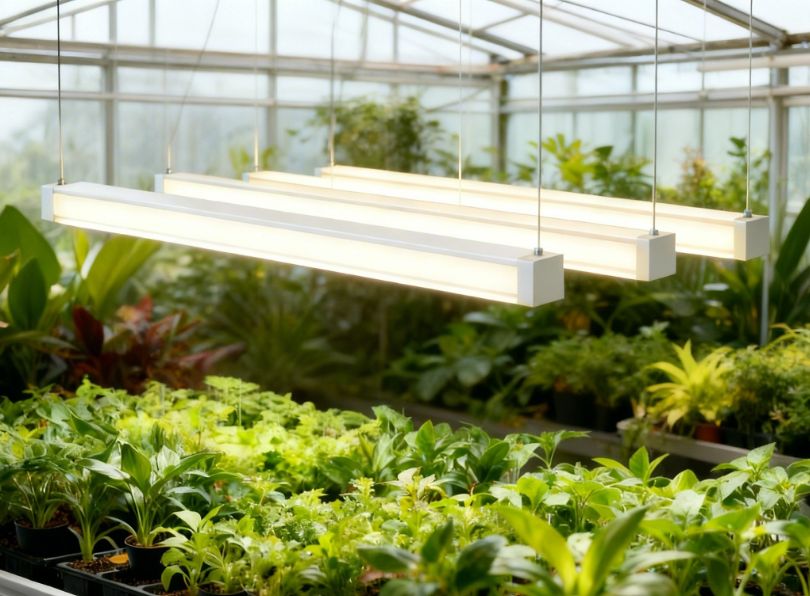
Retail display lighting: accent lux ratios
In retail design, the concept of contrast ratio, the ratio of accent lux to ambient lux, is one of the most powerful tools for directing customer attention and creating visual hierarchy. The Society of Light and Lighting (SLL) guidance recommends:
- subtle emphasis: 3:1 ratio (accent 3× ambient);
- clear focus: 5:1 to 10:1 ratio;
- high-drama display: 15:1 to 30:1 ratio.
For a retail space with 400 lux ambient, a 10:1 contrast on featured product requires 4,000 lux, achievable with a tightly focused LED spotlight or a Ledpoint surface-mounted profile with a narrow-beam optic directly above the product.
Advanced lighting calculations: utilisation factor, maintenance factor, and the full lumen method
The advanced lighting calculation methodology extends the basic lux level calculator formulas with the psychophysics of enclosed spaces, the optics of real luminaires, and the degradation behaviour of LED sources over time. Mastery of these techniques is what separates a professional lighting designer from an amateur, and it is what ensures that a lighting installation still meets its target illuminance after five or ten years of operation, not just on the day of commissioning.
Utilisation Factor (UF) tables
The Utilisation Factor depends on three inputs: the Room Index (RI), the reflectances of the ceiling, walls, and floor, and the polar intensity distribution (photometry) of the chosen luminaire. Manufacturers publish UF tables in their technical data. In the absence of manufacturer data, the following typical values provide a good working estimate:
| Room index (RI) | High reflectance room (C:70, W:50, F:20) | Medium reflectance (C:50, W:30, F:20) | Low reflectance (C:30, W:10, F:10) |
|---|---|---|---|
| 0.75 | 0.42 | 0.32 | 0.22 |
| 1.00 | 0.52 | 0.40 | 0.28 |
| 1.25 | 0.58 | 0.46 | 0.33 |
| 1.50 | 0.63 | 0.51 | 0.37 |
| 2.00 | 0.70 | 0.58 | 0.43 |
| 2.50 | 0.74 | 0.62 | 0.47 |
| 3.00 | 0.77 | 0.65 | 0.50 |
| 4.00 | 0.81 | 0.69 | 0.54 |
| 5.00 | 0.83 | 0.72 | 0.57 |
C = Ceiling reflectance %, W = Wall reflectance %, F = Floor reflectance %
Maintenance Factor (MF) calculation
The Maintenance Factor is a composite of three individual factors:
MF = LLMF × LSF × LDD × RDD
Where:
LLMF = Lamp Lumen Maintenance Factor (LED lumen depreciation over design life)
LSF = Lamp Survival Factor (probability of LED functioning at end of design life)
LDD = Luminaire Dirt Depreciation (dust accumulation on luminaire optics)
RDD = Room Surface Dirt Depreciation (darkening of room surfaces over time)
Typical values for LED in clean office, 3-year maintenance cycle:
LLMF = 0.91 (LEDs at 50,000h retain ~91% of initial lumens)
LSF = 0.99 (LEDs very rarely fail before rated life)
LDD = 0.92 (clean office environment, IP20 downlight)
RDD = 0.96 (clean office, light surfaces)
MF = 0.91 × 0.99 × 0.92 × 0.96 = 0.80
Worked full lumen method calculation
Target: 500 lux Em, UGR ≤19
Luminaire: Ledpoint suspended linear profile, 3,500 lm per 1.2 m luminaire, UGR 17Step 1 — Room Index:
Hm = 3.0 − 0.85 = 2.15 m
RI = (12 × 8) ÷ [2.15 × (12 + 8)] = 96 ÷ 43 = 2.23Step 2 — Utilisation Factor (from table, RI=2.25, high reflectance): UF = 0.74Step 3 — Maintenance Factor: MF = 0.80Step 4 — Number of luminaires:
N = (500 × 96) ÷ (3,500 × 0.74 × 0.80) = 48,000 ÷ 2,072 = 23.2 → 24 luminairesStep 5 — Verify actual average illuminance:
Em = (24 × 3,500 × 0.74 × 0.80) ÷ 96 = 49,728 ÷ 96 = 518 lux ✓ (exceeds 500 lux target)Step 6 — Layout: 4 rows × 6 luminaires, spaced 2.0 m × 2.0 m apart in 12×8 m plan ✓
Lux to luminance conversion and advanced photometric concepts
For lighting designers and specifiers working at the highest professional level, understanding the relationship between illuminance (lux), luminance (cd/m²), and related photometric quantities enables both more accurate calculations and more sophisticated aesthetic decisions. This section covers the conversion from lux to luminance, the concept of luminous exitance, and how these quantities relate to the visual experience of a lit space.
How to convert lux to luminance
Luminance (L, measured in candela per square metre, cd/m²) is the photometric quantity that corresponds most closely to what the human eye actually perceives as brightness — the light reflected or emitted from a surface toward the observer’s eye. Converting from illuminance (lux) to luminance requires knowing the surface’s reflectance (ρ):
L = (E × ρ) ÷ π
Where:
L = Luminance (cd/m²)
E = Illuminance (lux)
ρ = Surface reflectance (0–1; e.g., white wall ≈ 0.7, dark grey ≈ 0.15)
π = 3.14159 (pi)
Example: 500 lux on a white desk surface (ρ = 0.80):
L = (500 × 0.80) ÷ 3.14159 = 400 ÷ 3.14 = 127 cd/m²
Example: 500 lux on a dark grey carpet (ρ = 0.20):
L = (500 × 0.20) ÷ 3.14 = 100 ÷ 3.14 = 32 cd/m²
Luminous flux, luminous intensity, illuminance, and luminance
| Quantity | Symbol | SI unit | Description | Measured by |
|---|---|---|---|---|
| Luminous flux | F, Φ | Lumen (lm) | Total visible light output from a source | Integrating sphere |
| Luminous intensity | I | Candela (cd) | Light emitted in a specific direction | Goniophotometer |
| Illuminance | E | Lux (lx = lm/m²) | Light falling on a surface | Lux meter (luxmeter) |
| Luminance | L | Candela/m² (cd/m²) | Light seen by observer from surface | Luminance meter |
| Luminous exitance | M | Lux (lm/m²) | Total light leaving a surface (all directions) | Calculated |
How to measure lumens and lux in the field
A lumens meter (integrating sphere photometer) is a laboratory instrument used to measure the total lumen output of a light source. For field use, a lux meter (digital illuminance meter) is the practical tool, typically available from professional lighting suppliers for £50–£500 depending on accuracy requirements. A lux meter measures the illuminance (lx) at its sensor location, allowing verification of calculated targets against actual installed performance.
Smartphone lux meter apps (using the phone’s ambient light sensor) can provide indicative readings for rough assessment, but they are insufficiently accurate for professional commissioning or regulatory compliance. Always use a calibrated handheld lux meter for any formal lighting audit or commissioning record.
Practical tools, apps, and online calculators
The availability of high-quality digital tools has transformed the accessibility of professional lux level calculator methodology, making it possible for non-specialist users, homeowners, photographers, teachers, gardeners, to perform reasonably accurate lighting calculations without specialist training. This section surveys the most useful tools and explains how to use them effectively, including their limitations and how to cross-check their results with the manual calculation methods covered in this guide.
Online lux level calculators
Several high-quality lighting calculator tools are available online that implement the lumen method with varying degrees of sophistication. The most useful include:
- dialux / relux: professional-grade software used by lighting designers. Free to download. Supports full 3D room modelling, photometric files (IES/LDT), and generates complete light level reports including lux contour plots and UGR values;
- ledvance lighting calculator: web-based, simpler interface, suitable for quick estimates by non-specialists. Implements the basic lumen method;
- LightingLine.eu selector: integrated on the LightingLine.eu website, this tool allows you to specify your dimensions and target lux level, then recommends the appropriate strip and profile combination with calculated lm/m requirements.
- Illuminance calculator (various mobile apps): apps available on iOS and Android that implement the basic illuminance formula. Best for quick sanity checks rather than final design verification.
How to use a lux calculator effectively
Regardless of which online lux calculator or led lighting calculator you use, the quality of your results depends entirely on the accuracy of your inputs. The most common errors are:
- using wattage instead of lumens for light source input — always input lumen output, not wattage;
- assuming UF = 1.0 (100% efficiency) — most basic calculators make this simplification; for accurate results, apply a UF of 0.6–0.75 manually;
- forgetting the maintenance factor — always plan for a 0.80 MF to ensure the system still meets its target after years of operation;
- using floor area when the working plane area should be used — for a kitchen, the relevant area is the worksurface, not the total floor area;
- ignoring beam angle for directional sources — a 30° spotlight produces dramatically different lux distribution from a 120° floodlight, even with identical lumen output.
Room dimensions calculator integration
Many lux calculators incorporate a room dimensions calculator that allows you to input room length, width, and height to automatically compute floor area and Room Index. For rooms with irregular shapes, divide the space into regular rectangles, calculate each zone separately, and average the results. For triangular or L-shaped rooms, the same approach applies — break the plan into rectangular zones.
Convert lumens to lux: quick reference tool
The simplest possible convert lumens to lux tool is a mental arithmetic shortcut: divide lumens by area in m². For rooms in square feet, first convert: 1 m² = 10.76 ft², so 120 sq ft = 11.15 m². A 1,600-lumen LED in a 120 sq ft room produces 1,600 ÷ 11.15 ≈ 143 lux — comfortable ambient residential lighting.
Converting lux to lumens reverses this: multiply lux by area. For 300 lux in a 15 m² kitchen: 300 × 15 = 4,500 lm required (basic, pre-factor). This is the most commonly used form of the lux to lumens calculator function in everyday lighting planning.
Frequently asked questions
This section consolidates the most frequently asked questions about lux level calculators, lumens, lux, and LED lighting, with complete, authoritative answers. These questions reflect the real queries from architects, photographers, educators, gardeners, and content creators who consult LightingLine.eu for lighting guidance.
Lux calculations: your questions
Can you calculate lux from lumens?
Yes. The formula is: Lux = Lumens ÷ Area (m²). This gives the average illuminance across the area. For more accuracy in real rooms, apply the utilisation factor and maintenance factor as described in Section 14.
How do you convert lumens to lux?
Divide the total lumen output of all light sources in the space by the area of the illuminated surface in square metres. Example: 3,000 lumens over 15 m² = 200 lux. To convert lux back to lumens, multiply lux by area: 200 × 15 = 3,000 lm.
Does 1 lux equal 1 lumen?
No — but 1 lux equals 1 lumen per square metre. If 1 lumen of light is distributed over exactly 1 m², the result is 1 lux. Lux and lumens measure different things: lumens measure total light output, lux measures light falling on a surface per unit area.
How many lumens is a 10,000 lux light?
It depends on the area illuminated. 10,000 lux over 1 m² = 10,000 lumens. Over 0.09 m² (a 30×30 cm SAD lamp effective area at 30 cm distance) = 900 lumens at the target. The total lumen output of a 10,000 lux SAD lamp is typically 5,000–8,000 lm due to optical losses.
How many lux is 3,200 lumens?
3,200 lumens over 10 m² = 320 lux. Over 16 m² = 200 lux. Over 6.4 m² = 500 lux. The lux value is always area-dependent.
How do you calculate lux in a room?
1. Measure the room area in m². 2. Identify total installed lumens (sum of all fixture lumen outputs). 3. Apply basic formula: Lux = Lumens ÷ Area. 4. For professional accuracy, multiply by UF (0.55–0.75) and MF (0.80). The result is the maintained average illuminance.
Lumens and room lighting questions
How many lumens for a 12×12 room?
A 12×12 ft room ≈ 13.4 m². For 200 lux ambient (living room): 200 × 13.4 = 2,680 lm basic (4,731 lm with factors). For 500 lux (home office): 500 × 13.4 = 6,700 lm basic (11,828 lm with factors). A Ledpoint 14.4 W/m strip at 2,000 lm/m, 5–6 m total length, provides approximately 10,000–12,000 lm — sufficient for a bright home office in this size room.
Is 2,000 lumens bright enough for a kitchen?
For a small kitchen (8 m²), 2,000 lm delivers 250 lux ambient — adequate as general lighting with under-cabinet supplements. For a medium kitchen (12 m²), 2,000 lm = 167 lux — below the recommended 300–500 lux for kitchen task areas. A 12 m² kitchen needs at least 3,600 lm general plus under-cabinet strips for worksurface tasks.
Is 1,000 lumens bright enough for a bedroom?
For a 10 m² bedroom targeting 100 lux ambient, 1,000 lm is exactly right. This is comfortable for evening use on a dimmable circuit. For a 14 m² double bedroom, 1,000 lm produces only 71 lux — dim but acceptable on a dimmable circuit set to 50% of full output.
How bright is 1,000 lumens?
1,000 lumens is roughly the output of a standard 60–75W incandescent bulb, or a 9–11W LED. Spread over 10 m², it delivers 100 lux (comfortable bedroom ambient). Focused by a 30° beam downlight onto a 1 m² area, it delivers approximately 700–900 lux (bright task illumination). Context — both area and direction — determines perceived brightness.
Is 5,000 lumens very bright?
Yes. 5,000 lumens over a 10 m² room = 500 lux — bright office-standard illumination. Over a 25 m² open-plan space = 200 lux — comfortable ambient. Over a 2 m² work surface = 2,500 lux — extremely bright task lighting. 5,000 lumens from a single source (e.g., a high-powered floodlight) would be uncomfortably dazzling at close range.
Is 2,000 lumens enough for outdoor lighting?
For a small garden area (30–40 m²), 2,000 lm delivers 50–67 lux — adequate for entertaining and safe movement. For a driveway or large garden (100 m²), 2,000 lm provides only 20 lux — acceptable as ambient but insufficient for security-grade illumination. For security perimeters requiring 50–100 lux, a 100 m² space needs 5,000–10,000 lm total.
What is the recommended lumens for a room?
There is no single answer — it depends entirely on room size and function. Using the formula Lumens = Lux × Area (m²): a 20 m² living room at 200 lux needs 4,000 lm basic; a 10 m² kitchen at 400 lux needs 4,000 lm; a 15 m² office at 500 lux needs 7,500 lm. Always calculate from your specific room dimensions and target lux level.
Market data, industry statistics, and research on lighting and led technology
Understanding the broader context of the LED lighting market provides valuable perspective for anyone making purchasing decisions, specifying systems, or designing lighting schemes. The global LED lighting market has undergone one of the most rapid technology transitions in industrial history, and the data that documents this transition also illuminates (in every sense) the performance advantages that drive the adoption of LED profiles like Ledpoint and the importance of accurate lux level calculator methodology in maximising the return on lighting investment.
Global led market statistics
| Metric | Value | Source / year |
|---|---|---|
| Global LED lighting market size (2023) | USD 86.4 billion | Grand View Research, 2024 |
| Projected market size (2030) | USD 194 billion | Grand View Research, 2024 |
| CAGR (2024–2030) | 12.2% | MarketsandMarkets, 2024 |
| LED penetration of global lighting market (2023) | ~65% | IEA, 2024 |
| Energy savings from LED vs. incandescent | 75–85% | US DOE, 2023 |
| Average LED lifespan | 25,000–50,000 hours | IEC 62612 |
| Global lm/W improvement per year (LED) | ~10–15% | US DOE SSL Programme |
| Best commercial LED efficacy (2024) | 250+ lm/W | Cree, Nichia technical data |
| European commercial building energy use for lighting | 25–40% of total | BPIE, 2023 |
| Lighting’s share of residential electricity use (EU) | 11–15% | Eurostat, 2023 |
The business case for accurate lux level calculation
A 2022 study by the Carbon Trust (UK) found that over-specified artificial lighting, systems delivering more lux than necessary due to poor design or outdated specifications, is responsible for approximately 20–30% of unnecessary energy consumption in commercial buildings. This means that getting the lux level calculation right, using accurate formulas and applying the correct maintenance and utilisation factors, is not merely an aesthetic exercise it has direct, quantifiable financial and environmental impact.
The same study found that lighting energy costs in European office buildings average €6–12 per m² per year. A building with 1,000 m² of office space over-lit by 30% wastes €1,800–€3,600 per year. Proper use of the lumen method with real photometric data from products like Ledpoint eliminates this waste while simultaneously ensuring occupant comfort and regulatory compliance.
Human health research: lighting quality and wellbeing
The scientific literature on the relationship between light levels and human health has grown dramatically in the past decade, driven by discoveries about the non-visual effects of light on circadian rhythm, sleep quality, mood, and cognitive function. Key findings relevant to lighting design:
- a study in The Journal of Clinical Endocrinology & Metabolism (Zeitzer et al., 2020) found that exposure to bright light (>1,000 lux) in the morning phase-advances the human circadian clock by 1–2 hours, improving sleep quality in shift workers;
- research from the Lighting Research Centre (Troy, NY) demonstrated that task illuminances below 300 lux significantly increased self-reported eye strain and reduced reading speed in office workers over 8-hour shifts;
- a meta-analysis in Ergonomics (2021) found that optimising classroom illuminance (300–500 lux, CRI ≥80) improved reading speed by 12% and reduced error rates by 18% in primary school students.
- horticulture research (Bugbee, 2022, Utah State University) confirmed that supplemental LED lighting at 200–500 μmol/m²/s PPFD increases lettuce yield by 40–60% and tomato fruit set by 25–35% in greenhouse environments.
Energy efficiency standards and regulatory context
The regulatory environment for lighting in the EU and UK has progressively tightened, phasing out inefficient light sources and establishing minimum efficacy requirements. Key regulatory milestones:
- EU Regulation 2019/2020 (EcoDesign): prohibits sale of fluorescent tubes and non-directional halogen lamps in EU from 2023. Minimum LED efficacy requirement: 85 lm/W;
- UK SLL/CIBSE Lighting Guide LG3 (2018 edition): sets recommended illuminance, uniformity, and glare limits for all workplace categories;
- EN 12464-1:2021: updated European standard for indoor workplace lighting, incorporating additional requirements for cylindrical illuminance and modelling index to support three-dimensional visibility;
- BREEAM and LEED: green building certification systems that award credits for meeting or exceeding recommended lux levels, installing daylighting controls, and achieving high lighting energy efficiency (LPD — Lighting Power Density).
Lux level calculator and product recommendations: choosing the right led profile for perfect lux
The journey from a blank room to a perfectly lit space begins and ends with the lux level calculator. As this comprehensive guide has demonstrated, the calculation of appropriate illuminance levels is not a single formula but a layered methodology: understanding the relationship between lumens, lux, candela, and watts, applying room-appropriate correction factors, selecting luminaires with appropriate photometric data, laying out fixtures for uniform distribution and verifying results with field measurement. Every professional lighting designer, every informed architect, every technically engaged photographer and teacher, can and should perform this calculation before specifying a single LED strip or downlight.
Led profiles provide the photometric performance, build quality, and design flexibility needed to achieve any lux target in any environment. Whether you need the subtle, glare-free ambient glow of an opal-diffused ceiling cove for a residential living room, the clinical brightness of a 500-lux office lighting system, or the high-CRI precision of a photography studio or retail display.
The key recommendations from this guide are summarised below for quick reference:
| Application | Target lux | Recommended strip | Recommended profile | Notes |
|---|---|---|---|---|
| Residential living room (ambient) | 150–200 lux | Standard 24V, 900–1,100 lm/m | LP-R recessed, opal | Dimmable driver recommended |
| Kitchen worksurface (task) | 400–600 lux | High-Output 24V, 1,600–2,000 lm/m | LP-S surface, frosted | Under-cabinet installation |
| Bedroom (ambient/relaxation) | 100–150 lux | Standard 24V, 900 lm/m | LP-R recessed or cove | 2700K warm white |
| Office (EN 12464-1) | 500 lux | Ultra-High 24V or suspended linear | LP-SUS suspended | UGR ≤19 diffuser essential |
| Retail display (accent) | 1,000–2,000 lux | Premium CRI90, 14.4 W/m | LP-W wide or spot optic | CRI ≥90 essential |
| Bathroom (vanity) | 400–500 lux vertical | Standard 24V, CRI ≥90 | LP-S surface, IP44 | Horizontal either side of mirror |
| Outdoor garden path | 30–70 lux | Outdoor IP65, 12 W/m | LP-OUT surface | 24V for long cable runs |
| Photography studio | 2,000–3,000 lux | Premium CRI95, ultra-high output | LP-W wide beam | 5000–5500K daylight |
| Staircase (safety) | 50–100 lux | Standard 12V or 24V | LP-STR stair profile | IP44 if exterior |
| Classroom / educational | 300–500 lux | High-Output 24V | LP-SUS pendant linear | UGR ≤19, CRI ≥80, 4000K |
The lux level calculator in practice
Whether you are using the simplest possible estimate (Lux = Lumens ÷ Area) or the full professional lumen method with utilisation and maintenance factors, the lux level calculator process can be summarised in five clear steps:
1. Define your target lux: use the reference tables in Sections 4 and 10 to identify the appropriate illuminance for your space and application.
2. Calculate your room area: measure length × width in metres for the relevant zone (not always the whole room).
3. Compute total lumens needed: multiply target lux by area, then divide by (UF × MF) for professional accuracy.
4. Select your LED product: choose a Ledpoint strip and profile combination that delivers the required lm/m over the installation length.
5. Verify and adjust: after installation, measure with a calibrated lux meter. Fine-tune with dimmer controls and driver adjustments as needed.
With this methodology, every lighting project , from the simplest bedroom renovation to the most complex commercial installation can be designed with confidence, precision, and the certainty of achieving exactly the visual experience intended. That is the power of the lux level calculator.
This article was developed with the support of artificial intelligence and subsequently reviewed, corrected, and validated by the LightingLine.eu technical team, which guarantees its reliability and compliance with official sources.