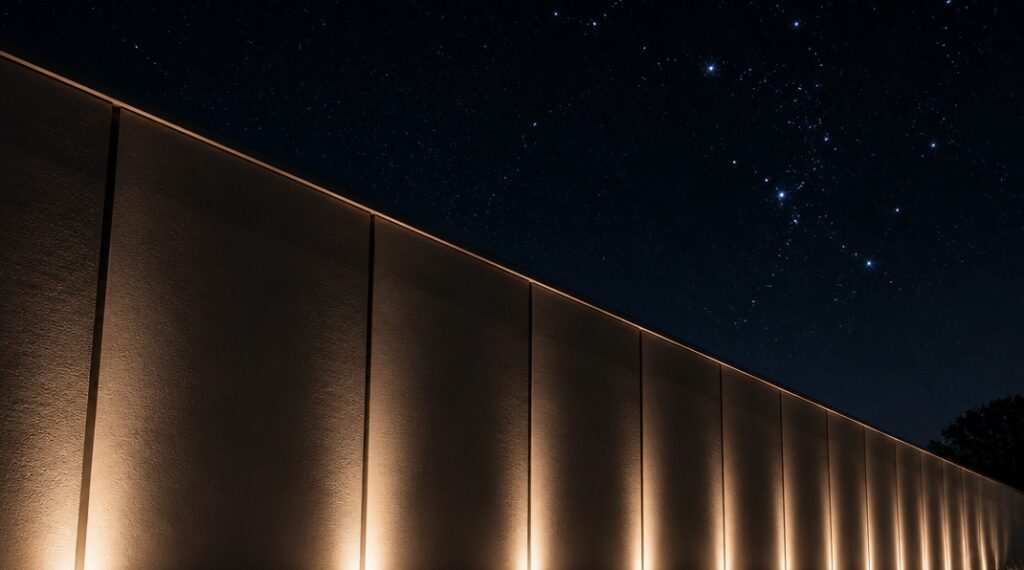
Outdoor led profiles are created to resolve some problem created by artificial light on deprecate the natural environment. The stars above a mountain village, the Milky Way arching over a coastal headland, the deep darkness of a forest clearing illuminated only by moonlight, these are not merely aesthetic experiences. They are ecological necessities, cultural heritage assets, and, increasingly, subjects of enforceable environmental regulation. Yet across the developed world, artificial light at night has eroded these experiences at a rate that most people have never stopped to quantify. The consequences extend far beyond an inability to stargaze: disrupted wildlife migration, degraded human circadian rhythms, wasted energy measured in billions of euros annually, and the systematic dismantling of the nocturnal ecosystems on which diurnal life depends. Understanding this problem is the necessary first step for any professional who specifies outdoor lighting and acting on it is, increasingly, both an ethical and a legal obligation.
For the lighting industry, this reality presents both a significant challenge and an extraordinary design opportunity. The challenge is that most outdoor lighting installed each year (whether for architectural effect, safety, or wayfinding) is specified without any meaningful consideration for its sky-glow contribution, its spectral emission profile, or its ability to dim intelligently when full output is unnecessary. The result is a built environment that floods the atmosphere with light energy serving no useful purpose while creating measurable harm. The opportunity is equally compelling: modern outdoor LED aluminium profiles, when correctly specified with the right LED strips, the right spectral management, and intelligent controls, give designers the power to create outdoor lighting that is simultaneously beautiful, functional, energy-efficient, and fully compliant with International Dark-Sky Association (IDA) guidelines.
This article is a comprehensive professional guide for architects, landscape designers, municipal planners, and lighting engineers who need to understand how to select, specify, install, and maintain weatherproof outdoor LED profiles that genuinely meet the highest environmental standards while delivering the architectural quality their projects demand. Central to the discussion is backlighting (the technique of hiding the light source within an architectural element so only the reflected or transmitted glow remains visible) which is, by its very geometry, the most naturally dark-sky-compliant outdoor lighting technique available. When light is hidden, the sky above it is protected.
In this article…
- Light pollution: scale, impact and the IDA response3. outdoor LED profiles: what they are and why they matter
- IP ratings and weather resistance
- Types of outdoor LED aluminium profiles
- Backlighting techniques with outdoor LED profiles
- Cutting, connecting and installing outdoor LED strips in profiles
- Spectral management: warm CCT, amber light and dark-sky LED strips
- Intelligent controls: DALI-2, dimming and sensing
- Building an IDA-compliant outdoor LED ecosystem: full product specification
- Applications and project examples
- Selection guide: how to choose the right outdoor LED profile
- Sustainability, circularity and environmental responsibility
- Certifications and standards
- Frequently asked questions
- Outdoor led profile: a solid base to lightening the dark sky
Light pollution: scale, impact and the IDA response
For the professional outdoor lighting specifier, understanding each category in technical detail is the foundation of responsible practice because each type of light pollution is addressed by different design strategies, and a specification that addresses one without attending to the others falls systematically short of genuine environmental compliance.
What is light pollution and why does it matter?
Light pollution is the collective term for all adverse effects produced by artificial light at night (ALAN). It is not a single phenomenon but a family of related problems, each with distinct primary impacts on human health, ecological systems, energy economics, and cultural heritage.
Skyglow is the diffuse brightening of the night sky above populated areas, caused by light scattering off atmospheric particles (water vapour, aerosols, fine particulates) back toward the Earth’s surface. A landmark 2016 study published in Science Advances by Falchi et al. established that more than 80% of the world’s population now lives under measurably light-polluted skies. In Europe, the figure exceeds 99% of the EU population. The European Environment Agency estimates that wasted outdoor lighting in the EU costs more than €5 billion annually in electricity alone, without accounting for the ecological services degraded in the process. Skyglow is primarily driven by short-wavelength (blue) light emission, which scatters approximately sixteen times more effectively through the atmosphere than amber or red wavelengths, a physical fact that makes the choice of outdoor LED colour temperature one of the most consequential specification decisions in environmental lighting design.
Glare is the visual discomfort or reduced visual acuity caused by excessive luminance contrast between a light source and the surrounding field of view. Unshielded outdoor LED luminaires with exposed chip arrays produce Unified Glare Ratings (UGR) that significantly exceed safe thresholds for pedestrian and driver safety. The paradox of outdoor glare is well-documented: a pedestrian walking toward an over-bright unshielded fixture cannot clearly see the ground surface or hazards ahead because their eye adaptation is overwhelmed by the bright source. More light, in this situation, means less vision, a problem that recessed backlighting profiles resolve structurally, by making the source invisible to the observer entirely.
Light trespass occurs when artificial light extends beyond its intended target zone, illuminating a neighbour’s window, flooding a garden that should be dark, or projecting into woodland at the forest edge. Light trespass is increasingly subject to planning enforcement in European jurisdictions, and specifiers who ignore it face legal as well as ethical liability. The IDA’s model lighting ordinance, which has been adopted with varying stringency by hundreds of municipalities worldwide, includes specific illuminance-at-boundary limits as enforceable standards for new outdoor lighting installations.
Key market data: the outdoor LED lighting landscape
| Metric | Figure | Source |
|---|---|---|
| Global outdoor LED lighting market (2023) | USD 14.8 billion | Grand View Research, 2024 |
| Projected CAGR 2024–2030 | 12.4% | Grand View Research, 2024 |
| % of world population under light-polluted skies | > 80% | Falchi et al., Science Advances, 2016 |
| EU annual cost of wasted outdoor lighting energy | > €5 billion/yr | European Environment Agency |
| Energy savings achievable via smart outdoor dimming | 30–60% | IESNA RP-33, 2022 |
| IDA-designated Dark Sky Places globally (2024) | > 200 | International Dark-Sky Association |
| Nocturnal insect species decline in illuminated areas | up to 49% | Knop et al., Nature, 2017 |
| LED aluminium profile outdoor market CAGR (Europe) | ~9.8% (2023–2028) | MarketsandMarkets, 2024 |
The ecological consequences of artificial light at night (ALAN)
Beyond lost starscapes, ALAN creates cascading ecological harm across multiple levels of functioning ecosystems. Nocturnal insects, particularly moths, beetles, and lacewings, navigate by celestial light cues refined over hundreds of millions of years of evolution. Artificial sources override these cues at the neurological level, producing the well-documented flame-attraction behaviour that results in exhaustion, reproductive disruption, and death. A 2017 study in Nature by Knop et al. found that artificially lit meadows showed nocturnal pollinator visit rates at flowers up to 49% lower than unlit controls with profound implications for wild plant reproduction and agricultural pollination services. Sea turtles on nesting beaches are among the most studied cases: hatchlings navigate to the ocean by moving toward the brightest horizon, artificial coastal lighting reverses this cue with lethal consequences. Peer-reviewed research confirms that amber and red wavelengths above 560nm are essentially invisible to sea turtle vision, making the spectral specification of coastal outdoor LED profiles a direct conservation decision. Migratory birds suffer similar disruption: the American Bird Conservancy estimates more than one billion North American bird deaths annually from collisions with illuminated structures, the majority preventable through shielded, downward-directed, warm-spectrum lighting.
IDA guidelines: the three technical pillars
The International Dark-Sky Association (IDA), founded in 1988 and headquartered in Tucson, Arizona, is the world’s leading scientific and advocacy authority on artificial light at night. Its technical guidelines for outdoor lighting (which underpin certification programmes including the IDA Fixture Seal of Approval (FSA) and the International Dark Sky Place designation) are built around three core requirements that must be simultaneously satisfied for a specification to be genuinely dark-sky compliant. Addressing only one or two of these pillars produces partial compliance that does not meet the standard for certified projects.
| Pillar | IDA requirement | Technical parameter | Compliant solution |
|---|---|---|---|
| 1. Shielding & direction | Zero upward light emission (Full Cutoff), minimise lateral spill and glare | B.U.G. rating U0, UGR < 19 for pedestrian areas | Deep-housing LED aluminium profiles, recessed backlighting, asymmetric precision lenses |
| 2. Spectral management | CCT ≤ 3000K, preferably 2700K, amber in ecologically sensitive zones | Blue-light fraction R_blue < 15%, S/P ratio < 1.5 | 2700K warm-white COB LED strips, narrow-spectrum amber strips (590–600 nm) |
| 3. Intelligent control | Dimming to ≤ 50% during low-activity periods, presence-based control | DALI-2 / 0-10V / PWM dimming, PIR or microwave occupancy sensing, daylight harvesting | DALI-2 outdoor sensors, IP67 PWM controllers, programmable constant-voltage drivers |
The IDA’s B.U.G. rating system (Backlight, Uplight, Glare) provides a standardised framework for evaluating directional light distribution in any outdoor luminaire. A rating of U0 (zero uplight) is mandatory for IDA-certified Dark Sky Places and is referenced in a growing number of local dark-sky ordinances. Recessed backlighting profiles achieve U0 compliance by geometry: the architectural element that conceals the profile physically prevents any light from reaching above the horizontal plane. No additional optics are required. The IDA Fixture Seal of Approval certifies individual products as compliant, specifiers can search the FSA product database at the IDA website to identify certified luminaires for project specifications.
Dark-sky legislation around the world
IDA guidelines are voluntary technical standards, but they increasingly underpin enforceable planning law. Understanding the regulatory context in which a project sits is not merely good practice, it is a professional obligation in jurisdictions where non-compliant outdoor lighting installations can result in enforcement action, planning refusal, or mandatory post-installation modification.
In Italy, the primary market of LightingLine, regional light pollution legislation is among the most advanced in Europe. Lombardy’s landmark Legge Regionale 17/2000 established mandatory full-cutoff requirements for new public and commercial outdoor lighting as early as the year 2000. Veneto, Tuscany, Emilia-Romagna, and most other regions have since enacted their own frameworks, many now including CCT limits of 3000K or lower for all new public outdoor lighting and mandatory power-reduction schedules after midnight. The national PRIC (Piano Regolatore dell’Illuminazione Comunale) framework requires municipalities to produce comprehensive outdoor lighting plans with explicit light-pollution impact assessments, creating direct professional demand for dark-sky-compliant outdoor LED profile specifications.
In Spain, the Canary Islands’ Ley del Cielo mandates that all outdoor lighting within 15 kilometres of a designated astronomical observatory use sodium vapour or warm LED at or below 2200K, be fully shielded with zero upward emission, and be dimmed or extinguished between midnight and astronomical dawn. These are actively enforced legal requirements, not advisory guidelines. In the United Kingdom, designated International Dark Sky Parks including Exmoor, Galloway Forest, and the Brecon Beacons have planning policies that reference IDA technical parameters for any new outdoor lighting within or adjacent to the designated areas. In the United States, Arizona, New Mexico, Hawaii, and Maine have state-level light pollution statutes, and the National Park Service requires all NPS facilities to comply with IDA guidelines for new lighting installations.
Outdoor led profiles: what they are and why they matter
Before examining specific products and installation techniques, it is essential to establish a precise conceptual understanding of what an outdoor LED profile actually is, what functions it performs, and why the choice of profile is one of the most consequential decisions in any outdoor lighting specification. Too many outdoor LED lighting projects fail (technically, aesthetically, and environmentally) not because the wrong LED strip was chosen but because the profile was absent, inadequately specified, or poorly installed. The profile is not a cosmetic housing; it is an engineered optical, thermal, and structural system that determines where the light goes, how long the system lasts, and whether it complies with environmental standards.
LED strip vs. LED profile: the critical distinction
An LED strip, also called LED tape or LED flex, is a flexible printed circuit board (PCB) carrying surface-mount LED chips at regular intervals. It provides the light source and the electrical circuit. In isolation, however, it is a fragile component: it has no structural rigidity, no thermal management beyond the thin PCB copper traces, no optical control beyond the individual chip phosphor lens, and no meaningful protection against UV radiation, moisture, mechanical impact, or dust. A bare LED strip in an outdoor environment without a protective profile housing will typically fail within months from UV degradation, PCB delamination under thermal cycling, moisture ingress at cut points, and physical damage.
An LED aluminium profile is the complete engineering system that transforms the LED strip into a production-grade outdoor luminaire. It performs five distinct functions simultaneously:
| Function | How the profile delivers it | Outdoor performance impact |
|---|---|---|
| Thermal Management | Aluminium body conducts heat away from LED junction via PCB contact, acting as a continuous heatsink | Reduces junction temperature 15–25°C, extends rated lifespan from ~30,000 to 50,000+ hours, critical in hot summer climates |
| Optical Management | Diffuser covers (opal, frosted, clear, microprism) eliminate LED hotspots, precision lenses shape beam angle | Eliminates pixellation in backlighting applications, enables precise beam angles 15°–120° for facade and pathway illumination |
| Mechanical Protection | Extruded aluminium body provides rigid structural support, sealed end-caps protect terminations | Protects against impact, UV degradation of PCB substrate, and thermal cycling stress cracking |
| IP-Rated Sealing | IP-rated diffuser clips, sealed end-caps, and potted cable entries create an ingress-protected enclosure | Enables reliable use in rain, condensation, flood-prone areas, fountains, and below-grade installations |
| Aesthetic Integration | Anodised or powder-coated finishes in silver, black, white or custom RAL integrate invisibly into architecture | Essential for backlighting where the profile must disappear, enables flush recessed installation in masonry, timber and concrete |
The LED strip determines light quality, the LED profile determines system quality. A premium COB strip in a poorly sealed profile fails outdoors within months. A well-engineered IP65+ aluminium profile paired with a quality Ledpoint 2700K strip delivers consistent, beautiful light for a decade or more with minimal maintenance. The profile is not optional; it is the component that makes outdoor LED lighting viable as a professional architectural solution.
Why aluminium is the gold standard for outdoor LED profiles
Aluminium dominates outdoor LED profile specification for reasons grounded entirely in material science and engineering performance. Thermal conductivity is the primary reason: aluminium conducts heat at approximately 205 W/m·K, compared to approximately 0.2 W/m·K for polycarbonate plastic, a ratio of over 1,000:1. This means that an LED strip adhesive-bonded to an aluminium channel base transfers its heat to the atmosphere through the profile body far more efficiently than any plastic alternative. LED junction temperatures in an aluminium profile run 15–25°C cooler than in unmanaged or plastic-housed configurations and since LED lifespan scales inversely with junction temperature (the Arrhenius relationship), this thermal management directly translates to years of additional service life.
Corrosion resistance is the second critical advantage. Aluminium naturally passivates: it forms a thin, adherent aluminium oxide layer that halts further oxidation. This can be enhanced through anodising (which thickens the oxide layer to 10–25 microns) or powder-coating for coastal salt-air environments. A properly anodised aluminium outdoor LED profile maintains structural and surface integrity for 25+ years in coastal environments, a durability that no polymer luminaire housing approaches. Dimensional stability is the third advantage: aluminium’s thermal expansion coefficient (23 × 10⊃;−6;/°C) is well-characterised and predictable, allowing precise engineering of expansion joints for long linear installations. For LED aluminium profile 3m and LED aluminium profile 5m outdoor runs, the seasonal thermal expansion between winter lows and summer highs must be explicitly accommodated in the mounting design — a calculation the aluminium material makes straightforward and reliable.
PVC vs. aluminium profiles outdoors: comparative analysis
PVC and polycarbonate profiles offer a lower initial purchase price and are appropriate for indoor residential use. For permanent professional outdoor installations, however, their technical limitations make them unsuitable for anything beyond light-duty sheltered applications.
| Property | Aluminium profile | PVC / Polycarbonate profile | Verdict |
|---|---|---|---|
| Thermal conductivity | ~205 W/m·K | ~0.13–0.22 W/m·K | Aluminium decisively better for LED lifespan |
| UV resistance (uncoated) | Excellent; stable oxide layer | Yellows and embrittles within 2–5 years outdoors | Aluminium superior |
| Operating temperature range | −40°C to +120°C | −10°C to +60°C (standard PVC) | Aluminium wins in cold and hot climates |
| Impact resistance | Good; IK09 achievable in standard sections | Brittle at low temperature; maximum IK06 | Aluminium required for public installations |
| End-of-life recyclability | Fully recyclable; 75%+ EU rate; high scrap value | Limited; typically landfill | Aluminium wins on sustainability |
| Profile geometry variety | Hundreds of extrusion sections; custom available | Limited to standard shapes | Aluminium far broader range |
| Initial purchase cost | Higher (~2–3× PVC at equivalent section) | Lower upfront | PVC lower upfront; aluminium far lower TCO over 10+ years |
IP ratings and weather resistance: choosing the right protection level
The Ingress Protection (IP) rating system, defined by IEC standard 60529, is the single most important technical parameter for specifying weatherproof outdoor LED profiles. Under-specifying IP leads to premature failure from moisture ingress, electrical safety hazards, and expensive early replacement. Over-specifying wastes capital on protection the environment does not require. Correct IP specification requires understanding not only what each rating means technically but how the real-world exposure conditions of each specific installation location map to the formal IP classification criteria.
IP rating breakdown for outdoor applications
The IP code consists of two digits: the first indicates protection against solid particle ingress; the second, against liquid ingress. For outdoor LED lighting, the second digit is almost always the governing factor. The ratings most relevant to outdoor LED profile specification are:
| IP rating | Dust protection | Water protection | Outdoor application | Example environment |
|---|---|---|---|---|
| IP44 | Objects >1mm | Splashing from any direction | Sheltered external, minimum for any outdoor use | Under covered veranda, protected car park ceiling |
| IP54 | Dust limited | Splashing from any direction | Semi-exposed positions | Partially sheltered facade reveal, deep eave underside |
| IP65 | Fully dust-tight | Water jets from any direction | Standard minimum for all fully exposed outdoor | Exposed facade, garden perimeter, park pathway, terrace coping, pergola |
| IP66 | Fully dust-tight | Powerful water jets | High-pressure wash, heavy coastal rain | Car park washdown, industrial outdoor, exposed coastal installations |
| IP67 | Fully dust-tight | Temporary immersion to 1m / 30 min | Ground-level, flood-prone areas | Paving insets, step-nose profiles, low-level coastal |
| IP68 | Fully dust-tight | Continuous submersion (depth per manufacturer) | Permanently wet, submerged, buried | Fountain edge, pool perimeter, buried in-ground linear |
IK impact resistance ratings for public installations
In public outdoor environments, luminaires face risks of physical impact from foot traffic, bicycles, maintenance vehicles, and deliberate vandalism. The IK rating system (IEC 62262) quantifies impact resistance and is the secondary protection parameter for public-space outdoor LED profile specifications.
| IK rating | Impact energy | Equivalent impact | Recommended application |
|---|---|---|---|
| IK06 | 1 joule | 0.5kg falling 20cm | Private residential, low-risk garden |
| IK08 | 5 joules | 1.7kg falling 30cm | Semi-public spaces, hotel exteriors |
| IK09 | 10 joules | 5kg falling 20cm | Public parks, pedestrian zones, municipal plazas |
| IK10 | 20 joules | 5kg falling 40cm | High-vandalism-risk areas, transport interchanges, ground-level step and path lighting |
For in-ground flush profile applications subject to direct foot traffic, IK10-rated hardened glass diffusers are mandatory in any public installation. Standard polycarbonate diffusers, however UV-stabilised, will crack under sustained pedestrian loading within one to two seasons in high-traffic locations, compromising the IP seal and exposing the LED assembly to moisture and mechanical damage.
Thermal management and operating temperature range
Outdoor LED profiles face extreme temperature variation across their operational lifetime. In direct summer sunlight, a dark-anodised aluminium profile surface can reach 70–80°C surface temperature at ambient air temperatures of 35°C. The LED strip, bonded to the profile interior, operates at a thermal environment more demanding than laboratory test conditions. For high-solar-exposure applications: select LED strips with lower power density (7–10 W/m rather than 15–20 W/m), specify profiles with maximum thermal mass and design for shaded mounting positions where possible. Recessed backlighting configurations are inherently shaded by the architectural element that conceals them, a thermal management advantage in addition to their optical and environmental benefits.
For cold climates, specify polycarbonate (PC) rather than PVC for all plastic profile components, PC retains adequate impact resistance to approximately −40°C while standard PVC becomes brittle below −15°C. LED driver electronics should be rated to −20°C minimum for northern European installations; −40°C for alpine or high-latitude deployments.
Types of outdoor LED aluminium profiles
The LightingLine product catalogue at catalogue.lightingline.eu presents a comprehensive range of outdoor-rated aluminium profiles covering every architectural and landscape lighting application. Understanding the principal categories (their geometry, optical capabilities, and dark-sky compliance potential) is the foundation of informed professional specification for any outdoor project.
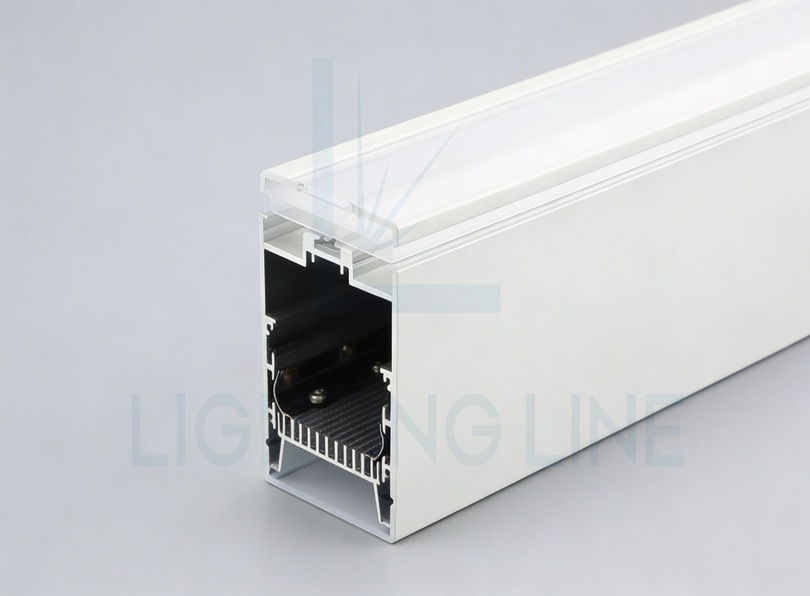
Surface-mounted outdoor LED aluminium profiles attach directly to an architectural or landscape surface using integral mounting clips, T-slot fixings, or direct screw attachment. They project from the mounting surface by a depth that varies from as little as 5mm for thin accent profiles to 75mm for deep architectural housings. The choice between low-profile and deep designs depends on three factors: required lumen output, desired optical characteristic (diffuse wash or controlled beam), and the degree of visual prominence of the unlit profile.
Low-profile surface-mounted designs (8–15mm height) are appropriate where the profile must be minimally obtrusive when unlit: for example, along the underside of a timber decking fascia for a ground-level backlighting effect, or along the outer edge of a coping stone. These profiles suit accent and mood applications at up to approximately 10 W/m. Deep surface-mounted profiles (40–75mm height) are the architectural workhorses of outdoor linear LED lighting. Greater depth provides natural shielding of the LED source from oblique viewing angles (dramatically reducing UGR) while accommodating high-density strips for applications requiring substantial lumen output. The CL02-07 (50×75mm) from LightingLine exemplifies this category: its 75mm body depth creates a natural shield that eliminates virtually all upward and lateral light spill, achieving IDA full-cutoff compliance through geometry alone.
Recessed and in-ground outdoor profiles
Recessed outdoor LED profiles install flush with (or slightly below) the architectural surface in which they are set. Wall-recessed channels are set into masonry, concrete, or cladding; in-ground profiles are flush with paved surfaces, decking, or soil. Recessed profiles represent the definitive dark-sky-compliant outdoor lighting solution: the LED source is geometrically impossible to observe from above the horizontal plane when correctly installed, achieving U0 uplight compliance without requiring any additional optics or baffles. The compliance is structural and failure-proof.
In-ground flush profiles for pathway and step edge marking carry the most demanding IP and IK requirements of any outdoor LED application: IP67 or IP68 is mandatory, IK09 or IK10 for the diffuser, load-distributing aluminium mounting frames to spread foot traffic loads across the profile length. Diffusers must be UV-stabilised polycarbonate or hardened tempered glass, standard acrylic will cloud and crack under the combination of UV exposure and foot traffic abrasion within one to two seasons.
Corner and stair-nose profiles for outdoor steps
Outdoor step lighting is a critical safety application with specific requirements. UK Health and Safety Executive data indicates falls on steps account for over 40% of all outdoor fall injuries treated in accident and emergency settings annually. LED aluminium stair-nose profiles with 45° downward-angled or asymmetric-downward light exit faces direct light exclusively onto the tread surface with zero emission above the horizontal plane, simultaneously satisfying the safety function (defined step edge and illuminated tread) and the dark-sky requirement (zero uplight). For dark-sky-sensitive gardens and public parks, amber LED strips in stair-nose aluminium profiles are the gold standard: safe, functional, and ecologically responsible.
Deep housing profiles for architectural backlighting
Backlighting, the concealing of the LED source within a deep channel so only reflected or transmitted light is perceptible, is the most architecturally sophisticated and environmentally compliant technique in outdoor LED design. Deep housing profiles are its enabling hardware. The defining technical parameter is the internal cavity ratio: the relationship between the profile’s depth (LED strip position to light exit plane) and the width of the light exit aperture. A high cavity ratio produces controlled, shielded output with very low UGR; a low ratio produces a broader, less-shielded output. For dark-sky-compliant backlighting, a high cavity ratio is always preferable.
The CL02-07 (50×75mm) deep profile from LightingLine is engineered specifically for architectural backlighting in demanding outdoor environments. Its 75mm internal depth recesses the LED strip approximately 65mm below the diffuser plane, eliminating any direct view of the LED chip from any realistic architectural viewing angle. This produces a UGR below 10 (well within IDA’s most stringent requirements) without additional optical accessories. Deep profiles for backlighting are the simplest, most reliable, and most cost-effective path to IDA full-cutoff compliance in architectural outdoor lighting.
Asymmetric optic profiles for pathway and facade lighting
While deep-housing profiles achieve dark-sky compliance through geometric source shielding, asymmetric optic profiles achieve it through precision beam control. Where the requirement is to illuminate a specific surface (a pathway from a wall-mounted profile, a facade from a ground-level installation) asymmetric profiles with precision lenses direct all available lumens precisely onto the target with a defined beam cutoff that prevents emission beyond the target boundary, achieving near-100% optical efficiency and zero sky-glow contribution from the lighting task itself.
LightingLine’s CL01-06 profile paired with asymmetric lenses PRD-06-XK1-L3 or PRD-06-XK1-L4 concentrates the beam to one side of nadir at a 15–35° offset, directing all light downward and outward onto the target surface with zero sky emission. For facade washing, asymmetric lenses with tightly controlled vertical spread (15–25°) ensure all flux reaches the facade and terminates there, without continuing into the sky above the roofline — the IDA-compliant contrast to conventional open floodlighting that wastes 40–60% of its output directly into the atmosphere.
Backlighting techniques with outdoor LED profiles
Architectural backlighting is both the most visually compelling and the most environmentally responsible technique in the outdoor LED designer’s toolkit. It combines the elimination of visible glare, the structural guarantee of zero upward light emission, and the maximum utilisation of every lumen produced, all within a single design approach that, when executed well, appears utterly effortless: nothing is visible except the quality of the light itself. Understanding backlighting in depth (what it is, why it works, how to calculate it, and how to specify and install it correctly) is the central competency that distinguishes professional outdoor lighting specification from amateur practice.
What is architectural backlighting?
In outdoor LED profile specification, backlighting describes any configuration in which the LED strip and its aluminium housing are positioned behind, beneath, or within an architectural element such that the element itself acts as the primary visual presence and the light is perceived indirectly: through reflection, transmission, or emission from a concealed aperture. The observer sees a luminous glow, a defined edge of light, a wash of illumination across a textured surface, or a line of light at grade level but never the light source itself. This invisibility of the source is the aesthetic and environmental signature of professional backlighting.
Outdoor architectural backlighting encompasses several related sub-techniques: cove lighting (a ledge or reveal conceals the profile; light washes across an adjacent wall surface), perimeter lighting (a profile along the outer edge of a horizontal element as terrace coping or deck fascia directs light downward), shadow-line lighting (a recessed reveal profile creates a luminous horizontal datum line defining a building’s architectural language), void lighting (a profile within an architectural gap illuminates the slot space), and ground-level perimeter lighting (flush in-ground profiles define path edges and planting borders with a thin line of light at grade). In all configurations, the source is hidden, the architecture is revealed, and crucially for dark-sky compliance upward light emission is geometrically eliminated.
Why backlighting is the most dark-sky-friendly technique
The relationship between backlighting and dark-sky compliance is not incidental but structural and geometric. When an LED profile is positioned behind or below an architectural element and directed to wash light across a surface rather than into open space, three of the IDA’s core requirements are simultaneously and automatically satisfied:
Zero upward light emission: the architectural element itself physically intercepts every light path that would travel above the horizontal plane. The profile cannot emit upward because the architecture prevents it. This is Full Cutoff (U0) compliance achieved through design rather than optics: the most robust compliance method possible, because it cannot be undermined by lens degradation, mounting errors, or maintenance activities.
Minimised glare: the UGR of a correctly configured backlighting installation is effectively zero from the observer’s perspective. The light source is entirely invisible; the only light the observer receives is the gentle, spatially distributed reflection from an illuminated surface, with a luminance orders of magnitude below that of an exposed LED chip. This is not just an aesthetic quality; it is a quantifiable improvement in visual comfort and outdoor safety that is directly validated by the photometric research behind the UGR system.
Maximised optical efficiency: every lumen produced by the LED strip in a backlighting configuration is directed at a defined architectural surface target. Conventional open floodlighting systems typically direct 40–60% of their output into the sky, adjacent properties, or other unintended directions; a well-designed recessed backlighting profile approaches near-100% useful lumen delivery. This efficiency means lower LED wattages achieve equivalent or superior perceived illumination effects, further reducing the total energy and sky-glow footprint of the installation.
Backlighting applications: facades, coping, steps, pergolas
| Application | Backlighting configuration | Recommended profile type | LED strip | IP min. |
|---|---|---|---|---|
| Terrace / pool coping edge | Profile under overhanging coping, directed downward onto wall face | Deep surface-mount, downward exit | 2700K COB, 10 W/m | IP65 |
| Garden wall / raised planter | Profile recessed into top of wall, wash down onto face | Wall-recessed linear channel | 2700K warm white, 7 W/m | IP65 |
| Architectural facade shadow line | Profile in horizontal reveal, illuminating the shadow-gap | Surface or recessed low-profile | 2700K COB | IP65 |
| Pergola / beam underside | Profile along beam underside, wash onto decking below | Wide-body surface-mount | 2700K COB, 10–14 W/m | IP65 |
| Outdoor steps / stair nosing | Profile in stair riser face, directed down onto tread | Stair-nose recessed profile | 2700K or amber, 7 W/m | IP67 |
| Path perimeter / ground edge | In-ground flush profile defining path edge | IP67/68 in-ground flush | Amber 590nm (wildlife zones); 2700K standard | IP68 |
| Facade wash (low-to-high) | Ground-level profile, asymmetric lens, 25° upward beam with defined cutoff | PR-CL01-06 + PRD-06-XK1-L3/L4 | 2700K high-density, 15 W/m | IP65 |
| Fountain / water feature edge | Underwater edge profile directed across water surface | IP68 waterproof profile | IP68 silicone-encapsulated, 2700K | IP68 |
Calculating backlighting distance and uniformity
Achieving uniform, hotspot-free backlighting with outdoor LED profiles requires understanding the relationship between three parameters: the throw distance (LED strip to illuminated surface), the LED pitch on the strip, and the optical diffusion characteristic of the profile cover. Getting this relationship wrong produces visible hotspots that undermine the premium quality a backlighting installation should communicate and the errors are expensive to correct once installed.
The critical distance rule: the minimum throw distance required for visual uniformity is approximately 1.5× the LED pitch spacing for frosted or opal diffusers, and approximately 3× the LED pitch for clear diffusers. For a strip with 20mm pitch, this means a minimum of 30mm with a frosted diffuser, or 60mm with a clear diffuser. The PR-CL02-07 deep profile with its approximately 65mm of recessed depth provides adequate throw distance for virtually any commercially available LED strip pitch with any diffuser type which is why deep profiles are the most forgiving and professionally reliable backlighting solution for demanding architectural applications.
COB (Chip-on-Board) LED strips have a continuous light-emitting surface with no discrete pitch visible above approximately 5mm distance. For very shallow backlighting applications (a narrow shadow-gap reveal of only 15–20mm depth) a COB strip in a frosted diffuser profile produces perfect uniformity where a conventional discrete-LED strip would show visible hotspots. This is why COB LED strips are the preferred choice for the most demanding architectural backlighting applications, particularly in the Ledpoint F52-270-320OS2/6 COB series at 2700K, which delivers a perfectly continuous luminous line with the warm spectral quality required for IDA compliance.
Cutting, connecting and installing outdoor LED strips in profiles
The quality of a finished outdoor LED installation depends as much on installation technique as on the quality of the specified components. Poorly cut strips, inadequately waterproofed connections, incorrectly sealed end-caps, and improperly earthed profiles are the most common causes of outdoor LED failure and all are entirely preventable with proper technique. This chapter provides a comprehensive professional guide to every stage of the outdoor LED strip and profile installation process, from selecting tools to sealing the final joint.
Tools required for professional installation
| Tool / material | Specification / grade | Purpose |
|---|---|---|
| Metal shears or dedicated LED strip cutter | Sharp, clean blade designed for FPC (flexible printed circuit) cutting | Clean cuts at strip cut points without delaminating PCB layers |
| Mitre saw with aluminium blade | Fine-tooth TCT (80+ teeth), 3000+ rpm | Accurate-angle cutting of aluminium profiles for corners and length adjustment |
| Temperature-controlled soldering iron | 25–40W; 320–360°C, fine tip | Soldering wire connections to LED strip copper pads |
| Lead-free solder | Sn96.5/Ag3/Cu0.5, 0.6–0.8mm, no-clean flux core | Low-temperature joins on LED strip and connector terminations |
| Dual-wall adhesive-lined heat-shrink | 3:1 or 4:1 shrink ratio, internal adhesive liner | Waterproofing solder joints and wire terminations to IP67 standard |
| Self-amalgamating silicone tape | Outdoor-grade, UV-resistant | Additional waterproofing wrap over complex joints |
| Neutral-cure exterior silicone sealant | Exterior-grade, −40°C to +150°C operating range | Sealing profile end-caps and cable entry points |
| IP68 cable entry glands | PG7, PG9, or M12 thread, sized to cable OD | Waterproofing all cable entries into profile body or driver enclosure |
| Multimeter | DC voltage and current, continuity test function | Voltage verification at strip input, short-circuit testing before energising |
| Calibrated lux meter | 0–10,000 lux range, cosine-corrected sensor | Verification of illuminance levels at design completion, commissioning documentation |
| Torque screwdriver | 2–8 Nm range | Correct torquing of mounting screws in profile clips, prevents stripping of aluminium threads |
How to cut LED strips correctly
Cutting an LED strip at the wrong location is the most common installation error. A strip cut between LED chips destroys the LEDs on either side of the cut and creates a non-functional dark section that requires replacement of the entire cut piece. Every LED strip has marked cut points indicated by copper pad pairs, scissor symbols printed on the PCB substrate, and visible gaps between LED groups defining the minimum cuttable unit length. Never cut a LED strip anywhere except at a marked cut point.
Step 1 — Identify the nearest cut point to your required length. If the required length falls between two cut points, use the shorter option; you cannot cut between cut points without destroying the adjacent LEDs.
Step 2 — Mark the cut line on the PCB substrate with a fine permanent marker. For outdoor installations, plan cuts so the strip termination end is protected within the profile body and not exposed at a vulnerable position near the end-cap seal.
Step 3 — Cut with dedicated strip scissors or sharp metal shears. Position the blade precisely at the centre of the copper pad set and cut with a single clean perpendicular action. Do not use household scissors, which compress and delaminate PCB layers.
Step 4 — Inspect the cut end under magnification if possible, copper pads should be clean, flat, and free of substrate fragments.
Step 5 — Immediately protect the cut end with a drop of clear silicone sealant or a dedicated end-cap before installation. An unprotected cut end in an outdoor environment will oxidise and cause electrical faults within months.
Connecting LED strips: soldering vs. connectors
When a LED strip run requires a junction (to join two strips, connect to a feed cable, or negotiate a corner) the installer must choose between soldering and push-in connectors. For all permanent outdoor installations, direct soldering is the professional standard and the only method that achieves IP67 or higher when correctly waterproofed.
| Method | Advantages | Disadvantages | Recommended for |
|---|---|---|---|
| Direct soldering | Lowest resistance, permanent, fully waterproofable, most reliable long-term | Requires skill and equipment, time-consuming, not easily adjusted post-installation | All permanent outdoor installations, IP67/68 applications, long runs where voltage drop management is critical |
| Solderless push-in connectors | Fast; tool-free, useful for commissioning and testing | Higher contact resistance, maximum IP44 without additional sealing, can loosen under thermal cycling | Sheltered outdoor (IP44 environment maximum), commissioning and testing only for exposed outdoor |
| IP-rated waterproof connectors | Pre-assembled IP67/68 body, faster than soldering in the field, serviceable | Higher cost, bulkier, not available for all strip widths | Fully exposed outdoor where field service access is required, correct for IP65/67 applications |
Soldering procedure for outdoor LED strip connections
Step 1 — Tin the copper pads: apply a small amount of solder to each copper pad on the strip cut end. Apply the iron tip for no more than 2–3 seconds per pad, excessive heat lifts the pad from the PCB.
Step 2 — Prepare feed wires: strip 5mm of insulation, tin the conductor. Match wire cross-section to strip current: up to 5A use 0.75mm², 5–10A use 1.5mm², above 10A or long feed runs use 2.5mm².
Step 3 — Attach wires: hold tinned wire against tinned pad, apply iron tip briefly to flow the surfaces together. A correct joint is shiny and slightly convex; a dull or granular joint is a cold joint and must be redone.
Step 4 — Verify polarity with a test power supply before waterproofing any joint.
Step 5 — Waterproof the joint: slide a pre-fitted dual-wall heat-shrink tube over the joint, apply heat gun to shrink and flow the adhesive liner around the joint and cable. Wrap with self-amalgamating silicone tape for maximum protection.
Inserting LED strips into aluminium profiles
The strip insertion process determines both the optical quality of the installed system and the long-term reliability of the IP sealing.
Step 1 — Prepare the profile: ensure the aluminium channel is clean, dry, and free of metal swarf from cutting. Remove any protective film from the interior base.
Step 2 — Mark the centreline at each end: the strip must run precisely along this centre with equal clearance on both sides. Even a 2mm offset in a 15mm-wide profile produces a visible asymmetry in the backlighting wash.
Step 3 — Expose the backing adhesive in 200–300mm sections only: do not remove the entire release liner before starting, as exposed adhesive picks up dust and loses tack.
Step 4 — Initial positioning: press the strip into the start of the profile, verifying centreing; once adhered the strip cannot be repositioned without PCB damage.
Step 5 — Progress along the profile: in 300–500mm increments, releasing backing as you go, pressing with a clean roller to ensure full contact with the profile base.
Step 6 — Insert the diffuser from one end with even hand pressure, working along the length; if resistance is felt, check that strip and connection wires are not obstructing the diffuser seating channel.
Waterproofing connections and joints for outdoor use
Systematic waterproofing of every ingress point determines the long-term reliability of any outdoor LED installation. The critical points are: end-caps, cable entry points, strip-to-strip joints, and profile mitre joints. Each requires specific treatment.
End-cap waterproofing: apply neutral-cure clear silicone sealant to all mating surfaces of the end-cap before pressing it home. Apply with a fine brush to ensure complete coverage without voids. Allow a full 24-hour cure before exposing to moisture.
Cable entry waterproofing: use IP68-rated cable glands (PG7 or PG9 for typical 2-core cable) rather than passing cable through a silicone-sealed hole. Glands provide mechanically secure, waterproof retention that maintains integrity through thermal cycling and cable movement, silicone alone will crack over time under these conditions.
Profile-to-profile joint waterproofing: at mitre joints or butt joints between profile sections, seal the aluminium-to-aluminium interface with grey or colour-matched exterior silicone before pressing the sections together. Allow the sealant to fill the joint gap completely, tool the exposed face smooth before it cures.
Common outdoor LED lighting mistakes and how to avoid them
| Mistake | Consequence | Prevention |
|---|---|---|
| Under-specified IP rating | Water ingress within months, LED and driver failure, electrical safety hazard | Specify IP65 minimum for all exposed outdoor, IP67 for ground-level, IP68 for buried or submerged |
| Cutting strip between cut points | Dark sections, destroyed LEDs, unrepairable without full piece replacement | Always verify cut-point positions before cutting, measure twice, cut once |
| Insufficient voltage drop calculation | Colour temperature shift along run, dimming at far end, premature failure at over-driven near end | Calculate voltage drop for full strip length, inject power at both ends for runs over 5m, use 24V to halve current for a given power |
| Using acid-core solder | Copper pad corrosion within weeks, intermittent failure, complete failure in humid outdoor environments | Use only no-clean flux-core lead-free solder for all LED strip connections, always |
| Selecting CCT above 3000K outdoors | Increased light pollution, skyglow, wildlife disruption, IDA non-compliance | Specify 2700K or lower for all outdoor, amber for ecologically sensitive zones |
| Omitting thermal expansion gaps in long profile runs | Profile buckling in summer heat, mechanical stress on end-caps and cable entries, IP seal failure | Allow 3mm expansion gap per metre of profile at all join points, use flexible joining sections for runs over 3m in exposed environments |
| Non-waterproof driver mounted outdoors | Driver failure from condensation or rain, potential electrical fire | Always use IP65+ LED drivers for all outdoor installations, mount in ventilated weatherproof enclosure if IP44 only |
| Inadequate earth bonding of aluminium profiles | Lethal electric shock risk in wet conditions, regulatory non-compliance | All aluminium profile sections must be connected to building earth via mounting hardware or dedicated bonding conductor, verify with earth continuity test before energising |
Spectral management: warm CCT, amber light and dark-sky LED strips
The colour temperature and spectral composition of the light produced by an outdoor LED strip is not merely an aesthetic consideration, it is the single most important factor determining a lighting installation’s contribution to light pollution and ecological harm. IDA spectral guidelines are grounded in the physics of Rayleigh scattering and in peer-reviewed ecology, and understanding them is as important for the professional lighting specifier as understanding IP ratings or lumen output. Getting spectral specification wrong in an outdoor context is not a minor design error; it is an environmental failure that is increasingly also a regulatory violation.
Colour Temperature selection for IDA compliance
Rayleigh scattering (the physical mechanism responsible for the blue daytime sky) affects short-wavelength (blue) light approximately sixteen times more intensely than long-wavelength (amber-red) light. An outdoor LED installation using 5000K daylight-white strips emits approximately 25–30% of its visible light energy in the blue range; the same installation using 2700K warm-white strips emits only 5–8% in the blue range, a fourfold to fivefold reduction in sky-glow-causing radiation for identical total lumen output. For ecologically critical applications, amber (590nm peak) strips reduce the blue component to under 0.5%, delivering the same functional illumination from a human safety perspective while being essentially spectrally invisible to most nocturnal species.
| CCT / spectrum | Blue light fraction | IDA status | Recommended application | Ecological impact |
|---|---|---|---|---|
| 6500K (cool daylight) | 30–35% | Not compliant | Not recommended for any outdoor use in IDA-sensitive areas | Very high: maximum skyglow, severe wildlife disruption |
| 4000K (neutral white) | 20–25% | Not compliant in sensitive areas | Commercial outdoor in non-sensitive zones only | High |
| 3000K (warm white) | 10–15% | Conditionally compliant | Urban commercial outdoor, general public lighting in non-protected areas | Moderate, reduced vs 4000K+ |
| 2700K (warm white) | 5–8% | Fully IDA-compliant | All outdoor applications in IDA-guided specifications, residential, hospitality, civic | Low, recommended minimum for all outdoor LED |
| 2200K / PC Amber | <2% | Preferred in sensitive zones | Observatory buffer zones, coastal wildlife, national parks | Very low, safe for most studied nocturnal species |
| 590–600nm Amber (narrow) | <0.5% | Gold standard | Sea turtle nesting beaches, astronomical observatories, amphibian habitats | Minimal, essentially transparent to most nocturnal species |
Amber and yellow LED strips: the ecologically sensitive choice
The availability of high-quality amber and yellow LED strips emitting primarily at 590–600nm, with minimal blue or green spectral content, represents a genuine breakthrough in outdoor lighting’s potential to minimise ecological harm. Led light that provide precisely this narrow-spectrum amber output, with phosphor formulations developed to eliminate the blue-light peaks that characterise broad-spectrum warm-white LEDs are essential. Sea turtle hatchling orientation research confirms that amber wavelengths above 560nm produce zero disorientation response in hatchlings. Moth attraction studies at the Centre for Ecology and Hydrology (UK) find amber LED sources attract 20–30 times fewer insects per lumen than white LEDs and bat foraging research confirms that reduction in artificial insect attraction near roost and foraging areas is directly protective for bat populations.
For the architect or landscape designer working on ecologically sensitive coastal, rural, or protected area projects, specifying amber LED strips in outdoor aluminium profiles is increasingly a planning requirement rather than a design choice. Coastal development projects in Florida, Spain’s Mediterranean coast, and Italian coastal protected zones now require documented evidence of spectral compliance with wildlife protection standards as a condition of planning consent. The specification of amber strips in LightingLine outdoor aluminium profiles, with their documented spectral power distribution data, provides precisely the evidence trail these regulatory submissions require.
CRI outdoors: visual quality vs. sky-glow reduction
The Colour Rendering Index (CRI) measures how faithfully a light source renders object colours compared to a reference illuminant. High-CRI LEDs achieve superior colour rendering by emitting a broader, more continuous spectrum (including relatively more blue wavelength energy) than lower-CRI alternatives. There is therefore an inherent tension: higher CRI at a given CCT means more blue light and more sky-glow contribution per lumen. For most outdoor architectural lighting applications, CRI ≥ 80 at 2700K represents the optimal balance: sufficient colour rendering for aesthetic and safety purposes, with a controlled blue-light fraction. Specifiers should resist CRI90+ for outdoor environments where superior colour rendering is not justified by a genuine task requirement. For pathway safety lighting, CRI80 is entirely adequate; the additional environmental cost of CRI95 is not warranted by any realistic safety or visual performance benefit in an outdoor context.
Intelligent controls: DALI-2, dimming and sensing for dark-sky compliance
Intelligent control is the third pillar of IDA compliance and the one most often omitted from specifications that are otherwise technically well-conceived. The principle is simple: the best dark-sky outdoor lighting is light that is active only when and where it is genuinely needed, at the minimum level required to serve its function. This principle, implemented through DALI-2 sensing, PWM dimming, and programmable drivers, can reduce a lighting installation’s total environmental impact by 40–60% compared to a fixed full-output system, while simultaneously improving the user experience for occupants of the space and reducing the client’s electricity bill.
DALI-2 motion and daylight sensing
DALI-2 (Digital Addressable Lighting Interface version 2) is the internationally standardised protocol for digital communication between lighting controls and LED drivers. For outdoor dark-sky-compliant installations, DALI-2 enables two critical compliance strategies simultaneously. The Mean Well DLS-208-P is a DALI-2 certified combined motion and daylight sensor designed for outdoor heights up to 10 metres. Its dual function delivers:
Daylight harvesting: the sensor continuously monitors ambient light levels. When natural illumination is sufficient, artificial lighting is inhibited entirely. As natural light fades, the system ramps up output proportionally, ensuring outdoor LED installations are never activated during twilight when full darkness has not arrived, eliminating the energy waste and ecological disruption of fixed-time control systems that activate regardless of actual ambient conditions.
Presence-based dimming: motion detection allows two-level operation: a background level (typically 10–30% of full output) during periods of no occupancy, rising to full output only when movement is detected. In a typical municipal park active between 20:00 and 23:00, this strategy reduces total light-at-night energy consumption by 50–70% compared to a fixed full-output system — while improving the experience for users who are present (full light on demand) and dramatically reducing sky-glow contribution during unoccupied periods.
Waterproof PWM dimming controllers
The Skydance V1 and V2 series represent the professional standard for outdoor LED strip dimming. Both carry IP67 protection, enabling direct outdoor mounting without a separate weatherproof enclosure, reducing installation cost and eliminating one potential water-ingress point from the system. The V1-WPM handles single-channel monochrome circuits (96W at 12V, 192W at 24V), the V2-WPM provides two-channel output for dual-zone or tunable-white applications. A technically critical specification for dark-sky compliance is the logarithmic dimming curve: the Skydance V-WPM controllers apply a logarithmic correction algorithm that maps the control input to a perceptually uniform output, enabling smooth, visually linear dimming from 100% to 0.1% — essential for the gentle, natural-feeling fade to nighttime background levels that characterises premium architectural outdoor backlighting in residential and hospitality environments.
Industrial-grade waterproof LED drivers
The LED driver is the component that most determines the long-term reliability of any outdoor LED installation. Driver failure is the single most common cause of outdoor LED system failure and is almost invariably attributable to moisture ingress, thermal stress, or electrical surge damage. The Mean Well XLG series addresses all three failure modes comprehensively. IP67 Protection via full potted construction eliminates all moisture pathways, unlike ventilated-slot designs that provide IP54 at best. Surge protection up to 10KV (line-to-line via MOV and TVS diode suppression) protects against lightning and grid-switching transients that routinely destroy inadequately protected outdoor electronics. Up to 94% conversion efficiency at full load reduces internal heat dissipation, directly extending driver lifespan and reducing total system energy consumption, a key metric in any dark-sky compliance assessment that includes energy efficiency as a component.
Building an IDA-compliant outdoor LED ecosystem: full product specification
The following section translates the IDA technical framework into a concrete, fully specified outdoor LED ecosystem drawing on the complete product ranges of LightingLine, Ledpoint, Skydance, and Mean Well. This is the practical reference guide for architects and planners who need to specify a dark-sky-compliant outdoor lighting system from first principles to completed installation, with documented product references for tender and specification documents.
To specify outdoor lighting that complies with International Dark-Sky Association (IDA) guidelines, architects and planners must focus on three technical pillars: shielding and direction, spectral management (low blue light), and intelligent control. The following professional-grade components offer a complete ecosystem to achieve these environmental goals.
Optical control and shielding
The primary IDA requirement is to minimise upward light output and glare. LightingLine aluminium profiles provide the necessary mechanical shielding to ensure light is directed only where it is needed.
Deep housing for natural shielding: utilising deep profiles such as the -CL02-07 (50×75mm) allows the LED strip to be deeply recessed. This configuration uses the profile’s own aluminium walls to naturally shield the light source, drastically reducing the Unified Glare Rating (UGR) and preventing lateral light spill. The deep cavity geometry ensures full-cutoff compliance (B.U.G. U0) without requiring additional optical accessories, making it the most reliable and lowest-maintenance path to IDA certification in architectural outdoor backlighting applications.
Precision asymmetric optics: to illuminate pathways or facades without light trespass, LightingLine offers the CL01-06 profile paired with asymmetric lenses like the D-06-XK1-L3 or L4. These optics precisely concentrate the beam downward or toward the target surface, ensuring zero light is wasted or dispersed into the atmosphere. The combination achieves near-100% luminous efficiency for the lighting task, every lumen reaches the target and none escapes into the environment.
| Profile model | Dimensions | IP (with sealed end-caps) | Dark-sky function | Available Lengths |
|---|---|---|---|---|
| PR-CL02-07 | 50×75mm | IP65 | Natural shielding via deep housing, UGR elimination, zero upward emission for architectural backlighting | 1m, 2m, 3m, 5m |
| PR-CL01-06 | Section for asymmetric lens | IP65 | Asymmetric beam for pathway and facade lighting with precision cutoff, zero sky emission | 1m, 2m, 3m |
Spectral management — Ledpoint LED strips
To limit rayleigh scattering (the primary cause of skyglow) IDA guidelines recommend warm colour temperatures (preferably 2700K or lower) to minimise the blue light component of the spectrum.
Warm white solutions: for sensitive outdoor environments, it’s useful a led strip that provides a continuous, soft 2700K light that mimics traditional incandescent warmth while maintaining high efficiency. The COB technology eliminates LED pixellation in architectural backlighting applications, delivering a perfectly smooth, continuous luminous line at the warm spectral quality required for full IDA compliance.
Controlled spectrum (yellow/amber): in critical areas like astronomical observation zones or wildlife habitats, specific light frequencies are required. Yellow/Amber strips that eliminate nearly all blue light peaks, providing the ecologically safest outdoor illumination available in a linear LED format.
Outdoor durability: for long-term outdoor reliability,IP68 and IP67 led strip utilise solid silicone encapsulation to protect LEDs from moisture and chemical agents without shifting colour temperature over time, essential for consistent spectral compliance across the installation’s multi-year service life.
| Technology | CCT | IP | Wattage | Dark-sky suitability |
|---|---|---|---|---|
| COB continuous | 2700K | IP20 (within sealed profile) | 6 W/m | Excellent — IDA compliant, ideal for architectural backlighting |
| Discrete 2835 SMD, amber phosphor | Amber ~590nm | IP67 silicone sleeve | 8 W/m | Gold standard — near-zero blue, wildlife-safe |
| COB, yellow/amber narrow spectrum | Yellow 580–600nm | IP20 (within sealed profile) | 5–8 W/m | Gold standard — observatory and ecological zones |
| Silicone-encapsulated SMD | 2700K or 3000K | IP68 | Various | Excellent — for in-ground, submerged, high-moisture outdoor |
Intelligent management — Skydance & Mean Well
Dark-sky compliance also involves “Light only when and where needed” through effective dimming and sensing.
DALI-2 motion and daylight sensing: the Mean Well DLS-208-P is a DALI-2 certified sensor designed for outdoor heights up to 10 metres. It allows for Daylight Harvesting, inhibiting light activation when natural light is present and automatically dimming fixtures during hours of low activity, the primary mechanism for achieving “light only when needed” compliance in any IDA-governed outdoor specification.
Waterproof intelligent control: the Skydance V1 and V2 controllers offer IP67 protection for outdoor dimming. These devices allow for precise logarithmic dimming, ensuring that light levels can be lowered smoothly to comply with local nighttime ordinances, with the gentle, perceptually natural fade that characterises professional backlighting design.
Industrial-grade drivers: the Mean Well XLG series (IP67) provides up to 94% efficiency and professional-grade surge protection (up to 10KV), ensuring the system remains operational and efficient under harsh weather conditions for the full design lifetime of the installation.
By integrating lensed LightingLine profiles for shielding, 2700K Ledpoint strips for spectral control, and DALI-2 sensors for intelligent management, designers can create outdoor spaces that respect the night sky while providing safety and architectural beauty, the definitive expression of responsible professional outdoor lighting design in the twenty-first century.
Applications and project examples
The technical framework and product specifications of the preceding chapters find their expression in a wide range of real-world project types. The following section provides detailed guidance on the application of outdoor LED aluminium profiles and dark-sky-compliant design principles across the most architecturally significant outdoor project categories, addressing the specific questions and professional needs of landscape architects, hospitality designers, municipal planners, and public-realm specifiers.
Architectural facade and cladding backlighting
Architectural facade backlighting is the most visually impactful application of outdoor LED aluminium profiles and the one that most completely demonstrates the synergy between design excellence and dark-sky compliance. When horizontal shadow lines, reveals, copings, or panel joints in a building facade are fitted with recessed LED profiles directed to wash light across the facade surface, the resulting illumination defines architectural form through light and shadow without any of the environmental pollution associated with conventional floodlighting. The technique is particularly powerful with masonry, stone, and textured concrete facades, where low-angle grazing light enhances material texture in a way that frontal floodlighting entirely fails to achieve.
For facade backlighting requiring continuous illumination over long building lengths, the LED aluminium profile 5m option from LightingLine significantly reduces the number of joints required: a 20-metre coping run needs only four sections at 5m, versus ten at 2m — reducing joint count by 60% and meaningfully reducing both installation time and long-term maintenance risk. The LED aluminium profile 3m is the preferred choice for medium-length architectural details such as terrace copings, raised planter perimeters, and facade lintel reveals where the 5m length would require on-site cutting in most configurations.
From a dark-sky perspective, facade backlighting with 2700K COB strips in deep LightingLine profiles is the definitive IDA-compliant facade illumination solution: zero upward light emission by geometry, warm spectral quality that minimises skyglow contribution, and precision control of the illuminated area through the profile’s cavity ratio and the architectural element that conceals it.
Garden and landscape lighting
Garden and landscape LED lighting presents some of the most ecologically sensitive outdoor specification environments. Private and designed public gardens are frequently adjacent to (or embedded within) functioning ecosystems whose nocturnal processes depend on genuine darkness. The insects that pollinate the garden’s plants, the bats that feed on those insects, the hedgehogs and toads patrolling the perimeter, and the migratory birds passing overhead at night are all potentially affected by every specification decision the designer makes. This responsibility should not be underestimated, and it should not be sacrificed for convenience.
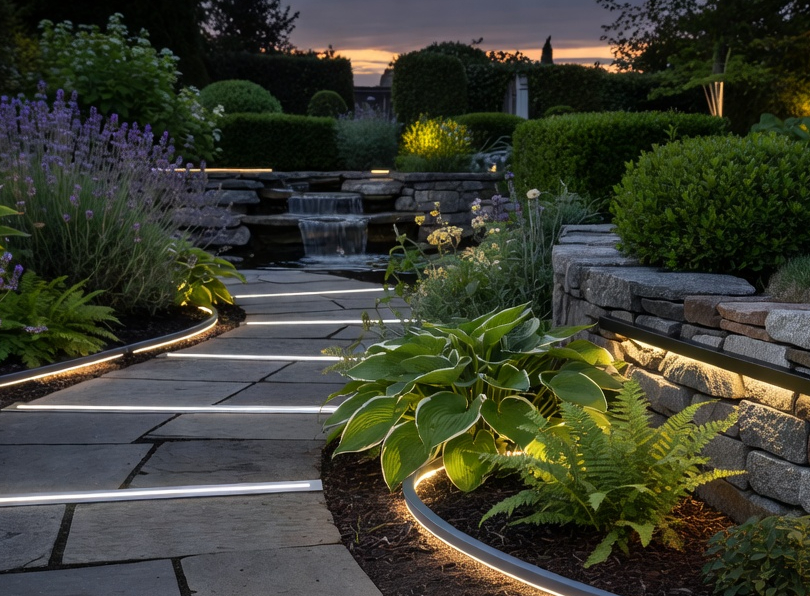
For landscape architects specifying outdoor LED profiles in garden settings: define the functional minimum first (what is the absolute minimum light needed for safety and the intended experience?), then design upward from that minimum rather than downward from a desired lumen output. In most garden contexts the answer is modest: a few lumens per square metre of pathway, supplemented by accent profiles highlighting key planting features or water elements. Use linear profiles along path edges or within step risers rather than bollard or area lighting, the backlighting effect of a defined path edge is safer for navigation, more aesthetically sophisticated, and vastly more environmentally responsible than diffuse area illumination. Specify 2700K minimum outdoors, amber in wildlife-sensitive locations. The cost difference between a 2700K and 4000K LED strip is negligible, the ecological difference is significant and measurable.
Public spaces, parks and municipal infrastructure
Municipal outdoor lighting is the single largest source of light pollution in most countries and the one with the greatest potential for rapid, system-level improvement through coordinated specification upgrading. As existing sodium-vapour and mercury street lighting reaches end of life and is replaced with LED systems, municipalities face a one-time opportunity to dramatically improve environmental performance or lock in decades of continued light pollution if replacement specifications are inadequate.
For municipal planners specifying weatherproof outdoor LED profiles for public spaces, two considerations beyond the immediate lighting performance requirement are critical: life-cycle cost analysis and vandalism resistance. Quality outdoor LED profile systems carry a higher initial cost than commodity alternatives. Over a 10-year municipal maintenance cycle, however, the quality system typically delivers lower total cost of ownership due to significantly lower replacement rates and maintenance call-out costs. A single driver or strip failure requiring scaffold access to an elevated facade will cost €500–2,000 in labour and disruption costs independent of the €30–50 component cost, minimising failure frequency is the dominant economic factor. For impact resistance: specify IK09 minimum for all public park and plaza applications, IK10 hardened glass diffusers for all ground-level in-ground profiles in public spaces.
Hospitality: hotels, restaurants and outdoor dining
The hospitality sector offers the most commercially compelling case for high-quality outdoor LED aluminium profiles, combining demanding aesthetic requirements with a guest audience acutely sensitive to the quality of the lighting experience. A well-specified outdoor dining terrace (warm 2700K backlighting under pergola beams, glowing coping details around a pool, amber accent profiles along planting borders) creates an experience of relaxed luxury that is intrinsically associated with quality. It happens, by design, to also be fully IDA-compliant, demonstrating that environmental responsibility and design excellence are not competing values in outdoor lighting specification but mutually reinforcing ones.
For hospitality lighting designers: specify consistent colour temperature across the entire exterior lighting system. A single 2700K specification applied to all profiles throughout a property creates a cohesive, immersive environment in which architecture and landscape are unified by the quality of the light. Mixing even 2700K and 3000K, indistinguishable on paper, produces a visually incoherent result in person that undermines the luxury positioning of the property. LightingLine’s full outdoor range at catalogue.lightingline.eu maintains consistent 2700K specification across all profile types and lengths, enabling this single-temperature strategy for any project scale.
Dark-sky reserves and astronomical observation zones
The most demanding outdoor lighting specification environment is a designated IDA Dark-Sky Reserve or International Dark Sky Park areas where night-sky protection is an explicit planning objective enforced with the rigour typically applied to building and environmental codes. There are currently over 40 IDA-designated International Dark Sky Reserves worldwide, with numbers growing as communities recognise the tourism and scientific value of preserved dark skies.
Within and adjacent to Dark-Sky Reserves, requirements are absolute rather than aspirational: zero upward light emission is a code requirement, CCT limits of 2200K or amber-only may be legally mandated, intelligent dimming to 10% or lower during designated hours may be required and any significant new outdoor lighting installation may need a formal dark-sky impact assessment as a planning condition. The ecosystem described provides a complete, technically documented solution that satisfies all IDA Reserve requirements. Key documentation for planning submissions: photometric reports from the profile-lens combination confirming B.U.G. U0 rating, spectral power distribution data for the specified LED strips confirming blue-light fraction, and DALI-2 control system commissioning documents confirming programmed dimming profile.
Selection guide: how to choose the right outdoor LED profile
Translating technical knowledge into concrete product selection is the practical challenge every specifier faces. The following structured tools (a specification checklist, a length selection guide, and a budget analysis framework) provide the decision support architecture for efficient, confident outdoor LED profile specification on any project type or scale.
Specification checklist for architects and planners
| Parameter | Decision question | Options and guidance |
|---|---|---|
| IP Rating | What is the exposure level of the installation location? | Sheltered: IP44–IP54. Exposed: IP65 min. Ground-level: IP67. Buried/submerged: IP68 |
| CCT | Is the project in or adjacent to a dark-sky-sensitive area? What are local ordinances? | Standard outdoor: 2700K. Protected/sensitive area: 2200K or amber. Observatory zone: 590nm amber only |
| Profile Type | Is the light source to be visible (surface) or hidden (recessed/backlighting)? | Hidden: recessed or deep-housing. Visible but shielded: surface-mount with diffuser. Directional: asymmetric lens profile |
| Profile Length | What is each lighting run length and how many joints can be tolerated? | Short: 1m or 2m. Medium: 2m or 3m. Long facade/perimeter: 5m for minimum joints. See Section 12.2 |
| LED Strip Power | What illuminance is required at the target surface, at what throw distance? | Accent: 5–8 W/m. Functional path: 8–12 W/m. Facade wash or primary: 12–20 W/m |
| Dimming System | Is IDA compliance, energy management, or nighttime zoning required? | Basic PWM: Skydance V-WPM. DALI-2 with sensing: Mean Well DLS-208-P. Smart building: DALI-2 gateway |
| Driver | What is total system wattage and what is the driver mounting environment? | Exposed outdoor: Mean Well XLG IP67 always. Protected IP65 enclosure: Mean Well HLG. In-building: standard rated driver |
| IK Rating | Is there a risk of mechanical impact (foot traffic, public access, vehicle proximity)? | Private: standard. Semi-public: IK08. Public: IK09 min. High-risk public: IK10 |
| CRI | Is colour-critical task performance required, or accent and mood? | Mood and accent: CRI ≥80. Food service, art display: CRI ≥90. Wildlife-sensitive: lower CRI preferred (reduced blue fraction) |
| Finish | Must the profile be invisible when unlit? What is the architectural substrate? | On light masonry: silver anodised. On dark substrates: black anodised. Bespoke: powder-coat to RAL specification |
Profile length selection: 1m, 2m, 3m and 5m options
The choice of profile length has significant practical consequences for installation quality, cost, and long-term reliability. LightingLine outdoor profiles are available in 1m, 2m, LED aluminium profile 3m, and LED aluminium profile 5m standard lengths. The decision framework is as follows:
| Length | Best for | Advantages | Considerations |
|---|---|---|---|
| 1m | Short accent runs, step risers, individual planting feature highlights, tight architectural slots | Easy single-person handling, flexible for irregular run lengths, lowest shipping cost per unit | Highest joint count per linear metre, more waterproofing points per run |
| 2m | Garden perimeter sections, pergola beam runs, standard architectural detail lengths | Good balance of handleability and joint reduction, most common architectural module | Requires two-person handling for vertical or overhead installation |
| 3m | Facade coping runs, terrace perimeter, longer architectural reveals, staircase side-walls | Significantly reduces joints vs 1m or 2m, excellent for cove-lighting reveals, reduces cumulative waterproofing risk | Requires care during transport to avoid profile bending, may need on-site cutting to final length |
| 5m | Long facade runs, large terrace and pool perimeters, commercial-scale public space, transport infrastructure | Minimum joint count, maximum visual continuity, lowest cost per waterproofed connection, significant installation time saving | Requires vehicle transport, needs team of minimum three for handling, critical attention to thermal expansion joint provision |
Budget considerations and total cost of ownership
The initial purchase price of a quality outdoor LED profile system (profile, LED strip, diffuser, end-caps, driver, and controls) is typically 2–3 times higher than a commodity alternative. This differential is consistently cited by procurement teams as a barrier, and it can and should be challenged with systematic total cost of ownership (TCO) analysis built on three quantifiable factors:
Extended lifespan: a quality outdoor LED system specified to the standards described in this guide (IP67 strip, aluminium profile, Mean Well XLG driver) will achieve L80 (80% initial lumen output maintained) at 60,000 hours under rated outdoor temperature conditions. At 4,000 operating hours per year (approximately 11 hours per night), this is 15 years of service before first component replacement. A commodity system with an IP44 driver, PVC profile, and standard adhesive strip in the same outdoor environment will typically require its first significant intervention within 3–5 years — a 3–5 times higher replacement cycle cost over the same period.
Energy savings: the difference between 85% (commodity) and 94% (Mean Well XLG) driver efficiency is approximately 9W of wasted power per 100W installed system. At typical European commercial electricity tariffs, this is approximately €40/year/system point. Over 15 years, €600 per installation point, comparable to the initial cost differential between quality and commodity drivers, which means the driver efficiency improvement effectively pays for the quality premium before a single component has been replaced.
Maintenance cost avoidance: in outdoor architectural installations, the labour cost of any maintenance intervention typically runs 5–10 times the component cost, due to access requirements (scaffold, cherry picker, stone removal to access recessed profiles). A driver failure requiring scaffold access to an elevated facade costs €500–2,000 in labour and disruption, independent of the €30–50 component. Minimising failure frequency is therefore the dominant economic factor in outdoor LED specification, far outweighing initial purchase price differentials for any installation where maintenance access is non-trivial.
Sustainability, circularity and environmental responsibility
The environmental credentials of outdoor LED aluminium profile lighting extend well beyond dark-sky compliance. A comprehensive sustainability assessment must consider the full product lifecycle: raw material extraction, manufacturing, operational energy use, maintenance, and end-of-life disposal or recycling. On every dimension, quality aluminium LED profiles compare favourably with alternative outdoor lighting technologies.
Material sustainability: aluminium is one of the most sustainably managed structural materials in European manufacturing. Over 75% of all aluminium ever produced remains in active use today. European aluminium recycling rates exceed 75%, and recycling requires only 5% of the energy needed for primary production. LED aluminium profiles at end of service life can be fully disassembled: the aluminium extrusion enters the aluminium recycling stream, the polycarbonate diffuser enters the PC stream, the LED strip PCB enters the electronic waste processing stream. No component of a quality LED profile system requires landfill disposal.
Operational energy efficiency: modern high-quality COB LED strips achieve efficacies of 150–200 lm/W, approximately 10× the efficacy of incandescent sources and 4–5× the efficacy of fluorescent linear sources. Combined with intelligent dimming controls reducing average operational wattage by 40–60%, total operational energy intensity of an outdoor LED profile installation is dramatically lower than any previous technology it replaces. As European electricity progressively decarbonises through renewable energy expansion, the operational carbon footprint of LED installations will continue to decrease throughout their 15-year service lives, meaning the carbon investment in the product pays back more quickly each year.
Ecological impact reduction: beyond energy and recycling, specifying 2700K or amber outdoor LED profiles instead of 4000K+ alternatives directly reduces measurable harm to pollinator populations, bat foraging corridors, migratory bird flyways, and marine turtle nesting beaches. This is not a soft benefit; it is a quantifiable ecological service with documented monetary value. The economic cost of pollinator service degradation from ALAN in European agricultural areas has been estimated in the hundreds of millions of euros annually by the European Commission’s Biodiversity Strategy Task Force. Professional lighting specifiers who choose warm-spectrum outdoor profiles are making a small but real contribution to the preservation of this ecological infrastructure.
Certifications and standards for outdoor LED profiles
| Certification / standard | What it covers | Relevance for outdoor LED profiles | Mandatory or advisory |
|---|---|---|---|
| CE Marking | Conformity with EU safety, health, and environmental directives (LVD, EMC, RoHS) | Mandatory for all LED products sold in EU, verifies basic electrical safety and EMC | Mandatory (EU) |
| IEC 60529 (IP Code) | Ingress Protection rating methodology and testing | Defines IP65, IP67, IP68 claims, specifiers should require test certificates from accredited labs | Advisory, test certificate recommended |
| IEC 62262 (IK Code) | Impact resistance testing | Defines IK08–IK10 ratings, required for public installation specifications | Advisory, mandatory in many public sector tenders |
| ENEC+ / ENEC | European harmonised mark, covers LM-80 lumen maintenance testing | Independent verification of lumen output claims, preferred for public sector procurement | Advisory, often required by public sector |
| IDA Fixture Seal of Approval (FSA) | IDA certification for dark-sky-compliant luminaires,; requires B.U.G. U0 and CCT ≤ 3000K | Benchmark certification for dark-sky compliance, required for IDA designated site applications | Advisory, mandatory for IDA certified sites |
| DALI-2 Certification (DiiA) | DALI Alliance certification, verifies DALI-2 interoperability | Required for DALI-2 compliant systems, ensures cross-manufacturer compatibility | Advisory, recommended for all DALI-2 installations |
| RoHS 3 (2015/863/EU) | Restriction of Hazardous Substances in EEE | Ensures LED strips and drivers are free from lead, mercury, cadmium, mandatory for EU market | Mandatory (EU) |
| ErP / Ecodesign (EU) 2019/2020 | Minimum energy efficiency requirements for light sources | Sets minimum efficacy thresholds (currently ≥ 85 lm/W for directional sources), sub-threshold products cannot be marketed in EU | Mandatory (EU) |
Certification verification note: the proliferation of false CE marks and unverified IP ratings in the commodity LED market is a significant and growing problem. For professional or public installations, always request independent test laboratory certificates (TÜV, Bureau Veritas, Intertek, SGS) for claimed IP and IK ratings, never accept printed claims on packaging alone.
Frequently asked questions
The following frequently asked questions address the most common queries from architects, landscape designers, municipal planners, and project managers about outdoor LED profiles, backlighting, dark-sky compliance, and installation best practices. Each answer is designed to be directly actionable and technically precise.
Can LED profiles be used outdoors?Yes. LED aluminium profiles can absolutely be used outdoors, provided they carry the correct IP rating for the specific installation environment. IP65 is the standard minimum for all fully exposed outdoor applications including exposed facades, garden perimeters, and pathway lighting. IP67 is required for ground-level applications in areas prone to water pooling or temporary flooding. IP68 is required for permanently submerged or buried installations. The aluminium housing is naturally corrosion-resistant, with properly sealed end-caps and IP-rated cable entries, outdoor LED aluminium profiles deliver reliable performance for 10–15+ years even in demanding coastal and continental climates. The best outdoor LED profiles for professional outdoor use combine IP65+ housing, polycarbonate diffusers, and Mean Well IP67 drivers for complete system weather resistance.
|
What is the difference between an LED strip and an LED profile?An LED strip is a flexible printed circuit board carrying LED chips, it provides light and electrical circuit, but has no structural rigidity, no thermal management, no optical control, and no IP-rated protection in isolation. An LED aluminium profile is the complete engineering system that transforms the strip into a professional-grade outdoor luminaire: it manages heat (extending LED lifespan from ~30,000 to 50,000+ hours), controls optics (diffuser covers eliminate hotspots; lenses shape beam), provides mechanical protection, delivers IP-rated sealing, and integrates aesthetically into architecture. For outdoor use, the profile is not optional, it is the component that makes the system viable.
|
What does IDA dark-sky compliance mean for outdoor LED lighting specification?IDA compliance requires satisfying three simultaneous technical criteria: (1) Full optical shielding with zero upward light emission — B.U.G. U0 rating, achieved through deep-housing profiles or recessed backlighting configurations; (2) Warm spectral management — CCT at or below 3000K, preferably 2700K, or amber strips for ecologically sensitive zones; (3) Intelligent controls — DALI-2 or PWM dimming to 50% or lower during off-peak hours, combined with motion or daylight sensing. Recessed backlighting installations with 2700K COB strips and DALI-2 sensors satisfy all three requirements simultaneously, making them the definitive IDA-compliant outdoor lighting specification.
|
How is backlighting achieved with outdoor LED profiles?Backlighting hides the LED aluminium profile behind or beneath an architectural element — a stone coping, timber fascia, concrete reveal, or glass parapet — so that the LED source is completely invisible. Only the reflected or transmitted glow of the illuminated surface is visible. Deep-housing profiles such as the LightingLine PR-CL02-07 are ideal because the aluminium walls naturally shield the LED from any direct viewing angle, ensuring both optical quality (no hotspots, no glare) and dark-sky compliance (zero upward light emission). Backlighting is the most aesthetically sophisticated and environmentally responsible outdoor LED technique available.
|
What are the most common outdoor LED lighting mistakes?The most common professional errors are: (1) Under-specified IP rating for the actual exposure level; (2) Cutting LED strips between cut points — this destroys the adjacent LEDs and cannot be repaired without replacing the whole piece; (3) Using non-waterproofed connectors or standard heat-shrink (without adhesive liner) in wet environments; (4) Selecting CCT above 3000K outdoors, which increases light pollution and wildlife disruption; (5) Omitting thermal expansion gaps in long profile runs, causing buckling and IP seal failure in summer heat; (6) Using acid-core solder, corrodes copper pads in humid outdoor environments within months; (7) Connecting LED strips to AC supply without the correct driver, a potentially fatal electrical safety error.
|
How do I cut and connect outdoor LED strips correctly?Always cut only at marked cut points (copper pad pairs with scissor symbols). Use dedicated LED strip scissors or sharp metal shears for a clean, burr-free cut. For outdoor connections, solder with lead-free no-clean flux-core solder; waterproof every joint with dual-wall adhesive-lined heat-shrink followed by self-amalgamating silicone tape. Use IP68-rated cable glands for all cable entries into profile bodies or driver enclosures. Verify polarity with a test supply before sealing any joint. Never use acid-core solder outdoors.
|
What length options are available for outdoor LED aluminium profiles?LightingLine outdoor LED aluminium profiles are available in 1m, 2m, LED aluminium profile 3m, and LED aluminium profile 5m standard lengths. The 1m and 2m are ideal for short accent runs and standard architectural details. The 3m is preferred for medium-length architectural elements such as terrace copings, garden wall perimeters, and reveal lighting where fewer joints are desired. The 5m LED aluminium profile is the optimal choice for long continuous facade or perimeter runs, a 20-metre coping requires only four 5m profiles versus ten 2m profiles, reducing joints by 60% and significantly improving both installation speed and long-term waterproofing reliability.
|
What CCT is best for dark-sky-compliant outdoor backlighting?2700K warm white is the IDA-recommended standard for all general outdoor LED applications including architectural backlighting. In ecologically sensitive locations, coastal turtle nesting beaches, insect-sensitive habitats, bat foraging corridors, or observatory buffer zones, amber or yellow narrow-spectrum LED strips at 590–600nm peak wavelength are the gold standard. Ledpoint’s L52-270Y and F52-YEL series provide this performance. These strips produce virtually no blue-spectrum light (the primary driver of skyglow and wildlife disruption) while delivering sufficient amber illumination for human safety and architectural accent purposes in outdoor backlighting applications.
|
Are outdoor LED aluminium profiles recyclable?Yes. Aluminium has a European recycling rate exceeding 75%, with recycling energy requirements only 5% of primary production. LED aluminium profiles are fully disassembled at end of life: the aluminium extrusion enters the aluminium recycling stream, the polycarbonate diffuser enters the PC stream, the LED strip PCB enters electronic waste processing. No profile component requires landfill disposal. This makes quality aluminium outdoor LED profiles significantly more sustainable than cast-plastic luminaires, which typically cannot be economically recycled and must be landfilled at end of life.
|
How does voltage drop affect long outdoor LED strip runs?Voltage drop is the reduction in supply voltage along the length of a LED strip PCB caused by the resistance of the copper traces. At the far end of a long run, LEDs receive less voltage and produce less light, creating a visible dimming gradient. For 12V systems, maximum recommended run length from a single feed point is typically 3–5m, for 24V systems, 8–10m. For longer runs, inject power at both ends or at mid-points. Using 24V LED strips rather than 12V halves the current for a given power and reduces voltage drop by 75%, making 24V the professional standard for all outdoor architectural backlighting runs exceeding 5m.
|
Can outdoor LED profiles be integrated with smart home and BMS systems?Yes. Outdoor LED profile systems can be fully integrated with smart home platforms and building management systems through DALI-2 (for professional building-wide control via KNX, BACnet, or MODBUS), Zigbee or Z-Wave (for residential smart home integration with Apple HomeKit, Google Home, or Alexa), and Wi-Fi-based PWM controllers. The Skydance V1-WPM and V2-WPM series provide both standalone wireless dimming and integration capability with smart home platforms. DALI-2 systems via Mean Well DLS-208-P sensors enable complete property-wide lighting management with per-zone scene programming, energy monitoring, and fault detection — the professional standard for hospitality and civic outdoor installations.
|
What certifications must outdoor LED profiles carry for public installations?For public outdoor installations in the EU: CE marking (mandatory), independently certified IP rating from an accredited test laboratory (TÜV, Bureau Veritas, SGS, Intertek), RoHS 3 compliance and ErP/Ecodesign regulation minimum efficacy compliance. For public sector procurement, ENEC+ marking provides additional confidence in lumen maintenance claims. For dark-sky-sensitive installations, the IDA Fixture Seal of Approval is the appropriate standard. For DALI-2 control systems, DiiA DALI-2 product certification ensures cross-manufacturer interoperability. Always request test certificates rather than accepting printed IP claims on packaging.
|
Outdoor led profile: a solid base to lightening the dark sky
The night sky belongs to everyone, to every generation that has ever lived beneath it, to the countless species whose survival depends upon it, and to every architect and designer whose work shapes the spaces in which people encounter it. The scale at which we are now degrading this heritage (not through dramatic catastrophe but through the accumulated effect of millions of inadequately considered outdoor lighting specifications) is a professional responsibility that the lighting industry can no longer credibly claim ignorance of. The science is clear: the regulatory framework is evolving rapidly to reflect it and the tools to do better are available, affordable, and beautiful.
This guide has demonstrated, in technical detail, that dark-sky-compliant outdoor lighting specification is not a compromise. Weatherproof outdoor LED aluminium profiles designed for IDA compliance (deep-housing channels, recessed backlighting configurations, asymmetric optic profiles) produce architecturally superior results compared to conventional floodlighting alternatives. The 2700K warm-white LED strip that satisfies IDA spectral requirements also creates the warmth and intimacy that every successful hospitality outdoor environment demands. The DALI-2 dimming system that enables nighttime dark-sky dimming also delivers the sophisticated multi-scene control that premium residential and civic clients expect. And the backlighting technique that structurally guarantees zero upward light emission is, simultaneously, the most aesthetically refined, glare-free, and experientially engaging outdoor lighting approach available to the contemporary designer.
For architects, landscape designers, and municipal planners who specify outdoor lighting, the challenge is not technical, it is one of intention and knowledge. The technical solutions exist: the specification guidance is in this document. The remaining step is to choose to use them: to specify best outdoor LED profiles at IP65 and above, to select 2700K or amber LED strips for every outdoor application, to integrate intelligent DALI-2 dimming controls, and to embed the principles of optical shielding and spectral responsibility into every outdoor lighting brief from the first line of the programme. The stars are still there with the right specification decisions, they can be seen again.
This article was developed with the support of artificial intelligence and subsequently reviewed, corrected, and validated by the LightingLine.eu technical team, which guarantees its reliability and compliance with official sources.