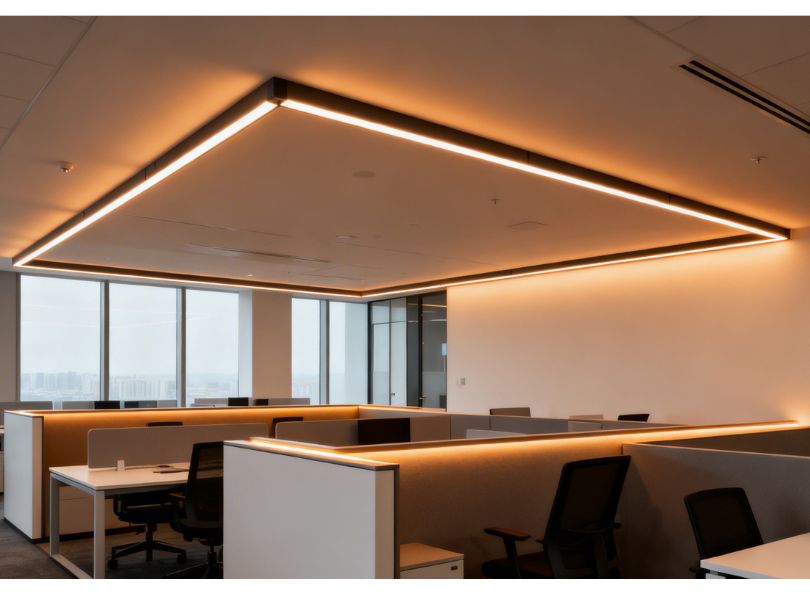
Yet the building stock available to coworking operators is often old, constrained and expensive to alter. Suspended ceilings may be low, structural grids may be irregular, and landlords may prohibit permanent alterations. The coworking lighting solution must therefore be high-performance, highly flexible and structurally light, capable of being installed, reconfigured and even relocated as leases change.
LED aluminium profiles have emerged as the answer to this coworking lighting challenge. Unlike conventional luminaires, profiles are not fixed-function objects: they are infrastructure, linear channels that carry LED strip light, manage heat, direct beam angles and integrate with control systems, all in an extruded aluminium exoskeleton that can be cut, joined, suspended, surface-mounted or embedded into furniture and partition systems.
This guide is written for the three professionals who shape coworking lighting decisions: architects specifying the base-build, interior designers layering the fit-out, and operators managing ongoing reconfigurations as their member mix evolves. It covers flexible zone design, desk-level illuminance targets, plug-and-play modularity, product selection and the business case for investing in coworking lighting infrastructure based on LED profiles.
In this article…
- Why LED profiles for coworking lighting
- Flexible lighting zones for coworking lighting
- Desk-level illuminance: hitting 500 lux where it counts
- Plug-and-play modularity: reconfigure without rewiring
- Profile types and their role in coworking environments
- Human-centric lighting and tunable white in coworking lighting
- Biophilic design integration with LED profiles
- Acoustic panels and LED profiles: the double-duty ceiling for coworking lighting
- Control systems: DALI-2, Bluetooth Mesh and app-driven zones
- Energy efficiency, metering and ESG reporting
- Installation guide for fit-out teams
- Product selection table: profiles for coworking lighting
- Case scenarios: coworking lighting in three typical configurations
- Cost, ROI and membership premium
- Regulations, standards and wellness certifications
- Future trends: kinetic zones, AI scheduling and circular profiles
- Frequently asked questions
- Coworking lighting as a strategic asset, not a line item
Why LED profiles are the right choice for coworking lighting
The debate between linear LED profiles and conventional downlights in commercial interiors is, for coworking spaces specifically, largely settled. Downlights excel in retail and hospitality , wherever accent pools and dramatic contrast are the goal. But coworking lighting requires even, glare-controlled, directionable light across large, reconfigurable task planes, and that is precisely what linear profiles deliver.
Directionality and coverage
A single suspended linear LED profile running along the length of a hot-desking bench delivers consistent illuminance across every seat. A row of downlights over the same bench creates bright spots between seats and dimmer areas directly beneath each fixture. The coefficient of uniformity (Uo) for a well-designed linear coworking lighting system at the task plane typically exceeds 0.7; an equivalent downlight grid rarely exceeds 0.5 without adding significantly more fixtures and driving up energy use.
UGR control in coworking lighting
Unified Glare Rating (UGR) is the critical comfort metric in coworking lighting. EN 12464-1 stipulates UGR ≤ 19 for computer-based office work. Suspended direct/indirect LED profiles achieve UGR ≤ 16 routinely, because the luminous surface is elongated, the luminance is spread and the indirect component softens the ceiling luminance contrast. Bare downlights with small apertures frequently produce UGR values above 22 in open-plan configurations — a source of visual fatigue that members feel, even if they cannot articulate it.
Reconfigurability
When a coworking operator redesigns a floor (moving benches, adding phone-booth pods, converting open desks to a private studio) the coworking lighting must follow. Downlights are fixed to the ceiling grid and cannot move without structural and electrical work. Modular LED profiles on wire-rope suspension can be repositioned in hours, their suspension points shifted and their electrical connections re-routed along a low-voltage bus without electricians. This reconfigurability has a measurable financial value: it reduces the cost and downtime of coworking lighting layout changes from days to hours.
Aesthetic integration
The best coworking interiors read as designed environments, not generic offices. Linear LED profiles allow coworking lighting to become an architectural element, defining zones with light lines, tracing the geometry of partition systems, integrating with acoustic baffles and creating the visual rhythm that distinguishes a considered interior from a commodity fit-out. Downlights, however precise, are punctuation marks in a ceiling; profiles are sentences.
Flexible coworking lighting zones: the architecture of adaptability
The defining characteristic of a successful coworking lighting scheme is its ability to create distinct micro-environments within a single open-plan floor plate. Flexible coworking lighting zones are pre-designed configurations, each with its own illuminance level, colour temperature and control logic — that can be activated, blended or overridden as the use of the space changes throughout the day and week.
The five essential coworking lighting zones
Every coworking space, regardless of size, contains five functional coworking lighting zones that must be designed independently
| Zone | Primary activity | Target illuminance (lux at task plane) | UGR limit | Preferred CCT | Recommended profile type |
|---|---|---|---|---|---|
| Hot-desk / open bench | Concentrated individual work, laptop use | 500 lux (EN 12464-1 §5.3) | ≤ 19 | 4000–5000 K (tunable) | Suspended direct/indirect linear |
| Meeting / collaboration | Group discussion, presentations, video calls | 300–500 lux (ambient + task) | ≤ 19 | 3000–4000 K (warmer for video) | Recessed or surface-mount ceiling linear, perimeter wall wash |
| Phone / focus booth | Private calls, deep-focus individual work | 500 lux at desk plane | ≤ 16 | 4000 K fixed or tunable | Under-shelf profile, micro-profile desk integration |
| Lounge / social | Informal meetings, breakout, relaxation | 150–300 lux (ambient) | ≤ 22 | 2700–3000 K (warm) | Recessed cove, pendant accent, floor-level uplighter profile |
| Reception / circulation | Navigation, brand impression, wayfinding | 200–300 lux | ≤ 22 | 3000–4000 K | Recessed or suspended linear, wall-wash profile on brand feature |
Zone boundaries and coworking lighting curtains
In open-plan coworking, zone boundaries are defined by coworking lighting, not walls. A subtle change in illuminance level or colour temperature between the hot-desk area and the lounge communicates a spatial transition that members instinctively respond to, they lower their voice, adopt different postures, shift their expectations. This is the psychoacoustic and psycho-visual dimension of coworking lighting design that goes beyond mere foot-candle compliance.
Linear LED profiles are uniquely suited to creating coworking lighting curtains: a continuous vertical light plane between two zones, achieved with a floor-to-ceiling profile mounted on a low partition, serves simultaneously as a zone divider, a wayfinding element and a source of ambient illuminance for both zones. The profile is single-piece coworking lighting infrastructure doing three jobs.
Dynamic zone switching in coworking lighting
Modern coworking management platforms — OfficeRnD, Nexudus, Cobot — now offer API integrations with DALI-2 and Bluetooth Mesh coworking lighting controllers. When a member books a meeting room through the app, the coworking lighting in that room can automatically switch to the meeting-room scene — 400 lux, 3500 K, low UGR — rather than defaulting to the general office scene. When the booking ends, the space reverts to its unoccupied standby scene (50 lux, 3000 K warm). This integration eliminates the friction of manual coworking lighting control and supports the operator’s energy management goals simultaneously.
Desk-level coworking lighting: hitting 500 lux Where It Counts
The European standard EN 12464-1:2021 defines the illuminance requirements for coworking lighting with engineering precision. For offices with concentrated visual tasks — which describes virtually every hot-desking area in a coworking space — the standard specifies a maintained illuminance (Ēm) of 500 lux at the task area (the horizontal plane on the desk surface), with a uniformity ratio Uo ≥ 0.6 and a UGR ≤ 19.
Meeting these coworking lighting targets with LED profiles requires understanding how profile position, strip specification and optical diffuser interact to produce the illuminance distribution at the desk plane.
The inverse-square relationship in coworking lighting
The fundamental photometric relationship governing illuminance from a linear coworking lighting source is not identical to the inverse-square law for a point source, but it is closely analogous. For a finite linear luminaire, the illuminance directly beneath the centre falls as:
E (lux) ≈ (I₀ × cos³θ) / h²
Where:
E = illuminance at the point directly below the luminaire
I₀ = luminous intensity in candela at nadir (0° from vertical)
θ = angle from nadir to the point of interest
h = mounting height above the desk surface (metres)
For a suspended coworking lighting profile at 2.0 m above a 0.75 m desk:
Effective h = 2.0 – 0.75 = 1.25 m above task plane
A profile delivering I₀ = 800 cd/m directly below:
E ≈ (800 × 1.0) / (1.25²) ≈ 512 lux ✓ (meets 500 lux coworking lighting target)
This calculation illustrates why mounting height relative to the desk surface is the most critical variable in coworking lighting design for hot-desk areas. A ceiling height of 3.5 m is comfortable; a ceiling of 2.5 m in a mezzanine coworking conversion requires a much higher strip output to achieve the same task illuminance, because the profile hangs proportionally further from the desk.
Mounting height guidelines for coworking lighting profiles
| Ceiling height (m) | Typical suspension drop (m) | Profile height above desk (m) | Required lm/m (direct component) | Recommended strip category |
|---|---|---|---|---|
| 2.5 | 0.10 | 1.65 | 2,200–2,600 lm/m | Professional High-Output |
| 2.8 | 0.15 | 1.90 | 1,800–2,200 lm/m | Professional |
| 3.0 | 0.20 | 2.05 | 1,600–2,000 lm/m | Professional |
| 3.2 | 0.25 | 2.20 | 1,400–1,800 lm/m | Standard or Professional |
| 3.5 | 0.30 | 2.45 | 1,200–1,600 lm/m | Standard |
| 4.0+ | 0.50–1.00 | 2.75–3.25 | 1,000–1,400 lm/m | Standard, longer suspension |
Note that the values in Table 2 reflect the direct downward component only. A direct/indirect coworking lighting profile distributes typically 60% of its flux downward and 40% upward; the indirect component reflects off the ceiling and adds 80–120 lux of diffuse ambient illuminance, improving uniformity and significantly reducing perceived glare without counting toward the primary EN 12464-1 task illuminance measurement.
Desk-integrated micro-profiles for coworking lighting
For hot-desking benches where members rotate through multiple seats during the day, a desk-integrated micro-profile, mounted beneath an upper shelf or within a purpose-built extrusion along the back of the bench, provides supplementary task illuminance that is independent of ceiling height. These miniature aluminium coworking lighting profiles accept 8 mm or 10 mm LED strip and deliver 300–400 lux directly onto the desk at a distance of 400–600 mm, with the diffuser controlling glare toward the seated user.
The combination of a suspended ceiling coworking lighting profile (ambient + primary task) and a desk-integrated micro-profile (supplementary task) allows any ceiling height to be served, and gives members the ability to boost their personal illuminance when they need it without affecting their neighbours — a critical benefit in the mixed-use, continuously occupied environment of a flex-office.
Plug-and-play coworking lighting modularity: reconfigure without rewiring
The commercial proposition of plug-and-play coworking lighting profile systems is straightforward: the cost of reconfiguring a coworking floor is dominated not by the materials but by the labour. If moving a cluster of desks requires an electrician to re-route mains wiring, the cost of the coworking lighting change may exceed the cost of the furniture move. Plug-and-play modular coworking lighting systems eliminate that friction.
How modular coworking lighting systems work
A plug-and-play coworking lighting profile system operates on 24 V DC distributed from a central driver or from a distributed driver network. The profiles connect to the bus through standardised push-in or magnetic snap-fit connectors. Individual coworking lighting profile sections (typically 600 mm, 900 mm, 1200 mm, 1500 mm or 2000 mm in length) clip together to form runs of any length, with feed-in connectors accepting power from the nearest drop point on the bus.
Within each section, the LED strip is pre-installed by the coworking lighting profile manufacturer or distributor. When an operator needs to extend a run, add a branch, or shorten a coworking lighting line by removing a section, they disconnect the end connector, insert or remove the section, and reconnect, no tools, no wire stripping, no voltage testing. The 24 V DC system is safe to handle without isolation under normal conditions (SELV — Safety Extra Low Voltage).
Addressing and dimming in coworking lighting
Each coworking lighting profile section can be individually addressed through DALI-2, Casambi Bluetooth Mesh or Zigbee protocols. This means that within a single continuous bus, individual profile sections can be dimmed to different levels — creating a gradient of illuminance across a coworking lighting zone, or maintaining full light above an occupied desk while dimming down sections above empty seats. Occupancy sensors embedded within the coworking lighting profile housing detect presence at the individual seat level and trigger the relevant section to full task illuminance automatically, reverting to a low standby level when the seat is vacated.
Modular coworking lighting profile lengths and joining
| Section length | Typical use | Joining method | Max run length (24 V, standard strip) | Bus feed interval |
|---|---|---|---|---|
| 600 mm | Phone booth, small pod | Push-in clip connector | 5 m from one feed | Every 5 m |
| 900 mm | Single-desk row | Push-in clip connector | 5 m from one feed | Every 5 m |
| 1200 mm | 2-seat bench module | Push-in clip connector | 5 m from one feed | Every 5 m |
| 1500 mm | 3-seat bench module | Push-in clip connector | 10 m with mid-feed | Every 5 m bidirectional |
| 2000 mm | 4-seat bench module | Magnetic snap / push-in | 10 m with mid-feed | Every 5 m bidirectional |
Not all LED profiles serve the same function in a coworking lighting scheme. Understanding the optical and structural properties of each type allows designers to specify the right profile for each zone and to build a layered coworking lighting system that is coherent, energy-efficient and experientially rich.
Suspended direct/indirect profiles: the coworking lighting workhorse
The workhorse of coworking lighting. A suspended direct/indirect profile delivers the primary task illuminance downward through an opal or microprismatic diffuser, while simultaneously bouncing 30–50% of its flux off the ceiling as indirect ambient light. The result is a bright task plane combined with a luminous, evenly lit ceiling that eliminates harsh shadows and reduces the luminance contrast that drives glare. These coworking lighting profiles are the first choice above hot-desking benches, open meeting tables and any zone requiring sustained concentrated work.
Recessed ceiling profiles for coworking lighting
In coworking spaces with suspended ceilings, recessed linear profiles offer a clean, architectural finish for coworking lighting. They are ideal for meeting rooms, reception areas and branded zones where the lighting should be present but not prominent. Their limitation in coworking lighting contexts is inflexibility: once recessed, they cannot be repositioned without ceiling work. They are therefore most appropriate in zones of the floor plate that are permanently committed as meeting rooms, landlord lobbies, circulation spines.
Surface-mounted profiles
Surface-mounted profiles screw or clip directly to the ceiling soffit. They are less elegant than recessed profiles but far easier to install in existing buildings without suspended ceilings, and moderately easier to reposition than recessed coworking lighting installations. In coworking fit-outs of older industrial buildings, former warehouses, converted floors in Victorian commercial stock, surface-mounted profiles are often the most practical coworking lighting choice.
Wall-mounted and cove profiles for coworking lighting ambience
Cove and indirect wall-mounted profiles create the ambient coworking lighting wash that gives a lounge its warmth and hospitality feel. An LED profile installed in a ceiling cove, directing light upward onto a white or light-coloured ceiling, can deliver 80–120 lux of smooth, shadow-free ambient coworking lighting across an entire lounge zone, enough for comfortable relaxed conversation and laptop use, while creating the visual atmosphere that marks the transition from work zone to social zone.
Desk-level and furniture-integrated micro-profiles
The smallest category but arguably the most transformative for hot-desking coworking lighting environments: miniature aluminium profiles (8–16 mm wide) that integrate directly into bench worktops, under-shelf positions, monitor risers or partition top rails. They provide personal task coworking lighting that is independent of the ceiling system, allowing individual members to fine-tune their illuminance without affecting neighbours and allowing operators to specify a less intensive (and more energy-efficient) ceiling coworking lighting system because the heavy lifting of task illuminance is shared with the desk layer.
| Profile type | Best coworking lighting zones | UGR achievable | Reconfigurability | Installation complexity | Relative cost |
|---|---|---|---|---|---|
| Suspended direct/indirect | Hot-desk, open meeting | ≤ 16 | High (wire-rope repositionable) | Medium | Medium–high |
| Recessed ceiling | Meeting rooms, reception | ≤ 16 | Low (ceiling cut required) | High | Medium |
| Surface-mount ceiling | Industrial/loft conversions | ≤ 19 | Medium | Low–medium | Low–medium |
| Cove / wall indirect | Lounge, reception mood | n/a (no direct glare) | Low | Low–medium | Low |
| Desk micro-profile | Hot-desk bench task | ≤ 13 (close-mounted) | Very high (clips off/on) | Very low | Low |
Human-Centric coworking lighting and tunable white
Human-centric coworking lighting (HCL) is the application of circadian science to architectural lighting design. The core premise is that the spectral content and intensity of artificial light affects the human body’s circadian rhythm, its biological clock, through intrinsically photosensitive retinal ganglion cells (ipRGCs) that are most responsive to short-wavelength (blue-enriched) light in the 460–490 nm range. Bright, cool coworking lighting in the morning suppresses melatonin and promotes alertness; warm, dimmer light in the evening allows melatonin to rise and supports sleep preparation.
In a coworking space occupied from early morning through evening by members with diverse circadian needs and schedules, tunable-white coworking lighting LED profiles are not a premium add-on but a genuine performance tool.
Circadian coworking lighting schedules
| Time | Scene name | Illuminance (lux) | CCT (K) | Rationale |
|---|---|---|---|---|
| 07:00–09:00 | Morning activate | 600–700 lux | 5000–6000 K | Supports alertness, blue-enriched to suppress residual melatonin |
| 09:00–12:00 | Deep work | 500 lux | 4500 K | Peak cognitive performance, EN 12464-1 compliant coworking lighting |
| 12:00–14:00 | Midday transition | 400 lux | 4000 K | Slight dimming for post-lunch rhythm, neutral tone |
| 14:00–17:00 | Afternoon focus | 500 lux | 4000 K | Post-lunch alertness recovery, sustained task performance |
| 17:00–19:00 | Evening ease | 300 lux | 3000–3500 K | Warmer coworking lighting as evening approaches, supports late workers |
| 19:00–close | Late evening | 200 lux | 2700–3000 K | Minimal blue content, warm ambient coworking lighting for evening sessions or events |
Tunable-white coworking lighting LED profiles achieve this schedule through dual-channel LED strips, one warm-white (2700 K) and one cool-white (6500 K), which are independently controlled by the driver. Blending the two channels in different ratios produces any CCT in the spectrum between the two endpoints. The full circadian coworking lighting schedule above can be programmed into a DALI-2 or Casambi controller in under an hour and runs automatically thereafter, visible to members through a subtle, slow shift in the quality of the light that is experienced as comfort rather than noticed as a technical event.
Biophilic design integration with coworking lighting profiles
Biophilic design, the integration of natural patterns, materials and stimuli into the built environment, has become a major differentiator in premium coworking positioning. Living walls, indoor trees, natural timber, exposed stone and water features all contribute to a sensory environment that reduces stress, improves mood and increases the perceived quality of the space.
Coworking lighting profiles play a specific and often overlooked role in biophilic interiors: the quality of coworking lighting on natural materials determines whether they read as alive and present or flat and decorative. A living wall lit with high-CRI (Ra ≥ 90, R9 ≥ 50) coworking lighting LED profiles in the 3000–4000 K range appears lush and vibrant; the same wall under generic CRI 80 cool-white downlights looks institutional and grey. The coworking lighting profile is not just the light source — it is the instrument through which the biophilic investment is perceived.
CRI requirements for biophilic coworking lighting
| Material / Element | Critical colour quality | Minimum Ra | Key R-indices | Preferred CCT |
|---|---|---|---|---|
| Living wall / moss panels | Green fidelity, vibrancy | 90 | R9 ≥ 50, R11 (green) ≥ 80 | 3000–4000 K |
| Natural timber (desk, partition) | Warmth, grain definition | 90 | R9 ≥ 50, R12 ≥ 70 | 2700–3500 K |
| Stone / concrete feature wall | Texture, depth, warmth/cool balance | 85 | R9 ≥ 40 | 3000–4000 K (grazing light) |
| Indoor trees / large plants | Green and yellow fidelity | 90 | R9 ≥ 50, R11 ≥ 80 | 3500–5000 K (simulates daylight) |
| Woven textiles / rugs | Saturation, pattern clarity | 90 | R9 ≥ 50 | 2700–3500 K |
Acoustic panels and LED profiles: the double-duty coworking lighting ceiling
Acoustic comfort and coworking lighting quality are the two most consistently cited performance priorities in coworking member satisfaction surveys. They are also the two most frequently addressed by separate, competing ceiling systems that compete for the same structural fixings, the same ceiling void and the same design budget. The integration of LED profiles into acoustic panel systems resolves this conflict by making coworking lighting and acoustics a single, coordinated assembly.
Several manufacturers now produce acoustic baffle systems with integrated LED coworking lighting profile channels, the baffle body is formed from high-density acoustic foam faced with fabric, and an aluminium LED profile channel runs along the base of each baffle, directing coworking lighting downward onto the zone below. The result is a ceiling system that simultaneously absorbs mid-frequency sound (NRC 0.75–0.90 depending on baffle depth), defines coworking lighting zones through its geometry, and delivers task illuminance without any additional ceiling fixtures.
For coworking operators, this integration delivers a compelling operational benefit: a single contractor installs both the acoustic and the coworking lighting system in one pass, the two systems share suspension points, and the visual result is a considered, intentional ceiling that reads as a designed element rather than an assemblage of separate components.
Coworking lighting control: DALI-2, Bluetooth Mesh and app-driven zones
The intelligence of a coworking lighting profile system is defined by its control architecture. Three protocols dominate the flex-office market in 2026:
DALI-2 for coworking lighting (Digital Addressable Lighting Interface)
DALI-2 is the established standard for commercial coworking lighting control. It provides individual addressability of up to 64 devices per bus, bidirectional communication (the controller can query each driver for its current status, energy consumption and fault state), and integration with BMS (Building Management Systems) through DALI-to-BACnet or DALI-to-KNX gateways. DALI-2 is the correct coworking lighting choice for spaces of 500 m² and above, or wherever the operator wants to integrate coworking lighting into a broader smart-building platform. Its limitation is that it requires dedicated two-core DALI wiring alongside the power cabling, a consideration for retrofit projects.
Casambi Bluetooth Mesh coworking lighting
Casambi is a Bluetooth Low Energy mesh protocol embedded directly into the LED driver chip. It requires no dedicated control wiring, the Mesh network is formed automatically between drivers using the existing power cabling and wireless RF. For coworking lighting retrofits in listed buildings or spaces where additional cabling is impractical, Casambi is often the most viable solution. It supports up to 250 devices per network, offers a capable smartphone and tablet app for coworking lighting zone programming and scene management, and integrates with popular coworking management platforms through its open API.
Zigbee and Matter for coworking lighting
Zigbee has long been the wireless protocol of choice for large-scale commercial coworking lighting mesh networks. The emerging Matter standard (backed by Amazon, Apple, Google and the Connectivity Standards Alliance) is beginning to unify the previously fragmented smart-building device ecosystem, and LED driver manufacturers are releasing Matter-compatible firmware. For coworking operators specifying new fit-outs today, asking for Matter-ready drivers is a future-proofing measure that adds minimal cost and preserves maximum flexibility in the coworking lighting control ecosystem.
| Protocol | Wiring required | Max devices / Network | BMS integration | Best for | App control |
|---|---|---|---|---|---|
| DALI-2 | Dedicated 2-core DALI bus | 64 per bus (expandable) | Excellent (BACnet, KNX) | Large new-build or refurb | Via gateway app |
| Casambi BLE Mesh | Power only (wireless control) | 250 per network | Via API / gateway | Retrofits, listed buildings | Native iOS / Android app |
| Zigbee | Power only (wireless control) | 65,000 theoretically | Via Zigbee coordinator | Large networks, IoT integration | Via coordinator app |
| Matter | Power only (wireless control) | Mesh, no hard limit | Emerging, API-based | Future-proof new installations | Cross-platform (iOS, Android, web) |
| 0–10 V analogue | Signal wire + power | 1 zone per channel | Via BMS analogue output | Simple 1–2 zone dim only | No native app |
Coworking lighting energy efficiency, metering and ESG reporting
Coworking lighting accounts for 20–35% of electricity consumption in a typical coworking space, depending on ceiling height, window area and occupancy patterns. A well-specified coworking lighting LED profile system with occupancy sensing and daylight dimming can reduce coworking lighting energy consumption by 60–75% compared with a conventionally switched T8 fluorescent installation, a saving that is increasingly material as both electricity tariffs and ESG reporting requirements escalate.
Daylight harvesting in coworking lighting
Daylight harvesting, the automatic dimming of artificial coworking lighting in proportion to available natural light, is one of the highest-return control strategies available. A lux sensor at desk level in a perimeter zone measures the combined natural and artificial illuminance and sends a continuous signal to the DALI-2 controller, which dims the coworking lighting LED profiles to maintain the target 500 lux regardless of the time of day or sky condition. The interior zones, which receive little natural light, run at full output; the perimeter zones may be dimmed to 20–40% of full coworking lighting output for much of the day, saving significant energy in the zones that are also typically most densely occupied.
Coworking lighting metering and ESG transparency
DALI-2’s bidirectional communication allows each coworking lighting driver to report its actual energy consumption to the building management system in real time. For coworking operators pursuing BREEAM Excellent ratings, WELL Building Standard certification or GRI-aligned ESG reporting, this granular coworking lighting metering data (zone by zone, hour by hour) provides the evidence base that auditors require. It also allows operators to allocate coworking lighting energy costs more accurately to individual zones or floors, supporting metered billing models for private office tenants.
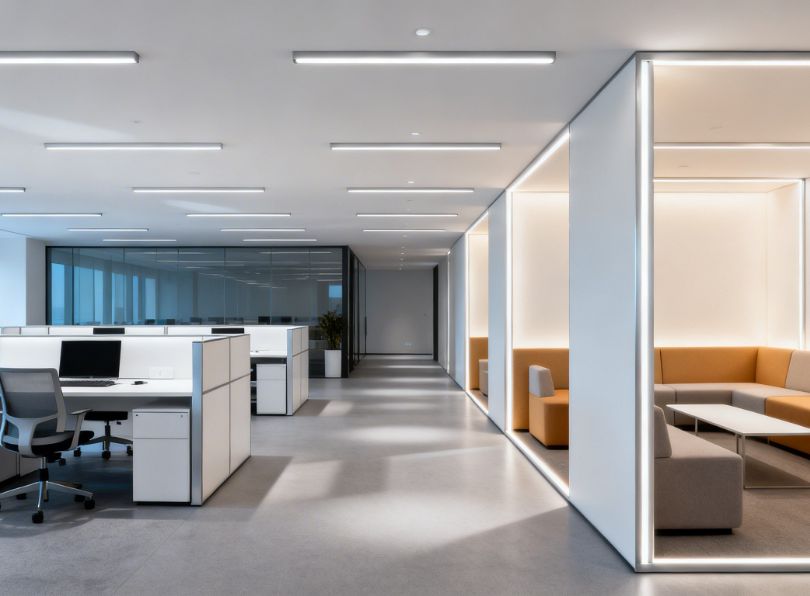
Coworking lighting installation guide for fit-out teams
The following sequence describes a standard coworking lighting installation workflow for suspended direct/indirect LED profiles in a new fit-out. It assumes a ceiling height of 3.0–3.5 m, a structural soffit above a suspended ceiling grid, and a DALI-2 control system.
Pre-installation: coworking lighting layout and zoning plan
Before any fixing work begins, the coworking lighting designer or fit-out team should produce a reflected ceiling plan (RCP) showing: profile positions and lengths, wire-rope suspension point coordinates on the structural soffit, driver locations and wiring routes, DALI bus topology and device addresses, and daylight sensor and occupancy sensor positions. The RCP should be cross-referenced against the furniture layout plan to ensure that coworking lighting profiles are centred over bench runs and that suspension points do not conflict with partition systems or HVAC diffusers.
Structural fixing for coworking lighting
Wire-rope suspension systems anchor to the structural soffit above the ceiling grid using M6 or M8 drop-in anchors rated for the full suspended load of the coworking lighting profile plus a 5× safety factor. For a typical 2-metre aluminium coworking lighting profile weighing 2.5 kg, the anchor must be rated for ≥ 12.5 kg. Each coworking lighting profile typically hangs from two wire ropes, each with its own anchor point; the wire rope passes through the suspended ceiling grid tile (using a pre-cut hole or a tile insert) to the profile suspension bracket below.
Electrical connection for coworking lighting
The 24 V DC coworking lighting driver is installed in the ceiling void, mechanical room or a surface-mounted driver enclosure. From the driver, a low-voltage cable runs to the first profile in the zone. Subsequent profiles connect through push-in inter-profile connectors along the run. The DALI signal wire (2-core unshielded, any polarity) loops from driver to each coworking lighting profile address unit in a simple daisy-chain or star topology.
Maximum run length from a single 24 V coworking lighting driver: 5 m for standard-density strip (≤ 14 W/m); 3 m for high-density strip (≤ 24 W/m). Longer runs require a mid-feed injection or a higher-voltage 48 V DC system, which doubles the viable coworking lighting run length to 10 m and 6 m respectively.
Coworking lighting commissioning
DALI-2 coworking lighting commissioning involves assigning short addresses (0–63) to each driver on the bus, grouping drivers into zones, and programming scenes with illuminance levels, CCT values and transition times. With a Casambi system, coworking lighting commissioning is performed wirelessly through the smartphone app: the technician scans for devices in range, names them, assigns them to groups and programs scenes, a process that takes 20–40 minutes for a typical coworking lighting floor of 30–50 profile sections.
Product selection table: profiles for coworking lighting
| Profile Series | Type | Width × Height (mm) | Strip Compatibility | Max lm/m (with Professional strip) | Diffuser Options | Coworking Lighting Application |
|---|---|---|---|---|---|---|
| LLP-CL01-06 | Suspended direct/indirect | 36 × 75 | Up to 20 mm strip, dual channel | 2,200 lm/m (direct) + 800 lm/m (indirect) | Opal, microprismatic, clear | Hot-desk bench coworking lighting, open meeting table |
| LLP-RE04-07 | Recessed ceiling | 67 × 22 | Up to 10 mm strip | 1,800 lm/m | Opal, microprismatic | Meeting rooms, reception, corridors |
| LLP-SL02-06 | Surface-mount ceiling | 36 × 26 | Up to 10 mm strip | 1,800 lm/m | Opal, clear | Industrial/loft coworking lighting, low ceiling |
| LLP-WL04-05 | Cove / indirect wall | 31 × 70 | Up to 12 mm strip | 1,400 lm/m (upward indirect) | Open / no diffuser | Lounge cove coworking lighting, perimeter ambient, brand wall |
| LLP-SL03-02 | Desk micro-profile | 8 × 10 | Up to 6 mm strip | 600 lm/m | Frosted, opal | Bench under-shelf coworking lighting task, monitor riser |
| LLP-WL02-03 | Wall-wash | 24 × 24 | Up to 12 mm strip | 1,600 lm/m | Asymmetric lens, opal | Feature wall, living wall, wayfinding coworking lighting |
Case scenarios: coworking lighting in three typical configurations
Scenario A: 200 m² urban flex-office coworking lighting, 2.8 m ceiling
Context: a 200 m² coworking space in a converted commercial building. Ceiling height 2.8 m, no suspended ceiling, structural concrete soffit. 40 hot-desk seats in an open plan, one 8-person meeting room, a lounge with 12 soft seats, and a reception desk.
Coworking lighting solution: suspended LP-S70 direct/indirect profiles at 2.6 m above floor (200 mm drop), running parallel to the bench rows at 1.2 m spacing, delivering 520 lux at desk level. LP-M10 micro-profiles under each bench shelf provide supplementary coworking lighting task light for the rear-seated members. LP-C40 cove profiles along the perimeter of the lounge zone create 120 lux warm ambient coworking lighting. The meeting room uses LP-R60 recessed profiles in a false ceiling panel. DALI-2 coworking lighting control with daylight sensors at the perimeter windows. Casambi Bluetooth Mesh for the lounge and reception coworking lighting zones (no DALI wiring required in those zones). Total installed load: 18 W/m² (well below the BREEAM Excellent target of 25 W/m² for open-plan offices).
Scenario B: 800 m² corporate coworking lighting floor, 3.5 m ceiling
Context: an 800 m² floor in a new-build office tower. Raised access floor, suspended acoustic tile ceiling at 3.0 m, structural soffit at 3.5 m. 120 hot-desk seats, 6 meeting rooms (4–12 persons), 2 phone booths, a branded café/lounge and a formal reception.
Coworking lighting solution: acoustic baffle ceiling above the open-plan zone, with LP-S70 coworking lighting profiles integrated into the base of each baffle to deliver task illuminance downward. LP-R60 recessed profiles in the suspended ceiling of the meeting rooms. LP-M10 micro-profiles provide coworking lighting in the phone booths. A custom LP-WW35 installation along the curved reception feature wall creates a branded coworking lighting line. Full DALI-2 system with BACnet gateway to the building BMS. Tunable-white coworking lighting throughout (2700–6500 K), with a circadian schedule programmed across all hot-desk zones. Occupancy sensing in every meeting room and phone booth feeds into the operator’s workspace management platform for utilisation analytics. Total installed coworking lighting load: 14 W/m² (aided by daylight harvesting on the south-facing perimeter).
Scenario C: 50 m² boutique creative studio coworking lighting, 4.5 m exposed brick ceiling
Context: a small premium coworking studio in a converted Victorian industrial unit. Exposed brick walls, 4.5 m ceiling, no suspended ceiling, no false wall. 12 desks, a small meeting area and a standing-height collaboration bar. The operator wants a design-forward coworking lighting aesthetic that reflects the creative-industry membership.
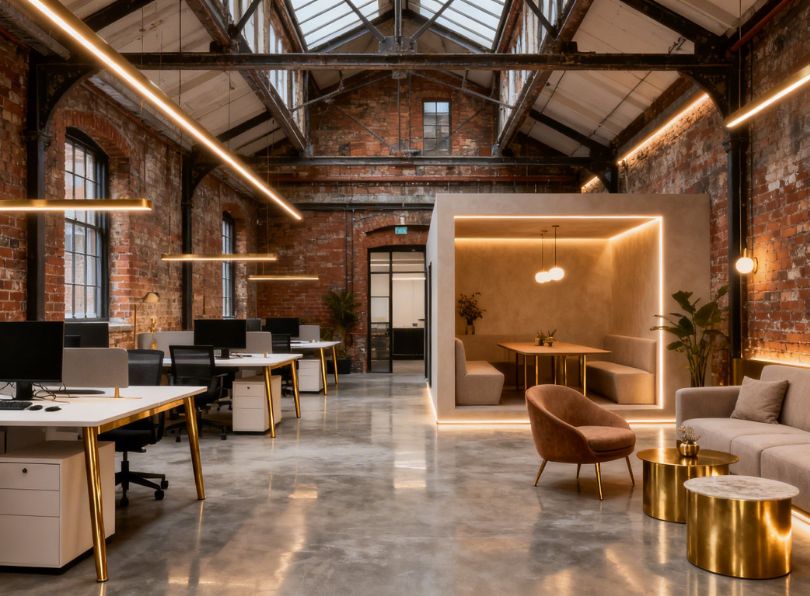
Coworking lighting solution: long-drop LP-S70 profiles on 1.5 m wire-rope drops, bringing the coworking lighting profile down to 3.0 m above the floor. The long drops become a deliberate coworking lighting design element, the wire rope is stainless steel, the profile black anodised, the combined visual creates a strong industrial-minimal aesthetic. LP-WW35 profiles with grazing angle brackets illuminate the exposed brick on the feature wall. LP-C40 cove profiles are installed in a custom timber shelf unit behind the collaboration bar, providing warm-white ambient coworking lighting for the social zone. The entire coworking lighting system runs on Casambi Bluetooth Mesh, no control wiring required, managed through the app. CCT fixed at 3500 K across the desk coworking lighting zones (balancing the warm brick tones) and 2700 K in the lounge/bar area. Total installed coworking lighting load: 11 W/m².
Coworking lighting cost, ROI and membership premium
The business case for specifying premium coworking lighting LED profiles rests on three financial arguments: energy savings, maintenance cost reduction, and the membership premium that superior amenities support.
Coworking lighting energy savings
Replacing a conventional T8 fluorescent grid coworking lighting installation (40 W/m² installed load, no dimming, manual switching) with a LED profile coworking lighting system with occupancy sensing and daylight harvesting (14–18 W/m² installed load, automatic dimming) typically achieves a 60–70% reduction in coworking lighting electricity consumption. At a European commercial electricity tariff of €0.22–0.30/kWh and a coworking occupancy of 3,000 annual operating hours, a 500 m² space saves approximately €2,000–3,500 per year in coworking lighting electricity alone.
Coworking lighting maintenance cost reduction
Coworking lighting LED profiles with L70 lifespans of 50,000–80,000 hours require no lamp replacements and minimal maintenance over a 10-year period. A comparable fluorescent coworking lighting installation requires lamp replacement every 2–3 years at €8–15 per lamp (including labour), aggregating to a significant maintenance liability over a decade. The maintenance cost differential over 10 years typically exceeds the premium paid for the coworking lighting LED profile system at specification stage.
Membership premium from superior coworking lighting
Research from the Global Coworking Survey and independent operator benchmarking consistently finds that members are willing to pay a premium of 12–20% for spaces they perceive as higher quality, and that coworking lighting quality is among the top three cited factors in their quality assessment (alongside internet reliability and acoustic comfort). A coworking space whose coworking lighting achieves 500 lux on every desk, UGR ≤ 16 throughout, and a well-programmed circadian lighting schedule is not competing on price — it is commanding a justified premium.
| Cost item | Fluorescent grid | LED coworking lighting system | Saving (LED) |
|---|---|---|---|
| Installation cost (Year 0) | €18,000–22,000 | €28,000–38,000 | –€10,000–16,000 |
| Electricity (10 yr @ €0.25/kWh) | €60,000 | €22,000 | +€38,000 |
| Lamp / maintenance (10 yr) | €12,000–18,000 | €1,500–2,500 | +€10,500–15,500 |
| Reconfiguration cost (3 major moves) | €9,000–15,000 | €1,500–3,000 | +€7,500–12,000 |
| 10-year Total Cost of Ownership | €99,000–115,000 | €53,000–75,500 | +€40,000–56,000 saving |
Coworking lighting regulations, standards and wellness certifications
Coworking lighting must comply with a layered framework of regulations and standards and, for operators pursuing wellness or sustainability certifications, must additionally meet the specific photometric requirements of those schemes.
EN 12464-1:2021 — Coworking lighting standard
This is the fundamental European standard for coworking lighting. The key requirements are: 500 lux maintained illuminance (Ēm) at the task plane, Uo ≥ 0.6, UGR ≤ 19, Ra ≥ 80. Premium coworking lighting operators target Ra ≥ 90 for improved visual comfort and biophilic material rendering. The 2021 revision introduced enhanced requirements for melanopic light exposure (circadian effectiveness), reflecting the growing scientific consensus on the importance of blue-enriched morning coworking lighting in workplace environments.
WELL Building Standard v2 — Coworking lighting concept
The WELL Building Standard Light Concept includes preconditions and optimisations relevant to coworking lighting. The most demanding requirements are for circadian coworking lighting design, specifically that workspaces achieve equivalent melanopic EDI (Equivalent Daylight Illuminance) of ≥ 250 lux at the eye plane between 9 a.m. and 1 p.m. at least 75% of the time. This requires not only high illuminance levels but high melanopic content, meaning blue-enriched, high-CCT coworking lighting in the morning, delivered at eye height by well-positioned suspended profiles.
BREEAM coworking lighting credits
BREEAM’s Hea 01 credit covers coworking lighting quality and awards up to three credits for meeting illuminance, glare, colour rendering and zoning requirements. The Ene 01 energy credit rewards low installed coworking lighting power densities, BREEAM Excellent requires ≤ 25 W/m² for open-plan offices. A coworking lighting LED profile system with occupancy sensing and daylight harvesting comfortably achieves 12–18 W/m², supporting multiple BREEAM Ene credits.
Future coworking lighting trends: kinetic zones, AI scheduling and circular profiles
The LED coworking lighting profile as an architectural element is evolving rapidly. Three trends will shape coworking lighting over the next five years.
Kinetic coworking lighting zones
Kinetic coworking lighting, profiles that physically move, rotate or tilt in response to space use patterns, is emerging from the museum and high-end retail sectors into commercial interiors. In coworking, this translates to suspended coworking lighting profiles on motorised tracks that can reposition laterally by 300–600 mm, allowing the lighting to follow a reconfigured desk layout without any human intervention. The profile receives its new position coordinates from the building management system when a desk booking is made, and moves to its new coworking lighting position overnight. Within five years, kinetic coworking lighting profiles will be a standard specification option for premium flex-office operators.
AI-Driven coworking lighting schedules
The convergence of occupancy sensing, calendar integration and large language model inference is producing AI-driven coworking lighting controllers that optimise illuminance, CCT and zone activation in real time based on predicted occupancy patterns, actual sensor readings and member preference data. Rather than a static circadian schedule programmed by a commissioning engineer, the AI coworking lighting controller learns the space’s occupancy rhythm over weeks of data collection and continuously refines its programme, dimming zones that are habitually unoccupied in the early morning, boosting coworking lighting illuminance before the predictable lunchtime exodus ends, shifting CCT profiles as seasonal daylight patterns change.
Circular economy coworking lighting profiles
The aluminium extrusion industry is responding to ESG pressure with circular-economy coworking lighting product programmes: profiles manufactured from 95–100% recycled aluminium with take-back schemes that recover and re-extrude the profile at end of life. For coworking operators targeting B Corp certification or net-zero supply chain claims, specifying recycled-aluminium coworking lighting profiles with documented take-back commitments is a low-cost, high-visibility sustainability action that resonates with environmentally conscious members and supports the operator’s ESG narrative.
Frequently asked questions about coworking lighting
| Question |
|---|
| What lux level is required for coworking lighting on a desk? + |
EN 12464-1 specifies a minimum maintained illuminance of 500 lux at the task plane (the desk surface) for coworking lighting in office and concentrated work settings. Coworking lighting for premium memberships often aims for 500–750 lux at desk level, complemented by 300 lux ambient coworking lighting in circulation zones. Uniformity (Uo) must be ≥ 0.6 across the task area. |
| What is the best LED profile type for coworking lighting? + |
Suspended direct/indirect LED profiles are the workhorses of coworking lighting: they deliver desk-level illuminance downward while bouncing indirect coworking lighting off the ceiling to reduce glare and provide comfortable ambient. Surface-mounted and recessed profiles suit lower ceilings and fixed coworking lighting zones. Desk-integrated micro-profiles are ideal for hot-desking benches where supplementary personal coworking lighting task light is needed regardless of ceiling height. |
| How does plug-and-play modularity work with coworking lighting profiles? + |
Plug-and-play modular coworking lighting profile systems use standardised push-in or magnetic snap-fit connectors so individual profile sections can be added, removed or repositioned without tools or rewiring. A central 24 V DC bus powers the entire coworking lighting run; each segment draws only what it needs, and DALI-2 or Bluetooth addressability allows each coworking lighting zone to be dimmed independently. |
| Can coworking lighting LED profiles be retrofitted into an existing fit-out? + |
Yes. Surface-mounted and pendant coworking lighting profiles install with minimal structural work. Cable-suspended linear systems require only two wire-rope anchor points per luminaire. For hot-desking benches, under-desk micro-profiles clip directly onto the bench extrusion. Most coworking lighting systems run on 24 V DC, so a single driver per zone replaces existing 230 V circuits with a simple adapter plate. |
| What colour temperature is best for coworking lighting? + |
Tunable-white coworking lighting LED profiles covering 2700–6500 K are the most versatile choice. Morning coworking lighting sessions benefit from cooler CCT (4000–5000 K) to support alertness; afternoon and evening coworking lighting sessions shift to warmer tones (2700–3500 K) to ease eye strain and support members who work late. Fixed-CCT coworking lighting installations should use 4000 K for primary work zones and 3000 K for lounge zones. |
| How many coworking lighting profile sections does a 200 m² space need? + |
A rough estimate for a 200 m² open-plan hot-desk coworking lighting zone (with 3.0 m ceiling, 1.2 m profile spacing) requires approximately 33 linear metres of suspended coworking lighting profile above the desk area, divided into 1.2 m or 2.0 m sections — that is, 16–27 profile sections plus 3–5 additional coworking lighting sections for lounge cove and reception. Total: approximately 40–60 coworking lighting profile sections for the full space, plus drivers, connectors and control hardware. |
| What UGR value should coworking lighting profiles achieve? + |
EN 12464-1 requires UGR ≤ 19 for computer-based office work. Premium coworking lighting operators typically specify UGR ≤ 16 to provide a measurably more comfortable visual environment that differentiates the space from standard commodity offices. Suspended direct/indirect coworking lighting profiles with opal or microprismatic diffusers routinely achieve UGR 13–16 in open-plan configurations. |
| What is the energy efficiency of coworking lighting LED profiles? + |
Modern coworking lighting LED profiles with Professional-grade strips achieve luminous efficacies of 120–160 lm/W at the strip level, translating to 80–110 lm/W at the system level (accounting for driver losses and diffuser transmission). With occupancy sensing and daylight harvesting, installed coworking lighting power density typically falls to 12–18 W/m² — well below the BREEAM Excellent ceiling of 25 W/m² for open-plan offices. |
| Does coworking lighting qualify for WELL Building Standard certification? + |
Yes, provided the coworking lighting meets the photometric requirements specified in the WELL Light Concept. Key requirements include achieving 500 lux at the task plane (Precondition L01), maintaining melanopic EDI ≥ 250 lux at the eye plane between 9 a.m. and 1 p.m. (Optimization L07), and providing UGR ≤ 19 throughout task areas (Precondition L02). Tunable-white coworking lighting profiles with high melanopic content at 4000–6500 K are the most straightforward route to meeting the circadian optimisation requirements. |
| How often do coworking lighting LED profiles need to be replaced? + |
LED strips within coworking lighting aluminium profiles have rated lifespans of L70 = 50,000–80,000 hours (meaning they retain ≥ 70% of their initial lumen output after that period). At 3,000 operating hours per year (a typical coworking lighting occupancy figure), this translates to 16–26 years before the strip requires replacement — far exceeding the typical fit-out cycle of 7–10 years. The aluminium coworking lighting profile housing itself is indefinitely reusable; when a space is refitted, the profiles can be cleaned, restripped with new LED strip and reinstalled. |
Coworking lighting as a strategic asset, not a line item
Throughout this guide, coworking lighting has been examined from every angle that matters to the professionals who specify and operate flex-office environments — from the photometric fundamentals of desk-level illuminance to the business case arithmetic of a 10-year total cost of ownership. The conclusion is consistent across every dimension: coworking lighting is not a commodity decision to be resolved by lowest installed cost per square metre, but a strategic asset that shapes member experience, operator profitability and the long-term adaptability of the space itself.
The shift from conventional downlight grids to modular LED aluminium profiles represents more than a technology change. It represents a fundamental rethinking of what coworking lighting infrastructure is asked to do. In a fixed office, lighting is a background utility, it illuminates the space and stays out of the way. In a coworking environment, lighting must be as flexible as the membership model, as responsive as the booking system and as considered as the furniture specification. A hot-desk bench that cannot be relit in under an hour when the layout changes is a cost and an operational liability. A lounge zone that cannot shift from 500 K energising white to 2700 K warm amber as the working day transitions to an evening event is a missed opportunity to retain members beyond core hours. A meeting room whose coworking lighting defaults to a generic office scene regardless of the activity booked is a friction point that members notice and attribute, rightly or wrongly, to the overall quality of the space.
LED profiles resolve each of these shortcomings not through complexity but through the elegant combination of good photometric engineering, modular 24 V DC infrastructure and intelligent addressable control. The suspended direct/indirect profile above a bench run, the micro-profile beneath a shelf, the cove profile washing the lounge ceiling, each is a simple component performing a specific task with precision. Together, layered across the five coworking lighting zones that every flex-office floor contains, they create an environment that members experience as simply working well, without ever consciously registering the coworking lighting as the reason why.
For architects specifying the base-build, the key decision is to design the structural fixing grid and low-voltage cable routes for modular profile suspension from the outset, a detail that costs almost nothing at design stage and saves considerable money in every subsequent refit. For interior designers layering the fit-out, the key insight is that coworking lighting zones should be designed before furniture zones, not after: the profile positions determine the quality of light at every seat, and the furniture should follow the light rather than the reverse. For operators managing an existing space, the key action is to audit the current coworking lighting against the EN 12464-1 targets for task illuminance and UGR, and to identify the zones where member dissatisfaction with the physical environment is, in truth, a coworking lighting problem that a profile installation or retrofit can resolve.
The market evidence is clear: coworking spaces that invest in specification-grade coworking lighting, achieving 500 lux at every desk, UGR ≤ 16 in work zones, tunable-white for circadian support and DALI-2 or Casambi addressability for zone management, command membership premiums of 12–20% over commodity alternatives. In a sector where revenue per square metre is the defining metric of viability, a coworking lighting investment that pays back through energy savings alone within three to five years, and additionally supports a meaningful membership price uplift, is one of the highest-return capital decisions available to an operator.
Coworking lighting, specified with this level of intention and executed with the right profile infrastructure, is ultimately an act of hospitality, a commitment by the operator that every member, at every seat, in every zone and at every hour of the day, deserves light that supports their best work. That commitment, more than any amenity, is what builds the member loyalty that sustains a coworking business over the long term.
This article was developed with the support of artificial intelligence and subsequently reviewed, corrected, and validated by the LightingLine.eu technical team, which guarantees its reliability and compliance with official sources.