Everything you need to know about choosing, buying and installing ceiling lights for UK homes: from energy-efficient LED flush fittings to elegant pendant lights and smart home-compatible ceiling luminaires. This guide, written by LightingLine.eu’s expert team with 10 years of lighting industry experience, covering every type, technology, room application and installation consideration in comprehensive, authoritative detail.
In this article…
- Why ceiling lights matter more than you think
- The UK ceiling lights market: key statistics and trends 2026
- Types of ceiling lights: a complete guide
- Ceiling lights by room: expert recommendations
- LED technology: the science behind modern ceiling lights
- IP ratings & safety
- The ultimate ceiling lights buying guide
- Installation guide
- Smart ceiling lights and home automation
- Sustainability and environmental impact
- Comprehensive comparison table
- Why buy from LightingLine?
- Frequently asked questions (FAQ)
- Ceiling lights: final recommendations from the experts
1. Why ceiling lights matter more than you think
Ceiling lights are, without question, the single most impactful element of any interior lighting scheme. Unlike wall lights, floor lamps or decorative table lamps, which contribute accent and ambience, the ceiling light is typically the primary source of illumination in any room, responsible for defining how a space feels, how comfortable it is to live in, and how much it costs to run every single day. Yet despite their central importance, ceiling lights are often chosen hastily, based on price alone or on passing aesthetics, without regard for the complex interplay of lumen output, colour temperature, fitting size, ceiling height, and room function that determines whether a lighting installation is merely adequate or genuinely exceptional.
In the United Kingdom, the ceiling light market has undergone a remarkable and accelerating transformation over the past decade. The rapid phaseout of incandescent and halogen bulbs, finalised by UK government energy efficiency regulations that took full effect from September 2023, has compelled both manufacturers and consumers to adopt LED technology as the universal standard across every product category. This transition has fundamentally changed what is possible in ceiling light design, enabling ultra-thin flush fittings just 4–6cm deep that were physically impossible with hot-running halogen sources, RGB colour-changing ceiling lights that require no separate smart hub, and integrated LED panels that deliver commercial-grade illumination at a fraction of the running cost of fluorescent alternatives. The consumer who understands these changes, and knows how to navigate the resulting wealth of options, is the consumer who makes the best lighting purchase.
This guide is designed to be the most comprehensive and authoritative resource available to UK homeowners, interior designers, property developers, and electricians. Drawing on over 15 years of expertise supplying the European lighting market, detailed analysis of content gap data from our market research, extensive customer feedback from thousands of UK buyers, and the latest product developments from leading European manufacturers, we cover every significant type of ceiling light, every relevant technology, every key purchasing consideration, and every major room application scenario. Whether you are renovating a Victorian terrace, fitting out a new-build, or simply replacing a single ceiling light, this guide will equip you with everything you need to make the right choice with complete confidence.
2. The UK ceiling lights market: key statistics and Trends 2026
Understanding the landscape of the UK ceiling lights market provides essential context for any purchasing decision. The market is substantial, diverse, and evolving rapidly: shaped by regulatory change, consumer behaviour shifts driven by energy costs, and the accelerating pace of smart home adoption. A buyer who understands the market forces at work is far better placed to identify genuine quality and value from marketing hyperbole, and to make purchasing decisions that will remain sound for the decade-plus lifespan of a quality LED ceiling light.
2.1 Market size and growth
The UK residential and commercial lighting market was valued at approximately £1.2 billion (€ 1.417 billion) in 2024, according to data from the Lighting Industry Association (LIA). Ceiling lights and ceiling light fittings account for the largest single segment within this market, representing approximately 38% of all luminaire sales by unit volume. The market has demonstrated consistent growth at a compound annual rate of approximately 4.2% since 2020, driven principally by the COVID-19-era renovation boom, the ongoing retrofit replacement cycle as older halogen and fluorescent fittings reach end-of-life, and rapid growth of new-build residential construction averaging approximately 200,000 completions per year from 2021 to 2024 (MHCLG data).
Online purchasing now dominates UK ceiling light sales, with approximately 67% of ceiling lights purchased through e-commerce channels in 2024, up from just 48% in 2019. This reflects both the increasing confidence of UK consumers in purchasing home furnishings online, and the significant price advantages offered by specialist online retailers compared to high-street electrical and DIY alternatives. LightingLine.eu positions at the quality end of the online specialist market, a curated range of high-quality European ceiling lights at competitive prices, backed by expert customer service that significantly exceeds the industry standard.
| Year | UK lighting market value | LED share of ceiling light sales | Avg ceiling light price | Smart ceiling light share |
|---|---|---|---|---|
| 2020 | £ 0.98bn (€ 1.19bn) | 72% | £34.50 (€ 39.91bn) | 8% |
| 2021 | £ 1.05bn (€ 1.21bn) | 81% | £36.20 (€ 41.87bn) | 11% |
| 2022 | £ 1.10bn (€ 1.27bn) | 89% | £39.80 (€ 46.04bn) | 16% |
| 2023 | £ 1.15bn (€ 1.21bn) | 95% | £42.10 (€ 48.70bn) | 21% |
| 2024 | £ 1.20bn (€ 1.33bn) | 96% | £45.60 (€ 52.75bn) | 27% |
| 2025 | £ 1.26bn (€ 1.46bn) | 97%+ | £47.00 (€ 54.36bn) | 33% |
Source: Lighting Industry Association (LIA), LightingLine.eu market analysis, GfK UK Retail Data, 2025
2.2 Consumer purchasing behaviour
Key consumer priorities when purchasing ceiling lights, according to a 2024 survey of 1,500 UK homeowners conducted by YouGov on behalf of the Lighting Industry Association, ranked in order of importance:
| Priority | % “Very Important” | % “Important” | Combined |
|---|---|---|---|
| Energy efficiency / running costs | 71% | 23% | 94% |
| Brightness / lumen output | 65% | 28% | 93% |
| Purchase price | 63% | 30% | 93% |
| Aesthetic / design style | 58% | 34% | 92% |
| Ease of installation | 54% | 37% | 91% |
| Brand reputation / quality | 47% | 42% | 89% |
| Warranty / guarantee length | 44% | 40% | 84% |
| Dimmability | 38% | 35% | 73% |
| Smart home compatibility | 28% | 38% | 66% |
| Colour temperature options | 26% | 41% | 67% |
Source: YouGov / Lighting Industry Association Consumer Survey, Q3 2024 (n=1,500 UK homeowners)
2.3 Key market trends 2026
1. Integrated LED dominance: by Q1 2025, over 58% of new ceiling light sales in the UK featured integrated (non-replaceable) LED modules, up from 31% in 2021. Integrated designs offer superior lumen output per watt, ultra-slim profiles, and operational lifespans of 30,000–50,000 hours, equivalent to 20–30+ years at average domestic use rates.
2. Smart lighting acceleration: the smart ceiling light segment is growing at approximately 24% per annum, far outpacing the broader market. Quality smart ceiling lights are now available from £35–£40, and the Matter universal standard (launched 2022/23) has eliminated the interoperability concerns that previously deterred mainstream adoption.
3. Tunable white technology: tunable white ceiling lights, adjustable from 2700K to 6500K, are moving from a premium niche to mainstream pricing. Research from the Sleep Foundation confirming the impact of blue-light exposure on melatonin production has driven strong consumer demand for this technology in bedrooms and living rooms.
4. Sustainability and circular economy: following revised UK WEEE regulations in 2024, modular LED designs (where the LED module and driver can be independently replaced) are gaining significant market traction. LightingLine.eu actively prioritises modular and serviceable designs across our product range as part of our sustainability commitment.
5. Design premiumisation: the average transaction value for ceiling lights has continued to increase as UK consumers invest in their homes. Statement pendants, architectural fixtures, and designer LED panels have all seen above-average growth in the £ 80–£ 250 ( € 92.50–€ 289.08) price segment, reflecting a growing preference for buying fewer, better-quality pieces over multiple budget alternatives.
3. Types of ceiling lights: a complete guide
The category of ceiling lights encompasses an extraordinarily diverse range of product types, each suited to different ceiling heights, room functions, architectural styles, and budget levels. Understanding the distinct characteristics, advantages, and limitations of each type is the essential first step in making an informed purchasing decision. This section provides a comprehensive technical and practical guide to every major category of ceiling light available in the UK market in 2026, with detailed specifications, application guidance, performance data, and expert commentary for each product type.
3.1 Flush ceiling lights
Flush ceiling lights (also known as close-ceiling lights, oyster lights, or surface-mounted ceiling lights) are fittings that mount directly against the ceiling surface with no visible gap between the body of the fitting and the ceiling. This design makes flush ceiling lights the single most versatile and widely applicable type of ceiling light, suitable for virtually any domestic room and particularly essential in rooms with low ceiling heights (under 2.3 metres), where pendant or semi-flush alternatives would reduce headroom to unacceptable and potentially hazardous levels. By unit volume, they are the most sold ceiling light type in the entire UK market.
Modern flush ceiling lights are predominantly integrated LED designs featuring a shallow circular, square, or rectangular housing, typically between 4cm and 12cm in depth, from which an acrylic or glass diffuser panel emits a broad, even spread of diffused light. A quality 24W flush LED ceiling light now delivers approximately 2,400 lumens (equivalent to what would previously have required a 150W incandescent lamp) while occupying a housing just 6cm deep. More powerful 36W and 48W flush fittings delivering 3,600–4,800 lumens are increasingly common, making it possible to adequately illuminate even large open-plan spaces with a single fitting. The efficacy of leading flush LED fittings now reaches 120–130 lumens per watt, among the most energy-efficient ceiling light formats available in the UK market.
| Specification | Entry level (£15–£35/ € 17.34 – € 40.47) | Mid-range (£35–£80/ € 40.47 – € 82.50) | Premium (£80–£200+/ € 92.50 – € 231.26) |
|---|---|---|---|
| Wattage range | 12W–18W | 18W–36W | 24W–60W |
| Lumen output | 900–1,600 lm | 1,600–3,200 lm | 2,400–6,000 lm |
| Efficacy (lm/W) | 70–85 | 85–100 | 100–130 |
| CRI | Ra≥70 | Ra≥80 | Ra≥90–95 |
| Colour temperature | Single fixed CCT | 1–3 selectable CCT | Tunable 2700K–6500K |
| Dimmable | Rarely | Some models | Usually yes |
| Lifespan (hours) | 15,000–20,000 | 25,000–30,000 | 30,000–50,000 |
| Warranty (typical) | 1–2 years | 2–3 years | 3–5 years |
| IP rating | IP20 | IP20–IP44 | IP44–IP65 options |
| Smart control | No | Some (Bluetooth) | Yes (Zigbee/Wi-Fi) |
Best applications for flush ceiling lights: bedrooms (especially in properties with standard or low ceiling heights), hallways and corridors, bathrooms (IP44-rated models), kitchens as the primary ambient light source, utility rooms and garages, rental properties where robustness and ease of maintenance are priorities, and any space where a clean, unobtrusive ceiling presence is desired over decorative impact.
3.2 Semi-flush ceiling lights
Semi-flush ceiling lights occupy the design middle ground between flush-mounted fittings and pendant lights, hanging below the ceiling by a short stem or rod, typically 10cm to 40cm below the ceiling surface. Semi-flush ceiling lights are among the most popular choices for living rooms, dining rooms, and master bedrooms in the UK, combining practical light output with a distinctly more decorative presence than flush alternatives, while remaining practical at standard UK ceiling heights where a full pendant light might compromise headroom.
Semi-flush fittings work best at ceiling heights between 2.3m and 2.7m: low enough that a long pendant would create a headroom hazard, high enough that a flush fitting would appear too small and inadequate for the space. In Victorian and Edwardian properties, which typically feature ceiling heights of 2.5m–2.8m, semi-flush lights are particularly well-suited to the scale and architectural character of the space, offering the visual presence of a statement fitting without the commitment to a full-length pendant or chandelier.
| Style | Description | Best applications | Price range |
|---|---|---|---|
| Globe semi-flush | Spherical glass or acrylic shade; clear, opal, smoked or coloured glass options | Living room, bedroom, hallway | £25–£120 (€ 28.91 – € 138.76) |
| Drum semi-flush | Cylindrical fabric or glass shade; clean contemporary profile; multiple sizes | Living room, dining room, bedroom | £35–£180 (€ 40.47 – € 208.13) |
| Cage / industrial | Metal cage around LED bulb; exposed filament aesthetic; raw/industrial character | Kitchen, dining, home bar, office | £30–£150 (€ 52.03 – € 173.45) |
| Crystal semi-flush | Compact multi-arm or crystal-encrusted design; decorative focal point | Living room, bedroom, landing | £45–£350 (€ 52.03 – € 404.71) |
| Art deco semi-flush | Geometric forms, frosted/tinted glass, chrome or brass finish | Living room, hallway, dining room | £55–£250 (€ 63.60 – € 289.08) |
| Scandinavian minimalist | Simple forms, matte finishes (white, black, grey); clean lines | Any room; particularly modern interiors | £40–£200 (€ 46.25 – € 231.26) |
3.3 Pendant ceiling lights
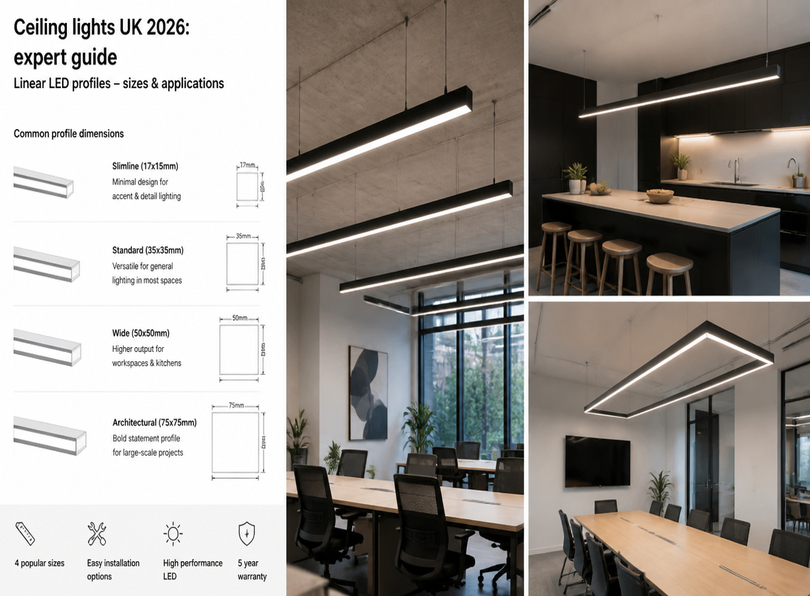
Pendant lights (luminaires that hang from the ceiling by a cable, rod, or chain) represent one of the most architecturally impactful types of ceiling light available to UK homeowners and interior designers. A well-chosen pendant light is as much a piece of furniture as it is a luminaire, a focal point that defines the character of a space and communicates clear design intent. The pendant category spans from a simple fabric-covered cord with a basic E27 lampholder to hand-blown Murano glass shades costing thousands of pounds, and encompasses four principal configurations: single pendants, cluster pendants, linear pendants (ideal over rectangular dining tables and kitchen islands), and multi-pendant bar systems.
Pendant lights are most commonly used over dining tables and kitchen islands, where a close relationship between the light source and the surface below creates intimate, focused illumination. The recommended hanging height is 70–90cm from the bottom of the shade to the table surface. A critical practical note for UK homeowners: with standard 2.4m ceilings, only approximately 30cm of pendant drop remains above the safety minimum of 2.1m floor clearance, meaning adjustable-height pendant fittings are strongly recommended for installation in most contemporary UK homes.
| Application | Recommended bottom-of-shade height | Notes |
|---|---|---|
| Over dining table | 70–90cm above table surface | Lower for intimate dining; higher for open areas |
| Over kitchen island (bar height) | 75–90cm above counter | Allow 30cm clearance above bar stools |
| Over kitchen worktop island | 60–75cm above counter | Ensure bottom is above eye level when standing |
| General room pendant (ambient) | Min. 2.1m above floor level | Safety minimum; 2.3m+ recommended |
| Stairwell pendant | Min. 2.1m above highest step | Allow for maintenance access |
| Bedside reading pendant | 40–60cm above mattress level | Position so light falls on book when reading in bed |
3.4 Chandeliers
The chandelier has undergone a radical reimagining in the contemporary UK market. While traditional crystal and candle-style chandeliers remain perennially popular in period properties and formal reception rooms, the contemporary chandelier market now encompasses abstract sculptural forms in matte black steel, minimalist hoop or ring chandeliers in brushed brass, industrial-style bare-filament multi-arm designs, and elegant globe clusters in smoked or amber glass. For most UK homeowners, the sweet spot of quality and value sits between £150 and £600 (€ 173.45 and € 693.78), where well-engineered chandeliers from reputable European manufacturers deliver genuine visual impact and reliable long-term performance. The chandelier in 2026is as likely to be a statement piece in a contemporary London flat as in a grand country house dining room.
| Room dimensions | Recommended chandelier diameter | Min. ceiling height | Suggested hanging height (base to floor) |
|---|---|---|---|
| Up to 3m × 3m | 40–55cm | 2.4m | 2.1m minimum |
| 3m × 4m | 55–70cm | 2.5m | 2.1–2.2m |
| 4m × 5m | 70–90cm | 2.6m | 2.1–2.3m |
| 5m × 6m | 90–110cm | 2.8m | 2.2–2.5m |
| Over 6m × 6m | 110cm+ | 3.0m+ | 2.3m+ |
| Over dining table | Table width minus 30cm each side | 2.5m recommended | 75–85cm above table |
3.5 Recessed spotlights and downlights
Recessed spotlights (also called downlights, pot lights, or hi-hats) are installed within the ceiling itself, with only the trim ring and lamp aperture visible from below. This design produces an extremely clean, uncluttered ceiling plane that has made recessed spotlights the defining feature of contemporary kitchen and bathroom design in the UK over the past two decades, and which continues to drive very strong sales in the new-build and renovation markets.
A critical regulatory point: fire-rated downlights are mandatory under UK Building Regulations Part B whenever recessed lights penetrate a fire-compartment ceiling — i.e., any ceiling with a habitable room or floor above. Fire-rated fittings incorporate an intumescent seal that expands under heat, closing the ceiling aperture and maintaining fire compartment integrity.
| Room size | Kitchen/bathroom (task lighting) | Living room/bedroom (ambient) | Hallway |
|---|---|---|---|
| 8 m² | 6–8 downlights | 4–5 downlights | 3–4 downlights |
| 12 m² | 8–12 downlights | 6–7 downlights | 4–5 downlights |
| 16 m² | 11–16 downlights | 8–10 downlights | 6–8 downlights |
| 20 m² | 14–20 downlights | 10–12 downlights | 8–10 downlights |
| 25 m² | 17–25 downlights | 12–15 downlights | 10–12 downlights |
Based on 400 lm per downlight. Adjust proportionally for higher or lower output models.
3.6 Track lighting
Track lighting systems (an electrified track along which individual light heads can be positioned, repositioned, and angled at will) have gained significant popularity in UK residential interiors over the past five years. No other ceiling light format offers comparable flexibility for adjusting the direction, focus, and distribution of light without additional electrical work. Modern magnetic track systems using 24V or 48V DC low-voltage wiring allow magnetic modules (spotlights, pendant adaptors, strip lights) to attach anywhere along the track without tools, representing a genuine revolution in domestic lighting flexibility. Track lighting is particularly suited to open-plan spaces with multiple functional zones, rooms with artwork requiring accent lighting, and kitchen/living combinations where lighting needs change throughout the day.
3.7 LED panel lights
LED panel lights are flat luminaires that surface-mount on or recess into ceilings. Originally commercial products, they have made significant inroads into domestic kitchens, offices, utility rooms, and garages. A 40W LED panel typically delivers 3,200–4,000 lumens, enough to illuminate a 10–15 m² kitchen to an excellent task lighting standard from a single fitting. Achieving the same result from GU10 recessed spotlights would require 8–10 individual fittings, each requiring its own ceiling hole, driver, and maintenance access. The LED panel’s perfectly even illuminance distribution eliminates shadows and hotspots, making it particularly suited to task-intensive environments.
3.8 Ceiling fans with lights
Ceiling fans with integrated LED light kits provide dual functionality, air circulation and ceiling illumination from a single fixture. UK searches for ceiling fans now reach approximately 4,400 per month, a figure driven substantially upward by the heatwaves of 2018–2023. Modern DC motor ceiling fans consume just 25–35 watts at full speed, comparable to a standard LED ceiling light, while reducing perceived room temperature by 3–8°C. Combined with an LED light kit (typically 15–30W), the total energy draw is broadly equivalent to a standard LED ceiling light while delivering the significant additional benefit of year-round air movement.
3.9 Smart ceiling lights
Smart ceiling lights with Wi-Fi, Zigbee, Bluetooth, or Matter connectivity enable remote control, voice control (Alexa, Google, Siri), programmable schedules, scene setting, geofencing, energy monitoring, and circadian rhythm support. The UK smart ceiling light market is growing at approximately 24% per annum, with quality options now from £35–£40 (€ 40,47 – 46,25) and the Matter standard ensuring universal platform compatibility going forward. For living rooms and bedrooms, where occupants regularly adjust lighting mood, smart ceiling lights deliver a return on investment that is difficult to overstate. The convenience of saying “dim the lights to 30%” without touching a switch transforms the daily living experience in ways that become quickly indispensable.
4. Ceiling lights by room: expert recommendations
The right ceiling light for a bedroom is entirely wrong for a kitchen: the ideal bathroom fitting would be dangerous in an outdoor porch if it lacked the correct IP rating. Matching the ceiling light to the specific functional demands, architectural constraints, and aesthetic intentions of each room is the core discipline of good domestic lighting design. This section provides expert, room-specific guidance for every major domestic space, integrating technical specification requirements, regulatory obligations, and design best practice into practical, actionable recommendations.
4.1 Living room ceiling lights
The living room is the most lighting-complex space in any UK home, required to simultaneously serve as a relaxing evening retreat, an entertaining space, a reading environment, and often a home office. Meeting all of these demands requires a layered lighting approach, and the ceiling light provides the all-important ambient base layer upon which accent and task lighting build. For a typical 15–20 m² living room with a 2.4m ceiling, our expert recommendation is a dimmable pendant or semi-flush ceiling light providing 3,000–5,000 lumens at maximum output, combined with at least two secondary sources (wall lights, floor lamps, or table lamps). The ceiling light must be dimmable — without dimming, it is impossible to use a living room ceiling light effectively across the full range of activities it must support.
| Interior style | Recommended fitting type | Colour temp. | Finish / material |
|---|---|---|---|
| Contemporary/modern | Geometric pendant or minimalist semi-flush | 2700K–3000K | Matt black, brushed steel, white |
| Scandinavian/Nordic | Simple globe pendant, paper shade | 2700K | Natural materials, white, pale tones |
| Industrial/loft | Exposed bulb pendant, cage pendant | 2200K–2700K | Raw steel, black metal, bronze |
| Traditional/Victorian | Chandelier, multi-arm fitting, crystal | 2700K–3000K | Polished brass, antique brass, crystal |
| Mid-century modern | Sputnik chandelier, orbital pendant | 2700K–3000K | Brass, walnut, retro colours |
| Japandi (warm minimalist) | Washi paper pendant, organic form | 2700K | Natural wood, aged brass, linen |
| Maximalist/eclectic | Ornate statement pendant or chandelier | 2700K–3000K | Mixed metals, coloured glass |
4.2 Bedroom ceiling lights
Bedroom lighting must simultaneously serve the needs of falling asleep, waking up, dressing, reading, and occasional work, activities whose lighting requirements are almost diametrically opposed. For most UK bedrooms with standard 2.3–2.5m ceiling heights, a dimmable LED flush or semi-flush fitting at warm white (2700K) is the most broadly suitable primary ceiling light. In master bedrooms with ceiling heights of 2.5m+, a statement semi-flush or small chandelier serves as both primary light source and focal decorative element.
The importance of dimmability for bedroom ceiling lights cannot be overstated. Research from the University of Surrey’s Sleep Research Centre found that dimming bedroom lighting to 50% or less in the 60–90 minutes before sleep significantly reduced melatonin suppression compared to full-brightness lighting, supporting faster sleep onset and improved sleep quality. A dimmable ceiling light costs only marginally more than a non-dimmable equivalent and delivers a lifetime of improved sleep quality, arguably the single best value lighting investment a UK homeowner can make.
| Bedroom size | Recommended lumen output | Fitting type | Dimmable | Additional lighting |
|---|---|---|---|---|
| Small single (7–9 m²) | 800–1,200 lm | Flush or small semi-flush | Recommended | Bedside lamp or reading light |
| Standard double (10–14 m²) | 1,200–2,000 lm | Semi-flush or pendant | Yes | 2× bedside lamps |
| Large double (14–18 m²) | 1,800–2,800 lm | Statement semi-flush or pendant | Yes | 2× bedside lamps + wardrobe lighting |
| Master suite (18–30 m²) | 2,500–4,000 lm | Chandelier or large pendant | Yes | Bedside, vanity, wardrobe |
| Children’s bedroom | 1,000–2,000 lm | Fun flush or themed pendant | Strongly recommended | Nightlight, desk lamp |
4.3 Kitchen ceiling lights
Kitchen lighting demands more of the ceiling light than any other domestic room. The kitchen is a task-intensive environment where poor lighting is a genuine safety risk, a poorly lit worktop significantly increases the risk of cutting injuries and mistakes with medications or ingredients. The optimal kitchen lighting solution is a layered approach: a primary ceiling light source (recessed spotlights, LED panel, or track lighting) providing general ambient and task illumination, supplemented by under-cabinet LED strip lighting to directly illuminate worktops, and where the kitchen opens into a dining area a statement pendant over the dining table or island to create social warmth.
| Kitchen type | Primary Ceiling Light | Supplementary | Island/Dining | Colour Temp. |
|---|---|---|---|---|
| Small galley (<8 m²) | 1× LED panel or 4–6 recessed spots | Under-cabinet strips | N/A | 4000K |
| L-shaped (8–14 m²) | 6–10 recessed spots | Under-cabinet strips | N/A or 1 pendant | 3000K–4000K |
| Kitchen/diner (14–25 m²) | 8–14 spots or track system | Under-cabinet strips | 1–3 pendants over island | 3000–4000K kitchen, 2700K dining |
| Open-plan (25 m²+) | Track lighting or zoned recessed spots | Under-cabinet strips, accent spots | Statement pendants over island | Tunable white 2700–4000K |
| Utility/laundry room | LED panel or 2–4 recessed spots | Task light over sink | N/A | 4000K–5000K |
4.4 Bathroom ceiling lights
Bathroom ceiling lighting is subject to specific statutory requirements under BS 7671 (IET Wiring Regulations) that do not apply to any other domestic room. All ceiling lights in bathrooms must be rated for their intended zone, and compliance with UK bathroom electrical zones is an absolute requirement, both for safety and for insurance, mortgage, and property sale validity.
| Zone | Location | Min. IP Rating | Notes |
|---|---|---|---|
| Zone 0 | Inside bath or shower tray/enclosure | IPX7 | Only 12V SELV equipment permitted |
| Zone 1 | Above bath/shower to 2.25m height | IP44 | Max 25V SELV or Zone 1 certified mains |
| Zone 2 | Within 0.6m horizontally of Zone 1, or 2.25m–3.0m above | IP44 | Standard mains voltage if IP44+ |
| Outside Zones | General bathroom area beyond the above | IP20 min. | IP44+ strongly recommended throughout |
In practice, we recommend specifying IP44 for all bathroom ceiling lights regardless of precise zone location. For wet rooms and rain shower areas, IP65 provides additional protection and is increasingly considered best practice for new installations. For colour temperature, our expert recommendation for bathrooms is neutral white (3000K–3500K) with CRI ≥ 90, providing flattering but accurate illumination for all grooming activities. Very warm white (2700K) flatters the complexion but impairs accurate colour judgement; very cool white (5000K+) can make skin tones appear sallow and is rarely appropriate in a domestic bathroom.
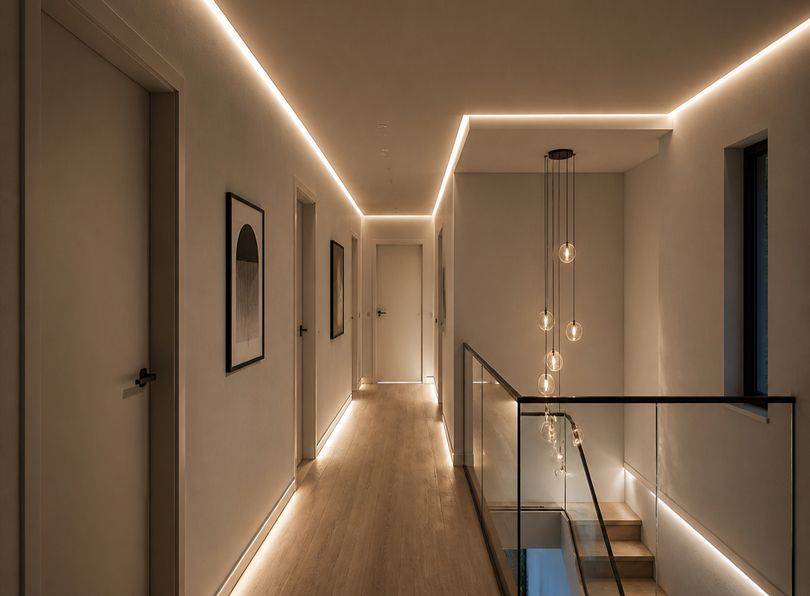
4.5 Hallway and landing ceiling lights
Hallways and landings are transitional spaces, areas through which we pass rather than linger, yet they create the critical first impression of any home and must provide adequate light for safe movement at all times. In a 2022 RoSPA report, inadequate staircase lighting was identified as a contributing factor in approximately 18% of all domestic stair-related accidents in England and Wales, making hallway and landing ceiling lights a genuine safety consideration, not merely an aesthetic one.
The primary ceiling light in a hallway should provide a minimum of 150 lux at floor level and on stairways, at least 100 lux on the stair treads with adequate contrast to allow tread edges to be clearly perceived. For narrow hallways with low ceilings (the norm in post-1960s UK construction) a flush-mounted LED fitting with a warm white output (2700K–3000K) and adequate lumen output (900–1,600 lm for a narrow hallway, 1,600–3,000 lm for larger entrance halls) is the standard solution. In grander entrance halls of Victorian or Edwardian townhouses, a statement pendant or chandelier creates the aspirational first impression the space demands.
Consider PIR (passive infrared) motion sensors for hallway and landing lighting, particularly in rental properties and for overnight use. A PIR-activated ceiling light uses no energy when the space is unoccupied, typically saving £10–£25 (€ 11.56 – € 28.91) per year in a frequently used hallway while ensuring the space is always lit when occupied. Combined LED/PIR ceiling lights are available from £15–£60 (€ 17.34 – € 69.38) and represent excellent value for these applications.
4.6 Home office ceiling lights
With 38% of UK workers now working from home at least two days per week (YouGov, 2024), home office lighting has become a mainstream requirement. Task performance, visual comfort, and sustained concentration require lighting levels of 300–500 lux at desk level, the standard recommended by both the Health and Safety Executive (HSE) and CIBSE for office work, typically achieved with a combination of ceiling lights and a dedicated desk lamp. Cool white ceiling lights (4000K–5000K) are strongly recommended for home offices, as they promote alertness and concentration more effectively than warm white alternatives. CRI ≥ 80 is the minimum, with CRI ≥ 90 recommended for any colour-critical or detailed work.
For home offices with video calling requirements (now standard in most professional roles) lighting direction is critical. A bright ceiling light directly above creates unflattering downward shadows on the face. Supplement the ceiling light with a soft front-facing desk lamp or ring light at approximately screen height to provide flattering front-fill illumination for video calls. This investment of £20–£50 (€ 23.13 – € 57.82) in supplementary task lighting dramatically improves on-screen appearance and presents a professional image to clients and colleagues.
4.7 Outdoor and porch ceiling lights
Outdoor ceiling lights (installed under porches, covered walkways, pergolas, carports, and canopy entrances) must contend with rain, temperature extremes (-15°C to +40°C), UV radiation, insects, and atmospheric pollution. All outdoor ceiling lights must carry an IP rating of at least IP44, and for exposed positions without protective side walls, IP65 is strongly recommended. All outdoor ceiling lights from LightingLine.eu carry appropriate weatherproofing certification and are supplied with complete installation guidance for UK outdoor use.
| Outdoor location | Min. IP rating | Recommended IP | Notes |
|---|---|---|---|
| Covered porch (sheltered on 3+ sides) | IP44 | IP54 | Protection from splash and insects required |
| Open soffit (exposed to weather) | IP54 | IP65 | Full weather resistance required |
| Carport ceiling | IP54 | IP65 | Vibration resistance also important |
| Pergola (open-sided) | IP65 | IP65 | Direct rain exposure must be assumed |
| Covered walkway | IP44 | IP54 | Vandal resistance important in public/communal areas |
5. LED technology: the science behind modern ceiling lights
Understanding the fundamental science of LED lighting technology is not merely of academic interest, it directly equips the buyer to make better purchasing decisions, to interpret the often-confusing specifications on product packaging and data sheets, and to assess whether a given ceiling light will genuinely perform as claimed. This section provides a thorough but accessible explanation of the key technical parameters that determine the real-world performance of modern LED ceiling lights in UK domestic applications.
5.1 Lumens, watts & energy efficiency
The most important shift in lighting understanding since the LED revolution is the move from watts to lumens as the primary measure of brightness. For over a century, British consumers used wattage as a proxy for brightness (a 100W bulb was bright, a 40W bulb was dim) because all incandescent lamps converted electricity to light at roughly the same efficiency. The arrival of energy-efficient lighting has destroyed this simple relationship: a 9W LED bulb is brighter than a 60W incandescent, and a 60W LED retrofit lamp produces as much light as a 400W tungsten lamp. Lumens (lm) measure total visible light output, the correct metric for comparing brightness. Watts (W) measure only the electrical power consumed.
| Technology | Typical efficacy (lm/W) | Typical lifespan (hours) | Heat produced | UK legal status 2026 |
|---|---|---|---|---|
| Incandescent (traditional) | 10–15 | 1,000 | Very high (95% heat) | Sale banned (2019) |
| Halogen (GU10, G9) | 15–25 | 2,000–3,000 | High (90% heat) | Sale banned (Sep 2023) |
| Compact Fluorescent (CFL) | 45–65 | 6,000–10,000 | Moderate | Sale banned (Aug 2023) |
| Standard LED | 80–110 | 15,000–25,000 | Low | Legal — recommended |
| High-efficacy LED | 110–160 | 25,000–50,000 | Very low | Legal — best choice |
| Premium LED (2026 frontier) | 160–220 | 50,000+ | Minimal | Legal — emerging segment |
Practical lumen requirements for UK rooms
| Room | Recommended lux | Example: 15 m² room (UF=0.65) | Note |
|---|---|---|---|
| Living room (ambient) | 100–200 lux | 2,300–4,600 lm | Supplement with floor/table lamps |
| Dining room | 150–200 lux | 3,460–4,615 lm | Focus illumination on the table |
| Kitchen (general) | 150–300 lux | 3,460–6,920 lm | Plus under-cabinet task lighting |
| Bedroom | 100–150 lux | 2,300–3,460 lm | Supplement with bedside lamps |
| Bathroom | 200–300 lux | 4,615–6,920 lm | CRI ≥ 90 strongly recommended |
| Home office | 300–500 lux | 6,920–11,540 lm | Plus dedicated desk lamp |
| Hallway/landing | 100–150 lux | Variable by length | Multiple fittings for long hallways |
UF = Utilisation Factor (0.50 for dark-painted rooms, 0.65 for medium-tone, 0.75 for white/light rooms)
5.2 Colour temperature (Kelvin)
Colour temperature, measured in degrees Kelvin (K), describes the spectral character of a light source’s output. The key relationship to understand: lower Kelvin = warmer (more amber/orange) light, higher Kelvin = cooler (more blue-white) light. This unintuitive reversal of everyday “warm” and “cool” language trips up even experienced buyers. A candle burns at approximately 1800K, an incandescent lamp at 2700K, midday sunlight at 5500–6500K.
| Colour temperature | Description | Visual character | Best applications | Wellbeing effect |
|---|---|---|---|---|
| 2200K–2700K | Extra warm / warm white | Amber-tinged white | Bedroom, lounge, dining, hospitality | Promotes relaxation and melatonin, ideal evenings |
| 2700K–3000K | Warm white | Slightly warm white | Living room, bedroom, bathroom | Comfortable domestic warmth, very versatile |
| 3000K–3500K | Neutral warm white | Clean white, slight warmth | Kitchen, bathroom, retail | Balanced, task-friendly without clinical feel |
| 4000K–4500K | Cool white / neutral | White with slight blue undertone | Kitchen, office, workshop, garage | Promotes alertness and sustained concentration |
| 5000K–6500K | Daylight / cool daylight | Blue-white | Studios, hobby rooms, commercial | High alertness, suppresses melatonin, avoid in evenings |
5.3 Colour Rendering Index (CRI / Ra)
The Colour Rendering Index (CRI, also expressed as Ra) measures a light source’s ability to reveal the natural colours of objects compared to sunlight, on a scale of 0–100 where 100 represents perfect colour rendering. Standard LED ceiling lights typically achieve Ra70–Ra80, high-quality models achieve Ra90–Ra95. The practical importance of CRI is consistently underestimated by consumers: an Ra70 ceiling light makes room colours appear subtly wrong (reds appear slightly orangey, blues appear greenish) while an Ra90+ fitting renders colours with near-natural accuracy, making the room feel more vivid and vibrant, and making grooming, food preparation, and clothing selection significantly more accurate.
Our recommendations across all room types: Ra≥80 minimum for all rooms and Ra≥90 for bathrooms, kitchens, any space where colour accuracy matters. All premium ceiling lights in the LightingLine.eu range specify CRI on the product page.
5.4 Dimmable LED ceiling lights
Dimming LED ceiling lights involves specific compatibility requirements that do not apply to incandescent or halogen sources. LED drivers operate fundamentally differently from simple resistive incandescent loads, and a “dimmable” LED ceiling light requires a compatible LED dimmer (specifically a trailing-edge (electronic) phase-cut dimmer) to achieve smooth, flicker-free dimming across the full brightness range. Leading-edge (inductive/magnetic) dimmers designed for halogen transformers are frequently incompatible with LED drivers and will cause flickering, buzzing, or failure to dim.
The key dimmer compatibility rule: always match the minimum load of the dimmer to the actual load of the LED fitting. Many trailing-edge LED dimmers specify a minimum load of 10–25W, a single 10W LED fitting may fall below this minimum, causing instability. Where installing a single low-wattage LED ceiling light on a trailing-edge dimmer, verify that the fitting’s wattage exceeds the dimmer’s stated minimum load, or choose a dimmer specifically rated for low minimum loads (available from as low as 1W minimum load).
| Dimmer type | LED compatible | Notes |
|---|---|---|
| Trailing edge (electronic) phase-cut | ✓ Yes — best choice | Designed for LED, smooth dimming, silent operation |
| Leading edge (magnetic/inductive) | ⚠ Often incompatible | Designed for transformer loads, flickering with most LEDs |
| 0-10V analogue | ✓ Yes (with compatible driver) | Professional system, smooth 0–100% range |
| DALI (digital addressable) | ✓ Yes (with DALI driver) | Professional digital protocol, individual address per fitting |
| PWM (pulse width modulation) | ✓ Yes (PWM driver) | Used in smart LED systems, no visible flicker at ≥1000Hz |
5.5 LED drivers and transformers
Every LED ceiling light requires a driver, an electronic power supply that converts mains AC electricity (230V, 50Hz in the UK) to the specific DC voltage and current required by the LED chip array. The quality of the LED driver is one of the most significant determinants of a ceiling light’s long-term reliability: a premium LED chip combined with a cheap driver will underperform and fail prematurely, while a modest LED chip with a high-quality driver will provide years of reliable, consistent performance. Two principal driver topologies are used: constant current (CC) drivers, which maintain a fixed output current regardless of load variation (used in most quality integrated ceiling lights) and constant voltage (CV) drivers, which maintain a fixed output voltage and are used for LED strips and some modular luminaires.
6. IP ratings and safety: what every UK buyer needs to know
The IP (Ingress Protection) rating system, defined by IEC 60529 and its British equivalent BS EN 60529, provides a standardised method of describing the protection a luminaire’s enclosure offers against solid foreign bodies and liquids. Understanding IP ratings is essential for any ceiling light purchase in bathrooms, kitchens, outdoor areas, or any location where moisture, dust, or particles may be present. An IP rating consists of the letters “IP” followed by two digits: the first digit (0–6) indicates protection against solid particles, the second digit (0–9K) indicates protection against liquids.
| IP rating | Solid protection (1st digit) | Liquid protection (2nd digit) | Typical ceiling light applications |
|---|---|---|---|
| IP20 | Objects >12mm (fingers) | No water protection | Dry indoor rooms only (living room, bedroom, hallway) |
| IP44 | Objects >1mm (tools, wires) | Water splash from any direction | Bathrooms (zones 1&2), kitchens, covered outdoor locations |
| IP54 | Dust protected (limited ingress) | Water splash from any direction | Bathrooms, outdoor covered locations, dusty workshops |
| IP65 | Dust tight (no ingress) | Low-pressure water jets from any direction | Outdoor exposed locations, wet rooms, rain shower areas |
| IP67 | Dust tight | Temporary immersion (30 min, 1m depth) | Underwater features, pool surrounds, zone 0 bathroom |
| IP68 | Dust tight | Continuous immersion (depth specified by manufacturer) | Permanently submerged lighting applications |
A common point of confusion: the IP rating describes the fitting’s enclosure only, it does not cover the electrical cable entry point or the luminaire’s suitability for outdoor temperature ranges. For outdoor ceiling lights, also verify that the product is rated for the full UK temperature range (-10°C to +40°C) and that the electrical entry is sealed to the same standard as the body of the fitting.
7. The ultimate ceiling lights buying guide
With such a vast and technically diverse market, selecting the right ceiling light can feel overwhelming. This section distils our expert team’s accumulated knowledge into a structured, practical framework for making confident ceiling light purchasing decisions: covering every key variable from ceiling height and room size to energy labelling and running costs.
7.1 Ceiling height considerations
| Property type | Typical ceiling height | Recommended ceiling light types | Types to avoid |
|---|---|---|---|
| Post-1970s new-build | 2.3m–2.4m | Flush, recessed spots, compact semi-flush (drop <20cm) | Long pendants, large chandeliers |
| 1930s–1970s semi/terrace | 2.3m–2.5m | Flush, semi-flush, compact pendant (adjustable) | Full chandeliers, long fixed-drop pendants |
| Edwardian terraced house | 2.5m–2.8m | All types, pendants, semi-flush, chandeliers | Very oversized scale only |
| Victorian terraced/semi | 2.6m–3.0m | All types, chandeliers highly suitable | No significant restrictions |
| Victorian/Georgian townhouse | 3.0m–4.0m | Large chandeliers, dramatic statement pendants | Small flush fittings (visually lost at height) |
| Contemporary open-plan | 2.4m–3.5m (variable) | Track lighting, linear pendants, flush zones | Single central pendant over large span |
| Loft conversion | Varies 1.8m–3.0m | Flush, recessed, angled-ceiling fittings | Any pendant over areas with restricted headroom |
7.2 Room size and lumen output
Calculating the required lumen output for your room:
- Measure room area in m² (length × width)
- Determine the required lux for the room’s primary function
- Determine your room’s utilisation factor: 0.50 for dark walls/ceiling; 0.65 for medium tones; 0.75 for white or pale rooms
- Calculate: Required lumens = (Required lux × Area m²) ÷ Utilisation factor
7.3 Style and interior design compatibility
| Interior style | Key characteristics | Ceiling light finishes | Ceiling light forms | Colour temp. |
|---|---|---|---|---|
| Contemporary minimalist | Clean lines, neutral palette | Matt black, white, brushed steel | Simple geometric, flat disc, slim panel | 3000K–4000K |
| Warm minimalist (Japandi) | Natural materials, warm neutrals | Brushed brass, aged bronze, wood accents | Washi paper, natural linen, organic forms | 2700K |
| Industrial | Exposed materials, utilitarian aesthetic | Raw/brushed steel, black metal, factory bronze | Cage, dome, gooseneck, bare bulb | 2200K–2700K |
| Art deco | Geometric forms, decorative glamour | Polished gold/brass, chrome, black and gold | Stepped geometric, fan forms, frosted glass | 2700K–3000K |
| Farmhouse/country | Rustic warmth, natural textures | Aged brass, rubbed bronze, cream enamel | Lantern form, drum shade, simple chandelier | 2700K |
| Grand traditional | Formality, classical proportions | Polished brass, ormolu gold, crystal | Multi-arm chandelier, crystal drops, corona | 2700K |
7.4 Budget guide: what to expect at each price point
| Budget tier | Price Range | What to Expect | Efficacy | Warranty | Best For |
|---|---|---|---|---|---|
| Entry level | £8–£25 (€ 9.25 – € 28.91) | Basic flush LED, fixed CCT, no dimming, basic IP | 70–85 lm/W | 6–12 months | Rental properties, secondary/utility rooms |
| Mid-range | £25–£70 (€ 28.89 – € 80.90) | Better design, selectable CCT, some dimmable, IP44 options | 85–100 lm/W | 1–2 years | Most domestic rooms, good everyday value |
| Upper mid-range | £70–£150 (€ 80.90 – € 173.35) | Genuine design quality, dimmable standard, tunable white, Ra≥80 | 95–115 lm/W | 2–3 years | Living rooms, master bedrooms, kitchens |
| Premium | £150–£350 (€ 173.35 – € 404.50) | High-quality materials, Ra≥90 CRI, full smart home, exceptional diffusion | 110–130 lm/W | 3–5 years | Statement rooms, design-led interiors |
| Luxury | £350–£1,000+ (€ 404.50 – € 1,155.70) | Heritage/luxury brands, bespoke elements, exceptional craft and materials | Variable | 5+ years | High-end renovation, period properties |
7.5 Energy labels and running costs
Since September 2021, all light sources sold in the UK must display the revised rescaled Energy Label showing classes A (most efficient) to G (least efficient). Under the current system, most mainstream LEDs fall into classes B, C, and D: class A is reserved for the most advanced LED technology and class F and G for legacy inefficient products.
Annual running cost formula: (Wattage ÷ 1,000) × Daily hours of use × 365 × Unit rate (£/kWh)
| Fitting type | Wattage | Annual cost (4h/day, 34p/kWh) | 10-year running cost |
|---|---|---|---|
| Incandescent (100W equivalent) | 100W | £49.64 (€ 57.37) | £516 (€ 596.34)+ (incl. replacements) |
| Halogen (72W equiv.) | 72W | £35.74 (€ 41.30) | £387 (€ 447.26) |
| LED bulb (9W equiv.) | 9W | £4.47 (€ 4.17) | £51 (€ 58.94) |
| LED flush ceiling light (24W) | 24W | £11.92 (€ 13.78) | £125 (€ 144.46) |
| LED panel light (40W) | 40W | £19.86 (€ 22.95) | £204 (€ 235.76) |
| Smart LED ceiling light (18W) | 18W | £8.94 (€ 10.36) | £97 (€ 112.10) |
Based on UK average electricity rate of 34p/kWh (Q1 2025, Ofgem), 4 hours of daily use. Replacement lamp costs included for non-integrated fittings.
8. Ceiling lights installation guide
Ceiling light installation in UK domestic properties is governed by a clear and comprehensive regulatory framework. Electrical safety is not an area where shortcuts or guesswork are acceptable: incorrectly installed ceiling lights have been identified as contributing causes of electrical fires, electrical shock incidents, and fatal accidents in UK homes. Understanding what you can safely do yourself (and critically, when you must engage a qualified electrician) is essential knowledge for every UK homeowner.
8.1 UK Electrical Regulations (BS 7671 & Part P)
All fixed electrical installations in UK dwellings are regulated by BS 7671: Requirements for Electrical Installations (IET Wiring Regulations), 18th Edition, as amended 2022. This standard has statutory force in England and Wales through Part P of the Building Regulations 2010 (as amended). Scotland operates under equivalent provisions of the Scottish Building Standards.
Under Part P, electrical work is classified as:
- Notifiable work: must be carried out by a Part P registered electrician (who self-certifies) or notified to local Building Control for independent inspection. Includes: all new circuits, any new cable routes in walls or ceilings, any bathroom/kitchen/outdoor electrical work; consumer unit work and work in special locations.
- Non-notifiable work: minor work a competent person can carry out without notification. Includes: replacing a like-for-like ceiling light fitting on an existing circuit in a non-bathroom, non-kitchen, non-outdoor location.
8.2 DIY installation: step-by-step
For replacing a like-for-like ceiling light fitting in a non-bathroom, non-kitchen room, a competent homeowner can safely carry out installation by following these steps precisely:
- Switch off the power at the consumer unit (fuse box/MCB), not merely at the wall switch. The wall switch disconnects the switched live conductor only, the permanent live remains present at the ceiling rose when the switch is off.
- Verify power is off using a non-contact voltage tester (NCV tester, available from £10–£20) at the ceiling rose and at each individual wire before touching any conductors. Proceed only when all tests confirm no live voltage.
- Photograph the existing wiring connections before disconnecting anything, this provides an invaluable reference if any confusion arises during reconnection.
- Disconnect the existing fitting: unscrew the shade or cover, note and photograph the wire connections, disconnect wires from the terminal block or connector.
- Connect the new fitting: brown (or legacy Red) wire = Live (L terminal), Blue (or legacy Black) wire = Neutral (N terminal), Green/Yellow striped wire = Earth (E or ⏚ terminal). The earth connection must never be omitted or left disconnected — even if the existing fitting had no earth.
- Secure the fitting: to the ceiling according to the manufacturer’s instructions. Verify that the fitting’s weight is borne by the ceiling pattress or a structural joist, never by the electrical cable alone.
- Restore power and test: check dimmer compatibility before completing final installation if the circuit has a dimmer switch.
8.3 When to call a professional electrician
Always engage a Part P registered electrician (verifiable at competentperson.co.uk) for:
- Any bathroom ceiling light work — notifiable under Part P without exception
- Any new ceiling light position (new hole, new cable run, new circuit)
- Any kitchen ceiling light work
- Any outdoor ceiling light installation
- Fire-rated recessed spotlight installation in fire-compartment ceilings
- Multi-circuit or smart lighting system installation with new wiring
- Any situation where existing wiring is old (pre-2004 colours), deteriorated, or of uncertain configuration
- Properties being prepared for sale or new tenancy where compliance documentation (EICR) is required
The typical cost for a Part P registered electrician to install 1–6 ceiling lights at existing positions is £80–£200 (€ 92.46 – € 231.14) including certification, a modest investment given the safety assurance and legal compliance it provides. For new circuit work, costs will be higher and will require an Electrical Installation Certificate (EIC).
9. Smart ceiling lights and home automation
The integration of ceiling lights into the broader home automation ecosystem represents one of the most significant shifts in domestic lighting since the invention of the electric light itself. Smart ceiling lights transform lighting from a passive utility into an active contributor to home comfort, security, energy management, and wellbeing. The UK smart home market has grown at a compound annual rate of 18% since 2020, and lighting remains consistently the most popular entry point into home automation, ahead of smart heating, security cameras, and smart appliances. The primary driver is simple: the immediate, tangible benefit of voice-controlled, scene-based, and scheduled lighting is evident from the first day of use.
9.1 Zigbee vs Wi-Fi vs bluetooth vs matter
Smart ceiling lights use one of four principal wireless communication protocols, each with distinct characteristics that affect reliability, range, ease of setup, and ecosystem compatibility. Understanding the differences is essential before investing in smart ceiling lighting, as the protocol choice determines hub requirements, range, latency, and long-term platform compatibility.
| Protocol | Range | Requires hub | Mesh network | Latency | Key advantages | Key limitations |
|---|---|---|---|---|---|---|
| Zigbee | 10–20m per node (mesh extends) | Yes (Hue Bridge, SmartThings etc.) | Yes — self-healing mesh | <10ms | Highly reliable, low power, excellent scalability, wide device compatibility | Hub required, more complex initial setup |
| Wi-Fi (2.4GHz) | 30–50m (via home router) | No (uses home router) | No (standard) | 50–200ms | No dedicated hub, easy app setup, remote access out of the box | Congests home Wi-Fi, router-dependent, cloud reliance |
| Bluetooth (BLE Mesh) | 10–30m direct, extends via mesh | No (smartphone as hub) | Some (Bluetooth Mesh) | 20–100ms | Simple setup, works without internet for local control | Limited range without mesh, phone required for remote access |
| Matter over Thread | Variable (Thread mesh extends) | Thread border router needed | Yes — Thread mesh | <50ms | Universal standard, all major platforms, local control, future-proof | Ecosystem still maturing, some feature gaps |
9.2 Voice control integration
Voice control is now the primary interaction modality for smart ceiling lights in UK homes, ahead of smartphone apps and physical switches. All three dominant voice platforms (Amazon Alexa, Google Assistant, and Apple Siri) support ceiling light control through their respective ecosystems, and all LightingLine.eu smart ceiling lights are compatible with all three platforms as standard. The introduction of the Matter standard in 2022/23 (backed by Apple, Google, Amazon, Samsung, and over 400 technology companies) has created a landmark universal protocol guaranteeing forward compatibility for all Matter-certified ceiling lights across all current and future platforms.
Common voice commands that transform daily living with smart ceiling lights: “Alexa, dim the living room to 30%” — “Hey Google, set the bedroom lights to warm white” — “Siri, turn off all the lights” — “Alexa, activate cinema mode” — “Hey Google, good morning” (triggers a pre-programmed wake-up scene). The ability to control all ceiling lights from anywhere in the home, and remotely via smartphone, also delivers a meaningful security benefit, lighting can be set to simulate occupancy when the property is vacant.
10. Sustainability and environmental impact of LED ceiling lights
The transition to LED ceiling lighting represents one of the most straightforward and impactful environmental improvements available to UK households. If every ceiling light in the UK’s 29 million homes were replaced with an equivalent-output LED fitting, the resulting energy saving would be approximately 18 TWh per annum: equivalent to the output of 2–3 medium-sized power stations and a reduction in collective household electricity bills of approximately £8 billion (€ 9.25 billion) annually at current UK electricity prices. The UK Government’s Energy Efficiency Taskforce has identified LED lighting as the single highest return-on-investment energy efficiency measure available to UK households, ahead of heat pump installation, insulation upgrades, and smart meter rollout.
| Sustainability metric | Incandescent / Halogen | Standard LED (2020) | High-efficacy LED (2025) |
|---|---|---|---|
| Energy consumption (equivalent brightness) | 100% | 15–20% | 8–12% |
| Lifespan | 1,000–3,000 hours | 15,000–25,000 hours | 30,000–50,000 hours |
| Replacements in 20 years (avg. use) | 14–28 lamps | 1–2 lamps | 0–1 lamps |
| CO₂ equivalent (per lamp, 20 years, UK grid) | ~420 kg CO₂e | ~70 kg CO₂e | ~45 kg CO₂e |
| Mercury content | None (incandescent) / trace (halogen) | None | None |
| Recyclable materials | Glass, metal | Glass, aluminium, some plastics | Glass, aluminium, some plastics |
Beyond operational energy, important sustainability considerations include: manufacturing impact (rare earth minerals in LED chips; electronics manufacturing energy) and end-of-life disposal (WEEE Regulations require all electrical lighting products to be disposed of through authorised recycling channels, not general waste). L
The most sustainable ceiling light purchase is a modular, serviceable design with a high-quality driver, one where the LED module and driver can be independently replaced, extending the product’s useful life to 20+ years. We actively prioritise such designs across our range and label all serviceable products clearly on our product pages. A ceiling light that lasts 25 years, purchased once, is vastly more sustainable than four cheap alternatives requiring replacement every five to seven years each.
11. Comprehensive ceiling lights comparison table
The following master comparison table consolidates the key characteristics of all major ceiling light types, enabling rapid side-by-side evaluation for any given application, room, or budget requirement.
| Type | Min. ceiling height | Typical output | IP options | Dimmable | Smart | Price range (UK) | Best room(s) | Maintenance level |
|---|---|---|---|---|---|---|---|---|
| Flush LED | Any (ideal <2.4m) | 600–4,800 lm | IP20–IP65 | Some | Some | £12–£150 | Bedroom, hallway, bathroom | Very low |
| Semi-flush | 2.3m | 400–3,000 lm | IP20 | Many | Some | £25–£300 | Living room, bedroom, dining | Low |
| Pendant | 2.3m+ (table use: any) | 400–3,000 lm | IP20 | Many | Via smart bulb | £20–£500+ | Dining, kitchen island, bedroom | Low |
| Chandelier | 2.5m | 1,000–6,000+ lm | IP20 | Usually | Via smart bulbs | £60–£5,000+ | Dining, living, reception room | Medium |
| Recessed downlight | Any (needs ceiling void) | 300–700 lm each | IP20–IP65 | Many | Some | £8–£80 each | Kitchen, bathroom, living room | Low |
| Track lighting | 2.2m | Variable (multi-head) | IP20 | Many | Some | £50–£600 (system) | Open-plan, kitchen, gallery | Low (repositionable) |
| LED panel | Any | 2,400–6,000 lm | IP20–IP44 | Many | Some | £25–£200 | Kitchen, office, utility | Very low |
| Ceiling fan + light | 2.5m (ideal 2.7m+) | 500–2,500 lm | IP20 | Many | Many | £80–£500 | Living room, bedroom, conservatory | Medium |
| Smart ceiling light | Variable by design | 600–3,500 lm | IP20–IP44 | Yes (digital) | Yes | £35–£250 | Any room | Low |
12. Why buy ceiling lights from LightingLine?
At LightingLine, we are specialist lighting retailers with 10 years of experience supplying high-quality ceiling lights to homeowners, interior designers, property developers, and trade customers across Europe — with a particular focus on the UK market. Our business is built on a single proposition: to provide genuinely better ceiling lights than can be found in general electrical or DIY retailers, at prices that represent real value, backed by expert knowledge and exceptional customer service. We are not a marketplace, we are a specialist retailer where every product in our catalogue has been evaluated and approved by our lighting expert team before it appears on our website.
| Differentiator | LightingLine | Typical high-street retailer | Generic online marketplace |
|---|---|---|---|
| Product curation | Expert-curated, all products tested & approved before listing | Limited range, category buyer-led | Vast but completely unvetted, highly variable quality |
| Technical specifications | Complete, verified specs, CRI, dimmer compatibility, IP all verified | Basic, often incomplete or inaccurate | Frequently inaccurate, missing, or fabricated |
| Expert advice | Specialist lighting team: phone, email, live chat | General retail staff with limited product knowledge | No expert advice, automated chat only |
| Delivery | Fast tracked delivery to UK, no unexpected import costs | Same-day / next-day possible | Variable delivery times, potential customs charges post-Brexit |
LightingLine.eu stocks over 2,000 ceiling light products across all categories: flush LED, semi-flush, suspended, recessed, track and smart, spanning every price point from practical budget fittings to premium statement pieces. Our EU warehouse enables fast, tracked delivery to all UK mainland addresses. Expert product advice from our specialist team is available by phone, email, and live chat Monday to Friday, something simply not available from any general marketplace or DIY retail giant.
13. Frequently asked questions (FAQ)
The following FAQ covers the most commonly asked questions from UK buyers researching ceiling lights, drawn from our customer service records and search data analysis. Each answer is written to provide a complete, authoritative response to the question as typically posed to AI assistants, voice search, and search engines.
Ceiling lights: final recommendations from the experts
Ceiling lights are among the most significant investments you can make in the comfort, functionality, and aesthetic appeal of your home. The decisions you make when selecting ceiling lights will affect every day of your life in that space: the quality of the light you wake up to, work by, cook under, relax in, and fall asleep with. Given this pervasive and enduring influence, ceiling light selection deserves a level of care and knowledge that most consumers currently apply to purchases of far less lasting impact.
The overarching conclusion from everything this guide has covered is both simple and well-supported by the evidence: invest in quality LED ceiling lights, matched precisely to your room’s ceiling height, function, and aesthetic character, from a specialist retailer whose expert team can advise, whose products are fully specified and certified, and whose guarantee genuinely protects your purchase. That description, we believe, defines LightingLine.eu and it is the standard against which any ceiling light purchase should be measured.
LightingLine.eu expert recommendations: the essential summary
- Always choose LED: superior in every performance metric; lower running costs; far longer lifespan; halogen is now banned for sale in the UK.
- Match fitting to ceiling height: flush for under 2.3m; semi-flush or pendant for 2.3m–2.7m; chandeliers and dramatic pendants for 2.7m+.
- Prioritise lumens over watts: target the lux levels appropriate to each room’s function and calculate required lumens from room area and utilisation factor.
- Select the right colour temperature: 2700K for bedrooms and living rooms; 3000K–3500K for bathrooms; 4000K for kitchens and home offices.
- Invest in CRI ≥ 90 where it matters: bathrooms, kitchens, and anywhere you judge colour, skin tone, or food quality.
- IP44 as standard for bathrooms: IP65 for outdoor exposed ceiling locations and wet rooms.
- Choose dimmable in living rooms and bedrooms: the ability to control brightness transforms daily living and supports healthy sleep.
- Consider smart lighting: for rooms used actively living rooms, bedrooms, and kitchens deliver the strongest return on smart lighting investment.
- Buy quality, buy once: a ceiling profile that performs well and lasts 20+ years is dramatically better value than a budget product replaced every 3–5 years.
- Shop LightingLine.eu for expert curation, verified full specifications and genuine specialist support from our experienced team.
At LightingLine, we believe that every UK home deserves exceptional ceiling lighting and that exceptional ceiling lighting should not require exceptional expenditure. Our curated range of ceiling lights, each selected and approved by our expert team, represents the best of European lighting design and manufacturing quality at prices that make great lighting accessible to every homeowner. Great lighting transforms great spaces. Great spaces transform the quality of daily life. We look forward to helping you make your home’s ceiling lighting everything it can be.
This article was developed with the support of artificial intelligence and subsequently reviewed, corrected, and validated by the LightingLine.eu technical team, which guarantees its reliability and compliance with official sources.