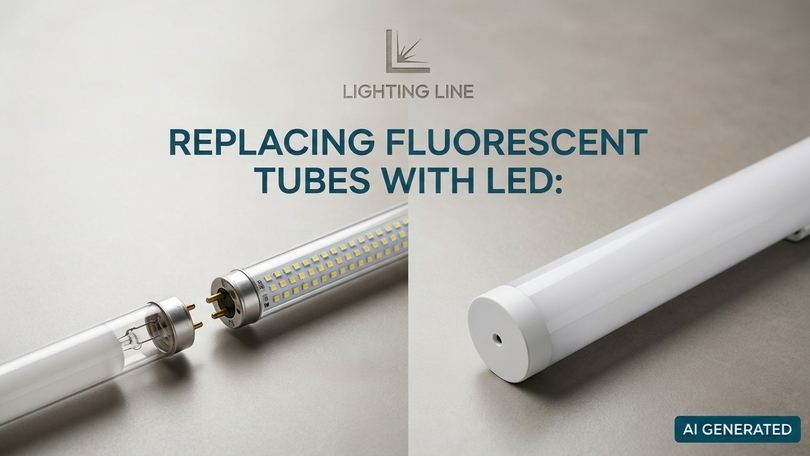
Fluorescent tubing lit Europe’s offices, factories, schools and car parks for more than half a century, and it is now leaving the market for good. Since 24 August 2023 the most common T5 and T8 fluorescent tubes can no longer be placed on the EU market, which means every building that still runs on fluorescent tubing is living on remaining stock. For construction companies, contractors, facility managers and electricians the question is no longer whether to move to LED, but how: drop an LED tube into the existing fitting, or replace the fitting with a new linear LED luminaire?This guide answers that question with numbers, tables and checklists.
It covers fluorescent tube sizes, ballast compatibility, lumens and colour temperature, costs and payback, safety, disposal and a sector-by-sector set of recommendations. It also shows how aluminium profiles and LED strips from the Lighting Line catalogue can replace fluorescent tubing with continuous, custom-length linear light that a building contractor can specify, install and document in BIM.
In this article…
- Why fluorescent tubing is being phased out
- How fluorescent tubing works
- Fluorescent tube sizes, types and caps
- Lumens, wattage, colour temperature and CRI
- Ballasts and electrical compatibility
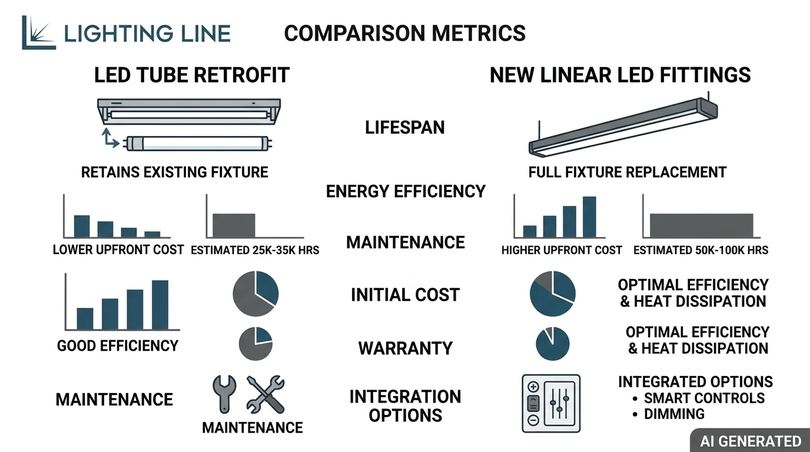
- Retrofit vs new linear fittings: the decision
- Building new linear LED fittings with profiles and strips
- Sector guide: industry, offices, schools, workshops, labs
- Fluorescent tubing installation and replacement, step by step
- Energy savings, costs and payback
- Maintenance schedules after the switch
- Three typical project scenarios
- Safety, storage and disposal of fluorescent tubing
- Specification checklist for construction companies
- Frequently asked questions
- From fluorescent tubing to linear light
1. Why fluorescent tubing is being phased out
The end of fluorescent tubing is not a market trend; it is a regulatory decision built on two pillars, mercury and energy. Understanding the dates and the rules matters, because it defines what you can still buy, what you can still install and how much time you really have to plan the transition.
The EU rules: RoHS and Ecodesign
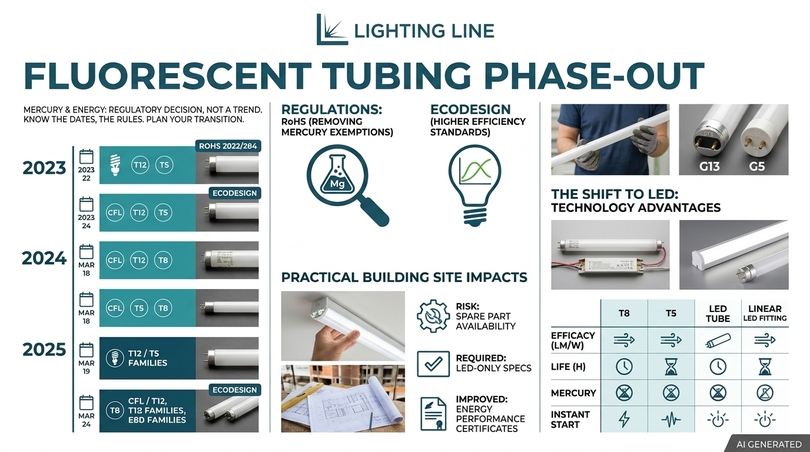
Fluorescent tubing contains a small dose of mercury. Under the RoHS Directive 2011/65/EU, mercury is a restricted substance, and fluorescent lamps had survived thanks to specific exemptions. Commission Delegated Directive (EU) 2022/284 removed those exemptions for general lighting. In parallel, the Single Lighting Regulation (Ecodesign Regulation (EU) 2019/2020) raised minimum efficiency levels that standard T8 tubes cannot meet.
Key EU dates for fluorescent tubing
| Lamp family | Typical examples | EU end of placing on the market | Legal basis |
|---|---|---|---|
| Compact fluorescent, non-integrated (pin base) | PL-C, PL-T, PL-L, 2G11, G24 | 24 February 2023 | RoHS 2022/284 |
| T12 linear fluorescent tubes | 38 mm halophosphate tubes | 24 February 2023 | RoHS 2022/284 |
| T5 linear fluorescent tubes | T5 HE 14/21/28/35 W, T5 HO 24/39/49/54/80 W | 24 August 2023 | RoHS 2022/284 |
| T8 linear fluorescent tubes | T8 18 W (2 ft), 36 W (4 ft), 58 W (5 ft), 70 W (6 ft) | 24 August 2023 | RoHS 2022/284 and Ecodesign |
| Special purpose lamps | UV-C, certain emergency and transport applications | Exemptions extended | RoHS Annex III |
The ban applies to placing new products on the market, not to using them. Fittings with working fluorescent tubing can legally stay in service, and distributors may sell remaining stock. But stock is shrinking, prices for the last tubes tend to rise, and lamp quality from unknown sources varies.
The UK timeline
Great Britain follows its own version of the rules. According to the Lighting Industry Association, T8 fluorescent tubes of 2, 4 and 5 ft were phased out from 1 September 2023 under Ecodesign, while T5 tubes and other T8 lengths followed from 1 February 2024 under RoHS. So the answer to “are fluorescent tubes banned in the UK?” is effectively yes for new supply, although you can still find and use remaining stock.
What the phase-out means on a building site
For a construction company or a maintenance contractor, the consequences are practical:
- Spare parts become a risk. A refurbished floor fitted with fluorescent tubing today will need replacement tubes in two or three years, when stock may be gone.
- Tender specifications change. Public and private clients increasingly require LED-only specifications, energy calculations and mercury-free installations.
- Energy performance certificates are affected. Lighting is a measurable part of a non-residential building’s energy demand, and replacing fluorescent tubing is one of the quickest ways to improve the rating.
- Warranty and liability shift. When you modify a fitting (for example, bypassing a ballast) the installer takes responsibility for the modified product.
Market context: why LED has already won
LED technology has moved from niche to default in the space of a decade. Modern LED sources reach well over 120 lumens per watt at module level, while a T8 fluorescent tube on a magnetic ballast delivers roughly 70 to 80 lumens per watt at system level. LED also starts instantly, does not suffer from frequent switching, works well in the cold and contains no mercury. The U.S. Department of Energy notes that quality LED products use at least 75% less energy than incandescent lighting and last far longer, and the gap against fluorescent tubing, while smaller, is still decisive in high-use buildings.
| Indicator | T8 fluorescent tubing (magnetic ballast) | T5 fluorescent tubing (electronic ballast) | LED tube | Linear LED fitting (profile + strip) |
|---|---|---|---|---|
| Typical system efficacy | 70 to 80 lm/W | 85 to 95 lm/W | 120 to 160 lm/W | 100 to 150 lm/W (after diffuser) |
| Typical rated life | 12,000 to 20,000 h | 20,000 to 24,000 h | 30,000 to 50,000 h | 50,000 h and more (depending on thermal design) |
| Mercury content | Up to 3.5 mg (EU limit for tri-band T8) | Up to 3 mg | None | None |
| Instant start, frequent switching | No, starter delay; switching shortens life | Partially | Yes | Yes |
| Dimming | Only with dedicated ballasts | With dimmable ballasts | Limited models | Yes, with suitable driver (DALI, 0-10 V, push) |
| Cold-start performance | Poor below 10 °C | Poor below 10 °C | Good | Good |
Values are typical ranges drawn from manufacturer datasheets; always check the specific product.
2. How fluorescent tubing works
To replace fluorescent tubing well, it helps to know what it is doing inside the fitting. The physics explains why a fluorescent tube needs a ballast, why it flickers when it ages, why it dislikes cold and why it is classified as hazardous waste. It also explains why LED tubes come in several electrical “types” that are not interchangeable.
Definition: what is a fluorescent tube?
A fluorescent tube is a low-pressure mercury-vapour gas-discharge lamp that uses a phosphor coating to turn ultraviolet radiation into visible light. The term “fluorescent tubing” is used in the trade both for the lamps themselves and, more loosely, for the linear tubular format they share. Fluorescent tubes are also called linear fluorescent lamps (LFL), tubular fluorescent lamps, strip light bulbs, fluro tubes or simply tube lights.
The gas discharge, step by step
- Electrodes heat up. At each end of the glass tube a tungsten filament coated with emissive material is heated, releasing electrons.
- A high-voltage pulse strikes the arc. The starter (in magnetic systems) or the electronic ballast creates a voltage peak that ionises the gas inside the tube.
- Mercury vapour emits ultraviolet light. Electrons collide with mercury atoms, which release mainly invisible ultraviolet radiation at 254 nm.
- The phosphor turns UV into visible light. The white powder coating on the inside of the glass absorbs the UV and re-emits it as visible light. The phosphor blend sets the colour temperature and the colour rendering.
- The ballast limits the current. A gas discharge has negative resistance: without a ballast, current would rise until the lamp destroyed itself.
Fluorescent tube components and construction
Every fluorescent tube light, from an 18 W T8 to a 54 W T5 HO, is built from the same set of parts. Knowing them helps when you diagnose a failure or evaluate a retrofit.
| Component | Function | Typical failure sign | What changes with LED |
|---|---|---|---|
| Glass envelope | Contains gas and supports the phosphor | Breakage, mercury release | LED tubes use polycarbonate or glass-coated shatter-resistant bodies; LED strips in aluminium profiles use PMMA or polycarbonate diffusers |
| Phosphor coating | Converts UV to visible light | Lumen depreciation, colour shift | Phosphor is on the LED chip; depreciation is slower |
| Electrodes (cathodes) | Emit electrons | Blackened ends, slow start, flicker | No electrodes, no end-blackening |
| Fill gas (argon + mercury) | Sustains the discharge | Hard starting in cold areas | No gas, instant start at low temperature |
| End caps (G13, G5) | Mechanical and electrical connection | Burnt pins, loose lampholders | LED tubes reuse G13/G5; new linear fittings use terminal blocks and connectors |
| Ballast | Limits current, provides ignition | Humming, heat, failure to start | Replaced by an LED driver or bypassed |
| Starter (magnetic systems) | Pre-heats electrodes, triggers ignition | Repeated blinking at switch-on | Replaced with an LED “fuse starter” or removed |
Why fluorescent tubing flickers
Flicker is one of the most frequent complaints about fluorescent tubing in workshops, offices and classrooms. On magnetic ballasts the arc extinguishes and re-strikes 100 times per second (at 50 Hz mains), producing a 100 Hz modulation that most people do not see but that can cause fatigue, headaches and stroboscopic effects on rotating machinery. As the tube ages, electrode wear causes visible flicker and blinking. Electronic ballasts operate the tube at high frequency (typically 20 to 60 kHz), which virtually eliminates perceptible flicker. LED drivers with low ripple current achieve the same or better result.
Fluorescent tube vs neon tube
People often ask about the difference between a neon tube and a fluorescent tube. A neon sign tube uses a high-voltage discharge in neon or other noble gases, and the colour comes directly from the gas; a fluorescent tube uses low-pressure mercury and relies on a phosphor coating to produce white light. Neon tubes are decorative; fluorescent tubing is general lighting. Both are now commonly replaced by LED: flexible LED neon for signs, LED tubes and linear LED fittings for general lighting.
3. Fluorescent tube sizes, types and caps
“How do I know which fluorescent tube I need?” is one of the most searched questions on the subject, and for good reason: ordering the wrong length or diameter stops a job. The same information is essential when choosing an LED replacement or sizing a new linear fitting, because the existing cut-outs, ceiling grids and suspension points usually follow fluorescent dimensions.
Reading the code: T5, T8, T12 and T4
The “T” stands for tubular, and the number is the diameter in eighths of an inch. So a T8 is 8/8 = 1 inch (about 26 mm), a T5 is 5/8 inch (16 mm) and a T12 is 12/8 = 1.5 inches (38 mm). The same logic applies to T4 (12.5 mm), often found in under-cabinet “strip lights” and mirror lights.
| Type | Diameter | Cap | Typical uses | Ballast | Status in the EU |
|---|---|---|---|---|---|
| T12 | 38 mm | G13 (bi-pin, 13 mm spacing) | Old industrial and commercial fittings | Magnetic | Phased out since February 2023 |
| T8 | 26 mm | G13 | Battens, offices, schools, warehouses, car parks | Magnetic or electronic | Phased out since August 2023 |
| T5 | 16 mm | G5 (bi-pin, 5 mm spacing) | Modern offices, recessed troffers, high-bays, shelving | Electronic only | Phased out since August 2023 |
| T4 | 12.5 mm | G5 or proprietary | Under-cabinet, kitchen, mirror strip lights | Electronic (integrated) | Remaining stock only |
| T9 circular / T5 circular | 29 mm / 16 mm | G10q / 2GX13 | Round ceiling fittings, kitchens, stairwells | Magnetic or electronic | Phased out since February 2023 |
Standard fluorescent tube lengths
Fluorescent tube sizes follow a nominal length that includes the pins. T8 lengths are given in feet in the UK and US and in millimetres in continental Europe; T5 lengths are about 50 mm shorter than their T8 “equivalents”, which is why a T5 never fits a T8 lampholder spacing.
| Nominal length | T8 length (mm) | T8 typical wattage | T5 length (mm) | T5 HE wattage | T5 HO wattage |
|---|---|---|---|---|---|
| 2 ft | 590 | 18 W | 549 | 14 W | 24 W |
| 3 ft | 895 | 30 W | 849 | 21 W | 39 W |
| 4 ft | 1200 | 36 W | 1149 | 28 W | 54 W |
| 5 ft | 1500 | 58 W | 1449 | 35 W | 49 W / 80 W |
| 6 ft | 1800 | 70 W | not standard | not standard | not standard |
| 8 ft | 2400 (mainly T12 / US) | 100 W (T12) | not standard | not standard | not standard |
How to identify the fluorescent tube you need
- Read the print on the glass. Most tubes show a code such as “TL-D 36W/840” or “F58W/865”. The number before W is the wattage; 840 means CRI 80+ and 4000 K; 865 means CRI 80+ and 6500 K.
- Measure the diameter. About 26 mm is T8, 16 mm is T5, 38 mm is T12.
- Measure the length pin to pin. Compare it with the table above.
- Check the pin spacing. 13 mm is G13 (T8/T12); 5 mm is G5 (T5).
- Look at the ballast label. It tells you whether the system is magnetic (heavy, with a separate starter) or electronic (light, no starter), and which lamp wattages it supports.
Slimline, high-output and long-life tubes
Beyond the standard families you may meet T8 “slimline” tubes, high-output (HO) and very-high-output tubes, and long-life tubes rated up to 40,000 hours or more. These were often used in high-ceiling warehouses, cold stores and 24/7 environments. The RoHS changes removed the long-life exemptions too, so these premium versions of fluorescent tubing are also leaving the market.
Compact fluorescent tubes
Compact fluorescent lamps (CFL) are fluorescent tubing folded into a U or spiral shape. Pin-based versions (PL-C, PL-T, PL-L) used in downlights and wall fittings were phased out in February 2023; screw-in CFLs with integrated ballast followed. Their replacement logic is similar to linear tubes: LED retrofit lamps exist, but new LED fittings often perform better.
4. Lumens, wattage, colour temperature and CRI
Replacing fluorescent tubing is not about matching watts; it is about matching, and ideally improving, the light delivered to the task. Five specifications decide whether a replacement succeeds: luminous flux, efficacy, colour temperature, colour rendering and lifetime. This section gives the reference values you need for a like-for-like comparison.
Fluorescent tube lumens and wattage
Watts measure energy consumed; lumens measure light emitted. When the market moved to LED, wattage stopped being a useful indicator of brightness. Use the table below as a reference for typical new tri-phosphor fluorescent tubing at 25 °C ambient (T8) or 35 °C (T5, which reaches peak output at higher temperatures).
| Fluorescent tube | Lamp power | System power (magnetic) | System power (electronic) | Initial lumens (approx.) | LED tube equivalent (typical) |
|---|---|---|---|---|---|
| T8 2 ft | 18 W | about 25 W | about 19 W | 1,350 lm | 8 to 10 W, 900 to 1,600 lm |
| T8 4 ft | 36 W | about 43 to 45 W | about 36 W | 3,350 lm | 14 to 18 W, 2,000 to 3,000 lm |
| T8 5 ft | 58 W | about 67 to 70 W | about 55 W | 5,200 lm | 20 to 24 W, 3,000 to 4,000 lm |
| T8 6 ft | 70 W | about 80 W | about 67 W | 6,200 lm | 28 to 30 W, 4,000 to 4,500 lm |
| T5 HE 4 ft | 28 W | n/a | about 32 W | 2,600 lm | 14 to 17 W, 2,000 to 2,500 lm |
| T5 HO 4 ft | 54 W | n/a | about 60 W | 5,000 lm | 24 to 26 W, 3,500 to 4,000 lm |
Why can an LED tube with fewer lumens than the fluorescent tube still give similar illuminance on the desk? Because a fluorescent tube emits light in all directions (360°) and a large share is lost inside the fitting’s reflector, while an LED tube emits mainly downwards. Compare “delivered lumens”, not lamp lumens. For new linear fittings, the profile’s diffuser transmission must also be considered; for example, Lighting Line publishes photometric tests showing the light loss of each cover, such as -32% for an opal diffuser in the outer position and -17% for a 60° lens on the 36×75 mm suspension profile.
Colour temperature for commercial and industrial spaces
Colour temperature (CCT), measured in kelvin, describes whether white light looks warm or cool. Fluorescent tubing codes include it in the last two digits: 827 = 2700 K, 830 = 3000 K, 840 = 4000 K, 865 = 6500 K.
| CCT | Appearance | Recommended for | Avoid in |
|---|---|---|---|
| 2700 to 3000 K | Warm white | Hospitality, retail ambience, residential, corridors in care homes | Inspection areas, laboratories |
| 3500 to 4000 K | Neutral white | Offices, classrooms, shops, general industry, healthcare | Rarely inappropriate; the safe default |
| 5000 to 6500 K | Cool white / daylight | Workshops, inspection, laboratories, warehouses, car parks | Relaxation areas, hospitality |
| Tunable (CCT 2700 to 6500 K) | Adjustable | Schools, offices with human-centric lighting, multi-use halls | Budget-only projects |
Colour rendering (CRI)
The colour rendering index (CRI or Ra) measures how faithfully a light source reveals colours compared with a reference source, on a scale up to 100. Older halophosphate fluorescent tubing scored 60 to 70; tri-phosphor tubes reach 80 to 85; special “de luxe” fluorescent tubes (code 9xx) reach 90+ at the cost of lower efficacy. For workplaces EN 12464-1 requires a minimum of Ra 80 in most interior tasks and Ra 90 for tasks where colour judgement is critical, such as colour inspection, medical examination and certain laboratory work. LED strips with CRI Ra above 90, like many of the COB LED strips in the Lighting Line catalogue, meet that higher requirement without the efficacy penalty that 9xx fluorescent tubing used to carry.
Lifetime and lumen maintenance
Fluorescent tubing life is quoted as “average rated life”, the time when 50% of a large batch has failed. LED life is quoted as L70 or L80, the time when output has fallen to 70% or 80% of the initial value, often with a failure fraction (B10, B50). The two are not directly comparable: a fluorescent tube fails suddenly or flickers, while an LED gradually dims. For maintenance planning, this means group replacement of fluorescent tubing every 2 to 4 years versus LED systems that can run 10 to 15 years in a typical office before reaching L80.
| Hours of use per year | T8 fluorescent tubing (15,000 h) | T5 fluorescent tubing (20,000 h) | LED tube (40,000 h L70) | Linear LED fitting (50,000 h L80) |
|---|---|---|---|---|
| 2,500 h (office, school) | 6 years | 8 years | 16 years | 20 years |
| 4,000 h (retail, two-shift industry) | 3.75 years | 5 years | 10 years | 12.5 years |
| 6,000 h (three-shift industry) | 2.5 years | 3.3 years | 6.7 years | 8.3 years |
| 8,760 h (24/7, car parks, stairwells) | 1.7 years | 2.3 years | 4.6 years | 5.7 years |
Theoretical service life, calculated as rated hours divided by annual hours. Real life is shorter for fluorescent tubing switched frequently, and depends heavily on thermal management for LED.
5. Ballasts and electrical compatibility
The ballast is the component that decides which LED replacement is possible, how much work the installer has to do, and who carries the responsibility afterwards. Most failed retrofits are not caused by a bad LED tube but by an LED tube installed on the wrong kind of ballast. This section explains how to read the system you have and match it to the right replacement.
Magnetic vs electronic fluorescent ballasts
| Feature | Magnetic (electromagnetic) ballast | Electronic ballast (HF) |
|---|---|---|
| How to recognise it | Heavy, metal-cased choke; separate starter canister in the fitting | Light, slim box; no starter; label shows “electronic”, “HF” or “EVG” |
| Operating frequency | 50 Hz | 20 to 60 kHz |
| Own losses (36 W T8) | about 7 to 10 W | about 2 to 4 W |
| Flicker | 100 Hz modulation, visible when tube ages | Practically none |
| Noise | Hum possible | Silent |
| Typical age | Installed before about 2005 to 2010 | Most installations after about 2005 |
| Best LED path | Type A tube with LED starter, or ballast bypass, or new fitting | Type A (HF-compatible) tube, or ballast bypass, or new fitting |
The four LED tube types
LED tubes are classified by how they are powered. The terminology (Type A, B, C) comes from North American practice but is now widely used in Europe; the relevant European safety standard for double-capped LED lamps designed to retrofit linear fluorescent lamps is EN 62776.
Type A: plug-and-play on the existing ballast
A Type A LED tube runs on the existing fluorescent ballast. On magnetic systems you replace the starter with the LED “starter” (a fuse) supplied with the tube; on electronic systems you just swap the tube, provided the ballast is on the tube manufacturer’s compatibility list. Pros: no rewiring, minutes per fitting, the fitting’s certification is untouched. Cons: the ballast still consumes energy and will eventually fail; compatibility with electronic ballasts is not universal; efficiency is lower than other options.
Type B: ballast bypass (direct mains)
A Type B LED tube has its driver inside and is connected directly to mains voltage after the ballast and starter are removed. Pros: highest efficiency of the retrofit options, no ballast to fail. Cons: requires rewiring by a qualified electrician; the modified fitting must be labelled; the person who modifies the fitting becomes responsible for its compliance. Single-ended and double-ended wiring schemes exist, and mixing them up with a fluorescent tube later is a safety hazard.
Type A+B: hybrid tubes
Hybrid tubes work on a compatible ballast today and on direct mains after the ballast fails. They are useful in large estates where ballast condition is mixed.
Type C: remote driver
Type C systems replace the ballast with an external LED driver feeding low-voltage tubes. They offer good efficiency and dimming but cost nearly as much as a new fitting while keeping the old housing, which is why many contractors skip directly to new linear fittings.
Do I need to replace the ballast when installing new fluorescent tubes?
If you stay with fluorescent tubing, replace the ballast only when it is faulty: symptoms include humming, overheating, scorch marks, slow or failed ignition with new tubes, and blackened tube ends after short use. Electronic ballasts for fluorescent lamps must match lamp type and wattage exactly. However, buying a new fluorescent ballast in 2026 is rarely a good investment: the money is better spent on an LED solution that removes the ballast altogether.
How to check whether a tube is compatible with your ballast
- Open the fitting (circuit isolated) and read the ballast label: brand, model, lamp type and wattage, number of lamps.
- Check the LED tube manufacturer’s ballast compatibility list for that exact model.
- Verify the number of lamps per ballast (tandem, twin, quad) and wiring scheme (series or parallel).
- Check emergency lighting: fittings with emergency modules need specific LED tubes or a new emergency solution.
- When in doubt, test one fitting for a few days before rolling out.
Wiring diagrams and safety warnings
Fluorescent tube wiring diagrams vary by ballast type and by the number of lamps. When converting to ballast bypass, follow only the LED tube manufacturer’s diagram, and place a durable label inside and outside the fitting stating that it has been modified for LED and must not be used with fluorescent tubing. Inserting a fluorescent tube into a fitting wired for direct mains, or an incompatible LED tube into a live lampholder, can expose the installer to electric shock: never handle tube pins while the other end is in a live lampholder.
6. Retrofit vs new linear fittings: the decision
This is the core of the article. Both strategies remove fluorescent tubing and save energy, but they deliver different results over a building’s life. The right answer depends on the condition of the fittings, the hours of use, the lighting quality required and whether the space is being refurbished anyway, which for construction companies is very often the case.
The two options in plain words
Retrofit means keeping the existing fitting (housing, reflector, lampholders, sometimes the ballast) and replacing the fluorescent tube with an LED tube. New linear fitting means removing the old luminaire and installing a new LED luminaire; in architectural and contracting projects this is increasingly a custom linear system built from an aluminium profile, an LED strip, a diffuser, end caps, mounting accessories and a driver.
Side-by-side comparison
| Criterion | LED tube retrofit | New linear LED fitting (profile + LED strip) |
|---|---|---|
| Upfront cost per point | Low | Medium to high (depends on length and finish) |
| Installation time | 2 to 15 minutes per fitting | 20 to 60 minutes per metre run, depending on mounting |
| Energy saving vs T8 magnetic | 40 to 60% | 45 to 60% on its own; 60 to 75% with dimming and presence sensors |
| Light quality | Limited by old reflector and lens; possible glare | Designed optics: opal, frosted or lens diffusers, low glare, continuous lines |
| Colour rendering | Usually CRI 80 | CRI 80 to 90+ available |
| Dimming and controls | Rare | Native with DALI, 0-10 V or push drivers |
| Lifetime of the whole system | Limited by old housing, wiring and lampholders | All components new; long service life |
| Design flexibility | None: same positions, same lengths | Any length, continuous lines, corners, suspended, recessed, surface, plasterboard |
| Compliance responsibility | Unchanged for Type A; shifts to installer for Type B | New system documented from scratch |
| BIM and documentation | Usually none | Datasheets, photometric tests and BIM files available for profiles |
| Best for | Quick wins, sound fittings, low budgets, rented spaces | Refurbishments, new builds, high-use spaces, design-led projects |
Decision matrix: which path fits your project?
| Situation | Recommended path | Why |
|---|---|---|
| Fittings under 10 years old, electronic ballasts, no refurbishment planned | Type A LED tubes (verified compatible) | Fast, cheap, no change to certification |
| Fittings 10 to 20 years old, magnetic ballasts, ceiling stays | Type B LED tubes with bypass, or new fittings | Removes ballast losses; new fittings if housings are degraded |
| Fittings over 20 years old, yellowed diffusers, corroded reflectors | New linear LED fittings | Retrofit would keep the weakest parts of the system |
| Space being refurbished (new ceiling, new layout) | New linear LED fittings | Marginal installation cost is low; best long-term value |
| New build or extension | New linear LED fittings | Fluorescent tubing is no longer an option; design from scratch |
| Rented premises, short lease | Type A LED tubes | Lowest investment, reversible |
| Laboratories, inspection, healthcare | New fittings with CRI 90+ sources and controlled optics | Quality requirements exceed what a tube in an old reflector can deliver |
| Wet, dusty or greasy environments | New sealed linear fittings with suitable IP | Old fittings rarely keep their IP rating after decades |
Hidden costs that change the comparison
A retrofit looks cheaper on day one, but several costs only appear later:
- Ballast failures in Type A installations generate call-outs; each call-out typically costs more than the tube.
- Old lampholders become brittle and break when tubes are rotated.
- Yellowed prismatic diffusers can absorb a significant share of the light, wasting the efficiency gained.
- Glare from bright LED tubes in open louvre fittings may not meet the UGR limits of EN 12464-1 for offices (UGR 19).
- Mixed systems (some bypassed, some not) create a safety risk for future maintenance staff.
Conversely, a new linear fitting brings costs that a retrofit avoids: ceiling work, new wiring routes and, in occupied buildings, disruption. That is why the most cost-effective moment to switch to new linear LED fittings is during a planned refurbishment, when ceilings are open and trades are on site.
A note on “LED replacements for fluorescent tubes” bought online
Searches like “LED tubes to replace fluorescent tubes” or “LED fluorescent replacement bulbs” return thousands of products of very uneven quality. Check CE marking, compliance with EN 62776, a stated ballast compatibility list, a realistic lumen figure, flicker data (percent flicker or SVM/Pst LM values) and a warranty of at least 3 to 5 years. For new linear fittings the same rigour applies to the LED strip: lumens per metre, CRI, voltage drop over length, binning (MacAdam steps) and thermal management through the aluminium profile.
How to read an LED tube datasheet against fluorescent tubing
When comparing a candidate LED tube with the fluorescent tubing it replaces, line up the same data points side by side. A short comparison sheet avoids the most common purchasing mistakes and gives the client a document they can approve.
| Datasheet field | What to look for | Red flag |
|---|---|---|
| Luminous flux (lm) | Close to the delivered lumens of the fluorescent tubing in that fitting | Only “equivalent watts” stated, no lumen value |
| Efficacy (lm/W) | Above 130 lm/W for current products | Below 100 lm/W |
| Beam angle | Around 150 to 200° for battens; narrower for high ceilings | Not stated |
| CRI and CCT | CRI 80 minimum, CCT matched to the existing fluorescent tubing or the new brief | CRI below 80 for workplaces |
| Ballast compatibility | Explicit list of ballast brands and models | Generic “works with most ballasts” |
| Standards and marks | CE, EN 62776, EN 62471 photobiological safety | No standards listed |
| Flicker metrics | Percent flicker or SVM / Pst LM values declared | No flicker data |
| Life and warranty | L70 or L80 hours with test basis, 3 to 5 years warranty | Only “50,000 hours” with no definition |
| Body material | Polycarbonate or coated glass for shatter resistance | Unspecified |
The same discipline applies to the end of fluorescent tubing on site: once a datasheet is approved, install a sample, measure illuminance under the fitting before and after, and only then release the order. In large estates, a one-week pilot on one floor or one aisle saves weeks of corrections later.
7. Building new linear LED fittings with profiles and strips
For construction companies, the most interesting replacement for fluorescent tubing is not a tube at all. It is a linear LED system assembled from an aluminium profile and an LED strip: the same long, even line of light that architects liked about fluorescent battens, without the fixed 600, 1200 and 1500 mm modules, without the dark gaps between fittings and without the mercury. This section explains how such a system is built and how to choose each component from the Lighting Line profiles range.
Why profiles and strips suit building contractors
- Any length, cut on site or to order: profiles are supplied in 2 and 3 metre bars and LED strips can be cut at short, regular intervals, so a run can follow the room instead of the lamp catalogue.
- Continuous lines: profiles can be joined in long runs and at angles, which is impossible with fluorescent tubing.
- Integration with the building fabric: dedicated profiles exist for plasterboard, concrete, tiles, corners, walls and suspended mounting, so lighting becomes part of the architecture.
- Thermal management: aluminium dissipates the heat of the LED strip, which is the single most important factor for LED lifetime.
- Documentation: datasheets, photometric tests, lux calculation tools and BIM files for Revit simplify specification and tender documents.
Anatomy of a linear LED fitting
| Component | Role | What to specify | Catalogue section |
|---|---|---|---|
| Aluminium profile | Housing, heat sink, mounting body | Mounting type, internal width (PCB up to 6, 10, 12, 20, 30 or 40 mm), length, finish | Profiles |
| LED strip | Light source | SMD or COB, lm/m, W/m, CCT, CRI, voltage (24 V or 48 V), IP rating, cut interval | LED strips |
| Diffuser or lens | Controls glare and light distribution | Opal, frosted, transparent or lens (60°, 90°, asymmetric) | Diffusers |
| End caps | Close the profile, cable entry | Matching profile code, with or without hole, colour | End caps |
| Mounting brackets and kits | Fix or suspend the profile | Clips, springs, suspension cables, junctions | Mounting brackets |
| Connectors | Join strips and feed power without soldering | Matching PCB width and strip type | PCB connectors |
| LED driver (power supply) | Converts mains to constant voltage | Voltage, power with 20% margin, dimming protocol, IP, flicker performance | Specified per project |
Mapping old fluorescent fittings to new profile families
The fastest way to plan a replacement is to look at each type of fluorescent fitting in the building and choose the profile family that does the same job better.
Surface battens and twin-tube fittings → surface profiles
The classic 4 ft or 5 ft batten with bare fluorescent tubing is the most common fitting in warehouses, plant rooms, garages and corridors. Surface aluminium profiles replace it with a slim, sealed line. For general lighting with high output, larger sections such as the 36×26 mm surface profile accept wider or double strips; compact sections such as the 21×25 mm profile or the 17×15 mm profile work well under shelving, in workbenches and in technical cupboards where T5 or T4 strip lights were common.
Office pendants with T5 → suspension profiles
Many offices of the 2000s used suspended T5 luminaires with direct and indirect light. The suspension profiles offer the modern equivalent. The 36×75 mm suspension profile (LLP-CL01-06) is a good example of what a contractor can do: it is a modular profile that can be joined to others at different angles, it accepts diffuser and heat sink at two different levels depending on the light effect required, it can host up to two 10 mm LED strips, and it is designed to accommodate a slim power supply inside. It is available in silver, white and black, in 3 metre lengths, with opal or frosted diffusers and transparent lenses of 60°, 90°, asymmetric and double asymmetric. Wider options are the 50×75 mm and 60×73 mm suspension profiles, which accept PCBs up to 30 and 40 mm for higher outputs.
Recessed T5 and T8 troffers → recessed and drywall profiles
Where fluorescent tubing sat in recessed modular fittings, new ceilings can integrate light lines flush with the surface. Recessed profiles fit into routed or cut slots, while drywall (plasterboard) profiles are installed during the plasterboard phase and skimmed in, leaving only the light line visible. For construction companies, drywall profiles are the clearest advantage of new linear fittings over retrofit: lighting is installed by the same team, at the same stage, as the ceiling.
Corridor and stair fittings → wall and corner profiles
Bulkheads and short tube fittings in corridors and stairwells can be replaced by wall profiles or corner profiles that wash walls and mark routes. In residential common areas this delivers a visible upgrade with very little power.
Concrete and architectural applications
For new builds with exposed structures there are profiles for concrete casting and architectural profiles. These are planned at the design stage and installed before or during the structural works, something no fluorescent fitting ever allowed.
Choosing the LED strip
The LED strip determines how much light the new fitting delivers and of what quality. Two technologies are available in the Lighting Line LED strip range.
| Feature | SMD LED strips | COB LED strips |
|---|---|---|
| Light emission | Individual LED chips spaced along the PCB | Dense chips under a continuous phosphor layer, dot-free line, wide beam (around 180°) |
| Diffuser needed for a uniform line | Yes, or deeper profile | Less dependent on diffuser; works in shallow profiles |
| Typical use | High-output general lighting, long runs | Visible lines, shallow recesses, high-quality finishes |
| Examples in the catalogue | Range of powers, CCTs and voltages | CRI Ra above 90, CCT tunable 2700 to 6500 K, 24 V, IP20 to IP67 versions |
How much LED strip replaces a fluorescent tube?
Use delivered lumens per metre as your design figure. A 4 ft T8 fluorescent tube in a typical batten with no diffuser delivers on the order of 2,500 to 2,800 lumens to the room, so roughly 2,100 to 2,300 lumens per metre. To match it with a linear fitting:
- Start from the target delivered lumens per metre (for example, 2,000 lm/m for a corridor-to-office equivalent).
- Divide by the diffuser transmission factor. With an opal diffuser that loses 32%, transmission is 0.68, so you need about 2,950 lm/m from the strip.
- Choose a strip power and efficacy that achieves it. At 120 lm/W, that means roughly 24 to 25 W/m, which suggests two strips in a profile that accepts them, or a single high-output strip.
- Check with a lux calculation for the real room. Lighting Line provides a lux calculation tool for specific installations on its profile pages.
Do not specify by watts alone, and do not copy the fluorescent layout blindly. A continuous line often achieves better uniformity with fewer lumens than spaced fluorescent fittings, because there are no dark patches between fittings.
Voltage, run length and voltage drop
LED strips at 24 V are typically fed every 5 metres or so to avoid visible brightness drop along the run; 48 V strips allow longer feeds. Plan feeding points, driver positions and cable routes at the design stage: inside a suspended profile designed for a slim power supply, at the ends of drywall runs, or in accessible ceiling voids. This planning is part of why new linear fittings fit naturally into a construction workflow.
Choosing the diffuser
| Diffuser | Visual effect | Typical light loss (example: 36×75 mm profile test) | Best use |
|---|---|---|---|
| Opal, outer position | Very uniform, soft, no dots | -32% | Offices, classrooms, visible lines |
| Opal, flat position | Uniform, lower profile look | -41% | Design-led spaces where the line is in direct view |
| Frosted | Semi-diffused | -32% / -41% depending on position | Retail, corridors |
| Lens 60° | Focused downward light | -17% | High ceilings, workbenches, aisles |
| Lens 90° | Broader controlled beam | -19% | Workshops, laboratories |
| Asymmetric lens | Throws light to one side | -21% | Wall washing, shelving, whiteboards |
| Double asymmetric lens | Two-sided directed light | -14% | Corridors, aisles between racks |
Light-loss values come from Lighting Line’s published photometric test for the 36×75 mm suspension profile; other profiles have their own test reports.
Profiles at a glance: which section replaces which fluorescent fitting
The table below links the most common fittings that used fluorescent tubing to profile families and example sections in the Lighting Line catalogue. Use it as a starting shortlist, then refine with the datasheets and the lux calculation.
| Fitting that used fluorescent tubing | Replacement profile family | Example sections | Suggested strip and diffuser |
|---|---|---|---|
| Bare T8 batten, 4 or 5 ft (warehouse, plant room, garage) | Surface | 36×26 mm, 27×12 mm | High-output SMD, 4000 to 5000 K, lens or opal |
| Suspended T5 office luminaire | Suspension | 36×75 mm, 50×75 mm, 60×73 mm | Double strip or wide PCB, 4000 K or CCT, opal |
| Recessed modular T5/T8 troffer | Recessed, drywall | Recessed range, drywall range | SMD or COB, 4000 K, CRI 80 to 90, opal |
| T4/T5 under-cabinet strip light | Compact surface, furniture | 17×15 mm, 21×25 mm | COB CRI 90+, 3000 to 4000 K |
| Corridor bulkhead or short tube fitting | Wall, corner | Wall range, corner range | COB or SMD, 3000 to 4000 K, opal, on sensors |
| Exposed-structure new build | Concrete, architectural | Concrete profile, architectural range | Specified at design stage with the structural team |
For each run, complete the kit with the matching end caps, mounting brackets and diffusers. Because every component is listed by profile code, a bill of materials for a whole floor can be prepared quickly and checked against the drawings, something that is much harder when old fittings with fluorescent tubing are being patched one by one.
BIM, datasheets and tender documents
Profile pages in the catalogue offer datasheets, photometric test reports and BIM files for Revit (for example for the 36×75 mm suspension profile), plus a comparative profile range to shortlist sections by size and PCB width. For a construction company this means the lighting can be modelled with the rest of the building and quantities can be taken directly from the model, which is rarely possible when you simply swap fluorescent tubing for LED tubes.
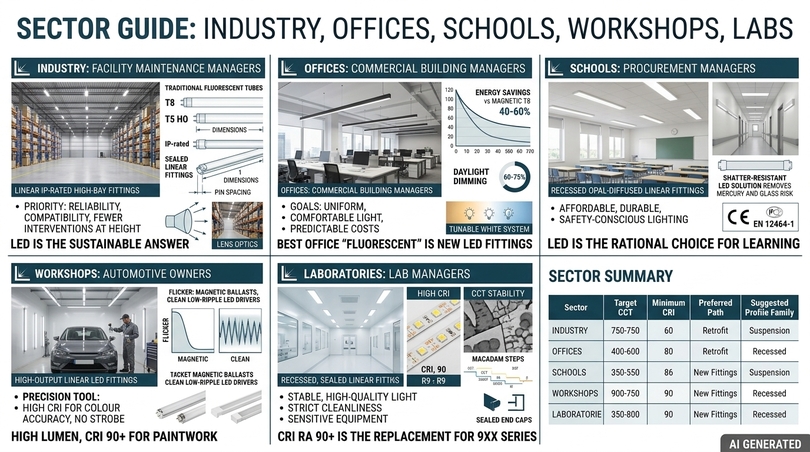
8. Sector guide: industry, offices, schools, workshops, labs
The same fluorescent tube can be the right lamp in a corridor and the wrong one in a laboratory. This section answers the questions that six professional profiles ask most often, from the maintenance manager who needs to cut downtime to the lab manager who needs precise colour. Each part closes with a practical recommendation on retrofit or new linear fittings.
Industrial maintenance managers
In factories and warehouses, lighting failure means downtime, safety risks and overtime for maintenance teams. The priority is reliability, compatibility with existing equipment and fewer interventions at height.
How do I choose the correct fluorescent tubing size for an industrial fixture?
Read the code on the existing tube and the ballast label, then measure diameter and pin-to-pin length as described in the sizes section. In industry the most common formats are T8 5 ft 58 W and T8 6 ft 70 W in battens and trunking systems, and T5 HO 49 W or 54 W in high-bay fittings. If you are planning an LED switch, record these data for every fitting type: they are your retrofit bill of materials or your design brief for new fittings.
Which fluorescent tubes are suitable for high-use industrial environments?
Historically, long-life T8 tubes rated 40,000 to 80,000 hours on electronic ballasts and T5 HO tubes were the reference. Both are now off the EU market. For high-use industrial spaces, LED is the only sustainable answer: IP-rated LED tubes in sealed fittings for quick fixes, or new linear fittings with IP-rated strips and lens diffusers for long aisles, where lenses of 60° or double asymmetric optics put light on the racks rather than on the ceiling.
How can I check whether a fluorescent tube is compatible with my ballast?
Match lamp type, wattage and number of lamps with the ballast label. For LED tubes, check the manufacturer’s compatibility list for that exact ballast model. On trunking systems with hundreds of identical fittings, test a sample for at least one week before ordering in bulk.
What is the average lifespan of industrial fluorescent tubing?
Standard tri-phosphor T8 tubes: 15,000 to 20,000 hours on electronic ballasts, less on magnetic ballasts and much less with frequent switching. In three-shift operations that is under three years. LED tubes reach 30,000 to 50,000 hours; well-designed linear fittings 50,000 hours or more.
Are energy-efficient fluorescent tubes available for large facilities?
“Energy saving” T8 tubes of 32 W or 51 W were once offered as drop-in replacements for 36 W and 58 W. They are also covered by the phase-out. The energy-efficient option for large facilities today is LED, ideally combined with presence and daylight sensors in low-traffic aisles.
Recommendation: Type B LED tubes in sound sealed battens for immediate savings; new linear fittings with surface or suspension profiles in areas being re-racked or refurbished.
Facility managers of commercial buildings
For offices and shops, the goals are uniform, comfortable light, predictable maintenance costs and a visible improvement in the quality of the space.
What fluorescent tubing is best for office and retail lighting?
Historically, T5 HE 840 tubes in low-glare recessed or suspended fittings for offices and 830 or 840 T5/T8 tubes in retail. Today, the best performing “fluorescent tubing” for an office is no fluorescent tubing at all: linear LED fittings with opal diffusers deliver uniform, low-glare light that meets the UGR 19 requirement for office work more easily than LED tubes in old louvre fittings.
How much energy can I save by replacing old fluorescent tubes?
Replacing T8 fluorescent tubing on magnetic ballasts typically saves 40 to 60% with LED tubes. New linear LED fittings save a similar share on their own, and reach 60 to 75% when combined with daylight dimming and presence detection, which add the biggest gains in perimeter zones, corridors and meeting rooms. A worked example is in the savings section.
Can fluorescent tubes be replaced with LED tubes without changing the fixture?
Yes, using Type A tubes on compatible ballasts or Type B tubes with ballast bypass. The fitting body stays; only the tube (and the starter, or the internal wiring for bypass) changes.
How do I determine the right colour temperature for commercial spaces?
4000 K is the standard for offices; 3000 K suits hospitality and fashion retail; 3000 to 4000 K for supermarkets depending on department. In open-plan offices, tunable white systems (2700 to 6500 K) let you follow daylight through the day, and CCT LED strips make this possible in a linear profile.
What maintenance schedule should I follow for fluorescent lighting systems?
For remaining fluorescent tubing: group relamping at 70 to 80% of rated life, cleaning of diffusers and reflectors every 12 months, starter replacement with each tube on magnetic systems, and a thermal check of ballasts every two years. For LED systems see the maintenance section.
Recommendation: new linear fittings during any fit-out; retrofit tubes only in back-of-house areas.
Electrical installers
Electricians need to supply compatible products, install them safely and stand behind the result with compliant, documented work.
How do I identify the correct fluorescent tube base and length?
Pin spacing tells you the base: 13 mm is G13 (T8 and T12), 5 mm is G5 (T5). Length and diameter are in the tables above. Circular tubes use G10q (T9) or 2GX13 (T5 circular); compact fluorescent lamps use 2G11, G23, G24 and GX24 bases.
What is the difference between T5 and T8 fluorescent tubing?
T5 is thinner (16 mm vs 26 mm), about 50 mm shorter per nominal length, uses G5 caps and works only on electronic ballasts. It is more efficient (up to about 104 lm/W lamp efficacy for T5 HE at 35 °C) and reaches peak output at higher ambient temperatures. T5 and T8 are not interchangeable without changing lampholders or fittings; adapter kits exist but are generally a poor idea from a safety and certification standpoint.
Do I need to replace the ballast when installing new fluorescent tubes?
Only if it is faulty or incompatible. When moving to LED, the ballast is either kept (Type A), removed (Type B) or replaced by a driver (Type C or new fittings).
What safety precautions should I follow when handling fluorescent tubing?
Isolate and lock off, verify absence of voltage, allow tubes to cool, wear gloves and eye protection, handle tubes by both ends, never force them into lampholders, and store removed tubes intact in purpose-made containers. Never break tubes to save space. Label any fitting modified for LED.
Which fluorescent tubes provide the best colour rendering for professional installations?
Fluorescent tubes with codes 9xx (for example 940 or 950) reach CRI 90+, but at lower efficacy, and they are no longer manufactured for the EU market. LED strips with CRI Ra above 90 or 93 now deliver higher colour quality with better efficiency.
Recommendation: offer clients a clear choice: retrofit for speed, new linear fittings for value. Document every modified fitting.
School procurement managers
Schools need affordable, durable lighting that supports learning, keeps corridors safe and does not overload maintenance budgets.
Which fluorescent tubing is suitable for classrooms and school corridors?
Classrooms traditionally used T8 or T5 840 tubes in louvre or opal fittings; corridors used T8 battens or bulkheads. For any new purchase, LED is the rational choice: fluorescent stock is limited, and tubes in classrooms are a breakage risk.
What colour temperature is recommended for classroom lighting?
4000 K is the common standard. EN 12464-1 recommends around 300 lux on desks (500 lux for evening and adult classes and technical drawing) with good uniformity and controlled glare. Tunable white systems that shift towards cooler light in the morning and warmer in the afternoon are increasingly specified in new schools.
How long do fluorescent tubes typically last in schools?
At about 2,000 to 2,500 hours a year, a T8 tube rated 15,000 hours lasts six to seven years in theory, often less due to switching. LED fittings rated 50,000 hours exceed the period between major refurbishments.
Are shatter-resistant fluorescent tubes available for educational facilities?
Yes, sleeved or coated fluorescent tubes exist to contain glass and phosphor if broken. But an LED solution with a polycarbonate body or a diffuser-covered aluminium profile removes both glass breakage and mercury from the classroom entirely, which is a stronger safety argument.
How should schools dispose of used fluorescent tubes safely?
As hazardous WEEE: intact, in dedicated containers, collected by an authorised operator, with records kept. Details are in the disposal section.
Recommendation: new linear fittings with opal diffusers in classrooms during summer refurbishment works; wall or surface profiles in corridors.
Automotive workshop owners
In a workshop, light is a precision tool: technicians must see scratches, leaks, colour differences and small parts, often under a vehicle.
What fluorescent tubing provides the best visibility for an automotive workshop?
Historically, 5 ft or 6 ft T8 tubes at 6500 K in sealed battens. Today, linear LED fittings with high lumen output, cool white light and lens diffusers that direct light into the work bay give better vertical illuminance on the sides of vehicles.
Are there fluorescent tubes designed for dusty or greasy environments?
The tubes themselves are not; the fittings are, through IP65 or IP66 sealed housings. Old sealed fittings often lose their seal over time. New linear fittings can combine aluminium profiles with IP65 or IP67 silicone-protected LED strips and sealed end caps.
Which colour temperature is best for inspecting vehicle parts?
5000 to 6500 K with CRI 90+ for paint and bodywork; 4000 to 5000 K with CRI 80+ for general mechanical work. High CRI matters more than high CCT for spotting colour differences in paint.
How can I reduce flicker from fluorescent lighting in my workshop?
On magnetic ballasts, flicker and stroboscopic effects can make rotating parts appear stationary, which is a real safety hazard. Short-term: replace ageing tubes and starters, or move to electronic ballasts. Long-term: LED with drivers that have low ripple current, which removes the 100 Hz modulation.
What are the most durable fluorescent tubes for garage lighting?
Long-life T8 tubes in sealed battens were the most durable option; they are no longer supplied in the EU. LED solutions with no glass, no electrodes and no starter are more robust against vibration and cold.
Recommendation: new linear fittings with high-CRI strips and lens diffusers in work bays; IP-rated surface profiles in washing areas.
Laboratory managers
Laboratories need stable, high-quality light for analysis and inspection, with strict attention to safety, cleanliness and compatibility with sensitive equipment.
Which fluorescent tubing offers the highest colour rendering for laboratory work?
Fluorescent tubes in the 9xx series (CRI 90+), especially 950 (5000 K) and 965 (6500 K), were the reference for colour-critical labs. With their phase-out, LED sources with CRI Ra above 90, and preferably high R9 (saturated red) values, are the replacement.
How can I minimise flicker in laboratory lighting?
Use electronic ballasts on remaining fluorescent tubing and, when converting, choose LED drivers with low flicker metrics. Flicker can interfere with cameras, microscopy and some optical instruments as well as with people.
Are low-mercury fluorescent tubes available for scientific facilities?
Low-mercury tubes with 1.5 to 3 mg of mercury were widely sold, but they too are covered by the phase-out. The only mercury-free option is LED.
What fluorescent tube specifications matter for accurate visual inspections?
CRI (and R9), CCT stability, illuminance and uniformity, flicker and glare. When moving to LED, also check colour consistency between batches (MacAdam steps), which matters when a lab is lit by several runs installed at different times.
How should fluorescent tubing be stored and disposed of in a laboratory?
Store new and spent tubes in their original packaging or in rigid containers, upright and away from traffic routes. Treat spent tubes as hazardous WEEE. If a tube breaks, follow the cleanup steps below and your chemical safety procedures.
Recommendation: new linear fittings with CRI 90+ strips, opal diffusers for uniformity and sealed end caps for easy cleaning.
Sector summary
| Sector | Target CCT | Minimum CRI | Preferred path | Suggested profile family |
|---|---|---|---|---|
| Industry and warehouses | 4000 to 5000 K | 80 | Type B tubes or new fittings | Surface, suspension |
| Offices | 4000 K or tunable | 80 (90 preferred) | New fittings | Suspension, recessed, drywall |
| Retail | 3000 to 4000 K | 90 | New fittings | Recessed, suspension, wall |
| Schools | 4000 K or tunable | 80 | New fittings at refurbishment | Suspension, surface, wall |
| Automotive workshops | 5000 to 6500 K | 90 in paint areas | New fittings | Surface with lens diffusers |
| Laboratories | 4000 to 5000 K | 90+ | New fittings | Recessed, surface with opal diffusers |
9. Fluorescent tubing installation and replacement, step by step
Whether you are fitting a new fluorescent tube in a fitting that must keep running for a few more months or converting a whole floor to LED, the order of operations is what keeps the job safe and fast. This section covers four procedures: replacing a fluorescent tube like for like, installing a plug-and-play LED tube, converting to ballast bypass, and installing a new linear LED fitting built from a profile and strip.
Before you start: the site survey
A short survey prevents most problems on installation day. For each fitting type record:
| Data point | Why it matters |
|---|---|
| Tube type, length, wattage, CCT (code on the glass) | Defines the LED equivalent or the lumen target |
| Number of tubes per fitting | Affects wiring and the ballast configuration |
| Ballast type, brand, model | Decides between Type A, Type B or new fitting |
| Starter present or not | Magnetic system indicator |
| Emergency module present | Needs a specific emergency solution after conversion |
| Condition of housing, lampholders, diffuser | Old or damaged parts point to new fittings |
| Mounting height and method | Affects access equipment and the choice of profile |
| Hours of use and control (switches, sensors) | Needed for savings and payback calculations |
| Environment (dust, moisture, temperature) | Defines IP rating and component choice |
Procedure 1: how to fit a new fluorescent tube
Even in 2026 maintenance teams still need to replace a failed fluorescent tube while the LED project is being approved. The safe method is simple:
- Switch off and isolate the circuit. Do not rely on the wall switch alone in commercial installations.
- Let the tube cool for a few minutes.
- Remove the diffuser or cover if present.
- Rotate the tube a quarter turn (90°) until the pins align with the lampholder slots, then lower it out. For spring-loaded T5 holders, push gently towards one end and lift.
- Check the new tube’s code matches the old one exactly: diameter, length, wattage and colour.
- On magnetic systems, replace the starter too. A worn starter shortens the life of a new tube.
- Insert the new tube, rotate it a quarter turn to lock, refit the cover, restore power and test.
- Place the old tube intact in the WEEE container.
Procedure 2: plug-and-play LED tube (Type A)
- Confirm ballast compatibility from the survey data.
- Isolate the circuit and remove the fluorescent tubing.
- On magnetic systems, remove the starter and insert the LED starter (fuse) supplied with the tube.
- Insert the LED tube, paying attention to any marked “power side” or orientation.
- Restore power and test for flicker, delayed start and audible noise.
- Record the installation date and tube model for warranty purposes.
Tip: in a twin fitting on one ballast, replace both tubes. Mixing a fluorescent tube and an LED tube on the same ballast is not supported.
Procedure 3: ballast-bypass LED tube (Type B)
This procedure must be carried out by a qualified electrician because it modifies the fitting’s internal wiring.
- Isolate, lock off and verify absence of voltage.
- Remove tubes, starter (if present) and diffuser.
- Disconnect and remove the ballast. Capacitors in older fittings may also need removing.
- Rewire the lampholders as shown in the LED tube manufacturer’s diagram: single-ended (live and neutral on one end) or double-ended (live on one end, neutral on the other). If using single-ended tubes, check that the lampholders are of the non-shunted type when required.
- Fit the label: “This fitting has been modified for LED tubes only. Do not install fluorescent tubes.”
- Insert the LED tubes, restore power and test.
- Update the installation records and, where relevant, the electrical certificate.
Procedure 4: new linear LED fitting with profile and strip
This is the procedure most construction companies will use on refurbishment and new-build projects. It is closer to carpentry and dry-lining work than to lamp changing, and it rewards good preparation.
Step 1: design and quantities
Define runs on the drawings or in the BIM model, choose the profile family (surface, suspension, recessed, drywall, wall, corner), the strip (lm/m, CCT, CRI, voltage, IP) and the diffuser. Calculate the number of profile bars (2 or 3 m), end caps, brackets, connectors and drivers. Allow a cutting allowance and remember that profile and diffuser lengths have a small manufacturing tolerance (for example ±2 mm).
Step 2: first fix
Run cables to feed points and driver locations. For drywall profiles, install the profiles on the plasterboard and finish the joint with filler before painting. For concrete profiles, fix them to the formwork before casting. For suspension profiles, install anchor points and suspension kits with adjustable wire.
Step 3: cutting and preparing profiles
Cut profiles with a fine-tooth aluminium blade, deburr the edges and clean out swarf: metal chips can short-circuit the strip. Drill end caps for cable entry where needed.
Step 4: mounting the LED strip
Clean the inside of the profile with isopropyl alcohol, cut the strip only at the marked cut points, and apply it in one continuous movement without stretching or sharp bending. Use solderless PCB connectors or soldered joints, and respect the maximum run length per feed. In profiles with a dedicated heat sink, mount the strip on the heat sink.
Step 5: joining and mounting
Join long runs with dedicated junctions, such as the metal junction for aluminium profiles, or the 90° horizontal junction for L-shaped and grid layouts. Fix surface profiles with their clips; hang suspension profiles and level them along the whole run.
Step 6: diffuser, end caps and driver
Slide or snap in the diffuser, fit the end caps, connect the driver (inside the profile where designed for it, otherwise in an accessible position), and check polarity.
Step 7: commissioning
Power up, check uniformity along the run (no dark joints, no brightness drop), check dimming and sensors, measure illuminance at representative points and compare with the design. Hand over datasheets, wiring diagrams and maintenance instructions to the client.
Typical installation times
| Task | Typical time per unit | Notes |
|---|---|---|
| Fluorescent tube replacement | 3 to 5 min per fitting | Plus access equipment set-up |
| Type A LED tube | 3 to 8 min per fitting | Including starter swap |
| Type B LED tube conversion | 10 to 20 min per fitting | Depends on fitting design |
| New surface linear fitting | 15 to 30 min per metre | Including cutting and strip mounting |
| New suspended linear fitting | 30 to 60 min per metre | Including anchors, levelling and driver |
| New drywall linear fitting | Integrated with dry-lining schedule | Plus finishing by decorators |
Indicative times for trained teams; actual times depend on access, ceiling type and project scale.
10. Energy savings, costs and payback
Every LED proposal ends with the same question from the client: how much will we save, and when do we get the money back? This section gives a transparent worked example you can adapt, a payback table by hours of use and a ten-year cost comparison. All figures are illustrative assumptions: replace them with your own tariffs, quotes and operating hours.
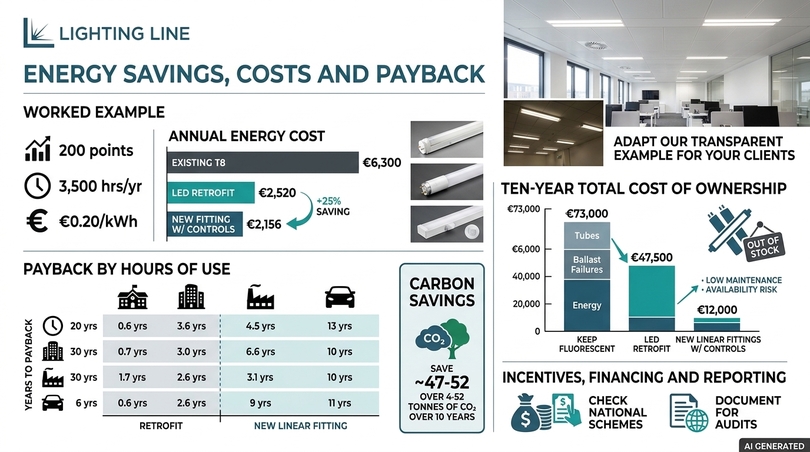
Worked example: 200 fluorescent battens in a commercial building
Assumptions: 200 single 4 ft T8 36 W battens on magnetic ballasts (about 45 W per fitting including ballast losses), 3,500 operating hours per year, electricity at €0.20 per kWh.
| Scenario | Power per point | Annual consumption | Annual energy cost | Saving vs fluorescent |
|---|---|---|---|---|
| Existing fluorescent tubing (T8 36 W + magnetic ballast) | 45 W | 31,500 kWh | €6,300 | baseline |
| LED tube retrofit (18 W, ballast bypass) | 18 W | 12,600 kWh | €2,520 | €3,780 (60%) |
| New linear LED fitting, no controls (about 22 W per equivalent point, opal diffuser, driver included) | 22 W | 15,400 kWh | €3,080 | €3,220 (51%) |
| New linear LED fitting with dimming and presence sensors (30% further reduction) | about 15.4 W average | 10,780 kWh | €2,156 | €4,144 (66%) |
Two honest observations come out of this table. First, a well-chosen LED tube saves a lot of energy for very little money, so for sound fittings in a building that will not be refurbished, retrofit is hard to beat on payback. Second, a new linear fitting that delivers better optics through a diffuser does not automatically consume less than an LED tube; its advantage comes from controls, better light quality, longer system life and, above all, from being the right choice whenever fittings are coming out anyway.
Payback by hours of use
The more hours the lights burn, the faster any LED investment pays back. The table uses the same per-point savings as the example (27 W for retrofit; about 29.6 W average for new fittings with controls) and illustrative installed costs of €27 per point for a Type B retrofit and €130 per point for a new linear fitting with controls.
| Annual hours | Typical building | Retrofit payback | New linear fitting payback (energy only) |
|---|---|---|---|
| 2,000 h | School, small office | about 2.5 years | about 11 years |
| 3,500 h | Office, retail | about 1.4 years | about 6.3 years |
| 6,000 h | Two- or three-shift industry | about 0.8 years | about 3.7 years |
| 8,760 h | Car parks, stairwells, 24/7 sites | about 0.6 years | about 2.5 years |
Energy-only payback; it ignores maintenance savings, which shorten payback considerably in high-use sites, and incentives or tax relief available in some countries.
Ten-year total cost of ownership
Energy is only part of the picture. Fluorescent tubing needs periodic relamping, starters and ballasts fail, and every intervention means labour and often access equipment. The following ten-year comparison for the same 200 points adds these costs.
| Cost item (10 years) | Keep fluorescent tubing | LED tube retrofit (Type B) | New linear fittings with controls |
|---|---|---|---|
| Initial investment | €0 | €5,400 | €26,000 |
| Energy | €63,000 | €25,200 | €21,560 |
| Relamping (tubes, starters, labour, disposal) | about €6,000 | about €0 to €1,000 | about €0 |
| Ballast failures and call-outs | about €4,000 | €0 (no ballast) | €0 (no ballast) |
| Availability risk of tubes | High: stock running out | Low | Low |
| Total | about €73,000 | about €31,000 | about €47,500 |
How to read this comparison
Keeping fluorescent tubing is the most expensive option of all, even before considering that replacement tubes are disappearing from the market. Between the two LED routes, retrofit wins on pure cost in an existing building that will not change. New linear fittings win when:
- the space is being refurbished and old fittings will be removed in any case, so the “retrofit” option does not really exist;
- the project is a new build, where the comparison is between different LED luminaires, not between LED and fluorescent;
- light quality is part of the brief (glare, uniformity, CRI 90, continuous lines, architectural integration);
- old housings, wiring and lampholders would otherwise remain in service for another ten to fifteen years;
- the client values design, documentation and a single coherent system over the lowest first cost.
Carbon savings
Energy savings translate into carbon savings. Using an indicative grid factor of 0.25 kg CO2 per kWh (the real figure varies widely by country and year), the retrofit in the example avoids about 4.7 tonnes of CO2 per year and the new fittings with controls about 5.2 tonnes. Over ten years that is roughly 47 to 52 tonnes, before counting the mercury removed from the building.
Incentives, financing and energy reporting
Many European countries support the replacement of fluorescent tubing through tax relief, white certificates, energy-efficiency obligation schemes or regional grants for businesses and public bodies. Rules change often and vary by country, so check the current national schemes before the investment decision, and keep the survey data, the product datasheets and the before-and-after consumption estimates: they are usually the documents required to claim support. Larger companies subject to energy audits or sustainability reporting can also use the same documentation to show a measurable reduction in electricity use and the removal of mercury-containing products from their buildings. A well-documented lighting project is often the simplest energy-efficiency measure to prove.
11. Maintenance schedules after the switch
One of the strongest arguments against fluorescent tubing is maintenance. LED does not mean zero maintenance, but it changes the routine from frequent replacement to occasional inspection. Here are realistic schedules for both worlds, useful for facility managers drafting service contracts.
Remaining fluorescent tubing
| Task | Frequency | Notes |
|---|---|---|
| Spot replacement of failed tubes | As needed | Replace starter at the same time on magnetic systems |
| Group relamping | At 70 to 80% of rated life | Reduces call-outs and keeps uniform colour |
| Cleaning of diffusers and reflectors | Every 12 months (every 6 in dusty areas) | Dirt can cut output significantly |
| Ballast and lampholder inspection | Every 24 months | Look for heat damage and brittle holders |
| Stock check of spare tubes | Every 6 months | Plan the LED transition before stock runs out |
LED tubes and linear LED fittings
| Task | Frequency | Notes |
|---|---|---|
| Visual inspection | Every 12 months | Check for dead sections, colour shift, loose diffusers |
| Diffuser cleaning | Every 12 to 24 months | Use mild detergent, no solvents on PMMA or PC |
| Driver and connection check | Every 24 to 36 months | Thermal check of drivers in enclosed spaces |
| Illuminance verification | Every 3 to 5 years | Compare with design maintained illuminance |
| Controls recommissioning | After layout changes | Sensor timings and dimming levels drift from use |
For linear profile systems, keep a stock of a few metres of the same strip batch and a spare driver. If a section fails years later, an identical batch avoids visible colour differences along a continuous line.
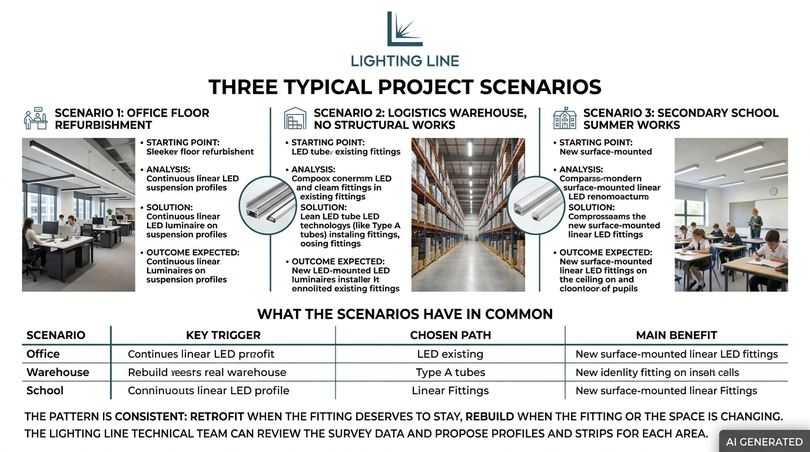
12. Three typical project scenarios
Theory becomes useful when it meets a real building. The three scenarios below are typical of projects that construction companies and contractors handle every month. They are composite examples, not case studies of specific clients, and they show how the same fluorescent tubing problem leads to different answers depending on context.
Scenario 1: office floor refurbishment
Starting point: a 1,200 m² open-plan office lit by recessed 600 x 600 mm modular fittings with four 2 ft T8 tubes each and magnetic ballasts, installed in the late 1990s. The client is replacing the suspended ceiling, the flooring and the HVAC terminals.
Analysis: retrofit is not a real option because the ceiling grid is coming out. The client wants a contemporary look, good glare control for screen work, and lighting that follows daylight along the façade.
Solution: continuous suspended lines over the desk rows using suspension profiles with opal diffusers, CCT tunable LED strips for 3000 to 5000 K, DALI drivers, and daylight sensors in the perimeter zone. In meeting rooms and corridors, drywall profiles are integrated into the new plasterboard bulkheads. The design is modelled in BIM with the profile files, and quantities are taken directly from the model.
Outcome expected: uniform light on desks, no dark gaps between fittings, a reduction of lighting energy in the order of 60 to 70% versus the original installation thanks to controls, no fluorescent tubing to maintain and a ceiling that looks designed rather than gridded.
Scenario 2: logistics warehouse, no structural works
Starting point: a warehouse with long rows of 5 ft T8 twin battens on electronic ballasts, about 12 years old, in good condition. Operations run two shifts, about 5,000 hours a year. The client wants savings fast, without stopping operations.
Analysis: fittings and ballasts are sound and on a known compatibility list. Hours are high, so payback is fast. Light quality is acceptable for the task.
Solution: Type A LED tubes verified on the installed ballasts, installed aisle by aisle during shift changes. Fittings with failed ballasts are converted to bypass and labelled. Over the next refurbishment cycle, aisles that are re-racked receive new linear fittings in surface profiles with lens diffusers directing light onto the rack faces.
Outcome expected: immediate energy savings of roughly half, minimal disruption and a clear, phased path towards new linear fittings where the layout changes.
Scenario 3: secondary school summer works
Starting point: twenty classrooms with surface-mounted twin 4 ft T8 fittings with prismatic diffusers, yellowed and brittle after 25 years; corridors with bulkhead fittings. Works must be completed within the summer break.
Analysis: retrofitting tubes would leave yellowed diffusers absorbing light and brittle plastic over the pupils’ heads. Safety (no glass, no mercury) is a priority for the school board, together with low maintenance.
Solution: new linear fittings in classrooms, using suspension or surface profiles with opal diffusers at 4000 K and CRI 80 or higher, with presence detection and a dedicated board-wash line using an asymmetric lens. Corridors receive wall profiles on sensors. All removed fluorescent tubing is collected in WEEE containers booked before the works start.
Outcome expected: brighter, more uniform classrooms, no fragile glass tubes overhead, maintenance reduced to inspections, and a measurable contribution to the school’s energy targets.
What the scenarios have in common
| Scenario | Key trigger | Chosen path | Main benefit |
|---|---|---|---|
| Office refurbishment | Ceiling replaced anyway | New linear fittings with controls | Design quality and deepest savings |
| Warehouse, no works | Sound fittings, high hours | Type A tubes now, linear fittings later | Fastest payback, no downtime |
| School summer works | Degraded fittings, safety focus | New linear fittings | Safety, uniformity, low maintenance |
The pattern is consistent: retrofit when the fitting deserves to stay, rebuild when the fitting or the space is changing. If you are not sure which side of the line your project sits on, the Lighting Line technical team can review the survey data and propose profiles and strips for each area.
13. Safety, storage and disposal of fluorescent tubing
A building-wide LED conversion can generate hundreds or thousands of spent fluorescent tubes in a few weeks. Each one contains a small amount of mercury and phosphor powder, which is why fluorescent tubing is classified as hazardous waste and must be handled, stored and recycled under specific rules. Getting this right protects workers, keeps the contractor compliant and is increasingly checked by clients.
Why fluorescent tubes are hazardous
The hazard is mercury vapour released when a tube breaks. Under EU rules a modern tri-band T8 tube may contain up to 3.5 mg of mercury and a T5 up to 3 mg; older tubes and some special types contained more. The amount per tube is small, but in a storage area with hundreds of broken tubes, or in a closed room after a breakage, exposure must be avoided. The phosphor powder and the broken glass add irritation and cut risks.
What to do if you break a fluorescent tube
The U.S. Environmental Protection Agency guidance on broken fluorescent lamps is one of the clearest public references; the steps below follow its logic and are consistent with common European workplace practice.
- Clear the room of people and pets and keep them out.
- Ventilate: open windows and doors to the outside for at least 10 to 15 minutes, and switch off central air handling or heating that could spread vapour.
- Collect the fragments with stiff card or paper, then use sticky tape to pick up small pieces and powder. Do not use a vacuum cleaner for the initial cleanup: it spreads mercury vapour and dust.
- Seal the debris in a glass jar with a metal lid or a sealed plastic bag, and place it outside or in the hazardous waste container.
- Keep ventilating the room for several hours.
- Dispose of the debris as hazardous waste through the authorised channel, never with general waste.
Storage of new and spent fluorescent tubing
- Store tubes in their original boxes or in rigid purpose-made containers, horizontally or upright as the container requires.
- Keep storage areas dry, ventilated and away from traffic routes and forklift aisles.
- Never tape tubes together into bundles: they break easily under their own weight.
- Label containers clearly (“Spent fluorescent lamps, contain mercury”).
- Never crush or break tubes to reduce volume unless you use certified lamp-crushing equipment under the applicable permits.
Disposal and recycling under WEEE
In the EU, gas discharge lamps fall under the WEEE Directive 2012/19/EU, which requires separate collection and treatment. Producers finance take-back schemes, and most countries run free collection networks for businesses through compliance schemes. The European Commission’s WEEE pages describe the framework; national rules define the paperwork. In recycling plants, glass, metal end caps, phosphor powder and mercury are separated and recovered.
| Who | Responsibility | Practical action |
|---|---|---|
| Building owner / facility manager | Holder of the waste | Arrange collection, keep waste transfer records |
| Contractor / electrician | Producer of the waste during works (in many countries) | Agree in the contract who handles the WEEE stream; provide containers on site |
| Schools and public bodies | Public procurement and environmental duties | Use framework contracts with authorised collectors; document volumes |
| Laboratories | Hazardous waste procedures | Integrate tubes into the lab’s chemical and hazardous waste plan |
LED at end of life
LED tubes, strips and drivers are also WEEE and must be collected separately, but they contain no mercury. Aluminium profiles are highly recyclable, which is one more environmental advantage of linear profile systems over sealed plastic fittings.
14. Specification checklist for construction companies
This checklist condenses the article into the questions a construction company, a contractor or a procurement office should answer before ordering. It can be pasted into tender documents or internal approval forms.
Project and survey
- Is the space being refurbished, extended or newly built? If yes, prefer new linear fittings.
- Have all fitting types been surveyed (tube type, length, wattage, ballast, emergency, condition)?
- What are the annual operating hours per area?
- What are the environmental conditions (IP, temperature, cleaning regime)?
Lighting performance
- Target maintained illuminance per area according to EN 12464-1 (for example 500 lux offices, 300 lux classrooms, 100 to 200 lux corridors and warehouses depending on task).
- Uniformity and glare limits (UGR 19 for offices and classrooms).
- CCT per area and whether tunable white is required.
- Minimum CRI (80 general, 90 for colour-critical tasks).
- Flicker performance of drivers or LED tubes.
Retrofit route
- LED tube compliant with EN 62776, CE marked, with a ballast compatibility list.
- Type A, B or hybrid chosen per fitting type; labels for modified fittings.
- Warranty of at least 3 to 5 years; replacement process agreed.
- Emergency lighting solution confirmed.
New linear fitting route
- Profile family and section selected from the profile range, with PCB width compatible with the strip.
- LED strip specified by lm/m, W/m, CCT, CRI, voltage, IP and cut interval.
- Diffuser chosen with its light-loss factor included in the calculation.
- End caps, mounting brackets, junctions and connectors listed per run.
- Driver sizing with 20% margin, feed points every few metres, dimming protocol defined.
- Datasheets, photometric tests and BIM files attached to the design documentation.
Site and handover
- WEEE containers and collection booked before removing fluorescent tubing.
- Isolation and lock-off procedures in the method statement.
- Commissioning measurements and as-built drawings delivered to the client.
- Spare strip from the same batch and spare driver handed over.
Common mistakes to avoid
| Mistake | Consequence | How to avoid it |
|---|---|---|
| Buying LED tubes by wattage alone | Too dark or too bright spaces | Specify delivered lumens and check a sample |
| Installing Type A tubes on unlisted electronic ballasts | Flicker, early failure, ballast damage | Check the compatibility list for the exact ballast model |
| Bypassing ballasts without labelling | Electric shock risk for future maintenance staff | Label inside and outside every modified fitting |
| Copying the fluorescent layout into a linear design | Uneven light, wasted power | Design runs and lumens per metre for the actual room |
| Ignoring diffuser losses | Lower illuminance than expected | Use the published light-loss data in calculations |
| Long 24 V runs from one feed | Visible brightness drop along the line | Feed every few metres or use 48 V strips |
| Mounting strips without a profile | Overheating and short LED life | Always use an aluminium profile as heat sink |
| Putting spent tubes in skips | Fines, contamination, reputational damage | Book WEEE collection before work starts |
Glossary
| Term | Meaning |
|---|---|
| Fluorescent tubing | Linear low-pressure mercury discharge lamps (T5, T8, T12) and, by extension, the tubular lamp format |
| LFL | Linear fluorescent lamp |
| CFL / CFLni | Compact fluorescent lamp / compact fluorescent lamp with non-integrated ballast (pin base) |
| Ballast | Device that limits current and starts a discharge lamp; magnetic or electronic |
| Starter | Small canister that pre-heats electrodes in magnetic systems |
| LED driver | Power supply that converts mains voltage for LEDs, constant voltage for strips |
| Type A / B / C | LED tube on existing ballast / direct mains / remote driver |
| CCT | Correlated colour temperature in kelvin |
| CRI (Ra) | Colour rendering index; R9 indicates rendering of saturated red |
| UGR | Unified glare rating; lower is less glare |
| L70 / L80 | Hours until LED output falls to 70% / 80% of initial |
| SMD / COB | Surface-mounted device LEDs / chip-on-board continuous LED strips |
| PCB width | Width of the LED strip circuit board; must fit the profile |
| WEEE | Waste electrical and electronic equipment; the EU collection and recycling framework |
| RoHS | Restriction of hazardous substances in electrical equipment; basis of the fluorescent phase-out |
15. Frequently asked questions
These are the questions that clients, installers and procurement teams ask most often about fluorescent tubing and its replacement. Click a question to open the answer.
Are fluorescent tubes illegal now?Using them is not illegal. Since 24 August 2023, T5 and T8 fluorescent tubing for general lighting can no longer be placed on the EU market under RoHS Delegated Directive 2022/284, but existing installations can stay in service and existing stock can still be sold. In practice, availability is shrinking and prices of the last tubes are rising, so planning the switch to LED is the sensible choice. |
Are fluorescent tubes banned in the UK?New supply is effectively banned. In Great Britain, 2, 4 and 5 ft T8 tubes were phased out from 1 September 2023 and T5 tubes and other T8 lengths from 1 February 2024. You may still use installed tubes and buy remaining stock while it lasts. |
Can you still buy fluorescent tubes?Yes, while stock lasts, from wholesalers, electrical distributors and DIY chains. Quantities and choice are decreasing, and long-term supply for maintenance cannot be guaranteed. For any planned project, specify LED tubes or new linear LED fittings instead of fluorescent tubing. |
Why are fluorescent tubes being phased out?Because they contain mercury, a restricted hazardous substance, and because LED technology now offers higher efficiency, longer life and no mercury. The EU removed the RoHS exemptions for general-purpose fluorescent lamps and tightened Ecodesign efficiency requirements, which together ended the placing on the market of most T5 and T8 tubes. |
Can I replace fluorescent tubes with LED tubes?Yes, in most fittings. Use a Type A LED tube that works on the existing ballast (with an LED starter on magnetic systems), a Type B tube with the ballast removed and the fitting rewired for direct mains, or a hybrid tube. Check the ballast compatibility list and label any rewired fitting. |
Is there a direct replacement for fluorescent tubes?Type A LED tubes are the closest to a direct replacement: same length, same G13 or G5 caps, installed in minutes. They depend on ballast compatibility, though. For a longer-lasting solution without the old ballast, consider ballast-bypass tubes or new linear LED fittings. |
Is it worth replacing fluorescent tubes with LED?In almost every case, yes. Energy savings of 40 to 60% with LED tubes, longer life, instant start, no flicker and no mercury give fast paybacks, often under two years in buildings used more than 3,500 hours a year. Keeping fluorescent tubing is the most expensive option over ten years. |
Should I choose LED tubes or new linear LED fittings?Choose LED tubes when the fittings are sound, recent and staying in place. Choose new linear LED fittings when fittings are old or damaged, when the space is being refurbished or newly built, when light quality and design matter, or when you want dimming and controls. New linear fittings built from aluminium profiles and LED strips can be cut to any length and integrated into ceilings and walls. |
How do I know what size fluorescent tube I need?Read the code printed on the tube, measure the diameter (26 mm = T8, 16 mm = T5, 38 mm = T12) and the pin-to-pin length (for example 1200 mm for a 4 ft T8, 1149 mm for a 4 ft T5), and check the pin spacing (G13 or G5). The ballast label also lists compatible lamp types and wattages. |
What are the standard sizes of fluorescent tubes?For T8: 590 mm (2 ft, 18 W), 895 mm (3 ft, 30 W), 1200 mm (4 ft, 36 W), 1500 mm (5 ft, 58 W) and 1800 mm (6 ft, 70 W). For T5: 549, 849, 1149 and 1449 mm, in HE and HO versions. T12 tubes followed lengths similar to T8, including 8 ft in some markets. |
What is the difference between T5 and T8 fluorescent tubes?T5 tubes are 16 mm in diameter with G5 caps and run only on electronic ballasts; T8 tubes are 26 mm with G13 caps and run on magnetic or electronic ballasts. T5 tubes are about 50 mm shorter per nominal length and more efficient. They are not interchangeable in the same fitting. |
What is the difference between T4 and T5 fluorescent tubes?T4 tubes are thinner (about 12.5 mm) and were mainly used in compact under-cabinet and mirror strip lights, often with proprietary lengths and integrated electronics. T5 tubes are 16 mm and follow standard lengths for general lighting. Replacement is usually by an LED under-cabinet fitting or a small aluminium profile with LED strip. |
Are all fluorescent tubes the same?No. They differ in diameter, length, cap, wattage, colour temperature, colour rendering and ballast requirements. A T8 36 W 840 and a T8 36 W 865 fit the same holder but give different light; a T5 and a T8 do not fit the same holder. |
Are fluorescent tubes AC or DC?Fluorescent tubes in buildings operate on AC through a ballast: at 50 Hz with magnetic ballasts or at high frequency (tens of kHz) with electronic ballasts. DC-powered fluorescent lamps exist in vehicles and battery lights, using inverters. LED strips in linear fittings run on low-voltage DC from a driver, usually 24 V or 48 V. |
Do fluorescent tubes use a lot of electricity?Compared with incandescent lamps, no; compared with LED, yes. A 4 ft T8 tube on a magnetic ballast draws about 43 to 45 W including ballast losses, while an LED tube with similar delivered light draws 14 to 18 W. |
Do I need to replace the ballast when installing new fluorescent tubes?Only if the ballast is faulty or does not match the tube. Signs of a failing ballast include humming, overheating, blackened tube ends after short use and failure to start new tubes. When converting to LED, the ballast is kept, bypassed or removed depending on the LED solution. |
How can I check whether a fluorescent tube or LED tube is compatible with my ballast?Read the ballast label for lamp type, wattage and number of lamps. For LED tubes, look up the exact ballast model in the LED manufacturer’s compatibility list, and test a sample fitting for a few days before a large rollout. |
How long do fluorescent tubes last?Standard tri-phosphor T8 tubes are rated around 15,000 to 20,000 hours on electronic ballasts, less on magnetic ballasts and with frequent switching. T5 tubes are typically rated 20,000 to 24,000 hours. LED tubes are rated 30,000 to 50,000 hours, and well-designed linear LED fittings 50,000 hours or more. |
What colour temperature should I choose for offices, schools and workshops?4000 K for offices and classrooms, 3000 to 4000 K for retail and hospitality, 5000 to 6500 K for workshops, inspection areas and many laboratories. Tunable white (CCT) LED strips allow the colour temperature to change through the day. |
Which light gives the best colour rendering for laboratories and inspection?Sources with CRI Ra 90 or higher, ideally with a high R9 value. Fluorescent 9xx tubes used to fill this role; today LED strips with CRI Ra above 90 offer better colour quality with higher efficiency. |
How do I reduce flicker from fluorescent lighting?Replace ageing tubes and starters, move from magnetic to electronic ballasts, or, best of all, convert to LED with drivers that have low ripple current. This removes the 100 Hz modulation that causes fatigue and stroboscopic effects on rotating machinery. |
Are shatter-resistant fluorescent tubes available?Yes, coated or sleeved tubes contain glass and powder if broken and were common in food processing and schools. LED tubes with polycarbonate bodies, or LED strips inside aluminium profiles with plastic diffusers, remove both the glass and the mercury. |
What should I do if a fluorescent tube breaks?Clear and ventilate the room, collect fragments with stiff card and sticky tape, do not vacuum at first, seal the debris in a closed container and dispose of it as hazardous waste. Keep ventilating for several hours. |
How do I dispose of fluorescent tubes safely?As hazardous WEEE. Keep tubes intact, store them in rigid containers, and hand them to an authorised collection point or compliance scheme. Never put fluorescent tubing in general waste or skips, and never break tubes to save space. |
What can I use instead of fluorescent tubes?LED tubes for direct replacement in existing fittings, or new LED luminaires. For construction and refurbishment projects, linear LED systems made of aluminium profiles, LED strips, diffusers and end caps offer custom lengths, continuous lines, integration into plasterboard, concrete and walls, and high colour rendering. |
How many metres of LED strip replace a 4 ft fluorescent tube?Think in lumens, not metres. A 4 ft T8 in a bare batten delivers roughly 2,500 to 2,800 lumens. Divide the target delivered lumens per metre by the diffuser transmission (for example 0.68 for an opal cover with 32% loss) to find the lumens per metre the strip must produce, then choose strip power and efficacy accordingly, and verify with a lux calculation. |
Can LED strips in aluminium profiles light an office or a warehouse, or are they only decorative?They can provide general lighting when the strip output, profile and diffuser are chosen for the task. High-output strips, double-strip profiles and lens diffusers deliver the illuminance needed for offices, classrooms and aisles, while the aluminium profile manages heat for long life. |
What documents should a contractor request for a linear LED system?Profile datasheets, photometric test reports with diffuser light-loss values, LED strip datasheets (lm/m, W/m, CRI, CCT, voltage, binning), driver datasheets, wiring diagrams, installation instructions and, for BIM-based projects, Revit files. Lighting Line provides datasheets, photometric tests and BIM files on its profile pages. |
What is the lifetime of an LED strip inside an aluminium profile?It depends mainly on temperature. With correct current, a suitable profile acting as heat sink and adequate ventilation, quality LED strips reach tens of thousands of hours before falling to 70 or 80% of initial output. Mounting strips without a profile shortens life considerably. |
Where can I buy aluminium profiles and LED strips to replace fluorescent tubing?Lighting Line supplies aluminium profiles for surface, recessed, suspension, drywall, corner, wall and concrete installation, SMD and COB LED strips, diffusers, end caps, mounting accessories and connectors through its online catalogue at catalogue.lightingline.eu, with technical support for project selection. |
16. From fluorescent tubing to linear light
The era of fluorescent tubing is over in Europe. The tubes still in ceilings will keep working for a while, but new supply has stopped, stock is shrinking and every month of delay means higher energy bills and more maintenance on an obsolete system. The real choice today is between two LED routes, and both are legitimate.
LED tube retrofit is the right answer when fittings are sound and the space is not changing: it is quick, inexpensive and pays back fast, provided ballast compatibility is checked and modified fittings are labelled. New linear LED fittings are the right answer when fittings are old, when the space is being refurbished or built, and when light quality, controls and design matter. For construction companies, this second route also fits the way buildings are made: profiles go into plasterboard, concrete and suspended layouts at the same stage as the rest of the works, documented with datasheets, photometric tests and BIM files.
If you are planning a project, start with the survey, define lumens rather than watts, and choose each component deliberately: profile, strip, diffuser, end caps, brackets and driver. Explore the aluminium profiles and LED strips in the Lighting Line catalogue, download the profiles catalogue and the LED strip catalogue, or contact the technical team with your survey data to receive a proposal for each area of your building.
Sources and further reading
- EUR-Lex: Commission Delegated Directive (EU) 2022/284 on mercury in fluorescent lamps
- Lighting Industry Association: UK and EU lamp phase-out guidance
- U.S. EPA: cleaning up a broken CFL or fluorescent tube
- European Commission: waste electrical and electronic equipment (WEEE)
- U.S. Department of Energy: LED lighting
This article was developed with the support of artificial intelligence and subsequently reviewed, corrected, and validated by the LightingLine.eu technical team, which guarantees its reliability and compliance with official sources.