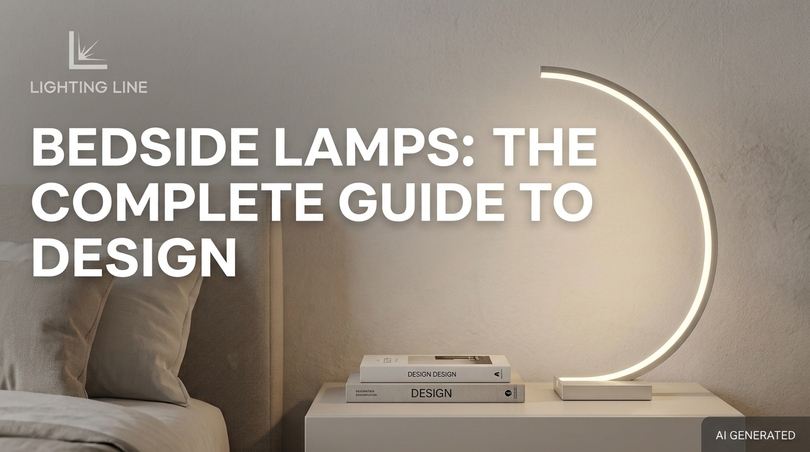
Bedside lamps are the most personal light in any building. They are the first light switched on in the morning and the last one switched off at night, and they sit within arm’s reach of the people who live, sleep and stay in the spaces you build. For a construction company, a fit-out contractor or a hotel developer, getting bedside lamps right is not decoration: it is part of how a bedroom works, how it is wired and how it is judged by the client on handover day.
This guide is written for builders, contractors, electricians, interior designers and hospitality operators who want more than a shopping list. It explains what bedside lamps are, where they came from and what they are for; it compares the main types of bedside table lamps, touch lamps and rechargeable lamps; it gives the size, height and light-quality rules that professionals use; and it ends with five step-by-step tutorials for building bedside lamps from aluminium LED profiles, COB LED strips and neon-effect silicone strips available in the LightingLine.eu online catalogue.
In this article…
- What are bedside lamps? Definition, purpose and history
- Bedside lamps and table lamps in numbers: market data and search demand
- Why bedside lamps matter for construction companies
- Light quality: lumens, colour temperature, CRI, sleep and eye comfort
- Types of bedside lamps: touch, pair, small, rechargeable, smart and more
- Styles, materials, iconic designs and 2026 trends
- How to choose bedside lamps: size, height and placement rules
- The LightingLine.eu toolkit: profiles, COB strips and neon-effect strips
- Five DIY bedside lamps built with LED strips: step-by-step tutorials
- Safety, compliance, maintenance and cord management
- Energy consumption and running costs
- Prices, value for money and where to buy bedside lamps
- Playbooks for designers, hotels, home offices, families, students and collectors
- Comparison chart and final recommendations
- Frequently asked questions about bedside lamps
- Bedside lamps are part of the build
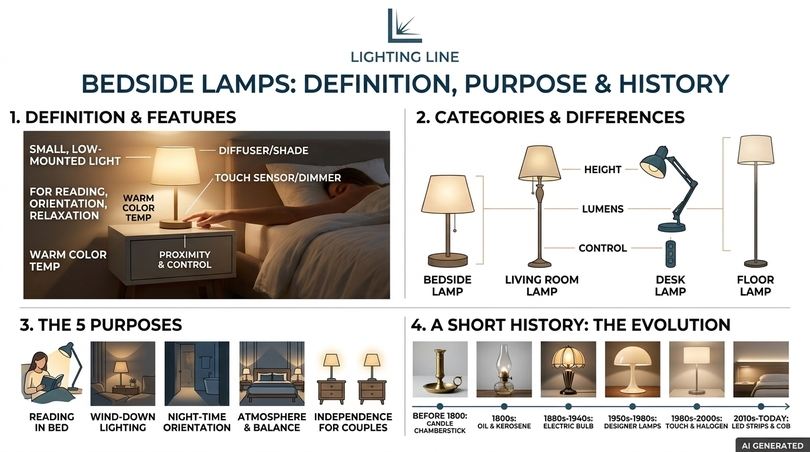
1. What are bedside lamps? Definition, purpose and history
Before choosing, specifying or building bedside lamps, it helps to agree on what the term means. The vocabulary around lamps is loose: shops, designers and search engines use “table lamp”, “bedside lamp”, “nightstand lamp”, “side lamp” and “bedroom lamp” almost interchangeably. This section draws the lines clearly, explains what bedside lamps are actually for, and traces how they evolved from candles to the LED strip lamps you can now assemble on site.
Definition: what is a bedside lamp?
A bedside lamp is a small, low-mounted light source placed beside a bed, usually on a bedside table, nightstand or headboard, designed to provide local light for reading, orientation and relaxation without lighting the whole room. It is a specific use of the broader table lamp family.
Its defining features are proximity and control. A bedside lamp is close to the user’s head, it must be switched on and off from a lying or sitting position, and its light should be soft enough not to disturb a partner or interfere with sleep. That is why the best bedside lamps combine a warm colour temperature, a shade or diffuser that hides the light source, and an easy control such as a touch sensor, a cord switch or a dimmer.
What is a table lamp, and what is it called?
A table lamp is any freestanding lamp designed to sit on a horizontal surface such as a table, desk, console, sideboard or nightstand. It typically has a base, a stem or body, a light source and a shade or diffuser. Depending on the context it is called a desk lamp, a reading lamp, an accent lamp, a side lamp, a nightstand lamp or, in a bedroom, bedside table lamps. In British English “table lamp” is standard, in American English “nightstand lamp” is common for the bedroom version. A lamp that stands on the floor is a floor lamp or, in the UK, a standard lamp.
Table lamp vs bedside lamp: what is the difference?
Every bedside lamp is a table lamp, but not every table lamp is a good bedside lamp. A living room table lamp is often taller, brighter and more decorative, because it must contribute to ambient light and be seen from across the room. Bedside lamps are judged up close: they must be shorter or narrower to fit a nightstand, glare-free from a pillow, dimmable, and operable in the dark. A large, bright table lamp that looks magnificent on a console can feel harsh and oversized next to a bed.
Desk lamp vs table lamp: what is the difference?
A desk lamp is a task light. It is usually adjustable (arm, head or both), directs a concentrated beam onto a work surface and is optimised for reading, writing and screen work. A table lamp is primarily an ambient or accent light that spreads light around it, usually through a fabric, glass or paper shade. In bedrooms, the two overlap: an adjustable bedside reading lamp borrows the directional optics of a desk lamp, while a classic bedside table lamp with a drum shade borrows the soft glow of a living room lamp.
| Category | Main purpose | Typical height | Typical light output | Ideal colour temperature | Control |
|---|---|---|---|---|---|
| Bedside lamp / nightstand lamp | Reading in bed, orientation, relaxation | 35-65 cm | 200-450 lumens | 2700K-3000K | Touch, dimmer, switch within reach |
| Living room table lamp | Ambient and accent light | 55-80 cm | 450-800 lumens | 2700K-3000K | Switch, smart control |
| Desk lamp | Task light for reading and screen work | 35-50 cm (adjustable) | 400-1000 lumens | 3000K-4000K | Switch, dimmer, CCT |
| Floor lamp / standard lamp | Ambient or reading light beside seating | 140-190 cm | 800-2500 lumens | 2700K-3000K | Foot switch, smart control |
| Wall-mounted bedside light | Reading light that frees the nightstand | Mounted 70-90 cm above mattress | 150-400 lumens | 2700K-3000K | Integrated switch or wall switch |
What are bedside lamps for? Their real utility
The purpose of bedside lamps is easy to underestimate. In a well-designed bedroom they carry out at least five distinct jobs, and a good specification addresses all of them.
Reading and screen use in bed
Reading is the most obvious job. A bedside reading lamp must put enough light on a page, an e-reader or a tablet to read comfortably for half an hour without eye strain. Lighting designers commonly target around 300 lux on the reading plane for comfortable reading, which a 300-400 lumen lamp at the right height delivers easily.
Wind-down lighting
Bedside lamps are the main tool for lowering light levels in the evening, which supports the body’s natural transition to sleep. Switching off the ceiling light and using dimmed, warm bedside lamps for the last hour of the day is one of the simplest light-hygiene habits recommended by sleep specialists.
Night-time orientation and safety
A low glow from a bedside lamp or a night light helps occupants find the door, the bathroom or a child’s room without switching on full light. For hotels and care homes, this is a safety function: a dim orientation light reduces the risk of falls at night.
Atmosphere and visual balance
A matched pair of bedside lamps frames the bed, the room’s focal point. Even when switched off, bedside lamps are furniture: when switched on, they create the layered, intimate atmosphere that photographs well in property listings and hotel booking platforms.
Independence for couples
Two bedside lamps give each sleeper control over their own light. One partner can read while the other sleeps, provided the lamp’s beam is controlled and its brightness can be reduced.
Are bedside lamps necessary?
Strictly speaking, a room can function with a ceiling light alone. In practice, a bedroom without bedside lamps is a bedroom that forces people to get out of bed to switch off the light, that offers no low-level light in the evening, and that looks unfinished. For residential developers, bedside lighting is part of what buyers perceive as a finished bedroom. For hotels, bedside reading lights and their switches are among the most frequently mentioned elements in guest reviews about room comfort. The answer, for any professional project, is yes: plan bedside lighting at the first-fix electrical stage, not as an afterthought.
When were bedside lamps invented? A short history
People have always wanted light beside the bed. The history of bedside lamps follows the history of artificial light itself, and each stage left a design idea that is still used today.
From candles and oil lamps to the electric bulb
For centuries, the bedside light was a candlestick or a chamberstick, a candle holder with a dish and a handle designed to be carried to the bedroom. Oil lamps and, in the nineteenth century, kerosene lamps with glass chimneys gave brighter light but carried a real fire risk next to bedding. The idea of a dedicated light by the bed is therefore centuries old; what changed was the technology.
The first electric bedside lamps (1880s-1920s)
Commercially practical incandescent light bulbs appeared at the end of the 1870s, and electric table lamps followed as homes were wired from the 1880s onwards. The electric bedside lamp as we know it, a base, a bulb and a shade on a bedside table, became common in wealthy homes and grand hotels in the late nineteenth and early twentieth centuries and spread to ordinary homes as electrification expanded in the 1920s and 1930s. Art Nouveau and later Art Deco designers turned the bedside lamp into an object of style, with leaded glass, bronze and opaline shades.
Mid-century modern and the designer lamp (1950s-1970s)
After the Second World War, Italian and Scandinavian designers reinvented the table lamp. Adjustable reading lamps, sculptural metal lamps and mushroom-shaped glass lamps from this era are still produced and copied today. This period also popularised the idea of bedside lamps as a pair, part of a coordinated bedroom suite.
Touch lamps and halogen (1980s-1990s)
Touch-sensitive table lamps, which switch or dim when the metal body is touched, became popular in the 1980s and 1990s. They solved a very bedside-specific problem: finding a small switch in the dark. Low-voltage halogen lamps brought crisp, bright light in compact sizes.
The LED era (2010s-today)
LEDs changed everything. They use a fraction of the energy, run cool enough to sit near fabric and skin, and can be shaped into lines, rings and ribbons. LED strips and COB strips allow bedside lamps to be integrated into headboards, shelves, niches and floating nightstands, or built as slim custom lamps that were impossible with bulbs. This is the technology behind the five models in this guide.
| Period | Light source | Typical bedside solution | Design idea still used today |
|---|---|---|---|
| Before 1800 | Candle | Chamberstick on a bedside stand | Portable, cordless light |
| 1800-1880 | Oil and kerosene | Glass-chimney table lamp | Glass diffuser around the flame |
| 1880-1940 | Incandescent bulb | Electric table lamp with shade | Base, stem and shade |
| 1950-1980 | Incandescent | Designer table lamps, matched pairs | Sculptural form, symmetry |
| 1980-2005 | Halogen, CFL | Touch lamps, adjustable readers | Touch control, task optics |
| 2010-today | LED, LED strips, COB | Integrated, dimmable, smart, rechargeable | Linear and built-in light, tunable white |
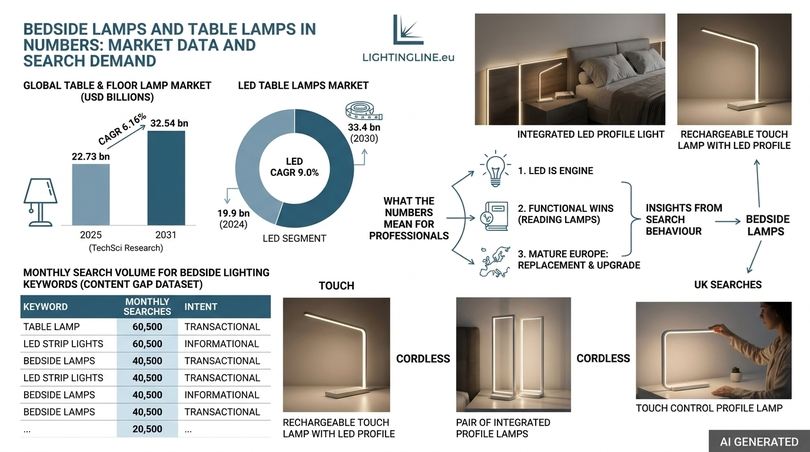
2. Bedside lamps and table lamps in numbers: market data and search demand
Bedside lamps sit inside a large and growing market. Understanding its size, its growth and what people actually search for helps manufacturers, retailers and builders decide where to invest. The figures below combine published market research with keyword data from a content gap analysis of LightingLine.eu against its main competitors.
Market size and growth
Independent research houses estimate the global table and floor lamp market at more than 20 billion US dollars. TechSci Research values the global table and floor lamp market at USD 22.73 billion in 2025 and projects USD 32.54 billion by 2031, a 6.16% CAGR. The LED segment grows faster: Global Industry Analysts estimate the LED table lamp market at USD 19.9 billion in 2024, rising to USD 33.4 billion by 2030 at a 9.0% CAGR, with reading lamps as the fastest-growing type. Europe is a more mature market, with Statista projecting low single-digit annual growth for table and floor lamps between 2025 and 2029.
| Segment | Base value | Forecast value | Growth rate | Source |
|---|---|---|---|---|
| Global table and floor lamps | USD 22.73 bn (2025) | USD 32.54 bn (2031) | 6.16% CAGR | TechSci Research |
| Global LED table lamps | USD 19.9 bn (2024) | USD 33.4 bn (2030) | 9.0% CAGR | Global Industry Analysts |
| Global table and floor lamps (alternative estimate) | USD 24.14 bn (2024) | USD 35.26 bn (2032) | 4.85% CAGR | Markets and Data |
| Table and floor lamps, Europe | – | – | 1.62% CAGR (2025-2029) | Statista Market Insights |
Market estimates differ between publishers because of different definitions and methods. Use them as indicators of direction, not exact values.
What the numbers mean for professionals
Three conclusions stand out. First, LED is no longer a niche: it is the growth engine of the table lamp market. Second, reading lamps, the core of the bedside category, are growing faster than decorative lamps, which confirms that buyers care about function. Third, in mature European markets growth comes from replacement and upgrade, which favours integrated, energy-efficient and custom solutions over cheap disposable lamps.
3. Why bedside lamps matter for construction companies
For a builder, bedside lamps can look like the client’s problem, something bought after handover. That view leaves value on the table. Bedside lighting affects first-fix wiring, socket and switch positions, joinery details and the perceived quality of every bedroom you deliver. This section explains why it pays to treat bedside lamps as part of the build.
Bedside lighting starts at first fix
Where will the bedside lamps sit? Where will the sockets be? Will there be a switch for the main light beside the bed? The cost of moving a socket after plastering is many times the cost of placing it correctly at first fix. Planning for bedside lamps means placing sockets 10-20 cm above the bedside table height on both sides of the bed, adding USB-C outlets where useful, and, for integrated lamps, running a low-voltage cable or conduit to the headboard wall.
Recommended electrical points per bedroom
| Item | Recommended position | Why |
|---|---|---|
| Double socket each side of bed | About 15 cm above nightstand top, 10-20 cm outside the bed edge | Lamp, phone charger and device without extension leads |
| Two-way switch for ceiling light | Beside the bed and at the door | Switch off main light without getting up |
| Low-voltage feed to headboard | Centre and both sides of headboard wall | Integrated LED reading lights and headboard glow |
| Driver location | Accessible void, bedside furniture or ventilated box | Driver replacement without opening walls |
| Night-light or orientation point | Low on wall or under bed / nightstand | Safe night-time movement |
Integrated bedside lamps add value
An integrated bedside light, a lit headboard, a floating nightstand with concealed LED, or a wall-mounted reading light in an aluminium profile, is perceived as a premium feature. It costs little in components but changes how the room is photographed, marketed and valued. For build-to-rent and student housing, integrated bedside lighting also reduces the number of loose lamps that tenants damage or remove.
Hospitality: bedside lamps are a brand asset
In a hotel room, bedside lamps are touched by every guest, every night. Guests expect to find switches without searching, to read without disturbing a partner, and to switch everything off from the bed. Durable, cable-free or integrated bedside lamps reduce housekeeping time and breakage. Low-voltage LED solutions cut energy use across hundreds of rooms.
Why build bedside lamps with LED profiles?
- Custom dimensions: aluminium profiles are cut to the millimetre, so bedside lamps match the joinery exactly.
- Consistency across units: the same profile, strip and colour temperature in 50 apartments give identical results.
- Repairability: standard 24V strips and drivers are easy to replace; no proprietary lamp to source in five years.
- Thermal management: aluminium dissipates heat, protecting LED life and keeping surfaces cool to the touch.
- Cost control: a pair of custom LED bedside lamps can cost less in parts than a single mid-range designer lamp.
4. Light quality: lumens, colour temperature, CRI, sleep and eye comfort
The shape of a lamp is what people notice first, but light quality is what they live with. A beautiful lamp with cold, flickering or glaring light is a bad bedside lamp. This section explains the four numbers that define good bedside light, then answers the questions people most often ask about light, sleep and eyes.
Brightness: how many lumens does a bedside lamp need?
Lumens measure the total light emitted. For bedside lamps, more is not better: the target is enough light for reading at the lamp’s maximum setting, with dimming down to a glow.
| Use | Recommended output | LED strip equivalent (approx.) |
|---|---|---|
| Night light / orientation | 5-30 lumens | A few cm of strip at low dim level |
| Ambient bedside glow | 100-250 lumens | 20-30 cm of 6-10 W/m COB strip |
| Bedside reading lamp | 300-450 lumens | 30-40 cm of 10 W/m COB strip |
| Bright table lamp for a dressing area or desk | 500-800 lumens | 50-70 cm of 10-15 W/m strip |
As a rule of thumb, a high-efficiency COB strip rated around 120 lumens per watt, like the 10.5 W/m 2700K COB LED strip, produces roughly 1,200 lumens per metre at full power before diffuser losses. A 30 cm length therefore delivers about 350 lumens, exactly the range for bright, comfortable bedside reading. Diffusers typically absorb 10-30% of the light, so plan accordingly.
Colour temperature: warm or cool light?
Colour temperature, measured in kelvin (K), describes whether light looks warm (yellow) or cool (blue-white).
- 2200K-2700K: very warm, candle-like. Ideal for the evening and for bedside lamps used to wind down.
- 3000K: warm white. A good compromise for bedside reading lamps that are also used during the day.
- 4000K: neutral white. Suitable for desks, wardrobes and work surfaces, too cool for most bedside lamps at night.
- 6000K-6500K: cool daylight. Avoid in bedrooms at night.
For bedside lamps, specify 2700K as the default and 3000K for multi-purpose rooms. Where the same bedroom doubles as a home office, a tunable white (CCT) strip such as the CCT 2700-6500K COB LED strip lets the user switch from cooler light for daytime work to warm light at night.
CRI: why colour rendering matters at the bedside
The colour rendering index (CRI) measures how faithfully a light source shows colours compared with a reference light, on a scale up to 100. Low-CRI light makes skin look grey, wood look flat and fabrics look dull. Bedside lamps should have a CRI of at least 90: this is where faces in a mirror, book pages and bedroom textiles look natural. All the COB strips proposed in this guide are rated CRI Ra above 90. For a technical background on the metric, see the overview of the colour rendering index.
Flicker, glare and uniformity
Flicker
Cheap dimmers and drivers can make LEDs flicker, sometimes invisibly, which can cause eye fatigue and headaches. Use quality constant-voltage drivers and PWM dimmers with high frequencies (well above 1 kHz) to keep light stable.
Glare
A bare light source visible from the pillow is the most common defect of bedside lamps. Shades, opal diffusers and recessed aluminium profiles hide the LED and direct light downwards to the book or the table.
Uniformity: why COB strips are ideal
COB (chip-on-board) strips produce a continuous line of light without visible dots, with a wide 180° beam angle. In a slim bedside lamp, where the diffuser is close to the LEDs, this avoids the “string of pearls” effect common with traditional SMD strips.
Are lamps good for sleep?
Light is the main signal that sets the body clock. Bright, blue-rich light in the evening suppresses melatonin and delays sleepiness, while dim, warm light is much less disruptive. Warm, dimmable bedside lamps are therefore better for sleep than ceiling lights, provided they are dimmed and switched off at bedtime. The Sleep Foundation’s guide to light and sleep explains the mechanisms in depth, and Harvard Health Publishing on blue light at night summarises research on evening light exposure.
Can you leave a bedside lamp on all night?
Technically, an LED bedside lamp can stay on all night safely: it uses a few watts and runs cool. From a sleep point of view, however, sleeping with a bright light on is not recommended. If a light is needed, for a child or for orientation, use a very dim, warm night-light setting below about 10-30 lumens, placed low and out of the direct line of sight. Avoid leaving old halogen or incandescent table lamps on overnight near fabric.
Are LED lamps good for your eyes?
Quality LED lamps are good for the eyes when three conditions are met: no flicker, no direct glare, and adequate brightness for the task. Reading in near-darkness forces the eyes to work harder, while reading under a glaring bare LED causes discomfort. A diffused, CRI 90+, flicker-free LED bedside reading lamp at 300-450 lumens is one of the most eye-friendly lights you can install.
Is studying under a table lamp good? What is the best study light for eyes?
Studying under a table lamp is good, as long as the room is not completely dark around it. High contrast between a bright page and a black room tires the eyes. Combine a task lamp at 3000K-4000K with low ambient light. Position the lamp opposite the writing hand to avoid shadows and below eye level to avoid glare.
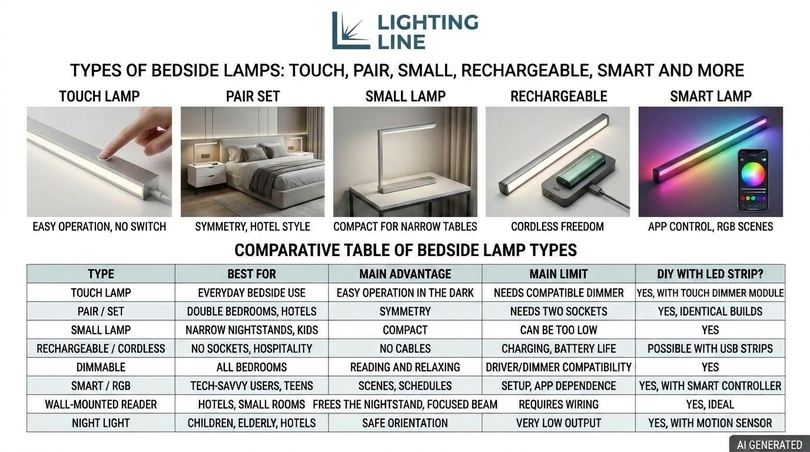
5. Types of bedside lamps: touch, pair, small, rechargeable, smart and more
Bedside lamps come in many forms, and each type solves a specific problem. Some are about control (touch lamps, smart lamps), some about flexibility (rechargeable and cordless lamps), some about space (small and wall-mounted lamps) and some about composition (pairs and sets). This section reviews each type, its strengths and its limits, and shows which can be reproduced or improved with LED strips and aluminium profiles.
Bedside lamps touch: touch lamps and touch control
A touch lamp switches on, off or between brightness levels when you touch its base, body or a dedicated sensor. Classic touch bedside lamps use the whole metal body as a capacitive sensor; modern LED versions use a small touch pad. Many cycle through three levels (low, medium, high), the so-called 3-way touch table lamps.
Are touch lamps still a thing? Are they good for bedside?
Touch lamps are not only still a thing, they are one of the most searched bedside lamp types, with around 9,900 monthly searches each for “touch lamp” and “touch lamps” in our dataset. Their advantage is obvious at night: no switch to find, no cord to fumble with. The downsides of older touch lamps were accidental activation and incompatibility with LED bulbs. Purpose-built LED touch dimmers have largely solved both. For custom LED bedside lamps, a 24V touch dimmer module wired between driver and strip gives the same experience.
Touch lamp variants searched by buyers
- Bedside touch lamps and touch bedside table lamps: the classic nightstand format.
- Small touch lamps and small touch table lamps: for narrow nightstands and children’s rooms.
- Large touch lamps and tall touch lamps: for wide bedside tables and living rooms.
- Glass touch lamp, white touch lamp, black touch lamp: finish-driven searches.
- Touch lamps pair and set of 2 touch lamps: matched bedroom lighting.
Bedside lamps pair: matching sets
Buying bedside lamps as a pair, also called as “pair of table lamps”, “set of 2 bedside lamps” or “bedroom lamp sets”, guarantees symmetry. Matching pairs suit classic, hotel-style and most double bedrooms.
Do bedside table lamps have to be the same? Do lamps need to match in a bedroom?
No, they do not have to be identical. Bedside lamps should match in scale, visual weight and light colour, but they can differ in form. A designer may pair a lamp with a wall light, or two different lamps of the same height and finish. What must match is the colour temperature: a 2700K lamp on one side and a 4000K lamp on the other looks like a mistake. For builders delivering multiple units, identical pairs are simpler and more consistent.
Do both bedside tables need a lamp? Do I need two bedside lamps?
For a double bed shared by two people, yes: each sleeper needs independent control. For a single bed against a wall, one lamp is enough. In small double rooms with only one nightstand, a wall-mounted reading light on the other side replaces the second lamp.
Bedside lamps, small: compact and narrow lamps
Small bedside lamps, from about 25 to 40 cm tall, suit narrow nightstands, children’s rooms, guest rooms and studio flats.
Can bedside lamps be too small?
Yes. A lamp that is too small looks lost next to a large bed, and its light source sits too low to illuminate a book held at chest height. If the bedside table is low (under 50 cm) and the mattress is high, a small lamp will throw light only on the table. The fix is either a taller lamp, a wall-mounted reading light or a lamp with an elevated light source, such as Model 1 in this guide.
Bedside lamps rechargeable: cordless and battery-powered table lamps
Rechargeable table lamps contain a lithium battery and charge via USB-C or a charging base. Searches for cordless table lamps reach around 2,900 per month in our dataset.
Are there battery powered table lamps? Are cordless lamps practical?
Yes, and they are very practical where sockets are missing or where cables are unacceptable, such as restaurant tables, hotel terraces and freestanding beds in the middle of a room. Typical runtimes range from 8 to 40 hours depending on brightness. Rechargeable bedside lamps are a good solution for existing buildings; for new builds, a correctly placed socket or an integrated low-voltage light is more reliable and needs no recharging.
A custom 24V LED strip lamp can be made cordless with a 5V or 12V USB-powered strip variant and a power bank, but for professional installations a mains driver is recommended.
Dimmable bedside lamps
Dimmable bedside lamps, also searched as bedside lamp with dimmer and dimmable bedside table lamps, are essential for any lamp used both for reading and for winding down. With LED strips, dimming is handled by a PWM dimmer on the 24V side or by a dimmable driver (TRIAC, 0-10V, DALI) on the mains side.
Smart and colour-changing bedside lamps
Smart bedside lamps connect to Wi-Fi, Zigbee or Bluetooth and can be controlled from a smartphone or voice assistant, with schedules, sunrise simulation and colour scenes. Colour-changing table lamps use RGB or RGBW LEDs.
Can I control a smart table lamp with my smartphone?
Yes. Most smart lamps use an app; custom LED strip lamps can be made smart with a Wi-Fi or Zigbee LED controller between driver and strip. The LightingLine catalogue lists RGB, RGB+CCT and CCT strips in the COB LED strips range, which pair with standard smart controllers.
USB charging table lamps
Table lamps with USB ports let users charge a phone from the lamp base. For students and hotels they are useful; for new builds, a socket with integrated USB-C beside the bed achieves the same with less clutter.
Bedside reading lamps, wall lights and over-bed lamps
Bedside reading lamps direct a focused beam onto the page. Wall-mounted versions, also called over-bed lamps, bed head lights or bed reading lights, free the nightstand and keep the light out of a partner’s eyes. For hotels and small bedrooms, wall-mounted LED reading lights are often the best bedside lamps of all, and they are the easiest to build with aluminium profiles (Model 4).
Bedside night lights and table lamps with night light
A night light is a very low-output light that stays on or switches on with motion. Some table lamps include a separate night-light function in the base. With LED strips, a motion-activated strip under a floating nightstand or bed frame does the same job invisibly (Model 5).
| Type | Best for | Main advantage | Main limit | DIY with LED strip? |
|---|---|---|---|---|
| Touch lamp | Everyday bedside use | Easy operation in the dark | Needs compatible dimmer | Yes, with touch dimmer module |
| Pair / set | Double bedrooms, hotels | Symmetry | Needs two sockets | Yes, identical builds |
| Small lamp | Narrow nightstands, kids | Compact | Can be too low | Yes |
| Rechargeable / cordless | No sockets, hospitality | No cables | Charging, battery life | Possible with USB strips |
| Dimmable | All bedrooms | Reading and relaxing | Driver/dimmer compatibility | Yes |
| Smart / RGB | Tech-savvy users, teens | Scenes, schedules | Setup, app dependence | Yes, with smart controller |
| Wall-mounted reader | Hotels, small rooms | Frees the nightstand, focused beam | Requires wiring | Yes, ideal |
| Night light | Children, elderly, hotels | Safe orientation | Very low output | Yes, with motion sensor |
6. Styles, materials, iconic designs and 2026 trends
A bedside lamp is furniture as much as it is light. Interior designers choose it to reinforce a style; collectors buy it for its design pedigree, hotel operators use it to express a brand. This section covers materials, styles, iconic designs and the trends shaping bedside lamps in 2026, and answers the recurring question: are table lamps still in style?
Are lamps still in style? Are table lamps still in style?
Yes. Table lamps and bedside lamps are firmly in style, and interior design has moved away from relying on a single ceiling light toward layered lighting made of several low, warm sources. The growth of the LED table lamp market discussed in section 2 confirms this. What has changed is the language: slimmer forms, integrated and linear light, natural materials and rechargeable designs.
Do people still use table lamps and lamps on end tables?
They do, in living rooms, bedrooms and hallways. End tables and side tables remain the natural home of side lamps, because they put light at seated eye level, where it is most flattering and most useful for reading.
Materials for bedside lamps
| Material | Look | Pros | Cons | Typical styles |
|---|---|---|---|---|
| Anodised aluminium | Satin silver, black, bronze | Light, rigid, dissipates heat, recyclable | Industrial look if not detailed | Modern, minimal, contract |
| Glass (opal, clear, fluted) | Luminous, soft | Beautiful diffusion | Fragile | Mid-century, classic, Art Deco |
| Ceramic | Matt or glazed | Heavy, stable base | Can chip | Traditional, Mediterranean, Japandi |
| Wood (oak, walnut, ash) | Warm, natural | Sustainable when certified | Needs heat separation from old bulbs | Scandinavian, Japandi, rustic |
| Metal (brass, copper, chrome, nickel) | Reflective | Touch-sensor compatible | Fingerprints | Classic, Art Deco, industrial |
| Fabric and paper shades | Soft glow | Excellent glare control | Dust, fire distance from hot bulbs | All styles |
| Silicone (neon-effect strips) | Continuous glowing line | Flexible, safe, IP67 | Lower output than open strips | Contemporary, playful, teen rooms |
What materials are best for high-end table lamps?
High-end table lamps rely on honest materials and precise detailing: solid brass, hand-blown glass, marble, ceramic, solid wood and anodised aluminium. Anodised aluminium deserves particular attention in LED bedside lamps, because the body doubles as the heat sink, protecting the LEDs and extending their life.
Sustainable materials for designer table lamps
Sustainable bedside lamps combine recyclable metals (aluminium is infinitely recyclable), FSC-certified wood, recycled glass and, above all, long-life LED sources with replaceable parts. A lamp built from a standard aluminium profile and a replaceable strip is more sustainable than a sealed lamp that must be discarded when its LED fails.
Styles of bedside lamps
Modern bedside lamps
Modern bedside lamps use clean geometry, matt finishes and hidden light sources. Linear and cylindrical LED lamps in aluminium are the purest expression of the style.
Traditional bedside lamps
Traditional styles feature turned bases, pleated or empire shades and brass or ceramic details. A traditional lamp can be retrofitted with a warm LED source without changing its look.
Industrial bedside lamps
Industrial lamps use exposed metal, visible screws and cage or tube forms. Aluminium profiles with black end caps fit this style naturally.
Scandinavian and Japandi
Pale wood, paper and linen shades, soft forms. Warm 2700K light and wood bases combine well with slim LED diffusers.
Hotel and boutique styles
Hotel bedside lamps prioritise robustness, symmetrical pairs, integrated switches and cable management. Luxury hotels increasingly use wall-mounted readers plus a decorative table lamp.
Table lamp trends 2026
- Integrated and architectural light: bedside lamps built into headboards, niches and joinery.
- Slim linear forms: COB LED makes 1-2 cm wide luminous lines possible.
- Rechargeable portability: cordless lamps that move from bedside to terrace.
- Warm dim and tunable white: light that warms as it dims, mimicking incandescent behaviour.
- Natural and recycled materials: wood, stone, aluminium and recycled glass.
- Neon-effect sculptural lines: flexible silicone LED strips shaped into arches, loops and signatures.
- Mushroom and globe shapes: soft, rounded forms inspired by the 1960s and 1970s.
7. How to choose bedside lamps: size, height and placement rules
Most bedside lamps fail for one reason: wrong proportions. A lamp too tall glares into the eyes, a lamp too short lights only the nightstand, a lamp too wide blocks the phone and the glass of water. This section gives the rules of thumb professionals use, adapted to bedside tables, consoles, side tables and living rooms, so you can specify or build bedside lamps that work the first time.
What is the rule of thumb for bedside table lamps?
The golden rule: when you sit up in bed, the bottom edge of the lamp shade (or the light source) should be roughly at chin-to-shoulder height, so you see the glow but not the bulb. In numbers, the combined height of bedside table and lamp is usually 55-70 cm above the top of the mattress, or about 110-130 cm from the floor in a typical bedroom.
| Bedside table height | Mattress top height | Recommended lamp height | Notes |
|---|---|---|---|
| 45 cm | 50-55 cm | 60-70 cm | Low platform tables need taller lamps |
| 55 cm | 55-60 cm | 50-60 cm | The most common combination |
| 60-65 cm | 60-65 cm | 45-55 cm | Standard hotel nightstand height |
| 70 cm+ | 65 cm | 35-45 cm | Tall chests: use smaller lamps |
How big should a lamp be on a table?
- Width: the lamp base and shade should not exceed about two-thirds of the bedside table width, leaving room for a phone, a book and a glass.
- Height: a lamp is usually about as tall as the table it stands on, within 10-20 cm either way.
- Shade: the shade diameter is usually smaller than the table depth so it does not overhang the edge.
- Visual weight: a heavy upholstered headboard needs a substantial lamp; a slim metal bed suits a slim lamp.
What table lamp size is appropriate for a bedside table or console?
For a 45-50 cm wide bedside table, choose a lamp with a base or footprint of 12-20 cm and a shade of 25-35 cm. For a console in a hallway, a taller lamp (60-80 cm) works because people view it standing. On a console, two lamps can be placed symmetrically at the ends, each set back about 10 cm from the edge.
How big should a lamp be over a table?
For a pendant over a dining or kitchen table, the light should hang about 75-85 cm above the table top, and its diameter should be about one-third to one-half of the table width. Linear suspension profiles are often used over rectangular tables.
Placement rules and common questions
Can you use a table lamp for a bedroom? Can you put a standard lamp in a bedroom?
Yes to both. Any table lamp of the right size and light quality can serve as a bedside lamp. A standard lamp (floor lamp) works in a bedroom beside an armchair or, in rooms without nightstands, beside the bed, provided its head can be angled toward the reading position.
Can a table lamp light up a room?
A single table lamp lights its surroundings, not a whole room. Two or three table lamps placed in different corners create a pleasant evening ambient level. For tasks across a whole room, combine them with ceiling or linear lighting.
Are floor lamps brighter than table lamps?
Floor lamps often have a higher output, because they are designed to light a larger area from a greater height. Brightness, however, depends on the light source, not the lamp type. An LED table lamp with 800 lumens is brighter than a floor lamp with a 400-lumen bulb.
Can you have two lamps in one room? Do you need 2 lamps in the living room?
Yes, and usually more. A living room typically benefits from three to five light sources at different heights: ceiling or cove light, one or two table lamps, a floor lamp and accent lights. A common rule is at least one lamp per seating area, placed so that every seat has light within reach.
How many table lamps should a living room have?
For an average living room of 15-25 m², two table lamps plus one floor lamp is a balanced starting point. Large or open-plan rooms need more sources, distributed so there are no dark corners.
Can you put 2 lamps on a console table?
Yes. A pair of lamps at each end of a console creates symmetry, especially beneath a mirror or artwork. The console should be at least 120 cm long for two lamps not to look crowded.
Can you put a lamp on a side table or end table?
Yes, that is what side tables are for. The side lamp should be tall enough that its shade bottom sits around seated eye level, about 100-110 cm from the floor including the table.
Can you put a floor lamp behind a side table?
Yes. A floor lamp placed slightly behind a side table, next to a sofa or bed, frees the table surface and lifts the light higher. Arc floor lamps are designed precisely for this.
Can you put a lamp on a kitchen table?
You can, with a rechargeable or cordless table lamp to avoid cables across the table. In kitchens, under-cabinet LED strips are usually a better task light.
How to style a table lamp in a living room?
Place the lamp to one side of a vignette (lamp, books, plant or object), choose a shade colour that matches textiles, and keep cables hidden behind furniture. Repeat a finish or colour from the lamp elsewhere in the room.
What makes a good table lamp? The buying checklist
- Correct proportions for the table and bed.
- Warm light (2700K-3000K) for bedrooms.
- CRI 90 or higher.
- Dimming or at least two brightness levels.
- Glare control: no bare LED visible from the pillow.
- Easy control in the dark: touch, cord switch or wall switch.
- Stable base, especially in children’s rooms.
- Safety marks: CE in the EU, UKCA or CE in Great Britain.
- Replaceable light source or replaceable LED strip.
- Style coherence with the room and headboard.
How can I choose a table lamp that matches a client’s interior design?
Start from the dominant materials in the room (wood species, metal finish, textiles), then decide whether the lamp should blend in or contrast. In minimal interiors, a slim aluminium LED lamp that disappears is often best; in eclectic interiors, a sculptural lamp can be the statement. Keep the light colour consistent with the rest of the scheme.
8. The LightingLine.eu toolkit: profiles, COB strips and neon-effect strips
Before building custom bedside lamps, it helps to understand the components. An LED strip lamp has four parts: the strip that produces light, the aluminium profile that holds it and dissipates heat, the diffuser that softens the light, and the electrical system (driver, dimmer, cables) that powers and controls it. This section maps the LightingLine.eu catalogue onto these four parts, so that you can select the right component for each model.
LED strips: COB vs SMD
LightingLine.eu offers two families of strips: SMD LED strips and COB LED strips.
- SMD strips use individual surface-mounted LEDs spaced along the strip. They are efficient and versatile but produce visible dots unless placed in a deep profile with a diffuser.
- COB strips place hundreds of tiny chips per metre under a continuous phosphor layer. They produce a seamless, dot-free line of light with a 180° beam angle, perfect for slim bedside lamps.
Recommended strips for bedside lamps
| Strip | Key specs | Best use |
|---|---|---|
| COB 2700K 10.5 W/m, 120 lm/W | 24V, 480 LEDs/m, CRI>90, IP20, cut every 5 cm | Bright bedside reading lamps |
| COB 2700K 7.5 W/m with current control | 24V, 480 LEDs/m, CRI>90, uniform brightness on long runs | Headboard glow, ambient bedside light |
| COB 2700K 11 W/m | 24V, 480 LEDs/m, CRI>90 | Brighter reading or dressing table lamps |
| COB CCT 2700-6500K 7.7 W/m | 24V, 600 LEDs/m, tunable white, cut every 2 cm | Bedrooms used as home offices, study lamps |
| COB 2700K 6 W/m, 3 mm, IP67 silicone tube | 24V, cut every 2.5 cm, round extruded silicone | Neon-effect sculptural bedside lamps |
| COB 3000K 6 W/m, 3 mm, IP67 silicone tube | 24V, warm white, flexible | Neon-effect lamps in multipurpose rooms |
Neon-effect strips: the neonflex alternative
Neon flex is a generic term for LED strips encased in a flexible silicone or PVC body that diffuses the light into a continuous, glowing line, imitating glass neon. LightingLine’s 3 mm COB strips with a spherical extruded silicone tube deliver the neon effect with the uniformity of COB technology and IP67 protection, while remaining thin enough to bend into curves, loops and letters. They are the basis of Model 3.
Aluminium profiles
The LightingLine.eu profiles range includes surface, recessed, corner, wall, suspension, round, furniture and flexible profiles, with matching diffusers, end caps and mounting brackets.
| Profile | Section | Why for bedside lamps | Used in |
|---|---|---|---|
| 21×25 mm surface profile | Deep square | Deep diffuser distance, rigid enough to stand as a lamp body | Model 1 |
| 36×26 mm surface profile | Wide | Higher output, double strip possible | Model 1 variant |
| Round profile, 50 mm diameter | Tube | Cylindrical lantern lamp, 360° glow | Model 2 |
| Round profile, 30 mm diameter | Tube | Slim column lamps, small bedside lamps | Model 2 variant |
| Round profile, 75 mm diameter | Large tube | Large bedside lamps, statement columns | Model 2 variant |
| 18×6 mm flexible profile | Bendable | Holds strips in curves and arches | Model 3 |
| 17×7 mm profile | Slim | Discreet wall reading lights | Model 4 |
| 8×10 mm profile | Micro | Minimal reading bars, headboard lines | Model 4 variant |
| 17×15 mm profile | Medium | Good balance of depth and slimness | Model 4 variant |
| Shelf aluminium profile | Furniture | Lights shelves and floating nightstands from the edge | Model 5 |
| Double emission profile for 18 mm shelves | Furniture | Light above and below an 18 mm panel | Model 5 |
| 27×12 mm surface profile | Wide-flat | Headboard back-lighting, wide glow | Model 5 variant |
Diffusers, end caps and brackets
A profile is completed by a diffuser (opal for soft light, frosted for balance, clear for maximum output), end caps (with or without cable hole) and mounting brackets. For bedside lamps, always choose an opal diffuser: it hides the LED completely and gives the soft, lamp-like glow users expect. Each product page lists the compatible diffusers, caps and brackets in its “available versions” section.
Drivers, dimmers and cables
All strips in this guide run at 24V DC. They need a constant-voltage 24V LED driver sized with a 20% margin, and optionally a dimmer.
- Driver sizing: total strip watts x 1.2. A 40 cm strip at 10.5 W/m uses 4.2 W, so a 6-10 W driver is sufficient; a pair of lamps can share a 15-20 W driver in integrated installations.
- Plug-in lamps: use a certified external 24V adapter with an EU or UK plug, the safest choice for freestanding bedside lamps.
- Dimmers: 24V PWM touch dimmers, rotary inline dimmers or smart controllers (Wi-Fi, Zigbee, Bluetooth).
- Cable: two-core cable of 0.5 mm² is adequate for short low-voltage runs; use the PCB LED strip connectors or soldering for reliable joints.
The LightingLine.eu technical team can confirm compatible drivers and dimmers for each strip, ask before ordering for multi-unit projects.
9. Five DIY bedside lamps built with LED strips: step-by-step tutorials
This is the practical heart of the guide. The five bedside lamps below can be built in a workshop or on site using LightingLine.eu profiles and strips plus standard hardware. Each model includes a parts table, tools, step-by-step instructions, a photo with description and professional tips for multi-unit projects. The designs are deliberately simple so that a joiner, electrician or skilled DIYer can reproduce them consistently across a whole building.
What models of bedside lamps can you make with LED strips?
Before the tutorials, here is the full range of bedside lamps that can be made with strips and profiles. The five chosen models cover the most requested formats: a freestanding table lamp, a cylindrical lantern, a neon sculpture, a wall-mounted reader and an integrated nightstand.
| Format | Typical components | Difficulty | Covered as |
|---|---|---|---|
| Linear table lamp | Surface profile, COB strip, base | Easy | Model 1 |
| Cylinder lantern lamp | Round profile, COB strip, opal diffuser | Easy-medium | Model 2 |
| Neon-effect sculptural lamp | Silicone COB strip, flexible profile, acrylic or wood base | Medium | Model 3 |
| Wall-mounted reading light | Slim profile, COB or CCT strip, wall bracket | Medium | Model 4 |
| Floating nightstand with light | Shelf profile, COB strip, motion sensor | Medium-advanced | Model 5 |
| Backlit headboard | Wide surface profile, 7.5 W/m strip | Medium | Variant of Model 5 |
| Under-bed night light | Slim profile, low-power strip, PIR sensor | Easy | Variant of Model 5 |
| Retrofit of a vintage lamp | Short COB strip around a mini round profile inside the shade | Medium | Section 13.6 |
General tools for all models
- Fine-tooth metal saw or mitre saw with aluminium blade, file and deburring tool.
- Soldering iron (40-60 W), lead-free solder, heat-shrink tubing, or solderless PCB connectors.
- Multimeter for checking polarity and voltage.
- Drill with 3-6 mm bits for cable holes and screws.
- Isopropyl alcohol and lint-free cloth to clean surfaces before applying adhesive strips.
- Measuring tape, square, pencil; safety glasses and gloves.
Golden rule for all models: cut strips only at the marked cutting points (every 5 cm, 2.5 cm or 2 cm depending on the strip) and always test the strip on the driver before closing the profile.
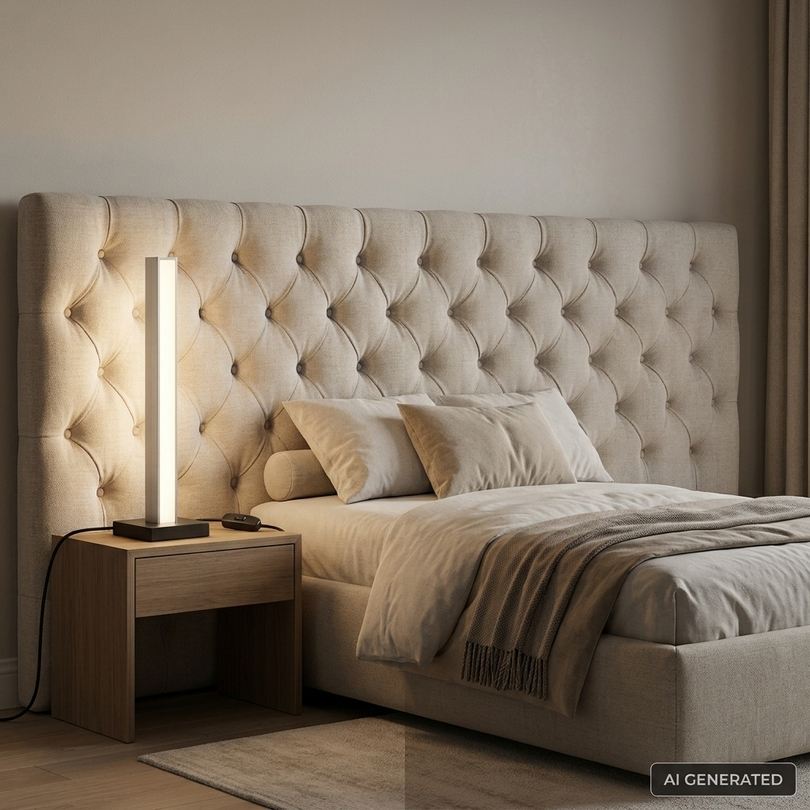
Model 1: “Linea”, the minimal linear bedside table lamp
Linea is a vertical bar of light standing on a heavy base, like a modern candle. It is the easiest of the five bedside lamps and the one that best demonstrates how a simple aluminium profile becomes furniture. It fits modern, minimal and contract interiors and can be made as a pair in under two hours.
Specifications
- Height: 45 cm (light section 35 cm).
- Output: about 350-400 lumens at full power (before diffuser loss).
- Colour: 2700K, CRI>90.
- Power: about 3.7 W.
- Control: inline touch dimmer or rotary dimmer on the cable.
| Part | Quantity | Source |
|---|---|---|
| 21×25 mm aluminium profile | 45 cm | LightingLine.eu |
| Opal diffuser compatible with the profile | 35 cm | LightingLine.eu, see product versions |
| End caps (one blind, one with cable hole) | 2 | LightingLine.eu |
| COB LED strip 2700K 10.5 W/m | 35 cm | LightingLine.eu |
| Base: steel plate, stone or hardwood block, 12x12x3 cm, min. 1 kg | 1 | Local supplier / joinery |
| 24V DC plug-in adapter, 10 W, CE/UKCA | 1 | Electrical wholesaler |
| 24V inline touch or rotary dimmer | 1 | Electrical wholesaler |
| 2-core cable 0.5 mm², 1.8 m, with DC jack | 1 | Electrical wholesaler |
| M5 threaded rod or 2 screws, felt pad | 1 set | Hardware store |
Step 1- Cut the profile and diffuser
Cut the profile to 45 cm with square ends. Deburr carefully: the cut edge will be visible at the top. Cut the opal diffuser to 35 cm, leaving the bottom 10 cm of the profile opaque. This opaque section hides the cable entry and gives the lamp a “stem”.
Step 2 – Prepare the base
Drill a cable hole through the base (6 mm) and two fixing holes matching the profile’s back. If the base is wood, rout a shallow channel underneath for the cable to exit at the back. Weight matters: a bedside lamp must not tip when touched in the dark, so aim for at least 1 kg.
Step 3 – Prepare and solder the strip
Cut 35 cm of COB strip at the nearest cutting point. Solder the red (+) and black (-) wires to the strip pads at the bottom end, then cover with heat-shrink. Test on the 24V adapter before installation.
Step 4 – Mount the strip in the profile
Clean the inside of the profile with isopropyl alcohol. Stick the strip on the profile floor, starting 10 cm above the base so that the light begins where the diffuser begins. Thread the cable down through the profile and out of the end cap with cable hole.
Step 5 – Fix the profile to the base
Screw or bolt the profile vertically to the base through the bottom end cap. Pass the cable through the base hole and channel. Check the profile is plumb with a square.
Step 6 – Insert the diffuser and cap the top
Click the opal diffuser into the profile from the top down. Fit the blind end cap on top.
Step 7 – Wire the dimmer and test
Connect the cable to the inline dimmer and the adapter. Test full brightness and minimum dimming. Stick a felt pad under the base.
Professional tips for Model 1
- For a brighter lamp or a desk version, use the 36×26 mm profile with two strips side by side.
- Rotate the profile so the light faces the bed at about 45°, illuminating the pillow area without glare.
- Black anodised or powder-coated profiles suit dark interiors; specify finish consistently across units.
Model 2: “Tubo”, the cylindrical lantern bedside lamp
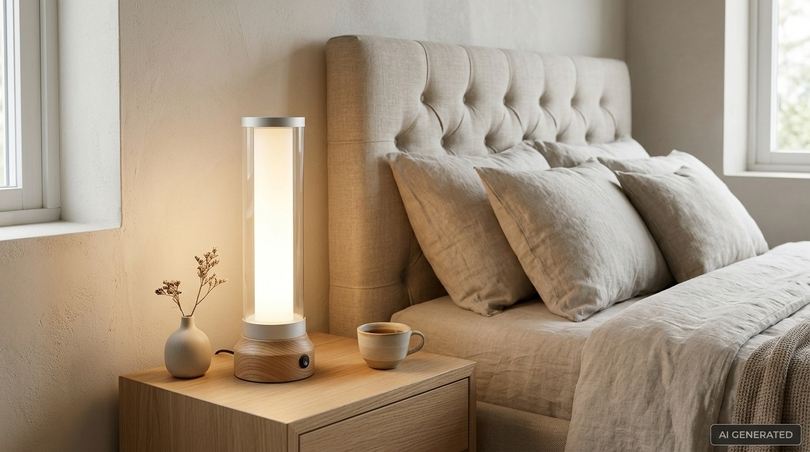
Tubo is a glowing cylinder, a contemporary lantern that spreads light 360° around it. It works in Scandinavian, Japandi and hotel interiors and creates a soft, ambient bedside glow rather than a directional beam. It is ideal where the bedside lamp’s main job is atmosphere and orientation.
Specifications
- Height: 30 cm light body on a 3 cm base (33 cm total), diameter 50 mm.
- Output: about 250-300 lumens through the round diffuser.
- Colour: 2700K, CRI>90.
- Power: about 3.75 W (two 25 cm strips at 7.5 W/m).
| Part | Quantity | Source |
|---|---|---|
| Round aluminium profile, 50 mm diameter | 30 cm | LightingLine.eu |
| Round opal diffuser for the profile | 30 cm | LightingLine.eu, see product versions |
| Round end caps (one with cable hole) | 2 | LightingLine.eu |
| COB LED strip 2700K 7.5 W/m with current control | 2 x 25 cm | LightingLine.eu |
| Turned wood or ceramic base, 10 cm diameter, 3 cm high | 1 | Joinery / ceramicist |
| 24V adapter 10 W, touch dimmer, cable | 1 set | Electrical wholesaler |
Step 1 – Understand the round profile
Round profiles hold the strip on an internal flat seat while the diffuser forms part of the cylinder. Check the product page for the strip seat width and the diffuser options. For a full 360° glow, two strips back to back (or on two seats, where available) give the most even result.
Step 2 – Cut and finish the tube
Cut the profile and diffuser to 30 cm. Deburr both ends; the top edge will be visible from the bed, so finish it carefully.
Step 3 – Install two strips
Cut two 25 cm lengths of strip. Solder them in parallel (both + to +, both – to -) at the base end. Stick them on the strip seats, starting 2-3 cm above the bottom so the base does not hide the light. The current-controlled strip keeps brightness identical along both strips.
Step 4 – Make the base
Turn or cut a 10 cm wooden or ceramic disc. Drill a central 50 mm recess 1 cm deep to receive the tube, plus a 6 mm cable hole exiting at the side. Glue the tube into the recess with construction adhesive or fix it with the bottom end cap screwed to the base.
Step 5 – Diffuser, top cap and wiring
Insert the diffuser, close the top with the blind cap, and connect the cable to the touch dimmer and adapter. Test at full and minimum brightness.
Professional tips for Model 2
- For a small bedside lamp or a child’s room, use the 30 mm round profile at 25 cm height.
- For a large bedside lamp or a living room statement, use the 75 mm round profile at 50-60 cm.
- For terraces and bathrooms, the waterproof 30 mm round profile combined with an IP-rated strip creates a damp-resistant version.
Model 3: “Arco Neon”, the neon-effect sculptural bedside lamp
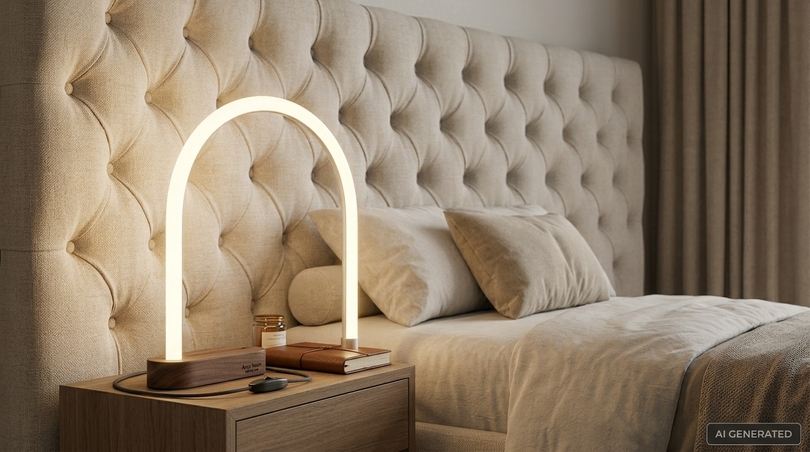
Arco Neon is a luminous arch of warm light rising from a solid base. It uses LightingLine’s 3 mm COB strip in an IP67 spherical silicone tube, which produces a continuous, neon-like line. It is the most decorative of the five bedside lamps, ideal for teenage bedrooms, boutique hotels, guest suites and showrooms where the lamp must also be a design object.
Specifications
- Size: arch about 30 cm high and 25 cm wide, on a 25 x 10 x 3 cm base.
- Strip length: about 80 cm.
- Output: soft ambient glow, about 250-350 lumens.
- Colour: 2700K or 3000K, CRI>90.
- Power: about 4.8 W.
| Part | Quantity | Source |
|---|---|---|
| COB strip 2700K 6 W/m, 3 mm, IP67 silicone tube (or the 3000K version) | 80 cm | LightingLine.eu |
| 18×6 mm flexible aluminium profile (optional, as a bendable spine) | 80 cm | LightingLine.eu |
| Solid base: oak, walnut, concrete or 15 mm acrylic, 25x10x3 cm | 1 | Joinery / plastics supplier |
| Silicone end caps and neutral-cure silicone sealant | 1 set | Electrical wholesaler |
| Clear acrylic or steel wire spine, 3-4 mm, as support | 90 cm | Hardware store |
| 24V adapter 10 W, inline touch dimmer, cable | 1 set | Electrical wholesaler |
Step 1 – Draw the arch at full scale
On a sheet of card, draw the arch at 1:1 scale: two vertical legs 5 cm apart from the base edges, joined by a semicircle. Mark the two entry points on the base. The strip’s minimum bending radius is shown on its product sheet; keep curves gentler than that limit.
Step 2 – Build the spine
The silicone strip is flexible and needs support to hold the arch. Two options work well:
- Flexible aluminium profile: bend the 18×6 mm flexible profile to the template, then lay the silicone strip on top or inside it. The aluminium spine also helps with heat dissipation.
- Wire spine: bend a 3-4 mm steel or brass rod to the template and attach the strip with transparent clips or clear silicone dots.
Step 3 – Prepare the base
Drill two holes in the base matching the spine legs, plus one hole for the strip’s feed end and a channel underneath for the cable. Fix the spine legs with epoxy.
Step 4 – Cut, seal and connect the strip
Cut 80 cm of strip at a cutting point. Seal the far end with a silicone end cap and neutral-cure sealant to maintain the IP rating. Solder the feed wires at the other end, insulate with heat-shrink, and test.
Step 5 – Mount the strip on the spine
Insert the feed end through its hole in the base, then follow the spine along the arch, securing every 8-10 cm. Hide the sealed end in the second hole. The arch should look like one continuous neon line, with no visible clips from the front.
Step 6 – Finish the base and wire the dimmer
Run the cable along the channel to the rear, add a felt base, connect the inline dimmer and adapter. Dim to about 50% for a perfect evening glow.
Professional tips for Model 3
- Shapes can be customised: circles, waves, initials or a hotel’s logo, while the electrical design stays the same.
- For teenage bedrooms, RGB versions in the COB range allow colour scenes; keep a warm white option for bedtime.
- Because the strip is IP67, the same lamp concept works on covered terraces and in spa areas, with a suitable outdoor-rated driver.
Model 4: “Lettura”, the wall-mounted bedside reading light
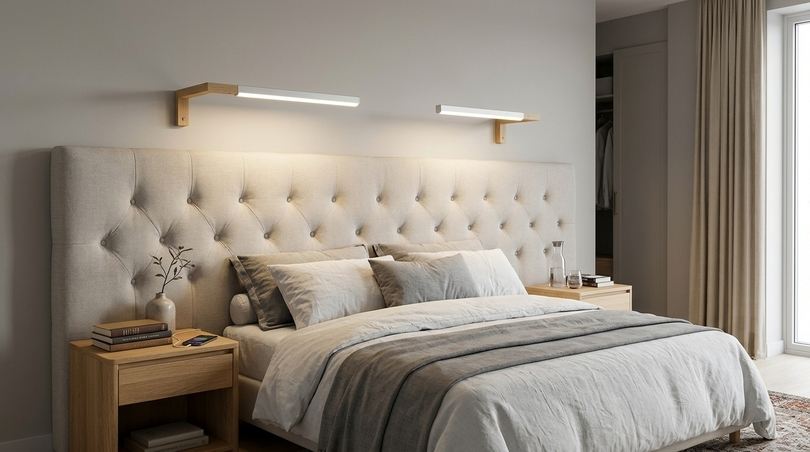
Lettura is a slim aluminium bar mounted on the wall or headboard above each pillow. It gives a focused, glare-free reading light, frees the nightstand completely and keeps one partner’s light out of the other’s eyes. It is the most efficient bedside lamp for hotels, build-to-rent flats and small bedrooms, and it is designed to be wired at first fix.
Specifications
- Length: 40 cm per side.
- Mounting height: bottom edge 70-80 cm above the mattress top, centred above each pillow.
- Output: about 300-350 lumens directed downward.
- Colour: 2700K fixed or 2700-6500K tunable.
- Power: about 3-4 W per side.
- Control: integrated touch sensor, wall push-dimmer or smart controller.
| Part | Quantity | Source |
|---|---|---|
| 17×7 mm aluminium profile (or 17×15 mm for deeper glare control) | 2 x 40 cm | LightingLine.eu |
| Opal diffuser, end caps, mounting clips | 2 sets | LightingLine.eu |
| COB CCT 2700-6500K strip or COB 2700K 10.5 W/m | 2 x 40 cm | LightingLine.eu |
| Hardwood or aluminium angle bracket (wall arm), 8-10 cm projection | 2 | Joinery / metalwork |
| 24V driver 15-20 W in accessible location | 1 | Electrical wholesaler |
| Two independent dimmers or a dual-channel controller | 1 set | Electrical wholesaler |
Step 1 – Plan at first fix
Mark the bed centreline, the pillow positions and the reading light positions. Run a low-voltage cable from the driver location (wardrobe void, ceiling void or bedside furniture) to each light point, and a control cable to each switch position beside the bed. Keep the driver accessible: never bury a driver behind plaster.
Step 2 – Prepare the wall arm
A small angled arm (8-10 cm projection) lets the bar sit forward of the headboard and tilt 30-45° toward the pillow. Use hardwood, a folded aluminium plate or a bespoke joinery bracket that matches the headboard.
Step 3 – Assemble the bars
Cut profiles and diffusers to 40 cm. Mount the strips, solder the feed (three wires for CCT strips), and fit end caps with cable holes on the wall side.
Step 4 – Fix and connect
Fix the arm to the wall, clip the profile to the arm with the profile’s mounting clips, connect to the feed cable. Each side must have its own dimmer or controller channel so that each sleeper controls their own light.
Step 5 – Aim and test
Tilt the bar until the light falls on a book held at chest height and does not hit the eyes of the person on the other side. Test both full brightness and minimum dimming; with CCT strips, check both 2700K and cooler settings.
Professional tips for model 4
- For the most minimal look, recess an 8×10 mm micro profile directly into an upholstered or timber headboard.
- Specify the same reading light in every room of a hotel: guests learn the controls once.
- Add a second, very dim channel (a short strip pointing at the floor) as a night light.
Model 5: “Sospeso”, the floating nightstand with integrated light and night light
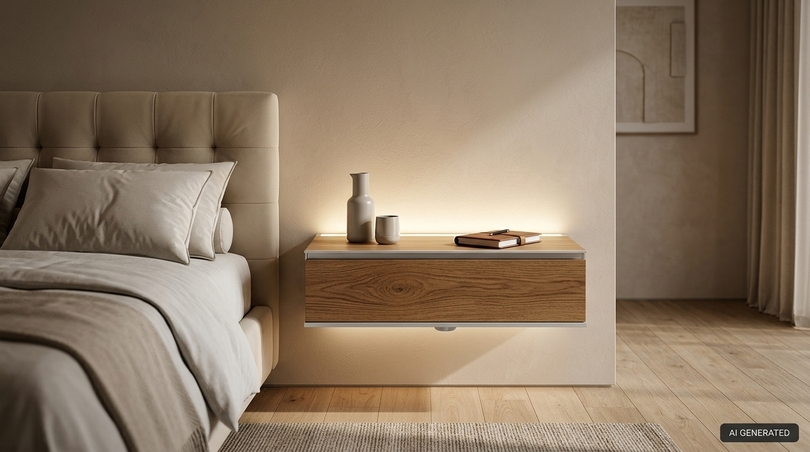
Sospeso is a wall-hung nightstand made from a single 18 or 25 mm panel with a glowing edge and a motion-activated night light underneath. It combines bedside tables and lamps into one built-in piece of joinery. For developers and hotels, it delivers the cleanest possible bedside: no loose lamp, no visible cable, nothing to break or steal, and an orientation light that switches on as soon as feet touch the floor.
Specifications
- Nightstand: 50 x 35 cm, 18 mm or 25 mm panel, wall-hung at 55-60 cm.
- Upward and downward light: double emission profile along the front edge.
- Night light: under-shelf strip at 10-20% brightness with PIR sensor.
- Colour: 2700K, CRI>90.
- Power: 3-5 W in use; under 1 W in night-light mode.
| Part | Quantity | Source |
|---|---|---|
| Double emission profile for 18 mm shelves or for 25 mm shelves | 50 cm | LightingLine.eu |
| Shelf aluminium profile (alternative, single emission) | 50 cm | LightingLine.eu |
| COB 2700K 7.5 W/m with current control | 2 x 48 cm | LightingLine.eu |
| Panel 50×35 cm (oak veneer, lacquered MDF, HPL) | 1 | Joinery |
| Concealed shelf brackets rated for at least 25 kg | 2 | Hardware supplier |
| 24V PIR sensor switch with adjustable timer, 24V touch dimmer | 1 each | Electrical wholesaler |
| 24V driver 15 W, accessible | 1 (can serve both sides) | Electrical wholesaler |
Step 1 – Coordinate joinery and wiring
Agree the nightstand height (55-60 cm to the top), the bracket positions and the low-voltage feed exit with the joiner and electrician. The cable should exit the wall exactly behind the panel, so nothing shows.
Step 2 – Fit the edge profile
Slide the double emission profile onto the front edge of the panel, or rout a groove for the shelf profile. Cut the strips to 48 cm and fit one in each channel: the upper strip washes the wall and the top surface, the lower one lights the floor.
Step 3 – Wire the two channels
- Channel A (upper strip): touch dimmer on the panel’s underside or a wall push-dimmer beside the bed, used as the bedside lamp.
- Channel B (lower strip): PIR sensor aimed at the floor, timer 1-3 minutes, brightness limited to 10-20%: the night light.
Step 4 – Hang the nightstand
Fix concealed brackets to studs or solid masonry, slide the panel onto them, connect the feed and test both channels. Check that the PIR sensor does not trigger from movement in bed.
Step 5 – Optional headboard glow
For a complete hotel-style composition, run a 27×12 mm surface profile with a 7.5 W/m strip behind the top edge of the headboard, on its own dimmer channel. This adds an indirect wall wash that makes the room glow without any visible source.
Professional tips for model 5
- Use the same driver for both nightstands and the headboard glow; place it in an accessible wardrobe void.
- In care homes and family homes, the motion night light is a real safety improvement.
- For a small bedroom, a wardrobe aluminium profile with the same sensor lights the wardrobe interior from the same driver.
The five models compared
| Model | Type | Light character | Power | Build time (pair) | Indicative parts cost (pair) | Best for |
|---|---|---|---|---|---|---|
| 1. Linea | Freestanding | Directional vertical glow | ~3.7 W | 1.5-2 h | Low | Modern homes, rental units |
| 2. Tubo | Freestanding | 360° ambient | ~3.75 W | 2 h | Low | Hotels, Japandi, kids |
| 3. Arco Neon | Freestanding sculpture | Neon-effect line | ~4.8 W | 3 h | Low-medium | Teens, boutique hotels, showrooms |
| 4. Lettura | Wall-mounted | Focused reading beam | ~3-4 W per side | 3-4 h incl. wiring | Low-medium | Hotels, small rooms, couples |
| 5. Sospeso | Integrated joinery | Wall wash + night light | 3-5 W | 4-6 h incl. joinery | Medium | Developers, hotels, care homes |
Parts cost depends on finishes, quantities and the driver/dimmer chosen. Request a project quotation from LightingLine.eu for exact figures on multi-unit orders.
10. Safety, compliance, maintenance and cord management
Bedside lamps live next to bedding, curtains, children and sleepy hands. Safety is therefore not a footnote. This section covers the questions most asked about the safety of bedside lamps, the compliance points that builders must respect in the EU and UK, and the simple maintenance routines that keep lamps working for years.
Are bedside lamps safe?
Modern LED bedside lamps that carry proper safety markings are among the safest electrical products in the home. LEDs run far cooler than incandescent or halogen bulbs, and 24V low-voltage strips operate at a safety extra-low voltage (SELV) level once the certified driver has converted mains power. The main risks come from uncertified chargers and adapters, damaged cables, overloaded extension leads and old high-wattage bulbs touching shades.
Safety checklist for bedside lamps
- Buy or use only drivers and adapters with CE marking (EU) or UKCA/CE (Great Britain), from traceable suppliers.
- Never exceed the maximum bulb wattage marked on old lamps; replace incandescent bulbs with LED.
- Keep fabric shades away from hot sources; with LED strips, keep the strip in an aluminium profile.
- Replace any cable with cracked insulation, and never run cables under mattresses or rugs.
- Do not cover lamps or drivers with clothes or towels.
- Use ventilated locations for drivers in integrated installations.
Compliance notes for builders in the EU and UK
Low voltage and SELV
Mains wiring must be carried out by qualified electricians under national rules (for example, BS 7671 in the UK). The 24V side of an LED system is SELV when supplied by a certified safety isolating driver, which simplifies installation in headboards and furniture, but connections must still be secure, insulated and accessible.
IP ratings
The IP code indicates protection against solids and water. IP20 strips suit dry bedrooms; IP65 and IP67 strips suit bathrooms, terraces and wet areas. The International Electrotechnical Commission’s explanation of IP ratings gives the official definitions.
Energy labelling and ecodesign
Light sources sold in the EU carry an energy class under the energy labelling regulation. LightingLine strip product pages display the energy class of each strip. Note that the current scale is deliberately strict, so classes E, F and G are normal for many good-quality LED products today.
UK plugs and voltage
For projects in the UK, use 24V adapters fitted with BS 1363 plugs, or integrated drivers wired into fused spurs. The LED strips themselves are identical across the EU and UK because they run on 24V DC.
Children’s rooms: safe table lamps
What is the safest table lamp for a child’s bedroom?
The safest lamp for a child’s bedroom is a low-voltage LED lamp with a heavy, wide base, no exposed hot parts, no small detachable pieces, and a cable that cannot be pulled or reached. Wall-mounted lights and integrated nightstand lights (Models 4 and 5) are even safer because there is nothing to knock over.
Are LED table lamps suitable for children? Which light is best for bedtime reading?
Yes. LED lamps stay cool to the touch and use safe low voltages after the adapter. For bedtime reading, use warm 2700K light at moderate brightness (around 200-300 lumens), dimmed further as sleep approaches.
Timers and automatic shut-off
Many modern lamps and controllers include a sleep timer. With LED strips, a smart controller or a PIR sensor with a timer provides automatic shut-off, useful for children who fall asleep with the light on.
Overheating prevention
LED strips generate heat at the chips; if the heat is not removed, lifespan falls. Aluminium profiles act as heat sinks. Keep strip power within the profile’s recommended range, never seal a strip in a closed plastic box without ventilation, and size drivers with a margin so they do not run at their limit.
Cord management
- Plan sockets close to the bedside table so cords are short and hidden.
- Route lamp cables through a grommet in the nightstand top or down the back leg.
- Use adhesive cable clips or cable channels painted to match the wall.
- For integrated lamps, run cables inside the wall or headboard during construction.
How to clean and maintain a table lamp
- Switch off and unplug the lamp.
- Dust aluminium bodies and diffusers with a microfibre cloth; use a slightly damp cloth with mild soap for marks.
- Avoid solvents on acrylic or polycarbonate diffusers: they can cloud.
- Vacuum fabric shades with a soft brush attachment.
- Check cables and connectors once a year in hotels and rentals.
- For LED strip lamps, replacing a strip after many years takes minutes: remove the diffuser, peel off the old strip, fit and connect a new one.
11. Energy wonsumption and running costs
Energy questions come up constantly: are table lamps expensive to run, do they use less electricity than ceiling lights, how much does an LED lamp cost per year? The short answer is that LED bedside lamps cost very little. This section shows the arithmetic, so you can quote real figures to clients.
How much electricity does an LED table lamp use?
A typical LED bedside lamp uses 3-8 W. The five models in this guide use between about 3 and 5 W each at full power and less when dimmed. For comparison, a 40 W incandescent bulb, once the standard bedside bulb, used ten times more energy. The US Department of Energy’s guide to LED lighting summarises how much less energy LEDs use and how much longer they last compared with incandescent lighting.
| Light source | Power | kWh per year | Cost per year |
|---|---|---|---|
| Incandescent bulb | 40 W | 43.8 | EUR 10.95 |
| Halogen bulb | 28 W | 30.7 | EUR 7.67 |
| LED bulb | 5 W | 5.5 | EUR 1.37 |
| LED strip lamp, Model 1 | 3.7 W | 4.1 | EUR 1.01 |
| LED strip lamp, Model 1, dimmed 50% | ~1.9 W | 2.0 | EUR 0.51 |
Driver losses add roughly 10-15%. Electricity prices vary by country and contract.
Are table lamps expensive to run? Do they use less electricity?
An LED bedside lamp costs about one euro a year to run in normal use. Using bedside lamps instead of a 30-60 W ceiling light in the evening reduces consumption further, because only the light that is needed is switched on. For a 100-room hotel, replacing 40 W bedside bulbs with 4 W LED strip lamps saves several thousand kilowatt hours per year.
Long life and sustainability
Quality LED strips are commonly rated for tens of thousands of hours. At three hours a day, 30,000 hours means more than 25 years of use. Combined with recyclable aluminium bodies and replaceable strips, LED strip bedside lamps are among the most sustainable table lamps you can specify: energy-efficient, long-lasting and repairable.
12. Prices, value for money and where to buy bedside lamps
Bedside lamps range from a few euros to several thousand. Understanding what drives the price helps buyers decide when cheap table lamps are good enough and when to invest, and helps builders explain the value of custom LED solutions.
Price ranges
| Range | Typical price | What you get |
|---|---|---|
| Budget / cheap table lamps | EUR 10-40 | Basic shade and base, often without bulb, limited light quality |
| Mid-range | EUR 40-150 | Better materials, touch or dimmer options, integrated LED |
| Premium | EUR 150-500 | Designer brands, high CRI, quality finishes |
| Designer icons | EUR 500+ | Iconic designs, hand-finished materials, collectability |
| Custom LED strip lamp (parts) | Low to medium | CRI 90+, dimmable, exact dimensions, replaceable strip |
Why are table lamps so expensive now?
Prices of designer and mid-range lamps have risen because of material and energy costs, shipping, compliance testing and the shift to integrated LED electronics. Designer lamps also carry licensing, research and craftsmanship costs. A custom LED strip lamp bypasses much of that cost because it uses standard, mass-produced components combined with local joinery.
Cheap table lamps and bedside lamps sale: what to watch
Cheap table lamps for bedrooms can be perfectly fine for occasional use. Check for safety markings, a stable base, a standard E14 or E27 socket (so you can use a quality LED bulb) and a shade that hides the bulb. Bedside lamps sale periods are a good time to buy branded models; for projects, value is better measured over the lamp’s life than at the till.
Where to buy bedside lamps and table lamps
Bedside lamps and table lamps are sold by department stores, home and DIY chains, discount retailers, furniture stores and online marketplaces; in the UK, shoppers often compare high-street and discount retailers for cheap table lamps. Value retailers generally offer budget lamps that are fine for light use, while specialist lighting suppliers offer better light quality and technical support. For professional projects that need custom, matching, integrated bedside lamps, the best place is a component supplier that also provides technical advice, such as LightingLine.eu, combined with a local joiner and electrician.
Value for money: the real comparison
| Option | Purchase | Energy (10 years) | Replacement parts | Typical lifetime |
|---|---|---|---|---|
| Cheap lamp + incandescent bulb | Low | EUR 110 | Several bulbs | Short |
| Cheap lamp + LED bulb | Low | EUR 14 | Possibly one bulb | Medium |
| Integrated LED retail lamp | Medium | EUR 10-15 | Lamp replaced if LED fails | Medium |
| Custom LED strip lamp | Low-medium | EUR 10 | Strip replaceable in minutes | Long |
Shopping terms decoded: what buyers mean when they search
Buyers describe bedside lamps in many different ways. Knowing what each search term really asks for helps retailers write better product pages and helps builders understand what clients expect.
| Search term | What the buyer usually wants | Best answer in this guide |
|---|---|---|
| bedside lamps UK, bedside lights UK, bedroom table lamps UK | Lamps with UK plugs and UK delivery | 24V strip lamps with a BS 1363 adapter (section 10.2) |
| next bedside lamps, bedside lamps next | High-street style matching pairs | Models 1 and 2 built as identical pairs |
| bedside lamps sale, bedroom lamps sale, bedside table lamps sale | A discount on branded lamps | Value comparison in Table 21 |
| bedside lamps cheap, cheap bedside lamps, table lamps for bedroom cheap | The lowest price for acceptable light | Cheap lamp + quality LED bulb, or a DIY strip lamp |
| bedside lamps small, small bedside lamps, small bedroom lamps | Compact lamps for narrow nightstands | Model 2 with the 30 mm round profile |
| bedside lamps pair, set of 2 bedside lamps, bedroom lamp sets | Matching lamps for a double bed | Any model built twice, model 4 as a wall pair |
| bedside lamps touch, touch bedside lamps, touch lamps for bedroom | Switching without a switch | Any model with a 24V touch dimmer |
| bedside lamps rechargeable, cordless table lamps | No cable, portable light | Section 5.4 |
| bedside tables and lamps, bedside table and lamp, nightstand with lamp | Nightstand and light as one solution | Model 5, Sospeso |
| 2 light table lamps | One lamp with two independent light sources | Model 5 (two channels) or Model 1 with two strips |
| bright table lamp, bright lamps for bedroom | High output for reading or dressing | Model 1 in 36×26 mm with 11 W/m strip |
| table top lamp, side lamps, table side lamps, night table lamps | Freestanding lamps for side tables and nightstands | Models 1, 2 and 3 |
| lamp bedside table, lamps for bedside tables, lamps table bedroom, bedroom table lights | The right lamp for a specific nightstand | Height and size rules, section 7 |
The common thread is simple: whatever words they use, buyers of bedroom lamps want warm, comfortable, easy-to-control light at a fair price. Custom LED strip bedside lamps meet all four needs.
13. Playbooks for designers, hotels, home offices, families, students and collectors
Different professionals and users look for different things in bedside lamps and table lamps. An interior designer needs coherence and originality, a hotel owner needs durability and simplicity, a parent needs safety, a student needs a cheap all-rounder. This section turns the guide into six short playbooks, each answering the questions these audiences ask most often, with a recommended LightingLine-based solution for each.
Interior designers: elegant, original and coherent
Which table lamp styles work best in modern living rooms?
Slim, sculptural lamps with hidden light sources: linear bars, cylinders, mushroom domes and globes in matt metal, glass or stone. Modern rooms benefit from lamps that create light without visual clutter, so integrated and linear LED forms work particularly well.
Are dimmable table lamps useful for creating different atmospheres?
Essential. Dimming lets the same lamp read as a working light at 6 pm and a candle-like glow at 11 pm. For a designer, a dimmable 2700K CRI 90+ lamp is the most flexible tool in the palette.
Where to find designer table lamps with sustainable materials?
Look for manufacturers that publish material origins and offer replaceable light sources. A sustainable and original route is the custom lamp: specify a LightingLine aluminium profile and COB strip, and have a local maker produce a base in reclaimed or certified wood, stone or recycled glass.
Recommended solution: model 2 (Tubo) in a bespoke finish for living rooms and bedrooms; Model 3 (Arco Neon) as a signature piece in a guest suite or showroom.
Home office workers: the best table lamp for working from home
What is the best table lamp for working from home?
An adjustable or linear lamp with 500-800 lumens, CRI 90+, flicker-free dimming and, ideally, tunable white. Place it on the side opposite your writing hand and slightly behind the screen line to avoid reflections.
Which table lamp features help reduce eye strain?
- Flicker-free driver and dimmer.
- Diffused light: no visible LED points.
- Adequate ambient light in the room, not just on the desk.
- Adjustable brightness to match the screen.
Warm or cool light for a home office?
Neutral (3500K-4000K) during focused daytime work; warm (2700K-3000K) in the evening. A CCT strip covers both from a single lamp.
What brightness is ideal for reading and computer work?
Around 300-500 lux on the work surface. In practice, a 500-800 lumen desk lamp at 40-50 cm from the surface delivers that range.
Ergonomic desk lamp setup and glare reduction
Keep the light source below eye level or shielded, aim the beam at the work area rather than the screen, and avoid glossy desk surfaces directly under the lamp.
Recommended solution: Model 1 (Linea) in the 36×26 mm profile with the CCT COB strip, tilted toward the desk: a compact table lamp with adjustable brightness and colour temperature.
Parents: safe, versatile lamps for children’s rooms
Which table lamps have child-friendly materials and stable bases?
Lamps with wide, heavy bases, rounded edges, no glass parts and cool-running LED sources. Aluminium and wood are durable; avoid thin glass shades in young children’s rooms.
How easy is it to clean and maintain a children’s table lamp?
An LED strip lamp in an aluminium profile with a polycarbonate diffuser is wipe-clean and has no bulb to break. Integrated night lights under furniture have nothing to clean at all.
Recommended solution: Model 5 (Sospeso) night light at 10-15% brightness with a PIR sensor, or a small version of Model 2 (Tubo, 30 mm profile) on a heavy wooden base, with an adapter placed out of reach.
Students: affordable, compact and smart
What is the best affordable table lamp for students?
A compact LED lamp with dimming and a small footprint. A self-built strip lamp gives better light than most cheap table lamps for a similar budget, and teaches a useful skill.
Which desk lamps are compact enough for a small room? Are USB ports useful?
Lamps with a footprint under 15 x 15 cm or clamp/wall mounting. USB ports are useful for students where sockets are scarce; a USB-powered LED strip lamp is also possible.
What table lamp is best for studying and gaming?
A tunable white lamp for study plus an RGB accent strip behind the desk or monitor for gaming. Keep the study light neutral and the accent light low.
Recommended solution: Model 4 (Lettura) mounted on the wall above the desk to save surface space, with a CCT strip.
Boutique hotel owners: durable, refined, easy to manage
Which table lamps are best for boutique hotel rooms?
Matching pairs of robust, dimmable bedside lamps or, better, wall-mounted readers plus a decorative lamp. Every guest must understand the controls within seconds, so use the same switch type in every room.
How can bedside lamps improve the guest experience?
Independent reading lights for couples, a master switch beside the bed, a dim night light to the bathroom and warm, flattering light all contribute directly to how guests rate room comfort.
What are the most durable table lamps for hospitality?
Metal or solid wood bodies, no fragile shades, fixed or weighted bases, and LED sources rated for long life. Integrated joinery lights are the most durable: they cannot be knocked over or removed.
Are cordless table lamps practical for hotel rooms and restaurants?
For restaurants and terraces, yes, with a charging routine for staff. For bedrooms, wired or integrated lights are more reliable, as no guest wants a flat battery at midnight.
Which designs create a luxurious atmosphere? How to choose energy-efficient lamps for a hotel?
Luxury comes from warm, low, layered light and fine materials. Energy efficiency comes from LED sources of 3-8 W, dimmers, occupancy sensors and master switches that turn everything off when guests leave.
Recommended solution: Model 4 (Lettura) above each pillow, Model 5 (Sospeso) nightstands with night light, and a headboard glow on a third channel, all on one accessible driver per room.
Vintage collectors: character, authenticity and LED retrofits
How can I identify an authentic vintage table lamp?
Look for manufacturer marks, labels or stamps on the base; period-correct wiring and sockets; patina consistent with age; and documentation such as catalogues or provenance. For iconic designs, compare dimensions and details with the manufacturer’s archive, since reproductions often differ in small ways.
Which materials are common in collectible table lamps?
Brass, bronze, chrome, opaline and Murano glass, enamelled metal, marble, ceramic and early plastics from the 1960s and 1970s.
What makes a designer table lamp valuable to collectors?
Designer and manufacturer attribution, production period (early runs are more valuable), condition, originality of parts and rarity of finish or colour.
How should I restore and maintain a vintage table lamp?
Have the wiring checked or replaced by a qualified electrician, keep original parts where safe, clean metal gently without aggressive polish, and document every intervention.
Are vintage table lamps compatible with modern LED bulbs?
Usually yes, through a standard socket and an LED bulb of the right shape. For lamps with unusual sockets or where the bulb would be visible, a reversible retrofit with a short COB strip wrapped around a small round aluminium core can recreate a warm, even glow inside the shade without drilling or altering the original body. Always keep the original parts so the lamp can be returned to its original state.
14. Comparison chart and final recommendations
To close, here is a single chart that compares the main solutions for bedside lighting by performance, design, functions and budget, followed by clear recommendations for each scenario. It is designed to help you choose quickly and to support the specification you send to clients.
| Solution | Light quality | Ease of use | Durability | Customisation | Energy | Budget |
|---|---|---|---|---|---|---|
| Cheap table lamp + LED bulb | Variable | Good | Low-medium | Low | Good | Very low |
| Branded touch lamp | Good | Very good | Medium | Low | Good | Low-medium |
| Rechargeable lamp | Good | Good (needs charging) | Medium | Low | Good | Medium |
| Designer icon | Very good | Good | High | Low | Depends on source | High |
| Custom LED strip lamp (Models 1-3) | Excellent (CRI>90) | Very good | High | Very high | Excellent | Low-medium |
| Integrated wall/joinery light (Models 4-5) | Excellent | Excellent | Very high | Very high | Excellent | Medium |
Final recommendations
- New-build apartments and houses: plan sockets and a low-voltage feed at first fix; offer Model 4 or Model 5 as an upgrade package.
- Hotels and serviced apartments: wall-mounted readers plus integrated nightstands with night light; identical controls in every room.
- Renovations: Models 1-3 as plug-in bedside lamps that need no new wiring.
- Interior design projects: custom profiles and bases that match the client’s materials exactly.
- Every bedroom: 2700K-3000K, CRI 90+, dimmable, glare-free.
Next step: plan your bedside lamps with LightingLine.eu
Ready to build? Browse the aluminium profiles and LED strips used in this guide, download the profiles catalogue and the LED strip catalogue, and contact the LightingLine.eu technical team with your room count and drawings. For multi-unit projects, the team can help you choose the right profile, strip, diffuser and driver combination for each bedside lamp model and confirm quantities before you order.
15. Frequently Asked Questions about bedside lamps
The questions below are the ones buyers, designers, builders and hotel owners ask most often about bedside lamps and table lamps. Click each question to open the answer. Each answer is written to be complete on its own, so you can quote it directly in specifications or client presentations.
What are bedside lamps?Bedside lamps are small lamps placed beside a bed, on a bedside table, nightstand or headboard, that provide local light for reading, orientation and relaxation without lighting the whole room. The best bedside lamps combine warm 2700K-3000K light, CRI 90+, dimming and an easy control such as a touch sensor. |
What is the difference between a table lamp and a bedside lamp?A bedside lamp is a table lamp designed for use next to a bed. It is usually smaller, lower in output, dimmable and glare-free from the pillow, while a living room table lamp is often taller and brighter because it contributes to ambient room light. |
What is the difference between a desk lamp and a table lamp?A desk lamp is an adjustable task light that concentrates light on a work surface. A table lamp is mainly an ambient or accent light that spreads soft light around it, usually through a shade or diffuser. |
Are bedside lamps necessary?For any double bedroom or hotel room, yes. Bedside lamps let each occupant read, wind down and switch off without getting up, provide low evening light that supports sleep, and make a bedroom look finished. |
When were bedside lamps invented?Bedside lights have existed for centuries as candles and oil lamps. The electric bedside lamp appeared after practical incandescent bulbs at the end of the 1870s and became common in homes and hotels between the 1880s and the 1930s. LED and LED strip bedside lamps became widespread from the 2010s. |
What is the rule of thumb for bedside table lamps?When you sit up in bed, the bottom of the shade or light source should be roughly at chin-to-shoulder height. In practice the combined height of bedside table and lamp is about 55-70 cm above the mattress top. |
How big should a bedside lamp be?The lamp should be roughly as tall as its bedside table, within 10-20 cm, and should not take more than about two-thirds of the table width, leaving space for a phone, book and glass. |
Can bedside lamps be too small?Yes. A lamp that is too small looks lost next to a large bed and lights only the table top instead of a book held at chest height. Choose a taller lamp or a wall-mounted reading light in that case. |
Do bedside table lamps have to be the same?No. They should match in scale, visual weight and colour temperature, but can differ in form. Identical pairs are simpler and more consistent for hotels and multi-unit projects. |
Do I need two bedside lamps?For a double bed shared by two people, yes, so each sleeper controls their own light. For a single bed against a wall, one lamp is enough. |
Are touch lamps still a thing? Are they good for bedside use?Yes. Touch lamps remain one of the most searched bedside lamp types because they are easy to operate in the dark. Modern LED touch dimmers avoid the flicker and accidental switching of older models. |
Are there battery powered or rechargeable table lamps?Yes. Rechargeable table lamps with lithium batteries and USB-C charging typically run 8-40 hours per charge. They suit rooms without sockets, restaurants and terraces; wired or integrated lights are more reliable in bedrooms. |
Can you leave a bedside lamp on all night?An LED bedside lamp can safely stay on all night because it uses only a few watts and runs cool, but bright light disturbs sleep. If light is needed, use a very dim, warm night-light setting placed low and out of direct view. |
Are lamps good for sleep?Warm, dimmed bedside lamps are better for sleep than bright ceiling lights in the evening because blue-rich bright light suppresses melatonin. Dim the lamp in the last hour before bed and switch it off to sleep. |
Are LED lamps good for your eyes?Quality LED lamps are eye-friendly when they are flicker-free, diffused so the LEDs are not directly visible, and bright enough for the task. Around 300-450 lumens is ideal for bedside reading. |
Are bedside lamps safe?Modern LED bedside lamps with CE or UKCA markings are very safe. 24V LED strip lamps operate at safety extra-low voltage after a certified driver. Avoid uncertified adapters, damaged cables and old high-wattage bulbs near fabric. |
What colour temperature is best for bedside lamps?2700K is the best default for bedside lamps because it is warm and relaxing. 3000K suits multipurpose bedrooms, and tunable white (2700-6500K) is useful when the bedroom doubles as a home office. |
How many lumens does a bedside lamp need?Around 100-250 lumens for an ambient glow and 300-450 lumens for comfortable reading. A night light needs only 5-30 lumens. |
Are table lamps expensive to run?No. An LED bedside lamp of 3-5 W used three hours a day costs about one euro a year at EUR 0.25 per kWh, roughly ten times less than a 40 W incandescent bulb. |
Do table lamps use less electricity than ceiling lights?Usually yes, because a bedside or table lamp of a few watts lights only the area needed, while ceiling lights often use 30-60 W to light the whole room. |
Are floor lamps brighter than table lamps?Floor lamps often have higher output because they light larger areas from greater height, but brightness depends on the light source. An 800-lumen LED table lamp is brighter than a floor lamp with a 400-lumen bulb. |
Can a table lamp light up a room?One table lamp lights its surroundings rather than a whole room. Two or three table lamps in different corners create a comfortable evening ambient level. |
How many table lamps should a living room have?For a living room of 15-25 square metres, two table lamps plus one floor lamp is a balanced start, with at least one lamp within reach of every seating area. |
Can you put 2 lamps on a console table?Yes, ideally on consoles at least 120 cm long. Place one lamp near each end, set back about 10 cm, often under a mirror or artwork for symmetry. |
Can you put a lamp on a side table or end table?Yes. The shade bottom should sit around seated eye level, about 100-110 cm from the floor including the table. |
Are table lamps still in style in 2026?Yes. Layered lighting with several low, warm sources is a core interior trend. 2026 trends include integrated and linear LED lamps, rechargeable designs, mushroom and globe forms, warm dimming and neon-effect sculptural lines. |
What is the famous mushroom table lamp?Mushroom lamps have a dome shade on a slim stem. The most cited designs are Panthella by Verner Panton, Nessino by Giancarlo Mattioli and Atollo by Vico Magistretti. |
Can I make my own bedside lamps with LED strips?Yes. With an aluminium profile, an opal diffuser, a 24V COB LED strip, a certified 24V adapter and a dimmer you can build linear, cylindrical, neon-effect, wall-mounted or integrated bedside lamps. This guide includes five step-by-step models. |
Which LED strip is best for DIY bedside lamps?A 24V COB LED strip in 2700K with CRI above 90 is best because it gives a continuous, dot-free line of warm light. For neon-effect lamps, use a COB strip in a round IP67 silicone tube. |
What is a neon flex bedside lamp?It is a lamp built from an LED strip encased in a flexible silicone body that diffuses the light into a continuous glowing line, imitating glass neon. It can be bent into arches, circles or letters on a solid base. |
What is the safest table lamp for a child’s bedroom?A low-voltage LED lamp with a heavy, wide base, no hot or small detachable parts and a cable out of reach. Wall-mounted or integrated nightstand lights are even safer because nothing can be knocked over. |
Which bedside lamps are best for hotels?Wall-mounted LED reading lights with independent controls for each side, integrated nightstands with a motion-activated night light, and a master switch beside the bed. Use identical controls in every room. |
Are vintage table lamps compatible with LED?Usually yes, with an LED bulb in the original socket. Where the socket is unusual or the bulb would be visible, a reversible retrofit with a short COB LED strip on a small aluminium core can recreate a warm glow without altering the original lamp. |
Where is the best place to buy a table lamp?Retailers and marketplaces suit off-the-shelf lamps. For custom, matching or integrated bedside lamps in professional projects, use a component supplier with technical support, such as LightingLine.eu, together with a local joiner and electrician. |
Why do people use table lamps?For local light where it is needed, for reading and tasks, to create a warm layered atmosphere, to save energy compared with ceiling lights and as decorative objects that define a room’s style. |
Bedside lamps are part of the build
Bedside lamps are small objects with a large effect on how a bedroom is lived in, judged and remembered. The right bedside lamp gives warm, glare-free, dimmable light at the right height; the wrong one glares, wastes energy or ends up unused. For construction companies, the opportunity is to stop treating bedside lighting as an afterthought and to plan it from first fix, with sockets, low-voltage feeds and, where it adds value, integrated reading lights and nightstands.
With standard aluminium profiles, COB LED strips and neon-effect silicone strips, every builder can deliver custom bedside lamps that match the joinery, run on a few watts, last for decades and can be repaired in minutes. Start with one of the five models in this guide, adapt it to your project, and explore the LightingLine.eu catalogue to select the components.
This article was developed with the support of artificial intelligence and subsequently reviewed, corrected, and validated by the LightingLine.eu technical team, which guarantees its reliability and compliance with official sources.