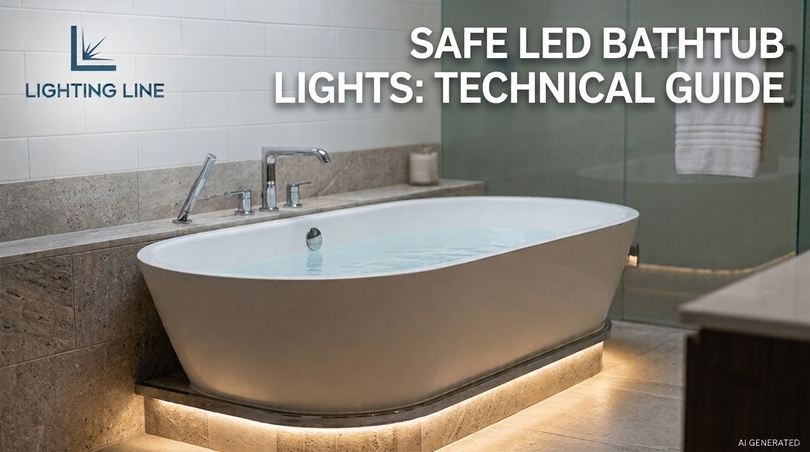
Bathtub lights are the most delicate lighting decision in any bathroom project: they sit closer to water than any other fixture, they define the mood of the room, and when they are specified wrongly they become an electrical hazard. For construction companies, electrical contractors and interior designers, the bathtub area is where a project earns its reputation or its warranty claims. This guide explains which bathtub lights to use, why, where to put them and which mistakes put people and buildings at risk.
The short answer, for anyone in a hurry: the safest and most versatile choice for bathtub lights is a 24V DC (SELV) COB LED strip with IP67 extruded-silicone protection, mounted in an aluminium profile, powered by a driver installed outside the wet zones and protected by a 30 mA RCD. Everything else in this article explains the reasoning, the numbers and the exceptions, so that you can defend the specification in front of a client, an inspector or a hotel operator.
The guide is written for professionals but kept readable. Each section opens with a short summary, then goes into detail. Tables condense the data you will want to copy into a specification sheet. Product links point to the Lighting Line online catalogue, where every strip, profile and accessory mentioned is available with its full technical data.
In this article…
- What are bathtub lights? Definition and functions
- Market data: why bathtub lights matter in 2026
- Can you install a light over a bathtub? Rules and bathroom zones
- IP ratings for bathtub lights explained
- Low voltage (SELV): why 24V is the professional standard
- Types of bathtub lighting compared
- Why COB LED strips are the best bathtub lights
- Where to place bathtub lights: layouts that work
- Colour temperature, CRI and brightness
- Dimmable and smart bathtub lights
- RGB, chromotherapy and cinematic bathtub lighting
- Installation guide for contractors
- Design ideas for every style
- Risks and dangers of the wrong bathtub lights
- Common bathtub lighting mistakes
- Maintenance and cleaning
- Costs, energy and buying criteria
- Answers by professional profile
- Specification checklist for construction companies
- Frequently asked questions
- Bathtub light: where design ambition and electrical risk meet
1. What are bathtub lights? Definition and functions
Before choosing products, it helps to define the category precisely. Bathtub lights is a term that covers very different objects, from ceiling downlights above the tub to LED strips under its rim and battery-powered floating lights. Clarity here prevents the most expensive error in the field: buying a decorative product for a technical position.
A working definition
Bathtub lights are any luminaires or light sources installed in, on, around or above a bathtub, whose position exposes them to water splashes, steam, condensation or, in some cases, immersion. What separates them from general bathroom lighting is not their shape but their exposure. A downlight in the middle of the ceiling and the same downlight directly over the tub are, from a regulatory point of view, two different products, because the second one falls inside a defined electrical zone.
In practice, the term covers five families:
- Ceiling lights over the bathtub: recessed downlights, surface spots, linear profiles in the ceiling or in a cove.
- Wall lights near the bathtub: sconces, wall-washers, linear profiles in niches.
- Integrated bathtub LED lights: LED strips under the rim, in the plinth, around the base of a freestanding tub or inside shelving niches.
- Underwater lights: chromotherapy spots built into whirlpool and spa tubs by the tub manufacturer.
- Portable and floating bath lights: battery-powered, sealed units that float on the water or stick to the tub wall.
Decorative and practical functions
Bathtub lights do three jobs at once, and a good specification balances all three.
Visual comfort and safety
Getting in and out of a bathtub is one of the most frequent causes of domestic falls. A low, glare-free light source near the floor or along the tub edge improves depth perception on wet surfaces without blinding a person who is lying down and looking up. This is why under-rim and plinth LED lighting is not merely decorative: it is a night-time orientation light.
Atmosphere and wellbeing
The bath is the one place in the home where people lie still and look at the ceiling. Light that is pleasant when standing becomes harsh when reclining. Warm, dimmable, indirect bathtub lights transform the bath into a relaxation ritual, which is exactly what spa-style residential projects and boutique hotels sell.
Architectural emphasis
A freestanding tub is often the most expensive object in the bathroom. A thin line of LED light beneath it creates the floating bathtub effect, separating the object from the floor and turning it into the focal point of the room. Wall-grazing light in a niche reveals the texture of stone, microcement or tiles.
How bathtub lighting differs from general bathroom lighting
General bathroom lighting is layered: ambient light from the ceiling, task light at the mirror, accent light in niches. Bathtub lighting borrows from all three layers but adds two constraints: water exposure and the reclining viewpoint. The table below summarises the differences.
| Criterion | General bathroom lighting | Bathtub lights |
|---|---|---|
| Main purpose | Even illumination, mirror tasks | Atmosphere, orientation, accent |
| Viewing position | Standing | Reclining, looking upwards |
| Water exposure | Mostly humidity | Splashes, jets, steam, possible immersion |
| Typical electrical zone | Outside zones or zone 2 | Zone 0, 1 or 2 |
| Recommended voltage | 230V allowed outside zones | SELV 12V or 24V strongly preferred |
| Minimum IP rating | IP20 to IP44 depending on position | IPX4 to IPX7 depending on zone |
| Glare control | Important | Critical |
| Dimming | Useful | Essential |
2. Market data: why bathtub lights matter in 2026
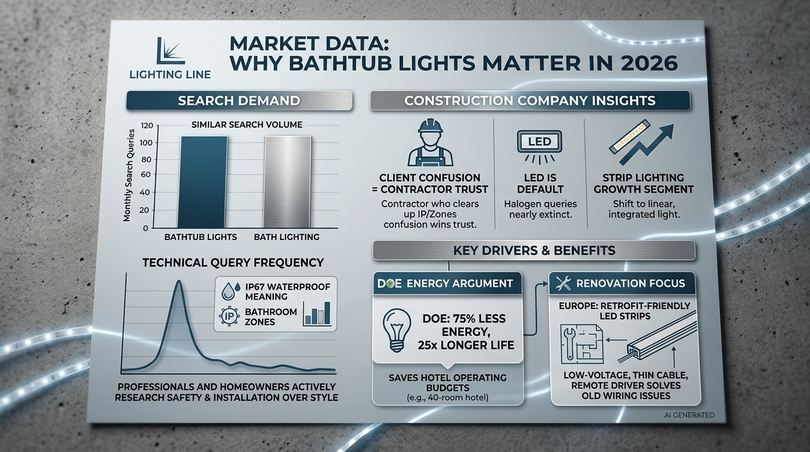
Demand for bathtub lights is not a niche curiosity. Search data shows that professionals and homeowners actively research the topic, and that most of their questions are about safety and installation rather than style. This section summarises the numbers, so that you can size the opportunity and anticipate client questions.
Search demand for bathtub lighting
Therequest come from a content-gap analysis of the lighting market. The key insight is that bathtub lights alone attracts the same search volume as bath lighting, and that technical queries such as bathroom zones and IP67 waterproof meaning are searched thousands of times a month. People are not only looking for something pretty, they are trying to understand what is safe.
What the data tells a construction company
Three conclusions follow from these figures.
- Clients arrive informed but confused: they have read about IP ratings and zones, often from conflicting sources. A contractor who explains the rules clearly wins trust immediately.
- LED is the default expectation: queries for LED bathtub lights and LED bathroom lighting are as frequent as many generic product searches. Nobody is asking for halogen any more.
- Strip lighting is the growth segment: searches for bathroom strip lighting and LED shower lighting signal a shift from point sources to linear, integrated light, which is exactly where LED strips and aluminium profiles excel.
The energy argument
According to the U.S. Department of Energy, residential LEDs use at least 75% less energy and last up to 25 times longer than incandescent lighting. For a single home, that means lower bills; for a 40-room boutique hotel where bathtub lights stay on for hours every evening, it changes the operating budget. We return to the numbers in the section on costs and energy.
The renovation driver
In Europe, a large share of bathroom work is renovation rather than new build. Renovation brings older wiring, unknown cable routes and limited space for drivers. Low-voltage LED strips are the most retrofit-friendly bathtub lights available: they need only a thin cable to the tub area, they fit in shallow profiles and the driver can sit in a ceiling void, an adjacent cupboard or a technical room.
3. Can you install a light over a bathtub? Rules and bathroom zones
This is the single most searched question about bathtub lights, and it has a clear answer: yes, you can install a light over a bathtub, provided the fixture matches the electrical zone it sits in, carries the correct IP rating and is installed on a properly protected circuit. The details depend on the country, but the logic is the same everywhere. This section explains the zone system used across Europe and the UK, the equivalent North American rule, and how both translate into real decisions on site.
The zone system in Europe and the UK
Most European wiring rules derive from the international standard IEC 60364-7-701, “Locations containing a bath or shower”. In the UK the same principles appear in Section 701 of BS 7671. The bathroom is divided into zones according to the likelihood of contact with water. The SELECT technical guide on locations containing a bath or shower illustrates the zones with clear diagrams and is a useful document to share with clients.
Zone 0: inside the bathtub
Zone 0 is the interior of the bath tub itself, the volume that can hold water. Only fixed equipment specifically designed for use in zone 0 is allowed, it must be at least IPX7 and it must be powered at SELV, with the safety source installed outside zones 0, 1 and 2. The SELV limit in zone 0 is 12V AC or 30V ripple-free DC. Underwater chromotherapy lights fitted by spa-bath manufacturers belong here.
Zone 1: directly above the bathtub
Zone 1 is the volume directly above the bath, from the floor up to 2.25 m, bounded by the vertical plane of the tub’s outer edge. A ceiling light directly over the bathtub in a room with a standard ceiling of 2.40 m is usually above zone 1, but in rooms with sloped or low ceilings, part of the ceiling can fall inside it. Fixtures in zone 1 need at least IPX4 (IPX5 where water jets are used for cleaning), and SELV is strongly recommended. The space under the bath is treated as zone 1 if it is accessible without a tool, which matters directly for under-rim LED strips.
Zone 2: around the bathtub
Zone 2 extends 0.6 m horizontally beyond the edge of zone 1 and up to 2.25 m above the floor. Wall lights beside the tub and the lower part of a niche usually sit here. Fixtures in zone 2 need at least IPX4.
Outside the zones
Beyond zone 2, ordinary rules for damp rooms apply. Many installers still choose IP44 fixtures here, because condensation does not respect zone boundaries.
| Zone | Location | Minimum water protection | Typical bathtub lights allowed |
|---|---|---|---|
| Zone 0 | Inside the bathtub | IPX7, SELV max 12V AC / 30V DC | Purpose-made underwater lights only |
| Zone 1 | Above the tub up to 2.25 m; under the tub if accessible without tools | IPX4 (IPX5 with water jets) | IP65 to IP67 SELV LED strips, sealed downlights |
| Zone 2 | 0.6 m beyond zone 1, up to 2.25 m | IPX4 | IP44 or higher wall lights, LED profiles with diffuser |
| Outside zones | Rest of the bathroom | No specific requirement (IP44 advisable) | Most luminaires suitable for damp rooms |
Additional protection by a residual current device (RCD) with a rated residual operating current not exceeding 30 mA is required for all circuits in a location containing a bath or shower. This applies to SELV circuits’ supply side as well: the driver itself is on a 230V circuit and must be RCD-protected.
The North American rule
In the United States, the National Electrical Code (NFPA 70, section 410.10) addresses luminaires near bathtubs differently but with the same intent. Luminaires located within 0.9 m (3 ft) horizontally and 2.5 m (8 ft) vertically from the top of the bathtub rim or shower threshold must be listed for damp locations, or for wet locations where subject to shower spray. Cord-connected luminaires, chain-, cable- or cord-suspended luminaires, track lighting, pendants and ceiling-suspended paddle fans are not permitted in that volume. In practice, this means that a hanging pendant directly over a bathtub is not allowed in the US unless it is outside that zone.
Can you have a hanging light over a bathtub?
This question deserves its own answer because chandeliers over freestanding tubs are a popular image in design magazines. Under North American rules, hanging fixtures are prohibited within the defined zone. Under IEC-based rules, a pendant may be possible only if it hangs entirely outside zones 1 and 2 (above 2.25 m from the floor and beyond the 0.6 m perimeter), is suitable for the location and is installed by an electrician. A chandelier that a bather could touch while standing in the tub, or that drips condensation into the water, is a hazard regardless of the rules. Where the client wants the look, a high ceiling and a professional assessment are mandatory, and an integrated linear light in a ceiling cove often produces a better effect with none of the risk.
Can you put lights above a shower?
Yes, with the same logic. The volume above a shower tray or a walk-in shower is treated like the volume above a bath. Recessed fixtures rated at least IP65 and powered at SELV are the professional choice; IP65 is preferred over IPX4 because shower spray strikes ceiling fixtures directly and steam penetrates poor seals. LED strips inside shower niches should be IP67 and installed in a profile with sealed end caps.
Can you put LED lights in a hot tub or a lazy spa?
Hot tubs and inflatable spas are a separate category. Lights inside the water belong to the equipment manufacturer and must be the manufacturer’s own parts or approved accessories. Adding generic LED strips inside the water of a hot tub is not appropriate, even if the strip claims IP68: chemical treatment, temperature, pressure and continuous immersion are conditions that need a product tested and approved by the spa maker. Around the outside of a hot tub cabinet, a 24V IP67 strip in a protective profile can create a beautiful perimeter light, with the driver kept well away from water.
Can any light fixture go in a bathroom?
No. The fixture must suit its zone, and outside the zones it must still tolerate humidity. Fabric shades, unsealed metal fixtures that corrode, open bulbs near the tub and plug-in lamps are the usual offenders. A plug-in lamp should never be used near a bathtub; in many countries, socket outlets are not even allowed within a set distance of the bath.
4. IP ratings for bathtub lights explained
The IP code is the language in which water protection is specified. Every professional who works on bathtub lights must read it fluently, because a single digit separates a fixture that survives steam from one that is safe under a jet of water or during temporary immersion. This section decodes the rating and maps it to bathtub positions.
How the IP code works
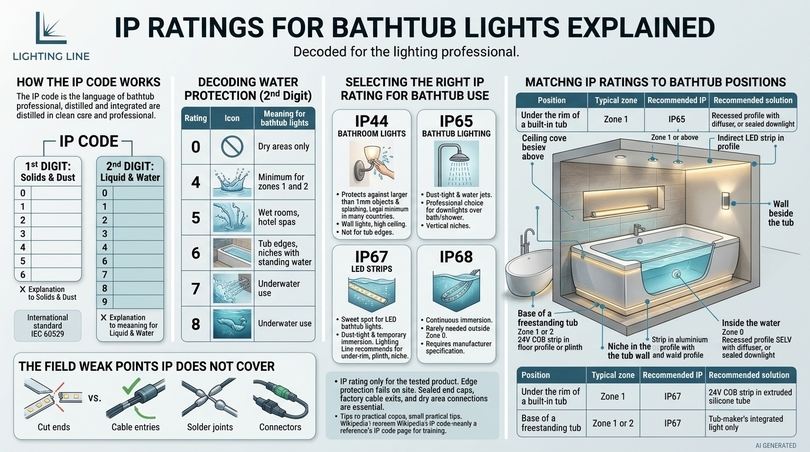
The IP (Ingress Protection) code is defined by the international standard IEC 60529, summarised on the IEC website. It has two digits: the first describes protection against solid objects and dust (0 to 6), the second against water (0 to 9). An “X” means the property was not tested. For waterproof bath lights, the second digit is the one that matters most.
| Second digit | Protection against water | Meaning for bathtub lights |
|---|---|---|
| 0 | None | Dry areas only, or inside a fully sealed enclosure |
| 4 | Splashing water from any direction | Minimum for zones 1 and 2 |
| 5 | Low-pressure water jets | Zone 1 where jets are used, shower ceilings |
| 6 | Powerful water jets | Wet rooms cleaned with hoses, hotel spas |
| 7 | Temporary immersion up to 1 m for 30 minutes | Tub edges, niches with standing water, minimum for zone 0 |
| 8 | Continuous immersion beyond 1 m, conditions declared by the maker | Underwater use, only as declared by the manufacturer |
IP44, IP65, IP67, IP68: which one for bathtub lights?
IP44 bathroom lights
IP44 protects against objects larger than 1 mm and splashing water. It is the legal minimum in zones 1 and 2 in many countries and is suitable for wall lights beside the tub and ceiling fixtures well above it. It is not suitable for a light at the rim of the tub, where water can pool.
IP65 bathtub lighting
IP65 is dust-tight and resists water jets. It is the professional choice for downlights over a bath or shower and for LED strips in vertical niches where water runs off rather than collecting. Note that some IP65 LED strips use a silicone coating over the components rather than a full extrusion; they resist splashes well but are less robust against standing water and aggressive cleaning products.
IP67 LED strips
IP67 is the sweet spot for LED bathtub lights: dust-tight and protected against temporary immersion. A strip with IP67 extruded silicone tube survives water pooling under a rim, condensation running down a niche and the occasional overflow. This is the rating Lighting Line recommends for under-rim, plinth and niche installations.
IP68
IP68 indicates protection against continuous immersion under conditions the manufacturer must specify (depth, time). It is the rating for pool and underwater equipment. For bathtub lights, it is rarely needed outside zone 0, and zone 0 should only host equipment designed for it. An IP68 claim on a generic strip is not, by itself, an authorisation to install it inside the water of a bathtub.
The weak points that the IP rating does not cover
An IP rating applies to the product as tested. In the field, protection fails at the edges: cut ends, cable entries, solder joints and connectors. An IP67 strip cut on site and closed without proper end caps and sealant is no longer IP67. This is why the installation section of this guide insists on sealed end caps, factory-made cable exits where possible and connection points placed outside the wet area. A practical, illustrated overview of the IP code is available on Wikipedia’s IP code page, a useful reference for training site teams.
Matching IP ratings to bathtub positions
| Position | Typical zone | Recommended IP | Recommended solution |
|---|---|---|---|
| Under the rim of a built-in tub | Zone 1 | IP67 | 24V COB strip in extruded silicone tube |
| Base of a freestanding tub | Zone 1 or 2 | IP67 | 24V COB strip in floor profile or plinth |
| Niche in the tub wall | Zone 1 | IP67 | Strip in aluminium profile with sealed caps |
| Ceiling directly above | Zone 1 or above | IP65 | Recessed profile with diffuser, or sealed downlight |
| Ceiling cove beside the tub | Zone 2 or outside | IP44 to IP65 | Indirect LED strip in profile |
| Wall beside the tub | Zone 2 | IP44 minimum | Sconce or wall profile |
| Inside the water | Zone 0 | IPX7 minimum, SELV | Tub-maker’s integrated light only |
5. Low voltage (SELV): why 24V is the professional standard
If the IP rating is the first line of defence against water, voltage is the second. A fixture can fail, a seal can age: a tile can crack and let water behind it. When that happens, the consequences depend on the voltage present in the wet area. This section explains why low-voltage bathtub lights are safer, and why 24V has become the professional standard over 12V.
What SELV means
SELV stands for Safety Extra-Low Voltage: a circuit whose voltage cannot exceed safe limits under normal conditions or single-fault conditions, supplied from a safety source such as a safety isolating transformer or an equivalent LED driver, and electrically separated from earth and from other circuits. In a bathtub area, the practical meaning is simple: the only voltage that reaches the wet zone is 12V or 24V DC, while the 230V side stays in a dry, accessible place outside zones 0, 1 and 2.
Are low-voltage bathtub lights safer than standard lighting?
Yes. The human body’s resistance drops sharply when the skin is wet, and a person lying in a bath has a large contact area with water that is in contact with earthed metal pipes. At 230V, a fault can drive a lethal current through the body. At 24V DC, the same fault produces a current that is far below dangerous thresholds in normal conditions. This is why every European wiring standard either requires or strongly prefers SELV for fixtures near a bathtub, and why mains-voltage LED strips have no place in zones 0, 1 or 2.
A warning that experience makes necessary: 230V LED strips with IP65 silicone jackets exist and are sold for outdoor and architectural use. They are convenient because they do not need a driver. They must never be used as bathtub lights. A damaged jacket on a 230V strip at the edge of a bath exposes the bather to mains voltage. If a 230V strip is found in a bathtub area during a renovation, it should be removed.
12V or 24V?
Both are SELV, both are safe. The difference is electrical performance.
| Criterion | 12V DC strips | 24V DC strips |
|---|---|---|
| Current for the same power | Double | Half |
| Voltage drop over long runs | Noticeable after a few metres | Much lower, more uniform light |
| Maximum single-feed run (typical) | Around 5 m | Around 5 to 10 m depending on W/m |
| Cable section needed | Larger | Smaller |
| Typical use | Very short runs, legacy systems | Professional standard for bathtub lights |
For most bathtub projects, 24V DC is the right choice: the perimeter of a tub (typically 4 to 6 m) can be lit from a single feed with uniform brightness, and cable sections remain manageable. All the waterproof strips recommended in this guide are 24V.
The driver: where the risk really sits
The driver (LED power supply) converts 230V AC into 24V DC. It is the only component of the system that carries mains voltage, which makes its position the most important decision in the installation.
- Place the driver outside zones 0, 1 and 2, in a dry, ventilated and accessible location: a ceiling void with an inspection hatch, an adjacent cupboard, a technical room or a dedicated box in the corridor.
- Never seal the driver behind tiles or inside the bath panel. Drivers produce heat and eventually need replacement; an inaccessible driver turns a 20-minute job into a demolition.
- Size the driver with a margin of at least 20%. A 5 m strip at 10.5 W/m draws 52.5 W, so a driver of at least 65 W is appropriate.
- Use a constant-voltage driver with the correct output (24V DC). If the driver must sit in a humid space, choose a sealed IP67 model; many professional brands offer them in their outdoor ranges.
- Protect the 230V supply with a 30 mA RCD, as required for all circuits serving a location containing a bath or shower.
Supplementary considerations
Depending on the national rules and the condition of the existing installation, supplementary equipotential bonding may be required in the bathroom. This is a decision for the qualified electrician who certifies the work. Consumer-oriented guidance from Electrical Safety First is a useful resource to give homeowners who want to understand why the work must be carried out by a professional.
6. Types of bathtub lighting compared
Clients often arrive with a picture from a magazine. The professional’s job is to translate the picture into a solution that is safe, buildable and maintainable. This section reviews every common type of bathtub light, with honest notes on where each works and where it does not.
Recessed lights above the bathtub
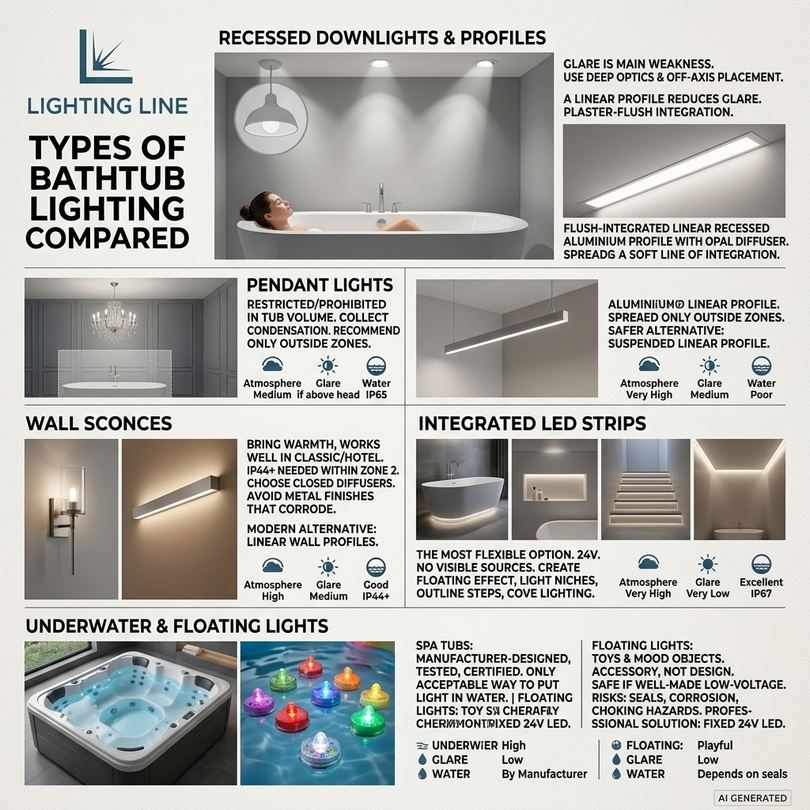
Recessed downlights are the classic answer to what kind of light fixture would look good over a bathtub. They disappear into the ceiling and leave the architecture clean. The weakness is glare: a person lying in the bath looks straight into them. If downlights are used over a tub, choose deep-recessed, anti-glare optics, place them off-axis rather than directly above the bather’s head, and fit dimmers. A linear alternative is a recessed aluminium profile with an opal diffuser, which spreads light along a line and dramatically reduces glare. Lighting Line’s recessed profiles and drywall profiles are designed for exactly this kind of plaster-flush integration.
Pendant lights over the bathtub
Pendants create drama, but as seen in the section on regulations, they are restricted or prohibited in the volume around the tub. They also collect condensation and are hard to clean. Recommend pendants only in very high rooms, outside the zones, after an electrician’s assessment, and consider a suspended linear profile placed beyond the zone boundary as a safer alternative. Lighting Line’s suspension profiles allow a slim, architectural line of light that is easier to keep clean than a chandelier.
Wall sconces near the bathtub
Sconces bring warmth and a residential feel, and they work well in classic and hotel bathrooms. Within zone 2, they need at least IP44. Choose closed glass or polycarbonate diffusers rather than open shades, mount them at a height that keeps the light source out of the bather’s direct line of sight, and avoid metal finishes that corrode in steam. Linear wall profiles are a contemporary alternative that wash the wall with light instead of creating bright points.
LED strips integrated around the bathtub
This is where the category has moved in the last decade. LED strips are the most flexible bathtub lights available: they follow any shape, fit into a few millimetres of space, run at 24V and produce light without visible sources. They create the floating bathtub effect, light niches from within, outline steps and plinths and provide indirect ceiling light from coves. They are the core of this guide and are covered in depth in the next sections.
Underwater and integrated spa lights
Spa tubs and whirlpools often include underwater chromotherapy lights. These are designed, tested and certified by the tub manufacturer as part of the appliance. They are the only acceptable way to put light inside the water of a bathtub. A contractor should not improvise underwater lights with generic components.
Floating bath lights and portable lights
Floating bath lights are small battery-powered, sealed units that float on the water, often with colour-changing LEDs. They are toys and mood objects rather than installations. Are floating bath lights safe? A well-made unit with a sealed battery compartment and a low-voltage battery is low-risk, because no mains power is involved. The risks are mechanical and chemical: seals that fail with age, batteries that corrode and, for families with small children, swallowing hazards from small parts and button cells. For a professional project, floating bathtub lights are an accessory, not a lighting design: the permanent, safe and designed solution is a fixed 24V LED installation.
Comparison of bathtub light types
| Type | Atmosphere | Glare risk | Water exposure handling | Installation complexity | Best for |
|---|---|---|---|---|---|
| Recessed downlights | Medium | High if above the head | Good with IP65 | Medium | General light over the tub |
| Recessed linear profiles | High | Low | Good with IP65/IP67 strip | Medium | Modern and minimalist bathrooms |
| Pendants and chandeliers | Very high | Medium | Poor, restricted by rules | High | High ceilings, outside zones only |
| Wall sconces | High | Medium | Good with IP44+ | Low to medium | Classic and hotel bathrooms |
| Under-rim LED strips | Very high | Very low | Excellent with IP67 | Medium | Floating effect, night orientation |
| Niche LED strips | Very high | Very low | Excellent with IP67 | Medium | Spa style, texture emphasis |
| Underwater spa lights | High | Low | By manufacturer design | Comes with the tub | Whirlpool and spa tubs |
| Floating battery lights | Playful | Low | Depends on product seals | None | Occasional decorative use |
7. Why COB LED strips are the best bathtub lights
Among all LED technologies, one has changed what is possible around a bathtub: COB (Chip On Board) strips. They produce a continuous line of light rather than a row of dots, which matters enormously when the light reflects in water, on glossy tiles and on enamel. This section explains the technology, compares it with traditional SMD strips and recommends specific products from the Lighting Line catalogue.
COB versus SMD
Traditional SMD strips place individual LED packages (for example the 2835 format) at intervals along a flexible circuit. Seen directly, or reflected in water, they produce a “string of pearls” effect. COB strips place hundreds of tiny chips per metre directly on the board and cover them with a continuous phosphor layer. The result is a uniform, dot-free line of light with a beam angle of around 180°, which looks like a neon tube and reflects in water as a clean, unbroken line.
| Feature | SMD strip (e.g. 2835, 120 LED/m) | COB strip (480 LED/m and above) |
|---|---|---|
| Light appearance | Visible dots without a diffuser | Continuous line, dot-free |
| Beam angle | About 120° | About 180° |
| Reflection in water and gloss surfaces | Row of bright points | Smooth, uniform line |
| Profile depth needed for a uniform look | Deep profile with opal diffuser | Shallow profiles work |
| Cutting interval | Typically 5 cm | Typically 2.5 to 5 cm |
| Best use near the bathtub | Indirect coves where the strip is hidden | Under-rim, niches, plinths, visible lines |
SMD strips are still excellent for indirect cove lighting where the strip is completely hidden, and Lighting Line’s SMD LED strips offer high-efficiency 24V options, such as the 3000K 2835 strip at 9.6 W/m for long ceiling runs. Wherever the line of light is visible or reflected, COB is the better choice.
The recommended waterproof bath lights: IP67 COB in extruded silicone
For positions exposed to water, the Lighting Line catalogue offers a 24V COB strip with 480 LED/m, 6 W/m, CRI greater than 90, a 3 mm PCB and a spherical extruded silicone tube rated IP67. The round silicone jacket diffuses light like neon, resists water and condensation and can be bent around the curves of a freestanding tub. It can be cut every 2.5 cm, which allows precise fitting around rims and niches.
| Product | Code | Colour temperature | Key specs | Best bathtub use |
|---|---|---|---|---|
| COB LED strip 2700K IP67 silicone tube | OR270W-U52-480OR2-W3 | 2700K warm white | 24V, 6 W/m, 480 LED/m, CRI>90, IP67, cut every 2.5 cm | Candlelight effect, spa and hotel suites |
| COB LED strip 3000K IP67 silicone tube | OR300W-U52-480OR2-W3 | 3000K warm white | 24V, 6 W/m, 480 LED/m, CRI>90, IP67, cut every 2.5 cm | Residential bathrooms, all-round choice |
| COB LED strip 4000K IP67 silicone tube | OR400W-U52-480OR2-W3 | 4000K neutral white | 24V, 6 W/m, 480 LED/m, CRI>90, IP67, cut every 2.5 cm | Contemporary, minimalist, stone finishes |
At 6 W/m, the IP67 silicone-tube COB strip is ideal for accent and atmosphere lighting: a 5 m perimeter around a tub consumes only 30 W. Its soft output is exactly what a reclining bather needs; it is not meant to be the main light of the bathroom.
High-output COB strips for profiles outside the wet zone
For ceiling coves, recessed profiles over the tub that are outside zones 1 and 2, or fully enclosed profiles with sealed diffusers, higher-output IP20 COB strips can provide functional light. These must always be mounted inside an aluminium profile with a closed diffuser and positioned where water cannot reach them.
| Product | Code | Key specs | Approximate output | Best use |
|---|---|---|---|---|
| COB 2700K CRI>90 10.5 W/m 120 lm/W | OR270-FA2-480OR2 | 24V, 480 LED/m, IP20, cut every 5 cm | About 1,260 lm/m | Warm cove light over the tub |
| COB 3000K CRI>90 10.5 W/m 120 lm/W | OR300-FA2-480OR2 | 24V, 480 LED/m, IP20, cut every 5 cm | About 1,260 lm/m | Ceiling profiles, general bath light |
| COB 4000K CRI>90 10.5 W/m 120 lm/W | OR400-FA2-480OR2 | 24V, 480 LED/m, IP20, cut every 5 cm | About 1,260 lm/m | Vanity and functional zones |
| COB 3000K CRI>90 7.5 W/m with current control | OR300-FA2-480OR2A | 24V, 480 LED/m, IP20, constant current on board | Uniform over long runs | Long perimeter coves in hotel bathrooms |
| COB CCT 2700-6500K CRI>90 7.7 W/m | ORCCT-FA2-600OR2 | 24V, 600 LED/m, IP20, tunable white | Variable white | Day-to-evening tunable scenes |
Output figures are calculated from the published power and efficacy (10.5 W/m x 120 lm/W) and refer to the bare strip; a diffuser reduces delivered light by roughly 10 to 30% depending on its opacity. The full range, including other IP65 and IP67 silicone versions, is available in the COB LED strips category, which can be filtered by IP rating, colour temperature, voltage and CRI. Technical data sheets are collected in the LED strip catalogue.
Why the aluminium profile is not optional
Even the best strip performs poorly without a profile. An aluminium profile dissipates heat, protects the strip mechanically, hides it from direct view, holds the diffuser and gives the installation a finished, cleanable surface. Heat is the enemy of LED lifetime, and bathrooms are already warm and humid; a strip glued directly to tiles or wood runs hotter and fails sooner. Lighting Line designs and manufactures its aluminium profiles in Italian-designed families: surface, recessed, corner, wall, concrete, drywall and round, each with matching end caps and mounting brackets. The full set of drawings is in the profiles catalogue.
8. Where to place bathtub lights: layouts that work
Position determines whether bathtub lights look professional or amateur. The same strip can create a sublime floating effect or a harsh reflection in the water, depending on a few centimetres. This section covers the main layouts for built-in and freestanding tubs, with the technical points that make each one work.
Under the rim: the floating bathtub effect
The most requested bathtub LED lights layout is a strip fixed under the rim of the tub or under the lip of the tub deck, so that light falls on the bath panel and the floor while the source remains hidden. The tub appears to float above a band of light. Key points:
- Use an IP67 strip: the space under a rim is zone 1 and can collect water from overflows or splashes.
- Recess the strip at least 1 to 2 cm behind the edge, so that the bather never sees the source directly.
- Choose warm white (2700K to 3000K) for residential and hotel projects; the light will reflect off the floor and warm the whole room.
- Bring the cable out at the lowest point of the panel through a sealed gland, and route it to a junction box outside the zones.
At the base of a freestanding tub
Freestanding tubs have no panel to hide a strip. The options are a recessed floor profile around the footprint, a low plinth with a shadow gap, or a strip attached to the underside of the tub’s base where the design allows it. For a lighting layout for a freestanding tub, the plinth with a shadow gap is usually the most robust: the strip sits in a profile under the plinth’s edge, protected from mop water and invisible from standing height. Floor profiles require sealed end caps and must not create a trap for standing water; Lighting Line’s tiling end caps are designed for profiles set flush with tiled floors.
In niches and recesses
Niches beside or above the tub are perfect for indirect accent lighting. A strip mounted in a profile along the top or the sides of the niche washes the back surface with light, revealing the texture of stone, zellige or microcement. Place the profile at the front edge of the niche, facing back, so that the light grazes the surface and the strip is hidden from a reclining viewpoint. In zone 1, niches need IP67 strips because water runs down the walls during a shower.
Along the plinth or skirting
A strip in a profile along the base of the walls or the bath step provides low orientation light and visually enlarges the room. It is the best night light in a bathroom: switched on at very low intensity, it allows safe movement without waking the eyes. Lighting Line’s baseboard mounting brackets help integrate the profile with the skirting line.
In a ceiling cove or on beams
A perimeter cove around the bathroom ceiling, or a strip hidden on top of a beam above the tub, produces soft, indirect general light. This is the most comfortable ambient light for a reclining bather because the light comes from a large, low-brightness surface rather than a point. Coves outside zone 1 can use high-output IP20 strips in profiles; coves in the volume directly above the tub should use IP65 or better.
Avoiding glare and reflections over the bathtub
Glare is the most common complaint about bathtub lighting, and it is entirely avoidable.
- Never place a bright point source directly above the bather’s head: offset downlights towards the tap end or the outer edge of the tub.
- Prefer indirect light: light that bounces off a wall, ceiling or floor before reaching the eye.
- Check reflections in the water surface: a visible strip at the rim reflects as a double line; recess it or use a COB strip that reflects as a continuous line.
- Use opal diffusers on any profile visible from the bath.
- Dim everything: a light that is perfect at 100% during cleaning will be too bright during a relaxing bath.
Lighting placement ideas at a glance
| Position | Effect | Zone | Strip | Profile type |
|---|---|---|---|---|
| Under the rim | Floating bathtub, orientation | 1 | IP67 COB 2700-3000K | Surface or corner profile, or bare silicone tube |
| Freestanding tub plinth | Floating sculpture | 1 or 2 | IP67 COB | Recessed or floor profile with sealed caps |
| Wall niche | Texture grazing, spa mood | 1 or 2 | IP67 COB | Recessed or corner profile |
| Skirting and step | Night orientation, depth | 2 or outside | IP65-IP67 | Baseboard profile |
| Ceiling cove | Soft ambient light | Outside zones or 2 | IP20 in profile, or IP65 | Drywall or wall profile |
| Mirror and vanity | Task light without shadows | Outside zones | CRI>90 3000-4000K | Surface or wall profile |
9. Colour Temperature, CRI and brightness for bathtub lights
Once safety and position are settled, the quality of light decides whether a bathroom feels like a spa or a hospital corridor. Three parameters matter: colour temperature, colour rendering and brightness. This section gives the values that professionals use and explains why.
Choosing the colour temperature
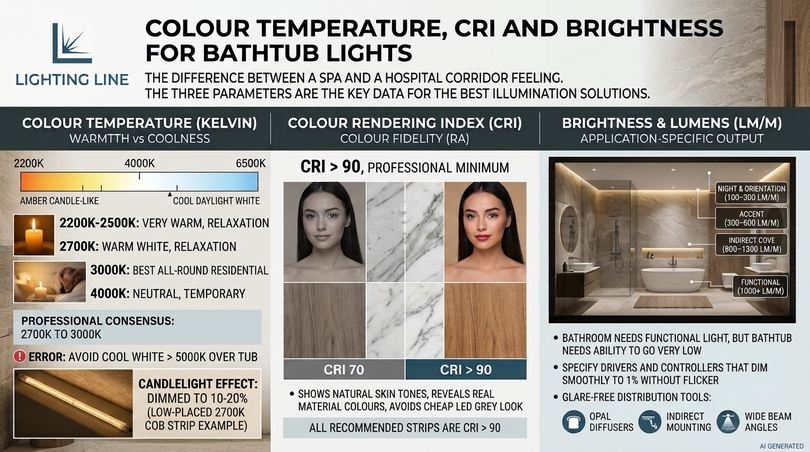
Colour temperature, measured in kelvin (K), describes how warm or cool white light appears. Lower values are warmer and more amber; higher values are cooler and bluer.
| Colour temperature | Perception | Bathtub use |
|---|---|---|
| 2200K to 2500K | Very warm, candle-like | Evening baths, aromatherapy, hotel turndown scenes |
| 2700K | Warm white, incandescent-like | Relaxation, spa atmosphere, under-rim light |
| 3000K | Warm white, slightly crisper | Best all-round choice for residential bathtub lights |
| 4000K | Neutral white | Contemporary design, stone and concrete, cleaning light |
| 5000K to 6500K | Cool to daylight white | Not recommended for relaxation; acceptable for task areas only |
For the best colour temperature for bathroom lighting around the tub, 2700K to 3000K is the professional consensus: it relaxes, flatters skin tones and harmonises with wood and natural stone. 4000K suits minimalist interiors with grey stone or concrete, and works well for the vanity area where a more neutral light helps grooming and make-up. Cool white above 5000K over a bathtub is one of the most frequent design errors; it makes the room feel clinical and suppresses the evening wind-down.
Can bathtub lights create a calming candlelight effect?
Yes. A 2700K COB strip, dimmed to 10 to 20% and placed low (under the rim or in a niche), closely recreates the warmth and softness of candlelight without the soot, the fire risk or the wax on the tiles. Tunable white strips that reach 2700K at the warm end can be programmed into a “candle” scene. For an even warmer effect, catalogue strips at 2200K and 2500K are available in the COB category.
Colour rendering (CRI)
The Colour Rendering Index (CRI or Ra) measures how faithfully a light source reveals colours compared with a reference source, on a scale up to 100. In a bathroom, CRI above 90 is the professional minimum: it shows skin tones naturally, reveals the real colour of tiles, marble and wood, and avoids the greyish, flat look of cheap LEDs. All the COB strips recommended in this guide are CRI greater than 90.
Brightness and lumens
Brightness for bathtub lights depends on the role of each layer.
| Lighting layer | Typical strip output | Purpose |
|---|---|---|
| Night and orientation light | 100 to 300 lm/m (dimmed) | Safe movement at night |
| Accent under rim or in niche | 300 to 600 lm/m | Atmosphere, floating effect |
| Indirect cove light | 800 to 1,300 lm/m | Soft ambient light for the whole room |
| Functional light (vanity, cleaning) | 1,000 lm/m and above | Grooming, cleaning, maintenance |
A useful rule: the bathroom as a whole needs good functional light for cleaning and grooming, while the bathtub area needs the ability to go very low. The best brightness for bathtub lights is the one you can dim down to almost nothing. Specify drivers and controllers that dim smoothly to 1% without flicker.
Glare-free light distribution
Distribution is as important as quantity. Light that grazes a wall or bounces off the floor is perceived as soft and abundant even at low lumen values; the same lumens from a bare point source feel harsh. Opal diffusers, indirect mounting and COB strips with wide beam angles are the three tools that produce glare-free bathroom lighting.
10. Dimmable and smart bathtub lights
Control turns good bathtub lights into a great experience. A bather cannot reach a wall switch with wet hands from inside the tub, a hotel guest does not want to read a manual, and a family wants a night light that switches on automatically. This section explains the control options and how to integrate them safely.
Dimming options for 24V LED strips
- PWM dimmers and controllers on the 24V side: the most common solution for strips; they sit between driver and strip and receive commands from a wall panel, a remote or an app.
- Dimmable drivers controlled by phase-cut (TRIAC), 0/1-10V or DALI signals on the input side: ideal when the dimming system is part of a building-wide control.
- DALI and DMX: professional protocols for hotels and larger projects, allowing central management of hundreds of points.
Choose flicker-free dimming at a high PWM frequency: flicker that is invisible at full brightness can become noticeable at low levels or on video, which matters to content creators and to sensitive users.
Controlling bathtub lights safely from inside the bath
Wired switches inside zones 0, 1 and 2 are restricted; in zone 1 and 2 only SELV switches with the safety source outside the zones are permitted in IEC-based systems. The cleanest solution is wireless control: battery-powered RF wall panels or remotes fixed beside the tub, communicating with a controller placed next to the driver, outside the wet zones. No mains cable ever approaches the water, and the bather can dim the light or change the scene without getting out. Waterproof remotes and wall panels rated for wet environments are available from the main LED controller manufacturers.
Smart home integration: Alexa, Google Home and apps
Can bathtub lights be controlled with Alexa or Google Home? Yes, through a compatible smart LED controller (Wi-Fi, Zigbee or Matter-compatible) installed on the 24V side of the system. The strip itself is “dumb”: the intelligence lives in the controller. This means any 24V strip from the Lighting Line catalogue can become a smart bathtub light, as long as the controller matches the strip type (single colour, tunable white CCT, RGB or RGB+white). Typical scenes:
- Bath time: under-rim at 30%, 2700K, ceiling cove off, niche at 20%.
- Night path: plinth strip at 5% triggered by a motion sensor between 23:00 and 06:00.
- Cleaning: all layers at 100%, 4000K.
- Morning: tunable strips at 4000K, vanity at 100%.
Remote control for hotel staff
Hotels can integrate bathtub lights into the guest room management system through DALI, KNX or proprietary platforms, so that housekeeping can set a welcome scene, maintenance can check status and energy managers can switch off unoccupied rooms. A 24V LED strip with a DALI-compatible driver or controller is the most future-proof specification for hotel suites.
Tunable white for circadian comfort
Tunable white strips, such as the COB CCT 2700-6500K strip, let the same installation provide crisp neutral light in the morning and warm light in the evening. Because this particular strip is IP20, it belongs in sealed profiles outside the wet zones, such as ceiling coves and vanity profiles, while IP67 warm-white strips handle the rim and niches.
11. RGB, chromotherapy and cinematic bathtub lighting
Colour-changing bathtub lights are a strong selling point for wellness professionals, hotels that want a memorable suite and content creators who need a striking backdrop. They are also easy to overdo. This section explains how to use colour with taste and with the right technology.
RGB versus RGB+W
RGB strips mix red, green and blue to create colours; they produce a poor-quality white when all three are mixed. RGB+W strips add a dedicated white channel (warm or tunable), so the same installation offers vivid colours and a high-quality white. For bathtub lights, RGB+W or RGB+CCT is almost always the better investment: the client will use white light most of the time and colour on special occasions.
The Lighting Line COB range includes RGB, RGB+3000K, RGB+4000K and RGB+CCT versions, filterable in the COB category. The COB RGB 768 LED/m 24V 14 W/m strip produces continuous, dot-free colour. Because it is IP20, it must be installed in a closed profile with diffuser, outside zones 0, 1 and 2, typically in a ceiling cove that bathes the whole room in colour.
Chromotherapy: what it is and what it is not
Chromotherapy uses colour to influence mood and perceived wellbeing. In spa practice, blue is associated with calm, green with balance, amber with warmth and comfort. Chromotherapy bathtub lights should be presented as an atmospheric and relaxation tool, not as a medical treatment; claims of therapeutic effect are not supported by robust clinical evidence. Within that honest framing, slow colour transitions and deep, saturated hues at low brightness create a powerful relaxation experience.
How colored bathtub lights improve a home spa experience
- Use colour on indirect surfaces (ceiling, back wall of a niche) rather than visible sources.
- Prefer slow transitions (several minutes per colour) over rapid effects.
- Combine one coloured layer with one warm white layer, so faces remain naturally lit.
- Keep the brightness low: saturated colour at 20 to 30% is more immersive than at 100%.
Music sync and apps
Can bathtub lights sync with music or smartphone apps? Yes, through RGB controllers with built-in microphones or app-based music modes. This is popular with content creators and in party-oriented hotel suites. The strip remains the same; the feature comes from the controller.
Cinematic bathroom lighting for content creators
For video and photography, the quality of light matters more than its quantity. COB strips are the best choice for filming because they produce clean, continuous lines without the dotted reflections that ruin close-ups on glossy surfaces and water. Practical tips:
- Use high-CRI white as the key light and colour as background or rim light; skin should stay natural.
- Set the controller’s PWM frequency high to avoid banding and flicker on camera, especially at high frame rates.
- Light the water from the side: a strip under the rim on the far side of the tub makes water glow and steam visible.
- Create depth with layers: a coloured ceiling cove, a warm under-rim line and a dark foreground.
Portable battery lights for filming are useful accessories, but they should be kept out of the water unless the manufacturer explicitly rates them for immersion. A permanent 24V installation remains the safest way to obtain vibrant, repeatable bathtub lighting for content.
12. Installation guide for contractors
This is the section for site teams and electrical installers. It translates everything above into a sequence of steps that reduces installation time, prevents water ingress and produces an installation that can be certified and maintained. It assumes that the final connection and certification are carried out by a qualified electrician in accordance with local regulations.
Before buying: installation requirements to check
- Zone mapping: draw zones 0, 1 and 2 on the bathroom plan, including the space under the tub.
- Driver location: identify a dry, ventilated, accessible position outside the zones, and the cable route from there to the tub.
- Supply circuit: confirm a 230V supply protected by a 30 mA RCD is available at the driver position.
- Control strategy: decide on switch, dimmer, wireless remote, smart controller or building management system before first fix.
- Substrate and fixing: check what the profile will be fixed to (tile, panel, plasterboard, concrete) and plan brackets accordingly.
- Lengths and feeds: measure each run, plan cut points and decide where the power feeds enter.
- Access for maintenance: ensure connection points and drivers can be reached without removing tiles.
Step-by-step: how to install LED bathtub lights
Step 1: first fix and cable routing
Run the 24V cable from the driver position to the tub area during first fix, inside a conduit wherever possible so that it can be replaced later. Use a cable section appropriate to the length and load (see the voltage drop table below). Bring the cable to the strip from above or from the side, never from a point where water can run along the cable into the connection. Form a drip loop before every entry point.
Step 2: prepare the profile
Cut the aluminium profile to length, deburr the edges and clean it with isopropyl alcohol. Drill the cable entry in the end cap or the back of the profile, at the highest point of the run. Fix the profile with mounting brackets or a suitable adhesive for wet areas; on tiled surfaces, mechanical fixing with stainless screws and plugs is more reliable over time than adhesive alone.
Step 3: cut and seal the strip
Cut the strip only at the marked cut points. For IP67 silicone-tube strips, use the manufacturer’s end caps and a neutral-cure silicone sealant suitable for the jacket material, and allow full curing time before exposure to water. Every cut end is a potential leak, seal it as carefully as a plumber seals a joint. Where possible, order strips pre-cut and pre-sealed to length: Lighting Line’s production unit makes custom strips to project lengths, which removes the most error-prone operation from the site.
Step 4: make connections outside the wet area
Join the strip lead to the supply cable in a junction box outside zones 0 and 1 whenever the layout allows, or at least in a sealed, accessible position well above any possible water level. Use connectors designed for the strip, such as Lighting Line’s PCB LED strip connectors for IP20 strips inside dry profiles, and soldered joints with heat-shrink and sealant for waterproof runs. Observe polarity; reversing it on a DC strip simply prevents it from lighting, but reversing channels on RGB strips produces wrong colours.
Step 5: insert the strip and fit the diffuser
Press the strip into the profile, check that it lies flat along the whole length, then clip in the diffuser and fit the end caps. For profiles exposed to splashes, apply a thin bead of sealant to the end caps. Lighting Line’s tiling end caps are designed for profiles integrated flush with tiles.
Step 6: connect the driver and control
Mount the driver in its dry location, connect the 230V input on the RCD-protected circuit and the 24V output to the controller or strip. Size the driver at least 20% above the total load.
Step 7: test before closing
Switch on and test every run before the final finishes. Check uniformity, colour consistency, dimming down to the minimum and the absence of flicker. Measure the voltage at the far end of each run; if it is more than about 5% below the nominal 24V, add a second feed or increase cable section. Then the electrician tests and certifies the circuit.
Voltage drop and feed planning
Voltage drop causes the far end of a strip to be dimmer and, on white strips, slightly warmer than the start. The table gives indicative maximum single-feed lengths for 24V strips; always follow the specific product’s data sheet.
| Strip power | Total load for 5 m | Indicative max single-feed run | Recommendation |
|---|---|---|---|
| 6 W/m | 30 W | Up to 5 m (one reel) | Single feed for a typical tub perimeter |
| 7.5 W/m with current control | 37.5 W | Up to 10 m with uniform output | Long coves and hotel corridors |
| 9.6 to 10.5 W/m | 48 to 52.5 W | About 5 m | Feed both ends for longer runs |
| 14 to 15.5 W/m | 70 to 77.5 W | About 5 m | Feed both ends or every 5 m |
Wiring bathtub lights in a humid environment
- Keep all 230V wiring and the driver out of zones 0, 1 and 2.
- Use conduits and junction boxes with appropriate IP ratings in humid areas.
- Avoid connections at the lowest point of a run, where condensation collects.
- Do not use the bath panel cavity as a technical room for drivers, if it must hold a connection, make the panel removable and the box sealed.
- Label the driver location in the handover documentation.
Bathroom lighting retrofit without major works
In renovations where chasing walls is not possible, low-voltage bathtub lights still offer solutions. A surface profile can be fixed under an existing rim; a thin 24V cable can run inside a skirting profile or a corner profile to a driver in an adjacent room or ceiling void. Lighting Line’s corner profiles are especially useful for retrofits because they turn an internal corner into a cable route and a light line at the same time.
Installation time and labour
With pre-cut strips, prepared profiles and a planned driver position, a typical under-rim installation for a standard bathtub can be completed by an experienced installer in a few hours, plus the electrician’s connection and testing. The main time savings come from three decisions: ordering strips cut to length, choosing profiles with clip-in diffusers, and placing the driver where it can be reached without tools beyond a screwdriver.
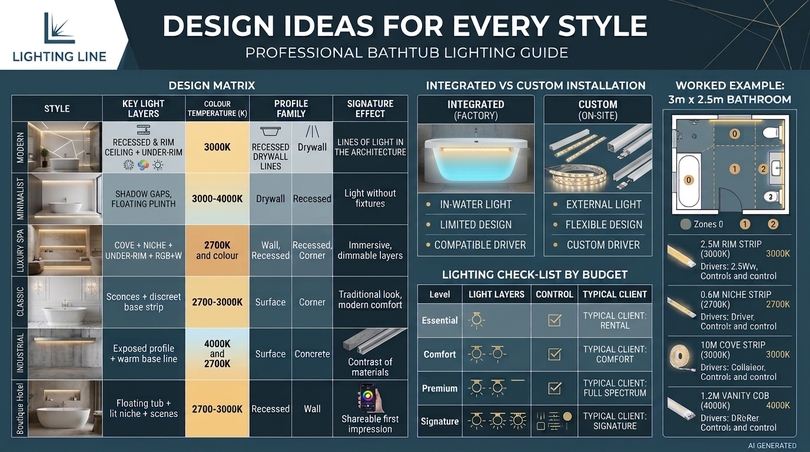
13. Design ideas for every style
Technical correctness is the foundation, design is what the client sees. This section proposes bathtub lighting ideas for the main interior styles, with the light layers, colour temperatures and Lighting Line products that suit each one.
Modern bathtub lighting ideas
Modern bathrooms favour clean lines, large-format tiles and integrated details. The signature move is a recessed linear profile in the ceiling, parallel to the tub but offset from the bather’s head, combined with an under-rim strip at 3000K. Wall niches lit from the top edge complete the composition. Use recessed and drywall profiles so the light sources disappear into the architecture.
Minimalist bathroom lighting
Minimalism demands that light appear without fixtures. Hide every source: shadow gaps at the ceiling perimeter, a floating plinth under a freestanding tub, a single line of light in a niche. Choose 3000K or 4000K depending on materials (warmer for wood, neutral for concrete and grey stone). The fewer the visible objects, the more important the uniformity of the line: COB strips are essential here.
Luxury and spa bathroom lighting
Luxury and spa bathrooms are about immersion and ritual. Layer three levels of warm light (cove, niche, under-rim) at 2700K, all independently dimmable, and add an RGB+W layer in the ceiling cove for colour scenes. Stone and textured walls benefit from grazing light from niches. A wireless panel beside the tub lets the bather control everything without moving.
Classic bathroom lighting
Classic bathrooms, with mouldings, marble and freestanding claw-foot tubs, welcome decorative fixtures. Sconces with glass diffusers on either side of the mirror, a ceiling fixture outside the zones and a discreet warm strip at the base of the tub keep the style intact while adding modern comfort. Keep strips invisible; the decorative fixtures are the visible protagonists.
Industrial bathroom light fixtures
Industrial bathrooms combine concrete, black metal and exposed elements. A surface-mounted aluminium profile with a black or anodised finish becomes a deliberate design element. Neutral 4000K light on concrete and a warm 2700K line under the tub create an attractive contrast. Concrete profiles, designed to be cast into or set into concrete surfaces, allow light lines to emerge directly from microcement or poured walls.
Boutique hotel suites
For hotel suites, the goal is a memorable first impression and a robust installation. The floating bathtub effect, a lit niche with toiletries and a soft cove light produce the “wow” photograph that guests share and that booking platforms reward. Pre-programmed scenes (arrival, bath, night) remove the need for guests to learn controls. Durability matters as much as beauty: IP67 strips, sealed caps, accessible drivers and constant-current strips for uniform long runs.
Design matrix
| Style | Key light layer | Colour temperature | Profile family | Signature effect |
|---|---|---|---|---|
| Modern | Recessed linear ceiling + under-rim | 3000K | Recessed, drywall | Lines of light in the architecture |
| Minimalist | Shadow gaps, floating plinth | 3000-4000K | Drywall, recessed | Light without fixtures |
| Luxury spa | Cove + niche + under-rim + RGB+W | 2700K and colour | Wall, recessed, corner | Immersive, dimmable layers |
| Classic | Sconces + discreet base strip | 2700-3000K | Surface, corner | Traditional look, modern comfort |
| Industrial | Exposed profile + warm base line | 4000K and 2700K | Surface, concrete | Contrast of materials |
| Boutique hotel | Floating tub + lit niche + scenes | 2700-3000K | Recessed, wall | Shareable first impression |
Bathtub with LED lights: integrated tubs versus a custom installation
Some manufacturers sell a bathtub with LED lights already built in, usually a spa or whirlpool model with underwater chromotherapy spots or a lit panel. A custom installation, by contrast, adds LED lights for the bathtub on site, using strips and profiles chosen for the specific room. Both are valid, they solve different problems.
| Criterion | Bathtub with integrated LED lights | Custom LED lights for the bathtub |
|---|---|---|
| Light inside the water | Yes, designed and certified by the maker | No, light stays outside the water |
| Freedom of design | Limited to the model | Any shape, length, colour temperature |
| Coordination with the room | Independent of other lighting | Designed with niches, coves and floor |
| Replacement of the light source | Manufacturer’s spare parts | Standard strips and drivers |
| Cost | Built into the price of the tub | Scales with the length and control chosen |
For most projects, the best result combines the two approaches: the tub’s own integrated light, if any, for the water, and custom bathtub lights LED strips for the architecture around it. Where the client has chosen a standard tub, a custom installation is the only way to obtain the floating effect and lit niches.
Worked example: lighting a 3 m x 2.5 m bathroom with a built-in tub
A practical example helps to turn principles into a bill of materials. Consider a renovation: a 3 m x 2.5 m bathroom with a 1.70 m x 0.75 m built-in tub along the short wall, a niche of 0.60 m above the tub, a vanity on the long wall and a 2.60 m ceiling with a perimeter plasterboard cove.
Zone analysis
The space under the tub panel is zone 1 if the panel can be removed without tools; the niche is inside zone 1; the vanity sits outside the zones; the cove above the tub is above 2.25 m, so above zone 1 in IEC-based systems, though it remains a humid area. The driver will sit in the corridor ceiling void, reachable through an inspection hatch.
Light layers and products
- Under-rim line: 1.70 m + 0.75 m on the exposed sides, about 2.5 m of IP67 COB strip at 3000K, 6 W/m (about 15 W).
- Niche: 0.60 m of IP67 COB strip at 2700K across the top edge, facing the back wall (about 4 W).
- Ceiling cove: about 10 m of IP20 COB 3000K at 10.5 W/m inside a drywall profile with diffuser (about 105 W), fed from two points.
- Vanity: 1.20 m of COB 4000K CRI>90 in a surface profile above the mirror (about 13 W).
Drivers and control
Two drivers keep circuits manageable: one of at least 30 W for rim and niche (19 W load plus margin) and one of at least 150 W for cove and vanity (118 W plus margin), both on the RCD-protected lighting circuit. A smart controller per group, with a battery wall panel next to the tub, provides “bath”, “night” and “cleaning” scenes.
Result
The bather has warm, glare-free light from below and from the walls, the cove fills the room softly, the vanity has neutral, high-CRI light for grooming, and no mains voltage enters zones 0, 1 or 2. This is the template that construction companies can repeat, scaling lengths and drivers to each bathroom.
Bathtub lights LED checklist by budget level
Not every project has the same budget. The following tiers keep safety constant and vary only the comfort and design features.
| Level | Light layers | Control | Typical client |
|---|---|---|---|
| Essential | IP67 under-rim strip, 3000K | Wall switch outside zones, dimmable driver | Rental apartments, standard renovations |
| Comfort | Under-rim + lit niche, 2700-3000K | Wireless dimmer with panel beside tub | Family homes, mid-range developments |
| Premium | Under-rim + niche + cove, tunable white | Smart controller, voice and app, scenes | High-end residential, wellness rooms |
| Signature | All layers + RGB+W cove | DALI or hotel management system | Boutique hotels, show homes |
14. Risks and dangers of the wrong bathtub lights
This section is deliberately direct. Bathtub lights combine three hazards that rarely meet elsewhere in a building: water, electricity and a person who is wet, unclothed, barefoot and relaxed. The consequences of a wrong choice range from premature failure to fatal electric shock. Construction companies carry legal and reputational responsibility for every one of them.
Electric shock
The most serious risk is electric shock from mains voltage reaching the water or wet surfaces. Typical causes are 230V LED strips or fixtures installed near the tub, drivers placed in the bath panel or behind tiles, damaged cable jackets, connections made at low points where water collects, and missing RCD protection. Wet skin dramatically reduces the body’s resistance; in a bathtub, a fault current can flow through the body to earthed pipework. SELV, correct IP ratings, drivers outside the zones and 30 mA RCD protection remove this risk in practice.
Water ingress and short circuits
Water inside a low-voltage strip will not usually electrocute anyone, but it will corrode the copper, short the circuit and destroy the strip and possibly the driver. The cause is almost always a cut end or connection that was not sealed. A strip rated IP20 installed under a bath rim will typically fail within months, often after the warranty period for installation has started, and the replacement requires dismantling finishes.
Overheating
LED strips produce heat. Glued directly to a surface without an aluminium profile, enclosed in a sealed cavity or overpowered beyond their rated output, they run hot, lose brightness, shift colour and fail early. Drivers in unventilated, humid cavities suffer the same way. Profiles, ventilated driver locations and drivers sized with margin are the remedies.
Glare and visual discomfort
A bright point source over a reclining bather is not dangerous, but it ruins the experience the client paid for. In hotels it generates complaints; in homes it means the lights are simply never used. Indirect light, anti-glare optics and dimming solve it.
Slips and falls
Poor lighting around the tub, especially at night, contributes to falls on wet surfaces. A dark bathroom with a single bright ceiling light creates deep shadows exactly where the edge of the tub is. Low-level orientation light under the rim or along the plinth is a safety feature, not just a decoration.
Risks specific to children
Are bathtub lights safe to use around children? Fixed 24V SELV installations with correctly sealed strips, drivers out of reach and no accessible connections are safe. The risks come from portable products: floating lights with small parts or button batteries that can be swallowed, plug-in lamps placed near the bath and remote controls left within reach of very young children. Battery compartments on any device used around children should be screw-fastened.
Fire risk from cheap components
Unbranded drivers without proper certification, undersized cables and poor solder joints can overheat. In a ceiling void above a bathroom, a failing driver can go unnoticed. Specify certified drivers with protection against short circuit, overload and over-temperature, from established manufacturers.
Legal and insurance consequences
In most European countries, electrical work in bathrooms must be performed or certified by a qualified person and documented. An installation that does not respect the zone rules can void insurance cover and expose the contractor to liability. For a construction company, the cost of compliance is a fraction of the cost of a single claim.
Risk summary
| Risk | Typical cause | Consequence | Prevention |
|---|---|---|---|
| Electric shock | 230V near water, no RCD | Injury or death | SELV 24V, driver outside zones, 30 mA RCD |
| Water ingress | Unsealed cuts, IP20 in wet area | Short circuit, failure | IP67, sealed caps, connections outside wet area |
| Overheating | No profile, enclosed driver | Early failure, colour shift | Aluminium profile, ventilated driver, 20% margin |
| Glare | Point source above head | Discomfort, unused lights | Indirect light, diffusers, dimming |
| Falls | Dark tub edge at night | Injury | Under-rim and plinth orientation light |
| Child hazards | Portable lights, batteries | Swallowing, shock | Fixed SELV installation, secured batteries |
| Fire | Uncertified drivers | Damage, liability | Certified drivers, correct cable sizing |
15. Common bathtub lighting mistakes to avoid
Most failures of bathtub lights are not caused by bad products but by small decisions on site. This list collects the errors most frequently seen in renovations, so that they can be prevented at the design stage.
| Mistake | Why it is wrong | Correct approach |
|---|---|---|
| Using a 230V strip near the bath | Mains voltage in the wet zone | 24V SELV strip only |
| Wrong IP rating (IP20 or IP44 under the rim) | Water pools under rims | IP67 under rims and in niches |
| Driver inside the bath panel | Heat, humidity, no access | Driver outside zones, accessible |
| Strip glued without profile | Overheating, adhesive failure | Aluminium profile with diffuser |
| Cut ends left unsealed | Water ingress | End caps and sealant, or factory pre-cut strips |
| Downlight above the bather’s head | Glare | Off-axis or indirect light |
| Cool white over 5000K at the tub | Clinical atmosphere | 2700-3000K |
| Low CRI strips | Dull skin tones and finishes | CRI greater than 90 |
| No dimming | Too bright for relaxing | Dimmable to 1%, flicker-free |
| Long single-feed runs | Uneven brightness | 24V, double feed or current-controlled strips |
| Pendant within reach of the tub | Prohibited or unsafe in most codes | Linear cove or high-mounted profile outside zones |
| Connections at the lowest point | Condensation collects there | Feed from above, drip loops |
| Wall switch inside the zones | Non-compliant | Wireless SELV remote or switch outside zones |
The most expensive mistake is the one that requires removing tiles to fix it. Every decision that keeps drivers and connections accessible saves future demolition.
16. Maintenance and cleaning of bathtub lights
Well-specified LED bathtub lights need very little maintenance, but very little is not none. Steam, limescale and cleaning chemicals are a demanding environment. This section gives a simple maintenance routine for homes and a periodic inspection plan for hotels.
How to clean bathroom light fixtures and LED profiles
- Switch off the circuit before cleaning, even with low-voltage systems, to avoid accidental activation and to let surfaces cool.
- Wipe diffusers and silicone jackets with a soft cloth and mild, pH-neutral detergent diluted in warm water.
- Remove limescale with diluted white vinegar, applied with a cloth, then rinse with clean water and dry.
- Avoid abrasive pads, solvents, bleach concentrates and ammonia-based cleaners on silicone and polycarbonate; they can cloud diffusers and degrade seals.
- Never use high-pressure jets on strips or profiles unless the rating explicitly allows it.
Preventing moisture damage
Good ventilation is the best maintenance tool. An extractor fan that runs during and after the bath reduces condensation on fixtures, ceilings and in profiles. In hotels, link the extractor to occupancy or humidity sensors.
Inspecting and replacing seals
Silicone sealant at end caps and cable entries ages with heat and cleaning chemicals. Inspect it annually in homes and every six months in hotels; replace any seal that is cracked, discoloured or detached. Replacing a bead of sealant takes minutes; replacing a corroded strip takes hours.
Maintenance schedule
| Task | Homes | Hotels |
|---|---|---|
| Wipe diffusers and silicone jackets | Monthly | Daily or weekly with housekeeping |
| Limescale removal | Every 2-3 months | Monthly |
| Check end-cap and cable-entry seals | Yearly | Every 6 months |
| Check uniformity and flicker | Yearly | Every 6 months |
| Inspect driver location for heat and humidity | Every 2 years | Yearly |
| RCD test button | As recommended by the device maker | As per maintenance plan |
How durable are bathtub lights for frequent use?
LED strips do not fail suddenly like bulbs: they lose brightness gradually over tens of thousands of hours. In a hotel suite where bathtub lights run four hours a day, a strip rated for 30,000 hours would reach that figure after roughly 20 years of use. In practice, lifetime is determined by heat and moisture management, not by the LEDs themselves: an IP67 strip in an aluminium profile, with an accessible, well-ventilated driver, is the most durable configuration.
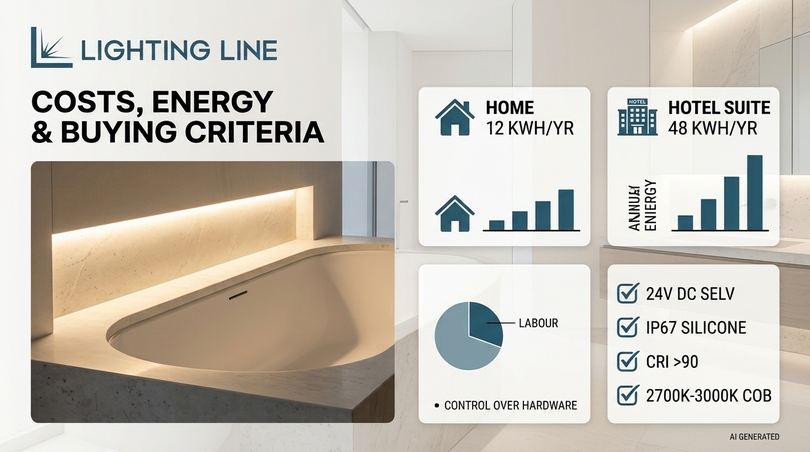
17. Costs, energy and buying criteria
Clients rarely ask about lighting cost per metre: they ask what the whole thing will cost and whether it will be expensive to run. This section offers a framework for estimating budgets, comparing value and presenting the energy argument, particularly to hotel operators.
What determines the cost of bathtub lighting
- Strip: technology (COB or SMD), IP rating, colour type (single, CCT, RGB+W) and length.
- Profile, diffuser and accessories: profile family, length, end caps and brackets.
- Driver: power, IP rating and dimming interface.
- Control: from a simple switch to a smart controller or a DALI integration.
- Labour: installation, connection, testing and certification.
Materials are usually the smaller part of the budget; labour and the cost of mistakes dominate. This is why specifying correctly once, with pre-cut strips and accessible drivers, is the most economical approach.
Energy consumption example
The table compares the annual energy of bathtub lights in a hotel suite and in a home, using the IP67 COB strip at 6 W/m and a 5 m perimeter. Driver losses are included as an approximate 10% surcharge.
| Scenario | Load | Hours per day | Annual consumption |
|---|---|---|---|
| Home, under-rim 5 m at full output | 30 W + 10% | 1 | About 12 kWh |
| Home, night light at 10% | About 3.3 W | 8 | About 10 kWh |
| Hotel suite, under-rim 5 m | 30 W + 10% | 4 | About 48 kWh |
| Hotel with 40 suites | 40 x 33 W | 4 | About 1,930 kWh |
Multiply the annual kWh by the local electricity price to obtain the running cost. Even at high European tariffs, LED bathtub lights cost a few euros per room per year to run, while the equivalent output from older halogen technology would consume several times more, in line with the Department of Energy comparison cited earlier.
Are there energy-efficient bathtub lights that reduce hotel costs?
Yes. Efficient COB strips (such as the 120 lm/W versions in the Lighting Line range), occupancy-linked scenes and dimming to the level actually needed reduce consumption further. The biggest saving in hotels comes from control, not from the strip: lights that switch off automatically in unoccupied rooms save more than any efficiency gain in the hardware.
Buying guide: what to check before you buy
| Criterion | Minimum for bathtub lights | Professional choice |
|---|---|---|
| Voltage | 12V DC SELV | 24V DC SELV |
| IP rating near water | IP65 | IP67 extruded silicone |
| LED technology | SMD with diffuser | COB, dot-free |
| CRI | Above 80 | Above 90 |
| Colour temperature | 3000K | 2700-3000K, or tunable |
| Profile | Any aluminium profile | Profile matched to the position, with sealed caps |
| Driver | Certified, constant voltage | Certified, sized +20%, flicker-free dimming |
| Documentation | Data sheet | Data sheet, energy class, installation notes |
| Supplier support | Product listing | Technical support and custom lengths |
Premium versus budget
The best bathroom light fixtures for the money are not the cheapest per metre but those that avoid callbacks. A budget strip that fails under a rim after a year costs more than a professional IP67 strip, once demolition, labour and client dissatisfaction are counted. Premium bathtub light fixtures are justified where the light is visible (COB uniformity), where water is present (IP67) and where the installation is hard to reach (long-life components).
18. Bathtub lights: answers by professional profile
Different professionals ask different questions about bathtub lights. This section gathers the most frequent ones, grouped by profile, and answers them directly, with references to the detailed sections above. It is designed as a quick reference you can forward to a colleague or a client.
For interior designers
Interior designers look for elegant, customisable bathtub lights that create relaxing atmospheres in residential bathrooms and boutique hotels, without sacrificing safety or ease of installation.
What are the best bathtub lights for creating a luxury spa atmosphere?
The best bathtub lights for a luxury spa atmosphere are warm (2700K), high-CRI COB LED strips in IP67 extruded silicone, used as hidden, indirect layers: under the rim for the floating effect, in niches for texture and in a ceiling cove for soft ambient light. Each layer should be independently dimmable. The 2700K IP67 COB strip is the reference product for this look.
Which bathtub lights offer adjustable colours and brightness levels?
Tunable white (CCT) strips adjust the colour temperature; RGB+W and RGB+CCT strips add saturated colours. Brightness is adjusted by the controller or a dimmable driver. A typical spa specification combines IP67 warm white near the water and a CCT or RGB+W layer in a sealed profile in the ceiling cove.
How can I install bathtub lights without compromising bathroom design?
Plan the light at the same time as the tiles, not afterwards. Recessed and drywall profiles sit flush with plaster; tiling end caps let profiles meet tiles cleanly; shadow gaps hide strips completely. Decide the driver position and cable route at design stage, so the electrician never has to improvise a box in a visible place.
Are these bathtub lights safe for wet and humid environments?
Yes, when the specification follows this guide: 24V SELV, IP67 near water, driver outside the zones, RCD protection and installation by a qualified electrician.
Which bathtub lighting options work best with modern freestanding tubs?
A floating plinth or a recessed floor profile around the tub’s footprint, lit by an IP67 COB strip, combined with a linear ceiling profile offset from the bather’s head. Avoid pendants directly over freestanding tubs unless the ceiling is high and the fixture is outside the zones.
For electrical installers
Installers want reliable, certified bathtub lights that integrate easily with existing systems, reduce installation time and guarantee maximum safety in humid environments.
What IP rating should bathtub lights have for safe installation?
At least IPX4 in zones 1 and 2, IPX5 where water jets are used, and IPX7 for any equipment in zone 0. For LED strips at the rim, in niches or under the tub, specify IP67, because water can collect there. See the IP ratings section.
How do I wire bathtub lights in a humid bathroom environment?
Keep the 230V side and the driver outside zones 0, 1 and 2, in a dry, accessible position. Run 24V cable in conduit to the tub area, feed strips from above with drip loops, make connections outside the wet area or in sealed, accessible boxes, and protect the circuit with a 30 mA RCD. Full sequence in the installation guide.
Are low-voltage bathtub lights safer than standard lighting systems?
Yes. SELV at 12V or 24V DC keeps dangerous voltages out of the wet zone entirely, so a damaged strip or a failed seal does not expose the bather to mains voltage.
What installation requirements should I check before buying bathtub lights?
Zone mapping, driver location, RCD-protected supply, control strategy, substrate and fixing, run lengths and feed points, and maintenance access. The specification checklist at the end of this guide lists them all.
Which bathtub lights are compatible with smart home control systems?
Any 24V constant-voltage strip can be integrated with smart systems through a compatible controller (Wi-Fi, Zigbee, Matter) or through dimmable drivers on DALI, 0/1-10V or KNX. Match the controller channels to the strip type: one channel for single colour, two for CCT, three or more for RGB and RGB+W.
For wellness professionals
Wellness professionals want soft, adjustable bathtub lights that enhance relaxing baths and aromatherapy sessions.
Which bathtub lights are best for relaxation and stress relief?
Warm white at 2200K to 2700K, indirect, dimmed low and free from flicker. Light coming from below eye level, such as an under-rim strip, feels particularly calming because it resembles firelight and avoids overhead glare.
Are there waterproof bathtub lights with warm white settings?
Yes: the IP67 COB strips in the Lighting Line catalogue are available at 2700K and 3000K, both CRI greater than 90.
Which bathtub lights are easy to control while taking a bath?
Systems controlled by wireless, battery-powered SELV remotes or wall panels fixed beside the tub, or by voice through a smart assistant. Pre-set scenes reduce interaction to a single touch, which is what a relaxing bath requires.
For boutique hotel owners
Hotel owners want distinctive bathtub lights that raise the perceived value of suites, create memorable guest experiences and differentiate the property.
What bathtub lights are suitable for luxury hotel bathrooms?
IP67 warm-white COB strips under the rim and in niches, current-controlled COB strips for long uniform coves, and an optional RGB+W layer for signature scenes. All on 24V, with drivers in accessible service positions and control through the room management system.
Can bathtub lights be controlled remotely by hotel staff?
Yes, through DALI, KNX or proprietary hotel platforms connected to the controllers or dimmable drivers. Staff can set welcome scenes, monitor status and switch off unoccupied rooms.
Which bathtub lighting designs create the best impression in hotel suites?
The floating bathtub, a lit niche with toiletries or a plant, and a warm cove that makes the ceiling glow. These three effects photograph beautifully, which matters for booking platforms and social media.
How do LED bathtub lights affect hotel operating costs?
As shown in the energy table, a 5 m IP67 strip running four hours a day uses about 48 kWh per year per suite. Combined with occupancy-based control, bathtub lights become a negligible line in the energy budget.
For families and smart-home enthusiasts
Parents want bathtub lights that are safe for the whole family, easy to use, compatible with smart devices and economical to run and maintain.
Are bathtub lights safe to use around children?
Fixed 24V installations with sealed IP67 strips and drivers out of reach are safe around children. Avoid plug-in lamps near the bath and portable lights with small parts or unsecured button batteries.
Which bathtub lights are cordless and easy to remove?
Battery-powered floating and suction lights are cordless and removable, but they are accessories with limited lifetime and seals that age. For a permanent solution without visible cords, a fixed 24V strip with a wireless remote gives the convenience without the trade-offs.
Can I control bathtub lights with Alexa or Google Home?
Yes, by installing a compatible smart LED controller between the driver and the strip. Voice commands, schedules and automations then work like any other smart light.
What are the most energy-efficient bathtub lights for everyday use?
Low-power COB strips (6 W/m) for accent and night light, and high-efficacy strips (120 lm/W) for functional light, all controlled by dimmers and motion sensors. A night light at 10% costs only a few euros a year.
How easy are bathtub lights to clean and maintain?
Very easy: a soft cloth with mild detergent, diluted vinegar for limescale and an annual check of seals. See the maintenance section.
For tech enthusiasts and content creators
Content creators want scenic RGB bathtub lights to produce original content, enhance the bathroom’s aesthetics and personalise the atmosphere with music or mood.
Which RGB bathtub lights are best for creating social media content?
COB RGB or RGB+W strips, because they produce continuous lines of colour without dots, which look clean on camera and in reflections. Pair them with a high-CRI white layer for natural skin tones.
What waterproof bathtub lights produce the most vibrant colours?
Colour saturation depends on the LED chips and on how the light is used. Coloured light on matte, light-coloured surfaces (a white ceiling, a pale niche) appears more vivid than on dark or glossy surfaces. Near water, use IP67 products; for the coloured layer, a sealed ceiling cove often gives the best effect anyway.
Are there portable bathtub lights suitable for filming videos?
Portable battery LED panels and tubes are useful on set, but should stay out of the water unless rated for immersion by their maker. The permanent strip installation provides the base light; portable lights add accents.
How can I create cinematic bathroom lighting with bathtub lights?
Layer light: a coloured or warm cove in the background, a warm line under the far rim to make the water glow, and a soft high-CRI key light on the subject. Keep dimming flicker-free and use high PWM frequencies. Details in the RGB section.
19. Specification checklist for construction companies
This checklist condenses the guide into a document you can attach to a tender or hand to the site manager. Every line corresponds to a decision that, if skipped, typically causes a callback.
| Item | Specification | Checked |
|---|---|---|
| Zone plan | Zones 0, 1, 2 drawn on plan, including under-tub space | |
| Voltage | 24V DC SELV for all bathtub lights in zones 0, 1, 2 | |
| Strip near water | COB, IP67 extruded silicone, CRI>90, 2700-3000K | |
| Strip in dry profiles | COB IP20 in closed profile, outside wet zones | |
| Profiles | Aluminium, matched to position, diffuser, sealed end caps | |
| Cut lengths | Factory pre-cut where possible; on-site cuts sealed | |
| Driver | Certified, constant voltage 24V, sized +20%, outside zones, accessible | |
| Supply protection | 30 mA RCD on the driver circuit | |
| Cabling | In conduit, fed from above, drip loops, section per voltage drop | |
| Connections | Outside wet area or sealed and accessible | |
| Control | Dimmable to 1%, flicker-free; wireless SELV control near tub | |
| Glare | No point source above bather’s head; diffusers on visible profiles | |
| Testing | End-of-run voltage, uniformity, dimming, electrician certification | |
| Handover | Driver location, product codes, maintenance instructions |
Recommended Lighting Line kit for a standard built-in tub
- One 5 m reel of IP67 COB strip 3000K, 6 W/m (OR300W-U52-480OR2-W3) for the under-rim line.
- A suitable surface or corner profile to hold the strip under the rim, with matching end caps.
- For the ceiling cove, a drywall profile with the COB 3000K 10.5 W/m strip.
- A certified 24V constant-voltage driver of at least 40 W for the rim line, and a separate one sized for the cove, both placed outside the zones.
- A wireless dimmer or smart controller with a battery wall panel beside the tub.
Lighting Line’s technical staff can review the layout, confirm product choices and supply strips cut to the exact lengths of the project. Sending a plan with the tub dimensions and the driver position is usually enough to receive a complete, ready-to-install bill of materials.
20. Frequently Asked Questions about nathtub lights
The answers below summarise the questions professionals and homeowners ask most often about bathtub lights. Click a question to open the answer.
Can you put a light over a bathtub?Yes. A light over a bathtub is allowed when it matches the electrical zone it sits in: at least IPX4 in zone 1 (the volume above the tub up to 2.25 m) and in zone 2, IPX7 and SELV for anything inside the tub. Low-voltage 24V fixtures, a driver outside the zones and a 30 mA RCD on the circuit are the professional standard. In North America, luminaires within 0.9 m horizontally and 2.5 m vertically of the tub rim must be listed for damp or wet locations. |
Can you have a hanging light or chandelier over a bathtub?In the United States the electrical code prohibits pendants, chain-hung and cord-hung fixtures within 0.9 m horizontally and 2.5 m vertically of the tub rim. Under IEC-based rules a pendant may be possible only if it hangs entirely outside zones 1 and 2, in a high room, after an electrician’s assessment. A recessed or suspended linear profile placed outside the zones gives a similar effect with less risk. |
Are bathtub lights safe?Bathtub lights are safe when they are SELV (12V or 24V DC), carry the right IP rating for their zone (IP67 recommended at the rim and in niches), have their driver installed outside zones 0, 1 and 2 and are protected by a 30 mA RCD. Mains-voltage strips or fixtures near the water are never safe. |
Are LED lights OK and suitable for bathrooms?Yes. LED lights are the best choice for bathrooms: they run cool, use far less energy than older technologies, last much longer and are available in low-voltage, waterproof versions. Choose CRI above 90 for natural skin tones and IP ratings appropriate to each position. |
Are LED lights good for a bathroom vanity?Yes. For the vanity, use LED profiles or fixtures with CRI above 90 at 3000K to 4000K, placed at the sides of the mirror or above it with a diffuser, so that the face is lit evenly without shadows. Tunable white strips allow a neutral light in the morning and a warmer one in the evening. |
Are there special lights for bathrooms and showers?Yes. Lights for bathrooms and showers carry an IP rating that certifies water protection. Near the tub or in a shower, use at least IP65 for ceiling fixtures and IP67 for LED strips in niches or at the tub rim, powered at 24V SELV. |
Can you put LED lights in a shower?Yes, if they are waterproof and low voltage. An IP67 24V LED strip in an aluminium profile with sealed end caps is the standard solution for shower niches and ceilings, with the driver placed outside the wet zones. Connections must be sealed and fed from above. |
Can you put lights in a hot tub or a lazy spa?Lights inside the water of a hot tub or inflatable spa should be the manufacturer’s own approved parts. Generic LED strips should not be immersed, even if they claim IP68. Around the outside of a hot tub, a 24V IP67 strip in a protective profile can create perimeter lighting, with the driver kept away from water. |
Are floating bath lights safe?Well-made floating bath lights are battery powered and sealed, so the electrical risk is low. The risks are aging seals, corroding batteries and, around young children, small parts and button batteries. They are accessories; a fixed 24V LED installation is the permanent, safe solution. |
What IP rating do bathtub lights need?At least IPX4 in zones 1 and 2, IPX5 where water jets are used and IPX7 for equipment designed for zone 0. For LED strips under a rim, in a niche or around a freestanding tub, IP67 is recommended because water can collect there. |
Why are 24V LED strips better than 230V strips for bathtub lights?24V DC is a safety extra-low voltage: a damaged strip cannot expose the bather to mains voltage. 230V strips must never be used near a bathtub. Compared with 12V, 24V also reduces voltage drop, so a tub perimeter can be lit uniformly from a single feed. |
What are the best bathtub lights for a spa atmosphere?Warm white 2700K COB LED strips with CRI above 90 in IP67 extruded silicone, placed under the rim, in niches and in a ceiling cove, each independently dimmable. COB strips give a continuous, dot-free line that reflects cleanly in water. |
What is the best colour temperature for bathtub lights?2700K to 3000K for relaxation and most residential and hotel bathrooms; 4000K for minimalist interiors with concrete or grey stone and for the vanity. Avoid cool white above 5000K around the tub. |
Where should the LED driver be installed?Outside zones 0, 1 and 2, in a dry, ventilated and accessible place such as a ceiling void with an inspection hatch, an adjacent cupboard or a technical room. Never behind tiles or inside the bath panel. |
Can bathtub lights be controlled with Alexa or Google Home?Yes. Install a compatible smart LED controller (Wi-Fi, Zigbee or Matter) between the 24V driver and the strip. Any constant-voltage strip then becomes a smart bathtub light, with voice control, scenes and schedules. |
How do I control bathtub lights from inside the bath?Use a wireless, battery-powered SELV remote or wall panel fixed beside the tub, communicating with a controller placed next to the driver outside the wet zones. No mains wiring approaches the water. |
Do colour-changing bathtub lights provide chromotherapy?RGB and RGB+W strips create colour atmospheres associated with chromotherapy, such as blue for calm and green for balance. They are a relaxation and atmosphere tool; they should not be presented as a medical treatment. |
How do you clean and maintain bathtub lights?Switch off the circuit, wipe diffusers and silicone with a soft cloth and mild pH-neutral detergent, remove limescale with diluted white vinegar, avoid solvents and abrasives, and check end-cap seals yearly (every six months in hotels). |
How much do LED bathtub lights cost to run?Very little. A 5 m IP67 COB strip at 6 W/m draws about 33 W including driver losses; at one hour a day it uses about 12 kWh per year. In a hotel suite at four hours a day it uses about 48 kWh per year. |
What are the most common bathtub lighting mistakes?Using 230V strips near water, IP20 or IP44 strips under the rim, drivers inside the bath panel, strips without aluminium profiles, unsealed cut ends, downlights directly above the bather’s head, cool white light and no dimming. |
20. Bathtub light: where design ambition and electrical risk meet
Bathtub lights sit where design ambition and electrical risk meet. Done well, they turn a bathroom into the most memorable room of a home or a hotel suite: done badly, they fail within months or, worse, endanger the people who use them. The rules are clear and the technology is mature. A 24V COB LED strip with IP67 protection, mounted in an aluminium profile, with the driver outside the wet zones and a 30 mA RCD on the supply, is the safe, beautiful and durable answer for almost every project. Warm colour temperatures, high CRI, glare-free placement and good control complete the specification.
Whether the brief calls for LED lights for bathtub rims, lit niches or floating bathtub lights effects under a freestanding tub, for construction companies the advantage is practical: fewer callbacks, faster installations and a finished result that clients photograph and recommend. Explore the full range of LED strips and aluminium profiles in the Lighting Line catalogue, or contact the technical team with your bathroom plan to receive a tailored specification.
This article was developed with the support of artificial intelligence and subsequently reviewed, corrected, and validated by the LightingLine.eu technical team, which guarantees its reliability and compliance with official sources.