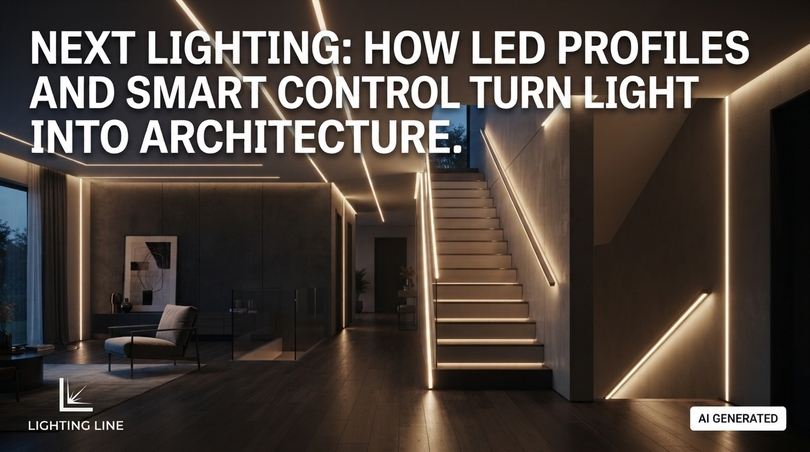
Next lighting (the next generation of illumination) is not simply a matter of more efficient LEDs: it is a new way of thinking about light as an integral part of architecture. For construction companies, architects, interior designers, facility managers, retail buyers, hoteliers and electrical integrators, next lighting means moving away from the logic of the single fixture and towards continuous, controllable, almost invisible lines of light that are designed into walls, ceilings, joinery and concrete from the first drawing.
This guide explains, with data, tables and specification-ready advice, how to deliver next lighting with the aluminium profiles and LED strips of the Lighting Line online catalogue, combined with the control technologies that are reshaping the building industry in 2027.The article is structured so that every professional can jump directly to the section that matters: definitions and trends for designers, protocols and commissioning for installers, energy and ESG data for sustainability managers, return on investment for facility managers, and sector playbooks for retail and hospitality.
In this article…
- What is next lighting? Definition and meaning
- What people mean when they search “next lighting”
- From the bulb to the system: history and development of next lighting
- Market data, statistics and regulation behind next lighting
- Lighting trends 2027: what is fashionable and what is outdated
- Next lighting products: aluminium profiles and LED strips
- Performance and quality: CRI, colour temperature, lumens and glare
- Next lighting technology: control, protocols and integration
- Sustainability, energy efficiency and ESG
- Applications: residential, offices, retail and hospitality
- Next lighting for construction companies: from specification to handover
- Installation, electricians, costs and troubleshooting
- Maintenance, return on investment and total cost of ownership
- Integrated next lighting versus decorative fixtures: a market comparison
- How to choose next lighting: buying guide and checklist
- The future of next lighting: outlook and innovation roadmap
- Frequently asked questions
- Next lighting is a building decision
1. What is next lighting? Definition and meaning
Before using a term, it must be defined. “Next lighting” is not a standardised technical expression, and online it is used in several different ways. In this article it has one precise meaning, which is the one that matters to people who design and build. Next lighting is the next generation of lighting design, in which light stops being an object added to a room and becomes a system built into the architecture itself.
A working definition of next lighting
Next lighting can be described through four characteristics that must be present together. Remove one, and you are back to conventional lighting with better lamps.
Integration
The light source disappears into the building fabric. Profiles are recessed into plasterboard, cast into concrete, mounted into shelves and stair treads, or suspended as minimal lines. Next lighting means overcoming the logic of the fixture in favour of continuous, invisible light. The observer perceives the effect, not the device.
Linearity and continuity
Points of light (spots, downlights, bulbs) are replaced or complemented by lines: grazing light along a wall, a luminous cut in a ceiling, a cove washing the soffit, a contour that follows a staircase. Linear LED strips housed in aluminium profiles are the natural tool for this geometry because they can be cut to length, joined, bent around corners and diffused into homogeneous, dot-free lines.
Control
Next lighting is dimmable, zoned and programmable. Intensity, colour temperature and sometimes colour change with the time of day, the occupancy of a space and the activity taking place. The control layer may be a simple wall dimmer, a wireless app-based mesh, a DALI-2 bus or a full building management system.
Measurability and sustainability
A next lighting installation can be measured: its energy use, its operating hours and, increasingly, its contribution to green building certifications. Materials matter too. Anodised aluminium is durable and recyclable, and LED strips replaceable inside a profile extend the life of the installation beyond the life of a single light engine.
What next lighting is not
To avoid confusion, it helps to say what the concept excludes. Next lighting is not a brand, it is not a product range of any single retailer, and it is not simply “smart bulbs”. Replacing an incandescent bulb with an LED bulb in an old pendant is a sensible saving, but it is not next lighting: the architecture has not changed and the light is still an object hanging from the ceiling. The philosophy of next lighting demands discretion, integration and materials that disappear.
Why the definition matters to the building industry
For construction companies the definition has a practical consequence: next lighting has to be decided early. A trimless profile in a plasterboard ceiling must be installed before the skim coat; a concrete profile must be positioned in the formwork before the pour; a shelf profile must be machined into the joinery before it leaves the workshop. Lighting moves from the last trade on site to one of the first decisions in the design. That shift is where both the value and the risk lie, and it is why the rest of this guide spends so much time on specification, sequencing and documentation.
| Aspect | Conventional lighting | Next lighting |
|---|---|---|
| Role of light | Object added to the room | Component of the architecture |
| Geometry | Points (bulbs, spots, pendants) | Lines, planes, contours, plus selected points |
| Visibility of the source | Fixture is visible and decorative | Source is hidden; only the effect is visible |
| Control | On/off, sometimes dimming | Dimming, zoning, scenes, tunable white, sensors |
| Design stage | Chosen at the end of the project | Specified at concept and detailed design |
| Maintenance logic | Replace the whole fixture | Replace the LED strip or driver inside a durable profile |
| Data | None | Energy and usage data available through controls |
2. What people mean when they search “next lighting”
The phrase “next lighting” is used with very different intentions. Understanding them helps readers find the right resource and helps us explain clearly where this guide fits. This guide is about next lighting as a design concept (the next generation of architectural light) and not about any retailer, brand or company with a similar name.
Retail and home-furnishing searches
A large share of queries comes from home shoppers in the UK and Ireland looking for the lighting department of the high-street retailer Next. Those shoppers are usually looking for a finished decorative object: a pendant, a table lamp, a lampshade. That is a legitimate need, and decorative pieces have a place in any layered scheme. But many of the same people, once they start renovating, discover that what makes a room feel contemporary is not the lamp itself but the way light is integrated into ceilings, kitchens, shelving and walls. That is where next lighting begins, and where a professional profile and strip system becomes relevant.
Company and brand-name searches
Other searches refer to businesses whose names contain similar words, such as next lighting corp, next lighting barcelona, next lighting ireland, next level lighting, next level lighting & electric, or searches like next lighting ebay. We do not describe or evaluate those companies here. Readers looking for them should consult the companies directly.
Technology and trend searches
The third family is the one this guide answers in depth: next generation lighting, next gen lighting, next lighting technology, the next big thing in lighting, what comes after LED, connected lighting, lighting trends for 2027. These are the questions asked by architects, designers, contractors and building owners, and they are the questions next lighting, understood as a design approach, is built to answer.
| Intent family | Typical searcher | What they need | Where this guide helps |
|---|---|---|---|
| Retail browsing (sale, clearance, shades, lamps) | Home shopper | A decorative product at a good price | Sections 5 and 10: how decorative pieces combine with integrated linear light |
| Company or brand names | Customer of a specific business | Contact or catalogue of that business | Not covered; see disambiguation note |
| Technology and trends | Architect, designer, contractor, facility manager | Understanding next generation lighting and how to specify it | The whole guide |
| Installation and cost | Homeowner, installer, developer | Rules, sequencing, costs, troubleshooting | Sections 11, 12 and 13 |
From a search to a specification
It is worth noting how often these intentions overlap. A homeowner who types “next lighting ceiling” looking for a flush fitting may, two weeks later, be talking to a builder about a plasterboard ceiling with a recessed linear light. A developer who searches “next generation lighting” may end up asking how much a trimless profile costs per metre. Next lighting is the bridge between the desire for a beautiful room and the technical system that delivers it. The rest of this guide walks across that bridge, step by step.
3. From the bulb to the system: history and development of next lighting
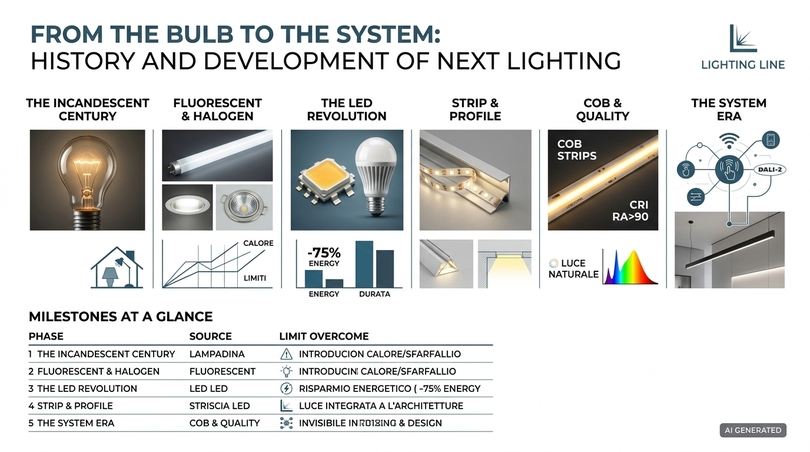
Next lighting did not appear overnight. It is the result of more than a century of changes in light sources, building regulations and design culture. Understanding that history helps professionals explain to clients why integrated linear light is not a passing fashion but the logical outcome of the technology. Every major milestone in lighting has reduced the size of the source and increased the freedom of the designer; next lighting is the point where the source becomes small enough to disappear.
The incandescent century: light as an object
For most of the twentieth century the light source was a hot glass bulb. Because the bulb was fragile, hot and short-lived, it had to be accessible and replaceable, and it had to sit in a fitting that dissipated heat and protected the user. The result was a culture of fixtures: pendants, chandeliers, wall sconces, table and floor lamps. The lampshade existed to soften the glare of a bare filament. Architecture provided a ceiling rose and a socket; the decorative object did the rest.
Fluorescent and halogen: the first architectural lines
Fluorescent tubes introduced linear light into offices, schools and factories, and cove lighting with tubes became an early form of architectural integration. However, tubes were bulky, required control gear, flickered at the end of their life and offered limited colour quality. Low-voltage halogen created the era of the recessed downlight, which brought light into the ceiling but filled it with holes and heat. Both technologies were steps towards integration, but neither allowed light to become truly invisible.
The LED revolution: efficiency first
The arrival of high-brightness white LEDs changed the economics of lighting. According to the U.S. Department of Energy, residential LEDs, especially ENERGY STAR rated products, use at least 75% less energy and can last up to 25 times longer than incandescent lighting. The first phase of the LED era was mainly about substitution: LED bulbs in old fittings, LED panels in old ceiling grids. Efficiency improved dramatically, but the architecture stayed the same.
The flexible strip and the aluminium profile: efficiency becomes form
The second phase began when LEDs were mounted on flexible printed circuit boards and sold as strips. A strip can be cut to length at regular intervals, powered at low voltage and placed almost anywhere. On its own, though, a strip is a component, not a luminaire: it needs heat management, mechanical protection, optics and a clean finish. The aluminium profile turned the LED strip into an architectural element: it dissipates heat, holds the diffuser, protects the circuit and gives the line of light a precise, finished edge. Surface, recessed, corner, suspended, drywall and concrete profiles allowed the same light engine to live in any part of a building.
COB strips and high colour rendering: quality catches up
Early strips produced visible dots of light, especially in shallow profiles. Chip-on-board (COB) strips, which place hundreds of tiny emitters per metre under a continuous phosphor layer, produce a uniform, dot-free line even with minimal diffusion. The Lighting Line catalogue, for example, lists COB strips at 24 V with more than 600 LEDs per metre, tunable white from 2700 K to 6500 K and colour rendering of CRI Ra>90. That quality allows linear light to be used in hospitality, retail and premium residential settings where material and skin tones must look natural.
Connected control: the system era
The third phase, which defines next lighting, is control. Standardised digital protocols such as DALI-2, wireless mesh networks, voice assistants and building management systems allow every line of light to be addressed, dimmed, tuned and monitored. The DALI Alliance certifies interoperable control gear and sensors, which gives specifiers confidence that drivers and controllers from different manufacturers will work together. Light becomes a dynamic, data-producing system rather than a static installation.
Milestones of next lighting at a glance
| Phase | Dominant source | Design consequence | Limit overcome by the next phase |
|---|---|---|---|
| Incandescent era | Filament bulb | Decorative fixtures, lampshades | Heat, short life, low efficiency |
| Fluorescent and halogen | Tubes, low-voltage halogen | Coves, grids, recessed downlights | Bulk, flicker, holes in ceilings |
| First LED era | LED retrofit lamps and panels | Same architecture, lower consumption | Light still tied to fixtures |
| Strip and profile era | SMD LED strips in aluminium profiles | Lines of light in any surface | Visible dots, limited control |
| Next lighting | COB and tunable strips, connected drivers | Invisible, controllable, measurable light as architecture | Ongoing: integration of data, health and circularity |
What is the next lighting technology after LED?
Clients often ask whether it is worth investing in LED systems if something better is around the corner. It is a fair question. Several technologies are under development: OLED panels that emit light from a thin surface, laser-based sources for very long-throw applications, micro-LEDs, spectrally tuned sources that reproduce daylight more faithfully, and Li-Fi, which uses modulated light to transmit data. None of these is positioned to replace LED in general architectural lighting in the near term: instead, the innovation is happening around the LED in optics, control, spectrum and integration. This is good news for anyone building today: a well-designed profile system can accept improved strips in the future, so the architecture is not made obsolete by the next generation of chips.
4. Market data, statistics and regulation behind next lighting
Design decisions in construction are increasingly justified with numbers. Clients, lenders and certification bodies want to know how much energy a lighting scheme will use, how long it will last and how it complies with regulation. This section collects the most useful reference points. The data point in one direction: regulation is removing older technologies from the market, while controls and integration are where the remaining savings and the added value lie.
Energy and lifetime: the baseline
The comparison between source technologies is now well established. LEDs use a fraction of the energy of incandescent and halogen lamps, and have significantly longer rated lives. For linear architectural applications the relevant comparison is with fluorescent tubes, which LED strips in profiles have replaced in most new projects.
| Technology | Typical efficacy | Typical rated life | Dimmability | Status in the EU market |
|---|---|---|---|---|
| Incandescent | Very low | About 1,000 hours | Yes | Phased out for general lighting |
| Halogen | Low | About 2,000 hours | Yes | Most mains halogen lamps phased out |
| Linear fluorescent (T5/T8) | Medium | Tens of thousands of hours | With dedicated gear | Phased out under RoHS exemptions expiry (2023) |
| LED strip in aluminium profile | High | Tens of thousands of hours, depending on thermal management | Yes, with compatible driver or controller | Mainstream technology |
The savings from controls
Once the source is LED, the next big lever is control. A widely cited meta-analysis by Lawrence Berkeley National Laboratory (Williams et al., 2012), which reviewed decades of field studies in commercial buildings, found average lighting energy savings of roughly 24% from occupancy sensing, 28% from daylight harvesting, 31% from personal tuning, 36% from institutional tuning and 38% when multiple strategies were combined. These figures are averages across many buildings and should be treated as orders of magnitude, not guarantees, but they explain why next lighting always combines efficient sources with intelligent control.
| Control strategy | Average savings | Best suited to |
|---|---|---|
| Occupancy sensing | About 24% | Meeting rooms, toilets, corridors, storage, hotel corridors |
| Daylight harvesting | About 28% | Perimeter offices, retail with glazing, atriums |
| Personal tuning | About 31% | Open-plan offices, workstations |
| Institutional tuning (task tuning, scheduling) | About 36% | Offices, retail chains, schools |
| Multiple strategies combined | About 38% | Whole-building next lighting with DALI or networked control |
Regulation: what is pushing the market
In the European Union, the Ecodesign requirements for light sources and separate control gear are set byCommission Regulation (EU) 2019/2020, applicable since September 2021. In parallel, the energy label for light sources was rescaled from A to G, which is why even very efficient LED strips may today show classes such as E, F or G: the scale was reset to leave room for future improvements. Restrictions on mercury under the RoHS Directive led to the phase-out of most compact fluorescent lamps and of common T5 and T8 tubes during 2023.
The recast Energy Performance of Buildings Directive, adopted in 2024, sets the path towards zero-emission buildings and strengthens the role of building automation and control systems. For the construction sector, the message of the new lighting legislation is clear: specify LED with controls, document the energy performance and design for future upgrades.
| Instrument | What it does | Practical consequence for projects |
|---|---|---|
| Ecodesign Regulation (EU) 2019/2020 | Minimum efficiency and functionality requirements for light sources and control gear | Older, inefficient sources disappear; LED becomes the default |
| Energy labelling Regulation (EU) 2019/2015 | Rescaled A–G label for light sources | Compare labels within the new scale; do not compare with old A++ labels |
| RoHS Directive and expiring exemptions | Restriction of mercury-containing lamps | Fluorescent tubes no longer an option for new or refurbished schemes |
| Energy Performance of Buildings Directive (recast 2024) | Pathway to zero-emission buildings, building automation requirements | Lighting controls and monitoring gain strategic importance |
| EN 12464-1 (indoor workplaces) | Illuminance, glare and colour rendering requirements | Office and retail schemes must meet lux, UGR and Ra targets |
Market signals: where demand is going
Three signals stand out in the market for architectural lighting. First, LEDs have become the majority technology in new lighting sales worldwide, as documented in the International Energy Agency’s tracking of lighting.
Second, demand for linear and integrated lighting is growing faster than demand for traditional decorative fixtures in professional projects, because developers want clean ceilings and flexible spaces. Third, connected control is moving from luxury to standard, driven by wireless protocols that reduce installation cost. The opportunity for building companies is to sell next lighting not as an extra but as a feature that raises the perceived value of every square metre.
Does lighting increase property value?
Estate agents and developers consistently report that lighting influences how a home is perceived in photographs and viewings. Integrated linear light, under-cabinet kitchen lighting and well-placed pendants make spaces read as recently renovated and carefully designed.
It is difficult to isolate the contribution of lighting to a sale price, and we will not invent a percentage, but buyers clearly notice dark, outdated rooms. A carefully designed next lighting scheme is one of the most cost-effective ways to make a renovation look premium.
Is lighting a good investment?
For commercial owners the answer rests on energy, maintenance and asset value. LED with controls reduces running costs; durable profiles reduce replacement costs; documented performance supports certifications that influence rents and valuations. For residential developers, lighting is a relatively small share of the build cost with a disproportionate effect on perceived quality. Section 13 shows how to calculate the return in your own project.
5. Lighting trends 2027: what is fashionable and what is outdated
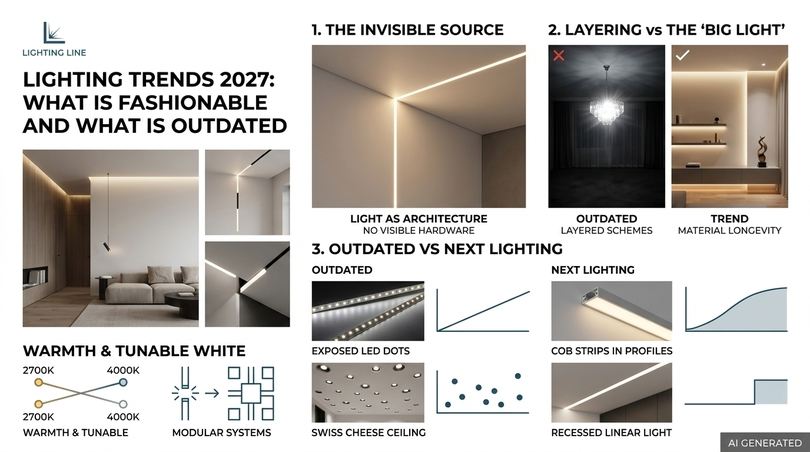
Every year designers ask the same questions: what lighting is fashionable, what lighting is popular now, which light fixtures are outdated, and what the latest trend in light fixtures is. In 2027 the answers converge remarkably well. The strongest lighting trend of 2027 is the disappearance of the fixture: light is layered, warm, dimmable and built into the architecture, while decorative pieces are fewer, more sculptural and more deliberate. This is exactly the direction of next lighting.
The six defining lighting trends of 2027
Invisible conduction and visual purity
The most requested effect in contemporary interiors is light without a visible source. Trimless drywall profiles, recessed lines and coves produce what designers call “cuts of light”: precise luminous lines that seem to be carved into the ceiling or wall. Anodised aluminium profiles make it possible to integrate the source with no visible hardware, in line with the trend towards the dematerialisation of the fixture.
Light as architecture
Light no longer decorates a space; it constructs it. A recessed line can mark a circulation route, a suspended profile can define a meeting table, a cove can make a low ceiling feel higher. Recessed and suspension profiles transform light into a structural element rather than a decorative accessory.
Layering instead of a single overhead light
The single central ceiling light — the “big light” — is widely regarded as outdated. Designers build rooms in layers: ambient light from coves or indirect lines, task light under cabinets and above worktops, accent light on shelves, art and textures, and a small number of decorative pieces for character.
Warmth and tunable white
Cold, flat light is out of fashion in homes and hospitality. Warm white (2700–3000 K) dominates residential schemes, while tunable white strips that move from warm to neutral allow a single installation to support both relaxation and concentration.
Modularity and personalisation
Clients want systems that adapt. Modular linear systems, with different lengths, diffusers, end caps and joints, respond to the demand for tailored solutions that can be reconfigured when a space changes use.
Honest materials and longevity
Material honesty is a strong theme in 2027 interiors: real metal, natural finishes, products designed to last and to be repaired. Anodised aluminium is durable, recyclable and visually coherent with this attention to longevity.
Which light fixtures are outdated?
Designers are increasingly consistent about what dates a room. The list below is not about taste alone; most of these elements are outdated because they produce poor light, not just because they look old.
| Outdated feature | Why it dates a space | Next lighting alternative |
|---|---|---|
| A single central ceiling light in every room | Flat, shadowless light; harsh at night | Layered scheme with coves, task lines and a few decorative pieces |
| Grids of many recessed downlights (“Swiss cheese ceiling”) | Visual clutter, glare, uneven walls | Fewer downlights plus continuous recessed linear light |
| Fluorescent battens in kitchens and garages | Cold colour, flicker, now phased out | Surface or recessed profiles with high-CRI LED strips |
| Exposed LED strips with visible dots | Cheap look, glare, short life without heat sink | COB strips in aluminium profiles with diffusers |
| Cool white light in living areas | Clinical atmosphere | Warm white or tunable white with dimming |
| Heavy, ornate fittings in small rooms | Overpower the space | Integrated lines plus one sculptural statement piece |
What is the trend for ceiling lights?
The ceiling is where next lighting is most visible, or rather, most invisible. The trend for ceiling lights in 2027 is towards clean planes interrupted by precise lines of light, perimeter coves that wash the ceiling, and shadow gaps with concealed strips. Where a decorative ceiling light remains, it is usually a single, well-chosen pendant over a table or island. The question “how do I pick a ceiling light?” increasingly becomes “how do I design a ceiling that lights the room?”
Are LED ceiling lights good?
LED ceiling lights are good when they are designed well: adequate lumen output, high colour rendering, low glare and compatibility with dimming. Integrated linear LED in profiles adds two advantages over flush LED fittings: the light can be distributed along the room rather than concentrated in the centre, and the strip can be replaced without changing the ceiling.
Which ceiling lights are the brightest?
Brightness depends on lumens per metre and on the diffuser. A high-output strip in a large profile with a clear or semi-opal diffuser delivers far more light than a small decorative fitting. However, brightness alone is not the goal: an over-lit room is uncomfortable. Calculate lux levels for the activity (see section 7) and use dimming to adjust.
Are wall lights still fashionable?
Yes. Wall lights are one of the clearest beneficiaries of the move away from overhead light, because they place light at eye level and create the warm pools of light that make a room feel intimate. In 2027 the trend for wall lights includes slim linear wall grazers, vertical lines integrated into plaster, picture lights and indirect up-and-down lighting from wall profiles. The Lighting Line range includes dedicated wall profiles and corner profiles that allow light to wash along a wall surface or emerge from the junction between wall and ceiling.
Should wall lights match ceiling lights?
They do not need to match, but they should belong to the same family of finish, colour temperature and intention. In a next lighting scheme, coherence comes from consistent colour temperature (for example 2700 K throughout a living area), consistent finishes (black, silver or white profiles chosen to match ceilings and joinery) and a clear hierarchy between architectural and decorative light. Mismatched colour temperatures are far more disturbing than mismatched shapes.
Pendants and hanging light styles
Hanging lights (often called pendants, suspensions or, colloquially, pendulum lights) remain popular, particularly over dining tables and kitchen islands. The trending hanging light styles in 2027 are either sculptural statement pieces or minimal suspended linear profiles. A suspended aluminium profile, such as the 36×75 mm suspension profile, can accommodate up to two 10 mm LED strips and even a slim power supply inside the body, providing direct and indirect light over a table, desk or reception counter.
What is a pendant light fitting and what is the drop?
A pendant light fitting is a luminaire suspended from the ceiling by a cable, chain or rod. The drop is the distance from the ceiling to the bottom of the fitting. As a practical guideline, the bottom of a pendant over a dining table or island typically sits around 75–90 cm above the surface, adjusted for ceiling height, the size of the fitting and sightlines across the room. In circulation areas the fitting must leave comfortable headroom.
Do pendant lights increase home value?
A pendant alone rarely changes value, but a well-lit kitchen island or dining area improves how a home photographs and feels during viewings. Combining a pendant with integrated under-cabinet and plinth lighting creates the impression of a fully designed kitchen.
Kitchen lighting trends 2027
Kitchens are the room where next lighting delivers the most visible improvement. The current trend for kitchen lighting combines three layers: integrated task light under wall cabinets, ambient light from ceiling lines or coves, and accent light in shelves, glass cabinets and plinths. Good ideas for kitchen lighting in the UK and elsewhere start from the worktop: the work surface needs bright, shadow-free, high-CRI light. Profiles with diffusers under the cabinets eliminate reflections of individual LEDs on glossy worktops. LED strip lights in the kitchen also benefit from aluminium heat sinks, which keep the strip cool near hobs and ovens.
Colours, finishes and lampshades in 2027
Which colour light fixtures are in style in 2027? Black and dark bronze remain strong for contrast in contemporary and industrial interiors; white finishes that disappear into ceilings dominate minimal schemes; natural aluminium suits technical and Scandinavian-inspired spaces. The trend in lampshades for 2027 favours natural textures — linen, paper, rattan — and pleated or sculptural forms, used sparingly as decorative accents within an architecturally lit room.
Why does Gen Z dislike overhead lighting?
The rejection of the “big light” by younger generations has become a cultural reference point. The reasons are practical: overhead light flattens faces, casts unflattering shadows, makes rooms feel institutional and looks poor on camera. Younger renters and buyers prefer lamps, LED strips and indirect light that create mood. Next lighting answers this preference with architectural quality: instead of improvised strips stuck behind furniture, it offers integrated, diffused, dimmable lines that are safe, durable and designed.
Lighting trends to avoid in 2027 renovations – and what to do instead
- Avoid adhesive LED strips without profiles: they detach, overheat and show dots. Use aluminium profiles with diffusers instead.
- Avoid mixing colour temperatures in the same room. Choose one value or tunable white with central control.
- Avoid over-lighting with dense downlight grids. Use fewer, better-placed sources and linear ambient light.
- Avoid non-dimmable installations in living spaces. Specify dimmable drivers or controllers from the start.
- Avoid choosing lighting after plastering. Decide on recessed and trimless profiles during the design stage.
6. Next lighting products: aluminium profiles and LED strips
Next lighting needs a toolkit. The core of that toolkit is a combination of aluminium profiles, diffusers, end caps, mounting brackets, LED strips and drivers. The Lighting Line profiles are designed for next lighting solutions in which light disappears into architecture: they are entirely designed in Italy, made of anodised aluminium and suitable for surface, recessed and suspended installation, at competitive prices. This section maps the catalogue to the design tasks it solves.
The profile families and what they do
| Profile family | Typical application | Next lighting effect | Catalogue link |
|---|---|---|---|
| Surface profiles | Under cabinets, ceilings, walls, furniture | Clean linear light without recess work | 21×17 mm surface profile |
| Recessed profiles | Ceilings, floors, stairs, furniture | Flush luminous lines | Recessed 9×8 mm profile |
| Drywall (plasterboard) profiles | Plasterboard ceilings and walls | Trimless “cuts of light”, corners, shadow gaps | Drywall profile range |
| Suspension profiles | Offices, tables, reception, retail | Direct and indirect linear pendants | 36×75 mm suspension profile |
| Furniture profiles | Shelves, wardrobes, mirrors | Accent and functional light in joinery | Furniture profiles |
| Corner, wall, concrete and round profiles | Wall-ceiling junctions, façades, cast concrete, decorative tubes | Light following the geometry of the building | Full profile catalogue |
Drywall profiles: the signature of next lighting
If one product family embodies next lighting, it is the drywall profile. Designed with lateral wings to be fixed into plasterboard and finished with skim, these profiles leave only the line of light visible. The range includes corner profiles for plasterboard, wide profiles for generous indirect light, and models such as the 57×10 mm white painted profile for plasterboard. Some drywall models position the strip higher inside the body so that the source is not directly visible unless the observer stands right below it, reducing glare.
Surface profiles: speed and flexibility
Surface profiles are the fastest route to next lighting in renovations, where opening ceilings is not possible. A profile such as the 21×17 mm model accepts LED strips with PCBs up to 12 mm and is available in 2 m and 3 m lengths, with transparent, opal, semi-opal and frosted diffusers. Larger surface profiles, such as the 36×26 mm profile, are available in silver, white and black finishes for higher outputs and more visible linear elements.
Diffusers, end caps and brackets: the details that make the difference
The diffuser determines how the line looks and how much light it emits. Photometric tests published in the catalogue show the effect clearly: on the recessed 9×8 mm profile, for example, an opal diffuser reduces output by about 50% and a satin diffuser by about 53%, in exchange for a perfectly homogeneous line. Choosing a diffuser is always a trade-off between uniformity and efficiency, and next lighting design starts by deciding which matters more in each location. End caps close the profile cleanly and allow cable entry; mounting brackets and springs ensure stable fixing and allow the profile to be removed for maintenance.
| Diffuser | Light output | Uniformity | Best for |
|---|---|---|---|
| Transparent | Highest | Low (dots visible with SMD strips) | Indirect coves, light hidden from view |
| Semi-opal / frosted | Medium-high | Medium | Task light, shelves, retail displays |
| Opal / satin | Lower | High, continuous line | Visible lines in ceilings, walls and furniture |
LED strips: SMD and COB
The Lighting Line LED strip range includes both SMD and COB strips, with fully customisable production. SMD strips use discrete LEDs and offer high efficiency and a wide choice of outputs; COB strips provide continuous, dot-free light, ideal for shallow profiles and visible lines. The catalogue includes 24 V COB strips with CRI Ra>90 and tunable white from 2700 K to 6500 K, as well as coloured strips for scenographic effects.
| Feature | SMD strip | COB strip |
|---|---|---|
| Appearance without diffuser | Visible individual points | Continuous line |
| Beam | Typically about 120° | Wide, up to about 180° |
| Profile depth required | Deeper, for mixing distance | Shallow profiles possible |
| Typical use | Coves, indirect light, high output | Visible lines, furniture, mirrors, shallow recesses |
| Colour options | Single white, tunable white, RGB, RGBW | Single white, tunable white, colours |
Specification resources for professionals
For architects and lighting designers, documentation is as important as the product. Lighting Line product pages provide downloadable datasheets, photometric tests and BIM files for Revit, as well as a lux calculation service. Having BIM objects and photometric data available from the first concept means next lighting can be modelled, rendered and calculated inside the same workflow used for the rest of the building. For guidance on layout, the technical article on the lighting layout calculator for LED profiles explains how to plan runs, spacing and recessed installation.
7. Performance and quality: CRI, colour temperature, lumens and glare
A beautiful concept fails if the light is poor. Next lighting must meet measurable quality criteria: enough light for the task, faithful colours, comfortable contrast, no glare and no flicker. This section gives the numbers professionals need. Quality in next lighting is defined by five parameters: illuminance, colour rendering, colour temperature, glare control and thermal management.
How many lumens do I need?
Lumens measure the quantity of light emitted; lux measure the light falling on a surface (one lux equals one lumen per square metre). To size a scheme, start from the target illuminance for the activity, multiply by the area, then correct for the efficiency of the profile and diffuser and for the reflectance of the room. A simple first estimate is:
Required lumens ≈ target lux × area (m²) ÷ utilisation factor
The utilisation factor accounts for losses in the diffuser and the room. For indirect cove lighting it can be low; for direct linear light with a clear diffuser it is higher. Always verify with a photometric calculation for professional projects.
| Space or task | Indicative maintained illuminance | Notes |
|---|---|---|
| Living room, general ambient | About 100-200 lux | Dimmable; add task and accent layers |
| Kitchen worktop | About 300-500 lux | High CRI, shadow-free under-cabinet light |
| Bathroom mirror | About 300-500 lux on the face | Light from the sides or front, not only from above |
| Corridors and hallways | About 100 lux | Linear light along walls widens narrow spaces |
| Office writing and reading | 500 lux (EN 12464-1) | UGR limit typically 19, Ra ≥ 80 |
| Retail sales area | About 300-500 lux general, with higher accent levels | Contrast ratios highlight products |
| Hotel room, general | About 100-200 lux | Scenes for arrival, reading, night |
Colour rendering index (CRI)
CRI (Ra) describes how faithfully a source reproduces colours compared with a reference. For offices, EN 12464-1 typically requires Ra ≥ 80. For homes, hospitality, retail of food, fashion and cosmetics, and for any space where materials matter, Ra > 90 is recommended. Many strips in the Lighting Line catalogue, including COB tunable white models, are specified at CRI Ra>90. High colour rendering is one of the clearest differences between professional next lighting and low-cost consumer strips.
What colour temperature is recommended for different rooms?
Colour temperature, measured in kelvin (K), describes whether white light appears warm or cool. The choice affects atmosphere, perceived comfort and, when combined with intensity and timing, the body’s circadian rhythm.
| Room or use | Recommended CCT | Next lighting tip |
|---|---|---|
| Living room, bedroom | 2700-3000 K | Warm coves and wall lines; dim in the evening |
| Kitchen | 3000-4000 K | 3000 K for open-plan living kitchens; 4000 K for task-focused kitchens |
| Bathroom | 3000-4000 K | High CRI at the mirror; IP-rated profiles in wet zones |
| Office | 3500-4000 K, or tunable | Tunable white supports daytime alertness |
| Retail | 3000-4000 K | Match CCT to product: warmer for wood and leather, neutral for technology |
| Hotel rooms and lobbies | 2700-3000 K | Warm, dimmable scenes reinforce hospitality |
| Wellness and human-centric applications | Tunable 2700-6500 K | Cooler and brighter during the day, warmer and dimmer at night |
Glare and visual comfort
Glare is the main reason linear light can feel uncomfortable. Next lighting controls glare with three tools: the depth of the profile (a deeper profile hides the source), the diffuser (opal and satin soften luminance) and the position (indirect light bounced off ceilings or walls is inherently comfortable). In offices, the Unified Glare Rating (UGR) should be calculated for the specific layout.
Thermal management and lifetime
LEDs are efficient, but the heat they produce is concentrated at the chip. If it is not removed, light output and lifetime fall. Aluminium profiles act as heat sinks, spreading the heat along their length. A strip installed in a correctly sized aluminium profile will last longer and maintain its colour better than the same strip glued to wood or plaster. Always respect the maximum power per metre indicated for each profile.
Voltage, runs and uniformity
Most architectural strips work at 24 V, which reduces current and voltage drop compared with 12 V. Long runs should be powered from more than one point or from both ends to keep brightness uniform. Check the maximum run length declared for each strip and design the power supply positions together with the profile layout.
The golden rule of lighting and the 5’7″ rule
Lighting designers often summarise good practice as a golden rule: light the surfaces, not just the space, and build in layers. Vertical surfaces — walls, shelves, artworks — define how bright and how large a room feels, which is why wall grazers and coves are so effective.
The so-called 5’7″ (or 57-inch) rule comes from galleries and interior design: the centre of artworks is commonly placed at about 57 inches (around 145 cm) from the floor, the average eye height. Lighting designers use the same reference to position wall lights, picture lights and accent lines so that light sits in the natural field of view without dazzling. Treat it as a guideline to adapt to ceiling heights, furniture and the people who use the space, not as a regulation.
Where should ceiling lights be placed in a bedroom?
Avoid placing bright sources directly above the bed, where a person lying down looks straight into them. Better solutions are a perimeter cove, a recessed line above wardrobes, wall lights or reading lights beside the bed, and low-level night light in profiles under the bed or along the floor. The bedroom lighting ideas 2027 guide develops these techniques in detail.
How do you light a living room and a small hallway?
The best lighting for a living room combines indirect ambient light (a cove or a recessed ceiling line), accent light on shelves and media walls, and one or two decorative pieces such as a floor lamp or pendant, all dimmable and in warm white. What is the best ceiling light for a living room? Often it is not a fitting at all, but a perimeter line of light that lifts the ceiling. For a small hallway, the best light is linear and vertical: a recessed line along one wall or a low-level strip near the floor makes the corridor feel wider and guides movement at night.
8. Next lighting technology: control, protocols and integration
Control is what turns efficient light into next lighting. It allows scenes, schedules, sensors and integration with building systems, and it produces the data that facility and sustainability managers need. Choosing the control protocol is a design decision with consequences for cost, flexibility and maintenance for the entire life of the building. This section compares the options and answers the most common questions from installers and integrators.
Are LED strips dimmable?
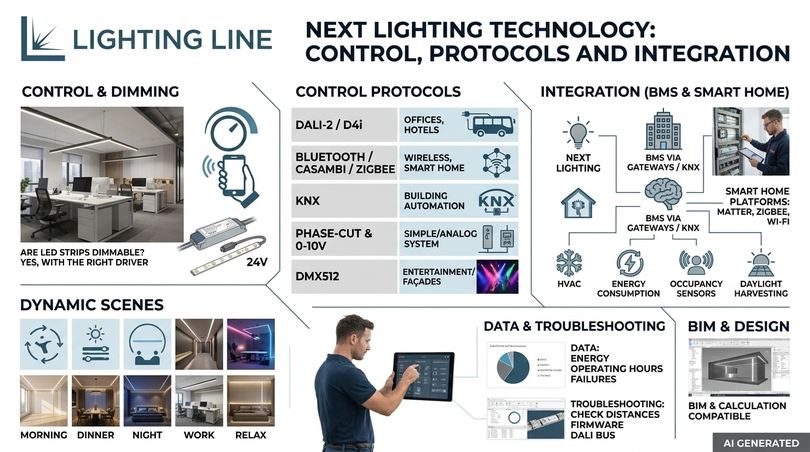
A question frequently asked about consumer products — “are next lights dimmable?” — has a clear answer for architectural LED strips: the strip itself is dimmable, but dimming depends on the driver or controller. Constant-voltage 24 V strips are typically dimmed with PWM controllers that receive commands from a wall dimmer, a DALI bus, a 0–10 V signal, or a wireless network. The key is compatibility: specify dimmable drivers and check that the dimming method matches the control system. Poor combinations cause flicker, which is one of the most common complaints about LED lighting.
The main protocols used in next lighting installations
| Protocol | Type | Strengths | Typical use |
|---|---|---|---|
| Phase-cut (leading/trailing edge) | Mains wiring | Simple, uses existing wall dimmers | Residential retrofits with suitable drivers |
| 0-10 V / 1-10 V | Analogue, wired | Simple, widely supported | Commercial zones with basic dimming |
| DALI-2 / D4i | Digital, wired bus | Addressable, interoperable, certified, data-capable | Offices, hotels, retail, public buildings |
| DMX512 | Digital, wired | Fast, precise colour control | Façades, entertainment, dynamic RGB scenes |
| KNX | Building automation bus | Integrates lighting, HVAC, blinds, security | High-end residential, commercial buildings |
| Zigbee | Wireless mesh | Low power, broad smart home ecosystem | Residential smart lighting |
| Bluetooth mesh (including Casambi-based systems) | Wireless mesh | No gateway required, app commissioning, fast retrofit | Hospitality, retail, renovations |
| Matter over Thread or Wi-Fi | IP-based smart home standard | Cross-platform interoperability among major ecosystems | Residential and small commercial |
Which next lighting systems are easiest to install and configure?
For renovations, wireless controllers that receive commands from an app or a wireless wall switch are the easiest: they require no control cables, and scenes can be configured on site. For new commercial builds, DALI-2 is usually the most robust choice, because every driver is addressable and groups can be changed in software without rewiring. The easiest system is the one decided before first-fix wiring: a few extra cables in the right place cost far less than retrofitting control later.
How can next lighting integrate with smart home platforms?
LED strip controllers with Zigbee, Wi-Fi or Matter compatibility can be added to popular smart home ecosystems, allowing voice control and automation. Integrators should define which platform is the “master”, avoid duplicating automations across multiple apps, and document the network for the homeowner. For higher-end homes, a KNX or DALI backbone with a gateway to consumer platforms combines reliability with convenience.
How can next lighting be integrated with a building management system?
In commercial buildings, lighting control is typically integrated with the BMS via gateways (for example DALI-to-BACnet or DALI-to-Modbus) or through KNX. Integration allows centralised schedules, energy metering, fault reporting (such as a failed driver) and coordination with HVAC and blinds based on occupancy. D4i-compliant drivers can store and report operating hours and energy data, which supports maintenance planning and ESG reporting.
Occupancy sensors and daylight harvesting
Occupancy and absence sensors switch or dim lights when spaces are empty; daylight sensors reduce output when natural light is sufficient. In offices, setting meeting rooms and corridors to absence detection (manual on, automatic off) often yields larger savings than presence detection. Linear profiles near windows can be grouped separately so that the perimeter dims first.
Creating dynamic lighting scenes
Scenes are pre-set combinations of intensity and colour temperature for groups of luminaires. In a home, typical scenes are “morning”, “cooking”, “dinner”, “film” and “night path”. In a restaurant: “lunch”, “dinner”, “late”, “cleaning”. In a hotel room: “welcome”, “work”, “relax”, “sleep”. Linear LED lines are ideal for scenes because each layer — cove, task, accent — can be controlled independently, creating very different atmospheres with the same hardware.
Which smart lighting systems are compatible with architectural design software?
Architects work in BIM environments such as Revit, and lighting designers use calculation software that reads photometric files (typically IES or EULUMDAT/LDT). Compatibility therefore depends on the availability of BIM objects and photometric data for the luminaires, rather than on the control protocol. Lighting Line provides BIM files for Revit and photometric tests on product pages, so profiles can be placed in the model, scheduled and calculated. Control zones and DALI addresses can be documented in the same model as parameters.
How to troubleshoot connectivity issues in smart lighting networks
- Check distances and obstacles: metal profiles, concrete and steel structures reduce wireless range; add repeaters or mesh nodes.
- Verify firmware versions of controllers and gateways; mixed versions cause unstable behaviour.
- Avoid channel conflicts between Wi-Fi and Zigbee networks in the 2.4 GHz band.
- For DALI, check bus power supply, cable length and addressing; duplicate addresses are a common fault.
- Document the commissioning: a network map saves hours of fault-finding later.
What training is required to install advanced lighting systems?
Installers need, at minimum, the electrical qualifications required in their country, plus familiarity with low-voltage DC wiring, voltage drop calculation and driver selection. For DALI, KNX and wireless systems, manufacturer and association training courses are widely available. Integrators who combine lighting with home automation benefit from commissioning experience on the specific platforms they offer.
What data can next lighting systems provide?
Depending on the control layer, next lighting systems can report energy consumption, operating hours, failures, occupancy patterns and space utilisation. For a retail manager this means knowing which zones are used most and when; for a facility manager it means predictive maintenance; for a sustainability manager it means measured rather than estimated energy data.
9. Sustainability, energy efficiency and ESG
Sustainability is no longer a separate chapter of a project; it is a requirement that shapes budgets, financing and reputation. Lighting is one of the few building systems where large, measurable improvements can be achieved quickly and documented clearly. Next lighting contributes to sustainability on three levels: lower operational energy, longer product life and recyclable materials, and measurable data for ESG reporting.
How can next lighting improve the energy efficiency of a building?
Energy efficiency in lighting comes from four steps, in this order: an efficient source (LED), an efficient optical system (profiles and diffusers chosen for the task, light directed where it is needed), the right quantity of light (no over-lighting), and control (light only when and where required). Each step multiplies the effect of the previous ones. Linear light also helps distribute illuminance evenly, which can reduce the total installed power needed to reach a target on work surfaces.
How much energy can a commercial building save with next lighting?
The answer depends on the starting point. Replacing fluorescent or halogen lighting with LED typically reduces lighting energy substantially; adding controls adds further savings in the range identified by the LBNL meta-analysis (around 24–38% depending on strategy). We avoid quoting a single universal percentage, because operating hours, daylight availability and occupancy vary enormously. A proper energy audit, followed by measurement after installation, is the only reliable basis for a business case.
Materials: are next lighting products recyclable?
Aluminium is one of the most recycled materials in construction and can be recycled repeatedly without losing its properties. Anodising creates a protective oxide layer that resists corrosion and wear, extending the life of the profile. Because the LED strip is a separate, replaceable component, the profile can outlive several generations of light engines. Designing for disassembly — profiles that open, diffusers that unclip, strips that can be replaced — is one of the most practical circular-economy measures available in lighting today.
Which next lighting solutions have the lowest environmental impact?
- Solutions that deliver the required light with the lowest installed power (correct optics and diffusers).
- Systems with controls that reduce operating hours.
- Durable, repairable hardware with replaceable LED strips and drivers.
- Products with complete technical documentation, so they can be correctly maintained and eventually recycled.
- Designs that avoid over-lighting and light pollution, especially outdoors.
Next lighting and green building certifications
Green building certifications reward lighting that is efficient, controllable and comfortable. The exact credits depend on the scheme and version, so always check the current manual, but the logic is consistent.
| Certification | Relevant areas | Next lighting contribution |
|---|---|---|
| LEED | Energy performance, interior lighting quality, lighting controls | Efficient LED, multi-zone dimming, high CRI, glare control |
| BREEAM | Energy, visual comfort, internal and external lighting | Zoned control, efficient installed power, appropriate illuminance |
| WELL | Light concept: visual and circadian lighting, glare, occupant control | Tunable white, indirect light, personal control |
| National energy codes and EPC ratings | Installed lighting power and controls | Lower lighting power density, automatic controls |
The WELL Building Standard is particularly relevant to next lighting because it explicitly addresses the effect of light on people, including circadian lighting design, glare control and the ability of occupants to adjust their lighting. Tunable white linear systems with intelligent control are among the most effective tools to meet these requirements in offices, schools and healthcare.
How can lighting energy savings be measured and reported?
Measurement and verification (M&V) follows a simple logic: establish a baseline, install, then measure. Methods range from simple calculations (installed power × operating hours before and after) to sub-metering of lighting circuits and data from digital drivers. For ESG reports, the most credible approach combines metered data with a documented method and clear assumptions.
| Method | Accuracy | Cost | Suitable for |
|---|---|---|---|
| Calculated (power × hours) | Indicative | Very low | Small projects, preliminary business cases |
| Spot measurement and logging | Good | Low | Retrofits with stable usage |
| Sub-metering of lighting circuits | High | Medium | Commercial buildings, ESG reporting |
| Driver-level data (DALI-2 / D4i) | High, granular | Medium, included in system | Smart buildings, portfolios, predictive maintenance |
How does next lighting contribute to corporate sustainability goals?
For companies with ESG commitments, lighting upgrades offer visible, quick-payback projects that reduce Scope 2 emissions (from purchased electricity), improve employee wellbeing and generate data for reporting. Next lighting adds a qualitative dimension: better light improves comfort and the perception of the workplace, which supports social as well as environmental objectives.
10. Applications: residential, offices, retail and hospitality
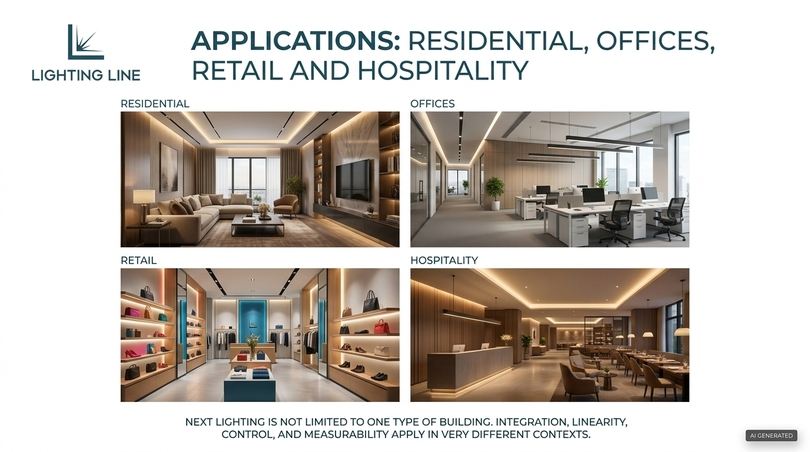
Next lighting is not limited to one type of building. The same principles (integration, linearity, control and measurability) apply in very different contexts, but each sector has its own priorities. A good next lighting design starts from the people who use a space and what they need to feel, see and do. This section translates the concept into practical playbooks for the main sectors served by construction companies.
Residential projects and luxury interiors
In homes, next lighting is about atmosphere, comfort and the quality of materials. Interior designers use integrated light to enhance textures, define zones in open-plan spaces and give clients personalised experiences through scenes.
How can next lighting enhance the atmosphere of an interior space?
By lighting surfaces rather than air. A cove that washes a ceiling makes a room feel taller; a vertical line beside a fireplace adds depth; light inside shelving turns objects into a display. Warm, dimmable light and the absence of visible sources create calm. Atmosphere comes from contrast and softness, not from quantity of light.
Which next lighting products are best for luxury residential interiors?
Trimless drywall profiles for ceilings and walls, COB strips with CRI Ra>90 for dot-free lines, furniture profiles for wardrobes and shelves, and suspension profiles over dining tables or kitchen islands. Finishes should match the interior: white for disappearing ceilings, black for contrast, silver for technical spaces.
How can decorative lighting be combined with smart lighting controls?
Decorative pendants, table lamps and floor lamps can be integrated into scenes by using dimmable lamps and smart controllers or by connecting them to switched circuits controlled by the same system. The decorative piece provides character; the architectural lines provide the base light. Both should share the same colour temperature.
Kitchens and bathrooms
In kitchens, LED strip lights under cabinets, in plinths and in glass cabinets create a fully designed space. In bathrooms, IP-rated profiles and appropriate drivers allow linear light around mirrors, in niches and in shower recesses, always respecting the safety zones and IP ratings required by local regulations. Bathroom strip lighting must be specified with the correct protection rating for its zone.
Children’s bedrooms and nurseries
Soft, indirect, dimmable light is ideal for children’s bedrooms and nurseries: a cove or low-level line for night-time, warm colour temperature in the evening and no exposed sources that can dazzle a child lying down.
Offices and corporate buildings
Facility managers want lower costs, fewer complaints and better control. Next lighting in offices combines suspended direct/indirect profiles over desks, recessed lines in corridors, sensors in meeting rooms and tunable white to support wellbeing.
How can occupancy sensors optimise office lighting?
Sensors should be zoned to match how people use the space: one sensor per meeting room, sensors along corridors with dimming to a low background level rather than switching off completely, and open-plan zones that dim when unoccupied. Absence detection in cellular offices encourages manual switching on only when needed.
Which next lighting systems offer the best return on investment?
The best returns typically come from spaces with long operating hours and inefficient existing lighting, such as corridors, warehouses, car parks and open offices, upgraded to LED with sensor control. Section 13 explains how to calculate payback.
Retail: lighting that sells
For retail purchasing managers, lighting is a sales tool. It guides customers, highlights products, creates mood and represents the brand — while keeping energy costs under control across a chain of stores.
How can next lighting improve the customer experience in retail stores?
By creating a clear hierarchy of light: brighter accent light on products, softer general light in circulation areas, and vertical illumination on walls that draws customers into the store. Linear light integrated into shelving and display units brings light close to the product, making colours and textures appear richer.
Which lighting solutions are best for highlighting products and displays?
Profiles integrated into shelves (such as double-emission shelf profiles), recessed lines in display cases, and high-CRI strips matched to product type. Fresh food, fashion and cosmetics benefit most from Ra>90 and carefully selected colour temperatures.
Can next lighting create different moods throughout a store?
Yes. Zoning and scenes allow different atmospheres in different departments and at different times of day, for example brighter and cooler during the day, warmer in the evening, and special scenes for promotions or seasonal campaigns. RGB or RGBW strips can add brand colours to architectural elements without changing the white light on products.
How can smart lighting reduce energy costs in retail?
Scheduling linked to opening hours, dimming during cleaning and stock replenishment, daylight harvesting near shop windows and centralised monitoring across the chain. For multi-site retailers, standardising profiles, strips and drivers simplifies purchasing and maintenance.
Hospitality: hotels, restaurants and spas
Hoteliers want spaces that welcome guests, express the brand and keep energy use under control in rooms and back-of-house areas. Next lighting is particularly well suited to hospitality because light can change through the day as guests’ needs change.
How can next lighting improve the guest experience in hotels?
Through intuitive scenes, comfortable warm light, night paths that do not wake guests, and well-lit mirrors and work areas. Integrated light in headboards, wardrobes and bathroom niches gives rooms a premium, finished appearance.
Which lighting systems suit hotel rooms and common areas?
In rooms: coves, headboard lines, wardrobe profiles and mirror lighting, controlled by a room controller or keycard system. In lobbies, corridors and restaurants: recessed lines, suspended profiles and scenes managed centrally through DALI or a wireless mesh.
How can guests control lighting through apps or voice assistants?
Room control systems can expose scenes to in-room tablets, guest apps or voice assistants. The key is simplicity: a guest should never need instructions to switch the lights off. Physical switches with clearly labelled scenes remain essential.
How can dynamic lighting support hotel branding?
Lighting scenes can reinforce the identity of a hotel: a recognisable colour temperature, signature lines in reception, façade lighting that changes for events. Consistency across properties strengthens the brand.
What are the best solutions for reducing hotel energy consumption?
Occupancy-based room control (lights off when guests leave), scheduled dimming in corridors at night, efficient LED in back-of-house areas with long operating hours, and monitoring to identify waste.
Outdoor and architectural façades
Outdoor next lighting includes façade grazing, step lights, garden paths and covered terraces. Outdoor applications require profiles and strips with appropriate IP ratings, careful glare control and attention to light pollution. Light should be directed downwards or onto surfaces, never wasted into the sky.
Next lighting in practice: three illustrative project scenarios
The following scenarios are illustrative compositions based on typical project requirements, not documented case studies of specific clients. They show how the principles described above translate into concrete specifications that a construction company can price and build.
Scenario A: a residential development of twenty apartments
A developer wants apartments that photograph well, sell quickly and avoid the dated look of downlight grids. The design team proposes a standard next lighting package for every unit: a trimless drywall line in the entrance hall that guides visitors towards the living area; a perimeter cove in the living room with a warm white 2700 K strip; surface profiles with opal diffusers and high-CRI strips under the kitchen wall cabinets; a plinth line for night-time orientation; and a recessed profile above the wardrobes in the main bedroom.
Control is kept simple and robust: wireless dimmers with two scenes per room and an app for buyers who want more. Because the package is repeated across twenty units, the drylining team installs the profiles at the same stage in every apartment, the electrician pre-positions drivers in accessible ceiling hatches, and the developer markets the apartments with a clear, visible design feature. Standardising a next lighting package across a development turns a premium feature into a repeatable, predictable cost.
Scenario B: refurbishment of a two-floor office
A facility manager needs to replace end-of-life fluorescent fittings, reduce energy use and improve comfort without closing the office for long. The solution combines suspended direct/indirect linear profiles over workstations, which light both the desk and the ceiling and reduce glare on screens; recessed lines in corridors dimmed to a low background level when unoccupied; absence detection in meeting rooms; and daylight-linked dimming for the rows near the windows. A DALI-2 system with D4i drivers reports energy and operating hours to the building management system, giving the sustainability team measured data for reporting. The work is phased floor by floor, and the suspended profiles avoid opening the existing ceiling, which shortens the programme.
Scenario C: a boutique hotel with a restaurant
A hotelier wants a recognisable atmosphere and lower energy bills. In guest rooms, a headboard line, a wardrobe profile with automatic switching, a mirror light with high colour rendering and a low-level night path are linked to the keycard system, so lights switch off when guests leave. Corridors use recessed lines dimmed automatically at night. The restaurant uses suspended profiles over tables and concealed coves with scenes for breakfast, lunch, dinner and late evening, all at warm colour temperatures. Reception features a signature line of light that becomes part of the hotel’s visual identity across its communication. Guests experience comfort; the operator sees lower consumption and simpler maintenance, because every line uses the same family of strips and drivers.
11. Next lighting for construction companies: from specification to handover
For construction companies, next lighting is both an opportunity and a coordination challenge. It raises the value of a project, but it requires decisions earlier than traditional lighting and involves several trades: drylining, plastering, joinery, electrical, controls and finishing. The construction firms that profit most from next lighting are those that treat it as a building system with its own design, sequencing and quality control, not as a list of fittings to buy at the end.
The next lighting project workflow
| Stage | Key decisions | Responsible | Deliverables |
|---|---|---|---|
| Concept design | Lighting intent, layers, zones, mood | Architect, lighting designer, interior designer | Lighting concept, reference images |
| Developed design | Profile families, positions, CCT, CRI, control strategy | Lighting designer, MEP engineer | Layout drawings, BIM model, lux calculations |
| Technical design | Exact profiles, diffusers, strips, drivers, cable routes | MEP engineer, electrical contractor | Schedules, details, wiring diagrams |
| Procurement | Quantities, lengths, accessories, lead times | Contractor, purchasing | Orders, delivery plan |
| First fix | Profiles in drywall or formwork, cables, driver positions | Drylining, concrete, electrical trades | Installed profiles, tested cabling |
| Second fix | Strips, diffusers, end caps, drivers, controls | Electrical contractor, integrator | Working installation |
| Commissioning | Addressing, scenes, sensors, schedules | Integrator | Commissioning report |
| Handover | User training, documentation, spares | Contractor | O&M manual, as-built drawings |
Drywall installation: precision before plaster
Trimless drywall profiles must be installed during board fixing and before skim. The setting-out has to be exact, because once plastered the line cannot be moved. Check the void depth behind the board, since some trimless channels require several centimetres of space. The technical guide on how to cut, join and install aluminium LED profiles on site describes the sequence in detail, including joints and corners.
Concrete installation: light cast into the structure
Concrete profiles are fixed into the formwork before the pour, protected during casting and cleaned after striking. Coordination with the structural engineer and the concrete contractor is essential: positions, reinforcement clearances and cable conduits must be agreed in advance. The result — lines of light flush with exposed concrete — is one of the most striking expressions of next lighting.
Joinery and furniture integration
Kitchens, wardrobes, shelves, headboards and retail fixtures are increasingly delivered with integrated light. Furniture profiles are machined into panels in the workshop; the joiner and the electrician must agree on cable routes, driver locations and access for maintenance. Shelf profiles with double emission light both the shelf above and the one below.
Common mistakes on site and how to avoid them
- Drivers with no access: always provide an access hatch or a removable panel near power supplies.
- Undersized power supplies: size drivers with a margin of roughly 20% over the strip load.
- Voltage drop on long runs: feed long lines from multiple points.
- Profiles fitted out of level: use lasers and temporary shims for trimless installations.
- Diffusers fitted before dust-producing work: install diffusers last and protect profiles during finishing.
- Undocumented control zones: record every zone and address in as-built drawings.
Training and capability for building firms
Firms that offer next lighting as a standard package benefit from training their drylining and electrical teams on profile installation, building a standard detail library and working with a supplier who provides technical support during design. Lighting Line’s technical staff support customers in choosing the most appropriate product for each project, which reduces the risk of errors on site.
12. Installation, electricians, costs and troubleshooting
Many of the most common lighting questions online are practical: do I need an electrician, how much will it cost, why are my lights not working? These questions matter for homeowners, but they also matter for contractors who need to explain rules and costs to clients. The safest answer is always the same: electrical work must comply with local regulations, and anything beyond a like-for-like replacement should be carried out or checked by a qualified electrician.
Do I need an electrician to change a light fitting?
Rules vary by country. In England and Wales, Part P of the Building Regulations governs electrical safety in homes. Replacing an existing light fitting like-for-like is generally not notifiable work, but it must still be done safely and in accordance with the wiring regulations (BS 7671). Installing new circuits, and certain work in special locations, is notifiable and should be carried out by a registered electrician or certified through building control. Scotland and Northern Ireland have their own rules, and the requirements in other countries differ again.
So, is it illegal to change a light fitting yourself in the UK? Generally no, if it is a straightforward replacement done competently. But “competently” is the key word: isolation, correct earthing, secure connections and suitable fittings for the location are essential. For integrated LED systems with drivers, controls and new cable runs, the work is in practice a job for a qualified electrician.
| Task | DIY possible? | Recommendation |
|---|---|---|
| Replacing a lamp or bulb | Yes | Switch off and allow to cool |
| Like-for-like replacement of a ceiling or wall fitting | Possible for competent people | Isolate the circuit; if in doubt, use an electrician |
| Adding a new light point or circuit | Not recommended | Registered electrician; may be notifiable |
| Bathroom or outdoor lighting | Not recommended | Electrician, correct IP ratings and zones |
| Integrated LED profiles with drivers and controls | No | Electrician and, for smart control, an integrator |
How do you change or install a ceiling light?
The general sequence for replacing a ceiling light fitting, including flush and pendant fittings, is: isolate the circuit at the consumer unit and confirm it is dead with a voltage tester; support the old fitting and note the existing connections (live, neutral, earth, and switched live in loop-in systems); disconnect and remove it; fix the new mounting bracket securely to the ceiling or a joist; connect conductors according to the manufacturer’s instructions; fix the fitting; restore power and test. Loose fixtures are usually caused by brackets fixed only into plasterboard without suitable fixings or support. Anyone unsure about identifying conductors or working at height should stop and call an electrician.
How do you connect and fit a pendant light?
A pendant is connected at a ceiling rose or a junction box concealed by a canopy. The weight of the pendant must be supported by the hook or bracket, not by the electrical connections. Set the drop before fixing the cable grip.
How are LED profiles installed?
Surface profiles are fixed with clips or brackets; recessed profiles are inserted into routed channels; drywall and concrete profiles are fixed during construction. The strip is inserted, connected to the driver, tested, then the diffuser and end caps are fitted. Low-voltage wiring between strip and driver must be sized for the current and run length.
How much does it cost to install new lighting?
Prices vary by region, building type, access and specification, and change over time, so we do not quote fixed figures. Requests such as “how much does an electrician charge to fit a ceiling light?”, “what’s the going rate to install a light?” or “how much does it cost to put new lighting in a house?” are best answered with written quotes from local registered electricians. What we can do is explain what drives the cost.
| Cost driver | Effect on price | How to control it |
|---|---|---|
| Like-for-like replacement vs new light point | New points require cabling and making good | Plan new points during renovation, when ceilings are open |
| Access (height, ceiling voids, finished surfaces) | Difficult access increases labour | Coordinate lighting with other trades |
| Recessed or trimless installation | Extra drylining and plastering work | Decide early; install during board fixing |
| Control system complexity | Programming and commissioning time | Standardise scenes; choose the right protocol |
| Product quality | Higher upfront cost, lower lifetime cost | Compare total cost of ownership, not unit price |
| Certification and testing | Required for notifiable work | Use registered electricians |
Troubleshooting: why are my lights not working?
Lights that stop working, flicker or do not switch on despite having power are frustrating. Most faults have simple causes. Always isolate the supply before inspecting any fitting.
| Symptom | Likely cause | What to check |
|---|---|---|
| Light has power but won’t turn on | Failed lamp or LED driver, loose connection, faulty switch | Test lamp elsewhere; check driver output; check terminals |
| Whole circuit off | Tripped breaker or RCD | Reset; if it trips again, call an electrician |
| LED flickering | Incompatible dimmer, failing driver, poor connection | Use LED-compatible dimmers and matched drivers |
| Part of an LED strip dark | Damaged segment or connector, voltage drop | Inspect connectors; add feed points on long runs |
| Colour shift along a strip | Voltage drop or overheating | Shorter runs; correct profile as heat sink |
| Fitting hanging loose | Inadequate fixing to ceiling | Refix into joist or with suitable cavity fixings |
Do light sockets go bad?
Yes. Lamp holders can deteriorate through heat, corrosion or loose contacts, especially in old fittings used with hot halogen or incandescent lamps. Discolouration, crackling or intermittent operation are signs that the holder or fitting should be replaced by a competent person.
Where can you buy lighting and reasonably priced professional products?
Homeowners often ask which shops sell lighting — whether department stores, DIY chains or furniture retailers stock lights and bulbs. Many general retailers carry decorative fittings, lamps, shades and bulbs, and their ranges change frequently, so it is best to check their current websites. For architectural next lighting, the right source is a specialist supplier that offers technical data, BIM files, photometric tests, customisable strips and technical support. The Lighting Line catalogue is designed for professionals and informed buyers looking for Italian-designed aluminium profiles and customisable LED strips at competitive prices.
13. Maintenance, return on investment and total cost of ownership
Facility managers and investors judge lighting on its lifetime performance, not its purchase price. Next lighting changes the maintenance model: instead of replacing entire fittings, the owner maintains a durable infrastructure of profiles and replaces only the components that wear out. The real economic advantage of next lighting is that the architecture lasts as long as the building, while the light engine can be upgraded.
What maintenance do advanced lighting systems require?
| Component | Typical maintenance | Frequency (indicative) |
|---|---|---|
| Diffusers and profiles | Cleaning to maintain output | According to environment: more often in kitchens, retail and dusty areas |
| LED strips | Visual inspection; replacement at end of life | Inspection during routine maintenance |
| Drivers and power supplies | Check temperature, ventilation, operation | Annual inspection in commercial buildings |
| Sensors | Check positioning, sensitivity and time-outs | Annual or after layout changes |
| Control software and firmware | Updates, scene review, backups | As released; review scenes annually |
How to calculate the return on investment
A simple payback calculation compares the additional investment with annual savings. The example below is purely illustrative, with assumed values, to show the method; replace every figure with data from your own project.
| Item | Existing system | Next lighting system |
|---|---|---|
| Installed lighting power (kW) | A | B (lower) |
| Annual operating hours | H | H × (1 − control savings %) |
| Annual energy (kWh) | A × H | B × H × (1 − control savings %) |
| Annual energy cost | A × H × tariff | B × H × (1 − savings) × tariff |
| Annual maintenance cost | M1 | M2 (usually lower) |
| Simple payback (years) | Additional investment ÷ (energy saving + maintenance saving) | |
For a more rigorous analysis, use total cost of ownership over the expected life of the installation, including energy, maintenance, replacement components, disposal and, where relevant, the financial value of certifications and improved occupant satisfaction.
Pros and cons of next lighting
| Advantages | Limits and how to manage them |
|---|---|
| Integrated, clean architecture with invisible sources | Requires early design decisions: involve lighting at concept stage |
| High energy efficiency with controls | Controls need commissioning: budget time for it |
| Flexible scenes and personalisation | Complexity for users: keep interfaces simple |
| Durable, recyclable aluminium profiles | Installation precision required: use trained teams |
| Replaceable strips and drivers | Access must be designed: plan hatches and removable panels |
| Data for maintenance and ESG | Data requires digital drivers or metering |
14. Integrated next lighting versus decorative fixtures: a market comparison
When people ask which lighting brand is best, what the most popular lighting company is, or how integrated systems compare with famous Italian decorative lighting manufacturers, they are often comparing different things. Decorative lighting brands sell objects; next lighting systems deliver light as part of the architecture — and the best projects use both, each for what it does best. This section offers a neutral comparison of approaches rather than of individual companies.
Decorative design lighting versus architectural linear systems
| Criterion | Decorative design fixtures | Integrated next lighting (profiles + strips) |
|---|---|---|
| Main purpose | Character, focal point, design statement | Ambient, task and accent light integrated into surfaces |
| Visibility | Fixture is meant to be seen | Source is hidden; effect is seen |
| Customisation | Choice among finished models | Lengths, diffusers, CCT, output and layout tailored to the project |
| Design stage | Can be chosen late | Must be designed early |
| Price structure | Price per piece, often high for iconic designs | Price per metre, scalable across large areas |
| Maintenance | Replace lamp or fixture | Replace strip or driver inside durable profile |
| Best use | Dining tables, entrances, statement spaces | Ceilings, walls, kitchens, joinery, offices, retail, hotels |
What makes a good lighting supplier for professional projects?
Rather than asking which company is the “biggest” or “most popular”, professionals should ask which supplier provides what the project needs. A good supplier for next lighting offers a wide and coherent range of profiles and accessories, high-quality strips with declared CRI, CCT and power, complete documentation (datasheets, photometric tests, BIM objects), customisation, technical support, consistent availability and competitive pricing. These criteria matter more to a project’s success than brand recognition.
Where Lighting Line fits
Lighting Line specialises in the manufacturing and supply of aluminium profiles and LED strips, with profiles entirely designed in Italy by its technical department, a production unit able to produce fully customisable strips, and technical staff available to help customers choose the right product. For designers and builders who want to deliver next lighting at scale, the combination of Italian design, technical documentation and competitive pricing is the decisive factor.
15. How to choose next lighting: buying guide and checklist
Choosing next lighting is easier with a structured method. The following guide condenses the previous sections into a practical sequence that architects, designers, contractors and buyers can follow for any project. Start from the space and the people, then choose the light, then the product – never the other way round.
Step-by-step selection guide
- Define the activities and atmosphere for each space: what people do, when, and how they should feel.
- Define the layers: ambient, task, accent and decorative.
- Set the targets: illuminance, colour temperature, CRI, glare limits.
- Choose the installation type for each layer: surface, recessed, drywall, concrete, corner, suspension or furniture profile.
- Choose the diffuser according to visibility of the line and efficiency needs.
- Choose the LED strip: SMD or COB, output per metre, CCT or tunable white, voltage.
- Choose drivers and control protocol: dimming method, zones, scenes, sensors, integration.
- Check documentation: datasheets, photometric data, BIM objects, installation instructions.
- Plan installation and maintenance: sequencing, access to drivers, spare parts.
- Measure and verify after commissioning.
Selection checklist by persona
| Role | Priority questions | Recommended focus |
|---|---|---|
| Architect and lighting designer | Integration, BIM, calculations, certifications | Drywall and concrete profiles, photometric data, DALI-2 |
| Interior designer | Atmosphere, materials, wellbeing | COB strips Ra>90, warm or tunable white, coves and furniture profiles |
| Facility manager | Energy, maintenance, BMS | Sensors, D4i data, replaceable strips, accessible drivers |
| Retail buyer | Product display, mood, energy across stores | Shelf profiles, high CRI, scenes, standardised components |
| Electrical installer and integrator | Ease of installation, protocols, reliability | 24 V systems, compatible drivers, wireless or DALI controls |
| Sustainability manager | Measurable savings, materials, reporting | Metering, recyclable aluminium, long-life design |
| Hotelier | Guest experience, branding, room energy | Scenes, room control, headboard and wardrobe lines |
Recommended next lighting starter kits
- Kitchen: surface profiles with opal diffuser and high-CRI strips under cabinets; recessed or drywall line in the ceiling; plinth light for night.
- Living room: perimeter cove with warm white strip; vertical wall line; furniture profiles in shelving; dimming with scenes.
- Bedroom: indirect cove; wardrobe profiles; low-level night light; warm, dimmable light.
- Office: suspended direct/indirect profiles over desks; recessed lines in corridors; occupancy and daylight sensors; DALI-2.
- Retail: shelf profiles; recessed lines in display units; zoned scenes; centralised monitoring.
- Hotel room: headboard line, wardrobe light, mirror light, night path; keycard or room controller integration.
16. The future of next lighting: outlook and innovation roadmap
What is the next big thing in lighting? The honest answer is that it is not one product but a convergence of trends that reinforce each other. Towards next lighting: from the lamp as an object to light as a system – integrated, human-centred, connected and circular. Construction companies that understand this direction can design buildings that remain relevant for decades.
Human-centric and circadian lighting
Lighting that follows the natural rhythm of daylight, cooler and brighter during the day, warmer and dimmer in the evening, will become more common in offices, schools, healthcare and homes. Tunable white strips and intelligent controls make this achievable with linear systems.
Interoperability and simpler connectivity
Standards such as DALI-2, D4i and Matter are reducing the fragmentation that made smart lighting complicated. The future of smart lighting is a system where luminaires, sensors and building platforms communicate without proprietary barriers.
Data-driven buildings
Lighting networks are among the densest sensor networks in a building, because luminaires are everywhere. They will increasingly provide occupancy, space utilisation and environmental data to optimise buildings beyond lighting.
Circularity and repairability
Regulation and market demand are both moving towards products that can be repaired, upgraded and recycled. Systems that separate a durable housing from a replaceable light engine, as aluminium profiles and LED strips do, are well positioned.
Quality of light as a differentiator
As efficiency gains become standard, competition will shift to the quality of light: spectral accuracy, absence of flicker, glare control and uniformity. High-CRI COB strips and well-designed diffusers are already part of this shift.
Next lighting industry outlook
| Area | Today | Direction |
|---|---|---|
| Source | High-efficiency SMD and COB LED | Better spectra, higher CRI, lower flicker |
| Form | Linear profiles in many installation types | Deeper integration in building components and prefabrication |
| Control | DALI-2, wireless mesh, smart home platforms | Interoperable, IP-based, data-rich systems |
| Health | Tunable white in premium projects | Circadian lighting as a standard expectation |
| Sustainability | Energy efficiency focus | Lifecycle, repairability and measured performance |
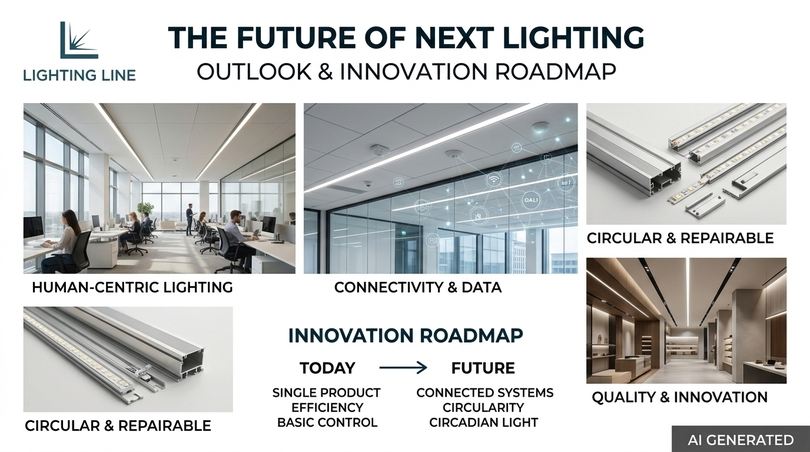
17. Frequently asked questions about next lighting
The following answers summarise the questions most frequently asked by architects, designers, installers, facility managers, retailers, hoteliers and homeowners. Click on each question to open the answer. Each answer is self-contained, so it can be read independently of the rest of the guide.
What is next lighting?Next lighting is the next generation of lighting design, in which light is no longer an object added to a room but a system integrated into the architecture. It combines LED strips housed in aluminium profiles, continuous lines of light, intelligent control and measurable energy performance. In this article the term describes a design approach, not a brand or a retailer. |
Is next lighting a brand or a technology?In this guide next lighting is neither a brand nor a single technology. It is a design philosophy that uses existing and emerging technologies, such as COB LED strips, tunable white, DALI-2 and wireless controls, to integrate light into ceilings, walls, joinery and concrete. Companies and retailers with similar names are not covered here. |
What is the next lighting technology after LED?Technologies such as OLED, laser sources, micro-LED, spectrally tuned sources and Li-Fi are being developed, but none is positioned to replace LED in general architectural lighting in the near term. Most innovation is happening around the LED: better optics, higher colour rendering, smarter control and deeper integration into buildings. |
What are the lighting trends for 2027?The main lighting trends of 2027 are invisible sources and visual purity, light as architecture, layered schemes instead of a single overhead light, warm and tunable white, modular and personalised systems, and honest, durable materials such as anodised aluminium. All of them point towards integrated linear lighting with smart control. |
What lighting is fashionable now?Fashionable lighting today is layered, warm and integrated: concealed coves, trimless ceiling lines, lit shelving and under-cabinet light, combined with a few sculptural pendants or lamps. Dense grids of downlights, cold white light and exposed LED strips without profiles are considered dated. |
What light fixtures are outdated?Single central ceiling lights used as the only source, dense downlight grids, fluorescent battens, exposed LED strips with visible dots, cool white light in living areas and heavy ornate fittings in small rooms are widely considered outdated. Each can be replaced by a layered next lighting solution. |
Are wall lights still fashionable?Yes. Wall lights are increasingly popular because they place light at eye level and create warm, intimate pools of light. Slim linear wall grazers, vertical lines integrated into plaster, picture lights and up-and-down wall profiles are among the strongest wall lighting trends of 2027. |
Should wall lights match ceiling lights?They do not need to be identical, but they should be coherent. Use the same colour temperature throughout a space, coordinate finishes with ceilings and joinery, and keep a clear hierarchy between architectural light and decorative pieces. Mismatched colour temperatures are more disturbing than mismatched shapes. |
Are LED ceiling lights good?LED ceiling lights are good when they offer adequate lumen output, high colour rendering, low glare and compatible dimming. Integrated linear LED in aluminium profiles adds better distribution of light across the room and the ability to replace the strip without changing the ceiling. |
Are LED strip lights dimmable?Yes, architectural LED strips are dimmable, but dimming depends on the driver or controller. Constant-voltage 24 V strips are usually dimmed with PWM controllers driven by wall dimmers, DALI, 0-10 V or wireless systems. Always specify compatible components to avoid flicker. |
How many lumens do I need for a room?Multiply the target illuminance in lux by the area in square metres, then divide by a utilisation factor that accounts for diffuser and room losses. Indicatively, living rooms need about 100 to 200 lux of ambient light, kitchen worktops about 300 to 500 lux and offices 500 lux on the task. Verify professional projects with photometric calculations. |
What colour temperature is best for each room?Use 2700 to 3000 K for living rooms, bedrooms and hotels; 3000 to 4000 K for kitchens and bathrooms; 3500 to 4000 K or tunable white for offices; and 3000 to 4000 K for retail, chosen according to the products displayed. Tunable white from 2700 to 6500 K supports human-centric lighting. |
What is the golden rule of lighting?A widely used golden rule is to light surfaces rather than empty space and to build light in layers: ambient, task, accent and decorative. Lighting walls, shelves and ceilings makes rooms feel brighter and larger with less glare than a single overhead source. |
What is the 5’7″ lighting rule?The 5’7″ or 57-inch rule comes from galleries: the centre of artworks is commonly hung at about 145 cm from the floor, around average eye height. Designers use the same reference to position wall lights, picture lights and accent lines. It is a guideline to adapt to each space, not a regulation. |
What is the best lighting for a living room?The best living room lighting combines indirect ambient light from a cove or recessed ceiling line, accent light in shelves and media walls, and one or two decorative pieces, all dimmable and in warm white around 2700 to 3000 K. Scenes allow the same room to work for reading, entertaining and relaxing. |
What is the best light for a small hallway?Linear light works best in small hallways. A recessed line along one wall or a low-level strip near the floor visually widens the corridor, guides movement at night and avoids the glare of a single ceiling fitting in a narrow space. |
What are good ideas for kitchen lighting?Start with shadow-free, high-CRI task light under wall cabinets in aluminium profiles with diffusers, add ambient light from a ceiling line or cove, then accent light in shelves, glass cabinets and plinths. A pendant over the island adds character. Keep colour temperature consistent across layers. |
How high should a pendant light hang over a table or island?As a practical guideline, the bottom of a pendant usually sits around 75 to 90 cm above a dining table or kitchen island, adjusted for ceiling height, the size of the fitting and sightlines. In circulation areas, ensure comfortable headroom. |
Do I need an electrician to change a light fitting in the UK?In England and Wales, a like-for-like replacement of a light fitting is generally not notifiable under Part P, but it must be carried out safely and in line with BS 7671. New circuits and certain work are notifiable. Integrated LED systems with drivers and controls should be installed by a qualified electrician. Rules differ in other parts of the UK and in other countries. |
Is it illegal to change a light fitting yourself?In the UK it is generally not illegal for a competent person to replace a light fitting like-for-like, provided the work is safe and compliant. Adding new circuits or working in special locations may be notifiable. If you are unsure about isolation, earthing or connections, use a registered electrician. |
How much does it cost to install new lighting?Costs depend on region, access, whether new light points are needed, recessed or trimless installation, control complexity and product quality. Prices change over time, so obtain written quotes from local registered electricians. Planning lighting during renovation, when ceilings are open, reduces cost significantly. |
Why are my ceiling lights not working?Common causes include a failed lamp or LED driver, a tripped breaker or RCD, a faulty switch or a loose connection. If a light has power but will not turn on, the driver is a frequent culprit in LED fittings. Always isolate the supply before inspection and call an electrician if a breaker trips repeatedly. |
Why do LED lights flicker?Flicker is usually caused by incompatible dimmers, failing or undersized drivers, poor connections or voltage drop on long strip runs. Use LED-compatible dimmers, drivers sized with a margin of about 20 percent and multiple feed points on long runs. |
Do light sockets go bad?Yes. Lamp holders can deteriorate through heat, corrosion and loose contacts, particularly in older fittings used with hot halogen or incandescent lamps. Discolouration, crackling or intermittent operation indicate that the holder or fitting should be replaced by a competent person. |
Why does Gen Z dislike overhead lighting?Overhead light flattens faces, casts harsh shadows, feels institutional and looks poor on camera. Younger people prefer lamps, LED strips and indirect light that create mood. Next lighting offers the architectural version of that preference: integrated, diffused and dimmable lines instead of improvised strips. |
How can next lighting improve the energy efficiency of a building?By combining efficient LED sources, optics that direct light where it is needed, correct illuminance without over-lighting, and controls such as occupancy sensing and daylight harvesting. A Lawrence Berkeley National Laboratory meta-analysis found average control savings of about 24 to 38 percent depending on strategy. |
Which protocols are used in next lighting installations?Common protocols include phase-cut dimming, 0-10 V, DALI-2 and D4i, DMX512, KNX, Zigbee, Bluetooth mesh and Matter. DALI-2 is often preferred in commercial buildings for its addressability and interoperability, while wireless mesh systems are popular in renovations and hospitality. |
Can next lighting be integrated with a building management system?Yes. Lighting controls connect to building management systems through gateways such as DALI to BACnet or Modbus, or through KNX. Integration enables central scheduling, energy metering, fault reporting and coordination with HVAC and blinds. |
Which next lighting solutions support green building certifications?Efficient LED with multi-zone dimming, occupancy and daylight controls, high colour rendering, glare control and tunable white support credits in schemes such as LEED, BREEAM and WELL. Always check the current version of the certification manual for the exact requirements. |
Are aluminium LED profiles recyclable?Aluminium is highly recyclable and can be recycled repeatedly without losing its properties. Anodising protects the surface and extends life. Because the LED strip is a separate component, the profile can outlive several light engines, supporting circular-economy goals. |
What is the difference between SMD and COB LED strips?SMD strips use discrete LEDs and may show individual points without a diffuser; they offer high efficiency and many output options. COB strips place many tiny emitters under a continuous phosphor layer, producing a dot-free line with a wide beam, ideal for shallow profiles and visible lines. |
Which aluminium profile should I use for plasterboard ceilings?For a flush, trimless look in plasterboard, use drywall profiles designed with lateral wings to be fixed into the board and finished with skim. They must be installed during board fixing, before plastering, with precise setting-out and adequate void depth. |
Can I get BIM files and photometric data for Lighting Line profiles?Yes. Lighting Line product pages provide downloadable datasheets, photometric tests and BIM files for Revit, and a lux calculation service is available. This allows architects to model, schedule and calculate next lighting within the same BIM workflow used for the building. |
Where can I buy professional LED profiles and strips?For architectural next lighting, choose a specialist supplier offering technical data, BIM files, photometric tests, customisable strips and technical support. The Lighting Line online catalogue offers Italian-designed aluminium profiles and fully customisable LED strips at competitive prices. |
How do I choose the right next lighting solution?Define activities and atmosphere, set light layers and targets, choose the installation type and diffuser, select the LED strip, choose drivers and control protocol, check documentation, plan installation and maintenance, and measure results after commissioning. |
What is the future of next lighting?The future of next lighting lies in human-centric and circadian lighting, interoperable connected control, data-driven buildings, circular and repairable products, and a growing focus on quality of light, including spectral accuracy, low flicker and glare control. |
18. Next lighting is a building decision
Next lighting is the point where efficiency, design and technology finally meet. LED sources made light efficient; aluminium profiles and COB strips made it architectural; digital and wireless control made it intelligent and measurable. Next lighting and LED profiles together form a new grammar of architectural lighting, in which light is drawn into the building rather than hung from it.
For construction companies, the practical lessons are clear. Decide lighting early, at the same time as ceilings, walls and joinery. Treat it as a system with its own drawings, schedules and commissioning. Choose profiles and strips with complete technical documentation and replaceable components. Combine integrated architectural light with a small number of well-chosen decorative pieces. Add controls from the start, and measure the results. Projects built this way look better, consume less, are easier to maintain and remain relevant as technology evolves.
For architects and lighting designers, next lighting offers a palette of lines, planes and contours that can be modelled in BIM and calculated with photometric data. For interior designers, it offers atmosphere and wellbeing through warm, layered, dimmable light. For facility and sustainability managers, it offers measurable savings and data. For retail buyers and hoteliers, it offers experience, identity and lower running costs. For installers and integrators, it offers a growing market for skilled, value-adding work.
The quickest way to start is to look at the products that make next lighting possible. Explore the drywall profiles for trimless lines, the furniture profiles for joinery and shelving, the suspension profiles for offices and tables and the SMD and COB LED strips, then download datasheets, photometric tests and BIM files for your next project. If you need help choosing the right profile, diffuser or strip, the Lighting Line technical team is available to support your specification.
Next lighting is not the future of lighting – it is the present of buildings designed well.
Note: in this article “next lighting” is used as an expression for the next generation of lighting solutions and design approaches. It does not refer to any retailer, brand or company with a similar name, and all trademarks mentioned belong to their respective owners.