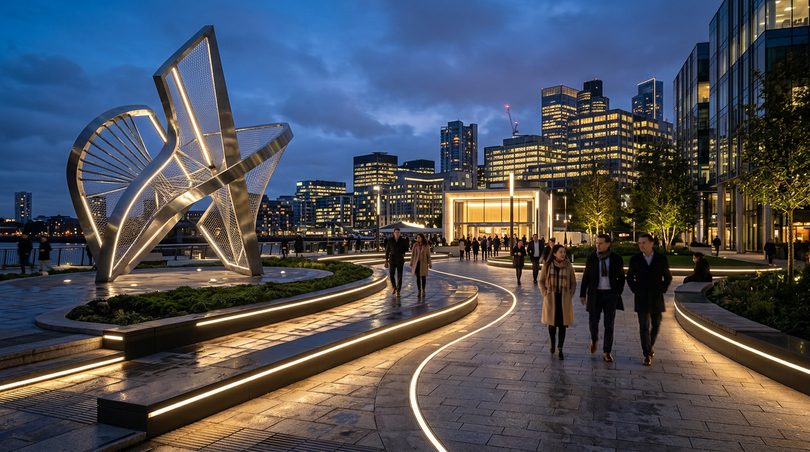
Urban lighting is no longer a purely technical afterthought bolted on once a square, street or public artwork has been built — it is one of the defining design layers of contemporary placemaking. Whether you are a municipal engineer specifying a new lighting master plan, an architect integrating linear light into a public sculpture, or a maintenance manager trying to reduce energy spend, the choices you make about fixtures, profiles, LED strips, controls and permits will determine how safe, memorable and sustainable a public space feels for decades. This guide walks through every stage of specifying urban lighting, from the underlying design principles and regulatory framework to the hands-on workmanship of cutting, joining and wiring aluminium profiles and LED strips correctly.
In this article…
- Introduction to urban lighting in public art and placemaking
- Types of urban lighting systems
- LED aluminium profiles for urban and architectural installations
- How to cut, join and connect profiles and LED strips correctly
- Design and planning of urban lighting
- Regulations, standards and permissions
- Environmental impact and sustainability
- Smart lighting, IoT and recent innovations
- Market data and statistics
- What different professionals need from urban lighting
- Challenges and future trends
- Frequently asked questions
- Conclusions
Introduction to urban lighting in public art and placemaking
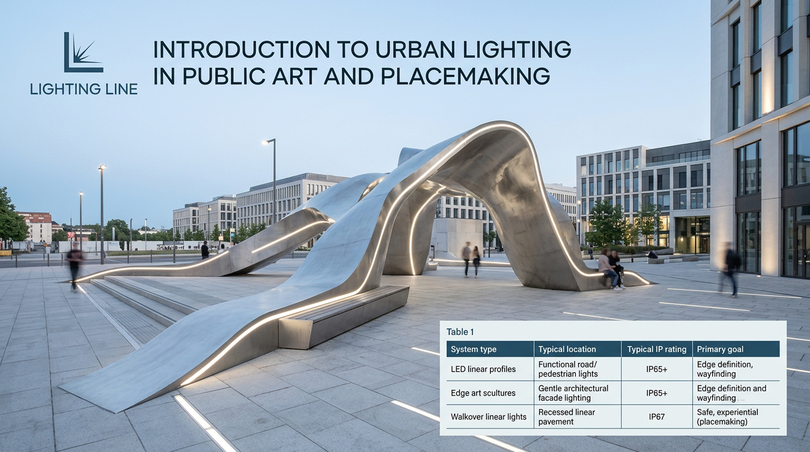
Every successful public space after dark is, in effect, a lighting design decision made visible. Urban lighting covers the full spectrum of fixed and architectural lighting used outdoors in cities: road and pedestrian illumination, façade and monument lighting, linear LED profile lighting embedded into benches, steps and sculptures, and the decorative layer that turns a plain plaza into a destination. Understanding what is urban lighting in practice means recognising that it operates on two levels simultaneously: a purely functional layer (so people can see and be seen safely) and an experiential layer (so a place has character, warmth and identity once the sun goes down).
The scope of urban lighting has expanded considerably in the last decade. Where once a city’s lighting department was concerned almost exclusively with lamp-post spacing and lux levels on carriageways, today’s briefs routinely include dynamic colour-changing installations for festivals, dimmable linear light embedded in public art, and sensor-driven networks that report back energy use in real time. This shift is why so many urban planners, landscape architects and public works managers are searching for guidance not just on fixtures, but on the underlying profiles, strips and connectors that make flexible, low-profile lighting possible in public realm projects.
At LightingLine.eu, the full lighting catalogue is built around exactly this need: robust, weather-rated LED aluminium profiles and high-output LED strips designed to survive years of outdoor exposure while remaining easy for contractors to cut, join and commission on site. The rest of this guide explains how to specify, install and maintain these systems correctly, and how they fit into the wider regulatory and design context of urban lighting for public art and placemaking.
Why urban lighting matters for safety, aesthetics and function
The scope of public lighting can be grouped into three overlapping categories: safety (reducing accidents and crime through adequate visibility), aesthetics (celebrating architecture, public art and green space at night), and function (enabling extended use of streets, parks and transit corridors after dark). A well-lit crossing reduces pedestrian collision risk, a well-lit park extends the hours residents feel comfortable using it, a well-lit sculpture or fountain becomes a genuine nighttime attraction rather than a dark silhouette. These three goals are rarely in conflict when the lighting design is done properly, but they do require different photometric approaches, which is why urban lighting solutions increasingly combine several fixture types rather than relying on a single lamp standard for an entire district.
Types of urban lighting systems
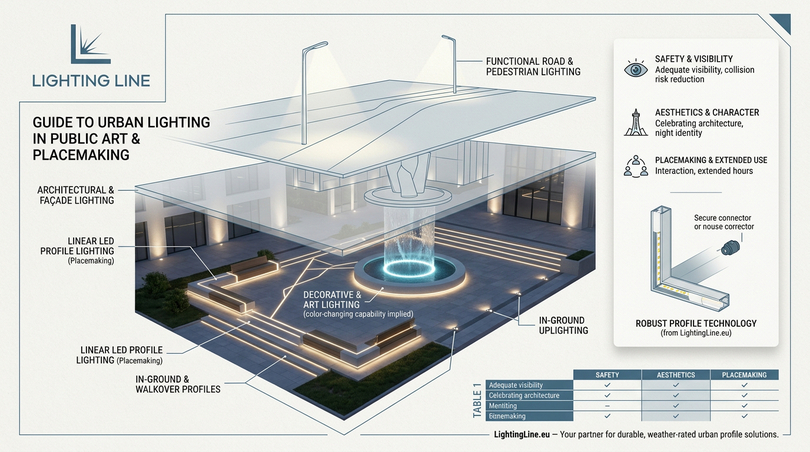
Before specifying any single product, it helps to map out the full family of systems that fall under the umbrella of urban and urban industrial lighting. Each type answers a different question such as how far does the light need to throw, how close will people get to the fixture, and does it need to survive being walked on, rained on or driven over.
Functional road and pedestrian lighting
This is the most familiar category: pole-mounted luminaires spaced along roads, cycle paths and footways to deliver a minimum average illuminance and uniformity ratio, as defined by standards such as EN 13201 in Europe. Traditionally based on high-pressure sodium or metal halide lamps, this layer has moved almost entirely to LED over the past ten years because of the dramatic gains in sustainable lighting and controllability.
Architectural and façade lighting
Uplights, downlights, wall-washers and linear grazing fixtures used to highlight the texture and form of buildings, bridges, monuments and public art. This is where industrial lighting ceiling systems and exposed structural fixtures are often reinterpreted for outdoor civic use: visible conduit, cage guards and Edison-style lamps borrowed from vintage industrial lighting UK aesthetics are increasingly popular for markets, waterfronts and regenerated industrial quarters seeking an authentic, characterful night identity.
Linear LED profile lighting
Perhaps the fastest-growing category in placemaking projects, linear LED profile lighting uses an aluminium extrusion (the profile) to house, protect and diffuse a flexible LED strip. Profiles can be recessed into paving, embedded into handrails and bench seating, mounted along the underside of canopies, or run continuously around the base of a sculpture to create a glowing edge. Because the light source is fully enclosed and diffused, profiles deliver a clean, glare-free line of light that is far more resistant to vandalism and weather than an exposed strip, which is why they have become the default choice for urban lighting ceiling and edge-lighting applications in civic schemes.
In-ground and walkover lighting
IP67/IP68-rated in-ground uplights and load-rated walkover profiles are used to illuminate trees, façades and public art from below, or to mark the edges of steps, ramps and plazas. These fixtures must tolerate standing water, de-icing salt and, in walkover applications, the weight of pedestrian and even light vehicle traffic.
Decorative, festive and placemaking lighting
Colour-changing RGB and RGBW strips, chase-effect linear light and programmable installations used for festivals, seasonal events and permanent art pieces. This is where the creative and technical sides of urban lighting meet most directly: the LED strip itself is a commodity, but the profile, diffuser and control system determine whether the finished installation looks premium or looks like an afterthought.
| System type | Typical location | Typical IP rating | Primary goal |
|---|---|---|---|
| Road / pedestrian lighting | Streets, cycle paths, footways | IP65+ | Safety, uniformity |
| Architectural / façade lighting | Buildings, bridges, monuments | IP65+ | Aesthetics, identity |
| Linear LED profile lighting | Benches, steps, sculptures, canopies | IP65–IP67 | Edge definition, placemaking |
| In-ground / walkover lighting | Plazas, tree pits, ramps | IP67–IP68 | Uplighting, wayfinding |
| Decorative / festive lighting | Markets, festivals, public art | IP65+ | Events, seasonal identity |
LED aluminium profiles for urban and architectural installations
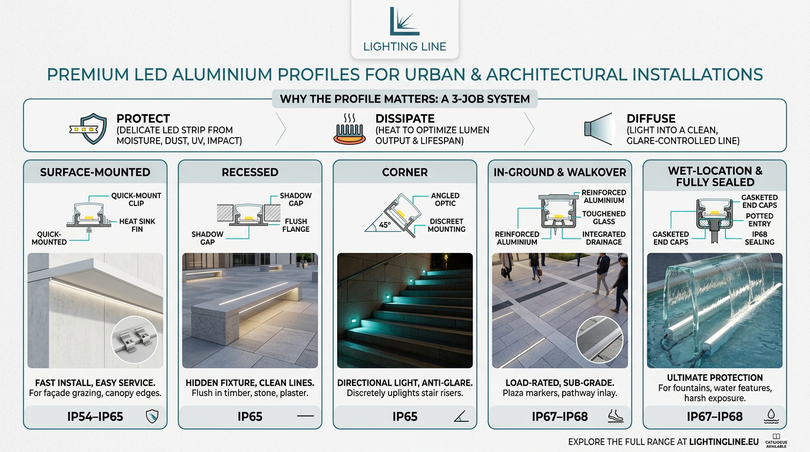
The profile is arguably the single most under-appreciated component in an urban LED lighting scheme, yet it is what separates a professional, durable installation from one that fails within a season. A profile does three jobs at once: it protects the delicate LED strip from moisture, dust, UV and mechanical impact; it dissipates heat away from the LEDs to protect lumen output and lifespan and it diffuses the light output into a clean, glare-controlled line rather than a row of visible dots. The full range of profiles suited to public realm work is available in the LED profiles section of the LightingLine.eu catalogue, alongside compatible diffusers, end caps and mounting clips.
Surface-mounted profiles
Fixed directly to a wall, soffit, handrail or the underside of a canopy using screws or adhesive mounting clips. These are the fastest to install and the easiest to service, making them the default choice for façade grazing and canopy edge lighting in civic schemes. Browse the surface-mounted profile range for options rated for outdoor use.
Recessed profiles
Set flush into a groove routed into timber decking, stone benches or plasterboard soffits, recessed profiles produce a shadow-gap effect that hides the fixture almost entirely, leaving only a thin line of light visible. This is a favourite technique for lighting the edges of public seating and low walls without any visible hardware. See the recessed profile collection.
Corner profiles
Angled at 30, 45 or 60 degrees, corner profiles are used to graze a vertical surface from a discreet position along its edge, or to uplight the risers of steps without the fixture being visible from a standing eye height: an important safety and aesthetic detail on public staircases. Explore the corner profile range.
In-ground and walkover profiles
Built with toughened, slip-resistant glass or polycarbonate covers and load ratings suitable for pedestrian and, in reinforced versions, light vehicle traffic, in-ground profiles are used to create glowing pathway markers, plaza borders and tree-pit uplighting rings. Because these units sit permanently below grade and are exposed to standing water and de-icing salt, IP67 or anodised aluminium are essential specification points. See the in-ground and walkover profile collection.
Wet-location and fully sealed profiles
For fountains, water features and any installation permanently exposed to rain or spray, fully sealed profiles with gasketed end caps and potted cable entries are required to maintain an IP67 rating over the long term. These are also the correct choice for any urban barn lighting or agricultural-adjacent public realm project where washdown or heavy weather exposure is expected. Browse outdoor and wet-location profiles.
| Application | Recommended profile type | Minimum IP rating |
|---|---|---|
| Canopy / soffit edge lighting | Surface-mounted | IP54–IP65 |
| Bench and seating edge | Recessed | IP65 |
| Step riser / staircase uplighting | Corner | IP65 |
| Plaza / pathway inlay | In-ground / walkover | IP67–IP68 |
| Fountains and water features | Wet-location sealed | IP67–IP68 |
How to cut, join and connect profiles and LED strips correctly
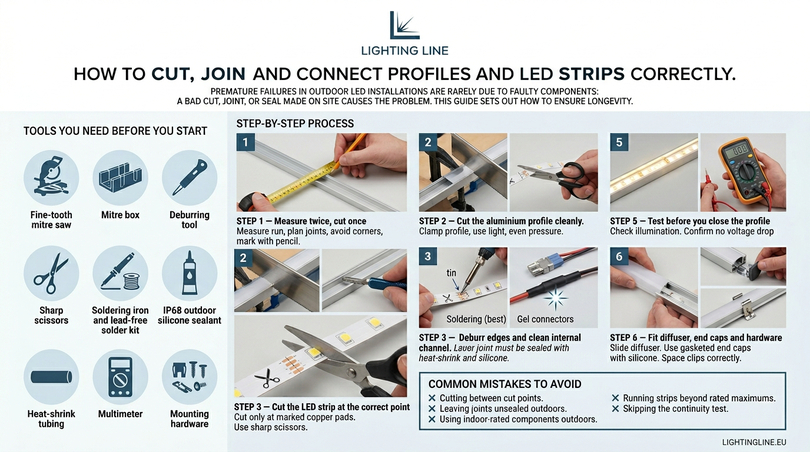
Most premature failures in urban LED installations are not caused by a faulty component: they are caused by a bad cut, a bad joint or a bad seal made on site. This section sets out, step by step, how to work with aluminium profiles and LED strips so that the finished installation performs as well after five years outdoors as it did on day one.
Tools you need before you start
- A fine-tooth mitre saw or dedicated aluminium profile cutter (a hacksaw with a 32-teeth-per-inch blade is an acceptable manual alternative for short runs)
- A mitre box or cutting jig to guarantee a square, repeatable cut
- A deburring tool or fine file to remove sharp edges and swarf from the cut end
- Sharp scissors rated for cutting LED strip only along the marked copper cut-points
- A soldering iron (low-wattage, fine tip) and lead-free solder, or strip-to-strip / strip-to-wire clip connectors rated for outdoor use
- Heat-shrink tubing or IP68 outdoor silicone sealant for every exposed joint
- A multimeter to test continuity and voltage before final closure of any joint
- Mounting clips, screws or adhesive tape rated for the substrate and outdoor exposure
Step 1 — Measure twice, cut once
Measure the finished run length including any end caps and connector allowances, then mark the profile with a fine pencil or scribe rather than a marker pen, which can smear. For runs longer than a single standard profile length (usually 1 m, 2 m or 3 m), plan the joint positions before cutting so that connectors land on straight sections rather than directly at a corner.
Step 2 — Cut the aluminium profile cleanly
Always cut the aluminium profile before cutting the LED strip that will sit inside it. Clamp the profile securely in the mitre box to prevent vibration, which is the most common cause of a ragged, uneven cut. Use light, even pressure and let the blade do the work — forcing the cut will bend the thin extrusion walls, especially on shallow or corner profiles. After cutting, run a deburring tool or fine file along both the cut edge and the internal channel to remove any burrs that could puncture the strip’s adhesive backing or scratch the diffuser during insertion.
Step 3 — Cut the LED strip at the correct point
Every LED strip has marked cut points, usually indicated by a printed scissor icon or a copper pad, spaced at fixed intervals (commonly every 3, 5 or 10 cm depending on strip density). Cutting anywhere other than the marked cut point will damage the circuit and can leave that entire segment, or the rest of the reel, non-functional. Use sharp, clean scissors and cut in a single motion directly through the centre of the marked line to leave enough exposed copper pad on both sides of the cut for a reliable connection.
Step 4 — Join strip sections correctly
There are three acceptable ways to join two strip sections or a strip to a power lead, in order of reliability for outdoor public realm work:
- Soldering — the most durable method for permanent outdoor installations. Tin the copper pad lightly, tack the wire in place, and avoid excess heat dwell time, which can lift the pad from the strip’s flexible substrate.
- Crimp or clamp connectors — fast and tool-free, suitable for accessible indoor runs or temporary event installations, but less reliable outdoors unless the connector itself is fully potted or gasketed and rated IP65 or higher.
- Solderless clip connectors with gel-filled outdoor housings — a good compromise for site conditions where soldering is impractical, provided the connector is specifically rated for outdoor / wet-location use.
Whichever method is used, every outdoor joint must be sealed after connection with adhesive-lined heat-shrink tubing or a bead of IP68-rated silicone sealant, fully encapsulating the copper pads and the first few millimetres of insulated cable. An unsealed joint is the single most common cause of corrosion-related failure and intermittent flicker in outdoor linear lighting within the first year of operation.
Step 5 — Test before you close the profile
Before fitting the diffuser and end caps, power the run briefly and check for full, even illumination along its entire length, and use a multimeter to confirm there is no unexpected voltage drop at the far end of long runs (a symptom of undersized cable or too many strip segments daisy-chained from a single driver). Correcting a fault now takes minutes; correcting it after the profile is sealed, mounted and grouted into paving can mean re-excavating an entire section of plaza.
Step 6 — Fit the diffuser, end caps and mounting hardware
Slide the diffuser lens into the profile channel from one end — forcing it in from the top can scratch the internal reflective surface. Fit gasketed end caps to any outdoor or in-ground profile, applying a thin bead of silicone around the cap’s perimeter before pressing it into place. Finally, secure the profile to its substrate using the manufacturer’s specified clip spacing; under-supporting a profile is a common cause of sagging and eventual diffuser cracking on long architectural runs.
Common mistakes to avoid
- Cutting the LED strip between cut points rather than exactly on the marked line
- Leaving a soldered or clipped joint unsealed in an outdoor or in-ground application
- Using indoor-rated connectors or drivers in a location exposed to rain, spray or ground moisture
- Running strip lengths beyond the driver’s or strip’s rated maximum run without voltage-drop compensation or mid-run power injection
- Skipping the continuity test before sealing a profile permanently into paving or joinery
Design and planning of urban lighting
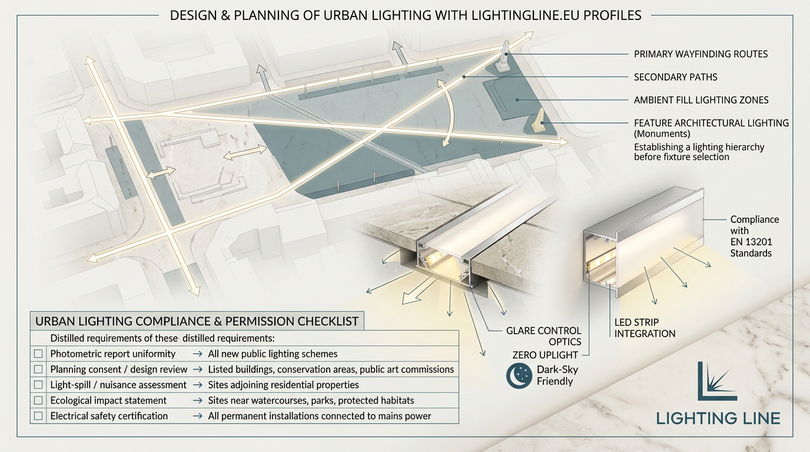
Lighting design planning starts long before any fixture is selected. A well-run design process maps the space’s uses at different times of day and night, identifies the architectural or artistic features worth highlighting, and sets a lighting hierarchy so that the most important elements (a monument, a main pedestrian route, a public artwork) receive proportionally more visual emphasis than secondary areas.
Establishing a lighting hierarchy
Good public lighting design avoids the trap of lighting everything to the same brightness, which flattens a space and increases both energy use and light pollution. Instead, designers typically define three or four brightness tiers: primary wayfinding routes, secondary paths, ambient fill light, and accent or feature lighting on art and architecture, each calibrated relative to the others.
Light distribution and glare control
The distribution of light (how light spreads from a fixture) determines both usability and comfort. Full cut-off and semi cut-off optics direct light downward onto the intended surface rather than sideways into windows or upward into the sky, reducing glare for pedestrians and drivers while also cutting light pollution.
Minimising light pollution
Excessive uplight (light that escapes above the horizontal plane) is the primary driver of sky glow, which obscures stars, disrupts nocturnal wildlife and wastes energy that serves no functional purpose. Best practice for urban lighting in placemaking projects includes selecting fixtures with a zero or near-zero upward light output ratio (ULOR), using warmer colour temperatures (2700K–3000K) in ecologically sensitive areas, and applying timers or dimming so that decorative and accent lighting reduces intensity during the latest, quietest hours of the night.
Regulations, standards and permissions
Any public lighting scheme (whether it is a full street relighting programme or a single illuminated art installation in a square) sits within a framework of technical standards, planning permissions and, in many cases, heritage or environmental consultation. Getting this sequence wrong is one of the most common causes of delayed or rejected placemaking projects.
Technical standards
In Europe, road and pedestrian lighting is generally governed by the EN 13201 series, which sets minimum illuminance, uniformity and glare limits by road and area class. Electrical safety of luminaires and drivers falls under the EN 60598 family, while ingress protection ratings (IP codes) are defined by IEC 60529 and determine which fixtures are suitable for exposed, in-ground or wet-location use.
Planning permissions and consultation
Permanent lighting installed on or near listed buildings, in conservation areas, or as part of a public art commission typically requires planning consent from the local authority, and in many jurisdictions a separate heritage or design-review sign-off if the site has protected status. Applications generally need to demonstrate photometric calculations, fixture specifications and cut-sheets, a light-spill assessment for neighbouring properties, and (increasingly) an ecological impact statement covering effects on bats, birds and other nocturnal species where the site is near a watercourse, park or protected habitat.
Dark-sky and environmental compliance
A growing number of municipalities have adopted dark-sky-friendly lighting policies, requiring full cut-off fixtures, capped colour temperatures and curfew dimming schedules for new public lighting schemes. Specifying compliant fixtures from the outset avoids costly retrofits once a scheme is already installed and commissioned.
| Requirement | Typically required for |
|---|---|
| Photometric report (illuminance, uniformity, glare) | All new public lighting schemes |
| Planning consent / design review | Listed buildings, conservation areas, public art commissions |
| Light-spill / nuisance assessment | Sites adjoining residential properties |
| Ecological impact statement | Sites near watercourses, parks, protected habitats |
| Electrical safety certification | All permanent installations connected to mains power |
| Structural / load assessment | Walkover, in-ground and pole-mounted fixtures |
Environmental impact and sustainability
The environmental case for upgrading legacy urban lighting to modern LED systems is now well established, but sustainability in placemaking projects extends beyond the light source itself to the whole lifecycle of the installation.
Energy and carbon reduction
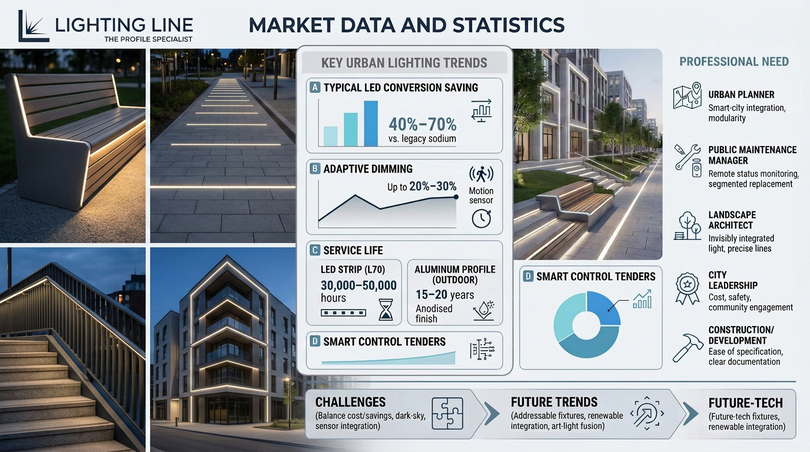
Reducing energy consumption from LED conversion typically ranges from 40% to 70% compared with sodium-vapour or metal-halide fixtures, and rises further when paired with dimming, daylight sensing and scheduled curfews. For municipalities, this directly reduces both operating cost and the carbon footprint of public infrastructure.
Material longevity and circularity
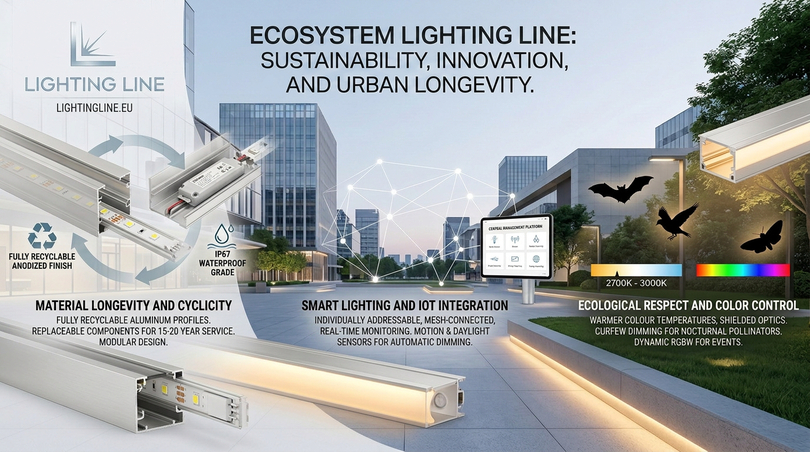
Aluminium profiles are fully recyclable and, when specified with a marine-grade or anodised finish, can remain in service for 15–20 years outdoors — far longer than the LED strip or driver they house, both of which are designed to be replaced independently without disturbing the surrounding paving, joinery or artwork. This modularity is a genuine sustainability advantage of profile-based systems over sealed, non-serviceable fixtures.
Ecological considerations
Warmer colour temperatures, shielded optics and curfew dimming reduce disruption to nocturnal pollinators, bats and migratory birds, an increasingly important consideration in environmental impact assessments for public realm and park-adjacent lighting schemes.
Smart lighting, IoT and recent innovations
Remote lighting control and smart city integration have moved from pilot projects to mainstream specification in the space of a few years. A modern urban lighting network typically includes individually addressable fixtures, wireless mesh or cellular connectivity, and a central management platform that reports energy use, faults and dimming schedules in real time.
Urban lighting sensors
Motion, daylight and occupancy sensors allow lighting to dim to a low standby level and brighten automatically as a pedestrian or vehicle approaches, cutting energy use on quiet routes without compromising safety when the space is in use.
Integration with smart city platforms
Increasingly, lighting poles and profile-mounted fixtures double as infrastructure for air-quality sensors, Wi-Fi access points and traffic-counting cameras, turning what used to be a single-purpose asset into a multi-service node within a broader IoT e smart city network.
Dynamic and addressable colour control
Individually addressable RGB and RGBW LED strips allow a single linear run to display gradients, chase effects or synchronised colour changes for events, while reverting to a calm, warm-white ambient setting for everyday use: a flexibility that static fixtures cannot match and that is particularly valuable for public art installations designed to change character for festivals or civic occasions.
Market data and statistics
Market sizing and technology-adoption data help planners and procurement teams benchmark their own schemes against wider industry trends, and build a stronger business case for investment in modern urban lighting infrastructure.
| Metric | Indicative figure |
|---|---|
| Typical energy saving from LED street lighting conversion | 40%–70% vs. legacy sodium-vapour lighting |
| Additional saving from adaptive dimming / sensors | Up to a further 20%–30% |
| Typical LED driver and strip service life | 30,000–50,000 hours to L70 lumen maintenance |
| Typical aluminium profile service life outdoors | 15–20 years with anodised or marine-grade finish |
| Share of new municipal lighting tenders specifying smart controls | Rising sharply year on year across major EU cities |
These figures are indicative industry benchmarks intended to support planning and business-case discussions; project-specific photometric and energy modelling should always be carried out for formal tender or planning submissions.
What different professionals need from urban lighting
Public realm lighting projects bring together a wide range of stakeholders, each approaching the same installation from a different professional angle. Recognising these perspectives helps produce a brief that satisfies safety, budget, aesthetics and long-term operability at the same time.
Urban planners
Urban planners are typically focused on integrating lighting with wider smart-city infrastructure, reducing installation and lifecycle cost, and staying ahead of evolving regulation. LED profile systems support this by being modular, individually serviceable and compatible with sensor and control retrofits without full replacement of the installed base.
Public maintenance managers
For maintenance teams, the priority is long-term reliability and the ability to monitor fixture status remotely rather than relying on manual night-time patrols. Networked drivers that report faults automatically, combined with profiles that allow a failed strip segment to be swapped without disturbing the surrounding structure, directly reduce both labour cost and response time.
Landscape architects
Landscape architects generally want lighting that disappears into the design by day and reveals architectural or planting detail by night. Recessed and corner profiles, in particular, allow a light source to be almost invisible in daylight while producing a precise, glare-free line of light after dark: a combination that is difficult to achieve with surface-mounted luminaires alone.
City leadership and public officials
Elected officials and city leadership are usually balancing cost, safety outcomes and community engagement. Phased LED and smart-control rollouts, supported by clear before-and-after energy and safety data, tend to build the strongest public and budgetary case for continued investment.
Construction and development businesses
For contractors and developers, ease of specification, availability of pre-configured kits, and clear installation documentation reduce both project risk and the cost of training site teams: one of the reasons standardised, well-documented profile and strip systems are increasingly preferred over bespoke, one-off fixture designs.
Challenges and future trends
The urban lighting sector continues to face a familiar set of tensions: balancing capital cost against long-term savings, meeting rising expectations for dark-sky compliance while still delivering adequate safety lighting, and integrating an ever-growing number of sensors and connected devices without creating a maintenance burden that offsets the efficiency gains.
Looking ahead, the clearest trends are the continued shift toward fully addressable, individually monitored fixtures, the use of renewable-powered lighting (solar and small-scale wind) for off-grid or low-infrastructure locations such as parks and rural connector routes, and closer integration between lighting design and public art commissioning, so that illumination is considered a core creative material from the earliest concept stage rather than added afterward as a technical layer.
Frequently asked questions
| Question |
|---|
What is urban lighting?Urban lighting is the combined network of street, architectural, in-ground and decorative lighting systems used to illuminate streets, squares, parks and public art for safety, wayfinding and placemaking. |
What is street lighting?Street lighting is the functional subset of urban lighting dedicated to roads, footpaths and cycle lanes, designed to meet minimum illuminance and uniformity standards for road safety. |
Is street lighting a public or a private good?Public street lighting is generally a public good funded and maintained by local authorities. Lighting within private developments or business districts can instead be privately owned and maintained. |
What are the different types of urban lighting?The main types are functional road and pedestrian lighting, architectural and façade lighting, linear LED profile lighting, in-ground and walkover lighting, and decorative or event lighting. |
Why is lighting important in public spaces?It improves safety and reduces crime, extends the hours a space can be used, supports local commerce, and shapes the character and identity of a place after dark. |
What is the most efficient street lighting available today?LED lighting combined with adaptive dimming, motion sensors and daylight sensing is currently the most energy-efficient street lighting technology available. |
When did gas street lighting end?Most European cities phased out gas street lighting between the 1930s and 1950s in favour of electric lighting, though a small number of heritage gas lamps remain in preserved historic districts. |
Who is responsible for street lighting?Local municipalities or regional highway authorities are typically responsible for public street lighting, while private developments manage their own lighting. |
How do you cut and join LED aluminium profiles correctly?Cut the profile with a fine-tooth mitre saw, deburr the edges, cut the LED strip only at its marked cut points, join sections by soldering or with outdoor-rated connectors, and seal every joint with heat-shrink or IP68 silicone before closing the profile. |
What is the importance of urban lighting in placemaking?It is used deliberately to highlight architecture and public art, define pedestrian routes, build a sense of identity and safety after dark, and encourage people to gather and return to a public space. |
Specifying urban lighting that works: the interplay of compliance, creativity, and craft
Specifyingurban lighting for public art and placemaking successfully means treating three layers as equally important: the regulatory and permissions framework, the design intent that shapes how a place feels at night, and the hands-on workmanship of cutting, joining and sealing the profiles and LED strips that actually deliver the light. Get the workmanship wrong, and even the most carefully designed and permitted scheme will fail within a season: get the design and permissions wrong, and even the best-built installation will never be approved or will disappoint once installed. The full range of profiles, strips, connectors and diffusers referenced throughout this guide is available in the LightingLine.eu catalogue, along with technical datasheets to support photometric and compliance submissions.
This article was developed with the support of artificial intelligence and subsequently reviewed, corrected, and validated by the LightingLine.eu technical team, which guarantees its reliability and compliance with official sources.