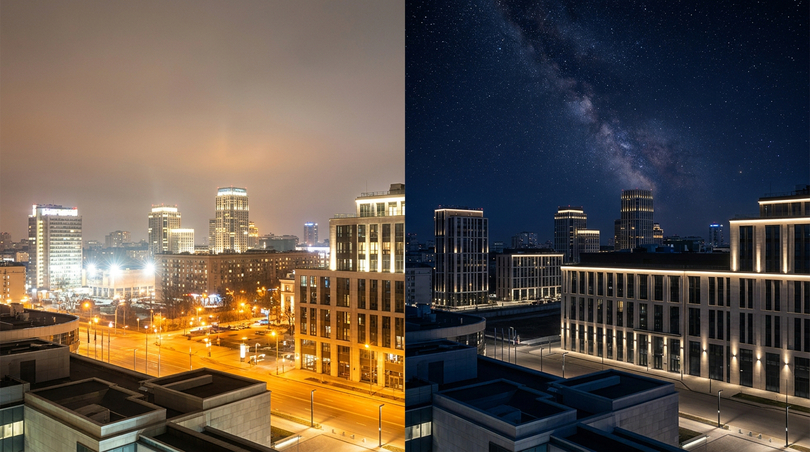
Every night, the sky above our cities loses a little more of its natural darkness. Lighting pollution is no longer a marginal concern discussed only by astronomers: it is a measurable, growing environmental issue that touches urban planning, public health, biodiversity, energy policy, and the everyday design decisions made by lighting manufacturers, architects, and installers. This article was written for professionals and curious readers who want more than a dictionary definition: it walks through the science, the regulations, the data, and, very concretely, the technical practice of specifying, cutting, and joining LED aluminium profiles so that light goes exactly where it is needed and nowhere else. Because good lighting design, not less lighting, is the real antidote to lighting pollution.
Throughout the guide you will find direct references to the aluminium profile catalogue and the LED strip catalogue of Lighting Line, because the choice of profile — surface, recessed, corner, wall, concrete, suspension, drywall, or round — is one of the single most effective ways to control glare, light trespass, and upward waste light at the source.
In this article…
- What is light pollution? A precise definition
- The four types of light pollution
- Causes of light pollution: where does it come from?
- Effects of light pollution on health, wildlife and astronomy
- Light pollution statistics and market data
- Light pollution laws and regulations
- Solutions: how good lighting design reduces light pollution
- Working with LED profiles: cutting, joining, and specifying correctly
- A guide for every professional: urban planners, researchers, lighting companies, influencers and interior designers
- Dark sky places and success stories
- Frequently asked questions
- Conclusion
What is lighting pollution?
Light pollution (or lighting pollution) is defined by the International Dark-Sky Association and the scientific community as the inappropriate or excessive use of artificial outdoor light. It is not simply “too much light”: it is light that is misdirected, unshielded, poorly timed, or of the wrong spectral composition for its purpose. What is light pollution, in practical terms? It is the orange-white dome visible over every city at night, the floodlight that shines straight into a bedroom window three streets away, the car park lit like a stadium at 3 a.m. with nobody in it.
Light pollution behaves like any other form of environmental pollution: it is a by-product of a useful technology (artificial lighting) that, when badly designed or badly installed, escapes its intended target and produces measurable harm. Just as air pollution is unwanted particulate matter in the atmosphere, light pollution is unwanted photons in the atmosphere and on surfaces where light was never needed.
Lighting pollution essay: why the definition matters for design
Framing light pollution correctly changes how a lighting specifier, an urban planner, or a product manufacturer approaches a project. If the problem is treated as “not enough light,” the industry answer is always more lumens. If it is treated, correctly, as badly directed light, the answer becomes better optics, shielding, correlated colour temperature, and control systems. This second framing is exactly the philosophy behind properly engineered LED profiles: an enclosed aluminium channel with a diffuser or optic controls the beam angle and cut-off in a way that a bare LED strip glued to a shelf never can.
The four types of light pollution
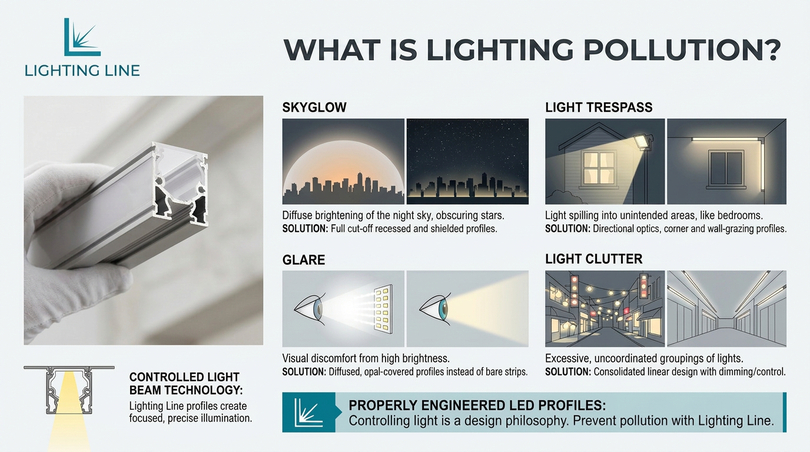
Understanding types of light pollution is the first practical step toward reducing it, because each type requires a different technical fix. The scientific literature and dark-sky organisations consistently identify four categories.
Skyglow
Skyglow is the diffuse brightening of the night sky over inhabited areas, caused by artificial light scattering off particles and molecules in the atmosphere and reflecting back down. It is what makes the Milky Way invisible from most European and North American cities and is the type of light pollution most associated with astronomy and dark sky preservation.
Light trespass
Light trespass occurs when light spills beyond the boundary of the property or area it is meant to illuminate: for example, a neighbour’s security light shining into a bedroom, or a car park floodlight illuminating a residential garden. This is the type of pollution most often behind the question, “can you complain about a neighbour’s light?” and in most jurisdictions you generally can, through environmental health or nuisance legislation.
Glare
Glare is excessive brightness that causes visual discomfort or reduces visibility: paradoxically, badly designed safety lighting with strong glare can make streets and car parks less safe, not more, because it blinds the eye and creates deep shadows immediately around the light source.
Light clutter
Light clutter refers to a confusing or excessive grouping of light sources, common in commercial strips, motorway junctions, and dense urban signage. It increases energy waste and can even interfere with aviation and driver attention.
| Type | Main mechanism | Typical LED profile fix |
|---|---|---|
| Skyglow | Uplight scattered by the atmosphere | Full cut-off recessed and shielded surface profiles |
| Light trespass | Light spilling past the target area | Directional optics, corner and wall-grazing profiles |
| Glare | Unshielded, high-brightness point source | Diffused or opal-cover profiles instead of bare strips |
| Light clutter | Excessive, uncoordinated fixtures | Consolidated linear lighting design with dimming/control |
Causes of light pollution: where does it come from?
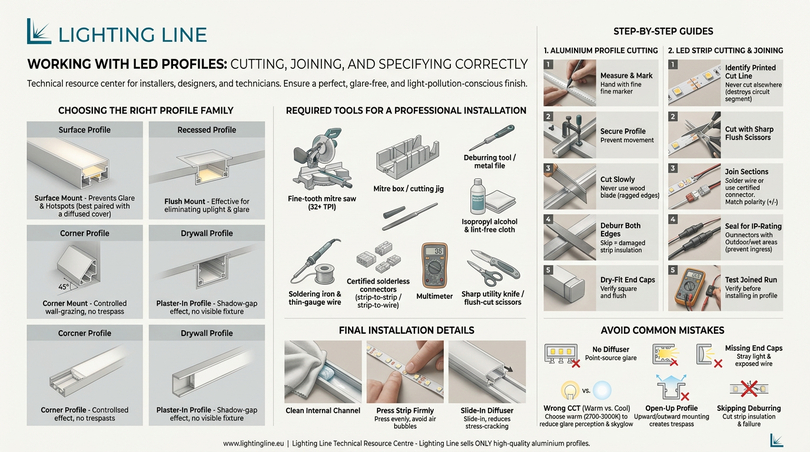
The causes of light pollution are rarely a single bad actor because they are the cumulative result of millions of individually small decisions: a shop that leaves its sign lit all night, a homeowner who installs an unshielded floodlight, a municipality that replaces sodium lamps with brighter, bluer LEDs without adjusting the optics. Below are the main contributing factors recognised by researchers and dark-sky advocates.
Excessive public and commercial illumination
Street lighting, car parks, advertising, and building façades represent the largest single source of outdoor artificial light. Public lighting is often over-specified “for safety,” using far higher lumen output than is actually required by the relevant lighting class of the road or area.
Poorly shielded fixtures
A fixture that emits light above the horizontal plane (uplight) contributes directly to skyglow with zero benefit to the intended task. Un-shielded and unfiltered fixtures are consistently the single largest preventable cause of light pollution, according to dark-sky research bodies, because the same illumination on the ground can be achieved with a shielded fixture at a fraction of the wasted light.
The shift to blue-rich LED lighting
The transition from sodium-vapour to LED street lighting has cut energy consumption, but many early-generation LEDs used a cool white spectrum rich in blue wavelengths, which scatters more in the atmosphere and is more disruptive to circadian biology than warmer light. This is a key, if counter-intuitive, cause: LED lighting can reduce light pollution dramatically if specified with a warm colour temperature and good optics, or increase it if specified badly.
Decorative, security and advertising lighting
Illuminated signage, architectural up-lighting of building façades, and residential security floodlights that stay on all night are a fast-growing category, especially as LED cost has fallen and made “always-on” decorative lighting affordable to nearly everyone.
Absence of curfews and dimming controls
Many causes are not about the fixture at all but about scheduling: lighting that runs at full output all night, with no dimming after midnight and no motion-triggered switching, wastes light and energy for no operational benefit.
Effects of light pollution on health, wildlife and astronomy
The effects of light pollution extend well beyond a washed-out night sky. Peer-reviewed research over the last two decades has documented measurable impacts across at least four domains: human health, wildlife and ecosystems, energy consumption, and scientific/cultural loss. T
Effects on human health
Artificial light at night, and blue-rich light in particular, suppresses the secretion of melatonin, the hormone that regulates the sleep-wake cycle. Disrupted circadian rhythm from night-time light exposure has been associated in multiple studies with poorer sleep quality, and researchers continue to investigate links to broader metabolic and mood effects. For city residents, chronic exposure to street lighting and light trespass through bedroom windows is a a quantifiable, addressable source of this exposure — one that better-shielded, warmer-temperature fixtures can directly reduce.
Effects on wildlife and ecosystems
Nocturnal and migratory species evolved over millions of years with the night sky as a stable reference point. Artificial light disrupts:
- Bird migration: migratory birds navigate partly by starlight and the Earth’s magnetic field; bright urban skyglow disorients them, contributing to fatal building collisions.
- Sea turtle hatchlings: newly hatched turtles instinctively move toward the brightest horizon, historically the reflection of moonlight on the sea; coastal artificial lighting draws them inland instead, with lethal consequences.
- Insect populations: nocturnal insects are drawn to artificial light sources, disrupting pollination cycles and feeding predator-prey balance, with cascading effects up the food chain.
- Plant physiology: artificial light at night can alter the flowering and leaf-drop timing of trees and plants near street lighting.
Effects on astronomy and cultural heritage
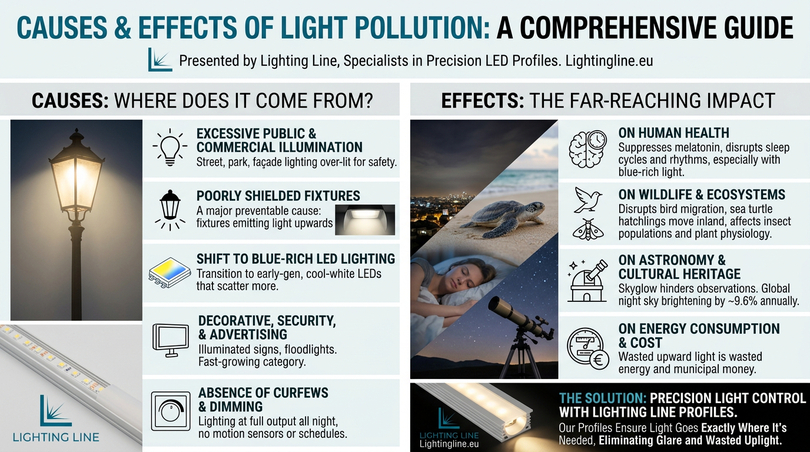
For professional and amateur astronomers alike, skyglow is the single greatest obstacle to ground-based observation. Recent citizen-science research is unambiguous on the pace of the problem: a large-scale study using more than fifty thousand naked-eye observations collected between 2011 and 2022 found that the night sky brightened by an average of roughly 9.6% per year globally, with North America increasing faster (around 10.4% a year) than Europe (around 6.5% a year): a compounding rate that can double sky brightness in less than a decade. Independent satellite-based analysis has separately estimated that artificial lighting brightened the Earth’s surface by around 16% between 2014 and the early 2020s, even though satellite sensors under-detect the blue-rich light emitted by most modern LEDs, meaning the true increase experienced by the human eye is likely higher still.
Effects on energy consumption and cost
Every photon that travels upward into the sky instead of onto the pavement it was meant to illuminate is, by definition, wasted energy. Outdoor lighting inefficiency is estimated by multiple energy agencies to represent a significant share of avoidable municipal electricity spend: a cost that well-shielded, properly dimmed LED fixtures with good optics can reduce substantially without cutting the useful light level on the ground.
Light pollution statistics and market data
Numbers make the abstract concrete. The table below summarises some of the most frequently cited, methodologically sound light pollution statistics from recent peer-reviewed research and major scientific institutions, useful for planners, researchers, and communicators who need light pollution facts to support a policy case or an awareness campaign.
| Metric | Data point | Source / period |
|---|---|---|
| Global night sky brightening rate | ≈ 9.6% per year (naked-eye observations) | Kyba et al., Science, 2011–2022 |
| North America brightening rate | ≈ 10.4% per year | Same study |
| Europe brightening rate | ≈ 6.5% per year | Same study |
| Global artificial light increase (satellite) | ≈ 49% between 1992–2017; ≈ 16% between 2014 and the early 2020s | VIIRS / Black Marble satellite data |
| France light pollution reduction | ≈ 33% reduction over the same recent period, via national policy | National lighting curfew regulations |
| Regional European variation (SQM network) | 1.7%–3.7% annual increase depending on urban/rural/intermediate zone | 2023 study, 26 European sites |
These figures matter to the audience of this article for different reasons: an urban planner can use the France example as policy proof-of-concept; an environmental researcher can use the SQM regional variation to argue for localised, not just national, monitoring; and a lighting company owner can use the scale of global brightening as market evidence that demand for well-shielded, dark-sky-compliant fixtures will only grow.
Light pollution laws and regulations
Regulation is where awareness turns into enforceable change, the regulatory landscape is fragmented but growing quickly.
European Union
The EU Biodiversity Strategy for 2030 formally recognised light pollution as an environmental problem requiring Member State action, calling for guidelines to reduce artificial light at night (ALAN) and set reduction targets. Several countries (France notably among them) have gone further with binding national curfews on commercial and architectural lighting overnight.
United Kingdom
In the UK, light pollution is not a specific criminal offence in most cases, but excessive artificial light that unreasonably interferes with the use and enjoyment of a property can be treated as a statutory nuisance under environmental protection law, giving local councils the power to issue abatement notices. Anyone asking “can I complain about a neighbour’s light” or “can you complain about a neighbour’s security light” can generally start with their local council’s environmental health team.
Dark sky designations and local ordinances
Independent of national law, a growing number of regions have adopted outdoor lighting ordinances that specify maximum lumen output, mandatory full cut-off fixtures, maximum colour temperature (commonly 3000K or below near sensitive habitats), and curfews for non-essential lighting. These local rules are frequently more technically detailed than national legislation and are the ones a lighting specifier or public lighting company actually has to design against.
Solutions: how good lighting design reduces light pollution
The good news, repeated by every serious study on the subject, is that light pollution is one of the most reversible forms of environmental damage: turn off or correctly shield a badly designed fixture, and the effect disappears immediately, unlike a contaminated water table or an extinct species. This section covers the practical solutions to light pollution that matter most to specifiers and installers.
Full cut-off and shielded fixtures
A full cut-off fixture emits no light above the horizontal plane. This single specification choice eliminates the largest preventable contributor to skyglow while normally improving, not reducing, useful light on the ground, because previously wasted uplight is redirected downward.
Correct colour temperature
Choosing warmer colour temperatures (2700K–3000K) instead of cool white (5000K+) for outdoor and residential-adjacent lighting reduces atmospheric scattering and circadian disruption, without a meaningful loss of perceived brightness for most tasks.
Directional optics instead of bare emitters
This is the single most relevant point for anyone specifying LED products: a bare LED strip, glued directly to a surface with no diffuser or channel, is one of the least controllable light sources available: it has no shielding, produces significant glare, and is very difficult to aim precisely. An enclosed aluminium profile with the correct diffuser (opal, frosted, or micro-prismatic) turns the same LED strip into a controlled, glare-reduced, precisely directed light source.
Dimming, timers and motion control
Smart controls that dim lighting after a set hour, or trigger it only on motion, cut both energy waste and unnecessary sky brightening without compromising safety when needed.
Urban planning integration
For urban planners, the most effective lever is not retrofitting individual fixtures but building dark-sky principles into planning permission conditions from the start: maximum lumen density per hectare, mandatory full cut-off design, and lighting curfews for non-essential façade and advertising illumination.
Working with LED profiles: cutting, joining, and specifying correctly
This section is the technical heart of the article, written for installers, interior designers, and lighting company technicians who need to translate the theory above into a correctly finished installation. Getting the profile selection and the cutting/joining process right is what actually determines whether a project ends up glare-free and light-pollution-conscious, or badly finished with visible hotspots, leaking joints, and stray light.
Choosing the right profile family
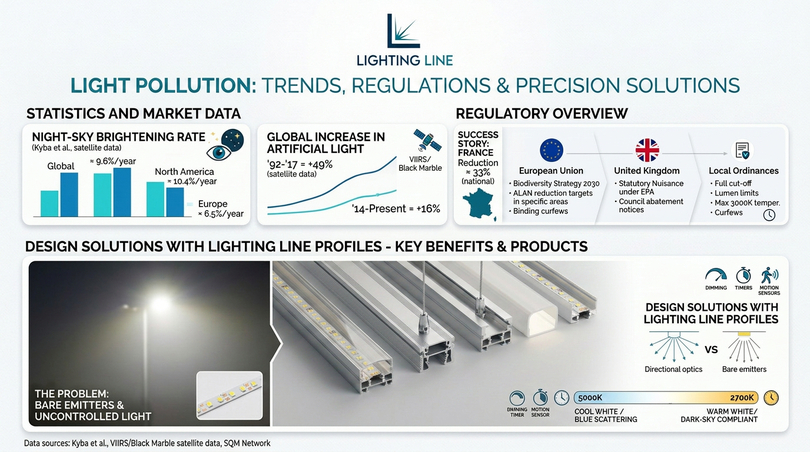
Lighting Line’s aluminium profile range is organised by installation method, and the choice directly affects light control:
- Surface profiles: mounted on top of a surface; best paired with a diffused cover to prevent glare and hotspots when viewed at an angle.
- Recessed profiles: set flush into the surface, the most effective family for eliminating uplight and glare entirely, since the light source sits below the finished plane.
- Corner profiles: mounted at a 45° or 90° internal/external corner, ideal for controlled wall-grazing without light trespass onto ceilings.
- Wall profiles: designed for continuous linear wall-washing with a directional optic.
- Concrete (in-concrete) profiles: embedded before a pour, used for outdoor pathway and landscape lighting where full cut-off, ground-level illumination is essential.
- Suspension profiles: pendant-mounted, often used with an up/down asymmetric diffuser to balance ambient light without excessive ceiling glare.
- Drywall (plaster-in) profiles: fully recessed into plasterboard for a shadow-gap, edge-lit effect with no visible fixture body at all.
- Round profiles: used for pendant or surface circular applications, typically finished with an opal or satin diffuser.
Every profile family should be paired with matching end caps (to fully enclose the channel and prevent stray light or moisture ingress) and, where the installation is not glued or clipped directly, appropriate mounting brackets.
Tools required for a correct, professional cut
Before cutting any aluminium profile, assemble the following:
- A fine-tooth mitre saw or hacksaw with a metal-cutting blade (32+ TPI) — never a wood blade, which will tear the aluminium and leave a ragged edge.
- A mitre box or profile-specific cutting jig to guarantee a perfectly square (or precisely angled, for corner joints) cut.
- A deburring tool or fine metal file, to remove sharp aluminium burrs left by the cut — skipping this step is the most common cause of damaged strip insulation during installation.
- A sharp utility knife or flush-cut scissors for the LED strip itself, used only at the marked cut points (see below).
- A soldering iron and thin-gauge wire, or certified solderless strip-to-strip / strip-to-wire connectors, for joining LED strip sections.
- A multimeter, to verify polarity and continuity before powering on any joined section.
- Isopropyl alcohol and a lint-free cloth, to clean the profile channel and the adhesive backing of the strip before installation.
Step-by-step: cutting the aluminium profile
- Measure twice: mark the exact cut length on the profile with a fine permanent marker, accounting for end caps and any mitred corner angle.
- Secure the profile: in the mitre box or jig so it cannot shift during the cut — movement is the main cause of an out-of-square edge.
- Cut slowly: with the fine-tooth blade, letting the blade do the work rather than forcing it, which prevents the aluminium from deforming or the diffuser channel from cracking.
- Deburr both cut edges: immediately with a file, running it at a shallow angle along the inside and outside of the cut to remove all sharp aluminium fragments.
- Dry-fit the end caps: before final installation to confirm the cut is square and the cap seats flush — an out-of-square cut is the single most common reason installers report light leaking from an unsealed profile end.
Step-by-step: cutting and joining the LED strip correctly
LED strips can only be cut at the marked cut points printed on the strip (usually every 2, 5, or 10 cm, indicated by a copper pad and a scissor icon or cut line). Cutting anywhere else destroys the circuit segment and can damage the entire remaining run: this is the single most frequent installation error that leads to dead sections, flicker, or premature failure.
- Identify the printed cut line: never cut between two adjacent LEDs at a point other than the marked line.
- Cut with sharp: flush scissors directly on the marked line, keeping the cut perpendicular to the strip.
- To join two strip sections either solder short wire jumpers to the exposed copper pads (the most reliable, lowest-resistance method for outdoor or high-output runs) or use a certified solderless connector rated for the strip’s width and current.
- Always check and match polarity (+/-) before joining: reversed polarity on a joined section is a common cause of a dark or flickering segment.
- Where the joint will be inside an IP-rated outdoor profile: seal the connection with heat-shrink tubing or silicone sealant rated for the fixture’s IP class, an unsealed joint is the most common point of water ingress and premature failure in outdoor linear lighting.
- Test the joined run with a multimeter and a brief low-current power-on before final installation inside the profile, so any fault is caught before the channel is sealed and mounted.
Installing the strip inside the profile
Clean the internal channel with isopropyl alcohol to remove dust and machining oil, then press the LED strip’s adhesive backing firmly and evenly along the full length of the channel, working from one end to the other to avoid trapping air bubbles that can cause the strip to lift over time. Fit the diffuser cover last, sliding it from one open end rather than snapping it down at multiple points, which reduces the risk of stress-cracking the diffuser material: a detail that matters both for appearance and for maintaining the even, glare-controlled light distribution that keeps the installation free of hotspots and stray light.
Common mistakes that increase glare and light trespass
- Using a surface profile without any diffuser, leaving the bare LEDs visible and creating strong point-source glare.
- Omitting end caps, which leaves both stray light and the electrical connection exposed.
- Choosing a cool white (5000K+) strip for an outdoor or residential-facing installation where a warmer 2700–3000K would reduce both glare perception and skyglow contribution.
- Mounting an open, unshielded profile facing upward or outward toward a neighbouring window or the sky, effectively creating light trespass by design.
- Skipping the deburring step, which can cut into the strip’s adhesive backing or insulation over time and cause premature failure.
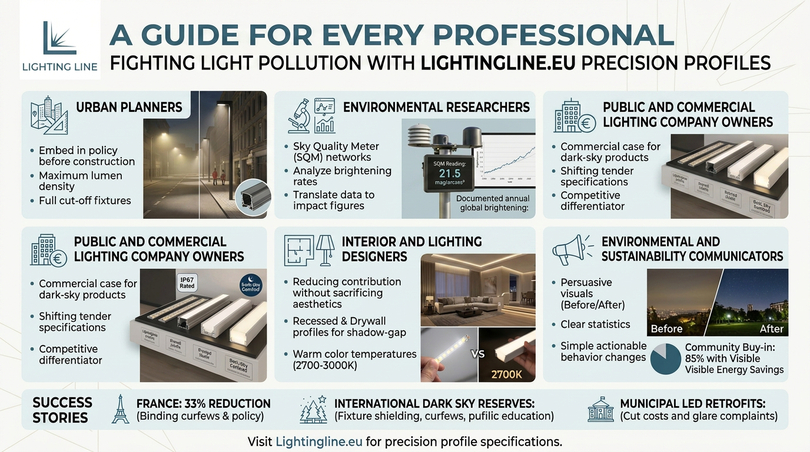
A guide for every professional
Light pollution is addressed differently depending on who is tackling it. This section speaks directly to the five professional profiles most engaged with the topic, answering their most common practical questions.
Urban planners
For an urban planner, the priority is embedding light-pollution controls into planning policy before construction begins, rather than retrofitting afterward. Practical levers include maximum lumen density per hectare in the local plan, mandatory full cut-off fixture specification for any new public lighting contract, a lighting curfew clause for façade and advertising illumination after a set hour, and requiring post-installation sky-brightness measurement (via SQM or similar) as a condition of sign-off. Public sensitisation campaigns paired with visible before/after energy savings tend to secure the most political buy-in.
Environmental researchers
Researchers studying ecological light pollution increasingly rely on long-run Sky Quality Meter (SQM) networks, satellite radiance data (VIIRS/Black Marble), and citizen-science naked-eye reporting to track change over time at both regional and hyper-local scale, since (as the 2023 European SQM study shows) urban, rural, and intermediate zones can brighten at very different annual rates. Collaboration with municipal environmental departments is most effective when researchers can translate raw brightness data into a concrete cost or biodiversity impact figure that a policymaker can act on.
Public and commercial lighting company owners
For a business supplying public or commercial lighting, the commercial case for dark-sky-compliant products is strengthening: growing municipal and EU-level regulation is shifting tender specifications toward full cut-off, low colour-temperature, dimmable fixtures. A well-specified, enclosed LED profile range with certified IP ratings and correct optics is both a compliance requirement and, increasingly, a competitive differentiator against suppliers still offering unshielded or bare-strip products. The return on investment for upgrading to shielded, dimmable systems typically comes from a combination of lower energy consumption, reduced maintenance visits (fewer premature failures from water ingress or overheating), and eligibility for public tenders that now explicitly require dark-sky compliance.
Environmental and sustainability communicators
For anyone building content or campaigns around this topic, the most persuasive material combines a strong visual (a before/after sky-brightness comparison), one clear statistic (such as the ~9.6% annual global brightening rate), and one simple, immediately actionable behaviour change (shielding a home security light, switching to warm white bulbs). Partnering with local astronomy clubs, environmental NGOs, or municipal sustainability offices adds credibility and reach that a single account cannot achieve alone.
Interior and lighting designers
For an interior designer, reducing a client’s contribution to light pollution does not mean sacrificing aesthetics: recessed and drywall profiles achieve the fashionable shadow-gap, edge-lit look while keeping the light source fully controlled and glare-free, and warmer colour temperatures (2700–3000K) are also the most flattering for residential interiors and skin tones. Educating clients is best done by demonstrating, rather than explaining: a side-by-side sample of a bare strip versus the same strip in a diffused profile makes the glare difference immediately obvious.
Dark sky places and success stories
Concrete examples make the abstract case for light-pollution reduction tangible. Several regions have achieved measurable, verified reductions:
- France has achieved an estimated 33% reduction in light pollution over a recent multi-year period through binding national curfews on commercial and office lighting overnight — one of the clearest examples of policy directly reversing the global brightening trend.
- International Dark Sky Reserves and Parks, including Galloway Forest Park in Scotland, Exmoor National Park, and NamibRand Nature Reserve in Namibia, maintain certified low sky-brightness through a combination of fixture shielding requirements, curfews, and public education for surrounding communities.
- Municipal LED retrofit programmes that specify full cut-off, warm colour-temperature fixtures have, in multiple documented city case studies, cut both energy costs and reported glare complaints simultaneously , demonstrating that the “more light for safety” assumption is not supported by well-designed retrofits.
Frequently asked questions
| Question | Answer |
|---|---|
What is light pollution? | Light pollution is the excessive, misdirected, or unnecessary use of artificial outdoor light, encompassing skyglow, light trespass, glare, and light clutter, with measurable effects on health, wildlife, and astronomy. |
What are the 4 types of light pollution? | Skyglow, light trespass, glare, and light clutter. |
What causes light pollution? | Unshielded public and commercial lighting, poorly aimed floodlights, blue-rich LED spectra, always-on decorative and advertising lighting, and the absence of dimming or curfew controls. |
Does light pollution affect human health? | Yes. Night-time light exposure, especially blue-rich light, suppresses melatonin and disrupts circadian rhythm, with associations to poorer sleep quality documented in multiple studies. |
Can you complain about a neighbour’s security light? | In many countries, including the UK, light that unreasonably interferes with your property can be reported to the local council’s environmental health service as a statutory nuisance. |
How can LED aluminium profiles reduce light pollution? | An enclosed profile with the correct diffuser directs and shields light, eliminating the bare-bulb glare and stray uplight typical of unshielded strips. |
How do I cut and join an LED profile and strip correctly? | Cut the aluminium profile square with a fine-tooth blade and deburr the edges; cut the LED strip only at its marked cut points; join sections by soldering or certified connectors, matching polarity, and seal outdoor joints to the fixture’s IP rating. |
What is the darkest region in the UK? | Areas such as Galloway Forest Park, Exmoor, and Northumberland hold International Dark Sky Park or Reserve status and are among the darkest in the UK. |
Is light pollution getting worse? | Yes — recent citizen-science research measured a global average night-sky brightening rate of around 9.6% per year between 2011 and 2022, a compounding trend that can double sky brightness within roughly a decade. |
Can light pollution be fixed? | Yes, and relatively quickly compared with other forms of pollution: correcting or shielding a badly designed fixture removes its light-pollution contribution immediately. |
Dark-sky design isn’t rocket science — It’s just better specs
Lighting pollution is not an abstract, distant environmental problem: it is a design choice made fixture by fixture, project by project, and it is one of the few forms of environmental damage that can be reversed almost as quickly as it was created. For urban planners, researchers, lighting companies, communicators, and interior designers alike, the path forward is the same: shield the source, choose the correct colour temperature, direct the beam precisely, and control when the light is actually needed. At the product level, this means choosing enclosed, diffused aluminium profiles over bare LED strips, cutting and joining them correctly so no light or moisture escapes where it shouldn’t, and specifying the right profile family for the application at hand. Explore the full profile range and LED strip catalogue to specify a project that is both beautifully lit and dark-sky responsible.
This article was developed with the support of artificial intelligence and subsequently reviewed, corrected, and validated by the LightingLine.eu technical team, which guarantees its reliability and compliance with official sources.