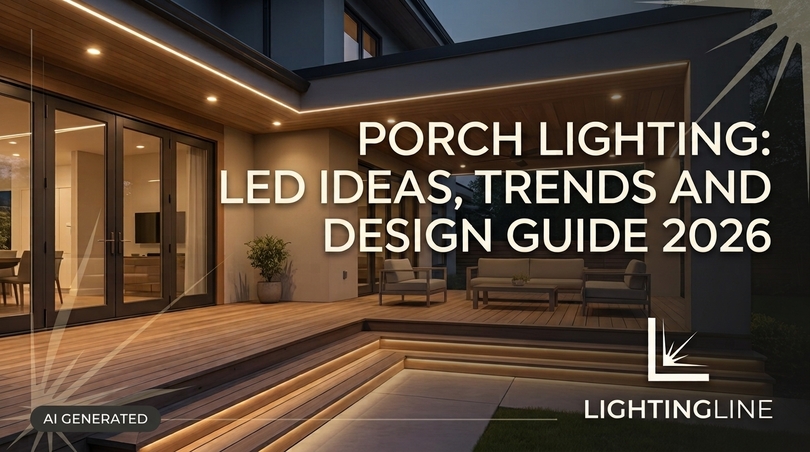
Porch lighting is the first piece of architecture a visitor experiences after dark, and it is also the element of exterior lighting that most often gets designed last, in a hurry, with a single lantern bought off the shelf. This guide sets out to change that and it explains how to plan porch lighting as a real architectural layer: how many lumens a front porch needs, which colour temperature flatters brick, stone, timber and render, how IP65 and IP67 ratings really behave in rain and frost, how to hide LED strips inside aluminium profiles so that the light seems to come from the building itself, and how to deliver entry-level, mid-range and premium solutions with the same design logic.
Here you get answer at question as: should you leave the porch light on all night? Do porch lights deter burglars? How much does it cost to run a porch light 24/7? Are solar or LED outdoor lights better? What does a green, blue or purple porch light mean? Every recommendation is linked to real, currently available products in the LightingLine.eu online catalogue of aluminium profiles and LED strips, so you can move directly from idea to specification sheet.
The short answer, if you only have thirty seconds? The best porch lighting in 2026 is layered, warm (2700K–3000K), glare-free, weatherproof (IP65 minimum, IP67 where water can pool or splash), controlled by a dusk sensor or smart timer, and built around integrated linear LED rather than a single bright fixture. Read on for the reasoning, the calculations and dozens of project examples.
In this article…
- Why porch lighting matters: safety, curb appeal and function
- What people search for: market data and demand for porch lights
- Porch lighting fundamentals: lumens, Kelvin, CRI, glare and the 5’7″ rule
- Types of porch lights and porch lighting fixtures
- LED strips and aluminium profiles: the architect’s porch lighting toolkit
- IP65, IP67 and outdoor durability explained
- Matching porch lighting to architectural style
- Porch lighting trends for 2026 and beyond
- Porch lighting ideas by space: front, back, covered, screened, car porch and veranda
- Entry-level, mid-range and premium porch lighting layouts
- Energy efficiency, running costs, solar vs LED and smart control
- Security: do porch lights deter burglars and should they stay on all night?
- Porch light etiquette and what porch light colours mean
- Bugs, light pollution and neighbours: lighting responsibly
- Installing porch lighting: step-by-step for LED profiles
- Maintenance and long-term reliability
- Regulations, certifications and safety standards (UK, EU, US)
- Common outdoor lighting mistakes and how to avoid them
- Answers for homeowners, architects and entrepreneurs
- Where to buy porch lights: big-box retailers vs specialist LED systems
- Frequently asked questions about porch lighting
- Porch lighting: next steps
1. Why porch lighting matters: safety, curb appeal and function
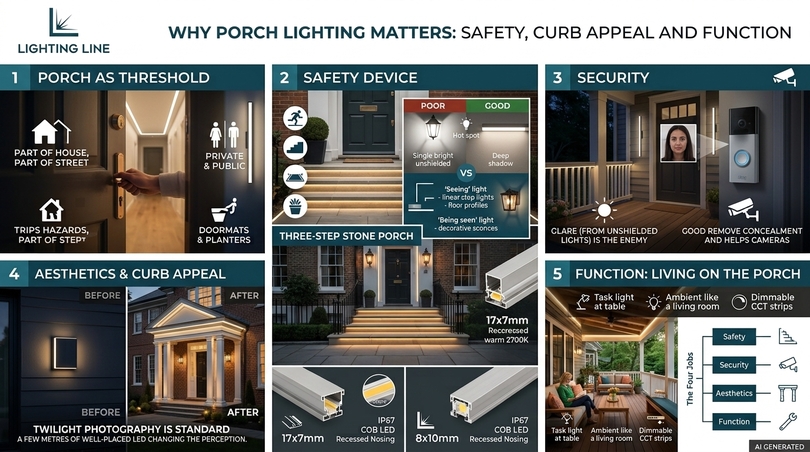
Before choosing a single fixture, it is worth understanding what porch lighting is actually asked to do. A porch is a threshold: part of the house and part of the street, private and public at once. Its lighting therefore carries three simultaneous jobs, and a design that ignores any one of them will feel wrong, even if the visitor cannot say why.
Porch lighting as a safety device
The most basic purpose of porch lighting is to let people move safely between the dark exterior and the lit interior. Steps, level changes, thresholds, door mats, planters and wet tiles are the classic trip hazards of an entrance, and they are almost always found within two metres of the front door. Good porch lighting reveals every change of level without dazzling the eye that has to read it.
This is where many exterior lights for house entrances fail: a single, bright, unshielded lantern next to the door creates a hot spot at eye height and deep shadows on the treads below. The pupil closes in response to the bright source, and the steps become harder to see, not easier. Architects solve this by separating the “seeing” light (low, directed, on the ground plane) from the “being seen” light (the decorative lantern or sconce that marks the entrance).
Practical example: a three-step stone porch
Consider a Georgian-style townhouse with three limestone steps up to a panelled door. A traditional approach places two lanterns either side of the door at 1.8 m. A better approach keeps the lanterns (dimmed, 150–250 lumens each, purely as markers) and adds a warm 2700K linear light under each step nosing, recessed in a slim aluminium channel. The treads are now evenly lit, the risers stay in soft shadow so each step reads clearly, and the lanterns no longer need to be bright. A 17x7mm aluminium profile or the compact 8x10mm aluminium profile fits discreetly under a nosing, fed by an IP67 2700K COB LED strip with extruded silicone tube.
Porch lighting and security
The second job is security. Light lets residents see who is at the door, lets cameras and video doorbells record usable faces, and removes the concealment that opportunistic intruders rely on. We will look at the evidence in detail in the security section, but the headline is simple: well-designed security lighting on the porch reduces the opportunity for crime, but only if it illuminates faces and approaches rather than blinding observers. Glare is the enemy of security as much as darkness is.
Aesthetic porch lighting and curb appeal
The third job is aesthetic. At night, the facade disappears and the house is reduced to whatever the lighting chooses to show. A porch lit with care tells the story of the architecture: the depth of a portico, the rhythm of columns, the grain of a timber soffit, the texture of a brick reveal. A porch lit carelessly shows only a glowing box on a dark wall.
Estate agents know this intuitively, which is why twilight photography is standard for premium property listings. Aesthetic porch lighting is one of the most cost-effective curb appeal investments available, because a few metres of well-placed LED can change the night-time perception of an entire elevation.
The functional layer: living on the porch
Finally, many porches are rooms. Verandas, screened porches, back porches and covered decks are places to eat, read, work, host friends and watch the evening arrive. They need task light at the table, ambient light that feels like a living room, and the ability to dim right down when conversation turns late. This is where outdoor home lights borrow directly from interior design, and where integrated LED profiles excel, because they can be built into ceilings, beams, benches and railings like joinery rather than hung like accessories.
| Job | What it must achieve | Typical target | Best tools |
|---|---|---|---|
| Safety (seeing) | Reveal steps, thresholds, level changes | 20-50 lux on treads and landings | Step-nosing profiles, floor-recessed profiles, low wall grazers |
| Security (being seen / seeing others) | Light faces at the door, approach path, camera field | Vertical illuminance on faces, 10–30 lux; sensor boost | Soffit profiles, shielded sconces, motion-sensor circuits |
| Aesthetics (curb appeal) | Express the architecture, frame the entrance | Contrast ratios of 3:1 to 5:1 between features and background | Wall-grazing profiles, uplights, decorative lanterns |
| Function (living) | Dining, reading, relaxing, hosting | 50-150 lux ambient, 200-300 lux at a table | Ceiling coves, suspended linear profiles, dimmable CCT strips |
2. What people search for: market data and demand for porch lights
Understanding demand helps architects anticipate client questions and helps homeowners realise they are not alone in their doubts. The LightingLine.eu team analysed thousands of request received every month at our service related to outdoor lighting, garden and patio lights. The results show a clear pattern: people generally require first outdoor lights, then narrow to a specific place such as porch lighting and finally ask very practical questions about costs, safety and etiquette.
Monthly demand for porch and outdoor lighting
| Search query | Monthly request | What they require |
|---|---|---|
| outdoor lights | 33,100 | Initial phase |
| garden lights | 18,100 | Garden and patio lighting |
| outdoor wall lighting | 8,100 | Wall-mounted solutions for entryway projects |
| outdoor lighting for security | 6,600 | New ideas and proposals for porches |
| porch lighting | 5,400 | LED lighting suitable for porches |
| porch lights | 5,400 | LED solutions for architects and designers |
| outdoor LED lighting | 2,900 | LED is now the default expectation |
| exterior lighting | 1,500 | Effect lighting for outdoor |
| outdoor sensor lighting | 1,600 | Outdoor lighting automation |
| deck lights | 1,600 | How to design decks and porches |
| ip67 waterproof | 480 | Waterproofing ratings for porch products |
| outdoor soffit lighting | 110 | Outdoor soffit lighting |
The most interesting signal is that people want to learn before they buy.
That is why this guide focuses on explanation first and products second. The growth of request uch as “outdoor soffit lighting”, “strip LED lights outdoor” and “IP rating outdoor lights” shows a shift from buying a fixture to designing a lighting system, which is precisely the territory of LED profiles.
The technology shift behind the data
According to the U.S. Department of Energy, residential LEDs use at least 75% less energy and can last up to 25 times longer than incandescent lighting. The International Energy Agency reports that LEDs now account for the majority of global lighting sales. For porch lights, which often run for many hours every night, this is not a marginal improvement; it changes the economics of leaving a light on, the maintenance schedule, and the freedom to add more lighting points without increasing the electricity bill.
In practical terms, an entire LED porch lighting scheme of eight to ten metres of linear light can consume less than a single old 60 W incandescent bulb. We will do the maths in the energy section.
What clients actually ask architects
From our technical support conversations with designers and installers, the recurring client questions fall into five families:
- Brightness: “How bright should my porch light be?” and “How many lumens do I need for a porch?”
- Colour: “What colour should a porch light be?” and “Is warm white or cool white better outside?”
- Running cost: “Do porch lights use a lot of electricity?” and “How much does it cost to leave a porch light on all night?”
- Security: “Do porch lights deter burglars?” and “Should I leave my porch light on or off at night?”
- Durability: “Can LED lights be used outside in the rain?” and “Can IP65 lights be used outside?”
Each of these receives a full, evidence-based answer below, and a condensed answer in the FAQ.
3. Porch lighting fundamentals: lumens, kelvin, CRI, glare and the 5’7″ rule
Every successful porch lighting design rests on a handful of physical quantities. They are not difficult, but they are often confused, especially when product listings mix watts, lumens and equivalent figures. Let us define them clearly and translate them into porch-specific targets.
Lumens: how bright should a porch light be?
Lumens measure the total amount of visible light a source emits. Watts measure the electricity it consumes. With LED, the two are no longer tightly linked, so always specify porch lights by lumens, not watts.
How many lumens do I need for a porch?
For a typical front porch of 3–6 m², a total of 600 to 1,200 lumens from all sources is usually sufficient. That total should be divided between layers rather than concentrated in one fixture. For a small entrance with a single door and a shallow canopy, 400 to 800 lumens is often plenty. Larger covered porches and verandas used as living spaces may need 1,500 to 3,000 lumens, but always dimmable.
| Zone | Recommended output | Linear LED equivalent | Notes |
|---|---|---|---|
| Decorative lantern or sconce beside door | 150-450 lm each | – | Marker light; avoid visible bare lamps above 300 lm |
| Porch ceiling or soffit general light | 300-800 lm total for a small porch | 1-2 m of 6-10 W/m strip, dimmed | Aim light down onto the floor and faces |
| Steps and thresholds | 50-150 lm per step | Short runs of 6 W/m strip under nosings | Continuous, even, glare-free |
| House number and door face | 100-300 lm | Small wall-grazing profile | Important for deliveries and emergency services |
| Covered porch or veranda (living) | 1,500-3,000 lm total, dimmable | Perimeter cove plus suspended profile over table | Use scenes: dining, relaxing, cleaning |
| Car porch or carport | 1,000-2,500 lm | Surface profiles with opal diffuser on beams | Higher neutral light (3000-4000K) acceptable |
What is the brightest porch light, and do you need it?
Commercial outdoor floodlights can exceed 5,000 lumens, and some security porch lights reach 3,000 lumens or more. For a residential entrance, this is almost always too much. The brightest porch light is rarely the best porch light: excessive output creates glare, annoys neighbours, attracts insects and makes the space beyond the light look darker. Brightness should be set by the task, and a motion-sensor boost can provide extra light only when needed.
Colour temperature: what colour should a porch light be?
Colour temperature, measured in kelvin (K), describes whether white light looks warm (yellowish), neutral or cool (bluish). For porch lighting on homes, the consensus among lighting designers is clear: 2700K to 3000K is the best colour temperature for most residential porches. It matches the warm glow of interior lighting seen through windows, flatters natural materials, and is recommended by DarkSky International for reducing ecological impact (the organisation advises 3000K or lower).
| Colour temperature | Appearance | Best porch applications | Catalogue example |
|---|---|---|---|
| 2200K-2500K | Candle-like amber | Heritage facades, cabins, rustic outdoor lighting, ecologically sensitive sites | Filter LED strips by 2200K / 2500K |
| 2700K | Warm white, classic incandescent feel | Front porches, brick, timber, stone, verandas | 2700K COB IP67 strip |
| 3000K | Warm white, slightly crisper | Modern porch lights, render, concrete, contemporary homes | 3000K COB IP67 strip |
| 4000K | Neutral white | Carports, workshops, outdoor shop lighting, utility zones | 4000K COB IP67 strip |
| Tunable CCT (2700-6500K) | Adjustable | Enclosed sunrooms and fully protected screened porches | CCT COB strip (IP20, dry locations only) |
CRI: why colour rendering matters outdoors
The Colour Rendering Index (CRI or Ra) indicates how faithfully a light source reveals colours compared with a reference. Cheap outdoor LEDs often sit around Ra 70-80, which makes red brick look brown, greenery look grey and skin tones look unhealthy. For porch lighting that presents a home well, specify CRI Ra>90. The COB strips linked in this article are rated CRI Ra>90, which is one reason they photograph beautifully and make timber, terracotta and planting look natural.
Glare and visual comfort
Glare is the single biggest quality problem in exterior lights for house entrances. It comes from seeing a bright source directly against a dark background. The solutions are simple and architectural:
- Hide the source: place LED strips inside profiles with deep channels or opal diffusers so the eye sees a soft line, not a row of points.
- Aim the light: light surfaces (floors, walls, ceilings) rather than the eyes of approaching people.
- Balance the contrast: avoid a single very bright point surrounded by darkness; several low-level sources are more comfortable than one strong one.
- Dim for night: the eye adapted to darkness needs far less light than product datasheets assume.
What is the 5’7″ lighting rule?
The “5’7″ rule” is a rule of thumb used by some designers for porch and entrance sconces: the centre of a wall light beside a door is placed roughly 5 feet 7 inches (about 1.70 m) above the finished floor or threshold, which is close to average eye level. The logic is that the fixture reads as part of the door composition and illuminates faces rather than the tops of heads. A related guideline suggests that a wall lantern beside a door should be roughly one quarter to one third of the door’s height.
For architects, the 5’7″ rule is a starting point, not a law.
With integrated LED profiles, the equivalent reasoning is to position the light so it reaches faces at the door at a comfortable angle: a soffit line 30-60 cm forward of the door plane usually does this better than any sconce, because it lights the face from above and slightly in front, the way a good portrait photographer would.
Beam, distribution and diffusers
Linear LED lighting is shaped by the profile and its diffuser. An opal diffuser softens and spreads light; a clear diffuser gives more output and a crisper line; deep profiles with recessed strips cut off glare at low viewing angles. The LightingLine.eu diffusers range allows the same profile to deliver very different effects, and COB strips, which have a virtually dot-free emission and a 180° beam, pair naturally with slim profiles where the source might otherwise be seen.
4. Types of porch lights and porch lighting fixtures
What are porch lights called? The answer depends on where they are mounted and how they distribute light. The market uses dozens of names, from “porch lamps” and “entrance lights” to “exterior chandeliers” and “outdoor gooseneck lights”. Understanding the families helps you combine them intelligently, and helps you see where integrated linear LED replaces, complements or outperforms a traditional fixture.
Wall-mounted porch lights: sconces, lanterns and entry lights
The most common porch lighting fixtures are wall-mounted: porch sconce lighting, front door lanterns, coach lights and outdoor entry lights. They mark the door, create symmetry and carry much of the stylistic weight of the entrance. Materials range from brass outdoor lanterns and solid brass outdoor lighting to galvanized outdoor lights, copper exterior lights, pewter, cast iron and outdoor wrought iron lighting.
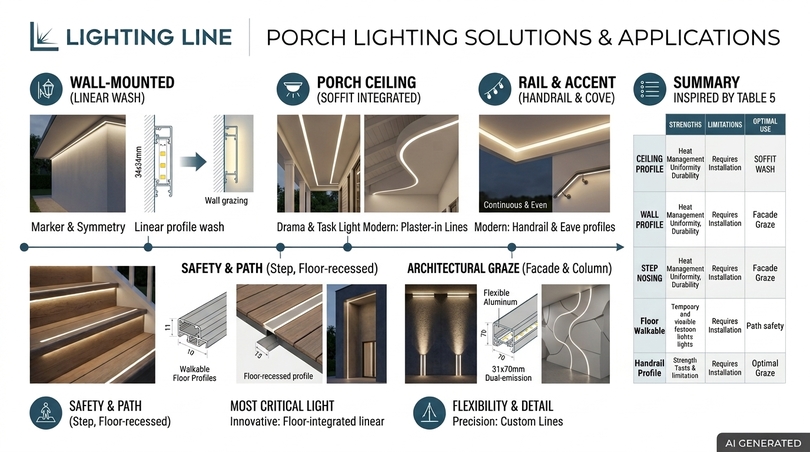
Their weakness is optical: most decorative lanterns emit light in all directions, including straight into the eyes of the visitor. The best practice is to use them at low output as a stylistic marker and to deliver the functional light through concealed sources. A linear profile for wall installation, such as the 24x24mm aluminium profile for wall installation or the 34x34mm wall profile, can wash the door reveal with soft light while the lantern glows gently above.
Porch ceiling lighting: flush mounts, pendants and chandeliers
Porch ceiling lighting includes flush-mount fixtures, overhead porch lights, pendants, hanging lanterns and exterior chandeliers. For deep porches and verandas, ceiling-mounted light is often the primary source, because it lights the floor, the furniture and the faces of people seated below.
Porch chandelier lighting: when it works
A porch chandelier or exterior chandelier creates drama on a tall, grand portico or a Southern-style wraparound porch. It works best when ceiling height exceeds 3 m, when the fixture is rated for damp or wet locations, and when its output is modest and dimmable. A chandelier should be the jewel, not the workhorse.
Porch ceiling lighting ideas with integrated LED
The most elegant porch ceiling lighting ideas avoid fixtures altogether. Recessed linear profiles set flush into a timber or plaster soffit create a continuous line of light that follows the geometry of the porch. Recessed aluminium profiles are designed for exactly this, and drywall profiles can be plastered in so that only the diffuser remains visible. For concrete soffits and cast canopies, the concrete profile category and the PVC profile for cement (3 m) allow light lines to be cast directly into the structure.
Floor, step and path lighting
Step lights, floor-recessed lights and low-level path lights deliver the most important safety light on any porch. Walkable, floor-recessed linear profiles now make it possible to draw lines of light in porch decking, stone or tile. The LightingLine.eu catalogue includes the 20x11mm walkable floor-recessed aluminium profile, the 25x11mm walkable floor-recessed profile and the deeper 20x26mm walkable floor-recessed profile, plus the waterproof floor aluminium profile for 12mm tile for tiled porches where water resistance is essential.
Rail, rope and string lighting
Porch rail lighting runs light along the underside of a handrail or balustrade cap, lighting the floor and the treads while remaining invisible. It is one of the most effective and underrated porch lighting ideas. Porch rope lighting and porch string lighting are the decorative, festive cousins: fairy lights along the eaves, festoon bulbs across a back porch, rope light around columns. The LightingLine.eu handrail profile category addresses the integrated version, while the flexible 18x6mm flexible aluminium profile follows curved rails, arches and bay porches.
The architectural difference between rope light and a profile-mounted strip is permanence and precision: a profile gives a straight, even, heat-managed line that is part of the building; a rope light is a temporary garland. Both have their place, but only one belongs in a specification drawing.
Uplights, grazers and facade accents
Outdoor lighting uplights and wall grazers reveal texture: the relief of stone, the fluting of a column, the vertical grain of cladding. A linear LED placed 5-15 cm from a textured wall at its base produces a graze that turns the porch into a sculpture. The 31x70mm aluminium profile with dual light emission for wall mounting is interesting here, because it can wash both up and down from a single line, doubling the architectural effect.
Solar porch lights
Solar porch lights and solar outdoor lighting integrate a photovoltaic panel, a battery and an LED. They require no wiring, which makes them attractive for rented homes, garden paths and remote cabins. Their limits are output, reliability in winter and colour quality. We compare solar and mains LED in detail in the energy section.
Specialist and niche fixtures
Some fixture families answer specific architectural languages: the outdoor gooseneck light and outdoor barn lighting of farmhouse and industrial styles, stained glass outdoor lighting and arts and crafts outdoor lighting for early twentieth-century homes, southwestern outdoor lighting in pierced metal, light stanchions and lamp posts marking a garden entrance; even propane lighting and gas lamps on historic streets. Each can be respected and complemented by concealed linear LED that does the functional work, leaving the period fixture to express character.
| Fixture type | Main role | Strengths | Limitations | Integrated LED alternative or complement |
|---|---|---|---|---|
| Wall lantern / sconce | Marker, style | Strong character, symmetry | Glare, uneven light | Wall profile grazing the door reveal |
| Flush ceiling light | General light | Simple, economical | Single hot spot, dated look | Recessed linear soffit profile |
| Porch chandelier / pendant | Decorative focus | Drama, height, luxury feel | Requires height, cleaning | Perimeter cove as ambient base |
| Step light | Safety | Targeted light on treads | Point sources can dazzle | Continuous step-nosing profile |
| Floor-recessed light | Guidance, drama | Invisible by day | Water ingress if poorly specified | Walkable floor-recessed profile with IP67 strip |
| Rope / string light | Festive ambience | Cheap, flexible, fun | Temporary, visible cables | Handrail and eave profiles for a permanent version |
| Solar light | No-wiring accent | Zero running cost, easy | Low output, winter weakness, poor CRI | Low-voltage 24V strip on a timer |
| Floodlight | Security | High output | Glare, light trespass | Shielded soffit line with sensor boost |
5. LED strips and aluminium profiles: the architect’s porch lighting toolkit
If traditional porch lights are furniture, LED profiles are architecture. An aluminium profile is a precision extrusion that houses an LED strip, dissipates its heat, protects it mechanically, and, with a diffuser and end caps, turns a flexible circuit board into a finished luminaire. For architects, it is the most flexible tool available for porch lighting, because it adapts to the building instead of asking the building to adapt to it.
Why profiles make LED porch lighting better
- Thermal management: aluminium draws heat away from the LEDs, extending life and stabilising colour. This is a key reason why integrated LED porch lighting can outlast plastic fittings.
- Protection: the profile shields the strip from impact, UV, insects and cleaning.
- Optical quality: diffusers eliminate visible dots and reduce glare.
- Precision: profiles can be cut to length, joined, mitred at corners and aligned with joinery.
- Design freedom: surface, recessed, corner, suspended, floor, wall, tile and concrete versions cover every porch surface.
Profile families mapped to porch applications
| Profile family | Where it goes on a porch | Typical effect | Catalogue link |
|---|---|---|---|
| Surface | Underside of beams, fascia boards, bench seats, step nosings | Clean line of light on existing structures, ideal for renovation | Surface profiles |
| Recessed | Timber soffits, ceiling boards, door reveals | Flush, minimal, “light from nowhere” | Recessed profiles |
| Corner | Junction of wall and ceiling, internal corners of canopies | Diagonal wash onto two surfaces | Corner profiles |
| Wall | Door surround, side walls of porch, columns | Grazing, wall washing, up/down emission | Wall profiles |
| Concrete | Cast canopies, concrete porches, precast steps | Light lines cast into structure | Concrete profiles |
| Suspension | Over a porch dining table, high verandas | Linear pendant, task and ambient light | Suspension profiles |
| Drywall | Plastered porch ceilings, enclosed porches | Seamless plastered-in light lines | Drywall profiles |
| Round | Columns, circular details, tubular balustrades | Soft, 360° glowing rods | Round profiles |
| Tiling | Tiled porch floors, tiled risers, tiled walls | Integrated light joints in tile | Tiling profiles |
| Floor | Porch decking, stone floors, thresholds | Walkable guidance lines | Floor profiles |
| Baseboard | Base of porch walls, enclosed verandas | Low-level orientation light | Baseboard profiles |
| Handrail | Stair rails, balustrades | Rail lighting on treads | Handrail profiles |
| Furniture | Built-in benches, outdoor kitchens on covered porches | Under-bench and shelf lighting | Furniture profiles |
| Architectural | Special applications: floors, tiles, cement, baseboards | Integrated architectural light | Architectural profiles |
Key surface profiles for porch retrofits
Surface profiles are the fastest way to upgrade porch lighting in an existing house, because they mount directly onto beams, joists, fascias and soffits without cutting. Some useful references:
- 21x25mm aluminium profile: a generous section for higher-output strips, suitable under porch beams and carport rafters.
- 36x26mm aluminium profile: wider body for multiple strips or wider PCBs, useful where more light is needed over a covered dining area.
- 27x12mm aluminium profile and 27x7mm aluminium profile: slim, wide profiles for soffit lines and fascia details.
- 17x15mm aluminium profile: a deeper narrow section that hides the strip well and cuts glare.
- 17x7mm aluminium profile and 8x10mm aluminium profile: minimal sections for step nosings, benches and handrails.
Wall profiles for entrances and facades
The wall profile range is designed for vertical surfaces. The 48x18mm aluminium profile for wall installation and the 30x29mm wall profile create directional washes along porch walls, while the dual-emission 31x70mm profile lights ceiling and floor at once. On a porch, a single horizontal wall line at 2.1-2.4 m can replace two lanterns, three downlights and a floodlight, washing the ceiling for ambience and the floor for safety.
COB vs SMD LED strips for porch lighting
LED strips come in two main technologies. SMD strips use discrete LED chips spaced along the board, COB (Chip-on-Board) strips pack hundreds of tiny chips per metre under a continuous phosphor layer. The LightingLine.eu catalogue contains both SMD LED strips and COB LED strips.
| Feature | COB LED strip | SMD LED strip |
|---|---|---|
| Light appearance | Continuous, dot-free line | Visible dots unless diffused |
| Beam angle | Approximately 180° | Typically 120° |
| Profile depth needed for uniform light | Shallow profiles work well | Deeper profiles or opal diffusers recommended |
| Best porch uses | Visible lines, slim soffits, steps, handrails | Hidden coves, high-output indirect light, RGB effects |
| Colour options | Warm to neutral white, CCT | Wide range including RGB, RGB+CCT, pixel |
Recommended strips for outdoor porches
For exterior porch lighting exposed to weather, the LightingLine.eu IP67 COB strips with spherical extruded silicone tube are a strong default. They operate at 24V, draw only 6 W/m, have CRI Ra>90, 480 LEDs per metre, a 3 mm PCB and cut points every 2.5 cm, which allows precise lengths on steps and short architectural runs:
- 5m warm white 2700K COB LED strip, 24V, 6W/m, IP67 – the classic choice for front porch lighting on traditional homes.
- 5m warm white 3000K COB LED strip, 24V, 6W/m, IP67 – ideal for modern porch lights and contemporary facades.
- 5m neutral white 4000K COB LED strip, 24V, 6W/m, IP67 – for carports, workshops and outdoor shop lighting.
For fully enclosed, dry porches (glazed sunrooms, winter gardens), higher-output IP20 strips such as the 2700K COB strip at 10.5W/m and 120 lm/W or the tunable CCT 2700–6500K COB strip can be used inside profiles. IP20 strips must never be used where rain, condensation or hose water can reach them. The full LED strip catalogue can be filtered by IP rating (IP20, IP65 silicone, IP67 silicone), voltage, colour temperature and power.
The complete system: end caps, brackets and connectors
A profile is only as good as its details. End caps close the profile and allow cables to exit neatly, mounting brackets make installation and future maintenance easy, PCB LED strip connectors join sections. For a quick overview of all dimensions, the downloadable Profiles Catalog and Strip LED Catalog are useful references at the design stage.
6. IP65, IP67 and outdoor durability explained
“Can IP65 lights be used outside?” and “Can you leave outdoor lights outside in the rain?” are among the most frequent porch lighting questions. The answer depends on understanding the IP code, defined by the international standard IEC 60529 (EN 60529 in Europe).
How to read an IP rating
The IP (Ingress Protection) code has two digits. The first indicates protection against solids (dust, fingers, tools), from 0 to 6. The second indicates protection against water, from 0 to 9. For porch lighting, the second digit is the one that decides whether a light survives.
| Rating | Solids | Water | Porch suitability |
|---|---|---|---|
| IP20 | Protected against fingers | No protection | Indoor and fully enclosed dry spaces only |
| IP44 | Protected against objects over 1 mm | Splashing water | Sheltered positions under a deep canopy |
| IP54 | Dust protected | Splashing water | Covered porch walls away from direct rain |
| IP65 | Dust tight | Low-pressure water jets | Most exterior porch walls and soffits exposed to rain |
| IP66 | Dust tight | Powerful water jets | Exposed coastal facades, pressure-washed areas |
| IP67 | Dust tight | Temporary immersion (up to 1 m, 30 minutes under test conditions) | Floors, steps, gutters, areas where water can pool |
| IP68 | Dust tight | Continuous immersion (manufacturer-specified) | Pools, fountains, submerged installations |
Can IP65 lights be used outside?
Yes. IP65 lights are suitable for most outdoor positions exposed to rain, including exterior porch walls and open soffits. However, IP65 is not designed for standing water. On porch floors, thresholds, and steps where water collects, choose IP67. The same applies to installations in concrete or tile, where water can wick along joints.
Can you leave outdoor lights outside in the rain?
Products rated for outdoor use (IP44 and above, with appropriate wet or damp location certification in the US) are designed to remain outside permanently, including in rain. What fails in practice is rarely the rated fixture itself, but the connections: unsealed cable joints, junction boxes without glands, drivers mounted where water runs. The golden rules are simple: keep power supplies in dry, ventilated enclosures, seal every joint with appropriate IP-rated connectors or resin; form drip loops on cables so water runs away from entries; and use end caps correctly on IP-rated strips.
Can LED lights be put outside my house?
Absolutely, provided they are rated for the location. LED is in fact better suited to exterior use than older technologies: it starts instantly in the cold, has no glass filament to break, and performs well at low temperatures. Are LED lights better for the outside? In almost every respect, yes: they last longer, use less electricity, start instantly in winter, can be dimmed and controlled, and produce less heat that attracts insects.
Materials and corrosion
Porches near the sea, pools or roads treated with salt in winter expose metals to corrosion. Anodised aluminium profiles resist corrosion well, stainless steel screws should be used and connections should be protected. Traditional galvanized outdoor lights, copper porch lights and brass exterior lights age with a patina that many clients love, and linear aluminium profiles can be specified in finishes that sit quietly alongside them.
Low voltage as a safety advantage
24V LED strips operate at extra-low voltage (SELV when supplied by a suitable safety transformer driver). This greatly reduces the risk of electric shock in wet environments compared with mains-voltage fittings, and it is one reason why low-voltage linear lighting has become the default for steps, handrails and floor-integrated porch lighting. The mains-voltage part of the installation (the driver supply) should always be designed and installed in accordance with local wiring regulations.
7. Matching porch lighting to architectural style
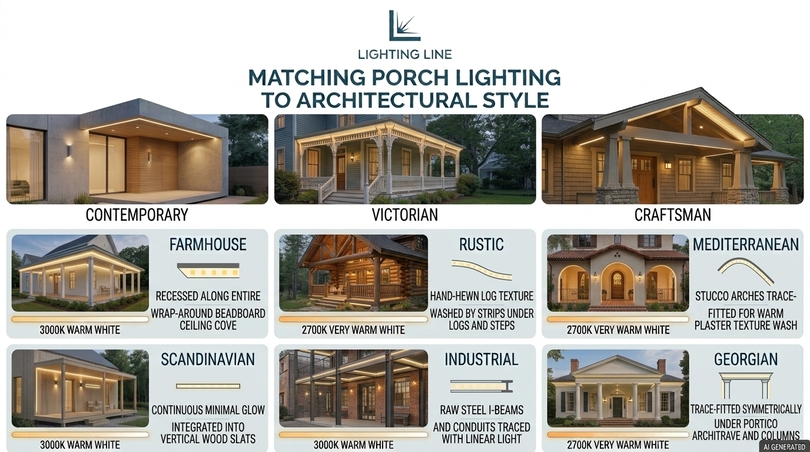
Porch lighting design is not only about light levels. It is about coherence: the lighting should feel as if it were drawn by the same hand as the building. Matching porch lights with house style is the brief that architects hear most often, and it is the one that most often goes wrong when fixtures are chosen from a catalogue photograph without reference to proportion, materials and period. Below are the major residential styles, each with a concrete lighting recipe that combines decorative fixtures with integrated LED profiles.
Contemporary and minimalist homes
Modern porch lights should almost disappear. The contemporary porch is typically a cantilevered canopy, a recessed entrance or a deep reveal in a monolithic volume. Here the ideal porch lighting fixture is no fixture at all: a line of light recessed in the canopy soffit, aligned with the door frame.
Recipe: the floating canopy
- A recessed profile set 40 cm in from the canopy edge, running the full width, with an opal diffuser and a 3000K IP67 COB strip.
- A second, shorter line in the door reveal using the 24x24mm wall profile, grazing the door leaf.
- A floor line in the threshold with the 20x11mm walkable profile, making the canopy appear to hover.
Result: an entrance that reads as a single luminous gesture, with no visible fittings on the facade by day.
Victorian and edwardian homes
Victorian exterior lighting relies on ornament: glazed lanterns, cast iron lighting fixtures, tiled paths, encaustic tiled porches and decorative bargeboards. The brief here is to respect the period while delivering modern performance. Outdoor lighting in Victorian style typically means a lantern (often black, bronze or brass) above or beside the door and perhaps a pair of lamps on gate piers.
Recipe: heritage lantern plus invisible function
- Keep a traditional lantern as the marker, fitted with a warm LED lamp of about 200–300 lumens at 2700K or lower.
- Under the porch roof, conceal a 17x15mm profile behind the fascia or a timber moulding to wash the tiled floor.
- If there are steps, add short step-nosing lines at 2700K, dimmed to a whisper.
The period fixture tells the story, the concealed light does the work.
In the UK, where porch lighting ideas often revolve around terraced houses with small open porches, this combination is especially effective because space is limited and glare onto the pavement must be avoided.
Arts and crafts and craftsman homes
Arts and crafts outdoor lighting is characterised by honest materials: oak, copper, hammered metal, mica shades, stained glass outdoor lighting in geometric patterns. Craftsman porches have heavy tapered columns and exposed rafters, perfect for integrated light.
Recipe: rafter tails and warm copper
- Choose copper exterior lights or a stained glass lantern as the stylistic anchor.
- Run a 27x7mm surface profile along the side of a main beam so that light spills between exposed rafters, emphasising the rhythm of the timber structure.
- Use 2700K or 2500K to deepen the warmth of oak and copper.
Farmhouse, country and barn style
Country outdoor lighting and outdoor barn lighting use gooseneck lights, galvanized shades, enamel reflectors and exposed filament lamps. The farmhouse porch is broad, often wraparound, used for rocking chairs and long evenings.
Recipe: the wraparound porch
- Outdoor gooseneck lights in galvanized or black finish over each entrance door.
- A continuous cove line along the top of the porch wall, using a corner profile at the wall-ceiling junction to wash the beadboard ceiling.
- Handrail lighting along steps with the handrail profile.
- Seasonal festoon string lights across the back porch for summer gatherings.
Log cabin and rustic outdoor lighting
Cabin outdoor lighting and log cabin outdoor lighting must respect darkness. These homes are often in natural settings where the night sky is part of the experience. Rustic outdoor lighting means iron, antler, wood and amber glass, light should be very warm and very low.
Recipe: dark-sky cabin porch
- Use 2200K-2500K throughout, filtered in the LED strip catalogue.
- Place light only where needed: a line under the porch bench, a line under the stair nosings, one shielded wrought iron lantern.
- Put everything on a timer and a motion sensor, switch off after midnight.
Mediterranean and italian villa style
Italian and Mediterranean homes feature loggias, arcades, terracotta, lime plaster and stone. Light here should feel like late evening sun: warm, low, grazing. Arches can be traced with the 18x6mm flexible aluminium profile, while column bases can be uplit to reveal the texture of stone.
Recipe: the illuminated loggia
- Uplight each column from a floor-recessed short profile at 2700K.
- Trace the intrados of each arch with a flexible profile and IP67 COB strip.
- Add a suspended linear profile over the outdoor dining table, dimmable for long dinners.
Southwestern and adobe style
Southwestern outdoor lighting uses pierced tin, wrought iron and mica, set against thick adobe walls. The deep portal (covered porch) of this architecture benefits from soft grazing on textured plaster. A low wall profile at the base of the wall, aimed upward, produces a glow that emphasises the handmade surface.
Scandinavian and nordic homes
Nordic porches are about hygge: warm timber, simple forms, long winter darkness. Porch lighting here must be efficient (it runs for many hours), warm and calm. Slim recessed lines in timber soffits, a pair of simple wall lights and 2700K throughout create the characteristic glow of a Nordic entrance on a snowy evening.
Industrial and loft conversions
Industrial styles welcome visible hardware: exposed aluminium profiles, black finishes, outdoor shop lights, cage lanterns. Surface profiles such as the 21x25mm or 36x26mm fixed to steel beams become a design statement rather than something to hide.
Traditional georgian, colonial and classical
Symmetry rules. Traditional exterior wall lights in pairs, brass outdoor lighting or pewter outdoor lighting, fanlights and pediments. Integrated lighting should be symmetrical too: identical lines either side of the door, a centred downlight line in the portico soffit, and subtle uplighting of columns. Brass outdoor lanterns and solid brass outdoor lighting remain among the most requested finishes in UK porch lighting, and they pair beautifully with warm 2700K concealed LED because the metal reflects the same warmth.
| Architectural style | Decorative fixture | Finish / material | Colour temperature | Integrated LED role |
|---|---|---|---|---|
| Contemporary / minimalist | None or slim cylinder | Anodised aluminium, black | 3000K | Primary: recessed soffit lines, floor lines |
| Victorian / Edwardian | Glazed lantern | Black, bronze, brass, cast iron | 2700K or lower | Concealed wash, step lighting |
| Arts and Crafts | Stained glass or mica lantern | Copper, oak | 2500-2700K | Beam and rafter lighting |
| Farmhouse / country | Gooseneck, barn light | Galvanized, enamel | 2700K | Ceiling coves, handrails |
| Log cabin / rustic | Wrought iron lantern | Iron, amber glass | 2200-2500K | Minimal, shielded, low-level |
| Mediterranean / Italian | Wall lantern, pendant | Wrought iron, terracotta | 2700K | Arches, column uplights, suspended dining |
| Southwestern | Pierced tin lantern | Tin, iron | 2500-2700K | Wall grazing on plaster |
| Scandinavian | Simple wall light | White, timber | 2700K | Timber soffit lines |
| Industrial | Cage lantern, shop light | Black steel | 3000-4000K | Exposed surface profiles |
| Georgian / Colonial | Paired lanterns | Brass, pewter | 2700K | Symmetrical soffit and column lighting |
8. Porch lighting trends for 2026 and beyond
What are the latest trends in outdoor lighting? What is the newest trend in lighting overall? Across our project enquiries, trade fairs and architectural publications, a set of clear directions has emerged. Some are aesthetic, others are technological, all of them favour integrated, controllable LED systems over standalone fixtures.
Architectural integration: light as part of the building
The dominant porch lighting trend is integration: light that is built into soffits, steps, floors, handrails and walls rather than hung on them. Clients increasingly want to see the effect of light, not the fitting. This trend has driven the search growth for “outdoor soffit lighting” and “strip LED lights outdoor” in our data, and it is the core reason architects now specify profiles for exterior porch lighting as routinely as they do for kitchens.
Warm, low and dark-sky friendly
After a decade of cold, bright LEDs, the pendulum has swung to warmth. 2700K is the new standard, 2200K is gaining ground in rural and heritage settings, and the DarkSky movement has made “less but better” fashionable. Lower light levels, full shielding and curfews (lights dimming or switching off late at night) are now signs of a sophisticated scheme.
Smart porch lighting and automation
Smart outdoor lighting has become mainstream: dimmable drivers, app control, voice assistants, astronomical timers that follow sunset through the year, and motion sensors that lift the light level only when someone approaches. Smart porch lighting can also integrate with video doorbells and alarm systems, turning the porch into an active security layer.
Tunable white and circadian awareness
Tunable white strips allow the colour temperature to shift from warmer in the evening to crisper for tasks. On enclosed porches and sunrooms, CCT strips such as the 2700–6500K COB CCT strip let clients choose atmosphere. Outdoors, most designers keep the palette warm and limit tuning to 2700–3000K.
Mixed metals and material honesty
In decorative fixtures, brass outdoor lighting, aged copper, galvanized steel and blackened iron are all strong. The trend is honesty: materials that age visibly, paired with invisible technical lighting. Brass exterior lights and copper porch lights are frequently specified alongside anodised or black aluminium profiles.
Biophilic and garden-connected porches
The porch is increasingly designed together with the garden: planted edges, climbing plants on pergolas, water features. Light links them, with garden and patio lights continuing the language of the porch into the landscape. Linear light under a bench, a graze up a planted wall and low path lights create continuity.
Fotogenic lighting for social media
Lighting for photography is a real brief today. Lifestyle creators, holiday rentals and boutique hotels design porches to be photographed at blue hour. The key ingredients are warm high-CRI light, layered depth (foreground, midground, background), and controllability.
Sustainability and repairability
Clients and regulators increasingly expect lighting that can be maintained. Profiles with removable diffusers, standard drivers and replaceable strips are easier to repair than sealed fittings, and they align with the circular-economy direction of European ecodesign policy.
| Rising | Fading |
|---|---|
| Integrated linear LED in soffits, steps and handrails | Single bright unshielded lanterns |
| 2700K and 2200K warm light | Cool 5000-6500K “security white” |
| Dimming, scenes and astronomical timers | On/off switches left on all night at full power |
| Motion-sensor boost from a low base level | Floodlights triggered by every passing cat |
| CRI Ra>90 for materials and faces | Low-CRI LEDs that dull brick and planting |
| Brass, copper, galvanized and black finishes | Chromed and polished plastic fittings |
| Repairable, modular systems | Sealed disposable fittings |
9. Porch lighting ideas by space: front, back, covered, screened, car porch and veranda
Every porch is different. A two-metre urban entrance, a Southern wraparound veranda and a screened back porch have almost nothing in common except the word porch. In this section we collect porch lighting ideas organised by space type, each with specific layouts, product suggestions and design notes that architects can adapt.
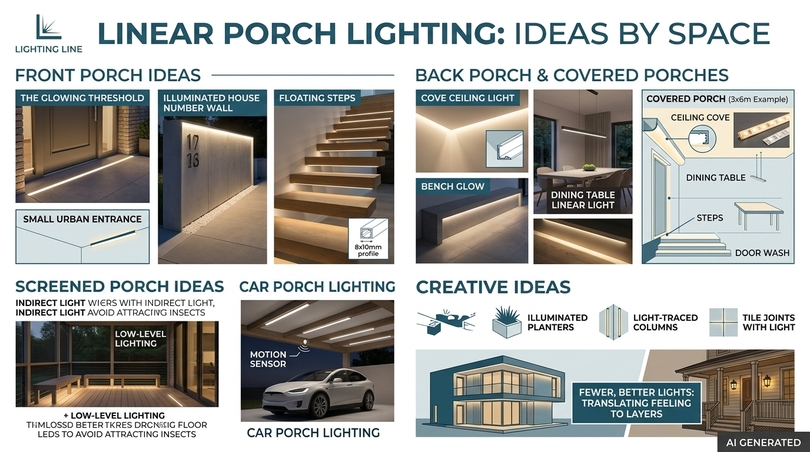
Front porch lighting ideas
Front porch lighting has the most public role: it welcomes visitors, guides deliveries, frames the house number and represents the home to the street. How do you light a front porch? Start with three layers: the marker (lantern or sconce), the approach (steps and path), and the face (soffit light over the door).
Idea 1: the “light-from-the-roof” front porch
On a pitched-roof porch, recess a continuous profile into the ceiling boards, parallel to the door, about 50 cm in front of it. Faces at the door are lit softly from above and in front, perfect for video doorbell cameras. Keep lanterns dimmed or on a separate scene.
Idea 2: the glowing threshold
A floor-recessed line inside the threshold stone or tile, using the waterproof floor profile for 12mm tile, creates a welcome mat of light. It is dramatic, safe and memorable.
Idea 3: illuminated house number wall
Place the house number on a small wall panel and graze it from above or below with a short wall profile. The number is readable from the street at night, which matters for emergency services and couriers.
Idea 4: front porch steps that float
Fix a compact 8x10mm profile under each tread nosing. With an IP67 2700K strip, the treads appear to float and every level change is visible.
Front porch lighting designs for small urban entrances
In terraced streets and apartment entrances, space is tight and neighbours are close, a single recessed line in the canopy plus a lit house number is often enough. Avoid wall lights that project beyond the building line and avoid glare towards the pavement.
Back porch lighting ideas
The back porch is private and social, it is for evening meals, reading, children’s games and summer parties. Back porch lighting ideas therefore prioritise ambience and flexibility over street presence.
- Cove ceiling light: a perimeter corner profile washing the ceiling creates a “room” feeling.
- Table light: a suspended linear profile over the dining table on its own dimmer.
- Bench glow: a surface profile under built-in benches or planters.
- Festive layer: porch string lighting or festoons, switched separately.
Covered porch lighting
How do you light a covered porch? Covered porches are ideal for integrated LED because the roof protects fittings from the worst weather and provides surfaces to mount on. What is the best lighting for a covered porch? Generally, a combination of indirect ceiling light for ambience and targeted light for circulation.
Example: 3 x 6 m covered porch on a family home
| Layer | Product | Length | Power |
|---|---|---|---|
| Ceiling cove (perimeter) | Corner profile + 2700K IP67 COB strip | 18 m | 108 W at full output (typically dimmed to 30–50%) |
| Dining table | Suspension profile + 2700K strip | 2 m | 12–21 W |
| Steps (3 treads, 1.5 m wide) | 17x7mm profile + IP67 strip | 4.5 m | 27 W |
| Door wash | 24x24mm wall profile | 1 m | 6 W |
With dimming and scenes, typical evening consumption stays around 40–70 W for the entire porch, less than many single halogen floodlights.
Screened porch lighting ideas
Screened porch lighting has a particular challenge: insects are attracted to light, and screens become visible, even reflective, if lit from the wrong side. Screened porch lighting ideas that work well include indirect ceiling light (which does not light the mesh directly), warm colour temperatures (less attractive to many insects) and low-level lighting on floors and benches. Where the screened porch is fully enclosed and dry, IP20 strips inside profiles are acceptable while where rain can blow through the screens, stay with IP65 or IP67.
Car porch lighting ideas and carport lights
Car porch lighting ideas and carport lights must be practical: enough light to load shopping, find keys and check the car, without glaring into neighbours’ windows. Surface profiles with opal diffusers fixed to the underside of beams give even, shadow-reducing light. 4000K IP67 strips are acceptable here, though 3000K is more pleasant if the carport is part of the entrance composition. A motion sensor makes sense: light rises when the car arrives and fades after a few minutes.
Outdoor veranda lights
Verandas, especially in warm climates, are living rooms without walls. Outdoor veranda lights combine ceiling fans with integrated lights, pendants over seating areas, and perimeter lighting along beams. The dual-emission wall profile along the house wall provides both ceiling uplight and floor downlight in a single line, a very efficient solution for long verandas.
Porch ceiling lighting ideas
- Beadboard wash: a hidden cove that grazes painted tongue-and-groove, revealing its texture.
- Coffered porch ceiling: small recessed profiles in each coffer, creating a grid of soft light.
- Beam lines: surface profiles on the sides of exposed beams, lighting the ceiling planes between them.
- Central light line: a single recessed line on the axis of the porch, aligned with the front door, for a strong formal gesture.
Creative porch lighting ideas
- Illuminated planters: a surface profile under the overhang of built-in planters creates a floating effect.
- Light-traced columns: vertical round profiles or corner profiles on square columns.
- Glowing bench: a light line under a cantilevered stone bench on the porch.
- Tile-integrated lines: tiling profiles that turn a tile joint into a line of light on porch walls.
- Cast-in-concrete signature: the PVC profile for cement cast into a concrete canopy or step.
How can I light my porch without electricity?
Options include solar porch lights, battery-powered LED lanterns with rechargeable cells, and traditional candles or oil lanterns (with obvious fire-safety caveats). Solar is the most practical where a mains supply is not available, but expect lower brightness and limited winter performance in northern Europe and the UK. For a permanent, reliable, architectural result, a low-voltage 24V system powered from the house remains superior.
Porch lighting images and Pinterest inspiration
Many clients arrive with folders of porch lighting images, Pinterest boards and screenshots. They are valuable for understanding taste, but beware: professional photographs are often taken at blue hour with long exposures and extra lighting. Ask clients to describe the feeling they want (welcoming, dramatic, cosy, discreet), then translate that feeling into lux, Kelvin and layers. This conversation usually leads to fewer, better lights than the mood board suggests.
10. Entry-level, mid-range and premium porch lighting layouts
Good porch lighting is not reserved for large budgets. The same design principles (layering, warm light, hidden sources, control) can be delivered at three levels of investment. Below are three complete layouts for a typical 2.5 x 4 m front porch with three steps, designed to be adapted by architects to any project. Product links point to the LightingLine.eu catalogue; prices vary with length, quantity and version, so check current pricing on each product page.
Entry-level layout: the essential upgrade
Objective: safe, warm, efficient porch lighting with minimal construction work, suitable for renovation and rental properties.
| Element | Product | Quantity | Notes |
|---|---|---|---|
| Soffit line over the door | 27x7mm surface profile with opal diffuser | 2 m | Surface-mounted under existing canopy |
| Step lighting | 17x7mm surface profile | 3 x 1.2 m | Fixed under each nosing |
| LED strip | 2700K COB IP67 24V 6W/m | 1 reel (5 m) plus offcuts as needed | Cut every 2.5 cm for precise lengths |
| Accessories | End caps, brackets | As required | Stainless screws outdoors |
| Control | Dusk-to-dawn sensor or plug-in timer on the driver supply | 1 | 24V driver in a dry location |
Total connected load: about 33 W at full output, often run at 50% via dimming or low-power strip selection.
This single upgrade typically transforms the perception of an entrance more than an expensive decorative lantern could.
Mid-range layout: layered and controllable
Objective: a complete architectural porch scheme with scenes, suitable for most new-build and renovated homes.
| Element | Product | Quantity | Notes |
|---|---|---|---|
| Recessed soffit line | Recessed profile + opal diffuser | 4 m | Flush in timber or plaster ceiling |
| Door reveal wash | 24x24mm wall profile | 2 x 2 m (vertical, both sides) | Frames the door, lights faces laterally |
| Floating steps | 8x10mm profile | 3 x 1.2 m | Separate dimmable channel |
| Decorative lantern | Brass or black lantern of client’s choice | 1-2 | Warm LED lamp, 200-300 lm |
| LED strip | 3000K or 2700K COB IP67 | 2-3 reels | One colour temperature throughout |
| Control | Smart dimmer or multi-channel controller + motion sensor | 1 system | Scenes: welcome, night, away |
Premium layout: architectural signature
Objective: a porch that becomes the signature of the house, integrated into structure and landscape, with full smart control.
| Element | Product | Quantity | Notes |
|---|---|---|---|
| Cast-in canopy lines | PVC profile for cement / concrete profiles | 6-9 m | Placed in formwork before casting |
| Walkable threshold and path | 20x26mm walkable floor-recessed profile | 4-8 m | IP67 strip, drainage detail in the floor build-up |
| Tile-integrated wall line | Profile for 11mm tile or white painted profile for 8mm tile | 2-4 m | Sheltered positions; seal joints carefully |
| Dual-emission facade line | 31x70mm dual-emission wall profile | Full porch width | Up and down light from one element |
| Handrail lighting | Handrail profile | Stair length | Continuous light on treads |
| Dining pendant (veranda) | Suspension profile | 2-3 m | Separate scene |
| Arch tracing | 18x6mm flexible profile | Per arch | For loggias and curved porches |
| Control | Home automation (KNX, DALI, Zigbee or Matter-compatible controllers), astronomical clock, presence sensors | 1 system | Curfew dimming after midnight |
In all three layouts the design logic is identical: warm light, concealed sources, separate layers, control.
What changes is how deeply the light is integrated into the construction. This makes it easy for architects to present options to clients and to scale a scheme up or down without redesigning it.
Cost-saving tips without losing quality
- Use one strip type and one colour temperature across the project to simplify purchasing and ensure consistency.
- Plan runs to minimise offcuts: the 2.5 cm cut points of the IP67 COB strips help.
- Group circuits by function (steps, ceiling, accents) to use fewer, larger drivers.
- Choose surface profiles for renovation to avoid costly carpentry.
- Invest in control before extra fixtures: dimming makes a modest installation feel premium.
11. Energy efficiency, running costs, solar vs LED and smart control
Do porch lights use a lot of electricity? How much does it cost to leave a porch light on all the time? These are among the most searched porch lighting questions, and the answers have changed dramatically with LED. Energy efficient porch lighting is no longer a compromise, it is the default.
How to calculate the cost of running a porch light
The formula is simple: cost = power (kW) × hours of use × price per kWh. Power in watts divided by 1,000 gives kilowatts. For our examples we use an indicative electricity price of €0.30 per kWh (in the UK, roughly 25–27p per kWh under recent price caps, check your own tariff).
| Light source | Power | Dusk to dawn (avg. 12 h/night) | Annual cost (12 h/night) | 24/7 all year | Annual cost (24/7) |
|---|---|---|---|---|---|
| Incandescent bulb | 60 W | 263 kWh | €78.84 | 526 kWh | €157.68 |
| Halogen | 42 W | 184 kWh | €55.19 | 368 kWh | €110.38 |
| CFL | 14 W | 61 kWh | €18.40 | 123 kWh | €36.79 |
| LED lamp | 8 W | 35 kWh | €10.51 | 70 kWh | €21.02 |
| 1.5 m of 6 W/m COB strip | 9 W | 39 kWh | €11.83 | 79 kWh | €23.65 |
| 1.5 m of 6 W/m COB strip dimmed to 40% | 3.6 W | 16 kWh | €4.73 | 32 kWh | €9.46 |
How much does it cost to leave a porch light on 24/7? With an 8 W LED lamp, around €21 per year; with an old 60 W incandescent bulb, over €150. A dimmed LED line costs under €10. Note that driver losses add a small percentage (typically 5-15%) to LED strip figures, and that leaving any light on in daylight is simply wasted energy.
Do porch lights need outdoor bulbs?
Yes: any lamp used in an exposed fixture should be suitable for the conditions, and the fixture itself must be rated for outdoor use. Many LED lamps are fine inside an enclosed outdoor-rated lantern, but check the lamp’s operating temperature range and whether it is approved for enclosed fixtures. Integrated LED strips rated IP65 or IP67 remove this question entirely because the light source is the fixture.
Motion sensor porch lights
Motion sensor porch lights (PIR or microwave) switch on or brighten when movement is detected. The most sophisticated approach is base plus boost: a very low base level all evening, rising to full output for a few minutes when someone approaches. This gives the house a lived-in look, keeps the path safe, and saves energy while offering a noticeable reaction that discourages loiterers. With 24V LED drivers and suitable controllers, this is straightforward to implement on linear systems.
Dusk-to-dawn sensors and astronomical timers
Photocells switch lights at sunset and sunrise. Astronomical timers calculate sunset and sunrise from the date and location, so they are not fooled by shade or car headlights. Combined with a curfew (for example, dimming to 20% at 23:30), they deliver the ideal balance of welcome, security and efficiency.
Are solar or LED outdoor lights better?
Solar outdoor lights are LED lights too, the difference is the energy source. The honest comparison is between solar-powered LED and mains-powered (low-voltage) LED:
| Criterion | Solar porch lights | Mains / 24V LED porch lighting |
|---|---|---|
| Installation | No wiring, very quick | Requires power supply and cabling |
| Running cost | Zero | Very low (see Table 15) |
| Brightness | Usually low to moderate | As high as required, dimmable |
| Winter reliability (UK, northern Europe) | Limited: short days, low sun, cold batteries | Constant |
| Colour quality | Often cool and low CRI | Warm, CRI Ra>90 available |
| Lifespan | Battery replacement every few years | Long LED life; driver replaceable |
| Architectural integration | Limited: panel must see the sky | Complete: hidden in soffits, floors, rails |
| Best use | Garden accents, remote paths, temporary setups | Porch, steps, entrances, facades |
Are solar lights worth it in the UK?
For decorative garden accents and paths far from a power source, solar lights can be worth it, particularly in spring and summer. For porch lighting, where reliability matters every night of the year, including short December days, a mains-supplied low-voltage LED system is the more dependable choice. Solar is a good complement to porch lighting, rarely a substitute for it.
Eco-friendly porch lighting beyond the kilowatt-hour
Sustainability is not only about consumption. Eco-friendly porch lighting also means: warm colour temperatures that reduce impact on wildlife, shielding to avoid skyglow, curfews, durable, repairable products and avoiding over-lighting. The greenest lumen is the one you do not need.
Smart porch lighting: how to automate it
How can I automate porch lighting? The typical architecture is:
- Light sources: 24V LED strips in profiles, grouped by circuit.
- Drivers: constant-voltage power supplies, installed in a dry, ventilated location.
- Controllers: dimmers or multi-channel controllers (Zigbee, Wi-Fi, Bluetooth mesh, DALI, KNX or Matter-compatible devices).
- Sensors: PIR or microwave presence sensors, photocells, or astronomical logic in the controller.
- Integration: scenes in the home automation app, voice assistants, links to video doorbells and alarm systems.
Are there weatherproof smart lighting options? Yes: the light sources can be IP67 strips in profiles, while the smart components (controllers, drivers) are installed indoors or in IP-rated enclosures. This separation is more robust than all-in-one smart fixtures exposed to weather.
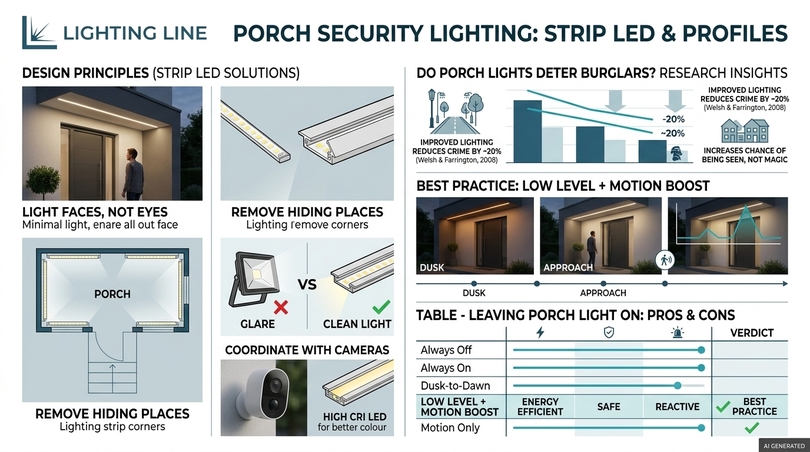
12. Security: do porch lights deter burglars and should they stay on all night?
Security lighting porch design is one of the most debated topics in residential lighting. Do porch lights deter crime? Should you leave the porch light on all night, or does it signal that nobody is home? Let us look at the evidence and then at practical design.
What the research says
Research on lighting and crime has mostly looked at street and public lighting rather than individual porches, but it offers useful lessons. A widely cited systematic review by criminologists Brandon Welsh and David Farrington (Campbell Collaboration, 2008) found that improved street lighting was associated with an average reduction in crime of around 20% in the areas studied. A randomised experiment in New York City public housing, led by the University of Chicago Crime Lab and published in 2019-2021, found that adding temporary lighting towers reduced nighttime outdoor index crimes by roughly a third in treated developments.
The evidence suggests that light reduces opportunity for crime mainly by increasing the chance of being seen, not by magic. A porch light helps if it makes the approach and the door visible to neighbours, passers-by and cameras. It helps far less if it is so bright and glaring that it blinds observers or casts deep shadows beside it.
Do porch lights deter burglars and thieves?
Porch lights can deter opportunistic burglars and package thieves, who prefer to work unseen. Police crime-prevention advice in the UK and elsewhere commonly recommends lighting entrances and using dusk-to-dawn or motion-activated lights. However, light alone is not a security system. Do outside house lights deter burglars? They help as part of a combination: good locks, visible cameras, sightlines from the street, and signs of occupancy.
Designing porch security lighting that actually works
- Light faces, not eyes: a soffit line in front of the door lights the face of a visitor for cameras and residents looking through a peephole.
- Remove hiding places: light the side corners of the porch and any recess where someone could stand unseen.
- Avoid glare: a floodlight aimed outward blinds neighbours and passers-by, which reduces natural surveillance.
- Use motion boost: a sudden increase in light attracts attention and signals awareness.
- Coordinate with cameras: warm light with high CRI gives cameras better colour images than harsh, low-CRI floodlights; avoid lights pointing into the camera lens.
Should you leave your porch light on all night?
There is no single right answer, but there is a best practice. The most effective approach is to leave the porch light on at a low level from dusk, with a motion sensor that increases brightness when someone approaches, and optionally a curfew that dims it further late at night.
| Strategy | Advantages | Disadvantages | Verdict |
|---|---|---|---|
| Always off | Zero energy, darkest sky | Unsafe steps, no visibility at door, dark hiding places | Not recommended for occupied homes |
| Always on at full brightness | Constant visibility | Energy waste, glare, insects, neighbour annoyance, predictable | Outdated approach |
| Dusk to dawn at low level | Welcoming, safe, low cost with LED | Some light pollution if unshielded | Good |
| Low level plus motion boost | Safe, efficient, reactive, noticeable | Requires sensor setup | Best practice |
| Motion only (off otherwise) | Very efficient, dark sky friendly | House looks dark; sensor range must be correct | Good for rural and dark-sky sites |
Is it better to leave the porch light on or off when away?
A porch light burning 24 hours a day, including daylight, can actually signal that nobody is home to switch it off. Timers, photocells and smart controls that follow a natural pattern (on at dusk, dimmed late, off at dawn) are much better. Smart systems can also simulate occupancy by varying interior and exterior lighting.
Why are people leaving porch lights on?
People leave porch lights on for several reasons: security, welcoming family members returning late, deliveries, tradition (the “light left on” for someone expected), and sometimes awareness campaigns using coloured light. With LED, the cost is low enough that leaving a dimmed porch light on is no longer an extravagance.
13. Porch light etiquette and what porch light colours mean
What does leaving the porch light on mean? Porch lights carry social meaning in many communities, especially in North America and increasingly in the UK. Understanding these codes helps homeowners avoid misunderstandings and helps designers plan for coloured-light capability if clients want to take part in awareness campaigns.
Porch light etiquette
- Halloween: in the US, UK and elsewhere, a porch light on usually signals that trick-or-treaters are welcome, a light off means “please skip this house”.
- Waiting for someone: a light left on traditionally means someone is expected home, a gesture of welcome.
- Deliveries and visitors: a lit porch and house number help couriers and emergency services.
- Neighbourliness: avoid lighting that shines into neighbours’ windows or bedrooms, especially late at night.
Do porch light colours mean anything?
Yes, some colours are associated with awareness campaigns, although meanings vary by country and context, and many people simply use coloured bulbs for decoration. The most common associations are:
| Colour | Common association | Typical period |
|---|---|---|
| Green | Support for military veterans (for example, the “Operation Green Light” initiative in the US) | Especially around Veterans Day in November |
| Blue | Support for law enforcement, also used for autism awareness campaigns | Year-round, autism awareness especially in April |
| Purple | Domestic violence awareness, also used for other causes (e.g. Alzheimer’s awareness) | Domestic violence awareness especially in October |
| Red | Heart health awareness, support for firefighters, sometimes simply festive decoration | Heart awareness especially in February |
| Pink | Breast cancer awareness | Especially in October |
| Orange / amber | Halloween decoration, also used by some campaigns | October |
| Yellow / amber | Practical choice to attract fewer insects | Summer |
Designing for colour with LED strips
If a client wants to participate in campaigns or festive lighting without changing bulbs, an RGB or RGB+white strip on a dedicated accent circuit is the elegant solution. The SMD LED strip range includes RGB, RGB+CCT and monochrome coloured options, filterable in the strip catalogue. Keep the functional porch lighting in high-CRI warm white and add colour only as a separate, switchable accent layer. Check the IP rating of any colour strip used outdoors.
14. Bugs, light pollution and neighbours: lighting responsibly
Responsible porch lighting considers everyone who shares the night: neighbours, passers-by, wildlife and the insects that swarm around every bright lamp. Lighting that respects them is also better lighting for the people who live in the house.
What is the best porch light to keep bugs away?
Many night-flying insects are strongly attracted to short-wavelength (blue and ultraviolet) light. Warm white light with less blue content, and amber or bug lights, generally attract fewer insects than cool white or older mercury-vapour sources. LEDs emit essentially no UV, which is already an improvement over some older technologies.
- Choose 2700K or lower (2200K and amber attract even fewer insects).
- Light surfaces, not the air: concealed downlight on the floor attracts fewer insects to the door than a glowing lantern at head height.
- Use motion sensors so light is on only when needed.
- Keep sources away from doors: insects gather at the brightest point; move it away from the entry.
Light pollution and dark-sky principles
DarkSky International promotes five principles for responsible outdoor lighting: light should be useful, targeted, low level, controlled and warm-coloured. These principles align perfectly with good porch lighting design and with integrated LED profiles, which naturally direct light downward onto surfaces. A fully shielded, warm, dimmable porch light is both the dark-sky choice and the architect’s choice.
Can neighbours complain about outside lights?
Yes. In England and Wales, artificial light emitted from premises can be treated as a statutory nuisance under the Environmental Protection Act 1990 (as amended by the Clean Neighbourhoods and Environment Act 2005), provided it unreasonably and substantially interferes with the use or enjoyment of another property or is prejudicial to health. Local councils investigate complaints and can serve abatement notices. Similar principles exist in other jurisdictions through nuisance law or local ordinances.
Can I complain about neighbours’ bright lights or garden lights?
You can. The recommended route is first to talk to your neighbour: many people do not realise their light shines into your windows. If that fails, contact your local council’s environmental health department. Can neighbours complain about garden lights too? Yes, the same nuisance rules apply to garden lighting, floodlights and decorative lights.
How to design porch lighting that neighbours will never complain about
- Aim all light downward and inward, onto your own surfaces.
- Avoid unshielded floodlights; use concealed linear sources.
- Keep output modest and warm.
- Set motion sensors so they do not trigger on the street or neighbouring gardens.
- Dim or switch off late at night.
15. Installing porch lighting: step-by-step for LED profiles
This section covers porch lighting installation with LED strips and aluminium profiles, the most flexible architectural approach. It is written for designers and competent installers. Any work on mains voltage must be carried out by a qualified electrician in accordance with local regulations; the low-voltage part is more accessible but still requires care, especially outdoors.
Can I replace an outside light myself in the UK? Do I need an electrician?
In England and Wales, electrical work in dwellings falls under Part P of the Building Regulations. Generally, replacing an existing outdoor light fitting on an existing circuit is not notifiable work, and a competent person can do it. Installing a new circuit, including a new outdoor circuit, is notifiable and should be done by a registered electrician (or notified to building control). All work must comply with BS 7671 (the IET Wiring Regulations). Scotland and Northern Ireland have their own rules. In other countries, local codes apply: in the US, the National Electrical Code (NEC) and local amendments while in Italy, CEI 64-8 and Ministerial Decree 37/2008 on qualified installers. When in doubt, use a qualified electrician for the mains connection and let the low-voltage lighting be designed around it.
Can you install a porch light, and can outdoor lights be plugged in outside?
Yes, you can install a porch light, but the method matters. Plug-in outdoor lights are legitimate if they use an outdoor-rated socket (IP-rated, weatherproof, protected by an RCD in the UK and Europe, or a GFCI in the US) and outdoor-rated cables. For permanent porch lighting, a hardwired, fused supply to a driver located in a dry place is the professional standard.
Planning checklist
- Survey: measure surfaces, note exposure to rain, splash zones, drainage and where water can pool.
- Define layers: steps, soffit, walls, accents, decorative fixtures.
- Select IP rating per position: IP65 for exposed walls and soffits, IP67 for floors, steps and anywhere water can collect.
- Choose profiles and diffusers for each surface (see Table 6).
- Calculate loads: metres × W/m per circuit; add 20–25% headroom to driver sizing.
- Plan voltage drop: for 24V runs, feed long lengths from both ends or from the middle, and keep cable sections adequate.
- Locate drivers in a dry, ventilated, accessible position (utility room, loft, IP-rated enclosure).
- Plan control: switches, sensors, timers, smart controllers.
- Plan maintenance access: removable diffusers, accessible junctions.
Step-by-step installation of an LED profile porch line
Step 1: prepare surfaces and routes
Clean and dry the mounting surface. For recessed profiles, cut the groove or build the recess in the joinery or plaster so for concrete, place the PVC profile for cement in the formwork before casting. Plan cable routes and entry points, protecting holes with grommets and sealing them afterwards.
Step 2: fix brackets or profiles
Fix mounting brackets with stainless steel screws at regular intervals, or bond surface profiles with an exterior-grade adhesive where appropriate. Check alignment with a laser: a crooked light line is visible from far away.
Step 3: prepare the LED strip
Cut the strip only at the marked cut points (every 2.5 cm on the IP67 COB strips referenced in this guide). For IP-rated strips, reseal the cut end and cable entry according to the manufacturer’s instructions, using suitable end caps and sealant. The integrity of the seal determines the real IP rating of the installation.
Step 4: insert the strip and diffuser
Place the strip in the profile (the aluminium acts as heat sink), route the cable through the end cap, and click in the diffuser. Opal diffusers give the softest effect outdoors.
Step 5: connect and seal
Make low-voltage connections with appropriate connectors or soldered joints protected by heat-shrink with adhesive lining or IP-rated junction boxes. Form drip loops so water runs off the cable before reaching any entry.
Step 6: connect the driver and controls
The electrician connects the driver’s mains side to a protected circuit (RCD/GFCI), together with sensors and controllers. Check polarity on the low-voltage side before powering.
Step 7: test, aim and commission
Test every circuit at night: adjust dimming levels, sensor sensitivity and time delays, timer schedules and scenes. Walk the approach as a visitor would, looking for glare, dark spots and light spill onto neighbouring properties.
Installing wall lights outdoors: best practices
- Use a proper outdoor mounting box or back plate, seal the top edge but leave a small weep path at the bottom where the manufacturer recommends it, so condensation can escape.
- Never mount drivers or junctions in the path of runoff water.
- On rendered or insulated facades (ETICS), use appropriate fixings and seal penetrations to avoid thermal bridges and water ingress.
- Keep decorative wall lights at a consistent height across the elevation.
Outdoor lighting safety tips
- RCD protection: all outdoor circuits should be protected by residual current devices in the UK and EU (GFCI in the US).
- Extra-low voltage: prefer 24V for anything within reach or on floors.
- Correct IP: match each product to its exposure.
- Cable protection: use UV-resistant, outdoor-rated cables, protect buried cables with ducting and warning tape at appropriate depth.
- Isolation: provide a clearly labelled means of isolation for maintenance.
16. Maintenance and long-term reliability
Outdoor light maintenance is often forgotten until something fails. A little planning keeps porch lighting beautiful for many years and protects the client’s investment.
Routine maintenance schedule
| Frequency | Task |
|---|---|
| Every 3 months | Clean diffusers and lenses with a soft cloth and mild soapy water, remove insects and cobwebs |
| Every 6 months | Check sensors, timers and schedules (especially after clock changes) |
| Every year, before winter | Inspect seals, end caps, cable glands, drip loops and junction boxes, check floor profiles for debris and drainage |
| Every year | Test RCD protection, check fixings and brackets for corrosion |
| As needed | Replace drivers or strip sections, keep spare lengths from the original batch for colour consistency |
Troubleshooting common problems
- Flickering: often a loose connection, an overloaded driver or an incompatible dimmer.
- One end dimmer than the other: voltage drop; feed from both ends or use shorter runs.
- Section not working after rain: water ingress at a joint; dry, reseal, and check drip loops.
- Colour mismatch after repair: different production batch; keep spare strip from the original order.
- Sensor triggering constantly: reduce sensitivity or reorient away from the street and moving foliage.
Why aluminium profiles improve longevity
Heat is the main enemy of LED lifespan, and the aluminium profile is the strip’s heat sink. Running a strip inside a well-sized profile, at a moderate power density such as 6 W/m, keeps LED junction temperatures lower and colour stable over time. Profiles also protect strips from mechanical damage, UV and cleaning, and make replacement of a section a simple job rather than a demolition.
17. Regulations, certifications and safety standards (UK, EU, US)
Outdoor lighting safety regulations can feel like a maze, but for porch lighting they come down to a limited set of requirements: the product must be safe and correctly marked, it must be suitable for the location, and it must be installed according to national wiring rules. This section summarises the main references architects should know. It is an overview, not legal advice; always check the current version of each standard and local requirements.
Product safety and conformity marking
| Region | Reference | What it covers |
|---|---|---|
| EU | CE marking; Low Voltage Directive 2014/35/EU | Electrical safety of equipment from 50 to 1000 V AC |
| EU | EMC Directive 2014/30/EU | Electromagnetic compatibility (drivers and controllers) |
| EU | RoHS Directive 2011/65/EU | Restriction of hazardous substances |
| EU | Ecodesign Regulation (EU) 2019/2020 and Energy Labelling Regulation (EU) 2019/2015 | Minimum efficiency and A-G energy classes for light sources, including LED strips |
| UK (Great Britain) | UKCA marking (with CE marking still accepted for many products under current government policy) | Equivalent GB conformity regime |
| International / EU | IEC/EN 60598 series | Safety of luminaires, including requirements for outdoor luminaires |
| International / EU | IEC/EN 60529 | IP code (ingress protection) |
| International / EU | IEC/EN 62471 | Photobiological safety of lamps and lamp systems |
| International / EU | IEC/EN 61347 series | Safety of LED control gear (drivers) |
| US | UL / ETL listing, “damp location” and “wet location” ratings | Fixture suitability for covered porches (damp) and exposed positions (wet) |
For porch lighting in the US, a “damp location” listing is typically sufficient under a covered porch roof, while fixtures exposed to rain need a “wet location” listing. In Europe and the UK, the IP rating plays the equivalent role.
Installation rules and building codes for outdoor lights
- UK: BS 7671 (IET Wiring Regulations, 18th Edition and amendments), Part P of the Building Regulations in England and Wales, and Part L for energy efficiency in new dwellings where relevant.
- Italy: CEI 64-8 for low-voltage installations and Ministerial Decree 37/2008 for qualified installers and declarations of conformity.
- Other EU countries: national standards based on the IEC 60364 series.
- US: National Electrical Code (NFPA 70), including provisions for luminaires in damp and wet locations and GFCI protection for outdoor receptacles, plus local amendments.
Energy classes of LED strips
Under the EU energy labelling scale introduced in 2021, light sources are graded from A to G on stricter thresholds than the old A++ scale. Many high-quality LED strips appear in classes E, F or G on the new scale, which surprises some clients. This is not a sign of poor quality: the rescaled label deliberately leaves the top classes almost empty to leave room for future technology. The catalogue product pages show the energy class of each strip, for example class G for the 6 W/m IP67 COB strips and classes E-F for several higher-output IP20 COB strips.
Accessibility and wayfinding
Although private homes are not usually subject to the same accessibility regulations as public buildings, good practice from standards such as EN 12464-2 (lighting of outdoor workplaces) and accessibility guidance is useful: consistent light on steps, contrast on nosings, avoidance of glare and of sudden transitions between bright and dark. For multi-residential entrances and shared porches, local accessibility and emergency lighting rules may apply.
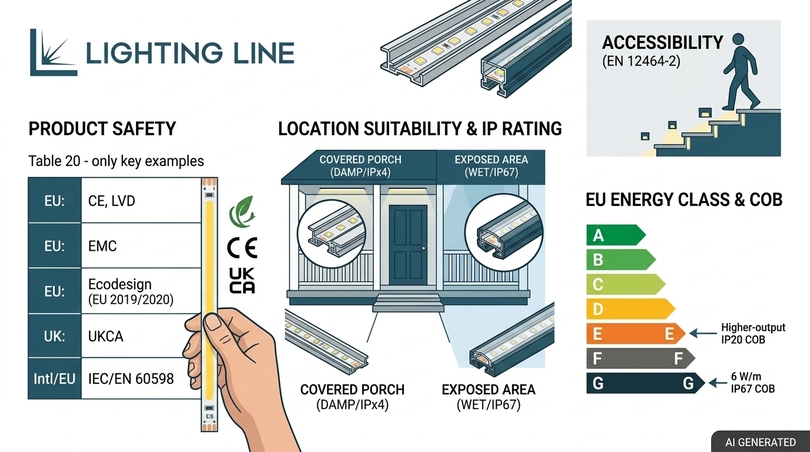
18. Common outdoor lighting mistakes and how to avoid them
What are common outdoor lighting mistakes? After many years of supporting projects, our team sees the same errors again and again. Avoiding them is often worth more than any product choice.
| Mistake | Why it is a problem | The fix |
|---|---|---|
| One very bright fixture beside the door | Glare, deep shadows, poor faces on camera | Split into layers: low marker + concealed downlight |
| Cool 5000-6500K light | Harsh, clinical, attracts more insects, clashes with interiors | 2700-3000K, CRI Ra>90 |
| Wrong IP rating | Water ingress, early failure, safety risk | IP65 exposed walls, IP67 floors and steps |
| Drivers outdoors in the rain path | Failures, tripping RCDs | Drivers indoors or in proper enclosures |
| Visible LED dots | Cheap appearance | COB strips or opal diffusers, adequate profile depth |
| Fixtures too small for the facade | Look lost from the street | Scale lanterns to about one quarter to one third of door height |
| Lighting the neighbours | Complaints, nuisance | Aim down and in, shield, curfew |
| No control | Waste, all-or-nothing effect | Dimming, sensors, timers, scenes |
| Mixing colour temperatures | Patchy, unplanned look | One colour temperature across the scheme |
| Forgetting the steps | Trip hazard | Step-nosing or handrail lighting |
| No maintenance access | Costly repairs | Removable diffusers, accessible junctions |
19. Answers for homeowners, architects and entrepreneurs
Different people come to porch lighting with different goals. This section gathers direct answers for four typical profiles, so each reader can find their own questions quickly.
For homeowners: security, curb appeal and simplicity
What are the best porch lighting options for security?
A soffit line in front of the door that lights faces, lighting on the side corners of the porch, and a low base level with motion boost. Avoid glaring floodlights. Combine with a video doorbell and good locks.
How can I enhance curb appeal with lighting?
Light the architecture rather than the air: graze the door reveal, wash the porch ceiling, make the steps float, and illuminate the house number. Keep everything warm (2700–3000K) and consistent. Twilight is when the effect is strongest.
Are there energy-efficient porch lighting solutions?
Yes. A 6 W/m LED strip line dimmed on a timer costs a few euros per year to run. See Table 15.
How do I install outdoor lighting safely?
Use products rated for the location, 24V low-voltage lighting where possible, RCD-protected circuits, drivers in dry positions, and a qualified electrician for the mains connection.
For architects: sustainable, integrated and customisable
What are sustainable porch lighting options?
Warm, shielded, dimmable LED at low power density, in repairable aluminium profiles, controlled by astronomical timers and presence sensors. Specify only the light the task needs.
How can I integrate smart lighting into outdoor designs?
Separate the weather-exposed components (IP67 strips in profiles) from the smart components (drivers and controllers in dry locations). Plan circuits by layer so scenes can be created. Choose open protocols to future-proof the system.
What are the best fixtures for modern porch aesthetics?
Recessed and surface aluminium profiles, walkable floor profiles and wall profiles, all in a single warm colour temperature. For a decorative accent, one slim cylindrical wall light is plenty.
How do I create a cozy ambiance with porch lighting?
Wash the ceiling indirectly, add low light at seat level (under benches and planters), keep the palette at 2700K or warmer, and dim. Cosiness comes from low, warm, horizontal light, like firelight.
Are there customisable outdoor lighting solutions?
Yes. Profiles are cut to length and strips are cut at short intervals, so every installation is tailor-made. LightingLine.eu also produces fully customisable strips; contact the technical team through the About us page for project support.
For entrepreneurs and property managers: automation and cost control
How can I automate porch lighting and reduce energy consumption?
Use astronomical timers with curfews and presence sensors on low-power LED circuits. For multiple properties, choose controllers that can be managed remotely and scheduled centrally.
What are the best motion sensor outdoor lights?
The best motion sensor outdoor lighting has adjustable sensitivity, time delay and ambient-light threshold, and a “base plus boost” mode. Pair a quality outdoor sensor with dimmable 24V LED linear lighting rather than buying all-in-one floodlights.
What is the installation process for automated porch lights?
Survey, specify layers, install profiles and strips, install drivers and controllers in a dry location, connect sensors, then commission scenes and schedules. See the installation section.
20. Where to buy porch lights: big-box retailers vs specialist LED systems
Many buyers begin with price comparison: request such as “outdoor porch lights, find the best price”, “outdoor lighting from 100+ retailers”, “porch lighting lowes” or “porch lighting home depot” are common, alongside UK-focused demands for outdoor porch lights. Big-box retailers and marketplaces offer convenience and a wide choice of ready-made porch light fixtures, lanterns and solar lights, which is ideal for a quick replacement.
Specialist LED profile systems answer a different need. If the goal is architectural porch lighting, integrated into the building, with precise lengths, consistent colour and professional technical support, a specialist manufacturer is the better route. The LightingLine.eu catalogue offers Italian-designed aluminium profiles and LED strips for exactly this purpose, with the option of fully customised strips and direct technical advice.
| Criterion | Ready-made fixtures (retail) | Integrated LED profile systems (specialist) |
|---|---|---|
| Speed of purchase | Immediate | Requires some design |
| Design integration | Limited to fixture shape | Built into architecture |
| Customisation | Low | Lengths, colour temperature, diffuser, mounting |
| Light quality | Varies widely | High CRI options, controlled optics |
| Serviceability | Often replace whole fixture | Replace strip or driver |
| Technical support | General | Specialist, project-oriented |
Many of the best schemes combine both: a characterful lantern chosen from a retailer or designer brand, plus a concealed LED profile system that delivers the real lighting performance.
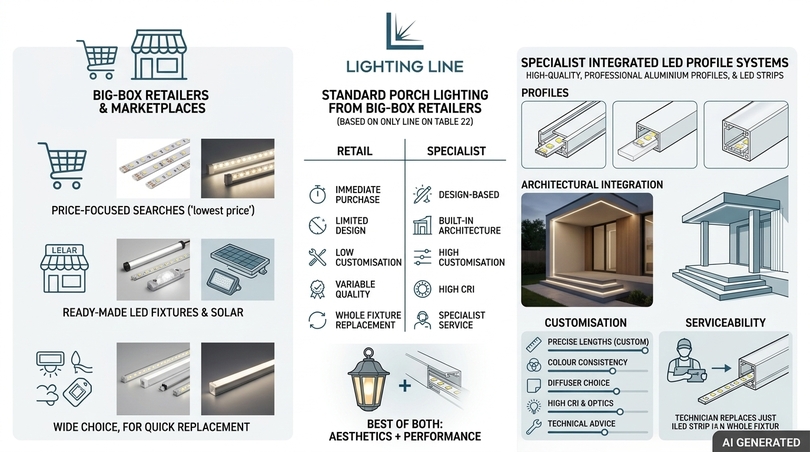
21. Frequently asked questions about porch lighting
Below you will find concise answers to the questions people ask most often about porch lighting, porch lights and outdoor home lights. Click on each question to open the answer.
What is the best lighting for a porch?The best porch lighting is layered, warm and glare-free: a concealed LED line in the porch ceiling or soffit to light faces and the floor, low-level light on steps, and an optional decorative lantern at low output. Choose 2700K to 3000K, CRI Ra>90, IP65 for exposed walls and IP67 for floors and steps. |
How bright should my porch light be?For a typical front porch, 600 to 1,200 lumens in total is usually enough, divided between layers. A small entrance often needs only 400 to 800 lumens. Decorative lanterns should stay around 150 to 450 lumens each to avoid glare. |
How many lumens do I need for a porch?Plan roughly 400 to 800 lumens for a small entrance porch, 600 to 1,200 lumens for a standard front porch, and 1,500 to 3,000 lumens (dimmable) for a covered porch or veranda used as a living space. |
What colour should a porch light be?Warm white between 2700K and 3000K is the best colour for most residential porches. It matches interior light, flatters natural materials, attracts fewer insects than cool white and is recommended by dark-sky guidance. Use 2200K to 2500K for heritage, rustic and ecologically sensitive settings. |
Are LED lights better for the outside?Yes. LEDs use at least 75% less energy than incandescent lamps, last many times longer, start instantly in cold weather, can be dimmed and controlled, and emit virtually no UV. With the correct IP rating they are the best choice for porch and outdoor lighting. |
Are LED porch lights good?Quality LED porch lights are excellent, provided you choose warm colour temperatures, high colour rendering (CRI Ra>90), the correct IP rating and good optics or diffusers to avoid glare and visible dots. |
Can IP65 lights be used outside?Yes. IP65 products are dust-tight and protected against low-pressure water jets, so they are suitable for most exterior walls and soffits exposed to rain. For floors, steps and areas where water can pool, choose IP67. |
Can you leave outdoor lights outside in the rain?Outdoor-rated lights (IP44 or higher, or wet-location listed in the US) are designed to stay outside in the rain. Make sure every connection is sealed, drivers are in a dry place and cables have drip loops. |
Should you leave your porch light on all night?The best practice is to run the porch light at a low level from dusk, with a motion sensor that boosts brightness when someone approaches, and optionally a curfew that dims it further late at night. Avoid leaving it on at full brightness all night or during daylight. |
Is it better to leave the porch light on or off at night?For most occupied homes, on at a low level with a motion boost is better than off, because it keeps steps safe and the entrance visible. In rural or dark-sky areas, motion-only operation is a good compromise. |
Do porch lights deter burglars?Porch lights can deter opportunistic burglars and package thieves by increasing the chance of being seen. Research on lighting and crime shows reductions when lighting improves visibility. Light works best combined with good locks, cameras and clear sightlines, and without glare. |
Do front porch lights deter crime?They help, as part of a wider security approach. Light faces and approaches, remove dark hiding spots and avoid glaring floodlights that blind neighbours and cameras. |
Does leaving a porch light on deter thieves?A light that follows a natural pattern (on at dusk, dimmed late, off at dawn) and reacts to movement is more effective than a light left on permanently, which can signal that nobody is home. |
Do porch lights use a lot of electricity?Not with LED. An 8 W LED porch light used 12 hours a night uses about 35 kWh a year, roughly 10 euros at 0.30 euros per kWh. A dimmed LED strip line can cost under 5 euros a year. |
How much does it cost to leave a porch light on 24/7?At 0.30 euros per kWh, an 8 W LED lamp left on 24/7 costs about 21 euros a year, while an old 60 W incandescent bulb costs about 158 euros a year. Check your own tariff for exact figures. |
How much does it cost to have a porch light installed?Costs vary widely by country, access and complexity. Replacing an existing fitting is usually a short job for an electrician, while a new circuit or an integrated LED profile scheme requires more planning and labour. Ask for a quote that separates products, labour and any building work. |
Are solar or LED outdoor lights better?Solar lights are LED lights powered by a panel and battery. They are convenient for garden accents, but mains-powered 24V LED porch lighting is brighter, more reliable in winter, offers better colour quality and integrates into architecture. |
Are solar lights worth it in the UK?For decorative garden accents and remote paths, yes, especially in spring and summer. For porch lighting that must work every night, including short winter days, a mains-supplied LED system is more dependable. |
How can I light my porch without electricity?Use solar porch lights, rechargeable battery LED lanterns or battery string lights. Expect lower brightness and limited winter performance compared with a wired low-voltage LED system. |
Can I put LED lights outside my house?Yes, as long as the products are rated for outdoor use and the location: IP65 for exposed walls, IP67 for floors and steps, with sealed connections and drivers in a dry place. |
Do I need an electrician to fit an outside light?In England and Wales, replacing an existing outdoor fitting on an existing circuit is generally not notifiable, but a new outdoor circuit is notifiable work under Part P and should be done by a registered electrician. All work must comply with BS 7671. Other countries have their own rules. |
Can I replace an outside light myself in the UK?A competent person can usually replace an existing outdoor light on an existing circuit, following BS 7671 and with the power isolated. If you are not confident, or a new circuit is needed, use a registered electrician. |
Can outdoor lights be plugged in outside?Yes, if the outdoor socket is weatherproof and RCD-protected (GFCI in the US) and all plugs, cables and extension leads are rated for outdoor use. For permanent porch lighting, a hardwired supply is preferred. |
Can neighbours complain about outside lights?Yes. In England and Wales, artificial light can be a statutory nuisance under the Environmental Protection Act 1990 if it unreasonably and substantially interferes with a neighbour’s use of their property. Aim light down, shield it, keep it warm and dim it late at night. |
Can I complain about neighbours’ bright lights?Yes. Talk to your neighbour first; if the problem continues, contact your local council’s environmental health team, which can investigate artificial light nuisance. |
Do porch light colours mean anything?Some colours are linked to awareness campaigns: green often signals support for veterans, blue support for police or autism awareness, purple domestic violence awareness, pink breast cancer awareness and red heart health awareness. Meanings vary by country and many people use colour simply for decoration. |
What does a green porch light mean?Most commonly, support for military veterans, particularly around Veterans Day in November in the US. |
What does a blue porch light mean?Usually support for law enforcement, or autism awareness, particularly in April. |
What does a red porch light mean at night?Usually a festive decoration or support for a cause such as heart health awareness. Older stereotyped meanings are largely outdated. |
What does it mean if someone has a pink porch light?Most often breast cancer awareness, especially in October. |
What does leaving the porch light on mean?Traditionally it signals welcome: someone is expected home, or visitors are welcome. At Halloween, a porch light on usually means trick-or-treaters are welcome. |
What is porch light etiquette?Light your entrance for visitors and deliveries, keep the house number visible, turn the light on at Halloween if you welcome trick-or-treaters, and avoid shining light into neighbours’ windows, especially late at night. |
What is the 5’7″ lighting rule?A rule of thumb that places the centre of a wall light beside a door at about 5 feet 7 inches (about 1.70 m) above the threshold, close to eye level. It is a starting point; concealed soffit lighting placed in front of the door often lights faces better. |
Where should porch lights be placed?Place functional light in the ceiling or soffit slightly in front of the door, on steps and thresholds, and on the door reveal. Place decorative lanterns beside or above the door, scaled to roughly one quarter to one third of the door height. |
What is the best porch light to keep bugs away?Warm light of 2700K or lower, or amber light, attracts fewer insects than cool white. Concealed downlight, motion sensors and keeping sources away from the door also help. |
What is the best lighting for a covered porch?Indirect ceiling light from a cove or recessed linear profile for ambience, a suspended linear light over any dining table, and low-level light on steps. Dimming and scenes make the space feel like an outdoor room. |
What is the best lighting for a screened porch?Indirect ceiling light that does not illuminate the mesh directly, warm colour temperatures and low-level light. Use IP65 or IP67 products wherever rain can blow through the screens. |
What is trending in outdoor lighting?Integrated linear LED in soffits, steps and handrails; warm 2700K and 2200K light; dark-sky friendly shielding; smart dimming with motion boost; high colour rendering; and brass, copper, galvanized and black finishes on decorative fixtures. |
What are common outdoor lighting mistakes?Using one very bright fixture, choosing cool white light, specifying the wrong IP rating, placing drivers where water runs, leaving visible LED dots, lighting the neighbours, having no control and forgetting to light the steps. |
Do porch lights need outdoor bulbs?Lamps used in outdoor fixtures should be suitable for the conditions and for enclosed fixtures if applicable, and the fixture must be outdoor rated. Integrated IP65 or IP67 LED strips avoid the issue because the light source and fixture are one system. |
Can LED strips be used for porch lighting?Yes. IP65 or IP67 LED strips installed in aluminium profiles with diffusers are one of the most versatile and architectural ways to light porches, steps, soffits, handrails and floors, with low running costs and excellent visual comfort. |
Which LED strip is best for outdoor porch lighting?A 24V COB strip rated IP67, warm white 2700K or 3000K, CRI Ra>90, at a moderate power such as 6 W/m, mounted in an aluminium profile. It gives a continuous, dot-free line with good durability and low consumption. |
22. Porch lighting: next steps
Porch lighting is small in area and large in impact. It shapes the first impression of a home, keeps people safe on steps and thresholds, supports security, and turns porches and verandas into living spaces after dark. The formula for excellent porch lighting in 2026 is consistent across every style and budget: warm light, concealed sources, clear layers, correct IP ratings and intelligent control.
For architects, integrated LED profiles are the tool that makes this formula buildable: recessed lines in soffits, floating steps, grazed walls, walkable floor lines, handrails and cast-in-concrete details, all from a coherent family of products. For homeowners, the same approach means lower running costs, fewer complaints, better photos and a house that looks cared for every evening.
To start your project:
- Explore the full range of aluminium profiles for LED strips.
- Choose outdoor-rated strips from the LED strip catalogue, filtering by IP65 or IP67.
- Start with the proven 2700K IP67 COB strip for traditional homes or the 3000K IP67 COB strip for contemporary architecture.
- Download the Profiles Catalog and Strip LED Catalog for your specification documents.
- Contact the LightingLine.eu technical team for help choosing the right combination for your porch.
This article was developed with the support of artificial intelligence and subsequently reviewed, corrected, and validated by the LightingLine.eu technical team, which guarantees its reliability and compliance with official sources.