
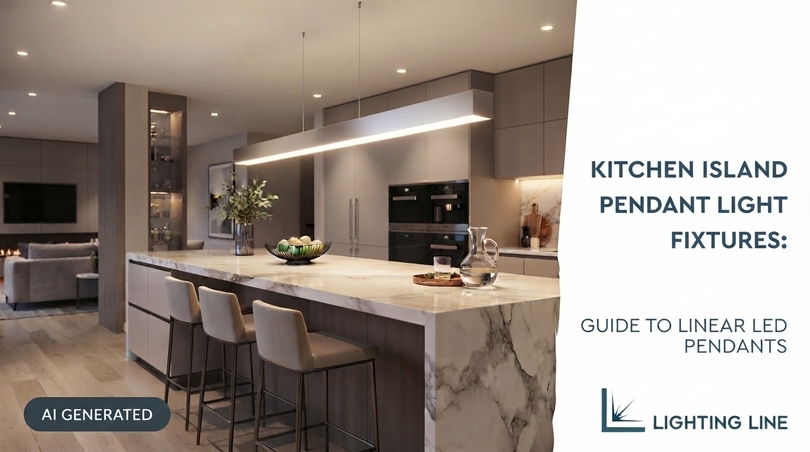
Kitchen island pendant light fixtures are suspended luminaires hung above a kitchen island to deliver focused task light on the worktop and define the island as the architectural centre of the room. In 2026 the strongest specification is a dimmable linear LED pendant with CRI 90+, 2700–3000K, hung 75–90 cm above the counter and layered with ambient and accent light.The kitchen island has become the most negotiated square metre in residential architecture. It is where clients chop, plate, work on laptops, help children with homework, pour wine for friends and lean while the coffee brews.
That single element carries the expectations of a professional workstation and a dining table at the same time, which is precisely why the choice of kitchen island pendant light fixtures is no longer a decorative afterthought chosen from a showroom wall. It is a lighting design decision with measurable consequences on visibility, energy use, comfort, maintenance and the long-term perception of the whole interior.This guide was written for architects, interior designers, kitchen studios and informed homeowners who want more than a list of pretty lamps.
We translate photometric data into practical rules, answer the questions people actually type into Google and ask AI assistants (“are pendant lights over an island out of style?”, “how many lumens do I need in my kitchen?”, “is 2700 or 3000 Kelvin better for a kitchen?”), and show how custom linear pendants built from aluminium LED profiles and high-CRI LED strips can outperform many off-the-shelf kitchen island lights in light quality, flexibility and cost per lumen. Every product mentioned links to the Lighting Line catalogue of aluminium profiles, where you can download datasheets, photometric tests and BIM files for Revit.We have kept the tone direct and the data first. Where we quote figures, they come either from recognised standards bodies, from the published photometric tests in our catalogue, or from worked calculations that you can repeat yourself. Where something is a matter of taste, we say so.
In this article…
- What kitchen island pendant light fixtures are and why they matter
- Are pendant lights over an island out of style? Trends for 2026
- Layered kitchen lighting: ambient, task, accent and decorative
- How bright should a kitchen be? Lumens, lux and rules of thumb
- Warm or cool light? Kelvin, CRI and the best LED colour for a kitchen
- Size, height, spacing and number of pendants
- Linear LED pendants with Lighting Line suspension profiles
- Ten avant-garde concepts architects can build with profiles and strips
- Choosing the LED strip: COB vs SMD, watts, efficacy and voltage
- Small kitchens, galley layouts, low and high ceilings, peninsulas and kitchens without an island
- Matching the style: modern, Scandinavian, industrial, rustic, art deco and luxury
- Smart kitchen lighting: dimming, sensors, DALI and tunable white
- Installation, safety and when you need an electrician
- Energy efficiency: LED vs halogen vs fluorescent
- Costs and budget planning
- Common kitchen lighting mistakes and how to avoid them
- Answers for chefs, designers, homeowners and older users
- The architect’s specification checklist
- The future of kitchen lighting
- Frequently asked questions
- Light the island like architecture
1. What kitchen island pendant light fixtures are and why they matter
Before talking about lumens and Kelvin, it is worth agreeing on vocabulary. Clients, contractors and search engines use dozens of names for the same object, and confusion at the briefing stage is the first source of disappointing results. This section defines the terms, explains the role of pendants within the overall kitchen lighting scheme and sets out why the island deserves its own lighting strategy.
What are hanging kitchen lights called?
The generic term is pendant: any luminaire that hangs from the ceiling on a cord, cable, rod or chain. Over an island you will also hear “drop lights”, “hanging lights over kitchen island”, “suspended kitchen lighting”, “island pendants” and, for larger multi-arm pieces, “kitchen island chandeliers”. In technical documentation and tenders the preferred phrase is suspended luminaire, and when the body is a long extruded bar it becomes a linear suspended luminaire or “linear pendant”. All of these belong to the family of kitchen island pendant light fixtures; the differences lie in shape, light distribution and how the light source is integrated.
Common names and what they usually mean
| Term clients use | What it usually describes | Typical light source |
|---|---|---|
| Pendant / drop light | Single shade on a cord | Replaceable LED lamp (E27, E14, GU10) or integrated LED |
| Island pendants (cluster) | Two to five matching shades in a row | Replaceable LED lamps |
| Linear pendant / bar light | One long fixture following the island | Integrated LED strip in an aluminium profile |
| Kitchen chandelier | Multi-arm or multi-element decorative piece | Several lamps or integrated LED modules |
| Island ceiling lights | Recessed or surface lights above the island instead of pendants | Downlights or recessed linear profiles |
Why kitchen island pendant light fixtures need their own lighting strategy
General ceiling light in a kitchen is designed to fill the room evenly. The island, by contrast, is a horizontal work surface, often 90 cm high, frequently used by people standing on both sides, and sometimes doubling as a dining table. Light that comes only from recessed downlights in the ceiling tends to put the user’s own head and shoulders between the source and the worktop, creating shadows exactly where knives and hands are moving. Kitchen island pendant light fixtures bring the source closer, reduce those shadows and allow a higher illuminance on the counter with fewer watts.
There is also an architectural argument. The island is usually the visual anchor of an open-plan kitchen-diner. Lighting above it defines a “room within the room”, lowers the perceived ceiling over the eating zone and gives scale to the furniture. Good lighting for kitchen islands therefore works on three levels at once: function, spatial definition and identity.
Benefits of good kitchen lighting, in measurable terms
The benefits of proper kitchen lighting are often described vaguely (“brighter”, “cosier”). It is more useful to state them as outcomes you can check on site:
- Visibility: sufficient illuminance on the worktop to read labels, judge doneness and cut safely.
- Colour fidelity: food, stone and timber that look as they do in daylight, thanks to a high colour rendering index.
- Visual comfort: no direct view of bright LED dots, controlled glare for seated diners, no harsh reflections on glossy surfaces.
- Flexibility: dimming and scene control so the same island works for breakfast, homework and dinner parties.
- Efficiency: lower installed watts and lower running costs over the life of the installation.
- Durability: fixtures that remain relevant when the next trend arrives, because their form follows function.
Off-the-shelf versus bespoke: high street, DIY stores and specified systems
Many clients begin their search for kitchen lights at large retailers. In the UK, people search for “b&q lighting”, “b&q kitchen lighting”, “b&q pendant lights” or “next kitchen lights”, in North America “kitchen lighting lowes” is a common starting point and image platforms such as Pinterest and HGTV-style makeover galleries feed the inspiration stage. These channels are useful for understanding a client’s taste and budget, and their ranges of ready-made kitchen ceiling lights and pendant lights for kitchen use are convenient for simple replacements.
Where specified systems make the difference is in dimensions, photometry and integration. A ready-made pendant comes in fixed lengths and diameters; a linear pendant built from an aluminium LED profile can be cut to the exact length of the island, fitted with the precise strip output required, and joined at angles to follow an L-shaped or rectangular layout. For architects, that means the luminaire is designed with the furniture rather than added to it. The rest of this guide shows how.
2. Are pendant lights over an island out of style? Kitchen lighting trends for 2026
Clients worry, reasonably, that a fixture bought today will look dated in five years. The honest answer is that pendants over islands are not disappearing; what is changing is their form, their light source and how they relate to the rest of the scheme. This section separates lasting principles from passing fashions.
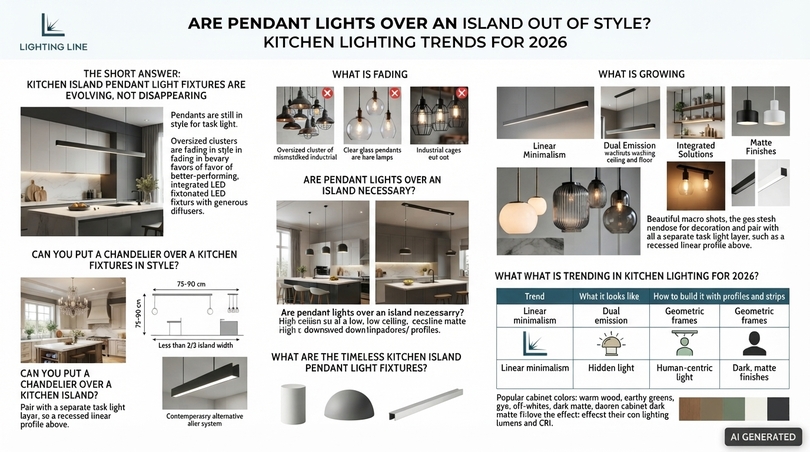
The short answer: kitchen island pendant light fixtures are evolving, not disappearing
Pendant lights over an island are still in style in 2026 because the functional reason for them has not changed: the worktop needs close, controllable task light. What is falling out of favour is the purely decorative approach, where three large shades were chosen for their look and then left to deliver uneven, glary light. Designers increasingly favour fewer, better-performing kitchen island pendants with integrated LED, generous diffusers and dimming.
What is fading
- Oversized clusters of mismatched shades that block sightlines across open-plan spaces.
- Clear glass pendants with exposed bare lamps, which create glare for seated diners.
- Industrial cages with filament lamps used as the only light over a working island.
- Fixtures that require obsolete lamp types, now difficult to buy in the EU.
What is growing
- Slim linear pendants that follow the island’s length and almost disappear when off.
- Dual-emission pendants that light the worktop downwards and wash the ceiling upwards.
- Pendants integrated with shelves, racks or acoustic panels.
- Warm, dimmable, high-CRI light and tunable white that follows the time of day.
- Matte finishes (black, white, natural aluminium) chosen to match handles, taps and frames.
Are glass kitchen island pendant light fixtures in style?
Glass pendants remain popular, especially opal, ribbed and smoked versions. The key is the glass type. Opal or frosted glass diffuses the source and reduces glare; clear glass shows the lamp and is best reserved for decorative accents rather than the main lighting over the kitchen island. If a client loves clear glass, pair it with a separate high-performance task layer, such as a recessed linear profile in the ceiling directly above the worktop, so the glass pieces can be dimmed down to a decorative glow.
Can you put a chandelier over a kitchen island?
Yes, you can put a chandelier over an island, and kitchen chandeliers are a recognised element of traditional, country and luxury kitchens. Three conditions apply:
- First: the chandelier must not obstruct sightlines or head movement: keep the bottom at least 75-90 cm above the worktop and check the view from the hob and the sink.
- Second: a chandelier rarely provides uniform task light, so plan a second layer for food preparation.
- Third: scale it to the island: as a rough guide, its width should be less than two thirds of the island width so it does not overhang the edges.
A contemporary alternative to the chandelier is a geometric frame of linear profiles joined with 90° horizontal junctions, which gives the same sense of occasion with far better light control.
Are pendant lights over an island necessary?
No, pendants are not strictly necessary. An island can be lit by recessed downlights, recessed linear profiles in a drywall ceiling or a surface-mounted linear system. Pendants become the best option when the ceiling is high, when the island is also used for dining, or when the client wants a visible design element. In low-ceilinged kitchens, or where the island sits in a main circulation route, a flush or recessed solution can be smarter. We cover these alternatives in Section 10.
What are the timeless kitchen island pendant light fixtures?
The fixtures that age well share three traits: simple geometry, honest materials and good light. A matte aluminium linear pendant, a plain opal cylinder or a well-proportioned dome in metal will look appropriate across several decades of kitchen styles. The most timeless kitchen lighting is the one people notice for the quality of the light rather than for the object itself. That principle is the reason linear LED profiles have become a staple of architectural kitchens: when the profile is the right length, colour and height, it reads as part of the architecture.
What is trending in kitchen lighting for 2026?
Across design fairs, kitchen studios and specification practice, the latest kitchen lighting trends converge on a handful of themes:
| Trend | What it looks like | How to build it with profiles and strips |
|---|---|---|
| Linear minimalism | One continuous line over the island, sometimes extending into the dining area | 60×73 mm suspended profilewith opal diffuser and COB strip |
| Dual emission | Light down on the worktop and up on the ceiling for a softer room | 50×75 mm profile with upper and lower diffusers |
| Geometric frames | Rectangles, L-shapes and hexagonal outlines hanging over the island | 36×75 mm modular profile with 90° and 120° junctions |
| Hidden light | Glowing plinths, under-cabinet lines and lit shelves with no visible source | Furniture profiles, baseboard profiles |
| Human-centric light | Cooler, brighter light in the morning, warm and dim at night | CCT COB strip 2700-6500K with a tunable-white controller |
| Dark, matte finishes | Black oxidised aluminium matching taps and frames | Black versions of the suspended profiles |
What cabinet colours and kitchen styles are popular now, and why it matters for lighting
People who ask whether pendants are outdated often also ask “what cabinet colour is outdated?” or “what is the most popular kitchen style now?”. Taste varies by market, but the direction in many European projects is towards warm wood, earthy greens and greys, off-whites and dark matte fronts, often combined with natural stone. Darker and matte finishes absorb more light, so a dark kitchen typically needs more lumens and a high CRI to keep its materials rich rather than muddy. Light colours reflect more and make a kitchen look bigger, which is why white kitchens can achieve the same perceived brightness with fewer fittings. We return to reflectance in the brightness section.
3. Layered kitchen lighting: ambient, task, accent and decorative
A single type of light can never do every job in a kitchen. The professional approach, used by lighting designers for decades and now expected by well-informed clients, is to build the scheme in layers that can be switched and dimmed independently. Kitchen island pendant light fixtures are one layer, usually the most visible one, but their performance depends on what surrounds them. This section explains each layer, the types of kitchen fixtures that serve it, and how LED profiles and strips can deliver every layer with one coherent language.
The four layers explained
| Layer | Purpose | Typical fixtures | Indicative target |
|---|---|---|---|
| Ambient (general) | Safe movement and overall brightness | Kitchen ceiling lights, recessed downlights, recessed linear profiles, indirect cove light | 100-300 lux on the floor |
| Task | Food preparation, cooking, cleaning, reading | Pendants over the island, under-cabinet lighting, light above the stove and over the sink | 300-500 lux on worktops (more for older users) |
| Accent | Highlight textures, open shelves, display cabinets | Lit shelves, glass cabinet lighting, wall grazers | 3-5 times the surrounding level on the object |
| Decorative / mood | Atmosphere, identity, night-time orientation | Plinth lights, toe-kick lines, statement pendants, kitchen chandeliers | Low levels, often 2200-2700K |
The most common failure in residential kitchens is relying on ambient light to perform task duties. Six or eight recessed spotlights evenly spread across a ceiling can make a room look bright in a photograph while leaving the worktops in the shadow of the cook’s body. Layering solves this by moving part of the light budget closer to where work happens.
Ambient lighting: kitchen ceiling lights done properly
Ambient light is the base. In a modern kitchen it is often delivered by recessed downlights, but there are better options when the ceiling allows. A continuous recessed profile set into plasterboard, such as those in the drywall profile range, produces a soft line of light that reads as a slot in the ceiling rather than a grid of dots. Indirect light from a cove or from the upper emission of a suspended profile bounces off the ceiling and reduces the contrast between bright fixtures and dark ceiling, which is one of the reasons kitchens lit this way feel calmer.
Are downlights still fashionable?
Downlights remain a sensible ambient tool, but the grid-of-spotlights look is no longer considered a complete design. If you use them, choose deep-recessed, low-glare models, place them in relation to the worktops rather than the room centre, and avoid putting them so close to wall cabinets that they create scalloped shadows on the doors. A good alternative to spotlights in the kitchen is a recessed linear profile running parallel to the worktop run, about 30–40 cm out from the wall cabinets, which lights both the counter and the cabinet faces.
Task lighting: where kitchen island pendant light fixtures earn their place
The task layer is where kitchen island pendant light fixtures, under-cabinet lighting and the lights above the hob and sink operate. Task light must be close, shadow-free and of high colour quality. Under wall cabinets, a slim surface profile fixed towards the front edge of the cabinet underside throws light onto the back of the worktop and the splashback; pick from the surface profiles or the corner profiles if you want the light angled at 45° towards the wall. Over the island, pendants or linear suspended profiles take the task role for the main work surface.
Accent lighting: telling the story of materials
Accent light picks out what makes the kitchen special: a fluted timber panel, a marble splashback, a collection of ceramics on open shelves. Accent light is where architects can differentiate a project at minimal cost, because a few metres of LED strip in a well-chosen profile transform the reading of a surface. The shelf aluminium profile integrates light into the front edge of a shelf, while the double emission profile for 18 mm shelves lights both the shelf below and the objects above.
Decorative and mood lighting
The last layer is about atmosphere. A warm line of light under the island plinth makes the island appear to float and provides gentle night-time orientation without waking the whole house. Statement pendants and kitchen chandeliers also belong here when they are chosen primarily for their presence. The best mood lighting for a kitchen is low, warm (2200-2700K) and indirect, so the source is hidden and only its effect is seen. The baseboard profileand the floor profiles are designed for exactly this.
A worked example of a layered scheme
Consider a 5 × 4 m open-plan kitchen with a 2.4 × 1.0 m island, wall cabinets along one side and a dining table near the window. A layered plan built entirely with aluminium profiles and LED strips could look like this:
| Zone | Layer | Solution | Control |
|---|---|---|---|
| Ceiling perimeter | Ambient | Recessed drywall profile, 3000K, CRI 90+ | Dimmable circuit 1 |
| Island | Task + ambient | Dual-emission 50×75 mm suspended profile, 2 m, 3000K | Down and up channels dimmed separately |
| Wall cabinets | Task | Surface profile under cabinets, front-mounted, 3000K | Circuit 3, motion or touch sensor |
| Open shelves | Accent | Shelf profiles, 2700K | Circuit 4 |
| Island plinth | Mood | Baseboard profile with warm COB strip, 2700K | Night scene, low level |
| Dining table | Task + mood | Shorter linear pendant matching the island profile | Dimmed independently |
Using the same profile family across zones gives visual coherence: the island pendant, the dining pendant and the ceiling lines read as one system. This is the architectural quality clients struggle to name but immediately recognise.
4. How bright should a kitchen be? Lumens, lux and rules of thumb
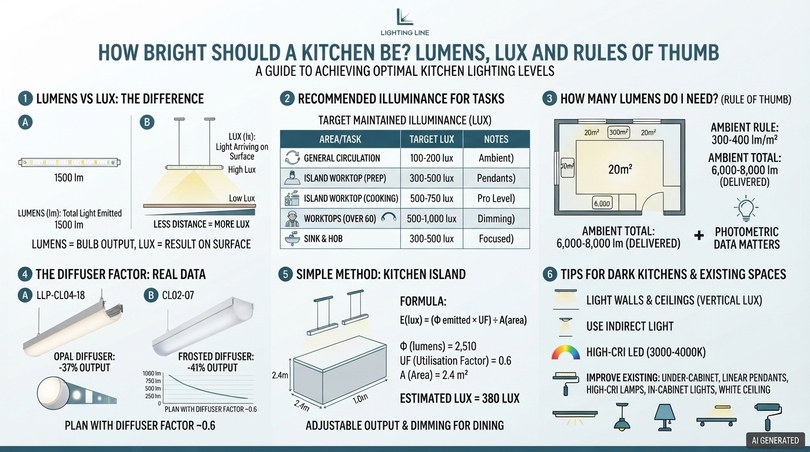
“How bright should a kitchen light be?” and “how many lumens do I need in my kitchen?” are among the most searched kitchen lighting questions, and they are frequently answered with numbers taken out of context. Brightness depends on the task, the surfaces, the age of the users and the distance between the source and the worktop. This section gives clear targets, explains the difference between lumens and lux, and provides a simple method to size the lighting above a kitchen island.
Lumens, lux and why the difference matters
Lumens (lm) measure how much light a source emits; lux (lx) measure how much light arrives on a surface, in lumens per square metre. Clients shop by lumens because that is what is printed on boxes, but the result they experience is lux on the worktop. A 1,500 lm pendant hung 70 cm above an island delivers far more lux on the counter than the same pendant hung 120 cm above it, because light spreads out with distance. That is why the height of kitchen island pendant light fixtures is as important as their output.
Recommended illuminance for kitchen tasks
Residential kitchens are not regulated like workplaces, but professional standards give useful benchmarks. The European standard EN 12464-1 for indoor workplaces sets maintained illuminance for commercial kitchens at 500 lux, and the guidance published by the Illuminating Engineering Society recommends higher levels for older occupants, whose eyes need considerably more light to perform the same task. In practice, the following ranges work well in homes:
| Area / task | Target maintained illuminance | Notes |
|---|---|---|
| General circulation in the kitchen | 100-200 lux | Floor level, from ambient layer |
| Island worktop, everyday food preparation | 300-500 lux | From pendants or linear suspension |
| Island worktop, serious cooking or professional chef at home | 500-750 lux | Aligns with commercial kitchen practice |
| Worktops for users over 60 | 500-1,000 lux | Use dimming so levels can be reduced in the evening |
| Sink | 300-500 lux | Focused light over the basin |
| Hob | 300-500 lux | Often from the extractor hood, supplemented if needed |
| Island used for dining | 150-300 lux | Dim the task layer down |
How many lumens do I need in my kitchen?
A quick rule of thumb used by many designers is to provide around 300-400 lumens per square metre of floor for general kitchen lighting (roughly 30–40 lumens per square foot), and an additional dedicated task layer over the worktops. For a 20 m² kitchen, that means roughly 6,000–8,000 lumens of ambient light, plus the task fixtures. These are delivered lumens from the fixture, not raw lumens of the LED chip: diffusers, reflectors and optics absorb part of the light, which is why photometric data for the complete luminaire matters.
The diffuser factor: real data from our photometric tests
Every diffuser costs light. Our own photometric tests, published on each product page, quantify it. For the60×73 mm suspended profile LLP-CL04-18, the opal diffuser reduces output by 37% and the satin diffuser by 38% compared with the bare strip. For the50×75 mm profile CL02-07, the lower opal diffuser costs between 39% and 40% depending on its position, and the frosted one between 41% and 43%. Planning with a diffuser factor of about 0.6 is therefore realistic for opal diffusers on suspended profiles, and it is the single most frequently forgotten number in DIY lighting calculations.
A simple method to size the lighting over a kitchen island
For quick feasibility checks, the average illuminance on the island can be estimated with the lumen method:
E (lux) ≈ Φ (lumens emitted by the luminaire) × UF ÷ A (worktop area in m²)
where UF is a utilisation factor that accounts for how much of the emitted light actually lands on the worktop. For a pendant hung 75-90 cm above an island with a mostly downward distribution, a UF of 0.5-0.7 is a reasonable assumption for a first estimate.
Worked example: a 2.4 × 1.0 m island
- Profile: 2 m 50×75 mm suspended profilewith lower opal diffuser.
- Strip: COB LED strip 2700K, CRI Ra>90, 10.5 W/m, 120 lm/W: about 1,260 lm per metre, so about 2,520 lm for 2 m.
- Diffuser loss: about 40%, so about 1,510 lm leave the profile downwards.
- Utilisation factor: 0.6.
- Worktop area: 2.4 m².
- Estimated average illuminance: 1,510 × 0.6 ÷ 2.4 ≈ 380 lux, before adding any ambient contribution from the ceiling.
That figure sits comfortably in the everyday preparation range. For a keen cook or an older client, specifying two strips in a wider profile, or a higher-output strip, pushes the island past 600 lux, and dimming brings it back down for dinner. For precise calculations at specific heights, use the lux calculation tool for the 50×75 mm profile or the equivalent tool on each product page.
How many lights do I need in my kitchen? Is it better to have 4 or 6 can lights?
The number of fixtures should follow the layout, not a fixed count. As a guide, recessed downlights for ambient light are usually spaced at roughly half the ceiling height apart; with a 2.6 m ceiling, that means about 1.2-1.5 m between centres. A typical 3 × 4 m kitchen might need four to six downlights for ambient light, but whether you choose four or six matters less than whether they are positioned in front of the worktops rather than over the middle of the floor. Over the island, one linear pendant or two to three round pendants is usually enough when correctly sized.
Do kitchen island pendant light fixtures give enough light?
Pendants alone rarely light a whole kitchen, and they are not meant to. Pendant lights give enough light for the island when they are specified for task output, but the perimeter worktops, the sink and the hob need their own sources. Decorative pendants with dark shades or small apertures may deliver only a few hundred lumens downward; in those cases, treat them as decorative and add a dedicated task layer. Are pendant lights enough for a kitchen? Only if the kitchen consists of nothing but an island, which is rarely the case.
What are the best lights for a dark kitchen?
Dark kitchens, whether due to small windows, north-facing orientation or dark finishes, benefit from three moves. First, raise vertical illuminance: light the walls and cabinet fronts, not just the floor, because people judge brightness by what they see at eye level. Second, use an indirect component, such as the upward emission of a dual-emission pendant, to light the ceiling. Third, choose high-CRI LED at 3000–4000K for the working hours and dim to warmer tones later. The brightest-feeling kitchens are not the ones with the most watts but the ones where walls and ceilings are lit.
How can I improve the light in my kitchen without a renovation?
Not every project is a new build. To get more light in an existing kitchen with minimal works:
- Add under-cabinet LED profiles; they can often be powered from a nearby socket circuit via a driver, subject to local regulations.
- Replace a single central ceiling light with a linear pendant over the island on the same point, if the position is suitable.
- Swap old fluorescent battens or halogen spots for LED solutions with higher CRI.
- Add light inside glass-fronted cabinets or on open shelves to increase perceived brightness.
- Paint the ceiling in a high-reflectance matte white.
5. Warm or cool light? Kelvin, CRI and the best LED colour for a kitchen
Colour is the topic that generates the most contradictory advice. Some sources say kitchens need daylight bulbs, others insist on warm white. Both are partly right, and the confusion comes from mixing two different properties: colour temperature, measured in kelvin, and colour rendering, measured by the CRI. This section untangles them and gives clear recommendations for kitchen island pendant light fixtures and every other layer.
Colour temperature in plain words
| Kelvin | Common name | Perception | Best use in a kitchen |
|---|---|---|---|
| 2200-2500K | Extra warm | Candle-like, intimate | Mood lighting, plinths, late-evening scenes |
| 2700K | Warm white | Cosy, residential | Dining-led islands, traditional and country kitchens |
| 3000K | Warm white / soft white | Warm but crisp | The most versatile choice for kitchens |
| 4000K | Neutral / cool white | Clean, energising | Task areas, very modern or professional kitchens, daytime |
| 5000-6500K | Daylight / cold white | Clinical, bluish | Rarely recommended in homes except as part of tunable white |
Is 2700 or 3000 Kelvin better for a kitchen?
For most kitchens, 3000K is the best balance: warm enough to feel residential, crisp enough to make whites look clean and food look fresh. 2700K suits kitchens that are primarily social spaces, with timber, brass and warm stone, or islands that double as dining tables. When a client cannot decide, tunable white strips such as the COB CCT strip 2700-6500K with CRI Ra>90let them choose 3500-4000K for morning work and 2700K for dinner.
Should a kitchen have warm or cool light? Is cool white or daylight better?
Cool light (4000K) is not wrong in a kitchen; it simply needs to be used where it helps. It improves alertness and contrast during daytime tasks and suits all-white, steel or concrete kitchens. Daylight (5000-6500K) is generally too blue for residential evenings and can make warm materials look flat. The rule we use: keep all fixtures visible in the same view at the same colour temperature, because mixing 2700K pendants with 4000K under-cabinet lights is one of the most noticeable mistakes in finished kitchens.
Colour rendering: the number that changes how food looks
The colour rendering index (CRI or Ra) describes how faithfully a light source reveals colours compared with a reference source; the concept and its limits are well documented, for example in the overview of the colour rendering index. A low-CRI source can make tomatoes look brownish, meat dull and marble greyish, even if the colour temperature is pleasant. For kitchens we recommend CRI Ra > 90 as a minimum, and all the COB strips referenced in this guide meet that threshold. Chefs often ask what type of lighting enhances the visibility of food preparation: the answer is high CRI first, adequate lux second, and correct colour temperature third.
What colour light is best for a kitchen, in one table
| Kitchen type | Recommended CCT | CRI | Suggested Lighting Line strip |
|---|---|---|---|
| Modern, white or grey | 3000K (4000K task optional) | >90 | COB 3000K |
| Warm wood, country, rustic | 2700K | >90 | COB 2700K 120 lm/W |
| Professional / chef’s kitchen | 3000–4000K | >90 | COB 4000K |
| Open-plan kitchen-diner | Tunable 2700–4000K | >90 | COB CCT |
| Older users | 3000K bright by day, dimmable | >90 | COB 3000K with higher W/m |
Do LED lights look good in a kitchen?
Early LED products deserved their reputation for harsh, bluish light and visible dots. Modern COB LED strips have changed that. COB technology places the chips so densely under a continuous phosphor layer that the strip produces a continuous, dot-free line of light even without a deep diffuser, with a beam close to 180°. Paired with an opal diffuser in an aluminium profile, the result looks like a single glowing bar, which is exactly what makes linear kitchen island pendant light fixtures look refined.
6. Size, height, spacing and number of kitchen island pendant light fixtures
Proportion is what separates a kitchen that feels designed from one that feels furnished. Pendants that are too small look timid: pendants that are too large dominate the room and obstruct the view, pendants that hang too low get bumped, while pendants that hang too high lose their task value and become glare sources. This section sets out the dimensional rules architects use, with metric and imperial values, and resolves the most common questions about centring and quantity.
How high should kitchen island pendant light fixtures hang?
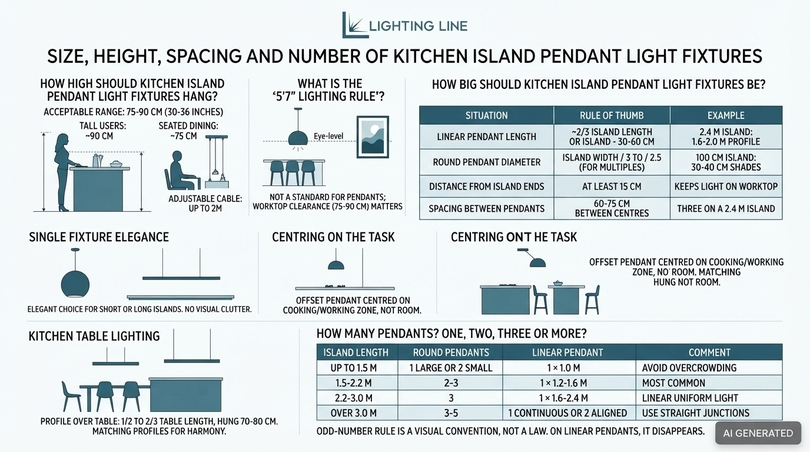
The accepted range is 75-90 cm (30-36 inches) between the worktop and the bottom of the fixture for standard ceiling heights of around 2.4-2.7 m. Within that range, adjust for the people and the use:
- Tall users or a standing-only island: towards 90 cm, so the fixture stays above the line of sight of someone standing opposite.
- Island used mainly for seated dining: towards 75 cm, to create intimacy and reduce glare for seated guests.
- High ceilings: many designers add roughly 7-8 cm (3 inches) per additional 30 cm of ceiling height above 2.4 m, while keeping the fixture within a reasonable distance of the worktop.
- Open-plan sightlines: check the view from the living area; a linear pendant at 85 cm can frame the view rather than block it.
Adjustable suspension kits make the final adjustment easy on site. The suspension kit with wire adjustable from the top (2 m cable) keeps the adjustment hidden at the ceiling canopy, while the kit adjustable from the bottom lets the installer level the profile from below, which is convenient on uneven ceilings.
What is the “5’7″ lighting rule”?
The figure 57 inches (about 145 cm) is widely used in galleries as the height for the centre of hung artwork, roughly average eye level, and it is sometimes repeated online as a “5’7″ rule”. It is not a standard for pendants. For kitchen island pendant light fixtures, what matters is clearance above the worktop (75-90 cm) and the line of sight of users, eye-level conventions are useful only to check that the pendant does not cut through the view of someone seated or standing on the far side.
How big should kitchen island pendant light fixtures be?
Several proportional rules circulate; the ones that work in practice are these:
| Situation | Rule of thumb | Example |
|---|---|---|
| Linear pendant length | About two thirds of the island length, or island length minus 30–60 cm | 2.4 m island: 1.6-2.0 m profile |
| Round pendant diameter | Island width in cm ÷ 3 to ÷ 2.5, for multiple pendants | 100 cm wide island: 30-40 cm shades |
| Single large pendant or chandelier | Less than island width minus 30 cm | 100 cm wide island: max about 70 cm |
| Distance from island ends | At least 15 cm from the ends to the outermost fixture edge | Keeps light on the worktop, not the floor |
| Spacing between multiple pendants | 60-75 cm between centres for medium shades | Three pendants on a 2.4 m island |
Can you have one of the kitchen island pendant light fixtures alone over an island?
Yes, and in many contemporary projects a single fixture is the most elegant choice. Single pendant lights for kitchen island use work in two ways. On short islands (under about 1.5 m), one generous round pendant centred on the island gives a strong focal point. On long islands, one linear pendant replaces a row of shades and provides more even light. A single linear pendant also simplifies the ceiling: one or two suspension points, one feed, and no visual clutter, which is why it is the default choice for minimal and luxury kitchens.
Are pendant lights supposed to be centred over the island?
Generally yes: centre kitchen island pendant light fixtures on the island’s long axis and divide the length symmetrically. There are justified exceptions. If the island has a hob or sink on one side and seating on the other, shift the fixture slightly towards the working side so the cook gets the most light. If the island is offset relative to the ceiling, centre on the island, not the ceiling; then use a ceiling canopy or a track to bring the feed to the right point. Lighting is centred on the task, not on the room.
How big should a light be over a kitchen table?
For a dining table next to the island, the same logic applies: the fixture should be roughly half to two thirds of the table’s length (for linear pendants) or about half its width (for round ones), hung 70-80 cm above the table surface. When the table and island are in the same view, specify matching or related profiles so they read as a family, for example a 2 m 60×73 mm profile over the island and a 1.2-1.5 m section of the same profile over the table.
How many kitchen island pendant light fixtures: one, two, three or more?
| Island length | Round pendants | Linear pendant | Comment |
|---|---|---|---|
| Up to 1.5 m | 1 large or 2 small | 1 × 1.0 m | Small kitchen island pendant light fixtures; avoid overcrowding |
| 1.5-2.2 m | 2–3 | 1 × 1.2-1.6 m | Most common residential range |
| 2.2-3.0 m | 3 | 1 × 1.6-2.4 m | Linear gives the most uniform light |
| Over 3.0 m | 3-5 | 1 continuous or 2 aligned sections | Use straight junctions for continuous runs |
The odd-number rule (three pendants look better than two or four) is a visual convention, not a law. On a linear pendant, the rule disappears entirely, which is another reason architects like it.
7. Linear LED pendants built with Lighting Line suspension profiles
This is the core of the guide for specifiers. A linear LED pendant is made of four elements: an aluminium extrusion that houses and cools the LED strip, a diffuser that shapes and softens the light, the LED strip itself, and the suspension and power system. Choosing each element deliberately produces modern kitchen island pendant light fixtures that rival premium designer pieces in light quality, while allowing exact sizing and finishes. Below we compare the three suspended profiles in the Lighting Line catalogue and explain when to use each.
Why aluminium profiles make better kitchen island pendant light fixtures
Aluminium is light, rigid over spans of two or three metres, and conducts heat away from the LEDs, which protects their lifetime and colour stability. An LED strip running inside a well-sized aluminium profile stays cooler, so it keeps its lumen output and colour for longer than a strip glued to wood or plastic. Profiles also give a clean architectural line, accept end caps in matching finishes, and can be joined to form shapes. Datasheets, photometric tests and BIM files for Revit are available for each extrusion, so the pendant can be modelled accurately in the project.
The three suspended profiles compared
| Feature | 36×75 mm (CL01-06) | 50×75 mm (CL02-07) | 60×73 mm (CL04-18) |
|---|---|---|---|
| Character | Modular, slim, for geometric compositions | Dual emission, highly configurable | Wide, generous light body |
| Strip capacity | Up to two 10 mm strips | PCB up to 30 mm | PCB up to 40 mm |
| Diffuser options | Diffuser and heat sink at two different levels | Upper: transparent, opal, semi-opal, frosted, 54° lens. Lower: opal or frosted in three positions | Opal or frosted |
| Measured diffuser loss | See product datasheet | Opal 39-40%, frosted 41-43% (lower diffuser) | Opal 37%, satin 38% |
| Lengths | See product page | 2 m and 3 m | 3 m |
| Finishes | See product page | Silver, white painted, black oxidised | Silver, white painted, black oxidised |
| Special feature | Structure for joining at different angles | Space for a slim power supply inside; optional heat sink | Optional internal aluminium bar |
| Best for | Rectangles, L-shapes, hexagons over islands | Islands needing up and down light | Long islands with a strong, uniform light line |
The 50×75 mm profile: dual emission for islands that light the whole room
The 50×75 mm suspended aluminium profile is the most versatile option for kitchen island pendant lighting. It accepts an upper diffuser and a lower diffuser, so it can carry two strips: one lighting the worktop and one washing the ceiling. The lower diffuser can sit in three positions (protruding, flush or recessed), which changes both the look and the light distribution, as shown in the photometric tests on the product page.
Why dual emission matters over an island
Up-light on the ceiling lowers the contrast between the pendant and its surroundings, reducing perceived glare and making the whole kitchen feel brighter without increasing the downward lux. On separate channels, the down-light becomes the task layer and the up-light becomes part of the ambient layer. In the evening, switching off the down channel and leaving the up channel at 30% creates a soft, indirect glow ideal for dinner.
Integrated power supply
The profile is designed to accommodate a slim power supply inside. This is a practical advantage over many off-the-shelf linear pendants: the ceiling canopy can stay small, and the feed can be a single mains cable. Always check the driver’s dimensions, thermal requirements and local electrical rules before integrating it.
Upper diffuser options and what they do
- Opal: maximum softness on the ceiling, no visible strip.
- Semi-opal: a compromise between efficiency and diffusion.
- Frosted: slightly higher efficiency, slight texture visible.
- Transparent: maximum output; acceptable when the strip is COB and not visible from below.
- 54° lens: concentrates the light, useful for a stronger beam or to reach high ceilings.
The 60×73 mm profile: the wide light body for long islands
The60×73 mm suspended profile has a broader face, which spreads the light over a wider emitting surface and reduces luminance, the “brightness per area” that the eye perceives as glare. With a PCB width up to 40 mm, it can carry wide or multiple strips for high output. On islands of 2.5 m or more, a 3 m length of this profile with an opal diffuser gives the calm, monolithic light line typical of high-end Italian kitchens. Matching black, white or greyend caps complete the look.
The 36×75 mm modular profile: geometry over the island
The 36×75 mm modular suspended profile is built to be joined. Its structure allows several profiles to meet at different angles, and it can hold diffuser and heat sink at two levels to tune the light effect, producing a continuous and homogeneous line. It accommodates up to two 10 mm LED strips. This is the profile to use when the design calls for a frame rather than a bar: a rectangle hovering above the island, an L that wraps from island to dining table, or a hexagon in a contemporary interior.
The junctions that make shapes possible
- Straight metal junction (LLM-AC01-M) for continuous runs longer than one profile.
- 90° horizontal junction (LLM-AC03-M) for rectangles and L-shapes.
- 120° horizontal junction (LLM-AC02-M) for hexagonal and faceted outlines.
- 90° vertical junction (LLM-AC04-M) for profiles that turn down a wall or drop vertically.
Suspension, mounting and accessories
Suspended profiles are hung using cable kits and, where needed, themounting spring for suspended profiles. As a guide, use at least two suspension points per profile, and add an intermediate point on long runs or when the profile carries a driver. Diffusers are available separately, for example the diffuser for LLP-XXXX-18 profiles and the diffuser for LLP-XXXX-07 profiles. For solder-free connections between strip segments, see the PCB LED strip connectors. Remember that LED strips, end caps, clips and accessories are sold separately from the profile, and lengths have a tolerance of ±2 mm.
Linear versus traditional kitchen island pendant light fixtures: an objective comparison
| Criterion | Linear LED profile pendant | Row of 3 decorative pendants | Kitchen chandelier |
|---|---|---|---|
| Light uniformity on the island | High | Medium (bright spots under each shade) | Low to medium |
| Glare control | High with opal diffuser | Depends on shade | Often low |
| Exact length to island | Yes, cut to size | No | No |
| Dual emission (up and down) | Yes (50×75 mm) | Rare | Sometimes |
| Number of ceiling points | 1-2 feeds | 3 | 1 |
| Colour quality | CRI > 90 COB strips | Depends on lamps | Depends on lamps |
| Visual weight | Low, architectural | Medium to high | High, decorative |
| Style longevity | High | Depends on design | Depends on style |
8. Ten avant-garde concepts architects can build with profiles and LED strips
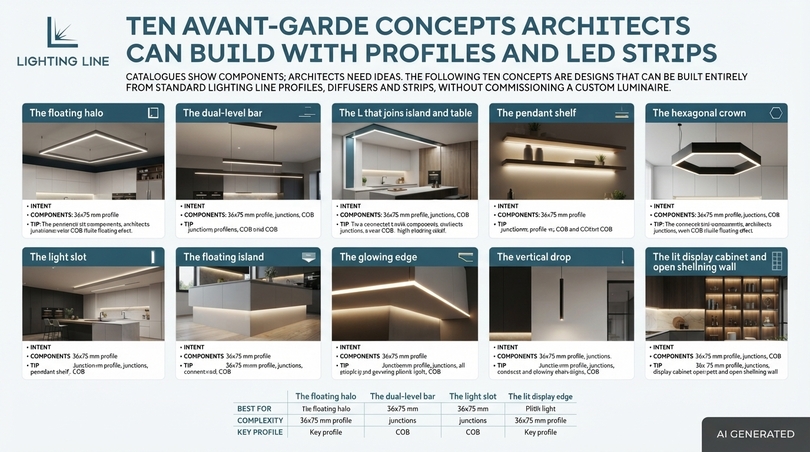
Catalogues show components; architects need ideas. The following ten concepts are designs that can be built entirely from standard Lighting Line profiles, diffusers and strips, without commissioning a custom luminaire. Each one includes the design intent, the components and a practical tip from installation experience. They range from minimal kitchen island lighting ideas to luxury statements, and several combine pendants with furniture to create integrated lighting furniture.
The floating halo: a rectangular frame over the island
Intent: a thin rectangle of light that echoes the island’s footprint, hovering above it like a drawn outline.
Components: four lengths of the 36×75 mm modular profile, four 90° horizontal junctions, opal diffusers, COB 3000K strip.
Tip: make the frame about 20-30 cm smaller than the island on each side so the light falls on the worktop, not on stool users’ heads. A frame lights the island from four directions at once, practically eliminating hand shadows.
The dual-level bar: task down, glow up
Intent: one linear pendant that does two jobs, perfect for kitchens without other ceiling lights.
Components:50×75 mm profile, upper opal diffuser, lower opal diffuser in recessed position, two COB strips on separate channels.
Tip: specify a cooler or brighter strip downwards (3000K at higher W/m) and a warmer, lower-power strip upwards (2700K). The ceiling becomes a large, warm reflector.
The L that joins island and table
Intent: a single line of light that runs along the island, turns 90° and continues over the dining table, uniting kitchen and dining in one gesture.
Components: 36×75 mm or 60×73 mm profiles, a 90° horizontal junction, two channels so the island and table sections can be dimmed independently.
Tip: keep both legs at the same height above their respective surfaces; if the table is lower than the island, use the vertical junction to create a step, turning a technical necessity into a design detail.
The pendant shelf: light plus storage
Intent: a suspended shelf over the island for herbs, glasses or cookbooks, lit underneath for task light and on top for display.
Components: a timber or metal shelf hung from the ceiling, fitted with thedouble emission profile for 25 mm shelves or the version for 18 mm shelves.
Tip: keep the shelf above 90 cm from the worktop and limit what it carries; it should feel like an object, not a cabinet. This is one of the most unusual kitchen lighting ideas that clients remember, and it brings the warmth of a country kitchen pot rack into a contemporary language.
The hexagonal crown for luxury kitchens
Intent: a faceted outline that replaces a chandelier in modern luxury kitchen island lighting.
Components: six lengths of 36×75 mm profile joined with120° junctions, black oxidised finish, warm 2700K COB.
Tip: a hexagon reads best on square or very wide islands; on long, narrow islands, consider two hexagons in sequence.
The light slot: recessed line instead of pendants
Intent: for low ceilings or minimal interiors, a recessed line in the ceiling directly above the island, aligned with its axis.
Components: a drywall profile plastered into the ceiling, or a recessed profile in a timber or MDF ceiling.
Tip: because the source is further from the worktop than a pendant, choose a higher-output strip. These island ceiling lights are the answer to “kitchen lighting ideas for low ceilings”.
The floating island: plinth light
Intent: make the island appear to hover by lighting the floor beneath its toe-kick.
Components:baseboard profileor a surface profile fixed under the plinth, warm COB strip. For areas exposed to mopping water, an IP-rated strip such as the IP67 COB 3000K in extruded silicone is a robust choice.
Tip: set it on a motion sensor at 10–20% for night-time, and the kitchen becomes safely navigable without switching on the main lights, a valuable feature for older users.
The glowing edge: light in the worktop overhang
Intent: a line of light under the overhang of the island where stools sit, adding depth and a sense of luxury.
Components: slim surface profiles or furniture profiles recessed into the underside of the overhang.
Tip: aim the light back towards the island body, not towards the users’ knees, and keep it dim; it is mood lighting, not task light.
The vertical drop: pendants that become columns
Intent: profiles that drop from the ceiling and turn horizontal over the island, forming a sculptural frame that connects floor-to-ceiling cabinets with the island.
Components: 36×75 mm profiles with 90° vertical junctions.
Tip: the vertical sections can be left unlit, so only the horizontal part over the island emits light; the shape remains readable even when switched off.
The lit display cabinet and open shelving wall
Intent: balance the island’s light with a vertical plane of light on the wall behind it, so the room does not look like a spotlight on a dark stage.
Components: shelf profiles, 15×29 mm wardrobe/cabinet profile for tall pantry units, wall profiles for grazing textured walls.
Tip: vertical light is what makes a kitchen feel bright; lighting one wall plane can do more for perceived brightness than doubling the downlights.
Summary of kitchen island pendant light fixtures concepts by project type
| Concept | Best for | Complexity | Key profile |
|---|---|---|---|
| Floating halo | Modern, square-ish islands | Medium | 36×75 mm + 90° junctions |
| Dual-level bar | Any island, kitchens without ceiling lights | Low | 50×75 mm |
| Island-to-table L | Open-plan kitchen-diners | Medium | 36×75 or 60×73 mm |
| Pendant shelf | Country, Scandinavian, chef’s kitchens | Medium | Double emission shelf profiles |
| Hexagonal crown | Luxury, high ceilings | High | 36×75 mm + 120° junctions |
| Light slot | Low ceilings, minimal design | Medium (ceiling works) | Drywall / recessed |
| Floating island | All styles, night lighting | Low | Baseboard + IP67 COB |
| Glowing edge | Islands with seating overhang | Low | Furniture / surface |
| Vertical drop | Statement architecture | High | 36×75 mm + vertical junctions |
| Lit wall | Dark or deep kitchens | Low to medium | Shelf, wall, wardrobe profiles |
9. Choosing the LED strip: COB vs SMD, watts, efficacy and voltage
The profile gives the form; the strip gives the light. Two pendants built from the same extrusion can perform completely differently depending on the strip inside. This section explains how to read a strip specification, which characteristics matter for kitchen island pendant light fixtures and how to choose between COB and SMD technologies. If you have ever wondered what is the best LED light for a kitchen, the answer starts here.
COB versus SMD
COB (chip on board) strips create a continuous, dot-free line of light with a wide beam angle close to 180°, which makes them ideal for shallow profiles and visible linear pendants. SMD stripsuse discrete LED packages; they can reach high efficacy and are excellent where the strip is hidden or where a deep diffuser is used. For island pendants with an opal diffuser, both work; for slim profiles or transparent diffusers, COB is the safer choice. Browse the full COB LED strip range.
Reading the specification
| Parameter | What it means | Recommendation for kitchen islands |
|---|---|---|
| W/m | Power per metre | 7-15 W/m for task pendants; 5-7 W/m for accent and mood |
| lm/W | Efficacy | As high as possible, 120 lm/W strips reduce running costs |
| CRI (Ra) | Colour rendering | > 90 |
| CCT | Colour temperature | 2700K, 3000K or tunable |
| Voltage | 12V, 24V, 48V or 230V | 24V is the usual balance of run length and safety |
| Cut point | Distance between cutting points | Shorter cut points give more precise lengths |
| IP rating | Protection against dust and water | IP20 inside closed profiles, IP65/IP67 near sinks and plinths |
| PCB width | Strip width | Must fit the profile: up to 30 mm in 50×75, up to 40 mm in 60×73 |
Selected strips for kitchen island pendant light fixtures
| Strip | Key data | Ideal use |
|---|---|---|
| COB 2700K 480 LED/m 24V 10.5 W/m 120 lm/W | CRI Ra>90, cut every 5 cm, IP20 | Main down-light in warm, efficient island pendants |
| COB 2700K 480 LED/m 24V 11 W/m | CRI Ra>90, cut every 5 cm | Warm task light with generous output |
| COB 2700K 24V 7.5 W/m with current control | Constant current along the run | Long continuous runs with uniform brightness |
| COB CCT 2700–6500K 600 LED/m 24V 7.7 W/m | CRI Ra>90, cut every 2 cm | Tunable white islands and human-centric lighting |
| COB 6000K 528 LED/m 24V 15.5 W/m | High output, CRI Ra>90 | Utility areas, pantries, technical zones |
| COB 3000K 6 W/m IP67 silicone tube, 3 mm PCB | Cut every 2.5 cm, IP67 | Plinths, near sinks, flexible decorative lines |
| COB 2700K 6 W/m IP67 silicone tube | Cut every 2.5 cm, IP67 | Warm mood lines and overhang lighting |
What is the brightest LED light for a kitchen?
Brightness in a linear system scales with W/m, efficacy and the number of strips. A single 15.5 W/m strip will emit more than a 6 W/m strip, two strips in a wide profile more still. But the brightest option is rarely the best one: aim for the right lux with dimming headroom, so the light can be turned down most of the time, extending LED life and improving comfort. Specifying 20-30% more output than needed, controlled by a dimmer, is a sound professional habit.
Voltage drop and long runs
Low-voltage strips lose voltage along their length, which can make the far end dimmer. On long islands or continuous island-to-table runs, feed the strip from both ends or the middle, use 24V or 48V rather than 12V, or choose a current-controlled strip. Planning the feed point is part of the design, not an afterthought for the electrician.
Drivers: the hidden component
Every low-voltage strip needs a power supply (driver) rated for its total wattage plus a safety margin, typically around 20%. Choose dimmable drivers compatible with the chosen control system (phase-cut, 0-10V, DALI, or wireless). For the 50×75 mm profile, a slim driver can sit inside the profile, otherwise place it in the ceiling void, in a canopy or in an accessible cabinet, always respecting ventilation and maintenance access.
10. Small kitchens, galley layouts, low and high ceilings, peninsulas and kitchens without an island
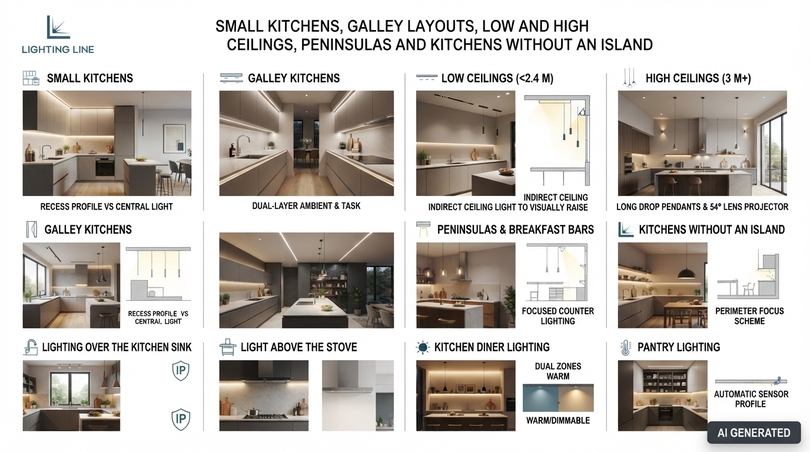
Most lighting guides assume a spacious kitchen with a generous island. Reality is more varied. Many searches concern small kitchen lighting ideas, galley kitchen lighting, kitchen lighting for low ceilings or kitchen lighting ideas without an island. The same principles apply, but the tools change. This section adapts the layered approach to these common situations.
Small kitchen island pendant light fixtures and small kitchens in general
In a small kitchen, every fixture is visible and every centimetre of headroom counts. Choose fewer, slimmer fixtures and push light onto vertical surfaces to make the room feel larger. A compact island or trolley can take a single 1 m linear pendant or one small round pendant. Under-cabinet lighting is essential, because in small kitchens the worktops are almost always under wall units. Light-coloured surfaces and continuous light lines along the cabinets visually extend the room.
What is the best light fitting for a small kitchen?
A flush or recessed linear profile running parallel to the main worktop, combined with under-cabinet strips, generally outperforms a single central ceiling light. It removes the cave effect created by one central fixture and wall cabinets that cast shadows.
Galley kitchen lighting
Galley kitchens have two parallel worktops and a corridor between them. The classic error is a single row of spotlights down the middle of the corridor, which puts the cook’s back between the light and the worktop. Instead, run two lines of light, one over each worktop edge, or use under-cabinet profiles on both sides and a soft central line for ambient light. Recessed profiles in a lowered ceiling or surface profileson an existing ceiling are both effective.
Kitchen lighting ideas for low ceilings
With ceilings under about 2.4 m, pendants over an island can feel oppressive and become an obstacle. Options include the recessed light slot, a surface-mounted linear profile, or a very short-drop pendant with a slim profile. For low ceilings, an indirect component is especially valuable: light on the ceiling visually raises it. A surface profile with a wide opal diffuser gives a soft, luminous ceiling line without lowering the headroom.
Kitchen lighting for high ceilings
High ceilings (3 m or more) invite statement kitchen island pendant light fixtures, but they also create two risks: pendants that float in the void without relating to the island, and ambient light that is lost before it reaches the floor. Use long suspensions to bring the pendant within 75-90 cm of the worktop, add up-light to reveal the ceiling volume, and consider the 54° lens upper diffuser of the 50×75 mm profile to project light more efficiently onto a distant ceiling.
Kitchen peninsula lighting and breakfast bar lighting
A peninsula is an island attached on one side. Light it as you would an island, but centre the fixture on the free part of the counter and respect the junction with the wall cabinets. Breakfast bar lighting ideas often aim at a more intimate effect: a shorter linear pendant or two small pendants at about 75 cm, warm 2700K, dimmable. For kitchen breakfast bar lights against a wall, a wall profile can light the counter from above without pendants.
Kitchen lighting ideas with no island
Without an island, the perimeter worktops become the focus. Combine under-cabinet lighting, a perimeter recessed or surface line for ambient light, and accent light on shelves or the splashback. A pendant over the dining table, if there is one, provides the visual centre that an island would otherwise give. Kitchen lighting without an island is not a lesser scheme, it simply moves the hero from the centre to the walls.
Lighting over the kitchen sink
Questions such as what is the best light for over the kitchen sink are frequent because the sink is often under a window, where there are no wall cabinets to hide a light. Options: a recessed profile in the ceiling directly above the basin, a small pendant at 75-90 cm above the sink edge, or a profile hidden in the window head or pelmet. Choose fixtures suitable for the humid environment, and if the strip is exposed to splashes, use an IP65 or IP67 product.
Light above the stove
The extractor hood usually provides light above the hob, but its built-in lamps are often weak or poorly coloured. A dedicated recessed line or a narrow profile on the underside of an adjacent cabinet can improve the situation. Never place strips where they are exposed to direct heat or grease, and keep the manufacturer’s clearances for the hood.
Kitchen diner lighting and dining lighting
In kitchen-diners, the lighting must support two different moods in one room. Separate the island and table circuits, dim the kitchen perimeter in the evening, and keep a consistent colour temperature or use tunable white across both zones. The best lighting for a dining area is warm, dimmable and positioned over the table, not over the room centre.
Pantry lighting ideas
Pantries and larder cupboards benefit from bright, neutral light that switches on automatically. A short profile with a door contact or motion sensor, fitted with a 4000K or 6000K strip, makes labels easy to read. Thewardrobe profileis designed to light the inside of tall units.
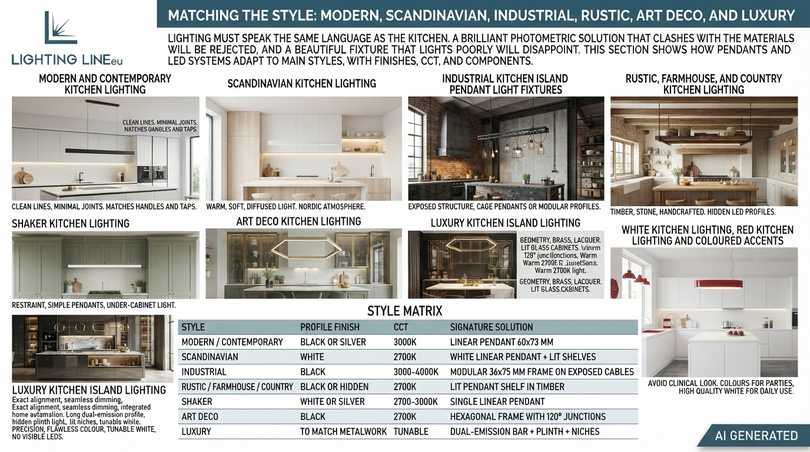
11. Matching the style: modern, Scandinavian, industrial, rustic, art deco and luxury
Lighting must speak the same language as the kitchen. A brilliant photometric solution that clashes with the materials will be rejected by the client, and a beautiful fixture that lights poorly will disappoint them every day. This section shows how kitchen island pendant light fixtures and linear LED systems adapt to the main kitchen styles, with finishes, colour temperatures and component choices for each.
Modern and contemporary kitchen lighting
Modern kitchen island pendant light fixtures favour clean lines, minimal joints and integrated light sources. A linear profile in matte black or natural aluminium, opal diffuser, 3000K, suspended on fine cables, is the archetype. In contemporary kitchens the light should look intentional when on and almost invisible when off. Match the profile finish to handles and tap: black oxidised for black fittings, silver for stainless steel, white painted for handle-less white fronts.
Scandinavian kitchen lighting
Scandinavian kitchens use pale wood, white walls and soft textiles. The light should be warm (2700K), soft and diffused. A white painted linear pendant above a light oak island, combined with lit open shelves, delivers the calm, bright atmosphere typical of Nordic interiors, where long winters have made good artificial light a cultural priority.
Industrial kitchen island pendant light fixtures
Industrial kitchens draw on factories and lofts: concrete, steel, exposed brick. Industrial style lighting for a kitchen used to mean cage pendants with filament lamps. A more performant route is a black profile with a visible structure, such as the 36×75 mm modular profile, suspended on exposed cables, or a profile set into concrete using the concrete profile. Neutral 3000–4000K suits these materials.
Rustic, farmhouse and country kitchen lighting
Rustic kitchen island lighting, farmhouse kitchen lighting and country kitchen lighting ideas share a love of timber, natural stone and handcrafted detail. Wooden kitchen light fixtures, enamel shades and pot racks are typical. LED profiles fit these interiors when they are hidden: under timber beams, inside a suspended wooden rack, beneath open oak shelves. The pendant shelf concept (8.4) built from reclaimed timber with a double emission profile is an elegant bridge between tradition and technology. Keep to 2700K and CRI above 90 to bring out the grain of the wood.
Shaker kitchen lighting
Shaker kitchens rely on simple panelled doors and restraint. Lighting should follow the same restraint: one simple pendant or linear fixture over the island, under-cabinet lighting, and nothing superfluous. White or natural aluminium finishes complement painted Shaker fronts in sage, navy or off-white.
Art deco kitchen lighting
Art deco kitchens revive geometry, brass and lacquer. Geometric frames built with 120° junctions, warm 2700K light and a careful contrast between dark and luminous surfaces echo the style without imitation. Pair them with lit glass display cabinets for drama.
Luxury kitchen island lighting and luxury kitchen island pendant light fixtures
Luxury kitchen island lighting is defined less by price than by precision: exact alignment with the island, flawless colour, no visible LEDs, seamless dimming, integration with home automation. Modern luxury kitchen island lighting often combines a long dual-emission profile, hidden plinth light, lit niches and tunable white controlled by scenes. In high-end projects, the quality of dimming at low levels is as important as maximum brightness: a light that flickers or steps at 5% betrays the whole scheme.
White kitchen lighting, red kitchen lighting and coloured accents
White kitchens reflect light generously, so they can look clinical if lit too coolly: 3000K keeps them inviting. Coloured accents, such as red kitchen lighting fixtures or yellow kitchen lights, are a matter of taste, RGB or RGB+CCT strips allow colour for parties while keeping high-quality white for daily use. Use colour as a temporary effect, not as the base light for food preparation.
Style matrix
| Style | Profile finish | CCT | Signature solution |
|---|---|---|---|
| Modern / contemporary | Black or silver | 3000K | Linear pendant 60×73 mm |
| Scandinavian | White | 2700K | White linear pendant + lit shelves |
| Industrial | Black | 3000-4000K | Modular 36×75 mm frame on exposed cables |
| Rustic / farmhouse / country | Black or hidden | 2700K | Lit pendant shelf in timber |
| Shaker | White or silver | 2700-3000K | Single linear pendant |
| Art deco | Black | 2700K | Hexagonal frame with 120° junctions |
| Luxury | To match metalwork | Tunable | Dual-emission bar + plinth + niches |
12. Smart kitchen lighting: dimming, sensors, DALI and tunable white
Control is what turns good fixtures into a good lighting system. Interior designers ask how to incorporate smart lighting into kitchen designs, homeowners ask how to control kitchen lights remotely and whether there are affordable smart options, older users want lights that switch on by themselves. This section maps the main control technologies and shows how they work with LED profiles and strips.
Dimming: the first and most important control
If a client can afford only one control upgrade, it should be dimming of the island lighting. Dimming allows the island to move from 500 lux for preparation to 150 lux for dining, prolongs LED life and reduces energy use. LED strips are dimmed through their driver, the driver and the dimmer must be compatible. Common methods include phase-cut (trailing edge) dimming of suitable drivers, 0–10V, PWM controllers on the low-voltage side and digital protocols.
DALI and professional control
DALI (Digital Addressable Lighting Interface) is an international standard for digital lighting control, widely used in commercial buildings and increasingly in high-end homes, the DALI Alliance maintains the specifications and certification. DALI allows each fixture or group to be addressed individually, scenes to be stored, and tunable white to be controlled precisely. For architects specifying a kitchen within a larger home automation system, DALI drivers for the LED strips make integration straightforward.
Wireless and app-based control
For renovations where new control wiring is impractical, wireless controllers for LED strips (Bluetooth mesh, Zigbee or Wi-Fi) allow app and voice control. They are the most affordable smart kitchen lighting route for homeowners and can be installed between the driver and the strip. Check compatibility with the client’s ecosystem and prefer systems that still work with a physical wall switch, so guests are not left in the dark.
Motion sensors and automatic control
Motion and presence sensors are ideal for under-cabinet lights, plinths, pantries and night-time orientation. For older users, automatic night lighting at floor level is one of the most effective safety measures in the home. Configure sensors with a short delay and low level at night, and a manual override for the main lights.
Tunable white and human-centric lighting
Tunable white strips such as the COB CCT 2700-6500K contain two sets of LEDs, warm and cool, mixed by the controller. A typical day profile might be 4000K and bright in the morning, 3500K at midday, 3000K in the afternoon and 2700K or lower at dinner. This approach, often called human-centric lighting, aims to support the body’s natural rhythm; research in this area is ongoing, and organisations such as the International Commission on Illumination (CIE) publish guidance on non-visual effects of light.
Lighting scenes for kitchen island pendant light fixtures
| Scene | Island down-light | Island up-light | Under-cabinet | Plinth | CCT |
|---|---|---|---|---|---|
| Morning | 80% | 60% | 80% | Off | 3500-4000K |
| Cooking | 100% | 50% | 100% | Off | 3000K |
| Homework / laptop | 60% | 60% | 40% | Off | 3500K |
| Dinner | 30% | 30% | 10% | 30% | 2700K |
| Night | Off | Off | Off | 10% on sensor | 2200-2700K |
13. Installation, safety and when you need an electrician
Questions like do I need a qualified electrician to change a light fitting? and how can I install smart kitchen lighting myself show that many homeowners want to do part of the work. Some tasks are reasonable DIY, others legally and practically require a professional. This section sets out good practice for installing kitchen island pendant light fixtures and LED systems safely, without replacing the advice of a qualified installer or local regulations.
Do you need an electrician to change a light fitting?
Rules differ by country. In the UK, electrical work in homes falls under Part P of the Building Regulations in England and Wales, some minor work, such as replacing a light fitting like-for-like on an existing circuit, may not be notifiable, while new circuits and certain other works are. Other European countries have their own rules. Our recommendation is clear: any work on mains voltage, new ceiling points, or new circuits should be carried out by a qualified, registered electrician, who can also certify the work. Low-voltage work on the strip side of a correctly installed driver is less risky, but still demands care.
Professional installation sequence for linear kitchen island pendant light fixtures
- Survey: confirm ceiling structure, position of joists, feed location and island axis.
- Fixings: install suitable anchors for each suspension point, rated for the weight of profile, strip, diffuser and driver.
- Power: bring the mains feed to the canopy or driver location, install the driver in an accessible, ventilated position or inside the profile where designed for it.
- Strip: cut the strip at marked cut points, connect with solder or PCB connectors, fix it to the clean profile or heat sink.
- Diffusers and end caps: fit the diffuser in the chosen position, then the end caps.
- Suspension: hang the profile, level it, set the final height (75–90 cm above the worktop).
- Testing: test full output, dimming range, colour consistency and the absence of flicker.
Safety tips for kitchen lights
- Never install LED strips in contact with heat sources or above hobs without adequate clearance.
- Use IP65/IP67 strips where water splashes are possible, such as near sinks or at floor level.
- Respect the driver’s maximum load; leave about 20% headroom.
- Ensure drivers are accessible for maintenance and not buried in sealed voids.
- Use certified components and keep documentation for the client.
- Check that suspension fixings can bear the full load, especially on plasterboard ceilings.
DIY kitchen lighting: what is reasonable
For confident DIYers, plug-in under-cabinet kits, low-voltage strips connected to a pre-installed driver, and wireless controllers are realistic projects. Wiring a new ceiling point for an island pendant is not. Upgrading existing kitchen lighting step by step, starting with under-cabinet and shelf lighting, is the safest DIY path and delivers immediate improvements in visibility.
How much do electricians charge to install a light?
Costs vary considerably by region, accessibility of the ceiling, need for new circuits and certification. Rather than relying on national averages, request at least two written quotes that specify the scope: new point or replacement, driver installation, dimming, testing and certification. Providing the electrician with the profile datasheet, such as the LLP-CL02-07 datasheet, reduces uncertainty and often the price.
14. Energy efficiency: LED vs halogen vs fluorescent kitchen lighting
Energy efficiency is no longer a niche concern; it is a regulatory reality and a running-cost argument that clients understand immediately. Questions such as “is LED or fluorescent kitchen lighting better?”, “what is the most economical kitchen light?” and “what is the best replacement for kitchen fluorescent lights?” have clear answers. This section explains them with a worked calculation.
Regulation: why LED is now the default in Europe
In the European Union, the ecodesign requirements for light sources (Regulation (EU) 2019/2020) and the end of RoHS exemptions have progressively removed most halogen lamps and, from 2023, compact and linear fluorescent lamps from the market. For new kitchens in Europe, LED is not just the efficient choice; it is effectively the only mainstream choice. TheU.S. Department of Energy’s LED lighting guidance reaches similar conclusions on efficiency and lifetime for North American users.
Technology comparison
| Technology | Typical efficacy | Typical life | Dimming | Heat | Status in EU |
|---|---|---|---|---|---|
| Halogen | About 12-20 lm/W | About 2,000 h | Easy | High | Largely phased out |
| Linear fluorescent (T5/T8) | About 70-100 lm/W | About 15,000-20,000 h | Limited | Medium | Phased out from 2023 |
| Compact fluorescent | About 50-70 lm/W | About 8,000-10,000 h | Poor | Medium | Phased out |
| LED strip in profile | Up to about 120 lm/W (strip), depending on product | Long, depending on thermal management | Excellent | Low | Standard |
Worked example: halogen vs LED kitchen island pendant light fixtures
Assume an island lit four hours a day, 365 days a year, and an electricity price of €0.30 per kWh (adjust to your local tariff).
| Solution | Installed power | Annual energy | Annual cost |
|---|---|---|---|
| 3 halogen pendants × 50 W | 150 W | about 219 kWh | about €66 |
| 2 m linear pendant, COB 10.5 W/m, plus about 10% driver losses | about 23 W | about 34 kWh | about €10 |
| Difference | about 127 W less | about 185 kWh saved | about €56 saved per year |
The LED solution in this example also delivers higher CRI and better uniformity. Over ten years the saving on the island alone is in the region of €550 at current prices, before considering lamp replacements and reduced cooling load in summer.
What is the best replacement for kitchen fluorescent lights?
Old fluorescent battens over worktops or under cabinets can be replaced by surface LED profiles of the same length. The result is typically thinner, dimmable, flicker-free with a good driver, and with markedly better colour rendering. For ceiling battens, a surface profile with an opal diffuser or a recessed profile in a new plasterboard ceiling gives a cleaner line.
Sustainable kitchen lighting tips
- Specify high-efficacy strips and run them dimmed; output headroom equals efficiency headroom.
- Use sensors in pantries, cupboards and plinths.
- Prioritise light on surfaces where it is used, rather than lighting the whole room uniformly.
- Choose aluminium profiles: aluminium is widely recyclable and the profile can outlive several strip upgrades.
- Design for maintenance: replaceable strips and accessible drivers extend the system’s life.
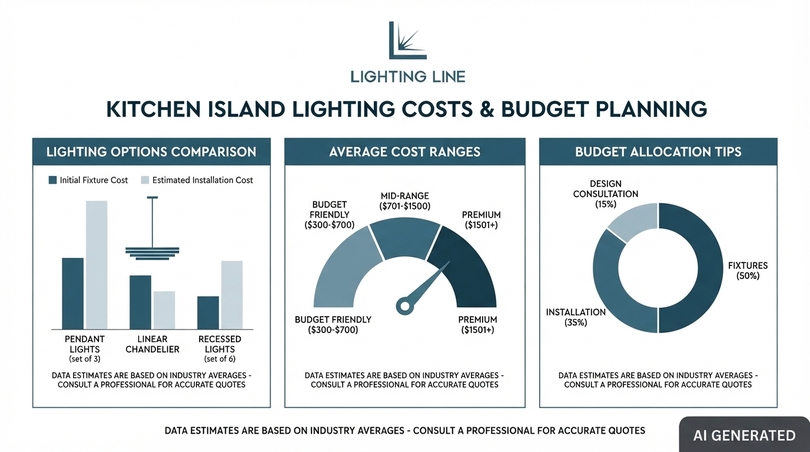
15. Costs and budget planning for kitchen island lighting
“What is a realistic budget for kitchen lighting?” and “what is the cheapest way to light a kitchen?” are practical questions that deserve practical answers. Prices vary by market, finish and installation complexity, so instead of quoting figures that age quickly, this section offers a budgeting framework and the relative costs of the main options.
Where the money goes
| Item | Share of a typical kitchen lighting budget | Comment |
|---|---|---|
| Fixtures and components | Largest share | Profiles, strips, diffusers, drivers, pendants |
| Installation | Significant | Higher with new circuits or ceiling works |
| Controls | Small to significant | From simple dimmers to full DALI systems |
| Design and calculation | Small | Prevents costly mistakes |
As a broad orientation, many designers allocate a meaningful percentage of the overall kitchen budget to lighting; agree a figure early with the client so lighting is not squeezed at the end, when the cabinets have absorbed everything.
What is the cheapest way to light a kitchen well?
The cheapest effective kitchen lighting is a combination of under-cabinet LED profiles and one well-specified island fixture, both dimmable. This delivers task light where it is needed with relatively few metres of strip. Adding ceiling works or multiple circuits increases cost; adding them later, after the plaster is painted, increases it far more. Cheap kitchen lights with low CRI and poor drivers are a false economy: they flicker, shift colour and are often replaced within a few years.
Cost comparison of kitchen island pendant light fixtures and alternatives
| Option | Relative component cost | Relative installation cost | Light quality | Flexibility |
|---|---|---|---|---|
| Off-the-shelf pendants from a DIY store | Low | Low | Variable | Low |
| Designer-brand pendants | High to very high | Low to medium | Good to excellent | Low |
| Linear pendant from aluminium profile and COB strip | Medium | Medium | Excellent (CRI > 90) | High (exact length, shapes) |
| Recessed drywall profiles | Medium | Medium to high | Excellent | High |
| Full layered system with DALI | Medium to high | High | Excellent | Very high |
For a quote tailored to a specific project, the Lighting Line technical team can help select components, use the contact page and attach the kitchen plan and ceiling height.
16. Common kitchen lighting mistakes and how to avoid them
Most disappointing kitchens are not the result of bad products but of predictable planning errors. Recognising them early saves money and protects the architect’s reputation. Here are the mistakes we see most often in projects and site visits, including the classic errors with recessed lighting.
The ten most common mistakes
| Mistake | Consequence | Fix |
|---|---|---|
| Grid of downlights over the room centre | Shadows on worktops | Place lights in front of worktops; add task layers |
| Pendants hung too high | Glare and weak task light | 75-90 cm above the worktop |
| Pendants hung too low | Obstructed views, head bumps | Check sightlines from all positions |
| Mixed colour temperatures | Patchy, unprofessional look | One CCT per view or tunable white |
| Low CRI | Dull food and materials | CRI Ra > 90 |
| No dimming | One mood only, wasted energy | Dim at least the island and perimeter |
| Under-cabinet strip at the back | Reflections on glossy splashback, shadows at front | Mount towards the front of the cabinet |
| Visible LED dots | Cheap appearance, reflections in stone | COB strips and opal diffusers |
| Forgetting driver location | No maintenance access | Plan accessible driver positions |
| Ignoring diffuser losses | Less light than expected | Use measured diffuser factors (about 0.6 for opal) |
What are the mistakes with recessed lighting in kitchens?
Beyond the grid problem, recessed lights are often placed too close to wall cabinets (creating harsh scallops on doors), too far from them (lighting the floor instead of the counters), or in mixed sizes and beam angles. Align recessed lights with the worktop edge, about 30-40 cm out from the wall cabinet face, and use consistent beam angles. Or replace them with a recessed linear profile for a continuous effect.
What is the rule of thumb for kitchen lighting?
If you remember only one rule, make it this: light the surfaces where people work and the walls they look at, then add atmosphere. Every other rule in this guide, from pendant height to CRI, is a refinement of that principle.
17. Answers for chefs, interior designers, homeowners and older users
Different people approach kitchen lighting with different priorities. A chef thinks in terms of visibility and speed, a designer in terms of trends and client satisfaction, a homeowner in terms of ease and cost, an older person in terms of comfort and safety. This section gathers the most typical questions of each group and answers them with direct, actionable recommendations.
For chefs and serious home cooks
What are the best lighting options for a professional kitchen?
Professional practice favours high, uniform illuminance (around 500 lux and above on preparation surfaces), CRI above 90, neutral to warm white (3000-4000K), and fixtures that are easy to clean. In a home chef’s kitchen, a long linear pendant over the island with a high-output COB strip, plus under-cabinet profiles on every worktop, reproduces these conditions.
What type of lighting enhances the visibility of food preparation?
High-CRI, shadow-free light from more than one direction. A linear pendant or a rectangular frame over the island lights the worktop from both sides of the cook’s hands, while high CRI reveals the true colour of ingredients.
How do I choose the right brightness?
Target 500-750 lux on preparation areas, with dimming down to 150–300 lux for service and dining. Use the lux calculation tools on each profile page to check the result at your chosen height.
For interior designers
How do I create a layered lighting scheme in a kitchen?
Start with task layers (island, worktops, sink, hob), then ambient (ceiling lines or indirect light), then accent (shelves, cabinets, walls) and finally mood (plinths, overhangs). Assign each layer to its own dimmable circuit or control channel. The worked example in Section 3.6 is a ready template.
What are the best fixtures for modern kitchen lighting?
Linear suspended profiles, recessed drywall profiles and furniture-integrated light. They let you design light as part of the joinery and architecture rather than as a separate object.
Which lighting options are best for small kitchen spaces?
Under-cabinet profiles, slim surface lines and a single compact pendant or none at all. Light vertical surfaces to enlarge the room visually.
For homeowners
What is the best way to upgrade existing kitchen lighting?
Start with under-cabinet LED profiles, then replace the island fixture with a dimmable linear pendant, then add accent light. Each step is independent and brings visible results.
Are there affordable smart lighting options for kitchens?
Yes: wireless LED strip controllers connected between driver and strip allow app and voice control at modest cost, without new wiring.
What are the most energy-efficient kitchen lights?
High-efficacy LED strips (up to about 120 lm/W) in aluminium profiles, used with dimming and sensors.
For retired and older users
What are the best lighting options for an older kitchen and older eyes?
Older eyes need more light, more contrast and less glare. Provide higher illuminance on worktops (500 lux and above), use opal diffusers to avoid glare, keep colour temperature around 3000K, and add automatic night lighting at floor level. Even, glare-free light is a safety feature: it helps people judge edges, read labels and avoid falls.
Are there easy-to-install solutions for seniors?
Plug-in under-cabinet kits with motion sensors and wireless controls with simple wall buttons are the easiest. Avoid systems that depend only on smartphone apps.
What type of lighting is best for cooking and cleaning?
Bright, high-CRI task light at worktops and sink, with no shadows from the user’s body: under-cabinet profiles plus a linear island pendant.
18. The architect’s specification checklist for kitchen island pendant light fixtures
Before issuing drawings or ordering components, run through this checklist. It condenses the guide into the decisions that must be documented, and it can be attached to the lighting schedule for the contractor.
| # | Decision | Recommended default | Documented? |
|---|---|---|---|
| 1 | Island dimensions and use (prep, dining, both) | Confirm with client | ☐ |
| 2 | Fixture type (linear, round, frame, recessed) | Linear for islands over 1.8 m | ☐ |
| 3 | Profile model and finish | 50×75 mm dual emission or 60×73 mm | ☐ |
| 4 | Diffuser type and position | Opal, account for about 40% loss | ☐ |
| 5 | Strip: W/m, lm/W, CCT, CRI | COB, CRI > 90, 3000K | ☐ |
| 6 | Target lux on worktop | 300-500 lux (500+ for chefs/older users) | ☐ |
| 7 | Mounting height | 75-90 cm above worktop | ☐ |
| 8 | Suspension kit and points | At least 2 per profile, top or bottom adjustable | ☐ |
| 9 | Driver: power, dimming protocol, location | 20% headroom, accessible | ☐ |
| 10 | Control and scenes | Dimming minimum, scenes for prep/dinner/night | ☐ |
| 11 | Coordination with other layers | Same CCT in the same view | ☐ |
| 12 | BIM model and datasheets | Download from product pages | ☐ |
Useful resources: the comparative profile range, the profiles catalogue, the LED strip catalogue and the BIM file of the 50×75 mm profile.
19. The future of kitchen lighting: innovations to watch
Lighting technology is moving fast, and architects who anticipate change design kitchens that remain relevant longer. Several directions are already visible in products and projects, and they all reinforce the logic of modular, profile-based systems that can be upgraded over time.
Integrated, invisible kitchen island pendant light fixtures
The clearest trend in innovative kitchen lights is integration: light disappearing into joinery, ceilings, shelves and even worktop edges. The future kitchen will have fewer visible fixtures and more lit surfaces. Profiles and strips are the natural tools for this, because they adapt to furniture rather than imposing a form.
Smarter, more interoperable controls
Digital control protocols and wireless standards continue to converge, making it easier to combine products from different brands in one system. Expect kitchens where lighting responds to presence, daylight and time of day by default, with manual control remaining simple.
Better light, not just more efficient light
After a decade focused on efficiency, the industry’s attention is shifting to quality: higher colour fidelity, smoother dimming, flicker-free drivers and spectra tuned for well-being. High-CRI COB strips and tunable white are early expressions of this shift.
Circular design
Regulations and client expectations increasingly favour repairable, upgradable products. A system where the strip can be replaced while the aluminium profile remains in place fits this future well, and it is a sustainability argument architects can present to clients today.
Trends in home lighting at a glance
| Direction | Implication for kitchen island lighting |
|---|---|
| Integration into architecture | Linear profiles, lit shelves, plinth light |
| Human-centric light | Tunable white strips and scene control |
| Interoperable smart control | Drivers compatible with DALI or wireless systems |
| Quality of light | CRI > 90, flicker-free dimming |
| Circular economy | Replaceable strips in long-life aluminium profiles |
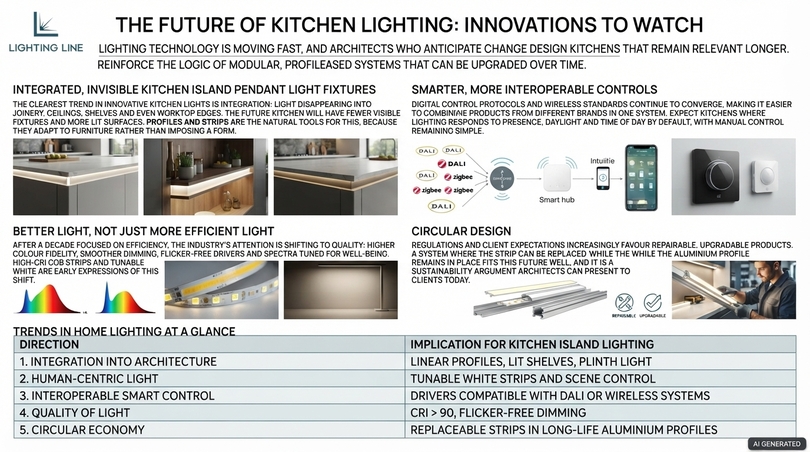
20. Frequently asked questions about kitchen island pendant light fixtures
The questions below are the ones clients, architects and readers ask most often. Click each question to open the answer.
Are kitchen island pendant lights going out of style in 2026?No. Kitchen island pendant light fixtures remain in style because the island needs close task light. What is fading is the cluster of oversized decorative shades with glary lamps. Slim linear LED pendants, dual-emission bars and sculptural frames with dimmable, high-CRI light are the forms gaining ground in contemporary and luxury kitchens. |
How high should kitchen island pendant light fixtures hang?Hang them 75–90 cm (30–36 inches) from the worktop to the bottom of the fixture. Go lower, towards 75 cm, for islands used mainly for seated dining, and higher, towards 90 cm, for tall users or standing work. With high ceilings, use longer suspensions rather than raising the fixture far above the worktop. |
How many kitchen island pendant light fixtures do I need?Islands up to 1.5 m usually take one large or two small pendants; 1.5–3 m islands take two or three round pendants or one linear pendant of about two thirds of the island length. Over 3 m, use three to five pendants or a continuous linear run joined with straight connectors. |
Can you put one light over an island?Yes. A single generous pendant suits short islands, and a single linear pendant is often the best choice for long ones, because it provides uniform light along the worktop with fewer ceiling points and less visual clutter. Size it to about two thirds of the island length and keep it 15 cm or more inside the island ends. |
Can I put a chandelier over my kitchen island?Yes, if it is scaled to the island, hung at least 75–90 cm above the worktop and does not block sightlines. Chandeliers rarely provide uniform task light, so add a separate task layer such as a recessed linear profile or under-cabinet lighting. A geometric frame of linear profiles is a modern, better-performing alternative. |
How many lumens do I need for a kitchen island?Aim for 300–500 lux on the worktop for everyday cooking. For a 2.4 × 1.0 m island this typically means about 1,500 lumens leaving the fixture downwards, after diffuser losses, with a pendant at 75–90 cm. Chefs and older users benefit from 500–750 lux or more, with dimming for dining. |
Is 2700K or 3000K better for a kitchen?3000K is the most versatile choice: warm and residential, yet crisp enough for food preparation and white surfaces. Choose 2700K for warm, wood-rich or dining-focused kitchens. If the island is used for both work and dinner, tunable white strips covering 2700–4000K or wider give the best of both. |
Is warm or cool light better for a kitchen?Warm white (2700–3000K) suits most homes and makes evenings comfortable. Cool or neutral white (4000K) improves contrast for daytime tasks and suits very modern or professional kitchens. Avoid mixing temperatures within the same view, and avoid 5000–6500K “daylight” as the main light in residential kitchens. |
Are LED lights good for a kitchen?Yes. LED lights are efficient, cool-running, long-lasting and dimmable, and modern COB strips with CRI above 90 render food and materials accurately. In the EU, LED is now the mainstream option after the phase-out of most halogen and fluorescent lamps. Choose quality drivers to avoid flicker. |
What is the best type of ceiling light for a kitchen?For ambient light, recessed linear profiles in plasterboard or well-placed low-glare downlights aligned with the worktops. For the island, a suspended linear profile or pendants. Indirect light on the ceiling, for example from a dual-emission pendant, makes the whole kitchen feel brighter and more comfortable. |
What is the best light over a kitchen sink?A focused source directly above the basin: a recessed profile in the ceiling, a small pendant at 75–90 cm above the sink edge or a profile hidden in the window head. Use 3000K, CRI above 90, and IP65 or IP67 strips wherever splashes are possible. |
Do I need an electrician to install kitchen island pendants?For new ceiling points, new circuits and any mains-voltage work, use a qualified, registered electrician; rules vary by country, and in England and Wales Part P of the Building Regulations applies. Low-voltage strip connections after a correctly installed driver are simpler, but still require care and certified components. |
What lighting is best for a small kitchen?Under-cabinet LED profiles, a slim ceiling line parallel to the main worktop and light on vertical surfaces. If there is a small island, one compact pendant or a 1 m linear pendant is enough. Fewer, slimmer fixtures and lit walls make a small kitchen look larger. |
What are good kitchen lighting ideas for low ceilings?Replace pendants with a recessed light slot above the island or a surface-mounted linear profile with an opal diffuser. Add indirect light to brighten the ceiling, which visually raises it, and rely on under-cabinet lighting for task work. Keep fixtures slim and avoid anything that intrudes on headroom. |
What is the most energy-efficient kitchen lighting?High-efficacy LED strips, up to about 120 lm/W, in aluminium profiles, run dimmed and controlled by sensors and scenes. In our worked example, a 2 m linear LED pendant uses about 23 W against 150 W for three halogen pendants, saving roughly 185 kWh and €56 per year. |
What are the kitchen lighting trends for 2026?Linear minimalism over islands, dual-emission pendants, geometric frames, hidden light in furniture and plinths, matte black and natural aluminium finishes, warm high-CRI light and tunable white for human-centric scenes. The common thread is light integrated into architecture rather than added as decoration. |
Should kitchen island pendant light fixtures match other kitchen fixtures?They should relate rather than match exactly. Coordinate the pendant finish with handles, taps or window frames, keep the same colour temperature as other lights in view, and, in open-plan spaces, use the same profile family over the island and dining table for coherence. |
What is a linear pendant light?A long suspended luminaire, usually an aluminium extrusion containing an LED strip and a diffuser, hung parallel to an island or table. It provides uniform light along the surface, can be cut to the exact length required and, with dual-emission profiles, can light both the worktop and the ceiling. |
How do I make my kitchen safer with better lighting?Provide bright, glare-free light on worktops, light the floor at night with low-level sensor-activated plinth lights, avoid strong contrasts between bright and dark zones, and choose high-CRI LED so edges and colours are easy to read. These measures particularly help older users. |
Where is the best place to put lights in a kitchen?Over the work: above the island, in front of wall cabinets along the worktops, above the sink and hob. Then on the walls and shelves for accent and perceived brightness, and finally low down for mood and night orientation. Avoid placing the main lights over the centre of the floor. |
21. Light the island like architecture
The question is no longer whether kitchen island pendant light fixtures are in or out of style. The question is whether they are designed. An island lit by a correctly sized, correctly hung, high-CRI and dimmable linear LED pendant will outlast every trend cycle, because it serves the people who use it. Off-the-shelf pendants have their place, but when the kitchen is an architectural project, aluminium profiles and LED strips give architects what fixed luminaires cannot: exact dimensions, measurable photometry, geometric freedom and a single visual language across island, table, cabinets and ceiling.
For kitchen island pendant light fixtures, start with the essentials: 75-90 cm above the worktop, 300-500 lux, 3000K, CRI above 90, dimming. Then choose the form that suits the project: the 50×75 mm dual-emission profile for islands that light the whole room, the 60×73 mm profile for a generous light line, or the 36×75 mm modular profile for frames and geometric compositions. Download datasheets and BIM files, run the lux calculation for your height, and if you would like a second opinion on a plan, send it to the Lighting Line technical team.
Ready to design your island? Explore all suspended profiles, compare COB LED strips with CRI above 90, and request technical support for your project.