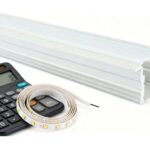
Browsing magazines, visiting renovation forums, interior design blogs, or simply furniture showrooms, you’ve probably noticed that the way we illuminate our spaces has changed dramatically. Contemporary lighting is no longer just a passing trend but is now about the atmosphere, architecture, and identity of a space. And the surface-mounted aluminum LED profile is at the heart of this quiet revolution: simple, elegant, and extraordinarily versatile.
If you’ve ever wondered what the difference is between modern and contemporary lighting, which profiles are best for a kitchen island, whether LED strips are suitable for bathroom vanity lighting, or what contemporary lighting means in 2026, you’ve come to the right place.
In this article…
- Defining contemporary lighting
- Modern vs. contemporary lighting: the difference nobody explains properly
- The rise of surface-mounted LED profiles in contemporary design
- Anodized aluminum profiles: why material matters more than you think
- Types of surface LED profiles and how to choose
- LED strip lights: the engine inside the profilet
- Contemporary lighting trends for 2026
- Room-by-room applications
- Contemporary outdoor lighting: garden, facade, post and sconce
- Commercial & hospitality applications
- Smart lighting & domotics integration
- Sustainability, energy efficiency and eco design
- The 4 types of interior lighting — And how profiles cover them all
- Design rules, tips and common mistakes
- Italian contemporary lighting and european design influences
- Contemporary lighting for specific markets: UK, Canada, and beyond
- Budget guide: contemporary lighting from affordable to premium
- How to plan, specify and install surface LED profiles
- Contemporary lighting design: light is never just light
Defining contemporary lighting
Searching for the meaning of “contemporary lighting” might yield different answers, some of them contradictory. Therefore, we want to first clarify this definition.
The word “contemporary” literally means “of or relating to the present time.” In design contexts, it’s used to describe an aesthetic that reflects current sensibilities — what feels fresh, relevant, and forward-looking right now, in this moment. Unlike “modern,” which (confusingly, we know) refers to a specific design movement from roughly the 1920s to 1960s, contemporary is a moving target. What was contemporary in 2010 may look dated by 2025.
In terms of lighting specifically, contemporary design tends to share several recognizable characteristics:
Minimalism with purpose. Contemporary lighting fixtures avoid excessive ornamentation. Clean lines, uncluttered silhouettes, and a preference for letting the light itself be the statement rather than the fixture. A surface-mounted LED profile running along the ceiling-wall junction is the distillation of this philosophy — you barely see the hardware, but the effect is unmistakable.
Technology as aesthetic. Rather than hiding technology, contemporary design often incorporates it openly. Exposed LED strips within clear or frosted diffusers, architectural channels that reveal their structural logic — these are hallmarks of the contemporary approach. There’s an honesty to contemporary lighting that older styles didn’t always embrace.
Material integrity. Contemporary fixtures use materials for what they actually are, not as imitations of something else. Anodized aluminum looks like aluminum. Brushed steel looks like steel. You won’t find much fake-wood plastic or gilt-painted resin in a genuinely contemporary scheme.
Integration over isolation. Contemporary lighting doesn’t just sit in a room — it becomes part of the architecture. Surface profiles recessed into plasterboard, LED strips tucked behind furniture, light that grazes a wall and defines its texture — these are deeply architectural decisions, not just product placements.
Tunability and control. A contemporary light source is almost always dimmable, often color-temperature adjustable (what the industry calls “tunable white”), and increasingly controllable via smartphone or voice. Static, single-setting lighting feels anachronistic in contemporary spaces.
One nuance worth addressing: contemporary lighting is not the same as “trendy” lighting. Trends come and go. A chandelier that goes viral on Instagram and then disappears from every showroom within 18 months is trendy, not contemporary. Genuinely contemporary design has a durability to it — it doesn’t rely on novelty, it relies on relevance. A well-designed surface LED profile in natural anodized aluminum is as contemporary today as it will be in 2030, because it’s rooted in function, material honesty, and architectural intelligence.
What makes a fixture “contemporary”?
We get this question a lot, usually from contractors who need to specify “contemporary fixtures” for a project but aren’t entirely sure what that rules in or out. Here’s a working checklist we use internally:
| Characteristic | Contemporary ✓ | Not typically contemporary ✗ |
|---|---|---|
| Light source | LED (high CRI, dimmable) | Incandescent, halogen (without design intent) |
| Form language | Geometric, linear, organic but purposeful | Heavily ornate, historicist, fussy |
| Materials | Anodized aluminum, brushed metal, glass, concrete, wood | Faux finishes, heavily gilded surfaces, imitation materials |
| Integration | Architectural, embedded, invisible or minimal hardware | Isolated, decorative object with no spatial dialogue |
| Control | Dimmable, smart-ready, tunable | Single fixed output, non-dimmable |
| Scale | Proportionate to space, intentional | Disproportionate, chosen for spectacle alone |
| Sustainability | Long lifespan, low energy, recyclable materials | Short lifespan, high consumption |
This isn’t a rigid ruleset — design is always contextual. A deliberately oversized chandelier can be deeply contemporary if the intention is right. But the table gives you a useful starting framework.
Modern vs. contemporary lighting: the difference nobody explains properly
This is probably the most common source of confusion in lighting specification, interior design briefs, and online searches. People use “modern” and “contemporary” interchangeably, but they’re not the same thing — not historically, and not practically.
The historical definition of “modern” in design
“Modern” as a design term refers to the Modernist movement, which emerged primarily in Europe and America in the early twentieth century. The Bauhaus school (founded 1919), the International Style in architecture, Scandinavian functionalism — these are the roots of design modernism. Key principles: form follows function, rejection of ornament (Loos’s famous essay “Ornament and Crime” was published in 1908), use of industrial materials — steel, glass, concrete. Mies van der Rohe’s “less is more.”
In lighting, Mid-Century Modern is the most recognizable expression — the Arco lamp by the Castiglioni brothers (1962), the PH series by Poul Henningsen, Gino Sarfatti’s articulated fixtures. These are “modern” in the historical sense. They’re also still beautiful, which is why “Mid-Century Modern” has become such a persistent trend in interior design.
Contemporary lighting: fluid and present-tense
Contemporary lighting doesn’t refer to a fixed aesthetic movement. It refers to what’s current — and that changes. In 2025, contemporary lighting is characterized by:
- integrated LED technology (often invisible sources);
- linear and architectural forms (surface profiles, recessed channels);
- smart control and automation;
- sustainable materials and manufacturing;
- biophilic influences (warm tones, nature-inspired forms);
- maximalist accents within minimalist contexts (statement pendants in an otherwise clean space).
Contemporary design can include elements of modernism, Scandinavian minimalism, industrial aesthetics, or even some classical references — as long as they’re interpreted through a current lens.
| Aspect | Modern lighting | Contemporary lighting |
|---|---|---|
| Time reference | Fixed (approx. 1920s–1970s) | Fluid (always “now”) |
| Key aesthetic | Functionalist, geometric, industrial-influenced | Variable, technology-integrated, often minimal |
| Light source (original) | Incandescent, fluorescent | LED, OLED, smart systems |
| Typical materials | Steel, glass, chrome, teak | Anodized aluminum, concrete, natural wood, glass, recycled materials |
| Design references | Bauhaus, Scandinavian, MidCent. Modern | Whatever is relevant today, including Bauhaus |
| Flexibility | Defined canon of recognized pieces | Highly flexible, market-driven |
| LED profiles | Retroactively applied (modern LED remakes) | Core product category |
So when a client says “I want modern lighting,” it’s always worth asking: do they mean the Bauhaus/Mid-Century aesthetic (clean, geometric, perhaps some warm wood or chrome), or do they simply mean “not old fashioned”? If it’s the latter, contemporary is probably what they’re looking for.
In practical terms for our work with surface LED profiles, the distinction matters because it affects finish choices, profile shapes, and how the system is integrated into the space. A “modern” brief might call for a surface profile in satin chrome. A “contemporary” brief might go for natural anodized aluminum with a warm 2700K strip and smart dimming.
The rise of surface-mounted LED profiles in contemporary design
Surface-mounted aluminum profiles have gone from a niche technical product used mainly by commercial installers to one of the most specifiable, versatile, and architecturally significant lighting components in contemporary design. Here’s how that happened.
This is because not long ago, roughly ten years ago, if you wanted architectural lighting in a residential project, you had limited options. You could do recessed downlights (intrusive to the structure, limited directional control), fluorescent battens (functional but cold and clinical), or invest in expensive custom-built plaster-integrated systems. LED strip lights existed but were seen as a DIY product — something you’d stick under a kitchen cabinet for a bit of accent light, nothing more.
Several converging developments changed this picture dramatically.
The LED revolution: quality catches up
Early LED strips had real problems. Low CRI (color rendering index), color inconsistency along the strip, poor heat management, patchy light output. By the mid-2010s, high-quality LED strip manufacturers — particularly from Europe and Japan — had addressed most of these issues. CRI 90+ strips became standard at professional level. CRI 95+ and even 97+ strips appeared for retail and hospitality applications. Color consistency (measured in SDCM or MacAdam ellipses) improved dramatically.
But strips without housing still had issues: visible hot spots (you could see individual LEDs through diffuse materials), no thermal management, exposed solder joints. The aluminum profile solved all of these problems at once.
Why aluminum? Why anodized?
Aluminum is an excellent thermal conductor — about four times better than stainless steel in typical alloy compositions. Heat is the enemy of LED longevity: for every 10°C reduction in junction temperature, LED lifespan roughly doubles (a well-established rule in photonics engineering). A well-designed aluminum profile acts as a passive heatsink, keeping strip temperatures in the safe operating range and extending lifespan dramatically — sometimes from 25,000 hours to 50,000 hours or more.
Anodizing, the electrochemical process that creates a hard, porous oxide layer on the aluminum surface, provides several additional benefits:
- corrosion resistance (critical for humid environments like bathrooms and outdoor applications);
- hardness and scratch resistance;
- color stability (anodized finishes don’t fade or peel like paint);
- reduced reflectivity, which can help with glare control;
- aesthetics: the matte, slightly warm look of natural anodized aluminum is itself a contemporary design statement.
Our surface-mounted profile collection includes profiles in natural anodized aluminum, black anodized, white coat, and silver. Available widths from 12mm to 36mm, with various diffuser options including opal, transparent, and sandblasted. Each profile is designed to accept standard 8mm, 10mm, 12mm, and 20mm LED strips. All profiles are supplied with end caps, mounting clips, and diffusers as standard.
From commercial niche to residential mainstream
Surface-mounted profiles initially found widespread use in commercial retail environments: clothing stores, jewelry stores, and luxury supermarkets. The uniform, diffuse, and glare-free quality of light was perfect for product presentation. Architects and interior designers took notice: by the early 2020s, surface-mounted LED profiles had become standard features in luxury residential projects.
What really accelerated adoption in the residential sector was the post-2020 renovation boom. Millions of people, spending more time at home, became much more concerned about the quality of their home environments, including lighting. Social media platforms showcased the extraordinary visual impact of cove lighting, architectural linear LEDs, and backlit panels. Surface-mounted profiles suddenly appeared in living rooms, kitchens, and bathrooms across Europe and beyond.
| Year | Global LED lighting market value (€ Billion) | Key development |
|---|---|---|
| 2015 | 28.6 | LED replaces fluorescent as dominant commercial light source |
| 2018 | 54.0 | Smart LED systems reach consumer mainstream |
| 2020 | 65.3 | Home renovation boom; architectural LED profile demand surges |
| 2022 | 83.7 | EU energy directives phase out remaining halogen products |
| 2024 | 108.2 | Biophilic lighting, tunable white, and human-centric lighting mainstream |
| 2025 (est.) | 122.5 | Surface LED profiles among top 5 residential lighting categories |
Anodized aluminum profiles: why material matters more than you think
We mentioned anodizing above, but it deserves a more thorough treatment because we see a lot of misunderstanding — and a lot of cheap profiles that look similar but perform very differently.
The anatomy of a surface LED profile
A surface-mounted LED profile is a deceptively simple object. From the outside, it’s a channel of aluminum, usually with a diffuser clip-rail along the top or front face. Inside is a flat mounting bed for the LED strip, often with a slight step or wing to accept the strip adhesive. The base may have mounting holes pre-drilled, or use spring-clip brackets. End caps close off the terminations. The diffuser — typically an extruded PMMA (acrylic) component — clips or slides into the profile mouth.
But the details of execution make an enormous difference:
| Profile component | Low quality | Professional quality |
|---|---|---|
| Aluminum alloy | Generic 6060 or unspecified | 6063-T5, consistent hardness |
| Anodizing thickness | 5–8 µm (minimum, chips easily) | 15–25 µm (Class 10–15 anodizing) |
| Extrusion tolerance | ±0.5mm (gaps, misalignment in long runs) | ±0.1mm (clean joints, continuous lines) |
| Diffuser material | PVC (yellows with heat, low UV resistance) | PMMA (optical clarity, UV stable, 50,000h+ life) |
| Diffuser fit | Loose (rattles, gaps at ends) | Precision-fit (click-in or sliding, flush termination) |
| Strip mounting bed | No thermal compound, poor contact | Polished flat with optional thermal tape pre-applied |
| End caps | Loose fit, generic | Precision-matched, with cable entry options |
| Length options | Fixed 1m or 2m only | Cut to length, 1m–6m standard, custom available |
Anodizing finishes: what’s available and what to choose
Anodized aluminum profiles come in a range of standard finishes. Here’s a practical guide:
Natural anodized (silver): the most versatile finish. Slightly warm silver-grey, with a matte to satin appearance. Works in virtually any contemporary interior scheme. Particularly effective in Scandinavian, minimalist, and industrial-contemporary contexts. Our most specified finish by volume.
Black anodized: a strong contemporary statement. Works beautifully against white or pale plasterwork, creating a graphic linear element. Popular in industrial-contemporary, dark interiors, and retail design. Note that black anodizing tends to show fingerprints more readily — relevant for installations at hand height.
Gold / Champagne anodized: a warmer, more premium finish. Pairs well with marble, walnut, and natural stone. Associated with Italian and luxury contemporary design. Currently having a significant moment in high-end residential.
White powder coat: technically not anodizing (it’s a paint process), but commonly available on profile ranges. Less durable than anodizing but offers a pure white that anodizing can’t quite achieve. Good for installations in white ceilings where visual integration is the priority.
Brushed stainless finish (on aluminum): a polished or brushed treatment that gives an appearance closer to stainless steel. Uncommon but available in premium profile ranges.
Types of surface LED profiles and how to choose
Surface-mounted profiles come in a wider variety of configurations than most people initially realize. Understanding the range helps you match the right profile to each application. We’ll work through the main categories.
Standard flat surface profile
The workhorse of the category. A shallow rectangular channel, typically 10–27mm wide, designed to be screwed or glued flat against a ceiling, wall, or any planar surface. The diffuser faces outward (away from the mounting surface), directing light into the space.
Best for: general ambient lighting runs, kitchen under-cabinet lighting, shelf edge lighting, wardrobe interiors, hallway ceiling strips.
Typical dimensions: width 10–27 mm, height 7–12 mm, available in 2m or 3m lengths.
Wide-body surface profile
A broader channel (25–36mm width) designed to accommodate higher-power strips or dual-row LED arrangements. The extra width also gives a more substantial visual presence — the profile itself becomes a visible design element rather than something to hide.
Best for: Feature ceiling strips, statement lighting runs in large spaces, retail display lighting, architectural cove feature lighting (surface-mounted version).
Corner / angular surface profile
A 45° or 90° extrusion designed to mount at wall-ceiling junctions or along architectural edges. The light exits at an angle (typically 45°), creating a graze-lighting effect on the adjacent surface or a more diffuse spread into the room.
Best for: wall-ceiling cove substitutes, staircase wall edge lighting, under-shelf grazing on textured walls, architectural column edge lighting.
High-profile / Deep surface profile
A taller profile body (35mm height) that accommodates higher-power strips and offers superior thermal management for high-lumen applications. Also creates a more pronounced shadow line when mounted on a surface.
Best for: task lighting applications requiring high output, commercial retail shelving, professional work environments, anywhere 24V high-density strips are used.
Micro surface profile
Tiny profiles — sometimes as narrow as 6–8mm — designed for applications where visual minimalism is paramount. Accommodate narrower LED strips (typically 6mm or 8mm width). Less effective as thermal management tools due to limited mass, so best used with lower-power strips.
Best for: furniture integration (hidden in groove details), very fine accent lighting, jewelry display cases, feature shelving where the profile must be almost invisible.
Plaster-in surface profile (hybrid)
A profile designed to be embedded in plasterboard or directly plastered over, leaving only the diffuser face flush with the finished surface. Technically not a “surface-mounted” profile in the traditional sense, but increasingly popular because it achieves the look of a fully recessed system without cutting into the building structure.
Best for: new build and renovation projects where architectural integration is a priority, corridor lighting, feature wall lighting, contemporary bathroom lighting schemes.
| Profile type | Typical width | Strip compatibility | Primary application | Thermal management |
|---|---|---|---|---|
| Standard flat | 10–27mm | 8–12mm strips | General ambient, accent | Good |
| Wide-body | 25–36mm | Up to dual-row | Feature, retail, high output | Excellent |
| Corner/angular | 10–30mm (per face) | 8–10mm strips | Edge, cove, graze | Good |
| High-profile/deep | 35mm | High-power strips | Task, commercial, high lumen | Excellent |
| Micro | 6–10mm | 6–8mm low-power strips | Furniture, accent, detail | Limited |
| Plaster-in | Variable | 8–12mm strips | Architectural integration | Good–Excellent |
Diffuser options: clear, opal, or frosted?
The diffuser is the element that has the most impact on the visual character of the finished installation. Here’s how the main options perform:
Clear/transparent diffuser: maximum light output, LED chips partially visible. Creates a more “raw” or industrial aesthetic. Best when the strip itself has high LED density (LEDs per meter) to minimize hot-spotting. Typical use: industrial-contemporary spaces, under-shelf technical lighting.
Opal (milk white) diffuser: the most popular choice. Completely hides individual LEDs, creating a smooth, even luminous surface. Reduces light output by approximately 15–20% compared to clear. Typical use: living room ambient lighting, hallway lighting, bathroom mirror lighting, anywhere a soft continuous light line is desired.
Frosted (satin) diffuser: a middle ground — diffuses light more than clear but maintains slightly more output than opal. Partially hides LEDs. Good for applications where both output and aesthetics matter. Typical use: kitchen work surface lighting, retail shelving.
Prismatic diffuser: a special-purpose option with a patterned surface that redirects light at specific angles. Used in commercial applications for wide-distribution linear lighting. Less common in residential.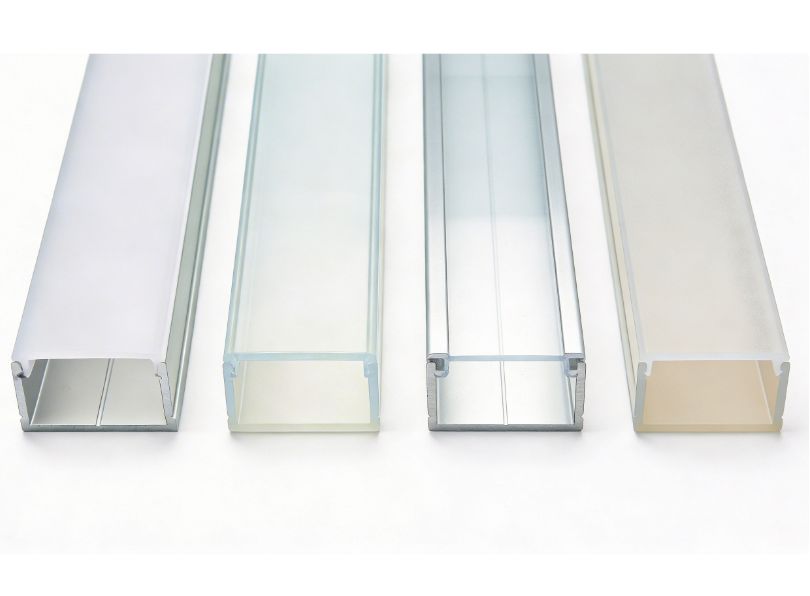
LED strip lights: the engine inside the profile
A surface profile is, ultimately, a housing. What goes inside determines the photometric performance of the finished luminaire. Choosing the right LED strip for your profile is just as important as choosing the right profile.
Strip basics
LED strips are typically described with a string of numbers and letters: “2835 120LED/m 10W/m 24V CRI90 2700K.” Let’s decode this:
| Parameter | What it means | Practical impact |
|---|---|---|
| 2835 (chip size) | LED chip dimensions in tenths of mm (28mm × 35mm) | Larger chips generally = better heat management, more output per chip |
| 120 LED/m | Number of individual LED chips per meter | Higher density = smoother, more even light; less hot-spotting |
| 10W/m | Power consumption per meter | Determines PSU sizing and heat output |
| 24V | Operating voltage | 24V allows longer runs without voltage drop vs. 12V |
| CRI 90 | Color Rendering Index | CRI 90+ recommended for living spaces; 95+ for kitchens and bathrooms |
| 2700K | Color temperature in Kelvin | 2700K = warm white; 3000K = warm-neutral; 4000K = neutral white |
Choosing color temperature for contemporary spaces
Color temperature is one of the most consequential decisions in a lighting scheme, and it’s one that many first-timers get wrong. Here’s our practical guide:
2700K – Warm white: the traditional incandescent equivalent. Creates a warm, intimate, amber-toned light. Excellent for living rooms, bedrooms, dining rooms, and hospitality spaces. Flattering to skin tones. Less good for task applications where color accuracy is needed.
3000K – Warm neutral: our single most-recommended color temperature for contemporary residential projects. Warm enough to feel inviting, neutral enough for kitchens, bathrooms, and workspaces. Works across almost every room type and pairs well with natural anodized aluminum profiles.
3500K – Neutral: a transition zone. Sometimes used in retail or office-adjacent residential spaces (home studios, libraries). Not particularly common in pure residential schemes.
4000K – Cool white / Neutral white: clinical, high-energy, good for task areas. Works well in contemporary kitchens (especially if the kitchen is very white and reflective), bathrooms where makeup application happens, garages, workshops. Can feel cold in social spaces.
5000K+ – Daylight: very cool, blue-white. Rarely used in residential. Commercial photography studios, specialist applications.
CRI: the overlooked performance metric
If we had to pick one specification that’s most consistently undervalued in lighting projects, it’s CRI. The Color Rendering Index measures how accurately a light source renders colors compared to a reference (typically sunlight). CRI 100 = perfect. CRI 80 = acceptable for general applications. CRI 90+ = noticeable improvement. CRI 95+ = excellent, approaching daylight quality.
Why does it matter? Under CRI 80 lighting, red tones in food look less appetizing. Skin tones look less healthy. Fabrics lose their vibrancy. If you’ve ever been in a supermarket with good produce lighting (warm, high CRI) versus a bad one (cool, low CRI), you’ve experienced this difference clearly.
For contemporary residential lighting, we recommend a minimum of CRI 90. For kitchens, bathrooms, art display areas, and anywhere skin tones are important, go to CRI 95+. The cost difference between CRI 80 and CRI 95 strips is typically 20–40% — almost always worth it over the lifetime of the installation.
Dimming: types and compatibility
Dimmable LED strips require a compatible dimmer and driver combination. The main dimming methods in contemporary installations:
TRIAC/phase cut dimming: the traditional method used with incandescent dimmers. Works with some LED strips and drivers but requires careful compatibility checking. Can cause flicker or humming if mismatched. Generally being superseded by other methods for new installations.
0-10V dimming: industry-standard protocol for commercial applications. A 0-10V control signal from a dimmer or building management system tells the driver output level. Very reliable, good range, minimal flicker. Our preferred solution for professional installations.
PWM dimming (pulse width modulation): the driver rapidly switches the LED on and off. The human eye perceives this as dimming. At low PWM frequencies (below 500Hz), some people — especially those sensitive to flicker — may notice strobing. High-quality LED drivers use PWM at 1000Hz or above to eliminate this. All Lightingline.eu recommended strips use high-frequency PWM.
DALI (digital addressable lighting interface): a two-wire digital protocol widely used in commercial and smart home applications. Allows individual or grouped control of many luminaires from a central system. Increasingly available in residential-grade products.
Contemporary lighting trends for 2026
We track the market closely — not just because it’s our job, but because we’re genuinely curious about where lighting design is going. Here’s our honest assessment of what’s actually happening in 2026, based on specifier orders, industry reports, and what we see coming through our social channels.
The warm renaissance
After years of cool white LED dominating commercial and residential installation — partly because early LED technology performed better at cooler temperatures — there’s been a strong swing back toward warmth. 2700K and 3000K strips are outselling 4000K by a significant margin in residential. Warm finishes, gold anodize, aged brass, warm bronze, are gaining on the once-dominant silver-aluminum aesthetic.
This connects to a broader cultural shift: the desire for homes as warm retreats rather than efficient work spaces. People want their homes to feel nurturing and warm light does that.
Linear lighting as architecture
The most significant trend we’re seeing in specification is the use of linear LED profiles as architectural elements in their own right — not accessories to other lighting types, but the primary structural visual element of a space. Continuous ceiling runs that define zones. Wall-mounted profiles that replace skirting boards. Kitchen plinths lit from within. Staircase profiles that guide and define each step.
Surface profiles are central to this trend because they can be installed without structural modification. A recessed channel requires cutting into ceilings and walls, a surface profile can be mounted on virtually any substrate with screws or adhesive, dramatically reducing installation time and cost.
Human-centric lighting (HCL)
HCL, sometimes called circadian lighting or biodynamic lighting, is the practice of adjusting artificial light throughout the day to support human circadian rhythms. Cooler, brighter light in the morning supports alertness instead of warmer, dimmer light in the evening supports melatonin production and sleep. Tunable white LED strips in surface profiles are the most practical delivery mechanism for HCL in residential settings.
This is no longer niche. WELL Building Standard, the global certification system for health-focused buildings, includes HCL criteria. Several major residential developers in the UK, Germany, and Italy are now specifying tunable white as standard in premium builds.
Smart integration without complexity
Smart lighting it’s finally happening — but the trend is for simplicity, not complexity. Ecosystems like Zigbee, Z-Wave, and Thread/Matter allow LED drivers to integrate with home automation platforms without requiring a proprietary hub. Tuya-compatible drivers are now widely available at accessible prices. Apple HomeKit, Google Home, and Amazon Alexa compatibility is table-stakes for premium LED drivers.
The key insight here is that installers and end users don’t want to configure complex systems. They want things to work facilmente: plug in the driver, connect to Wi-Fi, open an app.
Sustainability as specification criterion
More and more of our clients — particularly in the commercial and hospitality sector — are asking specifically about the sustainability credentials of the products we supply. This includes:
- aluminum recyclability (aluminum can be recycled indefinitely with minimal quality loss);
- LED strip longevity (L70 lifespan data — how long before the strip is at 70% of original output);
- driver efficiency (good drivers convert 90–95% of input power to output power);
- packaging (recycled/recyclable materials);
- country of manufacture (increasingly, EU-made or EU-assembled products are preferred).
Biophilic design integration
Biophilic design — incorporating natural elements, patterns, and processes into built environments — has become a major influence in contemporary interiors. In lighting, this manifests as:
- dynamic lighting that mimics daylight variation (intensity and color temperature shifting through the day);
- downlights with natural leaf/branch gobo patterns creating “dappled light” effects;
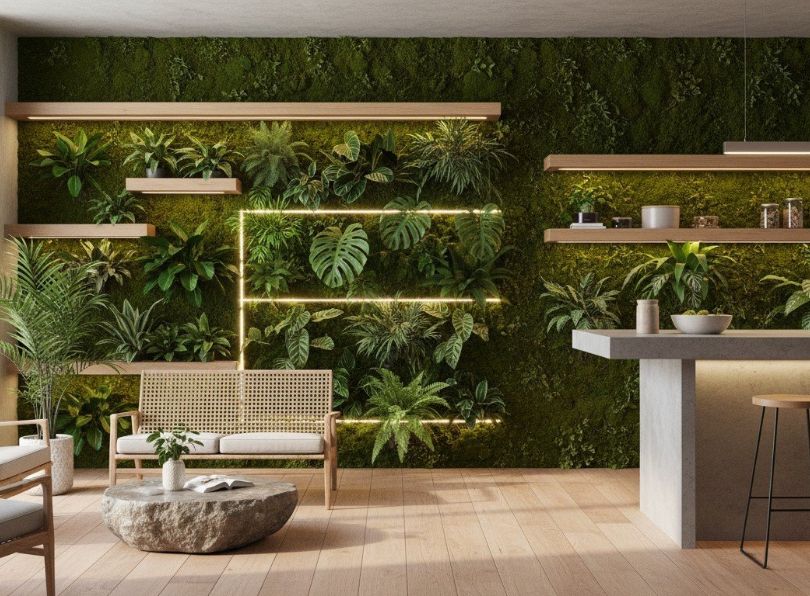
- lighting that emphasizes natural materials — stone, wood, living plants — through careful grazing and accent work;
- green walls with integrated LED lighting in surface profiles mounted vertically.
The return of the statement fixture
Against the backdrop of all this architectural integration and invisible LEDs, a countercurrent is emerging: maximalist pendant lights and chandeliers as deliberate focal points. The most successful contemporary spaces often juxtapose the invisible (architectural LED profiles for ambient lighting) with the clearly visible (a spectacular pendant light). This contrast between the elemental and the exuberant is a decidedly contemporary compositional strategy.
| Trend | 2023 relevance | 2025 status | Profile implication |
|---|---|---|---|
| Warm color temperatures | Growing | Dominant | 2700K/3000K strips; warm anodize finishes |
| Linear as architecture | Niche to mainstream | Mainstream | Surface profiles as primary lighting type |
| Human-centric lighting | Commercial only | Reaching residential | Tunable white strips; compatible drivers |
| Smart integration | Complex, proprietary | Simple, standard protocols | Matter/Zigbee-ready drivers |
| Sustainability criteria | Awareness | Active specification requirement | Recycled aluminum, longevity data |
| Biophilic integration | Emerging | Growing | Dynamic profiles, vertical plant-wall systems |
| Statement fixtures | Reaction to minimalism | Deliberate juxtaposition strategy | Profiles as ambient base for pendant-led schemes |
Room-by-room applications
Here’s where we get into the specifics that most professionals — and a surprising number of end users — actually care about. Each room in a contemporary home has distinct requirements, and surface LED profiles address each of them in different ways.
Contemporary living room lighting
The living room is where contemporary lighting design has perhaps its greatest expressive freedom. It’s a multi-purpose space (social gathering, relaxed watching, reading, occasional work) and contemporary lighting should support all of these modes through layering.
The layered approach: every contemporary living room lighting scheme should have at least three layers: ambient (general illumination), accent (highlighting art, architecture, or furniture), and task (reading, specific activities). Surface LED profiles are ideal for the ambient layer, and increasingly for the accent layer too.
Ceiling perimeter cove: a continuous surface profile running along the wall-ceiling junction, angled slightly toward the ceiling, creates a soft luminous wash that illuminates the ceiling plane and reflects gently downward. This is probably the single most transformative effect you can achieve in a living room without structural work. Use an opal diffuser and a 2700K strip at around 8W/m for a warm, intimate ambient effect.
Alcove and shelving integration: profiles mounted horizontally beneath each shelf level create layered accent lighting that simultaneously illuminates shelf contents and contributes ambient light. Use narrow micro profiles (8–10mm) for a refined, furniture-quality finish. Clear or frosted diffuser depending on whether display objects are the focus.
Feature wall grazing: a surface profile mounted 80–100mm from a textured wall surface (exposed brick, rough plaster, stone cladding) at ceiling height, angled to graze the wall surface, creates dramatic shadow play that reveals surface texture. One of the most effective and least expensive ways to create visual drama in a contemporary living room.
Sofa backlighting: a growing residential trend: a low-power LED profile mounted behind the sofa, running along the wall at approximately 400–600mm above the finished floor level. Creates a halo glow effect, defines the seating area, and adds to the layered lighting composition without contributing glare.
Color temperature recommendation: 2700K for a warm, intimate feel; 3000K if the space is large or if colder-toned furniture and finishes are used. Always dimmable — ideally to 1% minimum, not 10%.
Contemporary kitchen lighting & kitchen island
The contemporary kitchen is one of the most demanding lighting environments in the home: it requires functional task light for safe food preparation, ambient light for a social atmosphere when not cooking, and accent or feature light for display areas. It also typically has a high proportion of reflective surfaces (glossy units, stainless steel appliances, stone worktops) that require careful management of glare and reflection.
Under-cabinet task lighting: the most common surface profile application in kitchens. A profile mounted to the underside of wall-mounted cabinets, positioned at the front of the cabinet to maximize worktop coverage, provides even task illumination without creating shadows from the user’s body. Essential for safe food prep, especially at night. Use a 4000K or 3500K strip for good color rendering of food, with a frosted diffuser to minimize reflections in the worktop surface. CRI 95+ strongly recommended.
Kitchen island lighting: contemporary kitchen island lighting is one of the most specifiable and visible lighting categories in residential design. Options include:
- pendant lights (one, two, or three over the island — usually the dominant decorative feature of the kitchen);
- surface LED profiles running along the island edge (creates a distinctive floating effect when the profile is mounted to the underside of the overhang);
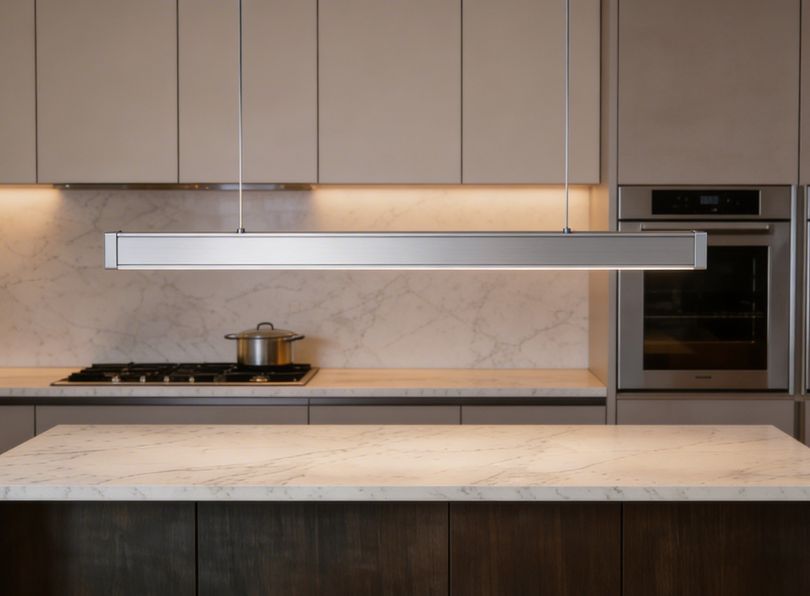
- linear profile suspended from ceiling (similar visual effect to pendant but with even, diffuse light output).
For contemporary kitchen island lighting, we often specify a combination: one or two statement pendants for visual interest and downward task light, supplemented by a continuous surface profile running beneath the worktop overhang to illuminate seating areas and create the “floating island” effect.
Top-of-cabinet lighting: LED strips in narrow surface profiles mounted on top of tall cabinets wash the ceiling with soft uplight, adding height and warmth. Use 2700K at low output — this is pure ambiance, not task light.
Plinth lighting: surface profiles or flexible LED strips at plinth level (the kick board at the base of kitchen units) create the impression of floating cabinetry. Extremely effective in contemporary kitchens with handleless units. Use 3000K at very low output; this is a purely decorative effect and should be subtle.
Color temperature recommendation: 3000K–3500K for general kitchen ambient; 4000K specifically for under-cabinet task areas. Never use 2700K as the primary kitchen light source unless the kitchen is purely social (open-plan entertainment area) and cooking is done elsewhere.
Contemporary hallway lighting
Hallways are often an afterthought in lighting design, but in contemporary homes they’re increasingly treated as important transitional spaces that set the tone for the entire home. A well-lit hallway says something about the attention given to the whole building.
The challenge: hallways are typically narrow, with low natural light levels. Standard downlights create columns of light interrupted by dark patches between fittings. Surface LED profiles solve this elegantly by providing continuous, even illumination along the full length of the space.
Ceiling-mounted continuous profile: the most effective hallway lighting solution. A single profile running the full length of the hallway ceiling, slightly offset from centre or running along one side, provides even ambient illumination without shadows or gaps. Use an opal diffuser and 3000K strip. At 8–10W/m, a 24V strip in a good-quality profile will provide comfortable ambient illumination in a standard hallway.
Cornice/cove lighting: in hallways with plaster cornice or coving, a small surface profile installed behind the cornice (top or bottom face) creates an integrated architectural lighting effect that adds visual height and interest.
Floor-level guide lighting: low-level surface profiles (or micro profiles in skirting channels) at floor level provide soft guide lighting for night-time movement. Particularly valuable for families with young children or elderly residents. Use 2200K amber-warm strips at very low output; these shouldn’t contribute to the daytime lighting scheme.
Stair lighting: surface profiles mounted to the leading edge or underside of each stair tread create distinctive contemporary stair lighting. Requires IP54 or above rating at the profile level due to the likelihood of moisture and cleaning contact. Use 3000K, dimmable to low levels for night-time function.
Contemporary bathroom lighting & vanity
Bathroom lighting is more technically complex than any other domestic application because of IP (Ingress Protection) requirements. UK Wiring Regulations and IEC standards divide the bathroom into zones with specific IP rating requirements. Surface LED profiles for bathroom use must be rated accordingly.
| Zone | Location | Required IP rating |
|---|---|---|
| Zone 0 | Inside the bath or shower | IPX7 minimum (waterproof) |
| Zone 1 | Above bath/shower to 2.25m height | IPX4 minimum (splash-proof) |
| Zone 2 | 600mm beyond zone 1 edge | IPX4 recommended |
| Outside zones | Rest of bathroom | IPX0 acceptable (standard) |
Most surface-mounted LED profiles for bathroom ceiling use (outside zones) require no special IP rating, but those near or in shower areas must be IP44, IP54, or IP65 as appropriate. Always check the installation zone before specifying.
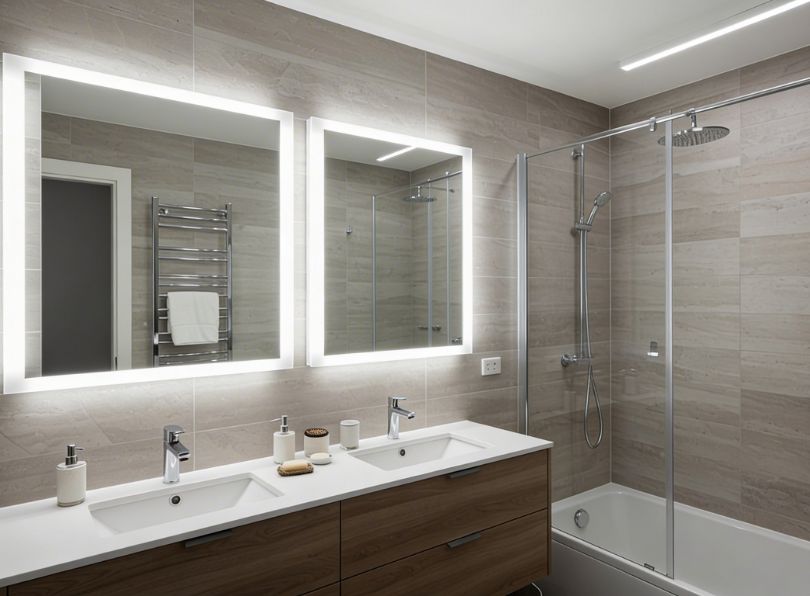
Contemporary bathroom vanity lighting: the mirror area is the most critical lighting position in any bathroom. Side-lighting at vanity height (eye level, approximately 1.5m) is optically superior to top-lighting from a ceiling fixture, which creates unflattering shadows under the chin and nose.
A surface LED profile mounted vertically on each side of the mirror, at approximately 450–600mm apart, provides even, shadow-free facial lighting. Use CRI 95+ strip at 3000K for the most flattering and color-accurate result. The light should be warm but not so warm as to distort makeup color — 3000K is usually the sweet spot.
An increasingly popular alternative: a horizontal profile mounted directly above the mirror, running its full width. Easier to install, provides good downward face illumination, and creates a strong contemporary visual statement. For larger mirrors, combining both a horizontal top profile and bilateral vertical profiles creates a “vanity Hollywood” aesthetic that is currently very fashionable in contemporary bathroom design.
Shower and bath area: IP65-rated profiles (fully dustproof and water jet protected) are suitable for most shower enclosure applications. A profile mounted at the head of the shower (above or to the side of the showerhead, out of the direct spray) provides task illumination. Use warm 2700K — standing in a clinical white-lit shower is not a pleasant experience.
Under-bath profiling: a concealed surface profile around the base of a freestanding bath creates the “floating” effect increasingly popular in contemporary bathroom design. Warm, very low output — 2700K at 5W/m or less. This is purely atmospheric and should not be visible as a distinct light source.
Contemporary dining room lighting
The dining room is where we eat, gather, celebrate, and converse. Lighting here is profoundly social — it should make people look their best, create warmth and intimacy, and have the flexibility to be adjusted from bright family breakfast to candlelit dinner party. It’s also the room where a single dramatic lighting choice can define the entire character of the space.
The pendant over the table: The most traditional and enduring contemporary dining room lighting choice. A single pendant, or a row of three smaller pendants, centered over the dining table is almost universally used — and it works, when done well. Key considerations: hang height (typically 70–80cm above table surface for a standard ceiling height), spread (pendant diameter should be approximately 30–50% of table width), and light quality (CRI 90+ essential; choose warm, flattering color temperatures).
Surface profiles for dining rooms: Profiles complement the pendant rather than replacing it. Common applications include:
- perimeter ceiling profile providing background ambient light that allows the pendant to be dimmed down dramatically for a more intimate dining atmosphere;
- profile lighting on a display wall or sideboard area highlighting china, artwork, or decorative objects;
- a profile running behind the table against the wall, creating a warm backlight for the dining zone;
- plinth lighting under a sideboard or drinks cabinet.
Color temperature recommendation: 2700K throughout the dining room. Warm, flattering, appetite-enhancing. Higher temperatures make food look less appealing and people look less healthy. The dining room should always be the warmest-feeling space in the house.
Contemporary bedroom lighting
Bedroom lighting has to serve more different scenarios than almost any other room: bright and energizing in the morning, focused for dressing and grooming, intimate and low-key for relaxed evenings, and gently guiding at night. Layering and dimming control are essential.
Ceiling ambient: many contemporary bedrooms avoid central ceiling fixtures entirely, relying on perimeter profiles and bedside lighting for ambient illumination. A surface profile running along the ceiling perimeter at low output provides gentle fill light that avoids the harsh “interrogation room” effect of a central pendant at high output.
Bedhead uplight: a surface profile mounted horizontally behind the headboard, angled to wash the wall above with light, is a signature contemporary bedroom detail. Warm 2700K at low output. Provides ambient light that reads from bedside without shining in the eyes when lying down. Often the only light on in the final stages of an evening.
Wardrobe interior lighting: narrow micro profiles mounted inside wardrobe rails or along shelf edges transform wardrobe storage from dark and frustrating to clear and functional. Motion-sensor-controlled systems are increasingly popular here. Use 4000K inside the wardrobe for accurate color rendering of clothing — 2700K makes color matching harder.
Under-bed guide lighting: a very low-output, warm (2200K) profile in a micro channel along the base of the bed frame provides subtle night-time guidance without disturbing a sleeping partner. A PIR-activated version in the bedroom is particularly practical.
Contemporary home office lighting
Home office lighting requirements are closer to commercial than residential: the primary need is functional task light that supports concentration, reduces eye strain, and provides appropriate color rendering for screen work and document review. But the space still needs to feel pleasant and domestic.
Task vs. display: the single most common home office lighting mistake is relying solely on overhead ambient light. This creates poor contrast between the lit screen and the dimly lit surroundings — a major contributor to eye strain. The solution is to provide indirect ambient light (surface profile on ceiling, not directly above the desk to avoid reflections in the screen) combined with a good desk lamp for task illumination.
Bias lighting: a surface profile mounted behind the monitor screen, illuminating the wall behind it, significantly reduces the apparent contrast between screen and room. This is evidence-based: it reduces eye strain and fatigue over long work sessions. Use a 6500K (daylight) bias light behind a display monitor if color-critical work is involved, 4000K for general use.
Video call lighting: an often-overlooked consideration. A surface profile at approximately eye level, mounted just above the monitor and angled toward the user, provides flattering front light for video calls eliminating the “spooky underchin lit” effect of desk lamps below the camera level and the “silhouetted against bright window” effect. 3000K, relatively low output, dimmable.
Contemporary outdoor lighting: garden, facade, post and sconce
Outdoor lighting with LED profiles is an area that’s grown significantly in the past five years. The availability of IP65 and IP67 rated aluminum profiles, combined with high-quality outdoor LED strips, has opened up applications that previously required expensive custom-made fittings.
Before going further, a critical point on specification: any aluminum profile installed outdoors must be rated for outdoor use. This means IP65 minimum (fully dust-sealed, protected against water jets from any direction) for sheltered outdoor locations, and IP67 (protected against temporary immersion) for ground-level installations and exposed roof terraces. The LED strip inside must similarly be rated — check that the manufacturer’s IP rating applies to the strip-in-profile assembly, not just the strip in isolation.
Contemporary outdoor wall lighting
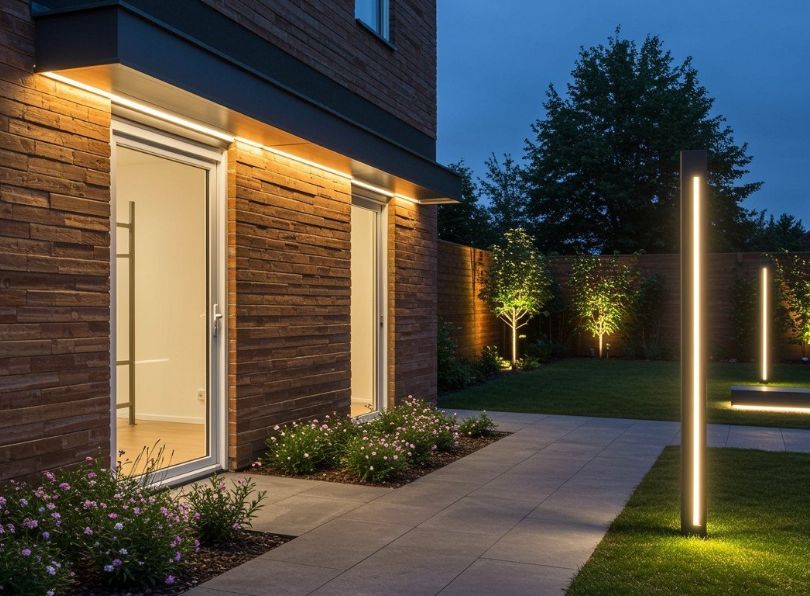
Surface profiles offer an attractive alternative to traditional outdoor wall lanterns for contemporary architectural buildings. A profile mounted vertically along a door frame, for example, provides uniform architectural illumination rather than the “pool of light” effect of a conventional wall lantern. Many of our customers have used horizontal profiles along exterior wall elements (stone cladding, wood paneling, rendered panels) to create spectacular façade lighting with exceptional grazing light effects that reveal the materials.
IP65-rated black aluminum surface profiles are currently the most popular specification for contemporary outdoor lighting in residential projects in the UK: the black finish resists weathering well and maintains a crisp, graphic appearance on rendered façades.
Contemporary outdoor post lighting
Contemporary outdoor post lights have moved well beyond the traditional lantern-on-a-pole. Current design trends favor integrated linear elements, a slim anodized aluminum post with a profile along one face, for example, providing a linear light source rather than a point source. This creates a very distinctive contemporary appearance that works particularly well in architectural gardens and driveways.
Some manufacturers offer post profiles that accept the same 10mm or 12mm LED strips used in interior profiles, allowing consistent specifications throughout interior and exterior lighting schemes.
Contemporary garden lighting
Contemporary garden lighting UK design tends toward restraint and integration: lighting that reveals the garden rather than dominating it. Surface profiles mounted along the underside of garden pergolas, decking edges, and garden walls create warm, defining illumination that works effectively from dusk until the final guests leave.
Colour temperature is particularly important in garden lighting. 2200K–2700K is strongly preferred outdoors — warmer light reduces light pollution impact, preserves dark sky quality, is less disruptive to wildlife (particularly insects and birds), and creates a warmer, more welcoming garden atmosphere. Cool white LED in garden settings almost always looks harsh and clinical.
Contemporary outdoor sconces and pendant lighting
Outdoor sconce lighting along a covered walkway, loggia, or external corridor benefits from the same profile-based approach as interior hallway lighting. A continuous surface profile running the length of the space provides even, architectural illumination without the visual clutter of multiple individual sconce fixtures.
Contemporary outdoor pendant lighting — over an external dining table on a covered terrace, for example — requires IP43 or higher rating for covered outdoor use. Purpose-built outdoor pendant fixtures in anodized aluminum with IP65-rated LED modules are the safest and most practical specification.
Commercial & hospitality applications
Surface LED profiles in anodized aluminum are a workhorse of commercial lighting design, and for good reason: they offer unmatched versatility, excellent thermal management for continuous operation, and a professional finish that holds up well in demanding environments.
Retail display lighting
Retail is where professional-grade surface profiles first proved themselves. The requirements are exacting: high CRI (95+ for fashion, jewelry, food), consistent color temperature across multiple profiles (SDCM ≤3), controllable intensity (both for daylight compensation and theatrical effect during events), and robustness to handle continuous operation (16+ hours per day).
For clothing retailers, 3000K at CRI 95 provides warm, flattering light that makes garments look appealing without distorting colors significantly. For jewelry, 4000K at CRI 97+ is often specified to maximize sparkle and clarity. For food retail, 2700K–3000K at CRI 90+ is standard practice.
Restaurant and hospitality
Hospitality lighting design is one of the most sophisticated and commercially important lighting disciplines. The right lighting can increase dwell time, improve guest perception of food quality, and drive significantly higher spending per cover. A 2016 study by Cornell University found that diners at tables with softer, warmer illumination spent an average of 16.7% more than those under brighter, cooler lighting, primarily due to increased dwell time and relaxation.
Surface profiles in hospitality applications appear primarily as architectural framing elements — running above banquette seating, in ceiling reveals, along bar fronts, under table overhangs — rather than as primary light sources. The primary light in fine dining is almost always pendant or chandelier, with profiles providing the ambient base and definition.
Office and workspace
Contemporary open-plan offices have largely abandoned the fluorescent troffer grid in favour of architectural linear LED systems, and surface profiles are a key component. UGR (Unified Glare Rating) is a critical specification parameter for office lighting: UGR ≤19 is required by EN 12464-1 for computer-based workplaces. Well-designed surface profiles with good diffusers can achieve UGR ≤19 in ceiling-mounted configurations.
| Commercial application | Recommended CCT | Recommended CRI | Typical illuminance | Special requirements |
|---|---|---|---|---|
| Fashion retail | 3000K | CRI 95+ | 750–1000 lux | SDCM ≤3; tunable option |
| Food retail | 2700K–3000K | CRI 90+ | 500–750 lux | High uniformity |
| Jewelry | 4000K | CRI 97+ | 1500–3000 lux | TM-30 Rf & Rg values |
| Fine dining | 2700K | CRI 90+ | 80–150 lux (table) | Deep dimming; ambience layers |
| Hotel lobby | 3000K | CRI 90+ | 200–500 lux | Daylight integration |
| Open office | 3500K–4000K | CRI 80+ | 500 lux (task) | UGR ≤19; tunable white |
| Healthcare | 3000K–4000K | CRI 90+ | 500–1000 lux | Flicker-free (<1% flicker) |
Smart lighting & domotics integration
The integration of LED surface profiles into smart home and building automation systems is one of the fastest-growing aspects of our work. What was once the exclusive domain of high-end custom installations is now accessible to any homeowner with a reasonable budget and a smartphone.
Why smart lighting matters for surface profiles
Surface LED profiles, by their architectural nature, are often the primary ambient lighting in a space. They set the scene. The ability to adjust their output, both intensity and color temperature, fundamentally changes how a room feels and functions. A static, non-dimmable surface profile wastes most of its potential. A smart-controlled, tunable white surface profile is one of the most versatile and valuable investments in a contemporary home.
Control protocols: what to specify
Zigbee: a low-power mesh networking protocol widely used in smart lighting. Compatible with Amazon Echo Plus, Samsung SmartThings, Philips Hue Bridge (and many others). Zigbee LED drivers are available at very accessible prices and offer excellent reliability. Our recommendation for most residential projects.
Z-Wave: similar to Zigbee but operates on a different frequency band (868MHz in Europe, 908MHz in USA), making it less susceptible to interference from Wi-Fi networks. Popular in high-end custom installations and home automation systems by Control4, Crestron, and Lutron.
Matter (formerly Project CHIP): the newest and most significant smart home protocol, developed collaboratively by Apple, Google, Amazon, and the Connectivity Standards Alliance. Matter operates over both Wi-Fi and Thread (a low-power mesh protocol), and is designed to be interoperable across all major platforms. Matter-compatible LED drivers are just becoming available and represent the future of smart lighting integration.
DALI-2: the professional-grade digital protocol for commercial buildings. DALI-2 (the updated version of the original DALI standard) adds device-level standardisation and bidirectional communication. Commonly used in offices, hotels, and commercial retrofit projects. DALI-2 drivers for surface profile systems are available from several European manufacturers.
0-10V / PWM direct control: still widely used in simpler systems where a dedicated physical dimmer or building management system provides the control signal. Very reliable, no connectivity required, works well with most professional LED drivers. Less flexible than protocol-based smart systems but extremely robust.
Scene and schedule programming
The real value of smart lighting for surface profiles emerges through scene programming. Examples from residential installations we’ve specified:
- morning scene: kitchen surface profiles gradually increase to 100% at 4000K over 20 minutes from 7:00am. Living room profiles remain off. Hallway profiles at 30%;
- working from home: home office profiles at 80% at 4000K. Living room ambient profiles at 20% at 3000K. Kitchen profiles at 40%;
- cooking: kitchen under-cabinet profiles at 100% at 3500K. Kitchen ambient profiles at 60% at 3000K. Living room profiles at 30% at 2700K;
- dinner party: dining room profiles at 20% at 2700K. Living room profiles at 15% at 2700K. Kitchen profiles off or at 10% (away from guests). Hallway at 30%;
- bedtime: all profiles at 5% maximum at 2700K. Hallway guide lighting at 3%. Bedroom perimeter at 10%.
This kind of programming, once the domain of expensive custom AV installations, is now achievable with a smart driver (around €50–80 per zone), a compatible hub (often something the homeowner already has), and an hour of setup time.
Sustainability, energy efficiency and eco design
The sustainability credentials of LED surface profile systems are genuinely impressive, and worth examining in detail rather than just citing broadly.
Energy efficiency: the numbers
A well-specified LED surface profile system consuming 10W/m of LED strip replaces the equivalent illumination of traditional light sources consuming 40–60W/m (fluorescent) or 100W/m (incandescent). In a typical domestic installation with 20 meters of surface profile, this translates to:
| Parameter | Incandescent/Halogen | Fluorescent | LED profile (high quality) |
|---|---|---|---|
| Typical power (20m equivalent) | 2000W | 800W | 200W |
| Annual energy cost (2000h use, €0.30/kWh) | €1,200 | €480 | €120 |
| Expected lifespan | 1,000h | 10,000h | 50,000h |
| Replacement frequency (at 2000h/year) | Every 6 months | Every 5 years | Every 25 years |
| CO2 over 25 years (EU grid average) | ~22,000 kg | ~8,800 kg | ~2,200 kg |
Based on EU average electricity emission factor of 0.275 kg CO2/kWh (Eurostat 2023)
Material sustainability
Aluminum is one of the most sustainable structural materials in common use:
- it is 100% recyclable indefinitely without quality loss;
- recycled aluminum requires only 5% of the energy needed to produce primary aluminum from bauxite;
- global aluminum recycling rates exceed 70% in Europe;
- anodizing uses no VOC solvents and produces no hazardous waste products under normal industrial conditions.
LED strips contain small amounts of rare earth elements (in the phosphors) and potentially trace amounts of controlled substances in older designs. The EU RoHS directive (Restriction of Hazardous Substances) prohibits the use of high level of lead, mercury, cadmium, hexavalent chromium, PBBs, and PBDEs in electrical equipment, and all profiles and strips sold in the EU must comply. Compliant LED strips are safe for disposal via standard WEEE (Waste Electrical and Electronic Equipment) channels.
EU ecodesign regulation
The EU Ecodesign Regulation (EU) 2019/2020, in force since September 2021, sets minimum energy performance requirements for light sources sold in the EU. Under this regulation, inefficient halogen and fluorescent sources have been progressively removed from the market. LED products meeting the regulation must display EEI (Energy Efficiency Index) values and other photometric data.
Light pollution and responsible outdoor lighting
Outdoor surface LED profiles, particularly when used for facade and garden lighting, contribute to light pollution if not used thoughtfully. Best practice guidelines include:
- use warm color temperatures (2200K–2700K) outdoors to minimise blue-wavelength light that has the highest impact on circadian rhythms and nocturnal wildlife;
- ensure outdoor profiles direct light downward or toward the target surface rather than upward (upward-directed outdoor light contributes directly to skyglow);
- use PIR/occupancy sensors or timers to switch off outdoor lighting when not needed, particularly after midnight;
- choose the lowest output that meets the functional requirement; outdoor lighting is almost always over-specified;
- refer to the Institution of Lighting Professionals (ILP) Guidance Note 01 (UK) or CIE 150:2017 for formal light pollution guidance.
The 4 types of interior lighting
One of the most common questions in lighting specification (and online search) is: “What are the 4 types of lighting?” It’s a useful framework, and it’s worth revisiting specifically in the context of surface LED profiles, which can perform across all four types.
The four types are: ambient, task, accent, and decorative.
Ambient lighting
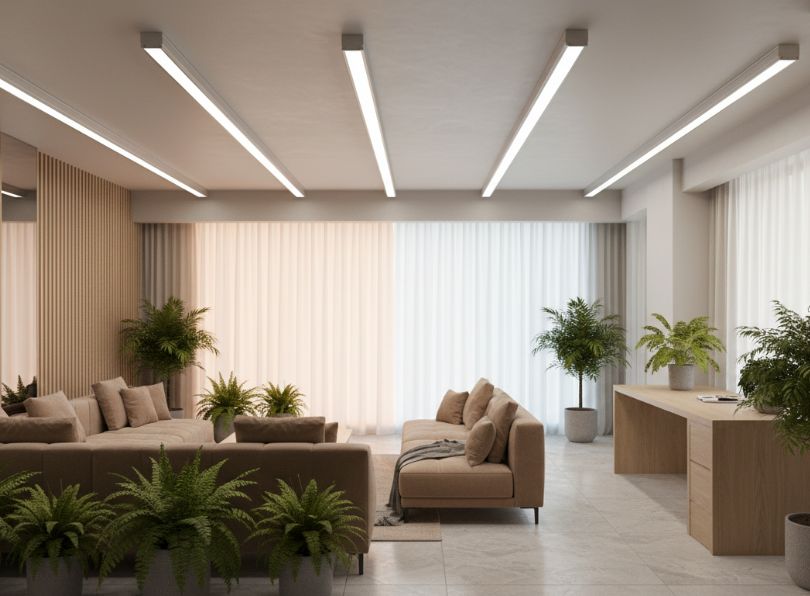
The base layer of illumination in a space ,the general light that allows people to navigate and function comfortably. In contemporary design, ambient lighting is increasingly provided by indirect means: light directed at ceiling or walls, bouncing back into the space as soft, diffuse illumination without glare.
Surface profiles are ideal ambient light sources in this indirect mode. A profile along a ceiling coving or perimeter, angled to wash the ceiling, provides even ambient illumination with no visible source and no direct glare. This is the most architecturally sophisticated ambient lighting approach available to designers.
Task lighting
Focused light for specific activities: reading, food preparation, desk work, makeup application. Task light must be adequate in quantity (sufficient lux on the task plane), good in quality (high CRI, minimal shadows), and positioned correctly (so the user doesn’t shadow their own work surface).
Surface profiles excel at task lighting in kitchen (under-cabinet), bathroom (vanity), wardrobe (interior shelving), and desk (under-shelf or monitor bias) applications. The continuous, even distribution of a LED strip in profile eliminates the shadow-gap problem associated with point-source task lights.
Accent lighting
Light used to draw attention to a specific object, surface, or feature: artwork, architectural details, display objects, plants, textured surfaces. Accent lighting relies on contrast — it works by making the highlighted element brighter than its surroundings. A general rule is that accent lighting should be at least 3:1 and ideally 5:1 brighter than the ambient level in the same area.
Surface profiles in corner/angular configurations are outstanding accent light sources. A 45° profile mounted at ceiling height and angled toward a textured wall creates a graze-lighting effect that reveals surface texture dramatically. Profiles beneath shelves or above display cabinets provide focused downlight accent for objects. Vertical profiles alongside artworks or architectural features create framinglight effects.
Decorative lighting
Light fixtures that are themselves visual features — pendants, chandeliers, sculptural table lamps. Their primary purpose is aesthetic: they contribute to the lighting scheme but their visible form is as important as their light output.
Surface LED profiles aren’t typically considered “decorative” in the traditional sense, but high-quality anodized aluminum profiles with clear diffusers, revealing the continuous luminous line of the LED strip, can be genuinely decorative in contemporary schemes. Black anodized profiles with bright LED strips are increasingly used as graphic architectural elements — furniture-quality decorative features as much as lighting tools.
| Lighting type | Primary purpose | Surface profile application | Typical output level |
|---|---|---|---|
| Ambient | General illumination | Ceiling perimeter, cove, indirect wall wash | 100–300 lux (target illuminance) |
| Task | Specific activity support | Under-cabinet, vanity, desk, wardrobe | 300–750 lux (task plane) |
| Accent | Highlight features/objects | Corner profile graze, shelf undersides, display areas | 3–5× ambient level |
| Decorative | Visual interest/aesthetics | Graphic linear elements, furniture integration, plinth lighting | Variable (atmosphere dependent) |
Design rules, tips and common mistakes
After years of specifying and selling surface LED profile systems, we’ve seen the same mistakes made repeatedly, and the same approaches consistently produce outstanding results.
The 5-7 lighting rule
A lot of people search for “the 5-7 lighting rule” and come up empty or with vague answers. The concept is sometimes articulated as: for every 5 square meters of floor area, provide approximately 7 different light sources or lighting positions. The intent is to encourage designers to think beyond a single central fixture and create layered, multi-source schemes that allow for varied moods and functional configurations.
The principle of layering through multiple independently controlled sources is sound, even if the 5:7 ratio is approximate. A 20m² living room with a single central pendant is under-lit in terms of flexibility. The same room with a central pendant, two perimeter profiles, three adjustable downlights, and two floor lamps offers radically more compositional possibility.
Common mistakes with surface LED profiles
1. Wrong color temperature for the space: the most common specification error. Cool white (4000K+) in a domestic living room makes the space feel clinical and cold. Warm white (2700K) in a kitchen work area makes food color judgment difficult. Match CCT to function and context, not to personal preference for “bright” light.
2. Inadequate dimming range: many budget dimmers cut out at 10–20% of maximum output, which is still very bright for evening ambient lighting. Professional LED dimming should go to 1% or 0.1%. Always test the dimming range before committing to a driver/dimmer combination for a full installation.
3. Visible LED hot-spotting: using a clear diffuser with a low-density strip (60 LED/m or fewer) will almost always result in visible hot spots — individual LEDs visible as distinct bright points within the diffuser. Either use higher density strips (120 LED/m minimum) with clear diffusers, or use opal diffusers with lower-density strips. The LED-to-diffuser distance also matters; deeper profiles generally hide hot spots better.
4. Skimping on driver quality: the driver (LED power supply) is the component most likely to fail in an LED system, and the one that has the most impact on LED strip lifespan. A cheap switching-mode driver with high ripple current will shorten LED life dramatically and can cause flickering. Specify drivers with DALI, 0-10V, or high-quality PWM dimming, from manufacturers with published MTBF (Mean Time Between Failures) data. We only supply drivers with MTBF ≥50,000 hours.
5. Ignoring voltage drop: 12V LED strips suffer significant voltage drop over runs longer than 3–4 meters, resulting in dimmer light at the far end of the run. Always use 24V strips for runs longer than 5 meters. Feed long runs from both ends where possible. Calculate voltage drop for each run using Ohm’s law (V = I × R, where R is the resistance of the strip’s copper traces).
6. Poor junction planning: in long continuous profile runs, the profile-to-profile joints must be planned carefully to minimise visibility. Butt joints between profiles should be mitered or sanded smooth, the diffusers should span the joint seamlessly, and electrical connections at joints must be reliably made. Use purpose-made male-female profile connectors rather than bare solder joints where possible.
7. Forgetting thermal management: if LED strips are mounted in profiles with poor contact between the strip’s adhesive backing and the profile’s flat mounting bed, or if the profile has insufficient mass to dissipate heat, operating temperatures will rise. This accelerates LED degradation. Always check that the strip is fully adhered to the profile (use additional thermal adhesive tape if necessary), and verify that the chosen strip power density is compatible with the chosen profile’s thermal capacity.
Lighting fixtures that are timeless
Another popular question: what lighting fixtures are truly timeless? The honest answer is: very few. But certain characteristics tend to age well:
- material integrity (real aluminum looks better at 20 years than painted plastic at 2 years);
- functional simplicity (a product that does one thing very well tends to outlast complex novelties);
- proportion and scale (a fixture that’s correctly proportioned to its space always looks right);
- high-quality light output (good light makes everything look better, including the fixture itself);
By these criteria, a well-made natural anodized aluminum surface profile with a high-CRI warm white strip is as close to timeless contemporary lighting as any current product category. It will still look right in 2035, and it will still perform well if the LED strip is replaced at the end of its life (which, at 50,000 hours, is a very long way off).
Italian contemporary lighting and European design influences
Italy has been the center of global lighting design for nearly a century. From the Milanese manufacturers who redefined the concept of the table lamp in the 1950s and 1960s to contemporary brands that continue to push technical and aesthetic boundaries, Italian lighting design has a distinctive character that is worth understanding for anyone working in contemporary spaces.
What makes contemporary Italian lighting distinctive? Several factors. A commitment to quality craftsmanship and materials that goes beyond technical specifications. A tradition of collaboration between industrial designers and engineers that creates products with both technical and aesthetic intelligence. A sensitivity to the quality of light (the way light falls on a surface, the color and warmth of light) that comes from living in the unique light of the Italian peninsula.
In the field of surface profiles, Italian manufacturers have historically been at the forefront of quality anodizing and precision extrusion tolerances. The ultra-thin profile walls, extremely smooth internal surfaces, and precision diffusers that characterize high-end Italian profiles are the result of decades of perfecting the production process.
Contemporary Lighting for specific markets: UK, Canada, and Beyond
Contemporary Lighting UK
The UK contemporary lighting market has several distinctive characteristics. UK homes tend to have lower ceiling heights than continental European equivalents, which makes luminaire placement particularly important — a surface profile that works beautifully in a 3m Italian apartment ceiling can feel oppressive at 2.4m, the typical ceiling height in British post-war and contemporary residential construction.
UK planning regulations and building regulations also affect outdoor lighting specification. Party Wall etc. Act and planning conditions in many authorities restrict external lighting lumen output, direction of light, and operating hours. The Institution of Lighting Professionals (ILP) Guidance Notes are widely referenced by local planning authorities for assessing outdoor lighting applications.
The UK contemporary lighting market has shown strong growth in the surface profile category over the past five years, driven partly by the renovation boom, partly by increased access to professional-grade products through online channels, and partly by the influence of social media design accounts that have popularized cove lighting, LED ceilings, and architectural linear lighting effects.
Contemporary lighting Canada
The Canadian contemporary lighting market shares many characteristics with the UK market — English-language design culture, strong Scandinavian influences (particularly in British Columbia and Ontario), and a climate that makes indoor lighting quality particularly important for well-being during long winters.
Canadian electrical code (CEC) requires CSA or cUL certification for luminaires used in Canadian installations. Surface LED profile systems imported for Canadian use should carry appropriate certifications. LED strips must comply with CEC requirements for voltage and power supply safety.
The Canadian market has shown particular interest in tunable white and human-centric lighting solutions, partly driven by the mental health implications of low natural light levels during winter months in northern cities. A 2021 survey by Statistics Canada found that 17.4% of Canadians reported symptoms consistent with Seasonal Affective Disorder — a figure that’s driving demand for biodynamic lighting solutions at the residential level.
Contemporary lighting Toronto and Montreal
Toronto and Montreal, Canada’s two largest and most design-conscious cities, have developed distinctive contemporary lighting markets. Toronto’s design scene draws heavily on both North American modernism and British contemporary influences, while Montreal’s French-Canadian cultural context brings a European sensibility — more willing to embrace architectural integration and subtlety in lighting design than the bolder, feature-focused American approach.
Budget guide: contemporary lighting from affordable to premium
One of the most practical questions we field is: what does this actually cost? Contemporary lighting can range from genuine budget to serious investment, and understanding where the cost differences lie helps in making intelligent specification decisions.
For surface LED profile systems, cost components are: the profiles themselves, the LED strips, the drivers/PSUs, control systems, and installation.
Budget tiers: what to expect
| Tier | Profile cost (per metre) | Strip cost (per metre) | Typical CRI | Expected lifespan | Best for |
|---|---|---|---|---|---|
| Entry (budget) | €2–6 | €2–5 | CRI 70–80 | 15,000–25,000h | Utility areas, temporary installs |
| Mid-range | €6–14 | €5–12 | CRI 80–90 | 25,000–40,000h | General residential, small commercial |
| Professional | €14–28 | €12–25 | CRI 90–95 | 40,000–50,000h | Premium residential, hospitality |
| Premium | €28–60+ | €25–60+ | CRI 95–97+ | 50,000h+ | Luxury residential, retail, art/museum |
A complete surface profile lighting scheme for a typical 3-bedroom contemporary home (living room, kitchen, hallway, bathrooms, bedrooms) using mid-range professional-quality components would typically run to €1,500–3,500 for materials, before installation. For the same home with premium components and smart control, expect €4,000–8,000+ for materials.
Compare this to the running cost savings over the installation lifetime — typically €800–1,200 per year compared to halogen or incandescent equivalents — and the return on investment is clear.
Where NOT to economise
If you have to choose where to spend and where to save in a surface profile system, here’s our hierarchy:
- Never economise on LED strip quality (CRI, consistency, longevity): the strip is what you see. Poor quality strips look bad and degrade fast.
- Never economise on driver quality: cheap drivers fail, cause flicker, and reduce strip lifespan.
- It’s acceptable to economise on profile finish: a mid-range anodized profile in a non-visible location (inside a cove, under a cabinet) performs as well as a premium profile.
- It’s acceptable to economise on diffusers in hidden applications: where the diffuser is not directly visible, grade doesn’t matter much.
How to plan, specify and install surface LED profiles
Properly planning the installation of a surface-mounted LED profile, before even driving a single screw into the wall, makes the difference between a professional-looking, effortless result and one that ends up with misaligned paths, under-powered circuits, and visible seams in the wrong places. We’ve created this step-by-step guide to make installation easier.
Step 1: audit the space
Before ordering anything, it’s a good idea to physically check the space: ceiling height, type of substrate (drywall, concrete, wood), existing electrical outlets and electrical panels, levels and direction of natural light at different times of day, location of main furniture and passageways, and any noteworthy architectural features.
Step 2: design the lighting scheme
Sketch (or use a lighting design tool) the planned profile positions. For each run, note:
- length of run;
- profile type and finish required;
- LED strip specification (CCT, CRI, wattage per metre);
- diffuser type;
- feed point (where the power connection will be made);
- control type (switch, dimmer, smart controller).
Step 3: calculate power requirements
For each circuit: total wattage = strip W/m × length in metres. Add 20% headroom. Select a driver with rated output ≥ calculated total × 1.2. Never run an LED driver at more than 80% of its rated capacity — this preserves driver lifespan and efficiency.
Example: 6 metres of 10W/m strip = 60W. Driver required: ≥ 60W × 1.25 = 75W. Specify an 80W or 100W driver.
Step 4: order materials
Order profiles, strips, diffusers, end caps, mounting clips, drivers, and all connectors and accessories. Add 5–10% extra length to profiles and strips for waste and error. Check that all components are compatible (strip width vs. profile bed width, driver voltage vs. strip voltage, dimming protocol compatibility).
Step 5: installation
Mounting the profiles: mark the profile positions with a chalk line or laser level. Pre-drill profiles at approximately 300–400mm centres (closer for overhead installations where the weight of the diffuser needs support). Use appropriate fixings for the substrate (plastic plugs in plasterboard, masonry anchors in concrete, direct screws in timber). Ensure alignment is precise — even small deviations are visible in the finished profile line.
Installing the LED strip: if not pre-applied, cut the LED strip at the designated cut points (always at the cut marks between solder pads, never through an LED or solder pad). Apply 3M thermal adhesive tape to the strip back if the profile doesn’t include it. Press the strip firmly into the profile bed. Make electrical connections carefully — use purpose-made strip connectors rather than soldering where possible in awkward positions.
Installing diffusers: clip or slide diffusers into position after strips are tested and working. Trim diffusers cleanly with a fine-tooth saw or dedicated diffuser cutter for clean end terminations. Apply end caps securely.
Testing: before finishing surfaces or closing up any ceiling/wall access, test every circuit at full output, at 50% dimming, and at minimum dimming level. Check for hot spots, colour inconsistencies, and flickering at low levels. Resolve any issues before the installation is inaccessible.
Contemporary lighting design: light is never just light
A well-lit room doesn’t just look better: it makes food taste better, conversation flow more smoothly, and work feel less like work. People notice good lighting without knowing why, and that’s exactly how it should be.
Surface-mounted aluminum profiles find themselves at an interesting intersection in contemporary design. They’re a technical product, but the experience they create is something else entirely. A warm line of light running along the ceiling of a hallway at 10 p.m., a continuous strip of light that skims the texture of a stone wall, the soft glow under a kitchen island that makes a Tuesday evening seem somehow thoughtful: these are the results of good decisions made at the beginning of a project and their implementation with quality components. For this reason we’ve tried to give you the tools to make those decisions well.