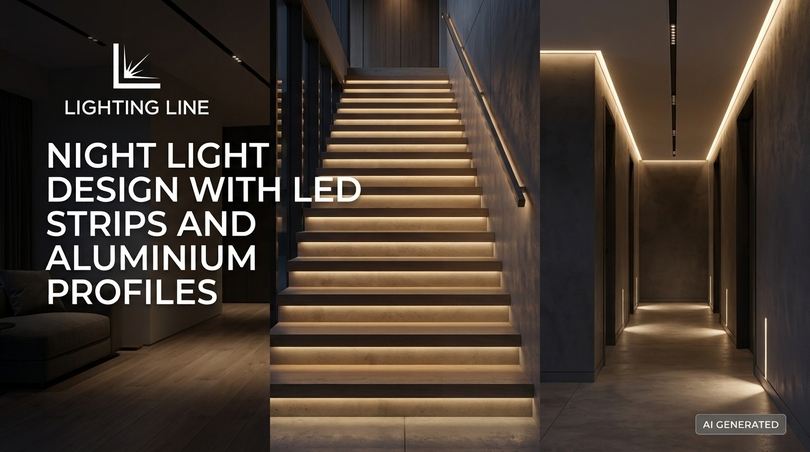
A night light is a low-intensity light source designed to stay on, or switch on automatically, during the hours of darkness so that people can see, orient themselves and move safely without waking up fully or disturbing others. For decades the typical night light was a small plastic plug in night light in a bedroom socket. Today the most effective night light solutions are architectural: warm, dimmable LED strips hidden inside aluminium profiles, controlled by motion sensors, timers and smart home systems, and integrated into skirting boards, stairs, bed bases, bathroom vanities and corridor walls.
This guide is written for construction companies, general contractors, electrical installers, architects, interior designers and developers who want to specify night lighting that is safe, efficient, comfortable and future-proof. It also answers the questions that end users ask most often, from “Is it good to sleep with a nightlight on?” to “What is the best night light for seniors walking at night?”, because a night light project only succeeds when it meets the real needs of the people who will live and sleep with it.
Throughout the article you will find practical tables, consumption calculations, product references from the LightingLine.eu online catalogue of aluminium profiles and LED strips, and links to the controllers and power supplies available on Ledpoint.it. Every recommendation is based on photometric principles, published research and the field experience of lighting professionals.
In this article..
- What is a night light? Definition, meaning and types
- Night light data, request and market demand
- Night light, sleep and health: what the science says
- Night light safety, fire risk and energy consumption
- Night light colour technologies: monochrome, CCT, RGB and human centric
- Night light control: sensors, dimmers, timers and smart home
- Choosing aluminium profiles and diffusers for a night light
- Night light applications in residential and non-residential buildings
- Four night light projects with LightingLine.eu profiles and strips
- How to make a night light with LED strips: design and installation
- Night light buying guide and comparison
- Night light beyond the bedroom: light shows, star effects and dark skies
- Night light maintenance, lifespan and troubleshooting
- Night light FAQ
- Building the night light of the future
1. What is a night light? Definition, meaning and types
Before choosing products or drawing a wiring diagram, it is worth agreeing on what a night light actually is and what it is not. The term is used for very different objects, from a toy projector in a nursery to a step light in a hotel corridor, and this ambiguity causes many specification errors on building sites.
Night light definition
A night light (also written nightlight or night-light) is a dim, continuous or automatically activated light source intended to provide just enough illumination during the night for orientation, reassurance and safe movement, without replacing the main lighting and without significantly disturbing sleep. Other words for night light include night lamp, nightlight lamp, orientation light, pathway light, step light, marker light and, in technical documents, “nocturnal orientation lighting”.
The purpose of a night light can be summarised in four functions:
- Orientation: helping people understand where they are and where walls, doors, steps and furniture are.
- Safety: reducing trips and falls when someone walks to the bathroom, the kitchen or a child’s room.
- Reassurance: easing fear of the dark in children and in some adults, and making unfamiliar spaces such as hotel rooms feel comfortable.
- Care tasks: allowing parents to feed or change a baby, and nurses to check on patients, without switching on full lighting.
What is the point of a night light compared with normal lighting?
Normal room lighting is designed for visual tasks: reading, cooking, working. It typically delivers 100 to 500 lux on the working plane. A night light works at a completely different scale. The point of a night light is to provide the minimum useful light, in the right place and in the right colour, at the moment it is needed. Anything brighter wakes people up, ruins dark adaptation and wastes energy. Anything dimmer or badly placed fails to prevent accidents.
That is why professionals treat the night light as its own lighting layer, alongside general, task, accent and decorative lighting. In a well-designed building, the night light layer has its own circuit, its own control logic and its own colour temperature.
Types of night lights
The market offers many types of night lights. Understanding their strengths and limits helps you explain to clients why an integrated LED strip night light is often the better long-term choice for new builds and renovations.
Plug in night light
The plug in night light is the most common product: a small unit that goes directly into a wall socket. Some include a light sensor (dusk to dawn) or a motion sensor. Plug in night lights for adults and children are cheap and easy, but they occupy a socket, their light comes from a fixed point at socket height, they can be knocked out by furniture, and their quality varies widely. In bathrooms, shaver socket night light models exist, but they remain point sources.
Battery night light and rechargeable night light
A battery powered night light or rechargeable night light (often with USB charging) is portable and can be stuck under a cabinet or inside a wardrobe. It is useful for rented apartments and temporary needs, but batteries must be replaced or recharged, brightness falls as the battery discharges, and the light output is usually small.
Motion sensor night light
A motion sensor night light, battery or mains powered, turns on only when someone moves. This is the logic that professionals reproduce at building scale with PIR sensors and LED strips, because it combines safety with very low energy use.
Night light projector and star projector night light
Projection night lights, star projector night light products, moon night light and galaxy models project patterns onto the ceiling. They are popular as a baby night light projector or toddler night light, mainly for bedtime routines. They are decorative and emotional rather than functional for safe movement.
Decorative night lamps
Night light lamp products shaped as animals, clouds, mushrooms, dinosaurs, unicorns or characters are designed to please children. They can help with fear of the dark but do little to light a route through a home.
Integrated LED strip night light
An integrated LED strip night light is a low-voltage LED strip installed inside an aluminium profile with a diffuser, built into the architecture and driven by a power supply and a control system. It can follow a skirting board, a stair nosing, a bed base, a kitchen kickboard or a bathroom vanity. Light is distributed along a line rather than from a point, so it defines edges and routes without glare. This is the type of night light this guide focuses on.
| Night light type | Light distribution | Typical power | Control options | Best use | Main limits |
|---|---|---|---|---|---|
| Plug in night light | Point source at socket height | 0.3 to 1 W (LED) | On/off, dusk sensor, some PIR | Quick retrofit, rental homes | Occupies socket, glare, limited coverage |
| Battery / rechargeable night light | Small point or short bar | 0.2 to 1 W | PIR, touch, manual | Wardrobes, temporary needs | Battery maintenance, falling output |
| Night light projector | Patterns on ceiling | 1 to 5 W | Remote, timer, music | Bedtime routine for children | Not designed for safe movement |
| Decorative night lamp | Soft glow from object | 0.5 to 3 W | Touch, remote | Children’s bedside | Lights the object, not the route |
| Integrated LED strip night light | Continuous line, low and glare-free | 0.5 to 6 W per installation when dimmed | PIR, dusk, timer, dimmer, ZigBee, DALI, app, voice | New builds, renovations, hotels, care homes, offices | Requires design and installation |
Why construction companies should care about the night light layer
For builders and developers, the night light is no longer a gadget that the occupant buys later. Integrating the night light into the design phase costs little, avoids visible cables and adapters, and adds tangible value that buyers notice during visits. A warm line of light under a floating bed, along a corridor skirting or under the steps of a staircase is one of the most photographed details in contemporary homes and hotels. It communicates quality, safety and attention to wellbeing, three values that justify higher sale or rental prices.
In addition, regulations and certification schemes for healthy buildings increasingly consider light and circadian health. A night light layer designed with warm, dimmable, low-glare light is a concrete feature that supports these goals.
2. Night light data, request and market demand
A good night light project starts from evidence. In this section we look at three types of data: research on light at night and health, statistics on falls that make the night light a safety device, and search-demand data that show how many people are actively looking for night light solutions. Together they explain why the night light category keeps growing and why integrated solutions are the next step.
Research on light at night
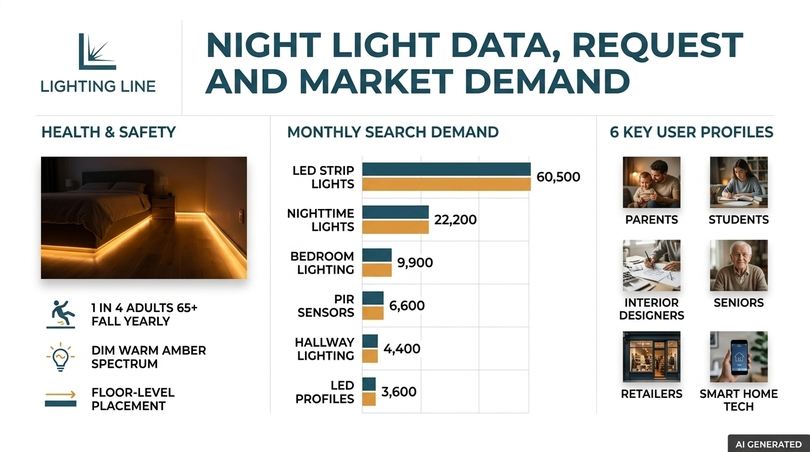
One of the most cited recent studies on night light exposure was published in the journal Sleep in 2022 by researchers at Northwestern University. They used wrist-worn sensors to measure real light exposure for seven days in more than 500 older adults aged 63 to 84. Less than half of the participants consistently had a five-hour period of complete darkness each day, and those exposed to any light during sleep were more likely to be obese, hypertensive and diabetic. The researchers stress that the study shows an association, not a cause, and that some people keep a light on precisely because they have health conditions and need to get up safely.
The practical advice from the same research team is extremely relevant for anyone who designs a night light: if a light is needed for safety, it should be dim, positioned close to the floor, and warm in colour (amber, red or orange rather than white or blue). You can read the full summary on the Northwestern University news page.
This is exactly the specification of a well-designed LED strip night light: low position, low intensity, warm spectrum, and activation only when needed.
Falls: why the night light is a safety device
According to the World Health Organization fact sheet on falls, falls are the second leading cause of unintentional injury deaths worldwide, and adults over 60 suffer the greatest number of fatal falls. In the United States, the Centers for Disease Control and Prevention report that about one in four adults aged 65 and over falls each year. Many of these falls happen at night, on the way to the bathroom, when people are drowsy, the eyes are not adapted to darkness and some medications reduce balance.
Lighting is one of the simplest environmental measures against falls. A continuous line of low light along the bedroom-to-bathroom route shows the floor edge, the door threshold and the first step, which are exactly the cues that the brain needs to keep balance in the dark. For care homes, assisted living and hotels with older guests, a night light layer is part of risk management, not decoration.
Demand for night light solutions
The interest in night light products is visible in the monthly request. The following figures come from an analysis of LightingLine.eu. They show both the size of the night light market and the strong overlap with LED strip and sensor lighting request.
| Search topic | Monthly request | What it tells a building professional |
|---|---|---|
| led strip lights | 60.500 | LED strips are a mainstream product that clients already know and ask for. |
| nighttime lights | 22.200 | People actively research lighting for the night hours. |
| bedroom lighting / bedroom lights | 9.900 | The bedroom is the core room for night light design. |
| pir sensors | 6,600 | Motion detection is a known concept for end users. |
| hallway lighting | 4.400 | Corridors and landings are a priority night light zone. |
| plug in night light | 3.600 | Strong demand for the traditional night light format. |
| led lighting profiles | 3.600 | Professionals look for profiles to integrate strips cleanly. |
| staircase lighting / stair lights | 2.900 | Stairs are one of the highest-risk night light locations. |
| sensor lights / motion sensor lights | 2.900 / 1.900 | Automatic activation is expected, not optional. |
| led under cabinet lighting | 1.900 | Kitchen night light and cabinet lighting overlap. |
| dim lighting / dimmer lights | 720 / 480 | Users want control over brightness at night. |
| dusk to dawn sensor | 480 | Automatic night-only operation is a common requirement. |
The data show a clear convergence: people search for night light products, for LED strips and for sensor lighting separately, but the best answer to all three needs is a single integrated system. Construction companies that offer this system as a standard or optional package respond to an existing demand rather than creating a new one.
Who asks for a night light and why
Research into user questions reveals six recurring profiles, each with specific expectations. Designing a night light for these profiles makes your proposal immediately relevant.
| User profile | Main goal | Typical questions | Integrated night light answer |
|---|---|---|---|
| Parent of a young child | Help the child sleep without fear of the dark | Is it safe all night? Does it have warm colours and adjustable brightness? | Low-voltage warm or amber strip, dimmable, no hot surfaces, no small parts |
| University student | Compact, modern, low energy | Which night lights use the least electricity? Can I control it from my phone? | Short COB strip in a slim profile, smart controller, under 1 W dimmed |
| Interior designer | Elegant, glare-free integration | Are there minimalist night lights with premium materials? | Recessed or drywall aluminium profile with opal diffuser, dot-free COB light |
| Retired person | Move safely between bedroom, bathroom and corridor | Can a night light reduce the risk of falling? Is a motion sensor easy to use? | PIR-activated skirting and bed-base light, automatic, no buttons |
| Children’s shop owner | Sell safe, durable products | What safety certifications should a children’s night light have? | CE-marked low-voltage components, certified power supply, aluminium housing |
| Home automation technician | Integrate with smart home and voice assistants | Can a night light connect to Alexa or Google Home? | ZigBee receiver and smart power supply, sensors linked to scenes |
3. Night light, sleep and health: what the science says
The most frequent question about any night light is simple: is it good or bad for sleep? The honest answer is that it depends on three variables: colour, intensity and position. Get those right and a night light supports safety without significantly disturbing rest. Get them wrong and the night light becomes a source of sleep disruption. This section explains the mechanisms in plain language.
How light affects melatonin and the circadian rhythm
The human eye contains special cells, called intrinsically photosensitive retinal ganglion cells, that contain a pigment named melanopsin. These cells are most sensitive to short-wavelength blue light, around 480 nanometres, and they send signals to the brain’s master clock. When they detect light at night, they suppress the production of melatonin, the hormone that prepares the body for sleep.
Blue-rich light at night has the strongest effect on melatonin, while warm amber and red light has a much smaller effect. The Harvard Health article on blue light summarises research showing that blue light suppresses melatonin for roughly twice as long as green light of comparable brightness and shifts circadian rhythms by about twice as much. For night light design this leads to a clear rule: use the warmest colour temperature compatible with the visual task.
What colour night light is best for sleeping?
The following table summarises the practical choice of colours for a night light, from the least to the most disruptive. The impact ratings are qualitative, based on the spectral sensitivity of the circadian system.
| Night light colour | Approximate spectrum | Expected circadian impact | Recommended use |
|---|---|---|---|
| Red | 620 to 700 nm | Very low | Bedroom night light, nursery feeding light, astronomy, night vision preservation |
| Amber / orange | 590 to 620 nm | Very low to low | Bedroom and corridor night light, care homes, children’s rooms |
| Extra warm white 2200K | Mostly long wavelengths | Low | Hallway, stairs, bathroom night light with natural colour rendering |
| Warm white 2700K | Warm with small blue component | Low to moderate (when dimmed) | General night light in homes and hotels |
| Neutral white 4000K | Balanced | Moderate to high | Not recommended for sleeping areas at night |
| Cool white 6000K+ | Blue-rich | High | Avoid as a night light; use only for daytime task lighting |
| Blue light | 450 to 490 nm | Highest | Avoid in bedrooms at night despite the “calming” reputation |
The best colour night light for sleep is red or amber, followed by extra warm white around 2200K. Many people choose a blue night light because blue feels calm, but from a biological point of view it is the worst choice for a bedroom at night. Green night light products sit in the middle and are also not ideal for sleeping areas.
How bright should a night light be?
Brightness matters as much as colour. A useful reference is that moonlight produces well under 1 lux, while a typical living room is between 50 and 200 lux. For a night light the goal is to provide about 1 to 5 lux on the floor of a route and up to 10 lux on steps or thresholds, while keeping the light source itself out of direct view from the bed.
With LED strips this is easy to achieve. A warm COB strip delivering several hundred lumens per metre at full power can be dimmed to 5 or 10 percent, producing a soft line of light that is clearly visible but never dazzling. Dimming also extends component life and reduces energy use.
Is it good to sleep with a nightlight on?
For most healthy adults, total darkness during sleep remains the ideal. However, many people need or prefer some light: children who fear the dark, parents who must check on a baby, older adults who get up at night, people in unfamiliar environments such as hotels or hospitals. If you sleep with a night light on, choose a dim, warm, low-positioned light that does not shine on your face, or better, a motion-activated night light that is off while you sleep and on only when you get up. This configuration offers safety with minimal light exposure during sleep.
Night light for adults: is it normal?
Yes. Many adults sleep with a night light or use one to move around the home at night, and there is nothing unusual about it. Adults may want a night light because of anxiety, past experiences, shared rooms, frequent nocturnal bathroom visits, pregnancy or simply habit. The best night light for adults is one that is discreet, warm, dimmable and automatic. An LED strip under the bed frame or along the skirting provides exactly this, without looking childish.
Night light for children: what age and which features?
Fear of the dark typically appears between the ages of two and six, when imagination develops faster than the ability to tell reality from fantasy. A night light can reassure the child, support a calm bedtime routine and make night-time awakenings less stressful for the whole family.
| Age | Need | Recommended night light approach |
|---|---|---|
| Newborns (0 to 6 months) | Newborns do not need a night light for themselves; parents need light for feeding and changing | Very dim red or amber light, controlled by parents, ideally motion or touch activated |
| Babies (6 to 24 months) | Night-time checks, settling | Amber nursery night light low on the wall or under the cot area, dimmed to minimum |
| Toddlers (2 to 4 years) | Beginning of fear of the dark | Warm night light with timer that fades after the child falls asleep |
| Children (4 to 10 years) | Reassurance, autonomy going to the toilet | Low pathway night light from bed to door, motion activated, warm colour |
| Teenagers and adults | Safety and comfort | Discreet architectural night light, smart control, no glare |
Should a 2 year old sleep with a night light? If the child is calmer with a light, a dim amber night light is a reasonable choice. Many families set the night light on a timer that dims it gradually over 30 to 60 minutes, so the child falls asleep with reassurance and then sleeps mostly in darkness. A motion sensor along the floor can then switch on the night light automatically if the child gets up.
Parents often ask: does a night light help with nightmares? A night light does not prevent nightmares, but it can reduce the fear and disorientation after waking from one, helping the child settle more quickly. Combined with a consistent bedtime routine, a warm night light is a useful tool.
Night light for seniors and the elderly
For older adults, the night light is primarily a fall-prevention device. Ageing eyes need more light to see the same detail and adapt more slowly to darkness. Contrast sensitivity also declines, which makes steps and thresholds harder to perceive. The best night light for the elderly therefore has four characteristics: it switches on automatically, it lights the floor and edges rather than the face, it is bright enough to show obstacles, and it stays warm in colour to support sleep after returning to bed.
Integrated LED strips are ideal: a line under the bed base, a line along the corridor skirting and a line under the bathroom vanity, all activated by a single motion sensor, create a continuous illuminated route without any buttons to find in the dark.
Does the “Night Light” mode on phones and computers work?
Many users ask whether they can use their phone as a night light or whether the night light feature on Windows, Android and iPhone actually helps. These “night light” or “night shift” modes shift the screen colours towards warm tones to reduce blue light in the evening. They can reduce glare and may make evening screen use slightly less stimulating, but they do not make screens neutral for sleep, because brightness and mental engagement also matter. A screen in night light mode is not a substitute for a real night light: it does not light the floor, it drains the battery and it keeps the phone in your hand at the moment you should be resting.
4. Night light safety, fire risk and energy consumption
A night light runs for many hours, often unattended, often in children’s rooms. Safety and running cost are therefore two of the most searched topics: “Are nightlights a fire hazard?”, “Are plug in nightlights safe?”, “Do night lights use a lot of electricity?”. This section answers them with numbers and with the technical criteria that a construction company should apply when selecting components.
Are night lights a fire hazard?
The fire risk associated with night lights comes mainly from old technologies and poor-quality products. Traditional incandescent night light bulbs of 4, 7 or 15 watts convert most of their energy into heat; if they touch fabric, paper or a pillow, they can reach temperatures high enough to cause scorching or ignition. Cheap uncertified plug-in units can also have poor internal insulation, weak contacts or plastics that are not flame retardant.
A modern LED night light built with certified components carries a much lower risk: LEDs produce far less heat for the same light output, and a low-voltage LED strip at 12V or 24V operates as a safety extra-low voltage (SELV) circuit when powered by an appropriate certified power supply. The aluminium profile acts as a heat sink, keeping the LED junction temperature low, which in turn prolongs life and preserves light quality.
The real safety-critical components in an integrated night light are therefore the power supply and the installation. A certified constant-voltage power supply, correctly sized and installed in a ventilated, accessible position, is essential. You can choose suitable units from the 24V power supplies and 12V power supplies ranges on Ledpoint.it.
Is it safe to leave a night light on all night?
Yes, provided that the night light is designed for continuous operation. Checklist for an all-night night light:
- LED light source, not incandescent or halogen.
- Low-voltage circuit (12V or 24V) supplied by a certified power supply with protection against short circuit, overload and overheating.
- Power supply loaded to no more than about 80 percent of its rated power.
- LED strip mounted in an aluminium profile for heat dissipation and mechanical protection.
- Diffuser that prevents direct contact with LEDs and avoids glare.
- Appropriate IP rating in bathrooms and humid areas.
- Installation by a qualified electrician according to local regulations.
Safety standards and certifications
When a parent or a children’s shop owner asks which certifications a night light should have, the answer depends on the product type. For an integrated LED strip night light in the European market, the key elements are:
| Element | What to check | Why it matters for a night light |
|---|---|---|
| CE marking | Declaration of conformity with the Low Voltage Directive and EMC Directive | Basic legal requirement and evidence of electrical safety |
| RoHS | Restriction of hazardous substances | Important for children’s rooms and healthy buildings |
| Power supply standards | Certified power supply with SELV output, short-circuit and overload protection | The power supply is the main safety component |
| IP rating | IP20 for dry indoor areas, IP65/IP67 for bathrooms and outdoors | Prevents moisture and dust problems |
| Ecodesign and energy label | Energy class and product information under EU lighting rules | Transparent efficiency data for clients |
| Flicker performance | Quality drivers and controllers with high PWM frequency | Flicker can cause discomfort, especially at low dimming levels |
EU light sources are subject to the ecodesign rules set out in Commission Regulation (EU) 2019/2020, which defines efficiency and functionality requirements, including information on lifetime, colour rendering and flicker. LED strips in the LightingLine.eu catalogue indicate their energy class directly on each product page, which helps contractors document compliance.
Do night lights use a lot of electricity?
No, if they are LED. A modern LED night light uses a fraction of the energy of the old incandescent models. The table below compares typical scenarios, assuming 8 hours of operation per night, 365 nights per year and an electricity price of 0.25 euro per kWh. Values refer to the light source, add roughly 10 percent for power supply losses.
| Night light scenario | Power | Energy per year | Cost per year |
|---|---|---|---|
| Incandescent night light bulb 15 W | 15 W | 43.8 kWh | about 10.95 euro |
| Incandescent night light bulb 7 W | 7 W | 20.4 kWh | about 5.11 euro |
| LED plug in night light | 0.5 W | 1.5 kWh | about 0.37 euro |
| 2 m COB LED strip 6 W/m dimmed to 10% | 1.2 W | 3.5 kWh | about 0.88 euro |
| 3 m COB LED strip 6 W/m dimmed to 25% | 4.5 W | 13.1 kWh | about 3.29 euro |
| 3 m COB LED strip 6 W/m at 50%, PIR activated 10 min per night | 9 W only when active | 0.55 kWh | about 0.14 euro (plus standby) |
The cheapest night light to run is a motion-activated LED night light: it can light several metres of route for a few cents per year. In that case the standby consumption of the power supply and controller becomes the largest share of energy use. A power supply with 0.3 W standby running all year uses about 2.6 kWh, roughly 0.66 euro. Choosing components with low no-load consumption, or switching the power supply via a smart relay, makes a measurable difference in large buildings with dozens of rooms.
How much does a night light cost to buy and install?
A simple plug in night light costs a few euro. An integrated LED strip night light costs more because it includes a profile, a diffuser, a strip, a power supply, a sensor or controller and installation time. However, when planned during construction, the incremental cost is modest because cable routes, boxes and recesses are prepared before plastering. For developers, the night light is one of the features with the best ratio between installed cost and perceived value.
5. Night light colour technologies: monochrome, CCT, RGB and human centric
Once you have decided that a night light is needed, the next decision is the type of LED strip. The choice determines how the light looks, how it can be controlled and how well it supports sleep. Here we compare the four main families and explain how to read the technical data on a product page.
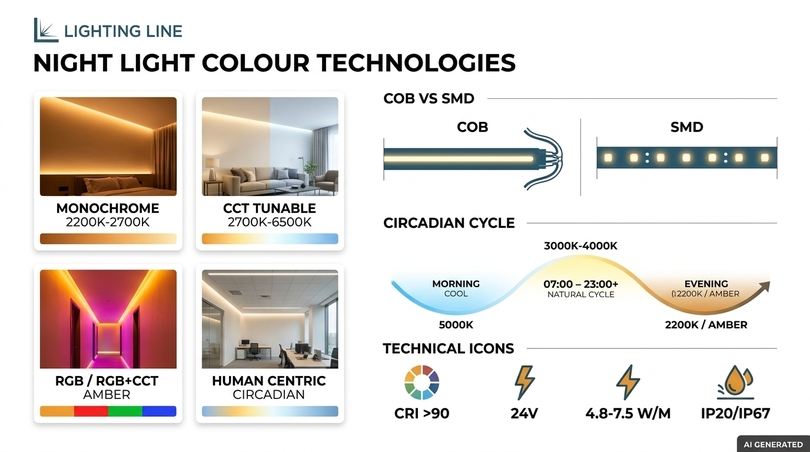
Monochrome warm white LED strips
A monochrome LED strip has a single channel and a single colour temperature. For night light applications, the most suitable options are 2200K, 2500K and 2700K. They are simple to control with a single-channel dimmer and offer excellent efficiency.
LightingLine.eu offers warm white COB strips particularly well suited to the night light role, for example the 5 m warm white 2700K COB LED strip, 480 LED/m, 24V, 6 W/m, 3 mm PCB, IP67 with spherical extruded silicone tube. Its 3 mm width allows installation in very slim profiles, the IP67 tube makes it suitable for bathrooms, and the COB technology produces a continuous, dot-free line, ideal for a glare-free night light. A 3000K version of the same strip is available when the night light must match a slightly less warm general lighting scheme.
For indoor dry areas, the COB LED strip 10 m warm white 2700K CRI Ra>90, 480 LEDs/m, 24V, 7.5 W/m with current control is interesting for long corridor runs: the integrated current control helps keep brightness uniform along the line, a key quality factor when the night light runs along tens of metres of skirting.
COB versus SMD strips for night lighting
LED strips come in two main constructions. SMD strips use discrete LED packages, such as 2835, spaced along the circuit board. COB (chip on board) strips use a dense line of tiny chips covered by a continuous phosphor layer. You can browse both families in the SMD LED strips and COB LED strips categories.
| Feature | COB LED strip | SMD LED strip |
|---|---|---|
| Appearance | Continuous, dot-free line even without deep diffusers | Visible dots unless used with deep profile and opal diffuser |
| Beam angle | Very wide (about 180 degrees) | Typically 120 degrees |
| Profile depth needed | Shallow profiles work well | Deeper profiles recommended for uniformity |
| Behaviour at low dimming | Smooth, uniform glow | Uniform if well diffused |
| Typical night light use | Skirting, under-bed, slim recessed lines, mirrors | Coves, longer runs, higher-output applications |
For most night light projects, COB strips are the preferred choice because their uniform line of light reflected on the floor looks like a natural glow rather than a series of bright points.
CCT tunable white LED strips
CCT (correlated colour temperature) strips have two channels, warm and cool white, which can be mixed to obtain any intermediate tone. The COB LED strip 10 m CCT 2700-6500K CRI Ra>90, 600 LEDs/m, 24V, 7.7 W/m from LightingLine.eu is a good example. During the day the same line can provide neutral accent light; at night it shifts to 2700K and dims to night light level.
To control CCT strips you need a two-channel controller. Ledpoint.it offers dedicated CCT controllers, receivers and remote controls that make this transition simple for the end user.
Coloured, RGB, RGBW and RGB+CCT LED strips
Coloured LED strips allow you to create a red or amber night light, which, as we have seen, has the lowest impact on sleep. You can use a monochrome coloured strip (for example orange or red) or an RGB strip mixed to amber. RGBW and RGB+CCT strips combine coloured channels with white channels, offering both an amber night light and high-quality white light for other uses.
LightingLine.eu’s LED strip range includes red, orange, yellow, RGB, RGB+3000K, RGB+4000K and RGB+CCT options, all filterable in the LED strips catalogue. For control, use RGB controllers, RGBW controllers or the RGB+CCT receivers and remotes available on Ledpoint.it.
A practical professional trick: program an “amber night light” scene on an RGB+CCT system, so that one button or one automation switches every line in the home to a dim, warm, sleep-friendly tone.
Human centric lighting and circadian night light
Human centric lighting (HCL) adapts colour temperature and intensity during the day to support the natural circadian rhythm: brighter and cooler in the morning, warmer and dimmer in the evening, and minimal amber at night. The night light is the final phase of this daily cycle.
Ledpoint.it has a dedicated Circadian Light range of LED strips designed for this purpose. Combined with LightingLine.eu profiles and an automated controller, it allows a building to offer a complete day-night lighting programme in which the night light is not an isolated product but the logical end of the day.
| Time | Colour temperature | Intensity | Purpose |
|---|---|---|---|
| 07:00 to 10:00 | 4000K to 5000K | High | Alertness and wake-up |
| 10:00 to 17:00 | 4000K | Medium to high | Activity and work |
| 17:00 to 21:00 | 3000K to 2700K | Medium to low | Relaxation |
| 21:00 to 23:00 | 2700K to 2200K | Low | Preparation for sleep |
| 23:00 to 07:00 | 2200K or amber | Night light level, motion activated | Safe movement with minimal sleep disruption |
How to read an LED strip data sheet for night light use
Product pages in the LightingLine.eu catalogue show icons and data for each strip. For a night light, these are the parameters to check:
- Colour temperature: 2200K to 2700K, CCT, or coloured (amber, red).
- CRI: a CRI above 90 renders skin tones and materials naturally even at low levels, which is appreciated in hotels and bathrooms.
- Power per metre: lower values (4.8 to 7.5 W/m) are usually more than sufficient for night light use.
- Voltage: 24V is the standard choice for longer runs; 12V suits short runs and battery systems.
- Cut point: a short cut interval (for example 2 or 2.5 cm) lets you fit the strip exactly to bed bases, steps and furniture.
- IP rating: IP20 for dry areas, IP65/IP67 for bathrooms, kitchens near sinks and outdoor paths.
- Strip width: must be compatible with the profile chosen.
6. Night light control: sensors, dimmers, timers and smart home
The difference between a basic LED line and a true night light system is control. Control decides when the light turns on, how bright it is, how long it stays on and how it fades away. It also decides whether the user has to do anything at all. The best night light is the one nobody has to remember to switch on. In this section we review every control technology relevant to night light design, with links to the matching controller categories on Ledpoint.it.
PIR motion sensors: the heart of an automatic night light
Passive infrared (PIR) sensors detect the heat movement of a person. When someone gets out of bed or walks into a corridor, the sensor switches on the night light; after a set time without movement, it switches off. For night light applications, choose sensors with adjustable delay (typically 30 seconds to a few minutes), adjustable sensitivity and, ideally, an integrated twilight threshold so that the sensor activates only in the dark.
Ledpoint.it offers a dedicated sensors category including models suitable for LED strip installations in furniture, walls and ceilings. Among them, microwave and infrared options allow detection through thin materials or in specific zones.
Sensor placement for a night light
- Under-bed sensor: mounted under the bed frame and aimed at the floor, it detects feet touching the ground without being triggered by movement during sleep.
- Corridor sensor: mounted at low height or on the ceiling at the corridor entrance, it triggers the pathway night light.
- Bathroom sensor: triggers a vanity or skirting night light instead of the main ceiling light, preserving sleep.
- Stair sensors: one at the bottom and one at the top, so the night light switches on in both directions.
Dusk-to-dawn and twilight sensors
A dusk-to-dawn sensor measures ambient light and enables the night light only when it is dark. It is the principle of the classic “automatic night light with sensor” for plug sockets, applied to an architectural installation. Combined with PIR detection, it avoids unnecessary activation during the day in naturally lit corridors.
Dimmers: the key to night light comfort
A night light must be dim, and dimming must be smooth down to very low levels without flicker. For single-colour strips, Ledpoint.it offers monochromatic dimmers, receivers and remote controls. Wireless remote controls are particularly appreciated by older users and parents, who can adjust the night light level from bed.
In professional buildings, the night light can be integrated into existing control standards:
- 0/1-10V: analogue dimming common in commercial projects; see 0/1-10V controllers.
- DALI: digital addressable control used in hotels, hospitals and offices; see DMX and DALI decoders.
- DMX: used in hospitality and entertainment for dynamic scenes.
Timers and fade-out programmes
A night light with timer is useful in children’s rooms: the light remains on for 30 to 60 minutes after bedtime and then fades out slowly, so the child falls asleep reassured and then sleeps in darkness. Timers are also useful in commercial buildings, where night light scenes are activated after closing hours and deactivated at opening time.
Smart night light: ZigBee, apps, Alexa and Google Home
A smart night light can be controlled by app, voice assistant or automation rules. ZigBee is one of the most widely used wireless protocols in smart homes and is supported by many hubs that integrate with Amazon Alexa, Google Home and other ecosystems. Ledpoint.it offers a ZigBee controller range and smart power supplies that combine the power stage and the control stage in one device, simplifying installation in furniture and false ceilings.
Typical smart night light automations include:
- “Night mode” scene at 23:00 that switches all strips to amber at minimum level.
- Motion-triggered night light route between bedroom and bathroom, active only between 23:00 and 07:00.
- Voice command “Turn on night light” for users who prefer not to move.
- Gradual sunrise simulation in the morning, ending night mode.
- Night light activation in the child’s room when the baby monitor detects crying.
Are smart night lights secure and reliable?
A well-designed smart night light should always work even when the internet is down. For this reason, professionals prefer local protocols such as ZigBee, local automation on the hub and physical sensors connected directly to the controller. Change default passwords, keep hub firmware updated and separate smart devices on a dedicated network where possible. The safety function of the night light, such as motion activation in the corridor, should never depend on a cloud service.
Emergency and power failure night light
In some buildings the night light also plays a role in emergencies. Power failure night lights stay on during a blackout to show the way out. For architectural installations, Ledpoint.it offers products in the emergency lighting category. Note that formal emergency lighting in public buildings must follow specific standards and be designed by qualified professionals; a domestic night light with battery backup is a comfort feature, not a substitute for certified emergency lighting.
Choosing the right control strategy
| Building type | Recommended night light control | Notes |
|---|---|---|
| Private apartment | PIR + twilight sensor + single-channel dimmer | Simple, reliable, no app required |
| Smart home villa | ZigBee receivers, smart power supplies, sensors, voice assistant | Scenes, schedules, remote management |
| Hotel | DALI or room controller integration, PIR under bed, bathroom sensor | Consistent guest experience, energy savings |
| Care home / assisted living | PIR under bed + corridor + bathroom, fixed amber or 2200K, no user controls needed | Fall prevention, staff visibility, minimal sleep disruption |
| Office / commercial | 0/1-10V or DALI with time schedules and occupancy | Night security and cleaning routes |
| Hospital ward | DALI with night scene and local switch for staff | Patient sleep and nurse rounds |
7. Choosing aluminium profiles and diffusers for a night light
An LED strip alone is not a finished night light. The aluminium profile protects the strip, dissipates heat, hides the light source, shapes the beam and gives the installation a clean architectural finish. The diffuser decides how soft and uniform the light appears. For a glare-free night light, the profile and diffuser are just as important as the strip itself. LightingLine.eu specialises in Italian-designed aluminium profiles, with more than 120 models across many categories.
Profile categories and their night light uses
| Profile category | Typical night light application | Why it works |
|---|---|---|
| Surface profiles | Under bed frames, under cabinets, under vanities, retrofits | No cutting into walls; quick installation |
| Recessed profiles | Floors, shelves, furniture, step nosings | Flush, invisible integration |
| Corner profiles | Wall-floor junctions, cabinet corners, stair stringers | Light aimed at 45 degrees towards the floor |
| Wall profiles | Corridor wall grazing, headboard walls | Indirect, soft light on vertical surfaces |
| Drywall profiles | Plasterboard walls and ceilings in new builds | Plastered-in, seamless finish ideal for construction companies |
| Floor profiles | Walk-over pathway night light | Robust, designed for foot traffic |
| Baseboard profiles | Skirting board night light along corridors and bedrooms | The classic low-level orientation line |
| Handrail profiles | Stair night light integrated into handrails | Light exactly where hands and feet need it |
| Furniture profiles | Wardrobes, bedside tables, kitchen plinths | Discreet integration in joinery |
| Mirror profiles | Bathroom mirror night light | Soft facial light without switching on the main light |
| Tiling profiles | Bathroom and shower niches, tiled walls | Installed with tiles, clean edges |
| Architectural profiles | Coves, shadow gaps, large projects | Integrated design for hotels and offices |
| Concrete profiles | Cast-in lighting in concrete stairs and walls | Permanent integration in structural works |
| Round profiles | Wardrobe rails, decorative elements | 360-degree or design-oriented emission |
| Suspension profiles | Night scenes in lobbies and open spaces (dimmed indirect component) | Combined general and night lighting |
Slim profiles for discreet night light lines
When the night light must be almost invisible, slim surface profiles are ideal. The 17×7 mm aluminium profile and the 8×10 mm aluminium profile fit under bed rails, shelves and stair treads. For curved furniture or rounded walls, the 18×6 mm flexible aluminium profile can follow the shape while keeping the strip protected.
When more depth is needed to soften SMD strips or to increase heat dissipation, profiles such as the 17×15 mm aluminium profile or the 21×25 mm surface profile provide more distance between LEDs and diffuser.
Diffusers: opal, satin and clear
The diffusers range determines the final look of the night light:
- Opal diffusers give the most uniform, soft line and the lowest glare: the first choice for bedrooms and children’s rooms.
- Satin diffusers balance efficiency and uniformity.
- Clear diffusers maximise light output but show the LEDs; suitable only with COB strips or where the profile is hidden from view.
For any night light visible from the bed, specify an opal diffuser and a COB strip: this combination eliminates hotspots and keeps luminance low, which is exactly what the eye needs at night.
End caps, mounting brackets and connectors
Professional finishing details make the difference. Each profile family has matching end caps (with or without cable hole) and mounting brackets. Solderless PCB LED strip connectors speed up installation on site and make future maintenance easier. For power supplies and cabling, refer to the power supplies section on Ledpoint.it.
Matching profile and night light design with interior style
Interior designers often ask how to choose a night light that matches a bedroom design. The answer lies in three choices:
- Finish: anodised aluminium for contemporary interiors, black or white finishes for minimalist schemes, plastered-in drywall profiles for invisible integration.
- Light line visibility: visible line as a design element (for example a floating bed) or hidden source with only the reflected glow visible.
- Colour temperature coherence: the night light should be the same or warmer than the evening general lighting.
A premium, minimalist night light is simply a thin line of warm light emerging from a precise shadow gap. No visible lamp, no plug, no cable. That is the aesthetic advantage of integrated profiles over any stand-alone night lamp.
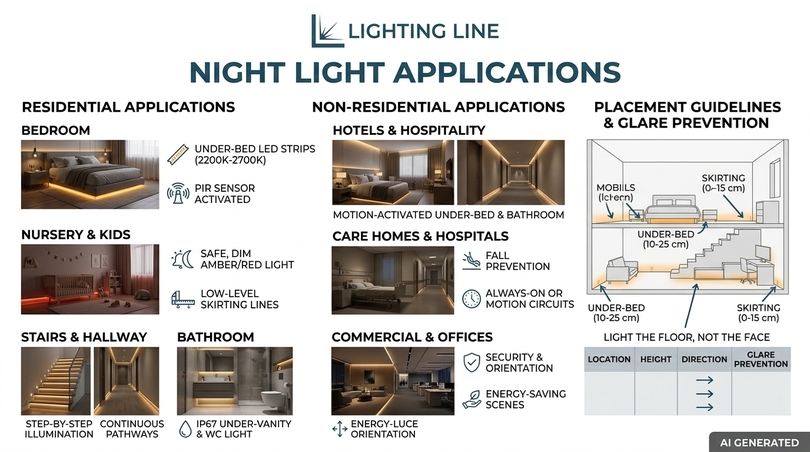
8. Night light applications in residential and non-residential buildings
Every room and every building type has its own night light needs. A child’s bedroom requires reassurance and very low light, a staircase requires clear step definition, a hotel corridor requires orientation and atmosphere, a care home requires fall prevention around the clock. In this section we examine each environment with practical guidance on position, colour, intensity, products and control, so that a construction company can turn the night light into a standard, repeatable specification.
Residential night light applications
Bedroom night light
The bedroom night light should never shine towards the pillow: the ideal source is under the bed frame, aimed at the floor. A line of warm COB strip in a slim surface profile fixed under the side rails of the bed creates a soft halo on the floor, visible when you put your feet down but almost invisible from the pillow. A PIR sensor under the bed switches the night light on as soon as the feet touch the floor, and off after one or two minutes. Recommended colour: 2200K to 2700K or amber. Recommended level: 1 to 5 lux on the floor.
For bedside reading at night, a separate dimmable reading light should be used; the night light is not a reading light. Many adults ask for the best night light for sleeping adults: in practice it is this under-bed motion night light, because it is completely off while you sleep.
Nursery night light and baby night light
In a nursery the night light serves the parents more than the baby. Night feeds, nappy changes and quick checks require just enough light to see, without fully waking the baby or the parent. A dim amber or red nursery night light, positioned low and out of the baby’s direct view, is the most sleep-friendly solution. Integrate a warm LED strip in a corner profile at floor level or under the changing table, controlled by a wireless remote or a touch sensor.
Many parents buy a baby night light projector or musical night light for the bedtime routine. These can coexist with an architectural night light: the projector is used for a short time at bedtime, while the integrated night light provides functional light during the night.
Children’s bedroom night light
For toddlers and older children afraid of the dark, a child night light should provide constant reassurance during the first part of the night and a lit route to the door. A warm line under the bed or along the skirting, with a timer that fades it down after the child falls asleep, works very well. Children love being able to choose a colour, so an RGB+CCT strip with a simple remote can turn the night light into a game while still allowing parents to set amber as the night-time default.
Safety considerations for kids are essential: low-voltage components, no accessible hot parts, profiles firmly fixed, power supply out of reach, no small parts. These are inherent advantages of an integrated night light over many plug-in and battery night light toys.
Hallway and landing night light
The hallway night light connects bedrooms, bathroom and stairs. A continuous low-level line along the skirting board is the most effective hallway night light, because it reveals the floor edges and the direction of the corridor. Baseboard profiles or corner profiles at the wall-floor junction are ideal. A night light for landing areas should also highlight the top of the stairs. Use ceiling or wall PIR sensors at each end of the corridor, with a twilight threshold.
Stair night light
Stairs are one of the highest-risk areas at night. Options include recessed profiles in each tread nosing, corner profiles along the stringer, handrail profiles and wall profiles at low height. The night light should make the edge of each step visible; step-by-step lighting is more effective than a single bright point at the top or bottom. Motion sensors at both ends should activate the night light, ideally with a sequential effect for added comfort in premium projects.
Bathroom night light
A bathroom night light avoids switching on the bright main light during the night, which can disrupt sleep for a long time after returning to bed. Install an IP67 warm COB strip under the vanity unit, behind the mirror at low level, or in a tiling profile at floor level near the toilet. A PIR sensor activates the night light automatically. For toilets, the classic “toilet night light” can be replaced by a discreet strip under a wall-hung WC frame or in the kickboard of the vanity. Always respect bathroom zone rules and use suitable IP ratings and SELV circuits.
Kitchen night light
At night, people often go to the kitchen for a glass of water. A kitchen kickboard night light, or a dimmed under-cabinet LED strip, provides enough light without waking the whole house. Many LED under cabinet lighting installations can be set to a night light scene at 5 to 10 percent with warm colour.
Living room and open spaces
In open-plan homes, a night light scene in the living area provides orientation from bedrooms to kitchen. Indirect coves or shelf lighting dimmed to night light level create a calm, safe environment without the feeling of “lights on”.
Wardrobes and walk-in closets
Wardrobe lighting with door or motion sensors is technically a night light too: it allows people to dress early in the morning without switching on the bedroom light and waking a partner.
Non-residential night light applications
Hotels and hospitality
Hotel guests sleep in an unfamiliar room. A hotel night light under the bed and in the bathroom, activated by motion, is one of the most appreciated comfort features and reduces the risk of falls and complaints. It also reduces energy use compared with guests leaving the bathroom light on with the door ajar, which is a common habit in hotels. In corridors, a dimmed night light scene at night maintains orientation and security while saving energy.
Care homes, nursing homes and assisted living
For care facilities the night light is a clinical and organisational tool. It helps residents move safely to the bathroom, allows staff to check rooms without switching on main lights, and supports sleep quality and circadian rhythm, which is particularly important for people with dementia. Fixed warm colour, automatic activation, no reliance on residents remembering to press buttons and robust, easy-to-clean profiles are the main requirements.
Hospitals and clinics
Hospital wards need a night light that allows nursing staff to work while patients sleep. Low-level night lights along the floor near the bed, combined with a separate examination light, provide the right balance. DALI integration makes it possible to manage night scenes for an entire ward.
Offices and commercial buildings
In offices, the night light layer supports security rounds, cleaning staff and late workers. A night scene with corridor lines at low level and occupancy detection reduces energy use while maintaining safe circulation.
Retail and showrooms
Shops and showrooms often keep some lighting on after closing for security and visibility from the street. A dimmed LED strip night light in shelves or display bases maintains presence at very low energy cost.
Residential common areas
Apartment buildings benefit from night light lines in stairwells, corridors and entrance halls, activated by motion and twilight sensors. They improve perceived safety for residents and reduce consumption compared with timer-based general lighting.
Schools, boarding schools and student housing
Dormitories and student residences need night light routes to bathrooms and exits. Students also appreciate personal night light control at the desk and bed, ideally with app or smartphone control.
Outdoor paths and gardens
Outdoor night light lines along paths and steps guide movement while limiting light pollution. Use IP67 warm strips at 2200K to 2700K in profiles aimed downwards, and activate them with dusk and motion sensors. This approach respects the night sky and wildlife, as discussed later in this guide.
Where to place a night light: position and glare prevention
| Location | Recommended height | Light direction | Glare prevention |
|---|---|---|---|
| Under bed | 10 to 25 cm above floor | Downward to floor | Profile hidden under frame, opal diffuser |
| Skirting / baseboard | 0 to 15 cm | Down and along floor | Light source not visible from standing position |
| Stair treads | Under each nosing | Down onto tread | Recessed profile, light aimed away from eyes |
| Corridor wall | 20 to 40 cm | Downward grazing | Asymmetric or shielded profile |
| Bathroom vanity | Under unit, 15 to 30 cm | Down to floor | IP67 strip, opal cover |
| Kitchen kickboard | 5 to 10 cm | Down to floor | Recessed into plinth |
| Headboard | Behind headboard, indirect | Up or sideways onto wall | Never directly visible from pillow |
The golden rule of night light placement is: light the floor, not the face. The lower the night light, the less it disturbs sleep and the better it reveals obstacles.
9. Four night light projects with LightingLine.eu profiles and strips
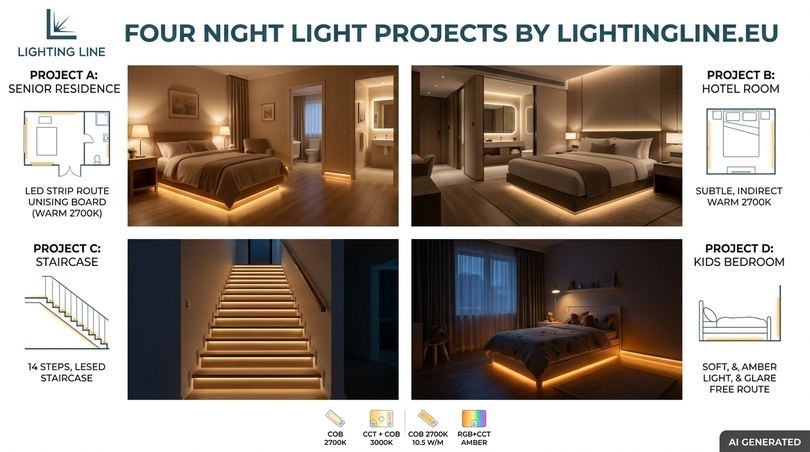
Theory becomes useful when it is translated into real projects. The following four examples show how a construction company can design a complete night light system in four different environments, combining LightingLine.eu profiles and LED strips with controllers, sensors and power supplies from Ledpoint.it and with emerging lighting control technologies. Each example includes the design goal, the bill of materials, the control logic and an indicative power calculation. Quantities and powers are indicative and must always be verified by the project electrician against the actual site measurements and local regulations.
Project A: senior residence room with fall-prevention night light route
Design goal
Create an automatic night light route from bed to bathroom for a resident aged over 75, with no switches to find in the dark, warm light to protect sleep, and visibility of floor edges and the bathroom threshold. The same design is repeated in every room of an assisted living building.
Night light layout
- Under-bed night light on the exit side of the bed: 1.8 m surface profile under the bed frame.
- Corridor skirting night light from bedroom door to bathroom: 4 m baseboard or corner profile.
- Bathroom night light under the vanity and along the floor near the WC: 1.2 m IP67 strip.
Bill of materials
| Component | Product reference | Quantity |
|---|---|---|
| LED strip under bed and bathroom | COB 2700K, 6 W/m, 24V, IP67 | 3 m |
| LED strip corridor | COB 2700K CRI Ra>90, 7.5 W/m, current control | 4 m |
| Under-bed profile | 17×7 mm aluminium profile with opal diffuser | 1.8 m |
| Corridor profile | Baseboard profile or corner profile | 4 m |
| Bathroom profile | Surface profile under vanity | 1.2 m |
| Diffusers, end caps, brackets | Opal diffusers, end caps, brackets | As required |
| Motion sensors | Ledpoint sensors: under bed and bathroom | 2 |
| Dimmer / receiver | Monochromatic dimmer | 1 |
| Power supply | 24V power supply, minimum 60 W | 1 |
Power calculation
Under-bed 1.8 m x 6 W/m = 10.8 W. Bathroom 1.2 m x 6 W/m = 7.2 W. Corridor 4 m x 7.5 W/m = 30 W. Total at full power: 48 W. Applying the rule of loading the power supply to about 80 percent, the minimum rated power is 48 / 0.8 = 60 W. In night light mode the system is dimmed to about 15 percent, which means roughly 7 W only while someone is moving.
Control logic
- Between 22:00 and 07:00 the under-bed sensor detects feet on the floor and switches on the entire route at night light level.
- The route stays on for 3 minutes after the last detection; the bathroom sensor extends the timing while the resident is in the bathroom.
- During the day the same lines can be used at higher level as orientation and accent lighting.
Emerging technologies
In advanced assisted living projects, the night light can be connected to presence and fall detection systems based on radar or millimetre-wave sensors. When the night light activates at an unusual time or the resident does not return to bed after a set period, the system can notify staff. This turns the night light into part of a broader ambient assisted living platform, while privacy is preserved because no cameras are used.
Project B: hotel room with guest night light and circadian scenes
Design goal
Give guests a premium, intuitive night experience: a soft glow under the bed when they get up, a guiding light to the bathroom, and a mirror night light that avoids the harsh main light at night. During the day, the same lines contribute to the room’s design and to a circadian lighting programme.
Night light layout
- Under-bed lines on both sides of a double bed: 2 x 1.6 m with CCT COB strip.
- Bathroom mirror night light: 1.6 m warm strip in a mirror profile.
- Entrance wardrobe lighting activated by door opening.
Bill of materials
| Component | Product reference | Quantity |
|---|---|---|
| Under-bed tunable strip | COB CCT 2700-6500K, CRI Ra>90, 7.7 W/m | 3.2 m |
| Mirror strip | COB 3000K, 6 W/m, IP67 | 1.6 m |
| Under-bed profile | 8×10 mm aluminium profile with opal diffuser | 3.2 m |
| Mirror profile | Mirror profile | 1.6 m |
| Wardrobe profile | Furniture profile | 1 to 2 m |
| CCT control | CCT controllers or DALI decoders for room management integration | 1 to 2 |
| Sensors | Motion sensors under bed and in bathroom; door sensor in wardrobe | 3 to 4 |
| Power supply | 24V power supply, minimum 45 to 60 W | 1 |
Power calculation
Under-bed 3.2 m x 7.7 W/m = 24.6 W. Mirror 1.6 m x 6 W/m = 9.6 W. Wardrobe about 6 W. Total about 40 W at full power, so a power supply of at least 50 W is required (40 / 0.8). In night light mode the under-bed lines run at 2700K and 10 percent, about 2.5 W.
Control logic and guest experience
- When the guest enters, the room controller activates the welcome scene; the under-bed line runs at 3000K as accent light.
- When the guest selects “sleep” on the room panel or by voice, all lines dim to off and the night light mode is armed.
- At night, motion under either side of the bed activates the night light at 2700K, 10 percent, and the bathroom sensor activates the mirror night light at 15 percent.
- In the morning, a gradual wake-up scene raises intensity and colour temperature.
For hotel owners, a guest night light is a tangible amenity that appears in reviews, reduces falls and avoids the energy waste of bathroom lights left on all night.
Project C: residential staircase and landing night light
Design goal
Make a 14-step staircase and the upper landing safe at night for a family with young children and grandparents, while creating a striking architectural feature visible from the living room.
Night light layout
- Under each tread nosing: a recessed or corner profile 0.9 m long, for 14 steps (12.6 m total).
- Landing skirting: 3 m baseboard profile with the same strip.
- Sensors at the bottom of the stairs and on the landing.
Bill of materials
| Component | Product reference | Quantity |
|---|---|---|
| LED strip | COB 2700K CRI Ra>90, 480 LEDs/m, 10.5 W/m, 120 lm/W | 15.6 m |
| Step profiles | Recessed profiles or corner profiles | 14 x 0.9 m |
| Landing profile | Baseboard profile | 3 m |
| Handrail option | Handrail profile | Optional |
| Connectors | PCB LED strip connectors and cables | As required |
| Sensors | Motion sensors top and bottom | 2 |
| Controller | Monochromatic controller or ZigBee receiver | 1 to 2 |
| Power supply | 24V power supplies, total at least 205 W (for example two units of about 120 to 150 W) | 1 to 2 |
Power calculation and wiring
15.6 m x 10.5 W/m = 163.8 W at full power, so a total power supply capacity of at least 163.8 / 0.8 = 205 W is required. Because each step is a separate segment, wire them in parallel from a 24V distribution bus rather than in series, to avoid voltage drop and uneven brightness. At night the stair night light runs at 10 to 20 percent, consuming 16 to 33 W only while someone is on the stairs.
Emerging technologies
Premium projects can use addressable or sequential control to light the steps one after another in the direction of travel. Ledpoint.it’s SPI controllers manage addressable strips for these dynamic effects. Integration with the smart home allows the stair night light to switch on automatically when a door sensor detects someone leaving a bedroom.
Project D: children’s bedroom with circadian and amber night light
Design goal
Help a child aged three to six fall asleep without fear of the dark, support a calm evening routine, and give parents a safe, glare-free light for night-time checks. The same installation should grow with the child.
Night light layout
- Under-bed line: 2 m RGB+CCT strip in a slim profile.
- Skirting line from bed to door: 3 m in a corner profile.
- Remote control for the child (colour choice) and parental programming (amber night default, timer).
Bill of materials
| Component | Product reference | Quantity |
|---|---|---|
| LED strip | RGB+CCT LED strip from the LightingLine.eu LED strips catalogue (filter by light colour: RGB+CCT) | 5 m |
| Under-bed profile | 17×7 mm profile or 17×15 mm profile depending on strip width | 2 m |
| Skirting profile | Corner profile with opal diffuser | 3 m |
| Controller and remote | RGB+CCT receiver and RGB+CCT remote control | 1 + 1 |
| Sensor | Motion sensor under bed | 1 |
| Power supply | 24V power supply sized at 125 percent of the strip load | 1 |
Control logic
- 19:30: bedtime scene at 2700K, 30 percent, while parents read a story.
- 20:00: child chooses a favourite colour for 10 minutes, then the night light shifts automatically to amber.
- 20:00 to 21:00: amber night light fades gradually from 15 percent to 3 percent.
- 21:00 to 07:00: night light off, motion-activated amber at 5 percent if the child gets up.
- 07:00: wake-up scene at 4000K.
This approach combines the emotional appeal of a children’s night light with the safety and sleep-friendliness of a professionally designed system. Unlike a plug-in toy, it has no small parts, no hot surfaces and no cables within reach, and it can evolve from nursery night light to teenager’s ambient lighting simply by changing the programme.
Comparing the four night light projects
| Project | Strip technology | Night light colour | Main control | Primary benefit |
|---|---|---|---|---|
| A. Senior residence room | COB 2700K, IP67 and current control | 2700K, 15% | PIR + dimmer | Fall prevention |
| B. Hotel room | COB CCT + COB 3000K IP67 | 2700K, 10 to 15% | Room controller / DALI + PIR | Guest comfort and energy savings |
| C. Staircase and landing | COB 2700K, 10.5 W/m, 120 lm/W | 2700K, 10 to 20% | PIR top and bottom, optional SPI sequence | Step safety and architectural impact |
| D. Children’s bedroom | RGB+CCT | Amber, 3 to 15% | RGB+CCT remote, timer, PIR | Reassurance and healthy sleep routine |
10. How to make a night light with LED strips: design and installation
“How to make a night light” is a frequent search, both from DIY enthusiasts and from professionals. A plug-in night light needs no design, but an integrated LED strip night light is a small lighting system and deserves a structured process. The following steps summarise how a construction company or electrical contractor can design, install and commission a reliable night light, from the first site survey to the handover to the client.
Step 1: map the night routes
Start with a simple floor plan and draw the routes people will take at night: bed to bathroom, bed to child’s room, bedroom to kitchen, top to bottom of stairs. Every night light decision follows these routes: where people walk is where the night light must be. Mark obstacles, thresholds, steps, changes of floor level and door swings.
Step 2: choose positions and profiles
For each segment of the route, choose the lowest suitable position (under bed, skirting, kickboard, stair nosing) and the matching profile family from the LightingLine.eu catalogue. In new construction, prefer recessed and drywall profiles that are installed before finishing; in renovations, surface and corner profiles are faster.
Step 3: select the LED strip
Choose colour temperature (2200K to 2700K, CCT, amber), power per metre (usually 6 to 10.5 W/m is more than enough for a night light that will be dimmed), voltage (24V for runs of several metres), IP rating (IP67 in bathrooms) and width compatible with the profile.
Step 4: calculate power and size the power supply
Multiply the length of each segment by the power per metre, add the segments, and divide by 0.8 to get the minimum power supply rating. Example: 7 m x 6 W/m = 42 W; 42 / 0.8 = 52.5 W, so choose a power supply of at least 60 W. Place power supplies in accessible, ventilated positions such as technical cupboards, false ceilings with inspection hatches or furniture compartments.
Step 5: manage voltage drop
Long runs of LED strip lose voltage along the copper tracks, which causes the far end of the night light to appear dimmer or warmer. For runs beyond a few metres, feed the strip from both ends or at intermediate points, use adequately sized cables, and prefer strips with current control when uniformity is critical. For stairs and multi-segment designs, use parallel wiring from a distribution point.
Step 6: choose and position controls
Decide the control strategy: PIR plus twilight sensor for automatic night light routes, dimmers or receivers for adjustable brightness, ZigBee or DALI for integration. Position sensors so that they detect people getting up without being triggered by sleeping movements or by pets, where relevant.
Step 7: prepare the site
- Plan cable routes and junction boxes before plastering.
- Provide recesses in plasterboard, joinery or concrete for recessed and drywall profiles.
- Coordinate with joiners for under-bed, wardrobe and kitchen plinth profiles.
- Coordinate with tilers for tiling profiles in bathrooms.
Step 8: install the night light
- Cut profiles to length and deburr edges.
- Clean the inside of the profile so the strip adhesive bonds correctly.
- Cut the strip only at the marked cut points.
- Connect leads with solderless connectors or soldering, respecting polarity.
- Apply the strip inside the profile, pressing firmly along its length.
- Insert the diffuser and fit end caps.
- Fix the profile with brackets, clips or adhesive suitable for the substrate.
- Connect the strip to controller and power supply.
Step 9: commission and fine-tune
Commissioning is where a good night light becomes a great one. Test every sensor at night with the lights off. Adjust sensor sensitivity and delay times. Set the night light level by eye in real darkness: the right level is the lowest level at which floor edges and steps are clearly visible. Check for glare from the bed and from standing positions. Program schedules and smart scenes and document everything for the client.
Step 10: handover and user training
Show the client how the night light works, how to adjust levels, and how to disable it if they wish. Provide a short written guide with product references and wiring diagrams. For hotels and care homes, train staff and include the night light system in maintenance plans.
DIY night light: what non-professionals should know
A simple DIY night light can be made with a short low-voltage LED strip, a slim profile, a plug-in certified power supply and a small motion sensor. However, any work on fixed wiring, bathrooms or mains-voltage connections should be carried out by a qualified electrician. Never use uncertified power supplies, never install IP20 strips in wet areas and never cover power supplies with insulation or fabric.
Common night light design mistakes
| Mistake | Consequence | Correct approach |
|---|---|---|
| Using cool white for the night light | Sleep disruption, clinical feel | 2200K to 2700K or amber |
| Night light too bright | Glare, waking up fully | Dim to 5 to 15 percent, test in darkness |
| Light source visible from bed | Disturbs sleep | Hide under frame, aim at floor, use opal diffuser |
| No sensor, always on | Unnecessary light during sleep, higher consumption | Motion and twilight activation |
| SMD strip in shallow clear profile | Visible dots, glare | COB strip or deep profile with opal diffuser |
| Undersized power supply | Overheating, short lifespan | Load to maximum 80 percent |
| Single feed on long run | Uneven brightness | Double feed or current-controlled strip |
| Cheap controller with low PWM frequency | Visible flicker at low levels | Quality dimmers and receivers |
11. Night light buying guide and comparison
Clients often ask: what is the best night light to buy? Where to buy a night light? Is a plug in night light enough, or is it worth investing in an integrated system? This buying guide helps you answer with clear criteria and helps end users compare products sold in large retail and online marketplaces with professional solutions.
How to choose a night light: the seven criteria
- Purpose: reassurance, orientation, fall prevention, care tasks or decoration.
- Colour: amber, red or warm white for sleep areas.
- Brightness and dimming: adjustable to very low levels.
- Activation: manual, timer, dusk sensor, motion sensor, app or voice.
- Power source: plug-in, battery, rechargeable, or hardwired low-voltage system.
- Safety: certifications, low-voltage, temperature, materials.
- Integration and design: visible object or invisible architectural line.
Plug-in, rechargeable or integrated night light?
| Criterion | Plug in night light | Rechargeable / battery night light | Integrated LED strip night light |
|---|---|---|---|
| Initial cost | Very low | Low | Medium (lower if planned during construction) |
| Installation | None | Adhesive or magnetic | Professional |
| Light quality | Variable | Variable, falls with battery | High CRI, uniform, dimmable |
| Coverage | One point | One point or short bar | Entire routes and rooms |
| Automation | Basic sensors | Basic sensors | Full: sensors, scenes, smart home, DALI |
| Design impact | Visible object | Visible object | Invisible or architectural feature |
| Maintenance | Replace unit | Recharge or replace batteries | Minimal, long LED life |
| Added property value | None | None | Yes, perceived quality and safety |
Are rechargeable night lights better than plug-in models? They are more flexible but require recharging and usually offer less light. For permanent needs in homes, hotels and care facilities, an integrated low-voltage night light is the more reliable and comfortable solution.
Where to buy a night light
Consumers can find plug-in, battery, projector and character night lights in supermarkets, department stores, toy shops and online marketplaces. These products are appropriate for quick, inexpensive needs. For architectural night lighting, buy from specialised lighting suppliers that provide technical data, compatible profiles, certified power supplies and technical support. The LightingLine.eu catalogue provides profiles and LED strips with full technical specifications, while Ledpoint.it supplies controllers, sensors and power supplies for complete systems, with technical staff available to help choose the right product for each project.
Answers for each type of buyer
Parents: what is the best night light for a child who is afraid of the dark?
A warm or amber night light that the child can see from the bed but that does not shine in the eyes, with adjustable brightness and a timer. An under-bed or skirting LED strip with remote control is ideal; it reassures the child and also lights the route to the door.
Students: what is the best affordable night light for a bedroom?
A short COB strip in a slim profile, powered by a small certified power supply, with a compact smart controller. It uses under 1 W when dimmed and can double as desk ambient light. Which night lights use the least electricity? Motion-activated LED night lights.
Interior designers: which night lights provide soft ambient light without glare?
Recessed and drywall profiles with opal diffusers and COB strips at 2200K to 2700K. These create clean light lines integrated into the architecture, ideal for modern interiors and premium projects.
Seniors: what are the easiest night lights to use for older adults?
Fully automatic motion-sensor night lights that require no buttons. They switch on when the person gets out of bed and switch off by themselves. A night light route from bed to bathroom is the most effective solution.
Children’s shop owners: which night lights are suitable for babies and toddlers?
Products with clear certifications, low-voltage operation, no small detachable parts, non-toxic materials, low surface temperatures and dimmable warm or amber light. Popular designs with children include animals, stars, moons, clouds and characters; durability and safety should, however, always come before appearance.
Home automation technicians: which night lights have motion and light sensors and work with Alexa and Google Home?
Systems built on ZigBee receivers or smart power supplies with compatible hubs, plus local motion and twilight sensors. This architecture offers voice control and app control while keeping the safety function local and reliable.
Night light price and feature comparison
| Segment | Typical product | Features | Ideal for |
|---|---|---|---|
| Entry | LED plug in night light with dusk sensor | Fixed brightness, automatic at night | Quick fix, rented rooms |
| Mid | Rechargeable motion sensor night light | PIR, portable, USB charging | Wardrobes, temporary solutions |
| Upper mid | Smart plug-in night light with app | Colours, schedules, app | Tech-savvy users |
| Professional | Integrated LED strip night light system | Profiles, COB strips, sensors, dimming, smart home, DALI | New builds, renovations, hotels, care homes |
12. Night light beyond the bedroom: light shows, star effects and dark skies
The night light concept extends beyond bedrooms and corridors. People search for light show night light effects, star projector night light products and ways to enjoy a night sky without light pollution. LED strips and profiles can respond to all three needs, as long as they are designed with care for comfort and for the environment.
Light show night light effects with addressable LED strips
Addressable (pixel) LED strips allow each segment to be controlled individually, creating flowing, sequential or starry effects. In a child’s room, a ceiling cove with addressable strips can recreate a slow “starry sky” for a few minutes at bedtime, offering the emotional appeal of a projector without hanging devices. Ledpoint.it offers addressable LED strips and SPI controllers for these effects. Dynamic effects should always end with a static, dim, warm night light setting, because motion and colour changes keep the brain alert.
Star projector night light versus architectural light
Many families want to buy a star projector night light for a baby or toddler. Projectors are effective for short bedtime rituals and can be combined with an architectural night light that provides safe, functional light for the rest of the night. For interiors that must remain minimal, a starry ceiling effect can also be achieved with fibre optics or addressable strips integrated in a ceiling cove, avoiding visible devices.
Night sky without light pollution: responsible outdoor night light
Outdoor lighting affects the night sky, wildlife and neighbours. Organisations such as DarkSky International promote lighting that is useful, targeted, low level, controlled and warm-coloured. These principles match perfectly the logic of a good night light:
- Useful: light only paths, steps and entrances that are actually used at night.
- Targeted: aim light downwards with shielded profiles; never upwards into the sky.
- Low level: use the minimum intensity needed for safe movement.
- Controlled: use motion and dusk sensors so lights are off when nobody is there.
- Warm-coloured: prefer 2200K to 2700K or amber to limit blue light emission.
An outdoor night light made with IP67 warm COB strips inside downward-facing profiles along garden steps or path edges illuminates the ground, not the sky, helping to preserve a dark night sky while keeping people safe.
Night light for pets
Some pet owners ask whether a dog or cat needs a night light. Cats see well in low light and do not need one; dogs can also navigate in very dim conditions, though older dogs with reduced vision may benefit from a dim, warm night light along their route. Aquarium night light settings with very low blue or moonlight effects are common, but for fish a regular dark period is important. In all cases, the principles of low intensity and warm colour apply.
Night light and night vision
Red light preserves dark adaptation, which is why astronomers, pilots and hunters use red torches. The same principle applies at home: a red or amber night light lets you move around at night while your eyes stay adapted to darkness, so returning to sleep is easier. For security cameras with infrared night vision, note that some infrared illuminators emit a faint red glow; positioning them away from bedroom windows avoids unwanted light.
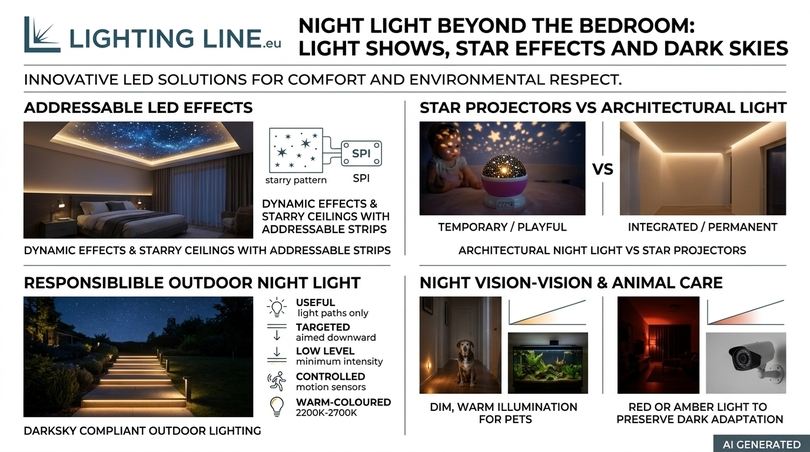
13. Night light maintenance, lifespan and troubleshooting
A well-installed LED strip night light requires very little maintenance, but a few simple checks keep it working perfectly for many years. This section covers lifespan, cleaning, typical problems and solutions.
How long does an LED night light last?
Quality LED strips mounted in aluminium profiles and operated at low dimming levels, as a night light normally is, can last tens of thousands of hours. Dimming and good thermal management are the two main factors that extend the life of a night light. The power supply is usually the component with the shortest life, so choose a quality unit, size it correctly and install it in a ventilated place.
How to clean a night light
- Switch off the power before cleaning.
- Clean diffusers with a soft, dry or slightly damp cloth; avoid solvents and abrasive products.
- In bathrooms, check that IP-rated end caps and seals remain intact.
- Check periodically that sensors are not covered by dust or furniture.
Night light troubleshooting
| Problem | Possible cause | Solution |
|---|---|---|
| Night light does not switch on | No power, sensor threshold too low, loose connection | Check power supply, adjust twilight threshold, check connectors |
| Night light switches on during the day | Twilight sensor missing or wrongly set | Add or adjust dusk sensor |
| Night light switches on while sleeping | Sensor sees movement in bed or pets | Lower sensor, aim at floor, reduce sensitivity |
| Flicker at low brightness | Low-quality controller or incompatible power supply | Use quality dimmer with high PWM frequency |
| Uneven brightness along the line | Voltage drop | Feed from both ends, thicker cables, current-controlled strip |
| Different colour at end of run | Voltage drop on CCT or RGB strip | Additional feed points |
| Strip detaching from profile | Dirty or cold surface during installation | Clean profile, install at proper temperature, use clips |
| Power supply hot | Overload or poor ventilation | Reduce load, larger power supply, ventilated position |
Battery replacement in portable night lights
For battery night light products, replace batteries with the type specified by the manufacturer and recycle used batteries correctly. For rechargeable night light units, avoid leaving them permanently in charge if the manufacturer advises against it, and replace them if the battery swells or the run time becomes very short. Integrated low-voltage night lights avoid these issues entirely.
14. Night light FAQ
This section collects the questions people ask most often about the night light, grouped by theme. Click on each question to open the answer.
| Night light basics |
|---|
What is a night light?A night light is a low-intensity light that stays on or switches on automatically at night to provide orientation, reassurance and safe movement without fully lighting a room or significantly disturbing sleep. It can be a plug-in unit, a battery or rechargeable device, a projector, a decorative lamp or an integrated LED strip installed in an aluminium profile. |
What is the purpose of a night light?The purpose of a night light is to help people orient themselves, move safely, feel reassured in the dark and perform night-time care tasks, such as feeding a baby or checking on a patient, without switching on bright lights. |
What is another word for night light?Common alternatives are nightlight, night-light, night lamp, orientation light, pathway light, step light and marker light. In professional lighting design, the night light is often called nocturnal or orientation lighting. |
What do you call a light that comes on at night automatically?It is called an automatic night light, dusk-to-dawn light or twilight-activated night light. If it reacts to movement, it is called a motion sensor night light or PIR night light. |
What are the main types of night lights?The main types are plug in night lights, battery and rechargeable night lights, motion sensor night lights, night light projectors, decorative night lamps and integrated LED strip night lights built into furniture and architecture. |
Is LED light a night light?LED is a technology, not a type of product. Most modern night lights use LEDs because they are efficient, cool-running and long-lasting. An LED strip becomes a night light when it is installed low, dimmed, warm in colour and controlled for night use. |
| Night light and sleep |
Is it good to sleep with a nightlight on?For most adults, complete darkness is best for sleep. If a light is needed, a dim, warm, low-positioned night light that does not shine on the face is the best compromise. A motion-activated night light is even better because it stays off while you sleep. |
What colour night light is best for sleeping?Red and amber are the best colours for a night light, followed by extra warm white around 2200K. Blue and cool white light have the strongest effect on melatonin and should be avoided in bedrooms at night. |
Are night lights bad for sleep?Bright or blue-rich night lights can disrupt sleep. Dim, warm and well-positioned night lights have a much smaller effect. Research from Northwestern University suggests that if light is needed at night, it should be dim, close to the floor and amber or red. |
Does a night light help you sleep?A night light does not directly improve sleep physiology, but it can help people who feel anxious in the dark, especially children, to fall asleep more easily. It also helps people return to sleep faster after a night-time awakening because they do not need to switch on bright lights. |
Do night lights help with nightmares?A night light cannot prevent nightmares, but it can reduce fear and disorientation after waking from one, helping a child or adult calm down and fall asleep again more quickly. |
Why do I sleep better with a night light?Some people feel safer and less anxious with a faint light, especially in unfamiliar places or after stressful experiences. If a night light helps you relax, choose a very dim amber model placed low and out of your direct view. |
Does the night light mode on phones and computers work?Night light or night shift modes reduce blue light from screens and may make evening screen use slightly less stimulating. They do not remove the effects of brightness and mental engagement. They are not a substitute for a real night light and should be combined with reduced screen time before bed. |
Can I use my phone as a night light?Yes, in an emergency, using the torch or a very dim warm screen. However, a phone is a poor night light: it drains the battery, provides uneven light and encourages screen use at night. A dedicated night light is safer and more comfortable. |
| Night light for children and adults |
At what age do kids need a night light?Many children start asking for a night light between ages two and four, when fear of the dark typically develops. Newborns do not need a night light for themselves, but parents benefit from a dim red or amber light for night feeds and changes. |
Should a 2 year old sleep with a night light?If the child is calmer with a light, a very dim amber night light is a reasonable choice. A timer that fades the light after the child falls asleep is a good compromise between reassurance and darkness. |
Do newborns need a night light?Newborns do not need a night light for their own sleep. Parents, however, need low light for feeding and changing. A very dim red or amber night light, controlled by parents, is the recommended option. |
What features should I look for in a nursery night light?Look for warm or amber colour, very low adjustable brightness, no flicker, low surface temperature, low-voltage operation, certified components, no small parts and easy control by parents, ideally with a remote or timer. |
What age should a child stop using a night light?There is no fixed age. Many children stop between six and ten years old, while others keep a dim night light longer. Gradually reducing brightness and using motion activation can help the transition. |
Is it normal for an adult to use a night light?Yes. Many adults use a night light for safety, comfort or habit. The best night light for adults is discreet, warm, dimmable and ideally motion-activated, such as an LED strip under the bed. |
What is the best night light for seniors?The best night light for seniors is automatic, motion-activated, warm in colour and positioned low along the route from bed to bathroom. It should light floor edges, thresholds and steps without glare and without requiring buttons. |
Can a night light reduce the risk of falling at night?A well-designed night light can reduce environmental fall risk by making floors, thresholds and obstacles visible. It is one of the simplest measures recommended in fall-prevention programmes, together with removing trip hazards and installing grab bars. |
| Night light safety |
Are nightlights a fire hazard?Old incandescent night light bulbs and poor-quality uncertified products can pose a fire risk if they overheat or touch flammable materials. Modern certified LED night lights and low-voltage LED strip systems produce much less heat and are designed for continuous operation. |
Are plug in nightlights safe?Certified LED plug-in night lights from reputable sources are generally safe. Avoid damaged units, uncertified products, models that get hot, and placing fabric or curtains over them. Do not use them in wet areas unless specifically rated. |
Is it safe to leave a night light on all night?Yes, if it is an LED night light designed for continuous use, with certified components and correct installation. Integrated low-voltage night lights with quality power supplies are designed to run every night for many years. |
What safety certifications should a children’s night light have?In the EU, look for CE marking, RoHS compliance, a certified power supply with protection against short circuit and overload, and clear documentation. Toys with lights must also comply with toy safety rules. |
Are IKEA or supermarket night lights safe?Night lights sold by established retailers in the EU must comply with safety regulations. Always check for CE marking, read the instructions and follow placement advice. For integrated building solutions, use professional components with full technical documentation. |
| Night light energy and cost |
Do night lights use a lot of electricity?No. An LED night light typically uses between 0.3 and a few watts. Running it 8 hours per night for a year usually costs well under a few euro, and motion-activated night lights cost even less. |
How much electricity does a nightlight use?An LED plug-in night light uses about 0.5 W, roughly 1.5 kWh per year at 8 hours per night. A dimmed 2 m LED strip night light at 1.2 W uses about 3.5 kWh per year. An old 7 W incandescent night light bulb uses about 20 kWh per year. |
How much does it cost to run a plug in night light?At 0.25 euro per kWh, a 0.5 W LED plug-in night light running 8 hours per night costs about 0.37 euro per year. A 15 W incandescent model would cost about 11 euro per year. |
Are LED night lights energy efficient?Yes. LED night lights are the most efficient option. Efficiency increases further when the night light is dimmed and activated by motion sensors, so it is only on when someone actually needs it. |
| Choosing and installing a night light |
What is the best night light to buy?For a quick solution, a certified LED plug-in night light with dusk sensor and warm colour. For a permanent, high-quality solution in homes, hotels and care facilities, an integrated LED strip night light with aluminium profile, opal diffuser, warm COB strip and motion sensor. |
What is the best night light for a hallway?A continuous low-level LED strip in a baseboard or corner profile along the skirting, activated by motion and twilight sensors at each end of the corridor, with warm colour and dimming. |
Where should a night light be placed?Low, close to the floor, along night routes, and out of direct view from the bed. Under the bed, along skirting boards, under bathroom vanities, under stair nosings and in kitchen kickboards are the best positions. |
What is the lowest lumen level for a night light?A night light needs very little light. A few lumens directed at the floor are often enough for orientation. For practical design, aim for about 1 to 5 lux on the floor of routes and up to 10 lux on steps. |
Are motion sensor night lights easy to install?Plug-in and battery motion night lights are very easy. Integrated motion-sensor systems require an electrician but are simple to use afterwards, because they work automatically without any user action. |
Can a night light connect to a smart home system?Yes. LED strip night lights can be controlled through ZigBee receivers, smart power supplies, DALI or other protocols, and integrated with hubs compatible with Alexa and Google Home for voice control, scenes and schedules. |
How can I automate a night light to turn on only when needed?Combine a motion sensor with a twilight sensor and a time schedule. The night light then switches on only when it is dark, during night hours and when someone is moving, and switches off automatically after a set delay. |
Which LED strip is best for a night light?A warm COB LED strip at 2200K to 2700K with high CRI, installed in an aluminium profile with an opal diffuser. COB strips produce a dot-free line that remains uniform even at very low dimming levels. |
How do I make a night light with an LED strip?Map the night route, choose a low position, select a warm strip and a matching profile, size a certified power supply at about 125 percent of the strip load, add a dimmer and motion sensor, install and test in real darkness. Fixed wiring should be carried out by a qualified electrician. |
15. Building the night light of the future
The night light has evolved from a small plastic plug into a complete architectural lighting layer. Today the most effective night light is invisible during the day and almost invisible at night: a warm, dim line of light along the floor that appears when someone needs it and disappears when they return to sleep. It reduces the risk of falls, reassures children, supports healthy sleep, adds value to properties and uses only a few cents of electricity per year.
For construction companies, developers, architects and installers, integrating the night light at the design stage is a simple way to deliver buildings that are safer, healthier and more attractive to buyers and guests. The right combination is now clear: aluminium profiles and warm COB LED strips from the LightingLine.eu profiles catalogue and LED strips catalogue, together with sensors, dimmers, smart controllers and power supplies from Ledpoint.it controllers and Ledpoint.it power supplies.
If you are planning a residential development, a hotel, a care facility or a commercial renovation, start by mapping the night routes and choosing the profiles. Then explore the catalogue, compare strip options by colour temperature, CRI and power, and contact the LightingLine.eu technical team to define the most suitable night light solution for your project. A well-designed night light is one of the smallest investments in a building and one of the details people remember most.
This article was developed with the support of artificial intelligence and subsequently reviewed, corrected, and validated by the LightingLine.eu technical team, which guarantees its reliability and compliance with official sources.