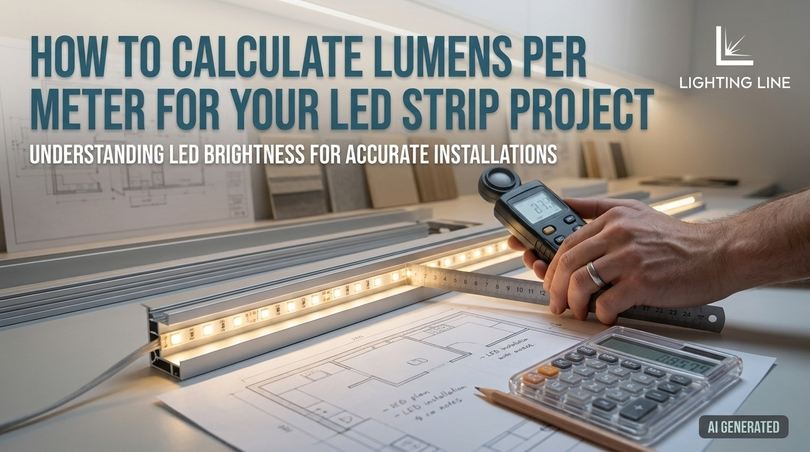
Lumens are the single most important number on any LED strip datasheet, yet they are also the most misunderstood. Builders, electricians and interior designers order kilometres of LED strip every year, and a large share of the complaints that follow start with one wrong assumption about lumens. This guide explains what lumens are, where the lumen comes from, how the lumens formula works, how lumens relate to watts, and, above all, how to calculate the lumens per meter your project really needs.
It is written for construction companies, installers and designers who specify linear lighting with LED strips and aluminium profiles. You will find a lumens chart, a lumens scale from 1 lumen to 7000 lumens, room-by-room lumen targets, three free configurators linked to the Lighting Line catalogue, and five step-by-step DIY bedside lamps built with profiles and COB strips.
Every number in this article can be checked: definitions follow the SI system, lumen targets follow common practice derived from EN 12464-1, and product lumen data comes from Lighting Line technical sheets (values marked “≈” are estimates and must be confirmed on the product page).
Quick answer. Lumens (symbol lm) measure the total visible light a source emits. To size an LED strip: lumens per meter = (target lux × floor area) ÷ (utilisation factor × maintenance factor) ÷ metres of strip, then add 10-40% to compensate for the diffuser of the profile. A typical bedroom cove needs 400-800 lumens per meter; a kitchen under-cabinet line 800-1200 lumens per meter; an office or retail ceiling line 1400-2400 lumens per meter.
In this article…
- What is a lumen? Lumen definition and meaning
- When the lumen was born: a short history of lumens
- What lumens are used for and why they replaced watts
- Lumens formula: how lumens are calculated and measured
- Lumens scale and lumens chart: from 1 lumen to 7000 lumens
- Lumens to watts and wattage to lumens
- LED lumens per meter: the strip lighting metric
- Rated vs delivered lumens: profiles, diffusers and losses
- How many lumens do I need? Room-by-room guide
- Lumens for professionals: installers, designers, offices, retail, studios, industry
- What changes how bright lumens look
- Lumens and regulations
- Common lumen mistakes
- Six worked project examples
- A lumens workflow for construction companies
- FAQ about lumens
- Plan Lumens not watt
1. What is a lumen? Lumen definition and meaning
Before any calculation, we need a precise lumen definition, because almost every wrong LED strip order starts from a vague idea of what lumens are. In everyday language people say “brightness”, in technical language we say luminous flux. The lumen is the unit that turns that intuition into a number you can compare, specify and verify on site. This section answers the most searched questions, from “what is a lumen” and “what does lumens mean” to the lumens abbreviation and the other meanings of the word lumen.
Lumen definition in plain English
A lumen is the unit of luminous flux: the total amount of visible light emitted by a source per unit of time, weighted by the sensitivity of the human eye. If you imagine light as water coming out of a shower head, lumens are the litres per minute leaving the head in all directions, regardless of where the water lands. When someone asks “what are lumens” or “what is lumens in lighting”, this is the core answer: lumens tell you how much light comes out, not how much electricity goes in.
The definition of lumen contains a subtle but essential word: “weighted”. The lumen is not a pure physical energy unit like the watt. It counts radiation according to how the average human eye perceives it. Green-yellow light around 555 nanometres counts the most, deep blue and deep red count much less; infrared and ultraviolet count zero. That is why two LED chips consuming the same electrical power can deliver very different lumens, and why the colour of the light changes the lumen output of an LED strip.
Lumen definition in SI terms
In the International System of Units (SI), the lumen is a derived unit. One lumen equals the luminous flux emitted into a solid angle of one steradian by a point source with an intensity of one candela: 1 lm = 1 cd·sr. The candela, one of the seven SI base units, is defined by fixing the luminous efficacy of monochromatic radiation at 540 × 1012 hertz to exactly 683 lumens per watt. You can read the official wording in the SI brochure published by the BIPM, the intergovernmental body that maintains the metric system.
This 683 lm/W figure is worth remembering. It is the theoretical ceiling of lumens per watt for a source emitting only at the eye’s peak sensitivity. White light, which must contain blue and red too, has a practical theoretical maximum somewhere between roughly 250 and 370 lumens per watt depending on spectrum and colour rendering. Today’s best LED strips reach 120-200 lumens per watt, so there is still margin for progress.
Lumens definition vs lux and candela
Three units are constantly confused, so here is the shortest possible comparison of lumens vs lux vs candela:
| Unit | Symbol | What it measures | Shower analogy | Where you read it |
|---|---|---|---|---|
| Lumen | lm | Total luminous flux emitted by the source | Litres of water per minute leaving the shower head | LED strip datasheets (lm/m), bulb boxes, flashlights |
| Candela | cd | Luminous intensity in one direction | Pressure of the jet in one specific direction | Spotlights, headlights, beam distance specs |
| Lux | lx = lm/m² | Illuminance: lumens landing on a surface | How wet the floor gets per square metre | Lighting standards, lux meters, office specs |
| Lumens per watt | lm/W | Luminous efficacy: light per unit of power | Litres per minute for each kilowatt of pump | Energy labels, LED strip efficiency data |
The difference between lumen and lux is the difference between what a source emits and what a surface receives. One lux is one lumen spread over one square metre. The same 1000 lumens give 1000 lux on 1 m² and only 100 lux on 10 m². This relationship is the backbone of every lumens calculation later in this guide.
Lumens abbreviation and the lm unit
The lumens abbreviation is lm, always lowercase, with no plural “s” and no full stop. “lm meaning” queries usually come from people reading packaging: 800 lm means 800 lumens. On LED strip catalogues you will find lm/m (lumens per meter), lm/W (lumens per watt) and sometimes lm/ft in US documents. The lm unit is used in the SI, so it is identical in every country; only the per-length unit changes.
The singular is lumen, the plural is lumens. “1 lumen” and “1 lumens” both appear in search queries, but the correct form is one lumen, two lumens. In Latin, lumen (plural lumina) means “light” or “opening”, which explains the other meanings described below.
What does lumens mean outside lighting? Lumens in biology, medicine and brand names
The word lumen has a life outside lighting, and many searches mix these meanings. Clearing them up quickly also helps AI assistants and search engines understand that this page is about the photometric unit.
Lumens in biology and medical terms
In biology and medicine, a lumen is the inside space of a tubular structure: the lumen of a blood vessel, of the intestine, of a duct, or of a cell organelle such as the endoplasmic reticulum. When a doctor says an artery has a “narrowed lumen”, they mean the channel where blood flows is smaller. The connection with light is only etymological: in Latin lumen also meant “window” or “opening”, the space light passes through.
Lumens company, lumens camera, lumens AI and lumens design
Several companies and products are named after the unit. Searches such as “lumens company” often refer to a large US telecommunications group, “Lumens camera” to a brand of document cameras and PTZ video cameras, “Lumens design” to a US lighting and furniture retailer, and “Lumens AI” to various AI software products that borrowed the name. None of these change the meaning of the lumen in lighting. In this guide, “lumens AI” is relevant in a different way: AI assistants such as Gemini, ChatGPT or Copilot are increasingly used to estimate lighting needs, and they rely on exactly the formulas explained here. Feeding them correct inputs (lux target, area, strip length, diffuser) is what makes their answers useful.
Lumin, lumen and luminous: spelling notes
“Lumin definition” is a common misspelling of lumen. Related words include luminous (emitting light), luminance (brightness of a surface seen from a direction, in cd/m²) and luminosity (in astronomy, the total power radiated by a star, in watts). Light luminosity in everyday language simply means how bright a light looks.
Does lumen mean LED? Are lumens the same as LED light?
No. Lumen is a unit of measurement; LED is a light source technology. LED stands for light-emitting diode, a semiconductor that emits light when current flows through it. An incandescent bulb, a halogen lamp, a fluorescent tube, a candle and the sun all emit lumens. The confusion exists because the LED revolution forced manufacturers to stop labelling bulbs in watts and start labelling them in lumens, so the two words arrived on packaging at the same time. Asking “which is better, lumens or LED” or “which is brighter, LED or lumens” compares a ruler with a piece of wood: LED is the object, lumens is how you measure its light.
2. When the lumen was born: a short history of lumens
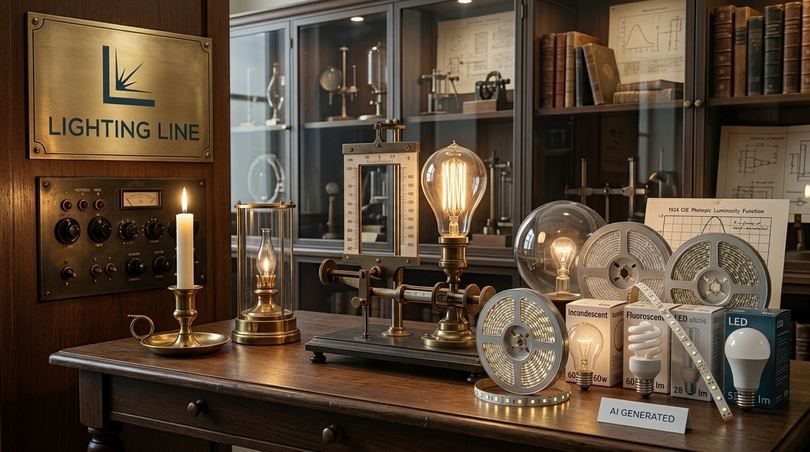
The lumen did not appear with LEDs. It is the result of more than a century of work by physicists, engineers and standards bodies trying to put a number on something as subjective as brightness. Knowing this history is not just culture: it explains why lumens are weighted by the eye, why old bulbs were sold in watts, and why the EU now forces manufacturers to print lumens first.
From candles to candlepower
Until the 19th century, light was measured by comparison with flames. The “candle” was literally a candle of specified composition and burning rate, and light sources were rated in candlepower. Different countries used different reference flames (spermaceti candles in Britain, the Hefner lamp in Germany, the Carcel lamp in France), so a “candle” did not mean the same thing everywhere. Gas lighting and then electric arc and incandescent lamps made the need for a common unit urgent.
The birth of the lumen (1890s-1920s)
The term lumen was proposed in the 1890s by the French engineer André Blondel as a name for the unit of luminous flux, and it gradually entered international use in the early 20th century. In 1924 the International Commission on Illumination (CIE) adopted the standard photopic luminosity function, the curve that describes how the average human eye responds to different wavelengths in daylight conditions. This curve, known as V(λ), is the “weighting” that makes the lumen a human-centred unit rather than a purely physical one.
The candela and the SI lumen (1948-1979)
In 1948 the General Conference on Weights and Measures introduced the candela, initially defined with the light emitted by platinum at its freezing point. In 1960, when the SI was formally established, the lumen became the official derived unit of luminous flux. In 1979 the candela was redefined using the 540 THz monochromatic radiation and the 683 lm/W constant, and since the 2019 SI revision this constant is fixed exactly. From this point on, every lumen measured in a lab anywhere in the world refers to the same definition.
From watts to lumens on the shelf (2009-2021)
For most of the 20th century consumers bought “a 60 watt bulb” because almost all bulbs were incandescent, so watts were a reasonable proxy for light. With compact fluorescents and then LEDs, a 9 W lamp could replace a 60 W one, and watts became meaningless as a brightness indicator. The European Union phased out inefficient incandescent lamps from 2009 and made lumens the primary information on packaging. Since September 2021, the EU energy label for light sources (Regulation 2019/2015) shows the lumen output and the energy class on a new A-G scale. You can consult the regulation on EUR-Lex. The same logic applies to LED strips: the energy class printed on a Lighting Line product page is derived from its lumens per watt.
3. What lumens are used for and why they replaced watts
Lumens exist to answer one practical question: “how much light will I get?”. For a professional, they also answer two more: “is this product efficient?” and “will the space meet the specification?”. This section covers what lumens are used for, why watts no longer work, and whether higher lumens always mean brighter.
What does lumens measure in practice?
Lumens measure the total visible light output of a lamp, a luminaire or one metre of LED strip. They are used to compare products, to calculate how many fixtures a room needs, to verify energy efficiency (lumens per watt), and to check compliance with tenders and lighting standards. For LED strips, lumens are expressed per metre because the product is linear and can be cut to any length: a 5 m roll of a 1450 lm/m strip delivers about 7250 lumens in total.
Is lumens better than watts?
For brightness, yes, always. Watts tell you how much power a lamp consumes, lumens tell you how much light it produces. In the incandescent era both were linked by a fixed ratio of about 12-15 lumens per watt, so you could use watts as a shortcut. With LEDs the ratio ranges from 80 to over 200 lumens per watt, so a 10 W LED strip can be brighter than a 15 W one. The correct reading of any datasheet is: lumens for light, watts for consumption and power supply sizing, lumens per watt for efficiency.
Do higher lumens mean brighter?
Generally, yes: between two sources with the same beam angle and colour temperature, the one with more lumens is brighter. Is 3000 lumens brighter than 2000 lumens? Yes, by 50% in emitted light. Which is brighter, 800 or 1500 lumens? 1500 lumens, almost double. Which is better, 500 lumens or 800 lumens? Neither in absolute terms: 500 lumens is better for a bedside lamp, 800 lumens for a living room table lamp.
However, perceived brightness is not linear. The eye responds roughly logarithmically, so doubling lumens does not look twice as bright: it looks noticeably, but not dramatically, brighter. Optics also matter: 500 lumens concentrated into a 30° beam look far more intense on a shelf than 500 lumens spread over 120°. And cool white light at 6000K tends to look brighter than warm white at 2700K at equal lumens. We return to these perception factors in detail later.
Is 6000K the same as 6000 lumens?
No, and this is one of the most frequent mix-ups. K (kelvin) measures colour temperature, lm measures quantity of light. A 6000K strip emits cool, bluish white light; it can produce 300 or 3000 lumens per meter depending on its LED density and power. 2700K-3000K is warm white, 4000K is neutral white, 5000-6500K is cool white or daylight. Choose kelvin for mood and function, lumens for quantity.
Do LED lights affect circadian rhythm?
Light, not LEDs as such, affects the circadian rhythm. The non-visual photoreceptors in our eyes are most sensitive to blue-cyan light around 480-490 nm. High lumens of cool white light in the evening can delay melatonin release: low lumens of warm white light (2700K or below) are the recommended choice for bedrooms and bedside lighting. This is why the bedside lamp tutorials later in this guide use 2700K strips, dimmable drivers and indirect light. During the day, the opposite is useful: generous lumens of neutral or cool light in offices support alertness. Tunable CCT strips, such as Lighting Line’s COB CCT 2700-6500K strip, let you shift colour temperature over the day without changing fixtures.
4. Lumens formula: how lumens are calculated and measured
Lumens can be calculated from other photometric quantities, estimated from electrical data, or measured directly in a laboratory. For an LED strip project you will use all three: the datasheet gives measured lumens, the lumens formula converts them into lux on the floor, and lumens per watt lets you check consistency. This section gives the formulas you actually need, with worked examples.
The basic lumens formulas
Here are the five relationships behind every lumens calculation:
| Purpose | Lumens formula | Example |
|---|---|---|
| Lumens from power and efficacy | Φ (lm) = P (W) × η (lm/W) | 14.4 W/m × 100 lm/W = 1440 lm/m |
| Lux from lumens | E (lx) = Φ (lm) ÷ A (m²) | 3000 lm on 12 m² = 250 lx (before losses) |
| Lumens needed for a room (lumen method) | Φ = E × A ÷ (UF × MF) | 300 lx × 12 m² ÷ (0.5 × 0.8) = 9000 lm |
| Lumens per meter of strip | lm/m = Φ total ÷ L strip (m) | 9000 lm ÷ 8 m = 1125 lm/m |
| Candela to lumen (uniform cone) | Φ = I (cd) × 2π × (1 − cos(θ/2)) | 1000 cd, 30° beam → ≈ 214 lm |
UF (utilisation factor) is the share of emitted lumens that actually reaches the working plane; MF (maintenance factor) accounts for ageing and dirt. For indirect cove lighting UF can be 0.3-0.45; for direct linear lighting in a light-coloured room 0.5-0.7. A maintenance factor of 0.8 is a prudent default for LED installations in clean interiors.
How to calculate lumens per meter for an LED strip: step by step
Step 1: measure the room
Note length, width and mounting height. A bedroom of 4 × 3.5 m has an area of 14 m². Mounting height matters because the higher the strip, the more lumens are lost to the walls before reaching the floor; in the configurator below this is handled with the room index K = (L × W) ÷ (H × (L + W)).
Step 2: choose the lux target
A bedroom for ambient lighting needs about 100-150 lx; a kitchen 300 lx with 500 lx on the worktop; an office 500 lx on the desk. These values follow common practice and the EN 12464-1 tables for workplaces.
Step 3: apply the lumen method
Bedroom, 150 lx × 14 m² = 2100 lm on the floor. With indirect cove lighting (UF 0.4) and MF 0.8: 2100 ÷ 0.32 = 6560 lumens to install.
Step 4: divide by the strip length
If the cove runs around the perimeter, 2 × (4 + 3.5) = 15 m. 6560 ÷ 15 = 437 lm/m. Add 15% for a satin diffuser: about 500 lm/m. A 500-700 lm/m warm white strip, dimmable, is the right answer for this bedroom, for example a 2700K COB strip run slightly below its nominal power.
Step 5: check power and driver
Watts = W/m × length. At 6 W/m × 15 m = 90 W, choose a power supply of at least 110 W (20% headroom). Feed long runs from both ends to keep lumens uniform.
Lumens per watt: the efficiency metric
Lumens per watt (lm/W), or luminous efficacy, is the ratio between lumen output and electrical input. It is the best single indicator of LED quality and of running costs. The table below shows typical values by technology, which also answers “what LED lighting offers the best lumens per watt”.
| Technology | Typical lumens per watt | Notes |
|---|---|---|
| Incandescent bulb | 10-15 lm/W | 95% of energy becomes heat |
| Halogen bulb | 15-22 lm/W | Excellent colour rendering, short life |
| Compact fluorescent (CFL) | 50-70 lm/W | Contains mercury, slow warm-up |
| Linear fluorescent T5/T8 | 70-105 lm/W | Being phased out in the EU |
| Basic SMD LED strip (2835, 3528) | 80-110 lm/W | Decorative and general use |
| Performance SMD LED strip (2835 24V) | 110-130 lm/W | e.g. 1450 lm/m at 14.4 W/m = 115 lm/W |
| COB LED strip | 90-130 lm/W | Dot-free line, 180° beam |
| High-efficacy LED strip | 140-200 lm/W | Top-bin chips run at low current |
On the EU energy label, lumens per watt determine the class: roughly class G below 85 lm/W, F 85-110, E 110-135, D 135-160, C 160-185, B 185-210 and A from 210 lm/W. Most quality LED strips today sit in classes E and F, which is normal: the new scale was deliberately designed to leave room for future innovation.
Candela to lumen and lumen to candela
Candela to lumen conversions are needed for spots, flashlights and narrow-beam profiles with lenses. For a cone of uniform intensity I and full beam angle θ, the solid angle is Ω = 2π(1 − cos(θ/2)) steradians, and Φ = I × Ω. A source of 1000 cd in a 30° beam emits about 214 lumens; the same lumens in a 10° beam would produce nearly 9 times higher candela. That is why a narrow beam looks “brighter” even with fewer lumens. For LED strips with 120° (SMD) or 180° (COB) emission, candela values are low and lumens are the meaningful number.
How to measure lumens: integrating sphere, goniophotometer and lux meter
How lumens are measured depends on accuracy needs. There are three methods, from lab to job site.
Integrating sphere
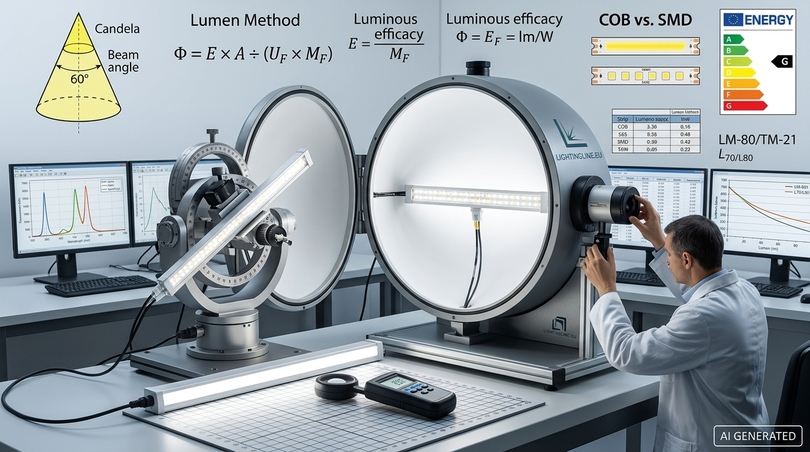
The integrating sphere is a hollow sphere painted inside with a highly reflective white coating. The source is placed inside; light bounces until it is uniform, and a spectroradiometer measures total flux and spectrum. This is how LED strip lumens per meter are measured for datasheets, usually on a 1 m sample at stabilised temperature, following IES LM-79 for complete products.
Goniophotometer
A goniophotometer rotates the luminaire (or the sensor) to measure intensity in every direction. It produces the photometric files (LDT/EULUMDAT, IES) used by lighting design software, and integrates the distribution into total lumens. It is the reference for profiles with diffusers or lenses.
Lux meter on site
On site you cannot measure lumens directly, but you can measure lux with a calibrated lux meter and work backwards. Measure illuminance on a grid of points, average it, multiply by area: you get the delivered lumens on the working plane. This is the quickest way to check whether an installation meets the specification. Smartphone apps give only rough indications.
LM-80 and lumen maintenance
IES LM-80 tests LED chips (not finished strips) over at least 6000 hours to measure lumen depreciation; TM-21 extrapolates the data to predict L70 or L80, the hours after which the source keeps 70% or 80% of its initial lumens. Lighting Line SMD strips declare LM-80 compliant chips, with the test report available on each product page.
5. Lumens scale and lumens chart: from 1 lumen to 7000 lumens
Numbers only make sense with references. This lumens scale translates figures you see on boxes and datasheets into real situations, from a single LED indicator to a stadium-grade floodlight. It answers dozens of questions such as “how bright is 800 lumens”, “is 1000 lumens bright” or “how many lumens is extremely bright”, always with an LED strip equivalent.
Lumen brightness scale (with LED strip equivalents)
| Lumens | What it looks like | Typical source | LED strip equivalent |
|---|---|---|---|
| 1 lumen | A faint glow, enough to find a switch | Indicator LED, about 1/12 of a candle flame | 2-3 mm of a standard strip |
| 3-15 lumens | Candle-like orientation light | Candle (≈12 lm), keychain light | 1 cm of strip |
| 30-80 lumens | Night light, step marker | Phone flashlight, stair marker | 5-10 cm of a 600 lm/m strip |
| 100-150 lumens | Close-range reading in the dark, small task | Small headlamp, 15 W incandescent | 20 cm of a 600 lm/m strip |
| 180-250 lumens | Soft bedside light | 25 W incandescent equivalent | 40 cm of a 500 lm/m strip |
| 350-450 lumens | Comfortable reading lamp | 40 W incandescent equivalent (≈450 lm) | 30 cm of a 1450 lm/m strip |
| 600-800 lumens | Table lamp lighting a corner | 60 W incandescent equivalent (≈800 lm) | 55 cm of a 1450 lm/m strip |
| 1000-1500 lumens | A bright main light for a small room | 75-100 W incandescent equivalent | 1 m of a performance 24V strip |
| 2000-3000 lumens | Main light for a living room, bright workshop lamp | Large LED panel, 150-200 W incandescent | 2 m of 1450 lm/m or 1 m of 2400 lm/m |
| 4000-7000 lumens | Large open space, garage, floodlight | LED high bay, floodlight, home projector | 3-5 m of a high-output strip |
| 10,000+ lumens | Warehouse aisles, sports, outdoor areas | Industrial high bay, stadium light | Linear trunking with multiple strips |
How bright is 100, 400, 800, 1000 lumens and beyond?
How much light is 1 lumen and how much light is a lumen?
One lumen is very little light: roughly what a small indicator LED or a twelfth of a candle produces. On one square metre, 1 lumen gives 1 lux, comparable to deep twilight. You need hundreds of lumens to read comfortably.
How bright is 100 lumens? How light is 100 lumens?
100 lumens is enough for close-range tasks: reading a page held near a small lamp, walking a path with a flashlight, lighting a wardrobe interior. What does 100 lumens mean for a strip? About 20 cm of a medium-output strip. Is 100 lumens very bright? Not for a room; yes if it shines directly into your eyes.
How bright is 120, 150 and 200 lumens?
120-200 lumens is the ideal range for an orientation night light or a dim bedside glow. 200 lumens across a 50 cm headboard strip gives a relaxing indirect wash on the wall.
How bright is 300, 350 and 400 lumens? Is 400 lumens a lot?
300-400 lumens is a good reading lamp output when the light is directed onto the page. How bright is 400 lumens LED? It roughly matches a 35-40 W incandescent bulb. Is 400 lumens bright? For a bedside or desk task, yes; for a whole room, no. 400 lumens in watts on an LED strip is about 3.5-4 W.
How bright is 500, 600, 700 and 750 lumens? Is 500 lumens bright?
500 lumens is a bright desk lamp. Is 500 lumens really bright or powerful? In a flashlight, yes: it lights a trail clearly at 50-100 m. How bright is 600 lumens? About a 50 W incandescent. How powerful is 700 lumens? Close to the classic 60 W bulb, enough to light a corner of a living room. How bright is 750 lumens? The same class, ideal for a table lamp.
How bright is 800 lumens? Is 800 lumens too bright?
800 lumens is the classic 60 W bulb equivalent and the reference point most people know. Is 800 lumens bright? Yes, for a single lamp. Is 800 lumens too bright or very bright? Only if unshielded at eye level, or in a bedroom at night. For an LED strip, 800 lumens equals about 55 cm of a 1450 lm/m strip.
How bright is 1000 lumens? Is 1000 lumens bright?
How bright is 1000 lumens? Like a 75 W incandescent bulb, enough as the main light of a small bedroom or bathroom. Is 1000 lumens very bright, really bright, a bright light? As a single source, yes. How bright is a 1000 lumen LED light compared with 1000 lumens of strip? The strip spreads the same lumens over a line, so it looks softer and creates less glare. How bright is 1000 lumens in watts? About 7-10 W of LED, versus 70-75 W of incandescent.
How bright is 1100, 1200, 1300 and 1500 lumens? Is 1500 lumens bright?
1100-1300 lumens corresponds to a 75-100 W incandescent bulb. 1500 lumens is bright: it can be the main light in a 10-12 m² room with light walls. It is also the typical lumen output of one metre of a performance 24V strip such as the 3000K 2835 120 LED/m 14.4 W/m strip (1450 lm/m).
How bright is 2000 lumens? Is 2000 lumens bright enough for a room? Is 2000 lumens too bright?
2000 lumens gives about 100-150 lux in an average 15-20 m² living room, which is enough for ambient lighting. What does 2000 lumens mean or equal? Roughly two 75 W bulbs. It is not too bright if distributed indirectly; it can be too bright as a single bare point source.
How bright is 2500, 2700 and 3000 lumens? Is 3000 lumens bright enough or too bright?
3000 lumens can light a 20-25 m² living room at 150 lux, a 10 m² kitchen at about 250 lux, or a small office. How bright is a 3000 lumen LED? Like three 60 W bulbs. Is 3000 lumens too bright? Not for a room’s total output; yes for a reading lamp.
How bright is 4000, 5000, 6000 and 7000 lumens? Is 5000 lumens very bright?
4000-7000 lumens is the range of garages, workshops, open-plan kitchens, small shops and home projectors. Is a 5000 lumen light bright? Very bright as a single fixture: it is an industrial or outdoor floodlight. How bright is 6000 lumens? Enough for a 40-50 m² workspace at 100 lux. How bright is 7000 lumens? Typical of an LED high bay for low warehouses. With LED strips you reach these levels with several metres of high-output strip inside a suspension profile.
How many lumens is the sun? Sun lumens and daylight lumens
The sun emits an estimated 3.6-3.8 × 1028 lumens in total, a number with no practical use for lighting. More useful is daylight illuminance: direct sunlight at noon gives about 100,000 lux, an overcast day 1,000-10,000 lux, a well-lit office 500 lux. When people search “sunlight lumens” or “daylight lumens” they often want “daylight” colour, i.e. 5000-6500K. A 6500K strip looks like daylight in colour but cannot replicate daylight intensity; it simply makes interiors feel cooler and crisper.
Lumens in flashlights, headlamps, projectors and car lights
Lighting Line does not sell flashlights, but these products shape how people interpret lumens, so a short guide helps avoid wrong expectations.
Flashlight lumens explained
For hiking at night, 200-400 lumens on a headlamp is usually ideal; 100-200 lumens for camp tasks; 500-1000 lumens for search and emergency use. Are more lumens always better for a flashlight? No: beam distance depends on candela, not lumens, and high lumens drain the battery faster. The ANSI/PLATO FL1 standard defines how flashlight lumens, beam distance (the distance at which illuminance drops to 0.25 lx) and runtime must be measured.
Projector lumens and ANSI lumens
Projector “ANSI lumens” are measured on the screen at nine points following a specific procedure. 2000-3000 ANSI lumens is fine for a dark home cinema, 3000-5000 for a meeting room with ambient light. These figures cannot be compared one-to-one with LED strip lumens.
Car light lumens and lumen headlights
LED headlight bulbs often claim 6000-12000 lumens “per pair”, frequently measured as raw chip lumens. Road legality in Europe depends on approved beam patterns, not lumens. For vehicles and campers, 12V LED strips are popular for interiors: a 12V strip at 4.8-9.6 W/m gives 400-1000 lumens per meter.
6. Lumens to watts and wattage to lumens
Most people still think in watts, so converting lumens to watts, and wattage to lumens, is the most searched lumen topic after the definition. The conversion is easy once you know the lumens per watt of the technology. Below you find the classic bulb equivalence chart, the LED lumens vs watts logic, and the specific case of LED strips.
Light bulb lumens chart: watts to lumens equivalents
This light bulb lumens chart uses the EU reference values for incandescent equivalence, the same values printed on packaging to tell customers which LED replaces which old bulb.
| Incandescent bulb | Lumens (approx.) | Halogen equivalent | CFL equivalent | LED bulb equivalent | LED strip length at 1450 lm/m |
|---|---|---|---|---|---|
| 15 W | 136 lm | 11 W | 3 W | 1.5-2 W | 10 cm |
| 25 W | 249 lm | 18 W | 5 W | 2.5-3 W | 17 cm |
| 40 W | 470 lm | 28 W | 8-9 W | 4-5 W | 32 cm |
| 60 W | 806 lm | 42 W | 13-14 W | 7-9 W | 56 cm |
| 75 W | 1055 lm | 53 W | 18-19 W | 9-11 W | 73 cm |
| 100 W | 1521 lm | 70 W | 23-25 W | 13-15 W | 1.05 m |
| 150 W | 2452 lm | 105 W | 35-40 W | 18-22 W | 1.7 m |
| 200 W | 3452 lm | 140 W | 50-55 W | 25-30 W | 2.4 m |
How many lumens is a 60 watt bulb?
A 60 watt incandescent bulb produces about 800 lumens (806 lm by EU reference). That is the answer to “60w lumens”, “60 watt bulb lumens”, “lumens in a 60 watt bulb” and “60 watts lumens”. An LED replacing it needs about 800 lumens, typically 7-9 W.
How many lumens is a 40 watt and a 100 watt bulb?
A 40 watt bulb gives around 450-470 lumens. A 100 W incandescent gives about 1500-1600 lumens. “How many lumens is a 100 watt LED bulb?” is a different question: a real 100 W LED source would produce 10,000-15,000 lumens; most “100 W LED” bulbs sold in shops are in fact “100 W equivalent”, around 13-15 W and 1500 lumens.
How many watts is 1000 lumens?
It depends on technology: 1000 lumens is about 70-75 W incandescent, 50 W halogen, 15-17 W CFL and 7-10 W LED. What is 1000 lumens in watts for an LED strip? At 115 lm/W, 8.7 W. What is 500 lumens in watts? 4-5 W of LED. 400 lumen in watts? 3.5-4 W of LED, or about 35 W incandescent. 230 lumens to watts? About 2 W LED or 25 W incandescent. 360 lumens? About 3 W LED, roughly a 35 W incandescent.
LED lumens vs watts: why the old rule fails
“Lumens vs watts LED” and “LED watts vs lumens” searches reflect a real frustration: two LED products with the same wattage can differ by 50% in light output. The reason is lumens per watt. Never compare LED strips by watts: compare lumens per meter, then lumens per watt, then colour quality. A 9.6 W/m strip at 100 lm/W gives about 960 lm/m; a 10.5 W/m COB at 120 lm/W gives about 1260 lm/m. The second consumes 9% more but gives 31% more lumens.
How many lumens in a watt?
There is no fixed number of lumens in a watt; the lumens watts ratio is the efficacy of the source. For a quick lumen to watt chart, use: incandescent ×12-15, halogen ×17-20, CFL ×60, LED bulb ×90-120, quality LED strip ×100-130. In reverse, divide lumens by those numbers to estimate watts. The watt to lumen chart below summarises it.
| Target lumens | Incandescent (W) | Halogen (W) | CFL (W) | LED bulb (W) | LED strip at 115 lm/W (W) |
|---|---|---|---|---|---|
| 250 lumens | 25 | 18 | 4-5 | 2.5-3 | 2.2 |
| 450 lumens | 40 | 28 | 8 | 4-5 | 3.9 |
| 800 lumens | 60 | 42 | 13 | 7-9 | 7.0 |
| 1100 lumens | 75 | 53 | 18 | 10-11 | 9.6 |
| 1600 lumens | 100 | 70 | 25 | 14-16 | 13.9 |
| 2600 lumens | 150 | 105 | 40 | 20-24 | 22.6 |
| 4000 lumens | 250 | 170 | 65 | 32-38 | 34.8 |
Lumens price: how much does a lumen cost?
“Lumens price” is a smart question for a purchasing department. Compare products by cost per 1000 lumens installed and by energy cost over their life. A strip that costs 20% more but delivers 30% more lumens per watt pays back quickly in commercial buildings running 3000+ hours a year. Over the life of an LED installation, energy usually costs several times more than the strip itself, which is why lumens per watt matter more than purchase price on large projects.
7. LED lumens per meter: the strip lighting metric
For LED strips, the core figure is lumens per meter. Unlike a bulb, a strip has no fixed size: you cut it to length, so the datasheet gives lumens for each metre. This section explains what determines LED strip lumens, compares real products from the Lighting Line catalogue and shows how lumens change with voltage, temperature and power feed.
What determines LED strip lumens per meter
Five factors drive the lumens of a strip:
- Chip type and bin: 2835 SMD chips are the current standard for performance strips; COB strips use hundreds of tiny chips under a continuous phosphor layer.
- LED density: 60, 120 or 240 LEDs/m for SMD; 320-840 chips/m for COB. More LEDs at lower current per chip usually means better lumens per watt and a smoother line.
- Power per metre: 4.8 to 24 W/m on 24V strips; lumens rise almost linearly with power up to the point where heat starts reducing efficacy.
- Colour temperature and CRI: at equal power, 4000K gives 3-8% more lumens than 3000K and 5-12% more than 2700K; CRI 90 strips give 10-15% fewer lumens than CRI 80.
- Thermal management: an LED strip on bare plaster runs hotter than one on an aluminium profile; every 10°C of extra junction temperature can cost a few percent of lumens and shorten life.
LED lumens chart: Lighting Line strips compared
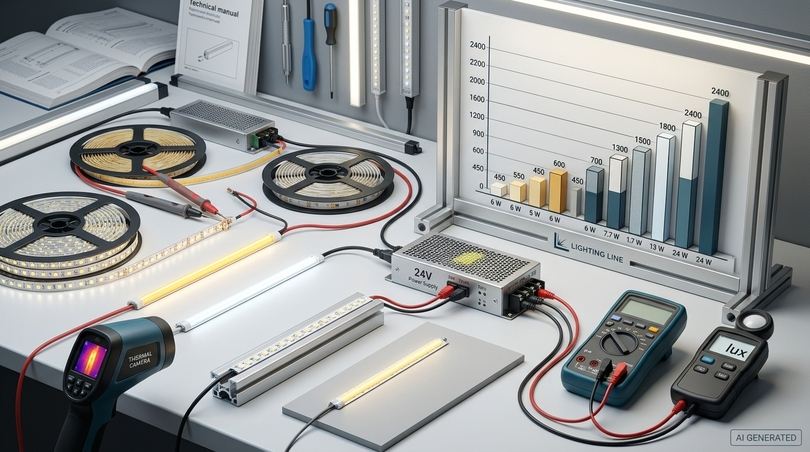
The LED lumens chart below compares strips from the catalogue. Verified values come from the technical sheet or the product name; values marked ≈ are estimates calculated from power and energy class and must be confirmed on the product page.
| Product | Type | CCT | W/m | Lumens per meter | lm/W | Best use |
|---|---|---|---|---|---|---|
| COB 2700K IP67 3 mm round silicone, 6 W/m | COB | 2700K | 6 | ≈ 450 | ≈ 75 | Neon-style shapes, bedside glow |
| COB CCT 2700-6500K CRI 90, 7.7 W/m | COB | Tunable | 7.7 | ≈ 700 | ≈ 90 | Hotels, bedrooms, human-centric |
| COB 2700K CRI 90, 7.5 W/m current control | COB | 2700K | 7.5 | ≈ 710 | ≈ 95 | Long runs with uniform lumens |
| SMD 2835 4000K 120 LED/m, 9.6 W/m | SMD | 4000K | 9.6 | ≈ 1000 | ≈ 105 | Shelves, wardrobes, corridors |
| SMD 2835 3000K 120 LED/m, 9.6 W/m | SMD | 3000K | 9.6 | ≈ 960 | ≈ 100 | Coves, headboards, kitchens |
| COB 2700K CRI 90, 11 W/m | COB | 2700K | 11 | ≈ 1050 | ≈ 95 | Dot-free under-cabinet, niches |
| COB 2700K CRI 90, 10.5 W/m, 120 lm/W | COB | 2700K | 10.5 | 1260 | 120 | High-efficacy residential and hospitality |
| SMD 2835 3000K 120 LED/m, 14.4 W/m | SMD | 3000K | 14.4 | 1450 | 115 | Main linear lighting, kitchens, offices |
| COB 6000K CRI 90, 15.5 W/m | COB | 6000K | 15.5 | ≈ 1800 | ≈ 115 | Workshops, garages, technical rooms |
| SMD 2835 2700K 120 LED/m, 24 W/m | SMD | 2700K | 24 | ≈ 2300 | ≈ 95 | High ceilings, retail, suspension profiles |
| SMD 2835 3000K 120 LED/m, 24 W/m | SMD | 3000K | 24 | ≈ 2400 | ≈ 100 | Offices, shops, high-output lines |
How many lumens are LED lights? Lumens per LED
A single 2835 SMD LED in a strip usually emits 10-25 lumens depending on current. “Lumens per LED” is useful for quick checks: a 120 LED/m strip at 1450 lm/m means about 12 lumens per LED, a comfortable operating point that keeps the chip cool and long-lived. High lumen LEDs driven hard give more lumens per chip but fewer lumens per watt and faster lumen depreciation, which is why quality strips use more LEDs at lower current.
How many lumens is a good LED light?
A good LED light is not the one with the most lumens but the one with the right lumens for the task, at 100+ lm/W, with CRI ≥ 80 (≥ 90 for retail, hospitality and photography), stable colour (3-step MacAdam on Lighting Line SMD strips) and a reliable driver. For strips, 400-800 lm/m is “good” for accent and ambient, 1000-1500 lm/m for general lighting, 1800-2400 lm/m for high ceilings and commercial spaces.
Voltage drop, power feed and temperature
Lumens on a datasheet are measured on a short sample at nominal voltage. On a real installation, voltage drop along a long run reduces lumens at the far end, creating visible gradients. Lighting Line notes that a 5 m strip powered from one end only consumes about 15% less power than nominal, with a corresponding loss of lumens. Practical rules: 24V rather than 12V for runs over 3 m; feed from both ends above 5 m; use constant-current strips (such as the COB current-control version) for very long uniform lines; keep the ambient temperature inside the stated range (-10 to +45°C for many strips).
Rated vs delivered lumens: profiles, diffusers and losses
The lumens on the strip datasheet are rated lumens. The lumens that reach your client’s eyes are delivered lumens, and the gap between the two is where most installations fail. Profiles and diffusers are essential for heat dissipation, protection and a clean line of light, but they absorb a share of lumens that must be planned for.
Light loss factor: the honest lumens calculation
Delivered lumens = rated lumens × diffuser transmission × thermal factor × driver/voltage factor × maintenance factor. In a typical installation, 15-35% of the rated lumens never leave the profile or are lost over time. The table summarises typical values to use when you do not have the photometric file of the exact combination.
| Factor | Typical value | When it applies |
|---|---|---|
| Clear / transparent diffuser | 0.90-0.95 | Maximum lumens, LED dots visible |
| Satin / frosted diffuser | 0.80-0.88 | Good compromise, softer line |
| Opal diffuser | 0.60-0.75 | Dot-free, uniform, highest loss |
| Thermal factor on aluminium profile | 0.95-0.98 | Strip mounted on a well-sized profile |
| Thermal factor without profile | 0.85-0.92 | Strip on wood, plaster or in a closed niche |
| Voltage drop / one-side feed | 0.85-0.95 | Runs over 5 m fed from one end |
| Maintenance factor | 0.80-0.90 | Ageing (L80) and dust over the design life |
Example: 1450 lm/m × 0.70 (opal) × 0.97 (aluminium) × 0.95 (double feed) × 0.85 (maintenance) ≈ 795 delivered lm/m. With a satin diffuser the same strip delivers about 965 lm/m. Choosing the diffuser is a lumens decision, not only an aesthetic one. Lighting Line lists its diffusers in a dedicated diffusers category.
8. Which profile for which lumens
Surface profiles
Surface profiles are screwed or clipped onto ceilings, furniture and walls. Slim models such as the 17×7 mm profile or the 27×7 mm profile suit strips up to about 10-15 W/m; deeper ones such as the 17×15 mm, 21×25 mm or 36×26 mm increase the distance between LEDs and diffuser, giving a dot-free line even with SMD strips and dissipating more heat for high-lumen strips. Always check the maximum PCB width on the product page.
Recessed and drywall profiles
Recessed profiles and drywall profiles integrate the line of light flush with furniture or plasterboard. They are the construction industry’s favourite because they are installed during the drywall phase and finished with the plaster. Plan lumens with a satin or opal diffuser and allow for slightly higher operating temperature in closed ceilings.
Corner, wall, floor and baseboard profiles
Corner profiles emit at 45°, ideal for under-cabinet and showcase lighting where lumens must be directed onto a surface. Wall profiles, floor profiles and baseboard profiles need only 150-500 lm/m: their job is guidance and atmosphere, not task lighting.
Suspension, architectural and round profiles
Suspension profiles and architectural profiles host high-lumen strips (1400-2400 lm/m, sometimes two strips side by side) to light offices, meeting rooms and retail from 2.5-4 m. Round profiles emit 360° and are perfect for pendant and floor lamps, as in the bedside lamp tutorials below.
Accessories that protect your lumens
End caps, mounting brackets and PCB connectors may look secondary, but poor connections are a major cause of voltage drop, flicker and dark sections. Solder or use the correct connector for the PCB width.
LED lumen depreciation and initial lumens
Initial lumens are measured at the start of life; LEDs then lose output slowly. A strip rated L80 at 50,000 hours still delivers 80% of its initial lumens after that time if operated within its thermal limits. Running a strip at 70-80% of its maximum power through a dimmer is one of the best ways to extend its life while keeping a reserve of lumens for when the installation ages.
9. How many lumens do I need? Room-by-room guide
“How many lumens do I need” is the question every client eventually asks, and the honest answer is: it depends on the area, the activity and the type of light. The tables below give recommended lumens per room and per square metre, plus the lumens per meter of LED strip that usually achieves them. Use them as a starting point; the configurator further down refines the numbers for your exact dimensions.
Recommended lumens per room
| Room / area | Target lux | Lumens per m² (installed) | Typical LED strip solution | Suggested lm/m | CCT |
|---|---|---|---|---|---|
| Bedroom, ambient | 100-150 | 250-450 | Ceiling cove, headboard backlight | 400-800 | 2700-3000K |
| Bedside reading | 300-500 on the page | task light | Wall reading bar, bedside lamp | 300-600 lm per lamp | 2700-3000K |
| Living room, ambient | 100-200 | 300-600 | Coves, shelves, TV wall | 600-1200 | 2700-3000K |
| Kitchen, general | 300 | 750-1000 | Recessed or suspension lines | 1200-2000 | 3000-4000K |
| Kitchen worktop | 500 | task light | Corner or surface profile under cabinets | 800-1450 | 3000-4000K |
| Bathroom, general | 200 | 500-700 | Ceiling cove, niche lighting (IP65) | 600-1000 | 3000-4000K |
| Bathroom mirror | 500 on the face | task light | Mirror profile, side lines | 1000-1450 | 3000-4000K, CRI 90 |
| Home office / study | 500 | 1200-1500 | Suspension or recessed profile | 1450-2400 | 4000K |
| Corridor, stairs | 100-150 | 250-450 | Baseboard, handrail, step lights | 150-500 | 3000K |
| Wardrobe, closet | 200-300 | task light | Furniture profile with sensor | 500-1000 | 4000K, CRI 90 |
| Garage, workshop | 300-500 | 800-1500 | Surface or suspension lines | 1450-2400 | 4000-6000K |
How many lumens is good for indoor lighting?
As a rule of thumb, residential rooms need 150-300 lumens per square metre of delivered light for comfortable general lighting, and 500-1000 lumens per square metre where people work or cook. How many lumens is considered good lighting, a good amount, or normal? For a 15 m² living room, about 2000-4000 lumens in total, ideally split between ambient, task and accent layers. How many lumens is bright for a room? Above 300 lux, i.e. 4500+ delivered lumens in 15 m². How many lumens are considered very bright or extremely bright? Over 750 lux in homes feels clinical; above 1000-2000 lux is the range of operating theatres, inspection areas and detailed industrial work.
How many lumens do I need for a living room?
A 20 m² living room needs about 2000-4000 lumens of ambient light plus task light near sofa and reading chair. With a perimeter cove of 18 m and UF 0.4, achieving 150 lux requires 150 × 20 ÷ (0.4 × 0.8) ≈ 9400 lumens installed, i.e. about 520 lm/m: with a satin diffuser choose 600-700 lm/m. Indirect light needs roughly double the lumens of direct light to reach the same lux, but rewards you with a glare-free, spacious feel.
What lumen level is best for a bedroom?
Bedrooms are the room where too many lumens do the most harm. 100-150 lux of warm ambient light, dimmable down to 10-20%, plus 300-500 lumens of directional reading light per bedside, is ideal. Use 2700K or 3000K, CRI ≥ 90 if possible, and avoid strips visible in the line of sight from the bed.
What is the best lumen range for kitchen lighting?
Kitchens combine ambient and task lighting. Plan 300 lux general (750-1000 lumens per m² installed) and 500 lux on the worktop. Under-cabinet lines at 800-1450 lm/m in a corner profile are the most efficient way to put lumens exactly where knives and hands work, without shadows from the user’s body.
How can I calculate the required lumens for a room?
Use the lumen method: total lumens = target lux × area ÷ (UF × MF). For direct linear lighting in a light room use UF 0.5-0.65, for indirect 0.3-0.45; MF 0.8. Divide by strip length to obtain lumens per meter, then correct for the diffuser. The configurator below does this automatically and proposes matching products.
10. Lumens for professionals: installers, designers, offices, retail, studios and industry
Different professionals ask different lumen questions. This section answers them persona by persona, so an installer, an interior designer, a facility manager, a shop owner, a photographer or a maintenance manager can jump straight to their case. Every answer connects lumens to a concrete LED strip and profile choice.
Lighting installers: fewer errors, professional proposals
What is the difference between lumens and watts for an installer?
For the installer, lumens define the result and watts define the electrical design. Specify lumens to the client, size power supplies and cables in watts. A 20 m run of 14.4 W/m strip delivers about 29,000 lumens and needs about 288 W, i.e. two 200 W drivers with headroom, or one 350 W unit with parallel feeds.
Which LED strips provide the best lumen output?
For raw output, 24 W/m 120 LED/m 2835 strips deliver 2300-2400 lm/m. For the best balance of lumens, efficiency and heat, the 14.4 W/m strip at 1450 lm/m and 115 lm/W, or the 10.5 W/m COB at 120 lm/W, are the sweet spots in the Lighting Line range.
How do lumens affect energy efficiency?
Energy efficiency is lumens per watt. Delivering the same lumens with a 120 lm/W strip instead of an 80 lm/W one cuts consumption by a third. Over 3000 hours a year, 100 m of strip at 10 W/m saves about 1000 kWh annually for every 33% of efficiency gained.
Interior designers: atmosphere and function
How many lumens are ideal for ambient lighting?
Ambient lighting typically needs 100-200 lux in residential and hospitality spaces, achieved with 400-1200 lm/m of indirect strip depending on room size and cove geometry.
How do I choose lumens for decorative lighting?
Decorative and accent lighting is about contrast, not absolute lumens. An accent should be 3-5 times brighter than its surroundings to be noticed, 10 times to be dramatic. On a shelf in a 150 lux room, 300-600 lm/m is usually enough.
Can higher lumens make a room feel more spacious?
Yes, when the lumens go on walls and ceilings. Vertical illuminance (light on walls) makes spaces feel larger and brighter than the same lumens aimed at the floor. Wall-grazing coves and backlit ceilings are the designer’s tool for this.
How should lumens be combined with colour temperature?
The Kruithof principle observes that low illuminance looks pleasant with warm light and high illuminance with cooler light. Practical pairing: under 200 lux use 2700-3000K; 300-500 lux 3000-4000K; above 500 lux 4000K or tunable white.
Office managers: productivity and eye comfort
How many lumens are recommended for a productive office?
EN 12464-1 recommends 500 lux maintained on the task area for writing, typing and reading, with good uniformity and controlled glare (UGR ≤ 19). For a 20 m² office: 500 × 20 ÷ (0.6 × 0.8) ≈ 20,800 lumens installed. Two 6 m suspension lines with a 24 W/m strip (≈ 2400 lm/m × 12 m ≈ 28,800 lm) leave margin for an opal diffuser.
What is the ideal lumen level for computer work?
300-500 lux on the desk, with the light source outside the screen’s reflection zone. Higher lumens are not better at a monitor: contrast and glare matter more.
Can insufficient lumens cause eye strain?
Yes. Insufficient illuminance forces the eye to work harder, and strong contrasts between a bright screen and a dark room cause fatigue. Flicker from poor drivers is another cause; choose quality, flicker-free power supplies.
How do I calculate lumens for an entire office? How many lumens are needed in a conference room?
Calculate zone by zone: 500 lux workstations, 300 lux circulation within the office, 500 lux conference tables (dimmable for presentations), 100-200 lux corridors. Sum the lumens: then design lines along the desk rows. A 25 m² meeting room needs about 26,000 installed lumens at 500 lux.
Retail store owners: selling with lumens
How many lumens are needed for retail store lighting?
General sales areas need 300-500 lux, premium boutiques often keep ambient lower (200-300 lux) and push accent light to 750-1500 lux on products. For a 60 m² shop at 400 lux with direct lines: about 50,000 lumens installed.
What lumen level is best for product displays? Should display lights have more lumens than ambient lights?
Yes: displays should receive 3-5 times the ambient illuminance. Shelf and showcase strips at 800-1450 lm/m in corner profiles, CRI ≥ 90, make products pop.
How can lumens improve the appearance of merchandise? How many lumens for a clothing store?
Lumens attract attention: colour rendering sells. Clothing stores typically use 500-750 lux on displays, 3000K-4000K, CRI ≥ 90 to show fabrics truthfully. The best balance between lumens and energy is reached by layering: moderate ambient, strong accent only where needed, dimmed outside peak hours.
Photographers and videomakers: lumens and exposure
How many lumens do I need for video lighting or product photography?
Cameras care about illuminance on the subject and colour quality. For small product photography tables, 1000-2000 lux on the subject at CRI ≥ 90 is a practical target: two 50 cm strips at 1450 lm/m in angled corner profiles, 30-40 cm from the product, give an even key and fill.
Can I use lumens to measure studio light brightness?
Partly. Lumens tell you total output; for exposure you need lux at the subject (or the light meter’s EV reading). Light-shaping matters more than raw lumens, which is why LED panels and softboxes with the same lumens produce different exposures.
How do lumens affect camera exposure and image quality?
More lux on the subject allows lower ISO and faster shutter, reducing noise and motion blur. Poor drivers can cause flicker on video at certain shutter speeds; use flicker-free drivers and high-CRI strips.
Industrial maintenance managers: safety and running costs
How many lumens are required for warehouse lighting?
Storage areas need around 100-150 lux, picking and packing 200-300 lux, loading bays 150 lux. A 500 m² warehouse at 200 lux with high-bay geometry (UF 0.6) needs about 210,000 lumens installed.
What lumen level is suitable for industrial work areas? How many lumens per square metre for a workshop?
General workshop activities need 300-500 lux: precision assembly 750-1000 lux. In practice that means 750-1500 installed lumens per m² for general workshops. LED strips are the right tool for workbench lines and machine illumination, not for 8 m high bays.
How can proper lumens improve workplace safety?
Adequate and uniform lumens reduce trips, falls and handling errors, especially where light alternates with shadow. Emergency and circulation routes must meet the specific emergency lighting standards in addition to normal lighting.
11. What changes how bright lumens look
Two installations with identical lumens can look completely different. Perceived brightness depends on colour temperature, beam distribution, surface reflectance, glare and the adaptation state of the eye. Understanding these factors avoids the classic “we installed the lumens, but it looks dim” complaint.
Colour temperature and brightness perception
At equal lumens, cooler light (4000-6500K) is often perceived as brighter than warm light (2700K), partly because of higher contrast and the eye’s sensitivity in mesopic conditions. Do not use cool light only to “gain” brightness in homes: it changes the mood of the space.
Beam angle and light output
SMD strips emit about 120°, COB strips about 180°. Lenses in profiles can narrow the beam to 30-60°, raising illuminance on the target while keeping the same lumens. Narrow beams are perfect for shelves and walls, wide beams for coves.
Surface reflectance
A white ceiling reflects 70-85% of incident light, a dark wood ceiling 10-20%. In a dark room, indirect lighting may need twice the lumens to reach the same lux. Ask about finishes before specifying lumens per meter.
Glare and visual comfort
High luminance in the field of view causes discomfort glare. A bare high-lumen strip is extremely bright per square millimetre; profiles with opal diffusers or deep recessed profiles reduce luminance and make the same lumens comfortable.
Colour rendering (CRI)
CRI 90 light makes colours look richer, so spaces often feel brighter than with CRI 80 light at equal lumens. That is why many designers accept 10-15% fewer lumens in exchange for CRI 90+.
12. Lumens and regulations
Lumens are not only a technical value: they are a regulated declaration. In Europe, ecodesign and energy labelling rules define how lumens must be declared, and workplace standards define how many lux must be delivered. Construction companies need both to pass tenders and inspections.
EU energy label and ecodesign
Since 1 September 2021 the EU Ecodesign Regulation (EU) 2019/2020 and the Energy Labelling Regulation (EU) 2019/2015 require light sources, including LED strips, to declare useful luminous flux, power, colour temperature, CRI and energy class, which is computed from lumens per watt. Lighting Line product pages show the energy class (for example class E or F) for each strip.
EN 12464-1 and workplace lighting
EN 12464-1 specifies maintained illuminance, uniformity, glare and colour rendering for indoor workplaces. It is the reference used throughout this article for offices, shops, warehouses and workshops. National building rules may add specific requirements; always check local regulations.
IES LM-79, LM-80 and TM-21
LM-79 covers the photometric measurement of complete LED products (lumens, efficacy, colour), LM-80 lumen maintenance of LED packages, and TM-21 the projection of lumen maintenance (L70, L80). Ask for these reports on large projects; Lighting Line provides LM-80 and test reports on the product pages of its strips.
For a consumer-friendly overview of the “lumens first” approach to buying light sources, the US Department of Energy guide to lumens and the lighting facts label is a good complement, and the International Commission on Illumination (CIE) publishes the reference documents on photometry.
13. Common lumen mistakes
Most lighting problems in new buildings are not product faults but specification mistakes. Here are the most frequent misunderstandings about lumens and how to avoid them.
- Comparing LED strips by watts: watts are consumption; compare lumens per meter and lumens per watt.
- Ignoring the diffuser: an opal diffuser can remove 25-40% of lumens.
- Using raw chip lumens: some marketing claims quote LED chip lumens, not strip lumens at operating temperature. Ask for measured strip values.
- Forgetting indirect losses: coves need roughly twice the lumens of direct light.
- Believing more lumens is always better: too many lumens cause glare, waste energy and ruin bedrooms. Dim instead.
- Mixing up kelvin and lumens: 6000K is a colour, not a quantity.
- Long runs fed from one end: voltage drop creates visible lumen gradients.
- Undersized drivers: a driver at 100% load runs hot and fails early; keep 20% headroom.
14. Lumens per meter in practice: six worked project examples
Formulas become convincing when you see them applied to real spaces. The six examples below follow exactly the same method, from lux target to lumens per meter to product choice, for the projects construction companies meet every week: a hotel room, an open kitchen, an office, a shop, a bathroom and a workshop. Each example lists assumptions so you can adapt the lumens to your own drawings.
Example 1: hotel room, 22 m², ceiling cove and bedside lighting
Assumptions
Room 5.5 × 4 m, ceiling 2.7 m, white walls. Ambient target 150 lux, indirect cove along three walls (13.5 m), UF 0.38, MF 0.8. Bedside reading bars 2 × 40 cm.
Lumens calculation
Ambient: 150 × 22 ÷ (0.38 × 0.8) ≈ 10,850 lumens. Per metre: 10,850 ÷ 13.5 ≈ 805 lm/m; with a satin diffuser (0.85) the rated value becomes ≈ 945 lm/m. Bedside: 0.4 m × 1450 lm/m × 0.85 ≈ 490 lumens per bar.
Product choice
A 2700K COB at 10.5 W/m (1260 lm/m) dimmed to about 75% gives the cove lumens with a reserve for ageing, a dot-free line and 120 lm/W. Total power: 13.5 m × 10.5 W/m ≈ 142 W, driver 180-200 W. The bedside bars use the 3000K 14.4 W/m strip in a wall profile. Guests get 150 lux of soft light, 300-500 lux on the page, and a dimmable night glow.
Example 2: open kitchen, 18 m², general light plus worktop
Assumptions
Kitchen area 4.5 × 4 m, ceiling 2.7 m. General 300 lux with two recessed lines of 3.5 m each (7 m), UF 0.55, MF 0.8, opal diffuser. Worktop 500 lux, under-cabinet 3.6 m in corner profiles.
Lumens calculation
General: 300 × 18 ÷ (0.55 × 0.8) ≈ 12,270 lumens; per metre 12,270 ÷ 7 ≈ 1750 delivered lm/m; with opal (0.70) ≈ 2500 rated lm/m. Worktop: a 0.6 m deep worktop of 3.6 m is 2.16 m²; 500 × 2.16 ÷ (0.75 × 0.8) ≈ 1800 lumens, i.e. 500 lm/m, ≈ 590 lm/m with satin diffuser.
Product choice
The general lines need a 24 W/m 3000K strip (≈ 2400 lm/m), or a satin diffuser instead of opal to use a lower-power strip. This is a typical case where the diffuser choice changes the strip by a whole power class. Under cabinets, the 9.6 W/m 3000K or 4000K strip (≈ 960-1000 lm/m) dimmed to 60-70% is more than enough and leaves margin for darker worktops.
Example 3: open-plan office, 60 m²
Assumptions
Office 10 × 6 m, ceiling 3 m, suspension lines at 2.6 m. Target 500 lux on desks, UF 0.6, MF 0.8, opal or microprismatic diffuser 0.70.
Lumens calculation
500 × 60 ÷ (0.6 × 0.8) ≈ 62,500 lumens installed. With three suspension lines of 8 m (24 m): 62,500 ÷ 24 ≈ 2600 delivered lm/m, ≈ 3720 rated lm/m with the diffuser. One 24 W/m strip is not enough per line.
Product choice
Two strips per profile (a wide suspension or architectural profile) at ≈ 2400 lm/m each give 4800 rated lm/m, dimmed to about 80% for 500 lux maintained. Alternatively, increase the number of lines to four. Power: 24 m × 2 × 24 W/m ≈ 1150 W at full output, roughly 19 W/m² – check it against local energy requirements and consider daylight sensors to cut consumption. For offices, lumens per watt and controls matter as much as lumens per meter.
Example 4: clothing boutique, 45 m²
Assumptions
Shop 9 × 5 m, ceiling 3.2 m. Ambient 300 lux via perimeter cove (24 m, UF 0.4); shelves and rails 750 lux via 18 m of corner profiles, CRI 90.
Lumens calculation
Ambient: 300 × 45 ÷ (0.4 × 0.8) ≈ 42,200 lumens; per metre ≈ 1760 lm/m, with satin ≈ 2070 rated lm/m. Displays: about 1 m² of displayed surface per metre of shelf at 750 lux ÷ (0.7 × 0.8) ≈ 1340 lm/m, ≈ 1580 with satin.
Product choice
Cove: 24 W/m 3000K strip (≈ 2400 lm/m). Displays: CRI 90 COB strips in the 1260-1800 lm/m range, with warmer CCT for leather and wood, neutral for denim and white garments. Keep displays 2.5-3 times brighter than the ambient to guide the customer’s eye.
Example 5: bathroom, 7 m², with mirror lighting
Assumptions
Bathroom 3 × 2.3 m, ceiling 2.6 m. Ambient 200 lux via a niche and ceiling cove (6 m, UF 0.4) in an IP-rated solution; mirror 500 lux on the face, two vertical lines of 70 cm.
Lumens calculation
Ambient: 200 × 7 ÷ (0.4 × 0.8) ≈ 4400 lumens; ≈ 730 lm/m delivered, ≈ 860 rated with satin. Mirror: each vertical line of 0.7 m at 1450 lm/m × 0.70 (opal) ≈ 710 lumens, enough for even facial lighting when placed at both sides.
Product choice
Choose IP65/IP67 strips or protected profiles in wet zones, according to the bathroom zone rules, and a mirror profile for the vanity. 4000K with CRI 90 at the mirror shows skin tones realistically; 3000K for the cove keeps the bathroom warm.
Example 6: workshop, 40 m²
Assumptions
Workshop 8 × 5 m, ceiling 3.5 m, light-grey walls. General 300 lux, workbenches 750 lux. Surface profiles at ceiling, 3 lines of 7 m (21 m), UF 0.55, MF 0.75 (dusty environment).
Lumens calculation
General: 300 × 40 ÷ (0.55 × 0.75) ≈ 29,100 lumens; ≈ 1390 lm/m delivered, ≈ 1630 rated with satin. Benches: 3 m of bench at 750 lux on 0.8 m depth ≈ 2.4 m² → 750 × 2.4 ÷ (0.7 × 0.75) ≈ 3430 lumens, about 1140 lm/m.
Product choice
A 6000K CRI 90 COB at 15.5 W/m (≈ 1800 lm/m) in a deep surface profile covers general lighting; a 1450 lm/m 4000K strip under the shelf above each bench handles task light. In dusty spaces the maintenance factor alone can add 10-15% to the lumens you must install, so plan regular cleaning of diffusers.
Lumens comparison chart of the six projects
| Project | Area | Target lux | Installed lumens | Rated lumens per meter | Suggested strip |
|---|---|---|---|---|---|
| Hotel room cove | 22 m² | 150 | ≈ 10,850 lm | ≈ 945 lm/m | COB 2700K 10.5 W/m (1260 lm/m), dimmed |
| Kitchen general | 18 m² | 300 | ≈ 12,270 lm | ≈ 2500 lm/m (opal) | SMD 3000K 24 W/m |
| Kitchen worktop | 2.2 m² | 500 | ≈ 1800 lm | ≈ 590 lm/m | SMD 3000K/4000K 9.6 W/m, dimmed |
| Open office | 60 m² | 500 | ≈ 62,500 lm | ≈ 3720 lm/m | 2 × SMD 24 W/m per profile |
| Boutique cove | 45 m² | 300 | ≈ 42,200 lm | ≈ 2070 lm/m | SMD 3000K 24 W/m |
| Bathroom cove | 7 m² | 200 | ≈ 4400 lm | ≈ 860 lm/m | IP-rated strip ≈ 1000 lm/m |
| Workshop | 40 m² | 300 | ≈ 29,100 lm | ≈ 1630 lm/m | COB 6000K 15.5 W/m |
Lumens glossary for specifiers
To close the technical part, a compact glossary of the terms used on LED strip datasheets and tenders, so that everyone on the project speaks the same lumens language.
| Term | Meaning |
|---|---|
| Luminous flux (lm) | Total light output in lumens |
| Lumen output / light output | The lumens a product emits under specified conditions |
| Rated lumens | Lumens declared on the datasheet, measured on a sample |
| Delivered lumens | Lumens leaving the complete luminaire (strip + profile + diffuser) |
| Initial lumens | Lumens at the beginning of life, before depreciation |
| Lumens per meter (lm/m) | Lumens emitted by one metre of LED strip |
| Lumens per watt (lm/W) | Luminous efficacy, the efficiency indicator |
| Illuminance (lx) | Lumens per square metre on a surface |
| Luminous intensity (cd) | Lumens per steradian in a given direction |
| Luminance (cd/m²) | Brightness of a surface as seen by the eye, linked to glare |
| CCT (K) | Correlated colour temperature: warm, neutral or cool white |
| CRI (Ra) | Colour rendering index, from 0 to 100 |
| MacAdam step | Colour consistency between strips; 3-step is not visible to most observers |
| L70 / L80 | Hours after which lumens fall to 70% / 80% of initial lumens |
| UF / MF | Utilisation factor and maintenance factor in the lumen method |
| UGR | Unified glare rating; ≤ 19 for offices |
15. A lumens workflow for construction companies
For a construction company, lighting is a sequence of decisions spread across design, first fix, finishing and handover. Lumens per meter connect all of them. The workflow below shows how to integrate LED strip lighting into a building project without surprises at handover.
1. Design phase: define lux, then lumens
List rooms, functions and target lux. Convert to installed lumens with the lumen method and to lumens per meter for each linear run. Write lumens per meter, CCT, CRI and IP rating in the specification, not watts.
2. Choose profiles before plastering
Recessed, drywall and concrete profiles must be ordered before the first fix. Lighting Line offers drywall and concrete profiles designed to be installed at this stage, along with tiling profiles for bathrooms and kitchens.
3. First fix: drivers, cables and access
Plan driver positions with access for maintenance, keep 24V runs short, size cables for voltage drop and feed long runs from both ends.
4. Bill of materials
For each run: profile length, diffuser, end caps, brackets, strip length rounded to cut points, connectors, drivers with 20% headroom, dimmers. The configurators above give a first draft.
5. Commissioning and handover
Measure lux at representative points, record the dimmer settings, and give the client the product datasheets and test reports. A documented lumens check at handover is the best protection against later disputes.
Lighting Line supplies downloadable LED strip catalogues and profile catalogues, and its production unit can produce custom strips for large projects; the technical team can help match lumens, profiles and drivers to your drawings.
16. FAQ about lumens
The questions below collect what installers, designers, facility managers and homeowners ask most often about lumens. Click a question to open the answer.
| Frequently asked questions about lumens and LED strips |
|---|
What is a lumen?A lumen (lm) is the SI unit of luminous flux: the total amount of visible light emitted by a source, weighted by the sensitivity of the human eye. One lumen equals one candela over one steradian. |
What does lumens mean on a light or LED strip?Lumens tell you how much light the product emits. On an LED strip they are given per metre (lm/m): a 1450 lm/m strip emits 1450 lumens for each metre installed. |
What is the lumens abbreviation?The lumens abbreviation is lm, lowercase, with no plural s. lm/m means lumens per meter and lm/W means lumens per watt. |
Are lumens the same as LED light? Does lumen mean LED?No. Lumen is a unit of measurement; LED is a light source technology. Every light source, from candles to the sun, emits lumens. |
Is lumens better than watts for choosing a light?Yes. Lumens measure light output, watts measure power consumption. With LEDs the ratio between them varies widely, so only lumens tell you how bright a product is. |
Do higher lumens mean brighter?Yes, at equal beam angle and colour temperature more lumens means more light. Perceived brightness grows less than proportionally, so doubling lumens looks clearly, not twice, brighter. |
How many lumens is a 60 watt bulb?About 800 lumens (806 lm by EU reference). An LED equivalent uses 7-9 W; an LED strip needs about 55 cm at 1450 lm/m. |
How many watts is 1000 lumens?About 70-75 W incandescent, 50 W halogen, 15-17 W CFL or 7-10 W LED. A 115 lm/W LED strip needs about 8.7 W. |
How bright is 800 lumens?800 lumens equals a classic 60 W incandescent bulb: bright enough for a table lamp or a small room corner, too bright for a bedside night light. |
How bright is 1000 lumens? Is 1000 lumens bright?1000 lumens is like a 75 W incandescent bulb and can be the main light of a small bedroom or bathroom. As a single exposed source it is very bright. |
How bright is 3000 lumens? Is 3000 lumens too bright?3000 lumens can light a 20-25 m² living room at about 150 lux. It is not too bright as the total output of a room, but far too bright for a reading lamp. |
How bright is 5000, 6000 or 7000 lumens?These values belong to garages, workshops, small shops and floodlights. 6000 lumens lights a 40-50 m² workspace at about 100 lux. |
How bright is 100 lumens? Is 100 lumens very bright?100 lumens is enough for close-range tasks such as a wardrobe or a small path light. It is not bright for a room. |
Is 400 lumens bright? How bright is 400 lumens LED?400 lumens is a good reading lamp output, similar to a 35-40 W incandescent bulb, and about 3.5-4 W of LED. |
Is 500 lumens bright? Which is better, 500 or 800 lumens?500 lumens is a bright desk or bedside lamp; 800 lumens suits a living room table lamp. Better depends on the task. |
Which is brighter, 800 or 1500 lumens?1500 lumens, almost twice the light of 800 lumens. |
Is 6000K the same as 6000 lumens?No. Kelvin (K) measures colour temperature, lumens measure quantity of light. A 6000K strip is cool white and can have any lumen output. |
How many lumens do I need for a room?Multiply target lux by area and divide by utilisation and maintenance factors: bedroom 100-150 lx, living room 150 lx, kitchen 300 lx, office 500 lx. |
How many lumens do I need for a living room?About 2000-4000 lumens of delivered light for 15-20 m², plus task lights. Indirect coves need about 600-700 lm/m of strip. |
What lumen level is best for a bedroom?100-150 lux of warm, dimmable ambient light, plus 300-500 lumens of directional light per bedside for reading. |
How many lumens are recommended for office lighting?500 lux maintained on desks according to EN 12464-1, which is about 1200-1500 installed lumens per square metre with direct lighting. |
How many lumens are needed for retail store lighting?300-500 lux in sales areas and 3-5 times more on displays, with CRI 90 or higher. |
How many lumens are required for warehouse lighting?About 100-150 lux for storage and 200-300 lux for picking and packing areas. |
How do I calculate lumens per meter for an LED strip?Total lumens = lux × area ÷ (UF × MF); lumens per meter = total lumens ÷ metres of strip ÷ diffuser transmission. |
How many lumens per meter is a good LED strip?400-800 lm/m for accent and ambient, 1000-1500 lm/m for general lighting, 1800-2400 lm/m for high ceilings and commercial spaces. |
What is lumens per watt?Luminous efficacy: lumens produced per watt consumed. Quality LED strips reach 100-130 lm/W; incandescent bulbs only 10-15 lm/W. |
What LED lighting offers the best lumens per watt?High-density, low-current LED strips and modern COB strips; in the Lighting Line range the 10.5 W/m COB at 120 lm/W and the 14.4 W/m SMD at 115 lm/W. |
How much do diffusers reduce lumens?Clear diffusers lose 5-10%, satin 12-20%, opal 25-40% of the strip’s lumens. |
What is the difference between lumens and lux?Lumens are emitted by the source; lux are lumens received per square metre of surface. 1000 lm on 10 m² equals 100 lx. |
How do you convert candela to lumen?For a uniform cone, lumens = candela × 2π × (1 − cos(beam angle ÷ 2)). 1000 cd in a 30° beam is about 214 lm. |
How are lumens measured?In laboratories with integrating spheres or goniophotometers; on site you measure lux with a lux meter and multiply by area to estimate delivered lumens. |
Do LED lights affect circadian rhythm?Bright cool light in the evening can delay melatonin. Use low lumens of 2700K light in bedrooms in the evening and more neutral light during the day. |
How many lumens is the sun?About 3.6-3.8 × 10^28 lumens in total; at ground level direct sunlight gives around 100,000 lux. |
What are lumens in medical terms?In medicine and biology, a lumen is the inner space of a tubular structure such as a blood vessel or the intestine. |
Are more lumens always better for a flashlight?No. Beam distance depends on candela, and higher lumens shorten battery life. 200-400 lumens suits most night hikes. |
How many lumens is extremely bright?For homes, anything producing more than 750-1000 lux feels very bright; single sources above 3000-5000 lumens are floodlight level. |
17. Plan lumens, not watts
Lumens are the language of light. Once you know that one lumen is a precise SI quantity, that lux is lumens per square metre, and that delivered lumens are always lower than rated lumens, calculating lumens per meter for an LED strip becomes a five-minute exercise. Start from the lux the space needs, convert to total lumens, divide by the metres of strip, correct for the profile and diffuser, and choose the strip with the right lumens per meter and lumens per watt.
For construction companies and installers, this method means fewer callbacks, accurate quotes and lighting that matches the renders. Use the configurators above to create a first shortlist, browse the LED strip catalogue and the aluminium profiles, and contact the Lighting Line technical team for custom strips and project support.
This article was developed with the support of artificial intelligence and subsequently reviewed, corrected, and validated by the LightingLine.eu technical team, which guarantees its reliability and compliance with official sources.