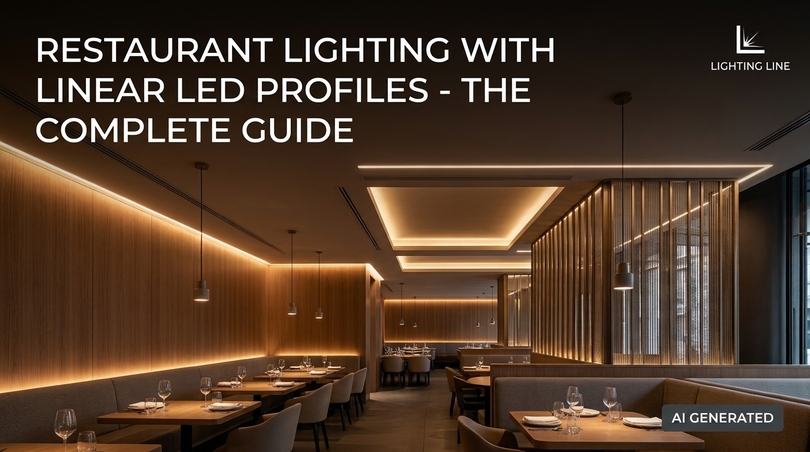
Restaurant lighting is the one design element every guest experiences from the first step inside to the last sip of coffee, yet it is often the last line item to be decided on a construction schedule. For construction companies, fit-out contractors, interior designers and restaurant owners, getting restaurant lighting right means balancing atmosphere, food presentation, staff safety, energy costs and building regulations, all within a fixed budget and a tight programme. This guide explains, step by step, how to plan, specify and install restaurant lighting with linear LED profiles and LED strips, with real lux and lumen figures, worked calculations, product selections from the Lighting Line aluminium profile catalogue and practical checklists you can use on site tomorrow.
Whether you are building a fine dining room, refurbishing a pub, opening a bistro with a dehors or rolling out a standard concept across a restaurant chain, the principles are the same: layer the light, control the light, and choose fixtures that disappear into the architecture until you want them to be seen. Linear LED profiles do exactly that, which is why they have become the backbone of modern restaurant lighting design.
In this article…
- Why restaurant lighting matters: psychology, food and revenue
- The 4 types of restaurant lighting and how to layer them
- Why linear LED profiles are the backbone of modern restaurant lighting
- Color temperature and CRI: the right light for food and faces
- How much light does a restaurant need? Lux, lumens and calculation
- Dining room lighting: tables, walls, walkways and ceilings
- Restaurant bar lighting: counters, back bars and pendants
- Commercial kitchen lighting: safety, hygiene and visibility
- Decorative lighting, architecture and brand identity
- Dimming, scenes and smart restaurant lighting control
- Restaurant outdoor lighting: facades, entrances and patios
- Visual comfort: glare, uniformity, flicker and shadows
- Regulations, emergency lighting and electrical safety
- Energy efficiency, sustainability and maintenance
- Restaurant lighting ideas by style
- Common restaurant lighting mistakes and how to fix them
- Budget, ROI, timeline and project planning
- Restaurant chains: standardization, bulk supply and long-term value
- Restaurant lighting trends for 2026
- Restaurant lighting in practice: six project scenarios
- The contractor’s restaurant lighting checklist
- Frequently asked questions
- Light the experience, not just the room
1. Why restaurant lighting matters: psychology, food and revenue
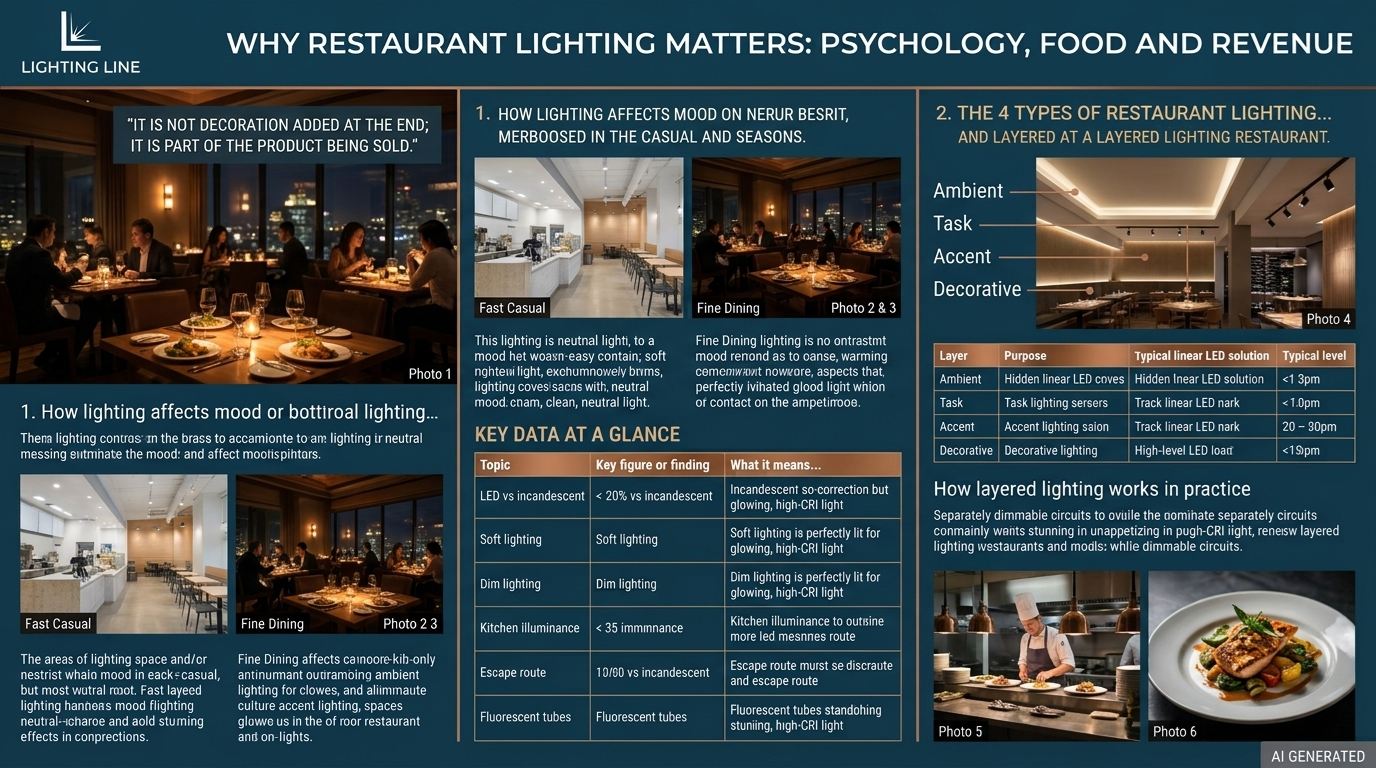
Before choosing a single fixture, it is worth understanding what light actually does inside a restaurant. Restaurant lighting shapes how long guests stay, what they order, how the food looks on the plate and how the place is remembered and shared online. It is not decoration added at the end; it is part of the product being sold.
How lighting affects mood in a restaurant
Human beings read light instinctively. Bright, cool, uniform light signals activity, speed and efficiency: think of an office, a canteen or a quick-service counter. Low, warm, uneven light signals rest, privacy and intimacy: think of candlelight, a fireplace or the last hour of a sunset. Every restaurant lighting decision moves the room somewhere along this scale between “efficient” and “intimate”.
A fast casual restaurant wants guests to order, eat and free the table, so it uses brighter, more neutral light. A fine dining restaurant wants guests to relax, order another bottle and linger over dessert, so it uses lower, warmer and more contrasted light. A bistro or café sits in between and often changes character during the day, which is why controllable restaurant lighting is so valuable.
Why are restaurant lights so dim?
Many guests ask why fancy restaurants have low lighting or why fine dining restaurants are so dark. The answer is a mix of psychology and practicality:
- Privacy: lower ambient levels shrink each guest’s perceived space to their own table, so conversations feel private even in a full room.
- Relaxation: dimmer, warmer light reduces alertness and encourages a slower pace, which supports longer stays and higher spending on wine and desserts.
- Contrast: when the room is dim, a well-lit table, plate or bar becomes the visual focus. Darkness is what makes the accent light work.
- Flattery: warm, soft light is kinder to skin tones and creates the “golden hour” effect people associate with special occasions.
The key point for designers is that a well-designed “dim” restaurant is never uniformly dark: it is dark around the edges and precisely lit where it matters. A restaurant that is simply under-lit everywhere feels gloomy, not luxurious.
Does dim light reduce appetite in a restaurant?
Dim light does not simply reduce appetite, it changes eating behaviour. A widely cited Cornell University field study (Wansink and van Ittersum, 2012) transformed part of a fast-food restaurant with softer lighting and music: diners in the relaxed zone ate roughly 18% fewer calories and rated their food as more enjoyable. Later research published in the Journal of Marketing Research (Biswas and colleagues, 2017) found that diners in dimly lit rooms tended to order less healthy, more indulgent dishes than those in brightly lit rooms. In practice, softer restaurant lighting slows people down, increases satisfaction and can support higher-value indulgent orders, while brighter light supports speed and turnover.
Lighting and food perception
Food is judged first by the eyes. The red of a rare steak, the green of fresh herbs, the gloss of a sauce and the crust of bread all depend on the quality of the light falling on them. Light with a poor color rendering index (CRI) makes food look grey, flat and unappetizing, no matter how good the cooking is. This is why the choice of LED strip, not just the fixture, is crucial in restaurant lighting: a high-CRI strip in a simple profile will make the plate look better than an expensive decorative lamp with a poor light source.
Lighting, dwell time and the Instagram effect
Restaurants today are also photographed constantly. Guests share plates, cocktails and interiors on social media, and these images work as free advertising. Well-balanced restaurant lighting, with good vertical illumination on faces and warm, high-CRI light on the table, produces better phone photos than harsh downlights or dark corners. A memorable lit feature, such as a glowing ceiling line or a back-lit bar, often becomes the signature image of the venue.
Key data at a glance
The table below summarizes the figures most often used when explaining the business value of restaurant lighting to clients and investors.
| Topic | Key figure or finding | What it means for the project |
|---|---|---|
| LED vs incandescent energy use | LEDs use at least 75% less energy and last up to 25 times longer (U.S. Department of Energy) | Lower operating costs and far fewer replacements in hard-to-reach ceilings |
| Soft lighting and eating behaviour | About 18% fewer calories eaten and higher satisfaction in a softer-lit zone (Cornell study, 2012) | Ambient level and warmth directly affect guest experience |
| Dim lighting and menu choices | Diners in dim rooms more likely to choose indulgent dishes (Journal of Marketing Research, 2017) | Lighting scenes can support specific dining concepts |
| Kitchen illuminance | Around 500 lux recommended on working surfaces in commercial kitchens (EN 12464-1) | Back-of-house needs bright, uniform, high-CRI task lighting |
| Escape route emergency lighting | At least 1 lux on the centre line of escape routes (EN 1838) | Emergency provision must be designed alongside decorative lighting |
| Fluorescent tubes in the EU | Most T5 and T8 fluorescent tubes phased out of the EU market from 2023 (RoHS) | Refurbishments are the ideal moment to switch to linear LED |
2. The 4 types of restaurant lighting and how to layer them
Professional restaurant lighting design is always built in layers. Instead of looking for one perfect light, the designer combines several types of lighting, each with a specific job, and controls them separately. Layering is the single most important principle behind every successful restaurant lighting scheme.
What are the 4 types of lighting?
Lighting professionals usually describe four layers. The first three are often called the three main kinds of restaurant lighting, with decorative lighting added as the fourth.
| Layer | Purpose in a restaurant | Typical linear LED solution | Typical level |
|---|---|---|---|
| Ambient (general) | Overall visibility, circulation, sense of space | Recessed or drywall profiles in the ceiling, indirect cove lighting | 50-200 lux depending on concept |
| Task (functional) | Reading menus, cutting food, serving, cooking, cash desk | Suspended profiles over tables and pass, under-cabinet profiles in the bar and kitchen | 150-500 lux on the task |
| Accent | Highlighting dishes, artwork, bottles, textures, architecture | Narrow corner or wall profiles, grazing lines, shelf lighting | 3-5 times the surrounding ambient level |
| Decorative | Character, brand identity, visual signature | Visible light lines, geometric suspensions, luminous signage, RGB effects | Visual impact rather than lux |
Ambient lighting in a restaurant
Ambient lighting provides the base level of light that lets guests and staff move safely and see the room as a whole. In a modern restaurant, ambient light is increasingly indirect: hidden LED strips in ceiling coves, light lines in drywall ceilings and up-lighting on walls create a soft, glare-free background. Indirect ambient light makes ceilings feel higher and rooms feel larger without exposing a single light source to the guest’s eye.
Task lighting in a restaurant
Task lighting is aimed at a specific activity: reading the menu, seeing the food on the plate, mixing a cocktail, plating a dish or counting the till. In the dining room, the main task is eating, so the table itself is the most important task surface. Suspended linear profiles over long tables and banquettes, or compact profiles under shelves and counters, provide focused light exactly where it is needed.
Accent lighting in a restaurant
Accent lighting creates contrast. A brick wall grazed by a line of light, a wine rack lit shelf by shelf, a sculpture or a feature plant all become focal points. As a rule of thumb, an accent needs about three to five times the surrounding light level to read clearly as a highlight. In a dim fine dining room, that can be achieved with very little power.
Decorative lighting in a restaurant
Decorative lighting is the layer guests notice and remember: pendant lamps, illuminated signage, sculptural light lines, back-lit panels. In linear LED systems, the profile itself can become decorative, for example a continuous line of light that runs from the entrance through the dining room to the bar, guiding the eye and the guest.
How layered lighting works in practice
Layers only become useful when they are wired and controlled separately. A typical dining room might have four circuits: ceiling ambient, table task, wall accent and decorative features. At lunch, ambient and task are high and accents low. At dinner, ambient drops sharply, table task stays focused and accents rise. For events, decorative and color-changing elements take over. Separate circuits plus dimming are what turn a lighting installation into a lighting design.
3. Why linear LED profiles are the backbone of modern restaurant lighting
Linear LED systems combine an aluminium profile, a diffuser, an LED strip, end caps and mounting brackets. Together, they form a light fixture that can be cut to length, recessed into plaster, surface-mounted, suspended or hidden in furniture. For builders and fit-out contractors, linear LED profiles are the most flexible restaurant lighting fixtures available, because they adapt to the architecture rather than forcing the architecture to adapt to them.
Anatomy of a linear LED system
| Component | Function | What to check when specifying |
|---|---|---|
| Aluminium profile | Housing, heat sink and mechanical support for the strip | Mounting type, internal width for the PCB, finish, available lengths |
| Diffuser | Softens the light, hides LED dots, protects the strip | Opal or clear, light loss, uniformity, cleanability |
| LED strip | The actual light source | Lumens per metre, Kelvin, CRI, voltage, SMD or COB, binning |
| End caps | Close the profile, allow cable entry | Matching profile code, with or without cable hole |
| Mounting brackets | Fix the profile to ceiling, wall, furniture or suspension | Substrate, spacing, tilt options |
| Connectors | Join strip sections and power feeds without soldering | PCB width, number of poles (mono, tunable white, RGB, RGBW) |
Advantages of linear LED profiles for restaurant lighting
- Continuous, shadow-free light lines that follow banquettes, bars, coves and architectural edges without gaps.
- Integration in walls and ceilings: recessed and drywall profiles sit flush with the finished surface, leaving clean ceilings.
- Thermal management: aluminium dissipates heat from the strip, protecting the LEDs and extending their life.
- Cut-to-measure flexibility: profiles and strips are cut on site to match the real dimensions of the room, not the drawings.
- Low profile and low weight: ideal in refurbishments where ceiling voids are shallow or structures cannot take heavy fixtures.
- Full control: strips can be dimmed, tuned from warm to cool white or switched to RGB and RGBW for events.
- Easy maintenance: diffusers clip off, strips can be replaced section by section.
Choosing the right profile family
The Lighting Line profile range covers every mounting situation found in restaurant construction. The table below maps each family to its typical role in restaurant lighting.
| Profile family | Typical restaurant application | Why it works |
|---|---|---|
| Suspension profiles | Over long tables, communal tables, bar counters, the kitchen pass | Brings task light close to the table and adds a strong linear design element |
| Recessed profiles | Ceiling light lines, wall slots, counter fronts, steps | Flush finish, minimal visual impact, clean architectural look |
| Drywall profiles | Plasterboard ceilings and walls in new fit-outs | Plastered in for a “light without fixture” effect, perfect for contractors working with drywall |
| Surface profiles | Under shelves, inside cabinets, under the bar top, in coves | Fast installation, no cut-outs needed, ideal for retrofit |
| Corner profiles | Back bar shelves, display cases, wall-ceiling junctions | Light aimed at 45 degrees onto bottles, shelves or textures |
| Wall profiles | Up-and-down wall washing, corridor and restroom lighting | Creates vertical brightness that makes rooms feel welcoming |
| Architectural profiles | Statement light lines, facade details, large-scale features | Designed to be seen as part of the architecture |
| Round profiles | Decorative suspensions, display rails, retro and industrial looks | 360-degree or soft rounded light emission |
| Floor profiles and baseboard profiles | Walkway guidance, steps, low-level orientation light | Safe movement in dim rooms without lifting ambient levels |
| Furniture profiles and handrail profiles | Banquettes, display cabinets, stair handrails | Light integrated in joinery and circulation elements |
| Mirror profiles and tiling profiles | Restrooms, tiled bar fronts, wet areas | Integrated finish with mirrors and ceramic tiles |
| Concrete profiles | Industrial restaurants with cast concrete walls or ceilings | Cast-in light lines for raw, industrial interiors |
Suspended profiles: modern pendant lighting for restaurants
Suspension profiles are the linear alternative to traditional pendant lighting for restaurants. Instead of a row of individual lamps, one continuous body of light runs along the table or bar. The Lighting Line range includes the 36x75mm suspended aluminium profile (LLP-CL01-06), the larger 50x75mm aluminium profile (LLP-CL02-07) and the 60x73mm suspended aluminium profile (LLP-CL04-18), with internal widths for strips up to 20, 30 or 40 mm depending on the model. Wider internal channels allow higher-output or double strips, which means one profile can provide both downlight on the table and soft uplight on the ceiling.
Recessed profiles: light without visible fixtures
Recessed profiles create clean light lines in ceilings, walls and joinery. For narrow accent slots, the recessed 23x8mm aluminium profile (LLP-RE01-03) and its version without flange step (LLP-RE01B-03) are discreet choices. Deeper bodies such as the recessed 23x15mm profile (LLP-RE02-03) or the recessed 32x15mm profile (LLP-RE05-01) increase the distance between strip and diffuser for a more uniform, dot-free line. For wide ceiling lines that must deliver real ambient light, the recessed 67x22mm aluminium profile (LLP-RE04-07) takes wide or multiple strips. The deeper the profile, the more even the light line, which is essential when the profile is in the guest’s field of view.
SMD or COB LED strips?
The choice of strip is as important as the profile. SMD LED strips use individual LED chips spaced along the circuit, offering high efficiency and a wide range of outputs. COB LED strips (chip on board) place the chips so densely, under a continuous phosphor layer, that the strip produces a seamless line of light even in very shallow profiles or without a heavy diffuser.
| Criterion | SMD strip | COB strip |
|---|---|---|
| Line uniformity | Needs depth or opal diffuser to hide dots | Dot-free even in shallow profiles |
| Efficiency | Very high, wide choice of outputs | Good, slightly lower in some versions |
| Best restaurant use | Ambient coves, kitchens, high-output suspensions | Visible light lines, shelves, furniture, slim recessed slots |
| Color options | Mono white, tunable white, RGB, RGBW | Mono white, tunable white, some color versions |
Lighting Line also manufactures customized LED strips, which is particularly useful for restaurant chains that need a precise Kelvin, CRI or output repeated identically across many sites. Full technical data are available in the Strip LED catalogue and the Profiles catalogue.
4. Color temperature and CRI: the right light for food and faces
After the amount of light, its color is the factor that most strongly defines the character of a restaurant. Color temperature, measured in Kelvin (K), describes whether white light looks warm (yellowish) or cool (bluish). Choosing the right Kelvin value is the fastest way to make a restaurant feel welcoming, elegant, energetic or clinical.
Restaurant lighting Kelvin guide
| Color temperature | Perception | Recommended restaurant use |
|---|---|---|
| 2200-2400 K | Candle-like, very warm amber | Fine dining at night, wine bars, decorative accents, outdoor terraces |
| 2700 K | Warm white, classic “incandescent” feel | Most dining rooms, bistros, pubs, cafés in the evening |
| 3000 K | Warm white with crisper whites | Casual dining, bars, front-of-house circulation, retail corners |
| 3500 K | Neutral-warm | Fast casual, daytime cafés, open kitchens visible to guests |
| 4000 K | Neutral white | Commercial kitchens, prep rooms, storage, washing areas |
| 5000 K and above | Cool white | Rarely suitable in front-of-house; occasionally in technical areas |
What is the warm lighting for restaurants?
“Warm lighting” in restaurants usually means 2700 K to 3000 K, sometimes down to 2200 K for intimate settings. For a warm and inviting restaurant atmosphere, 2700 K is the safest default for dining areas, with 3000 K for bars and circulation. Warm light flatters skin tones, enhances browns, reds and golds in food and wood finishes, and recalls domestic comfort.
What color temperature works best for fine dining restaurants?
Fine dining restaurants typically work between 2200 K and 2700 K for ambient and decorative layers, with table task lighting at 2700 K to 3000 K so that food colors stay accurate. Keeping the table slightly cooler and brighter than the surrounding room makes the plate stand out. Tunable white strips allow the room to start at 3000 K for early service and drift down to 2400 K as the evening progresses.
Is cool white ever right for a restaurant?
Cool white (4000 K and above) is the right choice in the commercial kitchen, where staff need maximum alertness and accurate perception of hygiene. In front-of-house, cool white tends to feel clinical, but neutral 3500 K can suit sushi bars, poke concepts, juice bars and daytime cafés where freshness and clarity are part of the brand.
Color rendering index (CRI): the hidden quality factor
CRI (or Ra) measures how faithfully a light source shows colors compared with a reference source, on a scale up to 100. More detail is available in the color rendering index overview. For restaurant lighting, CRI is crucial because food, wine and skin are all judged by color.
| CRI (Ra) | Quality | Restaurant suitability |
|---|---|---|
| Below 80 | Poor | Not recommended anywhere food is shown or prepared |
| 80-89 | Good | Minimum for kitchens, circulation, back-of-house |
| 90-95 | Very good | Recommended for dining tables, bars, open kitchens, buffets |
| 95+ | Excellent | Fine dining, food photography areas, display counters, pastry |
For any surface where food is served or displayed, specify LED strips with CRI 90 or higher; the extra cost per metre is minimal compared with the visible improvement on the plate. Also check the R9 value (saturated red): a high R9 makes meat, tomatoes, berries and red wine look rich instead of brownish.
Consistency between batches and fixtures
Mixing light sources with slightly different Kelvin values in the same room is one of the most visible errors in restaurant lighting. A ceiling line at 2700 K next to a pendant at 3000 K and a back bar at 3500 K creates a patchy, unplanned look. Specify one color temperature per layer, order strips from the same production batch where possible and ask for tight color binning (low MacAdam steps).
5. How much light does a restaurant need? Lux, lumens and calculation
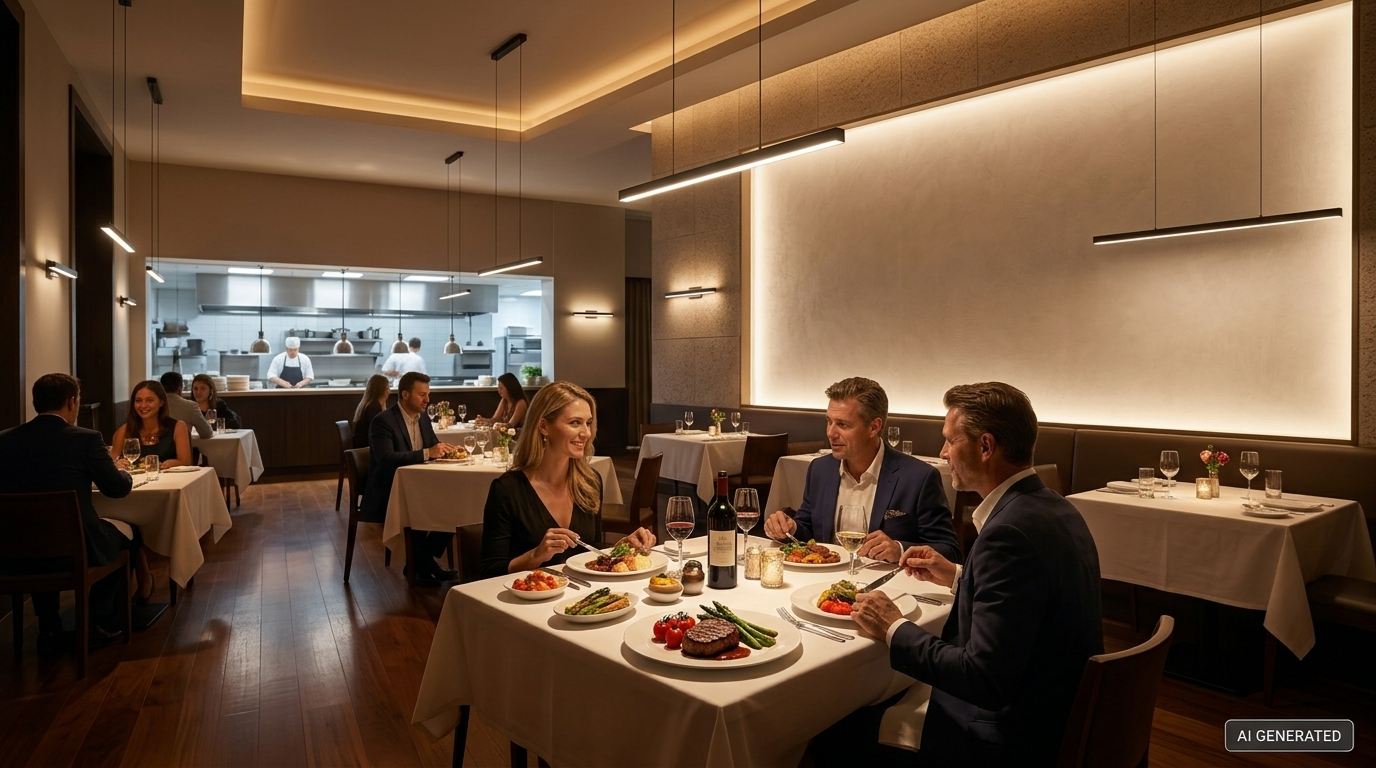
Questions such as “how many lumens are needed for a restaurant?” or “what is the required illumination for a restaurant?” come up in every project meeting. The honest answer is that there is no single number: restaurant lighting levels depend on the concept, the zone and the time of day. However, there are clear reference values and a reliable method to calculate them.
Lux and lumens: the difference in one sentence
Lumens measure how much light a source emits; lux measures how much of that light lands on a surface, per square metre. One lux equals one lumen per square metre. Product data sheets give lumens (or lumens per metre for LED strips); lighting standards and designers talk in lux.
What are the lux levels for restaurant lighting?
The European standard EN 12464-1 (Lighting of work places, indoor) is the main reference in Europe and in the UK (as BS EN 12464-1). It sets maintained illuminance values for working areas. For restaurant dining rooms, the standard deliberately avoids a fixed value, because the lighting must be designed to create the required atmosphere. The table below combines the standard’s indications for working areas with typical design ranges used for front-of-house.
| Area | Typical maintained illuminance | Recommended CRI | Notes |
|---|---|---|---|
| Fine dining room | 50-100 lux ambient, 150-250 lux on tables | 90+ | Strong contrast, warm color temperature |
| Casual dining room | 100-200 lux ambient, 200-300 lux on tables | 90+ | Balanced, dimmable |
| Fast casual / self-service | Around 200-300 lux | 80-90+ | EN 12464-1 indicates about 200 lux for self-service restaurants |
| Buffet and display counters | Around 300 lux or more on food | 90+ | Accent and task lighting on the food itself |
| Bar counter (guest side) | 100-200 lux | 90 | Back bar accent 3-5 times higher |
| Bar working surface | 300-500 lux | 90 | Under-counter task profiles |
| Reception / cash desk | Around 300 lux | 80-90 | Local task lighting avoids raising the whole room |
| Commercial kitchen | Around 500 lux on working surfaces | 80 minimum, 90 recommended | Uniform, low-glare, cleanable fixtures |
| Dishwashing area | Around 300 lux | 80 | Moisture-resistant fixtures |
| Food storage, cold rooms | 100-200 lux | 80 | Fixtures rated for low temperatures |
| Corridors, stairs | 100-150 lux | 80 | Step and handrail lighting improves safety |
| Restrooms | Around 200 lux | 80-90 | Mirror lighting for faces |
The values for working areas are indicative; always check the current edition of EN 12464-1 and any national or local requirements applicable to the project.
How do you calculate lighting for a restaurant?
The lumen method is the standard quick calculation used by designers and contractors to size a lighting installation. It can be done on a calculator in a few minutes and gives a reliable starting point before a detailed photometric simulation.
The lumen method formula
Total lumens required = (Target lux × Area in m²) ÷ (Utilization factor × Maintenance factor)
- Target lux: the average illuminance you want on the working plane (usually the table height, about 0.75 m).
- Area: floor area of the zone in square metres.
- Utilization factor (UF): the share of emitted light that actually reaches the working plane. It depends on room proportions, surface reflectances and fixture optics. For direct linear profiles in a typical restaurant, 0.5-0.7 is a realistic range; for indirect cove lighting, 0.3-0.45.
- Maintenance factor (MF): allows for dirt, aging and lumen depreciation. For quality LED systems in a clean dining room, 0.8 is common; in a kitchen with grease and steam, 0.7 is more prudent.
Worked example 1: casual dining room
A casual restaurant has a 120 m² dining room. The design target is 150 lux average at table height for the dinner scene at full output (dimmed down as needed). Linear direct light lines are used, so UF = 0.6, and MF = 0.8.
Total lumens = (150 × 120) ÷ (0.6 × 0.8) = 18,000 ÷ 0.48 = 37,500 lumens.
If the chosen LED strip delivers 1,500 lm/m and the opal diffuser reduces output by about 25%, each metre of profile delivers roughly 1,125 lm. The room needs about 37,500 ÷ 1,125 = 33 metres of linear light, for example three ceiling lines of 11 metres, or a combination of ceiling lines and suspended profiles over the tables.
Worked example 2: commercial kitchen
A 40 m² restaurant kitchen requires about 500 lux on the working surfaces. Direct linear profiles mounted close to the work zones give UF = 0.6; MF is set at 0.7 because of grease and steam.
Total lumens = (500 × 40) ÷ (0.6 × 0.7) = 20,000 ÷ 0.42 = about 47,600 lumens.
With a high-output strip of 2,200 lm/m and a 25% diffuser loss (about 1,650 lm/m effective), the kitchen needs roughly 29 metres of profile, positioned parallel to and slightly in front of work benches to avoid the cook’s shadow falling on the board.
Worked example 3: bar counter
An 8-metre bar counter, 0.7 m deep (5.6 m²), needs 300 lux on the working surface behind the bar. A surface profile under the upper shelf, close to the task, gives UF = 0.7 and MF = 0.8.
Total lumens = (300 × 5.6) ÷ (0.7 × 0.8) = 1,680 ÷ 0.56 = 3,000 lumens, which is just 8 metres of a modest 500 lm/m strip after diffuser losses. This shows why local task lighting is far more efficient than raising the whole room’s light level.
How many lumens per square metre for a restaurant?
As a quick rule of thumb, before applying the factors above:
| Zone | Target lux | Installed lumens per m² (approx., UF 0.6, MF 0.8) |
|---|---|---|
| Fine dining ambient | 75 | about 160 lm/m² |
| Casual dining | 150 | about 310 lm/m² |
| Fast casual | 250 | about 520 lm/m² |
| Kitchen | 500 | about 1,040 lm/m² (more with MF 0.7) |
What information is needed to create a restaurant lighting design?
To produce an accurate restaurant lighting design, the designer or supplier needs:
- Architectural plans, sections and reflected ceiling plans, ideally in DWG format.
- Ceiling heights, void depths and construction type (plasterboard, concrete, timber, exposed services).
- Furniture layout, including table positions, banquettes, bar and kitchen equipment.
- Finishes and colors of floors, walls and ceilings (they strongly influence reflectance and UF).
- The concept: fine dining, casual, bar-led, family, fast casual, themed.
- Opening hours and service phases (breakfast, lunch, dinner, events).
- Control requirements: simple dimming, scenes, app control, integration with building management.
- Budget, programme and any brand guidelines.
- Local regulations, emergency lighting strategy and fire engineering constraints.
6. Dining room lighting: tables, walls, walkways and ceilings
The dining room is where restaurant lighting earns its money. It must make food look delicious, faces look attractive, the space look generous and the atmosphere feel exactly right for the concept. The secret of great dining room lighting is to light the table and the walls, not the floor.
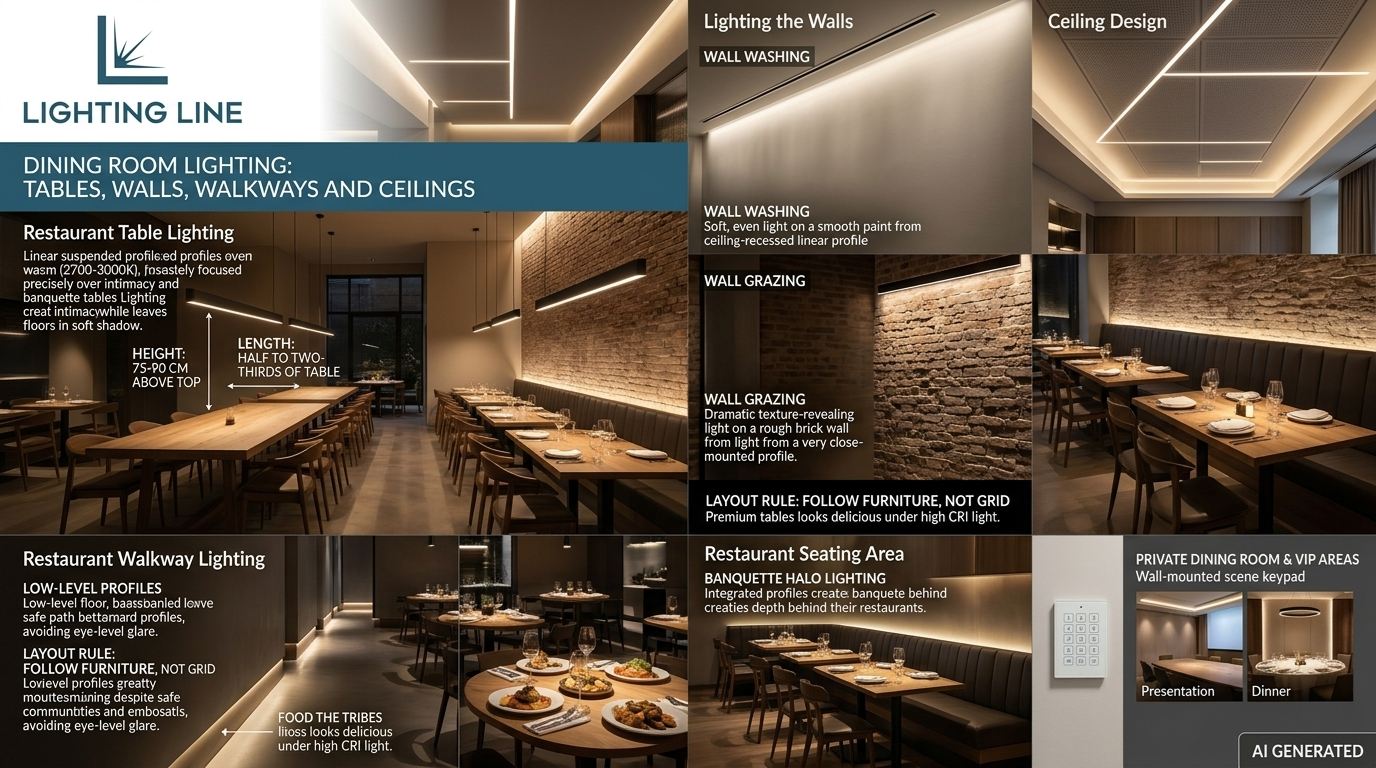
Restaurant table lighting
Every table should receive its own pool of light. When the table is brighter than its surroundings, guests feel a sense of intimacy and the plate becomes the focal point. Linear suspension profiles are ideal over long tables, communal tables and rows of two-tops along a banquette, because one continuous line covers the whole run with even light.
What is the rule of thumb for lighting over a dining table?
The commonly used rules are:
- Height: hang the bottom of pendants or suspended profiles about 75-90 cm (30-36 inches) above the table top. Lower creates intimacy but can block sightlines; higher spreads the light and loses focus.
- Length: the light should be roughly half to two-thirds of the table length, and at least 15 cm shorter than the table at each end.
- Width: for a single linear profile, aim the light at the centre line of the table; for wide tables (over 100 cm), consider a profile with an asymmetric or wider beam, or two lines.
- Glare: the light source must not be visible to seated guests; deep profiles and opal or micro-prismatic diffusers solve this.
What is the 5-7 (5’7″) lighting rule?
Lighting professionals use the “5’7″ rule” (about 170 cm) as a reminder of the average standing eye level. Any bright light source mounted near this height, such as wall lights, mirror lights or decorative fixtures in corridors, will hit people directly in the eye. In practice: keep exposed light sources clearly above or below standing eye height, or fully shielded and diffused. A related guideline from galleries places the centre of artworks at around 145-150 cm (57 inches), which helps position wall-washing and picture lighting in restaurants.
What is the rule for dining room lights in terms of layout?
Lights in dining areas should follow the furniture, not the ceiling grid. A classic error is to design a regular grid of downlights before the table layout is fixed, leaving some tables in dark gaps and others with hot spots on the edge. Fix the furniture plan first, then place the lighting over tables, banquettes and focal points. Linear profiles help here, because their continuous output tolerates small shifts in table positions.
Restaurant table top lighting
Table top lighting refers to the light that actually lands on the table surface and on the plate. It can come from suspended profiles, narrow recessed lines, track spots or portable table lamps. For a premium result, aim for 150-300 lux on the table with CRI 90+, at 2700-3000 K. Rechargeable table lamps add decorative charm on terraces and in wine bars, but they should complement, not replace, a properly designed overhead layer.
Restaurant seating area lighting
Banquettes and booths offer an excellent opportunity for integrated linear lighting. A furniture profile or surface profile under the backrest top or behind a decorative panel creates a soft halo that frames guests and adds depth to the room. Combined with a suspended line above the tables, it forms a complete, self-contained lighting scene for each seating zone.
Lighting the walls: the overlooked secret
People judge the brightness of a room mainly by its vertical surfaces. A room with lit walls feels bright and welcoming even at low lux levels, while a room with dark walls feels gloomy even with bright downlights. Wall washing (even light over the whole wall) and wall grazing (light from very close to the wall, emphasizing texture) are therefore two of the most effective restaurant lighting ideas.
- Wall washing: a recessed ceiling profile placed 30-60 cm from the wall, with an asymmetric or wide diffuser, lights a plaster or painted wall evenly.
- Wall grazing: a narrow profile placed 5-15 cm from a brick, stone, timber or concrete wall reveals its texture in dramatic relief.
- Coves and slots: recessed or drywall profiles at the junction between wall and ceiling create a floating ceiling effect.
Restaurant walkway lighting
In dim restaurants, guests and staff must still move safely between tables, to the restrooms and through the service routes. Raising the ambient level to light walkways would destroy the atmosphere; low-level guidance is the better answer. Floor profiles, baseboard profiles, step lights and handrail profiles mark the route with soft lines of light at foot level. Low-level linear light improves safety without adding glare at eye level.
Restaurant lighting ceiling design
The ceiling is the largest uninterrupted surface in most restaurants and the natural host for ambient and architectural lighting. Typical approaches are:
- Light lines in plasterboard: drywall profiles plastered into the ceiling for a seamless finish, often arranged in parallel lines, grids or geometric patterns that echo the floor plan.
- Floating ceiling with indirect cove light: the lowered central ceiling is surrounded by a hidden LED strip that washes the upper ceiling.
- Exposed ceilings: in industrial interiors, suspended profiles hang below exposed ducts and beams, painted black or left in raw aluminium.
- Acoustic ceilings: light lines integrated between acoustic panels combine sound absorption with linear light, a growing trend in noisy, hard-surfaced restaurants.
Private dining rooms and VIP areas
Private dining rooms must be flexible: business lunches, celebrations, tasting menus and presentations all need different light. Design them as self-contained zones with at least three circuits (ambient, table, accent) and a dedicated scene keypad. Include a brighter “presentation” scene for business use, a warm “dinner” scene and a very low “dessert and speeches” scene. Tunable white profiles over the table let staff adapt the mood in seconds without changing a single fixture. In VIP areas, invest in higher CRI, deeper diffusers and the most precise dimming available: this is where guests are paying for perfection.
7. Restaurant bar lighting: counters, back bars and pendants
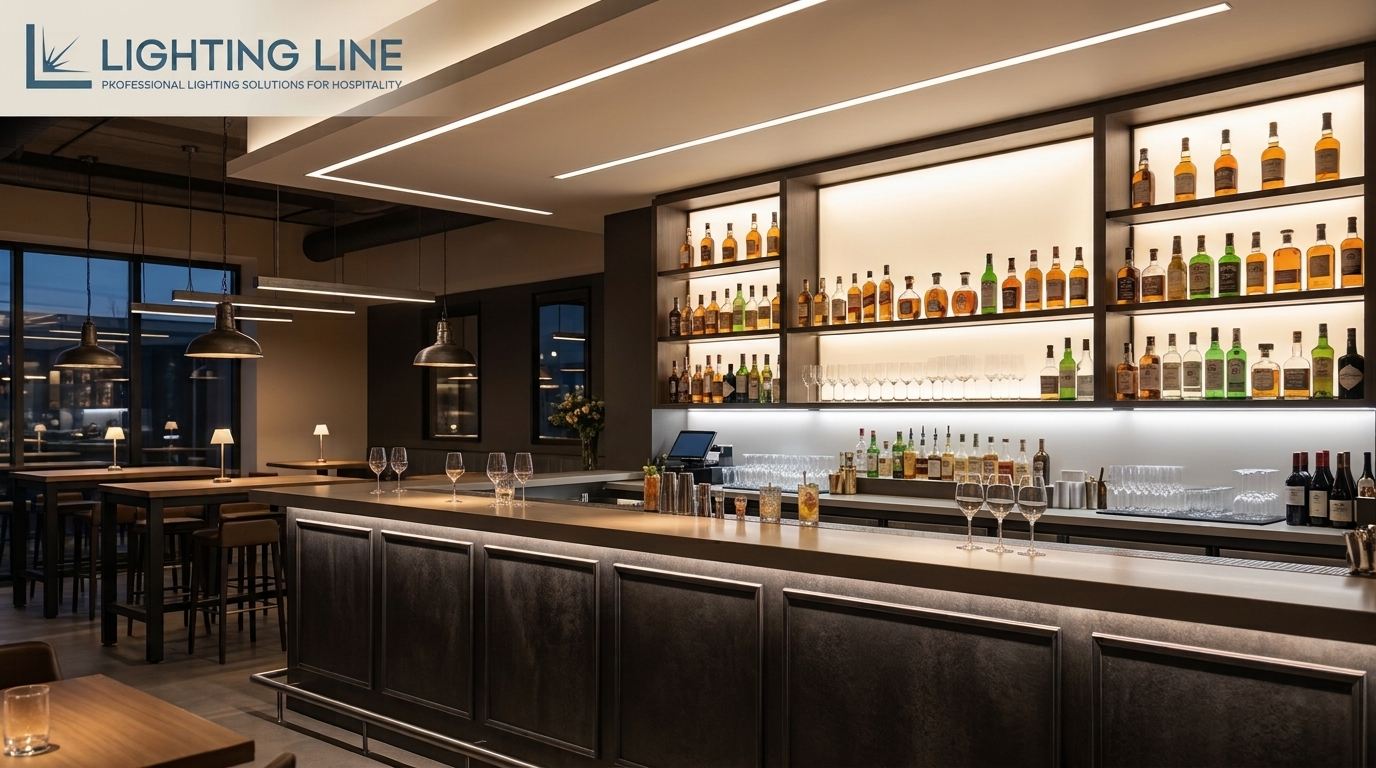
The bar is often the busiest, most photographed and most profitable area of a restaurant. Restaurant bar lighting must do two jobs at the same time: give bartenders a bright, practical work surface and give guests a glowing, theatrical focal point. Good bar lighting separates the working light from the show light, then balances the two.
Bar lighting ideas: the four zones of a bar
| Bar zone | Lighting goal | Recommended linear solution |
|---|---|---|
| Bar top (guest side) | Warm pools of light for drinks and faces | Suspended profiles or pendant lights over the bar, 2700-3000 K, dimmable |
| Working surface (bartender side) | Bright, shadow-free task light | Surface or corner profiles under the upper shelf or canopy, 3000 K, CRI 90 |
| Back bar shelves | Make bottles glow, display the offer | Corner or surface profiles under each shelf, or vertical lines at the sides |
| Bar front (counter face) | Visual signature from across the room | Recessed or surface profiles under the overhang, grazing the counter front |
Back bar lighting
Back bar lighting is all about the bottles. Light passing through glass and liquid creates the jewel-like glow that defines a great bar. Three techniques work particularly well with linear profiles:
- Under-shelf lighting: a slim profile under the front edge of each shelf lights the bottles below from above, revealing labels.
- Back-lighting: a lit panel or a profile behind translucent shelves makes the bottles glow from behind, perfect for whisky, gin and colored spirits.
- Bottom-lighting: a profile recessed into the shelf itself, under glass or acrylic, sends light up through the bottles.
Corner profiles are especially useful on back bar shelves because their 45-degree emission aims the light onto the bottles instead of into the bartender’s eyes.
Pendant lighting over a bar
Pendant lights over the bar are one of the most popular bar lighting fixtures. Linear suspended profiles offer a contemporary alternative or complement to traditional pendants: a single continuous line over the whole bar, perhaps with an up-light component to wash the ceiling. For a classic look, individual pendants can sit above the guest side while a linear profile handles the working surface. Keep pendants over the bar at a height that does not block eye contact between guests and staff, usually 80-100 cm above the bar top.
Ceiling bar lights and ceiling light bars
“Ceiling light bars” and “kitchen ceiling light bars” are linear fixtures mounted directly on the ceiling. In bars with low ceilings, a surface or recessed linear profile running along the bar provides even light without hanging elements. In high spaces with exposed services, suspended profiles keep the light close to the action.
Modern bar lighting and pub lights
Modern bar lighting tends towards minimal, integrated lines and warm, dimmable sources, often with RGB or RGBW accents for late-night scenes. Pubs and bistros keep their character with warm 2200-2700 K light, wall lights, vintage-style lamps and lit shelves. Hidden linear LED strips can modernize a traditional pub without changing its look: tucked under shelves and cornices, they add light while the original pub lamps and wall lights stay as decoration.
Bar table lights and hanging bar lights
High tables and standing areas near the bar need their own focused light. Hanging bar lights or a short suspended profile over each high table define small social islands within the bar zone. Rechargeable table lamps add warmth and flexibility, especially for events.
Industrial lighting over dining tables and bars
Industrial interiors favor visible, robust, matt black or raw aluminium fixtures. Large industrial lights, metal pendants and exposed linear profiles hung from chains or steel cables fit this language well. A black suspended aluminium profile over a reclaimed timber table or a concrete bar delivers the industrial look with modern efficiency and glare control.
8. Commercial kitchen lighting: safety, hygiene and visibility
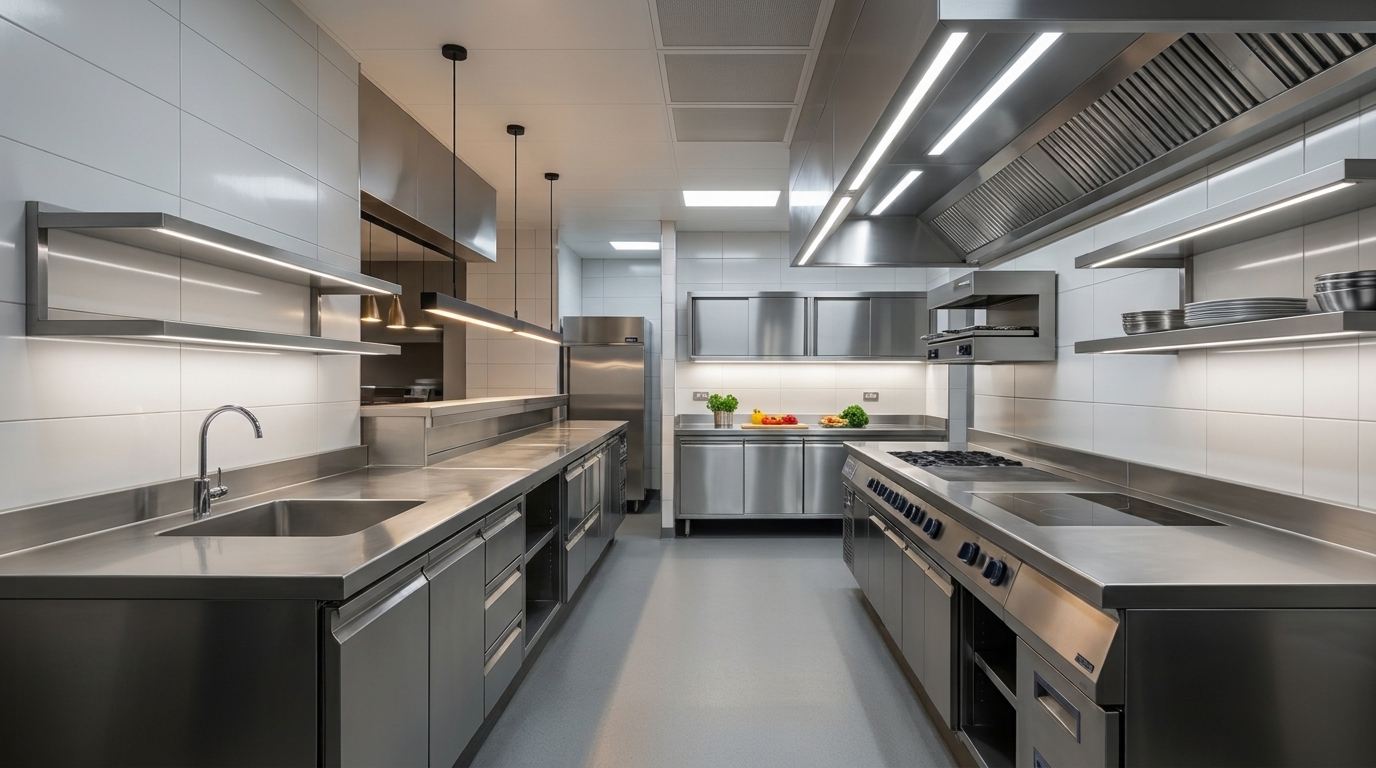
The kitchen is the engine room of every restaurant, and its lighting directly affects food safety, staff safety and productivity. Commercial kitchen lighting must be bright, uniform, accurate in color, easy to clean and resistant to heat, steam and grease.
What type of lighting is best for a commercial kitchen?
The best lighting for a commercial kitchen is linear LED with:
- Around 500 lux maintained on preparation and cooking surfaces.
- Color temperature of 4000 K (neutral white) for alertness, or 3500 K where the kitchen is open to guests.
- CRI at least 80, ideally 90, so cooks can judge doneness, freshness and color accurately.
- Good uniformity and low glare (EN 12464-1 indicates UGR 22 for kitchens).
- Closed, smooth fixtures with sealed diffusers and an appropriate IP rating.
How do you light a restaurant kitchen?
Follow these steps:
- Map the work zones: preparation, cooking line, pass, pastry, washing, storage.
- Place light over the front edge of each work surface, not over the centre of the room, so the cook’s body does not shade the board.
- Light the pass separately: the pass is where dishes are checked before reaching the guest. Use the same Kelvin and CRI as the dining room so chefs see the plate exactly as guests will.
- Coordinate with the extraction hood: most hoods have their own integrated lights; avoid duplicating or clashing with them.
- Specify protection: IP44 minimum in general kitchen areas, IP65 where fixtures are hosed down or exposed to steam and grease.
- Prevent breakage hazards: use shatter-resistant polycarbonate or PMMA diffusers, never exposed glass, over food areas.
Food preparation area lighting
In prep areas, light under wall cabinets and shelves is as important as ceiling light. A surface profile under shelving brings 500+ lux right onto the board. For pastry, garde manger and any station where color judgement matters, specify CRI 90 or higher.
Washing, storage and cold rooms
Dishwashing areas are wet, humid and hot; waterproof profiles such as the 32x10mm recessed waterproof aluminium profile (RE07-12-S3), combined with suitably protected strips, are good candidates. Storage rooms need lower levels (100-200 lux) but good vertical light to read labels. In cold rooms, LED performs well at low temperatures, but check the strip and driver ratings for the actual operating temperature.
Do restaurants use fluorescent lights?
Historically, yes: fluorescent tubes were the standard in commercial kitchens for decades. Today, that era is ending. In the European Union, most fluorescent tubes (including the common T5 and T8 types) have been phased out of the market since 2023 under the RoHS rules on mercury, and many other countries have followed. Any restaurant still using fluorescent lighting should plan an upgrade to linear LED, which offers better light, lower consumption, no mercury and instant start at any temperature.
What are the lighting regulations for commercial kitchens in the UK?
In the UK, kitchens are workplaces, so the Workplace (Health, Safety and Welfare) Regulations 1992 require suitable and sufficient lighting. The Health and Safety Executive’s guidance HSG38 “Lighting at work” explains how to assess lighting risks. BS EN 12464-1 provides recommended illuminance values (about 500 lux for kitchens), and food hygiene rules derived from Regulation (EC) No 852/2004 require food premises to have adequate natural or artificial lighting. Similar principles apply across the EU. Always verify current national and local requirements with the project’s health and safety consultant.
What is the current trend for kitchen lighting?
Open kitchens visible from the dining room are a strong trend. They require a careful balance: bright enough to work safely (often 500 lux), but with warmer color (3000-3500 K), shielded light sources and dimmable circuits so the kitchen glows rather than glares into the dining room. Industrial kitchen lighting ideas include black suspended linear profiles over the pass and integrated light lines in stainless steel shelving.
9. Decorative lighting, architecture and brand identity
Beyond function, light can tell the story of a restaurant. A distinctive lighting signature makes a restaurant recognizable at a glance, in person and on social media. This is where interior designers and architects can turn linear LED profiles into a branding tool.
How do I choose restaurant lighting that matches a specific interior design concept?
Start from the concept’s key words. A “Nordic minimal” concept suggests thin, flush light lines and warm white. An “industrial loft” concept suggests visible black suspended profiles and grazing light on brick. A “Mediterranean trattoria” concept suggests warm, cosy light, rounded shapes and lit niches. “Luxury lounge” suggests hidden coves, rich materials grazed by light and very low ambient levels. Then match:
- Shapes: straight lines, curves, grids or freeform patterns that echo the architecture.
- Finishes: anodized silver, black or white profiles that match joinery and ceilings.
- Visibility: decide what should be seen (decorative) and what should disappear (ambient and task).
- Color of light: one Kelvin family across the whole concept, with RGB or tunable accents only where they serve the brand.
Statement lighting for restaurants
Statement lighting is the “wow” element: a sculptural suspended line that zigzags above the dining room, a ring of light over a round table, a ceiling of parallel light lines that guides guests from the entrance to the bar. With suspension profiles, round profiles and architectural profiles, designers can build custom geometric compositions at a fraction of the cost of bespoke decorative fixtures.
Which lighting fixtures are suitable for highlighting architectural features and artwork?
- Columns and pilasters: vertical lines recessed into the corners, or grazing light from floor-level profiles.
- Vaulted or beamed ceilings: indirect strips hidden on top of beams wash the ceiling and reveal its structure.
- Niches and alcoves: a small profile hidden at the top of the niche lights objects and creates depth.
- Artwork: a recessed wall-wash line in front of an art wall gives even light that can be changed when the artworks change, unlike fixed spotlights.
- Textured walls: grazing with narrow profiles 5-15 cm from the surface.
- Stairs: step-edge profiles and lit handrails for safety and drama.
Restaurant logo lighting and branded interiors
Logos and signage can be back-lit with LED strips inside custom letters or behind panels, or outlined with flexible strips for a neon-like effect. Inside the restaurant, branded color accents (for example a signature color in a back bar or under the counter) can be created with RGB or RGBW strips. Use brand colors in small doses: one lit element in brand color is memorable, an entire room in brand color is tiring.
Lighting cafes and bistros
Café lighting and bistro lighting need to work from breakfast to aperitivo. Daytime calls for brighter, slightly crisper light (3000-3500 K) that complements daylight from the windows; evenings call for warmer, dimmer scenes. Linear profiles under the counter, over the pastry display and along shelving make the offer attractive, while bistro lights (festoon strings) and pendants give character. In cafés, the display counter is the most important sales surface: light it with CRI 90+ strips to make pastries and sandwiches irresistible.
10. Dimming, scenes and smart restaurant lighting control
A restaurant changes several times a day: bright breakfast, busy lunch, quiet afternoon, intimate dinner, late-night bar, private event, cleaning shift. Lighting control is what allows one installation to deliver all of these atmospheres automatically, consistently and with less energy. For owners, it is also the most visible daily benefit of a well-planned system.
Can restaurant lighting be adjusted for lunch, dinner and special events?
Yes, and it should be. The standard approach is to program “scenes”: predefined combinations of levels for each circuit, recalled with a single button, a tablet or an automatic timer.
| Scene | Ambient | Table task | Accent / walls | Decorative / color | Color temperature |
|---|---|---|---|---|---|
| Cleaning / setup | 100% | 100% | 50% | Off | 3500-4000 K |
| Lunch | 70-80% | 80% | 50% | 30% | 3000 K |
| Afternoon / café | 60% | 60% | 60% | 40% | 3000 K |
| Dinner | 25-35% | 60-70% | 70% | 50% | 2700 K |
| Late dinner / bar | 15-20% | 40-50% | 60% | 70% | 2200-2400 K |
| Event / party | 10% | 30% | Variable | RGB/RGBW dynamic | Variable |
Dimmable restaurant lighting: technologies
LED strips are driven by constant-voltage power supplies (usually 24 V for long runs) and dimmed by controllers. The most common dimming protocols in restaurant lighting are:
- Phase-cut (TRIAC/leading or trailing edge): uses existing wall dimmers; simple and economical for small projects, but less precise at very low levels.
- 0-10 V / 1-10 V: robust analogue control, common in commercial projects.
- DALI / DALI-2: digital, addressable control of each driver; ideal for scenes, monitoring and integration with building management systems.
- DMX: for dynamic RGB/RGBW effects and events.
- Wireless (Bluetooth mesh, Zigbee, Casambi-type systems): app-based control without new control wiring, very useful in refurbishments and heritage buildings.
For fine dining, choose drivers and controllers that dim smoothly down to 1% or less without flicker: the bottom of the dimming curve is exactly where these restaurants live.
Smart lighting for restaurants
Smart lighting systems connect fixtures to an app or cloud platform. For a modern, tech-forward restaurant this means:
- Control from a smartphone or tablet, including remotely for multi-site managers.
- Scheduled scenes that follow opening hours and adjust automatically at weekends.
- Astronomical clocks that switch outdoor and window lighting at sunset.
- Occupancy and daylight sensors in back-of-house areas, storage and restrooms.
- Energy monitoring by zone, useful for sustainability reporting.
- Integration with music, blinds and HVAC for complete “atmosphere” scenes.
Can restaurant lighting be controlled through a smartphone or tablet?
Yes. Wireless controllers for LED strips can be added to each circuit, and many systems offer staff-friendly apps with locked scenes, so the team can choose “Lunch” or “Dinner” without accidentally changing the design. Always give staff a simple physical keypad as well: an app is a bonus, not a replacement for a button by the door.
Which LED lighting systems can change color or intensity for different occasions?
- Tunable white (CCT) strips: two channels, warm and cool white, mixed to obtain any Kelvin value from about 2700 K to 6500 K (ranges vary by product). Ideal for following the day from bright lunch to warm dinner.
- RGB strips: red, green and blue channels for colored effects.
- RGBW and RGB+CCT strips: add one or two white channels, so the same installation provides quality white light and color effects. This is the most flexible option for restaurants that host events.
- Dim-to-warm: light becomes warmer as it dims, mimicking the behaviour of incandescent lamps and candles; very effective in fine dining.
How can programmable lighting improve restaurant branding and customer engagement?
Programmable lighting creates moments: a slow color shift when the dessert trolley arrives, a birthday scene, a subtle change at “golden hour” for social media photos, seasonal palettes for holidays or brand campaigns. Used with restraint, dynamic light becomes part of the experience guests talk about and share online. Used without restraint, it turns a restaurant into a nightclub, so always keep a calm default scene.
How can smart restaurant lighting help reduce energy consumption?
Control is the second big energy saver after LED itself. Dimming to 50% typically reduces LED consumption by close to half; timers prevent lights burning in empty rooms; occupancy sensors cut waste in storage and restrooms; daylight sensors reduce artificial light near windows during the day. Together, these strategies can significantly lower lighting consumption compared with the same LED system switched simply on and off.
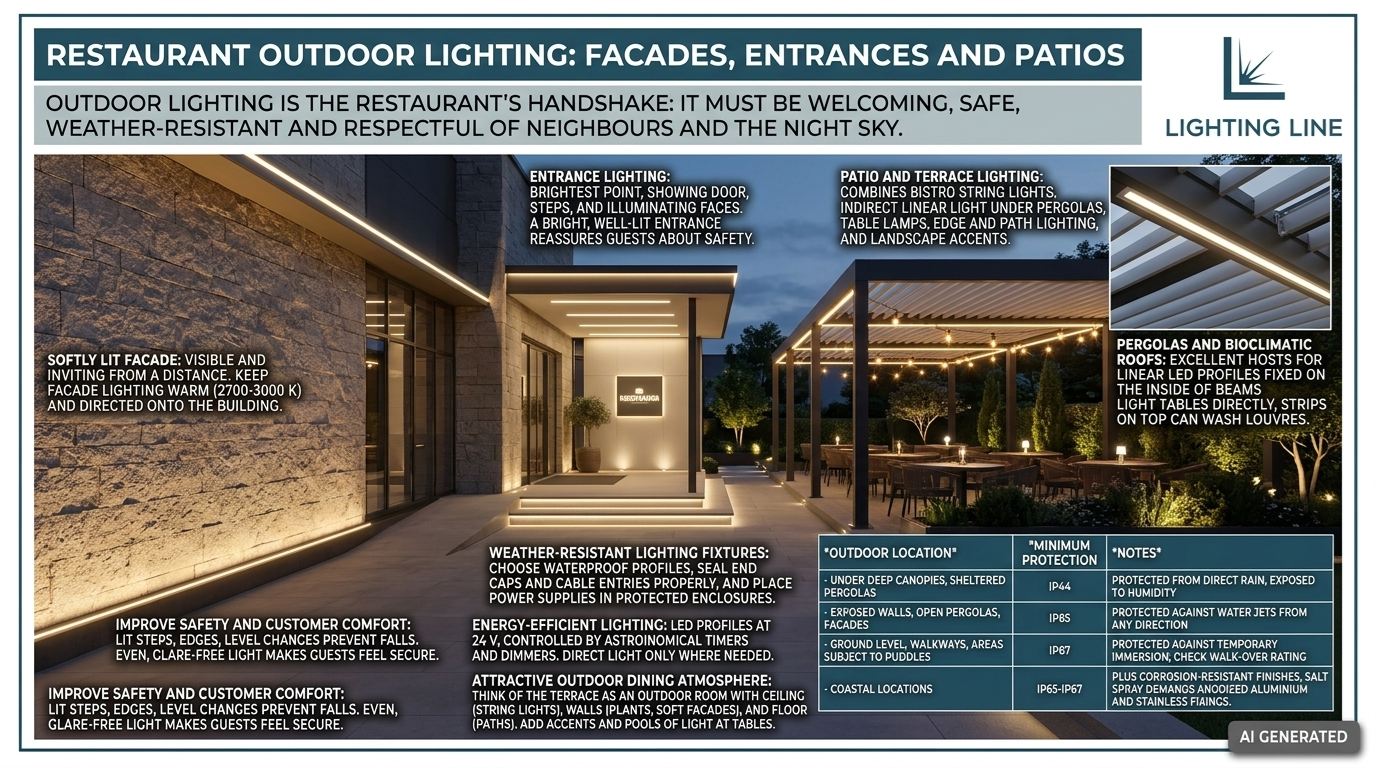
11. Restaurant outdoor lighting: facades, entrances and patios
Outdoor lighting is the restaurant’s handshake: it is the first thing guests see from the street, and it determines whether a terrace is used only in summer afternoons or all evening long. Restaurant outdoor lighting must be welcoming, safe, weather-resistant and respectful of neighbours and the night sky.
Restaurant facade lighting
A softly lit facade makes the restaurant visible and inviting from a distance. Grazing light from linear profiles at the base of the wall, or a line of light along a canopy, highlights the building’s materials. Keep facade lighting warm (2700-3000 K) and directed onto the building, not into the sky or neighbouring windows.
Restaurant entrance lighting
The entrance should be the brightest point of the facade. It must clearly show the door, the steps and any ramp, and illuminate the faces of guests and staff. A recessed line in the canopy or door frame, step lighting with floor profiles and lit signage create a clear, welcoming threshold. A bright, well-lit entrance also reassures guests about safety, especially in the evening.
What outdoor lighting is best for restaurant patios and terraces?
The best restaurant patio lighting combines:
- Warm ambient light from bistro string lights or indirect linear light under pergolas and awnings.
- Table light from suspended profiles under pergola beams or from rechargeable table lamps.
- Edge and path lighting to define the boundary of the terrace and guide guests safely.
- Landscape accents on plants, trees and walls to create depth beyond the tables.
Pergolas and bioclimatic roofs are excellent hosts for linear LED: profiles fixed on the inside of the beams light the tables directly, while strips on top of the beams can wash the louvres or canopy for a soft glow.
Which weather-resistant lighting fixtures are suitable for restaurant exteriors?
| Outdoor location | Minimum protection | Notes |
|---|---|---|
| Under deep canopies, sheltered pergolas | IP44 | Protected from direct rain, exposed to humidity |
| Exposed walls, open pergolas, facades | IP65 | Protected against water jets from any direction |
| Ground level, walkways, areas subject to puddles | IP67 | Protected against temporary immersion; check walk-over rating |
| Coastal locations | IP65-IP67 plus corrosion-resistant finishes | Salt spray demands anodized aluminium and stainless fixings |
Choose waterproof profiles and suitably rated LED strips, seal end caps and cable entries properly and place power supplies in protected, ventilated enclosures. Most outdoor LED failures come from water entering through poorly sealed connections, not from the LEDs themselves.
How can outdoor restaurant lighting improve safety and customer comfort?
Lit steps, edges, level changes and paths prevent trips and falls. Even, glare-free light around the terrace makes guests feel secure, while warm light and visible boundaries create a sense of enclosure that encourages them to stay longer. Make sure fixtures are not aimed at diners’ eyes or at passing drivers.
What are the best energy-efficient lighting options for a restaurant patio?
LED profiles and strips at 24 V, controlled by astronomical timers and dimmers, offer the best efficiency. Scenes can lower the patio lighting automatically after closing, leaving only safety and security lighting. Avoid uplighting into the open sky: it wastes energy and adds light pollution. Directing light only where it is needed is both efficient and good neighbourly practice.
How can I create an attractive outdoor dining atmosphere with lighting?
Think of the terrace as an outdoor room with a “ceiling” (pergola, string lights or canopy), “walls” (planting, screens, facades lit softly) and a “floor” (paths and edges). Light each element at low levels with warm white, add a few strong accents on trees or textured walls, and give each table its own small pool of light. The result feels intimate, safe and memorable.
12. Visual comfort: glare, uniformity, flicker and shadows
Visual comfort is what separates professional restaurant lighting from amateur installations. Guests rarely notice good lighting consciously, but they immediately feel discomfort from glare, flicker or harsh shadows. A comfortable restaurant is one where guests never see a bright point of light they did not expect.
Restaurant lighting glare reduction
Glare happens when a bright source is visible against a darker background. Its main causes in restaurants are exposed LED dots, downlights visible from seated positions, reflections from glossy tables and pendants hung at eye level. Solutions:
- Use deep profiles with recessed strips and opal or micro-prismatic diffusers.
- Place light lines out of the direct line of sight of seated guests, or shield them.
- Choose matt table finishes or adjust fixture positions to avoid reflections.
- Use indirect light for ambient layers.
- Select COB strips for visible lines to avoid dotted light.
Restaurant lighting uniformity
Uniformity means light is distributed evenly over a surface without hot spots or dark gaps. In kitchens, high uniformity is essential for safety. In dining rooms, the goal is controlled contrast: tables are evenly lit, but brighter than the surroundings. Linear profiles provide excellent uniformity along their length, which is why they are preferred to rows of downlights over long tables and counters.
Flicker and stroboscopic effects
Poor-quality drivers can make LED light flicker at frequencies that are not always visible but cause headaches and fatigue, and can produce unpleasant effects on phone cameras. Specify flicker-free drivers and controllers, especially for dimmed scenes and for spaces where guests and staff spend many hours. A quick check on site: film the light with a smartphone in slow motion and look for dark bands.
Shadows and faces
Strong downlights directly above people create shadows under eyes and noses, which is unflattering. A balance of vertical light from walls, indirect ceiling light and focused table light gives faces soft, natural modelling. This matters for the guest experience and for the many photos taken at the table.
Light quality checklist
| Parameter | Dining room target | Kitchen target |
|---|---|---|
| CRI (Ra) | 90+ | 80 minimum, 90 recommended |
| R9 (saturated red) | High (above 50 preferred) | Positive and as high as practical |
| Color consistency | Tight binning, same batch | Same Kelvin in all work zones |
| Glare | No visible sources from seats | UGR 22 or lower (EN 12464-1) |
| Flicker | Flicker-free across the dimming range | Flicker-free |
| Uniformity on task | Even on table, contrasted to room | High uniformity across work surfaces |
13. Regulations, emergency lighting and electrical safety
For construction companies and renovation consultants, compliance is not optional. A beautiful restaurant lighting scheme that fails inspection delays the opening and costs money. Restaurant lighting regulations cover four main areas: workplace illuminance, emergency lighting, electrical safety and accessibility. Requirements differ by country, so the information below is a general orientation, not legal advice.
What lighting regulations should be considered when opening a restaurant?
- Workplace lighting: EN 12464-1 in Europe (BS EN 12464-1 in the UK) provides the reference values for kitchens, counters, offices and circulation.
- Food hygiene: food premises must have adequate lighting so that cleaning and food handling can be done properly.
- Emergency lighting: EN 1838 defines performance; EN 50172 (and national equivalents such as BS 5266-1 in the UK) defines system design, testing and maintenance.
- Electrical safety: installation according to national wiring rules (IEC 60364 based standards, BS 7671 in the UK), CE or UKCA marked components, correct IP ratings.
- Energy performance: national building energy rules may cap installed lighting power or require controls in new and refurbished buildings.
- Accessibility: adequate lighting and visual contrast on routes, steps and signage help people with visual impairments.
Does a restaurant need emergency lighting?
Yes. Restaurants are places of public assembly, and emergency lighting is required almost everywhere to allow safe evacuation if the mains power fails. Emergency lighting is designed alongside, but separately from, the decorative restaurant lighting. Typical performance requirements under EN 1838 include:
| Emergency lighting type | Purpose | Typical minimum (EN 1838) |
|---|---|---|
| Escape route lighting | Light the route to the exits | At least 1 lux along the centre line of the route |
| Open area (anti-panic) lighting | Prevent panic in larger rooms such as dining halls | At least 0.5 lux on the floor of the open area |
| High-risk task area lighting | Allow safe shutdown of dangerous processes, e.g. kitchen cooking lines | 10% of normal maintained illuminance, minimum 15 lux |
| Exit signs | Identify exits and directions | Illuminated or internally lit safety signs |
Emergency duration is typically at least one hour, and in many countries three hours for premises where people may remain after evacuation or where immediate re-occupation is expected. Check the local fire safety requirements for the specific premises.
Can linear LED profiles be part of the emergency lighting?
Yes, if they are fed by a certified emergency power source (central battery system or emergency kits compatible with the LED driver) and the installation is designed and tested accordingly. In many restaurants, a selection of ceiling light lines is connected to an emergency circuit, so the escape routes stay lit with the same clean architectural look. Never improvise emergency functions: they must be designed, documented and tested by qualified professionals.
Restaurant electrical lighting safety
- Use SELV low-voltage systems (12 or 24 V DC) for LED strips wherever possible, especially within reach of guests.
- Size cables and power supplies for voltage drop and load, with a margin of 20-30% on power supply capacity.
- Feed long runs from both ends or from the middle to avoid brightness loss at the end of the strip.
- Place drivers where they can be ventilated, inspected and replaced, not sealed above fixed ceilings without access.
- Respect the IP rating requirements for wet and outdoor zones.
- Keep fixtures and cables away from heat sources such as hoods, ovens and fryers, following manufacturers’ temperature limits.
Restaurant lighting code compliance documentation
At handover, the contractor should provide: lighting layout drawings, product data sheets, photometric calculations, emergency lighting certificates and test logs, wiring diagrams, control system scene settings and maintenance instructions. This documentation protects the contractor and simplifies future maintenance and refurbishment.
14. Energy efficiency, sustainability and maintenance
Restaurants are energy-intensive businesses: kitchens, refrigeration and ventilation run for long hours, and lighting is on from early morning prep to late-night cleaning. Energy-efficient restaurant lighting is one of the quickest, lowest-risk ways to reduce operating costs, because the savings start the day the lights are switched on.
LED restaurant lighting benefits
According to the U.S. Department of Energy, residential LEDs use at least 75% less energy and last up to 25 times longer than incandescent lighting. Compared with halogen spots, compact fluorescents and old fluorescent tubes, quality LED strips and profiles offer:
- Lower consumption for the same or better light output.
- Long lifetime, typically tens of thousands of hours for quality strips used within their thermal limits.
- Less heat radiated into the room, which also reduces the load on air conditioning.
- No mercury and no UV in the beam, which protects food, fabrics and artworks.
- Instant full output and smooth dimming.
Which energy-efficient lighting options can help reduce operating costs?
| Measure | How it saves | Typical impact |
|---|---|---|
| Replace halogen and fluorescent with LED | Higher efficacy (lumens per watt) | Large reduction in lighting power |
| Local task lighting instead of high ambient levels | Light only where needed | Lower installed power per m² |
| Dimming and scenes | Lower output during dinner and quiet periods | Consumption falls roughly in line with dimming level |
| Timers and astronomical clocks | No lights left on after closing | Eliminates wasted hours |
| Occupancy sensors back-of-house | Storage, restrooms and corridors lit only when used | Significant savings in low-use rooms |
| Light-colored finishes | Higher reflectance, higher utilization factor | Fewer metres of profile for the same lux |
Restaurant lighting energy savings: a simple estimate
Consider a restaurant that replaces 60 halogen downlights of 50 W each (3,000 W) with 40 metres of LED profile at 12 W/m (480 W). If the lights operate 14 hours a day, 360 days a year:
- Before: 3.0 kW × 14 h × 360 days = 15,120 kWh per year.
- After: 0.48 kW × 14 h × 360 days = 2,419 kWh per year.
- Saving: about 12,700 kWh per year, an 84% reduction, before considering dimming.
At an energy price of €0.25 per kWh, this represents about €3,175 per year, plus savings on lamp replacements and reduced cooling load. Run the same calculation with your own tariff and hours: in most restaurant refurbishments, LED pays for itself within a few years.
Sustainable restaurant lighting design
Sustainability goes beyond watts. A sustainable restaurant lighting design also considers:
- Durability and repairability: aluminium profiles last as long as the interior; strips and drivers can be replaced without discarding the whole fixture.
- Recyclable materials: aluminium is highly recyclable.
- Right-sizing: avoid over-lighting; design to the real need.
- Light pollution: outdoor light directed downward and switched off when not needed.
- Local supply and logistics: European production and stock shorten lead times and transport.
What maintenance requirements should I consider when choosing restaurant lighting?
- Access: drivers and connections must be accessible through inspection hatches or removable elements.
- Cleaning: diffusers in kitchens and bars need regular degreasing; smooth, clip-in diffusers simplify this.
- Spare parts: keep spare strip lengths and drivers from the same batch for color-matched repairs.
- Emergency testing: monthly functional tests and annual full-duration tests, recorded in a log book.
- Control system: back up scene settings and document programming.
Low maintenance commercial lighting starts at the design stage: if a component cannot be reached, it will not be maintained.
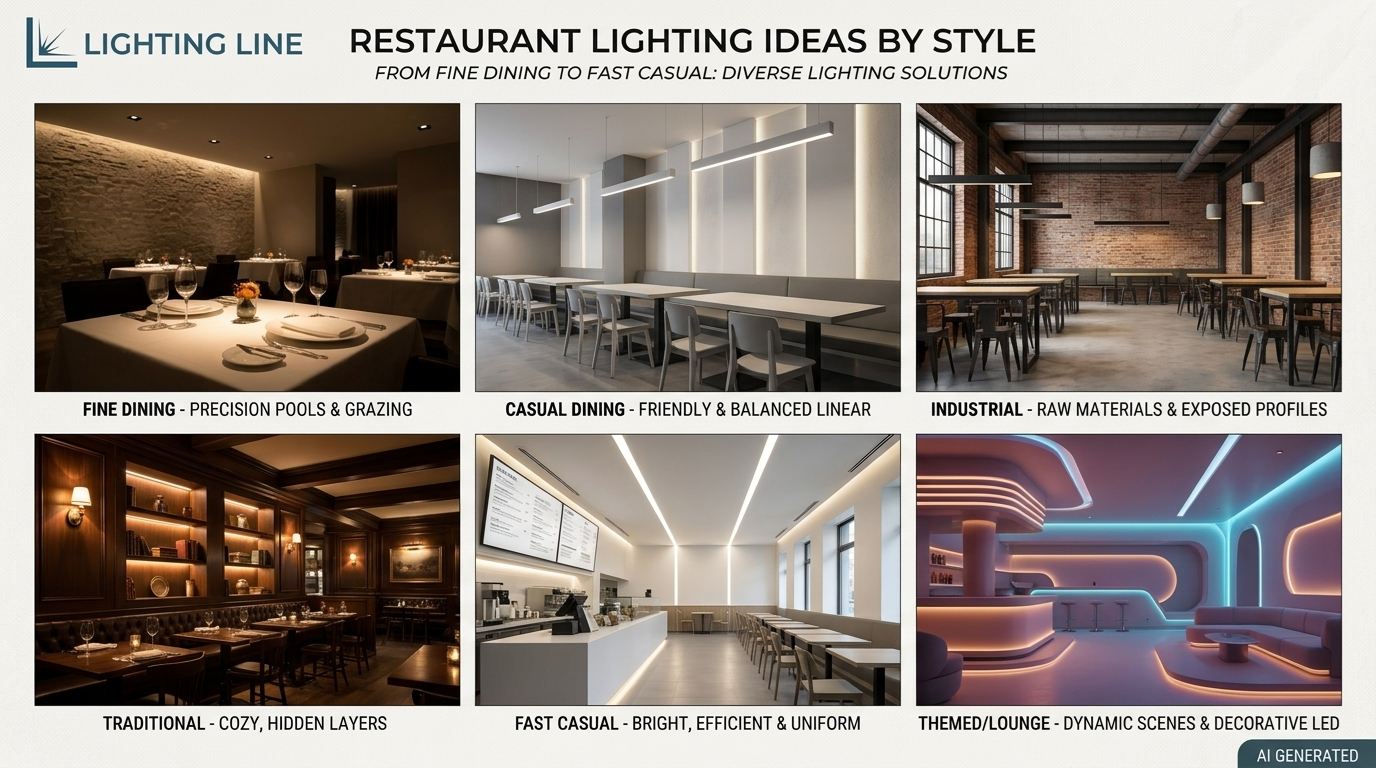
15. Restaurant lighting ideas by style
Every restaurant concept needs its own lighting language. The examples below show how the same toolbox of linear LED profiles, strips and controls can produce very different results.
Fine dining restaurant lighting
Luxury restaurant lighting is about contrast, discretion and precision. Ambient light is low (50-100 lux), warm (2200-2700 K) and mostly indirect. Each table receives a precisely aimed pool of high-CRI light. Walls, artworks and textures are gently grazed. Fixtures are almost invisible: recessed and drywall profiles, hidden coves, slim suspended lines in dark finishes.
What is the best lighting for a luxury fine dining restaurant? Layered, dimmable, warm light with CRI 95 on the tables, no visible light sources from the seats and smooth dim-to-warm or tunable white control.
What lighting techniques can enhance the perception of premium restaurant interiors?
- Grazing light on natural materials such as stone, timber and textured plaster.
- Indirect light that reveals ceiling height and volume.
- Back-lit wine walls and glowing display cabinets.
- Consistent color temperature throughout the room.
- Very low glare and very smooth dimming.
How can lighting make food presentation look more appealing?
Light the plate from above and slightly in front of the guest, at 150-300 lux, with CRI 90-95+ and high R9. Avoid cool or green-tinted sources. Keep the table slightly brighter than the surroundings so the plate becomes the focus, and match the light at the kitchen pass to the dining room so chefs plate under the same conditions.
Casual restaurant lighting design
Casual dining restaurants need friendly, balanced light: 150-200 lux ambient, 3000 K, good vertical light on walls and clear table lighting. Linear suspended profiles over tables and banquettes, recessed ceiling lines and some decorative pendants create a relaxed but lively atmosphere that works for families, lunch and dinner.
Industrial restaurant lighting
Industrial restaurants celebrate raw materials: brick, concrete, steel and reclaimed timber. Lighting ideas include black suspended profiles hung on cables, grazing light on brick walls, concrete profiles cast into walls, exposed cable runs and large industrial pendants as decorative accents. Keep color temperature at 2700-3000 K to balance the cool materials.
Traditional restaurants, trattorias and pubs
Traditional venues rely on warm, cosy light (2200-2700 K), wall lights, lit niches and shelves, and table-level light. Hidden linear strips update them discreetly: under shelves, above cornices, inside display cabinets and along beams. Pub wall lights and vintage pub lamps remain the visible decoration, while the hidden LED layer does the real lighting work.
Fast casual and quick service
Fast casual restaurants need brighter, more uniform light (200-300 lux), 3000-3500 K, strong menu board and counter lighting and a clean, modern look. Long recessed or surface light lines, lit menu boards and bright display counters support speed and visibility of the offer. Dimmed evening scenes can extend appeal for dinner service.
Cafés, bistros and brunch spots
Café lighting must follow daylight: bright and fresh in the morning, cosy in the evening. Tunable white profiles over counters and tables, warm pendants and lit shelving make the space adapt naturally across the day.
Themed restaurant lighting ideas
Themed restaurants (Asian, Nordic, Mediterranean, retro diner, rooftop lounge) use light to reinforce their story: paper-lantern-inspired diffused light for Asian concepts, clean pale wood and soft white for Nordic, warm terracotta tones for Mediterranean, colorful neon-like strips for retro diners, dynamic RGBW scenes for lounges. The theme should influence color, shapes and rhythm, but the fundamentals of good task lighting on tables never change.
Comparison table: lighting by restaurant style
| Style | Ambient level | Kelvin | Key linear solutions | Signature effect |
|---|---|---|---|---|
| Fine dining | 50-100 lux | 2200-2700 K | Recessed, drywall, slim suspension | Pools of light on tables, grazed walls |
| Casual dining | 150-200 lux | 2700-3000 K | Suspension, recessed lines | Lit banquettes and walls |
| Industrial | 100-200 lux | 2700-3000 K | Black suspension, concrete, surface | Grazed brick and exposed lines |
| Traditional / pub | 75-150 lux | 2200-2700 K | Hidden surface and corner profiles | Glowing shelves and niches |
| Fast casual | 200-300 lux | 3000-3500 K | Recessed and surface lines | Bright counters and menu boards |
| Café / bistro | 150-250 lux | 2700-3500 K (tunable) | Surface, suspension, furniture | Lit pastry displays |
| Themed / lounge | Variable | Tunable + RGBW | Architectural, round, suspension | Dynamic color scenes |
16. Common restaurant lighting mistakes and how to fix them
Many restaurants spend heavily on furniture and finishes, then undermine them with poor lighting. Most restaurant lighting problems come from a handful of predictable mistakes, and almost all of them can be avoided at the design stage.
The most frequent mistakes
| Mistake | Consequence | Fix |
|---|---|---|
| Too much uniform light | Canteen feel, no atmosphere | Lower ambient, add table and wall light, dim |
| Too little light everywhere | Gloomy room, menus unreadable | Add focused table light and vertical light on walls |
| Mixed color temperatures | Patchy, cheap look | One Kelvin per layer, same batch strips |
| Low CRI sources | Grey, dull food and skin | CRI 90+ on all food and guest areas |
| Visible glare and LED dots | Discomfort, poor photos | Deeper profiles, opal diffusers, COB strips |
| Grid layout ignoring furniture | Dark tables, bright floor | Design lighting after furniture layout |
| No dimming or single circuit | Same light at breakfast and midnight | Separate circuits and scenes |
| Cheap drivers | Flicker, early failures | Quality, flicker-free power supplies with margin |
| Inaccessible drivers | Costly repairs, ceiling damage | Plan access hatches and service zones |
| Kitchen light behind the cook | Shadows on the cutting board | Light the front edge of work surfaces |
| Ignoring emergency lighting until late | Visible add-on fittings, delays | Integrate emergency circuits from the start |
How to brighten up a dark restaurant
When a restaurant feels too dark, the instinct is to add brighter downlights. Usually the better answer is to:
- Light the walls: vertical brightness changes perception more than anything else.
- Light the ceiling indirectly: cove lighting makes the room feel taller and brighter.
- Improve table light: focused light where people look most.
- Raise the CRI and adjust Kelvin: better color makes light feel richer.
- Lighten finishes where possible: a pale ceiling can transform a room.
How can restaurants improve lighting without a full refurbishment?
Surface-mounted profiles under shelves, in coves and on top of furniture can be installed in a day or two without major works. Replacing old halogen lamps, adding dimmers and wireless controllers and introducing table lamps on terraces are all quick wins. A lighting audit, even a simple one with a lux meter and a walk-through at dinner time, usually reveals the three or four changes that make the biggest difference.
17. Budget, ROI, timeline and project planning
For owners and contractors alike, the key questions are always the same: how much will it cost, how long will it take and when will it pay back? A well-planned restaurant lighting project defines priorities early, so the budget goes where guests and staff will notice it most.
How much does it cost to install a complete restaurant lighting system?
Costs vary widely with country, labour rates, ceiling types, control complexity and the share of decorative fixtures. The ranges below are indicative orientation values for planning in Europe, not quotations; always request project-specific offers.
| Project level | Description | Indicative cost range (supply + installation) |
|---|---|---|
| Basic upgrade | LED retrofit, a few surface profiles, simple dimming | About €25-50 per m² of floor area |
| Standard fit-out | Layered linear LED, separate circuits, scene control | About €50-120 per m² |
| Premium / fine dining | Custom light lines, high CRI, DALI or wireless control, decorative features | About €120-250+ per m² |
As a reference for linear systems, the main cost drivers per metre are the profile, the diffuser, the strip (output, CRI, tunable or RGBW), the share of power supply and control, accessories and installation. Recessed and drywall profiles add plastering and finishing labour, while surface profiles are the fastest to install.
Restaurant lighting cost estimate: where to invest first
- Table lighting: the most important surface in the restaurant.
- Control and dimming: multiplies the value of every fixture.
- Light quality (CRI, consistency, flicker-free drivers): visible every single day.
- Wall and vertical light: transforms perception of the room.
- Bar and display areas: directly linked to sales.
- Decorative features: add once the fundamentals are secured.
Restaurant lighting ROI
Return on investment comes from three sources:
- Energy savings: often the easiest to calculate, as shown in the example above.
- Maintenance savings: fewer lamp changes, fewer call-outs, less disruption during service.
- Revenue effects: longer stays, higher average spend on drinks and desserts, better reviews and social media visibility. These are harder to measure but often the most significant.
How do I plan restaurant lighting during a renovation project?
Lighting must be planned early, ideally at concept design stage, because it affects ceilings, joinery, electrical design and the programme. A typical sequence:
| Phase | Lighting tasks | Who is involved |
|---|---|---|
| 1. Brief and survey | Concept, opening hours, existing installation, ceiling voids | Owner, designer, contractor |
| 2. Concept design | Layers, mood boards, key effects, budget allocation | Interior designer, lighting designer |
| 3. Technical design | Calculations, product selection, circuits, control, emergency | Lighting designer, electrical engineer, supplier |
| 4. Procurement | Samples, approvals, orders, lead times | Contractor, supplier |
| 5. First fix | Cabling, back boxes, drywall profiles installed with plasterboard | Electrician, drywall installer |
| 6. Second fix | Strips, diffusers, suspensions, drivers, controls | Electrician |
| 7. Commissioning | Scene programming, focusing, emergency testing, documentation | Lighting designer, electrician |
| 8. Handover | Staff training, maintenance plan, spare parts | Contractor, owner |
How long does it take to install a complete restaurant lighting system?
For a 150-250 m² restaurant, installation of a linear LED system typically takes from a few days for a surface-mounted retrofit to two or three weeks for a full fit-out with drywall profiles, suspended lines and scene control, spread across first and second fix. Lead times for materials, approvals and plastering often matter more than the installation itself, so order samples and confirm products early.
Tips for construction companies and fit-out contractors
- Coordinate drywall profiles with the plasterboard installer: they are fixed before skim coating, so timing is critical.
- Protect installed profiles from dust, paint and plaster with tape or protective film until final cleaning.
- Install diffusers and strips last, after dusty works are finished.
- Label every circuit and driver to simplify commissioning and future maintenance.
- Mock up one section of a key light line on site before full installation to confirm the effect with the client.
- Plan cable routes for both ends of long runs to avoid voltage drop.
How can I choose reliable restaurant lighting contractors and suppliers?
Look for suppliers who provide complete technical data (lumens per metre, CRI, R9, Kelvin, binning, IP rating, temperature limits), photometric files where needed, samples, technical support and stable stock. Contractors should show references in hospitality projects, understand dimming and control systems and offer clear documentation. Industry bodies such as the Chartered Institution of Building Services Engineers (CIBSE) and the Illuminating Engineering Society (IES) publish guidance and can help identify qualified lighting professionals.
18. Restaurant chains: standardization, bulk supply and long-term value
Restaurant groups face a specific challenge: every site has different architecture, yet guests expect the same brand experience everywhere. Linear LED systems are ideal for chains because the same profiles, strips and scenes can be adapted to any room geometry while delivering identical light quality.
What restaurant lighting solutions are suitable for multiple locations?
Solutions that combine a limited, standardized product palette with flexible lengths and mounting options. For example: one suspension profile model for all tables and bars, one recessed or drywall profile for ceiling lines, one surface profile for shelves and counters, one strip family in two outputs, all at the same Kelvin and CRI.
How can I standardize lighting across a restaurant chain?
- Create a lighting design manual with layers, lux targets, Kelvin, CRI and scene settings for each zone type.
- Define a standard product list with exact codes, finishes and diffusers.
- Specify custom LED strips with fixed Kelvin, CRI and output, produced consistently for all sites.
- Standardize control scenes and keypad labels so staff anywhere use the same system.
- Measure and photograph each site at opening to verify compliance with the manual.
Which commercial lighting products offer the best long-term value?
Products with high-quality components, replaceable parts and stable availability. Aluminium profiles have practically unlimited life, so the long-term value comes from quality strips, reliable drivers and a supplier able to provide the same specification for years. Choosing a manufacturer that also produces its own strips reduces the risk of color mismatches when sites are extended or repaired.
Can suppliers provide bulk pricing and customized lighting solutions for restaurant groups?
Yes. Manufacturers like Lighting Line, which produce customizable LED strips and offer a wide range of aluminium profiles, can support framework agreements, volume pricing, custom lengths and specific strip specifications for multi-site rollouts. Contact the technical team early in the brand development phase to align product choices with the rollout plan.
19. Restaurant lighting trends for 2026
Lighting trends evolve with design, technology and guest expectations. The strongest trends in modern restaurant lighting all point in the same direction: less visible hardware, more control and more human-centred light.
What is the newest trend in lighting?
- Integrated light lines: light built into ceilings, walls, furniture and acoustic panels instead of added fixtures.
- Warm, low, layered light: moving away from bright overhead downlights towards lamps, coves and table-level light.
- Tunable and dim-to-warm white: light that follows the time of day.
- Wireless control and apps: easier retrofits and remote management of multiple sites.
- Biophilic design: light on plants, natural materials and textures.
- Acoustic lighting: light lines combined with sound-absorbing panels.
- Black and dark finishes for profiles in industrial and contemporary interiors.
- Circular design: repairable, recyclable systems with replaceable strips.
Why does Gen Z hate overhead lighting?
On social media, many younger people openly dislike the “big light”, the single bright ceiling fixture common in homes. They prefer several lamps, warm indirect light and cosy, flattering ambience. For restaurants targeting younger guests, the lesson is clear: avoid flat overhead light, build atmosphere with low-level, indirect and table light, and create photogenic moments.
What is the trend for dining room lighting?
Long linear suspensions over tables, sculptural light lines, warm dimmable sources and decorative lamps combined with hidden architectural lighting. In restaurants, communal tables with a single long suspended profile are a recurring image of contemporary design.
What are the latest restaurant lighting trends for modern commercial interiors?
Beyond aesthetics, the main trend is integration: lighting coordinated from day one with architecture, acoustics, furniture and digital controls. Linear LED profiles are at the centre of this approach because they can be embedded almost anywhere.
20. Restaurant lighting in practice: six project scenarios
Theory becomes useful when it meets real buildings. The six scenarios below show how restaurant lighting decisions change depending on who is leading the project and what they need to achieve. Each scenario uses the same principles, but the priorities, products and budget split are different.
Scenario 1: the independent restaurant owner
An owner of a 90-cover neighbourhood restaurant wants a warmer atmosphere and lower bills. The existing restaurant lighting is a grid of halogen downlights on one switch. The new scheme keeps the ceiling but replaces the grid with two recessed light lines for ambient light, a suspended profile over the long banquette tables and surface profiles under the bar shelves. Everything runs at 2700 K, CRI 90, on four dimmable circuits with three scenes: lunch, dinner and late bar. The owner gains atmosphere and control, and the restaurant lighting consumption drops sharply compared with the halogen grid. The investment is concentrated on table light and dimming, the two elements guests notice every evening.
Scenario 2: the interior designer and the concept-led room
An interior designer is creating a Nordic-inspired restaurant with pale oak, linen and lime plaster. Visible hardware must be almost invisible. The restaurant lighting design uses drywall profiles plastered into the ceiling as thin parallel lines aligned with the tables, a perimeter cove that washes the lime plaster walls and a few handmade pendants as the only decorative pieces. Tunable white strips follow daylight from 3000 K at lunch to 2400 K late in the evening. Here, restaurant lighting becomes part of the architecture: the light is visible, the fixture is not.
Scenario 3: the purchasing manager of a restaurant chain
A purchasing manager must equip twelve new sites in three countries over two years. The restaurant lighting standard defines four product codes: one suspended profile, one recessed profile, one surface profile and one waterproof profile, plus a custom LED strip in two outputs at 3000 K and CRI 90. A framework agreement fixes prices and lead times, and a lighting manual describes lux targets and scenes for each zone type. Standardized restaurant lighting reduces design time per site, simplifies maintenance and guarantees the same brand experience in every city.
Scenario 4: the luxury restaurant manager
A fine dining restaurant wants every dish to look perfect and every table to feel private. Ambient restaurant lighting is reduced to about 60 lux from indirect coves, while each table receives about 200 lux from slim suspended profiles with CRI 95 strips and deep diffusers. Artworks are lit by a recessed wall-wash line, the wine wall is back-lit and the pass in the kitchen uses the same strip as the dining room. Luxury restaurant lighting is less about quantity and more about precision, consistency and silence: nothing flickers, nothing glares, nothing distracts from the plate.
Scenario 5: the tech-forward restaurant founder
A founder opening a modern, social-media-driven venue wants programmable light. The restaurant lighting system uses RGB+CCT strips in suspended and architectural profiles, controlled by a wireless system with a tablet app. During the day, the room runs at a calm, neutral white; at sunset, a “golden hour” scene warms the room for photos; on event nights, slow color sequences highlight the bar and the ceiling lines. Energy monitoring by zone feeds the sustainability report. Smart restaurant lighting turns light into content, but the default scene remains calm, warm and comfortable.
Scenario 6: the renovation consultant and the bistro with a dehors
A consultant manages the refurbishment of a historic bistro with a large outdoor terrace, with a fixed budget and a six-week programme. Indoors, surface profiles hidden on top of existing cornices and under shelves avoid any work on the protected ceiling. Outdoors, IP65 linear profiles fixed to the pergola beams light the tables, low-level profiles mark the steps and a warm string of bistro lights defines the “ceiling” of the terrace. An astronomical timer switches the outdoor restaurant lighting at sunset and dims it after closing. The terrace now works all evening, the interior keeps its heritage character and the project meets both budget and schedule.
What the scenarios have in common
In every case, the successful restaurant lighting project followed the same logic: understand the concept, light tables and walls first, keep color and quality consistent, separate circuits for control, plan maintenance and compliance from the start and use linear LED profiles to integrate light into the building. The tools are universal: the result is unique to each restaurant.
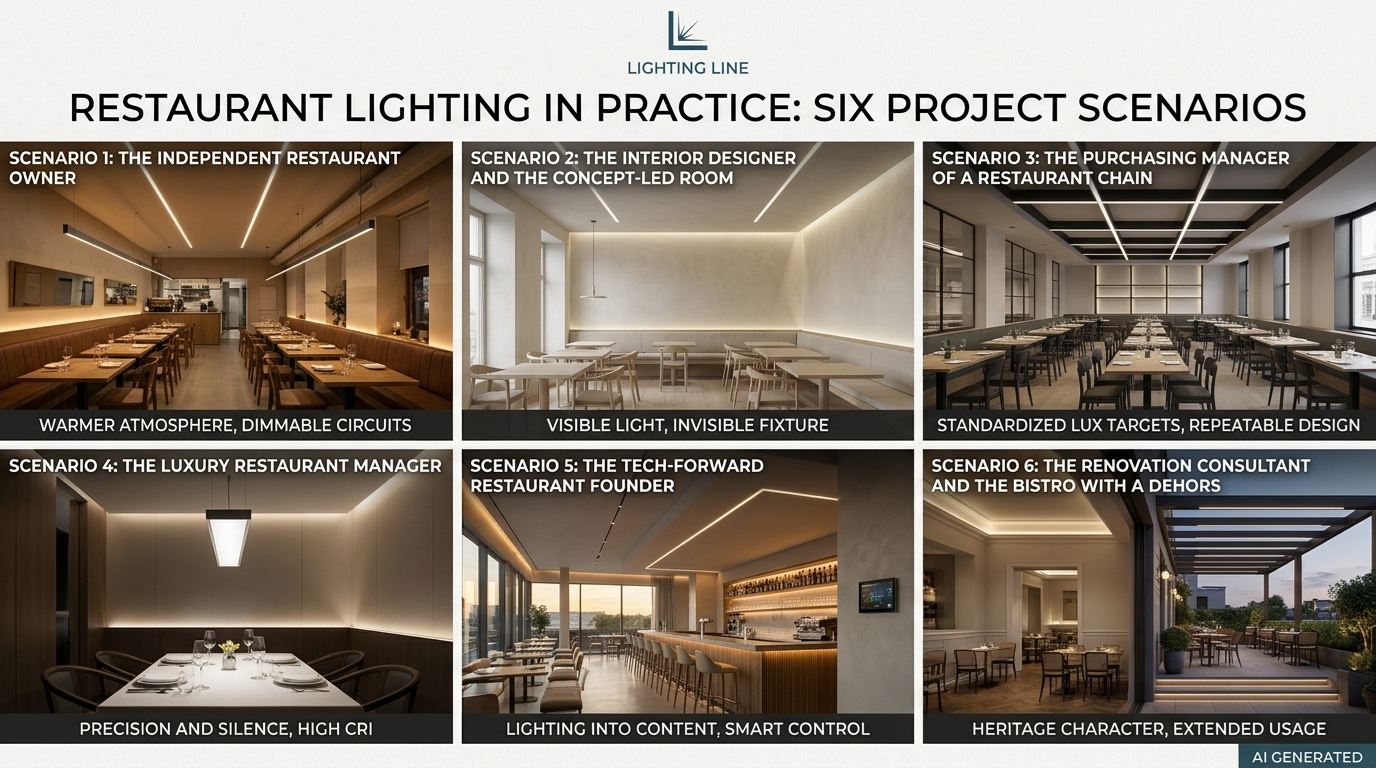
21. The contractor’s restaurant lighting checklist
Use this checklist on every restaurant project, from tender to handover.
| Stage | Check | Done |
|---|---|---|
| Brief | Concept, opening hours, service phases and events defined | ☐ |
| Brief | Furniture layout fixed before lighting layout | ☐ |
| Design | Four layers (ambient, task, accent, decorative) planned per zone | ☐ |
| Design | Lux targets and lumen calculations completed | ☐ |
| Design | One Kelvin per layer, CRI 90+ for food and guest areas | ☐ |
| Design | Glare check from seated positions | ☐ |
| Design | Circuits and scenes defined, dimming protocol chosen | ☐ |
| Design | Emergency lighting designed to EN 1838 / EN 50172 or national rules | ☐ |
| Design | IP ratings verified for kitchen, washing and outdoor areas | ☐ |
| Procurement | Samples approved, strips from the same batch | ☐ |
| Installation | Drywall profiles coordinated with plastering | ☐ |
| Installation | Drivers accessible, ventilated and labelled | ☐ |
| Installation | Voltage drop controlled on long runs | ☐ |
| Commissioning | Scenes programmed and tested at real service times | ☐ |
| Commissioning | Flicker check with smartphone slow motion | ☐ |
| Handover | Drawings, data sheets, certificates, spare parts, staff training | ☐ |
How to properly light a restaurant: the summary
If you remember only one paragraph from this guide, make it this one. To properly light a restaurant, define the concept, fix the furniture, light the tables and the walls before the floor, use warm high-CRI light in front-of-house and bright neutral light in the kitchen, separate the layers into dimmable circuits, design emergency lighting from day one and choose linear LED profiles that disappear into the architecture. Everything else is refinement.
Restaurant lighting glossary for builders and designers
Clear vocabulary avoids costly misunderstandings between owners, designers, contractors and suppliers. These are the terms that appear most often in restaurant lighting specifications.
| Term | Meaning in restaurant lighting projects |
|---|---|
| Lumen (lm) | Total quantity of light emitted by a source; LED strips are rated in lumens per metre. |
| Lux (lx) | Light falling on a surface, equal to one lumen per square metre; used for design targets on tables, counters and kitchen benches. |
| Maintained illuminance | The minimum average lux level that must be guaranteed over the life of the installation, after aging and dirt. |
| Kelvin (K) | Color temperature of white light: lower values look warmer, higher values look cooler. |
| CRI / Ra | Color rendering index: how faithfully colors of food, skin and materials appear; 90+ is recommended for guest areas. |
| R9 | Rendering of saturated red; crucial for meat, tomatoes, berries and red wine. |
| UGR | Unified glare rating: an index of discomfort glare; lower values mean more comfortable light. |
| Binning / MacAdam steps | How tightly LEDs are sorted by color; fewer steps mean more consistent white light between strips. |
| Diffuser | The cover of an LED profile; opal versions soften light and hide LED dots, clear versions maximize output. |
| SMD / COB | Two LED strip technologies: individual chips (SMD) or a dense continuous line of chips (COB) for dot-free light. |
| Tunable white / CCT | Strips that mix warm and cool white to change color temperature during the day. |
| RGBW / RGB+CCT | Strips that combine colored channels with white channels for both quality white light and color effects. |
| Constant voltage (24 V) | The usual power supply type for LED strips; 24 V allows longer runs with less voltage drop than 12 V. |
| Voltage drop | Loss of brightness along long strip runs; prevented by feeding the strip from both ends or at intermediate points. |
| DALI | Digital lighting control protocol allowing individual addressing, scenes and monitoring. |
| IP rating | Protection against dust and water; IP20 for dry interiors, IP44 to IP65 for kitchens and wet areas, IP65 to IP67 outdoors. |
| Utilization factor | Share of emitted light that reaches the working plane; depends on room shape, finishes and optics. |
| Maintenance factor | Allowance for dirt and aging in lighting calculations; typically 0.7-0.8 in restaurants. |
| Wall washing | Even light over a whole wall surface, increasing perceived brightness. |
| Grazing | Light placed very close to a surface to reveal texture, ideal for brick, stone and timber. |
| Cove lighting | Indirect light hidden in a recess, washing the ceiling or wall. |
| Scene | A stored combination of light levels and colors for all circuits, recalled with one button. |
| Escape route lighting | Emergency lighting that keeps exits and routes visible during a power failure. |
| Anti-panic lighting | Emergency lighting for open areas such as large dining rooms. |
Sharing this glossary with the whole project team at kick-off is a simple step that saves hours of clarification later. When everyone speaks the same language about lux, Kelvin, CRI and scenes, restaurant lighting decisions become faster, clearer and easier to verify on site.
22. Frequently asked questions about restaurant lighting
The answers below summarize the questions most often asked by restaurant owners, interior designers, purchasing managers and construction companies. Click each question to open the answer.
What is the best lighting for a restaurant?The best restaurant lighting is layered: indirect ambient light, focused task light on tables, accent light on walls and features, and a decorative element that expresses the brand. Use warm white (2700-3000 K) with CRI 90+ in dining areas, neutral white (4000 K) in the kitchen, and dimmable circuits so the light can change from lunch to dinner. |
What type of lighting is best for creating a warm and inviting restaurant atmosphere?Warm white light at 2700 K, low ambient levels, lit walls and soft pools of light on each table. Indirect cove lighting and hidden linear LED profiles remove glare, while dimming lets staff fine-tune the mood throughout the evening. |
How many lumens do I need for a restaurant?Use the lumen method: lumens = (target lux × area) ÷ (utilization factor × maintenance factor). For a casual dining room at 150 lux, that is roughly 300 lumens per square metre of floor; for a kitchen at 500 lux, more than 1,000 lumens per square metre. |
What is the recommended light level for restaurants?Typical design values are 50-100 lux ambient for fine dining, 100-200 lux for casual dining, about 200-300 lux for self-service and fast casual, about 300 lux for counters and around 500 lux for commercial kitchens (EN 12464-1). Tables usually receive more light than the surrounding room. |
Why are lights dimmed in restaurants?Dim lighting creates privacy, slows the pace of the meal, flatters guests and makes lit tables and plates stand out. Studies show that softer lighting can increase satisfaction and change ordering behaviour, which supports longer, more enjoyable visits. |
Does a restaurant need emergency lighting?Yes. As places of public assembly, restaurants require emergency lighting on escape routes (at least 1 lux on the centre line under EN 1838), in open areas (at least 0.5 lux) and in high-risk task areas such as cooking lines, with lit exit signs and regular testing. Check national fire safety rules for exact duration and design. |
Do restaurants still use fluorescent lights?Some older kitchens still do, but most fluorescent tubes have been phased out of the EU market since 2023. Linear LED profiles are the modern replacement, offering better light quality, lower consumption, instant start and no mercury. |
What color temperature is best for a restaurant?2700 K for most dining rooms, 2200-2400 K for intimate fine dining and wine bars, 3000 K for bars and casual concepts, 3500 K for daytime cafés and open kitchens, and 4000 K for commercial kitchens and technical areas. |
How should lighting be designed for private dining rooms and VIP areas?As independent zones with separate ambient, table and accent circuits, a dedicated keypad and at least three scenes (presentation, dinner, dessert). Use CRI 95 sources, deep glare-free profiles and tunable white for maximum flexibility. |
What is the best lighting for a commercial kitchen?Linear LED at about 500 lux on work surfaces, 4000 K, CRI 80-90+, low glare, shatter-resistant diffusers and IP ratings suited to steam, grease and washing (IP44 to IP65). Light the front edge of benches to avoid shadows. |
What outdoor lighting is best for restaurant patios?Warm white string lights or indirect linear light under pergolas, focused light on tables, low-level path and edge lighting and soft accents on plants and walls. Use IP65-IP67 products where exposed to rain and direct light downward to avoid glare and light pollution. |
Can restaurant lighting be controlled from a smartphone?Yes. Wireless controllers and smart lighting systems allow scenes, schedules and dimming to be managed from a phone or tablet, even remotely across several sites. A simple wall keypad should always remain available for staff. |
How much does restaurant lighting cost?As an indicative European range, from about €25-50 per m² for a basic LED upgrade to €50-120 per m² for a layered system with scene control, and €120-250+ per m² for premium fine dining installations. Get project-specific quotes based on drawings. |
How long does it take to install restaurant lighting?From a few days for a surface-mounted retrofit to two or three weeks spread over first and second fix for a complete fit-out with drywall profiles, suspensions and controls. Material lead times and plastering often determine the overall schedule. |
What are the most common restaurant lighting mistakes?Excessive uniform light, mixed color temperatures, low CRI, visible glare, layouts that ignore furniture, single-circuit installations without dimming, cheap flickering drivers and emergency lighting added as an afterthought. |
How can I standardize lighting across a restaurant chain?Create a lighting design manual, limit the product palette to a few profiles and strips with fixed Kelvin and CRI, standardize control scenes and work with a manufacturer able to produce custom LED strips consistently for all sites. |
What is the rule of thumb for lighting over a dining table?Hang pendants or suspended profiles 75-90 cm above the table top, make the light about half to two-thirds of the table length and keep the light source hidden from seated guests’ eyes. |
What are the three main kinds of restaurant lighting?Ambient (general) lighting, task (functional) lighting and accent lighting. Decorative lighting is often added as a fourth type, giving the four types of lighting used in professional restaurant lighting design. |
How can lighting improve the overall dining experience?By making food look appetizing (high CRI), faces look attractive (soft vertical light), the room feel comfortable (no glare) and the atmosphere match the moment (dimming and scenes). Good lighting also produces better photos, which spread the restaurant’s image online. |
Which linear LED profiles are best for restaurants?Suspension profiles over tables and bars, recessed and drywall profiles for clean ceiling lines, surface and corner profiles for shelves and back bars, wall profiles for vertical light and waterproof profiles for kitchens and outdoor areas, all available in the Lighting Line catalogue. |
23. Light the experience, not just the room
Restaurant lighting is a design tool, a sales tool, a safety system and an energy investment at the same time. When it is planned early, layered carefully and built with quality linear LED profiles and strips, it makes food more appealing, guests more comfortable, staff more efficient and operating costs lower. For construction companies and fit-out contractors, linear systems offer the flexibility to adapt to every room, the reliability to satisfy demanding clients and the speed to keep projects on schedule.
Explore the complete range of aluminium profiles, LED strips and accessories on the Lighting Line catalogue, and contact the technical team for support on your next restaurant lighting project, from a single bistro to a multi-site rollout.
This article was developed with the support of artificial intelligence and subsequently reviewed, corrected, and validated by the LightingLine.eu technical team, which guarantees its reliability and compliance with official sources.