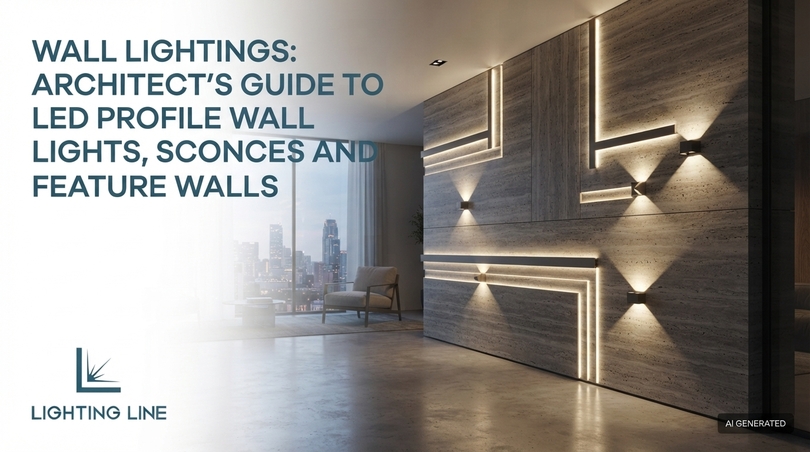
Wall lightings are the most underrated tool in an architect’s palette. A ceiling light tells a room where the floor is, a wall light tells it what the room is for. In the last decade the humble wall sconce has been joined by something far more flexible: the aluminium LED profile, a slim linear luminaire that can be cut, combined, recessed, floated and bent into almost any architectural gesture. This guide is written for architects, interior designers, hotel managers and ambitious homeowners who want to move beyond the catalogue lamp and design light as part of the wall itself.
Over the following sections we answer the questions clients actually ask (are wall lights outdated? do I need an electrician? how high should they go?), we compare every family of wall light fixtures on the market, and we show more than forty built-in and surface-mounted solutions you can realise with the Lighting Line wall profiles and LED strips. Every recommendation is tied to real measurements, published standards and installation practice, so you can lift details straight into a specification.
If you only have thirty seconds, read the summary box below. If you have a project on the drawing board, grab a coffee: by the end you will have a complete method for specifying modern wall lightings, from concept sketch to maintenance plan.
Wall lightings in 60 words: the quick answer
Wall lightings are luminaires fixed to or built into a vertical surface to provide ambient, accent, task or decorative light. They include sconces, up and down wall lights, picture lights, wall washers and linear LED profiles. In 2026 they are firmly in fashion, because lit vertical surfaces make rooms feel larger, calmer and more architectural while using far less energy than traditional fittings.
In this article…
- What are wall lightings called? Names, definitions and terminology
- Are wall lights still in fashion? Wall lighting trends for 2026
- The 4 types of residential lighting and where wall lights fit
- How to choose the right wall lightings: a 5-step method
- Types of wall lightings: from classic sconces to linear LED
- The lighting line wall profile range explained
- LED strips for wall lightings: SMD, COB, CRI and colour temperature
- Materials and finishes for modern wall lights
- Design and style: matching wall lightings to every interior
- 40+ avant-garde wall lighting ideas for architects
- Placement and room-by-room guide
- Functionality and technology: dimming, smart control, sensors
- Regulations, certifications and safety
- Installation and maintenance
- Prices and budget: what wall lightings really cost
- Wall lightings for hotels and hospitality
- Worked example: lighting a 5 m living room feature wall
- The architect’s specification checklist
- Unusual, luxury and designer wall lightings: three project scenarios
- Wall lightings for small spaces, rentals and renovations
- 12 common wall lighting mistakes and how to avoid them
- Frequently asked questions
- Designing with light, not just lamps
1. What are wall lightings called? Names, definitions and terminology
Before choosing anything, it helps to speak the same language as the client, the electrician and the manufacturer. Half of the misunderstandings on a lighting project start with a vague word such as “lamp” or “spot”. This section gives you a precise vocabulary for wall lightings, so that the drawing, the quote and the installed result all describe the same thing.
What is a wall luminaire?
Luminaire is the technical term used in standards such as EN 60598 for a complete lighting unit: the light source, the housing, the optic and the electrical parts. A wall luminaire is therefore any complete lighting device designed to be mounted on, or recessed into, a wall. A brass sconce, a linear aluminium profile with an LED strip and a recessed step light are all wall luminaires. In specifications, “wall mounted luminaires” is the preferred phrase because it is unambiguous and avoids brand names.
What are lights on walls called in everyday language?
Clients use many names for the same family of products. The most common are:
- Wall lights – the generic British term, also used for wall lights interior UK listings.
- Wall sconces or simply sconces – the American term, originally a bracket for a candle; today any decorative wall fitting.
- Wall lamps – usually a fitting with a visible shade or arm, often a wall lamp for bedroom reading.
- Wall brackets or wall bracket lights – an older British term for a fitting on a projecting arm.
- Applique – the European (French and Italian) term, common in design catalogues.
- Wall washers and wall grazers – architectural fittings that light the wall surface itself rather than the room.
- Uplighters and downlighters – wall lights that throw light in a single vertical direction.
What are those wall candles called?
The candle-shaped fittings seen in period homes, churches and traditional hotels are called candle sconces or candle wall lights; when they carry several arms they become chandelier sconces or chandelier wall sconces. In a contemporary project you can echo their rhythm without their ornament: a row of short vertical LED profiles with warm 2200–2700 K strips reads as a modern interpretation of the candle sconce, a trick we develop further in the ideas section.
What is lighting on the wall called by lighting designers?
Lighting designers describe the effect rather than the object. Wall washing means lighting a wall evenly from a distance so it glows uniformly, grazing means placing the source close to the wall so light skims the surface and reveals texture, accent lighting means picking out an object such as artwork, cove lighting means a hidden source that bounces light off a recess. A light wall or illuminated wall is a surface that emits light itself, usually through a backlit panel or a dense array of profiles.
Glossary table for specifications
| Term | Meaning | Typical use in wall lightings |
|---|---|---|
| Lumen (lm) | Total light emitted by a source | Comparing strips and fittings |
| Lux (lx) | Light falling on a surface, lumens per square metre | Checking reading or task levels |
| Efficacy (lm/W) | Lumens produced per watt consumed | Energy efficiency comparisons |
| CCT (K) | Correlated colour temperature, warm to cool | 2700 K living, 3000 K hospitality, 4000 K work |
| CRI (Ra) | Colour rendering index, 0-100 | Ra 90+ for art, skin tones, timber |
| IP rating | Protection against solids and water | IP44+ near baths, IP65+ outdoors |
| SELV | Safety extra-low voltage (12/24 V) | LED strips in profiles |
| Beam angle | Spread of light in degrees | Narrow for grazing, wide for washing |
| Diffuser | Cover that softens or hides LED dots | Transparent, opal, frosted/satin |
With the vocabulary settled, we can tackle the question every client eventually asks: are wall lights really still a good idea?
2. Are wall lights still in fashion? Wall lighting trends for 2026
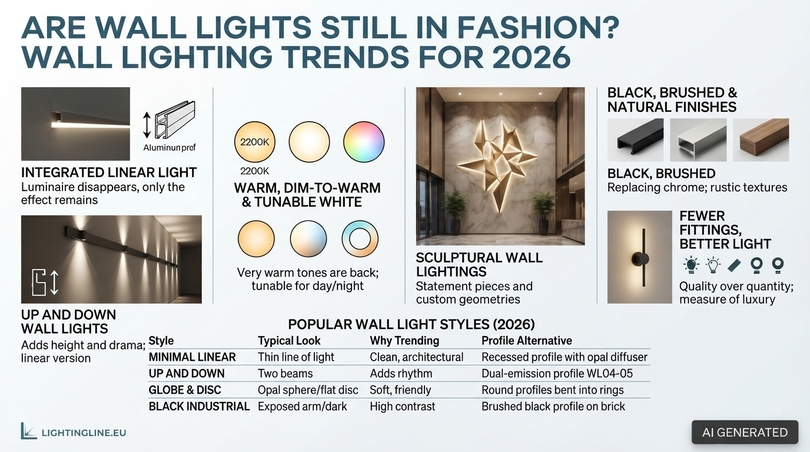
Few interior questions are searched as often, and in as many variations, as this one: are wall lights outdated, are wall sconces dated, are wall lamps in style, do people still have wall lights? The short answer is an emphatic no to “outdated” and yes to “in fashion”. What has gone out of fashion is the single, isolated fitting placed by habit; what is in fashion is wall light used deliberately as architecture. This section explains why, and what the trend looks like in practice.
Why wall lights looked dated, and why that has changed
Many people associate wall lights with the 1980s and 1990s: frosted-glass shell fittings, a pair either side of a chimney breast, a yellowish halogen glow. Those fittings were dated because they were generic, inefficient and placed without thinking about the wall behind them. Three shifts have reversed the perception:
- LED technology made it possible to hide a powerful, cool-running light source in a profile only a few millimetres deep, so the light can become part of the wall rather than an object stuck onto it.
- Layered lighting replaced the single central ceiling pendant as best practice. Designers now combine ceiling, wall, furniture and floor sources, and wall lightings are the layer that does the most to shape atmosphere.
- Wellbeing and circadian awareness pushed people away from harsh overhead light in the evening. Low, warm, indirect light at eye level is easier on the eyes and on sleep.
What are the latest lighting trends for walls?
Across residential, hospitality and workplace projects, the following trends are shaping the way wall lightings are specified in 2026:
1. Integrated linear light
Light is built into shadow gaps, skirting, shelves, headboards and joinery. The luminaire disappears and only the effect remains. This is where aluminium profiles shine, literally: recessed and plaster-in profiles create lines of light that look like part of the construction.
2. Up and down wall lights
Fittings that emit both upward and downward create two scalloped or linear beams on the wall, adding height and drama. The 31×70 mm dual-emission wall profile LLP-WL04-05 is a linear version of this idea, ideal for long walls where individual up down wall lights would look fussy.
3. Warm, dim-to-warm and tunable white
Very warm colour temperatures (2200-2700 K) are back, often with dim-to-warm behaviour that imitates the way a filament glows warmer as it dims. Tunable white strips allow the same wall to read crisp in the morning and amber at night.
4. Sculptural and unusual wall lightings
At the opposite end, statement pieces such as wall light sculptures, oversized discs and lighting wall art pieces are popular in living rooms and hotel lobbies. Custom geometries built with profiles and corner joints let architects create bespoke unusual wall lights without the cost of a one-off luminaire.
5. Black, brushed and natural finishes
Black metal wall lights, brushed black and textured finishes have replaced polished chrome as the mainstream choice; natural timber combined with aluminium answers the demand for wooden wall lights and rustic wall lighting in cottages and chalets.
6. Fewer fittings, better light
Clients increasingly prefer a small number of high-quality sources with high colour rendering over many cheap ones. Quality of light, not quantity of fittings, has become the measure of luxury.
What style of wall light is most popular right now?
Based on what designers are specifying and on the volume of search interest around terms such as modern wall lights, contemporary wall lights and designer wall lights, the most requested styles fall into four groups. The table summarises them, with the profile-based alternative an architect can build.
| Popular style | Typical look | Why it is trending | LED profile alternative |
|---|---|---|---|
| Minimal linear | Thin horizontal or vertical line of light | Clean, architectural, fits any style | Recessed or drywall profile with opal diffuser |
| Up and down | Two beams on the wall | Adds height and rhythm | Dual-emission wall profile WL04-05 |
| Globe and disc sconces | Opal sphere or flat disc | Soft, mid-century, friendly | Round profiles bent into rings or arcs |
| Black metal industrial | Exposed arm, dark finish | Contrast with plaster and brick | Brushed black wall profile on brick or concrete |
Are wall lights better than ceiling lights?
Neither is better, they do different jobs. Ceiling lights deliver general horizontal illumination efficiently, which is why offices and kitchens still rely on them. Wall lightings deliver vertical illumination, which is what our eyes actually perceive as brightness and spaciousness. A room with lit walls feels brighter than a room with the same number of lumens aimed only at the floor. In living rooms, bedrooms, corridors and hotel rooms, wall lights frequently make better use of every watt than downlights do.
| Criterion | Ceiling lights | Wall lights |
|---|---|---|
| General horizontal light | Excellent | Good when combined |
| Perceived spaciousness | Moderate | Excellent (lit vertical surfaces) |
| Glare control | Depends on optics | Excellent with indirect profiles |
| Atmosphere and mood | Limited | Excellent |
| Installation in existing homes | Uses existing points | May need new wiring, or plug-in options |
| Highlighting art and texture | Possible with adjustable spots | Natural strength |
Are wall lights necessary, and can you light a room with wall lights alone?
They are not legally necessary, but in most living spaces they are the difference between a room that is merely lit and one that feels designed. Yes, you can light a room with wall lights alone, provided you plan enough output: a combination of indirect uplight (bounced off a pale ceiling) and downlight can provide 100–200 lux of ambient light in a living room, which matches typical residential guidance. For kitchens, studies and bathrooms, add task light.
What to use instead of wall lights?
If wiring a wall is impossible or undesirable, alternatives include floor lamps, picture lights on plug-in leads, shelf-integrated LED strips, ceiling-mounted wall washers and track systems. Many of these can still be built with LED profiles: a furniture profile under a floating shelf, for example, becomes a wall light in all but name, powered from the nearest socket.
3. The 4 types of residential lighting and where wall lights fit
Every lighting scheme, from a studio flat to a five-star suite, is built from four layers. Understanding which layer a wall light belongs to is the fastest way to choose the right one. Wall lightings are unusual because, depending on design and position, they can deliver all four.
1. Ambient (general) lighting
Ambient light provides overall visibility. Indirect wall lightings, for example a continuous uplight cove or a dual-emission profile running the length of a room, can supply much or all of the ambient layer with almost no glare.
2. Task lighting
Task light is focused where work happens: reading, cooking, grooming, writing. Bedside wall lighting, mirror lights and kitchen wall light fixtures under cabinets are typical examples. Target 300–500 lux on the task surface.
3. Accent lighting
Accent light draws attention to art, texture, niches and architectural features. Grazing a stone wall, washing a gallery wall or lighting a bookshelf are classic accent uses. Accents should be roughly three to five times brighter than their surroundings to read clearly.
4. Decorative lighting
Decorative light is the luminaire as an object: a sculptural sconce, a star wall light in a child’s room, a lighting wall art installation. Here the fitting itself is the focal point.
| Layer | Target illuminance (indicative) | Wall lighting examples | Suggested Lighting Line product family |
|---|---|---|---|
| Ambient | 100-200 lx living, 50-100 lx corridors | Uplight coves, dual-emission linear | Wall profiles, drywall profiles |
| Task | 300-500 lx on surface | Bedside readers, mirror lights, under-cabinet | Mirror profile, furniture profiles |
| Accent | 3-5× surroundings | Grazing, picture lighting, niches | Recessed profiles, corner profiles |
| Decorative | Not measured, visual impact | Light frames, geometric art, rings | Round profiles, suspension profiles |
4. How to choose the right wall lightings: a 5-step method
Architects, interior designers and homeowners all ask the same question in different words: how do I choose the right wall lighting for different spaces? A repeatable method beats inspiration alone, because it turns taste into decisions a client can approve. Use these five steps for every room.
Step 1: define what the room needs to do
List the activities: relaxing, reading, cooking, working, sleeping, receiving guests. Each activity maps to a layer of light. A bedroom needs ambient, reading and night light, a corridor needs orientation and atmosphere, a gallery wall needs accent. Wall lightings should be chosen for a job, never just to fill a wall.
Step 2: choose the surface you want to see
Decide which walls should glow and which should stay quiet. Usually one or two surfaces carry the room: the wall behind the sofa, the headboard wall, the stair wall. Lighting every wall equally flattens a space.
Step 3: select the light direction and mounting
Up, down, both, grazing or washing; then surface, recessed, plaster-in, corner or suspended. This step determines the product family: dual-emission wall profiles for up and down, drywall profiles for frameless slots, corner profiles for junction grazing.
Step 4: specify the quality of light
Fix CCT, CRI, output per metre after diffuser loss, and dimming. These four numbers decide whether wall lightings feel luxurious or cheap far more than the shape of the fitting does.
Step 5: coordinate, control and maintain
Agree driver locations, switching, scenes and access with the electrician and joiner before construction. Record product codes so diffusers, strips and end caps can be reordered years later.
| Step | Key decision | Output for the specification |
|---|---|---|
| 1. Needs | Activities and lighting layers | Layer list per room |
| 2. Surface | Which walls glow | Marked elevations |
| 3. Direction and mounting | Up/down/graze; surface/recessed | Profile family and code |
| 4. Quality | CCT, CRI, lm/m, dimming | Strip and diffuser selection |
| 5. Coordination | Drivers, controls, access | Electrical and joinery details |
5. Types of wall lightings: from classic sconces to linear LED
The market for wall light fixtures is vast, and the names overlap. This section sorts it into clear families, explains what each does best, and shows where a profile-based solution matches or outperforms a ready-made fitting. Knowing the family first saves hours of scrolling through wall lights for sale.
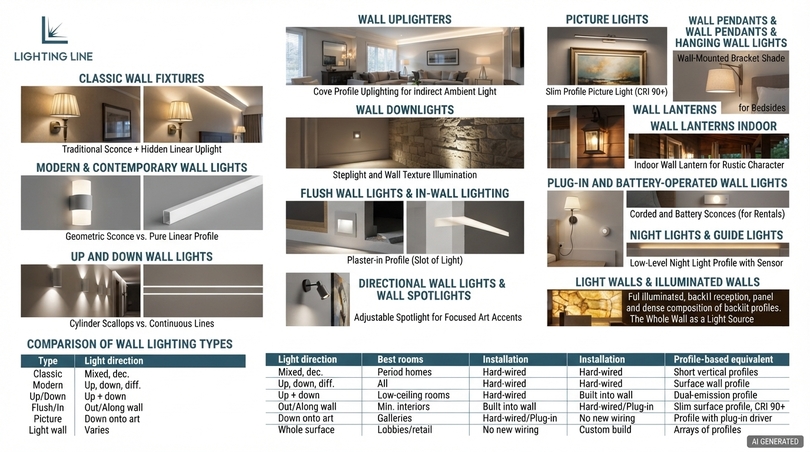
Classic wall fixtures and traditional wall lighting
Classic wall lights include candle sconces, swan-neck brackets, fabric-shaded wall lamps and crystal chandelier sconces. They suit period properties, traditional hotels and cottage wall lights schemes. Their limit is that they light themselves more than the room. Pair them with a hidden linear uplight in a cornice to give a traditional interior modern performance without changing its character.
Modern and contemporary wall lights
Modern wall lights are defined by simple geometry, integrated LED sources and restrained finishes: discs, cylinders, rectangles, slim bars. Contemporary wall lights interior ranges often include rectangular wall light and square wall lights shapes. A cut-to-length aluminium profile is effectively the purest modern wall light possible: a line of light whose length, colour and finish you choose.
Up and down wall lights
Up down wall lights project two beams, creating rhythm along walls and extra perceived height. Individual cylinder fittings produce scallops; continuous profiles produce two uninterrupted lines. LED up and down wall lights are ideal for corridors, stairwells, double-height living rooms and hotel facades (when rated for outdoor use).
Wall uplighters
Wall uplighters send all their light upward to bounce off the ceiling, giving soft ambient light with no direct glare. Wall mounted uplighters are a favourite for living rooms with low ceilings, because they visually lift them. LED wall uplighters built from a profile on a bracket or within a plaster cove are almost invisible during the day.
Wall downlights
Wall mounted downlights direct light downward, ideal for lighting a path, a step, a worktop or the texture of a stone wall below. Wall lights downlights in hallways help orientation at night when dimmed low.
Flush wall lights and in-wall lighting
Flush wall lighting sits close to or within the wall plane. In wall lights and in wall LED lights include recessed step lights, plaster-in profiles and shadow-gap lines. Recessed profiles are the architect’s favourite flush wall light because they leave nothing but a slot of light. See the recessed range and the drywall range, designed to be plastered into plasterboard.
Directional wall lights and wall spotlights
Directional wall lights and wall spot lights have an adjustable head to aim light at art, a desk or a bed. A wall spotlight is the right choice for precise accents; for even washes, a linear source is better.
Picture lights
Picture lights are a specialised directional wall light mounted above artwork. High CRI (Ra 90+) is essential. A slim surface profile with a high-CRI strip makes an elegant, low-heat picture light that will not damage pigments with UV or infrared.
Wall pendants and hanging wall lights
Wall pendant lights and hanging wall lamps suspend a shade from a wall bracket, a popular solution for bedsides where clients want the look of a pendant without ceiling wiring. Wall hanging lights work well in hotel rooms and small bedrooms where bedside tables are narrow.
Wall lanterns indoor
Indoor wall lanterns bring an outdoor, cabin or coaching-inn look inside, popular in rustic and traditional schemes, porches and conservatories.
Plug-in and battery-operated wall lights
Wall mounted plug in lights (also called wall plug in lamps, corded wall lamps or wall mount lamps plug in) run a cable to a socket, and a wall sconce light battery operated needs no wiring at all. They are the go-to answer for renters and quick upgrades. Battery units have limited output and runtime; plug-in units are more practical. A low-voltage profile powered by a plug-in driver is a professional-looking middle ground.
Night lights and guide lights
Wall night lights and wall mounted night lights give low-level orientation in bedrooms, nurseries and hotel corridors, often with a motion sensor. A profile at skirting height with a sensor and a very warm, dim strip is the most discreet version.
Light walls and illuminated walls
The most radical category: the wall itself becomes the light. A light wall can be a backlit stone or onyx panel, a stretched fabric with LEDs behind, or a dense composition of profiles. These installations are the ultimate feature wall lights and are especially effective in hotel receptions and retail.
Comparison of wall lighting types
| Type | Light direction | Best rooms | Installation | Profile-based equivalent |
|---|---|---|---|---|
| Classic sconce | Mixed, decorative | Period homes, hotels | Hard-wired | Short vertical profiles in warm white |
| Modern wall light | Up, down or diffuse | All | Hard-wired | Surface wall profile |
| Up and down | Up + down | Corridors, living rooms | Hard-wired | Dual-emission profile WL04-05 |
| Uplighter | Up | Low-ceiling living rooms | Hard-wired | Cove or wall profile facing up |
| Flush / in-wall | Out or along wall | Corridors, stairs, minimal interiors | Built into wall | Recessed and drywall profiles |
| Picture light | Down onto art | Galleries, living rooms | Hard-wired or plug-in | Slim surface profile, CRI 90+ |
| Plug-in / battery | Varies | Rentals, quick upgrades | No new wiring | Profile with plug-in driver |
| Light wall | The whole surface | Lobbies, retail, feature walls | Custom build | Arrays of profiles behind diffusing panels |
6. The lighting line wall profile range explained
An LED strip on its own is a component; inside an aluminium profile it becomes a luminaire. The profile manages heat, protects the strip, holds the diffuser that turns dots into a continuous line, and gives the architect a finished, dimensionally precise object. Choosing the right profile is the single most important decision in a linear wall lighting design. This section walks through the dedicated wall range and the other families that architects most often bring onto walls.
Why aluminium profiles make better wall lightings
- Thermal management: aluminium draws heat away from the LEDs. Running cooler, LEDs keep their brightness and colour for longer.
- Visual comfort: diffusers hide individual LED points and reduce glare, which is essential at eye level.
- Precision: profiles are supplied in 2 m and 3 m lengths and can be cut to size, so lines of light can align with joinery, door heads and tile joints. Lighting Line states a length tolerance of ±2 mm for profiles and diffusers.
- Finish: anodised silver, white-painted and brushed black options integrate with plaster, timber and metal.
- Serviceability: diffusers can be removed and strips replaced without breaking the wall.
The five dedicated wall profiles
The wall category of the Lighting Line catalogue groups five profiles designed specifically for wall installation. All accept LED strips with a PCB up to 12 mm wide. Always check the downloadable datasheet and photometric test for each model before finalising a design: the catalogue pages include a lux calculation tool, datasheets and photometric files.
WL01-03 – 48×18 mm aluminium profile for wall installation
The 48×18 mm wall profile combines a generous face width with a slim 18 mm projection. Its low depth makes it the natural choice where a wall light must stay close to the surface, for example in narrow corridors, behind a bed or along a stair where people brush past. Architects use it for long horizontal bands at dado height, for continuous bedside lighting across a headboard wall and as a slim, flush-feeling wall light in hotel corridors.
WL02-03 – 24×24 mm aluminium profile for wall installation
The 24×24 mm wall profile is the most compact of the range. Its small square section disappears against a wall and suits vertical compositions: a series of short vertical lines can recreate the rhythm of candle sconces in a contemporary key, or frame a doorway with two thin luminous jambs. It is also a strong option for small wall lights in bedrooms and bathrooms, provided the strip and installation meet the IP requirements of the zone.
WL03-01 – 30×29 mm aluminium profile for wall installation
The 30×29 mm wall profile is a balanced, mid-size section. It is compatible with the metal mounting clip IN08-M, which makes it quick to fix in long runs. Use it for living room wall lights over a sofa, for picture-rail lighting in galleries and as a robust solution in offices.
WL04-05 – 31×70 mm profile with dual light emission
The 31×70 mm dual-emission profile is the linear answer to the up and down wall light. It emits light both upward and downward, washing the wall in two directions from a single fitting. It is available in silver, white-painted and brushed black finishes, in 2 m and 3 m lengths, and accepts transparent, opal and frosted diffusers. Lighting Line’s own photometric tests on this profile measured a light loss of about 23% with the transparent diffuser, 38% with opal and 39% with satin, an essential figure when calculating how many lumens per metre the strip must deliver. Compatible accessories include the LLD-05 diffuser, the WL04 end cap and the white aluminium end cap. A dedicated lux calculation page, the datasheet and the photometric test are available for download.
WL05-05 – 34×34 mm aluminium profile for wall installation
The 34×34 mm wall profile offers a slightly larger square section with more internal volume, useful for higher-output strips and better heat dissipation. It shares the metal mounting clip with WL03 and WL04, so a project can mix sections while keeping one fixing method. Architects use it for statement vertical lines, for wall lights in double-height spaces and where a stronger visual presence is wanted.
Comparison of the wall profile range
| Code | Section (mm) | Emission | Max PCB | Best architectural uses |
|---|---|---|---|---|
| WL01-03 | 48 x 18 | See datasheet | 12 mm | Low-projection bands, headboards, corridors |
| WL02-03 | 24 x 24 | See datasheet | 12 mm | Vertical lines, door frames, small spaces |
| WL03-01 | 30 x 29 | See datasheet | 12 mm | Living rooms, galleries, offices |
| WL04-05 | 70 x 31 | Dual (up and down) | 12 mm | Corridors, double-height walls, hotels |
| WL05-05 | 34 x 34 | See datasheet | 12 mm | Statement verticals, high-output runs |
Finishing accessories are in the wall end caps and wall mounting brackets categories, and the comparative profiles range helps you compare sections side by side.
Other profile families that become wall lightings
Some of the most striking wall lighting design comes from profiles that were not born as “wall” products. An architect who knows the whole catalogue has many more ways to put light on a wall.
Drywall (plaster-in) profiles
The drywall profiles are designed to be set into plasterboard and skimmed over, leaving a clean slot of light with no visible frame. They are the key to shadow-gap lines, light seams that follow wall junctions and minimal light frames.
Recessed profiles
Recessed profiles sit in a routed groove in timber, MDF, stone or plasterboard with a neat flange. Use them in wall panelling, headboards, wardrobe fronts and reception desks.
Corner profiles
Corner profiles emit at 45°, ideal for internal corners where wall meets ceiling or where two walls meet. They are excellent for grazing a wall from its edge.
Surface profiles
Surface profiles are the most versatile family and work for picture lights, shelf lighting and quick retrofit wall lights.
Round profiles
Round profiles provide 360° or wide emission and are perfect for floating rods of light, contemporary torch wall light designs and sculptural compositions.
Suspension profiles
Suspension profiles are usually hung from ceilings, but mounted on stand-off brackets close to a wall they create a floating line that lights both wall and room.
Mirror, furniture and baseboard profiles
The mirror profile is designed for bathroom mirrors, the furniture profiles for shelves and joinery, and the 75×13 mm baseboard profile turns the skirting into a low-level wall light.
Tiling and floor profiles
Tiling profiles sit within tiled surfaces, ideal for showers and kitchen splashbacks, and the walkable floor profiles can graze a wall from the floor upward. Explore the full architectural category for these options.
| Profile family | Wall lighting effect | Typical project |
|---|---|---|
| Wall | Surface line, up and down wash | Corridors, living rooms, hotels |
| Drywall | Frameless slot of light | Minimal homes, galleries, offices |
| Recessed | Flush line in panelling or joinery | Headboards, wall panels, reception desks |
| Corner | 45° grazing from junctions | Cornices, wall-to-wall corners |
| Round | Floating rod, sculptural | Feature walls, art installations |
| Mirror / furniture | Task and shelf light | Bathrooms, libraries, kitchens |
| Baseboard / floor | Low-level guide, uplight grazing | Hallways, stairs, hotel corridors |
| Tiling | Waterproof line in tiles | Showers, splashbacks, spas |
7. LED strips for wall lightings: SMD, COB, CRI and colour temperature
The profile shapes the light; the strip creates it. Most disappointing wall lightings fail not because of the design but because the strip was wrong: too cold, too dotty, too dim after the diffuser, or with poor colour rendering that makes timber look grey and skin look tired. This section gives you the technical criteria to get it right first time.
SMD versus COB LED strips
Lighting Line offers both SMD LED strips and COB LED strips, and its production unit can make customised strips.
SMD strips
SMD (surface-mounted device) strips carry discrete LED packages spaced along the PCB. They offer high efficacy, a wide choice of outputs and colours, and are the right choice when a diffuser is used or the source is hidden in a cove.
COB strips
COB (chip-on-board) strips place many tiny chips under a continuous phosphor coating, producing an almost dotless line even without a diffuser. For exposed lines of light, shallow profiles and reflections in glossy surfaces, COB is usually the better choice. Because they need less diffusion, COB strips can be paired with a transparent or lightly frosted cover and lose less output.
| Criterion | SMD strips | COB strips |
|---|---|---|
| Line uniformity | Dotted without diffuser | Near-continuous line |
| Best diffuser | Opal or frosted | Transparent or frosted |
| Typical uses | Coves, hidden uplights, general lighting | Exposed lines, shallow profiles, mirrors |
| Colour options | Very wide, incl. RGB/RGBW | Mainly white, tunable options available |
| Viewing at eye level | Needs good diffusion | Comfortable with light diffusion |
Proprietary data: how diffusers change the light output
Diffusers are essential for visual comfort, but they absorb light. Lighting Line’s photometric test on the LLP-WL04-05 dual-emission wall profile provides concrete figures that architects can use directly in calculations.
| Diffuser type (LLP-WL04-05) | Measured light loss | Strip output needed for 600 lm/m delivered | Visual effect |
|---|---|---|---|
| Transparent | About 23% | About 780 lm/m | Maximum output, LED points visible with SMD |
| Opal | About 38% | About 970 lm/m | Soft, uniform line |
| Satin / frosted | About 39% | About 985 lm/m | Very soft, low glare |
Rule of thumb: when using an opal diffuser, specify a strip with roughly 1.6 times the lumens per metre you want to see on the wall. The “needed” column above is calculated as delivered output divided by (1 – loss). Always confirm with the datasheet of the exact profile and strip combination.
Colour temperature (CCT)
| CCT | Feeling | Recommended for |
|---|---|---|
| 2200-2400 K | Candle-like, intimate | Bars, restaurants, bedroom night scenes |
| 2700 K | Warm, homely | Living rooms, bedrooms, lounge wall lights |
| 3000 K | Warm-neutral, elegant | Hotels, hallways, kitchens, bathrooms |
| 3500-4000 K | Neutral, crisp | Offices, retail, workshops, galleries |
| Tunable white | Adjustable through the day | Bedrooms, offices, hotels, wellbeing projects |
Keep CCT consistent across a room. Mixing a 4000 K wall light with 2700 K lamps is the most common reason a scheme looks “wrong” even when individual products are good.
Colour rendering (CRI) and quality of light
CRI expresses how faithfully a source shows colours compared with a reference. For residential and hospitality wall lightings, specify CRI 90 or higher; for art and retail consider strips with high R9 (saturated red) values, which bring warmth to skin, wood and food. A CRI 80 strip can save a little money but will make an expensive oak panel look dull.
Output: how many lumens per metre?
| Application | Delivered output (indicative) | Notes |
|---|---|---|
| Night light / guide light | 50–150 lm/m | Dim, very warm, motion sensor |
| Decorative accent line | 200–400 lm/m | Feature lines, light frames |
| Ambient uplight cove | 500–1000 lm/m | Depends on ceiling reflectance |
| Wall washing / grazing | 800–1500 lm/m | Higher for textured, dark walls |
| Task (mirror, desk) | 800–1200 lm/m | CRI 90+, avoid glare |
Voltage: 12 V or 24 V?
For architectural runs, 24 V strips are generally preferred because voltage drop is lower, allowing longer runs from a single feed with uniform brightness. For very long walls, feed power from both ends or the middle. Connectors in the PCB LED strip connectors range simplify joins, though soldered joints remain the most reliable in permanent installations.
Colour changing wall lights: RGB, RGBW and pixel strips
Colour changing wall lights are popular in bars, gaming rooms, children’s bedrooms and hotel spas. RGBW strips add a dedicated white channel so you get good white light as well as colour. In residential settings, use colour sparingly: a single wall in colour reads as a design choice; four walls read as a nightclub.
8. Materials and finishes for modern wall lights
A wall light is seen at close range, often touched, and always read against the material of the wall. The finish of a fitting matters as much as its light, because it is visible all day while the light is on only for a few hours. Here we compare the main materials used in wall lightings and show how to combine aluminium profiles with other finishes for a premium result.
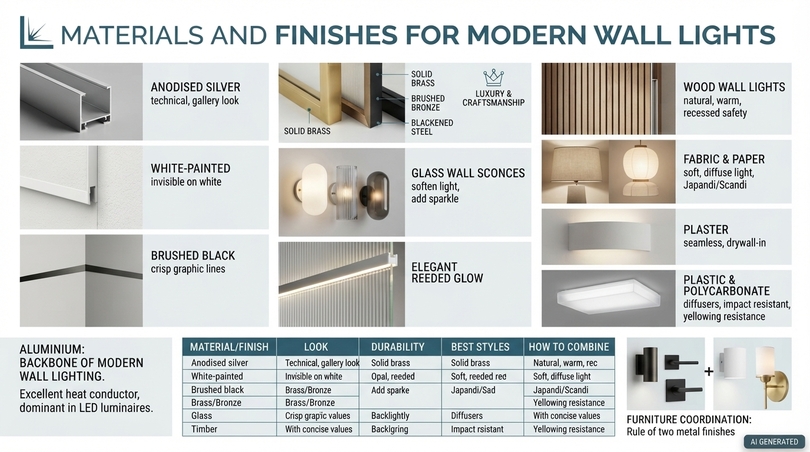
Aluminium: the backbone of modern wall lighting
Aluminium is light, rigid, recyclable and an excellent conductor of heat, which is why it dominates LED luminaires. Anodised silver aluminium has a technical, gallery-like look; white-painted aluminium disappears against white plaster; brushed black creates crisp graphic lines against pale walls and blends into dark ones. On the LLP-WL04-05 profile, all three finishes are available, so the same design can adapt to very different interiors.
Metal wall lights: brass, steel and bronze
Metal wall lights in brass, bronze and blackened steel signal luxury and craftsmanship. Black metal wall lights are the most requested in contemporary and industrial schemes. A practical approach for luxury projects is to combine a hidden aluminium profile, which does the lighting work, with a visible metal element such as a brass reveal, a bronze shelf edge or a steel frame, which provides the luxury material reading.
Glass wall sconces
Glass, whether opal, reeded, smoked or hand-blown, softens light and adds sparkle. Glass wall sconces work well in bathrooms and bedrooms. Linear profiles can backlight reeded glass panels, creating a fluted glowing wall that is one of the most elegant contemporary effects available.
Wood wall lights and wooden finishes
Wood wall light designs, from oak slats to walnut frames, answer the demand for natural, warm interiors, cottage wall lights and rustic wall lighting. Recessing an aluminium profile into a timber slat wall gives the warmth of wood with the safety and heat management of metal. Use 2700 K, CRI 90+ strips to bring out the grain.
Fabric, paper and plaster
Fabric shades and paper lanterns produce soft, diffuse light and suit Japandi, Scandinavian and traditional interiors. Plaster wall lights, which can be painted to match the wall, are a favourite of minimalists. Drywall profiles achieve a similar “light from the wall” effect with integrated LEDs.
Plastic and polycarbonate
Polycarbonate and PMMA are used mainly for diffusers. They are light, impact resistant and can be opal, transparent or frosted. Quality diffusers resist yellowing over time, which is important when you expect a wall light to last 50,000 hours.
Material and finish comparison
| Material / finish | Look | Durability | Best styles | How to combine with LED profiles |
|---|---|---|---|---|
| Anodised silver aluminium | Technical, clean | Excellent | Modern, gallery, office | Use as is |
| White-painted aluminium | Invisible on white walls | Very good | Minimal, Scandinavian | Use as is on white plaster |
| Brushed black aluminium | Graphic, contemporary | Very good | Industrial, contemporary, luxury | Contrast on pale walls |
| Brass / bronze | Warm luxury | Excellent, patinates | Luxury, classic, hospitality | Brass trim around hidden profile |
| Glass | Sparkle, softness | Good (fragile) | Bathrooms, bedrooms, Art Deco | Backlit reeded glass panels |
| Timber | Warm, natural | Good | Rustic, Japandi, cottage | Recessed profile in slats or panelling |
| Plaster | Seamless | Good | Minimal, Mediterranean | Drywall plaster-in profile |
| Fabric / paper | Diffuse, soft | Moderate | Japandi, traditional | Profile behind stretched fabric |
Furniture finishes and coordination
Coordinate wall light finishes with door handles, taps, switch plates and furniture legs. A good rule is to choose no more than two metal finishes per room. Brushed black profiles pair naturally with black ironmongery; white profiles disappear and let a statement brass sconce take centre stage.
9. Design and style: matching wall lightings to every interior
The best wall lighting design looks as if it could not belong anywhere else. Style is not only the shape of the fitting but the way light behaves in the space: crisp and graphic, soft and diffused, theatrical or calm. Here are the main interior styles with a ready-to-use “recipe” for each, built around profiles and strips.
Minimalist and contemporary
Minimal interiors depend on clean planes and hidden detail. Use drywall profiles to create frameless light seams where wall meets ceiling, or a single horizontal line at 2.1 m (door-head height) that runs around a room. CCT 3000 K, CRI 90+, opal diffuser. The light should look like a property of the architecture, not an added object.
Industrial
Industrial wall lamps feature exposed metal, visible fixings and raw materials such as concrete and brick. A brushed black wall profile fixed with visible brackets onto exposed brick, with a 2700 K strip grazing the texture, gives an industrial character without imitating vintage factory lamps. For concrete walls, the concrete profile can be cast directly into the structure.
Vintage and mid-century
Vintage wall sconces with opal globes, brass arms and pleated shades remain popular. Pair them with a discreet warm uplight to modernise performance. A round profile bent into a ring and mounted on a stand-off creates a mid-century “halo” effect that nods to the period.
Scandinavian and Japandi
Light timber, linen, paper and soft light. Recess a white or silver profile in oak slats, use 2700 K and dim low. Avoid visible hardware. Wall lamps designs in paper or fabric complement linear hidden light well.
Rustic, cottage and farmhouse
Cottage wall lights, wooden wall lights and wall lanterns indoor are typical. Use profiles for invisible support: under beams, along a deep window reveal or inside a dresser. Keep CCT very warm (2400–2700 K). Shabby chic wall lights can be paired with hidden lines to raise light levels without spoiling the look.
Traditional and classic
Classic wall lights such as candle sconces and picture lights belong in period homes. Hide profiles in cornices and picture rails to provide an indirect ambient layer that respects mouldings. Choose white profiles and paint them to match where appropriate.
Luxury and hospitality
Luxury wall lightings combine rich materials with precise light. Think backlit onyx, bronze reveals, fluted glass, tunable white and DALI control. In luxury interiors the light is never seen as a source; only surfaces glow.
Gothic, eclectic and statement
Gothic wall lights, funky wall lights and quirky wall lights are for bold clients. Profiles can trace pointed arches, frame dark walls with thin gold-toned light, or create asymmetric compositions. Dark walls (navy, oxblood, black) absorb light, so increase output and use narrow-beam grazing to make texture shimmer.
Coastal and Mediterranean
Lime plaster, white walls and natural fibres. Plaster-in profiles carved into niches and arches recreate the soft glow of Mediterranean architecture.
Style recipe table
| Style | Recommended profile family | Finish | CCT | Diffuser |
|---|---|---|---|---|
| Minimalist | Drywall, recessed | White | 3000 K | Opal |
| Industrial | Wall, concrete | Brushed black | 2700 K | Transparent / frosted |
| Mid-century | Round | Silver or black | 2700 K | Opal |
| Japandi | Recessed in timber | Silver / white | 2700 K | Opal |
| Rustic / cottage | Furniture, corner | Silver hidden | 2400–2700 K | Opal |
| Classic | Corner in cornice | White | 2700–3000 K | Opal |
| Luxury | Recessed, drywall, wall | Black or white | Tunable 2700–4000 K | Opal / satin |
| Gothic / statement | Wall, round | Brushed black | 2200–2700 K | Transparent COB |
10. 40+ avant-garde wall lighting ideas for architects
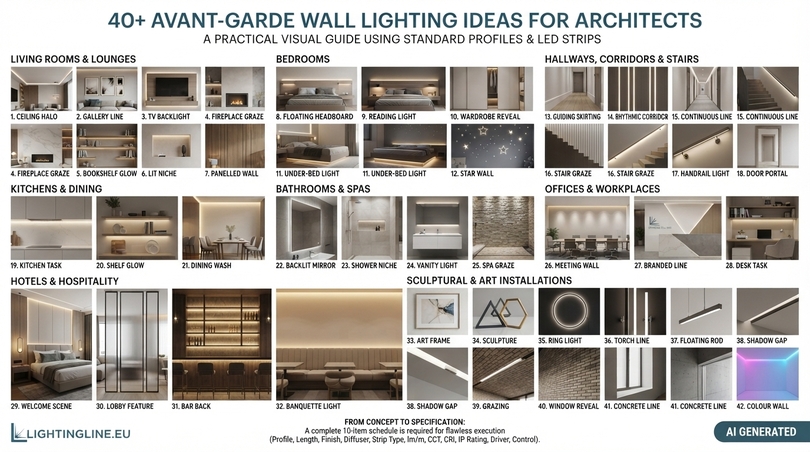
This is the practical heart of the guide. Each idea is described with its purpose, the products to use, and a construction tip. Every solution below can be built with standard profiles and LED strips, with no custom luminaire tooling. Use them as they are or as starting points for your own details.
Living rooms and lounges
1. The floating ceiling halo
Fix a dual-emission WL04-05 profile around the perimeter of the living room about 30–40 cm below the ceiling. The upward light washes the ceiling, the downward light washes the walls. Result: a room that feels taller and evenly lit, without a single ceiling fitting.
2. The sofa wall gallery line
Mount a 30×29 mm wall profile about 30 cm above the top row of frames over a sofa. Use a CRI 95 strip at 3000 K. It is a modern wall light for living room walls and a picture light in one.
3. The TV wall without glare
The best lighting for a TV wall is soft backlight behind the screen and low-level wall washing either side, never a bright source in front. Place a COB strip in a surface profile on the back of a floating TV panel and two vertical 24×24 mm profiles either side, dimmed to around 20% while watching. This reduces eye strain by lowering contrast between screen and wall.
4. The fireplace frame
Set a drywall profile in the reveal of a plastered chimney breast so the light grazes the face. The chimney becomes a luminous sculpture, an elegant alternative to the classic pair of wall lights either side.
5. The bookshelf wall
Recess furniture profiles under each shelf front, facing back toward the wall, so books are lit and the wall glows between them. A library wall becomes the main light source of a lounge.
6. The lit niche
Line the top of a plaster niche with a short recessed profile. Ideal for sculptures and ceramics. Use a narrow, high-CRI source for crisp shadows.
7. The panelled feature wall
On a timber or fluted MDF panel wall, insert recessed profiles in vertical joints every 60–90 cm. Feature wall lighting ideas like this transform an ordinary wall into the room’s focal point.
Bedrooms
8. The floating headboard
Build a headboard panel standing 4–6 cm off the wall, with a surface profile along its top edge facing up and one along the bottom facing down. The headboard appears to float. Add a separate dimmable channel for night scenes.
9. The integrated reading light
Inset a short 48×18 mm profile into the headboard at each side, 1.1–1.3 m from the floor, with a satin diffuser and a separate switch. It replaces a bedside wall lamp with a cleaner detail and no visible arm.
10. The wardrobe reveal
Run a drywall profile down the vertical gap between a built-in wardrobe and the wall. The furniture appears detached, and the slot doubles as a gentle night light.
11. The under-bed glow
A profile under the bed base, with a motion sensor and a very warm strip, gives safe night-time orientation without waking a partner.
12. The star wall for children
For a child’s room, design a star wall light pattern with short lengths of round or surface profiles arranged as a constellation, with tunable or RGBW strips on a dimmer and timer.
Hallways, corridors and stairs
13. The guiding skirting
Use the 75×13 mm baseboard profile along a hallway, on a sensor at 10% at night and 100% when needed. Hallway wall lights at low level avoid glare and make narrow corridors feel wider.
14. The rhythmic corridor
Place short vertical WL02 or WL05 profiles every 2–3 m along a long corridor, alternating sides. This creates the rhythm of traditional wall sconces with a contemporary look, ideal for hotels and offices.
15. The continuous up-down corridor
For long, wide corridors, a continuous WL04-05 dual-emission line at 2.1 m creates a calm, uniform wash, effectively a linear version of up and down lighting.
16. The stair grazing line
Set a drywall or recessed profile in the stair wall, parallel to the pitch line, about 30 cm above the treads. It lights every step evenly and replaces individual step lights.
17. The handrail light
Lighting Line offers a handrail profile that integrates light into the rail itself, grazing the wall and lighting the treads.
18. The door portal
Frame a main doorway with plaster-in profiles in the jambs and head. A luminous portal is a strong architectural gesture for entrances and suite doors.
Kitchens and dining
19. Splashback light
Combine under-cabinet furniture profiles with a tiling profile in the splashback. Kitchen wall light fixtures then provide 300–500 lux on the worktop with no shadows from the user’s head.
20. Open shelving glow
Floating oak shelves with recessed profiles turn kitchen shelving into wall lighting, a modern take on the kitchen wall lamp.
21. Dining wall wash
A corner profile at the junction of ceiling and wall behind a dining table washes art and creates intimacy. Combine with a pendant over the table.
Bathrooms and spas
22. The backlit mirror
Use the mirror profile to create shadow-free light for grooming. Light from the sides at face height is better than overhead light, which creates shadows under eyes.
23. The shower niche
A waterproof tile profile along the top of a shower niche, with an appropriately IP-rated strip and SELV supply, turns storage into a glowing feature.
24. The floating vanity
A profile under a wall-hung vanity grazes the floor and wall, doubling as a night light.
25. The spa wall
Graze a stone or tiled wall from the floor with a walkable floor profile. Texture appears; the room feels like a spa.
Offices and workplaces
26. The meeting room wall wash
Wall lights for office meeting rooms improve face rendering on video calls. A continuous wall wash on the wall behind the camera reduces harsh contrast.
27. The branded light line
A recessed line traced in a company’s brand geometry across a reception wall makes lighting part of the identity.
28. Desk-side task line
Under-shelf furniture profiles at 4000 K with high CRI give glare-free task lighting in home offices.
Hotels and hospitality
29. The guest room “welcome” scene
A sensor-activated line behind the headboard and in the entry niche switches on at low level when guests enter, a memorable first impression.
30. The lobby light wall
An array of vertical profiles behind a reeded glass or onyx panel creates an illuminated wall for reception backdrops.
31. The bar back
Backlit shelving with COB strips for an even glow behind bottles, with warm 2400 K and dimming.
32. The restaurant banquette
A profile under the upholstered back of a banquette and a wall wash above creates intimate pools of light at table level.
Sculptural and art installations
33. The light frame
Build a rectangle of thin profiles around a piece of art, a mirror or an empty wall area. Lights frame installations are among the most shared design images online.
34. The geometric wall sculpture
Assemble triangles, hexagons or free lines with profiles cut at angles. A wall light sculpture like this can be both art and ambient light.
35. The ring
A round profile bent into a large circle on a dark wall becomes a “sun” or “moon”, a statement unusual wall light for living rooms or hotel lobbies.
36. The torch line
Vertical round profiles on stand-offs recall a torch wall light. Use them in pairs either side of a door.
37. The floating rod
A suspension profile on short stand-off brackets 10 cm from the wall creates a floating line of light, like a contemporary picture rail.
38. The shadow gap seam
Where wall meets ceiling, a drywall profile in a shadow gap creates the illusion that the ceiling is floating. One of the most refined wall lightings details possible.
39. The textured grazing wall
Graze a limewash, brick, stone or tadelakt wall from a concealed slot at the ceiling. Narrow-beam grazing reveals every relief.
40. The window reveal
A profile in a deep window reveal lights the reveal at night, replacing the dark hole of a window with a soft glowing frame.
41. The concrete line
Cast the PVC profile for cement into an exposed concrete wall during construction. The line of light becomes part of the structure.
42. The colour-changing mood wall
An RGBW cove on one accent wall in an entertainment room creates a scene-controlled mood wall, a modern take on colour changing wall lights.
From concept to specification
For each idea, note profile code, length, finish, diffuser, strip type, lm/m, CCT, CRI, IP rating, driver, control and switching. A clear schedule of these ten items avoids nearly every site problem with linear wall lightings. The profiles catalogue and the LED strip catalogue give you all the data you need.
11. Placement and room-by-room guide
A beautiful wall light in the wrong place is a glare source, a shadow maker or a forehead hazard. Position decides whether wall lightings flatter a room or fight it. This section covers heights, spacing, direction, and a room-by-room method that you can apply directly to drawings.
How high should wall lights be in the UK?
There is no single legal height, but common practice in the UK and across Europe is consistent:
| Location | Typical height (centre of fitting, from finished floor) | Notes |
|---|---|---|
| Living room / lounge | 1.5-1.8 m | Above seated eye level to avoid glare |
| Hallway and corridor | 1.6-1.8 m, or 2.1 m for linear | Keep projection low where space is tight |
| Bedside wall lighting | 1.1-1.3 m | About 30 cm above mattress top for reading |
| Bathroom mirror | 1.5-1.7 m (centre of face) | Light from both sides is best |
| Stairs | About 1.8 m above pitch line, or low-level 30 cm | Consistent height along the flight |
| Picture lighting | 15-30 cm above frame | Arm length about half picture height |
| Kitchen under-cabinet | Front edge of cabinet underside | Avoid reflections in glossy worktops |
| Night / guide lights | 20-40 cm | Very warm, low output, sensor control |
Ceiling height changes these figures: in rooms over 3 m, raise living room wall lights to around 2 m; under 2.4 m, prefer uplighters and flush fittings so the light does not sit at head height. A practical check: when seated, you should not see the bare light source of any wall light.
Spacing wall lights
For decorative fittings, a common spacing is 2-3 m apart along a wall, and around 1 m from corners. For linear profiles the question becomes length: a line should relate to something architectural, such as the width of a sofa, the length of a headboard, the span between two doors or the full wall. Lines that stop randomly look like afterthoughts.
Should wall lights face up or down?
- Up – soft, indirect ambient light, increases perceived ceiling height, minimal glare. Ideal in living rooms, bedrooms and low ceilings. Requires a reasonably light ceiling to reflect.
- Down – defines a zone, lights paths and surfaces, reveals texture below. Ideal in hallways, stairs, above worktops and for art.
- Up and down – creates rhythm and drama, emphasises verticality; perfect for corridors, double-height rooms and hospitality.
- Diffuse / outward – lights the room directly; acceptable only with good diffusion or above eye level.
How do you uplight a wall?
To uplight a wall, place the source at the base of the wall or in a slot at floor level, aiming upward. A floor-recessed profile 10-20 cm from the wall gives a grazing effect that emphasises texture; a source 40-60 cm away gives a smoother wash. Garden wall uplighters follow the same principle outdoors, with IP-rated components.
How do you illuminate a wall evenly?
Even wall washing needs the source to be set back from the wall: roughly one third of the wall height is a good starting distance for spot-type washers. With linear profiles, a corner profile at the ceiling junction or a cove with an opal diffuser produces a smooth gradient. The smoother the wall finish, the further back the source can be; the rougher the wall, the closer you should graze.
How do you light up a wall to make it a feature?
Choose a single wall, increase its luminance to three to five times the surrounding walls, and keep other light low. Textured, coloured or art-filled walls benefit most. A feature wall lighting idea that rarely fails: a concealed slot at the ceiling grazing a limewash or stone wall, on its own dimmer.
What is the best lighting for pictures on the wall?
Use high CRI (90+, ideally 95+), a CCT matching the room (2700–3000 K), and an angle of about 30° from vertical to avoid reflections in glass. LEDs emit negligible UV and very little infrared towards the art, making them far kinder to pigments than halogen. A surface profile above a gallery wall gives consistent illumination for a series of frames.
Room-by-room guide
Living room wall lights
Aim for three layers: an ambient uplight (perimeter or dual-emission profile), an accent (art, shelves, fireplace), and a decorative piece. Living room wall mounted lights should be dimmable. Modern wall lights for living room spaces work well at 2700 K.
Bedroom wall lights
Bedroom wall lights ideas centre on the headboard: reading lights, an ambient glow, and a night light. Choose 2700 K or tunable white, and put switches within reach of the bed. Modern wall lights for bedroom use often replace bedside lamps entirely, freeing the bedside table.
Hallways and entrances
Wall lights for hallways must be glare-free, as people walk towards them. Low projection profiles like the 48×18 mm or recessed solutions are ideal. Hallway wall light fixtures on sensors save energy.
Kitchens
Task lighting on worktops is the priority. Under-cabinet profiles and shelf lighting are effectively wall lights in kitchens, and should be 3000–4000 K with high CRI so food looks appetising.
Bathrooms
Bathroom wall lamps must respect IP zones (see the safety section). Light at face height around the mirror and a soft ambient wash are a winning combination.
Home offices
Wall lights for office spaces should lift vertical illuminance and reduce contrast with screens. A wash on the wall behind the monitor reduces eye strain.
Hotel guest rooms
See the dedicated hotels section for scenes and controls.
12. Functionality and technology: dimming, smart control, sensors
Modern wall lightings are no longer just “on” or “off”. Dimming, tunable white, sensors and smart home integration change how a room feels throughout the day. A well-controlled 20 W line of light can be more versatile than a dozen traditional fittings. This section covers the main technologies and when to use them.
Are LED wall lights any good?
Yes. According to the U.S. Department of Energy, residential LEDs use at least 75% less energy and last up to 25 times longer than incandescent lighting. LED wall lights also run cool, enable slim profiles impossible with older lamps, and offer precise colour temperature and dimming. LED is now the default, not the alternative, for wall lighting.
Are LED lights good for walls, and can you put LED lights on walls?
LED strips are well suited to walls when installed in an aluminium profile. Sticking bare strips directly onto plaster or paint is not recommended: heat is poorly dissipated, adhesive can fail, and the strip is exposed. Profiles solve all three problems.
Dimming options
| Method | How it works | Best for |
|---|---|---|
| Phase-cut (triac / trailing edge) | Dims the mains supply to a compatible driver | Retrofit using existing wall dimmers |
| 0/1-10 V | Analogue control signal to the driver | Commercial, simple scenes |
| DALI / DALI-2 | Digital addressable control | Hotels, offices, large residences |
| PWM controllers (RF, Bluetooth) | Low-voltage control after the driver | Residential, colour and tunable strips |
| Casambi, Zigbee, Matter-compatible controllers | Wireless smart home integration | Smart homes, renovations |
Smart wall lights and home automation
Smart wall lights can follow schedules, react to voice assistants and adjust colour temperature through the day. For LED strips, use a smart LED controller between driver and strip, or a smart driver. For home automation, check compatibility with the client’s platform before specifying. In larger projects, DALI remains the most robust and future-proof choice.
Wall lights with switches
Wall lights switched locally (with an integrated or adjacent switch) are practical at bedsides and desks. Wall lights with switches can still be part of a central system if you use smart push-buttons rather than direct mains switches.
Motion sensors and night lights
Motion sensor wall lamps and wall night lamps are ideal for corridors, stairs, bathrooms and hotel rooms. Use presence detection with a low “background” level (around 10%) rather than full off, so people never walk into darkness.
Tunable white and circadian lighting
Tunable white strips shift from warm to cool. In bedrooms and hotels, keep evening scenes warm (2700 K or lower) and morning scenes neutral. This supports comfort and wellbeing.
Energy-efficient wall lights: real numbers
| Scenario (living room, 4 h/day) | Power | Annual energy | Indicative annual cost at €0.30/kWh |
|---|---|---|---|
| 4 traditional halogen wall lights, 40 W each | 160 W | 234 kWh | About €70 |
| 4 m LED profile at 10 W/m | 40 W | 58 kWh | About €18 |
| 4 m LED profile at 10 W/m, dimmed to 50% on average | about 20 W | 29 kWh | About €9 |
Figures are illustrative calculations (power × hours × 365) and do not include driver losses; use your local tariff for exact budgets. In a hotel with hundreds of rooms, these savings multiply significantly.
13. Regulations, certifications and safety
Lighting is an electrical installation first and a design element second. Compliance protects occupants, protects the designer’s liability and protects the client’s insurance. This section summarises the main rules for wall lightings in the UK and Europe, with notes for projects in North America. It is guidance, not legal advice: always confirm with a qualified electrician and local building control.
UK: Part P and BS 7671
In England and Wales, domestic electrical work falls under Approved document P (Electrical safety – dwellings) of the Building Regulations. All work must meet the safety requirements of BS 7671 (the IET Wiring Regulations). Some work is “notifiable”, which means it must be certified by a registered competent person or notified to building control, typically including new circuits, consumer unit replacements and certain work in special locations such as bathrooms. Adding a wall light to an existing circuit in a living room is often not notifiable, but it must still be done safely and to standard. Scotland and Northern Ireland have their own regimes.
The charity Electrical Safety First publishes clear consumer guidance on which jobs need a registered electrician, a useful link to share with homeowner clients.
Product standards and certifications
| Mark / standard | Region | What it covers |
|---|---|---|
| CE | EU / EEA | Manufacturer’s declaration of conformity with EU directives (LVD, EMC, RoHS, ecodesign) |
| UKCA | Great Britain | UK equivalent of CE; CE is currently still recognised for many products in GB |
| ENEC | Europe | Voluntary third-party certification of luminaires and components |
| EN / IEC 60598 | International | Safety of luminaires |
| IEC 61347 / EN 61347 | International | Safety of LED drivers (control gear) |
| EN 12464-1 | Europe | Lighting of indoor workplaces (illuminance, glare, colour rendering) |
| UL / ETL listing | USA / Canada | Product safety certification required by many jurisdictions and inspectors |
| IEC 60529 | International | IP ratings (ingress protection) |
The International Electrotechnical Commission publishes the IEC standards on which most national luminaire rules are based. For US projects, ask for UL approved wall lights or equivalent listings for every complete assembly, including the driver.
IP ratings and bathroom zones
| Bathroom zone (BS 7671) | Location | Minimum IP (typical guidance) | Wall lighting notes |
|---|---|---|---|
| Zone 0 | Inside bath or shower tray | IPX7, SELV max 12 V | Only specifically rated products |
| Zone 1 | Above bath/shower to 2.25 m | IPX4 (IPX5 with jets) | SELV strongly recommended |
| Zone 2 | 0.6 m around zone 1 | IPX4 | Mirror lights often fall here |
| Outside zones | Rest of bathroom | No specific IP, but IP20+ and RCD protection | Good practice: IP44 in steamy rooms |
Drivers must always be installed outside the wet zones, in an accessible, ventilated position. Use waterproof strips and sealed end caps in wet areas, and never rely on a profile alone for water protection unless the system is rated.
Low voltage, heat and fire
- Use SELV (12/24 V) drivers from reputable manufacturers, correctly sized with about 20% headroom.
- Keep drivers accessible for maintenance, never sealed behind plaster.
- Respect cable sizes for low-voltage runs; low voltage means higher current and greater voltage drop.
- Do not cover drivers with insulation; check the driver’s ambient temperature rating.
- Specify flicker-free drivers and controllers, especially in offices and for video calls.
Lighting quality standards for workplaces
EN 12464-1 sets illuminance, glare (UGR) and colour rendering requirements for workplaces. For lighting design guidance in the UK, the CIBSE and its Society of Light and Lighting publish widely used lighting guides and codes.
14. Installation and maintenance
The questions clients ask most often are practical ones: can I install a wall light myself, how much will an electrician cost, can I avoid chasing the walls? Installation is where good wall lighting design either becomes reality or becomes a patch-up. This section answers those questions and gives a step-by-step method for linear profile installations.
Do you need an electrician to install wall lights?
For hard-wired wall lights connected to mains circuits, using a qualified, registered electrician is strongly recommended, and in the UK some work is legally notifiable (see the safety section). A homeowner with suitable competence may legally carry out some minor, non-notifiable work in England and Wales, but it must still comply with BS 7671 and be safe. If in doubt, use an electrician: the cost is small compared with the risk.
Can I install a wall light myself?
DIY-friendly options exist:
- Plug-in wall lights – wall mounted plug in lights simply connect to a socket; cables can be hidden in decorative trunking.
- Battery-operated wall sconces – a wall sconce light battery operated needs no wiring. Ideal for rentals, with limited output.
- Low-voltage profiles with plug-in drivers – an LED profile with a plug-in power supply can be fitted by a competent DIYer, as the wall-side work is extra-low voltage.
Can you get wall lights without wiring, or install a wall light without existing wiring?
Yes, with plug-in or battery-powered fittings, or with a plug-in low-voltage system. For permanent, hard-wired results, new wiring must be added, usually by chasing the wall or running cables in stud partitions or surface trunking.
Can you wire a wall light to a socket?
A plug-in light connects via a plug. Permanently wiring a light from a socket circuit is possible in UK practice through a fused connection unit with an appropriate fuse, but it must be designed and installed by a competent person in line with BS 7671.
Can you put a ceiling light on a wall, or use ceiling lights on walls?
Some ceiling fittings are approved for wall mounting; others are not, due to heat, optics or mounting. Check the manufacturer’s instructions. Linear profiles are typically suitable for both orientations, which is one of their advantages.
How much does an electrician charge to install a wall light?
Costs vary widely by region and job complexity. In the UK, typical figures quoted for fitting a wall light where wiring exists are often in the low hundreds of pounds, rising for new circuits, chasing and making good. Get at least two written quotes and ask whether plastering and decorating are included.
| Job | Complexity | Indicative cost drivers |
|---|---|---|
| Replace an existing wall light | Low | Labour, about 1 hour |
| Add a wall light to existing circuit | Medium | Chasing, cable, making good |
| New circuit for several wall lights | High | Notification/certification, consumer unit capacity |
| Linear LED profile system | Medium–high | Driver location, control, joinery coordination |
Step-by-step: installing a linear LED wall profile
Step 1 – Plan and calculate
Define length, profile, diffuser, strip, lm/m and CCT. Calculate total wattage (W/m × length) and choose a driver with about 20% headroom. Plan cable routes and a maintainable driver location.
Step 2 – Prepare the wall
Mark a level line. For drywall profiles, coordinate with the plasterer: the profile is fixed before skimming. For recessed profiles, rout the groove accurately.
Step 3 – Cut the profile and diffuser
Cut with a fine-tooth saw or mitre saw, deburr the edges and clean off swarf. Remember the ±2 mm length tolerance.
Step 4 – Fix the clips or brackets
Use the dedicated mounting brackets or metal clips at regular intervals, typically every 30–50 cm, and always near the ends.
Step 5 – Install the strip
Clean the profile base with isopropyl alcohol, apply the strip without bending the PCB sharply, and join sections with connectors or soldering.
Step 6 – Wire and test
Connect the strip to the driver (low voltage) and the driver to the mains (competent person). Test before closing.
Step 7 – Close and finish
Clip in the diffuser, fit the end caps from the wall end cap range, and commission dimming and scenes.
Maintenance of wall lamps and profiles
- Cleaning wall sconces and profiles: switch off, dust with a microfibre cloth, and clean diffusers with a mild soapy solution. Avoid solvents on polycarbonate.
- Glass shades: remove and wash, dry thoroughly before refitting.
- Drivers: check accessibility and ventilation annually in commercial settings.
- Strips: quality strips can operate for tens of thousands of hours; replace sections if colour shift or failure appears.
Troubleshooting wall lights
| Symptom | Likely cause | Fix |
|---|---|---|
| Light dimmer at the far end | Voltage drop on long run | Use 24 V, feed from both ends, thicker cable |
| Flicker when dimmed | Incompatible dimmer/driver | Use matched dimmer and driver, or a PWM controller |
| Visible dots | SMD strip too close to diffuser | Use deeper profile, opal diffuser or COB strip |
| Colour mismatch between sections | Different batches or bins | Order full quantity at once from one batch |
| Strip detaching | Dirty surface or heat | Clean with alcohol, ensure profile is aluminium |
| Driver buzzing or hot | Overloaded or poor ventilation | Upsize driver, relocate to ventilated space |
| No light | Polarity, connector or driver fault | Check polarity and connections, test driver output |
15. Prices and budget: what wall lightings really cost
Wall lights for sale range from very cheap wall lights in the bargain aisle to luxury wall lights costing thousands. The real cost of wall lightings is purchase plus installation plus energy plus maintenance over the life of the room. This section helps you budget honestly.
Price tiers in the market
| Tier | Typical product | Indicative price per fitting | Strengths | Limitations |
|---|---|---|---|---|
| Budget | Basic plug-in or battery sconce | Under £30 / €35 | Cheap, quick | Low output, low CRI, short life |
| Mid-range | Branded modern wall lights | £40-£200 / €45-€230 | Good design, decent quality | Fixed size and shape |
| Premium designer | Designer wall lights, statement pieces | £200-£800+ / €230-€900+ | Iconic design, materials | Often low light output for cost |
| Luxury bespoke | Custom metalwork, art pieces | £1,000+ / €1,150+ | Unique | Long lead times, high cost |
| Architectural linear | Profile + strip + driver per metre | Varies by specification | Custom length, high performance, integrated | Requires design and installation planning |
Prices are indicative market ranges and vary by retailer and region; for exact profile and strip prices, see the Lighting Line catalogue or request a quote.
How to compare costs fairly
Compare cost per delivered lumen and per year of life, not just ticket price. A cheap fitting that delivers 200 lumens and fails in two years can cost more than a quality profile delivering 800 lumens per metre for many years. Also factor in that a linear profile often replaces several individual fittings.
Budget strategies
- Spend on the light you see most: the living room and bedside.
- Use standard profile lengths (2 m, 3 m) to minimise waste.
- Choose one driver for multiple lines in the same zone.
- Prioritise CRI 90+ strips; savings on CRI are visible every day.
- Plan wiring at first fix to avoid expensive chasing later.
16. Wall lightings for hotels and hospitality
In hospitality, light is part of the product. Guests rarely remember the brand of a mattress, but they remember a room that felt warm, calm and expensive the moment the door opened. Hotel wall lightings must deliver luxury atmosphere, practical function and low energy use at the same time, often within strict maintenance budgets. Here is how profiles help hotel managers and their designers achieve all three.
What wall lighting options create a luxurious hotel ambiance?
- Indirect light everywhere guests look: headboard backlight, wardrobe reveals, coves and lit niches. No bare sources in the field of view.
- Warm CCT with high CRI: 2700–3000 K, CRI 90+, so skin tones and materials look rich.
- Scenes, not switches: “welcome”, “relax”, “read”, “night” scenes on one keypad.
- Statement lobby walls: backlit stone or glass panels as a brand moment.
Wall lights that are both decorative and functional
Integrated profiles let a single element do two jobs: a backlit headboard frames the bed (decorative) and provides ambient light (functional); a lit wardrobe reveal adds depth and doubles as a night light; a corridor dual-emission line provides wayfinding and atmosphere.
Best practices for wall lights in guest rooms
| Element | Recommendation | Reason |
|---|---|---|
| Bedside reading | Separate, individually switched light for each side, 1.1-1.3 m | One guest can read while the other sleeps |
| Night light | Low-level sensor-activated strip, 2200-2700 K | Safe night movement without full light |
| Entry | Lit niche or wardrobe reveal on key-card activation | Strong first impression |
| Mirror | Side lighting at face height, CRI 90+ | Flattering grooming light |
| Control | Clearly labelled keypads, master off by the bed | Guest frustration is a top complaint |
| Drivers | Accessible location, labelled, spare stock | Fast maintenance, no wall damage |
Improving energy efficiency in hotel lighting
Replace halogen and compact fluorescent fittings with LED, add presence detection in corridors and back-of-house, and link guest-room lighting to the key-card system. Because corridors are lit around the clock, a dimmed baseline with presence boost can cut corridor lighting energy substantially. In hotels, the payback on LED wall lighting retrofits is often among the fastest of any energy measure.
Updating existing wall lighting fixtures to modern standards
Where rewiring is impossible, existing wall light points can feed new LED drivers serving linear profiles, preserving the circuit while transforming the effect. Swapping dated sconces for slim profiles at the same points, with a new headboard backlight fed from the same supply, is a cost-effective renovation strategy for guest rooms between full refurbishments.
How wall lightings enhance the ambiance of a room
Why do lit walls change how we feel? Human perception responds strongly to vertical brightness: we judge a space as bright, spacious and welcoming mainly from what we see on walls and at eye level. A room can measure enough lux on the floor and still feel gloomy if the walls are dark. Several mechanisms are at work:
- Spaciousness: lit walls push boundaries outward visually; uplight lifts ceilings.
- Intimacy: pools of light at low level draw people together and define zones in open-plan spaces.
- Texture and materiality: grazing reveals stone, timber and plaster, adding richness without decoration.
- Visual comfort: indirect light reduces glare and contrast, making evening spaces more relaxing.
- Orientation: lines of light guide movement along corridors and stairs.
For interior designers asking which wall lighting fixtures best create a cozy atmosphere, the answer is consistent: warm (2700 K or below), dimmable, indirect and low. Hidden profiles in coves, shelves and headboards deliver exactly this.
Sustainable and customisable wall lighting
Sustainability in lighting means efficient sources, long life, repairability and recyclable materials. Aluminium profiles are recyclable and durable; strips and drivers can be replaced individually without discarding the whole luminaire. Customisation is a further strength: Lighting Line’s production unit is equipped to produce fully customisable strips, and profiles can be cut to exact lengths. A customisable system is inherently more sustainable than a disposable fitting, because it can be adapted rather than replaced.
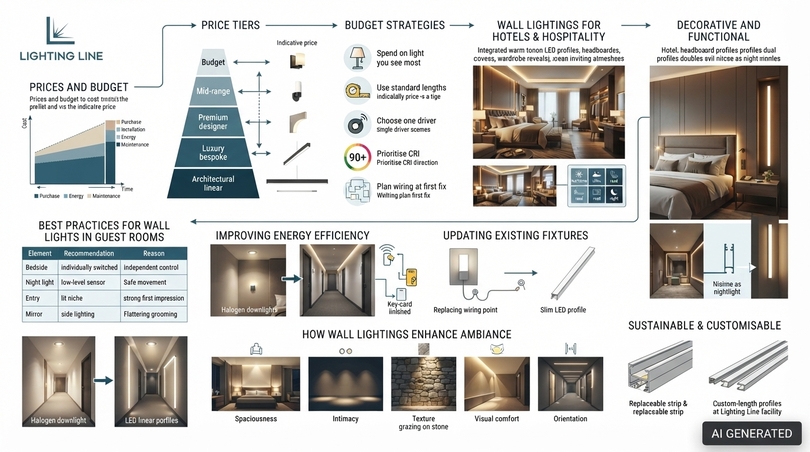
17. Worked example: lighting a 5 m living room feature wall
To show how the pieces fit together, here is a complete example that an architect could adapt for a client presentation.
The brief
A living room 5 m × 4 m, ceiling height 2.7 m, white walls, one long wall with a sofa and artwork. The client wants modern wall lights for the living room, no ceiling downlights, warm atmosphere, and a brighter setting for reading.
The design
- A 5 m run of WL04-05 dual-emission profile in white at 2.1 m on the long wall, opal diffusers.
- Upward channel: 2700 K CRI 90 strip for ambient ceiling bounce.
- Downward channel: 2700 K CRI 90 strip washing the artwork and sofa zone.
- A 2 m 24×24 mm profile vertically beside the armchair as a reading and decorative accent.
The numbers
| Item | Value |
|---|---|
| Target delivered output per channel | 600 lm/m |
| Opal diffuser loss (Lighting Line test) | About 38% |
| Required strip output | About 970 lm/m per channel |
| Total profile length | 5 m (two channels) + 2 m |
| Assumed strip power | About 10 W/m at the required output (check datasheet) |
| Total load | Around 120 W; driver sized at about 150 W or split across two drivers |
| Control | Two-channel dimming + separate reading light switch |
The result is a room lit entirely from one wall, with no glare, a lifted ceiling and art presented like a gallery. Fewer fittings, more atmosphere, and a cleaner ceiling: this is the essence of contemporary wall lighting design. Use the lux calculation page to verify levels for your exact dimensions.
18. The architect’s specification checklist
Use this checklist on every project that includes linear wall lightings. It condenses the whole guide into the decisions that matter.
| # | Decision | Questions to answer |
|---|---|---|
| 1 | Purpose | Ambient, task, accent or decorative? Which surface is being lit? |
| 2 | Mounting | Surface, recessed, plaster-in, corner, suspended, cast in concrete? |
| 3 | Profile | Code, section, finish, length, end caps, brackets |
| 4 | Diffuser | Transparent, opal or frosted; account for light loss |
| 5 | Strip | SMD or COB, lm/m, W/m, 12 V or 24 V, PCB width ≤ profile limit |
| 6 | Colour | CCT, CRI (90+), R9, tunable or RGBW |
| 7 | Protection | IP rating, bathroom zones, outdoor exposure |
| 8 | Power | Driver rating with headroom, location, access |
| 9 | Control | Switching, dimming protocol, sensors, scenes |
| 10 | Compliance | CE/UKCA, Part P / BS 7671, EN 60598, local rules |
| 11 | Coordination | Plasterer, joiner, electrician sequence; first fix cables |
| 12 | Maintenance | Access to drivers and diffusers, spare parts, cleaning plan |
Need help completing the checklist? The Lighting Line technical staff can advise on the most appropriate product for each project: contact the team with drawings and requirements, or download the profiles catalogue.
19. Unusual, luxury and designer wall lightings: three project scenarios
Search interest in unusual wall lightings, luxury wall lightings and designer wall lights keeps growing, because clients want something nobody else has. Bespoke does not have to mean a one-off luminaire: it can mean a standard profile used in an unexpected way. The three scenarios below show how architects can deliver a signature result with catalogue components. They are illustrative design scenarios, intended as templates you can adapt to your own projects.
Scenario 1: A city apartment with a “floating” plaster wall
The challenge
A narrow open-plan apartment with a long, blank partition wall and low ceilings. The client wanted modern wall lightings that made the space feel wider, without any visible fittings and without lowering the ceiling with downlights.
The solution
The designer proposed a plasterboard lining set forward from the existing wall, with drywall profiles forming a continuous shadow gap at the ceiling junction and at floor level. The upper line grazes the wall downward at 2700 K; the lower line, on a separate circuit with a presence sensor, acts as a night guide. Opal diffusers ensure a seamless line.
Why it works
The wall appears to hover between two lines of light. Because the light is on the vertical surface, the room reads as wider, and because nothing protrudes, the narrow corridor zone remains clear. This is the essence of architectural wall lights: the light belongs to the construction, not to an object.
Scenario 2: A boutique hotel corridor
The challenge
A 40 m hotel corridor with dated brass sconces every 3 m, high energy use, uneven light and frequent lamp replacements.
The solution
The existing wall light points were retained as power feeds. Between them, a continuous dual-emission WL04-05 profile in brushed black was installed at door-head height, with warm 3000 K strips. Each room door was emphasised by short vertical 34×34 mm profiles beside the frame, giving a “luminous portal” at every room. Presence detection keeps the corridor at a low background level at night.
Why it works
The corridor gains a calm, continuous rhythm, room numbers become easier to find, and maintenance moves from replacing individual lamps to occasional checks on accessible drivers. The black profile reads as a deliberate design line, turning a utilitarian space into part of the guest experience.
Scenario 3: A country house library
The challenge
A traditional library with oak shelving, ornate cornices and a collection of paintings. The owners wanted to keep the classic wall lights and traditional wall lighting character but needed far better light for reading and for the art.
The solution
The original candle sconces were kept as decorative lights. Discreet furniture profiles with CRI 95 strips were recessed under each shelf front, corner profiles hidden behind the cornice provided an indirect uplight; slim surface profiles acted as picture lights above the main paintings.
Why it works
Visitors see a traditional room; they experience a modern one. Hidden linear light lets heritage interiors gain contemporary performance without losing their character, an approach that respects the architecture while satisfying current expectations for comfort and efficiency.
20. Wall lightings for small spaces, rentals and renovations
Not every project is a new build with a generous lighting budget. Many clients live in rented flats, small homes or houses where walls cannot easily be opened. Smart choices in wall lightings can transform a small or temporary space without major works. This section collects the most effective strategies.
Small rooms: light the walls, free the floor
In small rooms, floor lamps and bedside tables eat precious space. Wall mounted lamps and slim profiles move light off the floor and onto the walls, where it also makes the room feel bigger. Choose shallow profiles such as the 48×18 mm wall profile, which projects only 18 mm from the surface, and pale finishes that blend with the wall.
Rentals: removable and plug-in solutions
Renters often cannot chase walls. Plug-in wall lights, battery wall sconces and low-voltage profiles with plug-in drivers can be fixed with a few screws and removed at the end of the tenancy. Furniture-based lighting (under shelves, behind a headboard, inside a bookcase) is the least invasive option of all and still behaves as wall lighting.
Renovations: plan at first fix
In a renovation, the cheapest moment to add wall lighting is when walls are already open. Run cables to every wall where light might be wanted, even if fittings come later. Specify accessible driver positions in cupboards, ceiling voids with hatches or service risers. A cable left in the wall today costs a fraction of chasing it in tomorrow.
Low ceilings and basements
Low ceilings make pendants and protruding sconces awkward. Uplight from wall profiles bounces off the ceiling and visually lifts it. In basements, where daylight is limited, lit walls are essential to avoid a cave-like feeling: wash the walls opposite the entrance and use high-CRI, slightly cooler (3000–3500 K) strips to simulate daylight quality.
Open-plan spaces
In open-plan homes, wall lightings help define zones without partitions. A warm wash behind the dining area, a brighter task line in the kitchen and a dim uplight in the lounge create three distinct “rooms” within one space, each on its own control.
| Situation | Best wall lighting approach | Suggested product family |
|---|---|---|
| Small bedroom | Headboard-integrated reading and ambient light | Wall or recessed profiles |
| Rented flat | Plug-in low-voltage profiles, furniture lighting | Surface and furniture profiles |
| Renovation | Plaster-in lines and coves planned at first fix | Drywall and corner profiles |
| Low ceiling | Uplight from wall-mounted profiles | Wall profiles facing up, dual-emission |
| Basement | Wash opposite walls, high CRI | Corner and wall profiles |
| Open plan | Zoned wall washes on separate controls | Mixed families with scene control |
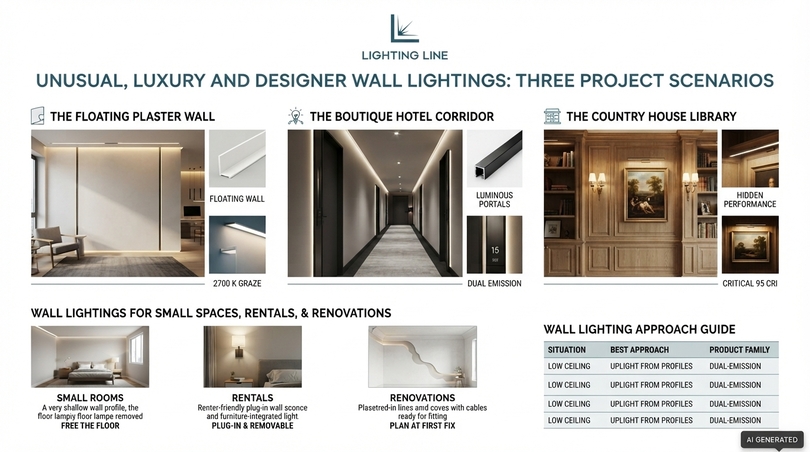
21. 12 Common wall lighting mistakes and how to avoid them
Even experienced teams repeat the same errors with wall lightings. Most of them are invisible on a drawing and obvious the first evening the client switches on. Review this list before issuing any lighting layout.
Design mistakes
1. Glare at seated eye level
A bare or poorly diffused source at 1.2-1.4 m in a living room will glare at everyone sitting on the sofa. Raise it, shield it or turn it into an uplight.
2. Mixing colour temperatures
A 4000 K line next to 2700 K lamps looks like a mistake. Fix one CCT per space, or use tunable white throughout.
3. Lighting the wrong wall
The wall you light becomes the focal point. Lighting the wall behind a television, a radiator or a blank corridor end draws attention to it. Light what deserves to be seen.
4. Lines that stop randomly
Linear light must relate to architecture: full wall, joinery width, door head. Arbitrary lengths read as unfinished.
5. Ignoring the diffuser loss
Specifying a strip by its bare output and then adding an opal diffuser can leave you with almost 40% less light than expected, as Lighting Line’s tests show.
6. Overlighting
More light is not more luxury. Without dimming, a wall light designed for reading will be too bright for relaxing.
Technical mistakes
7. Inaccessible drivers
A driver sealed behind plaster will eventually fail and require demolition. Always design an access hatch or remote location.
8. Undersized drivers
Drivers running at 100% load run hot and fail early. Allow about 20% headroom.
9. Voltage drop on long runs
Long 12 V runs fade at the end. Use 24 V and multiple feeds.
10. Bare strips on walls
Without a profile, strips overheat and peel off. Always mount strips in aluminium.
11. Wrong IP rating in bathrooms
Check zones and use waterproof strips, sealed end caps and SELV supplies.
12. Incompatible dimming
Choose drivers and dimmers as a tested pair, or use a dedicated LED controller, to avoid flicker and buzzing.
22. Frequently asked questions
These answers address the questions most frequently searched about wall lightings. Click each question to expand the answer.
Are wall lights outdated or still in fashion?Wall lights are firmly in fashion. What has dated is the isolated, generic fitting. Integrated linear light, up and down wall lights, warm dim-to-warm sources and sculptural sconces are among the strongest current trends, because lit walls make rooms feel larger, calmer and more architectural while using far less energy than older fittings. |
What are the current trends in wall lights?Key trends include integrated LED profiles in plaster and joinery, dual up and down emission, very warm and tunable white light, black and brushed finishes, timber combined with aluminium, and statement sculptural pieces. Designers favour fewer, higher-quality sources with CRI 90 or above, and lighting controlled through scenes rather than single switches. |
What are lights on walls called?They are generally called wall lights, wall sconces, wall lamps or wall luminaires. Specialist terms include wall washers, wall grazers, uplighters, downlighters, picture lights and applique. Candle-shaped fittings are called candle sconces, and multi-armed versions are called chandelier sconces. In specifications, “wall mounted luminaire” is the clearest term. |
Do you need an electrician to fit wall lights in the UK?For hard-wired wall lights, a registered electrician is strongly recommended. Under Part P, some work such as new circuits and certain bathroom work is notifiable and must be certified. All work must comply with BS 7671. Plug-in, battery and low-voltage plug-in profile systems avoid mains wiring work entirely. |
How high should wall lights be in the UK?Common practice places living room and hallway wall lights 1.5-1.8 m from the finished floor to the centre of the fitting, bedside reading lights at 1.1–1.3 m, and linear lines often at door-head height of about 2.1 m. Adjust for ceiling height and make sure seated occupants cannot see the bare source. |
Should wall lights face up or down?Face them up for soft ambient light and a higher-looking ceiling, down to light paths, surfaces and texture, or both for rhythm and drama. Up and down wall lights suit corridors and double-height spaces. In living rooms and bedrooms, upward or indirect light usually gives the most comfortable, glare-free result. |
Are LED wall lights any good?Yes. LED wall lights use at least 75% less energy than incandescent lamps, last many times longer, run cool and fit into slim profiles. Choose CRI 90+, a suitable colour temperature such as 2700–3000 K for homes, a quality driver and an aluminium profile with a diffuser for comfortable, durable light. |
Can you get wall lights without wiring?Yes. Battery-operated wall sconces and plug-in wall lights need no new wiring. A more professional option is an LED profile powered by a plug-in low-voltage driver, with the cable hidden in trunking or furniture. For permanent hard-wired lights, new cabling must be installed by a competent person. |
Are wall lights better than ceiling lights?They serve different purposes. Ceiling lights provide efficient general light on floors and worktops; wall lights light vertical surfaces, which strongly influence how bright and spacious a room feels. In living rooms, bedrooms, corridors and hotels, wall lights often create a better atmosphere with less glare. Most good schemes combine both. |
What is the best wall light for a living room?The best choice is a dimmable, warm (2700 K), high-CRI source that lights the walls indirectly, combined with an accent on art or shelves. A dual-emission linear profile such as LLP-WL04-05, or discreet up and down wall lights, creates ambient light without glare, while a separate reading light handles tasks. |
What is the best lighting for a TV wall?Use a soft, dimmable backlight behind the screen and low-level wall washing either side. This reduces the contrast between a bright screen and a dark wall, which causes eye strain. Avoid any light source reflecting in the screen. A COB strip in a profile behind a floating TV panel works well. |
What is the best lighting for pictures on the wall?Choose high colour rendering (CRI 90-95+), a colour temperature matching the room, and an aiming angle around 30° to avoid reflections. LEDs emit negligible UV and little infrared towards the artwork, protecting pigments. A slim linear profile above a gallery wall lights several frames uniformly. |
How do you uplight or illuminate a wall?To graze and reveal texture, place a linear source 10-20 cm from the wall, at floor or ceiling level. For a smooth wash, set the source further back or use a cove with an opal diffuser. Raise the feature wall’s brightness to three to five times its surroundings to make it a focal point. |
Can you put LED strips directly on walls?It is not recommended. Bare strips on plaster or paint overheat, the adhesive fails and the LEDs are exposed. Mounting strips in an aluminium profile with a diffuser dissipates heat, hides the LED dots, protects the strip and gives a professional finish that can be serviced later. |
How much light does a diffuser absorb?It depends on the diffuser and profile. Lighting Line’s photometric test on the LLP-WL04-05 wall profile measured about 23% loss with a transparent diffuser, 38% with opal and 39% with satin. As a rule, multiply the desired delivered output by about 1.6 when choosing a strip for an opal diffuser. |
What wall lights suit a luxury hotel?Luxury hotels use indirect, warm (2700-3000 K), high-CRI light: backlit headboards, lit wardrobe reveals, coves, niches and statement lobby light walls. Separate bedside reading lights, sensor-activated night lights and simple scene keypads complete the experience while LED and presence control keep energy use low. |
How do I clean and maintain wall lights?Switch off and let fittings cool. Dust with a microfibre cloth and clean diffusers with mild soapy water, avoiding solvents on plastics. Wash glass shades separately and dry before refitting. Keep drivers accessible and ventilated, and check commercial installations annually for loose connections or overheating. |
Are wall lights expensive to run?Not with LED. For example, a 4 m LED profile at 10 W per metre, used four hours a day, consumes around 58 kWh a year, roughly a quarter of four 40 W halogen wall lights. Dimming further reduces consumption. Check your local electricity tariff for exact running costs. |
23. Designing with light, not just lamps
Wall lightings have evolved from a decorative afterthought into one of the most powerful tools in contemporary architecture. The question is no longer whether wall lights are in fashion, but how intelligently they are integrated. A single, well-placed line of light can lift a ceiling, reveal a material, guide a guest down a corridor and replace a cluster of fittings with something calmer and more efficient.
For architects, the aluminium LED profile is the key that unlocks this approach. It can be surface-mounted, recessed, plastered in, cast in concrete or suspended; it can emit up, down, both or at 45°; it can be silver, white or brushed black, any length, any colour temperature. Combined with the right strip, diffuser and control, it makes bespoke modern wall lighting achievable on real budgets.
Start with purpose, choose the surface to light, select the profile, calculate the strip with diffuser loss in mind, and plan control and maintenance from day one. Then explore the Lighting Line wall profiles, the drywall range and the COB LED strips, download datasheets and photometric tests, and use the lux calculator to verify your design. When the walls glow, the whole room changes.
This article was developed with the support of artificial intelligence and subsequently reviewed, corrected, and validated by the LightingLine.eu technical team, which guarantees its reliability and compliance with official sources.