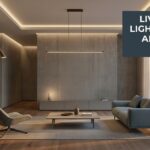
Light fittings are the part of a building that people notice last and feel first. A room with the right light fittings looks larger, calmer and more expensive but the same room with the wrong ones looks flat, tired and smaller than it is. For architects and interior designers, the choice of light fittings has moved from a finishing detail to a structural decision, because the most interesting light fittings of 2026 are no longer objects hung from a ceiling rose: they are lines of light built into ceilings, walls, stairs, joinery and even concrete.
This guide answers, in one place, the questions that clients, contractors and search engines keep asking about light fittings: what the different types of light fittings are called, whether light fittings are universal, whether you can change light fittings yourself in the UK, which ceiling light fittings give the most light, what the latest trends in ceiling lighting are, and how much each option really costs. Every section ends with practical specifications you can drop into a project, built on the aluminium profiles and LED strips available in the LightingLine online catalogue.
We wrote it for the architect who needs a defensible specification, the interior designer who needs an atmosphere, the furniture retailer who needs a display that sells, the homeowner who wants lower bills and the young professional who wants a flat that looks good on camera. Good read!
In this article…
- The short answer: what architects need to know
- What are light fittings? Fixtures, fittings and the names of ceiling lights
- Market data: search demand, regulation and the LED transition
- Types of light fittings: a complete classification
- Are light fittings universal? Sizes, caps, voltages and safety classes
- Ceiling lighting trends 2026: what is in fashion and why
- Materials and finishes: aluminium, glass, brass, copper and more
- LED technology explained: COB, SMD, CRI, dimming and smart control
- Brightness and colour temperature: choosing the right light for each room
- Room-by-room light fittings ideas
- Low ceilings, high ceilings and vaulted ceilings
- Light fittings for retail, offices and hospitality
- Project examples: budget, mid-range and premium schemes
- Installation: can you change light fittings yourself?
- Prices and cost factors
- Maintenance, lifespan and replacement
- Finished fittings from high-street retailers vs modular LED systems
- The architect’s specification checklist
- FAQ: light fittings questions answered
- Light fittings as architecture
What are light fittings? Fixtures, fittings and the names of ceiling lights
Terminology causes more confusion in lighting than almost any technical issue. Clients say “light fixture”, electricians say “luminaire”, estate agents say “fixtures and fittings”, and search engines treat all of them as related but different queries. Getting the vocabulary right is the first step to writing a clear specification and to avoiding disputes on site or at the point of sale.
Light fittings vs light fixtures: is there a difference?
In everyday British English, light fittings and light fixtures describe the same thing: the complete assembly that holds a light source, connects it to the electrical supply and shapes the light it produces. “Light fittings” is the dominant term in the UK and Ireland while “light fixtures” and “lighting fixtures” dominate in North America. The technical term used in standards such as EN 60598 is luminaire.
A light fitting normally includes a housing or body, a lamp holder or an integrated LED module, a driver or transformer where needed, optical parts such as a reflector, lens or diffuser, and a mounting system. In a linear LED system the same roles are played by the aluminium profile (housing and heat sink), the LED strip (light source), the diffuser (optics), the end caps and mounting brackets (mounting) and the power supply (driver).
Are light bulbs part of the light fitting?
Technically, the bulb (the “lamp”) is a separate, replaceable component. The fitting is the luminaire around it. With integrated LED light fittings the distinction becomes blurred, because the light source is built in and is not meant to be swapped like a bulb. LED strips sit in between: they are replaceable components, but they are designed to be cut, joined and installed as part of a system rather than screwed into a socket.
Are lights classed as fixtures or fittings when you sell a property?
In UK conveyancing, the words “fixtures and fittings” have a specific meaning that differs from the lighting trade. Fixtures are items attached to the building that normally stay with the property while fittings are free-standing items that the seller can take unless agreed otherwise. The TA10 Fittings and Contents Form used in England and Wales lists light fittings as a separate item so buyer and seller can agree exactly what stays.
In practice:
- Ceiling light fittings, wall lights, downlights and recessed LED profiles are generally treated as fixtures, because they are wired in and fixed to the fabric of the building.
- Lampshades, bulbs and plug-in lamps are usually treated as fittings or contents. A seller who removes a decorative pendant is normally expected to leave a safe ceiling rose, a working lamp holder or a properly terminated connection.
- Integrated linear lighting built into plasterboard, joinery or stairs is almost always a fixture, since removing it would damage the building.
For architects this has a practical consequence: integrated LED profiles add permanent value to a property, whereas a designer pendant can leave with the previous owner.
What are the lights in the ceiling called?
People search this question in dozens of forms: “what are the lights called that go in the ceiling?”, “what are little lights in the ceiling called?”, “what are LED lights in ceilings called?”. Here are the correct names, from the most common to the most specialised.
| Common name | Also called | What it is | Typical use |
|---|---|---|---|
| Downlight | Recessed light, can light, pot light, spotlight | A small light fitting recessed into the ceiling so that it sits flush | General lighting in kitchens, hallways, bathrooms |
| Spotlight | GU10 spotlight, directional downlight | A light with a narrow, often adjustable beam | Accent lighting on artwork, shelving, displays |
| Flush ceiling light | Flush mount, close-to-ceiling light, ceiling lamp | A fitting mounted directly against the ceiling with no gap | Low ceilings, bedrooms, landings |
| Semi-flush ceiling light | Semi-flush mount | A fitting held a short distance from the ceiling by a stem | Rooms of 2.4-2.7 m height needing decorative impact |
| Pendant light | Ceiling pendant, hanging light, drop light | A fitting suspended from the ceiling by a cable, chain or rod | Dining tables, kitchen islands, stairwells |
| Chandelier | Multi-arm ceiling light | A decorative, multi-lamp pendant | High ceilings, entrance halls, hospitality |
| Ceiling lantern | Hall lantern | An enclosed pendant or flush fitting with glass panels inside a metal frame | Hallways, porches, traditional interiors |
| Batten / strip light | Fluorescent batten, LED batten, tube light | A long, narrow surface-mounted fitting | Garages, workshops, utility rooms |
| Panel light | Troffer, 600×600 LED panel | A flat square or rectangular fitting for suspended ceilings | Offices, schools, commercial spaces |
| Linear LED profile | LED channel, aluminium profile, linear light | An aluminium extrusion holding an LED strip behind a diffuser | Continuous lines of light in ceilings, walls, joinery |
| Cove light | Indirect ceiling light, uplight | A concealed strip that washes the ceiling with reflected light | Living rooms, bedrooms, hotel rooms |
What is the difference between a pendant light and a ceiling light?
Ceiling light is the umbrella term for any light fitting attached to the ceiling. A pendant light is one specific type of ceiling light that hangs down on a cable, chain or rod. A flush ceiling light sits tight against the ceiling; a downlight is recessed into it. The practical difference is height: pendants reduce headroom and create a focal point, flush and recessed light fittings preserve headroom and spread light more evenly.
What is the difference between a downlight and a ceiling light?
A downlight is a ceiling light that is recessed, so almost all of its light goes downward. A surface-mounted ceiling light usually spreads light sideways and upward too, which lights the ceiling itself and makes a room feel brighter. This is why a room lit only by downlights can feel gloomy at ceiling level, and why designers increasingly add indirect linear light fittings that wash the ceiling.
What are the four types of lighting?
Lighting designers work with four functional layers. Understanding them is the single most useful idea in this guide, because it explains why one big ceiling light rarely works.
- Ambient (general) lighting: the base level of light that lets people move safely. Examples: flush ceiling light fittings, recessed profiles, cove lighting.
- Task lighting: focused light for activities such as cooking, reading, shaving or working. Examples: under-cabinet LED strips, mirror lights, desk lamps.
- Accent lighting: light that draws attention to objects or surfaces. Examples: spotlights on artwork, grazing light on stone walls, lit shelves.
- Decorative lighting: light fittings that are themselves the object of attention. Examples: statement pendants, chandeliers, sculptural linear suspensions.
What are the three types of lighting fixtures?
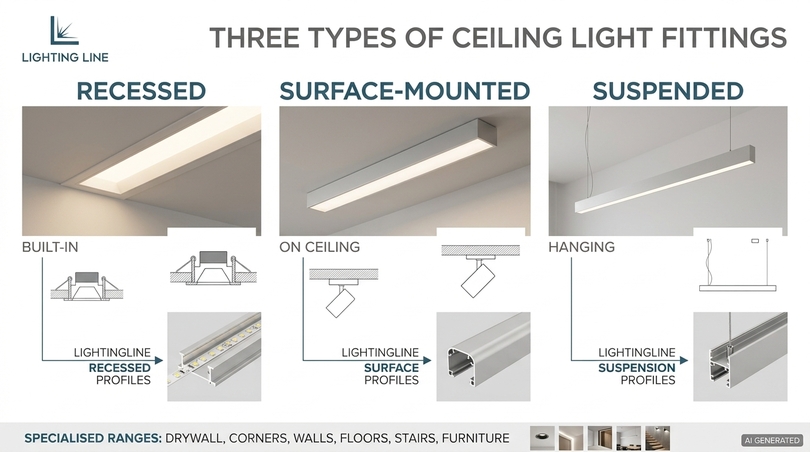
When people ask about the “three types” of ceiling light fittings, they usually mean the mounting method: recessed (built into the ceiling), surface-mounted (fixed onto it, including flush and semi-flush) and suspended (hanging from it). The same three categories organise the LightingLine aluminium profile range: recessed profiles, surface profiles and suspension profiles, plus specialised families for drywall, corners, walls, floors, stairs and furniture.
Market data: search demand, regulation and the LED transition
Good design decisions rest on good data. This section brings together three kinds of evidence: what people actually search for when they look for light fittings, what regulation now requires, and what the measurable performance differences between technologies are. Together they explain why linear LED light fittings have moved from niche to mainstream.
What people search for: monthly demand for light fittings and ceiling lighting
The table below shows how demand is distributed across the category of light fittings. Volumes are approximate monthly demands.
| Search term | Approx. monthly demands | What it tells us | |
|---|---|---|---|
| ceiling lighting / ceiling lights | 74,000-90,500 | Most people start by researching, not buying | |
| LED strip lights | 60,500 | Linear LED is now a mass-market interest | |
| LED strip lighting / LED strips lights | 27,100 | Strong overlap between research and purchase | |
| light fittings | 18,100 | The UK buying term: users are ready to choose | |
| LED light strips | 14,800 | Alternative phrasing of the same need | |
| bath / bathroom ceiling lights | 9,900-12,100 | Bathrooms are a high-value, regulation-sensitive niche | |
| LED ceiling lights / LED ceiling lighting | 9,900 | LED is assumed, not optional | |
| flush ceiling lights | 9,900 | Low ceilings are a widespread problem | |
| kitchen ceiling lights | 8,100 | Kitchens drive renovation budgets | |
| light fittings black | 5,400 | Black finishes remain a strong trend | |
| bedroom / living room ceiling lights | 5,400 each | Residential rooms are researched separately | |
| bathroom light fittings | 2,900 | Users need guidance on zones and IP ratings | |
| recessed lighting | 2,400 | Flush, integrated light is actively sought | |
| LED strip lights kitchen | 880 | Under-cabinet strips are a defined niche | |
| low ceiling lighting | 880 | Headroom problems generate purchase intent | |
| vaulted ceiling lighting | 480 | High-end, architect-led projects |
Three insights stand out. First, interest in LED strip lighting is now comparable to interest in ceiling lights themselves. Second, light fittings is a buying term: people who use it are close to a decision. Third, room-specific and problem-specific searches (low ceilings, bathrooms, kitchens) are where design guidance adds the most value.
Regulation: why the old lamps are disappearing
Much of the change in light fittings over the past decade has been driven by law rather than fashion. The main milestones for Europe and the UK are summarised below.
| Date | Measure | Effect on light fittings |
|---|---|---|
| 2009-2012 | EU phase-out of incandescent GLS lamps | Traditional bulbs for B22 and E27 light fittings withdrawn in stages |
| 2018 | EU phase-out of most mains halogen bulbs | Halogen replacements for standard fittings removed from sale |
| September 2021 | EU Ecodesign Regulation 2019/2020 and new energy label (Regulation 2019/2015), equivalent UK rules | Rescaled A-G energy label, stricter efficiency and flicker requirements; remaining halogen spots (GU10, MR16) largely withdrawn |
| February 2023 | EU RoHS exemption expiry for compact fluorescent lamps with integrated ballast | CFL bulbs withdrawn |
| August 2023 | EU RoHS exemption expiry for T5 and T8 linear fluorescent tubes | Fluorescent batten and tube light fittings moving to LED retrofit or replacement |
| 2023 onwards | UK phase-out of most fluorescent lamps (England, Scotland, Wales) | Same direction as the EU |
The practical conclusion for specifiers is simple: any new scheme should be designed around LED from the start. Questions such as “are light bulbs being phased out?” and “are fluorescent light fittings still legal?” now have a clear answer: existing fittings may remain in use, but replacement lamps are disappearing, so upgrading to LED light fittings is a matter of timing rather than choice.
Are bayonet light fittings being phased out?
No law bans B22 bayonet light fittings. The cap itself remains legal and LED bayonet bulbs are widely available. However, the market is gradually moving toward E27 screw caps across Europe and toward integrated LED light fittings everywhere, because they remove the lamp holder altogether. In new-build and major renovation work, bayonet fittings are becoming less common, while in UK replacement work they remain the norm.
Performance data: how the technologies compare
The following benchmarks are typical values used by lighting engineers. Individual products vary, so always check the data sheet.
| Light source | Typical efficacy (lm/W) | Typical rated life (hours) | Dimmable | Status in EU/UK |
|---|---|---|---|---|
| Incandescent (GLS) | 10-15 | 1,000 | Yes | Withdrawn |
| Mains halogen | 12-20 | 2,000 | Yes | Largely withdrawn |
| Compact fluorescent (CFL) | 50-70 | 8,000-10,000 | Rarely | Withdrawn |
| Linear fluorescent T5/T8 | 80-100 | 15,000-20,000 | With special ballast | Withdrawn |
| LED retrofit bulb | 80-150 | 15,000-25,000 | Some models | Standard |
| Integrated LED fitting / LED strip in profile | 90-160 (source), lower after diffuser | 30,000-50,000+ (L70/L80) | Yes, with suitable driver | Standard |
The US Department of Energy reports that residential LEDs use at least 75% less energy and last up to 25 times longer than incandescent lighting. For a typical renovation, switching the whole home from halogen to LED light fittings reduces lighting energy use by roughly three quarters, which is why energy efficiency now drives the specification as much as aesthetics.
Why aluminium profiles improve LED performance
LEDs are efficient, but the energy they do not turn into light becomes heat at the chip. Heat shortens LED life and shifts colour. An aluminium profile acts as a heat sink, drawing heat away from the strip and spreading it along the extrusion. This is why an LED strip mounted in a profile typically keeps its brightness and colour for far longer than the same strip stuck directly onto timber or plaster. The profile also protects the strip, hides the LEDs and, with the right diffuser, turns individual dots into a continuous line.
Types of light fittings: a complete classification
Clients rarely ask for a “luminaire with an IP44 rating and a UGR below 19”. They ask for “something nice over the island” or “a light that doesn’t make the ceiling feel lower”. Knowing the types of light fittings lets you translate those wishes into products. This section classifies light fittings by mounting, by light distribution and by application, and shows where linear LED profiles fit into each family.
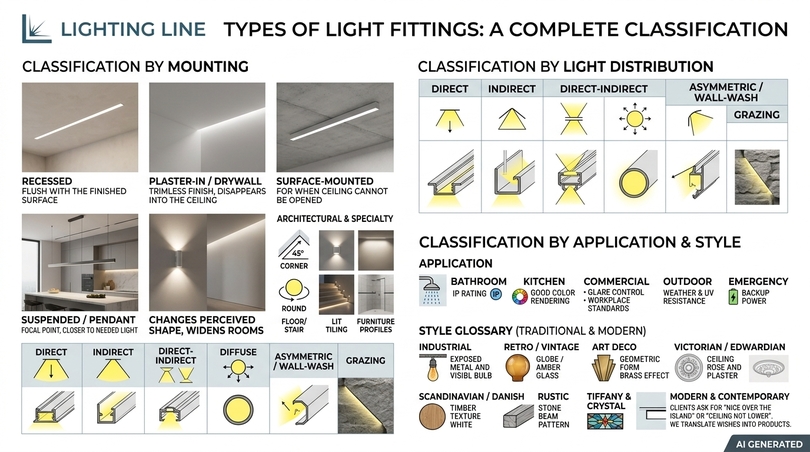
Types of ceiling light fittings by mounting
Recessed ceiling light fittings
Recessed light fittings sit inside the ceiling void so that the visible face is flush with the finished surface. Circular downlights are the familiar example, but recessed linear profiles are the fastest-growing category for architects, because they create lines of light that follow the geometry of the space rather than scattering dots across it.
LightingLine’s recessed aluminium profiles range from very slim channels such as the 8×9 mm LLP-RE09 family, which cuts a hairline into furniture or plasterboard, to wide channels such as the 67×22 mm LLP-RE04, which holds multiple strips for high output. Waterproof versions (RE07 and RE08, 32 mm wide) are designed for damp locations.
Plaster-in and drywall light fittings
For a completely trimless finish, drywall profiles are fixed to the plasterboard and then skimmed over, so the edge of the profile disappears into the ceiling. The result is a line of light that appears to be cut directly into the plaster, the signature detail of contemporary minimalist interiors. With fifteen drywall profiles in the catalogue, it is possible to create recessed lines, shadow gaps, cove lighting and ceiling-to-wall transitions within the same visual language.
Surface-mounted and flush ceiling light fittings
Where the ceiling cannot be opened, for example concrete slabs, listed buildings or rented flats, surface-mounted light fittings are the answer. Surface aluminium profiles are designed for exactly this situation. The ultra-slim 8×10 mm profile (SL03) and the tiny 8×5 mm profile (SL13) almost vanish on a white ceiling, while the 21×25 mm profile (SL01) and the 36×26 mm profile (SL02) accept wider or double strips for higher output.
Suspended and pendant light fittings
Pendant light fittings bring light closer to where it is needed and create a focal point. A linear suspension is the modern alternative to a row of pendants over a dining table, kitchen island, desk cluster or reception counter. Suspension profiles can be hung on steel cables to create continuous or segmented lines, with direct light downward and, in some designs, indirect light upward to the ceiling.
Wall light fittings and wall washers
Wall light fittings do more than light a wall: they change the perceived shape of a room. Wall profiles such as the WL series are designed for double-emission (up and down) lighting or for a wall-washer effect that lights a whole surface evenly. Washing a wall makes a narrow room feel wider and a low room feel taller, because the eye reads bright vertical surfaces as the boundaries of space.
Corner, round and architectural profiles
Corner profiles emit light at 45 degrees, which makes them ideal for the junction between wall and ceiling, inside cabinets and along shelving. Round profiles produce 360-degree light and work as hanging rods or wardrobe rails. Architectural profiles are larger sections for high-output and large-scale applications.
Floor, stair, tiling, concrete and furniture light fittings
Lighting has left the ceiling. Floor profiles create lit paths and thresholds, tiling profiles sit between tiles in showers and splashbacks; the concrete profile can be cast into walls and floors, baseboard and handrail profiles light stairs and corridors at low level, furniture and mirror profiles bring integrated light into joinery and bathrooms.
Types of light fittings by light distribution
| Distribution | How it works | Effect in the room | Linear LED equivalent |
|---|---|---|---|
| Direct | 90–100% of light goes downward | Efficient, focused, can create contrast and shadows | Recessed or surface profile with opal diffuser |
| Indirect | 90–100% of light goes upward or onto a wall | Soft, shadow-free, makes ceilings feel higher | Cove or drywall profile, suspension profile turned upward |
| Direct-indirect | Light goes both up and down | Balanced, comfortable for offices and living spaces | Double-emission suspension or wall profile |
| Diffuse | Light goes in all directions | Even, gentle, low glare | Round profile, frosted diffuser |
| Asymmetric / wall-wash | Light is thrown sideways onto a surface | Highlights texture and enlarges space | Wall-washer profile, corner profile |
| Grazing | Light skims a surface at a very low angle | Dramatises stone, brick, timber and plaster | Slim profile placed tight to the surface |
Types of light fittings by application
Applications bring their own requirements. Bathroom light fittings need suitable IP ratings. Kitchen light fittings need good colour rendering for food preparation. Commercial light fittings need glare control and compliance with workplace standards. Outdoor light fittings need weather and UV resistance. Emergency light fittings need backup power and certification. Later sections cover each in detail.
Traditional light fittings styles: a quick glossary
Clients often describe what they want by style rather than by type. Here is how common style names translate into specifications.
- Industrial light fittings: exposed metal, black or raw finishes, visible bulbs or linear lights in dark profiles. Pair black oxidised profiles with warm 2700 K strips.
- Retro and vintage light fittings (60s, 70s): globes, mushroom shapes, amber glass. Combine a vintage pendant with concealed linear background light.
- Art deco light fittings: geometric glass, brass and chrome, stepped forms. Echo the geometry with stepped cove lighting.
- Victorian and Edwardian light fittings: ceiling roses, glass shades, ornate plaster. Keep the rose, add discreet indirect light above cornices.
- Scandinavian and Danish light fittings: timber, white, soft diffusion. White painted profiles with opal diffusers.
- Rustic and antler light fittings: natural materials, heavy forms. Grazing light on stone or timber beams.
- Tiffany and crystal light fittings: coloured or cut glass. Use as decorative layer; supply ambient light separately.
- Modern and contemporary light fittings: minimal forms, integrated light, clean lines. This is where drywall and recessed profiles excel.
Are light fittings universal? Sizes, caps, voltages and safety classes
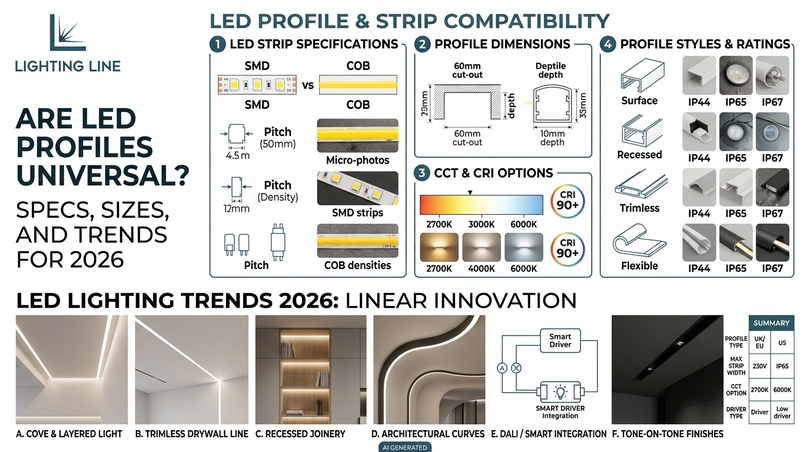
These are among the most searched questions about light fittings, and the answer to all of them is no. Compatibility depends on four things: the lamp cap, the voltage, the mounting system and the electrical safety class. This section explains each so that you can specify with confidence.
Are light bulb fittings universal? The main lamp caps
| Cap | Type | Diameter | Where you find it |
|---|---|---|---|
| B22 | Bayonet | 22 mm | Standard UK and Irish pendant and ceiling light fittings |
| B15 | Small bayonet | 15 mm | Small UK lamps, cooker hoods, chandeliers |
| E27 | Edison screw | 27 mm | Standard across continental Europe, common in UK designer fittings |
| E14 | Small Edison screw (SES) | 14 mm | Candle bulbs, chandeliers, small lamps |
| E26 | Edison screw | 26 mm | North America (not the same as E27 for certification purposes) |
| GU10 | Twist-lock bi-pin | 10 mm pin spacing | Mains-voltage spotlights and downlights |
| MR16 / GU5.3 | Bi-pin | 5.3 mm pin spacing | 12 V spotlights with transformer |
| G4 / G9 | Capsule bi-pin | 4 mm / 9 mm | Small decorative and cabinet fittings |
| G13 / G5 | Bi-pin tube | 13 mm / 5 mm | T8 and T5 fluorescent or LED tube light fittings |
A bulb will only fit a light fitting with the matching cap, and even then it must respect the maximum wattage and, for LED, the fitting’s heat and dimmer compatibility. Adaptors exist (for example B22 to E27), but they increase the length of the lamp, can overheat in enclosed fittings and should be avoided in professional work.
Are light fittings a standard size?
Ceiling light fittings follow common conventions rather than a single standard size. In the UK, most pendant and flush fittings mount to a ceiling rose or a BESA box (a round conduit box with two fixing lugs 51 mm apart). Downlights come in cut-out diameters from about 60 mm to 200 mm. Suspended ceiling panels are sized for 600×600 mm or 1200×600 mm grids. Linear LED profiles are supplied in standard lengths (typically 2 m and 3 m in the LightingLine range) and are cut to measure.
Can US light fittings be used in the UK?
Generally, no, not without modification and re-certification. North American light fittings are designed for 120 V; the UK and Europe use 230 V. US lamp holders (E26) are rated for 120 V, internal wiring and switches may be under-rated for 230 V, and the fitting will not carry UKCA or CE marking. A qualified electrician can sometimes rewire a US fitting with European-rated components, but this voids the original certification and responsibility shifts to whoever modified it. For projects, specify fittings built and marked for the market where they will be installed.
Why low-voltage LED systems simplify international projects
Most LED strips run at 12 V, 24 V or 48 V DC. The only mains-voltage component is the power supply, which is chosen for the local grid. This means the same profile and strip specification can be used in London, Milan or Dubai, with only the driver changing. LightingLine’s LED strips are available at 5 V, 12 V, 24 V and 48 V, plus 230 V versions for long runs without drivers.
Class 1, Class 2 and Class 3 light fittings: electrical safety classes
| Class | Protection method | Earth connection | Typical use |
|---|---|---|---|
| Class I | Basic insulation plus protective earth | Required | Metal-bodied light fittings, most commercial luminaires |
| Class II (double insulated) | Double or reinforced insulation | Not required | Plastic or insulated fittings, ceilings without an earth conductor |
| Class III | Supplied from safety extra-low voltage (SELV) | Not required | 12 V and 24 V LED strips and profiles powered by a SELV driver |
“Class 2 light fittings” and “double insulated light fittings” are popular searches because older UK homes often lack an earth conductor at the ceiling. If there is no earth, only a Class II fitting may be installed, or an earth must be added. LED strips powered from a SELV driver are Class III on the low-voltage side, which is one reason they are so versatile.
IP ratings and bathroom zones
The IP (Ingress Protection) code has two digits: the first for solids, the second for water. For light fittings the second digit matters most.
| Rating | Protection against water | Suitable for |
|---|---|---|
| IP20 | None | Dry indoor areas |
| IP44 | Splashing from any direction | Bathroom zone 2, kitchens, covered outdoor areas |
| IP65 | Water jets | Bathroom zone 1, showers, outdoor walls |
| IP67 | Temporary immersion | Bathroom zone 0 (with SELV at 12 V max), outdoor ground, fountains edges |
| IP68 | Continuous immersion | Pools and water features (as specified by manufacturer) |
Under BS 7671 (the UK Wiring Regulations), bathrooms are divided into zones. Zone 0 is inside the bath or shower tray, zone 1 is above it up to 2.25 m; zone 2 extends 0.6 m around zone 1. Outside these zones, standard rules apply, though IP44 is still good practice. Typical guidance: zone 0 requires IPX7 and SELV not exceeding 12 V AC or 30 V ripple-free DC, zones 1 and 2 are commonly specified at IP44 or better, with IP65 for areas exposed to jets. LightingLine offers IP65 and IP67 silicone LED strips and waterproof profiles for these applications. Always confirm the zone and IP requirement with the installing electrician.
Ceiling lighting trends 2026: what is in fashion and why
Trends in light fittings change more slowly than trends in furniture, because lighting is built into buildings. That makes it more important, not less, to understand where they are going. The trends of 2025 and 2026 share one idea: light as architecture rather than light as object. Here is what is driving specifications right now, and how to deliver each trend with profiles and strips.
Trend 1: the end of the single overhead light
Why does Gen Z hate overhead lighting?
It has become a social-media theme: the big light is out. Younger users describe a single central ceiling light as harsh, flat and unflattering, and prefer lamps, strips and indirect light. They are right about the physics: a single bright source on the ceiling lights the room from one point, creates hard shadows under eyes and furniture, leaves walls dim and makes the space look smaller. Layered, low-level and indirect light does the opposite.
For designers, this is an opportunity rather than a problem. The answer is not no ceiling light but no single ceiling light. Replace one central point with a combination of indirect cove lighting, wall washing and a decorative element, all on separate circuits or control channels.
Trend 2: invisible, integrated light
Trimless recessed lines, shadow gaps that glow, and lit reveals around doors and ceilings are the most recognisable contemporary lighting detail. They are delivered with drywall and recessed profiles fitted with high-density or COB strips, so the source is never seen. The light becomes part of the plaster.
Trend 3: dots-free, continuous lines
Early LED strips showed a visible row of dots through the diffuser. Clients no longer accept this. COB (chip-on-board) LED strips produce a continuous line of light without visible dots, even in shallow profiles. LightingLine’s catalogue includes 98 COB LED strips alongside 68 SMD LED strips, with densities up to several hundred LEDs per metre.
Trend 4: warm light and high colour rendering
The cool 6000 K “office white” that dominated early LED homes has given way to 2700 K and 3000 K with CRI above 90. Warm light is perceived as calmer and more residential: high CRI makes skin, food, timber and fabric look natural. Hospitality is moving even warmer, to 2200–2500 K for evening scenes.
Trend 5: tunable white and circadian lighting
Tunable white (CCT) strips let one installation shift from cool, energising light in the morning to warm, relaxing light in the evening. This supports human-centric or circadian lighting strategies in homes, offices, healthcare and hotels. A CCT COB strip ranging from 2700 K to 6500 K is an example of the technology.
Trend 6: black, dark and tone-on-tone finishes
Black light fittings remain popular: in linear lighting, black oxidised profiles disappear into dark ceilings, timber slats and industrial interiors, while white painted profiles vanish into white plaster. The trend is tone-on-tone: the profile matches the surface so that only the light is seen.
Trend 7: statement pendants with quiet backgrounds
The decorative pendant is not dead; it is being used more sparingly. One sculptural piece over a dining table, supported by invisible linear light elsewhere, is the typical 2026 composition. The pendant becomes an object; the architecture provides the light.
Trend 8: natural materials and organic lines
Timber slat ceilings, plaster curves, microcement and natural stone are everywhere. Flexible profiles such as the 18×6 mm bendable aluminium profile (LLP-SL04) follow curves, arches and organic ceiling forms, while grazing light reveals material texture.
Trend 9: smart, app-controlled and voice-controlled light
Smart lighting has moved from gadget to expectation. Scenes, schedules, presence detection and voice control are now requested in mid-range residential projects, not only in luxury homes. Protocols such as DALI-2, Zigbee, Bluetooth Mesh, Wi-Fi and Matter allow LED strips to join home-automation systems.
Trend 10: sustainability and repairability
Architects are increasingly asked to justify embodied carbon and end-of-life. Modular systems score well: aluminium is highly recyclable, strips and drivers can be replaced independently, and profiles outlive several generations of LED. This is a strong argument against sealed, non-repairable fittings.
Are downlights still fashionable?
Downlights remain useful but are no longer used as a grid across the whole ceiling. The swiss cheese ceiling of evenly spaced downlights is out of fashion; small, deep, low-glare downlights used purposefully, for example over a worktop or to accent a painting, remain fully current. Many designers now combine a few precise downlights with linear profiles for ambient light.
Trend summary table: ceiling light trends 2025–2026
| Trend | Rising or falling | How to deliver it with profiles and strips |
|---|---|---|
| Layered, low-glare light | Rising strongly | Separate circuits for cove, wall-wash and task strips |
| Trimless integrated lines | Rising strongly | Drywall profiles, plastered in, with COB strips |
| Warm white, CRI 90+ | Rising | 2700–3000 K high-CRI strips |
| Tunable white / circadian | Rising | CCT strips with compatible controller |
| Black and tone-on-tone finishes | Stable | Black oxidised or white painted profiles |
| Curved and organic lines | Rising | Flexible profiles and flexible diffusers |
| Smart control | Rising | DALI, Zigbee, Matter or Wi-Fi controllers |
| Grid of downlights | Falling | Replace with linear ambient light |
| Cool 6000 K in homes | Falling | Reserve for utility and technical areas |
| Fluorescent battens | Falling (regulation) | Surface profiles with high-output strips |
Materials and finishes: aluminium, glass, brass, copper and more
The material of a light fitting affects how it looks, how long it lasts, how it handles heat and how it ages. Architects are asked what materials are best for durable and stylish ceiling lights, in almost every residential brief. The honest answer is that the best material depends on whether the fitting is meant to be seen or to disappear.
Aluminium: the engineer’s material
Aluminium is the dominant material for LED light fittings for three reasons: it conducts heat well, it is light and easy to extrude into precise shapes, and it is highly recyclable. For linear lighting, aluminium is not a style choice but a performance requirement, because the profile is the heat sink that keeps the LED strip within its operating temperature.
Aluminium finishes
- Anodised silver: a natural, satin metallic finish; hard-wearing and neutral. Works with steel, glass and stone.
- Black oxidised: deep black that disappears in dark ceilings and industrial interiors; the most requested finish in current kitchens and bars.
- White painted: blends invisibly into white plaster and joinery; the natural choice for Scandinavian, minimalist and gallery-like spaces.
Many surface profiles in the LightingLine catalogue are available in silver, white and black, which lets you keep one profile family across a project while matching each surface.
Diffusers: the most underestimated component
The diffuser, sometimes called the cover or lens, decides whether a line of light looks premium or cheap. The same strip can look like a string of beads or a continuous glowing line depending on the diffuser and the distance between strip and cover.
| Diffuser type | Light transmission | Appearance | Best use |
|---|---|---|---|
| Transparent (clear) | Highest | LEDs visible, maximum output | Concealed coves where the source is never seen |
| Frosted | High | Softened light, some visibility of LEDs | Task lighting, under-cabinet |
| Semi-opal | Medium-high | Good balance of output and uniformity | General ceiling lines with medium-density strips |
| Opal | Medium | Uniform, milky line, dots-free with dense strips | Visible lines in ceilings, walls, furniture |
The diffusers category contains 28 covers matched to specific profile families. A practical rule: for a visible line with an opal cover in a shallow profile, use at least 240 LEDs per metre or a COB strip.
Glass light fittings
Glass remains the classic decorative material: clear glass pendants for industrial styles, opal glass globes for soft diffusion, fluted and ribbed glass for current retro trends, and crystal for traditional luxury. Glass is durable, easy to clean and does not yellow, but it is heavier and breakable. It is ideal for the decorative layer of a scheme, supported by concealed linear light.
Brass, copper and chrome light fittings
Brass light fittings (polished, brushed or antique) bring warmth and are central to art deco and luxury interiors. Copper light fittings suit industrial and eclectic styles and develop a patina over time. Chrome and satin chrome light fittings are the traditional bathroom choice because they are easy to clean and match taps. For linear systems, these metals appear in end caps, suspension hardware or adjacent decorative fittings, while the profile itself is usually anodised or painted aluminium.
Wood, concrete, plaster and plastic
Wooden light fittings suit Scandinavian and biophilic interiors but must be kept away from heat sources; LED makes wood far more practical than it was with halogen. Concrete offers a raw, monolithic look, and profiles can be cast directly into concrete walls. Plaster is the ultimate invisible housing when used with drywall profiles. Plastic light fittings are cheap and double-insulated but can yellow and become brittle over time.
Material durability comparison
| Material | Durability | Heat management | Recyclability | Style range |
|---|---|---|---|---|
| Anodised aluminium | Very high | Excellent | Excellent | Minimal, technical, contemporary |
| Painted aluminium | High | Very good | Very good | Invisible, tone-on-tone |
| Glass | High (breakable) | Neutral | Good | Classic to contemporary |
| Brass | Very high | Good | Excellent | Luxury, art deco, heritage |
| Copper | High (patinates) | Excellent | Excellent | Industrial, eclectic |
| Steel / stainless steel | Very high | Moderate | Excellent | Industrial, marine, commercial |
| Wood | Moderate | Poor (keep cool) | Good | Scandinavian, rustic, biophilic |
| Plastic / polycarbonate | Moderate | Poor | Limited | Budget, utility |
LED technology explained: COB, SMD, CRI, dimming and smart control
You do not need to be an electrical engineer to specify LED light fittings well, but you do need to understand six parameters. Most disappointing LED installations fail on one of them: dots, colour, flicker, heat, voltage drop or control. This section explains each in plain language and shows how to avoid the common mistakes.
SMD vs COB LED strips
SMD strips (surface-mounted device) carry individual LED packages, such as 2835, spaced along a flexible circuit board. They are efficient and available in many outputs, but individual points can be visible through a diffuser unless density is high or the diffuser is far from the strip. COB strips (chip-on-board) carry a very dense line of tiny chips under a continuous phosphor coating, producing a seamless line with a wide beam angle of about 180 degrees.
| Feature | SMD strip | COB strip |
|---|---|---|
| Appearance through opal cover | Dots visible at low density | Continuous, dots-free |
| Beam angle | About 120° | About 180° |
| Minimum profile depth for uniform light | Deeper | Very shallow |
| Typical efficacy | Very high on high-efficiency models | High; improving each generation |
| Cut interval | Varies by model | Often very short (for example 2–5 cm) |
| Best for | Concealed coves, high output, RGB | Visible lines, slim profiles, furniture |
Examples from the catalogue include a 2700 K COB strip, CRI above 90, 480 LEDs/m, 24 V, 10.5 W/m with 120 lm/W, suitable for residential ceiling lines, and a 7.5 W/m version with current control that keeps brightness uniform over longer runs.
Colour rendering index (CRI): why it matters
CRI (Ra) measures how faithfully a light source renders colours compared with a reference source, on a scale up to 100. Below CRI 80, skin looks grey and food looks unappetising; above CRI 90, materials look as the designer intended. For homes, restaurants, galleries, fashion retail and any space where people or products are judged by appearance, specify CRI 90 or higher. LightingLine strips are offered at CRI above 80, 85, 90 and 93.
Colour temperature (CCT) in kelvin
Colour temperature describes whether white light looks warm (yellowish) or cool (bluish). Lower kelvin values are warmer. The catalogue covers 2200 K, 2500 K, 2700 K, 3000 K, 3500 K, 4000 K, 5000 K and 6500 K, plus tunable CCT, RGB, RGB+CCT and addressable pixel options. The next section gives a room-by-room guide.
Voltage: 12 V, 24 V, 48 V or 230 V?
Current flowing through a long strip causes voltage drop, which makes the far end dimmer than the start. Higher voltage reduces current and therefore voltage drop.
- 12 V: short runs, furniture, cabinets, retrofit where 12 V drivers already exist.
- 24 V: the professional standard for most architectural runs; good balance of safety and run length.
- 48 V: long continuous runs with fewer feed points.
- 230 V: very long runs without drivers, typically in commercial or outdoor applications, with appropriate safety measures.
A current-controlled (constant-current IC) strip keeps light output uniform along the whole run, which is essential for long visible lines.
Dimmable LED light fittings: the options
What are the options for dimmable ceiling lighting is a key question for interior designers. Dimming is controlled by the driver, not the strip.
| Dimming method | How it works | Pros | Cons |
|---|---|---|---|
| TRIAC / phase-cut | Works with a compatible wall dimmer on the mains | Uses existing wiring, simple retrofit | Compatibility issues,possible flicker at low levels |
| 0–10 V / 1–10 V | Separate low-voltage control cable | Reliable, common in commercial | Extra wiring |
| DALI / DALI-2 | Digital addressable bus | Individual control, scenes, feedback, building-management integration | Higher cost, requires commissioning |
| PWM controller | Controller on the low-voltage side of the driver | Smooth dimming, RGB and CCT control | Must choose high-frequency PWM to avoid camera flicker |
| Wireless (Zigbee, Bluetooth Mesh, Wi-Fi, Matter) | Radio-controlled receiver | App and voice control, easy retrofit | Depends on ecosystem and network reliability |
Smart ceiling lights and home automation
Homeowners ask are there smart ceiling lights compatible with home automation systems and students ask are there affordable smart ceiling lights I can control with my phone. Both are well served by LED strips with a wireless controller. A 24 V strip, a suitable driver and a Zigbee, Wi-Fi or Matter controller give app control, schedules and voice assistants at a fraction of the cost of many branded smart fittings. For professional projects, DALI-2 offers the most robust integration with KNX and building-management systems.
Smart lighting in retail displays
Store owners can use scheduled scenes: brighter, cooler light during trading hours to energise; warmer, lower light for evening events; spotlight scenes that follow seasonal displays. RGB+CCT strips in shelving and window displays let one installation support multiple campaigns without rewiring.
What are the disadvantages of LED ceiling lights?
LED is the right technology, but honesty builds trust. The main disadvantages, and how to avoid them, are:
- Glare: bright, small sources can dazzle. Use diffusers, deeper profiles, indirect light and low-glare optics.
- Flicker: poor drivers can cause visible or camera-visible flicker. Specify quality drivers and high-frequency PWM.
- Poor colour: cheap LEDs have low CRI. Specify CRI 90+.
- Heat-related failure: strips without a heat sink degrade quickly. Always mount in an aluminium profile.
- Integrated fittings that cannot be repaired: choose modular systems where the strip and driver can be replaced.
- Dimming incompatibility: match driver and dimmer; test before handover.
- Higher initial cost: offset by lower running and maintenance costs.
Are LED light fixtures better?
On every objective measure that matters for a building, yes: efficiency, lifespan, controllability, compactness and design freedom. The quality gap is not between LED and older technologies, but between good and poor LED products. That is why specification detail matters.
What is the most efficient ceiling light?
The most efficient ceiling light fittings are LED fittings with high source efficacy, an efficient optic and a good driver, used with controls that cut unnecessary light. A high-efficacy strip (for example 120 lm/W at source) in a profile with an efficient diffuser, controlled by presence detection and daylight dimming, will outperform any bulb-based fitting. Efficiency is a system property, not a lamp property.
Brightness and Colour Temperature: choosing the right light for each room
“How do I choose the right brightness and colour temperature for my rooms?” is a question homeowners, designers and students all ask in different words. Brightness determines whether a room works; colour temperature determines how it feels. This section gives numbers you can use, along with the reasoning behind them.
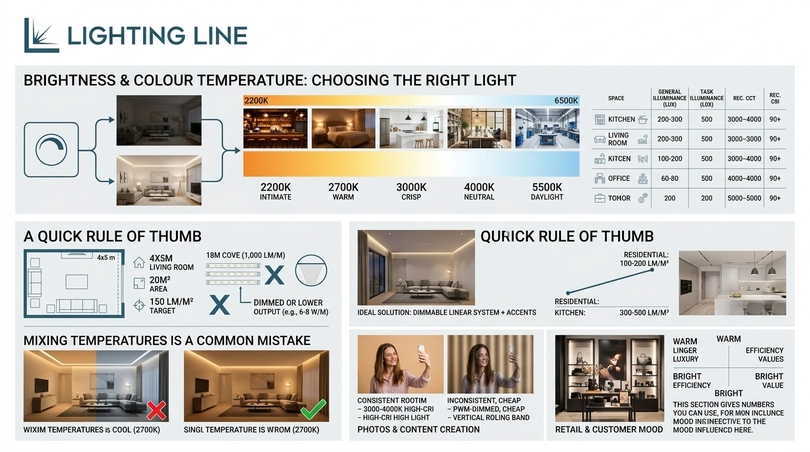
How much light do you need? Illuminance guidelines
Illuminance is measured in lux (lumens per square metre). The values below are typical design targets based on common practice and on standards such as EN 12464-1 for workplaces.
| Space | Typical general illuminance | Task illuminance | Recommended CCT | Recommended CRI |
|---|---|---|---|---|
| Living room / lounge | 100-200 lux | 300 lux for reading | 2700-3000 K | 90+ |
| Kitchen | 200-300 lux | 500 lux on worktops | 3000-4000 K | 90+ |
| Dining room | 100-200 lux | 200-300 lux on table | 2700 K | 90+ |
| Bedroom | 50-150 lux | 300 lux at mirror/wardrobe | 2700 K (2200-2500 K evenings) | 90+ |
| Bathroom | 150-300 lux | 500 lux at mirror | 3000-4000 K | 90+ |
| Hallway / landing / stairs | 100-150 lux | 150 lux on treads | 2700-3000 K | 80+ |
| Home office | 300 lux | 500 lux on desk | 3500-4000 K | 90+ |
| Retail sales floor | 300-500 lux | 750+ lux accent | 3000-4000 K | 90+ |
| Office | 300-500 lux | 500 lux at desk | 4000 K | 80–90+ |
| Restaurant / hotel lounge | 50-200 lux | Accent as needed | 2200-3000 K | 90+ |
A quick rule of thumb for ceiling lights
What is the rule of thumb for ceiling lights: for residential general lighting, a simple starting point is roughly 100-200 lumens per square metre for living spaces and 300-500 lumens per square metre for kitchens and work areas, delivered through several sources rather than one. For linear systems: multiply the strip output in lumens per metre by the length, then allow for diffuser losses (often 10–30% depending on cover type).
Worked example: a 4 x 5 m living room
Area: 20 m². Target: about 150 lm/m² for ambient light, so 3,000 lumens. Solution: an 18 m perimeter cove with a strip delivering about 1,000 lm/m would produce 18,000 lm at source, far more than needed, so dimming or a lower-output strip is appropriate. A 6-8 W/m high-efficiency strip in the cove, dimmed to 50-70%, plus two accent spotlights and a reading lamp, gives a flexible, comfortable scheme.
How do lighting temperatures affect room ambiance?
- 2200-2500 K: candle-like, intimate; bars, restaurants, bedrooms at night.
- 2700 K: the classic “warm white” of incandescent; living rooms, bedrooms, dining.
- 3000 K: warm but crisper, kitchens, bathrooms, hotels, fashion retail.
- 3500-4000 K: neutral white, offices, workshops, supermarkets, task areas.
- 5000-6500 K: cool daylight, technical areas, inspection, some healthcare. Rarely right for homes.
Mixing colour temperatures in the same view is the most common residential mistake. Choose one warm temperature for the main living areas and keep it consistent across all light fittings.
What colour light is best for a ceiling?
For most homes, 2700 K or 3000 K with high CRI. For indirect ceiling washes, slightly warmer light often looks best because it mimics evening skylight. For commercial ceilings, 3000 K or 4000 K depending on the brand and activity.
What lighting temperatures are best for taking photos at home?
Content creators and students often ask this. For photos and video, consistency matters more than any single number. Use one colour temperature throughout the frame (3000-4000 K is a good neutral compromise for phone cameras), choose CRI 90+ so skin tones look natural, and avoid cheap PWM dimming that produces rolling bands on camera. Soft, indirect light from a wall or ceiling wash is far more flattering than a single overhead light. A tunable CCT strip lets you match daylight from windows during the day and switch to warm light for evening shots.
How do ceiling lights influence customer mood and behaviour?
Retail research has long shown that lighting affects how long people stay, how they perceive quality and where they look. Warm, lower light encourages lingering and a sense of luxury; brighter, cooler light signals efficiency and value. Contrast guides attention: products lit at three to five times the ambient level stand out. For a furniture showroom, create room-like vignettes with warm ambient light and accent on key pieces, rather than lighting the whole floor uniformly.
Room-by-room light fittings ideas
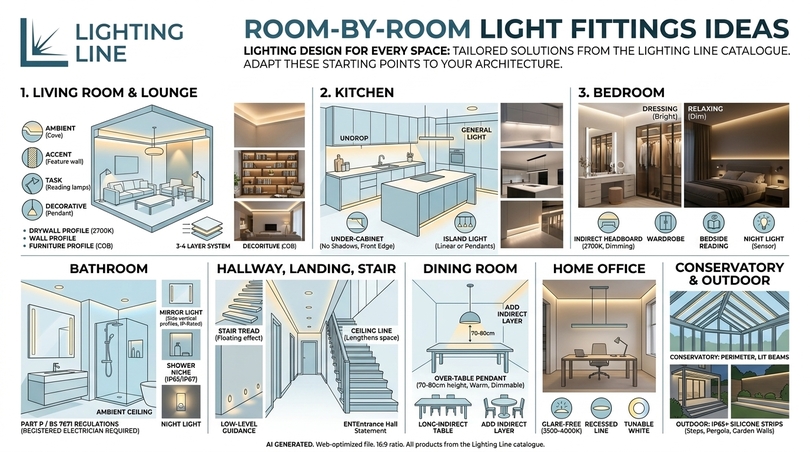
Every room asks a different question of its light fittings. A kitchen needs shadow-free worktops, a bedroom needs calm, a bathroom needs safety and a flattering mirror, a hallway needs guidance. Below, each room gets a design logic, a recommended layering strategy and concrete product combinations from the LightingLine catalogue. The combinations are starting points: adapt them to the architecture.
Living room and lounge light fittings
The living room is where the “big light” problem is most obvious. People search for “living room light fittings”, “lounge ceiling lights” and “best ceiling lights for living room” because they sense that one central fitting is not enough. The best living room light fittings are a system of three or four layers on separate controls.
Layering strategy
- Ambient: indirect cove light around the perimeter, or a recessed line along the long axis of the room.
- Accent: wall-wash on a feature wall, lit shelving or grazing light on a fireplace.
- Task: floor or table lamps for reading.
- Decorative: an optional statement pendant or sculptural fitting.
Product combinations
- Cove light in a plasterboard ceiling: a drywall profile designed for indirect light, with a 2700 K CRI 90+ strip.
- Cove light on existing ceilings: a corner profile fixed at the top of a wall or behind a timber batten.
- Feature wall wash: a wall profile mounted near the ceiling to graze a textured surface.
- Lit bookshelves: slim furniture profiles with COB strips.
What type of ceiling light is best for a living room? For most rooms, indirect linear light for ambience, plus accent and task lamps, gives a better result than any single ceiling light fitting. Where a central fitting is desired, choose a diffuse pendant on a dimmer and keep it as one layer among others.
Kitchen light fittings
Kitchens concentrate the hardest lighting problems: people stand between the ceiling light and the worktop, creating shadows exactly where they work. The solution is to light the worktop from above the work, not from behind the cook.
Key elements
- Under-cabinet light fittings: LED strips in slim surface or corner profiles under wall cabinets, positioned towards the front edge to avoid reflections on glossy worktops. 3000 K or 4000 K, CRI 90+.
- Island lighting: a linear suspension profile over the island replaces a row of pendants with one continuous line, or a trio of decorative pendants with a concealed recessed line for task light.
- General light: recessed profiles parallel to the worktops, or a small number of downlights over circulation areas.
- Plinth and toe-kick light: a low-level line under base units for night-time navigation.
- Inside cabinets and glass display units: slim profiles on door-activated switches.
A useful specification for under-cabinet light fittings is the 17×7 mm surface profile (LLP-SL17) or a corner profile, with an opal diffuser and a COB strip for a reflection-free line on glossy surfaces.
Bedroom light fittings
Bedrooms need two opposite things: bright, accurate light for dressing, and very soft light for relaxing. The most important bedroom light fitting is the one you can dim to almost nothing.
- Indirect ceiling or headboard light: a strip behind a headboard panel or in a ceiling cove, 2700 K, dimmable to very low levels.
- Wardrobe lighting: round profiles as lit hanging rails, or slim profiles on door sensors.
- Bedside reading light: directional wall lights or lamps.
- Under-bed night light: a very low-output strip on a motion sensor, a simple and much-appreciated detail.
Flush bedroom ceiling light fittings remain useful in rooms with low ceilings, but specify them on a dimmer and at 2700 K.
Bathroom light fittings
Bathroom light fittings combine safety rules with the most demanding visual task in the home: seeing your own face. The priority is even, shadow-free light at the mirror, from the sides or around it, rather than from above.
- Mirror lighting: the mirror profile or vertical profiles either side of the mirror, 3000–4000 K, CRI 90+.
- Shower niche and wet walls: tiling profiles with IP65/IP67 strips, installed according to bathroom zones.
- Ambient ceiling light: waterproof recessed profiles or IP-rated downlights.
- Night light: a low plinth strip on a sensor.
Bathroom light fittings regulations: in the UK, installation in a room containing a bath or shower is covered by BS 7671 and, in England and Wales, new circuits in a bathroom are notifiable under Part P of the Building Regulations. Use a registered electrician for any new wiring in bathrooms.
Hallway, landing and stair light fittings
Hallways are first impressions and landings are often forgotten. Linear light is exceptionally good at guiding movement, which makes it ideal for circulation spaces.
- Stair lighting: handrail profiles or strips recessed under each tread for a floating-stair effect.
- Corridor ceilings: a single recessed line along the length of the corridor visually lengthens it and leads the eye.
- Low-level guidance: baseboard profiles with motion sensors for night use.
- Entrance hall: a statement pendant or lantern where height allows, supported by concealed indirect light.
Dining room light fittings
Light over a dining table should make food and faces look good and should not glare. Hang pendants so the bottom is roughly 70–80 cm above the table, and choose warm, high-CRI light. A linear suspension works well over long tables; a cluster of pendants works over round tables. Add a dimmable indirect layer so the table light is not the only source.
Home office light fittings
Home offices need glare-free light on the desk and on screens. A direct-indirect suspension profile over the desk, or a recessed line parallel to the window wall, provides even light without reflections. 3500–4000 K for daytime work; tunable white lets the same space become a relaxed room in the evening.
Conservatory and orangery light fittings
Glazed roofs make conventional ceiling light fittings difficult. Perimeter lighting on the dwarf walls, lit beams and uplighting onto structural members keep the view of the sky clear. Surface profiles fixed to glazing bars or beams, with warm strips, are discreet solutions.
Small apartments and studio flats
Young professionals and students ask “what are the most stylish ceiling lighting options for small apartments?” and “how can I make my space look more vibrant?”. In a small space, light the walls and the ceiling, not the floor. Bright vertical surfaces make rooms feel larger. Practical ideas:
- A plug-in LED strip in a corner profile along the top of a wall, for instant indirect light without rewiring.
- A lit shelf or floating headboard as the “hero” feature for photos.
- RGB+CCT strips for flexible moods, but set to warm white for everyday life.
- Mirror and wardrobe lighting to double as make-up and outfit lighting for social media.
Outdoor light fittings
Outdoor light fittings must resist water, UV, temperature swings and corrosion. Use IP65 or higher, silicone-encapsulated strips and waterproof profiles, with drivers installed in dry, ventilated enclosures. Popular applications include step lights, façade lines, pergola lighting and garden walls. An example is the 3000 K COB strip, IP67, in extruded silicone tube, suitable for exposed locations when installed correctly.
Low ceilings, high ceilings and vaulted ceilings
Ceiling height changes everything. A fitting that is elegant under 3.5 m becomes a hazard under 2.3 m, and a scheme that works in a low flat disappears in a double-height hall. This section solves the three most common height problems, which together account for a large share of searches for light fittings.
What are the best lighting options for low ceilings?
With ceilings below about 2.4 m, avoid anything that hangs into the head zone. The best light fittings for low ceilings are those that make the ceiling look higher.
- Indirect uplighting onto the ceiling: a bright ceiling reads as higher. Use corner or wall profiles near the top of walls.
- Recessed linear light: drywall or recessed profiles sit flush and take no headroom.
- Ultra-slim surface profiles: where the ceiling cannot be opened, 8×5 mm or 8×10 mm profiles add only a few millimetres.
- Flush light fittings: if a decorative fitting is needed, choose flush rather than semi-flush.
- Wall lights: shift light sources to the walls to free the ceiling.
How do you illuminate a high ceiling?
High ceilings (above about 3.5 m) create two challenges: getting enough light to the floor, and making the space feel intimate. The best lighting for high ceilings combines light at human scale with light that reveals the height.
- Suspended linear light brought down to 2.5–3 m brings the effective ceiling closer.
- Uplighting from walls or suspensions reveals the volume, beams or coffers.
- Statement chandeliers or large pendants fill the volume visually.
- Wall washing at lower levels keeps the space human.
- High-output profiles such as architectural or wider recessed sections with double strips when light must come from the ceiling itself.
Vaulted and sloped ceilings
Vaulted ceilings are best lit indirectly. A continuous line along the ridge or along the wall plate, washing the slope, emphasises the geometry. Flexible and corner profiles can follow beams, suspension profiles can be hung from tie beams. Avoid scattering downlights across a slope, which looks random and produces uneven light.
How do you uplight a ceiling?
Uplighting a ceiling means directing light upward so that the ceiling becomes a large, soft reflector. Methods include coves (strips hidden in a ledge or dropped perimeter), wall-mounted profiles with upward emission, the top surface of a suspension profile, or strips on top of tall joinery. For even results, keep the strip at least 20–30 cm below the ceiling and use a strip with a wide beam. Matt white ceilings reflect best; glossy ceilings show hot spots.
How do you install a ceiling light without wiring?
Where there is no ceiling point, or where rewiring is not possible (rented flats, listed buildings), options include:
- Plug-in LED strips in profiles, powered by a plug-in driver, with a smart plug or wireless controller.
- Battery or rechargeable fittings for accent use.
- Swag pendants hung from a ceiling hook with the cable led to a wall socket.
- Tall floor lamps and uplighters that wash the ceiling.
Plug-in low-voltage strips are the most flexible: cable routes can run inside profiles along walls, and the scheme can move with the tenant.
What to use instead of ceiling lights
Many designers now light rooms with few or no ceiling light fittings at all. Alternatives include wall washers, coves, lit joinery, floor lamps, lit plinths and mirror lighting. The key is to cover the four layers of light even without a ceiling source.
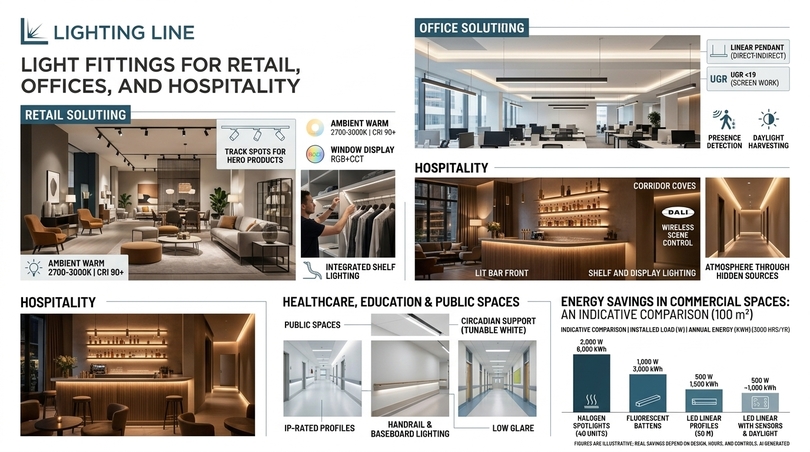
Light fittings for retail, offices and hospitality
Commercial projects change the priorities: energy costs are measured in kilowatt-hours per square metre per year, maintenance is scheduled and the lighting has a direct effect on revenue or productivity. Linear LED light fittings are particularly strong in commercial settings because they combine efficiency, brand-specific design and easy maintenance.
Retail and showroom lighting
Furniture store owners want to know which ceiling lighting options are most popular among my customers and if there are energy-saving ceiling lighting solutions suitable for commercial spaces.
- Room-set lighting: recreate the lighting of a real home in each vignette, so customers imagine the furniture in their space. Warm 2700–3000 K with CRI 90+.
- Accent lighting: track spots or lit shelves on hero products, at three to five times the ambient level.
- Shelf and display lighting: slim profiles on the front edge of shelves.
- Window displays: RGB+CCT strips for seasonal campaigns; timers and scenes for evening visibility.
- Selling lighting too: a store that sells furniture can demonstrate profiles and strips in its own displays, creating a new product line.
Which ceiling light fittings are most popular with customers?
Search data points clearly to LED ceiling lights, flush fittings, pendants for kitchens and dining rooms, black finishes, bathroom lights and LED strip lighting. Stocking a clear range across these categories, supported by demonstrations of linear lighting, meets most demand.
Office lighting
Office lighting in Europe is typically designed to EN 12464-1, with around 500 lux on desks and glare control expressed as UGR (Unified Glare Rating), commonly UGR below 19 for screen work. Linear suspended profiles with direct-indirect distribution are a classic office solution: they light the desk directly and the ceiling indirectly, reducing contrast and glare. Presence detection and daylight dimming reduce energy use further.
Hospitality: hotels, restaurants and bars
Hospitality lighting sells atmosphere. Warm light (2200-3000 K), low ambient levels, strong accents and hidden sources are the rules. Lit bar fronts, back-bar shelves, headboards, bathroom mirrors, corridor coves and façade lines are all natural applications of profiles and strips. DALI or wireless scene control lets staff change from breakfast to evening modes at the touch of a button.
Healthcare, education and public spaces
These environments need robust, easy-to-clean, low-glare light fittings and often benefit from tunable white for circadian support. Profiles with sealed covers and IP-rated strips resist cleaning; handrail and baseboard lighting help orientation at night.
Energy savings in commercial spaces: an indicative comparison
| Scenario (indicative, 100 m² space, 3,000 hours/year) | Installed load | Annual energy | Comment |
|---|---|---|---|
| Halogen spotlights (50 W each, 40 units) | 2,000 W | 6,000 kWh | High heat, frequent lamp changes |
| Fluorescent battens (legacy) | about 1,000 W | about 3,000 kWh | Lamps no longer available |
| LED linear profiles, 10 W/m, 50 m | 500 W | 1,500 kWh | Uniform light, low maintenance |
| LED linear profiles with presence and daylight control | 500 W | about 900–1,100 kWh | Savings depend on occupancy and daylight |
Figures are illustrative calculations to show orders of magnitude; real savings depend on design, hours and controls.
Project examples: budget, mid-range and premium light fittings schemes
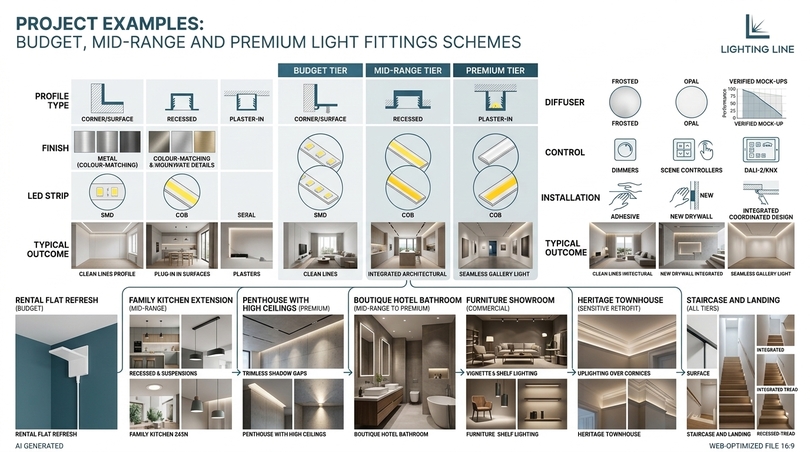
Architects are regularly asked to deliver the same design intent at three price points. The advantage of modular linear light fittings is that the visual language can stay the same while the components scale up or down. The following examples describe real-world typologies with indicative specifications. Prices vary with length, quantity and controls, so check live prices in the LightingLine catalogue or request a quote for the project.
How the three tiers differ
| Element | Budget tier | Mid-range tier | Premium tier |
|---|---|---|---|
| Profile type | Surface and corner profiles | Recessed profiles and selected drywall details | Plaster-in drywall profiles, suspension and architectural sections |
| Finish | Anodised silver or white | Colour-matched silver, white, black | Colour-matched throughout, bespoke lengths and joints |
| LED strip | SMD, CRI 80–90, 12 V or 24 V | COB or high-density SMD, CRI 90+, 24 V | COB CRI 90–93+, current-controlled, CCT or RGB+CCT where needed |
| Diffuser | Frosted or semi-opal | Opal | Opal with dots-free performance verified on mock-up |
| Control | On/off or plug-in dimmer | TRIAC or wireless dimming, 2–4 scenes | DALI-2 or KNX integration, tunable white, presence and daylight |
| Installation | Adhesive or clips on existing surfaces | Recessed into new plasterboard or joinery | Coordinated with plastering, joinery and M&E from design stage |
| Typical outcome | Clean lines, big improvement on a single ceiling light | Integrated architectural look | Seamless, gallery-quality light |
Example 1: rental flat refresh (budget)
Brief: a one-bedroom rental in a 1970s block with low concrete ceilings, a single central light in each room and a landlord who will not allow chasing of walls.
Solution:
- Living room: a plug-in 24 V strip in a 19 mm corner profile along the top of the longest wall, dimmable via a wireless controller. It washes the ceiling and makes the room feel higher.
- Kitchen: surface profiles under wall cabinets, 3000 K.
- Bedroom: a strip behind a freestanding headboard, 2700 K on a motion-sensor night mode.
- The central light fittings stay, fitted with warm LED bulbs, but they become one layer rather than the only light.
Result: the flat looks brighter and more expensive, energy use falls compared with the previous bulbs, and everything can be removed at the end of the tenancy.
Example 2: family kitchen extension (mid-range)
Brief: a rear extension with a 2.7 m flat plasterboard ceiling, rooflights, a 3 m island and a dining area.
Solution:
- Two parallel recessed profiles running the full length of the kitchen, aligned with the worktop edges, with 3000 K CRI 90+ COB strips.
- A linear suspension profile over the island, hung at about 80 cm above the worktop.
- Under-cabinet strips in slim surface profiles.
- Rooflight reveals lined with a concealed strip so the openings glow at night instead of becoming black holes.
- A decorative pendant over the dining table, 2700 K, on its own dimmer.
- Four scenes: cooking, dining, evening, night.
Result: shadow-free worktops, a warm dining zone and a ceiling composition that reads as architecture.
Example 3: penthouse with high ceilings (premium)
Brief: a 4 m high open-plan space with a double-height section, polished concrete floor, timber slat walls and a client who wants light without light fittings.
Solution:
- Trimless drywall profiles forming a shadow gap around the perimeter of the ceiling, glowing softly.
- Recessed lines cut through the ceiling following the structural grid.
- Grazing light on the timber slats from slim profiles hidden in the floor junction.
- A lit concrete wall with the concrete profile cast in during construction.
- Tunable white strips across the living zones, integrated with DALI-2 and the home-automation system.
- One monumental pendant in the double-height void.
Result: the architecture itself becomes the light fitting.
Example 4: boutique hotel bathroom (mid-range to premium)
Brief: 40 identical bathrooms, fast installation, easy maintenance, luxurious feel.
Solution: a mirror profile around the vanity mirror at 3000 K CRI 90+, tiling profiles in the shower niche with IP-rated strips, a low-level plinth strip on a sensor for night use, drivers located outside the zones in an accessible void. Standardised details across all rooms reduce installation time and simplify spares.
Example 5: furniture showroom (commercial)
Brief: an 800 m² showroom that looks like a warehouse; the owner wants customers to stay longer and buy premium pieces.
Solution: reduce general light, create room-set vignettes each with its own warm ambient cove and accent spots, add lit shelving for accessories and a feature suspension over the checkout. RGB+CCT in the window for campaigns. The store can also display the profiles as products, giving customers ideas for their own homes.
Example 6: heritage townhouse (sensitive retrofit)
Brief: a Georgian or Victorian house with ornate cornices and ceiling roses that must not be damaged.
Solution: keep the original ceiling roses with period-appropriate pendants; add concealed strips on top of cornices or on picture rails to uplight the ceilings; light bookcases and alcoves with slim profiles; use lamps for task light. Nothing is cut into historic plaster, yet the rooms gain layered, modern light.
Example 7: staircase and landing (all tiers)
Budget: a surface profile under the handrail. Mid-range: a handrail profile with integrated light. Premium: strips recessed under each tread for a floating effect, with a motion sensor that lights the stair progressively. Stair light fittings are one of the details clients photograph and share the most.
Installation: can you change light fittings yourself?
“Can I change a light fitting myself?”, “do you need an electrician to fit a ceiling light?”, “how much does an electrician charge to install a ceiling light in the UK?”. These questions carry real safety and legal weight. This section explains what is permitted, what should be left to professionals and how linear LED systems are installed. It is general guidance, not a substitute for local regulations or professional advice.
Can I change a light fitting myself in the UK?
In England and Wales, replacing an existing light fitting like-for-like on an existing circuit is generally not notifiable under Part P of the Building Regulations, provided the work is done safely and complies with BS 7671. Installing a new circuit, adding circuits in bathrooms, or work that changes the installation significantly is notifiable and is normally done by an electrician registered with a competent-person scheme, who then certifies the work. Scotland and Northern Ireland have their own rules.
Even where the law allows DIY, competence is the real requirement. You must isolate the circuit at the consumer unit, prove it dead with a suitable voltage tester, understand the existing wiring (including loop-in ceiling roses), connect earth correctly for Class I fittings, and ensure the new fitting is suitable for the location. If in doubt, use a qualified electrician.
Do you need an electrician to change a ceiling light?
Not always, but often it is the wise choice. Use an electrician when: there is no earth and the new fitting is Class I; the wiring is old or damaged; the fitting is in a bathroom or outdoors; you are adding new light points or switches; you are installing drivers for LED systems in concealed voids; or the fitting is heavy and needs structural fixing.
How much does an electrician charge to install a ceiling light in the UK?
Costs depend on location, access and complexity. As a broad guide, replacing a simple like-for-like ceiling light fitting is often quoted from roughly £50 to £150 per fitting, while new light points, chandeliers, high ceilings or complex integrated LED systems cost more because of labour, access equipment and certification. Always obtain written quotes that specify whether certification is included.
How do you replace a ceiling light fitting? Step by step
- Isolate: switch off and lock off the lighting circuit at the consumer unit; do not rely on the wall switch.
- Prove dead: test with an approved voltage indicator, checked on a known live source before and after.
- Record the wiring: photograph the existing connections, especially in a loop-in ceiling rose.
- Remove the old fitting and support its weight.
- Check the fixing: make sure the new fitting can be secured to a joist, noggin or suitable fixing box.
- Connect: live (brown), neutral (blue) and earth (green/yellow) according to the fitting instructions, using suitable connectors.
- Fix and test: secure the fitting, restore power and test operation.
How do you fit a ceiling rose?
A ceiling rose typically contains terminals for the permanent live (loop), the switched live, the neutral and earth. In a loop-in system, several cables arrive at the rose: identifying them correctly is essential, and the switched live returning from the switch should be sleeved or marked brown. Because miswiring can leave parts live even when the switch is off, fitting a ceiling rose is a task where many people choose an electrician.
Are ceiling light fixtures easy to replace?
Simple pendants and flush fittings are straightforward for a competent person. Recessed downlights may need a larger or smaller hole, and fire-rated fittings may be required where ceilings form a fire barrier. Integrated LED profiles are easy to maintain if designed for access: the diffuser clips out, the strip can be replaced, and drivers are located in accessible positions.
How to install LED strips in aluminium profiles
- Plan: measure runs, choose profile, diffuser, end caps and mounting brackets; calculate strip power and driver size (allow about 20% headroom).
- Plan feed points: for long runs, feed from both ends or the middle to limit voltage drop.
- Cut the profile to length with a fine-tooth saw; deburr the ends.
- Cut the strip only at the marked cut points.
- Connect the strip using solder or suitable PCB LED strip connectors.
- Stick the strip to the clean, dry inside of the profile, pressing along its length.
- Insert the diffuser and fit the end caps.
- Mount the profile with mounting brackets, screws, clips or adhesive; for drywall profiles, fix before skimming and protect the channel during plastering.
- Connect the driver (mains side by a competent person) and test before closing any access.
What are the easiest ceiling lights to install for a DIY project?
For homeowners without electrical experience, plug-in low-voltage LED strips in surface or corner profiles are the easiest: the only mains connection is a plug. Next come like-for-like replacements of flush or pendant fittings using existing wiring. Recessed and drywall profiles are best planned with a contractor, because they involve cutting or plastering.
Prices and cost factors: why some light fittings cost more
“Why are ceiling lights so expensive?” and “are cheap light fixtures safe?” are both common searches, and they are two sides of the same question. Price in light fittings reflects materials, optics, electronics, certification and design, and the cheapest option is often the most expensive over its life.
What drives the cost of light fittings
| Cost factor | Lower cost | Higher cost | Why it matters |
|---|---|---|---|
| Materials | Plastic, thin steel | Extruded aluminium, brass, glass | Heat management, durability, finish |
| LED quality | Low CRI, wide binning | CRI 90+, tight colour consistency | Colour quality and match between fittings |
| Driver | Basic, non-dimmable | Flicker-free, dimmable, DALI | Comfort, lifespan, control |
| Optics | Simple cover | Engineered diffuser or lens | Glare and uniformity |
| Certification | Minimal | Full CE/UKCA, tested photometry | Safety and legal compliance |
| Design | Generic | Original designer piece | Aesthetics and uniqueness |
| Installation | Plug-in, surface | Recessed, plastered, integrated | Labour and coordination |
Are cheap light fixtures safe?
Not necessarily. Very cheap light fittings, especially from unknown online sellers, may lack proper insulation, use under-rated cables, overheat, or carry false markings. Buy from established suppliers, check for CE or UKCA marking, the manufacturer’s name and address, the safety class and the IP rating, and keep instructions. Cheap LED strips without heat sinks may also fail early and shift colour.
How to get affordable light fittings without losing quality
Budget-conscious clients and retailers want “the best budget-friendly ceiling lights without compromising quality”. Spend on what you see and what runs every day; save on what is hidden or rarely used.
- Invest in good strips and drivers for main living areas; use simpler options in storage and utility rooms.
- Use standard profile lengths and minimise corners and bespoke joints.
- Choose surface profiles over recessed where construction is costly.
- Specify one colour temperature across the project to simplify stock.
- Design for replacement: modular systems cost less over time.
Total cost of ownership: an example
Consider a 10 m line of light used 4 hours per day. A 10 W/m LED strip consumes 100 W, or about 146 kWh per year. At an illustrative €0.30 per kWh, that is roughly €44 per year. An equivalent output from halogen spotlights could consume three to five times as much and require regular lamp changes. Over ten years, running and maintenance costs often exceed the purchase price of the light fittings, which is why efficiency and lifespan should weigh heavily in every specification.
Maintenance, lifespan and replacement
A light fitting is a long-term component of a building. Planning for maintenance at the design stage is the difference between a scheme that ages gracefully and one that is torn out in five years.
How long do LED light fittings last?
LED life is usually expressed as L70 or L80: the hours until light output falls to 70% or 80% of its initial value. Good LED strips in well-designed aluminium profiles are commonly rated at 30,000–50,000 hours or more. At 4 hours per day, 50,000 hours is more than 30 years of use. Heat is the main enemy: the cooler the LED, the longer it lasts, which is why profiles matter. Drivers often have shorter lives than LEDs, so they should be accessible.
Cleaning light fittings
- Switch off and let the fitting cool.
- Dust diffusers with a soft, dry microfibre cloth.
- For stubborn dirt, use a slightly damp cloth with mild detergent; avoid solvents that can cloud polycarbonate or PMMA diffusers.
- Glass shades can be washed; dry thoroughly before refitting.
- In kitchens, clean more often, as grease reduces light output.
Replacing LED strips and drivers
In a modular profile system, the diffuser clips out, the old strip peels away and a new one goes in, often without touching the plaster. This makes linear light fittings among the most maintainable in a building, provided the design includes access to drivers and connections.
Ceiling light fitting spare parts and accessories
Keep a small stock of diffusers, end caps, brackets, connectors and a matching strip reel for larger projects. Colour consistency between batches is a real issue in LED, so ordering spares with the original batch is good practice for premium projects.
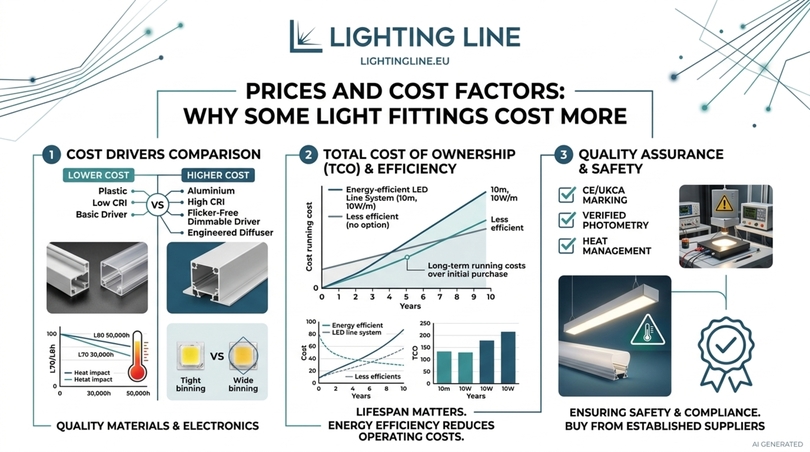
Finished fittings from high-street retailers vs modular LED systems
Many searches for light fittings include a retailer’s name: light fittings Screwfix, ceiling light fittings Screwfix, light fittings B&Q, Argos light fittings, light fittings IKEA, John Lewis light fittings, Dunelm, Next, Wilko, Homebase or The Range. These retailers sell finished, ready-to-hang light fittings; LightingLine supplies the components architects use to build light into the building itself. The two approaches are complementary, and understanding the difference helps you choose.
| Criterion | Finished light fittings from DIY and home retailers | Modular LED profiles and strips |
|---|---|---|
| What you buy | A complete pendant, flush light, spotlight or batten | Profile, strip, diffuser, end caps, brackets, driver |
| Design freedom | Choose from a range of ready designs | Any length, line, shape or pattern |
| Integration with architecture | Sits on or hangs from the ceiling | Recessed, plastered-in, built into joinery, stairs, walls |
| Installation | Straightforward on existing points | Requires planning; plug-in options for simple DIY |
| Repairability | Often replaced as a whole | Components replaced individually |
| Ideal for | Decorative layer, quick replacements | Ambient, task and accent layers; architectural projects |
A typical successful scheme uses both: a decorative pendant bought from a retailer or designer brand, with ambient and task light provided by integrated linear light fittings.
Which ceiling light brand is best?
There is no single best brand for every job. For decorative pieces, choose by design and build quality. For integrated lighting, choose suppliers who publish full technical data (lumens, CRI, CCT, power, IP rating, cut points, profile dimensions and photometric tests) and who offer technical support. LightingLine publishes profile dimensions, suitable PCB widths, installation drawings and photometric tests on product pages, and its staff provide technical support for project selection.
The architect’s specification checklist for light fittings
Before issuing a lighting specification, work through this checklist. It captures the decisions that most often cause problems on site if left open.
| Decision | Questions to answer |
|---|---|
| Layers | Have ambient, task, accent and decorative layers been defined for each room? |
| Light levels | What lux targets apply? Have lumens per metre been calculated after diffuser losses? |
| Colour | One CCT per zone? CRI 90+ where appearance matters? Tunable white needed? |
| Profile | Surface, recessed, drywall, corner, suspension, wall or special? Finish matched to surface? |
| Diffuser | Opal, semi-opal, frosted or clear? Dots-free performance verified? |
| Strip | COB or SMD? Voltage? Power per metre? Cut interval compatible with lengths? |
| Feed and voltage drop | Feed points and maximum run length defined? |
| Drivers | Size with headroom, dimming protocol, location, ventilation, access? |
| Controls | Scenes, dimming, presence, daylight, integration with home automation or BMS? |
| Safety | Electrical class, IP rating, bathroom zones, fire-rated ceilings, emergency lighting where required? |
| Installation sequence | Profiles fixed before plastering? Protection during works? Mock-up approved? |
| Maintenance | Access to drivers and connections? Spares ordered from same batch? |
| Sustainability | Efficacy, lifespan, recyclability, repairability documented? |
FAQ: light fittings questions answered
These are the questions architects, designers, retailers and homeowners ask most often about light fittings, answered briefly. Click or tap a question to open the answer. Longer explanations are in the relevant sections above.
Are all ceiling light fittings the same?No. Ceiling light fittings differ in mounting (recessed, surface, suspended), lamp cap (B22, E27, E14, GU10), electrical class (Class I, II or III), IP rating and weight. Always check that a new ceiling light fitting matches the existing supply, the fixing point and the room’s requirements, especially in bathrooms and ceilings without an earth conductor. |
Are light fittings universal?Light fittings are not universal. Lamp caps, voltages and mounting systems vary between countries and product types. In the UK most pendants use B22 bayonet or E27 screw lamp holders on a ceiling rose, while spotlights use GU10 or MR16. Low-voltage LED strips simplify compatibility because only the driver depends on the local grid. |
Are light bulb fittings universal? Can any light bulb go into any fixture?No. A bulb must match the lamp holder cap (for example B22, E27, E14 or GU10), respect the fitting’s maximum wattage and suit its enclosure and dimmer. LED bulbs in sealed light fittings need to be rated for enclosed use. Adaptors exist but are not recommended for professional installations. |
Are light fittings a standard size?There is no single standard size, but there are common conventions. UK ceiling light fittings usually mount on a ceiling rose or a BESA box with 51 mm fixing centres, downlights have standard cut-outs, suspended-ceiling panels fit 600×600 mm grids, and LightingLine aluminium profiles come in standard 2 m and 3 m lengths that are cut to measure. |
Are lights considered fixtures or fittings when selling a house?In UK property sales, wired-in light fittings are usually treated as fixtures that stay with the property, while bulbs, lampshades and plug-in lamps are often treated as fittings or contents. The TA10 Fittings and Contents Form records exactly what stays. Integrated LED profiles are almost always fixtures because they are built into the fabric. |
Are lampshades fixtures and fittings?Lampshades are generally treated as removable fittings rather than fixtures, because they can be taken off without damaging the property. Sellers who remove them should leave the light fittings safe and working. Agree anything unusual in writing through the fittings and contents form. |
Are bayonet light fittings being phased out?No law bans B22 bayonet light fittings, and LED bayonet bulbs are widely sold. However, new projects increasingly use E27 screw caps or integrated LED light fittings with no replaceable bulb, so bayonet fittings are gradually becoming less common in new-build and major renovation work. |
Are light bulbs being phased out?Most incandescent, halogen and fluorescent lamps have been phased out in the EU and UK through Ecodesign and RoHS rules between 2009 and 2023. LED lamps and integrated LED light fittings are the standard replacement. Existing light fittings can often be kept and fitted with LED lamps of the same cap. |
Are LED light fixtures better?Yes, in almost every measurable respect: LED light fittings use at least 75% less energy than incandescent lighting, last many times longer, dim smoothly with the right driver and allow slim, integrated designs. The key is choosing good-quality LEDs with high CRI, flicker-free drivers and proper heat management in an aluminium profile. |
Are LED ceiling lights a good idea?LED ceiling lights are the best choice for new and renovated spaces because of their efficiency, lifespan and design flexibility. For the most comfortable result, combine LED ceiling light fittings with indirect and accent light rather than relying on one bright central fitting. |
Are cheap light fixtures safe?Not always. Very cheap light fittings may have poor insulation, under-rated wiring or false safety marks. Buy from reputable suppliers and check for CE or UKCA marking, the manufacturer’s details, the electrical safety class and the IP rating. Cheap LED strips without an aluminium heat sink may fail early. |
Are Dunelm, IKEA or other high-street lights double insulated?Some are and some are not. Double-insulated (Class II) light fittings carry a double-square symbol on the label and in the instructions. Check each product individually rather than assuming by brand, particularly if your ceiling has no earth conductor. |
Are downlights still fashionable?Downlights are still used, but the grid of evenly spaced downlights across a whole ceiling is out of fashion. Designers now use a few low-glare downlights for precise tasks or accents and rely on linear LED profiles, coves and wall washing for ambient light. |
Can I change a light fitting myself in the UK?In England and Wales, a competent person can usually replace an existing light fitting like-for-like without notifying Building Control, provided the work complies with BS 7671. New circuits, work in bathrooms and major alterations are generally notifiable and should be done by a registered electrician. Always isolate the circuit and prove it dead first. |
Can you change light fixtures without an electrician?Yes, for simple like-for-like replacements if you are competent and the wiring is in good condition. Use an electrician if there is no earth for a Class I fitting, the wiring is old, the location is a bathroom or outdoors, or you are adding new light points, switches or LED drivers. |
Can US light fittings be used in the UK?Generally not without rewiring and re-certification. US light fittings are designed for 120 V with E26 lamp holders, while the UK uses 230 V. Components may be under-rated and the fitting will lack UKCA or CE marking. Specify light fittings made for the local market. |
Can anyone fit a ceiling light?Legally, the work must be done by a competent person and meet the Wiring Regulations. In practice, anyone who cannot confidently isolate, test and correctly connect the circuit, including loop-in ceiling roses, should use a qualified electrician. |
Do you need an electrician to fit a ceiling light?For like-for-like replacements, not necessarily, if you are competent. For new light points, bathroom light fittings, outdoor lighting, heavy chandeliers or integrated LED systems with drivers in ceiling voids, an electrician is strongly recommended and may be required for certification. |
How much does an electrician charge to install a ceiling light in the UK?As a broad guide, replacing a simple ceiling light fitting is often quoted from about £50 to £150, depending on region and access. New light points, high ceilings, chandeliers and integrated LED schemes cost more. Ask for written quotes that confirm whether certification is included. |
How do you fit a ceiling rose?Isolate the circuit, prove it dead and photograph the existing wiring. Connect the loop, switched live, neutral and earth conductors to the correct terminals, marking the switched live as live. Fix the rose securely to a joist or noggin. Because miswiring can leave parts live, many people use an electrician for this task. |
How do you install a ceiling light without wiring?Use plug-in LED strips in aluminium profiles powered by a plug-in driver, battery or rechargeable light fittings, swag pendants led to a wall socket, or tall uplighters that wash the ceiling. Plug-in low-voltage strips are the most flexible option for rentals and listed buildings. |
How do you illuminate a high ceiling?Combine light at human scale with light that reveals the height: suspended linear profiles at 2.5 to 3 m, uplighting onto beams or coffers, wall washing at lower levels and, where appropriate, a large statement pendant. High-output architectural or wide recessed profiles provide strong ambient light from the ceiling. |
How do you uplight a ceiling?Direct light upward from a cove, a wall-mounted profile, the top of a suspension profile or tall joinery. Keep the LED strip at least 20 to 30 cm below the ceiling and use a wide-beam strip for an even wash. Matt white ceilings give the smoothest result. |
How do I know what ceiling light to buy?Start with the room’s ceiling height, size and use, then decide the lighting layers you need. Choose the mounting type (recessed, flush, semi-flush, pendant or linear profile), the colour temperature (usually 2700 to 3000 K at home), CRI 90+ where appearance matters, and whether you need dimming or smart control. |
How to choose ceiling lights for a living room?Avoid relying on one central fitting. Use indirect cove or recessed linear light for ambience, wall washing or lit shelves for accent, lamps for reading and, if you like, a decorative pendant. Choose warm 2700 K light, CRI 90+ and dimmable drivers on separate circuits or scenes. |
What is the trend for ceiling lights in 2026?The main 2026 trends are layered, low-glare lighting instead of a single overhead light, trimless plastered-in linear LED profiles, dots-free COB strips, warm high-CRI light, tunable white, black or tone-on-tone finishes, curved lines and smart control. Statement pendants remain popular as single decorative pieces. |
What are the lights called that go in the ceiling?Lights set into the ceiling are called recessed lights or downlights; small directional ones are often called spotlights. Continuous lines of light set into the ceiling are recessed linear LED profiles, and trimless versions plastered into the ceiling are drywall or plaster-in profiles. |
What is a flush ceiling light?A flush ceiling light, also called a flush mount or close-to-ceiling light, is a light fitting mounted directly against the ceiling with no gap or stem. It is ideal for low ceilings, bedrooms and landings because it takes almost no headroom. |
What is a ceiling lantern?A ceiling lantern is an enclosed light fitting with glass panels inside a metal frame, either hung as a pendant or mounted flush. It is a traditional choice for hallways, porches and period interiors. |
What is a ceiling pendant?A ceiling pendant is a light fitting suspended from the ceiling on a cable, chain or rod. Pendants bring light closer to tables, islands and counters and act as decorative focal points. |
What type of ceiling light gives the most light?High-output LED light fittings give the most light per watt. For a ceiling, wide recessed or architectural profiles with high-lumen strips, LED panels or multiple downlights deliver high levels. However, perceived brightness also depends on lighting walls and ceilings, not just the floor. |
What type of lighting is best for high ceilings?Suspended linear light, uplighting and large pendants work best, supported by wall washing at human height. This combination delivers enough light at floor level while revealing the volume of the space. |
What are the best lighting options for low ceilings?Recessed linear profiles, ultra-slim surface profiles, flush light fittings, wall lights and indirect uplighting onto the ceiling. A brightly lit ceiling makes a low room feel taller. |
What is the difference between a pendant light and a ceiling light?Ceiling light is the general term for any light fitting attached to the ceiling. A pendant light is a type of ceiling light that hangs down on a cable, chain or rod, while flush and recessed ceiling lights stay tight to or inside the ceiling. |
What is the difference between a downlight and a ceiling light?A downlight is recessed into the ceiling and directs light downward. A surface ceiling light sits on the ceiling and usually spreads light sideways and upward as well, which lights the ceiling and makes a room feel brighter. |
What are the 4 types of lighting?Ambient (general), task, accent and decorative lighting. Good schemes combine all four, using different light fittings on separate controls. |
What are the three types of ceiling lights?By mounting method: recessed (built into the ceiling), surface-mounted (including flush and semi-flush) and suspended (pendants, chandeliers and linear suspensions). |
What is the rule of thumb for ceiling lights?A useful starting point for homes is about 100 to 200 lumens per square metre in living spaces and 300 to 500 lumens per square metre in kitchens and work areas, spread across several sources. Hang pendants about 70 to 80 cm above a dining table. |
What is the most efficient ceiling light?An LED light fitting with high source efficacy, an efficient diffuser and a good driver, controlled by dimming, presence detection or daylight sensors. Efficiency depends on the whole system, not only on the LED. |
What are the disadvantages of LED ceiling lights?Poor-quality LED light fittings can cause glare, flicker, low colour rendering, early failure from overheating and dimmer incompatibility, and some integrated fittings cannot be repaired. Choosing high-CRI strips, quality drivers, aluminium profiles and modular designs avoids these issues. |
Which colour light is best for a ceiling?For homes, warm white 2700 K or 3000 K with CRI 90+. For offices, 4000 K. For hospitality, 2200 to 3000 K. Keep the same colour temperature throughout a space. |
Which ceiling light brand is best?It depends on the role. For decorative pieces, choose by design and build quality. For integrated lighting, choose suppliers who publish full technical data, photometric tests and installation details and who offer project support, as LightingLine does for its profiles and LED strips. |
Why does Gen Z hate overhead lighting?A single bright overhead light flattens faces, creates hard shadows and leaves walls dim, which looks unflattering in person and on camera. Younger users prefer lamps, strips and indirect light, which create warmer, layered, more photogenic rooms. |
Why are ceiling lights so expensive?Price reflects materials, LED quality, drivers, optics, certification, design and installation complexity. Quality light fittings last longer and use less energy, so their total cost of ownership is often lower than cheaper alternatives. |
How can I reduce my electricity bill with new ceiling lighting?Replace halogen and fluorescent lighting with LED light fittings, use dimmers and scenes, add presence sensors in circulation areas, light surfaces efficiently rather than over-lighting floors, and turn to task lighting instead of raising general light levels. |
Are there customizable options for ceiling lighting fixtures?Yes. Modular LED systems are highly customisable: aluminium profiles are cut to any length, strips are cut at short intervals, diffusers and finishes vary, and colour temperature, output and control can be chosen per zone. LightingLine’s production unit can also produce customisable LED strips. |
What materials are best for durable and stylish ceiling lights?Extruded aluminium is the best technical material for LED light fittings because it manages heat and resists corrosion. Glass, brass and copper are durable choices for decorative fittings. Plastic is economical but less durable. |
What lighting temperatures are best for taking photos at home?Use one consistent colour temperature in the frame, typically 3000 to 4000 K, with CRI 90+ and flicker-free dimming. Soft indirect light from walls or ceilings is far more flattering than a single overhead light. |
20. Light fittings as architecture
The question is no longer which light fitting to hang from the ceiling, but how light should shape the space. In 2026 the most successful light fittings are the ones people barely notice as objects: lines of warm, high-quality light that follow the architecture, supported by a few carefully chosen decorative pieces.
For architects and designers, the method is consistent across budgets and building types:
- Design in layers: ambient, task, accent and decorative, each on its own control.
- Light surfaces, not just floors: walls and ceilings define how large and comfortable a room feels.
- Specify quality numbers: CRI 90+, one consistent colour temperature, flicker-free drivers.
- Use aluminium profiles to protect LED strips, manage heat and create dots-free lines.
- Plan installation and access early: feed points, drivers, plastering sequence and maintenance.
- Respect the rules: electrical classes, IP ratings, bathroom zones and local notification requirements.
Whether the project is a rental refresh, a family kitchen, a boutique hotel or a penthouse, the same modular components can deliver it. Explore the full range of aluminium profiles and LED strips in the LightingLine catalogue, download the profiles catalogue and the LED strip catalogue, or contact the LightingLine technical team for help choosing the right light fittings for your next project.
Quick product finder
| If you need… | Start with |
|---|---|
| A trimless line in a plasterboard ceiling | Drywall profiles |
| A flush line in ceilings, joinery or furniture | Recessed profiles |
| Light on a concrete or existing ceiling | Surface profiles |
| A linear pendant over an island, table or desk | Suspension profiles |
| Indirect cove light or 45° light | Corner profiles |
| Wall washing or up/down wall light | Wall profiles |
| Curves and organic shapes | Flexible 18×6 mm profile |
| Stairs and corridors | Handrail and baseboard profiles |
| Showers and splashbacks | Tiling profiles with IP-rated strips |
| Large-scale, high-output lines | Architectural profiles |
| Dots-free light in slim profiles | COB LED strips |
| High output, RGB or concealed coves | SMD LED strips |
This article was developed with the support of artificial intelligence and subsequently reviewed, corrected, and validated by the LightingLine.eu technical team, which guarantees its reliability and compliance with official sources.