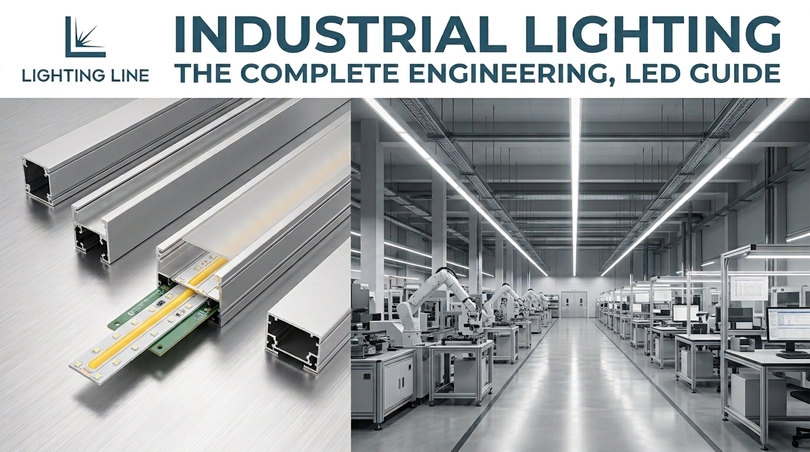
Industrial lighting is no longer a line item at the bottom of a building services budget: it is one of the few remaining infrastructure layers in a factory or warehouse that can simultaneously cut operating cost, raise productivity, reduce accident rates and generate usable data. A modern LED installation consumes 50–70% less electricity than the fluorescent or metal-halide system it replaces, and when that same installation is specified with linear LED profiles, sensors and adaptive control logic, the total saving frequently exceeds 80%. Yet the majority of European industrial buildings still operate lighting designed under assumptions that pre-date LED technology entirely: fixed output, fixed schedules, fixed positions, and maintenance performed only after a luminaire has already failed.
This guide has been realized because the questions surrounding industrial lighting have multiplied faster than the answers. A plant manager wants to know the payback period. A safety manager wants to know whether the installation satisfies EN 12464-1. An energy manager needs kWh data for ISO 50001 reporting. An IT/OT lead wants to know which protocol the fixtures speak and whether they represent an attack surface. A procurement manager simply wants to compare two quotations that appear to describe completely different products. Each of these people is asking about the same ceiling and each of them needs a different layer of the same technical truth.
What follows is that complete technical truth, organised so that any of those readers can enter at their own level and leave with a specification they can defend. We cover what industrial lighting actually means, the full taxonomy of fixture types, the illuminance standards that govern them, the photometric mathematics behind lumen calculations, the human factors that determine whether a workforce performs well under the light you installed, the linear LED profile systems available on catalogue.lightingline.eu, the aesthetics of industrial style lighting. Every section is built to be read on its own, and every claim is tied to a standard, a measurable quantity or a documented engineering practice.
In this article…
- What industrial lighting means: definition, scope and purpose
- The complete taxonomy: types of industrial lighting and factory lighting
- Industrial vs commercial vs residential lighting: the real differences
- Industrial lighting standards, guidelines and legal compliance
- Lumens, lux and watts: how to calculate industrial lighting correctly
- How much does industrial lighting cost? Prices, installation and wiring
- Light quality and human factors: colour temperature, CRI, flicker and circadian rhythm
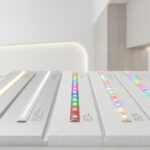
- LED linear profiles and strip systems for industrial applications
- The LightingLine.eu profile catalogue: selecting the right extrusion
- Industrial style lighting: vintage, loft and industrial chic design
- AI-powered industrial lighting: what it is and how it works
- How AI reduces energy consumption in industrial lighting
- Applications of AI in warehouses, factories and safety-critical areas
- IoT, Industry 4.0, Digital Twins and protocol integration
- Cybersecurity, resilience and offline behaviour of connected lighting
- Market size, growth drivers and industrial lighting trends
- ROI, total cost of ownership and procurement strategy
- Role-based answers: facility, energy, maintenance, IT, safety and procurement
- Implementation roadmap: from audit to commissioning
- Case studies and documented results
- Common specification pitfalls and how to avoid them
- Glossary of industrial lighting terminology
- Frequently asked questions
- Industrial lighting: an unusual position among building systems
1. What industrial lighting means: definition, scope and purpose
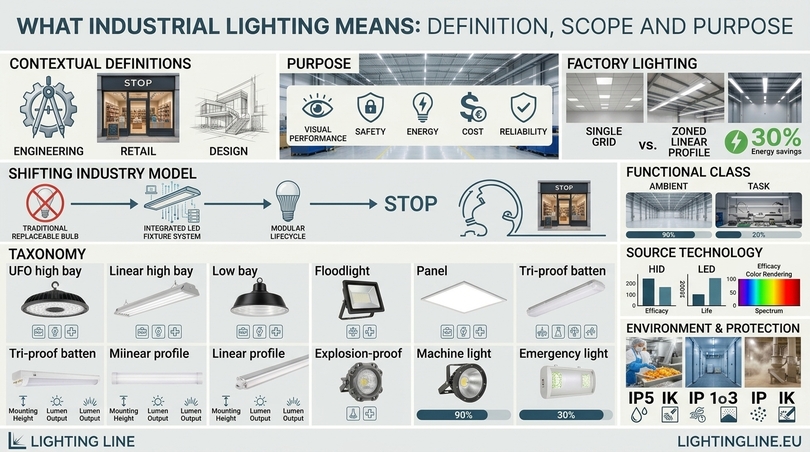
Before specifying a single fixture it is worth settling the definition, because the phrase is used loosely in three quite different conversations: engineering, retail and interior design. In engineering, industrial lighting is the discipline of providing controlled, measurable illuminance to spaces where work is performed on materials, machinery or goods: factories, warehouses, workshops, logistics hubs, food processing plants, cold stores, foundries and outdoor yards. In retail, industrial lighting often refers to the fixtures themselves. In interior design, the same words describe an aesthetic. This guide addresses all three, but keeps them clearly separated, because conflating them is the single most common cause of bad specification.
The technical definition
Industrial lighting is the engineered provision of artificial light in production, storage and processing environments, designed to deliver a specified illuminance level, uniformity, glare rating and colour rendering, while withstanding mechanical, thermal, chemical and environmental stresses that ordinary lighting is not built to survive. Three elements distinguish it from any other lighting category:
- Performance is specified numerically, not subjectively: a living room is lit until it “feels right”. A machining bay is lit to 500 lux maintained, with a uniformity ratio of at least 0.6 and a unified glare rating below 22. Those numbers come from standards, and they are auditable.
- The environment is hostile: industrial luminaires must tolerate vibration, dust, humidity, washdown chemicals, temperature extremes from −40 °C in cold stores to +55 °C under a foundry roof, and in some cases explosive atmospheres. Ingress protection, impact resistance and corrosion class are not optional extras.
- Mounting heights and geometries are extreme: a warehouse roof at 12 metres, a mezzanine at 4 metres and a machine enclosure at 0.4 metres all belong to the same project, and each requires a different optical solution.
The purpose of industrial lighting therefore extends well beyond visibility. It exists to enable accurate task performance, to prevent accidents by revealing hazards and moving equipment, to satisfy statutory duties of care, to support quality control where colour and surface defects must be judged, to secure premises outside working hours, and increasingly to serve as the physical layer of a building data network.
What is the lighting industry?
The lighting industry is the ecosystem of component manufacturers, luminaire assemblers, control system vendors, distributors, lighting designers and installers that brings light from semiconductor die to commissioned installation. Its structure changed profoundly between 2010 and 2025. The traditional chain (lamp manufacturer, ballast manufacturer, fixture manufacturer, wholesaler) was built around a consumable: the lamp burned out, and the customer bought another. LED broke that model, because the light source now lasts as long as the fixture. Revenue migrated from replacement lamps toward systems, controls, services and data.
For a buyer, this shift has a practical consequence: the important supplier questions have changed. Twenty years ago you asked about lamp price and availability. Today you ask about driver quality, thermal design, L90/B10 lifetime data, spare parts commitment, firmware update policy and control protocol openness. A supplier who can only discuss the first list is selling you yesterday’s product.
What is the purpose of industrial lighting?
Formally, an industrial lighting installation has five simultaneous objectives, and a competent design balances all five rather than optimising one:
| Objective | What it means in practice | How it is measured |
|---|---|---|
| Visual performance | Operators can resolve the detail their task requires, at speed, without eye strain | Maintained illuminance (lux), uniformity (U₀) |
| Visual comfort | No disabling or discomfort glare, no harsh contrast, no perceptible flicker | UGR, luminance ratios, SVM/PstLM |
| Safety | Hazards, level changes, vehicle routes and moving machinery are clearly visible | Lux on hazard zones, emergency lighting compliance |
| Energy and cost | The specified light is delivered with minimum installed power and running hours | W/m², kWh/m²/year, LENI |
| Reliability | Performance is maintained across the design life with predictable maintenance | L₈₀/L₉₀ lifetime, maintenance factor, failure rate |
The tension between these objectives is where design skill lives. Increasing illuminance improves visual performance but raises energy consumption. Narrow-beam optics improve efficiency at height but worsen uniformity between aisles. Higher colour temperature can improve perceived brightness but degrade comfort during night shifts. A good industrial lighting design is not the one with the highest lux figure; it is the one that satisfies every constraint with the least installed power and the fewest maintenance interventions over ten years.
What is factory lighting?
Factory lighting is the subset of industrial lighting applied to manufacturing environments, where the defining variable is the task rather than the building. A factory rarely has one lighting requirement: it has a dozen. Raw material intake needs 150–200 lux. General assembly needs 300 lux. Fine electronic assembly needs 750–1000 lux. Inspection under colour judgement needs 1000 lux at Ra ≥ 90. The corridor between them needs 100 lux. A single uniform ceiling grid delivering 500 lux everywhere would waste roughly 30% of the energy of a zoned design, and would still under-light the inspection bench.
This is precisely why linear LED profile systems have become central to modern factory lighting: they allow light to be placed exactly where the task is, at the height the task requires, rather than flooding an entire volume from the roof. A 3-metre run of aluminium profile with a high-efficacy strip mounted directly above a workbench delivers 1000 lux on the work plane for a fraction of the wattage a roof-mounted solution would need to achieve the same result through eight metres of empty air.
2. The complete taxonomy: types of industrial lighting and factory lighting
The different types of industrial lighting can be inserted along at least four axes: by fixture form, by mounting height, by lighting function, and by the physics of the light source. A specification that confuses these axes produces the classic procurement failure: a quotation for high bays where the building needs linear profiles, or floodlights where the site needs task lighting. The following taxonomy separates all four axes so that you can describe exactly what you need in language a manufacturer will interpret correctly.
Classification by fixture form
This is the classification most people are searching for when they ask what those industrial lights are called. The industry uses a fairly stable vocabulary, and using it correctly saves weeks of clarification emails.
| Fixture type | Typical mounting height | Typical output | Primary application |
|---|---|---|---|
| LED high bay (round / UFO) | 7–15 m | 10,000–40,000 lm | Warehouses, production halls, sports halls |
| LED linear high bay | 7–12 m | 12,000–35,000 lm | Racking aisles, long production lines |
| LED low bay | 3–7 m | 3,000–12,000 lm | Workshops, mezzanines, garages, service bays |
| Batten / weatherproof batten (tri-proof) | 2.5–6 m | 2,000–8,000 lm | Corridors, car parks, food processing, damp areas |
| Linear LED profile / trunking | 0.3–8 m | Configurable per metre | Task lighting, machine lighting, shelving, continuous rows |
| LED floodlight | 4–30 m | 5,000–150,000 lm | Yards, loading bays, façades, outdoor storage |
| LED panel | 2.5–4 m | 3,000–6,000 lm | Industrial offices, control rooms, clean rooms |
| Explosion-proof luminaire (ATEX/IECEx) | Variable | 3,000–20,000 lm | Chemical plants, paint booths, grain handling, fuel depots |
| Machine / task light | 0.1–1.5 m | 500–5,000 lm | CNC enclosures, inspection benches, control panels |
| Emergency and escape luminaire | Variable | 100–1,000 lm | Escape routes, open areas, high-risk task areas |
The single most useful distinction in this table is between high bay, low bay and linear profile, because it maps directly onto mounting height and therefore onto optics. Light obeys the inverse square law: doubling the distance between source and work plane reduces illuminance to one quarter. A luminaire at 12 metres must therefore be roughly sixteen times more powerful than one at 3 metres to produce the same lux, unless it uses narrow optics to concentrate the beam, which it does, at the cost of uniformity between fixtures.
What are the long industrial lights called?
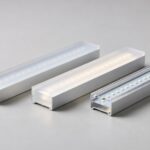
The long strip fixtures visible in most warehouses and workshops have three correct names depending on construction. A batten is a self-contained linear luminaire, typically 600–1800 mm, surface or suspension mounted, historically fitted with a fluorescent tube and now almost universally LED. A tri-proof or weatherproof batten is the sealed IP65/IP66 version used in damp, dusty or washdown environments. A continuous row / trunking system is a modular rail into which gear trays are clipped, allowing kilometres of unbroken illuminated line. And a linear LED profile is an aluminium extrusion housing a flexible LED strip behind a diffuser — the most configurable of the four, and the category in which LightingLine.eu specialises.
The fluorescent versions of all of these are now effectively obsolete in the European Union. Under the RoHS Directive, exemptions permitting mercury in most linear and compact fluorescent lamps expired during 2023, and the Single Lighting Regulation (EU) 2019/2020 imposed efficacy thresholds that fluorescent technology cannot meet. This means that any facility still operating T8 or T5 fluorescent battens is running a system whose lamps can no longer be legally placed on the EU market, and is carrying an unavoidable future replacement liability. Treating that liability as a planned LED profile upgrade rather than an emergency swap is one of the easiest cost savings available to a facility manager.
Classification by lighting function
The classic four-way functional classification comes from lighting design theory and applies as rigorously to a factory as to a hotel lobby.
| Functional type | Role | Industrial example | Typical share of installed load |
|---|---|---|---|
| Ambient (general) | Baseline illuminance across the whole volume | High bays over a production hall | 55–70% |
| Task | Additional local light where detail work occurs | LED profile above an assembly bench | 10–25% |
| Accent | Directs attention to a specific object or zone | Marking of hazard zones, wayfinding, display of finished product | 2–8% |
| Decorative | Contributes to identity and perceived quality of the space | Industrial style pendant lighting in reception, showroom, canteen | 2–10% |
| Emergency (fifth, mandatory) | Maintains minimum visibility on failure of mains supply | Escape route luminaires, high-risk task lighting | 1–5% |
The strategic insight buried in this table is the ambient-to-task ratio
Traditional industrial design pushed ambient lighting to whatever level the most demanding task required, lighting the entire building volume to inspection standard. Modern design does the opposite: it sets ambient light to the level required for safe movement and general orientation (typically 200–300 lux) and adds task lighting locally where 750 or 1000 lux is genuinely needed. In a 5,000 m² facility with twelve high-precision workstations, this approach routinely removes 25–35% of the installed load compared with a uniform high-lux ceiling, and it delivers better light where the work actually happens.
Classification by source technology
Four source technologies have dominated industrial lighting across the last century, and understanding their relative performance explains why retrofits pay back so quickly.
| Technology | Typical efficacy (lm/W) | Rated life (h) | CRI | Status in industrial use |
|---|---|---|---|---|
| Incandescent / halogen | 10–20 | 1,000–4,000 | 100 | Obsolete except for niche inspection |
| Fluorescent (T8, T5, CFL) | 60–100 | 10,000–24,000 | 80–85 | Withdrawn from the EU market |
| High-intensity discharge (metal halide, high-pressure sodium) | 60–120 | 10,000–20,000 | 20–70 | Legacy only; long restrike time |
| LED (including LED strip and profile systems) | 120–220 | 50,000–100,000 | 80–98 | Standard for all new industrial installations |
The efficacy column understates the real-world gap. A metal halide high bay loses 30–40% of its output over its life through lumen depreciation, requires 5–15 minutes to restrike after a power dip, and emits light in all directions: meaning a substantial fraction is absorbed by the reflector and the roof rather than reaching the floor. When luminaire-level efficacy, depreciation, directionality and control compatibility are all accounted for, replacing a 400 W metal halide high bay with a 150 W LED equivalent typically delivers equal or better floor illuminance at 62% lower energy consumption before any control strategy is applied. Add occupancy and daylight control and the figure commonly reaches 75–85%.
Classification by environment and protection rating
The final axis is environmental, and it is where most cross-border procurement errors occur, because a fixture that performs perfectly in a dry assembly hall may fail within months in a food processing washdown area.
| Environment | Minimum IP rating | Minimum IK rating | Additional requirements |
|---|---|---|---|
| Dry assembly, general manufacturing | IP20–IP40 | IK07 | Low UGR where screens are used |
| Warehouse, distribution centre | IP40–IP54 | IK08 | Impact protection near forklift routes |
| Dusty environments (woodworking, cement, milling) | IP6X | IK08 | Sealed optics, smooth surfaces |
| Damp and washdown (food, beverage, pharma) | IP66–IP69K | IK08–IK10 | Food-safe materials, shatterproof, HACCP compatibility |
| Cold store (−25 to −40 °C) | IP65+ | IK08 | Low-temperature drivers, condensation management |
| Outdoor yard, loading bay | IP65–IP66 | IK08–IK10 | Surge protection ≥10 kV, corrosion class C4/C5 |
| Explosive atmosphere | IP66 + ATEX/IECEx | IK10 | Zone classification, certified cable entry, Ex marking |
Ingress protection is stated as two digits, and both matter independently: the first describes solids, the second liquids
IP65 means dust-tight and protected against water jets; IP67 adds temporary immersion; IP69K adds high-pressure, high-temperature washdown. It is a common and expensive misconception that a higher second digit implies a higher first digit: an IP67 fitting is not automatically superior to an IP6K9K fitting for a steam cleaning regime. For LED strip and profile systems the distinction is even more important, because ingress protection can be achieved at three different levels: the strip itself may be encapsulated, the profile may be sealed with a gasketed diffuser and end caps, or the whole assembly may be potted.
3. Industrial vs commercial vs residential lighting: the real differences
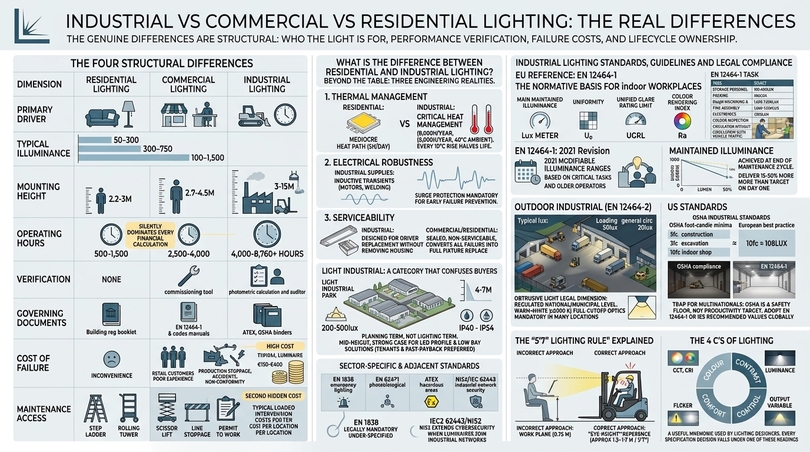
The genuine differences fot this type of lightingng are structural: they concern who the light is for, how performance is verified, what failure costs, and how the installation is owned across its life. Understanding these four differences prevents the two most expensive mistakes in the sector: buying commercial-grade fixtures for an industrial environment, and paying industrial prices for a space that only needs commercial performance.
The four structural differences
| Dimension | Residential lighting | Commercial lighting | Industrial lighting |
|---|---|---|---|
| Primary driver | Comfort, atmosphere, aesthetics | Brand experience, occupant comfort, energy code | Task performance, safety, uptime, cost per unit produced |
| Typical illuminance | 50–300 lux | 300–750 lux | 100–1,500 lux, strongly zoned |
| Mounting height | 2.2–3 m | 2.7–4.5 m | 3–15 m, plus sub-metre task positions |
| Operating hours | 500–1,500 h/year | 2,500–4,000 h/year | 4,000–8,760 h/year |
| Verification | None | Occasional commissioning measurement | Photometric calculation, site measurement, periodic audit |
| Governing documents | Building regulations | EN 12464-1, energy codes | EN 12464-1, sector standards, ATEX, machinery directives, OSHA (US) |
| Cost of failure | Inconvenience | Poor customer experience | Production stoppage, accident, non-conformity |
| Maintenance access | Step ladder | Ladder or tower | Scissor lift, line stoppage, permit to work |
Look at the operating hours row, because it silently dominates every financial calculation on this page. A commercial office fixture running 3,000 hours per year and an industrial fixture running 8,000 hours per year have completely different economics even if their purchase prices are identical. At €0.20/kWh, a single 150 W luminaire running continuously costs €263 per year in electricity: comfortably more than the fixture itself. Multiply by 200 fixtures and the annual energy bill for the lighting alone is €52,600. That figure, not the capital cost, is where the business case lives.
The maintenance access row is the second hidden cost. Replacing a failed driver in a 12-metre-high warehouse aisle can require racking to be cleared, a scissor lift to be brought in, and a permit to work to be issued. Industry practice puts the fully loaded cost of a single high-level intervention at €150–€400 depending on site conditions, entirely independent of the component price. This is why predictive maintenance, discussed in section 13, produces savings that dwarf the value of the components it protects: you are not saving the driver, you are saving the lift, the labour and the lost production.
What is the difference between residential and industrial lighting?
Beyond the table, three engineering realities separate the two categories. First, thermal management: a residential LED fixture running two hours a day may survive a mediocre heat path; an industrial fixture running 8,000 hours a year at 40 °C ambient will not. LED lifetime is governed by junction temperature, and every 10 °C rise roughly halves the useful life of both the diode and the electrolytic capacitors in the driver. Second, electrical robustness: industrial supplies carry inductive switching transients from motors and welding sets, and a fixture without adequate surge protection will fail early and unpredictably. Third, serviceability: an industrial fixture should be designed for driver replacement without removing the housing, because a sealed, non-serviceable unit converts every component failure into a full fixture replacement.
Light industrial: a category that confuses buyers
Light industrial is a planning and property term, not a lighting term. It describes premises used for manufacturing, assembly or storage whose activity can coexist with residential neighbours: typically without heavy machinery, significant emissions or 24-hour operation. From a lighting perspective, light industrial units sit between commercial and heavy industrial: mounting heights of 4–7 metres, illuminance targets of 200–500 lux, IP40–IP54 protection, and a strong case for LED profile and low bay solutions rather than high bays. Because these units are frequently leased, tenants also weigh capital cost differently: a fast-payback, easily demountable LED profile installation is often more attractive than a permanently integrated system.
4. Industrial lighting standards, guidelines and legal compliance
Every question that regarding the lighting standard for industry resolves, in Europe, to a single reference document supplemented by sector-specific rules. In the United States, a different framework applies. Because LightingLine.eu serves an international customer base, this section covers both, and highlights where they diverge in ways that matter for procurement.
EN 12464-1: the European reference for indoor workplaces
EN 12464-1, “Light and lighting — Lighting of work places — Part 1: Indoor work places”, is the normative basis for industrial lighting design across the European Union and the United Kingdom. It does not merely specify illuminance; it specifies a set of four linked parameters for every task type: maintained illuminance (Ēm), uniformity (U₀), unified glare rating limit (UGRL) and minimum colour rendering index (Ra). A design that meets the lux figure but fails the glare limit is non-compliant, and this is the most frequently overlooked failure mode in low-cost retrofits.
The 2021 revision introduced a significant change that many specifiers have still not absorbed: the concept of modifiable illuminance ranges, allowing (and in some cases requiring) higher levels where the task is critical, where operators are over 50, or where errors carry high consequence. It also strengthened requirements for cylindrical illuminance and wall/ceiling luminance, recognising that a space lit only on the horizontal plane feels like a cave regardless of its floor lux reading.
| Area / task | Ēm (lux) | U₀ | UGRL | Ra |
|---|---|---|---|---|
| Storage racks, unmanned aisles | 100 | 0.40 | — | 60 |
| Storage aisles with personnel | 150–200 | 0.40 | 25 | 60 |
| Packing and dispatch | 300 | 0.60 | 25 | 60–80 |
| Rough machining and welding | 300 | 0.60 | 25 | 60 |
| Medium machining, general assembly | 500 | 0.60 | 22 | 80 |
| Precision machining and assembly | 750 | 0.70 | 19 | 80 |
| Very fine assembly, electronics | 1,000–1,500 | 0.70 | 16–19 | 80–90 |
| Colour inspection and matching | 1,000 | 0.70 | 16 | 90 |
| Control rooms and industrial offices | 500 | 0.60 | 19 | 80 |
| Circulation routes without vehicles | 100 | 0.40 | 28 | 40 |
| Circulation with vehicle traffic | 150 | 0.40 | 25 | 40 |
Maintained illuminance it means the value must still be achieved at the end of the maintenance cycle, after lumen depreciation, dirt accumulation on the luminaire and reflectance loss on room surfaces. Designers apply a maintenance factor (typically 0.67 to 0.85 depending on environment and cleaning regime) meaning the installation must deliver roughly 15–50% more than the target figure on day one. A supplier who quotes initial lux rather than maintained lux is, deliberately or not, under-supplying the project by exactly that margin.
EN 12464-2 and outdoor industrial lighting
Outdoor industrial lighting (yards, loading bays, tank farms, container areas, external circulation) is governed by EN 12464-2. Typical requirements run from 20 lux for general outdoor circulation to 50 lux for loading bay operations and 100–200 lux for outdoor assembly or inspection work. Outdoor design carries an additional legal dimension that indoor design does not: obtrusive light. Upward light ratio, luminous intensity toward neighbouring properties and sky glow are increasingly regulated at national and municipal level, and several European jurisdictions now impose curfews and maximum correlated colour temperature limits for outdoor installations to protect nocturnal ecology. Specifying warm-white (3000 K or lower) full-cutoff optics for industrial outdoor lighting is no longer merely good practice: in many locations it is becoming a permit condition.
OSHA industrial lighting standards (United States)
US facilities operate under a different and, notably, much less demanding legal minimum. OSHA 29 CFR 1926.56 specifies minimum illumination in foot-candles for construction and general industrial areas: 5 fc for general construction areas, 3 fc for concrete placement and excavation, 10 fc for indoor shops and general shop areas, and 30 fc for first-aid stations and infirmaries. One foot-candle equals approximately 10.76 lux, so OSHA’s 10 fc requirement for indoor shops equates to roughly 108 lux — a fraction of the 300–500 lux that EN 12464-1 specifies for equivalent work.
This gap creates a genuine trap for multinational operators. An installation that is fully OSHA-compliant may be far below both European norms and the level required for competent task performance, because OSHA sets a floor for legal safety, not a target for productivity. Best practice for global manufacturers is to adopt EN 12464-1 or the IES Lighting Handbook recommended values as internal standards worldwide, using OSHA only as the absolute legal minimum.
Sector-specific and adjacent standards
| Standard | Scope | Why it matters |
|---|---|---|
| EN 1838 / EN 50172 | Emergency escape lighting | 1 lux minimum on escape route centre line, 0.5 lux open area, 15 lux high-risk task areas |
| EN 60598 series | Luminaire safety | Basis of CE marking, particular requirements per luminaire type |
| EN 62471 | Photobiological safety | Blue light hazard classification of LED sources |
| EN 61000 series | Electromagnetic compatibility | Prevents driver interference with industrial control systems |
| IEC 60079 / ATEX 2014/34/EU | Explosive atmospheres | Mandatory zone-rated equipment in hazardous areas |
| (EU) 2019/2020 SLR | Ecodesign for light sources | Minimum efficacy, effectively removed fluorescent from market |
| ISO 50001 | Energy management systems | Lighting sub-metering and continual improvement obligations |
| EN 17037 | Daylight in buildings | Basis for daylight-linked dimming strategies |
| IEC 62443 | Industrial network security | Applies to connected and AI-enabled lighting controls |
Two of these deserve particular attention from anyone specifying today
EN 1838 is legally mandatory and routinely under-specified in retrofit projects, where a contractor replaces general lighting but leaves a legacy emergency system whose batteries are beyond their service life. IEC 62443 is the newest arrival and the one most likely to surprise a lighting buyer: once luminaires join an industrial network, they fall within the scope of OT security governance, and in the EU the NIS2 Directive extends cybersecurity obligations to a far wider set of manufacturing and logistics operators than its predecessor.
The “5’7″ lighting rule” explained
Search interest in the “5’7″ lighting rule” is persistent and mostly the result of terminology drift between photography, interior design and workplace lighting. In practical workplace terms, the underlying principle is the eye-height reference: glare, luminance ratios and vertical illuminance should be evaluated from the position of a standing observer’s eye, conventionally taken as approximately 1.5–1.7 metres (roughly 5 feet 7 inches) above floor level, rather than from the horizontal work plane at 0.75 m. This matters enormously in industrial spaces, because a design that achieves perfect horizontal uniformity on the work plane can still place a 20,000-lumen high bay directly in the sightline of a forklift driver at eye height. EN 12464-1 addresses the same concern through UGR evaluation at defined observer positions and through cylindrical illuminance requirements. If a supplier cannot show you a UGR calculation from realistic observer positions, they have not completed the design.
The 4 C’s of lighting
A useful mnemonic used by lighting designers, and directly applicable to industrial specification: Colour (correlated colour temperature and colour rendering), Contrast (the luminance difference that makes detail visible), Control (the ability to vary output by time, occupancy and daylight) and Comfort (absence of glare, flicker and harshness). Every specification decision in this guide falls under one of these four headings, and a quotation that addresses only lumens and watts has addressed none of them.
5. Lumens, lux and watts: how to calculate industrial lighting correctly
“How many lumens for industrial lighting?” is the most frequently asked technical question in the sector, and it has no single answer because lumens describe what leaves the fixture, while the standard specifies lux, which describes what arrives at the work plane. The conversion between the two depends on mounting height, room geometry, surface reflectance, optical distribution and maintenance factor, and skipping that conversion is the reason so many self-specified installations end up either dim or absurdly over-lit. This section provides the full method, the shortcuts that are safe to use, and the reference tables that let you sanity-check any quotation you receive.
The three quantities you must never confuse
| Quantity | Unit | What it measures | Where it appears |
|---|---|---|---|
| Luminous flux | lumen (lm) | Total light emitted by a source or luminaire | Product datasheets |
| Illuminance | lux (lx) = lm/m² | Light arriving on a surface | Standards, site measurements |
| Luminance | cd/m² | Light leaving a surface toward the eye — perceived brightness | Glare and comfort analysis |
| Power | watt (W) | Electrical consumption, not light | Energy calculations |
| Efficacy | lm/W | Light produced per watt consumed | Efficiency comparison |
The habit of specifying lighting in watts is a hangover from the incandescent era and is now actively misleading
Two 150 W LED high bays from different manufacturers may differ by 60% in delivered lumens. Two fixtures with identical lumen output may differ by 40% in the lux they place on a work plane, because one has a 60° beam and the other 120°. The only defensible specification language is: maintained lux on a defined plane, uniformity, UGR, CRI, CCT, and installed W/m².
The lumen method: the calculation every buyer should be able to checkm
The lumen method is the standard first-pass calculation for regular rectangular spaces with a uniform luminaire grid. It will not replace a full photometric simulation in DIALux or Relux, but it will tell you within about 10% whether a proposal is credible.
Total lumens required = (Target lux × Area in m²) ÷ (Utilisation factor × Maintenance factor)
The utilisation factor (UF) expresses the proportion of luminaire output that actually reaches the work plane after absorption by walls, ceiling and floor, and after losses from beam spill. It is derived from the room index:
Room Index (K) = (L × W) ÷ (Hm × (L + W)), where L and W are room length and width and Hm is the mounting height above the work plane.
| Room index K | Space character | Typical UF, light surfaces | Typical UF, dark/industrial surfaces |
|---|---|---|---|
| 0.75 | Narrow and tall (e.g. high racking aisle) | 0.45 | 0.32 |
| 1.00 | Small hall, high ceiling | 0.55 | 0.40 |
| 1.50 | Medium production hall | 0.65 | 0.50 |
| 2.50 | Large hall, moderate height | 0.75 | 0.60 |
| 4.00 | Very large, wide open warehouse | 0.82 | 0.68 |
Maintenance factor (MF) combines lamp lumen maintenance, luminaire dirt depreciation, room surface depreciation and survival factor. Use 0.80 for clean environments cleaned annually, 0.70 for normal industrial conditions, and 0.60 for dirty environments such as foundries, cement works or woodshops.
A worked example: 2,000 m² warehouse
Consider a distribution warehouse 50 m × 40 m with a 10 m clear height, work plane at floor level, target 200 lux for aisles with personnel, normal industrial cleanliness.
- Room index K = (50 × 40) ÷ (10 × 90) = 2.22
- Utilisation factor, industrial surfaces ≈ 0.58
- Maintenance factor ≈ 0.70
- Total lumens = (200 × 2,000) ÷ (0.58 × 0.70) = 400,000 ÷ 0.406 = 985,222 lm
- Using 20,000 lm high bays: 985,222 ÷ 20,000 = 49 luminaires
- At 150 lm/W, installed power = 985,222 ÷ 150 = 6,568 W ≈ 3.3 W/m²
That 3.3 W/m² figure is the number to remember, because it is the benchmark against which any quotation should be judged
A modern LED warehouse installation delivering 200 lux should land between 2.5 and 4 W/m². A legacy metal halide installation delivering the same 200 lux typically consumes 9–14 W/m². If a supplier proposes 7 W/m² for a new LED design, either the efficacy is poor, the optics are wrong, or the design is over-lighting the space.
Reference table: how many lumens do I need?
| Space | Target lux | Lumens per m² (installed, MF 0.7, UF 0.6) | Indicative W/m² at 150 lm/W |
|---|---|---|---|
| Storage, low activity | 100 | 238 | 1.6 |
| Warehouse aisles with personnel | 200 | 476 | 3.2 |
| Packing, dispatch, general assembly | 300 | 714 | 4.8 |
| Machining, general production | 500 | 1,190 | 7.9 |
| Precision assembly | 750 | 1,786 | 11.9 |
| Electronics, fine inspection | 1,000 | 2,381 | 15.9 |
| Industrial garage / workshop | 300–500 | 714–1,190 | 4.8–7.9 |
| Outdoor loading bay | 50 | 119 | 0.8 |
Note how the last two columns collapse the entire specification exercise into a single sanity check.
If you are lighting a 1,200 m² machining hall to 500 lux, you need approximately 1.43 million lumens and roughly 9.5 kW of installed LED load. Any proposal significantly above that is over-specified; anything significantly below it will not meet the standard once maintenance factors bite.
Lux to lumens and foot-candles: quick conversions
- Lux = Lumens ÷ Area (m²) — for light falling uniformly on a surface
- 1 foot-candle = 10.764 lux
- 1 lumen per square foot = 1 foot-candle
- Illuminance at distance d from a point source: E = I ÷ d², where I is luminous intensity in candela
- Efficacy = Lumens ÷ Watts — always compare at luminaire level, never at chip level
The distinction between chip-level and luminaire-level efficacy is where a great deal of marketing dishonesty hides. An LED package may be rated at 220 lm/W under laboratory conditions at 25 °C junction temperature and 65 mA drive current. Installed in a real fixture, driven harder, running at 65 °C, behind a diffuser, with driver losses, the delivered efficacy may be 140 lm/W. Insist on LM-79 tested luminaire-level data measured in an integrating sphere or goniophotometer, and on LM-80/TM-21 data for lifetime projection. If a supplier cannot provide both, their lifetime and efficacy claims are unverifiable.
Uniformity: the parameter everyone forgets
Uniformity (U₀) is the ratio of minimum illuminance to average illuminance across the reference surface. A hall averaging 500 lux with a U₀ of 0.35 will contain dark patches at 175 lux where operators genuinely cannot see, alongside hot spots at 900 lux causing adaptation problems as workers move between zones. Poor uniformity is more damaging to visual performance than a modest deficit in average illuminance, because the human eye adapts to the brightest part of the visual field and then fails to resolve detail in the darker parts.
Uniformity is governed by the spacing-to-height ratio (SHR). As a rule of thumb, luminaires with a wide beam (120°) tolerate a spacing of roughly 1.2–1.5 × mounting height; narrow beam (60°) optics require spacing closer to 0.8–1.0 × mounting height. Increasing spacing to save on fixture count is the most common cause of failed uniformity — and it is invisible in a quotation that reports only average lux.
6. How much does industrial lighting cost? Prices, installation and wiring
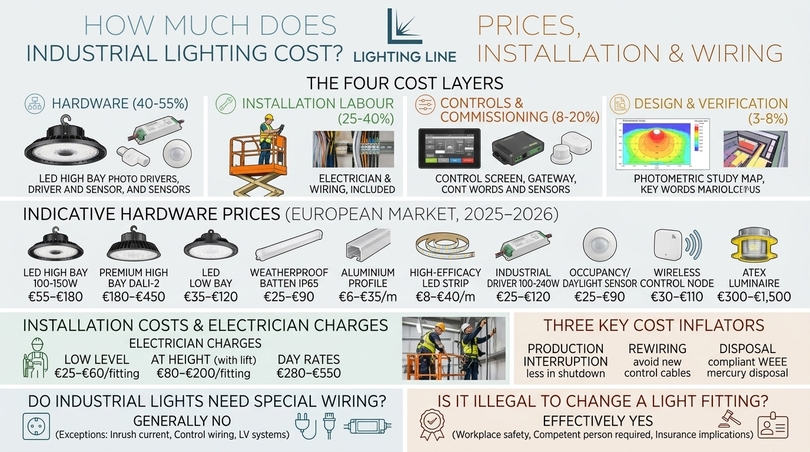
These are legitimate questions with genuinely variable answers, and the honest response separates four cost layers that are usually blended into one confusing number. Below is the full cost structure, with indicative European ranges that let you build a defensible budget before you speak to a single supplier.
The four cost layers
| Layer | What it includes | Typical share of project cost |
|---|---|---|
| Hardware | Luminaires, profiles, strips, drivers, sensors, gateways | 40–55% |
| Installation labour | Removal, mounting, wiring, access equipment | 25–40% |
| Controls and commissioning | Programming, zoning, sensor calibration, integration | 8–20% |
| Design and verification | Photometric study, measurement, documentation | 3–8% |
Indicative hardware prices (European Market, 2025–2026)
| Product | Indicative unit price range | Notes |
|---|---|---|
| LED high bay 100–150 W, 130–150 lm/W | €55–€180 | Price varies mainly with driver quality and warranty |
| LED high bay 150–240 W, premium, DALI-2 | €180–€450 | Includes control gear and sensor readiness |
| LED low bay 50–100 W | €35–€120 | Suitable for 3–7 m mounting |
| Weatherproof batten IP65, 1500 mm | €25–€90 | Tri-proof construction |
| Aluminium LED profile, per metre | €6–€35 | Depends on section size, finish and diffuser type |
| High-efficacy LED strip, per metre | €8–€40 | Depends on lm/m, CRI, IP and binning |
| Constant-voltage industrial driver 100–240 W | €25–€120 | Efficiency and surge rating drive price |
| Occupancy/daylight sensor, wired | €25–€90 | Per zone or per luminaire |
| Wireless control node | €30–€110 | Per luminaire, protocol dependent |
| ATEX luminaire | €300–€1,500 | Zone and certification dependent |
Installation costs and electrician charges
Electrician charges vary widely by country and by access difficulty, but the structure is consistent. A straightforward like-for-like fixture swap at low level typically costs €25–€60 per fitting in labour across most of Western Europe; the same swap at 10 metres requiring a scissor lift rises to €80–€200 per fitting. Day rates for a qualified industrial electrician generally range from €280 to €550, with two-person teams required for work at height under most safety regimes. Access equipment hire adds €90–€250 per day for a scissor lift and considerably more for boom lifts in constrained spaces.
Three factors inflate installation cost more than any others, and all three can be managed at design stage:
- Production interruption: work performed during scheduled shutdowns costs far less in total than work that stops a line. Phased installation aisle by aisle, or zone by zone, is almost always cheaper overall than a faster whole-building programme.
- Rewiring: reusing existing circuits keeps costs low; adding control wiring can double the labour. Wireless control nodes or DALI-over-existing-cable strategies frequently pay for their hardware premium in avoided cable routing.
- Disposal: fluorescent tubes and HID lamps contain mercury and are classified as hazardous waste. Compliant WEEE disposal is a real line item, typically €0.50–€3 per lamp, and is legally required.
Do industrial lights need special wiring?
In most cases, no: LED industrial luminaires operate on standard mains supply, and a direct replacement of an existing fluorescent or HID fitting can usually reuse the existing circuit, provided the circuit protection and cable are rated appropriately. Three genuine exceptions apply. First, inrush current: LED drivers draw a very brief but very high inrush spike, and a circuit that supported twenty HID fittings may trip when twenty LED fittings are switched simultaneously; a type C or type D MCB, or staggered switching, resolves this. Second, control wiring: DALI, DALI-2 and 0–10 V require dedicated control conductors, though DALI’s polarity-insensitive two-wire bus can often be run in the same containment. Third, low-voltage strip systems: LED profiles running at 24 V DC require remote drivers and correctly sized cable to avoid voltage drop over long runs — an issue we address in detail in section 8.
Is it illegal to change a light fitting? Do you need an electrician?
In an industrial or commercial setting the answer is effectively yes, regardless of jurisdiction. Electrical work in workplaces falls under employer duties for electrical safety, and work on fixed installations must be carried out by a competent person, with the installation certified and recorded. In the UK, work in commercial premises must comply with BS 7671 and the Electricity at Work Regulations: in Italy, DM 37/08 requires a qualified installer and a declaration of conformity; equivalent regimes exist across the EU. Beyond legality, insurance is the practical driver: an uncertified installation that contributes to a fire or an injury will be scrutinised, and coverage may be contested. For domestic contexts, rules are looser for like-for-like replacements but still restrict work in special locations such as bathrooms.
7. Light quality and human factors: colour temperature, CRI, flicker and circadian rhythm
Everything discussed so far concerns quantity. This section concerns quality, and quality is where industrial lighting stops being a building services topic and becomes a human performance topic. Two installations delivering an identical 500 lux can produce measurably different error rates, fatigue levels, absenteeism and even accident frequency, purely because of spectral content, flicker characteristics and glare geometry. These are not soft factors: they are measurable, they are increasingly regulated, and they are the difference between a lighting project that workers appreciate and one they complain about within a fortnight.
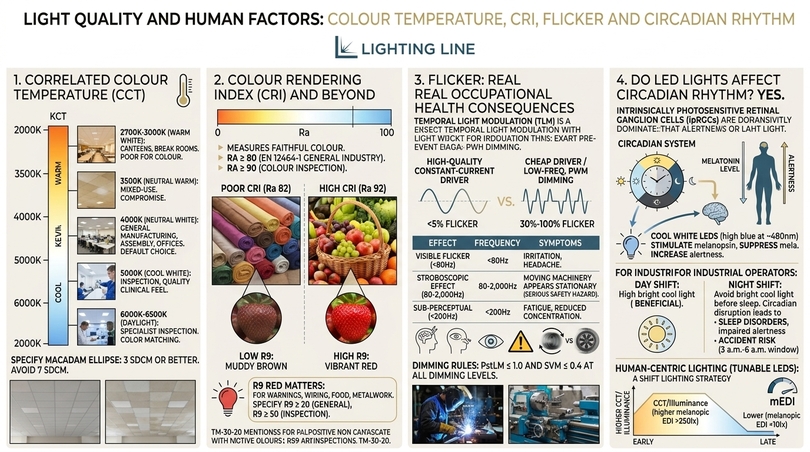
Correlated colour temperature: is 3000K or 4000K better?
Correlated colour temperature (CCT), expressed in kelvin, describes the visual warmth or coolness of white light. Lower values appear yellow-warm: higher values appear blue-cool. The choice of the colour temperature depends on three variables: the task, the daylight availability and the time of day the space is used.
| CCT | Appearance | Best industrial application | Cautions |
|---|---|---|---|
| 2700–3000 K | Warm white | Canteens, break rooms, reception, industrial style decorative lighting, outdoor (ecology) | Can appear dim at low illuminance; poor for fine colour tasks |
| 3500 K | Neutral warm | Industrial offices with significant evening use, mixed-use areas | Compromise value; less commonly stocked |
| 4000 K | Neutral white | General manufacturing, assembly, warehouses, control rooms, offices | The default and safest choice for most industrial work |
| 5000 K | Cool white | Inspection, quality control, high-precision assembly, colour-critical tasks | Can feel clinical; higher melanopic content affects night shifts |
| 6000–6500 K | Daylight | Specialist inspection, machine vision, colour matching against D65 | Highest blue content; avoid for general or night-shift lighting |
For offices and general industrial work, 4000 K is the correct default. It provides sufficient perceived alertness and colour discrimination without the harshness of 5000 K, integrates visually with daylight, and is the value most consistently recommended in European practice. Choose 3000 K only where the space is primarily used in the evening, where visual comfort outranks task precision, or where the interior design intent calls for warmth. Choose 5000 K only where colour judgement genuinely requires it and where you do, keep it zoned to those tasks rather than applying it to the whole building.
A frequently overlooked consideration is CCT consistency. Two fixtures nominally rated 4000 K can differ visibly if their colour binning tolerance is loose. Specify a MacAdam ellipse tolerance of 3 SDCM or better for any application where fixtures are seen side by side, and 5 SDCM as an absolute minimum for general industrial use. A 7-step tolerance product will produce a visibly patchy ceiling, and it is one of the clearest indicators of a low-quality supply chain.
Colour rendering index and beyond
CRI (Ra) measures how faithfully a light source renders colours compared with a reference illuminant, on a 0–100 scale. EN 12464-1 requires Ra ≥ 80 for most industrial work and Ra ≥ 90 for colour inspection. The limitation of Ra is that it averages eight pastel test colours and ignores saturated red entirely, which is why the supplementary index R9 matters so much in industrial settings: red is the colour of warning markings, wiring insulation, blood in food processing and heat discolouration in metalwork. A lamp can score Ra 82 while scoring R9 below zero, rendering red as muddy brown.
Specify Ra ≥ 80 and R9 ≥ 20 as a minimum for general industry while Ra ≥ 90 and R9 ≥ 50 for inspection, food processing and any task where red discrimination is safety-relevant. Where colour fidelity is critical, the modern TM-30-20 metrics (Rf for fidelity, Rg for gamut) provide substantially better information than CRI alone, and quality manufacturers now publish them.
Flicker: can LED lights cause dizziness?
Poorly designed LED lighting can cause dizziness, headaches, eye strain and, in rare cases, photosensitive seizures, and the mechanism is well documented: temporal light modulation, commonly called flicker. This is one of the most important and least understood topics in industrial lighting, and it deserves a direct answer because it has real occupational health consequences.
All mains-powered lighting fluctuates to some degree, because alternating current itself fluctuates. What varies is the depth and frequency of that fluctuation, which is determined almost entirely by the driver. A high-quality constant-current driver with adequate smoothing produces flicker percentage below 5% and is imperceptible. A cheap driver, or a dimming system using low-frequency pulse-width modulation, can produce 30–100% modulation depth at frequencies where the human visual system is most sensitive.
| Effect | Frequency range | Symptoms | Population affected |
|---|---|---|---|
| Visible flicker | Below ~80 Hz | Perceptible pulsing, irritation, headache | Most people |
| Stroboscopic effect | ~80–2,000 Hz | Moving machinery appears stationary or slowed — a serious safety hazard | Everyone, critical near rotating equipment |
| Phantom array | Above ~2,000 Hz | Streaks and ghost images during rapid eye movement | Sensitive individuals |
| Sub-perceptual effects | Below ~200 Hz | Fatigue, eye strain, reduced concentration, migraine trigger | Sensitive individuals, migraine sufferers |
The stroboscopic effect is the reason flicker is a hard safety requirement in industrial environments, not a comfort preference. A lathe chuck rotating at a speed harmonically related to the light modulation frequency can appear motionless. Workers have been injured reaching toward machinery that looked stopped. Since 2021, EU Ecodesign requirements have imposed limits on both flicker (PstLM ≤ 1.0) and stroboscopic visibility (SVM ≤ 0.4) for most light sources placed on the market but these limits apply to the source under specified test conditions, and the behaviour of a strip-plus-driver-plus-dimmer combination assembled on site is the integrator’s responsibility.
Practical specification rule: require PstLM ≤ 1.0 and SVM ≤ 0.4 at all dimming levels, not merely at full output. Many drivers behave impeccably at 100% and catastrophically at 10%. Where dimming is required, specify drivers using high-frequency PWM (above 3 kHz) or, better, hybrid constant-current-reduction dimming. For LED strip systems in profiles, this makes driver selection at least as important as strip selection.
Do LED lights affect circadian rhythm?
Yes. Light is the dominant environmental cue governing the human circadian system, and its effect is mediated principally by intrinsically photosensitive retinal ganglion cells containing melanopsin, which are most sensitive to short-wavelength light around 480 nm: precisely the region where cool-white LEDs emit strongly. Exposure to high melanopic light in the evening suppresses melatonin, delays sleep onset and shifts the circadian phase. Exposure to high melanopic light in the morning does the opposite and is beneficial.
For industrial operators running shift patterns, this is not an academic issue. Night-shift workers exposed to bright cool light throughout their shift, then daylight on the commute home, experience severe circadian disruption. The consequences documented in occupational health literature include sleep disorders, metabolic effects, impaired alertness in the second half of the shift, and elevated accident risk in the 3 a.m. to 6 a.m. window.
The engineering response is human-centric lighting, and it is one of the strongest arguments for tunable LED systems in 24-hour facilities. A well-designed shift lighting strategy uses higher illuminance and higher CCT during the first two-thirds of a night shift to sustain alertness, then reduces melanopic content in the final hours to ease the transition to sleep after the shift ends. Melanopic equivalent daylight illuminance (mEDI) is the correct metric, recommendations in current practice suggest at least 250 lx mEDI at eye level during the daytime biological day, and below 10 lx mEDI in the three hours before intended sleep.
Two cautions belong here. First, human-centric lighting is frequently over-claimed by vendors; a fixture that merely changes colour temperature on a timer is not a circadian intervention unless the melanopic ratios and vertical illuminances have been calculated. Second, the intervention must be coordinated with shift scheduling and management practice, or it will produce no measurable benefit and will discredit the investment.
Glare, contrast and visual ergonomics
Glare comes in two forms. Disability glare reduces the ability to see detail by scattering light within the eye. Discomfort glare causes irritation and fatigue without necessarily reducing visual performance, and is quantified by UGR. In industrial spaces, glare arises most often from three sources: high-output luminaires with insufficient shielding in direct sightlines, specular reflections from polished metal surfaces and machine guards, and extreme luminance contrast between a bright work area and a dark surrounding volume.
The remedies are geometric rather than electrical. Increase the number of lower-output luminaires rather than reducing the count of high-output ones. Use diffusers or micro-prismatic optics on any fixture within a normal sightline. Raise surface reflectance: repainting a dark factory ceiling white can raise floor illuminance by 10–20% at zero energy cost while dramatically improving comfort. Mount task lighting so the light comes over the operator’s shoulder rather than facing them. For LED profile installations above workbenches, the choice of diffuser is the single most influential comfort decision: an opal diffuser typically costs 5–15% of output but eliminates the visible dot pattern and the harsh point-source glare of a bare strip.
The seven types of light and why spectrum matters industrially
Questions about “the 7 different types of light” usually refer to the electromagnetic spectrum (radio, microwave, infrared, visible, ultraviolet, X-ray and gamma) of which only a narrow band is visible. Industrially, three bands are relevant beyond the visible. Infrared is a by-product of inefficient sources and a design problem in cold stores and food display, where every watt of heat must be removed by refrigeration, LED’s low IR emission is a genuine secondary saving. Ultraviolet is used deliberately in curing, inspection of fluorescent penetrant dyes and germicidal applications, and must be shielded from personnel. Near-infrared and specific narrow-band visible wavelengths are used extensively in machine vision, where illumination is selected to maximise contrast for a specific defect rather than to serve human eyes at all.
8. LED linear profiles and strip systems for industrial applications
Aluminium LED profiles are the most misunderstood product category in professional lighting. Many buyers still associate LED strip with decorative accent lighting or consumer-grade cove effects, and consequently overlook a technology that has become central to serious industrial installations. A correctly engineered aluminium profile with a high-efficacy strip and a quality driver is not a decorative accessory: it is a linear luminaire that you configure yourself, at any length, with any distribution, at a fraction of the cost of a proprietary equivalent, and with the crucial advantage that every component is individually replaceable. This section explains the engineering behind that claim, because it is the engineering, not the price, that justifies the specification.
Why profiles have replaced fixed luminaires in so many industrial roles
Three converging changes made this shift possible. First, LED strip efficacy rose from roughly 60 lm/W in 2012 to 150–200 lm/W today, closing the gap with high-quality fixed luminaires. Second, aluminium extrusion technology matured, producing profiles with genuine thermal capability rather than cosmetic housings. Third, the industrial demand pattern changed: as production lines became more reconfigurable, lighting that could be cut, extended, relocated and reconfigured acquired a value that fixed luminaires cannot match.
| Attribute | Fixed linear luminaire | Aluminium profile + strip system |
|---|---|---|
| Length flexibility | Fixed increments (600/1200/1500 mm) | Cut to any length, continuous runs of any dimension |
| Output tuning | Fixed lm/m per model | Strip selectable from ~500 to ~4,000 lm/m |
| CCT / CRI change | Replace whole fixture | Replace strip only |
| Failure repair | Usually whole-fixture replacement | Replace strip, driver or diffuser independently |
| Optical control | Manufacturer-defined | Diffuser and lens selectable per application |
| Recessing / integration | Limited | Recessed, surface, suspended, corner, machine-mounted, shelf-integrated |
| Spares risk | Model discontinuation risk | Standard components, long-term availability |
| Cost per delivered lumen | Higher | Typically 20–45% lower for equivalent quality |
The spares argument deserves emphasis because it is a genuine long-term risk that procurement teams routinely underestimate. A proprietary linear luminaire specified today may be discontinued within five years, leaving a facility with a partially failed continuous row and no matching replacement: a visible, irritating and often unfixable outcome. A profile system built from standard extrusions, standard 24 V strip and standard drivers can be repaired indefinitely, and any mismatch is confined to a replaceable strip rather than an entire fixture.
Thermal management: the engineering that separates good profiles from bad
This is the most important technical section in the chapter, because thermal performance determines everything else. An LED strip mounted on a bare surface, on a plastic channel, or on an undersized aluminium profile will run 20–40 °C hotter than the same strip on a properly sized extrusion, and that temperature difference translates directly into accelerated lumen depreciation and premature failure. The physics is unforgiving: LED junction temperature governs both light output and life, and the aluminium profile is the heat sink.
Three variables determine thermal adequacy:
- Cross-sectional mass of aluminium: more metal means more thermal capacity and more conductive path. A 6 mm × 6 mm micro-profile can dissipate only a few watts per metre; a 25 mm × 15 mm profile with fins handles 20–30 W/m comfortably.
- Surface area available for convection: a recessed profile buried in plasterboard or wood loses much of its convective capability, and its power rating must be de-rated accordingly, typically by 25–40%.
- Thermal interface quality: the adhesive tape between strip and profile is a thermal bottleneck. Standard acrylic tape has poor conductivity; thermally conductive tape or mechanical clamping improves the interface substantially.
| Profile class | Typical section | Safe continuous load, surface mounted | Safe continuous load, recessed | Typical industrial use |
|---|---|---|---|---|
| Micro / mini | 6–10 mm wide | Up to 8 W/m | Up to 5 W/m | Shelf edges, control panels, display cabinets |
| Standard | 12–18 mm wide | 10–15 W/m | 7–11 W/m | Workbench task lighting, machine interiors |
| Heavy / high power | 20–35 mm with fins | 18–30 W/m | 13–22 W/m | Continuous production line rows, corridors, aisles |
| Architectural / suspended | 35–80 mm | 25–45 W/m | n/a | Assembly halls, industrial offices, up/down distribution |
Rule of thumb: if a strip draws more than 14 W/m, it requires a substantial profile, and if it draws more than 20 W/m it requires a finned profile with genuinely free air movement. Running a 24 W/m strip in a 10 mm channel inside a recessed slot is the most common cause of premature LED strip failure in the field, and it is entirely avoidable at specification stage.
Voltage drop and circuit design in 24 V systems
LED strips operate at low voltage (typically 24 V DC, sometimes 12 V or 48 V) and low voltage means high current for a given power. Voltage drop along the strip and the supply cable is the second most common installation failure, producing runs that are visibly brighter at the feed end and dim at the far end.
The governing relationship is straightforward: drop = current × resistance. A 14.4 W/m strip at 24 V draws 0.6 A per metre. A 10-metre run therefore draws 6 A at the feed point, and the copper traces on the strip itself are only fractions of a millimetre thick. Practical maximum run lengths from a single feed:
| Strip power | System voltage | Max single-feed run | With both-end feed | Notes |
|---|---|---|---|---|
| 4.8 W/m | 12 V | 5 m | 10 m | Decorative only |
| 9.6 W/m | 24 V | 10 m | 18 m | General task lighting |
| 14.4 W/m | 24 V | 7–8 m | 14 m | Common industrial choice |
| 19.2–24 W/m | 24 V | 4–5 m | 9 m | High-output; verify thermally |
| Any | 48 V | Roughly double the 24 V figure | — | Preferred for long industrial runs |
For long industrial runs, the correct solutions are, in order of preference: use a 48 V system, inject power at multiple points along the run, use constant-current linear modules rather than voltage-driven flexible strip or segment the run into independently fed sections. Simply accepting the drop is not an option in a workplace, because it produces a uniformity failure that a lux meter will detect immediately during commissioning.
Diffusers, optics and beam control
The diffuser is not a cosmetic cover. It performs three functions: it protects the strip from dust and impact, it converts a line of discrete point sources into a continuous luminous line, and it shapes the distribution. Each diffuser type trades output against comfort.
| Diffuser type | Light transmission | Dot visibility | Glare control | Best industrial use |
|---|---|---|---|---|
| Clear / transparent | 92–95% | Fully visible | Poor | Concealed positions, maximum output, machine interiors |
| Frosted / satin | 85–90% | Slightly visible | Moderate | General purpose, above eye level |
| Opal | 75–85% | Hidden with adequate depth | Good | Workbenches, offices, any position in sightline |
| Micro-prismatic | 80–88% | Hidden | Very good (UGR <19 achievable) | Industrial offices, control rooms, screen-based work |
| Lens (15°/30°/45°/60°) | 80–90% | Depends | Directional | High racking aisles, vertical illumination, asymmetric wall wash |
Two practical rules govern diffuser selection. First, the “dot-free” result depends on the ratio between LED spacing and the distance from strip to diffuser: with a 120 LED/m strip you need roughly 8–12 mm of depth for an opal diffuser to fully homogenise; with a 60 LED/m strip you need 15–20 mm. Second, in industrial environments the diffuser is also the ingress barrier, so gasketed diffusers with end caps and cable glands are what convert an IP20 profile assembly into an IP65 luminaire.
Where profiles outperform conventional fixtures in industry
Machine and enclosure lighting
Modern CNC machines, packaging lines and robotic cells have enclosed working volumes that no ceiling fixture can illuminate. A compact profile mounted inside the enclosure, sealed against coolant and swarf, delivers 800–1,500 lux directly onto the tool and workpiece. This is one of the highest-value applications of LED profile technology, because it eliminates the operator’s habit of opening guards to see the work: a behaviour that is both a productivity loss and a serious safety violation.
Racking and aisle lighting
Vertical illuminance on rack faces is what allows a picker to read labels, yet horizontal-plane design routinely ignores it. Narrow-optic linear profiles mounted along the aisle centre, or profiles fixed to the racking uprights themselves, deliver vertical light onto the picking face at a fraction of the power required to achieve the same result from a 12-metre roof. In high-bay narrow-aisle warehouses this can reduce lighting energy by 40–60% relative to a uniform roof grid, while measurably improving pick accuracy.
Workbench and assembly task lighting
The single most cost-effective industrial lighting intervention available is adding profile-based task lighting above assembly benches and reducing the ambient level accordingly. A 1.5 m profile drawing 20 W placed 800 mm above a bench delivers 1,000+ lux on the work surface. Achieving the same 1,000 lux from a roof at 9 m would require roughly 130 W per workstation. The saving is not marginal (it is an order of magnitude) and it comes with better shadow control, better colour rendering where it matters, and individual switchability.
Corridors, stairwells, walkways and escape routes
Continuous linear profiles provide excellent uniformity along circulation routes, eliminate the light-dark-light patchiness of spaced fittings, and integrate naturally with emergency lighting modules. Because circulation routes require only 100–150 lux, low-power strip in modest profiles is sufficient, and continuous runs give a strong visual wayfinding cue.
Cold stores and refrigerated environments
LEDs perform better at low temperature, not worse: efficacy rises as junction temperature falls, and a strip in a −25 °C cold store may deliver 10–15% more lumens per watt than the same strip at 25 °C. The engineering challenge in cold stores is not the LED but condensation and driver placement. Sealed profiles with gasketed diffusers prevent moisture ingress during defrost cycles, and drivers should be located outside the cold envelope wherever cable runs permit, or specified for the full low-temperature range.
Washdown and food processing areas
Food-grade environments demand IP66 or IP69K, smooth cleanable surfaces, shatterproof covers and materials compatible with cleaning chemistry. A sealed aluminium profile with a polycarbonate diffuser, gasket and stainless fixings meets these requirements while avoiding the crevices and lamp-changing access panels of traditional fittings: a genuine HACCP advantage.
9. The LightingLine.eu profile catalogue: selecting the right extrusion
Everything in the previous section becomes actionable only when it is mapped onto real products. The profile families available on catalogue.lightingline.eu are organised by installation geometry and thermal class rather than by decorative style, which is precisely the logic an industrial specifier needs. The purpose of this section is to give you a selection method: a sequence of six decisions that leads from a description of your space to a specific profile, strip, diffuser and driver combination. Follow it in order and the result will be defensible in front of an engineer, an auditor and a finance director.
The six-decision selection method
| Step | Decision | What determines it | Typical industrial answer |
|---|---|---|---|
| 1 | Mounting geometry | Where the profile physically attaches | Surface, recessed, suspended, corner 45°, magnetic, machine-mounted |
| 2 | Required lumens per metre | Target lux, mounting distance, beam angle | 1,000–2,500 lm/m for task, 2,500–4,000 lm/m for high mounting |
| 3 | Thermal class | W/m of the chosen strip, recessed or exposed | Heavy profile for >14 W/m, finned for >20 W/m |
| 4 | Optical treatment | Sightline exposure, task type, dot tolerance | Opal for task areas, micro-prismatic for screen work, lens for aisles |
| 5 | Protection level | Dust, moisture, chemicals, impact | IP20 dry, IP65 general industry, IP66/69K washdown |
| 6 | Control architecture | Dimming, zoning, sensors, network | Non-dim, 0–10 V, DALI-2, or wireless node per zone |
Profile families and their industrial roles
Surface-mounted profiles
The workhorse of industrial retrofit. Surface profiles fix directly to ceilings, beams, walls, machine frames and bench uprights with brackets or clips, require no structural intervention, and can be installed by a single electrician without altering the building fabric. For a facility manager who needs a fast, low-disruption upgrade of workshop or corridor lighting, surface-mounted profiles combined with a 1,400–2,000 lm/m strip are the shortest path from decision to commissioned installation. Look for families with generous internal volume, integrated cable channel and end caps with cable entry, as these determine how tidy (and how fast) the installation will be.
Recessed profiles
Recessed extrusions are set into plasterboard, machined panels, worktops or metal ceilings so the diffuser sits flush. In industrial contexts they belong in control rooms, industrial offices, clean rooms and any environment where a flush cleanable surface is required. Remember the thermal penalty: a recessed profile loses convective cooling on three sides, so de-rate the permissible strip wattage by 25–40% or select a family with a wider flange that remains exposed to air. Where recessing into insulated ceilings, allow a clear air gap above the extrusion.
Suspended profiles
Suspended systems hang from cable or rod at a defined distance below a high roof, bringing the light source closer to the work plane and dramatically improving efficiency. Deep-section suspended profiles frequently offer up/down distribution: the downward component lights the task, the upward component washes the ceiling and eliminates the cave effect that plagues high-bay-only installations. In production halls with roofs between 6 and 10 metres, suspending linear profiles at 3.5–4.5 metres typically achieves the target illuminance with 30–45% less installed power than roof-mounted high bays, while sharply improving uniformity and vertical illuminance.
Corner and 45° profiles
Corner extrusions emit at 45°, which makes them ideal for lighting vertical surfaces from a horizontal edge: rack faces from a shelf underside, machine work areas from an enclosure corner, stair treads from a stringer, and inspection surfaces from a bench edge. Their asymmetric distribution places light where the eye needs it without placing the source in the sightline.
Heavy-duty and finned profiles
Where output requirements are high (continuous production line lighting, aisle lighting from height, replacement of 58 W fluorescent twin battens) the finned heavy profile is the correct family. Its extended surface area supports 20–30 W/m continuously, which at 160 lm/W corresponds to 3,200–4,800 lm/m: comparable to a linear high bay, but continuous, configurable and repairable.
IP-rated sealed profiles
Sealed profile assemblies combine a gasketed diffuser, sealed end caps and a cable gland to deliver IP65 or higher. These are the correct choice for food processing, car washes, wet workshops, external canopies, agricultural buildings and any area subject to washdown. Verify the IP rating of the assembled system, not merely of the strip: an IP68 strip inside an unsealed profile still permits water to reach the connections and the driver leads, which is where corrosion failures actually occur.
Micro and furniture profiles
Small-section profiles serve control panels, tool cabinets, inspection microscopes, parts bins, shelving edges and machine consoles. Their thermal limit is real (typically 5–8 W/m) but at task distances of 200–500 mm that is entirely sufficient to deliver 1,000+ lux.
Matching strip to profile: a practical reference
| Application | Target lux | Distance to task | Recommended strip output | Recommended profile | Diffuser |
|---|---|---|---|---|---|
| Assembly bench task light | 750–1,000 | 0.6–0.9 m | 1,400–2,000 lm/m | Standard surface or suspended | Opal |
| Precision inspection bench | 1,000–1,500 | 0.5–0.8 m | 2,000–2,800 lm/m, Ra 90+ | Heavy surface | Opal |
| CNC machine interior | 800–1,200 | 0.3–0.7 m | 1,000–1,600 lm/m | Micro or standard, IP66 | Clear or frosted, sealed |
| Racking aisle, vertical faces | 150–250 vertical | 2–6 m | 2,500–4,000 lm/m | Heavy finned suspended | Asymmetric lens |
| Corridor / walkway | 100–150 | 2.5–3.5 m | 800–1,200 lm/m | Standard surface or recessed | Opal |
| Industrial office | 500 | 1.8–2.2 m above desk | 1,200–1,800 lm/m | Suspended up/down | Micro-prismatic |
| Cold store aisle | 150–200 | 4–8 m | 2,000–3,000 lm/m | Heavy sealed IP65 | Frosted, gasketed |
| Washdown production area | 300–500 | 3–5 m | 1,800–2,600 lm/m | Sealed IP66/69K | Gasketed opal |
| Shelf edge / parts bin | 300–500 | 0.3–0.5 m | 600–1,000 lm/m | Micro or corner 45° | Frosted |
Drivers: the component that determines everything
In a profile system the driver is the shortest-lived component and the one most likely to cause a warranty claim, so it deserves more scrutiny than the strip. Specify against these criteria:
- Efficiency ≥ 88% at the intended load, driver losses are pure waste heat and pure cost.
- Load headroom of 20%: running a driver at 100% of its rating shortens its life dramatically; size for 75–85% loading.
- Surge protectio: a minimum of 2 kV line-to-neutral for indoor installations, and 4–10 kV for anything connected to external circuits or in facilities with heavy inductive loads.
- Flicker performance across the full dimming range: not just at 100% output.
- Ambient temperature rating (ta) matched to the actual installation location: a driver rated ta 45 °C installed above a furnace roof void at 60 °C will fail within months.
- Protection features: short circuit, open circuit, over-temperature and over-current, with automatic recovery.
- Control interface: non-dim, 0–10 V, DALI-2, DALI-2 D4i (which adds standardised luminaire data reporting), Casambi/Bluetooth mesh, or Zigbee.
Physical placement matters as much as specification. Remote-mounted drivers in an accessible enclosure (a distribution box at low level, an electrical cabinet, or a service walkway) turn a high-level maintenance intervention into a five-minute job at ground level. For any installation above 4 metres, remote driver placement pays for itself with the first replacement.
Buying industrial lighting online: what to verify before ordering
Purchasing profiles, strips and drivers online is now standard practice for professional buyers, and it is significantly more cost-effective than traditional wholesale channels. It also requires discipline. Before placing an industrial order on catalogue.lightingline.eu or any other professional supplier, confirm the following:
- Luminaire-level lumen output per metre at the stated drive current: not chip-level or theoretical maxima.
- Binning tolerance in SDCM: 3-step for any visible installation, 5-step maximum.
- CRI and R9 values: with TM-30 data where colour is critical.
- LM-80 / TM-21 lifetime projection: stated as L80 or L90 at a defined case temperature.
- Profile internal dimensions: against your strip width, including the tolerance for a strip with an IP silicone coating.
- Diffuser depth: against LED density for dot-free output.
- Warranty terms: including whether they cover strip, driver and profile, and whether they are conditional on using the supplier’s own driver.
- Declaration of conformity and CE/UKCA documentation: plus RoHS and REACH statements.
- Batch consistency guarantee: for phased projects where later orders must match earlier ones.
The final point is the one most often discovered too late.
If you are lighting a 6,000 m² facility in three phases across eighteen months, ask now whether the supplier can guarantee the same bin and the same profile section for the full programme. Reserving stock, or ordering the full quantity and staging delivery, costs a little working capital and prevents a visibly mismatched installation.
10. Industrial style lighting: vintage, loft and industrial chic design
Alongside the engineering discipline, “industrial lighting” describes one of the most durable aesthetics in interior design: the visual language of exposed metal, honest structure, visible fixings and unadorned light sources. This aesthetic matters commercially even to industrial buyers, because the reception areas, canteens, showrooms, meeting rooms and customer-facing zones of a manufacturing business are usually designed in exactly this idiom, and because the same profile products used on the factory floor can deliver it far more elegantly than reproduction fittings. This section covers the design language, its Italian heritage, and how to execute it with linear systems.
What defines industrial style lighting?
Industrial style emerged from the conversion of nineteenth and twentieth century factories, mills and warehouses into residential and commercial space, initially in New York, Manchester, Turin and Milan. The lighting vocabulary it inherited was purely functional: enamelled steel shades designed to direct light downward onto machinery, cage guards to protect bulbs from impact, conduit and cable run openly because there were no voids to conceal them, and exposed filament lamps because diffusion was an unnecessary expense.
Five characteristics define the style today:
- Honest materials: raw or blackened steel, aged brass, aluminium, concrete, reclaimed timber. Surfaces show their manufacture rather than concealing it.
- Visible structure: fixings, brackets, suspension cables and conduit are part of the design, not hidden.
- Functional forms: shapes derive from an original purpose — the dome shade, the cage, the articulating arm, the pulley pendant.
- Restrained palette: black, graphite, gunmetal, rust, natural aluminium, warm brass.
- Deliberate light source: warm colour temperature, visible or implied filament, generous shadow rather than flat uniformity.
Is industrial lighting still in style?
Yes, but it has evolved substantially, and the version that dominates 2025–2026 interiors is far more restrained than the exposed-Edison-bulb maximalism of the mid-2010s. Three shifts define the current expression. First, minimal industrial: the same materials and honesty, but with far cleaner geometry, often reduced to a single linear element in blackened aluminium. Second, warm industrial: the cold grey palette softened with timber, leather, textiles and 2700–3000 K light. Third, integrated industrial: light delivered as continuous lines and recessed planes rather than as objects, with the “industrial” quality expressed through structure and material rather than through fixture styling.
The reason the style endures is that it is fundamentally honest and fundamentally adaptable. It works in a loft apartment, a co-working space, a restaurant, a brewery tap room, a design studio and the front office of a machine shop. And crucially, it accommodates modern technology without visual compromise: a linear aluminium profile is, aesthetically, a perfectly authentic industrial object.
Executing industrial style with linear profiles
Reproduction industrial fittings have three practical weaknesses: they are optically inefficient, they usually accept only retrofit lamps of modest quality, and they date quickly. Linear profile systems avoid all three while remaining stylistically correct.
| Design intention | Profile solution | Specification notes |
|---|---|---|
| Loft living room, main light | Suspended up/down profile in black anodised finish | 3000 K, Ra 90, dimmable, 60/40 down/up split |
| Industrial kitchen island | Suspended linear profile above island, 1.2–1.8 m | 3000 K, opal diffuser, 800–1,200 lm/m, dim to 5% |
| Exposed brick wall wash | Surface or corner 45° profile at ceiling junction | 2700–3000 K, asymmetric lens, grazing angle to reveal texture |
| Industrial bathroom | IP65 sealed profile flanking the mirror | 3000–4000 K, Ra 90+, vertical mounting for shadow-free faces |
| Staircase and mezzanine | Recessed profile in stringer or handrail | Low output, 2700 K, glare shielded from ascending eye level |
| Bedroom, industrial minimal | Recessed perimeter cove with warm dim strip | Tunable 2200–3000 K for evening warm shift |
| Restaurant / brewery / retail fit-out | Continuous suspended runs in blackened aluminium | 2700 K, Ra 95, DALI or Casambi scene control |
| Office and studio, industrial chic | Suspended linear, micro-prismatic diffuser | 4000 K, UGR <19, daylight-linked dimming |
The single most effective industrial-style move available with profile systems is the continuous line.
A single unbroken luminous line running the full length of a loft ceiling, a corridor or a bar counter is visually powerful in a way that a row of separate pendants cannot match, and it is only achievable with a modular profile system. Achieving a seamless join requires attention: specify profiles with internal joining brackets, plan the strip cut points so they fall at joins, and use a single driver per continuous run wherever the load allows so that dimming tracks identically.
Italian lighting design: heritage and brands
Questions about famous Italian lighting brands appear constantly alongside industrial lighting searches, and the connection is not accidental. Italy is the country where industrial production and design culture fused most completely, and where the industrial aesthetic was first treated as a legitimate design language rather than a mere consequence of function.
The Italian lighting tradition took shape in the post-war period in Milan and its industrial hinterland. Manufacturers such as Flos (founded in Merano in 1962 and now based in Brescia, and unambiguously Italian) Artemide, Oluce, Fontana Arte, Martinelli Luce, Luceplan and Foscarini worked with designers including Achille and Pier Giacomo Castiglioni, Gino Sarfatti, Vico Magistretti, Gae Aulenti and Joe Colombo. What distinguished their output was a willingness to take industrial components (a car headlamp reflector, a stamped metal shade, a counterweight, an extruded section) and treat them as finished design elements.
That heritage is directly relevant to how a modern industrial profile installation should be conceived: not as a technical necessity that must be hidden, but as a designed linear element whose geometry, finish and proportion are chosen deliberately. The Italian lesson is that engineering rigour and visual quality are the same discipline approached from two directions. Emilia-Romagna and Lombardy remain among Europe’s densest concentrations of lighting and electrotechnical manufacture, and the region’s supply chain in extrusion, optics and electronics is the reason so much European professional lighting is designed and produced there.
What is vintage lighting?
Vintage lighting in the industrial context means one of three distinct things, and conflating them causes disappointment. Genuine antique fittings are original period pieces (enamel shades, bulkhead lights, factory pendants) usually requiring rewiring to current standards and often lacking any protective earth. Reclaimed and restored fittings are original items professionally rewired and CE-marked for contemporary use. Reproduction or vintage-style fittings are new products manufactured to resemble period designs. Only the second and third categories are appropriate for commercial installation without specialist assessment, and any original fitting used in a workplace must be brought fully into compliance with current electrical safety requirements before energising.
Where the vintage aesthetic is desired with modern performance, the practical route is a hybrid: reproduction shades or cages combined with high-CRI filament-style LED lamps at 2200–2700 K, supplemented by concealed linear profile lighting that provides the actual working illuminance. This is the standard professional approach in hospitality and retail, and it works equally well in the public-facing areas of industrial premises: the visible fittings carry the aesthetic, the concealed profiles carry the lux.
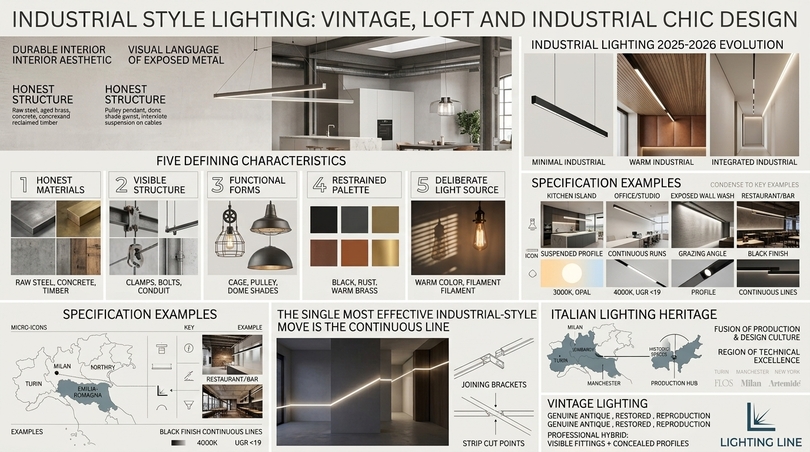
11. AI-Powered industrial lighting: what it is and how it works
The most significant change in industrial lighting since the LED transition is not happening at the light source. It is happening in the control layer. AI-powered industrial lighting refers to systems in which illumination is continuously adjusted by algorithms that learn from sensor data, occupancy patterns, production schedules, daylight availability and equipment condition, rather than following fixed rules programmed at commissioning. The distinction sounds subtle. In operation it is not: a rule-based system does exactly what it was told in 2019, while a learning system in 2026 is responding to how the building is actually used today.
This section explains what the technology is, how it differs from the smart lighting that preceded it, what it is genuinely capable of, and (equally important) where the marketing claims outrun the engineering.
What is AI-Powered industrial lighting?
An AI-powered industrial lighting system consists of four layers:
| Layer | Components | Function |
|---|---|---|
| Sensing | PIR, microwave, time-of-flight, photocells, thermal, current, temperature, air quality, camera-based analytics | Detects occupancy, daylight, movement direction, fixture condition and environment |
| Actuation | Addressable drivers, tunable-white modules, dimmable profile systems | Executes output changes per luminaire or per zone |
| Connectivity | DALI-2/D4i, Zigbee, Bluetooth mesh, Thread, LoRaWAN, Wi-Fi, PoE, Modbus, BACnet, MQTT | Carries commands and telemetry between devices, gateways and platforms |
| Intelligence | Edge controllers, on-premise servers, cloud analytics, machine learning models, digital twin | Learns patterns, predicts demand and failures, optimises setpoints |
The intelligence layer is what makes the system “AI”, and it performs four distinct functions that are worth separating because vendors rarely do: pattern recognition (learning that Aisle 14 is used heavily on Tuesdays and barely at all on Fridays), prediction (forecasting that a driver’s rising operating temperature and current signature indicate failure within six weeks), optimisation (solving for minimum energy subject to illuminance and safety constraints across thousands of luminaires simultaneously), and anomaly detection (identifying that a zone is drawing more power than its output justifies, indicating a fault or an unauthorised change).
What is the difference between smart lighting and AI lighting?
This is the question that most cleanly separates informed buyers from those about to overpay. Smart lighting is connected and programmable. AI lighting is connected, programmable and adaptive. The distinction is whether the system’s behaviour changes over time without a human reprogramming it.
| Capability | Conventional control | Smart lighting | AI-powered lighting |
|---|---|---|---|
| Switching | Manual / time clock | Scheduled, remote, sensor-triggered | Predictive, anticipating occupancy before arrival |
| Dimming | Manual or none | Daylight-linked to a fixed setpoint | Continuously optimised against measured task illuminance |
| Zoning | Fixed at wiring stage | Software-defined, manually configured | Self-organising, re-zoned automatically as usage changes |
| Maintenance | Reactive on failure | Runtime-based scheduling | Condition-based prediction from telemetry |
| Energy reporting | None or building-level | Zone-level consumption data | Luminaire-level data with attribution and forecasting |
| Response to change | Requires rewiring | Requires reprogramming | Adapts automatically within defined constraints |
| Typical energy saving vs uncontrolled LED | 0% | 20–35% | 35–60% |
The row that matters most for long-term value is response to change.
The single largest cause of lost savings in smart lighting installations is configuration drift: the building is re-racked, a production line moves, shift patterns change, and nobody updates the lighting programme. Within three years, a well-commissioned rule-based system is typically delivering 40–60% of the savings it achieved in year one. An adaptive system does not degrade in this way, and that persistence (rather than a higher peak saving) is usually the strongest financial argument for it.
How does AI change industrial lighting systems?
Four structural changes follow from introducing an intelligence layer:
- Lighting becomes granular: instead of a handful of switched circuits, every luminaire is individually addressable and individually measured. A 400-fixture warehouse moves from perhaps twelve control zones to four hundred.
- Lighting becomes a data source: because luminaires are distributed uniformly across every occupied square metre of a building, they form the best-positioned sensor network available. Occupancy heat maps, traffic flow, asset dwell times and space utilisation all become measurable as a by-product.
- Maintenance becomes predictive: drivers report their own operating hours, temperature, current and fault codes, allowing intervention to be planned rather than reactive.
- Lighting joins the OT estate: this is the change that surprises facility teams. Once lighting is networked, it falls within the governance, patching and security regime that applies to industrial control systems.
What technologies are used in AI industrial lighting?
| Technology | Role in the system | Practical implication |
|---|---|---|
| Machine learning (supervised) | Predicting failure from telemetry patterns | Requires historical failure data, improves over 6–18 months |
| Machine learning (unsupervised) | Clustering usage patterns, anomaly detection | Works without labelled data, useful from day one |
| Reinforcement learning | Optimising control policy against energy and comfort objectives | Powerful but requires strict safety constraints |
| Computer vision | Occupancy counting, PPE detection, vehicle tracking | Raises privacy and works-council considerations |
| Edge computing | Local inference without cloud dependency | Essential for latency and offline resilience |
| Digital twin | Simulation of lighting performance and scenario testing | Enables change testing before deployment |
| Time-series analytics | Energy attribution and forecasting | Feeds ISO 50001 and ESG reporting |
| Sensor fusion | Combining PIR, radar, photocell and current data | Reduces false positives and false-off events |
A word of realism belongs here
Not every product labelled AI lighting contains machine learning. A substantial share of the market consists of well-executed rule-based systems with attractive dashboards. That is not necessarily a bad purchase (a properly commissioned rule-based system with good sensors captures most of the available savings) but you should know which you are buying, and you should not pay an AI premium for scheduling logic.
12. How AI reduces energy consumption in industrial lighting
Energy is the primary business case, so it deserves precise treatment rather than a headline percentage. The savings from AI-powered industrial lighting come from six identifiable mechanisms, and any credible proposal should quantify each one separately for your building rather than presenting a single blended figure. Understanding the mechanisms also tells you which buildings will benefit most: savings scale with variability of occupancy, availability of daylight and the degree of over-lighting in the existing installation.
The six savings mechanisms
| Mechanism | How it works | Typical saving | Where it works best |
|---|---|---|---|
| Occupancy-based dimming | Reduces output in unoccupied zones to a safe standby level rather than switching off entirely | 20–45% | Warehouses, low-density storage, night operations |
| Daylight harvesting | Continuously trims artificial output against measured daylight through rooflights and windows | 15–40% | Buildings with 8%+ rooflight area |
| Task tuning | Sets each zone to exactly the required lux rather than a uniform maximum | 10–25% | Facilities lit to a single high level throughout |
| Predictive pre-positioning | Anticipates occupancy from historical patterns and production schedules, avoiding both delay and unnecessary run-time | 5–12% | Sites with strong routine patterns |
| Lumen maintenance compensation | Runs new installations at reduced output, raising it gradually to offset depreciation | 8–15% | All new installations |
| Demand response and tariff optimisation | Shifts non-critical lighting load in response to price signals or peak demand charges | 2–8% of cost (not kWh) | Sites with time-of-use or capacity tariffs |
Lumen maintenance compensation (often called constant light output) is the mechanism buyers most consistently overlook, and it is nearly free. Because a design must deliver its target lux at end of life, a new installation is over-delivering by 15–35% on day one. A system that measures or models depreciation and drives the fixtures at reduced current initially, increasing over the years, captures that entire margin as energy savings while also lowering junction temperature and extending fixture life. It requires only addressable drivers and a control platform: no additional sensors at all.
What energy savings can AI lighting actually achieve?
Savings must always be quoted against a stated baseline, and the difference between baselines is where most confusion originates.
| Baseline | Upgrade | Realistic total energy reduction |
|---|---|---|
| Metal halide / HPS high bay, uncontrolled | LED, uncontrolled | 50–65% |
| Metal halide / HPS high bay, uncontrolled | LED + rule-based sensors | 65–80% |
| Metal halide / HPS high bay, uncontrolled | LED + AI-powered adaptive control | 75–90% |
| T8 fluorescent battens, uncontrolled | LED profile system, uncontrolled | 40–55% |
| T8 fluorescent battens, uncontrolled | LED profile + AI control | 65–85% |
| Existing LED, uncontrolled | Add AI control layer only | 30–50% |
| Existing LED with basic sensors | Add AI optimisation layer | 12–28% |
The most commercially interesting row is the second from bottom: adding an intelligence layer to an existing uncontrolled LED installation. Many facilities completed an LED retrofit between 2015 and 2021 and now consider lighting a solved problem. It is not. Those installations typically run at full output for the full occupancy period, and a control retrofit (particularly a wireless one requiring no rewiring) can remove 30–50% of remaining consumption at a fraction of the original project cost, with payback frequently under three years.
Real-time energy monitoring and reporting
A D4i-compliant or equivalent luminaire reports its own energy consumption, operating hours, temperature and fault status. Aggregated across a site, this produces something most energy managers have never had: lighting energy data at fixture resolution, in real time, without installing a single additional meter. The reporting consequences are significant:
- ISO 50001 requires significant energy uses to be identified, monitored and improved. Fixture-level lighting data satisfies the monitoring and measurement clauses directly and provides auditable evidence of continual improvement.
- Energy audits under national implementations of the Energy Efficiency Directive become considerably cheaper when lighting consumption is already instrumented.
- ESG and CSRD reporting requires Scope 2 emissions data with increasing granularity; measured rather than estimated lighting consumption improves both accuracy and assurance readiness.
- Measurement and verification under IPMVP protocols becomes straightforward, which matters if the project is financed through an energy performance contract where payment depends on verified savings.
Carbon footprint reduction
The carbon arithmetic is direct. A 5,000 m² warehouse with a legacy metal halide installation might consume 12 W/m² for 6,000 hours per year: 360,000 kWh annually. At an EU average grid intensity in the region of 240 g CO₂e/kWh, that is approximately 86 tonnes CO₂e per year. An LED-plus-AI installation at 2.5 W/m² effective average consumption after control savings uses roughly 75,000 kWh: about 18 tonnes. The reduction of approximately 68 tonnes CO₂e per year from a single mid-sized building is typically among the largest single-measure emissions reductions available to a manufacturing operator, and it requires no process change whatsoever.
Embodied carbon deserves a mention for completeness. Manufacturing luminaires and profiles carries an embodied burden, typically recovered within three to nine months of operation for a metal-halide replacement. Aluminium profiles score well here because aluminium is highly recyclable and because a profile system’s replaceable-component architecture means that a strip upgrade in year twelve does not require discarding the extrusion, the diffuser or the mounting hardware.
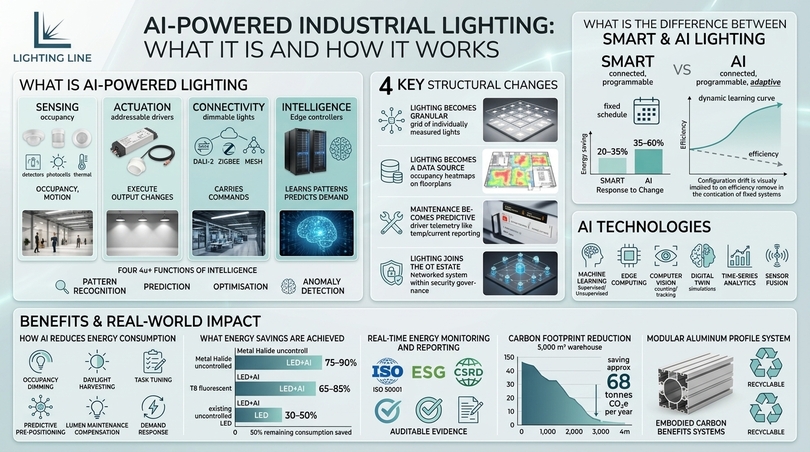
13. Applications of AI in warehouses, factories and safety-critical areas
Energy is the entry argument for AI-powered industrial lighting, but it is rarely the argument that closes the business case at board level. The applications that generate the strongest returns are operational: fewer accidents, less unplanned downtime, better pick accuracy, faster maintenance and measurable space utilisation data. This section covers each application with the mechanism, the measurable outcome and the practical caveats.
Warehouse lighting automation
Warehouses are the ideal environment for adaptive lighting because occupancy is sparse, highly variable and predictable in pattern. A typical distribution centre has 60–80% of its floor area unoccupied at any given moment, yet conventional lighting illuminates all of it continuously.
An automated system operates aisle by aisle, or even rack-bay by rack-bay. When no one is present, output drops to a standby level: usually 10–20%, sufficient for CCTV coverage, safe transit and immediate visual orientation. When a picker or forklift enters, the aisle lifts to full output before they reach the working position, and neighbouring aisles lift to an intermediate level so that the transition is not jarring. The critical design detail is that light must arrive ahead of the person: a system that switches on only after detection produces exactly the dark-then-bright experience that causes operators to disable it. Predictive control, using entry-point detection and learned movement patterns, solves this properly.
| Warehouse control strategy | Mechanism | Typical saving vs always-on LED | Risk to manage |
|---|---|---|---|
| Aisle-level occupancy dimming | PIR or microwave per aisle | 30–50% | False-off during static picking tasks |
| Sensor fusion with radar | Detects slow and stationary presence reliably | 35–55% | Higher sensor cost |
| Predictive pre-lighting | Learns routes and anticipates arrival | 40–60% | Requires learning period |
| WMS integration | Lights the aisles the pick list will visit | 45–65% | Integration effort with warehouse software |
| AGV/AMR coordination | Robots need less light than humans; system distinguishes | 50–75% in automated zones | Must maintain human-safe levels when staff enter |
The last row is quietly transformative
Automated guided vehicles and autonomous mobile robots navigate by LiDAR, fiducial markers or SLAM, and in most cases do not require visible light at all. A goods-to-person zone operating with robots only can run at 20 lux instead of 200. The lighting system’s job becomes ensuring that human entry, whether planned or unplanned, immediately restores full compliant illuminance, a safety-critical function that must be implemented with redundant detection and fail-safe defaults, never with a single sensor.
Factory smart lighting and production integration
In manufacturing, the highest-value integration is with the production schedule rather than with occupancy sensors. If the MES knows that Line 3 begins a precision assembly run at 06:00, the lighting system can raise that zone to 750 lux at 05:50 and return it to 300 lux when the run ends. If the schedule shows a changeover, task lighting around the machine can rise while ambient lighting elsewhere reduces.
Three further factory applications are worth specific attention:
- Quality-linked lighting: where defect rates are sensitive to illuminance and colour rendering, correlating quality data with lighting conditions identifies inspection stations that are under-lit. Several documented programmes have found measurable defect-detection improvements simply from raising inspection illuminance to 1,000 lux at Ra 90.
- Andon and status signalling: tunable and addressable lighting can carry status information — a zone shifting colour to indicate a line stoppage, a maintenance call or a safety event. This works only where colour signalling is standardised across the plant and does not conflict with statutory safety colours.
- Shift-aware lighting: different shifts frequently have different task mixes and different staffing densities. Learning these differences and adapting automatically avoids the compromise setpoint that suits nobody.
Industrial safety lighting and AI
Lighting is a documented factor in workplace accidents, and inadequate illumination is a recurring finding in incident investigations involving slips, trips, falls from height, forklift collisions and machinery contact. AI-enabled systems contribute to safety in five concrete ways:
- Guaranteed compliant illuminance: because output is measured and reported per fixture, the system can prove that the required lux was present at the time of an incident: or flag proactively when depreciation or a failure has taken a zone below its target.
- Hazard-zone response: integration with gas detection, machine guarding or fire systems allows lighting to escalate automatically: raising output, changing colour, or illuminating egress routes when a hazard is detected.
- Vehicle–pedestrian conflict management: detection at aisle intersections can trigger directional lighting cues warning of an approaching forklift, an intervention increasingly deployed at blind corners.
- Lone-worker visibility: where a single operator works in a large space out of hours, adaptive lighting maintains a lit envelope around them rather than lighting the building or leaving them in a pool of light in darkness.
- Emergency egress support: addressable systems can perform automated monthly and annual emergency function tests, log the results for the fire safety record, and dynamically indicate the safest route when integrated with a fire alarm, although dynamic escape route signage is subject to specific national approval requirements and must be designed by a competent fire engineer.
One caution deserves prominence: emergency lighting must fail safe. Any AI system controlling luminaires that also serve an emergency function must be architected so that the loss of the network, the gateway, the cloud connection or the algorithm cannot prevent emergency operation. This is normally achieved by keeping emergency luminaires on independent circuits with local self-test batteries, using the network only for reporting. Never accept an architecture in which emergency compliance depends on a functioning software platform.
Predictive maintenance for industrial lighting
This is the application with the clearest and most easily verified ROI, because the cost avoided is labour and access rather than energy.
How predictive maintenance actually works
An instrumented luminaire reports a stream of parameters: cumulative operating hours, driver case temperature, output current, supply voltage, dimming level, and any internal fault codes. Failures in LED systems are rarely sudden: the overwhelming majority are preceded by weeks or months of drift in one of these parameters. Electrolytic capacitor degradation in a driver shows as rising ripple and gradually increasing temperature. LED binning shift and lumen depreciation show as increasing current draw for a given commanded output. A loose connection shows as intermittent voltage anomalies.
A predictive model trained on these signatures flags the luminaire for attention before it fails. In practice this converts the maintenance regime from “replace when dark” to “replace the twelve flagged fixtures during the scheduled August shutdown, in one lift visit”.
| Parameter monitored | Failure mode it predicts | Typical warning period |
|---|---|---|
| Driver case temperature trend | Capacitor degradation, thermal fatigue | 1–6 months |
| Current draw vs commanded output | LED depreciation, partial string failure | 2–12 months |
| Operating hours vs rated L80 | End-of-life lumen depreciation | Predictable years in advance |
| Supply voltage anomalies | Loose terminations, circuit issues | Days to weeks |
| Switching cycle count | Driver stress from frequent cycling | Continuous |
| Ambient temperature at fixture | Environmental change affecting lifetime | Continuous |
Reduction in MTTR and maintenance cost
The measurable outcomes reported across industrial deployments follow a consistent pattern: mean time to repair falls sharply because the fault is diagnosed before the technician leaves the workshop, and total maintenance interventions fall because failures are batched into planned visits. Typical reported effects are a 25–45% reduction in lighting maintenance labour hours, a 50–70% reduction in emergency call-outs, and near-elimination of the “unnoticed dark zone” problem in which a failed fixture in a low-traffic area goes unreported for months while the space operates below its required illuminance.
CMMS and work order integration
Predictive alerts only create value if they reach the maintenance workflow. A well-integrated system pushes alerts directly into the CMMS as work orders, populated with fixture ID, physical location, fault classification, recommended part and access requirements. When evaluating vendors, ask specifically whether integration is via a documented REST API, MQTT, or a supported native connector and ask to see an example payload. A system that only sends emails to a shared mailbox will be ignored within two months.
Human-centric lighting in industrial environments
The industrial application is shift work, and the AI contribution is personalisation and precision. A learning system can align lighting transitions with the actual shift roster rather than a static clock, can adjust for seasonal daylight variation at the site’s latitude, and can maintain melanopic targets at eye level rather than merely changing nominal CCT.
Documented outcomes in shift-work settings include improved subjective alertness in the final third of night shifts, reduced self-reported sleep disturbance, and in several published studies reductions in error rates during the circadian nadir between 03:00 and 06:00. The effect sizes vary widely between studies and depend heavily on implementation quality, so a facility considering this should treat it as a well-founded intervention worth piloting with measurement, rather than a guaranteed outcome to be purchased.
Practical implementation guidance: use tunable-white luminaires or dual-strip profile systems capable of 2700–6500 K, target elevated melanopic exposure early in the night shift and reduced short-wavelength content in the final two hours, measure vertical illuminance at eye level, not horizontal at desk level, and involve the workforce and any works council from the outset, because lighting changes that arrive unannounced generate resistance regardless of their merit.
Lighting as a space utilisation data source
Because luminaires are the only building system distributed uniformly across every occupied area, they make an exceptional sensor grid. Occupancy data from lighting sensors supports decisions well beyond lighting: identifying underused floor area, optimising racking layout, validating pick-path efficiency, sizing HVAC zones, and evidencing space requirements in lease negotiations. Several operators now justify a substantial share of the control system cost on space analytics alone, treating the energy saving as the secondary benefit. This does, however, raise workforce monitoring considerations: in the EU, occupancy data that can be linked to identifiable individuals engages GDPR, and consultation obligations with employee representatives frequently apply. Design for aggregation and anonymisation from the start.
14. IoT, Industry 4.0, Digital Twins and protocol integration
For an IT or OT manager, the lighting conversation is not about lumens. It is about how several hundred new endpoints will join an industrial network, what they will speak, what data they will emit, who will patch them, and what happens when they are compromised. These questions are entirely legitimate, and a lighting vendor unable to answer them precisely should not be connecting equipment to your operational network. This section provides the technical framework.
The role of lighting in Industry 4.0
Industry 4.0 describes the convergence of physical production with networked sensing, data analytics and autonomous decision-making. Lighting occupies a specific and useful position within it: it is the most spatially complete infrastructure in any building, it already has power at every node, and it is low-consequence enough to be an ideal early deployment for industrial IoT practices. A lighting network is a genuinely good place to establish network segmentation discipline, device lifecycle management and telemetry pipelines before applying the same practices to production-critical systems.
In mature deployments, lighting contributes three data products to the Industry 4.0 stack: energy telemetry for cost and carbon accounting, occupancy and movement telemetry for operations analytics, and asset condition telemetry for maintenance planning. Each flows into the same platforms used for machine data: historians, time-series databases, analytics layers and dashboards.
Communication protocols: a complete comparison
| Protocol | Medium | Topology | Range / scale | Strengths | Limitations | Best industrial fit |
|---|---|---|---|---|---|---|
| DALI-2 / D4i | Two-wire bus | Bus, 64 addresses per line | 300 m per line | Open standard, certified interoperability, per-fixture addressing and reporting | Requires control wiring; address limit per line | New build and refurbishment where cabling is possible |
| 0–10 V / 1–10 V | Two-wire analogue | Broadcast per circuit | Circuit length | Simple, cheap, robust | No addressing, no feedback, no data | Basic dimming zones only |
| Zigbee | 2.4 GHz mesh | Self-healing mesh | Hundreds of nodes | No control wiring, mature ecosystem | 2.4 GHz congestion, commissioning discipline required | Retrofit across large areas |
| Bluetooth mesh | 2.4 GHz mesh | Flood mesh | Thousands of nodes | Phone-based commissioning, no gateway strictly required | Throughput limits for heavy telemetry | Retrofit, distributed sites, fast deployment |
| Thread / Matter | 2.4 GHz IPv6 mesh | Mesh | Hundreds of nodes | Native IP, strong security model | Newer in industrial products | Forward-looking IP-first deployments |
| LoRaWAN | Sub-GHz LPWAN | Star to gateway | Kilometres | Long range, low power, excellent building penetration | Very low bandwidth, high latency | Outdoor yards, remote sites, street and perimeter lighting |
| Wi-Fi | 2.4/5 GHz | Star to AP | AP coverage | Existing infrastructure, high bandwidth | Power hungry, AP load, security surface | Small deployments, camera-based sensors |
| PoE lighting | Ethernet cable | Star to switch | 100 m per run | Power and data on one cable, IT-managed | Power limits, switch cost, cable volume | Industrial offices, control rooms, clean rooms |
| KNX | Twisted pair / RF / IP | Bus | Building scale | Cross-discipline building integration | Cost and configuration complexity | Buildings with integrated HVAC/blinds/lighting |
| BACnet/IP | Ethernet | IP network | Building/campus | Native BMS integration | Not fixture-level; gateway based | Interface between lighting system and BMS |
| Modbus TCP/RTU | Serial / Ethernet | Master-slave | Plant scale | Ubiquitous in industrial automation | No native device model, no security | SCADA integration of gateways and panels |
| MQTT | Over IP | Publish/subscribe | Unlimited | Efficient telemetry transport to analytics platforms | Transport only; needs a data model | Sending lighting telemetry to IoT platforms |
| OPC UA | Over IP | Client/server, pub/sub | Plant scale | Rich information model, built-in security | Heavier implementation | Enterprise-grade OT integration |
The practical recommendation for most industrial projects is a hybrid architecture: DALI-2 with D4i luminaires within each hall or zone, wireless mesh where cabling is impractical, gateways aggregating to BACnet/IP or Modbus for BMS and SCADA visibility, and MQTT or OPC UA carrying telemetry to the analytics platform. This keeps device-level control on a deterministic, standardised bus while giving IT a manageable number of network endpoints rather than several hundred.
Why D4i matters more than most buyers realise
DALI-2 D4i extends DALI-2 with a standardised data model for luminaire-reported information: energy consumption, operating time, temperature, dimming level, driver diagnostics and the luminaire’s own identification and specification data. The commercial significance is that D4i makes fixture data portable across vendors, breaking the lock-in that has characterised proprietary control systems. A facility that specifies D4i can change control platform, analytics provider or maintenance contractor without replacing luminaires. A facility that accepts a proprietary protocol has effectively signed a fifteen-year single-vendor commitment on the day it commissioned the system.
BMS and SCADA integration
For a multi-site operations director, the integration question is whether lighting will appear on the same dashboards as everything else. Three architectural patterns exist:
- Gateway integration (most common): the lighting system exposes aggregated points (zone status, energy totals, alarm states) to the BMS over BACnet/IP or Modbus. Simple, robust, and adequate for supervisory purposes; it does not expose fixture-level detail.
- Full point-level integration: every luminaire appears as a BMS point. Rarely justified: it bloats the BMS database and duplicates functionality the lighting platform already provides better.
- Parallel data path (increasingly preferred): the lighting system publishes telemetry over MQTT or OPC UA directly to the enterprise data platform, while a lightweight BACnet gateway provides the BMS with supervisory status only. This gives analytics teams full-resolution data without burdening the BMS.
Digital twins and lighting
A digital twin of a lighting installation is a synchronised virtual model containing fixture positions, photometric data, control zoning, live telemetry and the building geometry. Its practical value lies in four use cases:
| Use case | What the twin enables | Value |
|---|---|---|
| Change simulation | Test a racking reconfiguration’s lighting impact before it happens | Avoids post-move compliance failures |
| Predictive illuminance | Model current delivered lux from telemetry and depreciation data | Continuous compliance evidence without manual surveys |
| Control policy testing | Trial an optimisation strategy virtually before deploying | De-risks AI control changes |
| Commissioning verification | Compare as-built performance against the design model | Objective basis for acceptance |
The honest caveat is that a digital twin is only as good as its geometric and photometric input, and keeping it synchronised with a changing facility requires ongoing effort.
A twin built once during commissioning and never updated becomes misleading within eighteen months. Budget for maintenance of the model, or do not build it.
Edge computing and offline behaviour
The question “what happens if the network goes down: does lighting still function?” is the most important question an IT manager will ask, and the answer must be architectural, not reassuring.
A correctly designed industrial lighting system degrades gracefully through four defined levels:
- Full operation: cloud analytics, edge inference, local control and manual override all available.
- Cloud unavailable: edge controllers continue executing the last optimised policy, sensors and local logic operate normally, telemetry buffers locally for later upload. No visible change to occupants.
- Edge controller unavailable: luminaires and sensors fall back to standalone behaviour programmed in the driver — typically corridor-function occupancy response at a defined level. Illuminance remains compliant.
- Total control failure: luminaires default to full output on power. This is the essential fail-safe: never accept a system whose default state on control failure is “off” or “10%”.
Edge computing is what makes level 2 and level 3 behave well. Running occupancy inference and optimisation locally on a controller in the plant (rather than round-tripping to a cloud service) removes latency, removes internet dependency, keeps potentially sensitive occupancy data on premises, and reduces bandwidth. For any safety-relevant lighting function, edge or device-level execution is not a preference; it is a requirement.
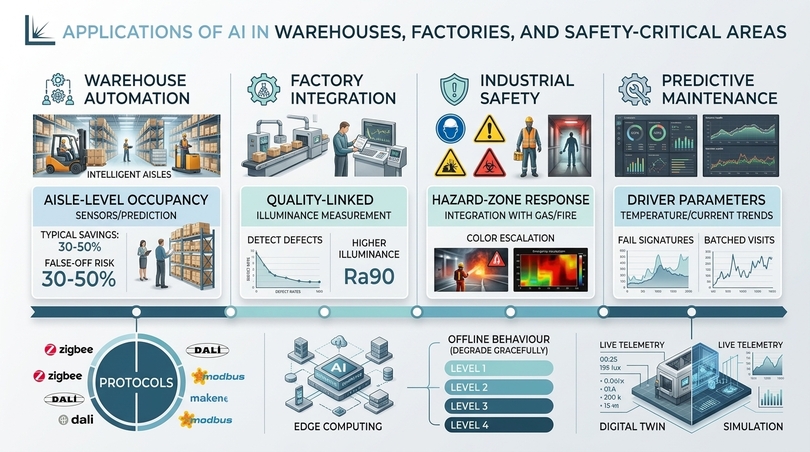
15. Cybersecurity, resilience and offline behaviour of connected lighting
Connected luminaires are network-attached embedded computers deployed in the hundreds, often installed by electrical contractors rather than IT teams, frequently never patched, and physically located throughout a facility. That combination makes them a genuinely attractive target: not because an attacker wants to control your lights, but because a compromised luminaire is a persistent foothold inside the OT network. Industrial lighting security has moved from a theoretical concern to a governance requirement, and in the EU the NIS2 Directive substantially widened the set of manufacturing, logistics and energy operators subject to formal cybersecurity obligations.
The threat model
| Threat | Mechanism | Consequence | Primary mitigation |
|---|---|---|---|
| Network pivot | Compromised luminaire or gateway used to reach other OT systems | Access to production control networks | Strict VLAN segmentation and firewalling |
| Default credentials | Commissioning passwords never changed | Full system takeover | Mandatory credential rotation at handover |
| Unpatched firmware | Known vulnerabilities persist for years | Remote exploitation | Signed OTA updates and a lifecycle policy |
| Wireless interception / replay | Weak or absent encryption on mesh traffic | Unauthorised control, data disclosure | AES-128 or better with per-device keys |
| Denial of light | Mass switch-off or flicker induction | Production stoppage, safety incident | Device-level fail-safe defaults |
| Data exposure | Occupancy data revealing staffing and operations | Privacy breach, competitive intelligence loss | Data minimisation, on-premise processing |
| Supply chain compromise | Malicious or vulnerable component in the firmware supply chain | Widespread latent vulnerability | SBOM requirement and vendor security assessment |
The security requirements to write into your specification
- Network segmentation: lighting on a dedicated VLAN with explicitly defined, deny-by-default flows to any other network.
- No default credentials in service: unique credentials per installation, rotated at handover and documented in a managed secrets store.
- Signed firmware and a stated update policy: ask specifically how long the vendor commits to providing security updates, and what happens after that period.
- Encryption in transit for all wireless and IP traffic, with per-device keys rather than a shared network key.
- Software Bill of Materials (SBOM) for controllers and gateways, increasingly expected under the EU Cyber Resilience Act.
- IEC 62443 alignment for the control system, with a stated security level target.
- Local-first architecture: full functionality without an internet connection, cloud used for analytics only.
- Audit logging of configuration changes, with logs exported to the organisation’s SIEM.
- Documented decommissioning process so that removed luminaires and gateways are de-provisioned rather than left as orphaned credentials.
The most common real-world failure is not an exotic exploit, it is a commissioning laptop with a stored administrator password, a gateway left on the corporate network with a public IP, and a system nobody has patched since installation. Governance beats technology here: assign the lighting system an owner in the OT asset register, include it in the patch cycle, and require the same vendor security assessment you would apply to a PLC supplier.
16. Market size, growth drivers and industrial lighting trends
Market context matters for two practical reasons: it tells a procurement team whether the technology they are buying is on a maturing or a still-volatile trajectory, and it tells a board whether an investment aligns with where the sector is heading. The industrial lighting market as a whole is growing steadily, while the smart and AI-enabled segment within it is growing three to four times faster, which is exactly the pattern you would expect from a mature product category undergoing a control-layer transformation.
Market size and growth
| Segment | Recent value | Forecast | CAGR | Source |
|---|---|---|---|---|
| Industrial lighting (total) | USD 7.83 bn (2025) | USD 12.09 bn by 2031 | ~7.5% (2026–2031) | Mordor Intelligence, 2026 |
| Smart industrial lighting fixtures | USD 3.2 bn (2024) / USD 3.5 bn (2025) | USD 12.2 bn by 2034 | 14.8% (2025–2034) | Global Market Insights, 2025 |
| Smart lighting (all sectors) | USD 15.7–18 bn (2024–2025) | USD 88.4 bn by 2034 | ~19.3% | Global Market Insights, 2025 |
| Smart lighting (alternative estimate) | USD 9.86 bn (2025) | USD 17.38 bn by 2030 | 12.0% | MarketsandMarkets, 2025 |
| LED smart fixtures (sub-segment) | ~USD 1.1 bn (2024) | — | 15.1% (2025–2034) | Global Market Insights, 2025 |
The divergence between the smart-lighting estimates is instructive rather than embarrassing: different analysts draw the segment boundary in different places, some counting only controls and others counting the entire connected luminaire. The consistent signal across all of them is a double-digit compound growth rate against a mid-single-digit growth rate for the underlying lighting market. In practical terms: the fixtures are becoming a commodity, and the value is migrating to the control and data layer.
Segment structure and regional adoption
Within the smart industrial lighting fixtures segment, manufacturing facilities represent the largest end-user category, holding approximately 31% of the market in 2024 according to Global Market Insights. On the protocol side, DALI held roughly 40% share of the control protocol segment in 2024 and is forecast to grow at approximately 15% annually, confirming the recommendation in section 14 that DALI-2/D4i is the safest interoperability bet for industrial buyers.
Regionally, Mordor Intelligence places Asia-Pacific at 39.1% of 2025 industrial lighting revenue with the fastest growth rate, driven by smart-factory incentives in China and industrial corridor development in India, with Japan and South Korea increasingly specifying digital twin capability in tender documents. North America accounted for around 30.7%, where the dominant driver is retrofit rather than new build because the average plant age is approximately thirty years. Europe’s position is distinctive: growth is driven less by new construction and more by regulatory pressure (the fluorescent phase-out, energy efficiency directives, CSRD reporting obligations and national decarbonisation targets) which makes the European market unusually compliance-led rather than technology-led.
The seven trends shaping industrial lighting to 2030
| Trend | What is changing | What a buyer should do about it |
|---|---|---|
| 1. Controls value exceeds fixture value | Hardware commoditises, software, data and services capture margin | Negotiate software licensing and data ownership explicitly, not as an afterthought |
| 2. Interoperability becomes mandatory | D4i, Matter and open APIs displace proprietary ecosystems | Refuse closed protocols; write portability into the contract |
| 3. Lighting-as-a-Service and performance contracting | Capex converts to opex with guaranteed savings | Model TCO across both routes before committing |
| 4. Circularity and repairability | Ecodesign pressure toward replaceable components and spare-part availability | Favour modular profile systems over sealed disposable fixtures |
| 5. Human-centric and well-being lighting | Circadian design moves from research to specification | Specify tunable capability now even if the strategy comes later |
| 6. Convergence of lighting and OT security | NIS2, IEC 62443 and CRA bring lighting into cyber governance | Involve IT/OT in the specification from day one |
| 7. Lighting as spatial data infrastructure | Occupancy and utilisation data monetised beyond energy | Plan data governance and works-council consultation early |
Trend four deserves the closest attention from anyone specifying today, because it directly favours the profile architecture described in sections 8 and 9.
European ecodesign policy is moving consistently toward products that can be repaired, upgraded and disassembled, with growing emphasis on spare-part availability and separability of components. A sealed luminaire in which a failed driver requires discarding the entire unit is on the wrong side of that trajectory. An aluminium profile whose strip, driver and diffuser are independently replaceable is on the right side of it, and will remain compliant and serviceable long after integrated products of the same vintage have been landfilled.
17. ROI, total cost of ownership and procurement strategy
Every reader of this article eventually arrives at the same question in a different accent: the plant manager asks about payback, the CFO asks about TCO, the procurement manager asks about hidden costs, and the consultant asks how to model it for a client. They are all asking for the same financial structure, and this section provides it in a form you can take directly into a business case.
The TCO model
Total cost of ownership over a defined horizon (use ten years for industrial lighting, since it approximates the realistic service life of a quality LED installation) comprises:
TCO = Capex + (Energy cost × years) + (Maintenance cost × years) + Control/software costs − Residual value − Incentives
| Cost element | Legacy HID/fluorescent | LED, uncontrolled | LED + AI control |
|---|---|---|---|
| Capex per m² (indicative) | €0 (existing) | €12–€22 | €18–€38 |
| Annual energy per m² at 6,000 h, €0.20/kWh | €13.20 (11 W/m²) | €4.80 (4 W/m²) | €2.16 (1.8 W/m² effective) |
| Annual maintenance per m² | €1.20–€2.50 | €0.25–€0.60 | €0.12–€0.35 |
| Software/licence per m²/year | €0 | €0 | €0.15–€0.60 |
| 10-year TCO per m² | €144–€157 | €62–€82 | €44–€68 |
Read the bottom row carefully, because it contains the whole argument.
The AI-controlled installation has the highest capital cost and the lowest ten-year total cost. It also has the widest range, because the outcome depends far more on implementation quality (sensor placement, commissioning discipline, ongoing governance) than on hardware selection. This is the central financial truth of the category: the money is made or lost in commissioning and operation, not in procurement.
Payback periods
| Scenario | Operating hours/year | Typical simple payback |
|---|---|---|
| HID high bay → LED, single shift | 2,500 | 3.5–5 years |
| HID high bay → LED, two shifts | 5,000 | 1.8–2.8 years |
| HID high bay → LED, continuous | 8,000 | 1.0–1.8 years |
| Fluorescent → LED profile, two shifts | 5,000 | 2.5–4 years |
| Adding AI control to existing LED | 5,000+ | 1.5–3.5 years |
| Full LED + AI, continuous operation | 8,000 | 1.5–2.5 years |
| Task lighting retrofit + ambient reduction | 4,000+ | 0.8–2 years |
The last row is consistently the best-performing intervention available and consistently the least often proposed, because it generates the smallest invoice for the supplier. Adding LED profile task lighting above workstations and reducing ambient levels to the compliance minimum often pays back inside a year, requires no controls infrastructure, and improves working conditions immediately. If a supplier has never suggested it, ask why.
Hidden costs procurement must surface
- Software licensing beyond year one: ask what the annual fee is in year five, whether it escalates, and what functionality is lost if you stop paying.
- Commissioning as a separate line: many quotations exclude sensor calibration and zone programming. Confirm it is included and specify the acceptance criteria.
- Network infrastructure: gateways, PoE switches, VLAN configuration and firewall rules are often assumed to be “the client’s IT scope”.
- Re-commissioning after layout changes: ask the cost of re-zoning after a racking change, and whether the system can do it itself.
- Data egress and platform migration: if you leave the vendor, can you export your historical data in an open format?
- Emergency lighting testing: automated testing is usually a paid module.
- Disposal of legacy fittings as hazardous waste.
- Scaffolding or lift access not included in the electrical quotation.
- Spare stock: hold 3–5% of fixtures and drivers as spares from the original batch; buying them later risks a visible mismatch.
Financing routes
| Route | How it works | Best for | Watch out for |
|---|---|---|---|
| Direct capital purchase | Buy outright, own the asset | Sites with available capex and long tenure | Competes with production investment for budget |
| Operating lease | Fixed monthly payment, off balance sheet in some regimes | Preserving capex, predictable cost | Total paid exceeds purchase price |
| Lighting-as-a-Service | Provider owns and maintains; you pay per month or per lux delivered | Leased premises, no maintenance capability | Long contract terms; exit and ownership clauses |
| Energy Performance Contract | ESCO funds the works, repaid from verified savings | Large multi-site programmes | Measurement and verification methodology must be agreed precisely |
| Grants and tax incentives | National energy efficiency schemes, white certificates, capital allowances | Any project, if applicable | Application timing often precedes works; check before ordering |
In several European countries, energy efficiency certificate schemes and accelerated depreciation allowances materially improve the business case, but almost all of them require the application to be filed before the installation begins.
The most common avoidable financial loss in lighting projects is completing the work and then discovering that the incentive required prior notification.
The vendor evaluation checklist
Take this list into every supplier meeting. A vendor who answers all of it in writing is worth serious consideration; a vendor who deflects on more than two points is not.
- LM-79 luminaire-level photometry and LM-80/TM-21 lifetime projection: supplied as documents, not claims.
- Maintained illuminance calculation for our specific building, showing UGR and uniformity, not just average lux.
- Installed W/m² for the proposed design, compared against the benchmarks in section 5.
- Flicker performance (PstLM and SVM) across the full dimming range.
- CRI, R9 and SDCM binning tolerance.
- Control protocol: open standard or proprietary, and what portability we retain.
- Behaviour on network, gateway and cloud failure, described level by level.
- Security: segmentation requirements, credential management, firmware update commitment period, SBOM availability.
- Data ownership, export format, and what happens to our data if we terminate.
- Warranty scope and duration for luminaire, driver and controls separately, with conditions.
- Spare part availability commitment in years, and batch matching guarantee for phased works.
- Two reference sites of comparable type and scale, with contactable references.
- Measured before-and-after energy data from at least one comparable installation.
- Total ten-year cost including all licences, with a written statement of what is excluded.
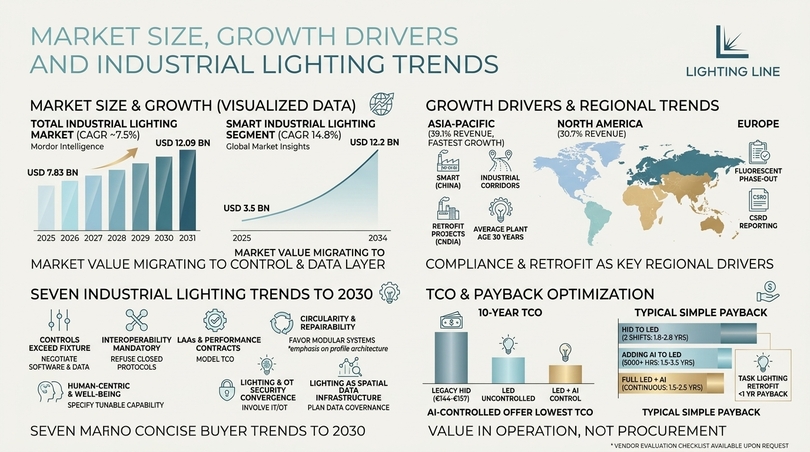
18. Role-based answers: facility, energy, maintenance, IT, safety and procurement
A lighting project succeeds or fails on whether eight different stakeholders each get an answer they can act on. This section addresses each role directly, with the questions they actually ask and answers written in the terms they are accountable for. If you are building an internal business case, this is the section to circulate, each subsection is designed to be read in isolation by the person named in its heading.
Facility manager / Plant manager
Your accountability is uptime, cost and compliance in a building you cannot stop. Every lighting question you have reduces to: will this reduce my running costs without creating new problems for me to manage?
- How much will this reduce energy costs? Against uncontrolled HID, expect 75–90% with LED plus adaptive control. Against existing uncontrolled LED, expect 30–50% from the control layer alone. Insist on a building-specific calculation using your metered baseline, not a generic percentage.
- How long does installation take without disrupting operations? A phased zone-by-zone retrofit of a 5,000 m² facility typically runs four to eight weeks with no production stoppage, working around shift patterns. Whole-building programmes are faster in elapsed time but almost always more expensive in total because of access coordination and overtime.
- Will it work with my existing infrastructure? In most cases the existing power circuits are reusable. Wireless control avoids new control wiring entirely. The genuine checks are circuit protection type for LED inrush, cable condition, and whether your distribution has the spare ways for any new zoning.
- What if the AI fails – is there a manual override? There must be, and it must be physical. Specify a hardwired override at distribution board level that forces full output independently of the control system, plus device-level defaults that go to full output on control loss. Test this at handover and document the result.
- Will it reduce maintenance and downtime? Yes, in two ways: LED failure rates are far lower than HID, and predictive alerts let you batch interventions into planned shutdowns rather than reacting to dark aisles.
- How does it improve safety and compliance? Measured, reported illuminance turns compliance from an annual survey into a continuous record. If an inspector or an insurer asks what the lux level was in Zone 7 on a given date, you have the answer.
Operations director / COO
Your questions are about scale, standardisation and proof. A solution that works brilliantly in one plant and cannot be replicated is not a solution.
- What savings across multiple sites? Model each site separately, savings vary by a factor of two depending on operating hours, daylight availability and current over-lighting, then aggregate. Portfolio-level savings of 60–80% of lighting energy are realistic where the estate is predominantly legacy.
- Can it scale across the portfolio? Only if you standardise now. Define a group specification covering protocol, luminaire classes, sensor types, security requirements and data model, and require every site to procure against it. The alternative, each site choosing its own vendor, produces an estate you cannot benchmark or manage centrally.
- How does it support ESG goals? Lighting typically represents 10–20% of industrial electricity consumption and is among the fastest-implemented Scope 2 reductions available. Measured fixture-level data also improves the assurance quality of your sustainability reporting, which matters increasingly under CSRD.
- How do we benchmark across facilities? Use normalised metrics: kWh/m²/year for lighting, W/m² installed, and lighting energy per unit of output. A common data model across sites is a procurement requirement, not a nice-to-have.
- Integration with BMS/SCADA? Through gateways using BACnet/IP or Modbus for supervision, with a parallel MQTT or OPC UA path to your data platform for analytics. See section 14.4.
Energy manager / Sustainability manager
- Annual savings? Calculate from your own baseline: current installed W/m² × area × operating hours. Then apply the mechanism-by-mechanism analysis in section 12.1 rather than a single blended percentage, it produces a defensible number you can put in front of an auditor.
- Real-time monitoring? D4i luminaires report their own consumption. You get lighting energy data at fixture resolution without installing meters, typically the highest-granularity energy data in the entire building.
- ISO 50001 and LEED support? Fixture-level metering directly supports ISO 50001’s monitoring, measurement and analysis requirements and provides auditable evidence of continual improvement. For LEED and BREEAM, lighting contributes to energy performance credits, and controls contribute to additional credits under lighting quality and controllability criteria.
- Comparison with a plain LED retrofit? A plain retrofit captures roughly two-thirds of the available saving. The control layer captures the remaining third at a lower incremental cost per kWh saved than the fixtures themselves, which is why doing the retrofit without controls and adding them later is the more expensive route overall.
- What data for reporting? kWh by zone and by fixture, operating hours, average dimming level, occupancy-driven savings attribution, and avoided emissions using your contracted grid factor.
Maintenance / Reliability engineer
- How does predictive maintenance work? See section 13.4. In short: drivers report temperature, current and hours; models detect drift; alerts precede failure by weeks to months.
- What sensors detect failures? Mostly no additional sensors, the driver’s own telemetry does the work. Supplementary ambient temperature sensing helps in thermally variable environments.
- MTTR reduction? Substantial, because diagnosis happens before dispatch. The technician knows the fixture ID, the location, the likely fault and the part required.
- CMMS integration? Require a documented REST API or MQTT output and confirm an example payload before purchase. Email alerts are not integration.
- Lifespan of connected fixtures? The LED source will typically reach L80 at 50,000–100,000 hours. The driver is the limiting component at 50,000–80,000 hours depending on thermal conditions. The control node’s practical life is often governed by firmware support rather than hardware, ask the vendor for their support commitment in years.
- Troubleshooting difficulty? An addressable system is dramatically easier to troubleshoot than a conventional one, because you can query any fixture individually. The difficulty shifts from electrical fault-finding to system configuration, which means your team needs one person trained on the platform, not the whole team.
Procurement manager
- Upfront cost versus traditional? Expect a 25–60% capital premium for an AI-controlled installation over a plain LED retrofit, recovered typically within two to three years of operation at industrial running hours.
- How to compare vendors? Use the fourteen-point checklist in section 17.5. Normalise every quotation to €/m² for a defined maintained lux, and to ten-year TCO including licences. Quotations expressed as “price per fixture” are not comparable.
- Typical warranties? Five years is standard for quality industrial luminaires; seven to ten years is available from premium manufacturers, usually conditional on using their driver and on ambient temperature limits. Read the conditions: many warranties are void if operating hours exceed a stated figure or if a third-party driver is used.
- Hidden costs? See section 17.3.
- Financing? See section 17.4.
- The single most valuable clause to negotiate: data portability and protocol openness. It is worth more over ten years than a 10% discount, because it preserves your ability to competitively tender the maintenance and control layer later.
IT / OT manager and Industry 4.0 lead
- Integration with IoT platforms? Via MQTT or OPC UA from the lighting gateway. Confirm the data model, message frequency and payload size before agreeing, several hundred luminaires reporting every second will generate more traffic than anyone expects.
- Which protocols? See the full comparison in section 14.2. Recommended: DALI-2/D4i at device level, wireless mesh where cabling is impractical, BACnet/IP or Modbus to the BMS, MQTT or OPC UA to analytics.
- Cybersecurity measures? See section 15.2 for the specification clauses. Non-negotiables: segmentation, unique credentials, signed firmware, encryption with per-device keys, and a stated support period.
- Digital twin feed? Possible where the vendor exposes fixture-level telemetry with stable identifiers and where you hold the photometric and geometric model. Confirm identifier stability across firmware updates.
- Edge computing? Local controllers execute inference and control logic on premises; cloud handles long-horizon analytics and model training. This is the correct architecture for latency, resilience and data protection.
- Network failure? See the four-level degradation model in section 14.6. Verify it by testing during commissioning: disconnect the gateway and confirm the lights behave as specified.
Health & safety manager
- How does it improve safety? Continuous verification of compliant illuminance, elimination of unnoticed dark zones, hazard-triggered lighting response, and better vertical illuminance at vehicle–pedestrian conflict points.
- Automatic response to hazards? Yes, where integrated with detection systems: but the integration must be designed by competent persons and must not compromise the independence of safety-instrumented functions.
- Night shift support? Tunable systems can maintain alertness early in the shift and reduce short-wavelength content later. Treat it as a measured pilot, not a guaranteed outcome.
- Emergency egress? Automated self-testing produces the compliance record EN 50172 requires. Dynamic escape routing is possible but subject to national approval and must be fire-engineered.
- Applicable standards? EN 12464-1 and -2, EN 1838, EN 50172, EN 60598, EN 62471, plus ATEX where relevant. See section 4.
Consultant / System integrator
- How do systems compare technically? Compare on four axes: protocol openness, edge autonomy, data model quality and security posture. Feature lists are largely interchangeable; these four are not.
- Deployment best practice? Pilot one representative zone with measured before-and-after data; standardise the specification before scaling; commission properly and budget for re-commissioning at six months once real usage patterns have emerged.
- Common pitfalls? See section 21.
- How to calculate client ROI? Build from metered baseline consumption, apply the six mechanisms in section 12.1 separately, add maintenance avoidance at realistic access costs, and present a range rather than a point estimate. A single confident number destroys credibility the first time reality differs from it.
19. Implementation roadmap: from audit to commissioning
The gap between a good specification and a good installation is process. This eight-phase roadmap reflects how successful industrial lighting projects are actually run, and the sequence matters: several of the most expensive mistakes in the sector come from starting at phase four.
Phase 1 – Baseline audit (1–3 weeks)
Count and catalogue every existing luminaire by type, wattage, condition and location. Measure actual illuminance on a grid at work-plane height and at eye level, in each zone, with the existing installation. Record operating hours per zone, either from a metered circuit or from a temporary logger. Photograph and note mounting heights, access constraints and surface reflectances. Without this baseline you cannot prove savings later, and any performance guarantee you negotiate will be unenforceable.
Phase 2 – Requirement definition (1–2 weeks)
Map each area to its EN 12464-1 task category and record the required Ēm, U₀, UGR and Ra. Identify special requirements: colour-critical inspection, washdown, ATEX zones, cold store, emergency lighting coverage. Interview supervisors from each shift — they know where the light is inadequate, and their input prevents the classic failure of a technically compliant design that the workforce dislikes.
Phase 3 – Design and Simulation (2–4 weeks)
Produce photometric calculations in DIALux evo or Relux using the actual building geometry and realistic reflectance and maintenance factors. Verify uniformity and UGR from realistic observer positions, not just average lux. Produce at least two design options with different fixture strategies — for example roof-mounted high bay versus suspended linear profile and compare them on installed W/m², capital cost and ten-year TCO.
Phase 4 – Pilot Installation (2–4 weeks)
Install one representative zone and measure it. This phase is skipped more often than any other and its absence is the leading cause of large-scale disappointment. The pilot validates the photometric model, exposes installation difficulties, tests the control system’s behaviour with real occupants, and gives you a measured saving figure to extrapolate rather than a modelled one. Run it for a minimum of four weeks across all shift patterns.
Phase 5 – Procurement (2–6 weeks)
Tender against the specification, not against a product list. Normalise all quotations to €/m² at defined maintained lux and to ten-year TCO. Apply the vendor checklist in section 17.5. Confirm batch matching and spare part commitments in writing.
Phase 6 – Phased Installation
Work zone by zone around production. Isolate, remove, install, test and hand back each zone before starting the next. Dispose of legacy lamps through a licensed WEEE route and retain the documentation. Update circuit records and as-built drawings as you go: not at the end, when nobody remembers.
Phase 7 – Commissioning (1–3 weeks)
This is where the value is created or lost. Calibrate every sensor to its actual environment rather than a factory default. Set and document dimming levels, time-outs, standby levels and daylight setpoints per zone. Verify measured illuminance against design on the same grid used in the baseline audit. Test failure modes explicitly: pull the gateway, drop the network, cut the cloud connection, and confirm each degradation level behaves as specified. Obtain the commissioning report as a deliverable, containing measured values and configuration settings, without it you have no baseline for the next contractor.
Phase 8 – Optimisation and governance (ongoing)
Review at three months and at six months, once the system has learned real usage and once occupants have voiced complaints. Re-tune time-outs and standby levels — over-aggressive settings are the main cause of user override. Assign an owner in the asset register, include the system in the OT patch cycle, and schedule an annual review of energy performance against the baseline. An AI lighting system with no owner degrades exactly like a rule-based one, because someone will eventually override it to solve a complaint and nobody will ever change it back.
20. Case studies and documented results
Generic percentages are easy to dismiss. What persuades a board is a documented sequence: this was the baseline, this was the intervention, this was the measured outcome, and this is what went wrong along the way. The following cases are composite profiles drawn from the pattern of documented industrial lighting projects in Europe, the figures reflect typical measured outcomes rather than any single client installation, and each case includes the difficulty encountered, because projects that report no difficulties are usually projects that were not measured.
Automotive components plant, Northern Italy – 8,400 m²
| Parameter | Before | After |
|---|---|---|
| Installation | 216 × 400 W metal halide high bay | 198 × 150 W LED high bay + 340 m suspended LED profile task lighting |
| Installed load | 95 kW (11.3 W/m²) | 36 kW (4.3 W/m²) |
| Control | Three manual switch groups | DALI-2 zoning, occupancy and daylight, adaptive optimisation |
| Measured illuminance, assembly | 310 lux average, U₀ 0.38 | 520 lux average, U₀ 0.64 |
| Measured illuminance, inspection benches | 420 lux, Ra 65 | 1,050 lux, Ra 90 |
| Annual consumption | 608,000 kWh | 119,000 kWh |
| Reduction | 80.4% | |
| Payback | 2.1 years including controls | |
The most interesting outcome was not the energy figure but the quality data. Raising inspection bench illuminance from 420 lux at Ra 65 to 1,050 lux at Ra 90 (achieved with LED profiles above the benches rather than by increasing ambient light) coincided with a measurable reduction in surface-finish defects escaping to the next station. The plant had previously attributed those escapes to operator attention.
Difficulty encountered: the first commissioning set occupancy time-outs at 90 seconds, and operators performing stationary bench work were repeatedly left in standby. Re-commissioning with microwave sensors and 12-minute time-outs in bench zones resolved it, at the cost of roughly 3% of the theoretical saving. This trade, accepting slightly lower savings for genuine user acceptance, is almost always the correct one.
Third-party logistics warehouse, benelux – 22,000 m², Narrow aisle
| Parameter | Before | After |
|---|---|---|
| Installation | LED high bay installed 2017, uncontrolled | Same fixtures + wireless control nodes + aisle sensors |
| Installed load | 81 kW (3.7 W/m²) | 81 kW installed, 29 kW average draw |
| Operating hours | 8,300 h/year | 8,300 h/year |
| Annual consumption | 672,000 kWh | 241,000 kWh |
| Reduction | 64.1% | |
| Project cost | €96,000 (controls only, no fixture replacement) | |
| Payback | 1.1 years at €0.22/kWh | |
This case illustrates the argument in section 12.2: an existing LED installation is not a finished project. No fixture was replaced. The entire saving came from adding wireless nodes and aisle-level detection to hardware that was already efficient, at roughly one-fifth of the cost of the original retrofit. In the second year, integration with the warehouse management system allowed pick-path pre-lighting, which added a further 6% while eliminating operator complaints about lights lagging behind them.
Difficulty encountered: 2.4 GHz mesh congestion in an aisle densely packed with metal racking required additional repeater nodes and a channel plan coordinated with the site’s RF-based scanning system: an integration cost not in the original quotation, and a standard reason to involve IT before, not after, procurement.
Cold storage facility, central Europe – 11,000 m² at −24 °C
Legacy fluorescent battens performed poorly at low temperature, with slow start-up and reduced output: a classic cold-store problem, since fluorescent efficacy falls sharply below 10 °C. LED behaves in the opposite direction.
| Metric | Before (fluorescent) | After (sealed LED profile) |
|---|---|---|
| Installed load | 7.8 W/m² | 2.6 W/m² |
| Measured illuminance, aisles | 95 lux | 185 lux |
| Start-up behaviour at −24 °C | 2–4 minutes to full output | Instant, full output |
| Annual lighting consumption | 601,000 kWh | 112,000 kWh (with occupancy control) |
| Refrigeration load from lighting heat | ~86 MWh/year removed | ~16 MWh/year removed |
The last row is the saving that most cold-store business cases omit entirely.
Every watt of lighting inside a refrigerated envelope must be removed again by the refrigeration plant, at a coefficient of performance typically between 1.5 and 2.5 in low-temperature applications. The effective energy saving is therefore substantially larger than the lighting meter shows: commonly 40–70% larger. Any cold-store lighting proposal that ignores the refrigeration interaction is understating its own value.
Precision engineering workshop, UK — 1,900 m²
A small-scale case that demonstrates the highest-ROI intervention in this guide. The workshop was uniformly lit to 620 lux from roof-mounted fittings at 7.5 m, because one operation (bore inspection) required high illuminance.
The intervention: reduce ambient lighting to 320 lux, and install 1.5 m LED profiles with opal diffusers directly above the twelve inspection and precision assembly positions, each delivering 1,100 lux on the work plane at 22 W.
- Installed load: from 14.6 kW to 6.1 kW – 58% reduction.
- Capital cost: €11,400 including installation.
- Annual saving at 4,200 h and €0.26/kWh: €9,282.
- Payback: 14.7 months, with no control system at all.
- Operator feedback was unusually positive: task illuminance rose from 620 to 1,100 lux exactly where it was needed, shadows from the operator’s own hands were eliminated by the linear geometry, and individual switching gave each position local control.
Not every industrial lighting problem requires machine learning. A great many require nothing more than putting the right amount of light close to the task, and profile systems are the most cost-effective way to do that. Evaluate the simple intervention before the sophisticated one, and if a supplier’s first proposal is a controls platform, ask them to price the task-lighting option alongside it.
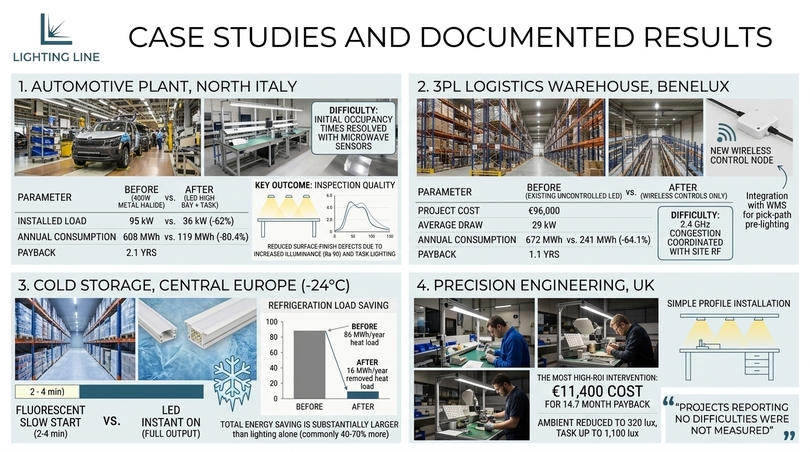
21. Common specification pitfalls and how to avoid them
The failures in this section are drawn from patterns that recur across the industry. Each one is entirely avoidable at specification stage and expensive to correct afterwards, which is precisely the combination that makes them worth reading twice.
| Pitfall | Why it happens | Consequence | Prevention |
|---|---|---|---|
| Specifying initial rather than maintained lux | Higher headline number in the quotation | Installation falls below standard within 3–5 years | Require maintained illuminance with the maintenance factor stated |
| Ignoring UGR | Not measured on site, invisible in a quotation | Operator complaints, glare-related fatigue, non-compliance | Require UGR calculation from realistic observer positions |
| Wide fixture spacing to reduce count | Lowers headline price | Uniformity failure, dark patches between fixtures | Check spacing-to-height ratio against the optic |
| Comparing chip-level efficacy | Marketing convention | Delivered output 30–40% below expectation | Demand LM-79 luminaire-level data |
| Overloading an undersized LED profile | Section chosen for appearance or price | Overheating, rapid depreciation, early failure | Match W/m to profile thermal class; de-rate if recessed |
| Long single-feed strip runs | Simplest wiring | Visible brightness gradient, uniformity failure | Feed both ends, inject mid-run, or use 48 V |
| Cheap drivers | Largest single cost saving available | Flicker, early failure, warranty disputes | Specify efficiency, surge rating, ta and flicker across the dimming range |
| Sensor time-outs set too short | Maximises modelled savings | Users disable the system entirely | Commission with real users; re-tune at three months |
| Emergency lighting left out of scope | Different budget line, different contractor | Legal non-compliance discovered at audit | Include emergency in the same project and test at handover |
| Proprietary control protocol | Vendor default, path of least resistance | Fifteen-year lock-in, no competitive re-tender | Require DALI-2/D4i or a documented open API |
| No commissioning documentation | Nobody asks for it | Next contractor must reverse-engineer the system | Make the commissioning report a contractual deliverable |
| No spare stock from the original batch | Budget pressure at handover | Visible colour mismatch on later repairs | Order 3–5% spares with the main batch |
| IT involved after installation | Lighting treated as an electrical project | Security objections force rework or blocked deployment | Include IT/OT in the specification phase |
| No measured baseline | Perceived as an unnecessary cost | Savings unprovable; performance guarantees unenforceable | Meter and measure before touching anything |
| Skipping the pilot | Programme pressure | Design flaws replicated across the entire building | Always pilot one representative zone first |
If you take only one item from this table, take the last one.
A pilot zone costs perhaps 3–5% of a project budget and reliably prevents the two failure modes that destroy industrial lighting projects: a photometric model that does not match reality, and a control configuration that the workforce will not tolerate. Every project that has to be partially redone shares the same history, it went straight from design to full deployment.
22. Glossary of industrial lighting terminology
| Term | Definition |
|---|---|
| ATEX | EU directive framework governing equipment for potentially explosive atmospheres |
| Binning / SDCM | Sorting of LEDs by colour; SDCM expresses colour consistency, lower is better |
| CCT | Correlated colour temperature in kelvin; the visual warmth or coolness of white light |
| CRI (Ra) / R9 | Colour rendering index; R9 is the supplementary saturated-red value |
| D4i | DALI-2 extension standardising luminaire data reporting including energy and diagnostics |
| DALI-2 | Digital Addressable Lighting Interface, certified open control protocol |
| Ēm | Maintained illuminance; the average lux that must still be achieved at end of maintenance cycle |
| Efficacy | Lumens produced per watt consumed; measure at luminaire level |
| Foot-candle | Imperial illuminance unit; 1 fc ≈ 10.76 lux |
| IK rating | Impact resistance rating, IK00 to IK10 |
| IP rating | Ingress protection; first digit solids, second digit liquids |
| L80 / L90 | Time at which output falls to 80% or 90% of initial value |
| LENI | Lighting Energy Numeric Indicator, kWh/m²/year |
| LM-79 / LM-80 / TM-21 | Test standards for luminaire photometry, LED lumen maintenance and lifetime projection |
| Lumen | Unit of luminous flux emitted by a source |
| Lux | Unit of illuminance; one lumen per square metre |
| Maintenance factor | Multiplier accounting for depreciation, dirt and failures over the maintenance cycle |
| mEDI | Melanopic equivalent daylight illuminance; the circadian-relevant light metric |
| MTTR | Mean time to repair |
| PstLM / SVM | Flicker and stroboscopic visibility metrics |
| Room index (K) | Geometric ratio used to derive utilisation factor |
| SHR | Spacing-to-height ratio governing uniformity |
| TM-30 | Modern colour rendition metric set, Rf fidelity and Rg gamut |
| U₀ | Illuminance uniformity, minimum divided by average |
| UGR | Unified glare rating; lower means less discomfort glare |
| Utilisation factor | Proportion of luminaire flux reaching the work plane |
23. Frequently asked questions about industrial lighting
The questions below are the ones most frequently asked by facility managers, energy managers, engineers, procurement teams and designers researching industrial lighting. Each answer is self-contained, so this section can be read on its own or used as a reference during a supplier meeting. Click any question to expand the answer.
What does industrial lighting mean?Industrial lighting means the engineered provision of artificial light in production, storage and processing environments: factories, warehouses, workshops, logistics hubs and outdoor industrial yards. It is defined by three characteristics: performance is specified numerically (maintained lux, uniformity, glare rating, colour rendering) rather than subjectively; the equipment must survive hostile conditions including dust, moisture, vibration, chemicals and temperature extremes; and mounting geometries range from sub-metre task positions to 15-metre roof structures. The term is also used loosely to describe an interior design aesthetic based on exposed metal and functional forms, which is a separate meaning covered in section 10. |
What are the different types of industrial lighting?By fixture form: LED high bay (round and linear), low bay, weatherproof battens, linear LED profile systems, floodlights, panels, explosion-proof luminaires, machine and task lights, and emergency luminaires. By function: ambient, task, accent, decorative and emergency. By source technology: incandescent, fluorescent, high-intensity discharge and LED – of which only LED is specified for new installations today. By environment: dry, dusty, damp, washdown, cold store, outdoor and hazardous area, each with its own minimum IP and IK rating. Section 2 contains the full taxonomy with mounting heights and typical outputs. |
What are industrial lights called?The correct names depend on form. Round ceiling-mounted units at height are high bays, often called UFO high bays. Their lower-mounted equivalents are low bays. The long strip fittings are battens, or tri-proof battens when sealed to IP65 or higher. Continuous modular rails are trunking or continuous row systems. Aluminium extrusions housing LED strip behind a diffuser are LED profiles or linear profile systems. Outdoor units projecting light over a wide area are floodlights. Certified units for explosive atmospheres are ATEX or Ex luminaires. |
What is the difference between commercial and industrial lighting?Commercial lighting serves offices, retail and hospitality, prioritising occupant comfort and brand experience at 300–750 lux, mounted at 2.7–4.5 metres, running roughly 2,500–4,000 hours annually. Industrial lighting serves production and storage, prioritising task performance, safety and cost per unit produced, at 100–1,500 lux in strongly zoned patterns, mounted anywhere from 0.3 to 15 metres, frequently running 8,000 hours annually. The deeper differences are verification (industrial installations are calculated, measured and audited), environmental robustness, and the cost of failure – a failed office fitting is an inconvenience, a failed warehouse aisle is a safety issue and a productivity loss. |
How many lumens do I need for industrial lighting?Calculate rather than guess: total lumens = (target lux × area in m²) ÷ (utilisation factor × maintenance factor). For typical industrial conditions use a utilisation factor of 0.55–0.65 and a maintenance factor of 0.70. As a quick reference, delivering 200 lux to a warehouse requires roughly 476 lm/m² installed; 300 lux for packing and general assembly needs about 714 lm/m²; 500 lux for machining needs about 1,190 lm/m²; and 1,000 lux for fine inspection needs about 2,381 lm/m². A worked example for a 2,000 m² warehouse appears in section 5.2.1. |
What is the lighting standard for industry?In Europe the primary standard is EN 12464-1 for indoor workplaces and EN 12464-2 for outdoor work areas. These specify maintained illuminance, uniformity, unified glare rating and colour rendering for each task type. Emergency lighting is governed by EN 1838 and EN 50172. In the United States the legal minimum is OSHA 29 CFR 1926.56, supplemented in practice by IES recommended practice documents. Sector-specific requirements add to these: ATEX and IEC 60079 for explosive atmospheres, food safety requirements for processing areas, and increasingly IEC 62443 for networked lighting controls. |
How much does industrial lighting cost?Hardware ranges from roughly €55–€180 for a standard LED high bay to €180–€450 for a premium DALI-2 unit, €25–€90 for a weatherproof batten, and €6–€35 per metre for aluminium profile plus €8–€40 per metre for the LED strip. Installation typically adds €25–€60 per fitting at low level and €80–€200 per fitting at height with access equipment. Across a whole project, hardware is 40–55% of cost, installation 25–40%, controls and commissioning 8–20%, and design and verification 3–8%. Section 6 provides the full breakdown. |
How much does it cost to install industrial lighting?Installation labour for a straightforward like-for-like swap at low level runs €25–€60 per fitting across most of Western Europe. The same swap at 10 metres requiring a scissor lift rises to €80–€200 per fitting. Qualified industrial electrician day rates typically fall between €280 and €550, with two-person teams generally required for work at height. Add €90–€250 per day for access equipment. The three factors that inflate installation cost most are production interruption, new control wiring, and compliant disposal of mercury-containing legacy lamps. |
Do industrial lights need special wiring?Usually not: LED industrial luminaires run on standard mains supply and can normally reuse existing circuits. Three exceptions apply. LED drivers produce a brief high inrush current, so a circuit that supported twenty discharge fittings may trip with twenty LED fittings switching simultaneously, a type C or D MCB or staggered switching resolves this. Control protocols such as DALI and 0–10 V require dedicated control conductors, although wireless control avoids this entirely. And 24 V LED strip systems require correctly sized low-voltage cabling and remote drivers to manage voltage drop. |
Do you need an electrician to change light fittings?In any industrial or commercial setting, effectively yes. Work on fixed electrical installations in workplaces must be performed by a competent person and certified: under BS 7671 and the Electricity at Work Regulations in the UK, DM 37/08 in Italy, and equivalent regimes elsewhere in the EU. Beyond legality, an uncertified installation contributing to a fire or injury will be examined closely by insurers. Domestic rules are looser for like-for-like replacements but still restrict work in special locations such as bathrooms. |
Is 3000K or 4000K better for an office?For most offices and general industrial work, 4000 K is the better default. It supports alertness and colour discrimination without the clinical harshness of 5000 K, integrates visually with daylight, and is the value most consistently recommended in European practice. Choose 3000 K where the space is used primarily in the evening, where visual warmth is a design priority, or in break rooms and hospitality areas. Choose 5000 K only for genuinely colour-critical inspection work, and zone it to those tasks rather than applying it building-wide. |
Can LED lights cause dizziness?Yes. Poorly designed LED lighting can cause dizziness, headaches, eye strain and, rarely, photosensitive seizures. The mechanism is temporal light modulation (flicker) and it is determined almost entirely by driver quality and dimming method. A quality constant-current driver produces flicker below 5% modulation and is imperceptible; a cheap driver or low-frequency PWM dimming can produce 30–100% modulation at frequencies to which the visual system is highly sensitive. In industrial settings there is an additional hazard: the stroboscopic effect can make rotating machinery appear stationary. Specify PstLM ≤ 1.0 and SVM ≤ 0.4 across the full dimming range, not merely at full output. |
Do LED lights affect circadian rhythm?Yes. Light is the dominant cue governing the human circadian system, mediated by melanopsin-containing retinal cells most sensitive to short-wavelength light around 480 nm – precisely where cool-white LEDs emit strongly. Evening exposure suppresses melatonin and delays sleep onset; morning exposure has the opposite, beneficial effect. For 24-hour industrial operations this matters considerably: night-shift workers exposed to bright cool light throughout their shift experience circadian disruption associated with sleep disorders and reduced alertness during the 03:00–06:00 window. Tunable lighting strategies that reduce short-wavelength content in the final hours of a night shift are the engineering response. |
Is industrial lighting still in style?Yes, though it has evolved substantially. The exposed-Edison-bulb maximalism of the mid-2010s has given way to three refined variants: minimal industrial, with the same honest materials reduced to clean linear geometry; warm industrial, softening the grey palette with timber, leather and 2700–3000 K light; and integrated industrial, where light is delivered as continuous lines and recessed planes rather than as decorative objects. The style endures because it is honest and adaptable, and because linear aluminium profiles are, aesthetically, entirely authentic industrial objects. |
What defines industrial style lighting?Five characteristics: honest materials such as raw or blackened steel, aged brass, aluminium and concrete; visible structure, with fixings, brackets and conduit treated as part of the design; functional forms derived from an original purpose, such as the dome shade, the cage guard or the articulating arm; a restrained palette of black, graphite, gunmetal and natural metal; and a deliberate light source, typically warm in colour temperature with generous shadow rather than flat uniformity. |
Is Flos lighting Italian? What is a famous Italian lighting brand?Yes, Flos is Italian — founded in Merano in 1962 and now headquartered in Brescia. It sits within a broader Italian lighting tradition that includes Artemide, Oluce, Fontana Arte, Martinelli Luce, Luceplan and Foscarini, developed principally in Milan and its industrial hinterland in the post-war period with designers including Achille and Pier Giacomo Castiglioni, Gino Sarfatti, Vico Magistretti and Gae Aulenti. Their distinctive contribution was treating industrial components as legitimate design elements: which is exactly the logic that makes a well-proportioned aluminium profile an appropriate architectural object rather than merely a technical one. |
What is the 5’7″ lighting rule?The term circulates informally, and in workplace lighting the underlying principle is the eye-height reference: glare, luminance ratios and vertical illuminance should be evaluated from a standing observer’s eye position, conventionally around 1.5–1.7 metres (approximately 5 feet 7 inches) above floor level, rather than only from the 0.75 m horizontal work plane. This matters in industrial spaces because a design with excellent horizontal uniformity can still place a high-output luminaire directly in a forklift driver’s sightline. EN 12464-1 addresses the same concern through UGR evaluation at realistic observer positions and through cylindrical illuminance requirements. |
What are the 4 types of lighting?Functionally: ambient (general baseline illumination), task (additional local light for detail work), accent (directing attention to a specific object or zone) and decorative (contributing to the identity of the space). Many sources add emergency lighting as a fifth, mandatory category — which is why you will see both “four types” and “five types” quoted correctly. A separate four-way classification exists by source technology: incandescent, fluorescent, high-intensity discharge and LED. |
What are the 4 C’s of lighting?Colour (correlated colour temperature and colour rendering), Contrast (the luminance difference that makes detail visible), Control (the ability to vary output by time, occupancy and daylight) and Comfort (freedom from glare, flicker and harshness). Every specification decision in industrial lighting falls under one of these headings, and a quotation that addresses only lumens and watts has addressed none of them. |
What is the best lighting for industrial buildings?There is no single answer, because a well-designed industrial building uses at least three solutions in combination. For high roofs above 7 metres, LED high bays or suspended linear profiles. For mounting between 3 and 7 metres, low bays or surface-mounted profiles. For task positions, LED profiles with opal diffusers close to the work. The strategic principle is to set ambient light to the level required for safe movement and orientation, typically 200–300 lux, and to add task lighting locally where 750 or 1,000 lux is genuinely needed: a zoned approach that routinely removes 25–35% of installed load compared with a uniform high-lux ceiling. |
What is industrial LED lighting?Industrial LED lighting is the application of light-emitting diode technology to industrial environments, delivering 120–220 lm/W at luminaire level with rated lifetimes of 50,000–100,000 hours, instant start with no restrike delay, full dimmability, and native compatibility with digital control protocols. It has entirely displaced fluorescent and discharge technology in new industrial installations, and in the European Union the withdrawal of most fluorescent lamps from the market has made LED the only viable route for replacement as well. |
What is the price of industrial LED?An LED high bay of 100–150 W with good efficacy typically costs €55–€180; a premium unit with DALI-2 control gear and sensor readiness runs €180–€450. Low bays are €35–€120. Weatherproof battens are €25–€90. LED profile systems are priced per metre: €6–€35 for the extrusion and €8–€40 for the strip, plus drivers at €25–€120. Price correlates most strongly with driver quality, thermal design and warranty period rather than with headline lumen output and the cheapest option is almost always the one with the shortest driver life. |
What is AI-powered industrial lighting?AI-powered industrial lighting is a system in which illumination is continuously adjusted by algorithms that learn from sensor data, occupancy patterns, production schedules, daylight availability and equipment condition, rather than following fixed rules programmed at commissioning. It comprises four layers: sensing, actuation through addressable drivers, connectivity via protocols such as DALI-2/D4i or wireless mesh, and an intelligence layer performing pattern recognition, prediction, optimisation and anomaly detection. |
What is the difference between smart lighting and AI lighting?Smart lighting is connected and programmable; AI lighting is connected, programmable and adaptive. The practical distinction is whether behaviour changes over time without a human reprogramming it. Smart systems typically deliver 20–35% savings against uncontrolled LED but degrade as the building changes and nobody updates the configuration; adaptive systems deliver 35–60% and, more importantly, sustain those savings because they re-optimise automatically. The diagnostic question for any vendor is: what does this system do differently in month eighteen than in month one, and can you show a documented example? |
How much energy can AI-powered industrial lighting save?Against uncontrolled metal halide or high-pressure sodium, expect 75–90% total reduction. Against uncontrolled fluorescent, 65–85%. Against an existing uncontrolled LED installation, adding an AI control layer alone typically removes 30–50% of remaining consumption. Savings come from six separable mechanisms (occupancy dimming, daylight harvesting, task tuning, predictive pre-positioning, lumen maintenance compensation and tariff optimisation) and a credible proposal quantifies each one for your building rather than quoting a single blended figure. |
What is the ROI of AI industrial lighting?Payback depends overwhelmingly on operating hours. Replacing discharge high bays with LED pays back in 3.5–5 years at 2,500 hours annually, 1.8–2.8 years at 5,000 hours and 1.0–1.8 years at 8,000 hours. Adding AI control to existing LED typically pays back in 1.5–3.5 years. Over a ten-year horizon, an AI-controlled installation has the highest capital cost and the lowest total cost of ownership: roughly €44–€68 per m² compared with €62–€82 for uncontrolled LED and €144–€157 for retaining a legacy discharge installation. |
What happens if the AI system fails — is there a manual override?There must be, and it must be physical. A correctly architected system degrades through four levels: with the cloud unavailable, edge controllers continue executing the last optimised policy; with the edge controller unavailable, luminaires fall back to standalone occupancy behaviour programmed in the driver; with total control failure, luminaires default to full output on power. Additionally, specify a hardwired override at distribution board level that forces full output independently of the control system. Never accept an architecture whose default state on control failure is off or dimmed, and test all four levels explicitly at commissioning. |
How does predictive maintenance work in industrial lighting?Instrumented luminaires report cumulative operating hours, driver case temperature, output current, supply voltage, dimming level and internal fault codes. LED failures are rarely sudden: most are preceded by weeks or months of drift in one of these parameters. Capacitor degradation shows as rising temperature and ripple; LED depreciation shows as increasing current draw for a commanded output; loose terminations show as intermittent voltage anomalies. A model trained on these signatures flags fixtures before failure, converting reactive maintenance into planned batch interventions during scheduled shutdowns, typically reducing lighting maintenance labour by 25–45% and emergency call-outs by 50–70%. |
What protocols are used in AI-powered industrial lighting?At device level, DALI-2 and its D4i extension dominate wired installations and provide certified interoperability with standardised energy and diagnostic reporting. Wireless options include Zigbee, Bluetooth mesh and Thread for indoor retrofit, and LoRaWAN for outdoor and remote assets. Integration upward uses BACnet/IP or Modbus for BMS and SCADA supervision, and MQTT or OPC UA for telemetry to analytics platforms. The recommended architecture for most industrial projects is a hybrid: DALI-2/D4i within each hall, wireless where cabling is impractical, and gateways aggregating to the enterprise layer. |
What happens if the network goes down – does lighting still function?In a properly designed system, yes, at every level of failure. Edge controllers execute control logic locally, so a lost internet connection changes nothing an occupant would notice; telemetry buffers and uploads later. If the edge controller itself fails, drivers revert to standalone occupancy behaviour. If the entire control layer fails, luminaires default to full output. Verify this during commissioning by physically disconnecting the gateway and the network and confirming the specified behaviour, do not accept it as a written assurance alone. |
What are the cybersecurity concerns for connected industrial lighting?The principal risk is not that an attacker wants to control your lights, it is that a compromised luminaire or gateway provides a persistent foothold inside the OT network. Specific threats include network pivot, unchanged default credentials, unpatched firmware, weak wireless encryption, denial-of-light attacks causing production stoppage, exposure of occupancy data revealing staffing patterns, and supply chain compromise. The specification response is network segmentation on a dedicated VLAN, unique credentials rotated at handover, signed firmware with a stated support period, per-device encryption keys, an SBOM, IEC 62443 alignment, local-first architecture and audit logging to your SIEM. |
Can AI lighting integrate with our existing BMS or SCADA?Yes, and the usual pattern is gateway integration: the lighting system exposes aggregated points (zone status, energy totals, alarm states) to the BMS over BACnet/IP or Modbus. Full point-level integration, exposing every luminaire as a BMS point, is rarely justified because it bloats the BMS database and duplicates functionality the lighting platform provides better. The increasingly preferred pattern is a parallel data path: supervisory status to the BMS, full-resolution telemetry direct to the enterprise data platform over MQTT or OPC UA. |
How does AI lighting support ISO 50001 or LEED certification?D4i-compliant luminaires report their own energy consumption, giving you lighting data at fixture resolution without installing meters, directly satisfying ISO 50001’s monitoring, measurement and analysis requirements and providing auditable evidence of continual improvement. For LEED and BREEAM, the installation contributes to energy performance credits, and the control layer contributes to additional credits under lighting quality and controllability criteria. The same data stream improves the accuracy and assurance readiness of Scope 2 reporting under CSRD. |
Why choose LED profiles instead of standard linear luminaires?Five reasons. Length flexibility: profiles cut to any dimension and form genuinely continuous runs. Output tuning: the same extrusion accepts strips from roughly 500 to 4,000 lm/m. Component-level repairability: strip, driver and diffuser are replaced independently rather than discarding a whole fixture. Optical choice: clear, frosted, opal, micro-prismatic or lensed diffusers selected per application. And cost: typically 20–45% lower per delivered lumen for equivalent quality. The long-term advantage is spares, a profile system built from standard components can be repaired indefinitely, while a discontinued proprietary luminaire cannot. |
How do I choose the right LED profile for an industrial application?Work through six decisions in order: mounting geometry (surface, recessed, suspended, corner, machine-mounted); required lumens per metre, derived from target lux and mounting distance; thermal class, matched to the strip’s W/m and de-rated by 25–40% if recessed; optical treatment, chosen by sightline exposure and task; protection level against dust, moisture and impact; and control architecture. Section 9.3 contains a matching table covering nine common industrial applications from assembly benches to washdown production areas. |
How long can an LED strip run be in an industrial installation?Voltage drop limits single-feed runs. At 24 V, a 9.6 W/m strip manages about 10 metres from one feed and 18 metres fed from both ends; a 14.4 W/m strip manages 7–8 metres single-feed and about 14 metres double-fed; a 19.2–24 W/m strip drops to 4–5 metres single-feed. A 48 V system roughly doubles these figures, which is why it is preferred for long industrial runs. The alternatives are mid-run power injection, segmenting the run into independently fed sections, or using constant-current linear modules instead of voltage-driven flexible strip. |
Can LED profiles be used in washdown or food processing areas?Yes, provided the assembly (not merely the strip) is rated for the environment. A sealed profile requires a gasketed diffuser, sealed end caps and a cable gland to achieve IP66 or IP69K. An IP68 strip inside an unsealed profile still allows water to reach connections and driver leads, which is where corrosion failures actually occur. Specify food-safe materials, shatterproof covers, stainless fixings, and (critically) state your actual cleaning chemistry in the tender, because gasket materials that tolerate one cleaning agent can harden and fail under another. |
Do LED profiles work in cold stores?Very well. LED efficacy improves as temperature falls, so a strip at −25 °C may deliver 10–15% more lumens per watt than at 25 °C, and LEDs start instantly at full output where fluorescent takes minutes. The engineering challenges are condensation management, which sealed gasketed profiles address, and driver placement: locate drivers outside the cold envelope wherever cable runs allow, or specify them for the full low-temperature range. Remember also that every watt of lighting inside a refrigerated space must be removed again by the refrigeration plant, which makes the effective saving 40–70% larger than the lighting meter shows. |
What IP rating do I need for industrial lighting?IP20–IP40 for dry assembly and general manufacturing; IP40–IP54 for warehouses and distribution; IP6X for dusty environments such as woodworking, milling and cement; IP66–IP69K for damp, food processing and washdown areas; IP65 or higher with low-temperature drivers for cold stores; IP65–IP66 with surge protection for outdoor yards; and IP66 with ATEX or IECEx certification for explosive atmospheres. Remember the two digits are independent (the first covers solids, the second liquids) so a higher second digit does not automatically imply better dust protection. |
What is the best lighting for a warehouse?For roofs above 7 metres, LED high bays or linear high bays with optics matched to the aisle geometry, or suspended linear profiles brought closer to the working plane. Target 100 lux for unmanned storage, 150–200 lux for aisles with personnel and 300 lux for packing and dispatch. The decisive factor in racking warehouses is vertical illuminance on the rack face, which is what allows pickers to read labels: a requirement that horizontal-plane design routinely ignores. Aisle-level occupancy control typically saves 30–50% against always-on LED, rising to 45–65% with warehouse management system integration. |
How does AI lighting improve safety in industrial environments?Five mechanisms. Continuous verification that compliant illuminance is actually present, with proactive flagging when depreciation or failure takes a zone below target. Hazard-triggered response, escalating output or illuminating egress routes when integrated with gas detection or fire systems. Vehicle–pedestrian conflict management through directional lighting cues at blind intersections. Lone-worker visibility, maintaining a lit envelope around a single operator out of hours. And automated emergency lighting self-testing, producing the compliance record EN 50172 requires. Emergency functions must remain independent of the control platform. |
How long does an industrial lighting installation take?A phased, zone-by-zone retrofit of a 5,000 m² facility typically runs four to eight weeks of installation with no production stoppage, working around shift patterns. Add one to three weeks for the baseline audit, one to two weeks for requirement definition, two to four weeks for design and simulation, two to four weeks for a pilot zone, and one to three weeks for commissioning. Whole-building programmes are faster in elapsed time but almost always more expensive overall because of access coordination and overtime. |
What is the lifespan of industrial LED fixtures?The LED source typically reaches L80 (80% of initial output) at 50,000 to 100,000 hours. The driver is usually the limiting component at 50,000 to 80,000 hours, and its life is governed principally by operating temperature: every 10 °C rise roughly halves the life of both the diodes and the electrolytic capacitors. For connected fixtures, the practical life is often determined by firmware support rather than hardware, so ask the vendor for a written support commitment in years. Insist on LM-80 and TM-21 data rather than an unsupported lifetime claim. |
Can I add AI control to an existing LED installation?Yes, and it is frequently the single best-value lighting investment available. Many facilities completed an LED retrofit between 2015 and 2021 and now consider lighting solved; in reality those installations usually run at full output for the full occupancy period. A wireless control retrofit requiring no rewiring can remove 30–50% of remaining consumption at roughly one-fifth of the cost of the original fixture project, with payback commonly under three years. The prerequisite is that existing drivers are dimmable, or can be replaced with dimmable equivalents. |
What is the difference between high bay and low bay lighting?The distinction is mounting height and therefore optics. Low bays are used from roughly 3 to 7 metres and produce 3,000–12,000 lumens with wide distribution. High bays are used from roughly 7 to 15 metres and produce 10,000–40,000 lumens with narrower optics to concentrate the beam over the greater distance. The underlying reason is the inverse square law: doubling the distance to the work plane reduces illuminance to a quarter, so a fixture at 12 metres must be far more powerful (or far more tightly focused) than one at 3 metres. |
Which light is used in industry today?LED, in essentially all new installations. Fluorescent lamps have been effectively withdrawn from the EU market following the expiry of RoHS mercury exemptions and the efficacy thresholds of Regulation (EU) 2019/2020. High-intensity discharge sources survive only in legacy installations and are replaced as they fail, because they suffer 30–40% lumen depreciation over life, require several minutes to restrike after a power dip, and cannot be dimmed or controlled digitally. Any facility still operating fluorescent battens is carrying an unavoidable replacement liability that is better addressed as a planned upgrade. |
How do I prove the savings from a lighting project?Establish a measured baseline before touching anything: metered or logged consumption by circuit, measured illuminance on a defined grid, and recorded operating hours per zone. After installation, measure on the same grid and meter the same circuits. Follow IPMVP measurement and verification protocols if the project is financed through a performance contract, because payment will depend on the methodology being agreed in advance. Without a baseline, savings are unprovable and any performance guarantee you negotiate is unenforceable — which is why skipping the audit to save cost is the most expensive economy in the sector. |
24. Industrial lighting: an unusual position among building systems
Industrial lighting occupies an unusual position among building systems: it is simultaneously one of the largest controllable electrical loads in a facility, one of the strongest determinants of task performance and safety, and one of the very few infrastructure layers that can be upgraded without interrupting production. That combination is why lighting consistently produces some of the fastest and most certain returns available to an industrial operator and why it remains, in a great many facilities, the largest unaddressed opportunity on the balance sheet.
Six conclusions follow from everything above, and they are the ones worth carrying into your next project meeting.
- Specify performance, not products – Maintained lux, uniformity, UGR, CRI, R9, flicker limits and installed W/m² are the language of a defensible specification. Fixture models and wattages are not. Any quotation that cannot be normalised to €/m² at a defined maintained illuminance and to a ten-year total cost of ownership cannot be meaningfully compared with another.
- Put the light close to the task – The most reliable saving in industrial lighting is not a control algorithm — it is geometry. Reducing ambient illuminance to the level required for safe movement and adding LED profile task lighting where detail work actually happens routinely removes 25–35% of installed load, improves working conditions immediately, and frequently pays back inside a year with no control infrastructure whatsoever. Evaluate this option before any sophisticated alternative.
- Treat the control layer as the main event – Fixture efficacy has largely converged; the remaining differentiation is in what the system does with those fixtures over time. An adaptive system’s real advantage is not its peak saving but its persistence — rule-based installations typically deliver only 40–60% of their year-one savings by year three because nobody updates them as the building changes.
- Insist on openness – DALI-2 and D4i, open APIs, exportable data and documented protocols are worth more over a ten-year horizon than a substantial discount, because they preserve your ability to re-tender the control and maintenance layer. A proprietary protocol accepted at commissioning is a fifteen-year single-vendor commitment signed without negotiation.
- Involve IT and the workforce before procurement, not after – Connected lighting is OT infrastructure and falls within cybersecurity governance; occupancy data engages privacy obligations and, in most European jurisdictions, consultation requirements. Meanwhile the most common cause of a technically excellent installation being disabled is a sensor time-out that nobody discussed with the people working under it.
- Pilot before you scale – One representative zone, measured across all shift patterns for at least four weeks, costs a small fraction of a project budget and prevents both failure modes that destroy industrial lighting programmes: a photometric model that does not match reality, and a control configuration the workforce will not accept.
The technology available in 2026 (high-efficacy LED, modular aluminium profile systems, addressable drivers with standardised data reporting, edge-executed adaptive control) makes it possible to build an industrial lighting installation that costs a third of what its predecessor cost to run, delivers measurably better light where the work happens, proves its own compliance continuously, and tells you when it is about to fail. None of that requires exotic engineering. It requires a clear specification, a measured baseline, a pilot, disciplined commissioning and an owner who reviews the results.
The catalogue of profiles, strips, diffusers and drivers at catalogue.lightingline.eu exists to make the hardware side of that straightforward, the LightingLine.eu technical team is available to support the specification side, from photometric calculation to profile and driver selection for your specific application.
This article was developed with the support of artificial intelligence and subsequently reviewed, corrected, and validated by the LightingLine.eu technical team, which guarantees its reliability and compliance with official sources.