Lighting for hotels is no longer a finishing touch bolted on at the end of a fit-out: it has become one of the most powerful commercial levers a hospitality operator controls. The way a lobby glows at check-in, the way a restaurant table flatters both the guest and the plate, the way a corridor guides a tired traveller to their door at two in the morning: all of this is engineered, and increasingly it is engineered with linear LED technology rather than the bulky luminaires of a decade ago. This guide is written for the people who actually make these decisions: hotel owners, interior architects, marketing managers, maintenance leads and design consultants who need hotel lighting that performs technically, photographs beautifully and survives years of continuous duty.
Throughout this article we treat lighting for hotels as a system: we explain how the right aluminium profile, the right LED strip, the right driver and the right control protocol combine into a coherent specification, and we point directly to the components that deliver each function. Because the gap between an amateur installation and a professional one is almost always in the details (how a profile is cut, how a strip is soldered, how a scene is recalled) we go deep on the craft as well as the concept.By the end you will understand not only what the best hospitality lighting design looks like, but how it is built, measured and maintained. Whether you operate a boutique property or a five-star flagship, the principles of modern hotel lights are the same: layer the light, control the colour, eliminate the flicker, and let the architecture (not the fixture) be what the guest remembers.
In this article…
- The commercial case for hotel lighting
- Why lighting matters in the hospitality industry
- The four types of lighting in a hotel room
- Lighting rules: the 3-point rule, the 5-7 rule and the 5 C’s
- Lighting the common areas: lobby, reception, restaurant and lounge
- Guest room and bedroom lighting design
- F&B and restaurant lighting specification
- Choosing and machining LED profiles and strips
- How to cut and connect profiles and strips correctly
- Technology and innovation: COB, smart control and sensors
- Energy efficiency and sustainability
- Standards, safety and compliance
- Professional component specification for hotels and restaurants
- Answering the real questions of owners, architects and managers
- A room-by-room blueprint for hotel lighting
- The metrics that define quality lighting
- Specifying and sourcing as a supplier partner
- Market trends shaping modern and luxury hospitality lighting
- A deeper look at lighting control for hotels
- Maintenance, lifecycle and total cost of ownership
- Light sources and fixture types in modern hotels
- The hospitality lighting design process step by step
- Bedside, reading and corridor fittings in detail
- Contract hotel lighting: procurement and project delivery
- Frequently asked questions
- Lighting for hotels: a consistent light
The commercial case for hotel lighting
Before exploring the techniques and components, it is worth grounding the discussion in the commercial reality that makes lighting for hotels such a consequential investment. Hospitality is a sector defined by experience and differentiation, and lighting is one of the few elements that simultaneously affects how a space feels, how it photographs, how much energy it consumes and how compliant it is. Few other line items in a fit-out touch so many outcomes at once, which is why both new-build and refurbishment projects increasingly bring lighting design forward from an afterthought to a primary design discipline.
The shift toward LED has been the enabling force. Over the past decade the technology has moved from a compromise (chosen for efficiency despite quality concerns) to the premium choice, as high colour rendering, flicker-free dimming and continuous COB emission have closed and then surpassed the quality of the sources LED replaced. Today, specifying anything other than well-controlled, high-quality LED for lighting for hotels would be difficult to justify on any of the grounds that matter: experience, efficiency, longevity or sustainability. The conversation has moved on from whether to use LED to how to use it well, which is precisely the subject of this guide.
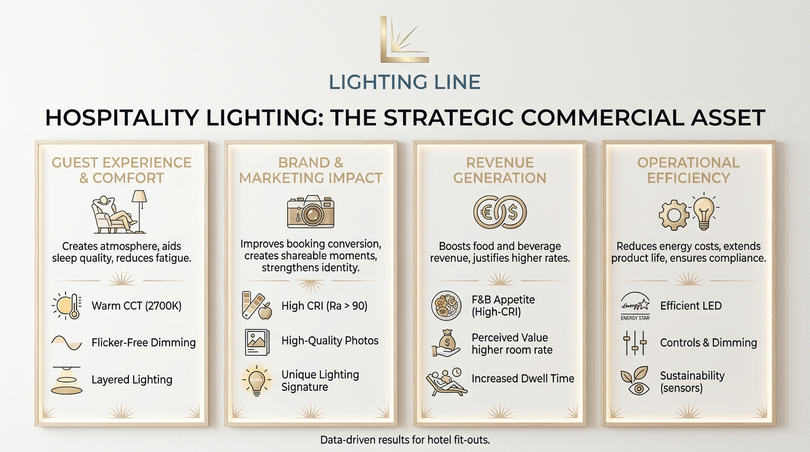
The stakes are commercial as much as aesthetic. In a market where booking decisions are driven by images and reviews, where energy is a major and volatile operating cost, and where guests increasingly expect both wellness-supporting environments and visible sustainability, the quality of a property’s lighting bears directly on its competitiveness. Treating lighting for hotels as a strategic system (layered, controlled, high-fidelity and well-maintained) is one of the most reliable ways a property can improve guest satisfaction, reduce operating cost and strengthen its brand simultaneously. The remainder of this guide sets out, in depth, exactly how to do so.
| Outcome area | How lighting influences it | Lighting lever |
|---|---|---|
| Guest satisfaction | Comfort, atmosphere, sleep quality | Warm CCT, layering, flicker-free dimming |
| Booking conversion | Quality of photographs in listings | High CRI, flicker-free, layered scenes |
| F&B revenue | Appetite, dwell time, ambience | High-CRI accent light, dynamic scenes |
| Operating cost | Energy and maintenance spend | Efficient LED, controls, long-life parts |
| Sustainability | Energy use and material lifecycle | LED, sensors, recyclable profiles |
| Compliance | Safety and accessibility obligations | Emergency lighting, IP rating, lux levels |
| Brand identity | Recognisable, consistent atmosphere | Controlled, repeatable lighting signature |
Why lighting matters in the hospitality industry
Before specifying a single fixture it is worth understanding why lighting in hotels carries such disproportionate weight in guest perception. Light is the first thing a guest experiences and the last thing they consciously process before sleep: it shapes mood before a word is exchanged at reception, it determines whether a restaurant feels intimate or clinical, and it silently signals the price tier of the property. Lighting for hotels is, in commercial terms, the cheapest and fastest way to change how expensive a space feels.
The hospitality industry has internalised this. Brand standards from major operators now specify colour temperature, dimming curves and even flicker tolerances, because these factors directly influence review scores, photograph quality on social media, and the perceived value that justifies the room rate. When we talk about the importance of lighting in hospitality, we are really talking about revenue per available room expressed through photons.
How lighting impacts mood, atmosphere and the guest experience
To understand why lighting for hotels commands such attention, it helps to look at the mechanisms through which light acts on perception. The human visual system does not measure brightness in absolute terms: it judges contrast, colour and the direction of light relative to the rest of the scene. This is why a room lit to the same lux level can feel either welcoming or clinical depending entirely on how that light is distributed. A property that masters lighting for hotels is really mastering contrast: where the bright points sit, how deep the surrounding shadows fall, and how warm the overall cast reads to a tired arriving guest.
Research into hospitality environments consistently finds that guests rate identical rooms more highly when they are lit with warm, layered, dimmable sources rather than a single bright overhead fixture. The effect is largely unconscious (guests rarely say “the lighting was excellent”) but it surfaces in higher comfort ratings, longer dwell times in bars and lounges, and a greater willingness to pay premium rates. Good hotel lighting works precisely because it is felt rather than noticed.
Human circadian biology responds to both the intensity and the spectral content of light. Warm, low-intensity light in the evening (around 2700K) encourages relaxation and signals wind-down, while cooler, brighter light (4000K and above) promotes alertness and is appropriate for workspaces and bathrooms during the morning. A well-designed hotel modulates these qualities across the day, which is precisely why static, single-temperature ceiling fixtures feel cheap: they ignore the way the human body reads light.
Good hospitality lighting design directly improves the guest experience by reducing visual fatigue, enhancing the sense of safety, and creating the layered depth that the brain interprets as luxury. A flat, evenly over-lit room is exhausting: a layered room with pools of warm accent light, soft ambient fill and discreet task lighting is restful. This is not subjective decoration, it is measurable in guest dwell time, in bar spend, and in the likelihood that a guest photographs the space and shares it.
It is worth being precise about the chain of cause and effect, because it is what justifies treating lighting for hotels as a strategic rather than a cosmetic decision. Light shapes first impressions, first impressions shape mood, mood shapes behaviour, and behaviour (how long a guest lingers, how much they order, whether they return, whether they recommend) shapes revenue. Each link in that chain has been studied in hospitality and retail environments, and each points the same way: environments lit with warmth, layering and high colour fidelity outperform flatly lit equivalents on the measures operators care about. When the lighting is right, every other investment in the space (the furniture, the finishes, the art) is seen at its best, when the lighting is wrong, even an expensive interior looks cheap. This leverage is why experienced operators treat lighting for hotels as one of the highest-return line items in any fit-out budget.
| Lighting variable | Typical hospitality target | Guest-perceived effect |
|---|---|---|
| Colour temperature (CCT) | 2700K–3000K in guest areas | Warmth, relaxation, residential feel |
| Colour rendering (CRI / Ra) | Ra > 90, ideally Ra > 95 | Natural skin tones, appetising food |
| Dimming range | 1%–100%, flicker-free | Atmosphere control across the day |
| Flicker (percent flicker) | < 5% at all dim levels | No headaches, clean video/photo |
| Layering (light sources per zone) | 3–5 independent layers | Depth, intimacy, perceived value |
Lighting as a brand and marketing asset
There is a second, harder-edged commercial dimension. In the booking funnel, photographs do the selling, and photographs are nothing more than captured light. A property whose lighting for hotels has been engineered for high colour rendering and flicker-free output photographs cleanly under any camera, while a property lit with cheap, low-CRI, flickering sources produces muddy, grey, banded images that quietly suppress conversion. The investment in quality light is, in this sense, an investment directly in the top of the marketing funnel.
For a hotel marketing manager, lighting for hotels is a differentiator hiding in plain sight. A distinctive lighting signature (a particular warmth in the lobby, a recognisable glow along the bar, a consistent accent colour in the spa) becomes part of the brand memory in the same way a scent or a soundtrack does. Crucially, it is also the single biggest factor in how well a property photographs, and in an era where booking decisions are driven by images, the quality of your hotel lighting is effectively the quality of your marketing.
Modern, controllable LED systems make it possible to maintain this signature consistently across every room and every season, and to adjust it centrally without re-wiring. That repeatability is what turns lighting from a one-off design flourish into a durable brand asset.
The four types of lighting in a hotel room
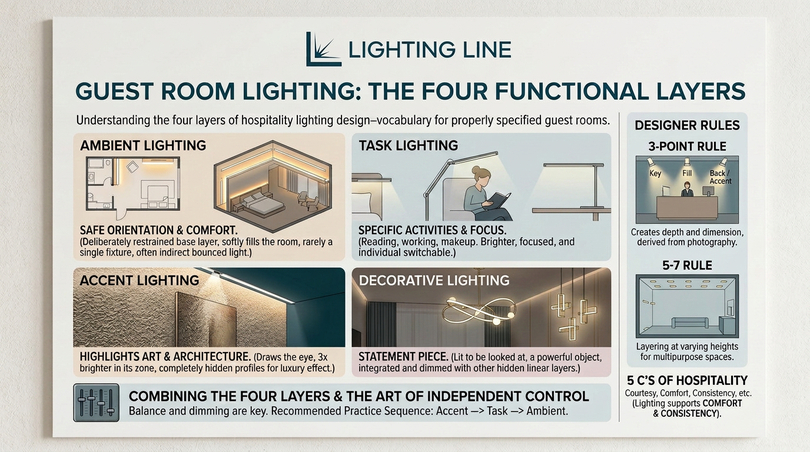
Almost every question about hotel lights (what kind to use, how many, where to place them) resolves once you understand the four functional layers of lighting. These four types are the vocabulary of professional hospitality lighting design, and a properly specified guest room contains all of them.
Ambient lighting
Ambient lighting is the layer most often misunderstood by non-specialists, who tend to equate “enough light” with “good light”. In professional lighting for hotels, ambient light is deliberately restrained: it provides safe orientation and a base level of comfort, but it should never be the brightest or most attention-grabbing element in the room. When ambient light dominates, the space flattens and when it recedes appropriately, the accent and task layers are free to create the depth and focus that read as quality.
Ambient (or general) lighting is the base layer that allows safe movement through a space. In contemporary lighting for hotels this is rarely a single bright ceiling fixture: instead it is delivered indirectly, light bounced off ceilings and walls via recessed LED profiles and concealed strips. The goal of ambient light in a hotel is to fill the room softly without creating glare or harsh shadows, establishing comfort while leaving the dramatic work to the other layers.
Task lighting
Task lighting serves specific activities: reading in bed, working at the desk, applying makeup at the mirror. It must be brighter and more focused than ambient light and, critically, individually switchable. The bedside reading light is the classic example, and one of the most reviewed features of any room: a guest who cannot read comfortably in bed remembers it. Well-placed task light using high-CRI strips inside slim profiles is a hallmark of good hotel lighting.
Accent lighting
Accent lighting draws the eye to architecture, artwork or materials: a textured headboard wall, a piece of art, a niche. It is typically three or more times brighter than the surrounding ambient layer in the area it highlights. Accent layers are where linear LED profiles excel, because they can be hidden completely, letting the guest see the effect without seeing the source. This is the essence of luxury hospitality lighting: the light is visible, the fixture is not.
Decorative lighting
Decorative lighting (pendants, hotel chandeliers, sculptural fixtures) is lit to be looked at rather than to light a task. In lobbies and fine-dining rooms a hotel chandelier remains a powerful statement piece, but in modern properties it is increasingly paired with, and dimmed in concert with, the concealed linear layers so that the decorative element reads as a jewel rather than the room’s only light source.
| Layer | Purpose | Typical LED solution | Relative brightness |
|---|---|---|---|
| Ambient | General safe movement | Recessed profile, indirect COB strip | Base (1×) |
| Task | Reading, desk, mirror | Slim profile strip, focused | 2–3× base |
| Accent | Highlight art / architecture | Hidden linear profile, COB | 3× base in zone |
| Decorative | Statement object | Chandelier / pendant, dimmed | Visual, not functional |
Combining the four layers in practice
The art of lighting for hotels lies not in any single layer but in how the four are balanced and, crucially, how independently they can be controlled. A room wired so that all four layers come on together with one switch wastes most of the design’s potential: a room wired so each layer dims independently lets staff and guests sculpt the atmosphere for any moment. The single most valuable upgrade in most hotel lighting schemes is not more fixtures but more independent control over the fixtures already present. This is why control strategy, covered later, is inseparable from layer design.
A practical sequence for specifying a room is to begin with the accent layer (deciding what the eye should be drawn to) then add task light where activities happen, then ambient light to fill the gaps softly, and finally a decorative element if the room’s positioning justifies it. Designing in this order keeps the focus on effect rather than on raw illumination, which is the mindset that separates considered hospitality lighting design from mere wiring.
Lighting rules: the 3-point rule, the 5-7 rule and the 5 C’s
Designers lean on a handful of memorable rules to avoid the most common mistake in lighting for hotels: under-layering. These rules are not rigid laws but reliable heuristics that translate the four-layer theory into practice, and they answer some of the most frequently searched questions about hotel lighting.
The 3-point (or 3-light) rule
Borrowed from photography and film, the three-point rule states that any subject (or any zone of a room) should be lit from at least three directions: a key light, a fill light and a back or accent light. Applied to a reception desk, that means a primary downlight on the working surface, a softer fill to lift shadows on the staff member’s face, and a back or wall-wash layer to separate the desk from the wall behind it. Following the three-point principle is the single fastest way to make any hospitality space look professionally lit rather than flatly illuminated.
The reason the three-point rule transfers so cleanly from photography to lighting for hotels is that a hotel space is, in effect, always being photographed (by guests, by reviewers, by the marketing team) and the same lighting that flatters a subject for a camera flatters it for the human eye. A single flat source from above casts unflattering shadows under the eyes and brow, drains a face of dimension, and makes a room feel like an office. Light from three directions restores depth, softens shadows and creates the sense of three-dimensional space that the brain reads as natural and comfortable. Applying this consciously to every important zone (reception, seating clusters, the bar, dining tables) is one of the most reliable techniques in the whole practice of lighting for hotels.
The 5-7 lighting rule
It is worth dwelling on why the 5-7 rule maps so well onto lighting for hotels specifically. A guest room is a multipurpose space (it serves as bedroom, study, dressing room and occasionally dining room) and each of those functions wants light in a different place and at a different intensity. Distributing five to seven controllable sources across the room is what allows a single space to reconfigure itself for each of these uses without re-wiring, which is exactly the flexibility a modern guest expects.
The 5-7 rule (sometimes written as the “5’7” rule) is a layering guideline: a well-designed room should contain on the order of five to seven distinct light sources at varying heights, so that the eye encounters light at floor, mid and ceiling levels rather than a single overhead plane. In a guest room these layers might be bedside task lights, a desk light, a concealed cove strip, an accent wash on the headboard wall, a floor lamp and a bathroom mirror light. The 5-7 rule exists to prevent the institutional, flattening effect of a single ceiling fixture, which is exactly why hotels famously favour lamps and layered sources over one central light.
The 5 C’s of hospitality
The 5 C’s of hospitality (commonly given as Courtesy, Comfort, Cleanliness, Convenience and Consistency) are a service framework rather than a lighting standard, but lighting touches every one. Comfort and consistency are the most lighting-dependent: comfort because glare, flicker and harsh colour temperatures actively degrade the guest experience, and consistency because a controllable LED system lets an operator reproduce exactly the same atmosphere in every room, every night. Good hospitality lighting design is, in this sense, a delivery mechanism for the 5 C’s.
Lighting the common areas: lobby, reception, restaurant and lounge
The common areas are where a property makes its first and most lasting impression, and where lighting in hotels does its hardest commercial work. These spaces must transition gracefully from bright, welcoming daytime activity to intimate evening atmosphere, all while photographing well and guiding circulation. This is the domain where layered LED specification pays for itself fastest, because a single rewireable, dimmable system can transform a multipurpose space several times a day.
The lobby and the best lighting for a hotel reception
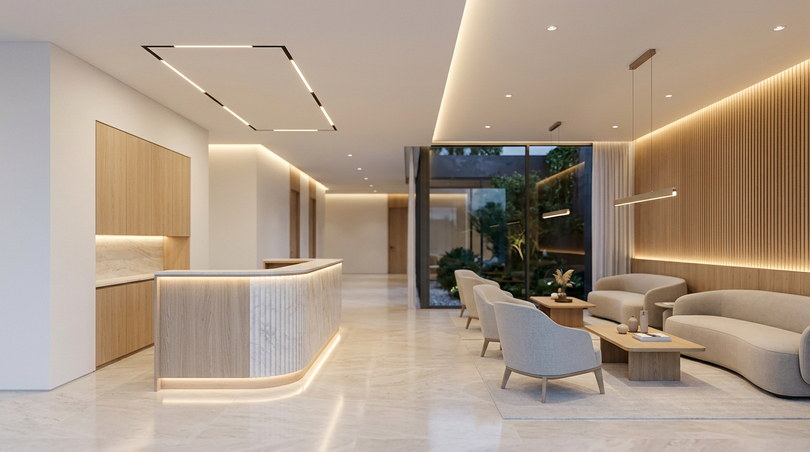
A lobby is simultaneously a first impression, a circulation hub and, increasingly, a co-working and social space. The best lighting for a hotel lobby therefore balances a generous ambient base with strong accent layers that articulate the architecture: the reception desk, the seating clusters, the route to the lifts. The reception desk itself should be one of the brightest, most carefully lit points in the entire lobby, because it is where the guest’s eye naturally travels and where the most important human interaction occurs.
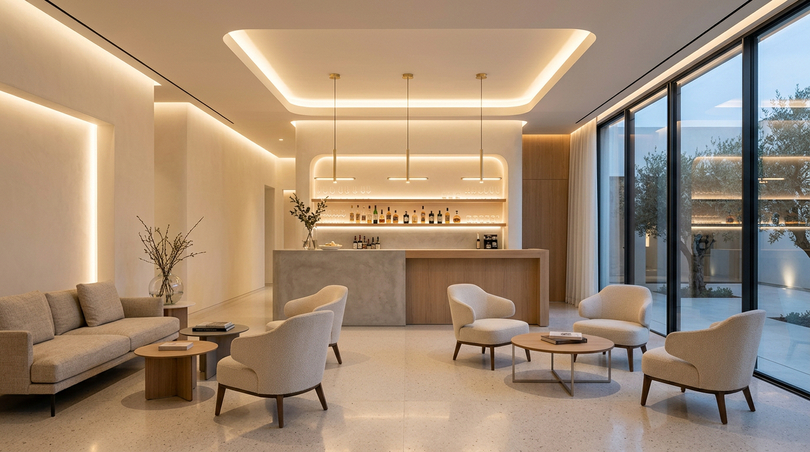
The most effective approach uses recessed linear profiles to wash the back wall behind reception, a discreet downlight or under-counter strip to light the working surface without glaring into the guest’s eyes, and concealed cove lighting to lift the ceiling plane and make the space feel taller and more generous. Because lobbies operate around the clock, this is also where intelligent scene control earns its keep: a bright, energetic morning scene gives way to a warm, low evening scene at the press of a button.
Restaurants and lounges within the hotel
Restaurant and lounge lighting inside a hotel must do something subtle: flatter both the guest and the food, define intimate zones within an open plan, and shift from a brighter breakfast service to a candle-low dinner. The best lighting design in restaurants uses tightly controlled accent light on each table — so the plate and the diner are the brightest things in view: against a deliberately dimmer surrounding ambient layer. High colour rendering is non-negotiable here: food lit by a low-CRI source looks grey and unappetising, while a high-CRI source makes the same dish look fresh and vivid. We return to the specific component choices that deliver this in the specification section.
| Area | Primary objective | Recommended CCT | Key LED technique |
|---|---|---|---|
| Lobby | Welcome & orientation | 2700K–3000K | Cove wash + accented reception |
| Reception desk | Focus & clarity | 3000K | Under-counter + back-wall wash |
| Restaurant | Flatter food & guest | 2700K, Ra>95 | Per-table accent, dim surround |
| Lounge / bar | Intimacy & spend | 2400K–2700K | Low layered pools, hidden strip |
| Corridor | Safe wayfinding | 2700K–3000K | Skirting profile + PIR sensors |
Corridor lighting design
Hotel corridor lighting design is an unglamorous but critical discipline. Corridors are long, repetitive and used at every hour, including by guests who are half-asleep. Good corridor lighting provides even, glare-free wayfinding, avoids the “tunnel” effect of regularly spaced downlights, and ideally dims down during quiet overnight hours, lifting only when motion is detected. Skirting-level linear profiles combined with motion sensors deliver discreet, energy-saving guidance that never dazzles a guest returning to their room at night: a technique detailed in the component specification below.
Corridors also present a repetition problem unique to lighting for hotels: because the same detail repeats along the whole length and across every floor, any flaw is multiplied dozens of times and any inconsistency is glaringly obvious. A single mismatched colour temperature or one strip cut slightly short becomes a defect the guest sees repeated all the way to their door. This is why corridor lighting demands the most rigorous quality control of any area: consistent strips from the same production batch, identical profiles, matched drivers and meticulous installation. The reward is a wayfinding experience that feels calm, premium and effortless precisely because nothing about it draws negative attention.
Back-of-house and staff areas
It is easy to lavish attention on guest-facing spaces and neglect back-of-house, but staff areas have their own requirements within a complete approach to lighting for hotels. Kitchens, housekeeping stores and corridors need higher, cooler, glare-free illumination for safe, accurate work, while still benefiting from the efficiency of LED and the convenience of sensor control in intermittently used rooms. Specifying these areas properly protects staff wellbeing and productivity, and because back-of-house lighting runs long hours, it is also a significant target for energy savings.
Guest room and bedroom lighting design
The guest room is where the promise of the brand is delivered or broken. It is the most personal, most reviewed and most photographed space in the property, and it is where the layered theory of lighting for hotels must be executed with the most care. Can you put LED lights in a hotel room? Not only can you: professionally fitted LED strips in aluminium profiles are now the default solution, because they deliver controllable, low-heat, flicker-free light in slim, hidden forms that traditional fixtures cannot match.
The bedside: reading lights and bedside lamps
Bedside lighting is the layer guests interact with most directly. A successful bedside solution offers an individually controllable, focused reading light for each occupant plus a softer ambient option for navigating the room at night. Each side of the bed must be independently switchable so that one guest can read while the other sleeps: a detail that distinguishes considered hotel lighting from careless installation. Whether implemented as hotel bedside lamps, wall-mounted hanging bedside lights or recessed strip in a headboard niche, the principle is the same: warm, dimmable, glare-controlled and personal.
Headboard, cove and accent layers
The headboard accent is one of the most photographed details in any guest room, and it is therefore one of the highest-leverage decisions in lighting for hotels. Executed well (a clean, dotless band of warm light behind a textured headboard) it elevates the entire room and reliably appears in guest photographs and listings. Executed poorly, with visible dotting or uneven brightness, it has the opposite effect, cheapening a room that may be expensive in every other respect. This is the layer where the quality of the strip and the precision of the installation matter most.
A concealed strip washing the headboard wall or running along a ceiling cove transforms a plain room into one that feels designed. This accent layer is where linear LED profiles are indispensable, because the effect (a clean band of glow) depends entirely on the source being invisible. The quality of this effect is determined by two things: the dotting (or absence of it) in the LED strip, and the precision of the profile installation. A COB strip inside a well-machined profile produces a continuous, seamless line; a cheap, low-density strip inside a poorly diffused channel produces a visible row of dots that instantly cheapens the room.
Desk, wardrobe and bathroom
The desk needs a focused task layer suitable for working and video calls: the wardrobe benefits from a sensor-triggered internal strip and the bathroom requires careful attention to the mirror, where front-and-side lighting (rather than a single overhead source) avoids the unflattering shadows that generate complaints. Across all of these, high colour rendering matters because guests apply makeup, judge their appearance and photograph themselves in these spaces.
What are the lighting requirements for a hotel room?
Pulling these threads together, the functional requirements for a guest room are: an adjustable task layer at the bed and desk, a soft and dimmable ambient layer, an accent layer for depth, bathroom lighting optimised at the mirror, flicker-free dimming throughout and a master control allowing the guest to switch everything off from the bed. On the engineering side, the room must meet electrical safety codes, provide compliant emergency and egress lighting, and in most modern brand standards use energy-efficient LED sources. A guest room that satisfies all of these reads as effortless to the guest precisely because so much engineering has gone into making it feel simple.
The master control and the bedside panel
One detail elevates a guest room above its peers more than almost any other: a single, intuitive master control at the bedside that lets the guest manage every layer without leaving the bed. The frustration of being unable to find the switch for one stray light, or of having to cross a dark room to reach a panel, is one of the most common complaints in guest reviews. A well-designed control scheme (offering simple preset scenes such as “welcome”, “relax”, “read” and “all off”) turns the complexity of a multi-layer room into a handful of effortless choices. This is where the control technology described later directly shapes the guest experience, and where thoughtful lighting for hotels proves its worth.
F&B and restaurant lighting specification
Food and beverage spaces are where lighting most directly influences revenue, because light shapes appetite, dwell time and spend. The best lighting for a restaurant is layered, warm, highly colour-accurate and dynamically dimmable so the room can move from a bright weekend brunch to an intimate dinner service. Within a hotel, F&B lighting must also coordinate with the property’s overall hospitality lighting design so that a guest moving from lobby to bar to restaurant experiences a coherent atmosphere.
Colour rendering and the appetite effect
The link between colour rendering and revenue is one of the most under-appreciated facts in lighting for hotels and hospitality dining. When a source renders colour poorly, the brain reads the food as less fresh and less appetising, subtly reducing both enjoyment and spend. When the same dish is lit by a high-CRI source that faithfully reproduces the full spectrum, it appears vivid and fresh, and guests order more freely and linger longer. The colour rendering specification of an F&B space is, in commercial terms, a lever on average spend per cover.
The most important single specification in any dining space is colour rendering. A high colour-rendering source (ideally Ra greater than 95) renders the reds of meat, the greens of vegetables and the warmth of skin tones naturally, making food look fresh and guests look healthy. A low-CRI source flattens these colours, makes plates look grey and tired, and subtly suppresses appetite and spend. This is why serious operators specify premium high-CRI strips for every surface where food or faces are seen.
Layering and zoning the dining room
Effective restaurant lighting creates a clear hierarchy: each table is the brightest point in its immediate vicinity, drawing the eye and creating a sense of privacy, while circulation and surrounding walls sit at a lower level. Achieving this with tightly controlled accent light (rather than flooding the whole room evenly) produces the intimate, premium feel that encourages guests to linger and order another course.
Dynamic scenes across the dining day
A hotel restaurant rarely serves a single function: the same room hosts a bright, energetic breakfast, a brisk lunch and an intimate dinner. Without controllable lighting for hotels, that room is forced to compromise on a single setting that suits none of these services well. With scene control, the space transforms: a higher, cooler, brighter scene for breakfast that signals energy and freshness; a balanced scene for lunch; and a low, warm, focused scene for dinner that draws diners into intimate pools of light. The ability to recall these distinct atmospheres at the touch of a button is what allows one physical room to perform as three different venues across the day.
Bars and lounges
Bars and lounges push the principles of restaurant lighting further still, favouring even lower ambient levels and even more dramatic accent work. Back-bar displays lit from within, under-counter glows that make the bar appear to float, and tightly controlled pools over seating clusters all combine to create the sense of intimate enclosure that encourages guests to settle in and spend. High colour rendering remains important here too, because cocktails, garnishes and faces all benefit from faithful colour, and because the bar is one of the most photographed and shared spaces in any property.
Choosing and machining LED profiles and strips
Everything described so far (the invisible accent lines, the seamless coves, the flicker-free dimming) depends on the physical components and on the craft of installing them. This is the heart of professional lighting for hotels, and it is where most amateur installations fail. The two foundational components are the aluminium profile and the LED strip, and choosing the right combination is the first decision in any specification.
Profile families and where they belong
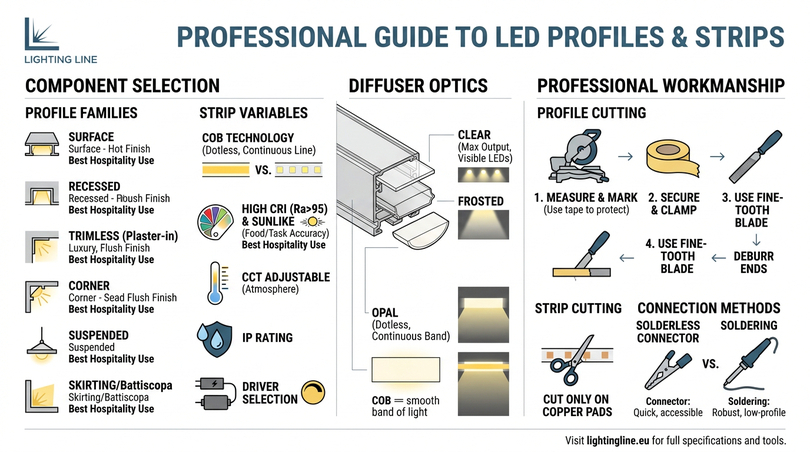
Aluminium LED profiles exist in families optimised for different mounting conditions, and selecting the correct family is what allows the light to disappear into the architecture. The single most important distinction in luxury work is between surface or recessed profiles with a visible frame and trimless profiles designed to be plastered flush into plasterboard, leaving no visible edge at all.
Within these broad categories sit numerous specialised forms, and matching the form to the architectural condition is the essence of skilled lighting for hotels. Corner profiles mounted at forty-five degrees throw indirect light across a ceiling or down a wall for a soft cove effect. Suspended profiles hang as linear pendants over desks, bars and reception counters, providing both direct task light and indirect uplight in a single clean line. Deep recessed profiles allow the strip to sit further back so the source is hidden from normal sightlines. Skirting profiles at floor level guide circulation discreetly. Each of these solves a specific problem, and a property of any size will typically use several families together, unified by a consistent strip, colour temperature and control approach so the whole reads as one coherent scheme rather than a patchwork.
| Profile family | Mounting | Best hospitality use |
|---|---|---|
| Surface profile | Mounted on a surface | Under-counter, wardrobe, retrofit |
| Recessed profile | Set into a groove | Coves, shelving, joinery |
| Trimless / plaster-in | Flush, no visible frame | Luxury cuts of light in ceilings/walls |
| Corner profile | 45° corner mount | Indirect cove and cabinet light |
| Skirting / battiscopa | Floor-level | Corridor and pathway guidance |
| Suspended profile | Hung linear pendant | Linear feature light over desks/bars |
For the seamless “cut of light” effect that defines premium luxury hospitality lighting, trimless plaster-in profiles such as the LightingLine DW series are the starting point, because they integrate the light into the plasterboard itself so that no fixture is visible — only a clean line of glow.
Diffusers: clear, frosted and opal
The diffuser (the cover that snaps into the profile) controls how the LED light is delivered. A clear cover maximises output but shows the individual LEDs; a frosted or opal cover blurs the source into a continuous line at the cost of a little brightness. For any installation where the profile is visible to guests, an opal diffuser combined with a high-density or COB strip is essential to eliminate dotting and produce the smooth band of light that signals quality. Matching the right led strip diffuser to the strip is as important as the strip itself.
Choosing the strip: density, COB and colour
The LED strip determines the character of the light. The key variables are LED density (chips per metre), the technology (discrete SMD versus continuous COB), the colour temperature, the colour rendering index and the power per metre. For hospitality, high density or COB construction, a warm colour temperature and a high CRI are the three specifications that matter most, because together they produce the continuous, flattering, premium light that guests associate with quality. The full catalogue of led strips covers single-colour, tunable-white and high-CRI Sunlike options for every layer.
| Layer / location | Recommended strip | Why |
|---|---|---|
| Visible accent cove | COB, high density | No dotting, continuous line |
| Restaurant / F&B | High-CRI (Ra>95) Sunlike | Natural food & skin tones |
| Task / desk / mirror | High-CRI, 3000K–4000K | Accurate, comfortable working light |
| Concealed ambient fill | Standard SMD, mid density | Cost-effective, hidden source |
| Tunable atmosphere | CCT-adjustable strip | Warm evening, cool morning |
IP rating and location
Every strip and profile selection in lighting for hotels must account for its environment. In dry interior locations a standard, non-protected strip is appropriate and offers the best value, but in bathrooms, spas, wellness areas, pool surrounds and any exterior application the strip must carry an ingress-protection rating suited to its exposure to moisture and cleaning. Specifying an under-rated strip in a wet zone is both a reliability failure (the strip will corrode and fail) and a safety failure. Matching IP rating to location is therefore a non-negotiable step in any compliant specification.
Power and driver selection
The driver is the unglamorous component that determines whether an installation is a quiet success or a recurring headache. The total wattage of a strip run, plus a safety margin, dictates the driver size: the dimming method (whether mains dimming, 0-10V, DALI or another protocol) dictates the driver type; and the quality of the driver dictates whether the result is flicker-free. Under-sizing a driver causes early failure, while choosing a low-quality driver reintroduces the very flicker that quality lighting for hotels works so hard to eliminate. The driver, in short, deserves as much specification attention as the strip it powers.
How to cut and connect profiles and strips correctly
This section is the practical core of the article — the difference between a clean professional installation and the visibly amateur work that undermines so many fit-outs. Cutting and connecting led strips and profiles is not difficult, but it is unforgiving: a strip cut off its marked line is ruined, and a cold solder joint will fail months later in an occupied room. Done carefully, with the right tools and sequence, the results are flawless and durable.
The tools you need
Before any work begins, assemble the correct tools. Using the wrong tool (a hacksaw on a strip, side-cutters on a profile, an underpowered iron on a solder pad) is the most common cause of failed installations.
| Task | Correct tool | Why it matters |
|---|---|---|
| Cutting aluminium profile | Mitre saw with fine non-ferrous blade, or mitre box + fine hacksaw | Clean, square, burr-free ends |
| Deburring profile | Fine file / deburring tool | Removes swarf that blocks the strip and diffuser |
| Cutting LED strip | Sharp scissors / fine snips | Cut exactly on the printed cut line |
| Connecting strip | Temperature-controlled soldering iron OR purpose-made connectors | Reliable electrical joint |
| Measuring & alignment | Steel rule, square, masking tape | Accuracy and protected surfaces |
Cutting the aluminium profile — step by step
The profile sets the geometry of the whole installation, so cutting it accurately is the foundation of a good result. Follow this sequence:
- Measure twice and mark once: mark the cut line with a fine pencil on masking tape applied to the profile; the tape both marks the line and protects the anodised surface from chipping.
- Support the full length: clamp or support the profile so it cannot vibrate; vibration causes a ragged cut and can bend thin-walled extrusions.
- Use a fine-tooth, non-ferrous blade: a mitre saw fitted with an aluminium-suitable blade gives a perfectly square end. For a simple butt join, cut at 90°; for an L-shaped corner that meets seamlessly, cut both pieces at 45°.
- Cut slowly and let the blade do the work: forcing the cut tears the aluminium and leaves burrs.
- Deburr immediately: file the cut end lightly inside and out so the diffuser still slides in and no swarf is left inside the channel. A single sliver of aluminium swarf left inside the profile can short a strip or block the diffuser, so this step is never optional.
Cutting the LED strip — on the line, every time
LED strips can only be cut at the marked cut points, which fall at regular intervals (typically every few centimetres) and always between two copper solder pads. Cutting anywhere other than exactly on this printed line will destroy the segment of strip on the cut side and may damage the next segment. Use sharp scissors, cut precisely down the centre of the marked line so that full, undamaged solder pads remain on both resulting pieces, and never cut a strip while it is powered.
For COB strips the cut points are closer together, which is part of their appeal for short, precise runs; always confirm the interval before measuring your run so the strip length matches the profile length.
Connecting strips: soldering versus connectors
There are two reliable ways to join or extend a strip, and choosing correctly depends on the application.
Solderless connectors are quick, require no tools and are ideal for accessible joints, corners and field repairs. The strip end is inserted into a clip-down or push-fit connector that bridges to the next strip or to the feed wire. The critical discipline is cleanliness and polarity: the copper pads must be clean and the strip must be inserted fully and the correct way round, matching + to + and − to −, or the strip will not light. Connectors are the right choice where a joint might one day need servicing.
Soldering produces the most robust, lowest-resistance and lowest-profile joint, which is why it is preferred for concealed, permanent runs and for any joint that must be invisible. The professional method is:
- Pre-tin both surfaces: apply a small amount of solder to the strip’s copper pads and to the tip of the connecting wire before joining them.
- Use a temperature-controlled iron at the right heat: too cool and you get a weak cold joint; too hot for too long and you lift the pad off the strip. A brief, confident contact is correct.
- Join quickly: bring the pre-tinned wire to the pre-tinned pad and touch the iron for one to two seconds until the solder flows and fuses, then remove the heat and hold steady until it sets.
- Respect polarity: match the markings on the strip; reversing polarity on a single-colour strip simply prevents it lighting, but on addressable or multi-channel strips it can cause damage.
- Insulate and strain-relieve: cover the joint with heat-shrink tubing and secure the wire so movement is never transmitted to the solder pad.
The most common failures (flickering, dead sections, joints that fail weeks after handover) are almost always caused by cold solder joints, reversed polarity or strain on an unsupported connection, every one of which is avoidable with the discipline above.
It is worth emphasising why this craft matters so disproportionately in lighting for hotels specifically. A failed joint in a private home is an inconvenience but a failed joint in a hotel is a guest complaint, a maintenance call, a room out of service and, multiplied across a property, a reputation problem. Because hotel installations are large, repetitive and run continuously, small percentage failure rates translate into a steady stream of faults if the underlying workmanship is poor. Conversely, disciplined work (clean cuts, properly tinned and insulated joints, correct polarity, adequate power injection and strain relief) produces installations that simply run, year after year, with no intervention. The economics strongly favour doing it right the first time, which is why specifying skilled installation is as important as specifying quality components in any serious approach to lighting for hotels.
Voltage drop, power injection and runs
Long runs of strip suffer voltage drop: the far end is dimmer than the end nearest the driver. For any run beyond the manufacturer’s stated maximum, power must be injected at both ends or at intervals so brightness stays uniform along the whole length. Plan the feed points before cutting, position the driver as close to the run as practical, and never daisy-chain more strip from a single feed than its specification allows, doing so causes the dim, uneven runs that betray an amateur installation.
Mounting the profile and finishing
With strip cut, connected and tested off the wall, the profile is fixed using its mounting clips or, for plaster-in trimless types, set into the plasterboard and finished flush by the plasterer before painting. Adhere or clip the strip centrally inside the channel, route the feed wire discreetly, snap in the chosen diffuser, and only then make the final connection to the driver and control. Always test the completed run before the diffuser and any plaster finish are committed, because correcting a fault after a trimless profile has been plastered in is a costly exercise.
A pre-handover checklist
Before signing off any installation in a programme of lighting for hotels, a disciplined installer runs through a final checklist. Confirm that every strip lights fully along its entire length with no dim sections, which would indicate voltage drop or a poor joint. Confirm that colour temperature is consistent across every strip in the same space, with no visible variation from one run to the next. Confirm that dimming is smooth and flicker-free across the full range, including at the lowest levels where cheap drivers fail. Confirm that every joint is insulated and strain-relieved, that every diffuser is fully seated, and that no aluminium swarf remains inside any channel. A run that passes all of these checks before the finish is committed is a run that will perform reliably for years: a run that skips them is a service call waiting to happen.
Common mistakes and how to avoid them
The recurring failures in amateur lighting for hotels installations cluster around a few avoidable errors. Cutting a strip off its marked line destroys the segment and is irreversible. Reversing polarity prevents single-colour strips lighting and can damage multi-channel ones. Cold solder joints look fine at handover but fail weeks later. Exceeding a strip’s maximum run length without power injection produces visibly dim far ends. Leaving swarf inside a profile blocks the diffuser or shorts the strip. Choosing a clear diffuser over a visible source reveals dotting. Every one of these is eliminated by the disciplined method described in this section, which is why craft is as important as component choice in achieving a professional result.
Technology and innovation: COB, smart control and sensors
The reason lighting for hotels has changed so completely in the last decade is technological. Three innovations in particular (COB LED strips, smart control protocols and presence sensors) have made it possible to deliver effects that were previously impossible or prohibitively expensive, and to manage them centrally across hundreds of rooms.
COB (Chip On Board) technology
COB technology deserves emphasis because it has quietly become the dividing line between amateur and professional lighting for hotels. Older discrete-LED strips reveal themselves at close range as a row of bright points behind a diffuser, an effect that immediately signals a budget installation. COB construction eliminates this entirely, producing a homogeneous line of light that holds up under the close scrutiny of a guest standing directly beneath it. For coves, headboards, mirrors and any other visible application, COB is now effectively the default specification in quality work.
COB strips place the LED chips directly on the board under a continuous phosphor layer, producing an unbroken line of light with no visible dots even at very close range. For any visible accent or cove in a hotel, COB technology is what separates a continuous ribbon of glow from a visible row of LEDs, and it is the single most impactful upgrade available for premium linear effects. COB also distributes heat more evenly and offers excellent uniformity, making it ideal for the seamless cuts of light that define contemporary luxury interiors.
Smart control and scene management
The benefit of an intelligent hotel lighting system is the ability to recall complete lighting scenes (carefully balanced combinations of brightness and colour across every layer) with a single command, and to schedule those scenes across the day automatically. A restaurant can move from breakfast to lunch to dinner, a lobby can shift from daytime energy to evening calm, a guest room can offer the guest one button for relaxation and another for work. Scene recall and scheduling are what turn a collection of dimmable fixtures into a managed atmosphere, and they are central to the value proposition of a smart hospitality system.
Sensors and presence detection
Motion and presence sensors (PIR (passive infrared) and microwave types — allow light to respond to occupancy. In corridors, wardrobes, bathrooms and stairwells, sensor control means light appears the instant a guest needs it and dims or extinguishes when the space is empty, simultaneously improving the experience and cutting energy use. Microwave sensors detect movement through thin materials and around corners, making them ideal for concealed corridor and pathway applications where the sensor itself must be hidden.
Energy efficiency and sustainability
Energy is one of a hotel’s largest controllable operating costs, and lighting runs continuously across hundreds of fixtures, so efficiency compounds quickly. Sustainable lighting for hotels is therefore both an environmental and a financial imperative, and modern LED systems deliver on both fronts without compromising quality, directly answering the owner’s question of how to reduce energy costs without dimming the guest experience.
Why LED is the sustainable baseline
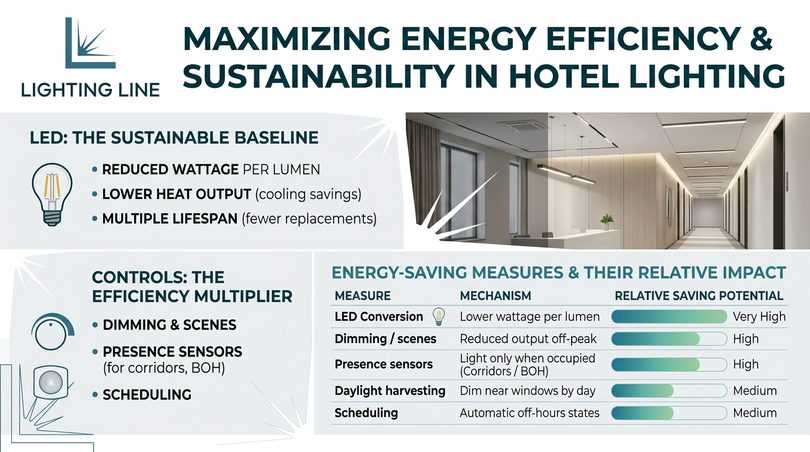
LED sources consume a fraction of the energy of the halogen and incandescent sources they replaced, produce far less heat (reducing cooling load), and last many times longer (reducing both replacement cost and maintenance disruption). Switching a property to LED typically cuts lighting energy consumption dramatically while extending service intervals from months to years, which is why energy-efficient LED is now the default specification in virtually every hotel brand standard.
The scale of the opportunity becomes clear when the duty cycle is considered. Many hospitality spaces (lobbies, corridors, exterior and back-of-house areas) are lit for the great majority of every twenty-four-hour period, and a property may contain thousands of individual light points. In that context, even a modest reduction in the energy each point consumes compounds into a substantial annual saving, and the difference between an efficient, well-controlled scheme and an inefficient one is measured in significant operating cost year after year. This is why sustainable lighting for hotels is not merely an environmental gesture but a core element of sound financial management, and why the payback period on a well-designed LED and controls upgrade is so often shorter than operators expect.
Controls as an efficiency multiplier
The biggest efficiency gains come not from the LED alone but from controlling it. Dimming reduces consumption proportionally; scheduling ensures spaces are not over-lit when unoccupied; and presence sensors eliminate waste in intermittently used areas such as corridors and back-of-house. A controlled LED system can save substantially more energy than an uncontrolled one of identical wattage, simply by ensuring light is only at full output when and where it is genuinely needed.
| Measure | Mechanism | Relative saving potential |
|---|---|---|
| LED conversion | Lower wattage per lumen | Very high |
| Dimming / scenes | Reduced output off-peak | High |
| Presence sensors | Light only when occupied | High in corridors / BOH |
| Daylight harvesting | Dim near windows by day | Medium |
| Scheduling | Automatic off-hours states | Medium |
Standards, safety and compliance
Beyond aesthetics and efficiency, lighting in hotels is governed by safety and performance standards that protect guests and staff. While exact requirements vary by jurisdiction, the categories below apply almost universally and must be addressed in any compliant specification. Compliance is not optional decoration: emergency lighting, electrical safety and accessibility provisions are legal obligations whose failure carries serious liability.
Emergency and egress lighting
Hotels must provide emergency lighting that illuminates escape routes and exits in the event of power failure, with appropriate duration and illuminance along corridors, stairs and to final exits. This is independent of the decorative scheme and must be maintained and tested on a defined schedule.
Electrical safety and ingress protection
All LED drivers and fittings must be correctly rated, installed by competent persons and compliant with local electrical regulations. In wet areas such as bathrooms and spas, fittings must carry an adequate ingress-protection (IP) rating appropriate to their zone, and low-voltage strip installations must use correctly sized, protected drivers.
Illuminance levels and accessibility
Recommended illuminance levels exist for each functional area (reception desks, reading positions, corridors, stairs and back-of-house) and accessibility guidance addresses contrast, glare and the needs of guests with visual impairments. Meeting these recommended levels while preserving atmosphere is precisely the balancing act that good hospitality lighting design resolves through layering and control.
The apparent tension between compliance and atmosphere dissolves once lighting is understood as layered and controllable. A space can hold a low, warm, intimate evening atmosphere for guests while still being capable of delivering the higher, even illumination that codes and tasks require, simply because the layers are independent and the levels are adjustable. Emergency lighting operates independently of the decorative scheme and activates only when needed, task levels are available on demand without forcing the whole space to be brightly lit at all times. In this way, rigorous compliance and a beautiful guest experience are not competing goals but complementary outcomes of the same well-designed, well-controlled approach to lighting for hotels.
Professional component specification for hotels and restaurants
Having established the principles, the layers and the craft, we can now translate them into a concrete, professional specification. The following section describes how the individual components fit together into a complete, certified system: the level of detail an architect or specifier needs to write a compliant, high-performance scheme.
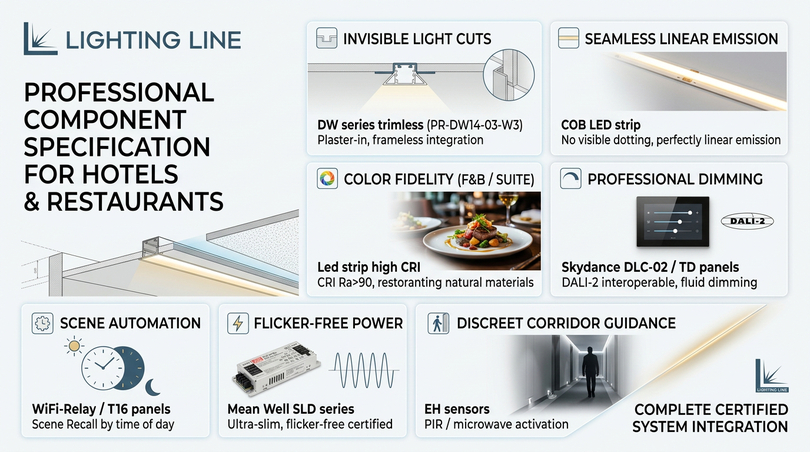
In the context of hospitality lighting design, the technical specification of components must satisfy demanding requirements for visual comfort, scenic flexibility and architectural integration. For high-end hotels and restaurants, the starting point is the use of trimless profiles from the LightingLine DW series (such as the DW14-03-W3 model), which make it possible to create minimalist “cuts of light” integrated into the plasterboard, turning light into an invisible structural element. Within these volumes, the adoption of LED COB (Chip On Board) technology is essential to guarantee a perfectly linear emission free of dotting, even in close-up, exposed installations. For colour rendering, a critical specification in F&B spaces and suites, CRI Ra>90 represents technological excellence, emulating the solar spectrum to restore the natural appearance of materials and the appeal of the dishes.
The dynamic management of atmospheres is entrusted to the Skydance ecosystem, where the integration of the DALI-2 protocol (via masters such as the DLC-02 or TD-series touch panels) allows fluid, professional dimming that complies with international interoperability standards. The Scene Recall function, available on advanced controllers such as the WiFi-Relay or the T16-series panels, is fundamental for automating the transition between the different hours of the day, allowing pre-set lighting configurations (e.g. breakfast, lunch, dinner) to be recalled with a single command. In terms of reliability and health, the entire system must be supported by flicker-free certified Mean Well power supplies, which eliminate flicker, protecting guest wellbeing and guaranteeing impeccable video and photo capture. Finally, for the safety of common circulation routes, the use of skirting profiles combined with PIR or microwave motion sensors of the EH series ensures intelligent, discreet activation as guests pass, while simultaneously optimising energy savings.
| Function | Recommended component | Specification highlight |
|---|---|---|
| Invisible cut of light | DW series trimless (PR-DW14-03-W3) | Plaster-in, frameless |
| Seamless linear emission | COB LED strip | No visible dotting |
| F&B / suite colour fidelity | Led strip high CRI | CRI Ra>90 |
| Professional dimming | Skydance DLC-02 / TD panels | DALI-2 interoperable |
| Scene automation | WiFi-Relay / T16 panels | Scene Recall by time of day |
| Flicker-free power | Mean Well SLD series | Ultra-slim, flicker-free certified |
| Discreet corridor guidance | EH sensors | PIR / microwave activation |
The real questions of owners, architects and managers
Different stakeholders approach lighting for hotels with different priorities. This section addresses the concerns that owners, interior architects, marketing managers, maintenance leads and design consultants most often raise, mapping each to the solutions described above.
For the hotel owner: atmosphere, cost and trends
Owners want a welcoming atmosphere, lower energy bills and a contemporary look. The answer is a layered LED scheme with warm, high-CRI sources for atmosphere, full dimming and presence control for energy savings, and trimless integrated profiles for the clean, current aesthetic that defines modern hospitality lighting. A smart, layered system reduces operating cost and elevates the guest experience simultaneously, which is why it pays back faster than almost any other fit-out investment.
For the interior architect: sustainability, integration and compliance
Architects need sustainable materials, seamless integration with the interior, smart-control compatibility and confidence in compliance. Recyclable aluminium profiles, long-life LED strips, DALI-2 interoperable control and components selected against recognised safety standards give the architect a palette that integrates invisibly while satisfying both the sustainability brief and the building code.
For the marketing manager: brand and differentiation
Marketing managers want a distinctive, photogenic lighting signature that reinforces the brand. A controllable, high-CRI, flicker-free system delivers exactly the consistent, camera-ready atmosphere that differentiates a property in listings and on social media, and that can be reproduced identically across every room.
For the maintenance manager: reliability and remote control
Maintenance leads prioritise reliability, low servicing and remote management. Long-life LED strips on quality flicker-free drivers minimise failures; serviceable connectors at accessible joints simplify any repair; and centralised, remotely manageable control reduces the need for room-by-room intervention. Specifying quality drivers and planning accessible, properly strain-relieved connections at the design stage is the most effective way to drive maintenance cost down over the system’s life.
For the design consultant: trends and domotics integration
Design consultants track trends and integration with building automation. The current direction is unmistakable: trimless integration, tunable white for circadian-aware atmospheres, COB for seamless lines, and DALI-2 control that slots into wider domotics and building-management systems: all of which the components specified above support natively.
A room-by-room blueprint for hotel lighting
Theory becomes useful only when it is applied to specific spaces. This section walks through the principal areas of a property and sets out a practical blueprint for lighting for hotels in each, translating the layered approach, the rules and the component choices into concrete recommendations a specifier can act on. The aim is to give owners, architects and consultants a shared reference that turns the abstract idea of “good light” into specific, repeatable decisions.
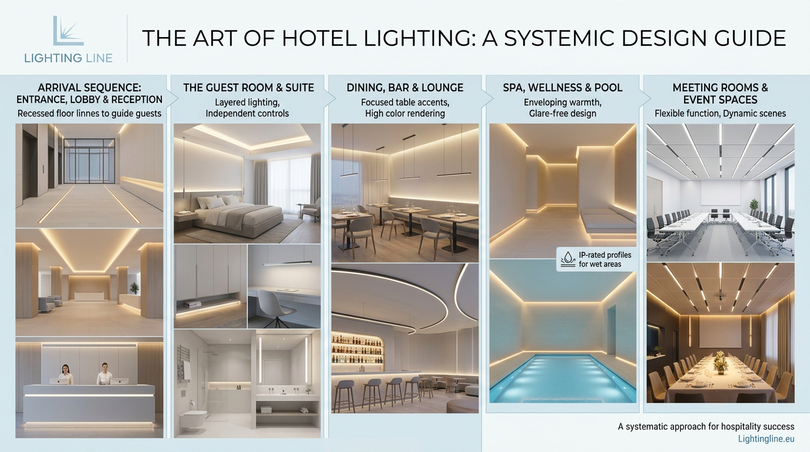
The arrival sequence: entrance, lobby and reception
The arrival sequence is a single continuous experience that should feel choreographed. At the entrance, light should welcome and reassure, lifting the threshold so the transition from outside to inside feels generous rather than abrupt. In the lobby, a warm ambient base lifted by concealed cove lighting makes the ceiling recede and the space feel taller, while accent layers articulate seating clusters and the route to the lifts. At reception, as established, the desk is one of the brightest, most carefully lit points, lit so that staff faces are flattered and the working surface is clear without glare. Across this whole sequence, consistency of colour temperature is what makes the arrival feel coherent: a warm lobby that gives way to a cold corridor breaks the spell immediately. This is one of the clearest demonstrations of why lighting for hotels must be planned as a system rather than space by space.
The guest room and suite
The guest room blueprint follows the layered model in detail independently switchable bedside reading lights on each side: a soft ambient layer delivered indirectly rather than from a single ceiling fixture, a hidden accent on the headboard wall or in a cove, a focused desk task light suitable for working and video calls, a sensor-triggered wardrobe strip and bathroom lighting optimised at the mirror with front-and-side sources. A suite extends this with additional zones (a living area, perhaps a dining nook) each treated as its own layered space but tied together by a single control scheme and a consistent warm palette. The defining quality of suite lighting for hotels is the seamless way the guest moves between zones, each appropriately lit, without ever hunting for a switch.
Dining, bar and lounge
These F&B spaces follow the restaurant principles already set out: high colour rendering for food and faces, tight accent light on each table against a deliberately dimmer surround, and dynamic scenes that move the room through breakfast, lunch and dinner. The lounge and bar push to lower, more intimate levels with dramatic accent work on displays and seating. Because these are among the most photographed and shared spaces in any property, the quality of lighting for hotels here pays back directly in social reach and brand perception.
Spa, wellness and pool
Wellness areas demand a distinct approach within the broader practice of lighting for hotels. The atmosphere should be calm, low and enveloping, with warm colour temperatures and carefully concealed sources that avoid any harsh glare into the eyes of a guest lying down. Critically, every fitting in these wet, humid environments must carry an appropriate ingress-protection rating, and any strip near water must be selected and installed to the correct standard. The combination of relaxation-grade atmosphere and rigorous wet-area compliance makes spa lighting one of the more demanding specification tasks in any property.
Meeting rooms and event spaces
Meeting and event spaces are the most functionally varied of all, hosting everything from bright daytime conferences to evening receptions. Here, flexible, high-quality lighting for hotels with strong scene control is essential: a crisp, even, glare-free scene for presentations and video; a warmer, layered scene for dinners and receptions; and dimmable accent work that can transform the room’s character entirely. Because these spaces are revenue generators sold on their flexibility, the lighting’s ability to reconfigure quickly is a direct commercial asset.
The metrics that define quality lighting
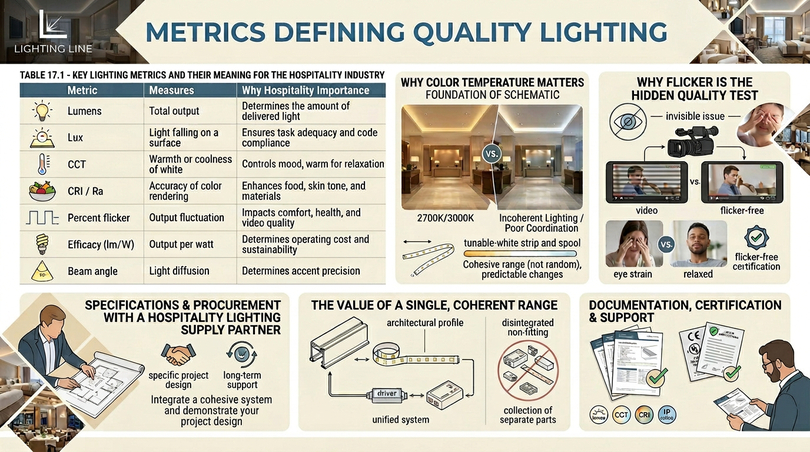
Specifying lighting for hotels with confidence requires a working grasp of the handful of measurable quantities that separate good light from poor light. These metrics turn subjective impressions into objective targets that can be written into a specification and verified on site.
| Metric | What it measures | Why it matters in hotels |
|---|---|---|
| Lumens | Total light output | Determines how much light a source delivers |
| Lux | Light falling on a surface | Sets task adequacy and code compliance |
| CCT (Kelvin) | Warmth or coolness of white | Controls mood, warm for relaxation |
| CRI / Ra | Colour-rendering accuracy | Flatters food, skin and materials |
| Percent flicker | Output fluctuation | Affects comfort, health and video |
| Efficacy (lm/W) | Output per watt | Drives running cost and sustainability |
| Beam angle | Spread of the light | Determines accent precision |
Why colour temperature anchors the scheme
Of all these metrics, colour temperature does the most to set the emotional register of a space, and it is the one most often specified inconsistently. A coherent scheme of lighting for hotels chooses a warm anchor temperature for all guest-facing areas (commonly 2700K or 3000K) and holds to it rigorously, because mixing warm and cool whites in the same sightline reads as a defect even to an untrained eye. Where the brief calls for circadian variation, tunable-white strips allow the temperature to shift through the day under control, but always within a deliberate, designed range rather than by accident.
Why flicker is the hidden quality test
Flicker is invisible to most people most of the time, yet it is one of the truest tests of quality in lighting for hotels. Poor drivers produce output that fluctuates rapidly, causing eye strain and headaches in sensitive guests and, very visibly, banding and stutter in any video shot in the space. Because so much guest content is now video, flicker-free certification has moved from a nice-to-have to a baseline requirement. Specifying flicker-free drivers throughout is one of the simplest, highest-impact decisions available to anyone serious about lighting for hotels.
Specifying and sourcing as a hospitality lighting supplier partner
Selecting the right hospitality lighting suppliers is as consequential as selecting the right components, because a property’s lighting must be supported, replaceable and consistent over many years. The advantage of sourcing a complete system (profiles, strips, drivers, controls and sensors) from a single coherent range is that every component is designed to work together, colour temperatures match across product families, and future replacements remain available and consistent.
The value of a single coherent range
When profiles, strips and controls come from different, unrelated sources, integration becomes a gamble: connectors may not fit, colour temperatures may not match, and a discontinued strip may be impossible to match years later when a section needs replacing. A unified approach to lighting for hotels, drawing the whole system from one well-documented catalogue, eliminates these risks and dramatically simplifies both installation and long-term maintenance. This coherence is one of the strongest arguments for treating lighting as a system, not a collection of separately bought parts.
Documentation, certification and support
Professional specification depends on documentation. Datasheets stating lumens, CCT, CRI, IP rating and flicker performance, together with the relevant safety certifications, are what allow an architect to write a compliant specification and a contractor to install with confidence. Reliable hospitality lighting suppliers provide this documentation as a matter of course, and the availability of clear technical data is itself a useful signal of a supplier’s seriousness about lighting for hotels.
Market trends shaping modern and luxury hospitality lighting
Anyone investing in lighting for hotels today is investing against a fast-moving backdrop of technology and guest expectation. Understanding the direction of travel helps ensure that a specification made now will still feel current in five years, and that the system chosen can absorb future enhancements without being ripped out. Several clear trends define the present moment in modern and luxury hospitality lighting.
The move to fully integrated, trimless aesthetics
The dominant aesthetic trend in luxury hospitality lighting is the disappearance of the fixture. Where a previous generation celebrated the luminaire as an object, the contemporary direction (and the one that reads as most current and most expensive) is to hide the source entirely and let only the effect remain. Trimless plaster-in profiles, concealed coves and seamless COB lines are the tools of this approach, turning light into an architectural material rather than an applied product. This integrated, source-free aesthetic is now the single clearest marker of high-end lighting for hotels.
Circadian and human-centric lighting
A second major trend is human-centric, or circadian, lighting: schemes that vary colour temperature and intensity through the day to support the guest’s natural rhythms, with cooler, brighter light in the morning and warmer, dimmer light in the evening. For a sector whose guests are frequently jet-lagged and sleep-deprived, the wellness value of circadian lighting for hotels is a genuine differentiator, and tunable-white LED strips on intelligent control make it practical to deliver at scale. Wellness-positioned properties increasingly treat circadian lighting as a headline amenity rather than a back-end technicality.
Smart, connected and centrally managed systems
The third trend is connectivity: lighting is increasingly integrated into broader building-management and guest-experience systems, allowing central monitoring, automated scheduling, energy reporting and even guest control via in-room tablets or apps. Interoperable protocols such as DALI-2 are what make this integration robust and future-proof, and specifying them now protects a property’s ability to add capability later. The trajectory of lighting for hotels is unmistakably toward systems that are not merely dimmable but fully connected, measurable and managed.
Sustainability as a guest expectation
Finally, sustainability has shifted from a cost-saving measure to a guest expectation and a brand value. Energy-efficient LED, intelligent controls that eliminate waste, long-life components that reduce replacement, and recyclable materials all contribute to a sustainability story that guests increasingly notice and value. Forward-looking lighting for hotels treats efficiency not only as an operating saving but as part of the brand promise.
A deeper look at lighting control for hotels
Control is the discipline that unlocks every other benefit discussed in this guide, and it deserves a closer examination than a single passing mention. The choice of control strategy determines how flexibly a space can be used, how much energy it saves, how reliably it performs, and how it integrates with the wider building. For serious lighting for hotels, control is not an add-on but the backbone of the whole system.
Control protocols compared
Several control methods coexist in hospitality, each with its place. Simple mains dimming is cheap and familiar but limited and prone to flicker with the wrong driver and analogue methods offer smoother dimming but limited intelligence. Digital, addressable protocols (of which DALI-2 is the most widely adopted open standard) allow each fitting or zone to be controlled, monitored and reconfigured individually, support reliable flicker-free dimming to very low levels, and integrate cleanly with building-management systems. For any property that wants scenes, scheduling, energy reporting and future flexibility, an interoperable digital protocol is the only approach that delivers all of these at once.
| Approach | Strengths | Best suited to |
|---|---|---|
| Mains dimming | Simple, low cost | Basic single-zone fittings |
| 0-10V / analogue | Smooth dimming | Simple commercial zones |
| DALI-2 (digital) | Addressable, interoperable, scene-capable | Whole-property hospitality systems |
| Wireless / app | Flexible retrofit, guest control | Refurbishments, guest-facing control |
Scenes, schedules and automation
The practical payoff of good control is the scene: a saved combination of levels and colours across every layer that can be recalled instantly. Scenes let a multipurpose space become several venues across a day, let staff reset a room to its ideal state with one touch, and let guests choose an atmosphere without understanding the underlying complexity. Layered on top of scenes, schedules automate the daily rhythm (brightening for breakfast, softening for evening) without staff intervention, and sensors trim waste in unoccupied areas. Together, scenes, schedules and sensors turn lighting for hotels from a static installation into a responsive system that works continuously to improve both atmosphere and efficiency.
Integration with the wider building
The most advanced hospitality properties integrate lighting with their building-management and guest-experience platforms, so that occupancy, time of day, energy targets and guest preferences all feed into how a space is lit. This is where interoperable protocols prove their worth, allowing lighting to be one well-behaved subsystem within a larger intelligent building. Specifying open, interoperable control from the outset is the single most effective way to keep this door open for future lighting for hotels enhancements.
Maintenance, lifecycle and total cost of ownership
A lighting scheme is not finished at handover: it must perform reliably for years under continuous use. Thinking about maintenance, lifecycle and total cost of ownership at the design stage is what separates a scheme that ages gracefully from one that becomes a recurring burden. This long-term view is central to responsible lighting for hotels.
Designing for serviceability
The decisions that determine maintenance cost are made during design, not during repairs. Placing serviceable connectors at accessible joints, providing adequate access to drivers, documenting which components are installed where, and choosing a coherent product range whose parts remain available all dramatically reduce the time and cost of any future intervention. A scheme designed for serviceability can be repaired in minutes by a maintenance technician; one designed without it may require an electrician, scaffolding and a discontinued part. Designing maintenance out of the system is one of the highest-return decisions in any approach to lighting for hotels.
The economics of LED longevity
Quality LED components, properly driven and adequately cooled, last for many years of continuous operation, which transforms the economics of lighting for hotels. The upfront cost of quality strips and drivers is repaid not only in energy savings but in the elimination of the frequent re-lamping that older technologies demanded, and in the avoidance of the guest disruption that maintenance work causes. When evaluated over the full lifecycle rather than at the point of purchase, quality components are almost always the cheaper choice.
Why cheap components cost more
The false economy of low-quality components is one of the most expensive mistakes in lighting for hotels. A cheap driver that reintroduces flicker, a low-density strip that shows dotting, or an under-rated strip that corrodes in a bathroom will all need replacing far sooner than a quality equivalent, and each failure carries not only the cost of the part and the labour but the intangible cost of a guest’s poor impression. Specifying quality from the outset is the most reliable way to minimise the true, lifetime cost of a hotel lighting system.
Light sources and fixture types in modern hotels
While linear LED dominates contemporary lighting for hotels, a complete property uses a palette of source and fixture types, each chosen for what it does best. Understanding this palette helps a specifier combine concealed linear light with the decorative and directional fixtures that complete a scheme, and it answers the common question of what lights hotels actually use and what they are called.
Concealed linear LED — the modern backbone
Concealed LED strips inside profiles are the backbone of modern lighting for hotels because they deliver invisible, continuous, controllable light in forms no traditional fixture can match. Coves, headboard washes, under-counter glows, shelf lighting and skirting guidance are all delivered this way, and the absence of a visible fixture is precisely what makes the result read as premium. This is the category on which most of this guide has focused, because it is where the greatest quality gains, and the greatest risk of amateur error, lie.
Downlights and directional fittings
Recessed downlights and adjustable directional fittings provide focused pools of light for tasks and accents where a precise beam is needed over a reception desk, onto a piece of art, across a dining table. The contemporary direction is toward smaller apertures, deeper baffles to control glare, and high colour rendering, so that these fittings deliver their focus discreetly rather than dominating the ceiling. Used sparingly and aimed precisely, they complement the linear backbone of a scheme.
Decorative fixtures and hotel chandeliers
Decorative fixtures (pendants, wall lights, table and floor lamps, and hotel chandeliers) remain essential as statement and human-scale elements. A hotel chandelier in a lobby or fine-dining room provides a focal jewel and a sense of occasion, while bedside and floor lamps bring warmth and a residential feel to guest rooms. The modern approach dims these decorative elements in concert with the concealed layers, so a chandelier reads as a sparkling accent within a balanced scheme rather than as the room’s only source. This blend of decorative warmth and concealed technical light is characteristic of the best lighting for hotels.
What hotel lights are called and how they combine
Guests often ask what the lights in their rooms are called; the answer is simply the four functional categories (ambient, task, accent and decorative) delivered through the source and fixture types above. The skill of lighting for hotels lies in combining them so seamlessly that the guest experiences only a comfortable, beautiful room and never thinks about the individual fittings at all. When the guest notices the atmosphere but not the fixtures, the lighting design has succeeded.
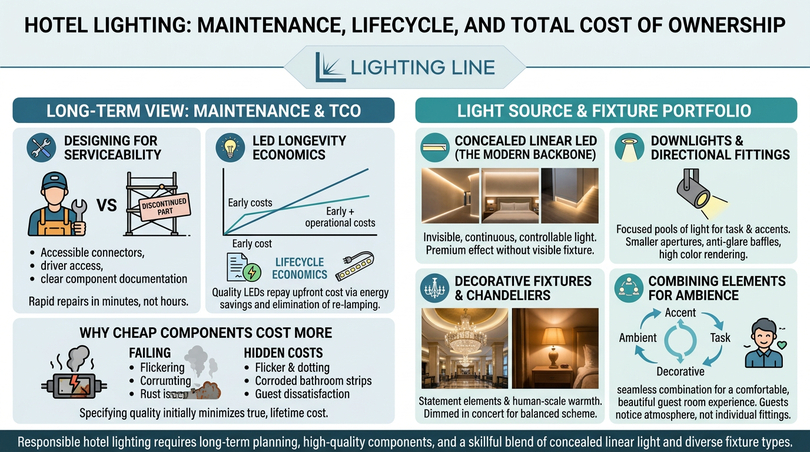
The hospitality lighting design process step by step
Bringing all of the foregoing together, it helps to set out the process by which a professional lighting for hotels scheme is actually developed, from brief to handover. Following a disciplined process is what ensures that the principles, metrics and components discussed throughout this guide are applied coherently rather than piecemeal.
Brief and concept
The process begins with the brief: the property’s positioning, brand, target guest and the atmosphere each space should evoke. From this, a lighting concept emerges: a guiding intent for how light will support the experience, expressed in terms of warmth, layering and focal points rather than specific products. A clear concept keeps every subsequent decision aligned, and it is where the commercial purpose of lighting for hotels is translated into a design intent.
Scheme design and layer planning
With the concept set, the designer plans the layers space by space: what the eye should be drawn to, where tasks happen, how the ambient fill is delivered, and which decorative elements complete each room. This is where the rules (three-point lighting, the 5-7 layering principle) are applied, and where the count and placement of sources for each space is fixed. The output is a scheme that defines the effect before any product is chosen.
Technical specification
Next, the scheme is translated into a technical specification: the profiles, strips, drivers, controls and sensors that will deliver each planned effect, with their metrics (CCT, CRI, IP rating, flicker performance) stated explicitly. This is the stage at which the component choices discussed in this guide are made, and where sourcing a coherent range from capable hospitality lighting suppliers pays off in matched, documented, supportable parts. A complete specification leaves nothing to chance on site.
Installation, commissioning and handover
Finally the scheme is installed with the craft described earlier (profiles cut cleanly, strips connected reliably, runs powered correctly) and then commissioned: scenes programmed, schedules set, sensors tuned, dimming verified flicker-free. A thorough commissioning and a documented handover ensure the system performs as designed from day one and can be maintained thereafter: it is in commissioning that a collection of correctly installed components finally becomes a managed atmosphere, which is the true product of lighting for hotels.
Post-occupancy refinement
The best schemes are refined after opening, once real guests and real operating patterns reveal what works. Scenes are adjusted, schedules tuned to actual occupancy, and sensor sensitivities calibrated to the way spaces are genuinely used. This willingness to refine in occupancy is a hallmark of a property that takes lighting for hotels seriously as an ongoing asset rather than a one-time installation, and it is how a good scheme becomes an exceptional one.
Bedside, reading and corridor fittings in detail
Some of the most frequently specified (and most frequently mishandled) elements of any scheme are the small, guest-facing fittings: the lamps beside the bed, the focused beam for reading, and the discreet light that guides a guest down a corridor at night. These fittings carry a disproportionate share of the guest’s impression of a property, because they are the ones a guest actually touches and controls. Specifying them well is where a thoughtful approach to lighting for hotels becomes tangible at arm’s length, and where many otherwise excellent schemes quietly fall short.
Hotel bedside lamps and bedside lights
The fitting beside the bed is, for most guests, the last light they switch off and the first they reach for in the dark. Hotel bedside lamps must therefore combine an inviting warmth with genuine usability: a switch that is found without thought, a dimming range that reaches truly low levels for a partner still sleeping, and a glare-free body that never shines into the eyes of someone lying down. The best hotel bedside lights integrate a clearly marked control, sit at a height matched to the headboard, and use a warm colour temperature around 2700K to support wind-down rather than alertness. Where the bedside function is delivered by integrated LED rather than a portable lamp (a recessed strip in a niche or a linear profile under a floating headboard) the same discipline applies: low glare, deep dimming and a switch the guest can locate instinctively in darkness.
Hotel reading lights
Reading in bed is a distinct task with distinct requirements, and treating it as such separates a considered room from a generic one. Hotel reading lights should deliver a controlled, focused beam onto the page without spilling across the whole room or disturbing a sleeping partner, which means an adjustable head, a tight beam angle and an independent switch separate from the ambient and bedside layers. A reading light that doubles as a bedside lamp inevitably compromises one role or the other; the strongest rooms provide a dedicated, aimable source per occupant. Specifying proper hotel reading lights with a neutral-to-warm tone around 3000K and a high colour rendering index keeps text crisp and comfortable, and the independent control is what lets one guest read while the other rests, a small courtesy that guests notice and remember.
Hotel corridor lighting design
Corridors are the connective tissue of a property, and good hotel corridor lighting design has to reconcile several competing demands at once: a welcoming brightness by day, a calm low-level wash at night, even illumination free of dark patches between fittings, and energy restraint across spaces that are empty most of the time. The most effective approach layers a continuous, glare-controlled general light (often a recessed linear profile) with discreet floor-level guidance from skirting profiles, the latter switching up gently on presence detection so a guest is never walking toward darkness. Thoughtful hotel corridor lighting design also resolves the transition from a bright corridor into a dim room and back, so the eye is never jarred, and it keeps emergency egress lighting integrated rather than bolted on. Done well, the corridor is felt rather than noticed, which is precisely the point.
Coordinating the room-fitting layers
The bedside, reading and corridor fittings do not work in isolation; they are layers within a single coherent experience, and they must be coordinated in control as well as in appearance. A guest arriving at night should find a gentle welcome scene rather than a wall of switches, and should be able to reach a single “goodnight” control that takes the whole room down to a safe, low path light.This coordination of the smallest, most personal fittings into one legible, guest-friendly system is the difference between a room that merely has lights and a room whose lighting for hotels has genuinely been designed.
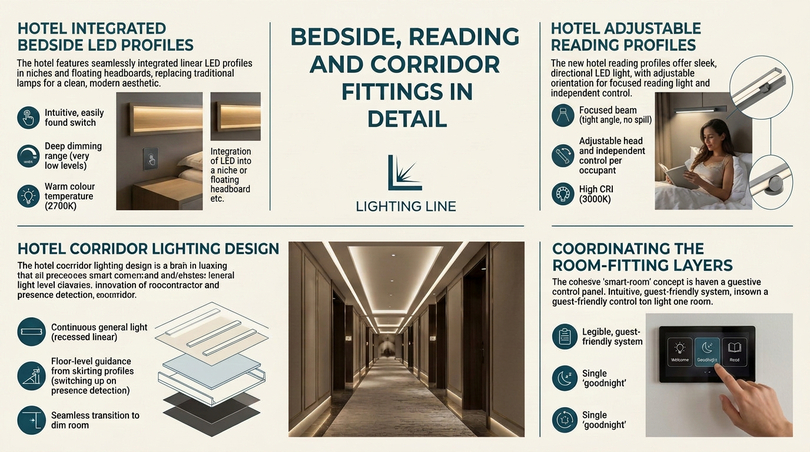
Contract hotel lighting: procurement and project delivery
Specifying the right products is only half of the task: delivering them reliably across an entire property, on programme and on budget, is the other half. This is the domain of contract hotel lighting: the disciplined procurement and project delivery that turns a design intent into hundreds or thousands of correctly supplied, documented and installed fittings. Understanding how contract supply works helps owners and specifiers avoid the delays, mismatches and warranty gaps that undermine otherwise excellent schemes.
What contract supply really means
A contract hotel lighting arrangement differs from buying fittings off the shelf in several important ways: products are supplied to a project specification with consistent batches and colour binning, quantities are coordinated to a programme, technical documentation is provided for sign-off, and a single accountable partner stands behind the whole package. This matters because a hotel is not one room repeated but many related spaces that must feel coherent, and that coherence depends on matched components sourced together rather than assembled piecemeal from whatever is in stock.
Batch consistency and colour matching
Few defects are as visible (or as expensive to remedy) as a corridor of nominally identical fittings that subtly differ in colour temperature. In contract hotel lighting, consistent colour binning across a production batch is a core requirement, ensuring that every white in a run renders the same on the wall. Specifying from a partner who can guarantee binning and reserve stock for later phases protects the property against the slow drift of replacements that no longer match, which is one of the most common and avoidable failures in volume installations.
Documentation, compliance and sign-off
Volume projects live and die by their paperwork. Proper contract supply provides the datasheets, photometric files, declarations of conformity and warranty terms that let a consultant sign off a scheme and a maintenance team support it for years. Sourcing from organised hospitality lighting suppliers who furnish complete documentation turns compliance from a scramble into a formality, and it is the documentation (not the fitting itself) that often determines whether a project passes inspection on schedule.
Phasing, lead times and stock continuity
Hotels are frequently delivered in phases, refurbished wing by wing, or operated while partially renovated, and lighting supply has to follow. A capable contract hotel lighting partner plans lead times against the construction programme, holds or reserves continuity stock so that later phases match earlier ones, and keeps spares available for the operational life of the scheme. This continuity is what allows a property to maintain a consistent look across years of incremental change rather than ending up with a patchwork of generations.
Partnering for the whole lifecycle
The strongest procurement relationships extend beyond the initial fit-out into the operating life of the building, covering replacements, upgrades and expansion with the same matched, documented components. Choosing a supply partner for contract hotel lighting on the basis of lifecycle support (not merely the opening order) is what keeps a property’s lighting coherent, compliant and maintainable for as long as it operates, and it is the quiet foundation on which every visible benefit of lighting for hotels ultimately rests.
Frequently asked questions
The questions below gather the most common queries about lighting for hotels and hospitality venues into a single quick-reference table. Click each question to reveal the answer.
| Question & answer |
|---|
Can you put LED lights in a hotel room?Yes. Professionally installed LED strips fitted inside aluminium profiles are the standard solution for hotel rooms, providing flicker-free, low-heat, fully controllable light across accent, reading and ambient layers. They are safer and far more flexible than the traditional fixtures they replace. |
How do you light a hotel room?By layering: a soft dimmable ambient base, individually switchable bedside and desk task lights, a hidden accent layer on the headboard or cove, and careful mirror lighting in the bathroom: all warm, high-CRI and flicker-free, ideally tied to a single bedside master control. |
What type of lighting is used in hotels?Hotels combine the four functional layers (ambient, task, accent and decorative) increasingly delivered through recessed and trimless LED profiles, COB strips and DALI-controlled scenes rather than single overhead fixtures. |
What is the best lighting for hotels?The best hotel lighting layers warm, dimmable LED (typically 2700K–3000K) with high-CRI strips (Ra>90, ideally >95), flicker-free drivers and scene control so the atmosphere adapts across the day. Quality of light and control matters more than raw quantity. |
What is the 5-7 lighting rule?It is a layering guideline suggesting roughly five to seven distinct light sources at varying heights in a room, so light appears at floor, mid and ceiling levels. This produces depth and comfort and avoids the flat, institutional look of a single ceiling fixture. |
What is the 3 lighting rule?Borrowed from photography, it recommends lighting any subject or zone from three directions (key, fill and back/accent) to create dimension. Applied to a reception desk or seating area, it instantly reads as professionally lit rather than flat. |
Why do hotels use lamps instead of ceiling lights?Lamps and indirect LED profiles create lower, warmer, layered light that feels residential and relaxing. A single bright ceiling source flattens a room and feels institutional, so hotels favour multiple smaller sources to build atmosphere. |
What are the lighting requirements for a hotel room?An adjustable task layer at bed and desk, a soft ambient layer, an accent layer, mirror-optimised bathroom light, flicker-free dimming, a bedside master switch, plus compliance with electrical safety, IP ratings in wet areas and emergency/egress lighting codes. |
What is the best lighting for a hotel reception?A generous ambient base with the desk as one of the brightest, most carefully lit points: a back-wall wash, glare-free under-counter or downlight on the working surface, and scene control to shift from energetic daytime to warm evening. |
What type of lighting is best for a restaurant?Warm (around 2700K), highly colour-accurate (Ra>95) and dimmable, with tight accent light on each table against a dimmer surround so food and guests are flattered and intimate zones are created. |
Do hotels use LED lights?Yes, overwhelmingly. LED is the default hospitality source because it is energy-efficient, long-lived, low-heat, dimmable and available in high-CRI, flicker-free forms suitable for every layer from corridors to fine dining. |
How can I improve my hotel lighting without high energy cost?Convert to LED, add dimming and scene scheduling, and fit presence sensors in corridors and intermittently used areas. Controlled LED can save far more energy than uncontrolled lighting of the same wattage while improving the guest experience. |
Lighting for hotels: a consistent light
Lighting for hotels rewards the operators and designers who treat it as an engineered system rather than a decorative afterthought. The principles are consistent across every property tier: layer the light into ambient, task, accent and decorative roles, control the colour with warm temperatures and high colour rendering, eliminate flicker with quality drivers and let intelligent control adapt the atmosphere across the day while presence sensors trim waste. Executed with care (right down to how a profile is cut and a strip is soldered) this approach produces hotel lighting that is more beautiful, more efficient, more compliant and more durable than anything the previous generation of fixtures could offer.
This article was developed with the support of artificial intelligence and subsequently reviewed, corrected, and validated by the LightingLine.eu technical team, which guarantees its reliability and compliance with official sources.