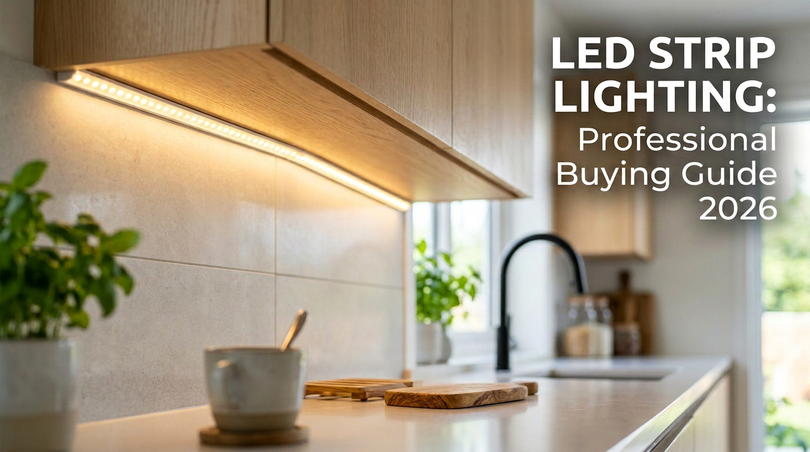
Everything you will ever need to know about led strip lighting from chip technology and CRI to the specific product decisions that separate installations that look magnificent for a decade from ones that look tired within two years. Written by the LightingLine.eu specialist team, sourced directly from two decades of attending international LED trade fairs and supplying professional installers, architects, and designers across Europe.
In this article…
2. The LED strip lighting market in 2026
3. Anatomy of a LED strip: what you are actually buying
4. SMD vs COB LED strip lighting: the decision that changes everything
5. CRI and R9: the quality numbers that determine whether your light is worth having
6. MacAdam ellipses and 3SDCM: why colour consistency is non-negotiable
7. Voltage: 12V vs 24V LED strip lighting
8. Wattage and lumen output: getting the numbers right
9. Colour Temperature: choosing the right white
10. IP ratings for LED strip lighting
11. LED strip lighting applications by room and sector
12. FAQ — Frequently asked questions
13. Conclusion
1. Why most LED strip lighting fails and how to make sure yours doesn’t
Walk into any DIY superstore or open any major e-commerce platform and you will find dozens of led strip lighting products for sale: they look similar. Many have impressive-sounding specifications, the prices range from absurdly cheap to moderately expensive. And here is what almost nobody tells you upfront: the overwhelming majority of those products, including several sold by household-name retailers, will not still be performing acceptably in three to five years. They will fade, shift colour, peel away from the surface they were stuck to, or fail entirely. Not because LED technology is unreliable but because the specific implementation of that technology in those specific products is engineered to a price point rather than a performance standard.
Led strip lighting, when it is done correctly, is one of the most transformative technologies available to anyone who cares about the quality of light in their space. It delivers architectural illumination effects that would have required specialist contractors and significant budgets just fifteen years ago. It runs at a fraction of the energy cost of the halogen task lighting it replaces. It lasts, in properly specified and installed form, for twenty years without requiring a single lamp change. The key phrase is “properly specified and installed”. This guide exists to give you (whether you are a professional installer, a lighting designer, an architect, a content creator, or a serious DIY enthusiast) everything you need to make the right choices every single time.
We will cover led strip lighting technology from the chip level upwards. We will explain precisely what the numbers on a specification sheet actually mean and which numbers are routinely falsified or omitted by suppliers who are not held accountable for them. We will provide detailed, technically accurate guidance on cutting led strip lighting to length, wiring it correctly, connecting it to mains power, and installing it in aluminium profiles. By the end of this guide, you will not need to read another led strip lighting buying guide for the rest of the decade.
2. The LED strip lighting market in 2026: what the numbers tell us
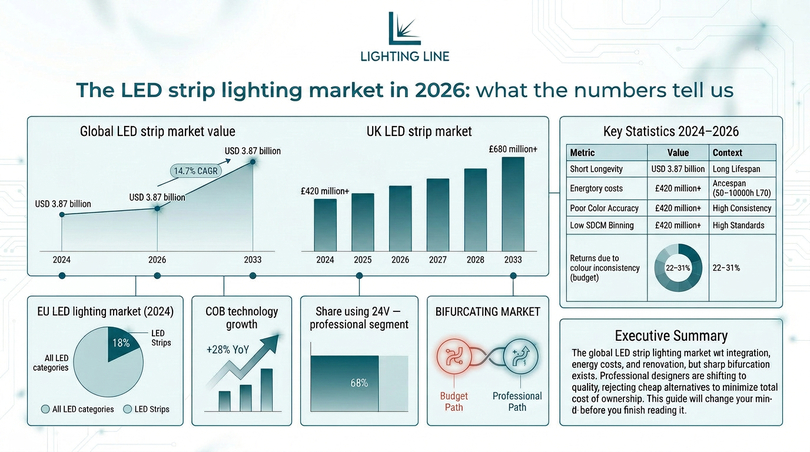
The global LED strip lighting market reached an estimated value of USD 3.87 billion in 2024 and is projected to grow at a CAGR of 14.7% through 2033, driven by accelerating residential renovation activity, commercial retrofit programmes motivated by rising energy costs, and the integration of led strip lighting into smart home ecosystems. In Europe specifically, the transition away from fluorescent and halogen task and architectural lighting has created a professional installer market for high-quality led strip lighting that is growing at approximately 11% per year. The UK led strip lighting market alone exceeded £420 million in 2024 and is expected to surpass £680 million by 2028.
| Metric | Value | Context |
|---|---|---|
| Global LED strip market value (2024) | USD 3.87 billion | COB and SMD segments combined |
| CAGR 2024–2033 (global) | 14.7% | Smart homes, retail retrofit, energy costs |
| EU LED lighting market (2024) | €22.85 billion | All LED categories; strips ≈ 18% share |
| UK led strip lighting market (est. 2024) | £420 million+ | Residential + commercial; fastest growing |
| COB technology growth rate | +28% YoY (2023–2025) | Architectural specification driving adoption |
| Share using 24V — professional segment | 68% | Shift from 12V driven by installation standards |
| Returns due to colour inconsistency (budget) | 22–31% | SDCM binning the primary cause |
| Average lifespan — LM-80 certified (at 85°C) | 50,000–100,000h L70 | TM-21 projected from 10,000h test data |
What these statistics reveal above all is that the led strip lighting market is bifurcating sharply. There is a large, price-sensitive segment dominated by products that look comparable to premium alternatives on a screen but are fundamentally different in longevity, colour accuracy, and long-term consistency. And there is a growing professional segment (architects, lighting designers, specification installers, content creators, and sophisticated DIY buyers) who have learned, often through painful experience with the cheap segment, that the total cost of a led strip lighting installation includes far more than the initial product price. This guide is written for that second group. If you are still shopping on price alone, this guide will change your mind before you finish reading it.
3. Anatomy of a LED strip: what you are actually buying
A led strip lighting product appears, to the casual observer, to be a simple thing: a flexible tape with lights on it. This impression is fundamentally misleading. The led strip is a sophisticated optoelectronic assembly in which four distinct components: the PCB substrate, the LED chip packages, the phosphor conversion layer, and the adhesive backing that interact to determine the performance of the entire system. Failure or substandard specification of any one component compromises the performance of all the others. Understanding each component is the prerequisite for making correct purchasing decisions.
The PCB: substrate, width and thermal conductivity
The PCB (Printed Circuit Board) is the flexible substrate on which the LED chips are mounted and the electrical circuit traces are deposited. In led strip lighting, PCB quality determines three things: thermal conductivity (how efficiently heat generated by the LEDs is conducted away from the junction to the aluminium profile heat sink), trace resistance (which determines voltage drop over the run length), and dimensional stability (how well the strip maintains its geometry during cutting and installation).
PCB substrates used in led strip lighting fall into two main categories: FR4 (fibreglass epoxy laminate) is the standard material for strips up to approximately 12–15 W/m in properly heat-sinked aluminium profiles. Above this power density, the superior thermal conductivity of aluminium-backed PCB (MCPCB) is required to maintain LED junction temperatures within specification. LightingLine.eu’s high-output SMD range (24 W/m) uses aluminium-substrate PCBs as standard, a specification detail that is absent from budget products at the same nominal power rating and is the primary reason their actual lumen output degrades significantly faster.
PCB width is the practical dimension that determines aluminium profile compatibility. LightingLine.eu COB strips are available on 3 mm, 5 mm, 8 mm, and 10 mm PCBs while SMD products on 8–12 mm standard PCBs. These dimensions are stated explicitly in every product listing in the LightingLine.eu catalogue, eliminating the most common and most expensive compatibility error in led strip lighting installation.
The LED chip — Why the designation lies to you
The LED chip designation on a led strip lighting product (2835, 3528, 5050, COB 0620) refers to the physical dimensions of the chip package in tenths of millimetres. It tells you nothing about the chip’s actual performance, quality tier, or manufacturer. The designation 2835 covers LED packages manufactured by dozens of companies operating at vastly different quality levels, whose actual luminous efficacy may range from 80 lm/W (budget) to 220 lm/W (Tier 1 premium), and whose lumen maintenance at 6,000 operating hours may be anywhere from 72% to 97% of initial output.
This is the most exploited ambiguity in the led strip lighting market. A budget supplier and a premium supplier can both list “2835 LED strip lighting” and the product pages may look substantially similar. The difference is invisible at the point of purchase and becomes apparent only after months or years of operation, by which time the supplier’s returns window has closed and the cost of replacement falls on the installer or end user. The only reliable way to navigate this ambiguity is to require LM-80 certification from an accredited independent laboratory, which documents actual chip performance under controlled conditions and allows verified longevity projections. LightingLine.eu requires this documentation for every product in the range. No exceptions.
The phosphor layer — Hidden arbiter of colour quality
All white led strip lighting (every warm white, cool white, and neutral white product in the market) operates by converting blue or near-UV light from the LED chip through a phosphor layer into broad-spectrum visible light. The formulation, thickness, and consistency of that phosphor layer determines the CRI (colour rendering index), the colour temperature accuracy, and critically the colour stability of the strip over its operational lifetime.
Poorly formulated or inconsistently applied phosphor layers produce strips that appear correct when new but change colour significantly as the phosphor degrades under thermal stress. A strip nominally rated at 3000K may measure 3,000K at initial commissioning and 3,350K after 10,000 hours of operation, a visible shift that is particularly damaging in cove and indirect lighting applications where the changed colour is prominently displayed on a broad ceiling surface. This degradation mechanism is not captured by the LM-80 test, which measures lumen output rather than chromaticity shift. High-quality phosphor sourcing is a supplier-level decision that cannot be verified by the buyer after purchase, which is precisely why purchasing from suppliers with transparent quality processes and a professional reputation to protect matters so much.
The adhesive — The component nobody talks about
The self-adhesive backing on led strip lighting is the component most frequently compromised by cost reduction — and its failure produces the most visible and frustrating installation failures. The correct specification is 3M VHB (Very High Bond) acrylic transfer tape, which maintains adhesion across temperatures from −40°C to +120°C, resists UV degradation, and provides bond strength of approximately 0.5–0.7 N/mm² on aluminium surfaces, more than adequate to hold a fully loaded LED strip in place for the lifetime of the installation, even on vertical surfaces and overhead profiles.
Generic acrylic tape, which looks identical to 3M VHB in every photo and even in person, typically begins to fail at temperatures above 55–60°C, which are routinely reached on led strip lighting PCBs even in well-ventilated aluminium profiles during full-power operation. The incremental cost is marginal but the difference in field performance across a five-year installation is enormous.
4. SMD vs COB LED strip lighting: the decision that changes everything
The choice between SMD and COB technology is the foundational decision in any led strip lighting specification. It determines optical performance, minimum installation dimensions, CRI achievability, and the visual quality of the finished result in ways that no amount of careful driver sizing, quality diffuser selection, or precise wiring can compensate for if the base technology is wrong for the application. Make this decision correctly and every other aspect of the specification becomes manageable. Make it incorrectly and you will be replacing the installation within three years.
SMD LED strip lighting explained
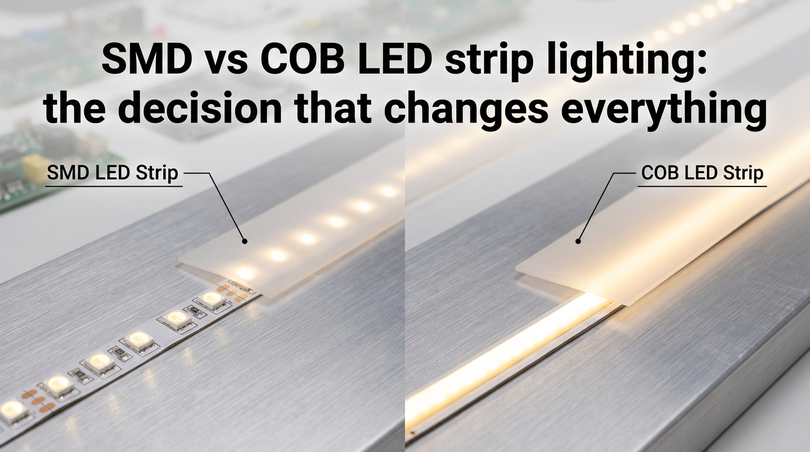
SMD (Surface-Mounted Device) led strips are the technology that defined the led strip lighting industry through most of its history and still represent the majority of products in the professional market. They consist of individual LED packages soldered onto the PCB at regular intervals, the density expressed as LEDs per metre (60/m, 120/m, 168/m being the most common for the 2835 chip in professional-grade products). At the correct density, in the correct profile depth, with an appropriate diffuser, SMD led strip lighting delivers excellent results for a wide range of applications.
The inherent optical limitation of SMD technology is the “dot effect”: because light is emitted from discrete point sources separated by dark sections of PCB, at shallow diffuser distances the individual LED positions are visible as a string of bright points against a darker background. This is visually unacceptable for cove and indirect lighting where the strip is viewed at glancing angles, for shelf-edge and display case lighting where the strip-to-diffuser distance is minimal, and for any installation where the profile interior is visible to observers from more than one angle. LightingLine.eu’s 68-SKU SMD range covers the full matrix of colour temperatures, power levels, and IP ratings for all applications where SMD is the correct technology.
COB LED strip lighting: dot-free, CRI 90+, architecturally perfect
COB (Chip-on-Board) technology represents the most significant advance in led strip lighting since the format’s commercial introduction. Rather than individual packages at intervals, COB strips fuse hundreds of micro-scale LED chips directly to the PCB beneath a continuous, uniform phosphor layer. The result is a strip that emits light from every millimetre of its length (no dots, no dark intervals, no visible individual LED positions) producing a continuous luminous line of extraordinary uniformity that is simply impossible to replicate with SMD technology at equivalent profile depths.
The COB offer from LightingLine have a range built on 480 LEDs per metre, a density that, combined with the continuous phosphor layer, produces a strip whose surface appears to glow as a single source rather than as a sequence of point emitters. The 180° beam angle delivers light across the full internal surface of any aluminium profile, maximising diffuser utilisation and ensuring consistent luminance from edge to edge. And the CRI Ra > 90 standard applied to every COB product in the range as a baseline, not a premium option means that every installation using our COB strips renders colours accurately enough to be professionally proud of, in every application from luxury bathrooms to hotel cove systems to content creator studios.
The COB IP67 silicone-tube format adds full waterproof protection through a spherical silicone extrusion around the PCB maintaining flexibility, preserving the optical clarity of the COB emission, and providing genuine IP67 immersion protection without the rigidity and thermal penalties of epoxy potting. This is the specification that has become standard for luxury bathroom, pool surround, outdoor architectural, and wet-area commercial installations.
Full technical comparison: SMD vs COB LED strip lighting
| Parameter | SMD 2835 | COB |
|---|---|---|
| Visual uniformity (dot-free) | No point sources, requires opal diffuser + min 25mm depth | Yes — continuous phosphor, zero hotspots at any depth |
| Minimum PCB width | 8mm (standard 2835) | 3mm — fits the narrowest architectural profiles |
| CRI (LightingLine.eu range) | Ra > 80 standard, Ra > 90 on premium SKUs | Ra > 90 on ALL products — mandatory baseline |
| Beam angle | 120° typical | 180° — maximum diffuser surface utilisation |
| Luminous efficacy | 120–145 lm/W | 100–130 lm/W |
| LED density | 60/m, 120/m options | 480/m — 4× to 8× higher than SMD |
| Colour range | Full: white, RGB, RGBW, tunable white | White tones only (single phosphor) |
| Waterproof format | IP20, IP65 resin coat | IP20, IP67 silicone tube — superior performance |
| Cut interval | Every 5cm (120 LED/m, 24V) | Every 2.5cm — finer precision |
| Strip visible to observer | Not recommended without deep profile | Always the professional choice |
5. CRI and R9: the quality numbers that determine whether your light is worth having
No parameter in led strip lighting specification is more important (or more frequently misrepresented) than the Colour Rendering Index. CRI is the difference between a kitchen that makes food look fresh and one that makes it look grey. Between a hotel bathroom that feels luxurious and one that feels clinical. Between a content creator’s studio that makes skin tones look natural on camera and one that requires heavy grading to fix. If you understand only one technical parameter in led strip lighting, make it CRI.
CRI (Ra) measures how accurately a light source renders the colours of objects compared to a reference illuminant, on a scale from 0 to 100. It is calculated as the average rendering accuracy across eight standard test colour samples (R1–R8), all moderately saturated pastel tones. The critical limitation: it completely excludes highly saturated colours, particularly reds, oranges, and skin tones. This is why R9 (the supplementary measurement of saturated red rendering) is the single most revealing quality indicator for any led strip lighting product. An Ra 90 strip with R9 of −5 (yes, R9 can be negative) will make fresh meat look unappetising, make warm-complexioned skin look sallow, and make red fabrics in a boutique look dull. An Ra 90 strip with R9 of 70 will make everything look the way it should.
| Ra value | R9 typical | Quality | Real-world effect | LightingLine catalogue |
|---|---|---|---|---|
| Ra < 70 | Often negative | Unacceptable | Severe colour distortion, objects unrecognisable in natural colour | Never stocked |
| Ra 70–79 | Often < 10 | Poor | Grey, flat appearance, skin tones sallow, food unappealing | Never stocked |
| Ra 80–84 | 0–25 | Basic | Adequate for non-critical storage, back-of-house, circulation | Entry SMD only |
| Ra 85–89 | 20–40 | Good | Acceptable for general office and basic residential | Selected SMD SKUs |
| Ra 90–94 | 50–70 | Excellent | Retail, hospitality, residential premium — accurate colour rendering | Standard COB, premium SMD |
| Ra 95+ | 70–90 | Premium | Jewellery, gallery, fashion, medical — indistinguishable from daylight | Available on request |
LightingLine.eu requires CRI Ra > 90 as a non-negotiable entry standard for every COB product in the range. We ask suppliers for photometric test reports from accredited independent laboratories (not manufacturer spec sheets) and we verify R9 values specifically before listing any product. The majority of the led strip lighting market does not disclose R9 at all. This omission is rarely accidental.
| Application | Min. Ra | R9 requirement | Consequence of under-specification |
|---|---|---|---|
| Storage, back-of-house, circulation | 80 | ≥ 0 | Negligible visible impact |
| General office, workspace | 80 (90 recommended) | ≥ 20 | Subtle colour fatigue; reduced visual comfort |
| Residential living, bedroom | 90 | ≥ 50 | Colours of furnishings misrepresented; space feels subtly wrong |
| Hospitality — hotel, restaurant | 90 | ≥ 50 | Food looks unappetising; skin tones sallow; premium feel destroyed |
| Retail — fashion, clothing | 90 | ≥ 50 | Fabrics look different in-store vs daylight; returns increase measurably |
| Food retail — produce, meat, bakery | 90–95 | ≥ 50 | Fresh food sales demonstrably reduced; product appears older |
| Jewellery, luxury goods, gallery | 95+ | ≥ 80 | Gems appear flat; gold loses warmth; artwork colours distorted |
| Content creation studio, video | 90 | ≥ 50 | Camera colour requires heavy correction; skin tones grade poorly |
6. MacAdam Ellipses and 3SDCM: Why Colour Consistency Is Non-Negotiable
Two led strip lighting products labelled “3000K warm white” can, when installed side by side, produce light that is visibly different in colour. Not because either is mislabelled, both may accurately represent the 3000K nominal colour temperature — but because the actual colour of any LED product falls within a zone on the chromaticity diagram, and the size of that zone is determined by the binning tolerance. In a 5m single-reel installation, this is invisible. In a 20m hotel corridor, or a retail perimeter, or a cove system using product from multiple reels, it is the difference between a professional result and a very expensive mistake.
The measurement unit is the MacAdam ellipse, reported as SDCM (Standard Deviation of Colour Matching). A 3-SDCM (3-step) ellipse is the largest tolerance within which colour variations remain invisible under normal lighting conditions for the vast majority of observers. A 5-SDCM or 6-SDCM ellipse, the standard tolerance for most budget and mid-market led strip lighting — produces variations that are clearly visible when strips from different batches are installed adjacent to each other in the same space.
A restaurant installs 30m of nominally 3000K led strip lighting in a continuous cove system. Reels 1 and 2 measure 3,010K effective colour point; reels 3, 4, and 5 measure 2,975K. Both within 5SDCM. Both nominally “3000K”. The result: a subtly but distinctly visible colour variation between sections that no dimmer adjustment can correct and that only a complete re-strip can fix. Cost of specifying 3SDCM from the start: approximately 8–12% premium. Cost of the mistake: the entire installation margin.
Every SMD and COB product in the LightingLine.eu led strip lighting range is specified to 3SDCM maximum colour binning tolerance. Any product from the LightingLine.eu 3000K family, purchased today or in two years, will fall within a colour zone that is visually indistinguishable from every other product in the same family. This specification is not optional for any professional installation or any installation of 5m or more where visual coherence matters.
7. Voltage: 12V vs 24V LED strip lighting
The question of 12V versus 24V led strip lighting is, for any professional or semi-professional application, settled. The answer is 24V: unambiguously, decisively, and for well-documented technical reasons that apply to every application except short-run decorative uses where run length is not a constraint. The persistence of 12V in the market reflects the legacy of the early LED strip era. In 2026, 24V has superseded it across every performance dimension that matters.
| Parameter | 12V LED strip | 24V LED strip |
|---|---|---|
| Maximum run length (5% V-drop, 14W/m) | 3–4m per driver | 7–10m per driver |
| Current at 100W load | 8.33A — requires 4mm² cable on medium runs | 4.17A — 1.5–2.5mm² cable sufficient |
| Voltage drop sensitivity | High — visible brightness/colour shift beyond 3m | Low — stable across full rated run |
| Cable heating (I²R losses) | Significantly higher (proportional to current²) | 75% lower cable heating at same power |
| DALI-2 driver range | Limited | Full professional range — all major brands |
| Recommendation for runs >3m | Not recommended | Correct specification |
| Safety class | SELV (<50V — safe to touch) | SELV (<50V — safe to touch) |
8. Wattage and lumen output: getting the numbers right for every application
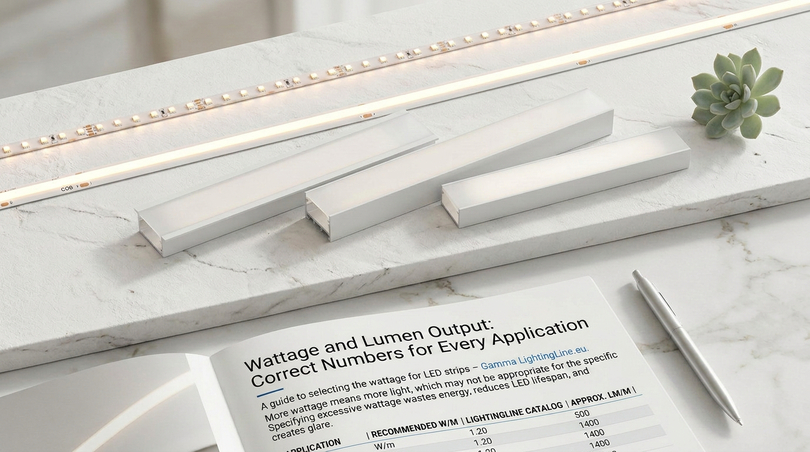
Power per metre (W/m) and luminous output per metre (lm/m) determine whether your led strip lighting installation achieves its functional purpose. More watts means more light, which may or may not be appropriate for the application. Specifying excessive wattage wastes energy, increases heat load, reduces LED lifetime, and creates glare rather than illumination. Specifying insufficient wattage produces an underlit space that requires expensive remediation.
| Application | Recommended W/m | LightingLine catalogue | Approx lm/m |
|---|---|---|---|
| Decorative accent / cove indirect | 6–9.6 W/m | COB 6W/m 480LED/m 24V or SMD 9.6W/m | 600–950 |
| Under-cabinet kitchen task | 9.6–12 W/m | SMD 2835 9.6–12W/m 120LED/m 24V | 900–1,350 |
| Retail shelf-edge accent (visible strip) | 6–10 W/m — COB essential | COB 6W/m 3mm PCB 24V | 600–900 |
| Office ambient — recessed profile | 14–18 W/m | SMD 2835 high-density 24V | 1,600–2,200 |
| Retail general ambient | 16–24 W/m | SMD 2835 24W/m 120LED/m 24V | 2,000–3,200 |
| LED strip lighting for stairs | 6–9.6 W/m — wayfinding | COB 6W/m or SMD 9.6W/m, IP44+ | 600–900 |
| LED strip lighting for bedroom | 6–12 W/m indirect preferred | COB or SMD 9.6W/m 2700–3000K dimmable | 600–1,200 |
| Outdoor led strip lighting | 12–16 W/m | SMD 9.6–24W/m IP65 24V | 1,100–2,400 |
| Commercial high-output | 20–30 W/m | SMD 2835 24W/m 120LED/m 24V | 2,800–4,000 |
9. Colour Temperature: choosing the right white for every space
Colour temperature is the most emotionally powerful parameter in led strip lighting design. Specify it correctly and the illumination becomes invisible, the space simply feels exactly as it should. Specify it incorrectly and even a technically perfect installation creates an atmosphere that is persistently wrong in a way that occupants notice without being able to articulate. Colour temperature is not a personal preference to be chosen at point of purchase. It is a design decision made in the context of the specific space, its surfaces, its function, and the time of day at which it will primarily be used.
| CCT | Character | Ideal applications | Available in LightingLine.eu catalogue |
|---|---|---|---|
| 2700K — Extra Warm White | Very warm, amber. Intimate, domestic. | Bedrooms, restaurants, luxury bars, spa | ✓ COB range; selected SMD |
| 3000K — Warm White ⭐ | Warm but clean. Flattering to skin and food. | Residential living, kitchens, hospitality, premium retail | ✓ Full SMD and COB range |
| 4000K — Cool White / Neutral | Clean, energising, high perceived brightness. | Offices, classrooms, supermarkets, studios | ✓ Full SMD and COB range |
| 6500K — Cool Daylight | Blue-white. Maximum alertness, colour discrimination. | Industrial, medical, technical inspection | ✓ Selected SMD SKUs |
For content creators, YouTubers, and video professionals, the recommended colour temperature for primary ambient led strip lighting is 4000K neutral white as the reference illuminant, supplemented with 3000K accent for background mood. This provides adequate blue channel content for camera sensors while maintaining flattering quality for human subjects. RGB led strip lighting used as background accent should always be layered over, never replace, a white reference illuminant at 4000K or 6500K.
10. IP ratings for LED strip lighting: waterproof, outdoor and bathroom
Specifying the correct IP (Ingress Protection) rating for led strip lighting is not a technical preference, in most wet and outdoor applications, it is a statutory requirement under building regulations and product safety legislation. Installing IP20 led strip lighting in a bathroom Zone 1 is not merely a performance mistake; it is a code violation and a potential fire and electrocution hazard.
IP20 through IP68 — What each means in practice
| IP rating | Protection level | Construction | Correct application |
|---|---|---|---|
| IP20 | No liquid protection | Bare PCB | Dry indoor only: office ceiling, residential living room, retail (no cleaning) |
| IP44 | Splash from any direction | Light silicone/conformal coat | Bathroom Zone 2 (>60cm from water source), kitchen splashbacks |
| IP65 | Water jets, low pressure | Silicone sleeve or potting over PCB | Outdoor led strip lighting (sheltered), above refrigeration, under-canopy |
| IP67 — COB silicone tube ⭐ | Immersion to 1m / 30 min | Full silicone tube extrusion around PCB | Bathroom Zone 1, outdoor exposed, pool surround, wet commercial |
| IP68 | Continuous submersion >1m | Epoxy potting + sealed jacket | Underwater pool, fountains, permanent in-water feature |
Outdoor LED strip lighting — Specific requirements
Outdoor led strip lighting faces environmental stresses that indoor installations do not: UV radiation from sunlight, thermal cycling, rain, condensation, and in some applications, salt spray or frost. For exposed outdoor led strip lighting, IP65 is the minimum; IP67 is the professional specification for any position that may experience direct rain, standing water, or condensation pooling.
Beyond the waterproof rating, outdoor led strip lighting must use UV-stabilised materials throughout, not just the waterproof coating, but the PCB substrate, the adhesive backing, and the aluminium profile finish. Generic IP65 strips with standard acrylic adhesive will have the adhesive fail within 12–24 months under UV exposure even if the IP65 coating remains intact. LightingLine.eu’s outdoor-rated products specify UV-stabilised materials throughout the assembly, and the matched aluminium profiles are available in anodised and powder-coated finishes rated for outdoor exposure.
Bathroom and kitchen LED strip lighting
Bathroom led strip lighting is governed in the UK by BS 7671 (IET Wiring Regulations) and Part P of the Building Regulations, defining three zones: Zone 0 (inside bath/shower enclosure): IP67 minimum. Zone 1 (above bath/shower to 2.25m height): IP44 minimum (IP67 recommended). Zone 2 (60cm outside Zones 0 and 1): IP44 minimum.
For led strip lighting for kitchen applications: under-cabinet positions are in a splash zone requiring IP44 minimum, IP65 preferred. Led strip lighting for kitchen areas above a hob, above a sink, or in positions exposed to steam must be IP65 minimum. Any led strip lighting for kitchen ceiling positions directly above food preparation must have a smooth, cleanable surface, sealed aluminium profiles with IP65 diffusers are the correct specification for professional kitchens.
11. LED strip lighting applications by room and sector
Led strip lighting is one of the most versatile lighting technologies available, spanning applications from the most delicate residential accent detail to robust commercial and industrial installations. Each application has distinct requirements for colour temperature, output level, IP rating, technology choice, and control system. The guidance below covers the most important application categories across residential, commercial, and creative sectors.
LED strip lighting for kitchen — Under cabinet, ceiling and island
Led strip lighting for kitchen installations is the largest single application category in the UK residential market, and one of the most frequently misspecified. The kitchen is simultaneously a working environment (requiring colour rendering accuracy for food preparation) and a social space (where atmosphere matters). This dual requirement means that led strip lighting for kitchen use must satisfy both a functional specification (Ra 90+, IP44+, correct lumen output for task areas) and an aesthetic specification (correct colour temperature for the surface and furniture scheme, dimmability for transitioning from task to ambient).
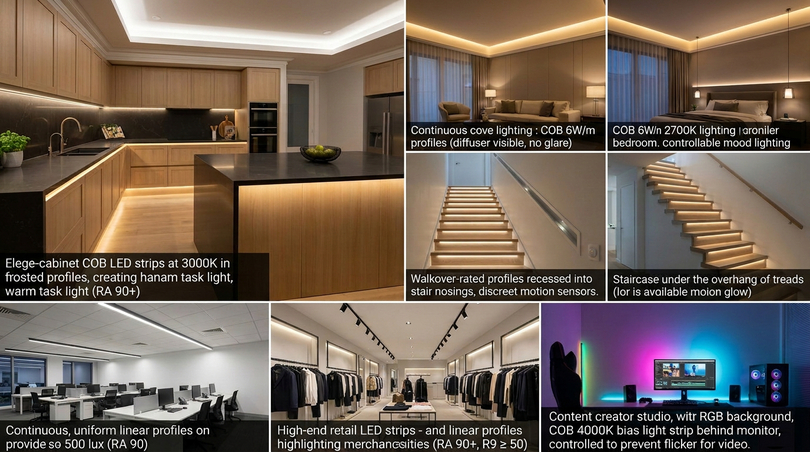
Under cabinet led strip lighting for kitchen use should be installed in low-profile surface-mounted aluminium profiles (8–12mm wide, 6–8mm deep), positioned at the front of the shelf soffit to maximise worktop illumination while minimising glare. The 3mm COB PCB fits narrower profiles that become invisible below wall units (eliminating the common issue of a visible strip or profile in the gap between unit base and splashback. Led strip lighting for kitchen under cupboards must always use a frosted or opal diffuser) bare strip without diffuser creates unacceptable glare and visible hotspots in kitchen splash panels and appliance surfaces.
For led strip lighting for kitchen ceiling applications, recessed profiles at 14–18 W/m 4000K SMD are the correct specification for primary ambient illumination, supplemented by under-cabinet COB at 3000K for warm task light. This layering creates the flexibility to switch from bright functional light during cooking to warm atmospheric light during dining without changing fittings.
LED strip lighting for bedroom and living room
Led strip lighting in the bedroom and living room serves primarily atmospheric functions, creating ambient warmth, defining architectural features, providing controllable mood illumination. The mandatory specification for bedroom led strip lighting is dimmability, a non-dimmable installation in a bedroom will never feel right, because the space requires fundamentally different illumination at different times of day and use.
Cove led strip lighting, installed in the junction between wall and ceiling, or in a dedicated architectural recess, is the premium residential specification for both bedroom and living room. It uses the LightingLine.eu COB 6W/m 2700K in corner or cove profiles, with frosted diffuser, to create a continuous warm glow on the ceiling that provides pleasant ambient light with no visible fitting and no direct glare. This is the specification we recommend without qualification for any residential space where the brief requires a relaxed, high-quality atmospheric result.
LED strip lighting for stairs
Led strip lighting for stairs serves a primary safety function, providing adequate visibility of stair nosings and step edges without creating glare, and a secondary aesthetic function as an architectural feature. For stair led strip lighting: low output (6–9.6 W/m), warm white (2700–3000K), IP44 minimum for indoor stairs (IP65/IP67 for outdoor or wet-area stairs). The strip should be recessed into the stair nosing using a walkover-rated aluminium profile (mechanical rating specified for pedestrian loading), or mounted under the stair overhang facing down to illuminate the tread below.
Motion sensor control is strongly recommended for led strip lighting for stairs: the sensor triggers illumination when approached and dims after 30–60 seconds of non-detection. This eliminates the need for manual switching (which stair users rarely use) and reduces energy consumption to negligible levels overnight.
Commercial and retail LED strip lighting
Commercial led strip lighting is the highest-specification application category, with binding requirements under EN 12464-1:2021 for illuminance levels, uniformity, UGR glare limits, and CRI. For office ambient led strip lighting: 500 lux on the working plane, UGR ≤ 19, CRI Ra ≥ 80 (90 recommended). For retail: 300–1000 lux depending on merchandise type, CRI Ra ≥ 90 for fashion and food. For hospitality: lower lux requirements but higher colour rendering — Ra 90+ with R9 ≥ 50 for any food display or customer-facing application.
Commercial led strip lighting installations are virtually always installed in aluminium profiles: the thermal management, optical control, and aesthetic finishing functions of the profile are mandatory in any professional application. The LightingLine.eu 25m reel format for SMD products is specifically designed for commercial installations, allowing hotel corridors, retail perimeters, and office cove systems to be completed with minimal joins, reducing colour variation points and the electrical connection count that is the primary source of long-term reliability issues.
LED strip lighting for content creators and studios
YouTubers, content creators, podcasters, and video professionals have discovered led strip lighting as a powerful, flexible tool for set design and ambient scene creation. The specific requirements of led strip lighting for studio and video use differ from other residential applications in three key ways: camera-specific colour rendering requirements (cameras less forgiving of colour temperature inconsistency than eyes), flicker sensitivity (cameras at high frame rates or certain shutter speeds capture PWM flicker invisible to the human eye), and controllability (RGB and tunable white led strip lighting allows rapid scene changes for different content types).
For studio primary ambient lighting, specify 4000K SMD led strip lighting with a PWM-free or very-high-frequency PWM driver (above 1,000 Hz) to eliminate camera flicker at all shutter speeds. For RGB background accent (colour washes on walls, underlighting of set elements, edge lighting) — the SMD range provides full colour control. For bias lighting behind monitors and screens, the COB 4000K or 6500K at 6W/m in a low-profile surface-mount profile is the specification that matches professional broadcast standard and does not introduce colour cast into the ambient reference illuminant. This specific use of led strip lighting for content creator studio bias lighting has become one of the fastest-growing applications in the professional led strip lighting segment in 2026.
12. FAQ – Frequently asked questions
Can I cut LED strip lights anywhere?
How do you connect LED strip lights to mains power?
Is 12V or 24V LED strip better?
What are the best LED strip lights to buy in 2026?
Can LED strip lights be left on all night?
Are LED strip lights a fire hazard?
Do I need an electrician to install LED strip lights?
What is the difference between LED tape and LED strip lighting?
How many LED strips do I need for a room?
Are LED strips good for lighting a room?
Are expensive LED strips worth it?
13. The only LED strip lighting decision that matters
If you have read this far, you now know more about led strip lighting than the vast majority of people who sell it. You understand what the LED chip designation tells you and what it conceals. You know why CRI Ra means nothing without R9, why 3SDCM binning separates professional installations from expensive failures, why 24V is the only voltage that makes sense for led strip lighting in any application above 3m, and why the aluminium profile is a mandatory thermal and optical component, not an accessory.
You also understand exactly how to cut led strip lighting correctly: at the marked cut points, with sharp clean scissors, with IPA-cleaned pads before connector fitting. You understand how to cut aluminium profiles with a fine-tooth non-ferrous blade, secured in a soft-jaw vice, deburring every cut face before fitting diffusers and end caps. You understand how to size a driver (load × 1.25, maximum 80% operating), how to choose between DALI-2, PWM, and 0–10V dimming for your application, and how to navigate the IP rating system from IP20 (dry indoor) to IP68 (permanent submersion).
All of that knowledge resolves to a single practical decision: buy your led strip lighting from a supplier who has already done the quality work for you.
The next step is straightforward.
This article was developed with the support of artificial intelligence and subsequently reviewed, corrected, and validated by the LightingLine.eu technical team, which guarantees its reliability and compliance with official sources.