This guide draws on the full technical ecosystem available with covering aluminium led profiles, high-performance led strip technologies, motion-sensor and DALI control systems, step-nosing and step-edge profile integration, indoor and outdoor installations, emergency lighting compliance, and the full range of building regulations applicable in the UK and across Europe. Every product recommendation is grounded in real engineering data, and every design principle is explained through the lens of both professional practice and practical DIY application.
In questo articolo…
The global market for staircase lighting: data, trends and opportunity
Before diving into technical specifications, it is worth establishing why staircase lighting has become one of the fastest-growing sub-segments within the global architectural lighting market. Understanding the commercial and societal context helps architects, designers and contractors to frame their recommendations to clients with compelling, evidence-based arguments.
Market size and growth projections
According to a 2024 report by Grand View Research, the global led lighting market was valued at USD 79.4 billion in 2023 and is projected to grow at a compound annual growth rate (CAGR) of 11.0% from 2024 to 2030. Within this, architectural led linear lighting — the category that encompasses led staircase lighting profiles, strip systems and recessed step lights — is growing even faster, driven by the rapid adoption of smart home technologies, increasing awareness of building safety regulations, and a widespread design shift towards integrated, invisible light sources.
| Market segment | 2023 value (USD Bn) | 2028 projected (USD Bn) | CAGR |
|---|---|---|---|
| Global led lighting | 79.4 | 133.0 | 11.0% |
| Architectural Linear led | 12.8 | 24.6 | 13.9% |
| Smart / Sensor-Activated Stair Lighting | 1.4 | 3.9 | 22.8% |
| led Aluminium Profile Systems | 3.1 | 6.8 | 17.1% |
| Recessed / Step-Edge Luminaires | 0.9 | 2.4 | 21.7% |
Safety statistics: the case for proper stair lighting
The financial case for investing in quality stair lighting becomes undeniable when examined alongside accident statistics. The UK’s Royal Society for the Prevention of Accidents (RoSPA) reports that staircase-related accidents account for over 300 deaths and approximately 1 million injuries per year in the United Kingdom alone. Of these incidents, a disproportionate number occur in low-light conditions — early morning, late evening, or in internal stairwells without natural light. In the United States, the CDC estimates that staircase falls result in 1.3 million emergency room visits annually, with an estimated societal cost exceeding USD 92 billion per year.
A 2022 peer-reviewed study published in the journal Lighting Research & Technology found that improving staircase illuminance from 10 lux to 100 lux reduced the frequency of misstep events by 58% in a controlled trial involving 240 participants across a range of age groups. The study also found that uniform light distribution, achieved through linear led strip systems with diffused profiles, was significantly more effective at reducing falls than point-source luminaires, even when both achieved the same average lux level. This finding has profound implications for the specification of staircase lighting systems and strongly supports the use of continuous led strip profiles over traditional spot or downlight solutions.
Design trend: from functional to architectural
Beyond safety, the design culture around staircase lights has undergone a fundamental transformation over the past decade. Driven initially by high-end residential and hospitality projects and subsequently democratised by falling led costs and the proliferation of easy-to-install DIY systems, staircase lighting has moved from a purely functional requirement to a primary vehicle for architectural expression. In a 2023 Houzz survey of over 58,000 homeowners undertaking renovation projects, staircase lighting was cited as the single most impactful lighting upgrade, with 74% of respondents reporting that it “dramatically transformed” the feel of their home. Instagram and Pinterest data show that content tagged with variations of “staircase lighting ideas” receives over 2.4 billion annual impressions, reflecting the enormous consumer appetite for inspiration in this category.
For the professional, architect, interior designer or building contractor, this cultural shift creates a significant commercial opportunity. Clients who previously would have accepted a single ceiling pendant over a staircase are now arriving with mood boards, Pinterest boards and detailed aesthetic aspirations. The ability to translate those aspirations into technically rigorous, code-compliant, durable systems is the core competence that separates the lighting-literate professional from the general practitioner.
Understanding staircase geometry and its impact on lighting strategy
Effective staircase lighting design begins with a thorough understanding of the staircase’s physical geometry. The same led strip and profile combination that performs brilliantly on a straight-flight domestic staircase may be wholly inadequate (or technically impossible to install) on a spiral staircase, a cantilevered stone flight or a narrow enclosed stairwell. This section analyses the main staircase typologies and maps them to appropriate lighting strategies, drawing on the profile and strip systems available.
Straight-flight staircases
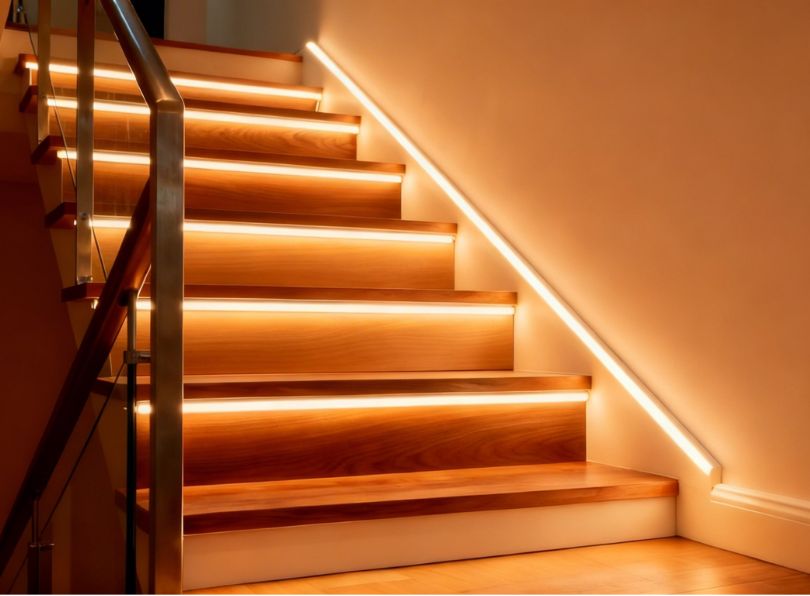
The straight-flight staircase is the most common typology in domestic and commercial construction and is the easiest to light effectively. It presents a uniform, repeating geometry of treads and risers that is ideally suited to a modular lighting approach using identical profile segments, one per tread or riser. The primary design decision is whether to illuminate the tread (the horizontal surface you step on), the riser (the vertical face between treads) or both.
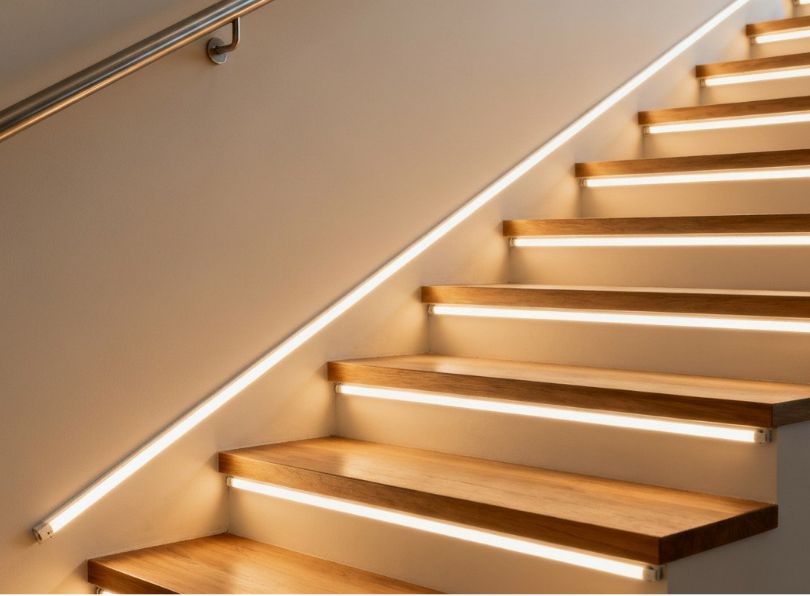
Tread illumination using step-nosing profiles creates a strong visual rhythm that highlights each individual step, maximises safety by clearly defining the step edge, and produces a dramatic cascading light effect when viewed from above or below the flight. Riser illumination using slim profiles mounted at the bottom of each riser washes light upwards across the tread above, creating a softer, more diffused effect. Combined tread and riser illumination , the approach favoured in high-end hospitality and residential projects, delivers maximum visual impact and illuminance uniformity.
For straight-flight staircases, the following LightingLine profile families are particularly well-suited: the step-nosing (step-edge) profiles designed specifically for tread-edge mounting, the slim surface-mounted profiles for riser installation, and the recessed profiles for flush-mounted tread illumination.
Spiral and curved staircases
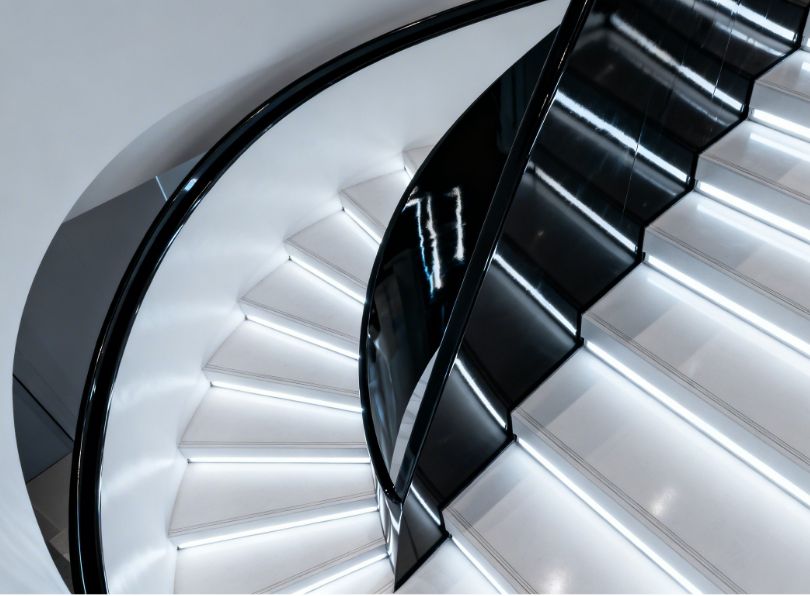
Spiral staircase lighting and curved staircase lighting present unique challenges that reward creative engineering. The curved geometry means that standard rigid aluminium profiles cannot follow the staircase contour without complex fabrication. Two primary approaches are used:
- flexible led strip without profile: high-density flexible led strips, particularly COB (Chip-On-Board) strips, can follow tight radii. However, without the thermal management and mechanical protection of an aluminium profile, the strip’s lifespan is significantly reduced. This approach is appropriate for low-power decorative applications but not for primary safety illumination;
- straight profile segments with mitred joints: straight aluminium profiles are cut at calculated angles and joined to approximate the curve of the staircase. This approach is standard for spiral staircase handrail lighting, where profiles are mounted along the underside of the helical handrail at short, mitre-joined segments. The number of segments determines how closely the straight-sided polygon approximates the true curve;
- purpose-made curved profiles: for premium projects, aluminium profiles can be roll-bent to a specific radius.
Narrow stairwells
How do you light a narrow stairwell? This is one of the most frequently asked questions in residential lighting design, and the answer reveals the fundamental advantage of linear led profile systems over traditional luminaires. In a narrow stairwell, typically 700–900mm clear width, there is simply no space for pendant lights, wide surface-mounted ceiling fixtures or bulky wall luminaires. The walls themselves are the only available mounting surface, and every fitting must be as slim as possible to avoid creating a physical hazard.
The optimal solution for a narrow stairwell is a combination of:
- step-edge profiles at each tread nosing, providing primary safety illumination at ground level where it is most needed;
- slim wall-mounted linear profiles at handrail height on one wall, providing ambient lighting and architectural definition without projecting more than 15–20mm from the wall surface;
- optional: recessed wall luminaires alternating up each side wall to create a sense of spatial rhythm and additional vertical illuminance.
For the very narrowest stairwells, common in Victorian terraced houses and compact modern apartments, the ultra-slim profiles in the LightingLine range (8–10mm height) are indispensable. These profiles are small enough to be integrated into the step nosing itself, making them effectively invisible during daylight hours whilst delivering a striking visual effect at night.
Open-tread staircases
Open-tread staircases, where the treads are cantilevered without risers, have been a signature element of contemporary residential architecture for over two decades and show no sign of declining in popularity. Their lighting is simultaneously the most visually spectacular and the most technically demanding of all staircase typologies. Without risers to conceal a profile, every lighting element must be thought through in terms of both its lit and unlit appearance.
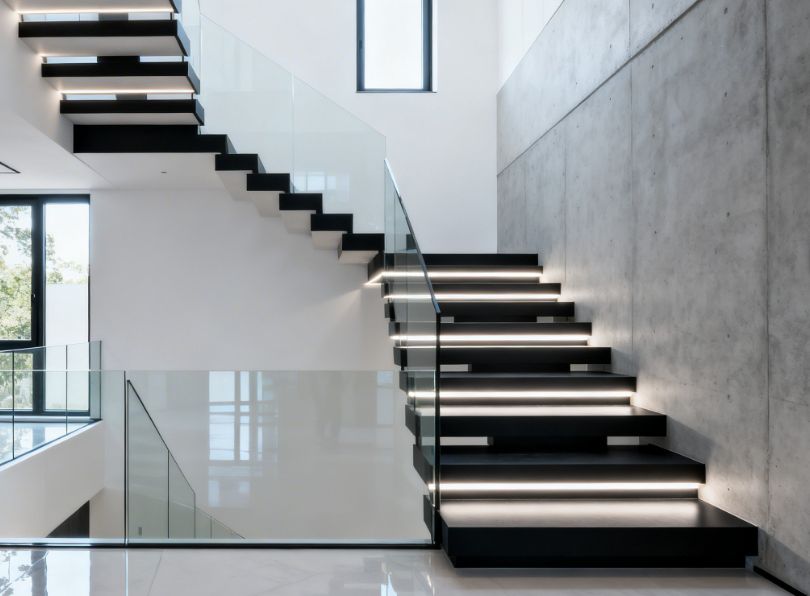
The most effective approach for open-tread stairs uses recessed tread underlit profiles mounted flush with the underside of each floating tread. When illuminated, these profiles wash light downwards onto the tread below and outwards into the stairwell space, creating the signature “floating step” effect that defines contemporary staircase aesthetics. When viewed in daylight, only the slim aluminium extrusion is visible — a clean, architectural detail that reinforces the minimalist character of the staircase.
High-CRI led strips (CRI >90, ideally >93) should be specified for open-tread applications, because the light falls directly on the tread material, whether timber, stone, glass or steel, and any colour inaccuracy will be immediately apparent. For timber treads in particular, the warm rendition of a CRI 93+ strip at 2700K–3000K is dramatically more flattering than a standard CRI 80 strip, bringing out the grain and warmth of the wood in a way that transforms the staircase from a functional element to a centrepiece of the interior.
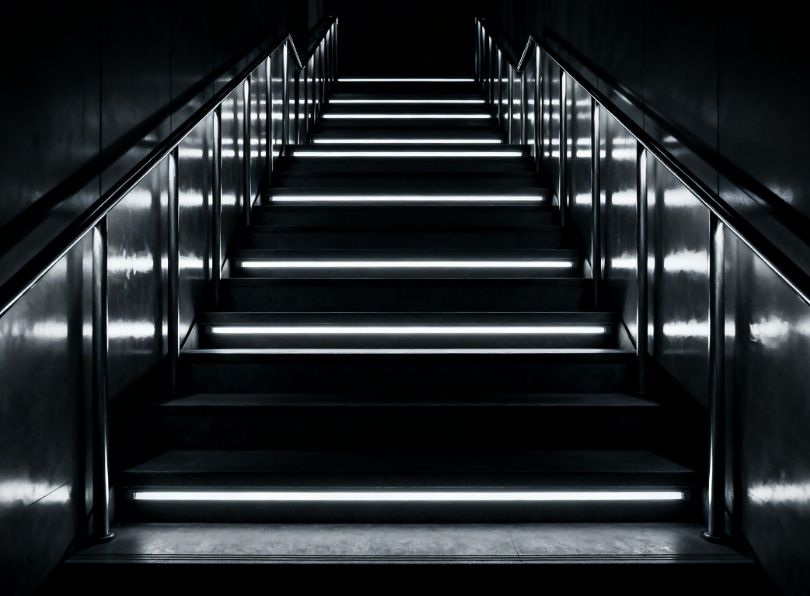
Enclosed staircases and dark stairwells
How do you brighten an enclosed staircase? Enclosed staircases, those boxed in on all sides with plaster or timber walls and a ceiling overhead, are among the most challenging lighting environments in domestic architecture. They are typically devoid of natural light, have limited wall and ceiling surface area, and suffer from acute psychological claustrophobia that good lighting can significantly mitigate.
The most effective strategy for enclosed staircases combines two complementary light sources: ceiling-mounted recessed downlights or linear profiles for primary ambient illumination, and wall-mounted step or linear profiles for localised tread illumination and spatial definition. The ceiling fixtures should be selected with a wide beam angle (60°+) to maximise the spread of light across walls and ceiling, visually expanding the perceived space. Warm white (2700K–3000K) generally performs better in enclosed spaces than cool white, as it avoids the clinical, compressed feeling that cooler temperatures can create in confined environments.
Where ceiling depth allows, recessed led downlights positioned directly above each tread provide excellent tread illuminance without consuming any wall space. Modern recessed downlights can achieve extremely low profile depths (as little as 35mm recess depth for fire-rated models), making them viable even in older properties with shallow ceiling voids.
Led strip technologies for staircase lighting: a comprehensive technical guide
The led strip is the heart of any modern linear staircase lighting system. Understanding the technical differences between led strip types, their respective performance characteristics, and their suitability for different staircase applications is essential for anyone specifying or installing a led stair lights system.
SMD led strips: the versatile standard
SMD (Surface-Mounted Device) led strips remain the most widely used technology in architectural lighting. Individual led chips, typically designated by their package size (2835, 5050, 3528, etc.), are soldered onto a flexible PCB (Printed Circuit Board) at defined densities (leds per metre). The 2835 package is the current industry standard for high-efficiency general illumination, offering excellent lumen output per watt and a compact footprint that fits easily into slim aluminium profiles.
| SMD package | Typical lm/led | Primary application | Min. bend radius | Stair suitability |
|---|---|---|---|---|
| 2835 | 10–22 lm | General illumination | 50mm | Excellent |
| 5050 | 15–22 lm | Colour / RGBW | 80mm | Good (RGBW accent) |
| 3528 | 6–8 lm | Decorative / accent | 40mm | Decorative only |
| 4040 | 18–28 lm | High-output linear | 60mm | Excellent |
| 5630 | 25–35 lm | High-lumen commercial | 80mm | Good (commercial) |
For staircase lighting, high-density SMD 2835 strips at 120 leds/m or above are recommended as the minimum specification for primary illumination. At this density, the individual led hot spots are close enough together that a standard satin (FS) diffuser in an aluminium profile creates a visually seamless line of light with no visible dotting effect at normal viewing distances (1 metre+).
COB led strips: the premium choice for step-edge profiles
COB (Chip-On-Board) led strips represent a significant technological advancement over traditional SMD strips for applications where visual uniformity is paramount. Instead of individual discrete chips mounted at regular intervals, COB strips use a dense array of micro-chips encapsulated in a continuous phosphor layer, producing light from an apparently continuous source with zero visible hot spots even at extremely close viewing distances (10–15mm).
This characteristic makes COB strips the definitive choice for step-edge profiles where the profile diffuser is directly in the line of sight of users descending the staircase. Any spotting effect would be immediately visible and distracting. With a COB strip the light output appears as a perfectly uniform, glowing line, clean, elegant and thoroughly professional. Key COB strip parameters for staircase lighting include:
- power density: 8–12W/m is appropriate for tread illumination profiles; 4–6W/m for handrail or decorative applications;
- CRI: Specify CRI ≥90 for all staircase applications. CRI ≥95 is recommended where the staircase material (timber, stone, carpet) is a key design element;
- voltage: 24V COB strips are preferred over 12V for staircase runs exceeding 3 metres, as the lower current reduces voltage drop across the length of the strip;
- colour temperature: 2700K–3000K for warm residential; 3500K–4000K for contemporary/commercial; CCT-tunable for smart home integration.
Featured product: ledpoint COB Performance Series
The performance series is a 24V COB strip offering CRI >90, 400 leds/m, and exceptional lumen uniformity, making it the specification choice for step-edge profile installations where absolute visual quality is required. Its high-density architecture eliminates all dotted-light artefacts, producing the seamless light line that professional staircase lighting demands.
Tunable White (CCT) led strips for staircase lighting
Tunable White or CCT (Correlated Colour Temperature) adjustable led strips allow the colour temperature of the light to be varied, typically between 2700K (warm white) and 6500K (daylight), either manually via a controller or automatically via a programmed schedule. For staircase lighting, CCT tunability offers three distinct benefits:
- circadian support: programming the staircase lights to operate at warmer colour temperatures in the evening minimises the suppression of melatonin production and supports healthy sleep patterns. This is particularly relevant for staircases used late at night by family members or hotel guests;
- design flexibility: the same staircase can be programmed to appear warm and intimate for evening social occasions, or bright and neutral for morning use, without any hardware changes;
- seasonal adaptation: in northern climates, increasing the colour temperature of interior lighting during winter months can partially compensate for the lack of natural daylight, supporting occupant wellbeing.
Featured product: CCT Tunable White Strip
This professional-grade CCT strip from ledpoint offers seamless transition between warm and cool white, making it ideal for staircase lighting systems where circadian health and design versatility are both priorities. Compatible with Skydance CCT controllers and DALI-2 systems for full smart home integration.
RGBW and dynamic colour strips for feature staircases
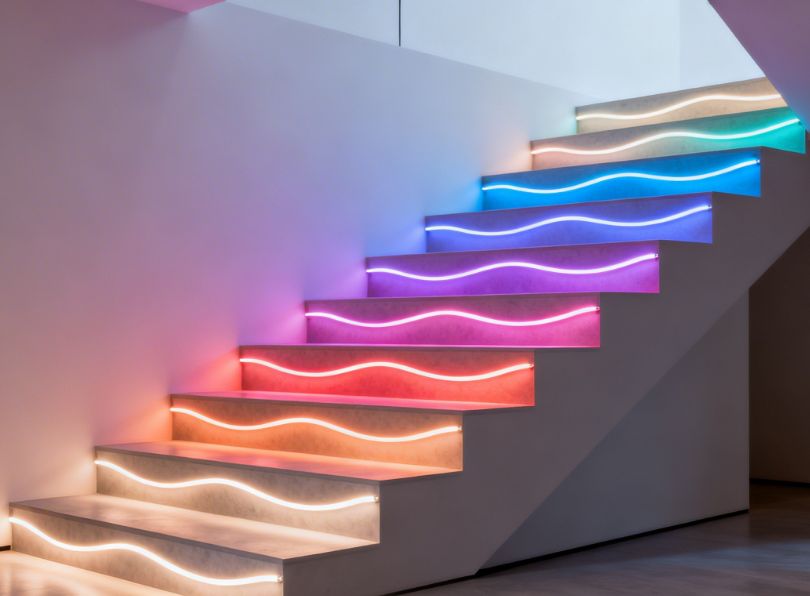
For feature staircases in hospitality, retail and high-end residential projects, RGBW (Red-Green-Blue-White) led strips offer the ability to programme dynamic colour-changing effects that transform the staircase into a kinetic light installation. The addition of a dedicated white channel (W) to the RGB base allows the system to produce both accurate white light for functional illumination and the full spectrum of colour for decorative programming, without the colour-temperature compromises of producing white from RGB primaries alone.
RGBW staircase lighting systems typically use DMX512 or Art-Net protocols for control, allowing individual step segments to be addressed independently for sequential or “wave” lighting effects.
IP ratings and environmental suitability
The IP (Ingress Protection) rating of an led strip determines its suitability for different environmental conditions. For staircase lighting, the appropriate IP rating depends entirely on the installation location
| Installation location | Minimum IP rating | Recommended strip type | Notes |
|---|---|---|---|
| Indoor, dry staircase (domestic) | IP20 | Standard PCB strip | Profile provides adequate mechanical protection |
| Indoor, potentially damp (e.g. basement stair) | IP44 | Silicone-sleeved strip | Also consider profile with sealed diffuser |
| Covered outdoor staircase | IP65 | Coated or sleeved strip | UV-resistant coating required for exposed profiles |
| Exposed outdoor staircase (rain-exposed) | IP67 | Fully encapsulated strip | Stainless steel or anodised profile recommended |
| Marine / coastal outdoor staircase | IP68 | Full silicone tube strip | 316 stainless steel profile; corrosion-tested driver |
Voltage drop calculations for staircase led strip runs
One of the most common technical problems encountered in staircase led strip installations is voltage drop — the progressive reduction in voltage along the length of the strip that causes the led chips at the far end of the run to receive insufficient voltage, resulting in reduced light output and poor colour consistency across the staircase length. This problem is exacerbated by long staircase runs (multi-storey installations), high-wattage strips and the use of 12V rather than 24V systems.
The voltage drop across a strip run can be calculated using the formula:
ΔV = I × R = (P / V) × (2 × L × ρ / A)
Where: I = current (A), R = resistance (Ω), P = total strip power (W), V = supply voltage (V), L = run length (m), ρ = resistivity of copper (1.72 × 10⁻⁸ Ω·m), A = conductor cross-sectional area (m²).
In practice, the industry rule of thumb is that voltage drop should not exceed 3% of nominal supply voltage (0.36V for 12V systems; 0.72V for 24V systems) along any continuous run. For typical 24V, 10W/m strips, this limits continuous injection-from-one-end runs to approximately 5–7 metres. For longer staircase runs, mid-point power injection or parallel power feeds at each step segment are required.
This is another reason why 24V systems are strongly recommended over 12V for staircase applications: the same percentage voltage drop occurs over a cable twice the length, significantly simplifying the power distribution architecture for multi-step flights.
Aluminium led profiles for staircase lighting: the complete specification guide
If the led strip is the heart of a staircase lighting system, the aluminium led profile is its skeleton, skin and thermoregulatory system combined. The profile determines how the strip is physically mounted, how heat is managed (critically affecting led lifespan), how the light is distributed and diffused, how the system appears when unlit (its daytime aesthetic), and how it integrates with the stair structure.
Why aluminium? The physics of thermal management
leds are semiconductor devices with well-characterised thermal dependencies: as junction temperature rises, lumen output decreases (thermal droop), colour temperature shifts, and — most importantly — lifespan shortens dramatically. The Arrhenius equation, applied to led degradation, shows that every 10°C increase in junction temperature approximately halves led lifespan. An led strip operating at 60°C junction temperature may have a rated life of 50,000 hours; the same strip running at 80°C may only achieve 25,000 hours.
Aluminium is the material of choice for led profiles because of its combination of high thermal conductivity (approximately 160 W/m·K for 6063 alloy, the most common profile material), low density (2.7 g/cm³ — lightweight for installation), excellent machinability (enabling complex extrusion geometries), and superior corrosion resistance when anodised. The profile acts as an extended heatsink, drawing heat away from the led junction through the PCB substrate and dissipating it into the ambient air through its exposed surfaces.
A properly specified aluminium profile can reduce led junction temperature by 15–25°C compared to the same strip installed directly on a surface (surface-only mounting with self-adhesive tape). This temperature reduction translates directly into extended led lifespan and maintained lumen output — a critical consideration for staircase installations where the cost and disruption of strip replacement is significant.
Profile categories for staircase applications
Now let’s look at the profiles that allow us to install led strips in the stairs.
Step-nosing / step-edge profiles
Step-nosing profiles (also called step-edge profiles or stair nosing profiles with integrated led) are purpose-designed for installation at the front edge of stair treads. They serve a dual function: they provide the primary safety illumination that defines each step edge in low-light conditions, and they double as a protective stair nosing that reinforces the most vulnerable part of the tread, the leading edge, against wear, chipping and impact.
Key design characteristics of step-nosing led profiles include:
- angled light window: the diffuser window is angled downwards (typically 30–45° below horizontal) to direct light onto the tread surface below and into the eyes of descending users, maximising safety illuminance at the point of maximum risk;
- non-slip surface finish: the exposed top surface of the step nosing profile typically features a ribbed or textured finish for anti-slip performance, often combined with a contrasting colour strip visible from above to aid tread differentiation;
- integrated fixing system: step-nosing profiles are typically secured with countersunk screws through the rear face, concealing the fixing from view. Some designs use a click-fit system for tool-free installation;
- flush front face: the front vertical face of the profile sits flush against the riser, creating a clean, integrated appearance and eliminating protruding elements that could be a trip hazard.
Step-nosing profiles are available in a range of standard tread widths (typically 25mm, 30mm, 40mm and 50mm) to suit different staircase dimensions. The led channel width is sized to accept standard 8mm or 10mm wide led strip PCBs. The profiles are anodised in silver (natural aluminium), black or gold, with bespoke powder-coat options available for premium projects.
Slim surface-mounted profiles
Slim surface-mounted profiles are the workhorses of staircase wall lighting. Their compact cross-section (typically 8–15mm height above the mounting surface) allows them to be applied to staircase walls, risers, handrail fascias and ceiling soffits without creating an intrusive protrusion or structural obstruction. The LightingLine SL08-03 series represents the ultra-compact end of this category: at just 8mm profile height, it is thin enough to be installed on a stair riser without creating a trip hazard or interfering with adjacent handrail clearances.
Slim profiles are available in three standard lengths (1m, 2m, 3m) and can be cut to length on site with a junior hacksaw or aluminium-profile cutting blade. The led strip is laid into the channel and secured with the self-adhesive backing; the diffuser cover clicks into the profile lips and can be removed for strip replacement without disturbing the profile fixing. End caps (open for cable exit, or closed for terminal ends) complete the installation.
At just 8mm overall height, the PR-SL08-03 is the thinnest surface-mounted led profile in the LightingLine range, making it ideal for stair riser illumination, handrail fascia lighting and any application where minimal visual intrusion is paramount. Available with opal, satin and clear diffusers. Accepts led strips up to 10mm wide.
Recessed profiles for tread and wall integration
Recessed led profiles are mounted flush with, or slightly proud of, the surface into which they are set. They require a routed channel or pre-formed recess in the substrate (timber, stone, concrete, plasterboard) to accept the profile body, with only the diffuser visible at surface level. The result is an extraordinarily clean, “of the surface” aesthetic that is the hallmark of high-end interior design — the light appears to emanate from within the material itself, with no visible fixture.
Recessed profiles for staircase applications are used in three principal contexts:
- tread recess: a channel is routed into the rear of the tread (from below, in the case of open-tread stairs) to receive a recessed profile, with the diffuser flush with the underside of the tread. This creates the celebrated “floating tread” effect;
- wall recess: horizontal channels routed into staircase walls at each step height receive recessed profiles that wash light across the tread surface from the wall. This approach is particularly effective in narrow stairwells where wall space is at a premium;
- riser recess: a channel at the base of each riser allows a recessed profile to direct light upwards and forwards across the tread. This creates a subtle, ground-hugging light effect that is particularly beautiful in contemporary timber staircase designs.
The LightingLine PR-RE01-03 series offers a range of recessed profile depths from 10mm to 22mm, accommodating the broadest possible range of substrate materials and led strip types. For installations in concrete or stone stairs, the profiles are supplied with a proprietary resin-mounting system that allows them to be set into cast concrete before finishing. For timber, standard routing with a plunge router and straight bit is sufficient.
Corner and angular profiles for handrail integration
Corner profiles (also called 45° or 90° angle profiles) are designed to be mounted at the internal or external corner between two surfaces. For staircase applications, they are principally used for handrail illumination, mounted at the junction between the handrail top surface and its vertical face, and for illuminating the angle between stair riser and tread where a step-nosing profile is not appropriate. The angled geometry of these profiles naturally directs light along the bisector of the corner angle, creating a grazing light effect across both adjacent surfaces.
Diffuser options and their effect on light quality
The diffuser (or cover) is the optical component of the profile that modifies the raw led output before it exits the profile. The choice of diffuser has a profound effect on both the aesthetic character and the photometric performance of the staircase lighting system. LightingLine profiles are available with the following standard diffuser types:
| Diffuser | Description | Light transmission | Hot-spot elimination | Best application |
|---|---|---|---|---|
| Clear | Transparent PMMA | ~92% | None | Maximum lumen output, visible leds acceptable |
| Satin | Lightly frosted PMMA | ~85% | Good (high-density strips) | General staircase illumination, best value |
| Opal | Heavily frosted PMMA | ~70% | Excellent | Premium applications, COB or SMD strips |
| Opaque milky | Dense white diffuser | ~55% | Complete | Maximum glare control, hospitality/commercial |
| Glare-free | Micro-prismatic lens | ~80% | Complete + beam shaping | Task lighting, compliance (UGR <19) |
For most staircase applications, the satin diffuser represents the optimum balance between lumen transmission (important for safety illuminance) and hot-spot elimination (important for aesthetic quality). Where the profile will be at very close viewing distance, as in step-nosing applications viewed by descending users, the opal or opaque milky diffuser is preferred, sacrificing approximately 15–25% of lumen output in exchange for a perfectly uniform, glare-free light line.
Profile finishing and aesthetic integration
The unlit appearance of aluminium profiles (their finish, colour and surface texture) is just as important as their lit performance in determining whether the staircase lighting system integrates harmoniously with the overall interior design. LightingLine profiles are available in the following standard finish options:
- silver anodised: the standard finish, offering a clean, contemporary appearance and excellent corrosion resistance. Compatible with most interior design styles from Scandi minimalism to industrial modernism;
- black anodised: increasingly the specification choice for high-contrast contemporary interiors, particularly those featuring dark timber, blackened steel or anthracite stonework. The profile virtually disappears against dark backgrounds when unlit;
- white powder-coat: ideal for installation against white or light-painted walls and ceilings, maximising visual integration in residential interiors;
- gold / brass anodised: available as a premium option for luxury residential and hospitality projects where warm metallic accents are a design theme;
- RAL custom powder-coat: for bespoke projects, profiles can be powder-coated in any RAL colour to achieve precise colour matching with adjacent surfaces or interior design elements.
Motion sensor activation for staircase lighting: technology, configuration and best practice
Motion sensor stair lights represent a fundamental evolution in how staircase lighting systems are used and experienced. By activating automatically when a person approaches the staircase, and extinguishing after a programmed delay once the staircase is clear, sensor-activated systems deliver three compounding benefits simultaneously: energy efficiency (lights are never left on unnecessarily), safety enhancement (the staircase is always illuminated when someone is present), and experiential quality (the automatic activation of step lighting as you approach is one of the most satisfying interactions in residential architecture). This section provides a comprehensive guide to sensor technology selection, positioning, configuration and integration with staircase lighting systems.
PIR sensor technology: how it works
PIR (Passive Infrared) sensors are the most widely used technology for stair lighting motion detection. They detect changes in the infrared (heat) signature of the space within their detection zone — specifically, the movement of warm objects (human bodies, at approximately 37°C skin temperature) against a cooler background. When a person enters the detection zone and moves through it, the changing thermal pattern triggers the sensor output, which in turn activates the lighting circuit.
Modern PIR sensors for staircase applications are characterised by:
- adjustable detection range: typically 3–8 metres for wall-mounted units; up to 12 metres for ceiling-mounted sensors. For a standard domestic staircase, a detection range of 4–6 metres is usually sufficient to detect a person approaching from either landing;
- adjustable detection angle: standard PIR sensors have a detection cone of 90°–110°. Some models feature a “creep zone” (a dead zone immediately below the sensor) which can be useful for avoiding false triggers from doors opening or small animals;
- time-delay adjustment: the “hold-on” time after the last detected motion can typically be adjusted from 10 seconds to 10 minutes. For a staircase, 30–90 seconds is usually appropriate, long enough to ensure the lights remain on for the full traversal of the flight, but short enough to ensure prompt switch-off after use;
- lux (daylight) threshold: many PIR sensors include a photocell that prevents activation during daylight hours, ensuring that the motion-activated staircase lighting only operates when there is insufficient natural light. This is a key energy-saving feature for staircases with any natural light source.
The Skydance EV-R is a high-performance PIR sensor specifically designed for integration with led stair lighting control systems. It offers adjustable time delay from 10s to 600s, adjustable sensitivity, and a built-in daylight override (lux threshold), making it ideal for both domestic and commercial staircase applications. Compatible with all 12V and 24V Skydance led controllers.
Sequential step activation: the cascade effect
The most visually dramatic form of sensor-activated stair lighting is the sequential step cascade, where each step illuminates in sequence from the bottom (or top) of the flight as the person begins to ascend (or descend), creating a “rolling wave” of light that tracks the user’s progress up or down the stairs. This effect requires a dedicated staircase lighting controller capable of addressing each step segment independently and triggering sequential activation.
The Skydance staircase lighting controller family supports up to 32 independently addressed step channels, with adjustable cascade speed (typically 100–500ms per step), independent brightness levels for “active” and “standby” modes (allowing the steps to glow at 10–20% brightness constantly as a night light, then brighten to 100% when triggered), and dual-sensor inputs at the top and bottom of the flight for bidirectional detection.
Dual-sensor bidirectional systems
A dual-sensor bidirectional staircase lighting system uses two PIR or microwave sensors, one at the top landing and one at the bottom, to detect the direction of travel and trigger the appropriate cascade sequence. When someone approaches from below, the bottom sensor triggers and the cascade runs from step 1 upwards. When someone approaches from above, the top sensor triggers and the cascade runs from the top step downwards. This bidirectional approach ensures that the light always “leads” the user rather than following them, maximising the safety benefit of the sequential activation.
This also provides the elegant solution to the classic regulatory question: do you need a light switch at both the top and bottom of stairs? With a properly designed bidirectional motion sensor system, both the functional requirement (lighting available from both ends of the flight) and the safety requirement (automatic activation regardless of which end is approached) are met without any manual switching at all. UK Approved Document B and Part K both accept automatic sensor-based control as an equivalent to two-way switching, provided the system meets the relevant fail-safe and emergency lighting provisions.
Microwave radar sensors
Microwave sensors use doppler radar to detect movement, offering several advantages over PIR technology for specific staircase applications:
- through-material detection: microwave sensors can detect movement through thin walls, glass and lightweight partitions. This is useful for sensors that need to be concealed behind drywall or within a handrail void;
- temperature independence: PIR sensors can be less reliable in environments where ambient temperature approaches body temperature (hot bathrooms, sauna approaches, tropical climates). Microwave sensors are unaffected by ambient temperature;
- fine motion detection: microwave sensors can detect subtle motions (breathing, minor postural shifts) at greater distances than PIR, which can be either an advantage (reliable detection of slow-moving occupants) or a disadvantage (false triggers from vibration or swaying objects).
For most domestic staircase applications, PIR sensors remain the preferred choice due to their lower cost, simpler integration and well-understood behaviour. Microwave sensors are favoured for commercial, hospitality and accessibility-focused applications where robustness and concealment are priorities.
DALI-2 and smart home integration
DALI-2 (Digital Addressable Lighting Interface, 2nd generation) is the professional industry standard for addressable, dimmable lighting control. For sophisticated staircase lighting systems, particularly in new-build residential, commercial and hospitality projects, DALI-2 offers capabilities that far exceed what is possible with simple on/off motion sensor control:
- precise dimming: 4096 dimming levels (12-bit) allow the transition between standby brightness (night light) and full activation brightness to be smooth and perceptually seamless, eliminating the abrupt “snap on” that can be startling when waking at night;
- flicker-free operation: DALI-2 certified drivers use PWM frequencies above 1,000Hz (typically 4,000Hz+), ensuring that the light output is flicker-free at all dimming levels. This is clinically important for occupants sensitive to flicker (approximately 10% of the population) and is mandated by the IEEE 1789 standard for safe led dimming;
- fault reporting: DALI-2 devices report their operational status back to the control system in real time, enabling proactive identification of failed led drivers or communication faults before they become a safety issue;
- integration with building management systems: DALI-2 staircase lighting can be integrated with BMS (Building Management Systems), KNX, Zigbee, Z-Wave, Apple HomeKit, Google Home and Amazon Alexa via appropriate gateway devices.
The Skydance DA4-L is a 4-channel DALI-2 led decoder supporting PWM dimming at 4096 levels with a carrier frequency above 4,000Hz for certified flicker-free operation. Ideal for professional staircase lighting systems requiring smooth sequential step activation and smart building integration. Compliant with IEEE 1789 anti-flicker standards and the ErP directive.
Building regulation compliance for staircase lighting: UK and European standards
For building contractors, architects and facilities managers, staircase lighting is not merely a design choice, it is a regulated building performance requirement. Failure to comply with applicable building regulations can result in enforcement action, failed building control inspections, insurance invalidation and, in the event of an accident, significant legal liability. This section provides a comprehensive overview of the principal regulatory frameworks applicable to staircase lighting in the UK and across Europe, with guidance on how led profile systems from LightingLine can be specified to meet these requirements.
UK building regulations: approved documents
In England and Wales, staircase lighting compliance is primarily governed by the following Approved Documents under the Building Regulations 2010, let’s see them now.
Approved document K: protection from falling, collision and impact
Approved document K requires that all staircases in new buildings (and material alterations to existing buildings) be provided with adequate lighting. Key provisions include:
- illuminance levels: minimum average maintained illuminance of 100 lux on stair treads in residential buildings; 150–300 lux in commercial/public buildings (cross-referenced to BS EN 12464-1);
- uniformity: minimum illuminance uniformity ratio (Emin/Eav) of 0.4 for residential; 0.5 for commercial applications;
- switch positions: two-way switching at the top and bottom of every staircase flight is required for manual control systems. Automatic (motion sensor) systems are accepted as an equivalent where they meet the performance requirements;
- step edge marking: in commercial and public buildings, contrasting nosing strips are required at each step edge. led step-edge profiles that incorporate a visible (lit or unlit) nosing line satisfy this requirement.
Approved document B: fire safety
Approved Document B addresses staircase lighting from the perspective of means of escape. Protected stairways, those forming part of the building’s fire escape route, have specific requirements including:
- emergency lighting: protected stairways in buildings over two storeys, or serving more than one floor of a residential building of more than two storeys, require emergency escape lighting capable of operating for a minimum of 3 hours on battery backup in the event of mains power failure. BS 5266-1 provides the detailed specification;
- luminaire classification: emergency luminaires in fire-protected enclosures must meet appropriate fire resistance requirements (typically IP4X as a minimum for recessed luminaires in fire-rated ceilings).
Led profile systems from LightingLine can be combined with Mean Well XLN or XLC series emergency led drivers to create emergency-compliant linear led luminaires within standard aluminium profiles. These drivers maintain the led output at a reduced emergency level (typically 10% of normal output) for the required 3-hour duration following a mains supply interruption.
Approved document L: conservation of fuel and power
Approved Document L sets energy efficiency requirements for lighting in new and substantially altered buildings. For staircase lighting specifically, the key requirements are:
- lighting efficacy: a minimum installed efficacy of 65 luminaire lumens per circuit watt (lm/cW) for general lighting in residential buildings, 75 lm/cW for non-domestic buildings. led systems easily surpass these thresholds, modern led strips achieve 130–180 lm/W, and even accounting for driver and profile losses, installed efficacies of 100–140 lm/cW are readily achievable.
- Presence detection: ADL Part L strongly encourages (and in some building types mandates) presence detection or time-switched controls for staircase lighting, exactly as provided by the motion sensor systems described in Section 5 of this guide.
- Metering and monitoring: in larger buildings (over 1,000m² floor area), sub-metering of staircase and common area lighting energy consumption may be required.
European standards: EN 12464-1 and CPR
Across the European Union and EEA, staircase lighting is governed by a combination of harmonised European standards (ENs) and national transpositions of EU directives.
EN 12464-1: light and lighting — lighting of work places
While primarily intended for work environments, EN 12464-1 is widely referenced in building regulations across Europe for its illuminance and quality parameters. Table 5.29 of the standard specifies:
| Space type | Maintained illuminance (Em) | Uniformity (Uo) | Max UGR (UGRL) | Min CRI (Ra) |
|---|---|---|---|---|
| Stairs (residential) | 100 lux | 0.40 | 25 | 80 |
| Stairs (commercial/public) | 150 lux | 0.50 | 22 | 80 |
| Stairs (hospital/care) | 200 lux | 0.60 | 19 | 90 |
| Emergency stairs / escape route | 1 lux (min on centreline) | — | — | 40 (min) |
The ErP directive and ecodesign requirements
The EU’s Energy-related Products (ErP) Directive (2009/125/EC, implemented through Ecodesign Regulations 2019/2020) mandates minimum energy performance and flicker standards for led lighting products placed on the EU market. For staircase lighting, the most practically significant requirements are:
- flicker threshold: led drivers must achieve a Flicker Index (FI) below 0.1 and a Stroboscopic Visibility Measure (SVM) below 1.6 at all dimming levels. Non-compliant products cannot legally be placed on the EU market.
- standby power: led drivers must consume less than 0.5W in standby mode.
- product information: manufacturers must provide full photometric data including colour rendering index, correlated colour temperature, lumen maintenance (L80B10), and flicker data.
CE, EMC and LVD compliance
All led lighting products sold within the EU and UK (the latter under the equivalent UKCA marking regime) must be compliant with:
- CE Marking: confirmation that the product meets all applicable EU directives (LVD, EMC, ErP, RoHS);
- EMC Directive (2014/30/EU): ensuring that led drivers and controllers do not emit electromagnetic interference that could disrupt other equipment, and are immune to interference from external sources;
- LVD (Low Voltage Directive, 2014/35/EU): ensuring that products operating at mains voltage are safe to use. Note that led strips themselves (operating at SELV — typically 12V or 24V DC) are exempt from LVD but the led driver (mains-to-low-voltage power supply) must be LVD compliant;
- RoHS Directive (2011/65/EU): restricting the use of hazardous substances (lead, mercury, cadmium, etc.) in electronic equipment. All ledpoint led strips and Skydance controllers are RoHS 3 compliant.
Power supply safety: SELV, Class II and Emergency Standards
The power supply (led driver) is the component that presents the greatest electrical safety risk in a staircase led lighting system, as it interfaces between the mains supply and the low-voltage led circuit. For metallic staircase structures (steel stringers, aluminium handrails, glass balustrades with metal fittings), the risk of electric shock from a faulty driver is particularly acute, and specification must be approached with care.
SELV: safety extra low voltage
SELV (Safety Extra Low Voltage) circuits operate at a maximum of 50V AC or 120V DC (typically 12V DC or 24V DC for led systems) and are defined by electrical separation from the mains supply by a Safety Isolating Transformer (SIT). SELV circuits do not require the provision of an earth conductor, and contact with live conductors in a SELV circuit is not considered to present a significant risk of electric shock to a healthy person under normal conditions. All low-voltage led staircase lighting systems should be SELV-rated — which, in practice, means specifying a SELV-rated led driver.
Class II (Double Insulated) drivers
Class II drivers are those that provide protection against electric shock through double or reinforced insulation, without reliance on a protective earth connection. They are denoted by the □ (double square) symbol. Class II drivers are the recommended specification for staircase lighting systems in metallic structures, as they eliminate the risk of the metal structure becoming live due to an insulation fault in the driver.
Dimensioning power supplies for longevity
A critical but frequently overlooked aspect of led staircase lighting specification is power supply dimensioning. Operating a led driver at close to its rated maximum output accelerates component degradation and shortens lifespan. Best practice is to select a driver rated at 1.2–1.3× the actual connected load — i.e., if the led strips in a staircase installation consume 40W in total, specify a 50W (1.25×) or 52W (1.3×) driver rather than a 40W unit. This derating improves the driver’s thermal environment, extends electrolytic capacitor life and virtually eliminates the risk of nuisance tripping due to momentary load spikes.
Elevator and lift lobby lighting: integrated led solutions for vertical circulation
The vertical circulation core of any multi-storey building encompasses not only the staircase but also lifts and elevators, and the lobbies, landings and transition spaces that connect them. A cohesive, integrated approach to lighting across the entire vertical circulation zone (stairs, lift cars and lobby areas) delivers a dramatically superior user experience compared to the piecemeal specification that is, unfortunately, the norm in most commercial and residential projects.
The challenge of elevator lighting
Elevator lighting requires a unique combination of high reliability, energy efficiency, and strict adherence to safety standards. The confined space of the elevator cabin, the continuous duty cycle (lifts in commercial buildings may operate 18+ hours per day), and the stringent safety requirements of the Lift Directive (2014/33/EU) create a demanding operating environment that generic residential led products are not designed to handle.
By integrating ledpoint led strips, LightingLine profiles, and Skydance control systems, it is possible to create professional elevator lighting solutions that comply with current regulations such as CE, EMC, LVD, and the ErP directive for flicker-free lighting, whilst delivering exceptional visual comfort and long-term reliability.
High-performance led strips for elevator cabins
In the confined space of an elevator, visual comfort is paramount. The close proximity of the passenger to the ceiling-mounted light source means that any dotted effect, flicker or colour inconsistency is immediately apparent and uncomfortable. We recommend avoiding the traditional led “dotted” effect by using COB (Chip-On-Board) technology or high-density SMD strips.
Performance Series (F52-400-060822BH5): these 24V strips offer a high CRI >90, ensuring that colours inside the cabin appear natural and vivid. The 400 leds/metre density produces a seamless light line with no visible hot spots, even at close viewing distances. The Performance Series strips are designed for long-term use, matching the high MTBF (Mean Time Between Failure) requirements of elevator systems, a critical consideration given the high cost of maintenance callouts in elevator environments.
Tunable White (CCT) Options: to support the wellbeing of passengers (Circadian Care), CCT strips like the F52-3s4s-240D22 allow the light to shift from warm to cool tones throughout the day. In a hotel, for example, the lift can be programmed for warm, welcoming 2700K in the evening and a more energising 3500K during the morning business rush — a subtle but measurable enhancement to the passenger experience.
Intelligent control and automation for elevator lighting
To maximise energy savings and passenger comfort, elevator lighting should respond dynamically to the lift’s usage pattern.
PIR motion sensors (EV-R / ER-C): these sensors automatically trigger the light when a passenger enters the elevator cabin. The EV-R model allows for adjustable time delays from 10s to 600s, ensuring the lights remain on only when necessary. During periods of inactivity (unoccupied cabin between floors), the lighting dims to a low standby level — typically 10–20% of full output — further reducing energy consumption during the hours when the building is lightly occupied.
Flicker-free dimming: using Skydance DALI-2 decoders (e.g., DA4-L) or PWM drivers ensures that the dimming is smooth (4096 levels) and perfectly flicker-free, which is essential for passenger comfort. Flicker in confined spaces is more perceptible and more physiologically significant than in open rooms, making the ErP and IEEE 1789 compliance of the dimming system particularly important in elevator applications.
DMX512 integration: for high-end buildings where elevators are part of a centralised lighting control system — such as those with lobby-level light shows, façade lighting programmes or event-driven lighting changes, Skydance DMX decoders provide 16-bit greyscale levels for ultra-smooth transitions, ensuring that the elevator cabin lighting change is exactly synchronised with the lobby lighting scene.
Slim architectural profiles for elevator ceilings
Elevators often have limited ceiling depth, the space between the cabin ceiling panel and the structural ceiling of the lift car is typically 50–80mm, and must also accommodate electrical conduits, the emergency lighting battery pack and the ventilation grill. LightingLine profiles provide a professional finish and essential heat dissipation within this constrained space.
Slim series (SL08-03): an ultra-compact profile (8mm height) that can be surface-mounted or easily integrated into ceiling panels. Its low height means it can be installed in the shallowest ceiling voids, and its lightweight aluminium construction minimises the additional load on the cabin ceiling structure.
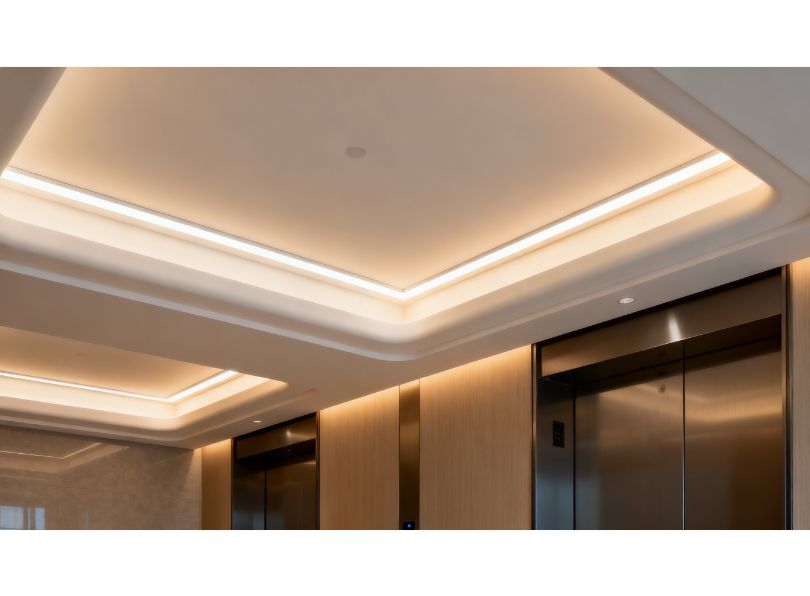
Recessed models (RE01-03): ideal for a flush-mount aesthetic, these profiles integrate seamlessly into the elevator’s interior structure when the ceiling panel is routed to accept them. The result is a ceiling that appears to glow uniformly from within — the premium standard for luxury elevator installations.
Glare control: using opaque or satin diffusers helps to soften the light output and reduce UGR (Unified Glare Rating), preventing passenger discomfort in the confined cabin environment. For elevator applications, an opaque milky diffuser is generally recommended, as the close viewing geometry of the cabin ceiling means that even moderate glare from a less opaque diffuser can cause significant discomfort.
Certified power supplies for elevator systems
For safety in metallic elevator structures, the choice of power supply is critical. The entire cabin, shaft and machinery space are metallic, creating a continuous conductive enclosure that could become dangerous in the event of an insulation fault in a non-SELV driver.
Safety standards: Class II (no FG/no functional earth) and SELV power units provide maximum protection against electric shock. These should be specified for all elevator lighting installations without exception.
Emergency lighting compliance: models like the Mean Well XLN or XLC series are specifically designed to meet Emergency Lighting (EL) standards (EN 60598-2-22, EN 62034), ensuring that lighting remains functional during power failures — a critical safety requirement for elevator installations where passengers may be trapped in the event of a power cut.
Reliability tip: it is recommended to dimension the power supply at 1.2 to 1.3 times the actual load to increase system longevity — particularly important for elevator applications where the cost of driver replacement (requiring a maintenance visit, shaft access and potential service interruption) is disproportionate to the cost of simply specifying a larger driver from the outset.
| Component | Specification | Product reference | Key compliance |
|---|---|---|---|
| Led strip | 24V COB, CRI >90, 400 leds/m | OR400-K52-400OR1-W5 | CE, RoHS, ErP |
| CCT strip (optional) | 24V CCT 2700K–6500K, 480 leds/m | ORCCT-F52-480OR1-W6-S1 | CE, RoHS, ErP |
| Profile | Slim 8mm / Recessed | LightingLine SL08-03 / RE01-03 | IP20 / IP44 |
| PIR sensor | Adjustable 10–600s delay | Skydance EV-R | CE, EMC |
| DALI-2 decoder | 4-channel, 4096 levels, flicker-free | Skydance DA4-L | DALI-2, IEEE 1789, ErP |
| Emergency driver | SELV, Class II, 3hr backup | Mean Well XLN / XLC | EN 60598-2-22, BS 5266 |
| Power supply | Derated 1.25× load, Class II SELV | Mean Well HLG / LPF series | LVD, EMC, SELV, Class II |
Staircase lighting design scenarios: practical application guides
The preceding sections have established the theoretical framework (strip technologies, profile types, sensor systems and regulatory compliance) for staircase lighting specification. This section translates that theory into practical design guidance for the most common real-world scenarios, addressing the specific needs of each of our core audience groups: architects, interior designers, building contractors and homeowners.
Scenario A: contemporary open-tread residential staircase
We would take in consideration a new-build detached house with open-tread oak staircase with glass balustrade and steel stringer, where the client wants dramatic “floating” effect: designer’s brief emphasises clean lines and warm ambience.
Lighting strategy: recessed profile under each tread, fitted with COB strip for seamless light line. Supplementary slim surface profile at handrail height on the wall side, with satin diffuser for gentle wall wash. Motion sensor cascade control for sequential step activation.
Strip specification: COB 24V, CRI 95, 2700K warm white, 10W/m, installed in LightingLine recessed profile RE01-03 with opal diffuser FM. Separate circuit for wall-mounted profile using lower power density (4W/m) for accent only.
Control: Skydance dual-sensor controller with PIR at top and bottom landing. Sequential cascade, 200ms per step, standby 15%, active 100%. Lux override: deactivated above 300 lux ambient.
Regulatory compliance: illuminance modelled at 120 lux average on treads (meets Approved Document K 100 lux minimum). CRI 95 exceeds EN 12464-1 minimum of 80. Emergency lighting provided by separate ceiling-mounted emergency luminaire in landing above (BS 5266-1).
Estimated component cost: £380–£520 for a 14-step flight (strips + profiles + controller + sensors + driver). Installation: 1–1.5 days for a competent first-fix carpenter and electrician. Total installed cost estimate: £800–£1,400.
Scenario B: enclosed Victorian terrace staircase
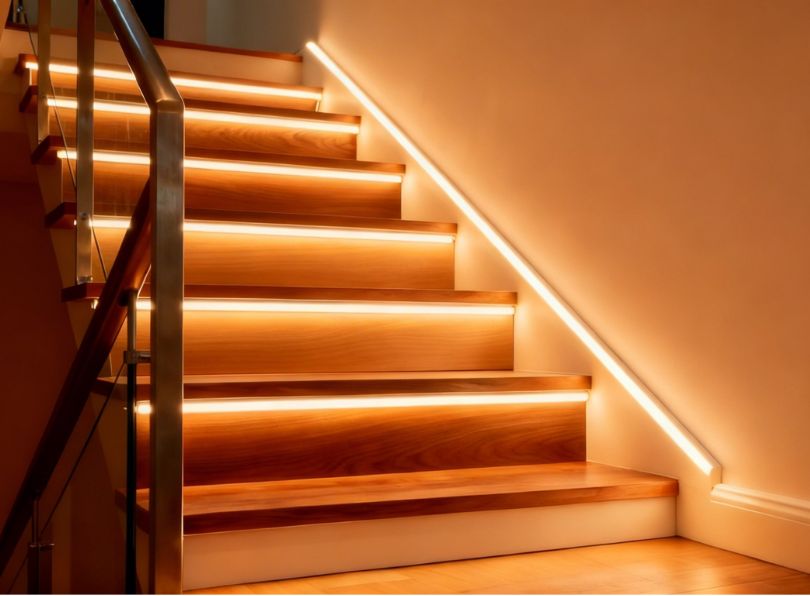
Now we take in consideration a terraced house conversion with enclosed staircase with plaster walls, carpet treads and period pine handrail. homeowner wants improved safety and a decorative upgrade and a budget-conscious DIY approach preferred.
Lighting strategy: wall-mounted slim surface profiles at step height on one wall (alternating steps for a “stepping” visual rhythm). Optional under-handrail profile for additional ambience. Single PIR sensor at foot of stairs for activation.
Strip specification: strip led SMD 2835, 24V, CRI 90, 2700K, 8W/m, 120 leds/m. Installed in LightingLine slim surface profile SL08-03 with satin FS diffuser. Cut to fit between skirting board and handrail height at each step.
Control: single Skydance EV-R PIR sensor at foot of stairs. Simple on/off activation, 60s delay. 24V Mean Well 30W LPF-series driver (1.25× derated). Lux threshold set to approximately 50 lux for evening-only activation.
DIY suitability: high. All components are low-voltage (24V SELV); the electrical connection to the driver requires a qualified electrician only for the mains input side. Strip and profile installation is a straightforward DIY task. Total component cost: £120–£180. Professional electrician day rate for connection: £150–£250.
Scenario C: commercial office building stairwell
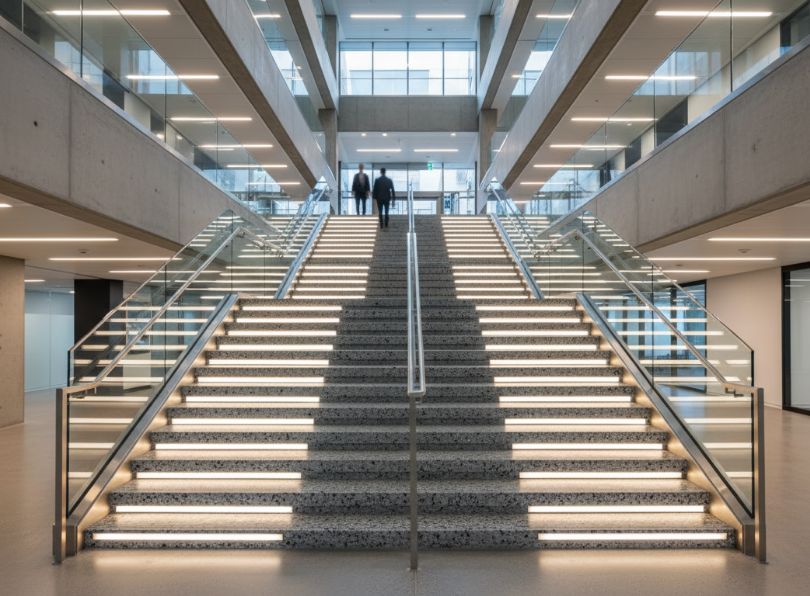
In this scenario we have a 5-storey commercial office building with concrete staircase with terrazzo treads. The building manager requires compliance with Approved Document B, BS 5266 emergency lighting, and Approved Document L energy efficiency; building has KNX BMS.
Lighting strategy: recessed step-edge profiles at all tread nosings (primary safety and compliance illumination). Recessed wall profiles at each half-landing (ambient illumination and wayfinding). All circuits fully DALI-2 addressable, integrated with KNX via Skydance DALI-KNX gateway. Emergency lighting via central battery system with maintained operation at all hours.
Strip specification: strip led SMD 2835, 24V, CRI 85, 4000K neutral white, 12W/m at nosing profiles. LightingLine step-nosing profile with glare-free FG diffuser (UGR <19 compliance for Approved Document L). Illuminance target: 200 lux maintained on tread surface (conservative specification for commercial occupancy).
Emergency provision: separate emergency led strip circuit in each staircase enclosure, powered by central 8-hour maintained emergency battery system (ELR-75-24 series from Mean Well). Emergency circuit provides 5W/m at each nosing profile = approximately 50 lux on tread centreline (exceeds EN 1838 minimum of 1 lux on escape route centreline).
Energy performance: with DALI-2 presence detection dimming (20% standby, 100% occupied), the installed power density is 6W/m², well below the Approved Document L target of 8W/m² for staircase areas. Annual energy saving versus maintained 100% fluorescent equivalent: approximately £420 per staircase flight per year at 2024 UK commercial electricity tariffs.
Scenario D: luxury hotel spiral staircase
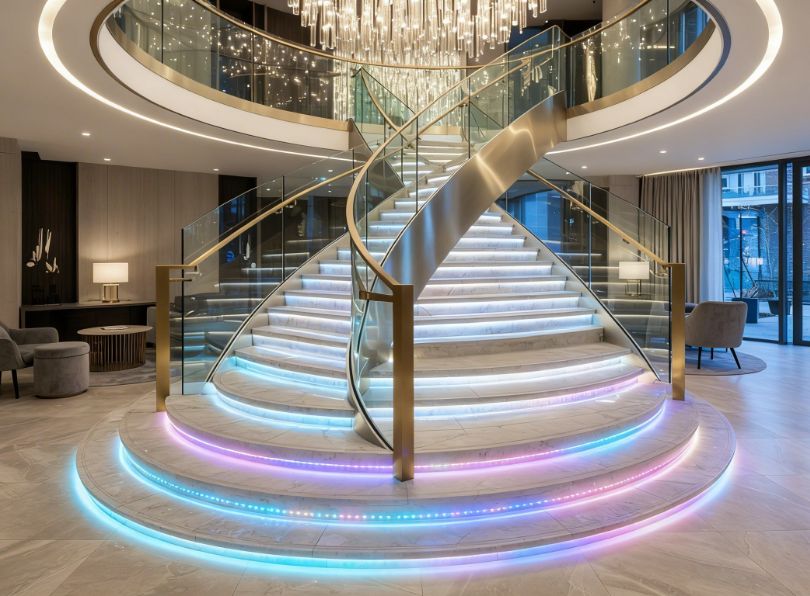
In this very particularlu context we have a 5-star hotel lobby feature staircase with an helical staircase with 2.4m diameter, solid marble treads, brushed brass handrail and structural glass balustrade. Lighting design is a key element of the interior concept.
Lighting strategy: custom curved profiles (mitre-segmented) along underside of all 24 treads, creating the “floating marble” effect. RGBW strips for programmable colour scenes (white for day use; amber/gold for evening events; custom programmed sequences for special occasions). Handrail underside illuminated with slim profile, glass balustrade backlit with recessed floor-level RGBW profile to enhance the glass luminescence.
Control: Skydance DMX512 decoder with ArtNet integration to the hotel’s Pharos lighting control system. 16-bit colour resolution enables sub-perceptual colour transitions during scene changes. Pre-programmed scenes include: “Morning” (4000K, 100%), “Afternoon” (3500K, 80%), “Evening Welcome” (2700K + gold hue, 70%), “Event Mode” (programmable RGBW sequence), “Night Walk” (warm 2700K, 20% — safety level for late-night guests).
Budget: high-specification projects of this type typically carry a component budget of £3,000–£8,000 for the complete lighting system (excluding installation labour). Design, programming and commissioning by a specialist lighting control engineer adds a further £2,000–£5,000. The ROI is measured not in energy savings but in brand value — a spectacular staircase is Instagram content that generates measurable organic marketing for the hotel.
Scenario E: outdoor stone staircase — Garden or landscape
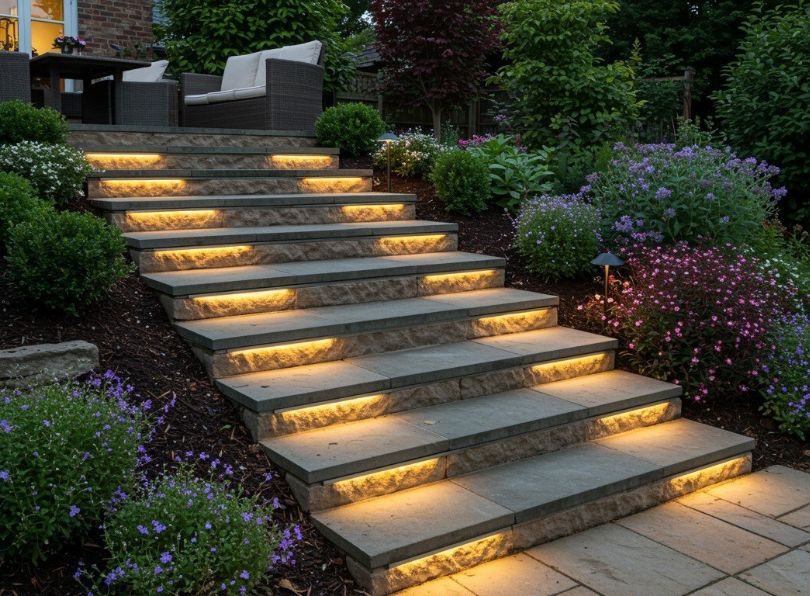
In this last case we have a private residential garden with an external stone staircase with 8 steps connecting terrace to garden level, exposed to weather. Client wants safe, attractive lighting without intrusive above-ground fittings.
Lighting strategy: IP67-rated fully encapsulated led strip inside stainless steel step-nosing profiles recessed into the front edge of each stone tread. No above-grade luminaires — all light sources invisible during daylight. PIR motion sensor concealed in adjacent wall pocket, IP65-rated.
Strip specification: IP67 fully encapsulated 24V strip, CRI 90, 3000K, 6W/m. Stainless steel 316 step-nosing profile with frosted PMMA diffuser — corrosion-resistant for outdoor exposure and coastal environments. All cable joints made with IP68-rated gel-filled terminal blocks.
Power supply: weatherproof IP65 Mean Well HLG-40H-24A driver, housed in vented outdoor enclosure recessed into adjacent boundary wall. 316 stainless steel conduit from driver to each step profile.
Solar option: for completely off-grid outdoor stair lighting, battery-powered solar led stair lights are available as an alternative specification. While their lumen output is limited compared to mains-powered systems, modern solar stair lights with lithium battery storage can achieve up to 12 hours of continuous operation from a single day’s charge, sufficient for most temperate-climate residential applications.
Installation guide: how to fit led lights to stairs
One of the most frequently asked questions in staircase lighting is how do you fit led strip lights to stairs. This reflects the democratisation of the technology and the growing confidence of homeowners, builders and small contractors in tackling led lighting installations themselves. This section provides a step-by-step installation guide for a typical domestic staircase lighting project using led profiles and strips, with guidance notes for the three most common substrate types: timber, masonry and concrete.
Tools and materials required
- Led strip (cut to the width of each tread; allow 5% additional for waste at cuts)
- Aluminium profiles (one per tread or riser; pre-cut or cut on site with junior hacksaw)
- Diffuser covers and end caps (supplied with profiles)
- 24V led driver (sized at 1.25× total strip wattage)
- Staircase lighting controller / PIR sensors
- Low-voltage two-core cable (1.5mm² for runs up to 5m; 2.5mm² for longer runs)
- Junior hacksaw or mitre saw with aluminium-cutting blade
- Plunge router (for recessed profile installations) with appropriate straight bit
- Drill + appropriate masonry/wood bit
- Cable clips, conduit (for surface-run cables)
- Connector solderless clips (for joining strip segments)
- Isopropyl alcohol + clean cloth (for surface preparation)
- Spirit level (for ensuring profiles are installed level)
Step-by-step installation procedure
There are 6 steps to lighting perfectly a stair, here they are.
Step 1: planning and marking out
Before cutting any material, plan the complete installation on paper. Draw a scaled elevation of the staircase showing each tread and riser, and mark the proposed profile position on each step. Calculate the total strip length required, the number of profiles, and the cable routing from the driver location to each profile. Determine the driver location (typically at the top or bottom of the flight in an accessible cupboard or service void) and plan the cable route accordingly, noting any penetrations through floors or walls that may require fire-stopping.
Mark the profile centre line on each step using a chalk line or pencil, checking that all lines are parallel with the step edge using a spirit level. For step-nosing profiles at the tread front edge, measure the setback from the step edge consistent with the profile’s design, typically 0–5mm back from the absolute front edge.
Step 2: cutting profiles to length
Cut aluminium profiles to the exact width of each step using a junior hacksaw or a mitre saw fitted with a fine-tooth aluminium cutting blade. Cut in the direction from the diffuser side towards the back of the profile to minimise burring on the visible face. Deburr the cut ends with a flat file or sandpaper. Wear eye protection when cutting aluminium profiles.
Step 3: preparing the substrate
For timber stairs: use a countersink drill bit to pre-drill fixing holes through the profile back at 200–300mm centres. Dry-fit the profile, mark the fixing positions on the timber, drill pilot holes and secure with stainless steel countersunk screws.
For recessed installations in timber: set up a plunge router with a straight bit of the appropriate width (typically 12–16mm for slim profiles). Route the channel to the depth of the profile body (minus diffuser) along the marked centre line. Square the channel ends with a sharp chisel. Test-fit the profile; adjust router depth if required for a flush-face result.
For masonry/concrete: use a hammer drill with a masonry bit to drill fixing holes. Insert nylon wall plugs and secure the profile with appropriate stainless steel screws.
Step 4: cutting and installing led strip
Cut the led strip to the exact length required using sharp scissors, cutting only at the designated cut points marked with scissor symbols on the PCB (typically every 50mm for 24V strips; every 33mm for 12V strips). Never cut between designated cut points, this will permanently damage the strip segment.
Clean the profile channel with isopropyl alcohol and allow to dry for 30 seconds. Peel the backing from the strip’s self-adhesive tape and press the strip firmly into the channel, starting from one end and working towards the other with firm, even pressure. Ensure the strip is properly aligned and fully adhered along its entire length.
Connect the strip’s positive and negative terminals to the control cable using solderless connector clips. Route the cable to the driver location, securing with cable clips at 150–200mm intervals along the route. Label each cable at both ends with the step number for ease of commissioning.
Step 5: driver and controller installation
Mount the led driver in the chosen location, ensuring adequate ventilation around the driver body (minimum 25mm clearance on all sides). Connect the mains input (this step requires a qualified electrician in the UK and most European jurisdictions). Connect all low-voltage output cables from the step profiles to the controller, following the manufacturer’s wiring diagram for the specific controller model.
Configure the controller parameters: PIR time delay, cascade speed, standby brightness and activation brightness. Commission by manually testing each step channel individually, then test the full cascade sequence from both sensors.
Step 6: diffuser covers and end caps
Once all strips are installed and cables routed, click the diffuser covers into the profiles. Apply end caps — selecting open (cable-exit) end caps where cables exit the profile and closed end caps at terminal ends. Check that all end caps are fully seated and that no raw led strip edges are exposed.
Common installation mistakes and how to avoid them
| Mistake | Consequence | Prevention |
|---|---|---|
| Cutting strip between designated cut points | Permanently damaged strip segment, must be replaced | Always cut at marked scissor symbols only |
| Using 12V strips on long runs (>3m) from single injection | Voltage drop, dim/warm end compared to bright/cool start | Use 24V strips, inject at multiple points on long runs |
| Insufficient thermal interface between strip and profile | High junction temperature, premature led degradation | Ensure strip self-adhesive is fully adhered, apply thermal tape if specified |
| Driver undersized (running at >80% rated load) | Overheating; shortened driver life, nuisance tripping | Always derate by 1.25×, verify actual strip wattage with clamp meter after installation |
| PIR sensor aimed directly into staircase (blind zone) | Person descends without triggering sensor, safety risk | Test detection from top and bottom of full staircase, adjust sensitivity and angle |
| Ignoring polarity on strip connections | Strip does not illuminate, possible damage to strip or controller | Mark all cables with polarity before connecting, use polarity-keyed connectors where available |
Specific application topics: answering the most important questions
Handrail and banister lighting
Stair handrail lighting and stair banister lights are among the most elegant and understated forms of staircase illumination. By concealing the led strip and its profile within or beneath the handrail, the light source becomes completely invisible to anyone using the staircase normally (they are aware of the light), but they cannot identify its source, creating the impression that the handrail itself is glowing. This “source-free” aesthetic is the gold standard of contemporary lighting design and is achievable with the right combination of profile and strip selection.
For handrail lighting, the most common approach is to route a channel in the underside of a timber or composite handrail to receive a slim recessed profile. The profile is set flush with the underside face of the handrail, directing light downwards onto the staircase and upwards onto the user’s hand. The opal or satin diffuser provides a soft, even light without any visible led pattern. An alternative approach, used where handrail routing is not possible, is to mount a slim surface profile on the wall-side face of the handrail’s structural post, directing light sideways along the staircase wall.
For stair railing lights on metal balustrades, thin magnetic-backing COB strips can be adhered directly to the inside face of vertical baluster members, with a slim clip-on aluminium cover protecting the strip and providing a finished appearance. This approach requires no tools and is particularly suited to stainless steel and aluminium balustrades in contemporary interiors.
Under-stair and under-step lighting
Under stairs lighting, illuminating the void beneath the staircase structure rather than the treads themselves, is a distinct design concept with different objectives. Rather than improving visibility on the treads (which under-stair lighting is poorly positioned to do), under-stair lighting serves to:
- illuminate storage space within the stair void (a practical requirement in most homes where under-stair storage is used);
- create a dramatic feature of the structural form of the staircase by illuminating its underside, the angled soffit of the flight, from below.
- provide indirect ambient light that spills into the adjacent room (typically a hallway or living area) through the open sides of the staircase structure.
For under-stair storage illumination, battery-operated led strip kits with magnetic mounting and PIR activation are the most practical solution, they require no electrical connection and can be installed by anyone without tools in less than 30 minutes. For more dramatic architectural applications, recessed uplight profiles set into the floor surface directly beneath the staircase flight create a breathtaking “glowing soffit” effect that is uniquely striking from the entrance hall below.
Night lights for stairs: safe navigation at minimum energy
Night lights for stairs, low-level lighting that remains permanently active during night hours to provide safe navigation without activating the full staircase lighting circuit, are an important safety provision, particularly in households with children, elderly residents or guests unfamiliar with the layout.
The most energy-efficient implementation uses the standby function of the staircase lighting controller: the led strips are maintained at 5–10% brightness permanently (consuming approximately 0.5–1W per step, negligible energy consumption), then brighten to 100% when the PIR sensor detects movement. This provides a constant dim “glow” that defines each step edge without significantly disturbing sleep, whilst ensuring that the full illuminance is available instantly when someone begins to descend.
The standby brightness can be varied seasonally or via a smart home schedule, slightly brighter in winter when nights are longer and more traversals occur during dark hours, reduced to virtually zero in summer when daylight persists until late evening. CCT-tunable systems can also shift to warmer, more biologically-friendly colour temperatures (1800K–2200K) at night, minimising the impact on melatonin production and sleep quality for late-night staircase users.
Battery-powered and wireless stair lighting
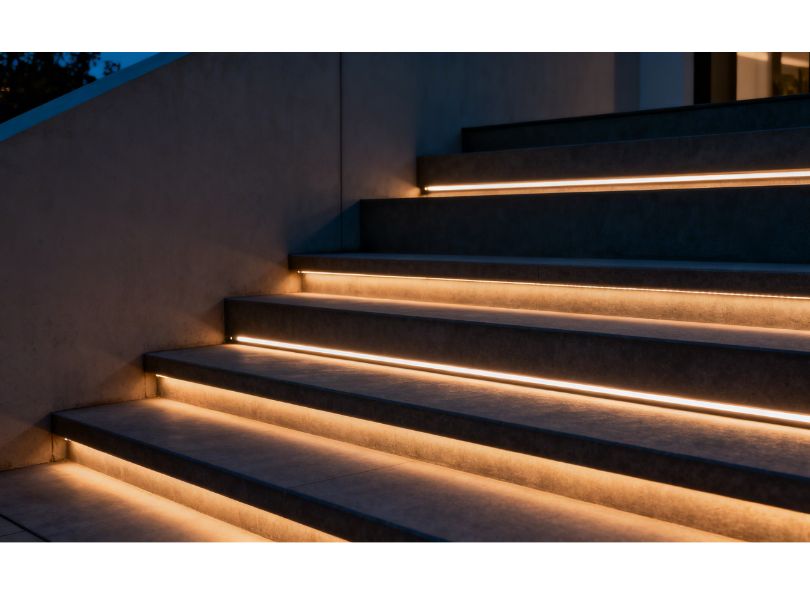
Battery-powered stair lighting and wireless led stair lights address scenarios where mains electrical connection is not available, not permitted (for example in listed buildings or rented accommodation) or simply too costly to install. Modern lithium battery technology and highly efficient led strips have brought battery-powered staircase lighting to a level of performance that, whilst not equivalent to mains-powered systems, is genuinely useful for safety-level illumination in domestic settings.
Key considerations for battery-powered stair light systems:
- battery capacity: lithium polymer (LiPo) batteries are the standard for rechargeable wireless stair lights, offering the best energy density. A typical 3,000mAh LiPo cell will power 2–3 led step lights at low brightness (20%) for 6–12 hours per charge, or at full brightness for 2–4 hours.
- solar charging: several products combine the step light unit with a small photovoltaic panel for self-charging in locations that receive some daylight exposure. True solar stair lights are better suited to outdoor installations in sunnier climates; in northern Europe, the limited solar irradiance makes them marginal for reliable year-round operation.
- RF wireless control: systems where multiple step light units communicate wirelessly (ZigBee, Z-Wave or proprietary RF protocol) allow a single PIR trigger to activate all units in a cascade sequence, without the need for any wiring between steps. This is the defining advantage of wireless stair lighting systems for retrofit in existing buildings.
Recessed stair lighting: achieving the flush aesthetic
Recessed stair lighting, where the luminaire (whether a point-source step light or a linear led profile) is mounted flush with the adjacent surface, represents the highest level of technical refinement in staircase lighting design. The flush aesthetic communicates an uncompromising commitment to architectural purity: nothing breaks the plane of the surface; the light appears to emanate from within the material.
Achieving a truly flush installation requires precision at every stage of the process. The routed or formed channel must be dimensioned and positioned with sub-millimetre accuracy to ensure the profile face sits exactly flush with the adjacent surface. Any deviation, a profile face recessed 1mm behind the surface, or proud of it by 0.5mm, will be visible in raking light and will detract from the intended effect. For high-quality timber work, this level of precision is achieved by routing the channel with a sharp, new router bit, squaring the corners by hand with a sharp chisel, and test-fitting the profile repeatedly before the permanent installation. For concrete and stone, template-based routing or precise formwork is required.
Recessed stair lights designed as point sources (circular or square luminaires set into the stair riser face) are simpler to install than linear profiles but provide a different aesthetic, a series of individual pools of light on each tread rather than a continuous light line. For period staircases and traditional interiors where a continuous led strip line would be anachronistic, individual recessed stair lights in a traditional pattern may be the more appropriate design solution.
Staircase lighting for accessibility and inclusivity
Staircase lighting design for buildings subject to the Equality Act 2010 (UK) or the European Accessibility Act must consider the specific visual impairments that are most prevalent in the population. The following design principles apply:
- high luminance contrast at step nosings: a minimum luminance contrast of 0.3 (Light Reflectance Value differential) between the nosing strip and the tread material is required under BS 8300:2018 for accessible buildings. Lit led step-nosing profiles naturally fulfil this requirement by providing a brightly lit strip against a less-bright tread surface;
- colour temperature consistency: abrupt changes in colour temperature between staircase and landing lighting can disorient visually impaired users. Ensure a consistent or smoothly transitioning colour temperature throughout the vertical circulation route;
- no flickering or stroboscopic effects: flicker in lighting can trigger photosensitive epilepsy in susceptible individuals. All led staircase lighting systems in accessible buildings must use flicker-free (IEEE 1789 compliant) drivers;
- maintained illuminance levels: design to the “maintained” (not initial) illuminance values in EN 12464-1, accounting for lamp lumen depreciation over the replacement cycle. For led systems, design to L80 lumen maintenance values over the intended maintenance interval.
Staircase lighting design ideas: inspiration for every style and context
Beyond the technical specifications, staircase lighting design is fundamentally a creative act, the marriage of light, architecture and space in a way that produces an emotional response. This section presents a curated selection of design ideas, exploring how different combinations of profiles, strips, colour temperatures and control strategies can create radically different atmospheres and experiences within what is essentially the same architectural element.
The minimalist approach: light without form
The minimalist staircase lighting concept strips the idea to its essence: the step edge glows, the source is invisible, the effect is serene. This is achieved through recessed step-nosing profiles with maximum opal diffusion, the wider the diffuser relative to the channel depth, the more submerged the source appears. Warm white COB strips at 2700K ensure that the glow is perceptibly warm and intimate, even at the very lowest dimming levels. The control is simple: a standby glow at 8% brightness, rising smoothly to 60% (not 100%) when motion is detected — full brightness is reserved for special occasions; the staircase normally exists in a state of gentle, half-lit beauty.
The dramatic approach: maximum visual impact
For the dramatic staircase, the centrepiece of a grand hallway, a hotel lobby, a luxury apartment, maximum visual impact requires layering light at multiple heights and angles. Step-edge profiles in every tread create the foundation. Handrail profiles add depth and define the architecture of the balustrade. Recessed uplight profiles in the landing floor wash upwards across the stair soffit. Each layer is independently controlled at a different brightness (treads at 80%, handrail at 40%, uplights at 100%) creating depth, shadow and dramatic chiaroscuro.
The colour story: RGBW narratives
In hospitality and retail, staircase lighting tells the brand story. A hotel with a strong red brand identity might programme its staircase to glow in subtle amber and gold tones, shifting to cooler whites during the day and warming throughout the evening. A retail experience store might programme its stairs as a sequential countdown, each step lighting in a different hue as customers descend, building anticipation for the product reveal below. The Skydance DMX system provides the precise, programmable colour control that brand-driven lighting narratives require.
The sustainable approach: zero-energy night safety
For the sustainability-focused client, the ideal staircase lighting system consumes virtually zero energy during the 20+ hours per day when no one is using the staircase, yet provides instant, full-illuminance safety lighting when needed. This is achieved through the combination of PIR-activated dimming (standby at 0% or 3% brightness, activated at 80–100%) with the lux threshold function on the sensor, so the system is completely off during daylight hours. A 14-step staircase with this approach might consume less than 15kWh per year — less than leaving a single led bulb on for 3 hours per day.
The heritage approach: invisible modernity
Listed buildings and period properties present unique challenges and constraints: often, any visible alteration to the fabric of the building requires listed building consent, and the installation of modern-looking led profiles on a Victorian or Georgian staircase would be architecturally incongruous. The solution is invisibility, concealing led strips in existing architectural features (the reveal at the base of the baluster, the underside of the handrail, the gap between tread and riser) with such precision that the installation is undetectable by day. Ultra-slim profiles (8mm height) in black anodised finish are virtually invisible against dark timber; the opal diffuser glows warmly at night without any daytime visual signature.
Staircase lighting cost guide: from budget to premium
A realistic understanding of the costs involved in staircase lighting projects is essential for architects presenting options to clients, for contractors estimating project budgets, and for homeowners planning a self-managed renovation. This section provides detailed cost guidance across the full range of staircase lighting systems, from basic DIY kits to bespoke architectural installations.
| System type | Component cost (14 Steps) | Installation labour | Total installed | Annual energy cost |
|---|---|---|---|---|
| Basic battery-powered wireless kit | £80–£150 | DIY (0h) | £80–£150 | £8–£15 (batteries) |
| Mains led strip, surface profile, PIR sensor | £150–£280 | £200–£400 | £350–£680 | £4–£8 |
| Recessed step-edge profiles, COB strip, cascade controller | £350–£600 | £400–£700 | £750–£1,300 | £5–£10 |
| Full architectural system (recessed + handrail + DALI-2) | £800–£1,500 | £800–£1,500 | £1,600–£3,000 | £6–£12 |
| Premium RGBW DMX hospitality system | £1,500–£4,000 | £2,000–£5,000 | £3,500–£9,000 | £15–£30 |
Costs are indicative based on 2024/2025 UK market prices. Regional variations apply. All led systems carry a negligible annual energy cost, the figures above are based on typical usage patterns of 2–3 activations per day, each lasting 60–90 seconds, with a 20% standby brightness maintained overnight. The annual energy cost of a quality led staircase lighting system is less than the cost of a single traditional incandescent bulb replacement.
Return on investment for staircase lighting
The financial return on a staircase lighting investment is measured across several dimensions:
- property value uplift: a survey by the Royal Institution of Chartered Surveyors (RICS) found that high-quality interior lighting upgrades, including staircase lighting, contribute on average 1–3% to residential property values. On a £500,000 property, this represents a potential £5,000–£15,000 uplift for an investment of £1,000–£3,000;
- insurance risk reduction: some home insurance providers offer premium reductions for properties with certified staircase safety improvements, including adequate lighting. Consult your insurer for specific terms;
- energy savings vs. incandescent equivalent: replacing a traditional 100W ceiling pendant (used as primary staircase lighting) with a sensor-activated led step light system using 10–15W total typically saves £40–£80/year at current UK electricity tariffs, a payback period of 5–15 years on the incremental installation cost.
Product guide and buying advice: how to select the right components
Navigating the full breadth of led strips, aluminium profiles, sensors and controllers available for staircase lighting can be daunting without a clear decision framework. This section provides structured buying advice for each component category, with specific product recommendations from the LightingLine catalogue.
Choosing your led strip: the key parameters
Before selecting an led strip for staircase use, determine the following parameters:
- primary function: safety illumination (requires ≥100 lux, specify higher power density) OR decorative accent (50 lux sufficient, lower power density acceptable);
- viewing distance: close-up (step-edge; specify COB or 240+ leds/m SMD) OR distant (handrail height, 120 leds/m SMD adequate);
- colour temperature: warm (2700K–3000K) for residential, neutral (3500K–4000K) for contemporary/commercial; CCT-tunable for smart systems;
- CRI: minimum 80 for safety, 90+ for quality illumination, 95+ for premium natural-material staircases;
- IP rating: IP20 for dry indoor, IP65+ for outdoor or damp;
- voltage: 24V for all runs >3m, 12V acceptable for shorter decorative runs.
Choosing your aluminium profile: the key parameters
- Mounting method: surface (easiest; no routing required) OR recessed (premium finish; requires routing).
- Profile height: as low as possible for visual minimalism; min 8mm for standard led strips.
- Diffuser type: FS (satin) for general; FO (opal) for close-viewing; FM (milky) for maximum glare control.
- Finish: silver / black / white / gold — match to the staircase material and interior design.
- Application: step-nosing / wall-mount / recessed tread / handrail — determine from the staircase typology analysis in Section 2.
Browse the full LightingLine profile range — with full dimensional drawings, photometric data and installation guidance at catalogue.lightingline.eu.
Choosing your control system: the key parameters
- Level of automation desired: simple on/off PIR (entry level) → Sequential cascade PIR (standard) → DALI-2 addressable (professional) → DMX/smart home integrated (premium).
- Number of steps: up to 16 steps: standard cascade controller. 16–32 steps: extended cascade controller. 32+ steps: DALI-2 or DMX with multiple decoder units.
- Smart home integration: if KNX, Zigbee, Z-Wave, Apple HomeKit, Google Home or Amazon Alexa integration is required, select a controller with the appropriate gateway capability.
- Emergency lighting requirement: if the staircase is in scope of BS 5266 or EN 60598-2-22, specify a dedicated emergency driver circuit.
Sustainability and environmental impact of led staircase lighting
The environmental case for led staircase lighting systems over traditional alternatives is overwhelming, not merely as a matter of marketing assertion, but as a quantifiable engineering reality. This section examines the sustainability credentials of led-based staircase lighting across the full lifecycle: from manufacture through in-use energy consumption to end-of-life disposal and recycling.
Energy Consumption Comparison
| Lighting technology | Installed power (14 steps) | Annual kWh (typical use) | Annual CO₂ (UK grid, 2024) | Lamp life (hours) |
|---|---|---|---|---|
| Incandescent pendant (1 × 100W) | 100W | 365 kWh | 73 kg | 1,000 |
| Halogen step lights (14 × 5W) | 70W | 256 kWh | 51 kg | 2,000 |
| Fluorescent strip (1 × 28W) | 28W | 102 kWh | 20 kg | 12,000 |
| led step profiles (sensor-activated, 14 steps) | 15W (active) / 1.5W (standby) | 14 kWh | 2.8 kg | 50,000+ |
| COB led step profiles (DALI-2 optimised) | 12W (active) / 0.8W (standby) | 10 kWh | 2.0 kg | 60,000+ |
The figures above illustrate that a sensor-activated led staircase lighting system consumes 97% less energy than a traditional incandescent pendant providing equivalent illuminance. Over a 20-year service life, the realistic lifespan of a quality led system, this represents a cumulative energy saving of approximately 7,000 kWh and a CO₂ saving of around 1,400 kg per staircase flight: the equivalent of driving a petrol car approximately 7,000 miles.
Circular economy and end-of-life considerations
Aluminium led profiles have an almost unlimited recycling life, aluminium can be recycled indefinitely without loss of material properties, and aluminium recycling consumes only 5% of the energy required for primary smelting. The environmental case for aluminium profiles over plastic alternatives is compelling: not just in terms of thermal performance (which extends led lifespan) but in terms of end-of-life recyclability.
Led strips contain copper, small quantities of precious metals (silver, gold at the contact surfaces) and phosphor materials, all of which are recoverable through WEEE (Waste Electrical and Electronic Equipment) recycling streams. The RoHS compliance of all ledpoint strips means that hazardous substances (particularly lead from solder, which was the primary environmental concern with previous-generation electronics) are entirely absent from the product.
Spiral staircase lighting: a deep dive into design and technical solutions
Spiral staircase lighting is a specialised sub-discipline within staircase lighting design that combines the technical challenges of curved geometry with the highest levels of aesthetic ambition. The spiral staircase is, by its nature, a sculptural object, it is impossible to design a spiral staircase without making a strong visual statement, and the lighting system must be worthy of the architecture it serves. This section provides an in-depth technical and design guide specifically for spiral and helical staircase lighting.
Geometry of spiral staircases
A spiral staircase is technically one that rotates around a central post (newel), with each tread cantilevered or connected to the central post. An helical staircase is one that rotates around a void (no central post), with treads cantilevered from the outer wall or structural stringer. The distinction matters for lighting design because the central newel of a true spiral staircase provides an additional mounting surface, wrapping an led strip around a central post, in a shallow helical path, creates a distinctive “DNA double-helix” lighting effect that is unique to spiral staircase typology.
Tread edge lighting on spiral steps
The tread edge of a spiral step is curved in plan, it follows an arc rather than a straight line. Standard straight aluminium profiles cannot follow this curve. The solutions are:
- flexible led neon (silicone extrusion): silicone-jacketed led strips with a flexible, semi-rigid profile can be bent to follow the radius of the step edge. Minimum bend radius for most silicone neon products is 50–100mm, suitable for large-radius treads (>600mm radius) but potentially too rigid for tighter spiral geometries. The silicone jacket provides IP65 protection and a smooth, uniform appearance similar to a traditional neon tube;
- short straight profile segments with arcs: multiple straight profile segments, each approximately 50–100mm long, are laid end-to-end with small gaps between them to approximate the curved tread edge. At viewing distances above 1.5m, the resulting polygon is perceived as a smooth curve. This approach uses standard profile lengths and is the most cost-effective solution for medium-quality spiral staircase installations;
- custom arc-bent aluminium profiles: for premium installations where close-up viewing makes the polygon approximation unacceptable, aluminium profiles can be roll-bent to the exact radius of the tread arc.
Central newel lighting
Wrapping an led strip around the central newel post of a spiral staircase creates one of the most visually distinctive lighting effects in residential design. The strip ascends in a helix, with the pitch of the helix matching the rise of the staircase, so each “coil” of the helix corresponds to one step. With a CCT-tunable or RGBW strip, the colour can shift gradually from warm to cool (or from one colour to another) as the strip ascends, creating a visual metaphor for the transition from one floor level to the next.
From a technical standpoint, central newel lighting uses a standard COB or high-density SMD strip without a profile (the newel post itself serves as the mounting surface and heat spreader, provided it is metal or exposed timber). The strip is secured with the self-adhesive backing along a helical path marked on the newel post surface. Where the strip must negotiate the junction between newel and tread (typically a 90° turn), flexible silicone neon is the preferred choice to avoid the risk of the PCB cracking at the bend.
Pendant lighting for staircases and ceiling lights for stairs and landing
Whilst this guide has focused primarily on linear led profile systems, the technical cornerstone of modern staircase lighting, it is important to acknowledge the continuing role of pendant lighting for staircases and ceiling lights for stairs and landing as design elements in their own right. In many staircase typologies, particularly multi-storey staircases with high voids, or period properties where a grand pendant light is an architectural statement, ceiling and pendant fixtures are not merely supplementary but primary.
The staircase pendant: scale, proportion and light output
A pendant light in a staircase void must be scaled to the void, a pendant that appears correctly proportioned in a standard room ceiling height will look insignificant and lost in a two- or three-storey void. As a general rule of thumb, the diameter of a pendant in a staircase void should be at least 1/4 of the void width and 1/6 of the void height. For a standard two-storey void (approximately 5m height, 2.5m width), a pendant of 600–900mm diameter suspended at mid-height creates the most visually balanced composition.
The led technology within the pendant should ideally be dimmable (DALI or TRIAC) so that the pendant can serve as both a high-output functional light source during the day and a dimmed ambient element in the evening. High-CRI (≥90) led modules are essential for pendants in high-visibility positions.
Recessed ceiling lighting for stairwells
For stairwells where pendant lights are impractical (narrow section, clean-lined contemporary design, or absence of a suitable structural fixing point), recessed ceiling downlights provide the primary ambient illumination. The key design principle for recessed stairwell lighting is that the downlights must be positioned directly above the stair treads — not centred on the stairwell plan but offset towards the “upper” side of each tread — to ensure that maximum illuminance falls on the tread surface rather than the riser or adjacent wall.
Where ceiling depth allows, narrow-beam (15°–25°) recessed downlights can be aimed directly onto individual treads from the ceiling overhead, creating a focused pool of light on each step with minimal spill. This produces a dramatic, theatrical lighting effect with strong shadow on the risers, aesthetically powerful but potentially insufficient for uniformity compliance. Supplementary linear wall lighting (slim profiles) should be combined with ceiling downlights to achieve the uniformity ratios required by EN 12464-1.
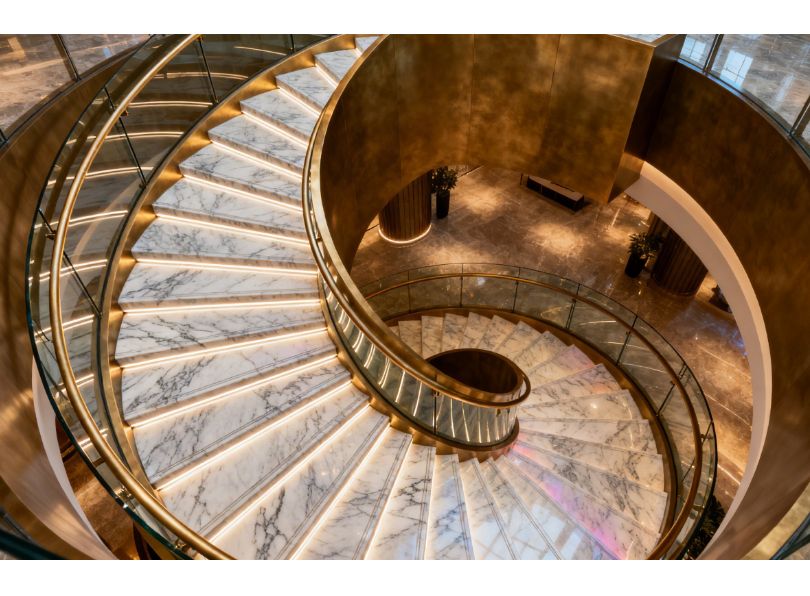
Smart home integration for staircase lighting: voice control, app control and automation
The integration of staircase lighting into a smart home ecosystem is one of the fastest-growing trends in residential lighting specification. When the staircase lighting becomes a device in the smart home ecosystem, it can respond not just to physical presence (PIR sensor) but to time of day, household occupancy patterns, sunrise/sunset data, voice commands and mobile app control. This section explores the principal smart home protocols and their application to staircase lighting control.
Zigbee and Z-Wave integration
Zigbee and Z-Wave are the two most widely used short-range mesh wireless protocols for smart home lighting. Both support dimmable led control and can be integrated with popular smart home hubs (Samsung SmartThings, Hubitat, Home Assistant). Zigbee 3.0-compatible led drivers are available in the Skydance range for integration with any Zigbee 3.0 compatible hub.
For staircase lighting, Zigbee or Z-Wave integration enables:
- sunset/sunrise automation (staircase lights activate automatically at dusk);
- occupancy-based scheduling (staircase lights switch off completely between midnight and 5am, except when the PIR is triggered);
- integration with door/window sensors (staircase lights activate when the front door is opened at night);
- remote monitoring and control from a smartphone app.
Matter protocol: the future standard
Matter (formerly Project CHIP) is the new unified smart home connectivity standard developed by a consortium including Apple, Google, Amazon, Samsung and the Connectivity Standards Alliance. Matter-compatible led drivers and controllers are beginning to appear in the market from 2024 onwards, and represent the recommended specification for new smart home lighting installations, they will ensure forward compatibility with all major smart home ecosystems without the vendor lock-in risks associated with proprietary protocols.
The LightingLine and Skydance product ranges are actively developing Matter-compatible versions of their smart home-capable controllers.
Voice control: Amazon Alexa, Google Home and Apple HomeKit
Voice control of staircase lighting via Amazon Alexa, Google Home or Apple HomeKit is achievable through the appropriate smart home integration. Common voice commands for staircase lighting include:
- “Alexa, turn on the stair lights”
- “Hey Google, dim the stairs to 50%”
- “Siri, activate evening staircase scene”
For voice control integration to work reliably with sequential step activation, the controller must support group control (all steps as a single device) for voice commands, whilst maintaining individual step addressability for the cascade effect. This is achievable with the DALI-2 gateway approach, where the staircase is presented as a single dimmable DALI group to the smart home hub whilst each step remains individually addressable for the cascade sequence through the DALI bus.
Maintenance and troubleshooting for led staircase lighting systems
One of the most compelling practical arguments for led staircase lighting, beyond its energy efficiency, aesthetic quality and design flexibility, is its extraordinarily low maintenance requirement compared to traditional light sources. A quality led strip in a well-specified aluminium profile, driven by a correctly derated driver, should operate for 50,000–80,000 hours (approximately 17–27 years at typical staircase usage rates) with less than 20% lumen depreciation. Nevertheless, systems do occasionally develop faults, and understanding how to diagnose and resolve them is valuable for any professional or informed homeowner.
Common fault scenarios and diagnosis
| Symptom | Most likely cause | Diagnosis method | Resolution |
|---|---|---|---|
| All steps dark, no illumination | Driver failure or mains supply fault | Measure voltage at driver output, check mains fuse/MCB | Replace driver, restore mains supply |
| One step dark, others normal | Strip failure on that step, or wiring fault at connector | Measure voltage at strip input on dark step | Check and reseat connectors, replace strip segment |
| Steps dimmer at far end of run | Voltage drop on long run | Measure voltage at first and last step | Add mid-run power injection, upgrade cable cross-section |
| Flickering, inconsistent | Loose connection, incompatible dimmer, RF interference | Check all connections, test without dimmer | Reseat all connectors, replace non-led-compatible dimmer |
| Colour shift (warm end vs. cool end) | Voltage drop causing colour temperature shift | As above, measure voltage at both ends | Power injection, re-specification to lower watt/m strip |
| Sensor not triggering | PIR blind zone, lux threshold too high, sensitivity too low | Test sensor detection with hand at the staircase entry point | Reposition sensor, reduce lux threshold, increase sensitivity |
| Lights stay on continuously | PIR time delay too long, multiple sensors interfering | Check controller time delay setting | Reduce time delay setting, reposition sensors to avoid overlap |
| Strip discolouring (yellowing) over time | UV degradation of diffuser (outdoor), thermal damage (overloaded strip) | Visual inspection, check junction temperature | Replace diffuser, add ventilation, reduce strip power density |
Cleaning and physical maintenance
Aluminium profiles and PMMA diffusers require minimal routine maintenance. Periodic cleaning (every 12–24 months, or more frequently in high-traffic or dusty environments) with a slightly damp microfibre cloth is sufficient to maintain optical performance. Avoid abrasive cleaners, solvents and pressure washing, as these can scratch the diffuser surface and degrade the anodised finish.
For outdoor step-nosing profiles, inspect annually for water ingress, corrosion at fixings and UV degradation of the diffuser. Replace fixings with stainless steel equivalents at the first sign of corrosion, replace degraded diffusers promptly as UV-damaged PMMA has reduced light transmission and can become brittle.
Frequently asked questions on staircase lighting
The following FAQ section addresses the most commonly asked questions about staircase lighting, we try to answer all of them.
| Question | Answer |
|---|---|
Are stair lights worth it?Absolutely. The benefits are tangible across multiple dimensions: safety (studies show a 58% reduction in misstep events when staircase illuminance is increased from 10 to 100 lux), aesthetics (staircase lighting is consistently ranked as the highest-impact lighting upgrade in residential renovation surveys), energy efficiency (led systems consume 95–97% less energy than traditional equivalents), and property value (RICS data suggests 1–3% property value uplift for quality lighting upgrades). The payback period for a properly specified led staircase lighting system, accounting for energy savings alone, is typically 5–10 years. When aesthetics and safety benefits are factored in, the case is unanswerable. | |
Do you need a light switch at the top and bottom of stairs?UK Building Regulations (Approved Document K) require that staircase lighting be controllable from both the top and bottom of the flight, hence the standard provision of two-way switching in all new builds and material alterations. However, motion sensor (PIR) activated systems are accepted as a code-compliant equivalent to two-way manual switching, provided that the sensor system activates the lighting from both approaches and provides the required illuminance level. For most residential and commercial applications, a properly designed bidirectional PIR system is both code-compliant and superior in practice to manual switching. | |
How do you light a narrow stairwell?Narrow stairwells (700–900mm clear width) benefit most from step-edge profiles at each tread nosing, these provide primary safety illumination without consuming any wall or ceiling space. Supplementary slim wall-mounted profiles (8–10mm height) at alternating step heights on one wall add ambient light and spatial definition without creating a protrusion hazard. For the very narrowest stairwells, ultra-slim profiles (LightingLine PR-SL08-03, 8mm height) are the definitive solution. Avoid ceiling-mounted pendants or large surface fixtures in narrow stairwells — they reduce clearance, create obstructions and are difficult to maintain. | |
How do you add lights to dark stairs?The most effective approach for adding lights to existing dark stairs is a retrofit led strip kit using slim surface-mounted profiles. These require no structural alteration, profiles are surface-fixed with screws directly to the riser or wall, the led strip is laid in the channel, and the low-voltage wiring is surface-clipped to the wall to a centrally located driver. The only electrical work requiring a professional is the mains connection to the driver. A competent DIYer can complete the strip and profile installation in a single day; the electrician’s connection typically takes 1–2 hours. | |
How do you light a staircase landing?Landing lighting should complement the staircase lighting in both illuminance level and colour temperature. For residential landings, a combination of ceiling-mounted downlights (or a pendant for a feature effect) and wall-mounted linear profiles provides the best balance of ambient and directional light. Ensure that the landing illuminance (target 100–150 lux) matches the staircase illuminance to avoid the disorienting effect of exiting a well-lit staircase into a dim landing or vice versa. Where the landing is also a circulation route, extend the step-edge profile concept as a wall-mounted linear profile at skirting level to maintain the staircase lighting aesthetic through the landing. | |
How many lights do you need in a stairway?The technical answer: each step tread should receive a minimum maintained illuminance of 100 lux (residential) as specified by Approved Document K and EN 12464-1. For a step-edge profile system using a 10W/m COB strip, this requires one profile per step. For wall-mounted profiles providing wash illumination across treads, the spacing depends on the profile power and mounting height, typically one profile every 2–3 steps for a mounting height of 200mm above tread level. Photometric modelling (using DIALux or similar software) is the professional approach to confirming that the required lux levels are achieved in the specific installation geometry. | |
How much does stair lighting typically cost?A basic domestic retrofit using surface-mounted slim profiles, led strips, a PIR sensor and a 24V driver for a 14-step staircase costs approximately £150–£280 in components and £200–£400 in installation labour (total: £350–£680). A recessed COB profile system with cascade controller for the same flight costs £350–£600 in components and £400–£700 in labour (total: £750–£1,300). A full architectural system with DALI-2 control and handrail integration ranges from £1,600–£3,000 installed. Premium hospitality systems can reach £3,500–£9,000+. | |
What is the best colour temperature for stair lighting?For safety-focused primary illumination, neutral white (3500K–4000K) provides the best visual acuity and step definition. For residential ambience, warm white (2700K–3000K) is more comfortable and flattering to most interior finishes. For night-time use only, very warm (1800K–2700K) is least disruptive to melatonin and sleep. CCT-tunable strips provide the ultimate flexibility, schedule warm tones for night use and neutral tones for daytime, automatically, via a smart home timer or astronomical clock. | |
How do you light stairs without a plug socket?Without a nearby mains socket, the options are: (1) Battery-powered wireless stair light kits, the simplest solution, requiring no electrical work at all. Lithium battery-powered units clip to the wall or step and are activated by motion sensor; recharging is via USB. (2) Solar-powered outdoor stair lights, for exterior stairs, small integrated PV panels charge the battery during the day. (3) Have a qualified electrician run a new mains supply to the driver location, the most durable long-term solution, as battery management adds ongoing maintenance. (4) Run a low-voltage cable from an existing socket to a surface-mounted driver, then route SELV low-voltage cable to the step profiles, the low-voltage cable side requires no special skills to run and does not require conduit in most domestic applications. | |
How do you fit led strip lights to stairs?Full installation guidance is provided in Section 9 of this guide. In summary: (1) Plan and mark out profile positions on each step. (2) Cut profiles to tread width. (3) Pre-drill and fix profiles to the substrate (surface-mount or recessed). (4) Cut led strip at designated cut points to profile length. (5) Clean the profile channel with IPA; install strip with self-adhesive backing. (6) Connect strip cable to controller, route to driver location. (7) Have a qualified electrician connect the driver to mains. (8) Configure PIR sensor parameters; commission and test. (9) Install diffuser covers and end caps. | |
Can led strip lights be used outdoors on stairs?Yes, with the correct IP-rated components. For covered outdoor stairs, IP65 strips and profiles are sufficient. For fully exposed stairs subject to rain and UV, specify IP67 fully encapsulated strips in stainless steel 316 or corrosion-resistant aluminium profiles. All connections must be made with IP68-rated waterproof connectors. The led driver must be housed in an IP65-rated weatherproof enclosure. Aingline.eu. | |
What regulations apply to staircase lighting?In the UK: Approved Document K (illuminance and uniformity requirements), Approved Document B (emergency lighting for protected stairways), Approved Document L (energy efficiency). British Standards: BS EN 12464-1 (illuminance levels), BS 5266-1 (emergency lighting), BS 8300:2018 (accessibility). All led products must carry CE/UKCA marking and comply with LVD, EMC, ErP and RoHS directives. DALI-2 drivers comply with IEEE 1789 anti-flicker standards. | |
What is the difference between a step light and a step-edge profile?A step light is typically a small, circular or square recessed luminaire mounted in the face of the stair riser, it is a point source that illuminates the tread above from a single compact fitting. A step-edge profile is a linear aluminium extrusion incorporating an led strip, mounted at the front edge (nosing) of the tread, it illuminates along the full width of the step from the step edge itself. Step-edge profiles provide superior uniformity, better safety visibility (the entire step edge is illuminated, not just the area near a single point source), and a more contemporary aesthetic. They also fulfil the contrasting nosing requirement of BS 8300 for accessible buildings. | |
How do you illuminate stair treads with led strips?The three most effective methods are: (1) Step-edge profile at tread nosing, profile with COB or high-density SMD strip mounted at the front edge of the tread, with diffuser angled down-forward to wash light onto the tread and make the edge clearly visible. (2) Under-tread recessed profile, for open-tread stairs, a recessed profile in the underside of the tread directs light downward onto the tread below and forward into the stairwell. (3) Riser base profile, a slim profile at the base of each riser directs light upward and forward across the tread above, creating a gentle upwash that reveals the tread surface. Methods 1 and 3 are compatible with solid (closed-riser) stairs; Method 2 requires open-tread construction. | |
Are motion sensor stair lights safe for children and elderly?Yes, motion sensor stair lights are specifically beneficial for children and elderly users, who are statistically at highest risk of staircase falls. The automatic activation ensures that the staircase is always illuminated when anyone is present, removing the need to remember to turn lights on or search for a switch in the dark. For elderly users, the standby night light mode (constant 5–10% brightness) ensures that the step edges are always dimly visible, even before the PIR triggers the full illuminance. For households with very young children, the lux threshold should be set conservatively low so that the lights activate even in moderately dim conditions. | |
How long do led stair lights last?Quality led strips in properly specified aluminium profiles (providing effective thermal management) achieve L80 lumen maintenance at 50,000 hours, meaning that after 50,000 hours of use, the light output is still at or above 80% of its initial value. At typical staircase usage rates (3–5 activations per day, each 60–90 seconds, plus overnight standby), 50,000 hours corresponds to approximately 25–35 years of realistic service life. led drivers typically have shorter specified lifespans (30,000–50,000 hours) and are the component most likely to require replacement during the system’s operational lifetime. Specifying high-quality Mean Well or equivalent drivers, properly derated, maximises driver lifespan. | |
Can I install staircase led lighting myself (DIY)?The low-voltage components of a staircase led lighting system, the profiles, led strips, cables and controller, are entirely safe to install as a DIY project. The single element that requires a qualified electrician is the mains connection to the led driver. In the UK, this connection must be made by a Part P-registered electrician if it involves a new circuit or an alteration to an existing circuit in a special location. A competent DIYer can complete all other aspects of the installation, profile fixing, strip installation, cable routing and controller configuration — in a single day for a standard 14-step staircase. Full installation guidance is provided in Section 9 of this guide. | |
Specific staircase types: a comprehensive lighting roundup
This final technical section provides concise, focused guidance for each of the most commonly encountered staircase types, synthesising the product and design recommendations from the preceding sections into a single reference point for each typology.
Wooden staircases with carpet treads
Carpeted wooden staircases are the most common typology in UK domestic housing. The carpet provides thermal and acoustic benefits but complicates the installation of recessed profiles (routing into a carpeted tread is impractical). The recommended approach is wall-mounted slim surface profiles at alternating step heights, plus an optional under-handrail profile for added ambience. Warm white (2700K) COB strips with satin diffusers complement the soft, domestic character of carpeted stairs.
Timber open-tread staircases
Open-tread timber stairs, the defining element of contemporary residential design, are best served by recessed underlit profiles creating the floating tread effect. The exposed grain of quality timber (oak, walnut, ash) is best complemented by high-CRI (>95) warm white (2700K–3000K) COB strips that render the wood’s natural colour with absolute fidelity. Recessed LightingLine RE01-03 profiles with opal FM diffusers provide the seamless light line that open-tread stairs demand.
Concrete and terrazzo staircases
Concrete and terrazzo stairs are predominantly found in commercial and institutional buildings, though polished concrete has become a significant material in contemporary luxury residential interiors. Their hardness makes in-situ routing possible (using an angle grinder and diamond blade, or a wet core drill for circular recesses). Step-nosing profiles recessed flush into the concrete tread edge are the premium solution; surface-fixed step-nosing profiles are adequate for buildings where modification to the structure is restricted.
Glass and steel contemporary staircases
Glass-tread and steel-frame staircases demand lighting that is as precise and minimal as the structure itself. Led strips without profiles (COB strips adhered directly to the steel stringer on the underside of each glass tread) create a pure, light-from-nowhere effect that no other approach can match. The steel structure acts as a perfect heatsink. The transparancy of the glass treads means that the light washes evenly through the tread, illuminating it from within. For the balustrade, led strips tucked into the structural channel sections of the steel framework provide subtle accent lighting without any visible luminaire.
Outdoor and garden staircases
Outdoor stair lighting must prioritise IP rating, UV resistance, and mechanical durability over pure aesthetics. IP67 step-nosing profiles in stainless steel 316 are the specification of choice for coastal and exposed outdoor installations. Solar-powered options are viable for garden environments with adequate solar exposure; for reliability in temperate climates, mains-connected IP65 driver systems are preferable. Warm white (2700K–3000K) is the standard for garden and landscape lighting; cool whites can appear harsh and clinical in softscape contexts.
The complete staircase lighting system
The journey through staircase lighting from market data and safety statistics through led strip technology, aluminium profile selection, sensor systems, regulatory compliance, installation practice and design inspiration reveals a discipline of remarkable depth and nuance. The staircase is one of the most intensely used and emotionally resonant spaces in any building, traversed dozens of times each day, experienced in every state of light from brilliant midday sun to total darkness. The lighting system that serves it must be technically precise, aesthetically considered, rigorously code-compliant and effortlessly usable.
Every component is selected for its technical excellence, compliance credentials and compatibility with its counterparts in the system, allowing architects, designers, contractors and homeowners to specify with confidence that the end result will meet the highest standards of performance, safety and aesthetics.
Whether the project is a grand spiral staircase in a five-star hotel, a narrow Victorian terrace stairwell in need of a safety upgrade, or a precision-engineered open-tread staircase in a contemporary new-build home, the principles and products outlined in this guide provide the complete reference framework for delivering staircase lighting that is worthy of the architecture it illuminates.
This article was developed with the support of artificial intelligence and subsequently reviewed, corrected, and validated by the LightingLine.eu technical team, which guarantees its reliability and compliance with official sources.