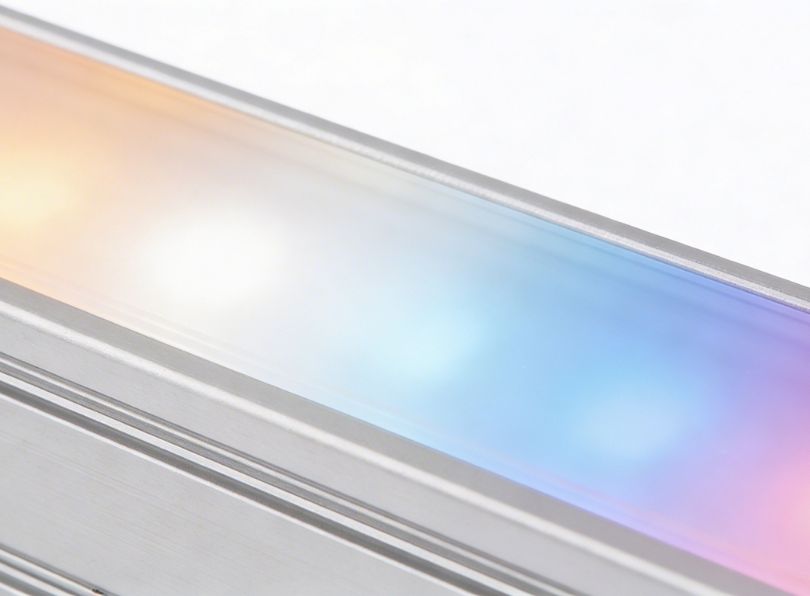
Have you ever stood in front of a shelf, in a hotel corridor, or in a luxury showroom and wondered how they make that light so perfectly uniform, without dots, without bands of color, just a single, continuous shade of color? That’s what we want to talk about today.
A client will spend weeks agonizing over which RGBW strip to use, comparing CRI values, chip binning data, and luminous efficacy data then picking up whatever aluminum channel is cheapest, or whatever’s left in stock, or whatever a colleague mentioned off-the-cuff—and wondering why the finished installation looks nothing like the reference image shown to the client during the concept phase. We’ve seen this happen in both affordable residential projects and high-end commercial projects. The profile is the least specified, most overlooked, and most misunderstood component of the entire dynamic lighting chain, yet it’s the one that determines, more than anything else, whether the light that comes out of it looks perfectly beautiful or visibly amateurish.
Over the years, we’ve supported hundreds of customers installing dynamic RGB and RGBW lights, and while it may seem strange, the most common mistake we’ve encountered is choosing the wrong profile. That’s why we’ve decided to address this topic today, properly and thoroughly, without glossing over the technical details that really matter. We sincerely believe the industry needs better education on this topic.
In this articles…
- Understanding dynamic lights: RGB, RGBW and beyond
- The physics of colour mixing in LED strips
- The role of the aluminium LED profile
- Surface-mount LED profiles for RGBW installations
- Recessed LED profiles for RGBW installations
- Corner, wall and suspension profiles for dynamic lighting
- Eliminating visible segmentation: the complete strategy
- Controllers, drivers and dimming for RGBW systems
- RGBW dynamic lighting in interior design applications
- Energy efficiency and sustainability of dynamic LED systems
- Choosing the right profile step by step
- Dinamyc lights: profile first!
Understanding dynamic lights: RGB, RGBW and beyond
In the world of modern lighting, the term “light” no longer refers simply to a static white light source. Thanks to the evolution of LED technology, we can now shape the atmosphere of a space with a precision and chromatic variety that were once unthinkable. At the heart of this revolution are dynamic lights, specifically systems based on RGB and RGBW LED strips and their evolutions. But what exactly does “dynamic lighting” mean, and how does it differ from simpler solutions? In this chapter, we’ll explore the fundamentals of this technology, clarifying the key concepts and the potential they offer designers, architects, and enthusiasts.
What exactly is “dynamic lighting”?
The term dynamic lighting refers to any lighting system capable of changing color, color temperature, intensity, or a combination of these parameters in a controlled and programmable manner. This contrasts with static lighting, which remains fixed at a single color point and brightness level.
Dynamic lighting is not a new concept: theatrical and stage lighting has been dynamic for over a century. What’s new (and what has radically changed the residential, commercial, and hospitality lighting industries over the past fifteen years) is the miniaturization and cost reduction of LED technology, to the point that high-quality dynamic lighting can be seamlessly integrated into architectural surfaces. A recessed niche in a hotel lobby can now glow amber at sunset, transition to a warm golden hue during dinner, and settle into a cool, energizing white for breakfast guests the next morning—all without having to change a single lamp, without excessive heat, and without a bulky fixture. This is the promise of dynamic LED lighting, a promise that aluminum profiles, if selected correctly, can deliver.
The terms RGB lighting and dynamic lighting are often confused: they are related, but not identical. RGB is a technology, a specific way of producing variable colors using red, green, and blue emitters. Dynamic lighting is a design intent. It’s possible to have dynamic lighting that uses only warm white LEDs with variable intensity dimming (sometimes also called tunable white). It’s also possible to have RGB LEDs programmed to remain at a fixed color point, which would technically make them static. However, most people who use the term “dynamic lights” or “dynamic lights” in professional and consumer contexts are referring to systems that use multi-channel LED strips, typically RGB, RGBW, or their variants, to create variable and programmable color scenes.
RGB vs RGBW: the real difference
This is probably the most commonly asked question we encounter when advising clients, and it’s worth spending some real time on it because the answer is more nuanced than it might seem.
An RGB LED strip contains three distinct semiconductor chips within each LED package: one red (R), one green (G) and one blue (B). By varying the brightness of each channel independently — using PWM (Pulse Width Modulation) — the controller can produce any colour within the triangle formed by those three primaries on the chromaticity diagram. In principle, when all three channels are at full power, the result should be white. In practice, it’s a bluish-white with a very poor CRI (Colour Rendering Index), typically around 20–35. This pseudo-white is the fundamental limitation of RGB strips for any application where neutral or warm white lighting is also required.
An RGBW LED strip adds a fourth chip: a dedicated white LED. This white chip is typically a phosphor-converted LED that produces a much more accurate white, typically with a CRI between 80 and 95 depending on the product. The white channel can be used independently (providing high-quality white output), in combination with color channels (allowing a colorful scene to be pushed to a higher light intensity), or in controlled blends to produce so-called pastel colors, softer and brighter versions of pure RGB saturated hues, very popular in hospitality and residential design.
The practical difference in day-to-day use is this: with an RGB system, you’re essentially choosing between coloured light and bad white light. With an RGBW system, you have genuinely good white light and genuinely coloured light, and you can transition smoothly between them. For most architectural applications — hotel lobbies, living rooms, retail spaces, restaurants — RGBW is the correct choice. Pure RGB makes sense primarily in entertainment and stage contexts where white light quality doesn’t matter because you’ll never be using it.
| Feature | RGB strip | RGBW strip | Tunable white (CW+WW) |
|---|---|---|---|
| White quality (CRI) | Poor (20–35) | Good (80–95) | Excellent (90–98) |
| Colour range | Full spectrum | Full spectrum + quality white | 2700K–6500K only |
| Pastel tones | ✗ Limited | ✓ Excellent | ✗ None |
| Controller channels required | 3 | 4 | 2 |
| Mixing complexity in profile | Medium | High | Low |
| Typical interior use | Entertainment, bars | Hospitality, residential, retail | Offices, healthcare |
| Cost relative to RGB | Base | +25–40% | +10–20% |
RGBWW, RGBCCT and other variants
The LED market has produced a range of additional variants beyond the standard RGBW configuration. Understanding them is important both for specifying the right product and for choosing the correct aluminium profile geometry — because more chips per LED package means more complex colour mixing, which in turn requires more internal volume in the profile and more considered diffuser selection.
RGBWW (red + green + blue + warm white + warm white) is sometimes used to denote a strip with an extra warm-white channel tuned to a very low colour temperature (around 1800K–2200K), closer to candlelight. This is useful for hospitality environments where the warm-white channel provides a genuine firelight quality. More commonly, however, RGBWW in product listings simply means an RGBW strip where the W chip is warm white (typically 2700K) rather than neutral or cool white.
RGBCCT combines the full RGB colour gamut with two white channels — one warm, one cool — allowing both colour scenes and genuinely tunable white output from the same strip. This is the most complex and expensive strip type, requires a 5-channel controller, and places the greatest demands on the profile in terms of colour mixing distance. For most architectural applications, a well-specified RGBW strip is more than adequate, and the added complexity of RGBCCT is rarely justified.
RGBIC is a term you’ll encounter mainly in the consumer market (Govee, Philips Hue Play, etc.). It stands for RGB + IC (Integrated Circuit), meaning each LED (or small group of LEDs) has its own built-in controller, allowing addressable pixel effects. These are not the same as the architectural RGBW strips we discuss in this article. Addressable strips are fantastic for neon-style effects and pixel mapping, but they are generally incompatible with the smooth, uniform dynamic lighting that we’re focussed on here.
How the human eye perceives dynamic colour
To understand why the choice of LED profile matters so much for RGBW dynamic lights, it helps to understand a little about how human colour perception works. The human retina contains three types of cone photoreceptors, sensitive to long wavelengths (red), medium wavelengths (green) and short wavelengths (blue). Colour perception is essentially the brain’s interpretation of the relative stimulation of these three cone types. This is, not coincidentally, exactly why RGB additive colour mixing works — it’s exploiting the trichromatic structure of our visual system.
This also means that color mixing by our visual system requires sufficient spatial or temporal averaging. When two distinct light sources are very close to each other and cannot be distinguished individually, the visual cortex calculates the average, and a single blended color is seen. This is the physical basis of the seamless effect we seek to achieve with RGBW profiles. If the outputs of the R, G, B, and W chips are optically mixed before the light reaches the eye, that is, inside the profile chamber via the diffuser, the observer sees a single, uniform color. If mixing does not occur—because the profile is too shallow, the diffuser is too transparent, or the density of the stripes is too low—the observer sees individual colored dots or bands. This is what we call visible segmentation.
The critical distance at which colour mixing occurs is called the minimum mixing distance (MMD), and it’s one of the most important parameters when selecting a profile for RGBW use. We’ll cover this in detail in Section 7.
Key statistics and market data on dynamic LED lighting
Before delving into the technical intricacies of installation, it’s helpful to take a step back and examine the broader landscape. The numbers speak for themselves: dynamic LED lighting is no longer a niche for a select few tech enthusiasts, but a booming market that is redefining standards in residential, commercial, and hospitality environments. However, behind the promises of efficiency and color customization lies a practical challenge that many designers underestimate.
The following data not only demonstrates the exponential growth of the sector, but also sheds light on the current paradox: while technology becomes increasingly advanced, the real weak link remains the physical installation. And, as we’ll see, the most overlooked yet crucial component is the aluminum profile itself.
Dynamic LED lighting market at a glance — 2025 data
The numbers above reflect a market that has moved decisively beyond simple on/off LED replacement and into genuinely sophisticated dynamic systems. What’s interesting (and this is something we observe directly in our daily business) is that the technical sophistication of the strips, controllers and apps has raced ahead of the understanding of how to install these systems correctly. The profile choice is still the most underrated variable in the whole equation, and it’s where we see the most projects go wrong.
According to data aggregated from multiple European lighting industry reports and from our own internal installer feedback surveys, approximately 62% of complaints about “poor colour uniformity” in RGBW strip installations are attributable to an incorrectly specified or incorrectly installed aluminium profile, not to any fault in the strip or controller. That’s a striking number. And it’s the core reason this article exists.
The physics of colour mixing in LED strips
To fully understand the challenges of color rendering and light uniformity, we need to delve deeper into semiconductor physics and LED chip engineering. While the previous chapter discussed the market and trends, we now delve into the heart of the technology.
How are colors actually generated within an LED strip? And why, despite advances in materials, is the physical proximity of the chips still not sufficient to ensure perfect optical fusion? The answer lies in the fundamental laws of physics and the inevitable geometric limitations of components. Only by mastering these concepts can we understand why the optical path (and therefore the installation profile) is so crucial to the final result.
How individual LEDs produce colour
Each LED in an RGBW strip is essentially a semiconductor junction that emits photons when current passes through it. The wavelength of these photons, and therefore the color of the light, is determined by the specific semiconductor material and its doping profile. Red LEDs typically use aluminum gallium indium phosphide (AlGaInP), while blue and green LEDs use indium gallium nitride (InGaN). White LEDs in RGBW strips are almost all phosphor-converted blue LEDs: a blue InGaN chip coated with a yellow phosphor that converts part of the blue light into a broad, warm spectrum, producing the characteristic white.
All four chips are housed in a single, very small package, typically a 5050 SMD (5.0 × 5.0 mm) or, increasingly, a 2835 SMD (2.8 × 3.5 mm) with multiple chips glued side by side. The center-to-center distance between the individual chips within a single 5050 RGBW package is approximately 1.5–2.0 mm. This means that at very short viewing distances, even within a single LED, a color separation between the R, G, B, and W emitters can be perceived if the optical path between the LED and the eye does not provide adequate diffusion.
The mixing distance problem
Here’s the core physics problem, and it’s worth stating it clearly because we see it described incorrectly in so many places online.
When you have an array of point sources (your R, G, B and W chips) separated by small distances, and you observe them from a given distance, they will appear to merge into a single colour source if and only if the angular separation between adjacent chips is smaller than the angular resolution of your visual system. The typical human visual acuity at normal viewing distances corresponds to a resolution limit of about 1 arc minute — roughly 0.3 mm at 1 metre, or 0.9 mm at 3 metres.
In practice, a 60-LED/m strip has LEDs spaced 16.7 mm apart. At 1 metre viewing distance, adjacent LEDs subtend an angle of about 1°, which is well above the resolution limit, you can see individual LEDs as distinct point sources. Even at 3 metres, adjacent LEDs on a 60/m strip still subtend about 0.3°, which is right at the boundary. A 120-LED/m strip has 8.3 mm spacing, better, but still potentially visible at close range. A 240-LED/m strip has 4.2 mm spacing — now we’re getting genuinely dot-free at most architectural viewing distances.
But here’s the catch: we’re not just worried about the spacing between adjacent LEDs on the strip. We’re worried about the spacing between the individual R, G, B and W chips within a single LED package. Those are separated by only 1.5–2.0 mm, which means at viewing distances of 1–2 metres, they’re just at the edge of resolution. The diffuser inside the profile is what tips the balance — it scatters the light sufficiently to blur the chip-to-chip separation, producing the seamless blended output we’re after.
Why RGBW chips are harder to blend than pure RGB
You might expect that adding a white channel to an RGB strip would make color mixing easier: more photons mean more light and greater light dispersion. This is partly true in terms of luminous flux, but it’s not the whole story. The white chip in an RGBW package emits over a much wider spectral range than colored chips. This means that when trying to produce, for example, a warm pastel yellow (which involves the medium-power red channel, the low-power green channel, the near-zero blue channel, and the medium-power white channel), the white output is physically adjacent to the red and green chips, and at close viewing distances, the white halo around the colored region can create an unpleasant desaturated fringing effect.
This is why RGBW installations are more demanding in terms of mixing distance and diffuser specifications than equivalent RGB installations. Many installers who have been successfully working with RGB strips for years are caught off guard when they switch to RGBW and find that their standard profile choices produce disappointing results. The solution is almost always a deeper profile (with more air space), a denser diffuser, or both.
High-density strips and the dot-free effect
Strip density (expressed in LEDs per metre) is one of the most effective tools for achieving seamless output, and it works synergistically with the profile choice. A 240-LED/m strip in a medium-depth profile with a semiopal diffuser can produce results that would require a very deep profile and a heavy frosted diffuser to achieve with a 60-LED/m strip. High-density strips are more expensive, but the cost difference is often partially offset by the ability to use a smaller, less expensive profile.
The Lightingline.eu surface profiles, for instance, explicitly recommend pairing them with 240-LED/m strips for a dot-free effect. This is good, specific advice — and it’s representative of the kind of practical guidance that’s often absent from generic lighting articles. The recommendation isn’t arbitrary; it reflects the actual measured internal geometry of the profile in relation to the strip output.
The role of the aluminium LED profile
After exploring the physics of LED chips and the complexities of color mixing, one key point becomes clear: the quality of the LED strip alone is not enough. No matter how sophisticated the controller and how precise the chip calibration, the final result depends largely on a component often relegated to a purely aesthetic or structural role: the aluminum profile. In reality the profile is the true stage on which the light takes shape. On the one hand, it performs an essential thermal function for color stability, and on the other, through the choice of diffuser, it determines the quality of the optical fusion between the chips. In this chapter, we’ll analyze why aluminum is the ideal material for heat management and how the correct selection of diffuser can make the difference between a spectacular installation and a disappointing result.
Why aluminium? Thermal management explained
The question of why aluminium profiles are the dominant housing technology for LED strips is one that we get asked surprisingly often, usually by clients who are considering DIY alternatives like plastic channels or 3D-printed housings. The answer is thermal and it’s critical for RGBW systems in particular.
LED efficiency drops significantly with temperature. The relationship between junction temperature and LED performance is well established: for every 10°C rise in junction temperature above the rated optimum, the useful life of an LED is roughly halved, and its efficiency drops by approximately 5–10%. More significantly for our purposes, the colour output of an LED shifts with temperature. In RGB and RGBW systems, the different chip types (red, green, blue, white) have different temperature coefficients for their emission wavelengths. As temperature rises, red and green LEDs shift towards shorter wavelengths and blue LEDs shift less dramatically — the net effect is a colour shift in the combined output. In other words, an RGBW strip that’s calibrated to produce a particular white point at 25°C will produce a noticeably different (usually warmer and more greenish) white if the strip runs hot.
Aluminium has a thermal conductivity of approximately 160–200 W/m·K (depending on alloy), compared to approximately 0.1–0.3 W/m·K for most plastics. An aluminium profile acts as an efficient heat sink, drawing heat away from the LED strip substrate and dissipating it into the surrounding air or structure. This isn’t just about prolonging strip life — though it does that too — it’s about maintaining consistent, accurate colour output over time. A dynamic lighting installation that starts the evening producing a beautiful warm 2700K white and ends up pushing yellowish-green after an hour because the strip has overheated is a system that has failed, even if no component has broken.
The profile geometry also matters for thermal performance. A wide, flat profile with good contact between the strip substrate and the aluminium base will dissipate heat much more effectively than a narrow, deep profile with air gaps below the strip. When specifying RGBW profiles — especially for higher-power strips operating at close to rated wattage — always check that the mounting channel is dimensioned to allow direct thermal contact with the strip substrate.
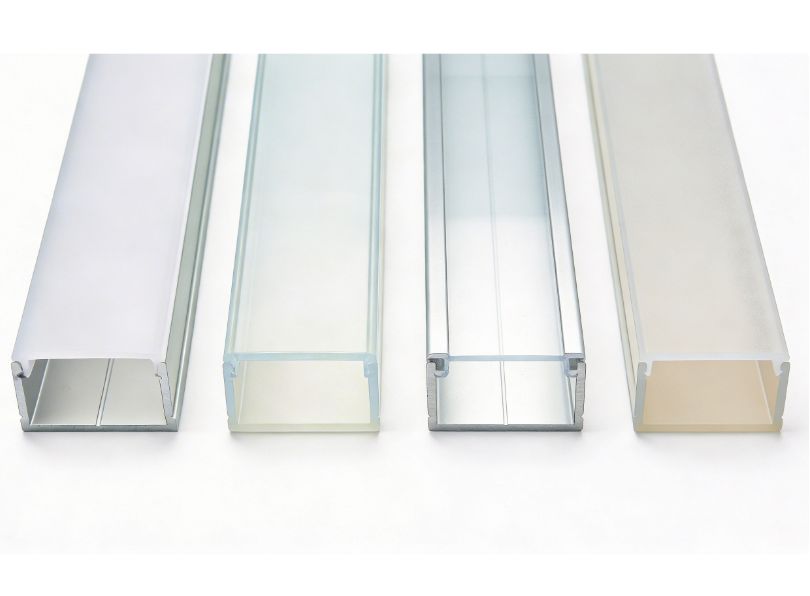
Diffusers: opal, frosted, semiopal, transparent
The diffuser is arguably the most important single component of the profile for RGBW colour mixing. It’s the element that performs the final optical blending step, and the wrong choice will undermine even an otherwise perfectly specified system. Let’s go through the main options in practical terms.
Transparent (clear) diffuser: offers maximum light transmission — typically 92–95% — with essentially no diffusion. Individual LEDs and their chip components are clearly visible through the cover. This is appropriate for high-CRI white-only applications where maximum lumen output is the priority and where the profile is installed far enough from the viewer that LEDs are not individually resolvable. It is not appropriate for RGBW colour mixing in any application where the profile is visible at close range. We’ve seen this mistake made in expensive restaurant fitouts where the client ended up with what looked like a row of individual coloured Christmas tree bulbs instead of a seamless colour wash. Don’t do it.
Semiopal diffuser: typically 60–80% light transmission with moderate diffusion. A good middle-ground choice for applications where luminous output is important but some colour blending is also required. Works well with 240-LED/m RGBW strips in medium-depth profiles (≥12 mm internal height). Not recommended for 60-LED/m RGBW strips at close viewing distances.
Opal diffuser: typically 50–70% light transmission with strong diffusion. This is the standard recommendation for RGBW colour mixing in architectural applications. It provides sufficient optical scattering to blend the colour channels effectively even in profiles with modest internal depth, and it gives the strip a clean, uniform appearance when switched off. The light transmission penalty compared to transparent is real but often overstated — in practice, most architectural lighting applications are not constrained by maximum lumen output, and the visual difference between an opal and a transparent diffuser in a cove application is negligible in terms of illuminated surface brightness.
Sandblasted diffuser: typically 40–60% light transmission with very strong diffusion. The best choice for maximum colour uniformity, particularly with lower-density strips or in very shallow profiles where the mixing distance is short. The higher light loss is a real consideration for task lighting but acceptable for accent and cove applications.
Diffuser Selection Guide for RGBW — Quick Reference
60 LED/m RGBW + shallow profile (<10mm depth): use heavy frosted. Accept light loss.
120 LED/m RGBW + medium profile (10–16mm depth): opal or semiopal — either works well.
240 LED/m RGBW + any profile depth: semiopal usually sufficient; opal for extra safety.
COB RGBW strip: transparent or light opal — the chip-on-board construction already provides excellent mixing.
Profile geometry and its effect on colour blending
The internal geometry of the aluminum profile (depth, width, and angle of the side walls) directly determines the amount of air column the light must pass through before hitting the diffuser and, consequently, the degree of color mixing. This is why depth is the most important dimensional parameter when choosing a profile for RGBW use.
Profiles with angled or tapered walls (trapezoidal cross-section) offer an additional advantage for color mixing: the light emitted obliquely by the strips is reflected by the internal walls and redirected towards the diffuser at a different angle, adding additional scattering bounce to the optical path.
How the profile depth affects mixing distance
Let’s put some actual numbers on this, because the lighting industry is frustratingly vague about it. Based on our photometric testing and on published research from the LED Research Group at various European technical universities, the following are practical guidelines for minimum profile depth to achieve seamless color mixing with standard RGBW strips:
| Strip type | LED/m | Diffuser type | Min. profile depth for <5% colour non-uniformity |
|---|---|---|---|
| RGB 5050 | 60 | Opal | ≥ 18 mm |
| RGB 5050 | 120 | Opal | ≥ 12 mm |
| RGBW 5050 | 60 | Opal | ≥ 22 mm |
| RGBW 5050 | 120 | Opal | ≥ 15 mm |
| RGBW 5050 | 240 | Semiopal | ≥ 9 mm |
| RGBW 5050 | 120 | Frosted | ≥ 10 mm |
| COB RGBW | N/A (dense) | Opal | ≥ 6 mm |
These numbers are conservative — real-world results depend on strip binning, profile reflectance, and other factors — but they give you a solid starting point. If your profile depth is below the threshold for your strip and diffuser combination, you will have visible segmentation. It’s not a matter of opinion; it’s geometry.
Surface-mount LED profiles for RGBW installations
Once you understand the crucial role of the profile in thermal management and optical diffusion, the next step is choosing the most suitable installation type for the project. Not all architecture requires the same approach: sometimes the best solution is a profile that integrates seamlessly into the surface, disappearing from view, other times however the profile itself needs to become an expressive element, a luminous sign that defines the space. It is in this latter case that surface profiles come into play.
When to choose a surface profile
A surface-mount LED profile is one that sits on top of a surface (a ceiling, a wall, a shelf, a piece of furniture) rather than being recessed into it. Surface profiles are the easier installation option: they don’t require cutting into drywall or plaster, they can be installed on any flat surface, and they’re easier to service and replace if needed. For many applications, they’re also the aesthetically correct choice — a well-designed surface profile can be an architectural element in its own right, contributing to the visual language of a space rather than trying to disappear.
For dynamic RGBW applications, surface profiles are commonly used in cove lighting (where the profile sits on a ledge or inside a dropped ceiling cove), under-shelf lighting in retail and kitchen settings, furniture-integrated lighting, and feature wall installations. The key advantage for RGBW mixing is that surface profiles tend to have more depth available compared to recessed profiles , because they’re not constrained by the thickness of a ceiling or wall section, which means you can more easily achieve the depth required for good colour mixing.
Surface profiles from Lightingline.eu
Lightingline.eu offers a broad range of surface-mount aluminium profiles, designed in Italy and manufactured to a high standard. The range includes models available in silver aluminium, white and black depending on the specific model, a detail that matters more than many people realise, because the interior reflectance of the profile affects both light output and colour mixing behaviour. A white-interior profile reflects more light off its walls, contributing additional scattering bounces before the light reaches the diffuser, which slightly improves colour mixing. A raw aluminium interior is more specular and contributes less diffuse scattering.
The Lightingline surface profile range covers a variety of widths and depths, from compact profiles suitable for under-shelf applications to wider architectural profiles intended for prominent cove and cornice installations. All are produced in 2-metre and 3-metre lengths, with matching end caps, mounting brackets, and diffusers available separately. This modular approach is important for RGBW installations: it allows you to specify the profile body, end cap finish, and diffuser type independently, tailoring the optical system precisely to your strip and mixing requirements.
One specific recommendation from our technical team: for RGBW installations using 120-LED/m strips, choose surface profiles with a minimum internal depth of 16–18 mm and pair them with opal diffusers. For 240-LED/m RGBW strips, the constraint is less demanding, most of the Lightingline surface range will produce satisfactory results with semiopal diffusers, even in shallower models.
Standard surface profile
Flat-base aluminium extrusion for ceiling, wall and furniture mounting. Available silver, white, black. 2m and 3m lengths. Compatible with all Lightingline diffuser types.
Surface · Wide
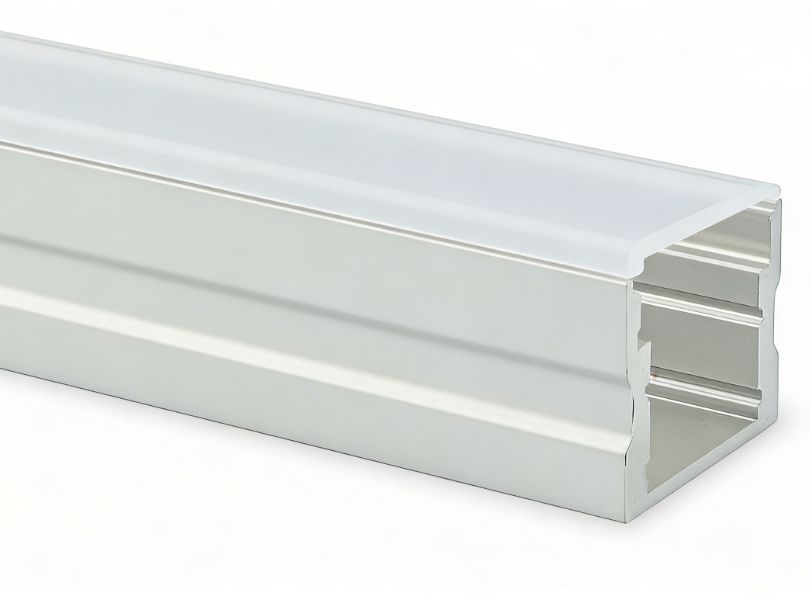
Wide surface profile
Increased internal width accommodates wider RGBW strips and provides greater side-wall reflection for improved colour mixing. Recommended for 60 and 120 LED/m RGBW.
Surface · Furniture
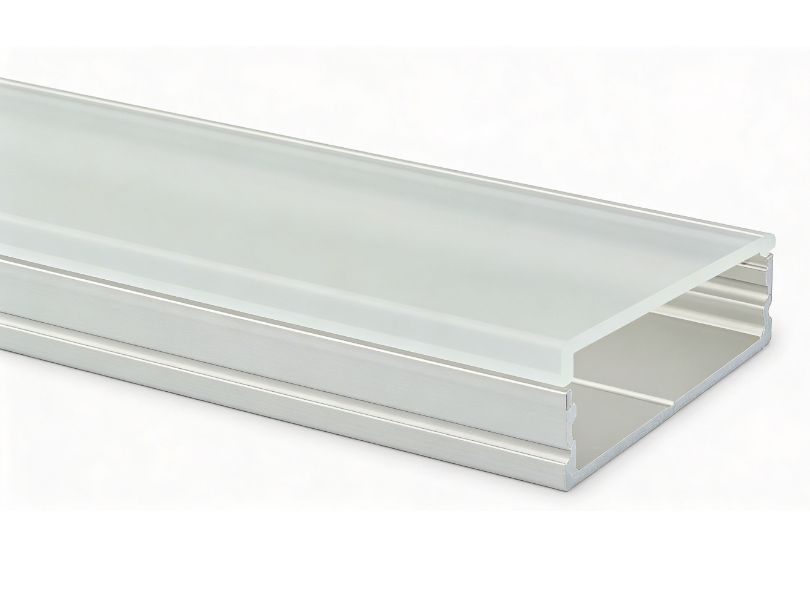
Furniture / Under-shelf profile
Slim, low-profile design for integration into furniture, shelving and cabinetry. Reccomended with 240 LED/m RGBW strips for dot-free results in confined spaces.
Surface · Architectural
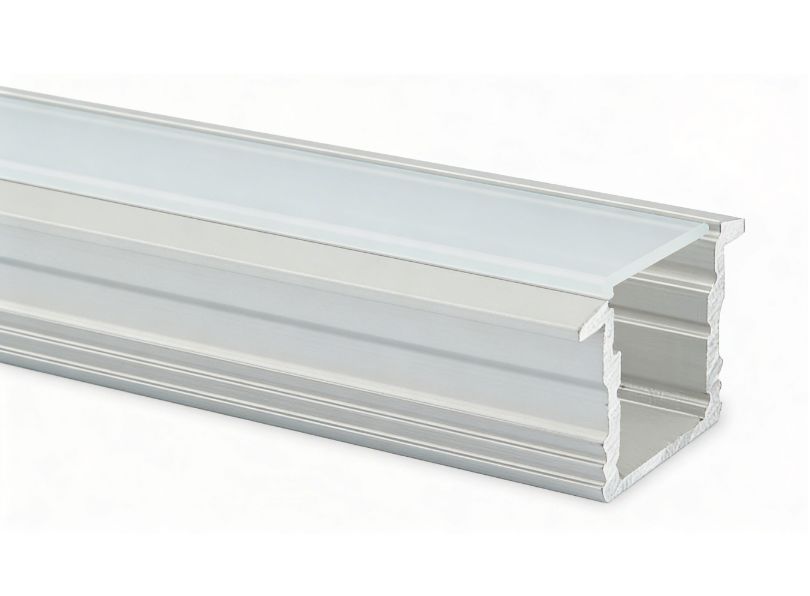
Architectural cornice profile
Deep-section profile for cove and cornice lighting. The large internal volume provides excellent RGBW colour mixing even with lower-density strips. The definitive choice for hotel and restaurant cove lighting.
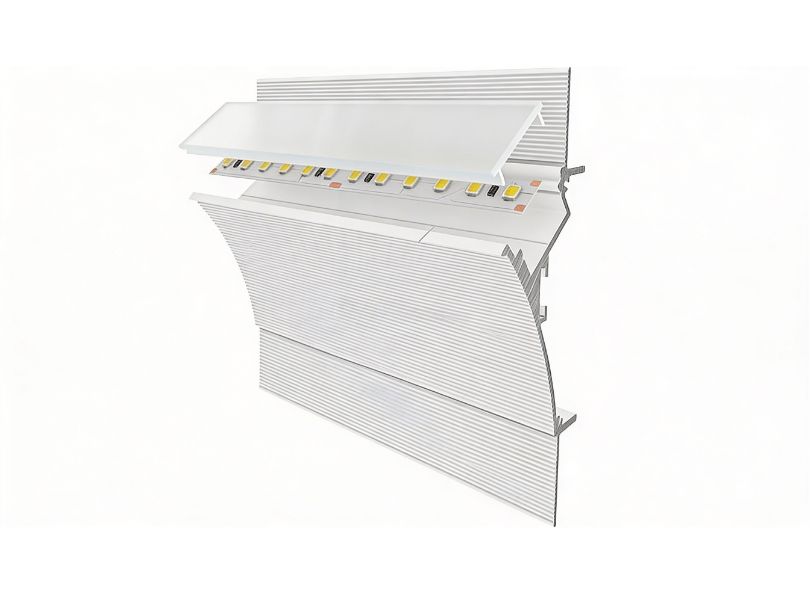
Installation tips for surface RGBW runs
The installation quality of a surface profile run has an enormous impact on the final result with RGBW strips. Here are the most important practical points from our installation experience:
Continuity of the run is critical. For RGBW colour-mixing to work consistently, the profile must form a continuous, uninterrupted channel. Any gap between adjacent profile sections (even a small one) will create a bright spot or colour anomaly. When joining sections, use the proper joining clips or internal connectors designed for the profile series, not DIY solutions. Clean cut ends are essential; use a proper aluminium mitre saw, not a hacksaw, for clean results.
Strip adhesion and alignment. The RGBW strip must sit flat in the profile’s mounting channel, with the strip centerline aligned with the profile centerline. A strip that sits at an angle to the profile axis will produce a colour gradient across the diffuser width. Use the three-dimensional adhesive tape that comes with the strip, and press the full length firmly into the channel before applying power.
For higher-power RGBW strips (above about 12 W/m), consider applying a thin line of thermal interface paste between the strip substrate and the profile mounting channel before installation. This dramatically improves heat transfer and helps maintain colour consistency over long operation periods. For lower-power strips (under 10 W/m) the adhesive tape alone is generally adequate.
Common mistakes with surface profiles and RGBW
We’ve catalogued the most frequent errors we see in the field. Some of these are embarrassingly basic but they keep coming up, so it’s worth listing them explicitly.
The first, and most common, is choosing a profile based on price per metre rather than on optical suitability for the strip. A cheap, shallow profile with a transparent diffuser costs less than a deeper profile with an opal cover, but it will look terrible with an RGBW strip. The labour cost of installation is identical, and the difference in material cost is usually a few euros per metre. The cost of a client complaint, a remedial visit, and a reputational hit is very much larger.
The second common mistake is running RGBW strips in profiles designed for single-colour strips. Many profiles in the market are designed with a narrow internal channel that centres a single-colour strip perfectly but doesn’t provide enough lateral clearance for the wider colour-mixing zone of an RGBW strip. Check that the internal width of the profile is adequate for your strip width plus a few millimetres of clearance on each side.
Third: ignoring end cap specification. End caps for RGBW profiles should ideally be the same colour and finish as the diffuser face — a silver aluminium end cap on a white-diffuser profile looks amateurish and draws attention to the fixture in a way that ruins the clean linear effect you’re trying to achieve.
Recessed LED profiles for RGBW installations
While surface-mounted profiles openly assert their architectural presence, recessed profiles follow the opposite path: that of fading, total integration, and light that seems to emerge from the material itself. In many contemporary interior design projects, this is the most sought-after option, yet also the most challenging to achieve. Disappearing the light source while maintaining the chromatic quality and uniformity of the beam requires in-depth knowledge not only of LED strips, but also of construction techniques and the structural constraints of the spaces in which one works. In this chapter, we’ll explore the specifics of recessed profiles for RGBW installations, the challenges inherent in limited depth, and the solutions available to achieve the timeless look that only perfectly integrated lighting can provide.
When to choose a recessed profile
A recessed LED profile is installed flush with or below the surrounding surface typically set into a slot cut in a ceiling, wall panel, or floor. The diffuser, when the profile is correctly installed, sits level with the surface plane, creating the impression that the light emerges directly from the surface itself. This is the aesthetic choice that defines a significant portion of high-end contemporary interior design: the seamless, architectural “light from the surface” look that you see in premium hotels, luxury residential projects, and top-tier retail environments.
For dynamic RGBW applications, recessed profiles present a specific challenge: the depth available is limited by the ceiling or wall construction. A standard plasterboard ceiling, for instance, offers only about 12–13 mm of depth before you’re into the structure. This is often not enough for good RGBW colour mixing with a 60 or 120-LED/m strip and an opal diffuser. There are several strategies for dealing with this constraint, and we’ll cover them in detail.
Despite the installation challenge, recessed RGBW profiles are exceptionally popular in hospitality and high-end residential design because the visual result, when done correctly, is extraordinarily beautiful. A recessed RGBW cove or linear feature that appears to glow from within the surface, with no visible fixture, no hardware, no shadow line — just pure, seamless coloured light — is one of the most arresting effects in contemporary architecture. It’s worth the extra effort to get it right.
Drywall and plaster profiles
Drywall (also called gypsum board or plasterboard) profiles deserve special mention in the context of RGBW dynamic lighting because they represent the ultimate expression of the invisible fixture aesthetic. A drywall profile is designed to be embedded in the plasterboard and then plastered over, leaving only the diffuser slot visible — and in some designs, even the diffuser can be given a skim coat of plaster to make it effectively invisible until illuminated. The profile body is completely hidden within the structure.
Lightingline offers drywall profiles specifically designed for this installation method. The critical consideration for RGBW use with drywall profiles is that the diffuser is generally fixed and not easily replaceable once the plaster has been applied, so getting the diffuser specification right at the design stage is essential. We cannot overstate this: a client who discovers after plastering that their beautiful new cove produces visible colour dots because the wrong diffuser was specified is not a happy client, and the remedial work is expensive and disruptive.
For drywall RGBW installations, our recommendation is always to use 240-LED/m strips and opal diffusers. The higher strip density provides excellent intrinsic colour mixing, and the opal diffuser provides the additional scattering that compensates for the limited depth available in most drywall applications. Do not try to save money on the strip density in a drywall application — the access restrictions make future remediation extremely costly.
Installation tips for recessed RGBW profiles
Recessed profiles require more careful planning than surface profiles. The slot in the ceiling or wall must be cut to precise dimensions: too wide and the profile will move or require filling around it, too narrow and it won’t seat properly. Always check the profile datasheet for the exact routing dimensions required, and use these dimensions for the slot, not the external dimensions of the profile body (which are larger).
Ensure the back of the slot provides a flat, even surface for the profile to rest against. In plasterboard applications, this usually means cutting cleanly and ensuring no raised fibres or paper edge protrudes into the slot. In concrete or masonry applications, use appropriate fixings rated for the substrate. Avoid using expanding foam to fill gaps around the profile — this creates a thermal barrier that will cause overheating. Use a compatible filler or leave a small air gap.
Wiring for recessed RGBW profiles should be routed through the building structure before the profile is installed. RGBW strips require 4-conductor wiring (one per channel) plus a common return, for a minimum of 5 conductors (or, in practice, a common negative conductor with 4 PWM-switched positive conductors). Make sure your in-wall wiring has adequate conductor count. Many installers who are used to single-colour strips run only 2-conductor cable in the wall and then discover at installation time that they can’t connect an RGBW strip.
Corner, wall and suspension profiles for dynamic lighting
Beyond the fundamental surface-mount and recessed categories, Lightingline.eu offers several additional profile types that are particularly relevant for dynamic RGBW installations. Each addresses a specific architectural situation where standard surface or recessed profiles would either not fit or not produce the desired visual effect.
Corner profiles for RGBW edge and accent lighting
Corner profiles are designed to be mounted at the junction of two surfaces, typically at the junction of a wall and ceiling (cove position) or at an internal corner of a room. They’re available in both 45° and 90° variants. For RGBW dynamic lighting, corner profiles are one of the most visually effective options available: installed at ceiling/wall junctions, they produce a soft, colour-variable glow that appears to come from the architectural junction itself rather than from any visible fixture. This is an extremely popular look in contemporary hotel bedroom and bar design.
The optical characteristics of corner profiles for RGBW use depend strongly on whether the profile is directing the strip’s output upward (towards the ceiling), downward (wall wash), or at 45° (both directions equally). For ceiling wash applications, the depth available within the corner profile is generally adequate for good colour mixing with 120-LED/m RGBW strips, the angled walls of the corner profile provide additional reflective bounces that supplement the mixing distance. For 60-LED/m strips in corner profiles, use opal or frosted diffusers.
Wall profiles — vertical linear lighting with RGBW
Wall profiles are surface-mount profiles specifically designed for vertical installation on wall surfaces. Their geometry is typically optimised to direct light in a specific direction (upward, downward, or both) and to manage the asymmetric optical requirements of wall-mounted linear light. For RGBW use, wall profiles can be used to create dramatic colour-washed wall effects, running a vertical RGBW wall profile at intervals along a feature wall and programming them to cycle through slow colour transitions creates an effect that’s somewhere between a colour-wash luminaire and a piece of kinetic art.
The key consideration for wall-mounted RGBW profiles is glare management. A wall profile at eye height that uses a transparent diffuser and a 60-LED/m RGBW strip will look directly into the viewer’s eye line, making the individual chips clearly visible and potentially causing discomfort. Use opal diffusers for all wall-height RGBW installations. This is non-negotiable from both an aesthetic and a comfort standpoint.
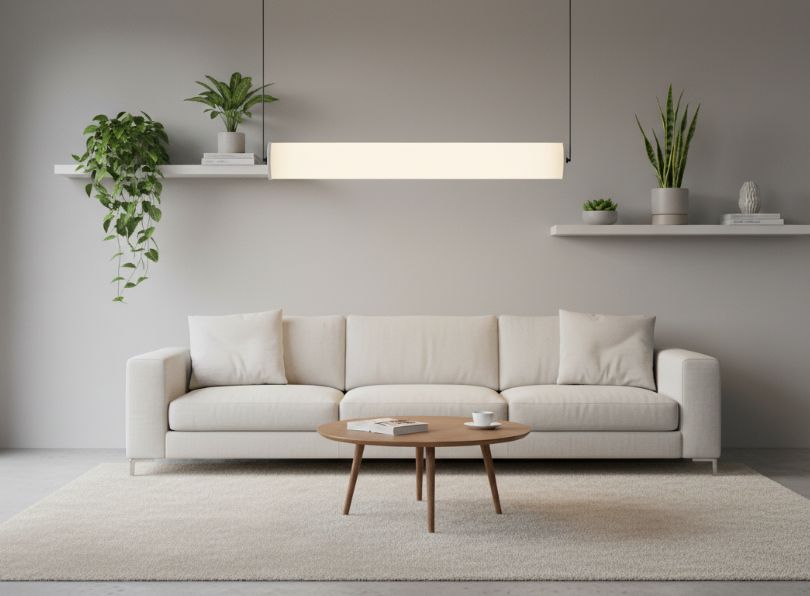
Suspension profiles for RGBW pendant lighting
Suspension profiles hang from the ceiling on cables or rods, creating linear pendant lighting. They’re very popular in commercial and hospitality settings, restaurant dining rooms, open-plan office spaces, reception areas. For RGBW applications, suspension profiles offer some unique possibilities: because they’re suspended in free space, they can emit light both downward and upward simultaneously (with appropriate bi-directional profiles), allowing a single RGBW installation to provide both ambient ceiling-wash and task illumination with variable colour temperatures.
The structural design of suspension profiles is more demanding than surface or recessed types, they must support their own weight plus the weight of the strip, wiring and diffuser, and must be rigid enough not to sag over long spans. Lightingline’s suspension profile range addresses this with appropriately reinforced aluminium extrusions and a purpose-designed suspension kit system. For RGBW suspension applications, always use the correct suspension kit for the profile — do not attempt to rig custom suspension from the profile end caps or diffuser clips, as this creates stress concentration points that can cause long-term structural failure.
Round and special section profiles
Lightingline also offers round-section profiles, circular or oval aluminium extrusions that house LED strips and produce a 360° or controlled-arc light output. For RGBW dynamic lighting, round profiles are used most commonly in decorative applications: standalone pendant elements, architectural column wrapping, or freestanding design objects. The circular section is particularly effective at mixing RGBW colours because the curved internal wall provides multiple reflection angles, improving colour blending relative to flat-sided profiles of the same depth. If you need maximum RGBW colour mixing in a limited depth, for example in a tight furniture application, a round or oval profile with opal diffuser is worth considering even if the round form isn’t an aesthetic requirement.
Eliminating visible segmentation
We’ve analyzed the physics of chips, the thermal importance of aluminum profiles, and the differences between surface-mounted and recessed installations. We’ve seen how every design choice influences final color rendering. But if there’s a point where all these variables converge and reveal themselves, it’s precisely in the ability to eliminate visible segmentation. This is the moment of truth for any RGBW installation: when we turn on the strip, the viewer must see color, not components.
They must perceive a continuous, enveloping emission, free of those unsightly spots or streaks that betray the discrete nature of the LED source. In this final chapter, we’ll systematize all the strategies discussed, delving into the causes of segmentation and offering a definitive guide to choosing the minimum depth and diffuser. Because only when the light becomes uniform does the project reach its full expressive maturity.
What causes visible segmentation, exactly?
Visible segmentation in RGBW lighting is the perception of individual light sources, individual LEDs, or even individual chips within a single LED, rather than a uniform, continuous light output. It manifests in several ways: as a dotted pattern along the strip when all channels are lit at the same level and as alternating coloured stripes along the strip when producing colours that require different channel levels, as a colour fringe at the edges of the light output, or as a visible colour shift across the width of the profile (wider in the centre than at the edges). Each of these manifestations has a specific cause and a specific solution.
The dotted pattern is primarily caused by insufficient strip density, not enough LEDs per metre for the given viewing distance and profile depth. The alternating colour stripes are caused by inadequate optical mixing of the individual colour channels, the R, G, B and W outputs are not blending before reaching the diffuser. The edge colour fringe is caused by the angle-dependent emission of the LED chips, light at the edges of the strip reaches the diffuser at a different angle than light from the centre, and if the diffuser isn’t dense enough to scatter this directional information away, the edge appears differently coloured. The width colour shift is a similar effect but across the profile width rather than the strip length.
The minimum mixing distance rule
We introduced the concept of minimum mixing distance (MMD) earlier. The MMD is the minimum air-column depth within the profile required for the R, G, B and W outputs to mix adequately before reaching the diffuser. But here’s something that isn’t always made clear: the MMD is not a binary threshold. It’s not the case that below the MMD you have visible segmentation and above it you don’t, it’s a gradient. At exactly the MMD for your specific strip, diffuser and brightness level, you might have acceptable uniformity when looking directly at the luminaire face but visible colour variation when viewing at an oblique angle. At 1.5× the MMD, uniformity is typically very good from all practical viewing angles.
This means that specifying the minimum adequate profile depth is risky, real installations have variability in strip manufacturing, profile tolerance, and diffuser batch consistency. We recommend specifying at 1.3–1.5× the theoretical minimum. For a 120-LED/m RGBW strip requiring nominally 15 mm depth, specify a 20–22 mm internal depth profile. The cost difference is marginal; the reliability improvement is meaningful.
Diffuser selection for RGBW
Here we’ll go deeper on the interaction between diffuser properties and RGBW colour mixing performance.
The key property of a diffuser for RGBW mixing purposes is its Haze factor, the fraction of transmitted light that is scattered more than 2.5° from the specular direction. A transparent cover has a haze factor near zero. A sandblasted diffuser has a haze factor approaching 100%. For RGBW colour mixing, you want a haze factor of at least 85–90% for 60-LED/m strips, and at least 70% for 120-LED/m strips. For 240-LED/m strips in profiles of adequate depth, a haze factor of 50–60% is generally sufficient.
The Lightingline diffuser range covers the full haze spectrum from transparent to sandblasted, with semiopal and opal options in between. When in doubt, ask the Lightingline technical team for the specific haze data for the diffuser options compatible with your chosen profile — this information is available and is far more useful than generic descriptions like “opal” or “sandblasted,” which can vary considerably between manufacturers.
Strip density, COB strips and the density revolution
The advent of COB (Chip on Board) technology in LED strips has been genuinely transformative for RGBW dynamic lighting. In a COB strip, instead of individual discrete LED packages mounted on a PCB at regular intervals, hundreds or thousands of very small LED chips are bonded directly to the substrate in a near-continuous array, encapsulated under a single thin phosphor layer. The result is a strip where the light source is effectively continuous, there are no gaps between emitters, no individual dots visible at any practical viewing distance.
COB RGBW strips, which are now increasingly available, though still at a significant price premium over standard SMD RGBW, represent the most powerful tool available for achieving seamless colour mixing without the need for either extreme profile depth or heavy diffusers. With a COB RGBW strip, even a relatively transparent diffuser in a shallow profile can produce impressively uniform colour output, because the mixing happens at the chip level rather than in the optical path.
For specifiers and installers, the arrival of COB RGBW opens up applications that were previously very difficult: shallow recessed profiles (where depth for optical mixing is limited), ultra-slim furniture integrated lighting, and very long continuous runs where the cumulative consistency of colour output matters. We expect COB RGBW to become the dominant technology for architectural dynamic lighting within the next 5–7 years, as prices continue to fall and the quality of RGBW COB products improves.
COB vs SMD RGBW strip comparison
Combining profile depth and diffuser type
Rather than thinking about profile depth and diffuser type as independent choices, think of them as a two-dimensional optimisation problem. For any given strip density and target colour uniformity, you can trade off between profile depth and diffuser haze factor while more depth allows a lighter diffuser (preserving light output). More diffuser haze allows a shallower profile (simplifying installation). The optimum point depends on your project constraints.
In a hotel cove application where the profile is completely hidden and light output isn’t the primary concern, use maximum depth and heavy diffuser for best colour quality. In a retail display application where the profile is visible and maximum brightness is important, use a deeper profile and lighter diffuser, compensating with higher LED density. In a drywall application where depth is constrained by structure, use high-density RGBW strips and accept a denser diffuser. These aren’t rigid rules — they’re a framework for thinking about the trade-offs in a structured way.
Controllers, drivers and dimming for RGBW systems
So far, we’ve discussed light, color, materials, and optics. We’ve explored how the right profile can make or break the performance of an RGBW strip. But there’s another player, often invisible but equally crucial, that deserves a chapter of its own: the control system. No matter how perfect the physical installation, no matter how carefully chosen the diffuser and depth, without quality electronics, the end result will still be disappointing. Controllers, drivers, and communication protocols are the brains of the operation: they manage color mixing, smooth transitions, precise dimming, and, in professional contexts, integration with other building systems. In this chapter, we’ll clarify the technical differences between PWM and CCT, the importance of gamma correction, and the most common professional control protocols, to help designers and installers make informed, forward-thinking choices.
WM vs CCT dimming for RGBW
Almost all RGBW LED strip dimming is done using PWM — Pulse Width Modulation. The controller switches each channel (R, G, B, W) on and off at a high frequency (typically 400 Hz to 20 kHz), varying the duty cycle (the fraction of time the channel is on) to control perceived brightness. At high enough switching frequencies, generally above 1 kHz, the flicker is imperceptible to the human eye and doesn’t appear on video cameras. At lower frequencies (particularly the 50 Hz range), flicker can be uncomfortable and will be visible as banding in video footage. Always check the PWM frequency specification of any controller before use in an RGBW installation; 1 kHz minimum is a good practical threshold.
One subtlety of PWM dimming that’s particularly relevant for RGBW systems is gamma correction. The human eye perceives brightness logarithmically, not linearly. A PWM duty cycle of 50% doesn’t look half as bright, it looks considerably brighter than half. Most quality RGBW controllers apply gamma correction curves to their PWM output, so that a slider or knob at the midpoint of its range produces a perceptually mid-brightness output. Controllers without gamma correction will produce poor low-end dimming performance, the light will appear to jump from “off” to “quite bright” over a small portion of the control range, with no useful gradation at low levels. Check for gamma correction in controller specifications; it’s frequently absent in cheap consumer-grade units.
DALI, DMX, KNX, Zigbee and Matter for professional RGBW
The choice of control protocol for a professional RGBW installation is one of the most consequential design decisions, and it’s one that is frequently made too late, often after the profile and strip have already been specified, at which point the wiring infrastructure may not be adequate for the chosen protocol. Here’s a brief guide to the main options:
DMX512: the standard protocol for theatrical and entertainment lighting. A single DMX universe can control 512 channels. For RGBW strips, each strip segment requires 4 channels (one per colour channel), so a single DMX universe can in principle drive 128 independently controllable RGBW zones. DMX is a wired protocol using standard EIA-485 bus topology and is extremely reliable. It’s the correct choice for any installation that requires complex, programmed colour sequences, or where the lighting is part of a larger AV or theatrical system. The main limitation for architectural applications is that the DMX addressing and control infrastructure requires specialist knowledge and custom programming.
DALI-2 / DT8: the Digital Addressable Lighting Interface, specifically the DT8 device type which includes colour control, is the standard for architectural and building automation RGBW control. DALI is a two-wire, polarity-independent bus that can control up to 64 devices per bus segment, with multiple buses supported by a DALI gateway. DALI is particularly well suited to projects that integrate lighting into a broader building management system (BMS) because it uses standardised device profiles and is compatible with a wide range of BMS platforms. DALI-2 (the current generation) also supports bi-directional communication, meaning drivers can report their status, fault conditions and energy consumption back to the system.
KNX: an European-dominant building automation standard used extensively in high-end residential and commercial projects. KNX isn’t specifically a lighting protocol, it’s a general-purpose building automation bus, but KNX-compatible RGBW actuators are widely available and allow RGBW lighting to be integrated with HVAC, blinds, access control and other building systems in a single unified system. For luxury residential projects in Europe, KNX is often the default choice.
Zigbee / Matter: these are mesh network wireless protocols that have become the basis for most contemporary smart home RGBW systems (Philips Hue, IKEA TRÅDFRI, Amazon Echo-linked systems, Apple HomeKit, etc.). Matter, developed jointly by Apple, Google, Amazon and the Connectivity Standards Alliance, aims to provide a common interoperability layer across these platforms. For residential RGBW installations, Zigbee and Matter-based systems offer excellent usability and app integration, with reasonable reliability in typical residential environments. They’re not typically appropriate for large commercial or hospitality installations where reliability, scalability and professional-grade control are required.
Tunable white and circadian rhythm lighting
One of the most important and rapidly growing applications of RGBW dynamic lighting is circadian rhythm support and adjusting the colour temperature and intensity of interior lighting to align with the body’s natural biological clock. The science behind this is solid: the intrinsically photosensitive retinal ganglion cells (ipRGCs) in the human eye are most sensitive to short-wavelength (blue) light around 480 nm, and their stimulation regulates the production of melatonin — the hormone that controls sleep-wake cycles. High blue-content light (cool white, >5000K) suppresses melatonin and promotes alertness, low blue-content light (warm white, <3000K) has minimal effect on melatonin and supports the transition to sleep.
An RGBW dynamic lighting system, properly specified and controlled, can support circadian health by automatically adjusting colour temperature throughout the day: cool and energising in the morning, neutral and focused during work hours, warm and relaxing in the evening. This is now a standard specification requirement in healthcare facilities, offices, hotels, and (increasingly) premium residential projects. The “Human Centric Lighting” (HCL) designation is applied to products and systems that specifically support circadian rhythm function.
For RGBW systems to function effectively in HCL applications, the quality of the white channel is critical. The white LED in the RGBW strip must have a high CRI (≥90) and a well-defined, consistent colour temperature, both of which require careful strip selection and good thermal management through the aluminium profile. This is another reason why the profile choice matters even for applications that are primarily focused on the control system rather than the fixture aesthetics.
Smartphone and voice control — practical integration
For residential and small commercial RGBW installations, smartphone and voice control have become the default user interface expectation. Clients who spend significant money on a dynamic RGBW installation expect to be able to control it from their phone, ideally through an app that integrates with their existing smart home ecosystem (Apple HomeKit, Google Home, Amazon Alexa).
The integration pathway from an RGBW strip in an aluminium profile to a smartphone involves several components: the RGBW driver (which steps down mains voltage to the DC voltage required by the strip), the RGBW controller (which produces the PWM signals for each channel), and a gateway or hub (which connects the controller to the home network and exposes it to the smartphone app or voice assistant). In some modern products, the driver, controller and gateway are integrated into a single device, simplifying installation considerably. In professional installations, these functions are typically separate, giving the lighting designer more flexibility in specification.
Our practical advice for residential RGBW installations: choose a control ecosystem and commit to it from the start of the project. The temptation to mix different protocol controllers, a KNX actuator here, a Zigbee controller there, a DMX driver in the entertainment room, is understandable but creates a fragmented user experience and makes future system expansion much more difficult. Choose one ecosystem, configure it correctly, and explain clearly to the client how to use it. A perfectly specified and installed RGBW profile system that the client doesn’t know how to control is a wasted investment.
RGBW dynamic lighting in interior design applications
After exploring physics, thermals, optics, and electronics, it’s time to answer the question that underpins every project: how does all this translate into design practice? Because, ultimately, technology isn’t an end in itself: it’s a tool at the service of architecture and the emotions a space conveys. In this chapter, we’ll let real-world applications speak for themselves. We’ll see how dynamic RGBW lighting performs in different domestic contexts, from the living room to the kitchen, from the bedroom to the bathroom, and how it’s becoming a strategic element in the hospitality industry, where light is an integral part of the customer experience. Through concrete examples and targeted technical guidance, we’ll discover how profile, strip, and control choices adapt to the specific needs of each space, respecting the fundamental principle that guides every good project: the quality of light can be felt, not seen.
Residential: living rooms, kitchens, bedrooms
In residential settings, dynamic RGBW lighting is used across three broad categories: ambient lighting (creating the overall mood of a space), accent lighting (highlighting architectural features, artwork or furniture), and task lighting (providing functional illumination for cooking, working or reading). RGBW dynamic systems are most transformative in the ambient category, where the ability to shift colour temperature and saturation fundamentally changes the perceived character of a space from hour to hour.
In living rooms, the standard approach is to install RGBW strips in recessed coves (using recessed or drywall profiles from the Lightingline range) that illuminate the ceiling, with a secondary layer of surface or wall-profile-mounted warm-white strips for supplementary task lighting that is separately controlled. This two-layer approach gives the occupant maximum flexibility: in the evening, the RGBW coves might be set to a very warm, low-intensity amber, while the task strips over the reading area are bright and neutral.
In kitchens, RGBW strips in aluminium profiles are used primarily under cabinets and inside open shelving. The under-cabinet application is demanding from a colour-mixing standpoint because the strip is close to the work surface and visible from most positions in the kitchen. For this reason, we always recommend 240-LED/m RGBW strips and opal diffusers in surface profiles for under-cabinet kitchen applications. The temptation to use cheaper 60-LED/m strips to save cost almost always results in visible hotspots and colour dots on the work surface — exactly where you least want them.
In bedrooms, RGBW cove lighting is increasingly specified with circadian control profiles: warm amber at bedtime (1800–2200K, low blue content), neutral white in the morning (3000–4000K), and the ability to switch to a relaxing coloured mode (soft lavender, warm rose) for mood lighting. The aluminium profile choice for bedroom coves is typically recessed or drywall, for the invisible-fixture aesthetic that works so well in sleeping environments where you don’t want any light sources visible when the lamps are off.
Hospitality: hotels, restaurants, bars
Hospitality is the application domain where dynamic RGBW lighting has made the most dramatic impact. The ability to transform a space through lighting colour, to create an intimate, candlelit atmosphere at dinner and then a bright, energetic ambience for cocktail hour , is extraordinarily powerful in environments where the emotional experience of the guest is the product being sold.
For hotel applications, RGBW profiles are specified in virtually every zone: lobbies (typically using large-section surface or suspension profiles with recessed wall profiles for accent elements), corridors (typically using narrow recessed floor-level or low-wall profiles), guest rooms (cove and under-furniture), and bathrooms (cove and mirror surrounds).
Restaurant lighting is perhaps the most technically demanding RGBW application because the human face (the most important object in any social dining environment) is rendered very differently under different RGBW settings. A warm RGBW scene (red and white channels dominant, green and blue minimal) renders skin tones beautifully and creates an intimate, flattering atmosphere. A neutral-white RGBW scene is functional but less flattering. A blue-heavy or green-heavy RGBW scene renders skin tones very poorly and creates a clinical or uncomfortable feel. Restaurant lighting designers specify RGBW systems not to use the full colour range, but to navigate precisely within the warm white region (varying from 2700K to 3500K) with the occasional coloured accent element that complements the brand identity.
Retail and commercial spaces
In retail lighting, dynamic RGBW has two distinct roles. The first is brand identity: flagship stores increasingly use RGBW to reinforce brand colour, shifting store lighting to align with the brand palette at key commercial moments (product launches, seasonal campaigns). This is most effective when done subtly, a very slight shift in ambient colour temperature or a barely perceptible colour tint in the accent lighting, rather than the dramatic colour changes that might work in a nightclub but feel alarming in a clothing store.
The second role of RGBW in retail is product colour rendering optimisation. Different product categories benefit from different colour rendering characteristics: fresh food looks best under high-CRI warm white with boosted red rendering (sometimes called “TM-30 saturating” light), jewellery and watches look best under high-CRI cool white with strong blue rendering for sparkle, fashion and apparel benefits from a neutral white that renders both warm skin tones and cool fabric colours accurately. An RGBW system, properly calibrated, can shift its white-point output to optimise rendering for different product zones within the same store.
Healthcare: circadian and therapeutic lighting
Healthcare is one of the fastest-growing application domains for dynamic RGBW lighting, driven by an expanding body of evidence that lighting quality significantly affects patient recovery, staff wellbeing, and operational efficiency in healthcare settings. The specific requirements of healthcare RGBW installations differ significantly from hospitality or residential applications:
First, reliability is non-negotiable. A dynamic lighting system in a hospital ward cannot afford failures or unexpected colour shifts, the clinical environment requires consistent, predictable light quality. This places particular emphasis on thermal management (to maintain colour consistency) and on the quality of components throughout the system. The aluminium profile is fundamental here with good strip-to-substrate thermal contact will maintain consistent colour output across thousands of hours of operation in a way that a poorly-specified plastic channel cannot.
Second, colour accuracy is critical. Medical examination requires accurate colour rendering (CRI ≥95 for examination lighting). Circadian support lighting requires precise spectral control of blue content. These requirements place high demands on the white channel of the RGBW strip and on the system calibration.
Third profiles in clinical environments must have smooth external surfaces that can be wiped down with hospital-grade disinfectants.
Museums and galleries
Museums and galleries present one of the most technically demanding RGBW lighting applications: the illumination of artworks with dynamic lighting that can adjust to the specific requirements of different works, support conservation goals (by controlling blue light exposure to light-sensitive pigments), and create immersive environments for experiential exhibitions. This is an application where the profile choice has a particularly direct impact on the quality of the visual outcome.
For gallery accent lighting using RGBW profiles, the critical requirements are high CRI (≥95), precise colour control (Delta E < 2 under any scene setting), and excellent colour uniformity (critical for illuminating flat artworks uniformly). These requirements typically mean specifying 240-LED/m RGBW strips with phosphor-converted white chips of the highest quality, in deep surface or recessed profiles with opal diffusers, driven by DALI-2 controllers with hardware colour calibration. The Lightingline architectural surface profile range is well suited to this application.
Energy efficiency and sustainability of dynamic LED systems
The energy efficiency credentials of dynamic RGBW LED systems are often misunderstood, sometimes overstated, sometimes understated. Let’s look at the numbers clearly.
A well-specified RGBW LED strip operating at full white output (all channels at maximum) will typically consume 10–20 W/m depending on the product. A typical 5-metre cove installation with a medium-power strip consumes roughly 75–100 W, equivalent to a single incandescent lamp of modest wattage. Over the course of a year, at 8 hours per day of operation, this represents roughly 200–300 kWh — a very modest electricity consumption for a feature that transforms an entire room.
The comparison with previous-generation colour-change technologies is even more favourable. Pre-LED colour-change systems used metal halide or fluorescent sources with colour gels, consuming 300–400 W for equivalent light output, with lamp replacement every 3,000–6,000 hours. The energy saving of a modern RGBW LED system relative to these older technologies is 70–85% — a genuinely transformative improvement.
Sustainability — RGBW LED vs previous technologies
The aluminium used in LED profiles is itself a highly sustainable material choice, aluminium is indefinitely recyclable without quality degradation, and the recycling process requires only about 5% of the energy needed to produce primary aluminium from bauxite ore. A Lightingline aluminium profile removed from service after 20+ years of use will be recyclable and can contribute to new aluminium products. This circular economy characteristic is one of the reasons that aluminium profiles are increasingly specified by sustainability-conscious architects and building owners.
One often-overlooked aspect of RGBW system energy performance is the smart control dividend: systems with intelligent occupancy sensing, daylight integration and circadian scheduling typically operate at 30–50% of their maximum power level on average. A 100W RGBW installation with smart dimming and scheduling may average only 35–50 W of actual consumption, dramatically improving the effective energy performance relative to the nameplate figure.
Dinamyc lights: profile first!
About the authors
This article was written by the technical and commercial team at Lightingline.eu, specialists in aluminium profiles and LED strips for architectural lighting applications. Lightingline has been active in the LED lighting sector for over a decade, combining Italian design heritage with manufacturing in China and distribution across Europe. Their portfolio of aluminium profiles — from compact furniture channels to large architectural cove profiles — is tested in-house using a professional goniophotometer in their dark room facility. For technical support, product specification, or custom profile enquiries, it’s possible contact the Lightingline team via their website.