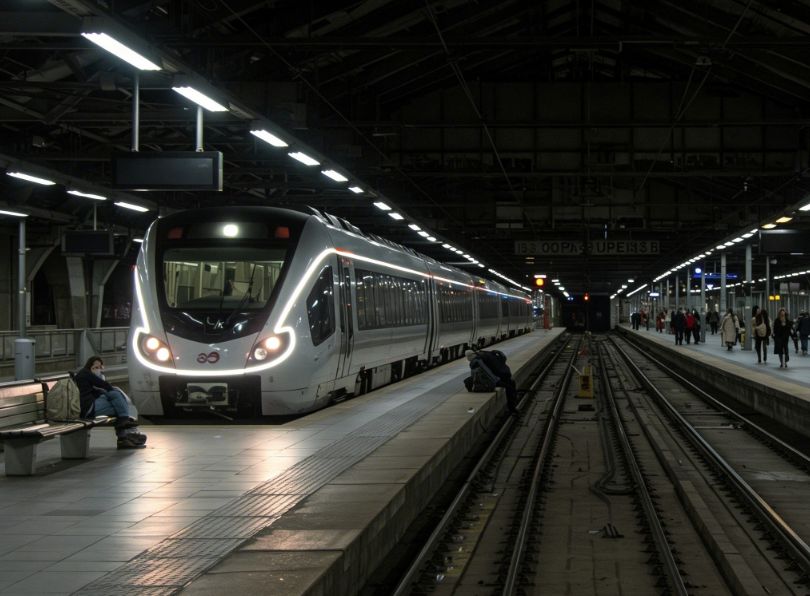
Railway lighting represents one of the most demanding environments for lighting systems. Vibrations transmitted through rails and car bodies, extreme temperature variations from –40°C to +85°C, voltage fluctuations in onboard networks, and strict fire safety regulations (EN 45545) impose technical requirements far beyond standard architectural lighting. For decades, the sector relied on fluorescent tubes and halogen sources, but the transition to LED technology has opened unprecedented possibilities – provided that the mechanical and thermal integration is solved correctly.
This is where LED profiles become critical components, not accessories. A bare strip mounted directly on a train ceiling will fail prematurely . The right profile acts as a structural element: it dissipates heat, dampens vibration, ensures fire safety, and guarantees that the lighting system outlasts the maintenance cycles.
This article examines every aspect of railway lighting design, from aluminum alloy selection to fastening systems and thermal simulation. Whether it’s the interior lighting of a high-speed train, the platform lighting of a subway station, or emergency lighting in a train tunnel, aluminum profiles are always essential for a successful installation.
In this articles…
Thermal simulation example: R8 profile
| LED strip power | Ambient temperature | Max. temp. (bare strip) | Max. temp. (in R8 profile) | Lifetime improvement |
|---|---|---|---|---|
| 15 W/m | 40°C | 78°C | 54°C | +210% L70 |
| 24 W/m | 45°C | 92°C | 63°C | +180% L70 |
| 36 W/m | 50°C | 110°C (failure risk) | 71°C | Prevents failure |
Fire safety and smoke toxicity compliance
Railway applications are subject to the strictest fire safety regulations in the world. EN 45545-2 defines the requirements for materials used in railway vehicles, classifying them into hazard levels (HL1, HL2, HL3) based on the vehicle type and operation. For lighting profiles, three parameters are critical: flame spread, smoke density, and toxicity of combustion gases. Standard anodized aluminum profiles, being inorganic, meet the highest requirements (HL3) for flame spread and smoke emission. However, the diffusers and end caps, typically made of polycarbonate or PMMA, must be specifically certified. The silicone gaskets used for IP sealing must be for low smoke emission (FST – Fire Smoke Toxicity compliant). When specifying profiles for rolling stock, always request the material certificates and test reports for the complete assembly (profile + cover + gaskets).
Installation systems: fixing LED profiles in railway environments
The method used to attach LED profiles to railway structures (ceilings, walls, floors, canopies, tunnels) is as important as the profile itself. An incorrectly fixed profile will transmit vibrations, can become a projectile in case of crash, and may not guarantee electrical continuity for grounding.
Surface mounting with anti-vibration clips
For retrofitting existing station carriages or ceilings, surface mounting is the most common solution. Standard mounting clips, however, are not suitable for railway use because they allow for micro-movements that cause noise and wear. The clip also allows for thermal expansion of the aluminum profile, which can be significant in tunnels where temperatures fluctuate rapidly.
Recessed mounting with spring clips
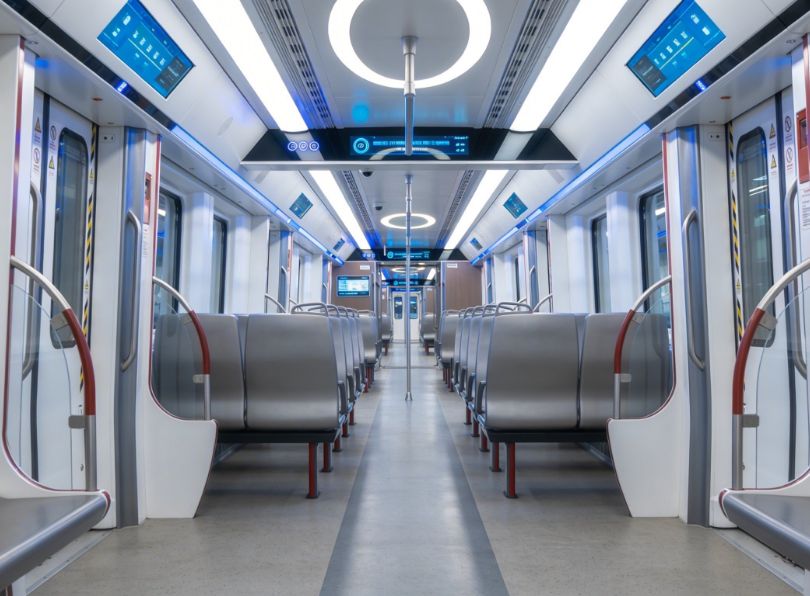
Modern trains and architectural stations require integrated, flush-mounted lighting. Recessed installation requires profiles that can be securely fastened into the openings while still allowing for removal for maintenance. The clips are designed with a locking mechanism that prevents accidental movement due to vibration, but also allows for deliberate release with a suitable tool. For fire-rated ceilings (station mezzanines), the profiles can be combined with dedicated strips to maintain the structure’s fire resistance. The installation depth and clearance above the ceiling must be carefully calculated to accommodate the driver and wiring, in compliance with railway electrical regulations (EN 50155 for rolling stock).
Illuminating the rails
Lighting the edges of platforms and trackbeds presents unique challenges: exposure to rain, snow, deicing salts, and the aerodynamic effects of passing trains. Waterproof profiles are designed for trackside installation, featuring a low profile to minimize wind loads and a mounting bracket resistant to corrosive environments. The profiles are mounted at a slight downward angle to illuminate the railhead, minimizing glare for train drivers. Wiring is routed through galvanized steel conduits integrated into the trackbed, with waterproof cable glands at the profile entry points.
Installation method comparison table
| Mounting type | Typical application | Profile series | Vibration resistance | IP rating |
|---|---|---|---|---|
| Surface clips | Carriage ceiling, station canopy | RV4, RV6, RV8 | EN 61373 Cat 1 | IP20/IP54 |
| Recessed spring | Flush ceiling, wall niches | RFR12, RFR20 | EN 61373 Cat 2 | IP20/IP40 |
| Magnetic | Inspection pits, workshops | RM40, RM60 | Not primary fix | IP67 |
| Track bracket | Platform edge, sleeper mounting | RTS30, RTS45 | EN 61373 Cat 3 | IP66/IP69K |
Railway lighting: standards
Compliance with European and international standards is not optional in railway lighting. It is a legal requirement and a precondition for safety approval. The following standards are the most relevant for LED profile selection and installation.
EN 45545-2 – Fire protection on railway vehicles
This is the most critical standard for materials used inside trains. It defines test methods and requirements for flammability, smoke density, and toxicity. For lighting profiles, the requirements are primarily in the R22 (interior lighting) and R23 (exterior lighting) categories. Railway profiles are tested: the test reports cover the aluminum profile (non-combustible), the polycarbonate cover and the silicone gaskets. Always request the full test report, not just a declaration.
EN 50155 – Electronic equipment for rolling stock
EN 50155 covers the electrical, environmental, and durability requirements for electronic equipment on trains. Although primarily aimed at electronic boards, it applies to LED drivers and, by extension, to the complete lighting assembly. Key requirements include: supply voltage variations (from 0.7 to 1.25 times nominal), temperature withstand (-40°C to +70°C), humidity (up to 95%), and vibration (EN 61373). Lightingline profiles, when combined with suitable drivers, help meet these requirements by providing mechanical protection and thermal management. The standard also requires documentation of the entire design process, from risk assessment to validation testing.
EN 61373 – Shock and vibration testing
This standard specifies shock and vibration tests for railway equipment. It defines three categories: body-mounted (Category 1), bogie-mounted (Category 2), and axle-mounted (Category 3). Most interior lighting falls into Category 1, which requires random vibration testing on three axes for 5 hours per axle, followed by shock pulses of 30 ms duration and 30 m/s² amplitude. Lighting line profiles are tested with LED strips and covers assembled, demonstrating no component loosening or optical misalignment after the entire test cycle.
EN 60529 – Degrees of protection
IP ratings are critical for railway applications exposed to humidity and dust. For platform lighting, IP65 is the minimum, while for carriage lighting, IP67 or IP69K (high-pressure cleaning) is required. Please note that the IP rating applies to the assembled profile, including covers and end caps, not just the extrusion.
Circular economy and sustainability
Rail operators require products that are easily recyclable at the end of their life. Aluminum profiles are inherently recyclable, but component separation (cover, gasket, PCB) must be considered. Clip-on cover systems allow for non-destructive disassembly, allowing the aluminum extrusion to be reused in new projects.
Engineering excellence for railway lighting
Railway lighting is a specialized discipline that demands a deep understanding of mechanical engineering, thermal physics, materials science, and regulatory frameworks. LED profiles, far from being simple housings, are critical components that determine the success or failure of a railway lighting installation. From the choice of alloy and wall thickness to the design of mounting brackets and gaskets, every detail matters.
Railway lighting must be able to offer:
- mechanical integrity: profiles that withstand vibration and shock without fatigue;
- thermal performance: heat dissipation that ensures LED lifetime meets project requirements;
- fire safety: certified materials for the highest hazard levels (HL3);
- installation versatility: fixing systems for every railway application, from train ceilings to trackside;
- future-proofing: designs that accommodate IoT integration and circular economy principles.
Per i progettisti di illuminazione, gli ingegneri ferroviari e i gestori delle infrastrutture, la scelta del profilo LED è una decisione che incide sulla sicurezza, sui costi operativi e sul comfort dei passeggeri per decenni.
Railway lighting: not just a question of lights
Railway lighting is a specialized discipline that requires in-depth knowledge of mechanical engineering, thermal physics, materials science, and regulatory frameworks. LED profiles, far from being mere housings, are critical components that determine the success or failure of a railway lighting installation. From the choice of alloy and wall thickness to the design of mounting brackets and gaskets, every detail matters. There are projects where a seemingly insignificant oversight (such as using a standard clip instead of an anti-vibration one) can lead to complete system failure after just 18 months of service. This isn’t just a costly repair: it’s a safety risk and reputational damage.
We now know the basics of a good railway lighting installation:
– mechanical integrity: it’s not optional; the profiles must withstand vibrations according to EN61373 without difficulty;
– thermal performance: it’s the silent killer; an 8°C difference in the LED junction can save their life;
– fire safety (EN45545 HL3): requires certified materials for the entire assembly, not just aluminum;
– installation versatility: it’s important whether surface-mounted, recessed, magnetic, or on-track; one system rarely fits all.
Future-proofing means designing for IoT, Li-Fi, and the circular economy now.