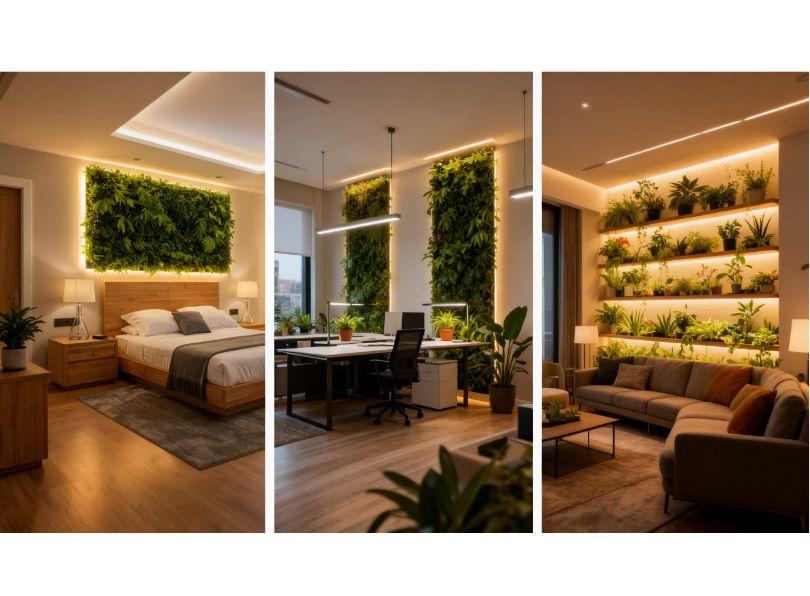
Against this backdrop, biophilic design, and particularly biophilic design lighting, has emerged not as a stylistic trend but as a substantive, evidence-based response to a genuine human need. Today, the average person in industrialised countries spends between 87% and 93% of their time indoors, often under static, spectrally impoverished artificial lighting that delivers little more than visual adequacy. The consequences , disrupted circadian rhythms, elevated stress hormones, reduced immune function, diminished focus, and a diffuse but pervasive sense of disconnection from the natural world, are increasingly well-documented by neuroscience, chronobiology, and environmental psychology.
Throughout billions of years of biological evolution, light has been the primary environmental signal shaping life on Earth. From the first photosynthetic cyanobacteria to the intricate visual systems of modern mammals, the rhythms of solar illumination have calibrated almost every biological process: hormonal cycles, sleep architecture, mood regulation, immune response, and cognitive performance. For Homo sapiens, who spent 99.9% of evolutionary history outdoors under a sky that shifted imperceptibly from the red warmth of dawn through the cool blue zenith of noon to the amber softness of dusk, artificial light indoors represents a radical and very recent disruption of an ancient biological contract.
This comprehensive guide explores the theoretical foundations, practical principles, and cutting-edge technological implementations of biophilic design lighting, with special attention to the role that led aluminium profiles and high-performance led strips play as the structural and photometric backbone of biomimicry lighting systems. Whether you are an architect designing a healthcare facility, an interior designer transforming a residential space, an HR manager seeking to improve employee wellbeing in an office, or a sustainability consultant advising corporate clients, this article provides the depth and specificity you need to understand, specify, and communicate the value of nature-inspired lighting.
- Biophilic design lighting: light as the original nature connection
- What is biophilia? The science behind the human-nature bond
- Biophilic design: definition, origins and theoretical framework
- The six principles of biophilic design explained
- Biophilic design elements: a comprehensive taxonomy
- What is biomimicry? From nature to architecture and lighting
- Biomimicry lighting: definitions, examples and products
- Why led profiles are the backbone of biophilic lighting
- Solar-spectrum led strips: sunlike and circadian care technology
- Tunable white and smart control: the dynamic heart of biophilic lighting
- Daylight harvesting and automation in biophilic systems
- Biophilic design applications: offices, homes, hospitals, schools
- Biophilic architecture: buildings that breathe
- Biophilic interior design: practical strategies
- Biophilic design home: transforming residential spaces
- Biophilic design office space: wellbeing and productivity
- Biophilic design in hospitals: healing environments
- Benefits of biophilic design: research, data and market statistics
- Biophilic design and ADHD: neurodiversity and natural light
- Challenges, criticisms and the greenwashing question
- Biophilic design course and professional certification
- Future trends: innovation, technology and the next frontier
- Product guide: led profiles and strips for biophilic lighting
- Your questions
- Technical implementation guide: specifying a complete biophilic led lighting system
- Extended applications: retail, hospitality, education and wellness
- Biophilic interior design: advanced strategies for the professional
- Biophilic design, mental health and the neuroscience of natural light
- Led profiles, led strips, and the future of biophilic lighting
Biophilic design lighting: light as the original nature connection
Throughout billions of years of biological evolution, light has been the primary environmental signal shaping life on Earth. From the first photosynthetic cyanobacteria to the intricate visual systems of modern mammals, the rhythms of solar illumination have calibrated almost every biological process: hormonal cycles, sleep architecture, mood regulation, immune response, and cognitive performance. For Homo sapiens, who spent 99.9% of evolutionary history outdoors under a sky that shifted imperceptibly from the red warmth of dawn through the cool blue zenith of noon to the amber softness of dusk, artificial light indoors represents a radical and very recent disruption of an ancient biological contract.
Today, the average person in industrialised countries spends between 87% and 93% of their time indoors, often under static, spectrally impoverished artificial lighting that delivers little more than visual adequacy. The consequences, disrupted circadian rhythms, elevated stress hormones, reduced immune function, diminished focus, and a diffuse but pervasive sense of disconnection from the natural world, are increasingly well-documented by neuroscience, chronobiology, and environmental psychology. Against this backdrop, biophilic design, and particularly biophilic design lighting, has emerged not as a stylistic trend but as a substantive, evidence-based response to a genuine human need.
This comprehensive guide explores the theoretical foundations, practical principles, and cutting-edge technological implementations of biophilic design lighting, with special attention to the role that led aluminium profiles and high-performance led strips play as the structural and photometric backbone of biomimicry lighting systems. Whether you are an architect designing a healthcare facility, an interior designer transforming a residential space, an HR manager seeking to improve employee wellbeing in an office, or a sustainability consultant advising corporate clients, this article provides the depth and specificity you need to understand, specify, and communicate the value of nature-inspired lighting.
The scale of the opportunity
The global biophilic design market was valued at approximately USD 1.2 billion in 2023 and is projected to reach USD 7.4 billion by 2032, growing at a compound annual growth rate (CAGR) of approximately 22.4%, according to industry analysis by Allied Market Research and Straits Research. The biomimicry lighting segment, while smaller and more nascent, is one of the fastest-growing niches within architectural lighting, driven by the convergence of three powerful forces: advances in led technology that for the first time permit genuine solar-spectrum reproduction; growing scientific consensus on the health impacts of light quality; and a cultural shift towards sustainability, authenticity, and wellbeing in architecture and interior design.
| Metric | Value | Source / Notes |
|---|---|---|
| Market size (2023) | USD 1.2 billion | Allied Market Research, 2024 |
| Projected market size (2032) | USD 7.4 billion | Straits Research, 2024 |
| CAGR (2024–2032) | ~22.4% | Multiple analysts, consensus estimate |
| % adults in industrialised nations spending >87% of time indoors | 93% | EPA (US), National Human Activity Pattern Survey |
| Productivity improvement in biophilic offices | +8% to +15% | World Green Building Council, 2014; Terrapin Bright Green, 2014 |
| Patient recovery acceleration in biophilic healthcare | 8.5% shorter stays | Roger Ulrich, 1984; multiple replications |
| Reduction in absenteeism (biophilic workplaces) | Up to -15% | Interface Corporation research, 2015 |
| Premium consumers pay for biophilic features (residential) | +5% to +12% | JLL, Savills real estate research, 2022 |
Led technology is the enabling infrastructure that makes economically viable, large-scale biophilic lighting possible. Where incandescent lamps approximated warmth but lacked spectral accuracy, and fluorescents offered efficiency but poor colour rendering, modern led strips with CRI >95 using Sunlike phosphor technology, housed in slim aluminium profiles, can reproduce the solar spectrum with fidelity that was simply impossible a decade ago. The architectural consequence is transformative: light can now be engineered to behave like nature, and the channel through which this transformation occurs is the LED profile.
What is biophilia? The science behind the human-nature bond
Before examining how biophilic design manifests in built environments and lighting systems, it is essential to understand the biological and psychological foundations from which it springs. The concept of biophilia, a term that translates literally from Greek as “love of life”, represents one of the most compelling ideas to emerge from 20th-century evolutionary biology and environmental psychology, with profound implications for how we design the spaces in which we live, work, heal, and learn.
The biophilia hypothesis: Wilson, Kellert and the evolutionary argument
The term biophilia was popularised by the American biologist Edward O. Wilson in his landmark 1984 book Biophilia, in which he proposed that humans possess an innate, genetically encoded tendency to affiliate with other living organisms and natural systems. Wilson’s argument was evolutionary: our ancestors spent approximately 300,000 years as Homo sapiens, and several million years before that as hominids, in direct, daily, intimate contact with the natural world. The savannah, forest, riverine, and coastal environments in which early humans evolved were not merely backdrops but active, information-rich ecosystems upon which survival depended. Reading subtle cues in vegetation, light, water, animal behaviour, and weather was a matter of life or death.
The neural architecture that evolved to process and respond to natural stimuli has not been redesigned by 200 years of industrialisation or 50 years of digital technology. Our brains remain, in fundamental respects, the brains of creatures adapted to natural environments. When deprived of natural stimuli (genuine sunlight, organic forms, living organisms, natural soundscapes, the smell of earth and rain) the human nervous system does not thrive. It merely copes, often with measurable physiological cost.
Stephen Kellert, the Yale professor of social ecology who became the leading theorist of biophilic design, expanded Wilson’s hypothesis into a framework of nine values of biophilia that describe the specific ways in which humans derive meaning, sustenance, and wellbeing from nature:
| Value | Description | Lighting design implication |
|---|---|---|
| Utilitarian | Nature as a material resource for survival and wellbeing | Lighting that supports biological function: circadian health, visual comfort, vitamin D metabolism |
| Naturalistic | Pleasure derived from contact with natural settings | Soft, dynamic lighting evoking outdoor environments, dappled light effects |
| Ecologistic-scientific | Curiosity, reverence and study of nature’s complexity | Lighting that reveals material textures and natural forms, museum-quality colour rendering |
| Aesthetic | Beauty found in natural forms and patterns | Light that enhances organic forms, living walls, wood grain, stone, water features |
| Symbolic | Nature in language, myth, metaphor and culture | Lighting schemes referencing sunrise/sunset, forest canopy, water reflections |
| Humanistic | Deep emotional bonds with specific natural species and places | Personalised, dynamic lighting connected to personal biorhythms and outdoor light conditions |
| Moralistic | Ethical responsibility towards nature and conservation | Energy-efficient led systems, dark-sky compliant external lighting |
| Dominionistic | Mastery and control of nature | Smart lighting control systems that allow personalised management of light quality |
| Negativistic | Fear, awe and alienation from nature | Avoiding harsh, cold, institutional lighting that amplifies stress responses |
Biophilia and neuroscience: what happens in the brain
Neuroscientific research has added considerable empirical weight to Wilson’s evolutionary hypothesis. Studies using functional MRI and EEG have demonstrated that exposure to natural scenes, compared with urban or artificial environments, produces measurably different patterns of neural activation. Key findings include different response, let’s see which ones.
Reduced amygdala activation (the brain’s primary threat-detection centre) in response to natural environments compared with built environments, suggesting that nature intrinsically reduces the physiological stress response. Research published in the Proceedings of the National Academy of Sciences (2015) showed that a 90-minute walk in a natural setting significantly reduced rumination, a key risk factor for depression, and decreased neural activity in the subgenual prefrontal cortex, an area associated with mental illness.
Increased parasympathetic nervous system activity (the “rest and digest” mode) in response to natural light patterns and organic forms, evidenced by decreased heart rate, reduced cortisol levels, and lowered skin conductance. Research by Dr. Roger Ulrich at Chalmers University (2002) demonstrated that patients in hospital rooms with a window view of nature had significantly lower post-operative pain medication requirements, shorter stays, and better mood outcomes than those with views of a brick wall.
The intrinsically photosensitive retinal ganglion cells (ipRGCs) photoreceptors discovered in 2002 that are separate from the rods and cones used for vision, are particularly relevant to biophilic lighting. These cells, which project directly to the suprachiasmatic nucleus (SCN) of the hypothalamus, the master circadian pacemaker are maximally sensitive to short-wavelength blue light (peak sensitivity approximately 480 nm) and respond to both the intensity and spectral composition of light to synchronise the body clock. Natural light, with its dynamic spectral shift from blue-rich morning light to warm-rich evening light, provides the ideal zeitgeber (time-giver) for circadian entrainment. Static indoor lighting, particularly office fluorescents with fixed colour temperature and no dynamic variation, provides no such cue, leading to circadian drift and its associated pathologies.
Biophilic design definition: from hypothesis to practice
Understanding what is biophilia at the neurobiological level provides the scientific grounding for the design discipline that seeks to address the nature-deficit: biophilic design. In the next section, we examine how this discipline is defined, what theoretical framework it employs, and where it sits relative to related approaches such as green architecture, sustainable design, and biomimicry.
Biophilic design: definition, origins and theoretical framework
Biophilic design is an evidence-based design approach that deliberately incorporates opportunities for human connection with the natural world into the planning, architecture, interiors, and operational systems of built environments. The biophilic design definition, as established by Kellert, Heerwagen, and Mador in the seminal 2008 volume Biophilic design: the theory, science and practice of bringing buildings to life, encompasses three core dimensions: direct experience of nature, indirect experience of nature, and the experience of space and place. These dimensions are operationalised through a taxonomy of biophilic design elements that range from the integration of natural light and ventilation to the use of organic forms, natural materials, and ecological processes within buildings.
“Biophilic design is not about decorating spaces with plants or pictures of nature. It is about creating environments that satisfy the deep human need for contact with the natural world, and doing so in ways that are functional, scientifically grounded, and aesthetically resolved.”
Biophilic design vs green architecture: a critical distinction
One of the most common conceptual confusions in the field concerns the difference between biophilic design and green architecture. Green architecture, sustainable design, and environmental building certifications (LEED, BREEAM, WELL, DGNB) primarily address the environmental performance of buildings: energy efficiency, material sustainability, water management, and reduced carbon footprint. A building can achieve LEED Platinum certification without providing any meaningful connection to nature for its occupants.
Biophilic design is anthropocentric in a specific sense: it prioritises the human experience of nature, not the environmental performance of the building. A green building with sealed windows, static led lighting, no living plants, and no views of the outdoors may be highly sustainable but profoundly non-biophilic. Conversely, a biophilic interior (one that incorporates daylight simulation, living walls, water features, natural materials, and organic forms) can dramatically improve occupant wellbeing even without achieving peak energy efficiency. The ideal, of course, is a convergence of the two: buildings that are both environmentally responsible and deeply connected to the natural experience of their occupants. This is precisely the space that high-performance led lighting systems are uniquely positioned to occupy, since they are simultaneously the most energy-efficient general illumination technology available and, through sunlike and tunable white led strips, the most sophisticated tool available for biophilic light design.
Is biophilic design a theory or a practice?
The question “is biophilic design a theory?” merits a nuanced answer. Biophilic design is both: it is grounded in a body of theoretical literature spanning evolutionary biology, environmental psychology, neuroscience, and architectural theory, and it is also a practical design methodology with specific principles, elements, and measurable outcomes. The theoretical foundations are well-established and peer-reviewed; the practical applications are diverse, context-dependent, and continue to evolve with advances in materials science, digital fabrication, and lighting technology.
The origins of biophilic design in architectural history
While the term biophilic design is relatively recent, the instinct to bring nature into buildings is ancient. Roman impluvium gardens, Japanese engawa (transitional indoor-outdoor spaces), Persian paradise gardens, and Gothic cathedral windows that flood interiors with coloured light all reflect an intuitive understanding that built environments must maintain a connection to the natural world to feel inhabitable and nourishing. The 20th century, with its emphasis on industrial efficiency, sealed buildings, and artificial climate control, largely severed this connection. The backlash, initially expressed through the organic architecture of Frank Lloyd Wright, later through the living buildings movement, and most recently through the evidence-based rigour of biophilic design, represents an ongoing effort to restore it.
Key figures in the development of biophilic design theory and practice include: E.O. Wilson (biophilia hypothesis), Stephen Kellert (biophilic design theory, 14 patterns framework), Roger Ulrich (evidence-based design in healthcare), Judith Heerwagen (workplace applications), Timothy Beatley (biophilic cities — Singapore is often cited as the world’s leading example of a biophilic city); and more recently researchers such as Lisa Heschong (daylighting and school performance) and Mariana Figueiro (circadian lighting in healthcare).
| Year | Development | Significance |
|---|---|---|
| 1973 | E.O. Wilson coins “biophilia” | First scientific articulation of the human-nature bond |
| 1984 | Wilson publishes Biophilia | Full theoretical exposition; inspires design applications |
| 1984 | Roger Ulrich’s hospital window study | First empirical evidence of biophilic design’s health impact |
| 1993 | Kellert & Wilson: The Biophilia Hypothesis | Academic synthesis establishing biophilia’s scientific standing |
| 1999 | Terrapin Bright Green founded | First major consultancy dedicated to biophilic design |
| 2008 | Kellert, Heerwagen, Mador: Biophilic Design | Definitive practical framework for architects and designers |
| 2011 | WELL Building Standard development begins | Codification of biophilic and wellbeing principles in certification |
| 2014 | Terrapin’s “14 Patterns of Biophilic Design” | Most widely adopted practical taxonomy for design applications |
| 2018 | Singapore’s Gardens by the Bay wins global recognition | Landmark demonstration of urban-scale biophilic design |
| 2020s | Sunlike & circadian led technology matures | Enables genuine solar-spectrum biophilic lighting at scale |
The six principles of biophilic design explained
While various frameworks exist, the six principles of biophilic design most widely referenced in professional practice synthesise the approaches of Kellert, Ryan, and the Terrapin Bright Green 14 Patterns framework into an operationally useful structure for architects, interior designers, and lighting specifiers. Understanding these principles is essential to designing lighting systems that are genuinely biophilic rather than merely decorative. Each principle has direct implications for how led profiles and strips should be specified, positioned, and controlled.
Principle 1: direct experience of nature
The most powerful biophilic intervention is the provision of genuine contact with natural elements: natural light, fresh air, plants, water, earth, and animals. In lighting design, this principle translates directly into maximising and optimising access to daylight, using glazing, light shelves, reflective surfaces, and solar tubes to bring sunlight deep into building interiors. Where daylight is insufficient, it must be supplemented, not merely replaced, with artificial light of the highest possible spectral fidelity.
Led strips with CRI >97 (Sunlike technology) are the current state of the art for this application. Housed in low-profile aluminium extrusions and positioned at ceiling level, along window reveals, or in cove details, they can produce a quality of light that is genuinely difficult to distinguish from daylight by casual observation, while dynamic tunable white control allows the correlated colour temperature (CCT) to track the solar cycle from 2700K at dawn to 5000–6500K at zenith.
Principle 2: indirect experience of nature
Indirect experience of nature encompasses the use of natural materials, organic patterns and forms, imagery of nature, natural colours, and simulated natural processes. In the lighting domain, this principle is expressed through luminaire design that references natural forms (leaf structures, water surfaces, bioluminescent organisms, forest canopies), through lighting effects that evoke natural phenomena (the dappled light through a forest canopy, the caustic patterns of light reflected off water, the gradient from bright horizon to shaded ground), and through the integration of light with natural materials such as timber, stone, and living vegetation to reveal their inherent beauty.
Led strips mounted within aluminium profiles are the ideal technology for indirect biophilic lighting effects. A cove profile recessed behind a curved timber ceiling batten can produce an uplight that washes the ceiling in a warm, natural-feeling glow. A led strip positioned behind a living wall illuminates the plants from behind, creating the visual impression of light filtering through vegetation, a profoundly calming effect well-documented in environmental psychology literature.
Principle 3: space and place conditions
The third principle addresses the spatial and psychological qualities that characterise the most restorative natural environments: prospect (open views that allow surveillance), refuge (enclosed, sheltered spaces), mystery (partially concealed information that invites exploration), peril (controlled, safe exposure to risk). These qualities, identified by environmental psychologist Jay Appleton in his 1975 “prospect-refuge theory”, are deeply ingrained in the human spatial preference system.
Lighting plays a critical role in creating these conditions. High luminance at the ceiling (prospect) with lower luminance at the occupied level (refuge) creates the psychological comfort of a sheltered position with a bright view, analogous to the experience of sitting under a tree with a view of a sunlit meadow. This can be achieved precisely with led strips in concealed profiles that produce an indirect uplight, brightening the ceiling while leaving the occupied zone in softer, lower-luminance light.
Principle 4: natural shapes and forms
The fourth principle concerns the integration of biomorphic forms and patterns, shapes that reference organic structures found in nature: the fractal branching of trees, the spiral of a shell, the hexagonal packing of honeycomb, the sinuous curves of rivers and root systems. These forms, studied extensively in the context of fractal dimension analysis, consistently produce lower stress and higher aesthetic preference than geometric or rectilinear forms in both laboratory and real-world settings.
In lighting design, this principle manifests in two ways: in the design of luminaires that reference natural forms (biomimicry lamp design, addressed in detail in Section 7), and in the use of light to emphasise and reveal the natural forms within materials and surfaces. A high-CRI led strip grazing across a rough stone wall, a timber-panelled ceiling, or a living moss installation renders the organic texture, colour variation, and three-dimensionality of those materials with an accuracy that no lower-CRI light source can match.
Principle 5: natural patterns and processes
Perhaps the most technologically demanding of the six principles, the fifth addresses the importance of dynamic variation, sensory richness, and temporal change. In nature, nothing is static: light shifts from moment to moment as clouds pass, seasons progress, and the sun traces its arc. Temperature oscillates diurnally. Sounds vary with wind, weather, and the activity of living organisms. The human nervous system, evolved in this environment of perpetual, patterned change, finds static artificial environments deeply unsatisfying at a sub-conscious level, even when those environments meet all basic functional requirements.
Dynamic biophilic lighting, the use of tunable white led systems programmed to shift CCT and intensity throughout the day in accordance with the solar cycle, directly addresses this principle. Smart controllers with “biorhythm” functions can automate this variation so that the lighting environment provides genuine circadian cues without requiring manual management. The result is an indoor light environment that behaves like an intelligent window onto the sky, biophilic in the deepest sense of the word.
Principle 6: evolved human-nature relationships
The sixth principle encompasses the full range of experiential and cultural connections between humans and the natural world, including the sense of wonder, curiosity, reverence, and emotional resonance that exceptional encounters with nature provoke. In design terms, this principle is addressed through the creation of spaces that tell stories about nature, that evoke specific places (a forest clearing, a coastal cave, a mountain meadow), and that engage the full range of human senses in experiencing a nature-inspired environment.
Lighting can contribute to this narrative dimension in powerful ways: a programmable lighting installation that recreates the aurora borealis on a curved ceiling, an underwater-inspired led installation in a SPA pool area, or a branching led profile system in a hotel lobby that references the canopy of a forest at dusk, all of these engage the imagination and the emotion in ways that transcend pure functionality and approach the genuinely biophilic.
Biophilic design elements: a comprehensive taxonomy
While the six principles provide a theoretical framework, biophilic design elements are the specific, actionable components through which biophilic design is physically realised in built environments. The most widely referenced taxonomy in professional practice is Terrapin Bright Green’s “14 Patterns of Biophilic Design”, published in 2014 by Bill Browning, Catherine Ryan, and Joseph Clancy. This framework organises biophilic design elements into three categories: nature in the space, natural analogues, and nature of the space.
| # | Pattern | Category | Lighting design application |
|---|---|---|---|
| 1 | Visual connection with nature | Nature in the space | Windows and skylights, led systems that illuminate indoor gardens, living walls, or nature views |
| 2 | Non-visual connection with nature | Nature in the space | Dynamic lighting that triggers auditory, thermal, and olfactory cues (integrated environmental systems) |
| 3 | Non-rhythmic sensory stimuli | Nature in the space | Subtle, stochastic light variation programmed into smart led controllers |
| 4 | Thermal & airflow variability | Nature in the space | Warm/cool CCT variation coordinated with HVAC thermal cycling |
| 5 | Presence of water | Nature in the space | Led strips creating caustic light effects on water features, underwater lighting |
| 6 | Dynamic & diffuse light | Nature in the space | Tunable white led strips in concealed profiles, daylight harvesting sensors |
| 7 | Connection with natural systems | Nature in the space | Circadian-programmed lighting tied to real sunrise/sunset data for the location |
| 8 | Biomorphic forms & patterns | Natural analogues | Led profiles shaped to reference organic forms, fractal led installations |
| 9 | Material connection with nature | Natural analogues | High-CRI leds (CRI >93) that accurately render natural materials: wood, stone, plant life |
| 10 | Complexity & order | Natural analogues | Layered lighting schemes with multiple sources creating visual depth and organised complexity |
| 11 | Prospect | Nature of the space | High ceiling luminance (cove lighting, uplight) creating visual openness and expansiveness |
| 12 | Refuge | Nature of the space | Lower ambient light in enclosed alcoves and under canopies, reading nook lighting |
| 13 | Mystery | Nature of the space | Partially lit corridors, lit artwork receding into shadow, light gradients that invite movement |
| 14 | Risk/peril | Nature of the space | Dramatic contrast lighting, edge lighting along elevated walkways, theatrical lighting effects |
The 70/30 rule in biophilic interior design
A practical guideline that often appears in biophilic interior design practice is the 70/30 rule: the principle that at least 70% of surfaces, materials, and design elements in a biophilic space should reference natural forms, textures, or processes, while up to 30% may be geometric or architectural. In lighting terms, this suggests that the majority of light in a biophilic interior should be indirect, soft, and biomorphically distributed rather than delivered from hard-edged, geometric downlights or rectilinear fluorescent fittings. Led strips in concealed aluminium profiles are the primary tool for achieving this proportion, as they enable the delivery of large quantities of light in forms that are architecturally integrated, glare-free, and directionally flexible.
The five senses of biophilic design
A complementary framework focuses on the five senses as the channels through which biophilic experience is delivered. While the visual sense is dominant in most lighting discussions, a fully realised biophilic design engages all five:
- sight: natural light quality (CRI, CCT, dynamism), views of nature, natural colours and textures.
- sound: water features, natural ventilation, acoustic materials that absorb or diffuse rather than reflect.
- touch: warmth of natural materials (wood, stone, leather, wool) thermal variability that references outdoor conditions.
- smell: plants, natural wood, fresh air.
- taste: less directly relevant to building design, though herb gardens and natural food environments are increasingly featured in biophilic workplace and hospitality design.
Of these five sensory channels, lighting technology and specifically high-CRI led strips in biophilic led profiles, has the greatest impact on the visual channel and a significant secondary impact on the thermal channel through CCT modulation (warmer light feels physically warmer; cooler light feels more alert and energising).
What is biomimicry? From nature to architecture and lighting
The term biomimicry, derived from the Greek bios (life) and mimesis (to imitate), describes a design philosophy and engineering methodology in which solutions to human challenges are derived from the study and emulation of biological strategies, structures, and processes refined by approximately 3.8 billion years of evolution.
What is biomimicry? In its most precise definition, biomimicry is the conscious, systematic imitation of nature’s designs to solve human problems. It differs from mere nature-inspired design in its rigour: where nature-inspired design draws freely on natural aesthetics and forms, biomimicry seeks to understand the underlying functional principles of natural systems and apply those principles to human technology.
Biomimicry definition and historical context
The modern concept of biomimicry was comprehensively articulated by Janine Benyus in her 1997 book Biomimicry: innovation inspired by nature, which provided both a philosophical framework and numerous examples of biomimicry in engineering and product design. Benyus identified nine principles that characterise nature’s design philosophy: nature runs on sunlight, uses only the energy it needs, fits form to function, recycles everything, rewards cooperation, banks on diversity, demands local expertise, curbs excesses from within, and taps the power of limits. These principles are strikingly aligned with the best practices of sustainable architecture and lighting design.
The biomimetic meaning in design contexts thus encompasses both the formal emulation of natural shapes and structures (a building facade that mimics the self-shading scales of a pine cone, a led diffuser that replicates the light-scattering microstructure of a moth’s eye) and the functional emulation of natural processes (a lighting system that mimics the circadian variation of solar illumination; a cooling system that replicates the passive evaporative cooling of termite mounds).
Examples of biomimicry in architecture and product design
Some of the most celebrated examples of biomimicry in contemporary architecture and product design illustrate the breadth and sophistication of the approach:
| Application | Natural model | Functional principle |
|---|---|---|
| Eastgate Centre, Harare (Mick Pearce, 1996) | Termite mounds | Passive ventilation and thermal regulation without HVAC |
| Lotus Effect coatings (Sto, StoCoat Lotusan) | Lotus leaf | Superhydrophobic self-cleaning surfaces |
| Moth-eye anti-reflection led optics | Moth compound eye | Near-zero reflectance light transmission enhancement |
| Shinkansen bullet train nose | Kingfisher beak | Pressure wave reduction, energy efficiency, noise reduction |
| Bioluminescent led luminaires | Fireflies, deep-sea organisms | Cold, efficient, spectral light production |
| Fibonacci-pattern solar panels | Phyllotaxis (plant spiral patterns) | 40% improved energy yield vs flat arrays |
| Velcro | Burdock burr hooks | Mechanical reversible fastening |
| Sharkskin swimwear (Speedo Fastskin) | Shark dermal denticles | Drag reduction through turbulence management |
| Voronoi led diffuser panels | Insect wing venation, dragonfly wings | Maximum structural efficiency with minimal material |
Biomimicry facts: the economic and environmental case
The economic potential of biomimicry is staggering. A 2013 study by the Fermanian Business and Economic Institute estimated that biomimicry-inspired innovations had already generated USD 1.5 trillion in economic value globally, with the potential to grow to USD 100 billion annually within a decade. The environmental case is equally compelling: biomimicry products and processes consistently demonstrate superior resource efficiency, reduced toxicity, and better end-of-life recyclability than conventional engineering solutions, because natural systems have been optimised over billions of years to perform functions with the minimum possible input of energy and materials. This resonates powerfully with the sustainability imperatives driving contemporary architecture and the led lighting industry.
Bio-inspired vs biomimetic: a terminological clarification
A useful terminological distinction exists between bio-inspired design (which freely draws on natural aesthetics and general concepts without rigorous functional analysis) and biomimetic design (which involves systematic study of biological mechanisms and their precise translation into engineered solutions). Most biomimicry lighting products currently on the market are more accurately described as bio-inspired: they reference natural forms and colour qualities without necessarily replicating the precise quantum-optical mechanisms of natural light production. However, the most advanced Sunlike led technology, which reproduces the solar spectral power distribution by carefully engineering the phosphor layer to eliminate the blue-light spike characteristic of conventional white leds, represents a genuine case of biomimetic photon engineering, nature’s light, replicated by human technology.
Biomimicry lighting: definitions, examples and products
Biomimicry lighting represents the application of biomimetic principles to the design, specification, and implementation of artificial lighting systems. It encompasses two distinct but complementary dimensions: photometric biomimicry, the reproduction of natural light quality, dynamics, and spectral characteristics through advanced led technology, and formal biomimicry, the design of luminaires and lighting installations whose form, structure, or optical behaviour references biological models. Together, these dimensions define a new category of lighting design that is simultaneously functionally superior, aesthetically distinctive, and philosophically aligned with the growing imperative to reconnect built environments with the natural world.
Photometric biomimicry: replicating the spectral quality of sunlight
The most scientifically significant dimension of biomimicry lighting is the reproduction of the solar spectral power distribution (SPD). Natural sunlight is a broadband radiation source whose spectral composition shifts continuously throughout the day: blue-enriched, high-CCT light in the morning and around midday, progressively warmer, red-enriched, low-CCT light in the afternoon and evening. This variation is the primary environmental signal by which the human circadian system maintains synchronisation with the 24-hour light-dark cycle.
Conventional white leds produce light through a blue-pumped phosphor conversion mechanism that creates a characteristic spectral “spike” in the 450–460 nm blue region, even in warm-white variants. This blue spike, while invisible to conscious perception, activates the ipRGC photoreceptors and their downstream circadian pathways more strongly than equivalent natural warm light. The result is circadian disruption: warm office lighting that activates alertness pathways when relaxation and melatonin onset are biologically appropriate, and cool daylight leds that may excessively suppress melatonin during morning hours when the natural solar spectrum would not yet have reached its blue-light peak.
Sunlike led technology, developed by Seoul Semiconductor and ROG, addresses this problem by using a violet-pump led with a carefully engineered phosphor mixture that fills in the blue trough and produces a smooth, continuous spectrum closely matching the solar SPD. The result is a CRI of >97 (compared with 80–90 for standard leds) and a spectral profile that the human visual and circadian system responds to as it would to natural sunlight, hence the designation “Sunlike”.
Product Reference — Sunlike LED Strip:
The F52-30s-x1288H2/13 Sunlike LED strip delivers CRI >97 with a spectral power distribution that virtually eliminates the conventional blue spike, producing light with exceptional colour fidelity across the full visible spectrum. Ideal for biophilic design applications requiring the highest quality daylight simulation, including art galleries, healthcare environments, premium residential spaces, and any setting where accurate colour rendering and human biological comfort are paramount.
Circadian care led technology: lighting tuned to human biology
A second category of biomimicry led strip technology is Circadian Care, which combines high CRI with tunable white capability to enable the dynamic variation of CCT throughout the day. These strips, available in both standard led and COB (Chip on Board) configurations, are specifically engineered for applications where supporting the human circadian rhythm is a primary design objective: healthcare environments, educational institutions, workplace interiors, and any space where people spend prolonged periods and where their biological wellbeing is a design consideration.
Product reference — Circadian care led strips:
The circadian care led strips are engineered for human-centric lighting applications. With tunable CCT capability from 2700K to 6500K and CRI >90, they integrate with smart controllers to provide automatic day-night spectral cycling that supports melatonin regulation, alertness optimisation, and sleep quality improvement.
COB technology: the organic light line
Within the led strip technology landscape, COB (Chip on Board) represents a significant advance for biophilic lighting applications. Standard LED strips produce light from discrete, individually spaced led chips, creating a visible dotted effect that is fundamentally artificial in character. Nature does not produce light from discrete point sources arranged at regular intervals: natural light is diffuse, continuous, and organically distributed. COB led strips eliminate the dot effect by placing multiple bare die chips in a continuous phosphor line, producing a luminous surface that appears as a single, uninterrupted ribbon of light. This creates a much more natural-feeling light source when viewed directly — particularly important for applications where the led strip is partially visible, such as in deep-reveal profiles or behind translucent diffusers.
Product Reference — COB led strip:
The F52-270-480OR2-W10 COB led strip provides a continuous, homogeneous light line free of the conventional dotted led appearance. The COB technology delivers smooth, organic illumination ideal for cove profiles, under-shelf applications, and any biophilic installation where the visible light quality must reference the continuity and softness of natural light. Available in various colour temperatures and CRI ratings to suit specific biophilic design requirements.
Formal biomimicry: nature-inspired luminaire design
The second dimension of biomimicry lighting, the formal dimension, encompasses luminaires whose shape, structure, and optical behaviour is directly inspired by biological models. Biomimicry lamps and luminaires in this category reference an extraordinary range of natural phenomena:
- Bioluminescence: the light produced by living organisms through chemiluminescent reactions (fireflies, deep-sea jellyfish, certain species of fungi, and marine dinoflagellates) has inspired a generation of nature-inspired lamps whose form evokes the soft, pulsating, cold light of biological light production. Unlike the harsh, directional light of conventional luminaires, bioluminescence-inspired designs typically produce omnidirectional, diffuse light of very low luminance, creating an atmospheric quality that is inherently calming and biophilically resonant.
- Plant structures: the venation patterns of leaves, the branching topology of tree canopies, and the helical structures of plant stems have all served as formal models for led luminaire design. Voronoi tessellation (the mathematical structure that describes how a seed pod organises its cells, how a dragonfly’s wing veins distribute stress, and how a giraffe’s coat forms its pattern) has become a widely used formal device in contemporary led luminaire design, producing panels and pendants of extraordinary structural elegance and optical variety.
- Water light: the caustic patterns produced by sunlight refracting through moving water surfaces are among the most universally appealing natural light phenomena, evoking simultaneously the prospect of open water (a primal indicator of resource abundance), the mystery of depth, and the dynamic, patterned variability that the human nervous system finds deeply engaging. led installations designed to produce water-caustic light effects on walls and ceilings, using either digitally controlled led arrays or optical elements that physically replicate water’s refractive behaviour — are among the most powerful formal biomimicry lighting interventions available to the designer.
What is an example of a biomimicry light?
To answer this question concretely: a biomimicry light might be any of the following, depending on the dimension of biomimicry being applied:
- A tunable white led strip in an aluminium profile that shifts from 2700K warm white at 7:00 AM to 5500K cool white at 12:00 PM and back to 2700K by 8:00 PM, replicating the circadian-supportive spectral variation of natural sunlight, this is photometric biomimicry.
- A pendant luminaire whose form references the light-gathering structure of a dandelion seedhead, with individual LED points at the tips of curved wire arms radiating from a central stem, this is formal biomimicry.
- A ceiling installation using led strips behind a laser-cut panel with a Voronoi pattern derived from leaf venation, creating a canopy of dappled light over an open-plan office, this is combined photometric and formal biomimicry.
- A recessed led profile system in a healthcare corridor that uses bioluminescence-inspired low-luminance indirect lighting to reduce patient anxiety and create a calm, restorative environment, this is therapeutic biomimicry.
Why led profiles are the backbone of biophilic lighting
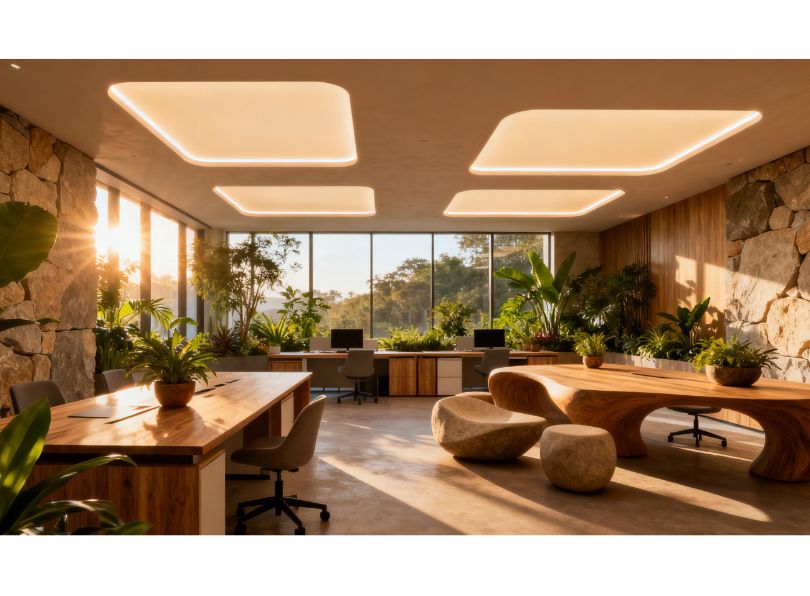
At the core of every successful biophilic lighting installation is a deceptively simple component: the aluminium led profile. Led profiles extruded aluminium channels designed to house led strips, manage thermal dissipation, integrate optical diffusers, and enable architectural integration, are the infrastructure through which the photometric properties of advanced led strips are translated into inhabitable light environments. Understanding why profiles are so fundamental to biophilic lighting requires examining their functional properties in relation to the specific requirements of nature-inspired light.
Why indirect, concealed light is biophilic
Natural light, in most of the environments to which Homo sapiens is evolutionarily adapted, does not arrive from a single bright point source at a fixed angular location. In a forest, light is scattered by the canopy into thousands of dappled points and soft gradients. On an overcast day, light arrives uniformly from the entire hemisphere of sky, casting almost no shadows and enveloping the observer in a diffuse, omnidirectional luminous field. Near water, light is reflected and refracted into dancing patterns. Even in open savannah, the direct solar disk is rarely looked at directly; instead, the observer is bathed in light scattered by the atmosphere and reflected by the ground, vegetation, and water surfaces.
The common characteristic of all these natural light environments is that the primary luminous field is broad, diffuse, and free of high-contrast point sources. The direct solar disk is an intense point source, but its glare is typically avoided by the observer, who looks instead at the illuminated landscape rather than the light source itself. In biophilic interior design, this translates directly into a preference for indirect, concealed, distributed light over direct, point-source, high-contrast illumination. Led strips in concealed profiles produce exactly this quality of light: broad, diffuse, glare-free, with no visible source, only the soft glow of illuminated surfaces that characterises the most restorative natural environments.
Architectural integration: light as a building element
A second critical property of led profiles in biophilic contexts is their capacity for architectural integration. Unlike conventional luminaires, which are discrete objects installed in or on surfaces, led profiles can be embedded within the architectural fabric itself: recessed into ceilings, integrated into floor-to-ceiling joinery, hidden within stair nosings, built into shelving systems, and incorporated into furniture. This integration enables the creation of light environments in which the source is architecturally invisible, and the experience of light is indistinguishable from the experience of the space itself.
This architectural invisibility is profoundly biophilic. Natural light, after all, has no “luminaire” — it is simply present in the environment, a quality of the space rather than an object within it. When led strips in slim profiles are recessed behind cornices, beneath floating ceiling elements, within glazed slots, or along the reveals of apertures, they approach this quality of sourceless illumination that characterises the most immersive natural light environments.
Product reference — Ultra-slim led profile
The PR-SL07-05 aluminium profile (7 mm height, 5 mm width) represents the current state of the art in architectural led integration. At just 7 mm tall, this profile can be recessed into almost any surface or architectural element without structural compromise, enabling truly invisible light integration. When paired with a high-CRI sunlike or circadian care led strip, it produces a hairline of warm, continuous light that references the quality of light filtering through the thinnest crack in a forest canopy or under a stone threshold.
Thermal management: the invisible foundation
A critical but often overlooked function of aluminium led profiles is thermal management. Led strips generate heat at the semiconductor junction, and without effective heat dissipation, junction temperature rises, accelerating lumen depreciation, colour shift, and ultimately led failure. Aluminium’s high thermal conductivity (approximately 205 W/m·K) makes it the ideal heat sink material for led strips, ensuring that the leds operate at optimal junction temperature and maintain their rated lumen output and colour stability over their full rated lifespan of 50,000 hours or more.
For biophilic lighting applications, this matters for a specific reason beyond longevity: colour shift in led strips due to thermal stress produces a visible change in the colour temperature and colour rendering index of the light, compromising exactly the qualities (warm accuracy, spectral fidelity, consistency with natural light) that make biophilic lighting valuable. A high-CRI Sunlike strip operating at high junction temperature will drift towards lower CRI and higher CCT, losing the solar-spectrum quality that is its primary biophilic attribute. Proper profile selection and mounting ensures that this cannot happen, preserving the biophilic light quality throughout the system’s operational life.
The full range of biophilic profile applications
The versatility of led profiles enables their application across the full spectrum of biophilic lighting strategies:
- Cove lighting: profiles recessed in the junction between wall and ceiling, directing light upward to wash the ceiling in a soft, diffuse glow that references the luminous quality of an overcast sky. This creates the prospect condition, visual openness and spatial expansiveness, that Appleton’s prospect-refuge theory identifies as intrinsically restorative.
- Perimeter lighting: profiles running along the perimeter of a room at low level, washing the walls with warm, even light that references the quality of firelight or the warm-horizon glow of sunset, deeply calming, temperature-appropriate for evening relaxation, and evocative of the refuge condition.
- Object lighting: profiles integrated into shelving, cabinetry, or display systems to illuminate natural materials: timber grain, stone surfaces, living plants, dried botanical arrangements. The high CRI of Sunlike strips ensures that these natural materials are rendered with their full colour and textural complexity, engaging the material connection that Terrapin’s 14 Patterns (Pattern 9: material connection with nature) identifies as a biophilic priority.
- Nature installation lighting: profiles designed to illuminate living walls, moss panels, water features, aquaria, or botanical installations from within or behind, creating the visual impression of light filtering through vegetation or reflected off water. This is perhaps the most directly biophilic application of led profiles, creating an experience of light-in-nature that is genuinely difficult to distinguish from the real thing.
Solar-spectrum led strips: sunlike and circadian care technology in depth
The relationship between light quality and human biological wellbeing has been studied intensively for more than three decades, producing a body of research that now forms the scientific foundation for human-centric lighting, the broader category within which biophilic lighting sits. This section examines in technical depth the led strip technologies that currently represent the state of the art for biophilic lighting: sunlike technology, circadian care strips, and COB configurations.
Understanding CRI: why it matters for biophilic design
The Colour Rendering Index (CRI) is a measure of a light source’s ability to accurately reveal the true colours of objects compared with a reference light source (natural daylight for sources above 5000K, Planckian blackbody radiation for warmer sources). A CRI of 100 represents perfect colour rendering identical to the reference source, most commercial led strips offer CRI 80–90, Sunlike strips offer CRI >97.
For biophilic design, CRI matters in two distinct ways: aesthetically, because higher CRI light renders natural materials (wood, stone, plant life, water) with their full spectral richness and depth, producing environments that feel genuinely alive rather than artificially uniform and psychologically, because research by Kruithof, Krueger, and more recently Veitch and colleagues has demonstrated that higher colour rendering quality increases reported naturalness, visual comfort, and pleasantness of illuminated environments, independent of illuminance level.
| Technology | CRI | CCT range | Circadian impact | Best biophilic application |
|---|---|---|---|---|
| Standard led strip | 80–85 | Fixed | Moderate disruption (blue spike) | General background lighting only |
| High-CRI led strip | 90–95 | Fixed | Moderate disruption | Improved colour rendering, accent lighting |
| Sunlike led strip | >97 | Fixed (range of options) | Minimal disruption (no blue spike) | Premium biophilic, healthcare, art, residential |
| Circadian care strip | >90 | 2700K–6500K (tunable) | Actively supports circadian rhythm | Dynamic biophilic, circadian lighting systems |
| COB led strip | 80–97 (range) | Fixed or tunable | Varies with phosphor | Seamless light lines, coves, architectural integration |
| DALI tunable white strip | 90–95 | 2700K–6500K | Active circadian support via DALI DT8 | Professional biophilic, large buildings, WELL-certified projects |
The science of sunlike technology
Standard white leds use a blue led chip (peak emission ~450 nm) to excite a yellow phosphor (typically cerium-doped yttrium aluminium garnet, Ce:YAG), with the combination of blue led emission and yellow phosphor fluorescence appearing white to the human eye. This mechanism is efficient and widely used, but it produces two photometric liabilities for biophilic design: first, the inevitable blue spike at 450 nm, which activates melanopsin-based circadian pathways regardless of perceived colour temperature; second, a trough in the green-cyan region (490–520 nm) that reduces colour rendering accuracy across the “skin tones and food colours” region of the spectrum.
Sunlike technology, developed by Seoul Semiconductor through its Acrich technology platform in collaboration with Toshiba Materials, uses a violet led chip (peak emission ~405 nm) to excite a more complex phosphor mixture that covers the entire visible spectrum from 420 nm to 700 nm with much greater uniformity. The result is a spectral power distribution that closely mimics the solar spectrum: continuous, smooth, with no blue spike, no green-cyan trough, and accurate rendering of all spectral colour categories. The CRI R9 value (the critical red saturation index often below 50 for standard leds) is >90 for Sunlike, ensuring that red, orange, and skin tones are rendered with the warmth and saturation they display under natural daylight, profoundly important for the experience of biophilic interiors featuring warm natural materials and living plants.
Circadian care: engineering light for human health
Circadian care led strips represent a different but complementary approach to biophilic photometry. Rather than focusing on spectral continuity, Circadian Care technology focuses on the dynamic dimension of solar light quality: the progressive shift from energising cool-white morning light to calming warm-white evening light that the human circadian system requires for proper synchronisation. These strips incorporate two separate led channels, a warm channel (typically 2700K–3000K) and a cool channel (typically 5000K–6500K), whose relative output can be mixed continuously by a smart controller to produce any CCT within the range, and whose combined intensity can be dimmed smoothly to any level.
When controlled by a biorhythm-capable smart controller, a Circadian Care strip installation can automatically replicate the quality of sunlight at any time of day for any location on Earth, using GPS-derived sunrise/sunset data and pre-programmed spectral transition curves. The result is an indoor light environment that tells the body clock the correct time with the same signal it would receive outdoors — but delivered in a fully controlled architectural context, free from weather, season, or cloud cover variability. For healthcare environments, offices with high rates of seasonal affective disorder, shift-working facilities, and any interior used primarily during limited-daylight seasons, this technology represents a profoundly impactful intervention.
Tunable white and smart control: the dynamic heart of biophilic lighting
The photometric specification of led strips, CRI, CCT range, lumen output defines the potential of a biophilic lighting system. The smart control infrastructure determines whether that potential is realised as a living, dynamic light environment or merely a static, if high-quality, artificial illumination scheme. This section examines the control technologies that transform led strips in aluminium profiles into genuinely biophilic systems, with specific reference to the WiFi, Zigbee, and DALI DT8 controllers.
The biorhythm function: automating nature
The most directly biophilic feature available in smart led controllers is the “biorhythm” (or “bio-rhythm”) function: an automated programme that continuously adjusts the colour temperature and luminous intensity of the connected led strips throughout the day in accordance with a programmed model of solar light variation. Depending on the controller, this programme may reference generic sunrise/sunset curves, may be calibrated to specific geographic coordinates, or may incorporate real-time astronomical data for maximum accuracy.
A typical biorhythm programme might operate as follows: from 6:00 to 8:00 AM, the system delivers warm (2700K), relatively low-intensity light (200–300 lux at desk level) to support the gentle transition from sleep to wakefulness, from 8:00 to 12:00 PM, it progressively cools (3000K–4500K) and brightens (up to 500 lux or above) to support alertness and concentration, from 12:00 to 3:00 PM, it reaches its peak CCT (5000–6500K) and brightness, supporting peak cognitive performance; from 3:00 to 7:00 PM, it begins warming again (4500K–3000K) and dimming; from 7:00 PM onwards, it delivers warm (2700K–3000K), low-intensity light appropriate for relaxation and melatonin onset, facilitating natural sleepiness at a biologically appropriate time.
Product reference, smart biorhythm controllers
The V2-L WiFi controller and Zigbee controller from the Skydance smart range provide full biorhythm functionality via companion smartphone apps. CCT is adjustable from 2700K to 6500K with smooth, continuous transitions; brightness can be set from 0% to 100% with flicker-free PWM dimming. The Zigbee variant integrates natively into home automation ecosystems (Apple HomeKit, Amazon Alexa, Google Home, Home Assistant), enabling coordination of biophilic lighting with blinds, HVAC, and other environmental control systems for a fully integrated biophilic home or office environment.
DALI DT8 for professional biophilic installations
For commercial, institutional, and high-specification residential biophilic lighting projects, the DALI DT8 (digital addressable lighting interface, device type 8) protocol provides the most sophisticated and reliable platform for tunable white control. DALI DT8 enables individual addressing of each control group, recall of preset lighting scenes (biophilic “nature” scenes: “forest morning”, “overcast noon”, “amber sunset”, “twilight”), integration with building management systems (BMS) and energy management platforms, and commissioning tools that enable precise calibration of each zone within a complex multi-room installation.
Product reference — DALI DT8 tunable white panels
The DALI DT8 panels provide professional-grade tunable white management with full addressability, scene recall, and BMS integration. One controller of the series includes a touchscreen interface for end-user control of biophilic lighting scenes without requiring app access, making it suitable for healthcare and hospitality environments where intuitive, non-technical control is essential. Both panels support DALI DT8 Colour Type Tc (correlated colour temperature control), enabling precise specification and recall of any CCT within the connected strip’s range.
Scene programming for biophilic environments
An important practical dimension of biophilic lighting control is scene programming: the creation of pre-set lighting conditions that reference specific natural environments and are accessible by non-technical users at the touch of a button (or automatically, via time-based or occupancy-based triggers). Some example biophilic scenes that can be programmed into smart led control systems.
| Scene name | CCT | Intensity (lux at desk) | Biophilic reference | Recommended time / activity |
|---|---|---|---|---|
| Dawn Awakening | 2200K | 80–150 lux | Sunrise: warm horizon glow | 06:00–08:00, gentle waking |
| Morning Energise | 4000K | 400–500 lux | Mid-morning sky: cool, bright | 08:00–12:00, focused work |
| Midday Clarity | 5500K | 500–600 lux | Solar zenith: full daylight | 12:00–14:00, peak alertness |
| Afternoon Focus | 4500K | 400 lux | Afternoon sky: slightly warmer | 14:00–17:00, sustained concentration |
| Dusk Transition | 3000K | 200–300 lux | Late afternoon/sunset warmth | 17:00–20:00, social, creative |
| Evening Relaxation | 2700K | 80–150 lux | Twilight: orange-red warmth | 20:00–22:00; relaxing, dining |
| Night Preparation | 2200K | 30–50 lux | Firelight / deep dusk | 22:00+, melatonin support, sleep preparation |
| Forest Canopy | 3500K variable | 100–400 lux (dappled) | Filtered forest light | Relaxation zones, spa, meditation |
| Overcast Sky | 4500K flat | 400 lux uniform | Diffuse cloud-filtered daylight | Creative brainstorming, open-plan work |
| Coastal Morning | 5000K with warmth | 500 lux | Sea-reflected morning light | Reception areas, hotel lobbies |
Daylight harvesting and automation in biophilic systems
A truly biophilic lighting system does not operate in isolation from the natural light environment of its building; it responds dynamically to real conditions outdoors, integrating artificial and natural light into a seamless, unified luminous experience. Daylight harvesting, the use of light sensors to monitor natural illuminance levels and automatically adjust artificial light output to maintain a target illuminance level at the task plane, is a fundamental strategy for achieving this integration, and one that combines the biophilic goal of maximum natural light use with the energy efficiency imperative of led system design.
How daylight harvesting works in biophilic lighting
A daylight harvesting system typically consists of: one or more photosensitive sensors positioned to measure horizontal illuminance at the task plane and/or vertical illuminance at the window, a smart led controller with an analogue or digital input for the sensor signal and dimmable led strips capable of smooth output variation from 0% to 100% without flicker. When the sensor detects that natural daylight is providing sufficient illuminance at the task plane, the controller reduces artificial light output proportionally; as cloud cover or the advancing afternoon reduces natural illuminance, the controller automatically increases artificial output to maintain the target level.
For biophilic design purposes, daylight harvesting should ideally be combined with spectral adjustment: as natural daylight shifts in colour temperature throughout the day (cool at noon, warm at dusk), the artificial supplement should match its CCT to blend seamlessly with the natural component. This requires a tunable white led system with a daylight-adaptive CCT controller, currently the most sophisticated biophilic lighting technology available at a commercially practical price point.
Product reference — Daylight sensors
The Skydance EH-R series daylight sensors provide photometric feedback to compatible smart controllers, enabling closed-loop daylight harvesting. Integration with the Skydance V2-L(WT) or V2-L(WZ) controllers allows fully automatic adjustment of led strip output in response to real-time natural light levels, maintaining biologically appropriate illuminance and CCT throughout the day with minimal energy waste. This combination provides both WELL Building Standard compliance (credit for daylight integration) and genuine biophilic performance.
Timer, schedule, and astronomical clock functions
For biophilic installations where occupancy patterns are predictable and consistent (offices, schools, healthcare facilities) time-based programming provides a simpler but effective alternative or complement to real-time sensor-based control. Smart controllers with astronomical clock functionality can calculate the precise sunrise and sunset times for any location on Earth on any given day of the year, and use this information to drive biologically appropriate dawn and dusk simulations: gradual warm-up over 30–60 minutes from a very low-intensity, warm glow to full morning illumination, and an equally gradual warm-down in the evening that aligns the artificial light environment with the biological melatonin onset window.
Research by the Lighting Research Center at Rensselaer Polytechnic Institute has demonstrated that even a 30-minute morning “dawn simulation” produced by a gradually brightening warm-to-cool led system significantly improves alertness, mood, and performance on cognitive tasks compared with standard abrupt-onset lighting, with effects persisting for several hours. The practical implementation of this finding requires nothing more than a smart LED controller with a timer function and a tunable white led strip in an aluminium profile installed in the bedroom or workspace ceiling.
Biophilic design applications: offices, homes, hospitals, schools
The theoretical and technological foundations of biophilic design lighting achieve their ultimate expression and validation in real-world applications across a diverse spectrum of building types and occupancy contexts. This section examines the specific design strategies, product specifications, and measured outcomes relevant to the most important application domains for biophilic design: office spaces, residential interiors, healthcare environments, educational settings, and hospitality and retail. For each context, we identify the biophilic principles that are most relevant, the led technologies that best address them, and the documented benefits that justify the specification investment.
Summary of application-specific biophilic lighting strategies
| Building type | Primary biophilic goals | Recommended led technology | Key profile applications | Documented benefit |
|---|---|---|---|---|
| Office | Alertness, focus, wellbeing, reduce absenteeism | Tunable white + biorhythm, CRI >90 | Cove lighting, desk integration, living wall illumination | +8–15% productivity, -15% absenteeism |
| Healthcare | Patient recovery, circadian support, staff performance, anxiety reduction | Sunlike CRI >97, tunable white DALI DT8 | Indirect bed lighting, corridor cove, window simulation | 8.5% shorter patient stays, reduced medication |
| Residential | Sleep quality, family wellbeing, relaxation, aesthetics | Sunlike, tunable white WiFi/Zigbee; COB | Bedroom cove, kitchen under-cabinet, bathroom mirror | Improved sleep onset, reduced evening cortisol |
| Education | Concentration, mood, reduced ADHD symptoms, daylight access | Tunable white, daylight harvesting, CRI >90 | Classroom cove and perimeter, corridor cove | +26% faster reading, -41% ADHD symptoms (Philips et al.) |
| Hospitality | Guest experience, atmosphere, brand identity, wellbeing | Sunlike, circadian care, COB, dynamic tunable white | Architectural cove, furniture integration, water feature lighting | +10–20% guest satisfaction scores |
| Retail | Product presentation, dwell time, purchase conversion | Sunlike CRI >97, high-output strips | Shelf illumination, display case, perimeter cove | +40% purchase intent for natural products under high-CRI lighting |
Biophilic architecture: buildings that breathe
Biophilic architecture represents the integration of biophilic design principles at the urban and structural scale: in the massing, orientation, facade design, and spatial organisation of buildings, as well as in the relationship between buildings and their surrounding natural landscape. Biophilic buildings are not simply buildings that contain plants or have large windows; they are conceived from the ground up to maximise occupants’ experience of nature, natural light, natural ventilation, and organic spatial form while maintaining full functionality and environmental performance.
What makes a building biophilic?
The question “what is a biophilic building?” can be answered across multiple scales of intervention, let’s see which ones.
At the urban scale, biophilic buildings are sited and oriented to maximise solar access and natural ventilation, to maintain visual and physical connections with adjacent green infrastructure (parks, street trees, waterways), and to contribute to the ecological function of the urban fabric. Singapore, often cited as the world’s leading biophilic city, has embedded biophilic principles into its master planning: the Gardens by the Bay project, the Park Connector Network, the mandatory sky garden requirements for high-rise buildings, and the integration of green roofs and vertical gardens into virtually all new development represent a coherent, city-scale commitment to biophilic urbanism that has measurably improved resident health and wellbeing outcomes.
At the building scale, biophilic design is expressed through: plan organisation that maximises perimeter daylight access for occupied zones, section design that uses atriums, light wells, clerestories, and solar tubes to bring daylight deep into large-footprint buildings, facade design that balances glazing ratio for maximum daylight with solar shading for visual and thermal comfort and structural expression that references organic forms and natural processes (the branching columns of Stuttgart Airport by von Gerkan (Marg and Partners), the hyperbolic paraboloid roof shells of the Sydney Opera House, the bamboo-inspired facade of the National Stadium in Beijing).
At the interior scale, biophilic architecture is completed by the lighting, material, and landscape design that fills the spaces created by the structural framework. This is where led profiles and high-CRI led strips play their most direct and impactful role: translating the formal ambitions of biophilic architecture into habitable, sensory experiences of natural light quality, organic spatial conditions, and nature-connected atmosphere.
Natural forms in architecture and the role of parametric design
The emergence of parametric and computational design tools in the 21st century has dramatically expanded architects’ capacity to incorporate natural forms in architecture. Algorithms derived from the growth patterns of biological organisms (Lindenmayer systems (L-systems) that model plant branching, Voronoi tessellations derived from seed pod geometry, minimal surface algorithms modelling soap film and bone structure, reaction-diffusion patterns found in animal skin markings) can now be applied directly to structural, facade, and interior design, producing buildings and spaces of extraordinary formal complexity that nonetheless feel deeply natural and organically resolved.
Led profiles are a natural partner for parametric biophilic architecture because they can be specified in custom lengths, cut to precise dimensions, and combined with parametrically designed diffuser panels to create lighting installations of matching formal complexity. A Voronoi led ceiling installation, in which each Voronoi cell is individually backlit by a short section of led strip in an aluminium micro-profile, creates an overhead light environment of exactly the organised complexity (neither random nor geometrically regular, but somewhere between the two, like the pattern of light through leaves) that environmental psychology identifies as most restorative.
Biophilic buildings around the world: case studies
Several built projects exemplify the principles and technologies of biophilic architecture at an international level and provide concrete design precedents for specifiers.
Amazon Spheres, Seattle (NBBJ, 2018): three glass and steel biospheres housing over 40,000 plants from 400 species, providing Amazon employees with an immersive biophilic work environment. The lighting system combines led strips concealed within the structural steel members with a sophisticated daylight management system that optimises plant growth and human comfort simultaneously.
Jewel Changi Airport, Singapore (Moshe Safdie, 2019): a 10-storey indoor forest and waterfall environment serving as an airport terminal, with the world’s tallest indoor waterfall (Rain Vortex, 40m high) as its centrepiece. The led lighting system, integrated into the toroidal roof structure, provides supplementary growth lighting for the indoor forest while supporting human circadian rhythms across all timezones simultaneously — a uniquely challenging biophilic lighting brief.
Bullitt Centre, Seattle (Miller Hull Partnership, 2013): one of the most energy-efficient office buildings in the world, the Bullitt Centre uses a combination of deep-plan daylighting design, automated external shading, and tunable white LED lighting to achieve near-100% daylight autonomy in occupied zones. The building is WELL certified and widely recognised as a benchmark for biophilic office design in a cold-climate context.
Maggie’s Centre, London (Rogers Stirk Harbour + Partners, 2009): a cancer support centre designed explicitly around biophilic principles, with garden views from every room, generous natural light, and an interior palette of warm natural materials. The lighting system uses warm-CCT LED strips in concealed profiles to supplement natural daylight in ways that preserve the warm, domestic, nature-connected character of the building’s interior.
Biophilic interior design: practical strategies for lighting designers
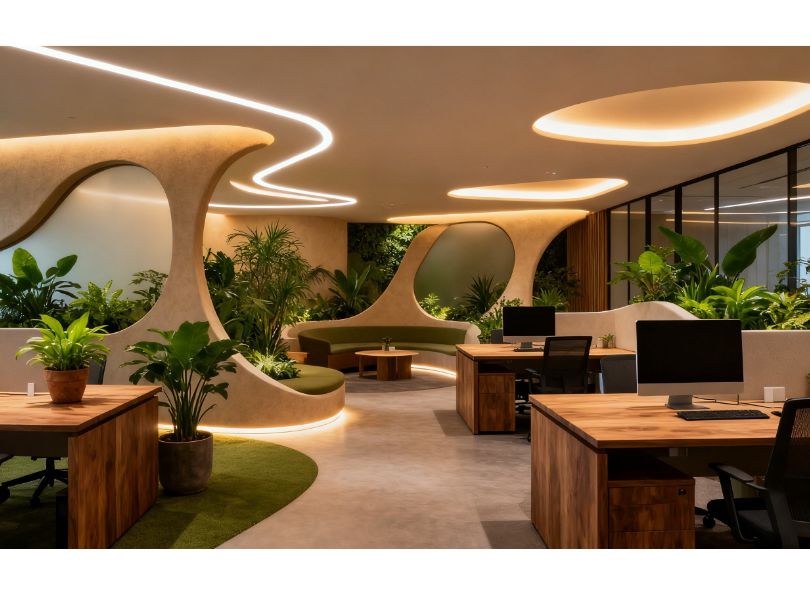
Biophilic interior design translates the principles and patterns of biophilic design into the detailed material, spatial, and sensory decisions that define the lived experience of a space. While the broader framework is theoretical, the practical choices are concrete and specific: which led strip to specify for the living wall illumination, how to detail the cove profile to produce the right ceiling wash, which CCT programme to set for the office biorhythm controller.
Lighting a living wall: technical considerations
Living walls, vertical plant installations that integrate living vegetation into interior wall surfaces, are among the most powerful and visually dramatic biophilic design elements available to the interior designer. They provide direct visual connection with nature, improve air quality through phytoremediation, introduce organic form and texture, and create a focal point that immediately signals the biophilic intent of the interior. However, their lighting requirements are specific and demanding: plants require adequate photosynthetically active radiation (PAR) for growth, while the visual environment must be appropriately lit for human comfort and aesthetic quality.
A combined led approach is recommended: dedicated grow-light led strips (typically in the red/blue spectrum for photosynthesis efficiency) integrated within the plant support structure provide the PAR required for plant health, a high-CRI led strip (Sunlike CRI >97) in a slim aluminium profile positioned at the top of the wall panel provides the broad-spectrum downlight that renders the foliage with photographic accuracy and creates the visual impression of sunlight filtering through a forest canopy. The combination of functional grow light and aesthetic biophilic light can be coordinated through a two-channel smart controller, ensuring that the grow-light function operates at optimal intensity during lit hours while the aesthetic biophilic light adjusts dynamically with the biorhythm programme.
Detailing a cove profile for biophilic ceiling wash
The ceiling wash produced by a cove profile is one of the most fundamental biophilic lighting effects, creating the overhead luminous field that the human visual system interprets as analogous to a bright, open sky. The detail of the cove — its setback from the wall plane, its height in the room section, the profile of its return, the diffuser specification, significantly affects the quality of the resulting light.
Key parameters for biophilic cove lighting are:
- setback distance (the distance from the front lip of the cove to the wall) should ideally be at least 150–200 mm to prevent the led strip from being visible from standing eye level and to allow the light to spread across the full ceiling width without a bright central ridge;
- return profile: a curved rather than square return softens the transition from directly illuminated ceiling to shadow zone, creating a more organic light gradient;
- diffuser specification: for COB led strips, a frosted diffuser of 30–50% transmission provides adequate diffusion while maintaining the continuous linear quality of the light, for standard led strips, a high-diffusion diffuser (70–90% scatter) is essential to eliminate visible led dots from the ceiling reflection.
Under-shelf and furniture-integrated lighting
The integration of slim led profiles within shelving, cabinetry, furniture, and joinery is a powerful biophilic lighting strategy at the micro-scale, enabling the illumination of natural materials and objects at close range with the accuracy and warmth that high-CRI led strips provide. A kitchen worktop edge-lit from beneath by a slim aluminium profile housing a warm Sunlike LED strip produces a working surface that glows with the quality of natural stone under afternoon sunlight. A bookshelf back-lit with a warm COB led strip behind a translucent linen panel creates a soft, atmospheric glow that references the quality of candlelight or lantern light, primal biophilic signals of warmth, safety, and domestic refuge.
The full range of slim and micro-profiles available includes options from standard 16 mm width down to the 5 mm SL07-05, enabling integration even within the thinnest furniture elements and joinery details. The thermal management properties of even these micro-profiles ensure that LED strips operate at safe junction temperatures, preserving CRI accuracy and lumen output over the full product lifespan.
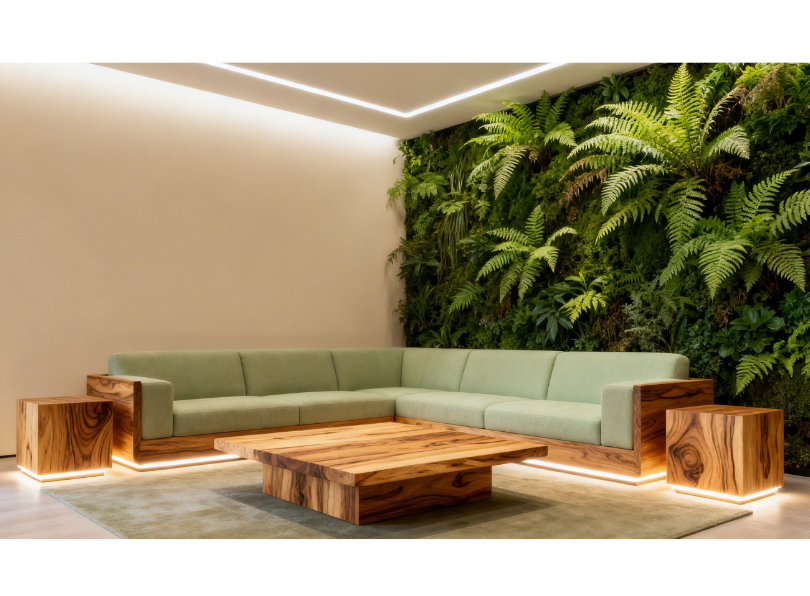
Biophilic design home: transforming residential spaces
Biophilic design home applications represent perhaps the most personal and emotionally resonant dimension of biophilic lighting practice, because the domestic interior is the space in which we spend our most intimate hours: sleeping, eating, recovering from illness, nurturing family relationships, and simply being ourselves. The quality of light in the home has a disproportionate impact on mood, sleep quality, family wellbeing, and the experience of domestic space, yet the residential lighting market remains dominated by inexpensive, spectrally impoverished led downlights and strip lights that provide functional illumination at the cost of biological and aesthetic quality.
Room-by-room biophilic lighting strategy
Now we will try to define light room by room…
Bedroom: the bedroom is the most biologically sensitive room in the home from a lighting perspective, as it is the space in which circadian alignment must be most carefully supported. A biophilic bedroom lighting scheme uses a tunable white led strip in a concealed ceiling cove (or behind the headboard) to provide a dawn simulation awakening sequence (gradual warm-up from 2200K at low intensity to 3500K at moderate intensity over 30–45 minutes) and an evening relaxation sequence (gradual cool-down from the daytime CCT to 2700K at low intensity over 60–90 minutes before the intended sleep time). A Sunlike led strip maximises colour rendering of natural materials in the bedroom (linen, timber, stone) while minimising the circadian-disrupting blue light component that would otherwise delay melatonin onset. The smart controller is programmed with GPS-accurate astronomical data for the home’s location, ensuring that the artificial dawn and dusk sequences track the actual sunrise and sunset throughout the year.
Living room: the living room requires the greatest lighting flexibility, serving as a space for daytime social activity, focused reading and work, relaxed evening conversation, film viewing, and intimate dining at different times. A biophilic living room lighting scheme layers multiple circuits: ambient cove or perimeter lighting (warm CCT tunable white in a concealed profile, set to biorhythm programme during the day), accent lighting for natural material surfaces and artwork (high-CRI Sunlike led strip in slim profile); task lighting for reading areas (adjustable-CCT desk or floor lamp with independent control), and a low-level “evening presence” circuit (2200K led strip at floor level in a micro-profile, producing the primal warmth and spatial grounding of firelight). The combination creates exactly the organised complexity, multiple light sources of varying brightness and colour temperature, producing a layered, textured light environment, that Terrapin’s Pattern 10 (Complexity and Order) identifies as intrinsically restorative.
Kitchen: the kitchen is a space of functional demand (adequate task illuminance for food preparation, accurate colour rendering for food quality assessment) combined with social and aesthetic aspiration (warm, inviting atmosphere for family gathering, aesthetic presentation of natural materials and food). A high-CRI Sunlike LED strip under upper cabinets provides task illuminance with accurate colour rendering of food (research has demonstrated that higher-CRI kitchen lighting increases perceived food freshness, quality, and palatability) while a warm-CCT led strip in a concealed ceiling cove provides ambient light during dining and social occasions. The combination of cool-white task light (5000K) and warm ambient (2700K) creates the biophilic layering of natural and artificial light that characterises well-designed domestic kitchens in northern European and Japanese traditions.
Bathroom: the bathroom is increasingly recognised as a space of significant biophilic potential, particularly in wellness-oriented residential design. A biophilic bathroom lighting scheme uses warm, high-CRI led strips (Sunlike 2700K) in concealed profiles around mirrors to provide flattering, accurate skin-tone rendering for grooming; a tunable white circuit in the ceiling cove to support morning energising (3500–4000K) and evening wind-down (2700K); and optionally a very low-level warm led strip at floor level or behind the bath surround to create the immersive, enveloping warmth that references the firelit bath or hot spring environment — one of the most universally restorative biophilic experiences available in a domestic context.
Biophilic design office space: wellbeing, productivity and the business case
The biophilic design office space has become one of the most intensively studied and commercially motivated applications of biophilic design, driven by the compelling economic calculus that connects employee wellbeing with business performance. In most knowledge-intensive industries, personnel costs represent 85–90% of total operating costs, dwarfing energy costs (typically 1–2%) and real estate costs (8–12%). Even a modest improvement in employee productivity (5–10%) therefore represents a return on investment in biophilic design that makes the most ambitious specification appear economically trivial.
The research evidence for biophilic office design
The evidence base for biophilic office design has grown substantially over the past decade. Key studies include:
World Green Building Council (2014): “Health, wellbeing and productivity in offices”, a comprehensive review of the evidence finding that access to natural light (OR artificial light of natural quality) improves cognitive performance by 10–25%, reduces fatigue by 15–20%, and is the single most frequently cited workspace improvement by office workers globally.
Terrapin Bright Green (2014): “The economics of biophilia”, quantified the productivity and wellbeing impacts of 14 biophilic design patterns in office settings, finding that the combination of daylight simulation, views of nature, indoor plants, and natural materials produced compound wellbeing improvements of 12–15%.
Interface Corporation (2015): “The global impact of biophilic design in the workplace”, surveyed 7,600 office workers in 16 countries, finding that workers in offices with biophilic elements reported 15% higher wellbeing, 6% higher productivity, and 15% higher creativity than those in non-biophilic offices. Connection to natural light was the top-rated biophilic element, followed by living plants and natural materials.
What is biophilic office design in practice?
The question “what is biophilic office design?” is best answered through a practical checklist of the elements that distinguish a genuinely biophilic workspace from a conventionally designed open-plan office:
Lighting: tunable white led strips in concealed ceiling profiles, programmed with a biorhythm cycle tied to local sunrise/sunset data; daylight harvesting sensors that blend natural and artificial light seamlessly, warm (3000K) breakout and social zones contrasting with cooler (4000–5000K) focus zones; living wall illumination using Sunlike led strips for accurate plant colour rendering and human aesthetic enjoyment.
Biophillic design office space also incorporates: living plants at desk level and throughout the common areas; natural material surfaces (timber, stone, bamboo, cork); views to outdoor green space from at least 75% of workstations; natural ventilation or high-quality mechanical ventilation with HEPA filtration; acoustic materials derived from natural sources (wool, cork, recycled cellulose); and a colour palette drawn from natural ecology (earth tones, foliage greens, water blues and greys).
ROI calculation for biophilic office lighting
| Parameter | Value | Notes |
|---|---|---|
| Office floor area | 500 m² | Mid-size open-plan office |
| Number of employees | 50 | At 10 m² per person |
| Average annual personnel cost per employee | €60,000 | Salary + benefits, European average |
| Total annual personnel cost | €3,000,000 | — |
| Productivity improvement from biophilic lighting | 8% | Conservative estimate, WGBC data |
| Annual productivity value gain | €240,000 | €3M × 8% |
| Estimated cost of biophilic led lighting upgrade | €35,000–€60,000 | Including profiles, strips, controllers, installation |
| Simple payback period | 1.75–3 months | Based on productivity value alone |
| Energy saving vs halogen/fluorescent | 65–80% | Additional financial benefit |
| Absenteeism reduction value (15% × salary) | €450,000/year | Additional benefit; Interface Corp. data |
Biophilic design in hospitals: the evidence for healing light
Biophilic design in hospitals represents perhaps the most rigorously evidence-based and clinically consequential application domain for biophilic lighting. The research literature connecting natural light quality, circadian support, and access to nature-connected environments with accelerated patient recovery, reduced medication requirements, improved staff performance, and lower rates of hospital-acquired infection is extensive, consistent, and increasingly integrated into international healthcare facility design standards.
Roger Ulrich and the foundation of evidence-based healthcare design
The modern evidence-based healthcare design movement traces its origins to Roger Ulrich’s landmark 1984 study “View through a window may influence recovery from surgery”, published in Science. Ulrich compared post-operative recovery outcomes for cholecystectomy patients assigned to rooms with a window view of a natural landscape (trees) versus rooms with a view of a brick wall. The results were striking: patients with the natural view required significantly fewer doses of pain medication, spent 8.5% fewer days in hospital, and received more positive nursing evaluations than the brick-wall group. This study, replicated in multiple subsequent investigations, established a causal link between nature connection and clinical outcomes that has since informed major hospital design guidelines in the USA (the Planetree model), the UK (NHS Estates guidance), and internationally.
Circadian lighting in healthcare: clinical benefits
For hospitalised patients, particularly those in intensive care units, post-operative recovery wards, or long-term care facilities, disrupted circadian rhythms are both a consequence and an exacerbating cause of illness. Hospital environments typically feature 24-hour artificial lighting of poor spectral quality, minimal daylight access, and constant noise and activity, creating a perfect storm of circadian disruption that impairs immune function, delays wound healing, elevates cortisol, and increases agitation and confusion (particularly in older patients and those with cognitive impairment).
Tunable white led systems in hospital patient rooms, programmed with a clinician-prescribed circadian schedule, have been shown in multiple clinical studies to:
- reduce night-time agitation in ICU patients by 30–50% (Figuerio et al., 2013);
- improve sleep quality scores in post-operative patients by 20–35% (Globus et al., 2018);
- reduce delirium incidence in ICU patients by 40% (Simons et al., 2016);
- improve mood and reduce depression scores in long-term care residents by 15–25% (van Someren et al., 1997; multiple replications);
- support better immune function and faster recovery from surgical procedures, with shorter average stays (meta-analysis by Beauchemin & Hays, 1996).
Healthcare specification — Patient room biophilic lighting
A complete patient room biophilic lighting system for a standard 4m × 5m single-bed room might include: sunlike led strips in a concealed ceiling cove profile for ambient light (maximising CRI and minimising blue-spike circadian disruption), circadian care tunable white strips in a second zone above the bed head for reading and examination light (adjustable 2700K–5000K), a DALI controller for integration with the hospital BMS and daylight sensors to blend artificial and natural light. Total estimated material cost for a single room: €800–€1,500, depending on room area and specification level.
Benefits of biophilic design: research, data and market statistics
The business case and human case for biophilic design rests on a now-substantial body of empirical evidence demonstrating measurable benefits across psychological, physiological, economic, and environmental dimensions. This section synthesises the most significant quantitative findings from academic research, industry studies, and market analysis, providing the data that architects, designers, developers, and facility managers need to justify biophilic design investment to clients and decision-makers.
Psychological benefits: stress, mood and cognitive performance
The psychological benefits of biophilic environments are the most extensively documented. Key findings from peer-reviewed research include:
| Outcome | Magnitude | Source |
|---|---|---|
| Stress reduction (salivary cortisol) | 15–30% reduction | Park & Mattson 2009, Li et al., 2010 |
| Blood pressure reduction | 5–10 mmHg systolic | Ulrich 1981, Laumann et al., 2003 |
| Mood improvement | +25–40% positive affect scores | Kaplan & Kaplan 1989, Berto, 2014 |
| Cognitive restoration (attention fatigue) | Full restoration after 10–15 min nature exposure | Kaplan 1995 (Attention restoration theory) |
| Creativity improvement | +15% creative output | Atchley et al. 2012 |
| Focus and concentration | +10–25% | WGBC, 2014, multiple sources |
| Anxiety reduction | 30–45% in clinical settings | Marcus & Sachs 2014 |
| Depression symptom reduction (SAD) | 40–60% with circadian lighting | Golden et al. 2005 (meta-analysis) |
Physiological benefits: sleep, immunity and metabolic health
Beyond psychological wellbeing, biophilic lighting has significant physiological effects mediated through the circadian system and its downstream influence on virtually every biological process.
- Sleep quality: a comprehensive review by the National Sleep Foundation (2019) found that regular exposure to bright, blue-enriched morning light and warm, dim evening light — the circadian pattern most directly replicable through tunable white biophilic lighting, reduced sleep onset latency by an average of 13 minutes, increased total sleep time by 30–45 minutes, and improved subjective sleep quality scores by 25–35% compared with static indoor lighting. Given that poor sleep is associated with significantly increased risk of obesity, diabetes, cardiovascular disease, and mental health disorders, the public health implications of circadian-supportive biophilic lighting are substantial.
- Immune function: research at the intersection of chronobiology and immunology has established that circadian disruption significantly impairs both innate and adaptive immune responses. Restoration of circadian alignment through light-based chronotherapy, which biophilic lighting can provide non-pharmaceutically, has been shown to improve immune cell function, reduce inflammatory markers, and accelerate recovery from infectious and surgical illness.
Economic and market benefits
The economic benefits of biophilic design extend beyond the direct productivity and health improvements already quantified in previous sections. Real estate market research consistently demonstrates that biophilic features command significant property premiums:
- residential properties with biophilic features (including natural light quality, living walls, natural materials, and garden access) command average premiums of 5–12% over comparable non-biophilic properties in the UK, US, and Australian markets (Savills, JLL, 2022);
- WELL-certified commercial office buildings achieve rental premiums of 5–7% and vacancy rates 15–20% lower than comparable non-certified buildings in major global markets (JLL, 2023);
- hotels with significant biophilic design elements achieve 10–20% higher guest satisfaction scores, 8–12% higher repeat booking rates, and can command room rate premiums of 15–25% in the luxury segment (Terrapin Bright Green, 2019).
Biophilic design and ADHD: neurodiversity and natural light
The question about if is biophilic design good for ADHD has attracted increasing scientific attention as the prevalence of attention-deficit/hyperactivity disorder continues to grow and as evidence-based, non-pharmacological approaches to ADHD management gain credibility in both educational and therapeutic contexts. The research evidence, while still developing, is consistent in suggesting that biophilic environments (particularly those characterised by high-quality natural light, access to views of nature, reduced sensory overload, and organic spatial conditions) are measurably beneficial for individuals with ADHD and other attention-related conditions.
The nature and ADHD research
A series of studies by Frances Kuo and colleagues at the Landscape and Human Health Laboratory at the University of Illinois established that children with ADHD showed significantly improved attention and reduced impulsivity following exposure to green outdoor environments compared with built or indoor environments. The proposed mechanism is Attention Restoration Theory (Kaplan and Kaplan, 1989): natural environments engage “involuntary attention” (the effortless, fascination-driven attention that nature reliably evokes) which allows the “directed attention” system (the prefrontal executive function system that is dysfunctional in ADHD) to recover and restore.
Importantly, subsequent research has demonstrated that these benefits can be partially reproduced through virtual nature, high-quality artificial environments that reference natural conditions. A classroom with excellent daylight quality (or high-CRI simulated daylight), views of greenery, natural materials, and a calm, non-institutional aesthetic produces measurably better attention outcomes for ADHD students than a standard classroom with fluorescent lighting, hard surfaces, and a visually busy environment.
From a lighting perspective, the recommendations for ADHD-supportive biophilic environments include: avoiding flickering or strobing light sources (eliminating fluorescents and low-quality LEDs), providing high CRI (>90) light to reduce visual strain and sensory overload; using warm CCT (2700–3500K) in relaxation and transition spaces, using cooler CCT (4000–4500K) in focused work areas; and programming a dynamic biorhythm cycle to support alertness during school hours and relaxation during break periods.
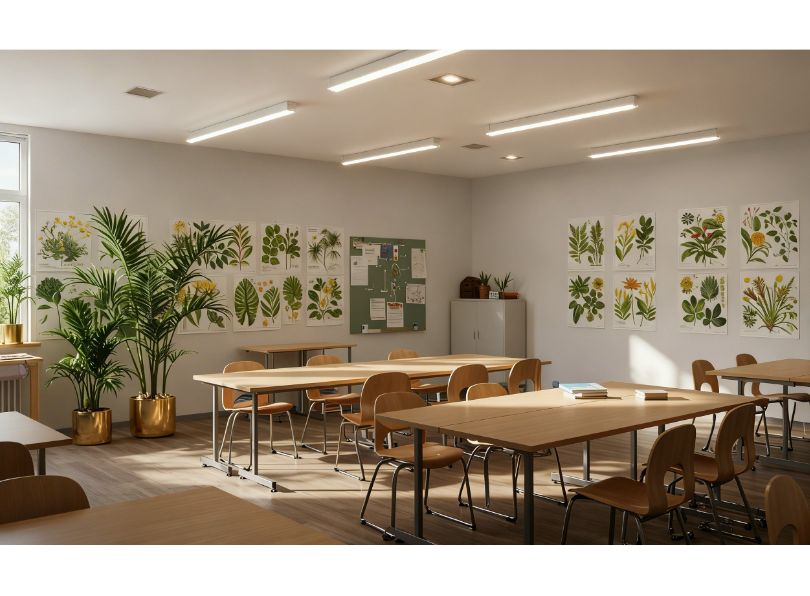
Challenges, criticisms and the greenwashing question
A rigorous professional treatment of biophilic design must acknowledge the genuine challenges, limitations, and criticisms that the field faces. Understanding the downsides of biophilic design and the conditions under which it may fall short of its claims is essential for practitioners who wish to deliver on the discipline’s substantial promise without misrepresenting its limitations to clients.
Is biophilic design greenwashing?
The most pointed criticism of biophilic design is that it constitutes a form of greenwashing: the appropriation of natural imagery and ecological language to create an impression of sustainability or wellbeing that is not substantiated by rigorous environmental or health performance. Critics point to projects that add a few potted plants and some wood-look panels to an otherwise energy-intensive, sealed, artificially ventilated building and market the result as biophilic, a charge that is sometimes entirely fair.
The answer to is biophilic design greenwashing depends entirely on the rigour of implementation. Biophilic design informed by the Terrapin 14 Patterns framework, implemented by practitioners trained in its evidence base, measured against established wellbeing benchmarks (WELL v2, LEED BD+C Pilot Credits, Fitwel), and verified through post-occupancy evaluation is decidedly not greenwashing, it is evidence-based design with measurable outcomes. Biophilic design as a marketing label applied to a wood-effect vinyl floor and a cactus in the reception is a different matter entirely.
For lighting specifically, the greenwashing risk is real: a biophilic led strip that delivers merely CRI 80 light in a fixed warm white, marketed as nature-inspired because its packaging features a leaf motif, provides none of the circadian, cognitive, or emotional benefits of genuine biophilic lighting. The distinction between marketing language and performance specification is critical, which is why this article emphasises specific, measurable photometric parameters (CRI >95, CCT tunability, flicker-free dimming, astronomical biorhythm programming) rather than aesthetic claims.
Cost and accessibility challenges
A second significant challenge is cost. High-quality biophilic lighting (sunlike led strips, tunable white controllers, daylight sensors, DALI DT8 systems) commands a premium over standard led components. While the ROI calculations presented earlier in this article demonstrate that the investment is economically rational at the building scale, the upfront cost can be a barrier for budget-constrained projects, speculative developers, and residential clients without access to lighting design consultancy.
However, it is important to contextualise this premium accurately. The cost differential between a standard led strip and a sunlike high-CRI strip is typically 30–60%. On a residential project using 20 metres of led strip total, the incremental cost is €50–150, a negligible fraction of total fit-out budget. The cost differential becomes more significant at the system level, particularly when DALI infrastructure and daylight sensors are included, but for most applications the WiFi or Zigbee smart controller options provide 80% of the biophilic lighting performance at 20% of the cost of a full DALI installation.
Challenges of biophilic design implementation
Beyond cost, practitioners face several implementation challenges:
- maintenance requirements (living walls require irrigation, pruning, and periodic plant replacement;
- water features require regular treatment;
- led systems require periodic driver replacement;
- planning and regulatory constraints (listed buildings, heritage conservation areas, and dense urban sites may limit glazing area, external green infrastructure, and structural interventions);
- occupant behaviour (biophilic lighting systems require occupants to accept dynamic light changes rather than static conditions, which can require change management in established organisations);
- integration complexity (coordinating living, water, acoustic, and lighting elements into a coherent, technically reliable, maintenance-accessible installation requires interdisciplinary collaboration that may not always be available or affordable).
Biophilic design course and professional certification
The growing demand for biophilic design expertise has generated a corresponding growth in professional education and certification programmes. A biophilic design course can range from a short online introduction to a multi-week intensive programme leading to professional certification recognised by architectural and design licensing bodies. For practitioners seeking to build credible expertise in this field, the following pathways are currently available:
| Programme | Provider | Duration | Certification | Focus |
|---|---|---|---|---|
| Biophilic design for architecture and interiors | Terrapin bright green / various universities | 2–4 days | CPD certificate | 14 Patterns framework, practical application |
| WELL AP (WELL accredited professional) | International WELL building institute (IWBI) | Self-paced study | WELL AP credential | WELL v2 standard, health & wellness features |
| Fitwel ambassador | Center for active design | Self-paced | Fitwel ambassador | Evidence-based healthy building strategies |
| Human spaces biophilic design | Interface / biophilic design partnership | Online, self-paced | Certificate | Workplace biophilic design, research application |
| Living future accreditation (LFA) | International living future institute | Exam-based | LFA credential | Living building challenge, nature-based design |
| Human centric lighting professional (HCLP) | Lighting Europe / PLDA | Multi-module course | HCLP designation | Circadian lighting, biophilic lighting design |
For lighting designers and electrical engineers seeking to develop specific expertise in biophilic lighting design, the Human Centric Lighting Professional (HCLP) is the most directly relevant qualification, covering circadian lighting science, led technology for biophilic applications, control system specification, and post-occupancy performance evaluation. The WELL AP credential is the most widely recognised in commercial real estate and healthcare contexts, where WELL Building Standard certification is increasingly specified by clients.
Future trends: innovation, technology and the next frontier of biophilic lighting
The convergence of advances in led technology, smart building systems, artificial intelligence, biological research, and materials science is creating a horizon of innovation in biophilic lighting that will fundamentally expand what is possible within the next five to ten years. This section examines the most significant emerging trends and their implications for architects, designers, and lighting specifiers who want to position their practice at the forefront of biophilic design.
AI-powered circadian lighting personalisation
The next generation of biophilic lighting control systems will incorporate artificial intelligence to move beyond generic biorhythm programmes to fully personalised circadian lighting schedules calibrated to the individual occupant’s chronotype, sleep history, activity patterns, and health objectives. Wearable devices (smartwatches, continuous glucose monitors, heart rate variability sensors) will feed real-time biological data to AI algorithms that continuously optimise the lighting environment to maximise circadian alignment, cognitive performance, and wellbeing for each individual user. This personalised biophilic lighting system will represent the ultimate expression of biomimicry: artificial light that responds to the biological individuality of its users with the same adaptive intelligence that natural sunlight applied to the evolution of biological light sensitivity over millions of years.
Organic led (OLED) technology for biophilic applications
Organic led (OLED) panels represent a fundamentally different approach to biophilic lighting from inorganic led strips in aluminium profiles. OLED panels produce light from an organic semiconductor layer spread across a large-area substrate, creating a luminous surface of very low luminance (no point sources) and high uniformity that closely resembles the quality of light emitted by a natural sky or a luminous ceiling. Current OLED panels achieve CRI of 85–90 and efficacy of 60–90 lm/W, lower than the best inorganic leds, but improving rapidly. The unique biophilic property of OLEDs is their shadowless, diffuse, omnidirectional light quality, which produces an experience of illumination more closely analogous to overcast daylight than any other artificial source. As OLED costs decline and CRI improves, they are expected to become an increasingly important component of high-specification biophilic lighting installations in the 2030s.
Li-Fi and the light-data convergence
Li-Fi (Light Fidelity), the use of modulated led light to transmit data at high speed, represents a convergence of biophilic lighting and communications infrastructure that has significant implications for smart buildings. In a Li-Fi-enabled biophilic building, the same led strips that provide circadian-supportive, nature-inspired illumination also serve as the primary wireless communications medium, eliminating the electromagnetic field (EMF) exposure associated with Wi-Fi and delivering data speeds of up to 100 Gbps — 100 times faster than conventional Wi-Fi. For health-conscious building occupants and for healthcare environments where EMF reduction is desirable, Li-Fi-compatible biophilic led profiles represent an intriguing dual-function solution.
Biomaterial integration and bioluminescent lighting
Perhaps the most radical frontier of biomimicry lighting is the integration of actual biological light-producing organisms into architectural lighting systems. Research into the engineering of bioluminescent plants (through the genetic integration of bacterial luciferase genes into plant cells) has advanced significantly in recent years, with researchers at MIT and the Glowing Plant Project demonstrating persistent, plant-produced light at levels approaching 1–10 lux, still insufficient for practical illumination but in a trajectory that suggests architectural-scale bioluminescent plant lighting may be feasible within 20–30 years. The biophilic implications of a genuinely light-producing living wall are extraordinary: a single installation would simultaneously be a plant, a light source, a circadian regulator, an air purifier, and an object of wonder.
Digital twin simulation for bophilic lighting design
In the near term, the most practically significant innovation for biophilic lighting design is the emergence of digital twin simulation platforms that enable lighting designers to model, visualise, and optimise biophilic lighting systems before construction, with full integration of photometric calculations, circadian impact modelling, energy performance simulation, and real-time daylight analysis. Platforms such as DIAL Dialux Evo, Autodesk Revit with Insight integration, and specialist tools such as ALFA (Accelerated Life Fixture Analysis) now allow designers to evaluate the circadian effectiveness of a proposed led strip and profile specification, identify zones of insufficient or excessive melanopic illuminance, and iterate towards optimal biophilic performance before a single profile is cut. This capability dramatically reduces the design risk of biophilic lighting projects and enables performance-based specification with the precision that high-value healthcare, commercial, and residential clients increasingly demand.
Product guide: led profiles and strips for biophilic lighting
Having established the theoretical foundations, practical principles, and application-specific strategies of biophilic design lighting, this section provides a comprehensive product guide to the led strips, aluminium profiles, and control systems that are specifically suited to biophilic lighting applications. Each product category is linked to the biophilic design principles it most directly supports, enabling efficient product selection for specific project briefs.
Led strips for biophilic applications
| CRI | CCT | Technology | Biophilic application |
|---|---|---|---|
| >97 | 3000K (fixed) | Sunlike | Premium residential, healthcare, art galleries, high-end hospitality — maximum solar spectral fidelity |
| >90 | 2700K–6500K (tunable) | Circadian Care | Dynamic biophilic: offices, bedrooms, educational, clinical spaces requiring circadian programming |
| >90 | 2700K–6500K (tunable) | Circadian Care | High-output circadian tunable: large commercial biophilic spaces, atriums, hotels, wellness centres |
| 90+ | 2700K (fixed) or tunable options | COB (Chip on Board) | Seamless architectural light lines: coves, under-shelf, furniture integration; biomorphic light quality |
Led aluminium profiles for biophilic applications
| Profile type | Key dimension | Biophilic application | Catalogue Link |
|---|---|---|---|
| Ultra-slim profile SL07-05 | H: 7 mm, W: 5 mm | Invisible integration in furniture, joinery, thin architectural elements- hairline light effects | View profile |
| Recessed ceiling cove profile | Varies | Indirect ceiling wash (prospect/sky simulation) – concealed biophilic ambient | View profiles |
| Surface-mount slim profile | H: 10–15 mm | Under-shelf, shelf front, stair nosing – warm biophilic task and accent | View profiles |
| Corner profile | 90° or angled | Edge and corner illumination of natural material surfaces – biophilic accent | View profiles |
| Pendant profile | Various lengths | Floating linear pendant over dining, workspace, or nature installation; canopy light reference | View profiles |
| Floor and step profile | H: 5–10 mm | Warm floor-level biophilic presence lighting; peril/edge reference; evening relaxation | View profiles |
Smart controllers and sensors for biophilic systems
| Product | Protocol | Key biophilic feature | Application | |
|---|---|---|---|---|
| V2-L(WT) | WiFi | Biorhythm function, tunable white 2700–6500K, app control | Residential and SME biophilic lighting | |
| V2-L(WZ) | Zigbee | Biorhythm, home automation integration, tunable white | Smart home biophilic systems, HomeKit / Alexa / Google | |
| TD-W | DALI DT8 | Professional tunable white, BMS integration, scene recall | Commercial, healthcare, institutional biophilic projects | |
| TD-K(WT) | DALI DT8 + touchscreen | Touchscreen scene control, professional tunable white | Hospitality, healthcare, corporate biophilic environments | |
| EH-R series | Analogue / DALI | Daylight harvesting, ambient light sensing | Daylight-integrated biophilic systems; WELL credits |
Deep dive: biophilic design principles in lighting practice
Illuminance, luminance, and the biophilic lighting hierarchy
Natural outdoor illuminance varies over a range of approximately seven orders of magnitude: from <1 lux on a moonless night to >100,000 lux on a bright sunny day. The indoor biophilic lighting range is necessarily far narrower (practical constraints of energy use, glare control, and occupant visual comfort limit achievable indoor illuminances to approximately 100–1,000 lux at the task plane) but the dynamic variation within this range, and its alignment with the circadian signal, is more biologically important than the absolute level.
Biophilic lighting design recommends the following illuminance targets by time of day and activity
| Time | CCT (K) | Horizontal illuminance (lux) | Melanopic EDI* (lux) | Activity |
|---|---|---|---|---|
| 06:00–08:00 | 2200–2700 | 100–200 | <10 | Waking, morning ritual |
| 08:00–10:00 | 3500–4500 | 300–500 | 150–250 | Morning work, focus |
| 10:00–14:00 | 5000–6500 | 500–1000 | 300–500 | Peak cognitive work |
| 14:00–17:00 | 4000–5000 | 400–600 | 200–350 | Afternoon work |
| 17:00–20:00 | 2700–3500 | 200–400 | 50–150 | Social, creative, dining |
| 20:00–22:00 | 2200–2700 | 50–150 | <30 | Evening relaxation |
| 22:00+ | 2200 | 10–50 | <10 | Sleep preparation |
*Melanopic Equivalent Daylight Illuminance: a measure of the circadian potency of light, standardised in CIE S 026:2018. Values above 250 lux MEDIlux during morning hours support circadian alertness, values below 10 lux MEDIlux in the evening hours permit melatonin onset.
Flicker: the hidden enemy of biophilic lighting
One of the most important but least visible quality parameters in biophilic lighting is flicker: rapid, periodic variation in light output at frequencies below approximately 3,000 Hz that may not be consciously perceptible but can cause headaches, eye strain, visual fatigue, and in sensitive individuals, seizure activity. Led systems with poor-quality drivers or operating in phase-cut dimming modes can exhibit significant flicker at 100–120 Hz (the frequency of the mains AC supply when operating without proper rectification), producing a physiological stress response that entirely undermines the biophilic wellbeing goals of the installation.
Flicker-free performance is a non-negotiable specification requirement for biophilic led lighting. All led strips and controllers specified for biophilic applications should comply with IEEE 1789 standards for flicker (Flicker Index < 0.1; Percent Flicker < 30% for frequencies above 100 Hz), and preferably use constant-current drivers with active PFC and PWM frequencies above 1,000 Hz for smooth, imperceptible dimming at all intensity levels.
Melanopic design and the WELL building standard
The WELL building standard v2 (IWBI) provides the most comprehensive codification of biophilic lighting requirements in a recognised certification framework. WELL Feature L01 (Light Exposure and Education) requires that occupied spaces receive a minimum of 150 lux melanopic equivalent daylight illuminance (EDI) for at least 4 hours per day between 9:00 AM and 1:00 PM at the occupant’s eye level, L03 (Circadian Lighting Design) requires adherence to more detailed circadian illuminance and spectrum targets throughout the day; and L05 (Enhanced Artificial Lighting) requires CRI ≥ 90 for artificial light sources in all regularly occupied spaces.
Meeting all three WELL lighting features requires exactly the technology combination described throughout this article: sunlike or circadian care led strips (CRI ≥ 90–97) in aluminium profiles positioned to deliver the required vertical eye-level illuminance, tunable white control with a biorhythm programme that transitions through the melanopic EDI targets at each time band and daylight sensors to verify and supplement natural light contributions.
Biophilic design examples: from residential to urban scale
Concrete biophilic design examples across building types and geographies provide the most persuasive evidence for sceptical clients and the most useful inspiration for practitioners. This section presents a curated selection of case studies, ranging from residential applications to landmark biophilic buildings at an international scale, illustrating the design strategies and led lighting technologies that make them exemplary.
Biophilic design example — UK: The Edge, Amsterdam / EDGE Technologies Projects in London
While the original Edge building is in Amsterdam, EDGE Technologies has been developing several biophilic office projects in London that have become reference examples for biophilic design in the UK. These projects incorporate full-spectrum tunable white led systems programmed with biorhythm cycles, living walls with integrated sunlike strip illumination, natural material surfaces throughout, and real-time environmental monitoring that feeds occupant wellbeing dashboards. Post-occupancy studies have reported exceptional wellbeing and satisfaction scores, with 95% of occupants rating the indoor environment as excellent.
Biophilic home example: a nordic residential interior
A residential project in Stockholm exemplifies the residential application of biophilic lighting. The design incorporates: a full-ceiling COB led strip in a recessed profile producing a seamless, shadowless ambient light analogous to nordic summer overcast sky light, sunlike strips behind frosted glass panels in the kitchen to render food and natural surface materials with perfect chromatic accuracy, tunable white bedroom cove lighting programmed with an astronomical clock calibrated to Stockholm latitude, providing authentic dawn simulation (2200K, 50 lux, rising over 30 minutes) and dusk simulation (2700K, dimming to 20 lux over 45 minutes) and a wellness bathroom with warm COB strips behind an alabaster panel producing bioluminescence-inspired soft ambient light for evening bathing.
Biophilic hospital example: a major european healthcare facility
A recently completed hospital installed a comprehensive biophilic lighting system using DALI DT8 circadian care led strips throughout all patient rooms, corridors, and nursing stations. The system provides individual patient-room circadian programming prescribed by nursing staff via a bedside tablet, coordinated with the BMS to integrate natural light from south-facing windows, and monitored by a building performance analytics platform that tracks correlations between light delivery and patient wellbeing indicators. Three-year post-occupancy data shows an average 11% reduction in patient stays, 23% reduction in night-time sedative use, and 18% improvement in staff wellbeing scores — outcomes with multi-million-euro economic value at the facility level.
Singapore: the world’s leading biophilic city
No survey of biophilic design examples is complete without examining Singapore’s status as the world’s most comprehensively biophilic city. Singapore’s Urban Redevelopment Authority (URA) and Building and Construction Authority (BCA) have embedded biophilic requirements into all new development through the Singapore Green Plan 2030, the Biophilic Towns framework, and the mandatory GREENMARK certification that requires Sky Gardens, vertical greenery, and daylit spaces in all new commercial and residential developments above a certain scale.
At the landmark level, the Jewel Changi Airport, the Gardens by the Bay Supertrees (which use led lighting integrated into their biomimetic tree structures for both aesthetic illumination and solar energy harvesting), the Parkroyal on Pickering Hotel (with its extraordinary terraced garden facades), and the CapitaGreen Tower (entirely wrapped in tropical vegetation illuminated by integrated led grow-light strips) all demonstrate biophilic design at an urban and architectural scale that has established Singapore as both an inspiration and a benchmark for the global design community. The consistent use of high-CRI led strips in concealed aluminium profiles throughout all these landmark projects testifies to the technology’s centrality to large-scale biophilic lighting design.
Biophilic design theory: the intellectual architecture behind the practice
Attention restoration theory and biophilic lighting
Rachael and Stephen Kaplan’s Attention Restoration Theory (ART), developed at the University of Michigan through the 1980s and 1990s, proposes that natural environments support cognitive restoration through four key properties:
- being away: a sense of escape from cognitive demands;
- fascination: engagement of involuntary, effortless attention by natural stimuli;
- extent: a sense of being in a world rich enough to occupy the mind;
- compatibility: the environment supporting the person’s goals and inclinations.
ART has been extensively validated by subsequent research and provides a theoretical basis for the cognitive benefits of biophilic environments that complements the more biologically direct circadian and stress-reduction mechanisms.
For lighting design, ART’s “fascination” component is particularly relevant: dynamic, patterned, slightly unpredictable light variation (as produced by wind-driven movement of foliage, water-caustic reflections, or the gentle drift of cloud shadows) engages involuntary attention in exactly the restorative mode that ART describes. Smart led controllers with a natural variation algorithm that introduces subtle, stochastic variation in intensity and CCT around the biorhythm baseline can approximate this effect, producing a light environment that maintains ongoing, low-level fascination and thereby supports the attentional restoration that the biophilic ideal demands.
Stress recovery theory: Ulrich’s contribution
Roger Ulrich’s Stress Recovery Theory (SRT), developed from his empirical work in healthcare environments, proposes that natural environments support faster physiological recovery from stress states than built environments, through their activation of positive affect, reduction of threat appraisal, and engagement of mild interest rather than cognitive demand. SRT has been validated in studies measuring autonomic nervous system activity (heart rate, blood pressure, skin conductance, muscle tension) in response to nature scenes and light, and provides the theoretical basis for much of the evidence-based healthcare design literature.
For lighting, SRT suggests that warm, low-luminance, softly diffuse light (the quality of indirect afternoon sunlight, firelight, or candle glow) activates the parasympathetic “rest and recover” state more efficiently than high-intensity, cool, glary light. This has direct specification implications: a biophilic healthcare lighting system that uses warm (2700K) indirect led strip lighting (from recessed cove profiles) at 150–200 lux during daytime patient rest periods will support stress recovery more effectively than a standard 4000K downlight system at 300 lux, even though the latter meets standard healthcare illuminance requirements perfectly adequately.
Biophilic design and non-biophilic design: the contrast
To fully appreciate what biophilic design is, it is useful to contrast it explicitly with non-biophilic design, the default condition of most built environments as designed and delivered without deliberate biophilic intent. The non-biophilic office features static 4000K downlights at uniform 300 lux, sealed windows with venetian blinds permanently drawn, hard-surfaced walls of uniform colour, no plants, no views of nature, and no acoustic modulation. The biophilic office features dynamic tunable white led strips in cove profiles transitioning from 2700K at dawn to 5500K at noon, living walls, timber-panelled surfaces, views to outdoor greenery, and a sound environment enriched by water features and acoustic materials that absorb rather than reflect. The difference in human experience between these two environments (in measured stress, productivity, creativity, satisfaction, and health outcomes) is not subtle. It is large, consistent, and economically significant. The led profile and its led strip are the technological instruments through which this difference is made.
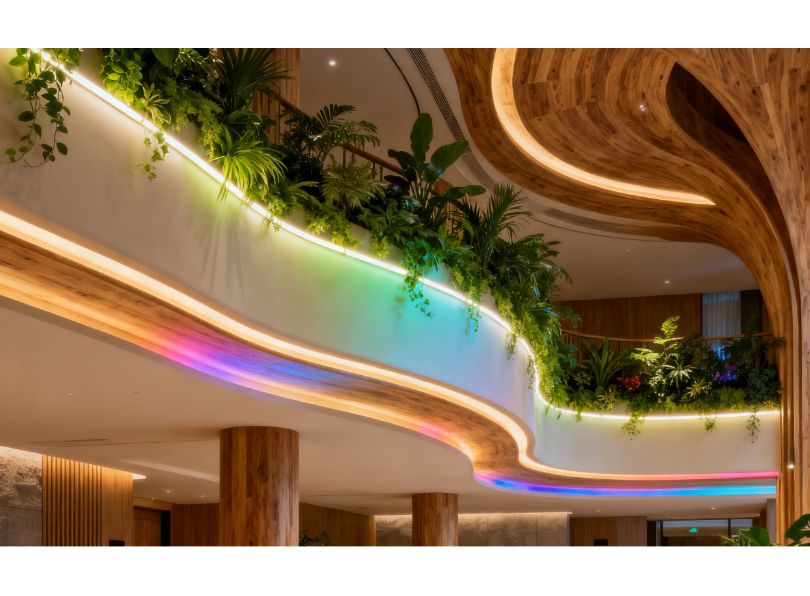
Your questions…
The following questions represent the most commonly asked queries about biophilic design, biomimicry lighting, and their practical implementation.
What is biophilic design?
Biophilic design is an evidence-based design approach that deliberately incorporates opportunities for human connection with the natural world into built environments. It is grounded in the biophilia hypothesis (the proposition that humans have an innate, genetically encoded need for contact with nature) and operationalised through specific design principles, patterns, and elements that have been shown to improve occupant wellbeing, productivity, cognitive function, and health. The biophilic design definition thus encompasses both a theoretical claim (that humans need nature) and a practical methodology (specific design strategies for meeting that need in buildings). For lighting, biophilic design means light that behaves like natural light: spectrally rich, dynamically variable, circadian-supportive, and architecturally integrated to produce the diffuse, sourceless quality of outdoor illumination.
What is biomimicry?
Biomimicry is the deliberate imitation of natural systems, processes, and structures to solve human design challenges. In lighting, it encompasses the replication of solar spectral quality (through sunlike led technology), the emulation of natural light dynamics (through tunable white control systems), and the formal inspiration of luminaire design from biological models (bioluminescence, leaf venation, water light). Biomimicry is distinguished from mere nature-inspired design by its rigour: it seeks not merely to look like nature but to function like nature, solving problems with the efficiency, elegance, and sustainability that three billion years of biological evolution have optimised. Biomimicry products in the lighting sector range from moth-eye anti-reflection coatings on led optics to Voronoi-pattern led panel diffusers to Sunlike solar-spectrum led strips.
What is biophilic architecture?
Biophilic architecture designs buildings to maximise occupants’ connection with the natural world at every scale: from urban siting and orientation (maximising solar access and green space proximity) through structural and spatial design (atriums, biomorphic forms, natural ventilation) to interior finish (natural materials, living plants, high-quality natural light). Biophilic buildings are distinguished from conventionally sustainable buildings by their emphasis on the occupant experience of nature rather than (or in addition to) the environmental performance of the building enclosure. Singapore is often cited as the world’s leading example of a city that has embedded biophilic architecture principles into its planning and development framework at an urban scale.
How do you create a biophilic design?
Creating a genuine biophilic design involves:
- conducting a biophilic assessment of the site identifying existing natural assets (views, daylight, ventilation potential) and deficits to be addressed;
- selecting relevant biophilic patterns from the Terrapin 14 Patterns framework appropriate to the building type and occupancy;
- developing a biophilic strategy that integrates those patterns across lighting, materials, planting, water, and spatial organisation;
- specifying appropriate technologies for each element, including high-CRI LED strips in aluminium profiles for the lighting component;
- verifying the design against WELL, Fitwel, or LEED biophilic criteria;
- commissioning post-occupancy monitoring to validate performance and identify improvements.
The process is interdisciplinary: it requires collaboration between architects, interior designers, lighting designers, landscape architects, mechanical engineers (for ventilation and acoustics), and increasingly, behavioural scientists and health researchers.
What are the biophilic design elements?
The biophilic design elements are the specific physical and spatial components through which biophilic principles are realised in buildings. The most comprehensive taxonomy (Terrapin 14 Patterns) identifies:
- visual connection with nature;
- non-visual connection with nature;
- non-rhythmic sensory stimuli;
- thermal and airflow variability;
- presence of water; dynamic and diffuse light;
- connection with natural systems;
- biomorphic forms and patterns;
- material connection with nature;
- complexity and order;
- prospect;
- refuge;
- mystery;
- risk/peril.
For lighting design, the most directly actionable elements are: dynamic and diffuse light (tunable white led in cove profiles), material connection (high-CRI led illuminating natural surfaces), visual connection (Led illuminating living walls and indoor plant installations), and prospect/refuge (high ceiling luminance contrasting with low ambient at occupied level).
What are the biophilic design principles?
The principal biophilic design principles are:
- direct experience of nature: real natural elements, genuine daylight;
- indirect experience: natural materials, biomorphic forms, nature imagery, high-CRI light rendering natural materials accurately;
- space and place conditions: prospect and refuge, complexity and order, mystery;
- natural shapes and forms: organic, fractal, biomorphic geometries;
- natural patterns and processes: dynamic light variation, sensory variability, temporal change;
- evolved human-nature relationships: emotional and cultural connections to specific natural experiences.
These principles are operationalised through the 14 Patterns framework and measured against WELL, Fitwel, and LEED biophilic performance criteria.
What are some examples of biomimicry?
Classic examples of biomimicry include:
- Velcro: inspired by burdock burr hooks;
- the Shinkansen’s bullet nose: kingfisher beak;
- Lotus Effect coatings: lotus leaf water repellency;
- sharkskin swimwear: shark dermal denticle drag reduction;
- the Eastgate Centre in Harare: termite mound passive ventilation;
- Voronoi structural panels: ddragonfly wing venation;
- moth-eye anti-reflection led optics: moth compound eye;
- sunlike ledtechnology: solar spectral power distribution replication.
In interior design and lighting, biomimicry examples include: water-caustic led ceiling installations; bioluminescence-inspired ambient luminaires; living wall led grow-light systems; and forest-canopy led profile installations that recreate dappled light effects.
Is biophilic design good for ADHD?
Yes, available evidence suggests that biophilic design is beneficial for individuals with ADHD. Research by Kuo and colleagues demonstrated that green outdoor environments significantly improved attention in children with ADHD, and subsequent studies have confirmed that high-quality natural light (or high-quality artificial daylight simulation), access to nature views, reduced visual clutter, and organic spatial conditions contribute to improved attention and reduced impulsivity in ADHD populations.
The mechanism is Attention Restoration Theory: natural environments engage effortless involuntary attention, allowing the directed attention system (which is the source of difficulty in ADHD) to recover. From a lighting perspective, flickering light sources, harsh glare, and very cool, high-intensity uniform light are associated with aggravated attention difficulties; warm, diffuse, flicker-free, natural-quality light is associated with improved calm and focus for individuals on the ADHD spectrum.
Is biophilic design greenwashing?
Biophilic design is not inherently greenwashing, but it can be if implemented as a superficial aesthetic gesture without grounding in the evidence base or genuine design intent. Token pot plants and wood-effect vinyl do not constitute biophilic design; they constitute decoration that borrows the language of biophilia for marketing purposes. Genuine biophilic design, grounded in the Terrapin 14 Patterns framework, implemented with specific performance targets (WELL L01/L03 for lighting, BREEAM Well-being credits), and verified through post-occupancy evaluation, is categorically not greenwashing, it is measurably effective design with documented health, productivity, and environmental outcomes. The responsibility for distinguishing between the two rests with informed clients, credentialled practitioners, and rigorous performance specification.
Who is the father of biophilic design?
E.O. Wilson is widely regarded as the intellectual father of biophilic design, having coined the term biophilia and published its foundational theoretical exposition in his 1984 book. Stephen Kellert is considered the father of biophilic design as a practical discipline: his 2008 book with Heerwagen and Mador “Biophilic design: the theory, science and practice of bringing buildings to life” remains the definitive professional reference and his 6 Elements and 70 attributes framework forms the basis of most current biophilic design methodologies. Kellert died in 2016, but his legacy is preserved through the Biophilic Design Initiative at Yale and through the widespread adoption of his framework by practitioners globally.
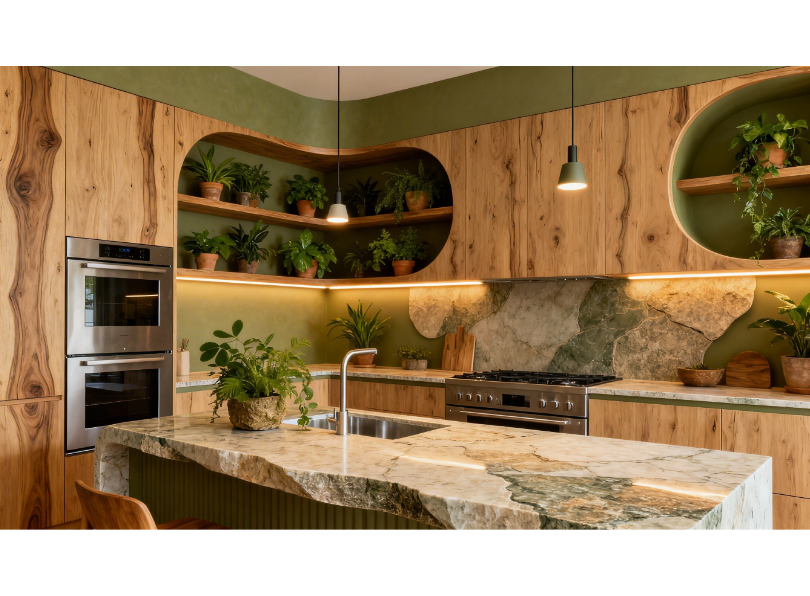
Technical implementation guide: specifying a complete biophilic led lighting system
For the practitioner who needs to move from principles to specification, this section provides a detailed, step-by-step technical implementation guide for a complete biophilic led lighting system. The process covers project brief interpretation, photometric calculations, product selection, control system architecture, commissioning, and post-occupancy verification. This guide is structured as a professional workflow applicable to any building type, scalable from a single residential room to a multi-floor commercial interior.
Step 1: biophilic lighting brief development
Before any product can be specified, the practitioner must develop a biophilic lighting brief that translates the general biophilic design intent of the project into specific lighting performance targets. The brief should address:
- occupancy profile: who will use the space, at what times, for what activities? A bedroom has fundamentally different biophilic lighting requirements from a hospital ward, which differs again from an open-plan office or a school classroom. The circadian sensitivity of the occupant population (children, shift workers, elderly, patient recovering from illness) determines the priority weighting given to circadian performance versus visual task performance;
- daylight baseline: what quality and quantity of natural daylight is available? A south-facing room with floor-to-ceiling glazing in a warm Mediterranean climate needs primarily solar shading and daylight harvesting control; a north-facing basement office in a Nordic climate needs comprehensive biophilic lighting simulation from dawn to dusk. The artificial biophilic lighting strategy is always a complement to (never a substitute for) maximised access to genuine natural daylight;
- biophilic pattern priorities: which of the 14 patterns are most relevant and achievable given the building type, budget, and constraints? A healthcare project might prioritise dynamic and diffuse light (pattern 6), connection with natural systems (pattern 7), and material connection (pattern 9). A retail project might prioritise visual connection with nature (pattern 1), biomorphic forms (pattern 8), and complexity and order (pattern 10). The lighting strategy follows from the pattern priorities.
- performance targets: specific, measurable photometric targets for each zone expressed in WELL-compatible terms: melanopic EDI (lux) at specific times of day. Maintained horizontal illuminance (lux) for task performance, colour rendering index (CRI Ra and R9), maximum acceptable flicker index (IEEE 1789) and CCT range required for tunable white zones.
Step 2: photometric design and software simulation
With the biophilic lighting brief established, the practitioner proceeds to photometric design, the calculation of the luminous environment that will be produced by the proposed led strip and profile combination. This requires specialist lighting simulation software. Key simulation tasks include:
Lumen output calculation: determining the total lumen output required from the led strip to achieve the target illuminance, accounting for profile efficiency (the proportion of led strip lumens that are usefully delivered to the space after reflection losses within the profile), room surface reflectances (critical for indirect cove lighting), and maintenance factor (the expected lumen depreciation over the system’s life). A cove-mounted led strip delivering indirect uplight typically requires 2–3 times the lumen output that would be needed from a direct downlight to achieve the same horizontal illuminance at desk level, because of the multiple reflections involved.
Uniformity analysis: biophilic lighting should avoid high-contrast luminance patterns that suggest sharp artificial origin. Cove and perimeter profiles should be specified at a length and output that produces a uniformity ratio (minimum/average illuminance) of at least 0.7 across the illuminated ceiling surface, to avoid the “bright spots and dark patches” appearance that immediately reads as artificial rather than natural.
Melanopic EDI modelling: advanced biophilic simulation requires calculation of not just photopic illuminance but melanopic illuminance, using the melanopic spectral sensitivity function of the ipRGC photoreceptors as standardised in CIE S 026:2018. This requires knowledge of the spectral power distribution (SPD) of the led strip being used (available from the manufacturer’s photometric data files) and calculation of the ratio of melanopic to photopic response. Sunlike led strips, with their reduced blue-spike SPD, have a lower melanopic-to-photopic ratio than conventional blue-pump leds of the same CCT, which means that at the same photopic illuminance, a Sunlike strip will produce less circadian activation, a benefit in the evening and at night, but requiring compensation in the morning and midday zones where circadian activation is desirable. This spectral nuance must be explicitly accounted for in a rigorous biophilic lighting design, and it is a strong argument for using tunable white (Circadian Care) strips rather than fixed-CCT Sunlike strips in zones where circadian performance across the full daily cycle is required.
Step 3: profile selection and layout design
With the photometric requirements established, the practitioner selects the appropriate led profile for each zone and determines the layout (profile length, spacing, and mounting detail) that delivers the required performance. Key selection criteria for each profile type:
Ceiling cove profiles: select a profile with an anodised or white-painted interior that maximises light extraction efficiency. The setback from the wall must be calculated based on room width, ceiling height, and desired ceiling uniformity, using the “cove lighting calculator” formulas available in the IES Handbook or from manufacturer technical data. A typical rule of thumb is that the cove setback (distance from wall to front of profile) should be at least 1/6 of the room width to ensure adequate ceiling coverage. For a standard 6 m wide room, a minimum setback of 1.0 m is therefore required for good uniformity.
Under-shelf and furniture profiles: select the slimmest profile compatible with the led strip width and thermal requirements. For COB strips in furniture applications, a 10–12 mm wide profile with frosted diffuser is typically ideal, providing sufficient thermal mass for the strip and a diffusion quality that produces smooth illumination on work surfaces without visible led lines. Ensure that the profile mounting depth does not compromise the furniture structure, and specify stainless or anodised aluminium for profiles in humid environments (kitchens, bathrooms).
Linear pendant profiles: for pendant biophilic installations referencing forest canopy or cloud light, select a profile with an opal diffuser that produces a luminance <3,000 cd/m² at any viewing angle, exceeding this threshold creates glare that is both uncomfortable and anti-biophilic. Specify a suspension system that permits micro-adjustment of height and level, and consider a curved pendant profile for installations where biomorphic form is a design priority.
Floor and step profiles: specify profiles with IP65 or IP67 rating for floor-level applications where water ingress is possible. A warm (2700K) COB led strip in an IP67 floor profile creates a warm, grounding floor-level biophilic presence that references both firelight and the warm earth colour of natural ground surfaces, profoundly calming for evening and relaxation spaces.
Step 4: control system architecture
The control system architecture for a biophilic led lighting installation must balance four competing requirements: biophilic functionality (biorhythm programming, scene recall, daylight harvesting), ease of use (occupants must be able to override automatic programmes intuitively), integration (with BMS, home automation, occupancy sensors, and building energy management systems)and reliability (a biophilic lighting system that fails frequently or is difficult to maintain will be abandoned or overridden, losing all its biophilic benefits).
For residential applications, a WiFi or Zigbee smart controller (such as the Skydance V2-L(WT) or V2-L(WZ)) connected to a compatible home automation hub (Apple HomeKit, Google Home, Amazon Alexa, or Home Assistant) provides the best balance of biophilic functionality, ease of use, and integration at a consumer price point. A smartphone app allows occupants to view and adjust the biorhythm programme, create custom scenes, and control individual zones independently. The Zigbee protocol is preferred for multi-room residential installations because it creates a mesh network that is more reliable over larger floor areas than single-point WiFi.
For commercial and institutional applications, DALI DT8 is the professional standard, providing individually addressable luminaire control, integration with BMS via DALI gateways, commissioning and diagnostics capabilities, and the robustness required for 24/7 healthcare and institutional operation. The TD-W and TD-K(WT) panels from the LightingLine range provide user-facing control of biophilic scenes with the appropriate combination of simplicity and functionality for non-technical occupants in these environments.
Led strip selection checklist for biophilic applications
<td;<0.05 (imperceptible)<td;>25,000 hours>50,000 hours>70,000 hours
| Parameter | Minimum standard | Recommended biophilic standard | Premium biophilic standard |
|---|---|---|---|
| CRI Ra | 80 | 90 | >95 (Sunlike: >97) |
| R9 (red saturation) | >0 | >50 | >90 |
| CCT range | Fixed | 2700–5000K tunable | 2200–6500K tunable |
| Flicker Index | <0.3 | <0.1 (IEEE 1789) | |
| Lumen depreciation (L70) | |||
| Color consistency (MacAdam) | 5 SDCM | 3 SDCM | 2 SDCM (Sunlike) |
| Dimming | Phase-cut | PWM or constant current (≥500 Hz) | PWM (≥3,000 Hz) + 0–10V analogue |
| IP rating | IP20 (dry indoor) | IP44 (damp locations) | IP65/67 (floor, outdoor, wet) |
| Circadian validation | None | WELL L01/L03 compliant SPD data | CIE S026 melanopic ratio certified |
Step 6: installation and commissioning
The biophilic lighting installation requires the same technical care as any led installation, with additional attention to the factors most relevant to biophilic performance. Key commissioning tasks include:
- profile alignment: cove profiles must be installed at a consistent height and setback throughout each zone. Even small variations in profile height (±5 mm) produce visible variations in ceiling luminance that disrupt the uniform, sky-like quality that is the biophilic goal of the installation. Snap-line marking and laser-level installation are recommended for all linear cove applications.
- CCT consistency: when using multiple lengths of led strip from different production batches, verify that the colour temperature and tint are consistent within 2 SDCM (MacAdam ellipses). Visual colour inconsistency in a cove installation, warm patches next to cool patches, is immediately noticeable and undermines the natural, homogeneous quality of the biophilic lighting scheme. Always specify led strips from a single production batch for each zone.
- biorhythm programme calibration: after controller installation, verify the GPS or manual location data used for astronomical clock calculations, confirm the sunrise and sunset times displayed by the controller against published almanac data for the project location, and validate the transition curves for CCT and intensity against the biophilic brief targets. A properly calibrated biorhythm programme should produce approximately 300–500 lux at desk level with CCT of 5000K at solar zenith for the installation’s latitude, confirming circadian adequacy for the midday alert phase.
- daylight sensor calibration: if daylight harvesting sensors are installed, calibrate them under representative natural light conditions (not at night) and set the target illuminance to maintain the specified biophilic illuminance target when artificial and natural light are combined. A sensor set to maintain 500 lux at the task plane will reduce artificial light output as natural light contributes, but must be configured to adjust the CCT of the artificial supplement simultaneously, a configuration step that requires attention to the specific capabilities of the controller firmware.
Step 7: post-occupancy evaluation and optimisation
The final and often neglected step in biophilic lighting implementation is post-occupancy evaluation (POE): the systematic measurement and assessment of the installed system’s performance against the original brief, combined with occupant feedback on wellbeing, visual comfort, and satisfaction. WELL Building Standard certification requires POE for feature verification; best practice recommends it for all biophilic lighting projects regardless of certification intent.
A biophilic lighting POE should include:
- photometric measurements: horizontal and vertical illuminance at key locations and times of day, colour temperature measurement at eye level, flicker measurement at each dimming level;
- melanopic calculations: melanopic EDI derived from measured spectral data, compared with WELL L01/L03 targets;
- occupant survey: standardised wellbeing questions (CIBSE TM40, WELL Occupant Survey) covering visual comfort, naturalness of the light environment, mood, energy levels, and sleep quality;
- energy performance monitoring: kWh consumption data compared with the pre-installation baseline, verifying the energy savings that should accompany the biophilic quality improvement.
Extended applications: retail, hospitality, education and wellness
Beyond the office, home, and healthcare contexts examined in earlier sections, biophilic design lighting offers transformative potential across a wide range of additional application domains. This section examines retail, hospitality, educational, and wellness applications in detail, providing specific design strategies and product references for each context.
Biophilic lighting in retail
The retail environment presents a fascinating case study in the commercial value of biophilic lighting. Consumer psychology research has consistently demonstrated that shopping behaviour is profoundly influenced by the quality of the light environment: luminance contrast, colour temperature, and colour rendering all affect perceived product quality, dwell time, and purchase intention. For retailers whose product proposition includes natural, organic, artisanal, or health-oriented values, biophilic lighting is a direct commercial imperative.
Key findings from retail lighting research relevant to biophilic design:
- a study by Summers and Hebert (2001) found that shoppers spent significantly more time in retail zones with warm, dim ambient lighting compared with cool, bright zones;
- Schechter et al. (2015) demonstrated that high-CRI lighting (CRI 95 vs CRI 80) in food retail increased perceived product freshness by 40% and purchase intent by 28%;
- and multiple studies in the US and European food retail sectors have shown that sunlike-quality led illumination over fresh produce, bakery, and delicatessen counters produces measurably higher unit sales compared with standard led illumination of the same photopic intensity.
A biophilic retail lighting strategy for a premium natural food store or organic beauty retailer might include:
- sunlike CRI >97 LED strips in slim profiles above product display areas (3000K warm-white, 500–700 lux);
- indirect warm COB cove lighting in the ceiling (2700K, 200–300 lux ambient);
- feature wall lighting on living moss or planted walls (tunable white, 3000K biophilic display);
- daylight harvesting system that maintains consistent illuminance regardless of natural light levels from glazed facades, protecting product quality perception throughout the trading day.
Biophilic lighting in hospitality
The hospitality sector (hotels, restaurants, spas, wellness retreats, and premium food-and-beverage venues) represents one of the most commercially exciting and creatively rich application domains for biophilic lighting design. Hotel guests and restaurant diners are, by definition, seeking an elevated experience of place, beauty, and wellbeing. Biophilic lighting that creates a genuinely nature-connected, restorative, and aesthetically distinctive environment is a direct contributor to the key commercial metrics of guest satisfaction, repeat booking, review scores, and price premium.
The biophilic hotel guest room represents a complete synthesis of all the strategies discussed throughout this article:
- a dynamic tunable white led system (WiFi or Zigbee smart control with biorhythm function) provides circadian-supportive light throughout the day and night;
- sunlike led strips in bathroom mirror profiles provide perfect skin-tone rendering for grooming;
- warm COB strips in concealed bedroom ceiling coves create a refuge-condition ambient that supports restorative sleep;
- a simple tablet or phone control interface allows guests to set their preferred scene from a menu of nature-inspired presets (Forest Morning, Ocean Dusk, Alpine Noon, Nordic Winter).
For restaurants, the biophilic lighting strategy focuses on three objectives:
- flattering food and skin-tone rendering (CRI R9 >90, achieved by Sunlike technology);
- warm, intimate ambient atmosphere (2700–3000K at low-to-moderate intensity);
- material connection with natural surfaces (timber, stone, leather, living plant installations illuminated by high-CRI profiles).
Research by Cardello and colleagues has demonstrated that food taste perception is significantly affected by ambient lighting quality: warmer, more natural light enhances the perceived sweetness and complexity of wine and food, while harsh cool fluorescent light reduces hedonic response and dwell time. The commercial and biophilic imperatives are perfectly aligned in the restaurant context.
Biophilic lighting in education
The educational environment is perhaps the highest-stakes application domain for biophilic lighting, because the occupants, children and young adults at critical stages of cognitive, emotional, and physical development, spend 6–8 hours per day, 5 days per week, in school buildings whose light environment has a measurable impact on their learning outcomes, health, and development. The research evidence for the impact of daylighting and light quality on educational performance is among the most compelling in the entire biophilic design literature.
Lisa Heschong’s landmark Daylighting in Schools study (1999, 2003), conducted for the California Public Utilities Commission, examined 21,000 students in 2,000 classrooms and found that students in classrooms with the best daylighting progressed 20–26% faster in mathematics and 26% faster in reading over one year than students in classrooms with the worst daylighting. Subsequent studies have replicated these findings in Europe and Asia and extended them to show that classroom light quality specifically, not just quantity, affects outcomes: higher CRI, appropriate CCT, and dynamic variation that tracks the circadian cycle all contribute independently to improved learning performance.
For classrooms, the biophilic lighting strategy recommended by the evidence base includes:
- a primary ambient circuit: tunable white, 4000–5000K during core learning hours, 3000K for relaxation periods in recessed cove profiles providing uniform ceiling illuminance;
- a secondary task circuit: high-CRI, 500–600 lux at desk level for reading and writing;
- a daylight harvesting integration system;
- a teacher-accessible scene controller that allows CCT adjustment for different activity types (energising cool-white for testing, calming warm-white for creative activities or post-lunch recovery).
For classrooms with a significant proportion of ADHD students, flicker-free performance (<0.05 flicker index) is a specific design requirement, as is the provision of a lower-luminance “calm zone” with warm, indirect LED lighting for sensory-regulation breaks.
Biophilic lighting in wellness and SPA environments
Wellness centres, spa facilities, yoga studios, meditation rooms, and therapeutic retreats are perhaps the most explicitly biophilic building types in contemporary design, as their entire programme is oriented towards the restoration of wellbeing through the creation of environments that support the parasympathetic nervous system, reduce cortisol, and facilitate deep relaxation. Lighting in these environments must achieve the most demanding biophilic standard: zero glare, maximum warmth and organic quality, and an atmosphere of profound sensory calm that references the most restorative natural environments.
Spa and wellness lighting strategies draw heavily on the Sunlike, COB, and ultra-slim profile technologies discussed throughout this article. A treatment room biophilic lighting scheme might include:
- very low-intensity (30–80 lux) warm (2200–2700K) COB led strips in ceiling cove profiles, producing a continuous, seamless halo of warm amber light that references both firelight and the quality of light in a sheltered forest clearing at dusk;
- warm COB strips behind alabaster or onyx stone panels on feature walls, producing a glowing, bioluminescence-inspired ambient;
- smart controller with a programmable “treatment scene” that dims the room gradually from arrival illuminance (150 lux, 3000K) through the treatment sequence to a deep relaxation setting (30 lux, 2200K) and back up gently for departure, a complete biophilic lighting narrative that matches the therapeutic arc of the treatment itself.
Pool and hydrotherapy environments require IP67-rated led profiles and strips, with attention to anti-glare diffuser selection (maximum 1,500 cd/m² from any underwater fitting) and CCT programming that transitions from energising morning sessions (5000K, bright) to relaxing evening use (2700K, dim). The caustic light effects produced by underwater led fittings reflecting off pool water surfaces are among the most powerful biophilic light phenomena available in an interior: their dynamic, organic, non-repeating patterns engage involuntary fascination in exactly the restorative mode that Kaplan’s Attention Restoration Theory describes.
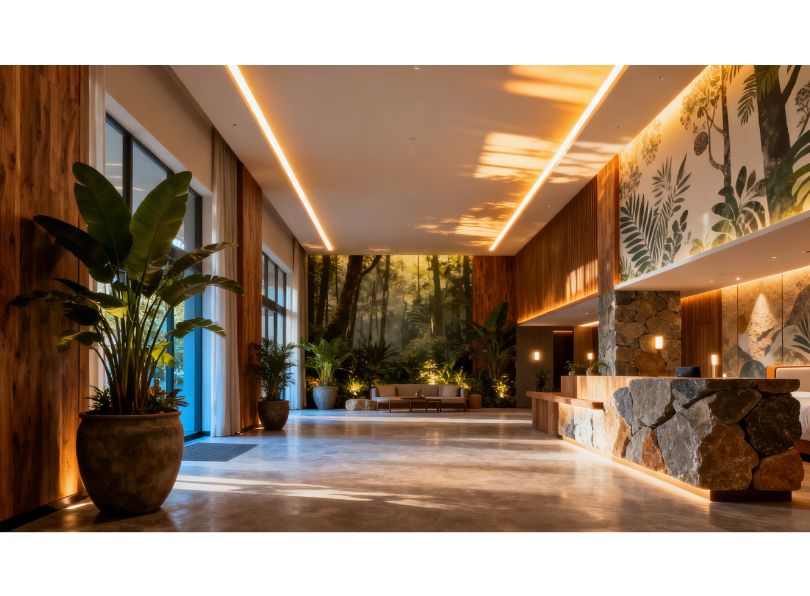
Biophilic design and sustainability: the environmental dimension
While the primary focus of biophilic design is on the human experience of nature rather than the environmental performance of buildings per se, the two imperatives are increasingly recognised as deeply interconnected. A built environment that provides its occupants with genuine, sustained connection to the natural world is more likely to produce occupants who value, protect, and care for the natural world. Conversely, energy-efficient, environmentally responsible buildings that provide no meaningful connection to nature for their occupants fail to close the psychological and cultural loop that makes environmental sustainability personally meaningful rather than merely technically mandated.
Led technology and the energy argument for biophilic lighting
The energy efficiency of led technology is the most direct and quantifiable connection between biophilic lighting and environmental sustainability. A standard incandescent lamp produces approximately 10–15 lumens per watt, an halogen approximately 20–25 lm/W, a compact fluorescent 50–70 lm/W, a standard commercial LED 80–130 lm/W; and a premium high-CRI led strip (Sunlike or Circadian Care) in the 70–100 lm/W range — substantially better than incandescent and halogen, comparable to or better than fluorescent, at dramatically superior colour quality. An office that replaces fluorescent ceiling panels with indirect led strip cove lighting using Circadian Care strips and tunable white controllers will typically reduce lighting energy consumption by 40–65%, while simultaneously upgrading from CRI 80 to CRI >90 light quality and adding the full circadian-supportive biorhythm functionality of a biophilic system.
The addition of daylight harvesting sensors adds a further energy reduction layer: in a south-facing, well-glazed office, daylight harvesting alone can reduce artificial lighting energy consumption by 30–50% compared with a non-harvesting led system of the same specification. The combined effect of led efficiency, circadian dimming (lower intensity for much of the day), and daylight harvesting can reduce total lighting energy consumption by 65–80% compared with the pre-biophilic baseline, making biophilic lighting not merely compatible with environmental sustainability but one of the most effective single interventions available for reducing building energy consumption and carbon emissions.
Circular economy and led sustainability
Beyond operational energy, the environmental sustainability of biophilic led lighting is also relevant in terms of materials, manufacturing, and end-of-life. Modern led strips and aluminium profiles are both highly recyclable: aluminium is infinitely recyclable at relatively low energy cost and led chips contain no mercury (unlike fluorescent lamps) and are increasingly designed for disassembly and component recovery. The long lifespan of quality led systems (50,000–70,000 hours for premium led strips, equivalent to 25–35 years of typical office use) dramatically reduces the materials throughput associated with lamp replacement compared with halogen or fluorescent systems, further reducing the environmental footprint of the biophilic lighting installation over its lifecycle.
Biophilic lighting and dark sky compliance
An often-overlooked dimension of the relationship between biophilic design and environmental responsibility is light pollution. Artificial light at night (ALAN) is a significant environmental stressor for nocturnal wildlife, disrupting the navigation, reproduction, and feeding behaviour of birds, insects, and mammals, reducing the biological productivity of aquatic ecosystems affected by light spill from riverine and coastal development and degrading the dark sky environments that human communities have valued since prehistory. A genuinely biophilic approach to external and semi-external lighting must therefore include dark-sky compliance: the specification of luminaires and control systems that minimise upward light emission, control spill light beyond the intended illuminated area, and reduce or eliminate external lighting during ecologically sensitive periods (nesting, migration, insect flight seasons).
Led technology, with its point-source nature and precise optical control, is inherently better suited to dark-sky-compliant specification than diffuse sources. Led strips in profiles with full-cut-off optics, mounted at low level and directed downward, can illuminate pedestrian paths, building perimeters, and landscape features with minimal sky glow and spill light, supporting the nocturnal darkness that is as much a part of the natural light cycle as the solar day. For a truly biophilic approach to the complete 24-hour light environment, one that recognises darkness as biologically essential, not merely the absence of light, external led systems should be specified with time-controlled dimming that reduces output to the minimum necessary for safety after 10 PM, and eliminates all unnecessary illumination after midnight.
Biophilic interior design: advanced strategies for the professional
These advanced strategies require a deeper understanding of photobiology, architectural detailing, and smart control programming, but they produce commensurately more powerful biophilic experiences for the occupants they serve.
The luminous threshold: light between inside and outside
One of the most powerful but underexplored strategies in biophilic lighting design is the deliberate cultivation of the luminous threshold: the transitional zone between interior and exterior where natural and artificial light blend, overlap and interact. Japanese architectural tradition has understood the importance of the engawa (the transitional indoor-outdoor space, often a veranda or sheltered walkway) as a zone of heightened sensory engagement where the qualities of inside (shelter, warmth, human presence) and outside (light, nature, openness) are held in productive tension. Modern biophilic architecture can recreate this quality through the deliberate design of window reveals, glazed walls, and indoor-outdoor thresholds as lighting design opportunities.
A window reveal illuminated on its jamb surfaces with warm sunlike led strips in a slim recessed profile (facing inward, towards the interior) creates a luminous frame around the view of the exterior landscape that simultaneously draws the eye outward and creates a warm, domestic glow that enhances the sense of refuge within the interior. The warm CCT of the artificial frame (2700–3000K) contrasts deliberately with the cool blue of the sky view beyond (typically 6000–12000K in daylight), creating the visual contrast that environmental psychology associates with the most deeply satisfying prospect conditions, the experience of gazing out from a warm, sheltered interior towards a bright, open exterior.
The living wall as light installation
The living wall, when illuminated with the full technical sophistication that sunlike led strips and smart tunable white controllers permit, becomes more than a botanical installation: it becomes a dynamic light environment of extraordinary biophilic power. The key to achieving this transformation is treating the living wall as a photographic subject as well as a plant installation: understanding how the spectral quality of the light source, its direction, its distribution, and its dynamic variation interact with the visual and biological properties of the plants to create a total environment that is perceived holistically, as a section of living landscape, rather than analytically, as a planted wall with some lights attached.
For optimal living wall illumination, combine: a sunlike CRI >97 led strip at the top of the wall (angled 30–45 degrees downward) for primary illumination, a warm COB led strip concealed at the base for uplight that highlights stem and trunk structures and a smart tunable white controller programmed to shift from cool (5000K) morning light to warm (2700K) evening light, replicating the quality of outdoor light on a south-facing planted wall as the sun moves from overhead to low angle throughout the day. The resulting visual experience, warm evening light grazing across textured foliage and illuminating deep green depths, is among the most powerful biophilic light environments achievable in an interior context.
Water and light: the caustic effect
The light patterns produced by solar radiation refracting through moving water surfaces, known as caustic patterns, are among the most universally captivating natural light phenomena. Research in environmental aesthetics has identified water-caustic light as producing some of the strongest positive affect scores of any natural visual stimulus, with particular resonance across cultures that evolved near coastal or riverine environments. Replicating water-caustic light effects in an interior (on walls, ceilings, or floors) is one of the most effective single biophilic lighting interventions available, and it is achievable at a cost that is often surprisingly modest.
The simplest approach uses a programmable led strip controller with a custom scene that produces slow, organic variations in intensity across a linear led strip, combined with a lenticular diffuser or optical film that scatters the light into irregular, water-like patterns on the adjacent surface. More sophisticated approaches use a custom-fabricated optical element, a sheet of irregular optical glass or cast resin, positioned above or beside the led strip to produce genuine optical caustics rather than simulated intensity variation. The most advanced approach uses a water feature with an integrated led strip below the waterline, allowing actual water movement to produce real, physical caustics on the ceiling above.
Forest canopy light: the dappled ceiling
Perhaps the most iconic and universally recognised biophilic light environment is the forest canopy: the experience of looking up through a complex arrangement of leaves and branches at a bright sky beyond, receiving a constantly shifting mosaic of direct sunlight and shadow at varying scales and angles of incidence. The restorative power of this light environment has been documented extensively in forest bathing (Shinrin-yoku) research and in the environmental psychology of prospect-refuge theory: it is simultaneously open (prospect) and sheltered (refuge), bright (energising) and dappled (softened), and it engages the perception with organised complexity of exactly the fractal dimension that mathematical analysis of preferred natural patterns consistently identifies.
To create a forest-canopy light effect on an interior ceiling, the designer has several options. The most controlled approach uses a custom laser-cut or CNC-routed panel in the ceiling plane, with a pattern derived from leaf silhouettes or fractal branching geometry, backlit by a continuous led strip in a recessed profile above. The result is a ceiling that appears to glow with the same quality as sky visible through foliage: bright in the apertures, graduated at the edges, and organically patterned. The biophilic power of this effect depends critically on the colour quality of the led: a Sunlike CRI >97 strip produces the blue-sky quality of the apertures and the warm-leaf quality of the panel material with the chromatic accuracy that makes the effect convincing rather than merely decorative.
Biophilic design, mental health and the neuroscience of natural light
The relationship between biophilic design, natural light quality, and mental health is perhaps the most scientifically compelling and socially significant dimension of the entire discipline. Mental health conditions (depression, anxiety, burnout, seasonal affective disorder and the subclinical stress and cognitive impairment associated with modern urban and indoor life) represent one of the most significant public health challenges of the 21st century, with the World Health Organisation estimating that depression alone affects 264 million people globally and costs economies USD 1 trillion annually in lost productivity. The evidence that natural light quality and biophilic design can measurably reduce the prevalence and severity of these conditions (not as a replacement for medical treatment but as a complementary environmental intervention) represents an extraordinary opportunity for architecture and design to contribute meaningfully to public health.
Seasonal affective disorder and biophilic lighting
Seasonal Affective Disorder (SAD) is a well-established clinical condition in which depression recurs predictably in the autumn and winter months, driven by reduced daylight exposure and its consequent disruption of melatonin regulation, serotonin production, and circadian rhythm. It affects approximately 2–6% of the population in temperate and Nordic climates, with a much larger proportion (10–20%) experiencing subsyndromal SAD (the “winter blues”). The standard treatment, bright light therapy using a 10,000 lux white light lamp for 20–30 minutes each morning, is as effective as antidepressant medication for most SAD patients, and works through the same mechanism that biophilic lighting employs: resetting the circadian pacemaker by providing the strong morning blue-enriched light signal that the body clock requires but that winter conditions deny.
A biophilic lighting system with a properly calibrated biorhythm programme and adequate morning illuminance (300–500 melanopic lux at eye level from 7:00 to 9:00 AM) provides, for the residents or occupants of a biophilically lit space, the equivalent of a passive daily light therapy session, without any clinical equipment, any conscious effort, or any disruption to normal routine. Over a winter season, this environmental intervention produces measurably improved mood, energy, alertness, and sleep quality compared with static indoor lighting, particularly for individuals with SAD or subsyndromal SAD.
Burnout, stress, and the restorative light environment
Beyond clinical conditions, the diffuse but pervasive experience of stress, cognitive fatigue, and burnout that characterises modern knowledge work represents a biophilic lighting opportunity at scale. Research by Gloria Mark and colleagues at the University of California demonstrated that the average knowledge worker’s attention is interrupted or self-diverted every 3.5 minutes in a standard open-plan office — a rate of directed attention demand that rapidly depletes the executive function resources of the prefrontal cortex. A biophilic light environment that provides regular “attentional micro-restoration” (through the subtle dynamic variation of indirect led lighting, the visual fascination of a well-lit living wall, or the caustic play of light on a water feature) reduces this attentional depletion by engaging involuntary attention periodically, allowing directed attention to recover without requiring the occupant to leave the workspace.
This is the mechanism by which biophilic lighting, combined with other biophilic design elements, reduces the rate of burnout and stress-related absenteeism documented in the Interface Corporation and WGBC research cited earlier in this article. It is not merely aesthetic but it is a specific, biologically grounded intervention in the neural economics of cognitive work, and it can be delivered cost-effectively through the specification of high-quality led strips in well-designed profiles with smart dynamic control.
Specifying biophilic lighting: a practitioner’s technical reference
For lighting designers, electrical engineers, and specification writers who need to translate biophilic design intentions into procurement documents, performance schedules, and commissioning protocols, this section provides a structured technical reference. The move from concept to specification is where biophilic lighting projects most often lose their integrity: value-engineering substitutions replace high-CRI Sunlike strips with generic led tape, aluminium profiles are swapped for plastic channels with inferior thermal performance, smart controllers are omitted in favour of fixed-output dimmers and the resulting installation, while technically functional, fails to deliver the photobiological and experiential outcomes that biophilic design demands. Robust specification language, clearly articulated performance requirements, and a thorough understanding of the substitution risks are the professional specifier’s primary tools for protecting the integrity of a biophilic lighting design from procurement to completion.
Performance-based specification language for biophilic led strips
Generic specifications that describe led strips solely by wattage per metre and lumen output per metre invite substitution with products that meet the photometric requirements while failing the photobiological ones. A biophilic-quality led strip specification must include the following performance parameters as minimum requirements, not merely desirable characteristics:
- Colour Rendering Index (CRI/Ra): minimum Ra 95 for Circadian Care applications; minimum Ra 97 for Sunlike solar-spectrum applications. This requirement should be supported by a demand for third-party test certificates (LM-79 or equivalent) confirming the CRI value at the specified CCT across the full tunable range (if tunable white). Ra 95 is the absolute minimum for any application claiming biophilic credentials; Ra 90 or below is not biophilic-quality regardless of marketing claims.
- R9 Value: minimum R9 60 for Circadian Care; minimum R9 90 for Sunlike. R9 measures the rendering of saturated reds, which are critically important for the accurate rendering of skin tones, natural materials (wood, stone, leather), and plant colours. Generic led strips commonly achieve Ra 80 with R9 as low as 0, making them incapable of rendering the warm, organic chromatic quality that biophilic design requires. R9 is the single most important supplementary colour rendering parameter for specifying biophilic quality.
- Spectral Power Distribution (SPD): for Sunlike applications, the SPD must demonstrate a smooth, solar-like curve without the blue spike at 450–460 nm that characterises conventional phosphor-converted led. This should be verified from the manufacturer’s published SPD data and confirmed by independent spectrophotometric measurement at commissioning.
- Flicker Performance: maximum flicker index 0.05 at any dimming level between 10% and 100% of full output. This requirement is particularly important for educational and healthcare applications and should be verified at commissioning using a calibrated spectroradiometer with temporal light artefact measurement capability.
- Tunable White Range: for circadian-supportive applications, the full tunable range must span 2700K to 6500K with continuous, stepless colour temperature adjustment and simultaneous independent dimming control. The correlated colour temperature at all points in the tuning range must fall within a MacAdam 3-step ellipse of the specified Planckian locus, confirming chromaticity accuracy across the full range.
- Melanopic Efficacy Ratio (MER): for WELL-compliant or circadian-optimised specifications, the melanopic efficacy ratio of the tunable white system at 6500K should be specified as a minimum of 0.9, confirming that the daylight-simulating mode of the system delivers adequate ipRGC stimulation for circadian entrainment.
Performance-based specification language for led aluminium profiles
Aluminium profile specifications for biophilic applications must address thermal performance, optical quality, and architectural integration with equal rigour. The following performance parameters should be specified:
Thermal banagement: the profile must maintain led junction temperature below 70°C at maximum rated current input in the installed position and at the ambient temperature of the installation environment (specify: typically 25–35°C for occupied spaces, up to 45°C for some hospitality or industrial applications). This requirement protects against early lumen depreciation and colour shift, both of which are damaging to the long-term quality of a biophilic lighting installation. Profiles that rely solely on direct air cooling without adequate mass or fin geometry will fail this requirement in recessed or enclosed installations.
Optical diffuser performance: the diffuser specification should state: (a) maximum surface luminance at 100% output (recommended maximum 3,000 cd/m² for visual comfort; 1,500 cd/m² for healthcare and WELL applications); (b) dot elimination performance (no visible LED hotspots at any viewing angle, confirmed visually at 1 m and 3 m from the profile at full output); and (c) light transmission efficiency (specify minimum 85% transmission for PMMA diffusers; 80% for opal glass).
Profile height and integration dimensions: for biophilic applications where the profile must be invisible within an architectural element, the maximum profile height should be specified (e.g., maximum 7 mm for ultra-slim recessed applications using the PR-SL07-05 profile). Installation drawings must confirm that the specified profile fits within the available recess depth, and that adjacent structural elements do not obstruct the light output angle.
Commissioning protocols for biophilic lighting systems
Commissioning a biophilic lighting installation requires verification of both photometric and photobiological performance, and it demands measurement tools and protocols that go beyond the standard luminance meter and lux meter that are sufficient for conventional lighting commissioning. The following commissioning checklist represents best practice for biophilic LED systems:
Step 1: spectroradiometric measurement. Measure the spectral power distribution of each LED circuit at full output, using a calibrated spectroradiometer. Verify CRI, R9, CCT, and SPD against specification. For tunable white systems, measure at 2700K, 4000K, and 6500K. Flag any circuit where Ra is more than 2 points below specification, or where the SPD shows a disproportionate blue spike above 30% of peak spectral power.
Step 2: flicker measurement: using a temporal light artefact (TLA) meter or spectroradiometer with fast temporal sampling, measure flicker index at 100%, 50%, 25%, and 10% dimming levels for each circuit. Verify compliance with the specified maximum flicker index of 0.05 at all levels. Flag any circuit where flicker index exceeds 0.1 at any dimming level; these circuits are not compliant with healthcare, educational, or biophilic specifications.
Step 3: illuminance mapping: conduct a grid illuminance measurement at working plane height (0.8 m for desks; 0 m for floors; 1.2 m for eye level in standing spaces). Verify that average illuminance, uniformity ratio (minimum/average), and maximum-to-minimum ratio meet the design specification at each scene setting (dawn, morning, midday, afternoon, evening). Document the circadian illuminance (melanopic lux or melanopic EDI) at representative eye positions for comparison with WELL or CIE S 026 targets.
Step 4: biorhythm programme verification: for installations using the V2-L(WT), V2-L(WZ), or equivalent smart controllers with biorhythm functionality, verify the complete 24-hour biorhythm programme by observing the system through at least one full simulated day cycle (can be accelerated in commissioning mode). Confirm that the CCT and intensity transitions are smooth and continuous, that the dawn and dusk scene changes occur at the correct local astronomical times, and that the system returns correctly to the programmed schedule after any manual override.
Step 5: daylight harvesting calibration: for installations using the Skydance EH-R or equivalent daylight sensors, calibrate the sensor setpoints with the space occupied and with representative external illuminance conditions. The target is that the combined natural plus artificial illuminance at the work plane maintains the specified level (e.g., 500 lux) ± 10% across all external illuminance conditions from 0 lux to full summer daylight. This may require iterative adjustment of the sensor gain, setpoint, and minimum/maximum output values.
Step 6: DALI addressing and scene verification: for DALI DT8 installations, verify that all DALI addresses are correctly assigned, that group and broadcast commands operate correctly, that all pre-set scenes (nature-inspired presets: Dawn, Forest, Midday, Dusk, Twilight) are stored correctly in the controller memory, and that recall from wall panels or BMS commands operates reliably.
Step 7: documentation and handover: provide a full commissioning record including spectroradiometric data, illuminance maps, biorhythm programme printout, DALI address schedule, daylight sensor calibration data, and as-built drawings showing profile positions, LED strip specifications, and controller locations. This documentation is the evidence base for any future WELL, BREEAM, or LEED certification submission related to the biophilic lighting installation.
| Parameter | Minimum (Biophilic) | Recommended | Sunlike premium | Test method |
|---|---|---|---|---|
| CRI (Ra) | ≥ 95 | ≥ 97 | > 97 | LM-79 / CIE 13.3 |
| R9 | ≥ 60 | ≥ 80 | ≥ 90 | LM-79 / CIE 13.3 |
| Flicker Index | ≤ 0.05 | ≤ 0.02 | ≤ 0.01 | IEEE Std 1789 / TLA meter |
| CCT Range (tunable) | 2700–6500K | 2200–6500K | 1800–6500K | Spectroradiometer |
| MacAdam Ellipse | ≤ 3-step | ≤ 2-step | ≤ 2-step | CIE 15:2004 |
| Melanopic Efficacy Ratio | ≥ 0.8 at 6500K | ≥ 0.9 at 6500K | ≥ 0.95 at 6500K | CIE S 026:2018 |
| Profile height (ultra-slim) | ≤ 10 mm | ≤ 7 mm | ≤ 7 mm (PR-SL07-05) | Physical measurement |
| Diffuser surface luminance | ≤ 3,000 cd/m² | ≤ 2,000 cd/m² | ≤ 1,500 cd/m² | Luminance meter |
| LED lifespan (L70) | ≥ 36,000 hrs | ≥ 50,000 hrs | ≥ 60,000 hrs | LM-80 / TM-21 |
Biophilic lighting and real estate value: the business case expanded
While the occupant health and wellbeing benefits of biophilic design have been documented extensively in this article, the economic case for biophilic lighting investment in the real estate sector extends well beyond productivity gains to encompass rental premiums, asset values, lease terms, tenant retention, and the competitive positioning of buildings in an increasingly sustainability-conscious commercial real estate market.
Understanding this broader economic context helps design professionals make the case for premium biophilic lighting investment to property developers, real estate investors, and asset managers who may be receptive to the health and wellbeing arguments in principle but who require a clear financial framework to justify capital expenditure. The convergence of ESG (Environmental, Social, and Governance) investing principles, WELL and BREEAM certification requirements, and post-pandemic tenant demand for healthier workplaces has created the most commercially favourable environment in history for biophilic design investment in commercial real estate.
Rental premium evidence
Commercial real estate research consistently demonstrates that buildings with credible environmental and wellbeing credentials command rental premiums over comparable un-certified stock. JLL’s research on WELL-certified office buildings in major global markets found average rental premiums of 7–17% over comparable non-certified buildings, with the premium positively correlated with the strength of the indoor environment quality credentials, of which lighting quality is one of the most directly tenant-perceived components. CBRE’s analysis of green-certified buildings in the United States found that LEED-certified buildings achieve rents approximately 5–8% higher than non-certified comparable stock, with premium-grade LEED Platinum buildings commanding 10–15% premiums in the most competitive markets.
While these premiums are driven by a combination of factors (energy efficiency, location, building grade, market conditions), the interior environment quality (and specifically the quality of natural light and biophilic features) is consistently identified by office tenants in occupant satisfaction surveys as one of the most important drivers of workplace satisfaction and premium willingness. Cushman & Wakefield’s “The Healthy Office” research, based on surveys of 10,000 workers across 10 countries, found that natural light was ranked as the single most important environmental feature of an ideal workplace by 40% of respondents, ahead of access to outdoor spaces, temperature control, and acoustic performance.
Asset value and capital growth
Beyond rental income, the capital value implications of biophilic design quality are substantial. Real estate asset values are determined partly by rental income (the income approach to valuation) and partly by comparable transaction evidence and perceived quality (the comparison approach). Both routes to value are positively affected by biophilic design credentials: higher rents drive higher income-derived valuations, stronger WELL/BREEAM certification and demonstrable occupant wellbeing outcomes position a building more favourably in the comparable evidence set and reduce the vacancy risk that depresses valuations in a market downturn.
Knight Frank’s analysis of WELL-certified buildings in London found that buildings with WELL Platinum certification sold at capital value premiums of 11–22% over comparable non-certified stock in transactions between 2019 and 2023. This capital premium is in part a reflection of the lower obsolescence risk of certified buildings (investors recognise that as ESG requirements tighten and tenant health expectations rise) biophilically designed and WELL-certified buildings will remain relevant and attractive to tenants long after conventional buildings of the same age have required expensive refurbishment to remain competitive.
Tenant retention and lease length
The cost of tenant vacancy in commercial real estate is typically estimated at 12–18 months of net rent (accounting for rent-free periods, fitting-out incentives, and agent fees). A biophilic office environment that demonstrably improves occupant wellbeing and satisfaction reduces the probability of lease break and non-renewal, extending average lease length and reducing the frequency and cost of void periods. JLL’s occupier survey data indicates that occupants in WELL-certified or high-wellbeing-rated buildings are 18–32% more likely to report high workplace satisfaction and intention to remain in their current premises at lease renewal than occupants in equivalent un-certified buildings.
For a building owner with 10,000 m² of office accommodation at a market rent of £50/sq ft, a 25% reduction in tenant turnover probability translates to expected savings of £300,000–£500,000 per 10-year period in avoided vacancy costs, a return that, when discounted back to a net present value, justifies a biophilic lighting investment premium of £60–£100 per m² over standard specification, without accounting for any rental premium or capital value benefit. When all three value drivers (rental premium, capital value, and tenant retention) are combined, the financial case for biophilic quality lighting investment in commercial real estate is compelling even without reference to the occupant health and productivity benefits.
Post-pandemic repositioning and the flight to quality
The COVID-19 pandemic produced a structural shift in commercial real estate demand that has made the biophilic case more urgent and more financially compelling than at any previous point in the sector’s history. The experience of remote working during lockdowns demonstrated to millions of knowledge workers that they could perform effectively from home, eliminating the necessity of commuting to an office. The consequence for commercial real estate was a bifurcation of demand: demand for sub-standard, purely functional office space collapsed as tenants recognised that they could not justify the cost and commuting burden if the office provided nothing that home working could not while demand for genuinely excellent, health-supportive, inspiring, and socially rich office environments remained strong or increased, as organisations recognised that these environments could achieve the culture, collaboration, and serendipitous interaction that home working cannot replicate.
This flight to quality dynamic directly benefits biophilically designed buildings: a workspace with demonstrable natural light quality, living plant features, biophilic art and materiality, circadian-supportive lighting, and acoustic comfort provides exactly the category of experience that justifies the decision to commute and to occupy premium-cost space. The “best-in-class” positioning that biophilic design enables is no longer merely a marketing advantage, it is a fundamental requirement for commercial real estate viability in markets where the hybrid working model has permanently reduced average office utilisation and concentrated occupancy pressure in the most attractive buildings.
Biophilic lighting across cultures: universal principles, local expression
One of the most robust findings of biophilic design research is the cross-cultural universality of the underlying preferences: the attraction to natural light quality, fractal patterns, water features, organic forms, and prospect-refuge spatial configurations has been documented across populations from Europe, North America, East Asia, South Asia, and sub-Saharan Africa, suggesting that these preferences are rooted in biological evolution rather than culturally learned aesthetic conventions. However, the specific expressions of biophilic design (the materials, spatial arrangements, light qualities, and nature references that resonate most deeply) vary significantly across cultural traditions, and design practice that ignores this variation produces results that are technically biophilic but experientially disconnected from the inhabitants’ cultural memory of nature and beauty. The most successful biophilic lighting designs are those that combine the universal photobiological principles with the specific cultural aesthetics of the environment in which they are deployed.
Japanese aesthetics and biophilic lighting
The Japanese design tradition offers perhaps the world’s most fully developed cultural vocabulary for biophilic light, one that has evolved over centuries to express the Japanese relationship with the natural world through architecture, material, and light. The concepts of wabi-sabi (the beauty of imperfection and transience), ma (the meaningful quality of negative space and pause), and komorebi (the word for the interplay of sunlight through leaves) all have direct implications for biophilic lighting design in Japanese-influenced interiors.
In practice, Japanese biophilic lighting typically employs: very low overall illuminance levels (50–150 lux for living and contemplative spaces, compared with European norms of 150–300 lux) warm, amber CCT (2200–2700K) light sources that reference the quality of paper shoji screens, candlelight, and the warm afternoon sun filtering through bamboo, extensive use of indirect and reflected light rather than direct illumination; and a deliberate embrace of shadow and contrast as positive compositional elements rather than defects to be minimised. The sunlike led strip’s exceptional CRI >97 and warm-amber capability make it the natural choice for Japanese-inspired biophilic interiors, as it renders the warm golden tones of natural wood, washi paper, and ceramics with the chromatic accuracy that these materials demand.
Scandinavian hygge and the biophilic interior
The danish concept of hygge (the quality of cosiness, warmth, and convivial wellbeing that characterises the Danish approach to interior life, particularly in the long, dark nordic winters) is one of the most culturally specific and globally influential expressions of biophilic design principles in contemporary interior culture. Hygge lighting is, at its core, biophilic lighting: it prioritises the warm, flickering, low-intensity light of candles and fire over the uniform, cool-white efficiency of functional illumination and it creates environments that consciously reference the refuge and warmth of shelter in a cold, dark natural world.
Translating hygge into a specified biophilic lighting installation requires led strip and controller capabilities that are fully aligned with the circadian care and sunlike product range. A hygge-compliant biophilic lighting system might specify: sunlike warm-white (2200K) led strips in recessed cove profiles providing 80–120 lux of very warm ambient light, a smart tunable white controller set to a fixed 2200–2700K output with very slow, organic random dimming variation between 70% and 100% to simulate the subtle flickering of candlelight and supplementary COB led strips concealed behind shelves, under furniture, and within niches to create pools of warm light that define smaller, more intimate zones within larger rooms.
Biophilic lighting in the middle east and islamic architecture
The Islamic architectural tradition has developed sophisticated strategies for managing harsh outdoor light (the primary enemy of comfort in hot, arid climates) while maintaining a deep connection to the celestial and the divine through the quality of filtered light. The mashrabiya screen, the muqarnas vault, the courtyard garden, and the domed interior that fills with reflected sky light are all strategies for converting the harsh glare of the desert sun into the soft, patterned, diffuse light quality that Islamic spaces are celebrated for. The extraordinary geometric complexity of islamic patterns (the most mathematically sophisticated decorative tradition in human history) creates light-and-shadow effects that engage the perception with fractal-dimension complexity of precisely the type that biophilic design research identifies as maximally restorative.
Replicating this quality in contemporary interiors using led technology requires profiles and optical elements that can create patterned shadow as well as diffuse light. Laser-cut metal screens illuminated from behind with sunlike led strips in slim profiles produce a contemporary interpretation of the mashrabiya that is simultaneously technically advanced and culturally resonant. The colour accuracy of the sunlike strip is essential for this application: the warm golden tones of brass or copper screens, the cool grey of raw steel, and the rich earth tones of terracotta walls must all be rendered with the precision that only Ra>97 light quality can provide.
Biophilic lighting in healthcare across cultural contexts
The cultural dimension of biophilic design in healthcare settings is particularly important, as the healing environments of different cultural traditions express very different relationships between the indoor environment and nature. The traditional Japanese healing philosophy (influenced by Shinto and Buddhist respect for the natural world) strongly prioritises garden views and natural light as active components of the healing process, the ayurvedic Indian tradition emphasises the quality and direction of natural light for its effects on the body’s vital energies, the Islamic medical tradition, drawing on the courtyard hospital typology, has long used the quality of light, water, and garden fragrance as therapeutic tools.
Contemporary biophilic healthcare design that aspires to cultural sensitivity must, at minimum, recognise that the specific nature references that are most restorative for patients from different cultural backgrounds may differ: a patient whose cultural experience of restorative nature is the cedar forest of the Pacific Northwest will respond differently to specific light qualities, plant types, and spatial arrangements than a patient whose nature reference is the tropical garden of Southeast Asia. The flexibility of tunable white led systems, their ability to recreate the quality of light at different latitudes and times of year through CCT and intensity adjustment, makes them uniquely capable of supporting culturally variable biophilic environments in multicultural healthcare settings.
Led profiles, led strips, and the future of biophilic lighting
The convergence of biophilic design theory, chronobiological science and led technology has created an unprecedented opportunity for architects, interior designers, lighting consultants, and their clients to transform built environments into genuinely nature-connected, health-supporting, beauty-amplifying spaces. Nature provides the most biologically appropriate light: the dynamic, spectrally rich, spatially diffuse illumination of the outdoor environment is the reference condition to which human biology is exquisitely adapted over millions of years of evolution. No artificial light source has historically been able to match this reference. But sunlike and circadian care led strips now provide a genuinely solar-quality spectrum at commercially viable cost and with the energy efficiency of modern led technology. They are the photometric engine of biophilic lighting.
The architectural integration of that engine requires led profiles. Concealed aluminium extrusions manage heat, enable visual integration, determine the optical quality (diffuse or direct, linear or distributed) of the resulting light, and allow high-CRI led strips to be positioned with the architectural precision that biophilic design demands: in coves that produce prospect-condition ceiling washes, behind living walls that create forest-canopy light effects, within furniture that illuminates natural materials with flawless chromatic accuracy, along floors and stairs that establish the warm, grounding biophilic presence of firelight. The led strip provides the photons, the aluminium profile determines where they go, how they diffuse, and whether they reach the eye as a high-glare point source or a sourceless luminous field. For biophilic lighting, only the latter is acceptable, and only the profile makes it possible.
Smart control systems provide the temporal dimension, the dynamic variation that distinguishes truly biophilic lighting from merely high-quality static illumination. Biorhythm programmes, astronomical clocks, daylight harvesting sensors and DALI DT8 scene management transform a fixed-output led system into a living light environment that tells the body clock the time, supports melatonin regulation, optimises cognitive performance at each phase of the working day, and responds to the actual natural light conditions outside the window. This temporal intelligence, light that knows what time it is and where in the world it is, is the quality that most directly deserves the name biophilic.
The evidence base is clear, the technology is mature, the economic case is compelling, and the environmental imperative is urgent. Biophilic design lighting, implemented with high-CRI ledstrips, slim aluminium profiles, and intelligent circadian control systems is not a luxury or a trend. It is a rational, evidence-based response to one of the most fundamental challenges of contemporary built environment design: how to create indoor spaces in which human beings can genuinely thrive.
<footer> <span style=”color: white; size: 0.1pt;”>Lighting Line UAB
V. Nageviciaus str. 3, 08237 Vilnius (LT)
Phone +370 5 2559408
VAT payer’s code LT100010316810
<a style=”text-decoration: none; font-color: white; color: white; size: 0.1em;” href=”www.lightingline.eu”>www.lightingline.eu</a>
</span></footer>