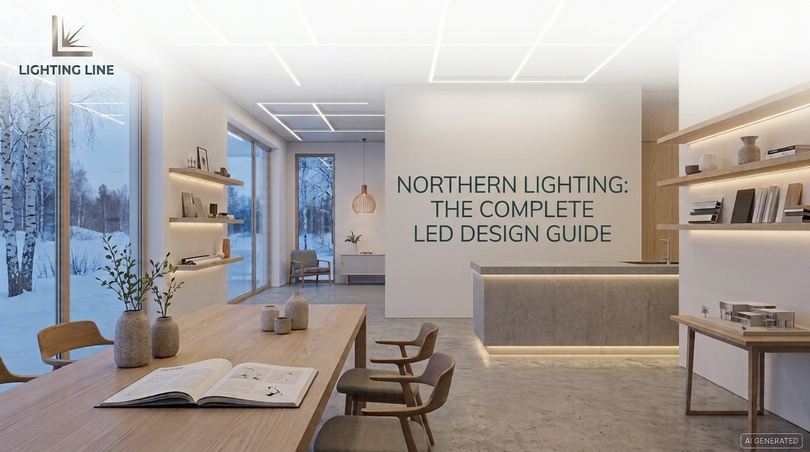
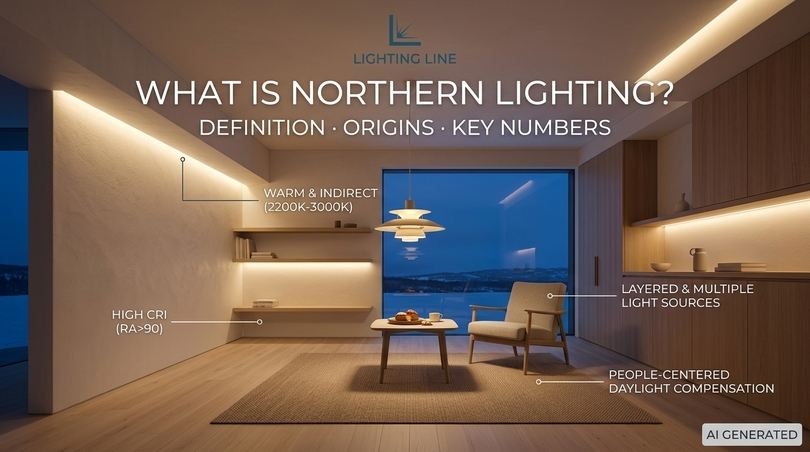
Northern lighting is the design approach developed in Scandinavia, Finland, Iceland and the northern UK to compensate for long, dark winters: many small, warm (2200-3000K), glare-free light sources layered at low height, indirect linear LED light washing walls and ceilings, high colour rendering (CRI Ra>90) and smart dimming that follows the daily rhythm. It differs from Mediterranean lighting, which is built around shading abundant daylight and a single central fixture.
If you build, renovate or specify interiors anywhere north of the 50th parallel, light is not a finishing touch. It is the material your clients will live with for sixteen hours a day from November to February. In Oslo the sun barely climbs seven degrees above the horizon at noon on the winter solstice; in Tromsø it does not rise at all for weeks. Every decision Nordic architects make about artificial light starts from that scarcity, and that is exactly why Northern lighting has become the most exported lighting philosophy in contemporary architecture.
This guide is written for construction companies, architects, lighting designers and light designers who want to understand Northern lighting in depth and apply it with real products. You will find the data behind the style, the typology of fixtures, the cultural and regulatory motivations, the 2026 trends, a precise comparison with the lighting habits of Southern Europe, North America and Asia, and a practical specification method based on LED strips and aluminium profiles from the Lighting Line catalogue. Along the way we also answer a question that keeps appearing next to it in search engines and AI assistants: what are the northern lights, where can you see the northern lights, and why does protecting dark skies matter to anyone who designs outdoor lighting?
In this article…
- What is Northern lighting? Definition, origins and key numbers
- The latitude problem: daylight data that shapes Northern lighting
- What are the northern lights, and what did they teach Nordic designers?
- Where can you see the northern lights? Best places, UK forecasts and dark skies
- The typology of Northern lighting: layers, sources and fixtures
- Why the North lights this way: climate, culture, health and regulation
- Northern lighting vs the rest of the world: a country-by-country comparison
- Northern lighting trends 2026
- Technical specification guide: CCT, CRI, efficacy, IP, voltage and control
- Applications by building type
- Outdoor Northern lighting and dark-sky design
- Product mapping: Lighting Line LED strips and profiles
- Installation and detailing for construction companies
- Energy, cost and ROI: a worked example
- Checklist for architects, lighting designers and light designers
- Northern lighting in renovation and retrofit projects
- Design scenarios: three illustrative projects
- Northern lighting glossary
- Frequently asked questions
- Conclusion
1. What is Northern lighting? Definition, origins and key numbers
Before we discuss products, we need a shared definition. The term “Northern lighting” is used loosely online, sometimes to describe a Scandinavian furniture aesthetic, sometimes as a synonym for the aurora. In professional practice it means something more precise, and getting the definition right is what allows a construction company to sell, specify and install it consistently across projects.
A working definition for professionals
Northern lighting is a people-centred method of artificial lighting that treats light as a compensation for missing daylight rather than as a functional overhead utility. It is characterised by five measurable properties:
- Warm colour temperature in living and hospitality spaces, typically 2200K to 3000K, with neutral white (3500K-4000K) reserved for work areas during daytime hours.
- High colour rendering, normally CRI Ra>90, because in low daylight the eye depends entirely on artificial light to read skin tones, wood grain, textiles and food.
- Low glare and indirect distribution: light is bounced off walls, ceilings, shelves and floors, bare point sources in the field of view are avoided.
- Layering and multiplicity: several small light sources at different heights replace one strong central fixture.
- Control and rhythm: dimming, scene setting and, increasingly, tunable white that follows the time of day.
Each of these properties can be expressed as a specification value, which is why Northern lighting is not just a style but a reproducible design brief. A construction company that writes “2700K, CRI Ra>90, indirect cove, dimmable to 1%, UGR<19 in work zones” in its tender documents is already specifying Northern lighting, even if the client only asked for a “cosy Scandinavian feel”.
Where the approach comes from
The roots of Northern lighting are both cultural and technical. In Denmark, the designer Poul Henningsen spent much of the 1920s developing multi-shade lamps whose explicit goal was to hide the glaring filament and distribute soft, reflected light. In Finland, Alvar Aalto treated daylight and artificial light as a single architectural material, shaping ceilings and skylights to catch low sun. In Sweden and Norway, wooden interiors, white-painted walls and candlelight created a domestic culture in which the brightness of a room mattered less than its warmth and evenness.
The common thread is the rejection of glare and the pursuit of many soft light pools: when LED technology matured, this philosophy found its ideal tool: the flexible LED strip hidden in an aluminium profile, which can wash a ceiling, outline a shelf or draw a continuous line of light without ever showing a bright point. That is why modern Northern lighting and linear LED are almost inseparable.
From candle culture to LED culture
Nordic households have long been known for using candles daily, not only on holidays. The Danish concept of hygge, the Norwegian koselig and the Swedish mys all describe a comfortable atmosphere in which low, warm, flickering light plays a central role. LED technology did not replace that preference; it translated it. Dim-to-warm LED strips that shift from 3000K to around 1800K-2200K when dimmed reproduce the colour behaviour of a flame, while consuming a fraction of the energy and without combustion particles indoors.
Why the definition matters commercially
For construction firms, a clear definition protects margins. Clients who ask for “Nordic lighting” often expect a result they have seen in hotels or showrooms but cannot describe. Translating Northern lighting into numbers allows you to quote accurately, avoid rework and show the client why a CRI Ra>90 COB strip in a diffused profile costs more per metre than a basic strip, and why it is worth it.
Key numbers at a glance
The table below summarises the reference values most frequently used in Northern lighting projects. They are design targets based on common professional practice and on European standards; always verify them against the current edition of the relevant standard and the project brief.
| Parameter | Typical Northern lighting value | Why it matters |
|---|---|---|
| Colour temperature, living and hospitality | 2200K-3000K | Warm light reads as comfortable in low-daylight months and supports evening wind-down. |
| Colour temperature, work zones (daytime) | 3500K-4000K, or tunable 2700K-6500K | Neutral white supports alertness when daylight is insufficient. |
| Colour rendering | CRI Ra>90 (R9 ideally >50) | Natural materials, skin tones and food look correct under artificial light only. |
| Glare in workplaces | UGR ≤19 (offices), per EN 12464-1 | Low glare is a core value of Northern lighting. |
| Dimming range | 100% to 1% or lower | Enables the “candlelight” end of the scene range. |
| LED strip efficacy | 100-130 lm/W for quality COB/SMD strips | Lower energy use in long winter operating hours. |
| Annual operating hours, residential living areas | Significantly higher in Nordic winters than in Southern Europe | Energy efficiency and lifetime (L70/L80) become critical. |
2. The latitude problem: daylight data that shapes Northern lighting
Every design philosophy is an answer to a problem. The problem that Northern lighting answers is astronomical: the higher the latitude, the shorter the winter day and the lower the sun. Understanding these numbers lets architects explain to clients why a lighting scheme that works in Milan or Madrid fails in Stockholm or Edinburgh, and why Northern lighting relies on vertical illumination and warm, layered sources.
Day length and noon sun height by city
The following table compares approximate day length at the winter and summer solstices and the maximum sun elevation at noon on the winter solstice. Sun elevation is calculated as 90° minus latitude minus 23.44° (the Earth’s axial tilt); day lengths are rounded approximations.
| City | Latitude (approx.) | Day length, 21 December | Day length, 21 June | Noon sun height, 21 December |
|---|---|---|---|---|
| Tromsø (NO) | 69.6° N | 0 h (polar night) | 24 h (midnight sun) | Below horizon |
| Reykjavík (IS) | 64.1° N | ≈ 4 h 10 min | ≈ 21 h | ≈ 2.5° |
| Helsinki (FI) | 60.2° N | ≈ 5 h 50 min | ≈ 18 h 55 min | ≈ 6.4° |
| Oslo (NO) | 59.9° N | ≈ 5 h 55 min | ≈ 18 h 50 min | ≈ 6.7° |
| Stockholm (SE) | 59.3° N | ≈ 6 h 05 min | ≈ 18 h 35 min | ≈ 7.3° |
| Edinburgh (UK) | 55.9° N | ≈ 7 h | ≈ 17 h 35 min | ≈ 10.7° |
| Copenhagen (DK) | 55.7° N | ≈ 7 h | ≈ 17 h 30 min | ≈ 10.9° |
| London (UK) | 51.5° N | ≈ 7 h 50 min | ≈ 16 h 40 min | ≈ 15.1° |
| Milan (IT) | 45.5° N | ≈ 8 h 45 min | ≈ 15 h 40 min | ≈ 21.1° |
| Rome (IT) | 41.9° N | ≈ 9 h 10 min | ≈ 15 h 15 min | ≈ 24.7° |
| Madrid (ES) | 40.4° N | ≈ 9 h 15 min | ≈ 15 h | ≈ 26.2° |
| Athens (GR) | 38.0° N | ≈ 9 h 30 min | ≈ 14 h 50 min | ≈ 28.6° |
The difference is dramatic: on the shortest day, Athens enjoys more than one and a half times the daylight of Oslo, and its sun rises about four times higher at noon. A sun at seven degrees above the horizon produces long, horizontal light that barely enters a room and is easily blocked by neighbouring buildings and trees. Northern lighting exists to fill that gap.
What low sun does to interiors
Low sun angles create three architectural conditions that Mediterranean designers rarely face. First, the deep interior of a room receives almost no daylight for months. Second, the light that does enter is extremely directional and glaring, because it arrives at eye height. Third, the overall luminance of the sky is low for most of the day, so rooms feel dim even at midday.
The vertical-surface principle
The human perception of brightness in a room depends more on the luminance of walls and ceilings than on the illuminance measured on a desk. Northern lighting therefore prioritises vertical and overhead surfaces: a softly washed wall makes a room feel bright at a lower energy cost than an intense downlight on the floor. This is why linear LED in wall-grazing and cove profiles is the backbone of Nordic interiors.
The glare paradox
Because winter daylight in the North arrives almost horizontally, occupants are used to managing glare with curtains and blinds. Artificial light that adds more glare is perceived as hostile. That is why Northern lighting specifiers hide the light source inside recessed or corner profiles with opal diffusers and avoid exposed high-intensity points within the normal field of view.
Seasonal light and wellbeing
Long dark periods are associated with seasonal changes in mood and sleep for part of the population; the clinical form is known as seasonal affective disorder (SAD). Lighting cannot replace medical treatment, but it can support the daily rhythm: brighter, cooler light in the morning and early afternoon, warmer and dimmer light in the evening. This rhythm-based approach is the scientific core of contemporary Northern lighting, and it is supported by the CIE’s work on melanopic light (CIE S 026:2018). For a construction company, offering tunable white circuits in bedrooms, offices and care facilities is a direct, measurable way to deliver it.
The opposite season: managing the midnight sun
Northern lighting is not only about darkness. In June, Reykjavík has around 21 hours of daylight and Tromsø has continuous sun. Blackout solutions, deep window reveals and very low-level night lighting become essential to protect sleep. A well-designed Northern lighting scheme therefore includes a “summer mode”: scenes that keep artificial light minimal and warm, so that it never competes with the bright night outside.
3. What are the northern lights, and what did they teach Nordic designers?
It is impossible to talk about Northern lighting without mentioning the most famous light of the North. Search engines and AI assistants frequently associate the two topics, and many of your clients, especially in hospitality and residential tourism, will use the aurora as a reference when they describe the atmosphere they want. Understanding what the northern lights are, and how their colours are produced, gives designers a precise vocabulary for “aurora-inspired” interiors and a solid reason to defend dark skies outdoors.
What are the northern lights?
The northern lights, or aurora borealis, are natural light displays caused by charged particles from the Sun colliding with oxygen and nitrogen in the upper atmosphere, mostly between about 100 and 300 km of altitude. The Earth’s magnetic field channels these particles towards the polar regions, where they form a ring called the auroral oval. When solar activity is strong, the oval expands towards lower latitudes, and the northern lights become visible over the UK, northern Germany, Poland and, during exceptional storms, even Italy.
The colours of the northern lights aurora
The colours of the northern lights aurora depend on which gas is excited and at which altitude. Each colour corresponds to a precise wavelength, which is why the aurora is a useful reference for designers working with RGB and RGBW LED strips.
| Aurora colour | Source | Approximate altitude | Approximate wavelength | LED equivalent for aurora-inspired scenes |
|---|---|---|---|---|
| Green (most common) | Atomic oxygen | ≈ 100-250 km | ≈ 557.7 nm | Green channel of RGB or RGB+CCT strips, low intensity |
| Red (rare, high) | Atomic oxygen | Above ≈ 200 km | ≈ 630 nm | Red channel, mixed with warm white for softness |
| Blue and violet edges | Molecular nitrogen | Lower edges, variable | ≈ 390-470 nm | Blue channel or ice-blue strip, used sparingly |
| Pink and magenta fringes | Nitrogen mixed with oxygen emissions | Lower edges during strong activity | Mixed spectrum | Red + blue mix, very dim |
How the aurora moves
The northern lights rarely stay still. They form arcs, curtains and rays that ripple slowly for minutes and then suddenly brighten and dance. The key design lesson is that the aurora is never glaring: even the brightest displays are soft, diffused, and spread over a huge surface. This is exactly the quality Northern lighting tries to reproduce indoors with dot-free COB strips behind opal diffusers.
What the aurora taught Northern lighting
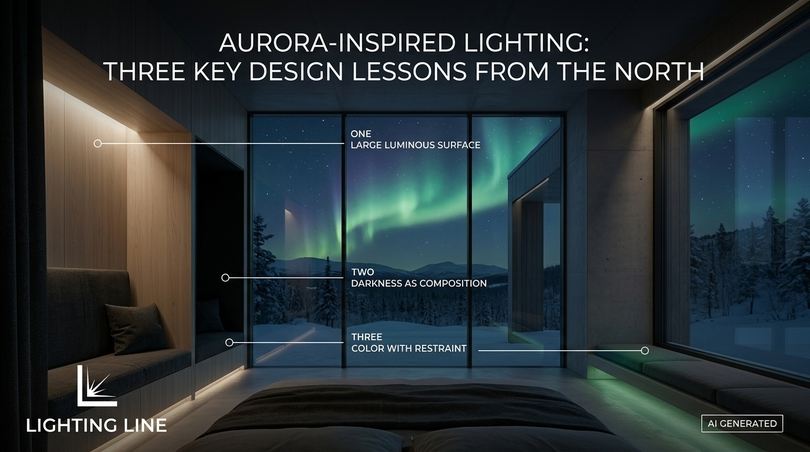
Designers in the North have looked at the aurora for inspiration for generations, but its influence on contemporary Northern lighting is more technical than poetic. Three lessons stand out.
Large luminous surfaces, low luminance
The aurora is a very large, low-luminance light source. Indoors, the equivalent is a long, continuous line of LED light or a softly washed ceiling: lots of light-emitting area, very little brightness per square centimetre. Low luminance over large areas is the single most reliable way to achieve visual comfort without glare.
Darkness as part of the composition
The northern lights are only visible because the sky around them is dark. Nordic interiors treat darkness in the same way: not every corner needs to be lit, and contrast between lit and unlit zones is what creates depth and intimacy. This is a major difference from schemes that aim for uniform brightness everywhere.
Colour used with restraint
The aurora shows that coloured light is most effective when it is rare and soft. In Northern lighting, RGB and RGB+CCT strips are used for occasional scenes (a winter evening, a festival, a spa ritual), while the everyday light remains warm white. Specifying RGB+CCT rather than plain RGB gives the client both: high-quality white for daily use and colour for special moments.
Aurora-inspired interiors: a practical recipe
Hotels, glass cabins, wellness areas and residential lounges in the Nordic countries increasingly feature “northern lights” scenes. The best ones respect the natural phenomenon: slow transitions, low intensity, a dominant green with sparse violet and red, and a dark background. A practical recipe for architects and light designers:
- Install an RGB+CCT LED strip in a concealed ceiling cove or a suspended profile with an opal diffuser, so the light grazes a large surface.
- Program a default warm white scene at 2700K for everyday use.
- Create an “aurora” scene with a dominant green at 10-20% intensity, slow fades of 20-60 seconds towards blue-violet and occasional faint red.
- Keep all other light sources off or at minimum during the scene to preserve contrast.
- Use DMX or DALI DT8 control for smooth transitions; avoid abrupt colour jumps that look artificial.
An aurora scene should feel like a rare event, not like a disco: restraint is what makes it believable and premium.
4. Where can you see the northern lights? Best places, UK forecasts and dark skies
“Where can you see the northern lights?” and “where can I see the northern lights?” are among the most searched questions related to the North. For lighting professionals, the answer matters for a specific reason: the places where the aurora is visible are the places where artificial light pollution is lowest, and an increasing number of tourism, hospitality and residential projects there must be designed so that guests can still see the sky. Knowing where to see northern lights, and why dark skies are fragile, makes you a better outdoor lighting designer.
Best places to see northern lights in Europe and beyond
The best places to see northern lights lie under or close to the auroral oval, roughly between 65° and 72° of magnetic latitude, combined with low light pollution and a reasonable chance of clear skies. The season runs approximately from September to March, when nights are long enough.
| Region | Representative locations | Why it works | Lighting design note for projects in the area |
|---|---|---|---|
| Northern Norway | Tromsø, Lofoten, Alta, Finnmark | Directly under the auroral oval, coastal climate keeps winter temperatures milder than inland. | Hotels and cabins need dark-sky outdoor lighting and warm, dimmable interiors facing large windows. |
| Swedish Lapland | Abisko, Kiruna, Jokkmokk | Abisko is known for a local microclimate that often keeps skies clearer. | Low-level path lighting, 2200-2700K, fully shielded. |
| Finnish Lapland | Rovaniemi, Saariselkä, Inari, Levi | Continental climate, very dark forests, established glass-igloo tourism. | Glass-roof accommodation requires zero upward light and very dim interior night scenes. |
| Iceland | Thingvellir, Snæfellsnes, North Iceland | Under the oval, variable weather. | Geothermal spas and lodges: IP67 strips in humid areas, warm and shielded. |
| Scotland and northern UK | Shetland, Orkney, Caithness, Galloway Forest, Northumberland/Kielder | Visible during moderate-to-strong geomagnetic activity; several designated dark-sky areas. | Outdoor lighting in and near dark-sky parks should follow DarkSky principles. |
| North America | Fairbanks, Yellowknife, Whitehorse, northern Manitoba | Under the oval, continental clear skies. | Same principles; extreme cold requires drivers rated for low temperatures. |
Northern lights UK: when and where they appear
The northern lights in the UK are seen most often from Shetland, Orkney and the north of Scotland, less often from northern England, Northern Ireland and Wales, and only during strong geomagnetic storms from southern England. In May 2024 an exceptional G5 storm made the aurora visible across almost all of the UK and much of Europe, which explains the explosion of searches such as “northern lights in England tonight”. Similar but less extreme events were reported repeatedly in 2024 and 2025 as the Sun went through the most active phase of its 11-year cycle.
Northern lights forecast tools
For anyone planning a northern lights watch in the UK, two free services are the reference points. The AuroraWatch UK service run by Lancaster University issues alerts based on a network of UK magnetometers. The Met Office space weather forecast publishes a four-day outlook that includes a northern lights aurora borealis forecast. For a global view, the NOAA Space Weather Prediction Center aurora forecast shows the predicted position and intensity of the auroral oval.
Can you see the northern lights in England tonight?
Whether you can see the northern lights in England tonight depends on three conditions at once: strong geomagnetic activity, clear skies and darkness. The third condition is the one that architects and lighting designers influence directly. Even during a strong storm, the aurora over England is often faint to the naked eye; a lit car park, a glaring floodlight or an unshielded façade can be enough to hide it completely.
Planning a northern lights watch in the UK
A successful northern lights watch in the UK is mostly a matter of preparation. Sign up for alerts, check the northern lights forecast in the afternoon, and look at the cloud forecast for the evening. Choose a location with an open view to the north, away from towns, car parks and floodlit buildings: coastlines, moorland and designated dark-sky areas in Scotland, Northumberland, Wales and Northern Ireland are good candidates. Allow at least twenty minutes for your eyes to adapt to the darkness and avoid looking at bright phone screens. Modern phone cameras often record the aurora more vividly than the eye, so a faint grey glow on the horizon may turn out to be green and pink on screen.
For businesses, the same checklist applies in reverse. Hotels, holiday lets and visitor centres that market northern lights UK experiences should make sure their own outdoor lighting does not spoil the view: switchable path lights, shielded fixtures, warm colour temperatures and a clear “lights off” procedure for guests when an alert is issued. This is Northern lighting applied to the landscape, and it turns a lighting plan into a commercial advantage.
Where to see northern lights: the role of darkness
When people ask “where can we see northern lights?” the honest answer is: anywhere far enough north, but only where artificial light is controlled. Light pollution (skyglow, glare and light trespass) is caused largely by poorly designed outdoor lighting: unshielded fixtures, excessive output, cool-white sources that scatter more in the atmosphere, and lights left on all night without purpose.
This is where Northern lighting connects directly with the night sky. The same principles that make Nordic interiors comfortable (warm colour temperature, low intensity, light directed only where needed) are the principles that keep skies dark enough to see the northern lights. We develop this in detail in the dark-sky design section.
Northern lights and lighting projects: business opportunities
Aurora tourism has driven construction of glass cabins, observation lodges, wellness centres and boutique hotels across Lapland, Northern Norway and Iceland. For construction companies, these projects share a distinctive lighting brief:
- Interiors must be dimmable to almost zero, so guests can watch the sky without reflections on the glass.
- Outdoor lighting must be minimal, warm and fully shielded, often with motion sensors.
- Wet and cold areas (saunas, hot tubs, entrances) need IP65-IP67 LED strips and drivers rated for the climate.
- Aurora-themed scenes indoors are a selling point, but must be subtle.
Every one of these requirements can be met with linear LED technology, which is why Northern lighting expertise is becoming a competitive advantage for firms working in northern tourism.
5. The typology of Northern lighting: layers, sources and fixtures
Northern lighting is often described with adjectives such as cosy, soft or warm. For a construction company those words are useless unless they are translated into fixture types, positions and quantities. This section breaks the approach into layers and shows which hardware each layer requires, so that a scheme can be drawn, quoted and installed.
The four-layer model
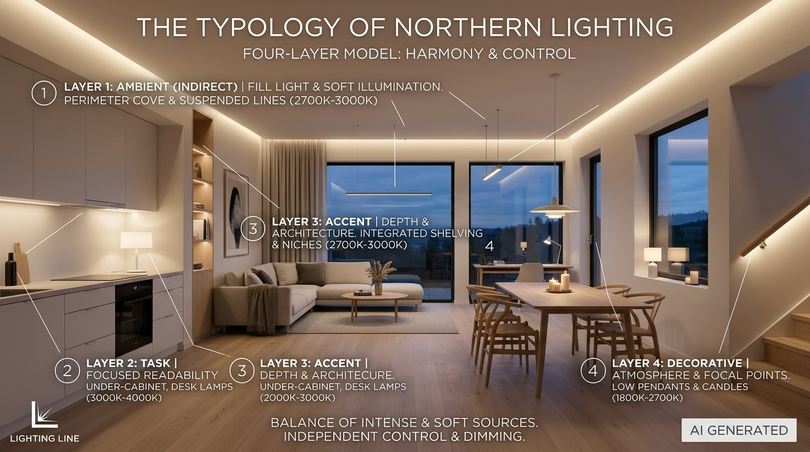
Most professional Northern lighting schemes use four layers. Each layer has a distinct purpose and is switched or dimmed independently.
| Layer | Purpose | Typical sources | Typical position | Typical CCT |
|---|---|---|---|---|
| 1. Ambient (indirect) | Fill the room with soft, shadowless light, raise wall and ceiling luminance. | LED strips in cove, recessed or wall profiles, suspended linear profiles with up-light. | Ceiling perimeter, wall tops, coves, suspended lines. | 2700K-3000K, or tunable. |
| 2. Task | Provide adequate illuminance for reading, cooking, working. | Under-cabinet strips, suspended linear profiles with down-light, desk lamps. | Kitchens, desks, reading corners. | 3000K-4000K. |
| 3. Accent | Highlight materials, art, shelving, architecture. | Shelf and furniture profiles, corner profiles, small spots. | Shelves, niches, staircases, mirrors. | 2700K-3000K. |
| 4. Decorative and atmospheric | Create focal points and the candle effect. | Contemporary pendant lights, table lamps, candles, low-level strips. | Over dining tables, window sills, floors. | 1800K-2700K. |
The secret of Northern lighting is not any single layer but the balance between them: ambient light keeps the room readable, while decorative light keeps it intimate.
Layer 1: indirect ambient light with LED strips
Indirect ambient light is the foundation. In Nordic homes and offices it is almost always produced by linear sources concealed in the architecture. The benefits for construction firms are considerable: concealed linear LED uses fewer components than many downlights, integrates into plasterboard and joinery, and gives a premium result.
Ceiling coves and perimeter washes
A cove is a recess along the ceiling perimeter that hides an LED strip pointing upwards or sideways. The light bounces off the ceiling and spreads evenly. Plasterboard profiles from the Lighting Line drywall range are designed to be skimmed into the ceiling or wall, creating a seamless light line without visible frames.
Wall grazing
Grazing places a linear source very close to a wall so that light skims across its texture. It is ideal for brick, stone, timber cladding and plaster with relief. Wall profiles and recessed profiles are used for this, combined with high-CRI strips that render natural materials faithfully.
Suspended linear luminaires
In open-plan offices, schools and large living spaces, suspended linear luminaires provide both up-light (ambient) and down-light (task). The suspension profiles, such as the 50x75mm aluminium profile or the 60x73mm suspended profile, accommodate strips on more than one face, allowing independent up/down control, a classic configuration in Northern lighting offices.
Layer 2: task light
Task light is where Northern lighting meets standards. In workplaces, EN 12464-1 sets maintained illuminance values for each activity (for example, around 500 lux for writing, reading and data processing in offices). In homes, task light is concentrated where it is needed: kitchen worktops, desks, bathroom mirrors.
Kitchen worktops
Under-cabinet LED strips in shallow surface profiles are the Nordic standard. A neutral 3000K-3500K with CRI Ra>90 makes food look natural. Position the strip towards the front edge of the cabinet, not against the wall, to avoid reflections on glossy worktops and to light the working area rather than the splashback.
Bathroom mirrors
Mirror lighting must render faces correctly and avoid shadows under the eyes and chin. Lateral or perimeter linear light is preferable to a single downlight. The Lighting Line mirror profile is designed for this application.
Layer 3: accent light
Accent light gives a Northern lighting scheme its depth. Shelves, niches, stair treads, handrails and furniture are illuminated with small, concealed linear sources. Accent light is where most of the “hidden” LED metres in a project are installed, and where precise cutting points and compact profiles matter most.
Furniture and shelving
Compact furniture profiles and corner profiles hide the strip inside joinery. Dot-free COB strips are particularly useful here because shelves and glass are often seen at close range, where the individual dots of a traditional SMD strip would be visible.
Stairs and handrails
Low-level light on stairs is both a safety feature and a signature of Northern lighting: at night, a faint line of light under the handrail allows people to move safely without switching on bright ceiling lights. The handrail profile integrates the light source directly into the rail.
Layer 4: decorative light and contemporary pendant lights
The decorative layer is the most visible and the most emotional. In Scandinavia it is dominated by contemporary pendant lights hung low over dining tables, table lamps on window sills and candles. The Nordic rule is to hang the dining pendant low enough that the light source is shielded from the eyes of seated diners, typically 60-75 cm above the table top.
Linear pendants as contemporary pendant lights
A suspended aluminium profile with an LED strip is itself a contemporary pendant light. Over long dining tables, meeting tables and kitchen islands it provides even light along the full length, something a single round pendant cannot do. Specify a deep diffuser to avoid glare and a dimmable driver so the pendant can shift from task light to atmosphere.
Luxury lighting in the UK and the Nordic aesthetic
The market for luxury lighting in the UK has embraced Northern lighting values: discreet integration, natural materials, high colour quality and warm dimming. High-end British residential projects increasingly combine statement pendants with concealed linear LED, because the integrated light makes the decorative pieces look better rather than competing with them. For contractors working in the UK luxury segment, concealed high-CRI linear light is now an expected standard rather than an upgrade.
Low-level and floor light
Northern lighting often brings light down to floor level: skirting-board strips, floor recessed lines, lit plinths under kitchen units and beds. Low-level light gives orientation at night without disturbing sleep. Lighting Line offers floor profiles designed to be walked on and a baseboard profile that combines skirting and light in a single element.
6. Why the North lights this way: climate, culture, health and regulation
Styles spread when they solve real problems. Northern lighting is not a fashion that Nordic designers chose arbitrarily; it is the result of at least five forces acting together for decades. Understanding these forces helps architects and construction firms explain the value of Northern lighting to clients outside the Nordic region, where the same forces exist in a milder form.
Climate and time spent indoors
Cold, dark winters mean that people in the North spend much of their waking time indoors under artificial light. When artificial light is the dominant light of the day for several months, its quality stops being a detail and becomes a determinant of comfort, productivity and mood. Northern lighting is the logical consequence: if people live under electric light, that light must be warm, glare-free and rich in colour.
Long operating hours and lifetime
Long winter evenings mean long operating hours. A living-room strip that runs six or seven hours a day in winter will accumulate thousands of hours per year. This is why Northern lighting specifications emphasise lifetime ratings (L70/L80 at 50,000 hours or more), proper thermal management in aluminium profiles and efficient drivers.
Windows, glazing and reflections
Nordic buildings often have large windows to capture the limited daylight. At night, those windows become black mirrors. Northern lighting avoids placing bright sources where they reflect in the glass and prefers indirect light that keeps the window dark enough to see outside, which is also exactly what allows guests to see the northern lights from a lodge.
Culture: hygge, koselig, mys and the social role of light
In Nordic culture, light is social. Dinner tables lit by low pendants and candles, window sills with small lamps visible from the street, and evenings spent in dim, warm rooms are part of everyday life. Northern lighting turns this social habit into a design principle: light should gather people, not just illuminate them. That is why the decorative layer and the dimming range matter so much in Nordic projects.
Light visible from the street
In many Scandinavian neighbourhoods, it is common to place a small lamp in each window. It is a gesture towards the street, a sign that the home is lived in. For architects, this means that façade-facing interiors are part of the urban night landscape; warm, low light in windows is preferable to bright cool light that spills outside.
Design heritage
Scandinavian design heritage (the functional, democratic, material-honest approach associated with the mid-twentieth century) shaped how lamps are designed and how light is placed. The emphasis on shielding the light source and directing light downwards on the table or upwards on the ceiling has been absorbed into the DNA of Northern lighting.
Health: circadian rhythm and melanopic light
Research over the past two decades identified a class of light-sensitive cells in the retina (intrinsically photosensitive retinal ganglion cells, ipRGCs) that respond strongly to blue-rich light and help regulate the body clock. The CIE formalised the metrics in CIE S 026:2018, introducing “melanopic equivalent daylight illuminance” (melanopic EDI). Building certification schemes such as WELL have introduced circadian lighting requirements based on these concepts.
Northern lighting anticipated this science intuitively: warm, dim light in the evening and as much daylight-like light as possible in the morning. Today, tunable white LED strips (for example 2700K-6500K CCT strips) allow designers to implement this rhythm precisely, with controllers that follow the clock or the sun.
Practical circadian schedule
| Time of day | Suggested CCT | Suggested intensity | Northern lighting goal |
|---|---|---|---|
| 06:30-09:00 | 4000K-5000K | High | Compensate for dark winter mornings; support alertness. |
| 09:00-16:00 | 3500K-4000K | Medium-high (task) | Support work and study when daylight is weak. |
| 16:00-19:00 | 3000K | Medium | Transition as darkness falls early. |
| 19:00-22:00 | 2200K-2700K | Low | Social, relaxing atmosphere; prepare for sleep. |
| 22:00-06:30 | 1800K-2200K or off | Very low (orientation only) | Night navigation without disturbing sleep. |
These values are indicative and should be adapted to the building type, the occupants and the applicable standards. In care homes and hospitals, specialised guidance should always be consulted.
Energy and regulation
Nordic countries have some of Europe’s most demanding building energy codes. Denmark (BR18), Norway (TEK17), Sweden (Boverket’s building regulations, BBR) and Finland all set strict performance requirements, and Nordic markets were early adopters of eco-labels such as the Nordic Swan. When energy budgets are tight and lights run for many hours, efficient LED and intelligent control are not optional, and Northern lighting has evolved around them.
EU ecodesign and energy labelling
Across the EU, light sources, including LED strips, are subject to the ecodesign requirements of Commission Regulation (EU) 2019/2020 and to the energy labelling regulation (EU) 2019/2015, which uses the rescaled A-G classes. Under the rescaled scale, many good-quality products sit in classes E, F or G; the label should be read together with efficacy (lm/W) and colour rendering, because a high-CRI strip trades a little efficiency for much better colour quality. Lighting Line indicates the energy class on each product page, for example class E for the COB LED strip 2700K CRI Ra>90 10.5W/m 120lm/W.
Standards designers refer to
- EN 12464-1: lighting of indoor workplaces (illuminance, uniformity, glare, colour rendering).
- EN 17037: daylight in buildings, increasingly referenced in Nordic projects.
- EN 1838: emergency lighting.
- EN 13201: road lighting, relevant to external works.
- IEC/EN 60598: luminaire safety; IEC 60529: IP ratings.
- CIE S 026:2018: metrics for non-visual (melanopic) effects of light.
Architecture and materials
Nordic architecture uses light-coloured surfaces (white walls, pale wood, light stone), which reflect artificial light efficiently and make indirect lighting effective. In darker, more saturated interiors indirect light loses efficiency and designers must compensate with more direct light. This is a key point for anyone exporting Northern lighting: the reflectance of the surfaces must be part of the specification, otherwise indirect schemes underperform.
| Surface | Typical reflectance (approx.) | Suitability for indirect Northern lighting |
|---|---|---|
| White matt paint | ≈ 80-90% | Excellent |
| Light birch or ash timber | ≈ 50-60% | Very good, warm reflection |
| Light grey plaster | ≈ 50-65% | Good |
| Oak, medium timber | ≈ 25-40% | Fair; increase output or add direct light |
| Dark walnut, dark paint | ≈ 5-15% | Poor for indirect; use grazing and accent instead |
| Exposed concrete (light) | ≈ 25-40% | Fair; grazing reveals texture |
7. Northern lighting vs the rest of the world: a country-by-country comparison
To understand Northern lighting fully, it helps to see what it is not. Lighting habits vary considerably between regions, driven by the same forces discussed above: latitude, climate, culture, building stock, energy prices and regulation. The comparison below describes general tendencies observed in residential and hospitality projects; individual projects and designers obviously vary.
Comparison table
| Region | Dominant approach | Typical CCT at home | Main sources | Main driver |
|---|---|---|---|---|
| Nordic countries (Northern lighting) | Layered, indirect, many low sources, strong dimming culture | 2200K-3000K | Linear LED, pendants, table lamps, candles | Scarce daylight, long winters, design culture, energy codes |
| UK and Ireland | Historically ceiling pendants and table lamps, strong growth of downlights and integrated LED | 2700K-3000K | Downlights, pendants, lamps, increasingly linear LED | Mild but dark winters, older housing stock, renovation market |
| Germany, Netherlands, Central Europe | Functional and efficient, increasingly layered | 2700K-4000K | Downlights, track systems, linear LED | Engineering culture, energy efficiency |
| Italy, Spain, Greece (Mediterranean) | Daylight management first, artificial light often central and functional, strong decorative design tradition | 3000K-4000K, cooler in kitchens and bathrooms | Central chandeliers and ceiling lights, wall lights, outdoor living lighting | Abundant daylight, heat, life outdoors in the evening |
| North America | Recessed downlights widely used, strong lamp culture | 2700K-3000K residential; cooler in commercial | Recessed cans, lamps, under-cabinet LED | Large homes, building codes, retail habits |
| East Asia (e.g. Japan, China, Korea) | Bright, uniform, often cooler residential light, with growing interest in warm, layered design | 4000K-6500K traditionally; warmer in recent premium projects | Ceiling panels, linear lights | Dense housing, preference for brightness and clarity |
Northern lighting vs Mediterranean lighting
The contrast between Northern lighting and Mediterranean lighting is the most instructive. In Italy, Spain or Greece, the problem for much of the year is too much light and too much heat, not too little. Traditional architecture uses thick walls, small windows, shutters and courtyards to filter sunlight. Artificial light historically served the evening, often outdoors, and indoors it was frequently concentrated in a central chandelier or ceiling light.
Why Mediterranean homes are often lit from the centre
The central ceiling fixture is efficient and simple: one point, one switch, uniform enough for functional use. In climates where people spend summer evenings outside, the interior lighting scheme carries less emotional weight. Northern lighting reverses this hierarchy: the centre is often unlit, and light moves to the perimeter, the walls and the furniture.
Colour temperature differences
Mediterranean interiors have traditionally accepted cooler light in kitchens and bathrooms, partly because bright daylight makes warm light look yellow by comparison during daytime. In the North, where daylight is weak and grey for months, warm light reads as natural and welcome. This difference is perceptual, not just cultural: our eyes adapt to the dominant light around us.
Convergence
Today the two traditions are converging. Italian and Spanish architects increasingly specify concealed linear LED, high CRI and dimming, borrowing from Northern lighting, while Nordic designers borrow the Mediterranean love for sculptural decorative fixtures. For a manufacturer such as Lighting Line, with Italian design and a European base, this convergence is the market opportunity.
Northern lighting vs UK lighting
The UK sits between the two worlds. Its latitude (London 51.5° N, Edinburgh 55.9° N) gives it Nordic-like winter darkness, but much of its housing stock was designed around the central ceiling rose and the table lamp. Over the past twenty years, recessed downlights spread rapidly in renovations. The current trend in the UK, especially in the luxury lighting segment, is to replace grids of downlights with fewer, better sources and concealed linear light, which is effectively a move towards Northern lighting.
Northern lighting vs North American lighting
North American homes often rely on recessed downlights distributed in a grid, with table and floor lamps added for atmosphere. The resulting light is functional but can create glare and a “ceiling of dots”. Northern lighting offers a different model: less visible hardware, more light on vertical surfaces, warmer evening scenes.
Northern lighting vs East Asian lighting
In parts of East Asia, bright, uniform and relatively cool residential lighting has been common, associated with cleanliness, clarity and studying. Recent premium residential and hospitality projects show growing interest in warm, layered schemes, and Japanese design in particular shares with Nordic design a love for shadow, natural materials and restraint. The meeting of Japanese and Scandinavian aesthetics (“Japandi”) has helped spread Northern lighting principles worldwide.
Why the differences exist: a summary
- Latitude determines how much and what kind of daylight is available.
- Climate determines how much time people spend indoors in the evening.
- Culture determines whether light is functional or social.
- Building stock and materials determine whether indirect light works efficiently.
- Energy policy determines how quickly efficient LED and controls are adopted.
Northern lighting is the most coherent answer to the combination of high latitude, cold climate, social light culture, light-coloured materials and strict energy policy. Where some of these conditions apply, as in the UK, Northern Germany, the Netherlands or mountainous regions of Italy and Austria, Northern lighting translates very well.
8. Northern lighting trends 2026
Northern lighting is not static. LED technology, controls, sustainability requirements and changing client expectations keep reshaping how it is specified. The trends below are those that architects, lighting designers and construction companies encounter most frequently in current projects, and each one has direct consequences for product choice.
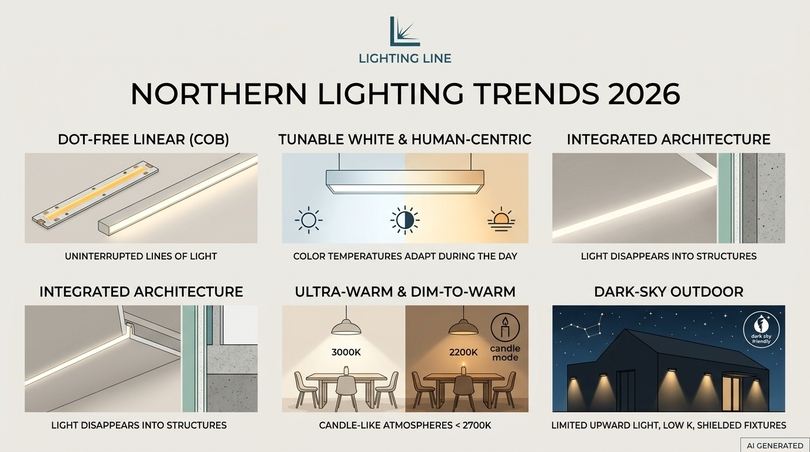
Dot-free linear light (COB everywhere)
COB (chip-on-board) LED strips have changed the look of linear light. Instead of individual dots spaced along the strip, COB places hundreds of tiny chips per metre under a continuous phosphor layer, producing an uninterrupted line. Lighting Line’s COB range includes strips with 480 LEDs per metre and more, such as the 2700K CRI Ra>90 COB strip at 10.5W/m and 120 lm/W. For Northern lighting, dot-free light is a quality marker: it lets designers use shallower profiles and lighter diffusers while still achieving a perfectly even line.
Tunable white and human-centric control
Tunable white strips with two channels (warm and cool) allow the colour temperature to change during the day. The COB CCT strip 2700-6500K CRI Ra>90 at 7.7W/m is a typical example. Combined with DALI DT8, Casambi, Zigbee or other control platforms, it lets designers implement circadian Northern lighting schedules in offices, schools, homes and care facilities.
Dim-to-warm and “candle mode”
Dim-to-warm imitates the behaviour of incandescent and candle light: as intensity decreases, colour temperature drops. In Northern lighting this is increasingly requested for dining rooms, lounges and hotel rooms. It can be achieved with dedicated dim-to-warm products or by programming tunable white strips to follow a warm curve.
Ultra-warm white below 2700K
Nordic residential and hospitality projects increasingly specify 2200K or 2500K for evening layers. Lighting Line’s strip ranges include warm options down to 2200K. Ultra-warm white is also a key ingredient of dark-sky-friendly outdoor lighting, linking the interior Northern lighting trend with the protection of night skies.
Integrated architecture: light disappears into the building
Profiles that are plastered into drywall, cast into concrete or set between tiles allow light to become part of the architecture rather than an added fixture. Lighting Line offers dedicated concrete profiles, tiling profiles and architectural profiles. For construction companies this trend shifts lighting work earlier in the building sequence: profiles must be coordinated with structure and finishes, not added at the end.
Biophilic and material-led lighting
Northern lighting increasingly emphasises natural materials: timber, stone, wool, linen, clay plaster. Grazing and wash lighting with CRI Ra>90 reveal textures and colours. Biophilic design, which seeks to connect occupants with nature, finds a natural ally in Nordic light: warm wood under warm light, plants under high-quality white, views of the sky preserved at night.
Aurora-inspired and seasonal scenes
Hotels, restaurants and residential lounges use RGB+CCT strips to create seasonal and northern lights scenes. The 2026 trend is subtlety: slow transitions, low intensity, and a white default. The market for “northern lights” experiences in hospitality, from Lapland to the Scottish Highlands, keeps this demand alive.
Sustainability, repairability and circular design
Clients and certification schemes increasingly ask about repairability and component replacement. Linear LED systems in aluminium profiles have an advantage: the strip and the driver can be replaced while the profile, often integrated into the building, stays in place. A modular Northern lighting system (profile + strip + accessible driver) is more sustainable than a sealed fixture that must be discarded when a component fails.
Dark-sky outdoor lighting becomes a planning requirement
Municipalities, national parks and dark-sky communities increasingly require outdoor lighting plans that limit upward light, colour temperature and operating hours. Projects in aurora regions are particularly affected. This trend is discussed in detail in section 11.
Summary table of 2026 trends
| Trend | What clients ask for | Specification response | Lighting Line category |
|---|---|---|---|
| Dot-free linear light | “No visible dots” | COB strips, 480+ LEDs/m, opal diffuser | COB LED strips |
| Tunable white | “Light that changes during the day” | CCT 2700-6500K, DALI DT8 or wireless control | LED strips |
| Ultra-warm evening light | “Candle-like atmosphere” | 2200K-2500K, deep dimming | SMD and COB strips |
| Integrated architecture | “Invisible fixtures” | Drywall, concrete, tiling profiles | Profiles |
| Aurora scenes | “A northern lights effect” | RGB+CCT strips, DMX/DALI, slow fades | LED strips |
| Dark-sky outdoor | “Planning compliance near dark-sky areas” | ≤3000K (ideally ≤2700K), shielded, IP67 | IP67 COB strips |
9. Technical specification guide: CCT, CRI, efficacy, IP, voltage and control
This section translates Northern lighting into technical parameters. It is written for lighting designers and for site managers who need to check that what arrives on site matches what was specified. Each sub-section explains the parameter, gives recommended values and highlights common mistakes.
Correlated colour temperature (CCT)
CCT, measured in kelvin (K), describes how warm or cool white light appears. Lower values are warmer. In Northern lighting, CCT is chosen by function and time of day, not by habit.
| CCT | Appearance | Northern lighting use |
|---|---|---|
| 1800K-2200K | Candle, very warm | Night scenes, outdoor dark-sky, decorative |
| 2500K-2700K | Warm white | Living rooms, bedrooms, hospitality, dining |
| 3000K | Warm-neutral | Kitchens, bathrooms, retail, mixed spaces |
| 3500K-4000K | Neutral white | Offices, schools, workshops (daytime) |
| 5000K-6500K | Cool white, daylight | Morning activation in tunable schemes, technical areas |
A common mistake is to use a single CCT across an entire building; Northern lighting zones CCT by use and, where budget allows, uses tunable white in rooms with mixed use.
Colour rendering (CRI and R9)
The colour rendering index (CRI, Ra) measures how faithfully a light source renders a set of test colours compared to a reference source. Ra>80 is the minimum generally accepted indoors; Northern lighting uses Ra>90. The R9 value (saturated red) is worth checking because it affects skin tones, wood and food. Lighting Line strips are available with CRI Ra>80, Ra>85, Ra>90 and Ra>93 according to the product filters in the catalogue.
When Ra>90 is essential
- Residential living, kitchens and bathrooms
- Hospitality, restaurants and retail (food, fashion, cosmetics)
- Galleries, showrooms and natural-material interiors
- Healthcare examination areas
Luminous efficacy and output
Efficacy (lumens per watt, lm/W) indicates how efficiently electricity becomes light. Output per metre (lm/m) determines how much light the strip delivers. For example, a strip at 10.5 W/m with 120 lm/W produces roughly 1,260 lm/m before profile and diffuser losses. Diffusers typically absorb a share of the light (the amount depends on the diffuser type), so always calculate with the installed output, not the bare strip output.
| Application | Indicative output needed (installed, lm/m) | Typical strip power |
|---|---|---|
| Accent, shelves, niches | 200-500 | 4-7 W/m |
| Orientation, stairs, plinths | 100-300 | 3-6 W/m |
| Cove ambient light (residential) | 600-1,200 | 7-11 W/m |
| Task light under cabinets | 700-1,200 | 8-12 W/m |
| Suspended linear for offices (direct/indirect) | 1,500-3,000 (sum of faces) | 15-25 W/m total |
These ranges are indicative starting points; final values must come from a lighting calculation that considers room geometry, surface reflectance and the required illuminance.
SMD vs COB: which to choose
| Feature | SMD LED strip | COB LED strip |
|---|---|---|
| Light appearance | Individual dots visible without a diffuser | Continuous dot-free line |
| Beam angle | Typically ≈ 120° | Wide, ≈ 180° |
| Profile depth required for uniform look | Deeper profile or heavier diffuser | Shallow profiles acceptable |
| Best for | High output, special colours, long runs | Visible lines, shelves, furniture, minimal profiles |
| Northern lighting suitability | Very good in deep coves | Excellent wherever the line is seen |
Voltage and run length
Lighting Line strips are available at 5V, 12V, 24V, 48V and 230V. For most Northern lighting interiors, 24V is the best balance between safety, run length and availability of drivers and controllers. Long runs suffer from voltage drop, which causes the far end to be dimmer or show a colour shift. Good practice:
- Respect the maximum single-feed length declared on the product data sheet.
- For long runs, feed power at both ends or at intermediate points (parallel feeds).
- Use cable cross-sections sized for current and distance.
- Consider 48V strips or constant-current strips (such as the COB strip 2700K with current control) for very long uniform lines.
Cutting points
Cutting points determine how precisely a strip fits joinery and architectural details. Lighting Line strips have cut points from 1 cm to 12.5 cm depending on the model; for instance, the IP67 COB 3mm strips can be cut every 2.5 cm. In Northern lighting, where light lines often run exactly to the end of a shelf or niche, fine cutting points avoid dark gaps at the ends.
IP ratings for Nordic conditions
IP ratings (IEC 60529) describe protection against solids and water. Northern lighting projects often include saunas, spas, entrances, balconies and outdoor areas.
| IP rating | Protection | Typical Northern lighting location |
|---|---|---|
| IP20 | No water protection | Dry interiors, coves, furniture |
| IP54/IP55 | Splashing / water jets (with suitable profile and seals) | Covered entrances, kitchens near sinks |
| IP65 | Dust-tight, protected against water jets | Bathrooms (outside wet zones as per local rules), covered outdoor |
| IP67 | Dust-tight, temporary immersion | Outdoor, façades, gardens, spa surroundings |
Always check local electrical regulations for bathroom zones and saunas, where specific temperature ratings and installation rules apply. Standard LED strips are not designed for the high temperatures inside a sauna cabin; use products specifically rated for that environment or place light outside the hottest zone.
Drivers and power supplies
The driver determines flicker, dimming quality and lifetime. For Northern lighting:
- Size drivers with a margin (commonly around 20%) above the connected load.
- Choose drivers with low flicker, especially for long evening use and video calls.
- In cold climates, verify the minimum operating temperature of drivers installed in unheated spaces.
- Keep drivers accessible for maintenance: a hidden driver behind sealed plasterboard is a future cost.
Dimming and control protocols
| Protocol | Strengths | Typical use in Northern lighting |
|---|---|---|
| Phase dimming (TRIAC/trailing edge) | Simple retrofit with wall dimmers | Small residential renovations |
| 0-10V / 1-10V | Simple analogue control | Commercial spaces with basic needs |
| DALI-2 / DALI DT8 | Addressable, tunable white, scenes, monitoring | Offices, hotels, healthcare, premium residential |
| DMX512 | Smooth colour effects, many channels | Aurora scenes, façades, hospitality |
| Wireless (Casambi, Zigbee, Bluetooth Mesh) | No control wiring, app-based | Renovations, residential, small hotels |
Profiles and diffusers
Aluminium profiles have three functions: heat dissipation, mechanical protection and optical control. Lighting Line’s catalogue groups them into surface, recessed, corner, wall, concrete, suspension, drywall, round, tiling, floor, baseboard, furniture, handrail, mirror and architectural types, with dedicated diffusers, end caps and mounting brackets. For Northern lighting, an opal diffuser is the default choice: it eliminates glare and reflection of the light source, while clear or semi-opal diffusers are reserved for high-output technical applications.
Glare control (UGR) and luminance
In offices, EN 12464-1 sets limits on the unified glare rating (UGR), typically 19 for office work. Linear direct/indirect suspended luminaires with good diffusers help achieve low UGR. In homes, the principle is simpler: never let a bright source be visible from normal seating positions.
Writing a Northern lighting specification clause
Tender documents often describe lighting vaguely (“LED strip, warm white”), which invites substitutions that destroy the design. A precise clause protects the architect, the lighting designer and the construction company. A good Northern lighting clause describes performance, appearance and installation, so that any alternative product can be judged on the same criteria.
Model clause for an indirect cove
The following text can be adapted for tender documents:
“Indirect perimeter light line in living areas: flexible COB LED strip, 24V DC, minimum 480 LEDs/m, CCT 2700K (±100K), CRI Ra>90, minimum efficacy 110 lm/W, nominal power 10-11 W/m, cutting points at maximum 5 cm. Strip mounted in aluminium drywall profile with opal diffuser, flush-finished with plaster. Maximum single-feed length as per manufacturer data sheet; parallel feeds where exceeded. Constant-voltage driver with low flicker, dimmable to 1% via DALI-2, installed in accessible location. Colour consistency between segments to be verified at commissioning. Equivalent products acceptable only if all values above are met or exceeded.”
Model clause for outdoor dark-sky details
“Low-level outdoor orientation light under handrails and step nosings: flexible COB LED strip in extruded silicone, IP67, 24V DC, CCT 2700K or lower, maximum 6 W/m, installed in shielding profile so that no light is emitted above the horizontal. Driver rated for minimum site winter temperature, housed in accessible IP-rated enclosure. Circuits controlled by astronomical clock and motion sensors with curfew dimming.”
Model clause for tunable white
“Tunable white linear light in bedrooms and offices: COB LED strip, 24V DC, two channels, CCT range 2700-6500K, CRI Ra>90, minimum 600 LEDs/m, mounted in aluminium profile with opal diffuser. Control via DALI DT8 or approved wireless platform, with programmed circadian schedule and manual override.”
Submittal checklist
| Document requested from the contractor | Why it matters for Northern lighting |
|---|---|
| Strip data sheet (CCT, CRI, lm/W, W/m, cut points, max run length) | Confirms appearance, efficiency and installation limits |
| Profile and diffuser data sheet | Confirms glare control and thermal management |
| Driver data sheet (flicker, dimming protocol, temperature range) | Confirms smooth dimming and climate suitability |
| Energy label information (EU 2019/2015) | Regulatory compliance |
| Wiring diagram with feed points | Prevents voltage drop and dark ends |
| Sample or mock-up | Validates colour and uniformity on real materials |
Requesting these documents takes little time and avoids the most expensive problem in Northern lighting: discovering, after the plaster is painted, that the installed strip is the wrong colour, shows dots or cannot dim smoothly.
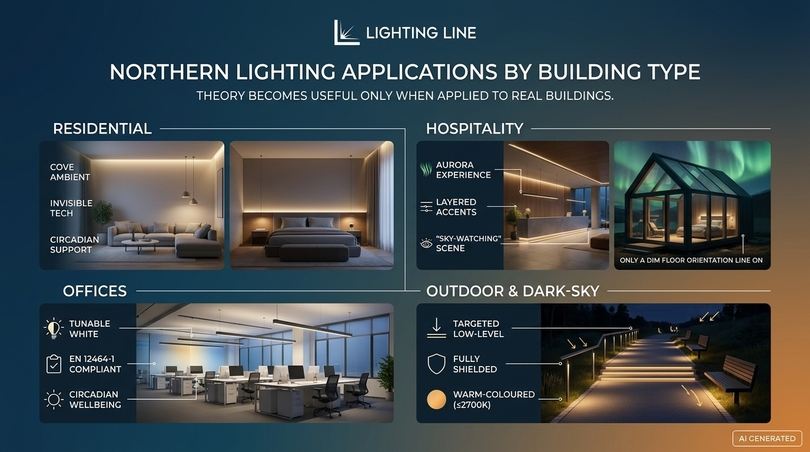
10. Northern lighting applications by building type
Theory becomes useful only when it is applied to real buildings. This section describes how Northern lighting is implemented in the building types that construction companies most often deliver, with the layers, products and pitfalls specific to each. Use it as a starting point for design briefs and tender documents.
Residential: apartments and single-family homes
Residential projects are the heart of Northern lighting. Clients want warmth, flexibility and invisible technology. The typical scheme combines perimeter cove light in the living room, low pendants over the dining table, under-cabinet strips in the kitchen, mirror light in bathrooms, low-level orientation light in corridors and stairs, and accent light in shelving.
Living room
- Ambient: 2700K COB strip in a drywall cove along two or four walls, dimmable.
- Accent: 2700K strip in furniture profiles inside shelving.
- Decorative: floor and table lamps; avoid ceiling downlights in the seating area.
- Control: at least three scenes (bright, evening, night).
Kitchen and dining
- Task: 3000K CRI Ra>90 strip under wall cabinets, positioned at the front edge.
- Island or dining table: suspended linear profile or contemporary pendant lights hung low.
- Plinth: low-level 2700K strip as night light.
Bedrooms
Bedrooms benefit most from circadian Northern lighting. A tunable white cove (2700-6500K) supports dark winter mornings, while a warm, low headboard strip and a dim floor-level orientation light serve the evening and night. Avoid cool light after sunset in bedrooms; Northern lighting reserves cooler white for the morning wake-up scene.
Bathrooms and wellness
Use IP-rated strips in profiles with suitable seals, positioned according to local bathroom zone regulations. Mirror lighting should be lateral or perimeter. In private saunas, place light outside the hottest zone or use products specifically rated for sauna temperatures.
Hospitality: hotels, lodges and aurora cabins
Hospitality is where Northern lighting meets tourism, and where the northern lights themselves often become part of the brief. Guests expect atmosphere, but staff also need practical cleaning and maintenance light.
Guest rooms
- Concealed cove or headboard light at 2700K, dimmable to very low levels.
- A “sky-watching” scene that turns off everything except a dim floor orientation line, so windows remain dark and the aurora is visible.
- Clear, simple controls: guests should never struggle to turn lights off.
- Cleaning scene at higher intensity and neutral white, accessible to staff only.
Lobbies, restaurants and bars
Layered light with linear accents on architecture, warm dimmed scenes in the evening and optional aurora scenes in lounges or bars. RGB+CCT strips in suspended or cove profiles allow the same installation to serve daily white light and special events.
Glass-roof cabins and observation lodges
In glass-roof accommodation, every lumen inside the cabin is a potential reflection that hides the northern lights; the design target is the lowest possible interior light at night. Use very warm (≤2200K) low-level strips, red or amber night modes where appropriate, and no upward light. Outdoor path lighting must be fully shielded and as dim as safety allows.
Offices and workplaces
Nordic offices combine EN 12464-1 compliance with comfort. Typical solutions include direct/indirect suspended linear luminaires over desks, tunable white for circadian support, wall washing in meeting rooms, and warm light in break areas.
| Space | Indicative maintained illuminance (check EN 12464-1) | Northern lighting solution |
|---|---|---|
| Open-plan desk area | ≈ 500 lx on task | Suspended direct/indirect profiles, tunable 3000-5000K |
| Meeting rooms | ≈ 500 lx on table | Linear pendant over table plus wall wash for faces on video |
| Corridors | ≈ 100 lx | Recessed linear or wall grazing, 3000K |
| Break and lounge areas | Variable | Warm 2700K cove and pendants, dimmable |
| Reception | ≈ 300 lx | Feature linear lines, high CRI |
Retail and showrooms
Northern lighting in retail emphasises product truth: high CRI, warm-to-neutral white and controlled contrast. Shelf strips in furniture profiles light products from close range; wall grazing reveals material textures; suspended lines provide general light without glare. For food retail, CRI Ra>90 and appropriate CCT make products look fresh without colour distortion.
Education
Schools in the North are often in session during the darkest months. Tunable white with morning activation, glare-free direct/indirect luminaires and quieter, warmer light in reading corners support learning and wellbeing. Classrooms are one of the strongest cases for circadian Northern lighting, because pupils spend their most important hours under artificial light in winter.
Healthcare and care homes
Care homes and hospitals benefit from tunable white schedules, night lighting that does not disturb sleep and orientation lighting along corridors and in bathrooms. Low-level strips in floor or baseboard profiles help residents move safely at night. Specialised healthcare lighting guidance must always be followed.
Residential common areas and stairwells
Stairwells, entrances and corridors in apartment buildings are lit for long hours in Nordic winters. Linear LED in handrail profiles, step-edge lighting and presence-controlled dimming reduce energy use and give a premium impression. Consider maintenance access and vandal resistance in public areas.
Façades, landscape and external works
External Northern lighting is restrained. The goals are orientation, safety and a hint of architecture, never floodlighting. IP67 COB strips in suitable profiles can outline steps, benches and paths at very low intensity. This is where interior Northern lighting principles meet dark-sky design, covered next.
Outdoor Northern lighting and dark-sky design
Outdoor lighting is where architects and construction companies have the greatest influence on whether people can see the stars and the northern lights. In many northern regions, dark skies are a tourism asset and an ecological necessity. In the UK, Scotland’s Galloway Forest and Northumberland’s Kielder area are well-known dark-sky destinations. This section explains how to design outdoor lighting that respects these values, using the same principles that define Northern lighting indoors.
The five principles of responsible outdoor lighting
DarkSky International promotes five principles for responsible outdoor lighting at night: light should be useful, targeted, low level, controlled and warm-coloured. Each principle maps directly to a design decision a construction company makes when it chooses a fixture, its position, its output, its control and its colour temperature.
| Principle | Meaning | Northern lighting implementation with linear LED |
|---|---|---|
| Useful | Every light needs a clear purpose. | Light only paths, steps, entrances; no decorative uplighting of trees or façades in dark areas. |
| Targeted | Direct light only where needed. | Strips installed under handrails, benches and step nosings, facing downwards, inside shielding profiles. |
| Low level | No brighter than necessary. | Low-power strips (e.g. 6 W/m or lower), dimmed further by the driver. |
| Controlled | Use timers, sensors and dimming. | Motion sensors, astronomical clocks, curfew dimming after midnight. |
| Warm-coloured | Limit blue-rich light. | 2700K or lower, ideally 2200K; DarkSky recommends not exceeding 3000K. |
Why warm colour temperature protects the night sky
Short-wavelength (blue-rich) light scatters more in the atmosphere than long-wavelength light, contributing more to skyglow. It also has a stronger effect on many nocturnal animals and on human circadian systems. Choosing 2200K-2700K for outdoor Northern lighting reduces skyglow and ecological impact while keeping the warm atmosphere clients associate with Nordic design.
Product choices for dark-sky outdoor lighting
For low-level outdoor applications, flexible IP67 strips with low power and warm CCT are effective, provided they are installed inside profiles or architectural details that direct the light downward. Examples from the Lighting Line catalogue:
- 5m warm white 2700K COB LED strip, 480 LEDs/m, 24V, 6W/m, IP67 silicone tube: suitable for step nosings, handrails and bench undersides.
- 5m warm white 3000K COB LED strip, IP67: the upper limit recommended for dark-sky-sensitive areas; prefer 2700K or lower near designated dark-sky places.
Avoid cool white (4000K and above) outdoors in aurora regions and near dark-sky parks, even if the product is efficient; the 4000K version of a strip is more appropriate indoors.
Design details that prevent light pollution
Shielding
Install strips in profiles or architectural recesses so that the light source is not visible from above or from a distance. Light should fall on the ground or the step, not into the sky or into neighbouring windows.
Mounting height and direction
Keep outdoor linear lights low (steps, plinths, handrails, bench edges). A light line 40 cm above the ground produces orientation with very little spill. Avoid upward-facing strips in gardens, on trees and on façades in dark areas.
Controls and curfews
Program outdoor circuits to dim significantly or switch off after a set time, with motion sensors for occasional use. In hospitality, offer guests a “sky mode” that turns off all non-essential outdoor light during an aurora alert.
Glazing and interior spill
Interior light that escapes through large windows contributes to light pollution. Northern lighting interiors with warm, indirect and dimmable schemes reduce this naturally; in sensitive locations, add blinds and night scenes.
Dark-sky checklist for planners and contractors
| Check | Target | Done |
|---|---|---|
| Every outdoor light has a defined purpose | Yes | ☐ |
| No light emitted above the horizontal | Fully shielded | ☐ |
| CCT | ≤2700K (≤3000K maximum) | ☐ |
| Lowest output that ensures safety | Verified on site | ☐ |
| Timers, sensors and curfew dimming | Programmed | ☐ |
| IP rating suitable for climate | IP65-IP67 | ☐ |
| Driver rated for minimum winter temperature | Checked | ☐ |
12. Product mapping: Lighting Line LED strips and profiles for Northern lighting
The previous sections described what Northern lighting requires. This section maps those requirements to products available in the Lighting Line LED strip catalogue and aluminium profile catalogue. Product data below are taken from the catalogue listings; always confirm the current data sheet before ordering.
LED strips
| Product | Key data | Northern lighting application |
|---|---|---|
| COB LED strip 10m warm white 2700K CRI Ra>90 | 480 LEDs/m, 24V, 10.5 W/m, 120 lm/W, IP20, cut every 5 cm, energy class E | Living room coves, wall washing, hospitality ambient light |
| COB LED strip 10m warm white 2700K, 11 W/m | 480 LEDs/m, 24V, 11 W/m, IP20, cut every 5 cm | Material-led interiors, retail, galleries |
| COB LED strip 2700K 7.5 W/m with current control | 480 LEDs/m, 24V, 7.5 W/m, CRI Ra>90, IP20 | Long uniform runs: corridors, façades of joinery, long shelves |
| COB LED strip 10m CCT 2700-6500K | 600 LEDs/m, 24V, 7.7 W/m, CRI Ra>90, IP20, cut every 2 cm | Circadian schemes in bedrooms, offices, schools, care homes |
| COB LED strip 10m cool white 6000K | 528 LEDs/m, 24V, 15.5 W/m, CRI Ra>90, IP20 | Technical areas, workshops; morning activation in mixed schemes |
| COB LED strip 5m 2700K IP67, 3 mm | 480 LEDs/m, 24V, 6 W/m, IP67 silicone tube, cut every 2.5 cm | Outdoor dark-sky details, spa surroundings, entrances |
| COB LED strip 5m 4000K IP67, 3 mm | 480 LEDs/m, 24V, 6 W/m, IP67 | Humid indoor technical areas; not recommended outdoors in dark-sky areas |
Aluminium profiles
| Profile family | Northern lighting use | Building phase |
|---|---|---|
| Drywall | Seamless coves and lines in plasterboard ceilings and walls | Drylining, before skim coat |
| Recessed | Flush lines in ceilings, walls, joinery | Joinery and finishes |
| Surface | Under-cabinet task light, retrofit | Fit-out |
| Suspension | Direct/indirect linear pendants over tables and desks | Fit-out |
| Corner | 45° light in furniture and wall-ceiling junctions | Joinery |
| Wall | Wall washing and grazing | Fit-out |
| Concrete | Light lines cast into concrete | Structure (pre-pour) |
| Tiling | Light lines in tiled walls, bathrooms, spas | Tiling |
| Floor / Baseboard | Orientation light, night paths | Flooring / finishes |
| Handrail | Stair safety and atmosphere | Fit-out |
| Mirror | Bathroom and dressing mirrors | Fit-out |
| Round | Wardrobe rails, tubular details | Joinery |
| Architectural | Large-scale lines in commercial interiors | Design and fit-out |
Example configuration: Nordic living room, 5 x 6 m
To show how products combine, here is an indicative configuration for a 30 m² living room with white walls and a pale timber floor:
- Perimeter cove (22 m): COB 2700K CRI Ra>90 10.5 W/m in a drywall profile with opal diffuser, fed in four segments; total ≈ 231 W at full output.
- Shelving accent (6 m): COB 2700K 7.5 W/m in furniture profiles; ≈ 45 W.
- Plinth night light (4 m): low-output warm strip at minimum dimming.
- Decorative: two table lamps, one floor lamp, candles.
- Control: DALI or wireless, scenes “Day”, “Evening”, “Night”, “Off”.
In everyday use the cove rarely runs at full output; in evening scenes it typically operates at a fraction of its power, which keeps energy use low while delivering a generous, glare-free Northern lighting atmosphere. A lighting calculation should confirm final quantities.
13. Northern lighting installation and detailing for construction companies
The most beautiful Northern lighting design fails if it is badly installed. Visible dots, dark joints, colour mismatches, overheating strips and inaccessible drivers are the most common causes of complaints and callbacks. This section collects the practical knowledge that site managers, electricians and joiners need, organised by building phase.
Design coordination phase
Linear LED integrated into the building must be coordinated early. Concrete profiles are positioned before the pour; drywall profiles before plastering; tiling profiles before tiling. For construction companies, the single most effective quality measure in Northern lighting is to include the light lines in the architectural and structural drawings, not just in the electrical layout.
Information to fix at design stage
- Exact length and position of each light line, including corners and joints.
- Strip type, CCT, CRI, power per metre and voltage.
- Profile type, diffuser type, end caps and brackets.
- Feed points, cable routes and driver locations with maintenance access.
- Control protocol, zones and scenes.
- IP requirements and environmental conditions (humidity, temperature).
First fix
Cable routes and feed points
Plan feed points to respect maximum run lengths and to avoid voltage drop. Leave service loops and label every cable. In long coves, intermediate feeds are cheaper to install now than to add later.
Driver locations
Place drivers in accessible, ventilated locations: inspection hatches, technical cupboards, ceiling voids with access panels. Never seal a driver permanently behind plaster or tiles. In unheated spaces such as cabins, garages or outdoor enclosures, check minimum operating temperature ratings, which matter in Nordic winters.
Concrete and drywall profiles
Concrete profiles must be fixed securely to formwork and protected from cement intrusion. Drywall profiles are fixed to the studwork or board and finished with filler and skim; their edges are designed to disappear into the plaster. Protect the profile channel during plastering and painting.
Second fix
Cutting and connecting strips
- Cut only at the marked cutting points.
- Use the correct connectors or soldered joints; Lighting Line offers PCB LED strip connectors.
- Respect polarity and channel order for CCT and RGB+CCT strips.
- Seal cut ends of IP-rated strips with appropriate end caps and sealant.
Mounting in profiles
Clean and degrease the profile before applying the strip’s adhesive tape. Press the strip firmly along its full length. Aluminium profiles act as heat sinks: a strip mounted directly on wood or plaster without a profile runs hotter, and higher operating temperatures shorten LED life and can shift colour over time.
Corners and joints
Plan corners carefully: mitre-cut profiles, continuous strips bent where the product allows, or separate segments with connectors. Dark spots at corners are one of the most visible defects in Northern lighting coves; COB strips with fine cut points reduce them.
Commissioning
Commissioning is where a Northern lighting scheme becomes what the designer intended. Test every circuit at full output and at minimum dimming, check colour consistency between segments, program scenes, and verify that sensors and timers work. Always check the lowest dimming levels: flicker, stepping or colour shifts at 1-5% are typical failure points, and the “night” end of the scene range is precisely where Northern lighting lives in the evening.
Commissioning checklist
| Test | Acceptance criterion |
|---|---|
| Uniformity along each line | No visible dots (with specified diffuser), no dark joints |
| Brightness at far end of runs | No visible drop compared to feed end |
| Colour consistency | No visible difference between segments of the same CCT |
| Dimming range | Smooth from 100% to minimum, no flicker |
| Tunable white | Correct CCT at each scene; channels not reversed |
| Scenes and controls | All scenes recalled correctly; labels clear for users |
| Outdoor circuits | Timers, sensors and curfew dimming working |
| Documentation | As-built drawings, product list, driver locations handed over |
Maintenance
Northern lighting systems built with profiles and accessible drivers are easy to maintain. Keep spare strip and diffuser lengths from the same production batch for future repairs, document driver positions and settings, and schedule periodic checks of outdoor seals.
14. Energy, cost and ROI: a worked example of Northern lighting
Clients often assume that “more light sources” means “more energy”. In Northern lighting the opposite can be true: indirect linear light at moderate output, with dimming and controls, can deliver more perceived brightness and comfort with less installed power than a grid of downlights. The example below uses clearly stated assumptions so that you can adapt it to your projects.
Assumptions
| Parameter | Assumed value |
|---|---|
| Project | Small boutique hotel, 20 rooms, plus lobby and corridors |
| Installed LED strip | 400 m of COB 2700K CRI Ra>90 at 10.5 W/m |
| Installed load (strips) | 400 × 10.5 = 4,200 W |
| Driver efficiency | ≈ 90%, so ≈ 4,670 W drawn at full output |
| Average dimming level over operating hours | 50% |
| Annual operating hours (lighting on) | 4,000 h |
| Electricity price | €0.25/kWh (assumption; adjust to local tariffs) |
Calculation
At full output for 4,000 hours, consumption would be about 4.67 kW × 4,000 h ≈ 18,680 kWh per year. With an average dimming level of 50%, consumption falls to roughly 9,340 kWh per year (in practice the relationship between dimming level and power is close to linear for good LED drivers, but not exactly). At €0.25/kWh, that is about €2,335 per year instead of €4,670, a saving of roughly €2,335 per year from controls alone.
The lesson is clear: in Northern lighting, controls are not an extra but a financial component of the system, because long winter operating hours multiply every watt saved. Presence detection in corridors and curfew dimming outdoors increase the savings further.
Comparing with a downlight grid
Replacing a dense grid of downlights with a combination of indirect linear light and a few accent sources often reduces the number of fixtures, ceiling penetrations and installation hours. Whether installed power is lower depends on the project, but the perceived quality usually improves because walls and ceilings are lit. Present both energy and quality arguments to clients, with a simple calculation like the one above.
Value beyond energy
- Higher perceived value: integrated light lines are associated with premium and luxury interiors, from Scandinavia to the luxury lighting market in the UK.
- Guest and user satisfaction: warm, glare-free light improves comfort and reviews in hospitality.
- Flexibility: tunable and RGB+CCT systems allow re-programming instead of re-installation.
- Longevity and repairability: modular profile systems extend the life of the installation.
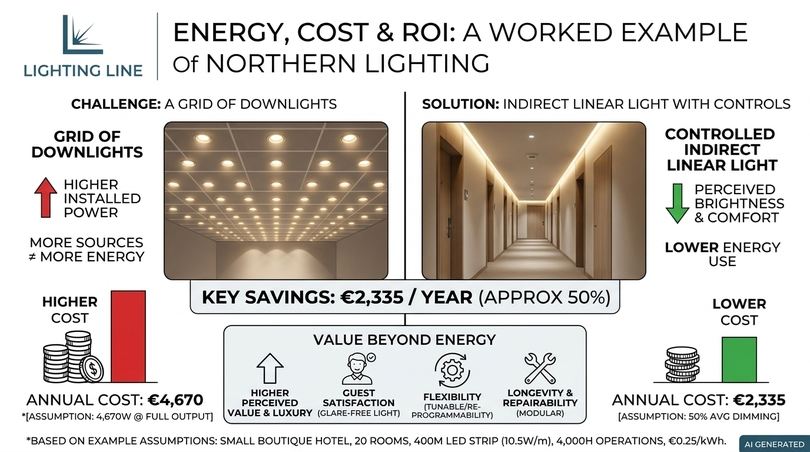
15. Northern lighting checklist for architects, lighting designers and light designers
Different professionals approach Northern lighting with different questions. The checklists below summarise what each audience should verify, so that the design intent survives from concept to handover.
For architects
- Have the light lines been drawn as architectural elements, with dimensions and details?
- Are surface finishes (reflectance, texture) compatible with indirect Northern lighting?
- Do window positions and glazing consider night reflections and views of the sky?
- Have dark-sky requirements been considered for external works?
- Is there a clear concept for daytime, evening and night atmospheres?
For lighting designers (progettisti illuminotecnici)
- Have illuminance, uniformity and glare been calculated against EN 12464-1 where applicable?
- Are CCT, CRI and R9 specified per zone?
- Have diffuser losses been included in output calculations?
- Are feed points, run lengths and voltage drop verified?
- Is the control system defined with zones, scenes and circadian schedules?
For light designers
- Does the scheme create hierarchy and contrast, not uniform brightness?
- Are decorative elements and contemporary pendant lights positioned to avoid glare?
- Is colour (RGB, aurora scenes) used with restraint and a white default?
- Has the night experience been designed, including “sky-watching” or “night” scenes?
- Have mock-ups been tested on site with the actual materials?
For construction companies
- Are all profiles, strips, drivers and accessories ordered from consistent batches?
- Are installation sequences coordinated with concrete, drylining, tiling and joinery?
- Are drivers accessible and documented?
- Is commissioning scheduled with the designer present?
- Has the client received clear instructions for scenes and controls?
Northern lighting in ten rules
- Light walls and ceilings, not only floors.
- Hide the source; show the light.
- Use warm white in the evening and neutral or tunable white for work.
- Specify CRI Ra>90 wherever people live, eat or shop.
- Layer ambient, task, accent and decorative light.
- Dim deeply and smoothly; design the night, not just the day.
- Let darkness and contrast create depth.
- Keep outdoor light low, shielded, warm and controlled.
- Integrate profiles into the architecture early.
- Keep components accessible and documented.
16. Northern lighting in renovation and retrofit projects
Most construction work in Europe is renovation, not new build. Many clients who ask for Northern lighting live in existing apartments, period houses or offices with fixed ceilings, limited voids and old wiring. This section explains how to bring Northern lighting into existing buildings with minimal demolition, which is often the deciding factor in whether a client says yes.
Surveying an existing space for Northern lighting
Before proposing a scheme, survey the space with the same parameters used in new build, but focused on opportunities rather than constraints. The aim of a Northern lighting survey is to find surfaces that can be washed, edges that can hide a strip and positions where a driver can be accessed later.
What to record during the survey
- Ceiling height and the presence of cornices, beams, picture rails or bulkheads that can conceal a light line.
- Wall and ceiling colours and finishes, with an estimate of reflectance.
- Existing joinery (wardrobes, kitchen units, shelving) that can host furniture or surface profiles.
- Location of existing switches, junction boxes and the consumer unit.
- Window orientation and the amount of winter daylight in each room.
- Any heritage restrictions that limit penetrations in ceilings or walls.
Low-intervention Northern lighting strategies
Several strategies deliver a convincing Northern lighting result without opening ceilings.
Furniture-led light
Bookcases, wardrobes, kitchen units and headboards are ideal hosts for linear light. A strip in a furniture or corner profile on top of a tall wardrobe washes the ceiling; a strip under a floating shelf grazes the wall below. Power can often be taken from an existing socket via a plug-in driver and a smart switch, avoiding new cable runs in the walls.
Surface-mounted coves
Where a plasterboard cove is not possible, a surface profile mounted on the top of a wall, close to the ceiling and facing upwards, behind a slim timber or plaster fascia, creates a similar indirect effect. This “applied cove” is one of the most cost-effective retrofit techniques in Northern lighting.
Picture rails and cornices
In period buildings, picture rails and cornices provide natural ledges for a slim COB strip. Because COB produces dot-free light, a very shallow profile is enough, and the line of light reads as part of the original architecture rather than as an addition.
Plinths and skirting
Kitchen plinths and bed bases can host low-level night light with minimal work. A baseboard profile can replace an existing skirting board, adding orientation lighting along corridors and stairs during a normal redecoration.
Wiring and control in existing buildings
Retrofitting control wiring is often the most disruptive part of a renovation. Wireless control platforms solve much of this: drivers with built-in wireless receivers can be grouped into scenes and controlled by battery-powered wall switches or apps. For many Northern lighting renovations, wireless control is the difference between a two-day job and a two-week job. Where walls are being opened anyway, a DALI bus is a future-proof alternative.
Replacing downlights
Many homes renovated in the 2000s and 2010s have grids of downlights. A Northern lighting retrofit does not always remove them; often it reduces their role. Keep a few downlights for task use on a separate circuit, fit warm-dim retrofit lamps where possible, and add indirect linear light for ambient use. Holes from removed downlights can be patched or fitted with blanking plates.
Retrofit priorities by room
| Room | Highest-impact Northern lighting intervention | Typical disruption |
|---|---|---|
| Living room | Applied cove or furniture-led ceiling wash at 2700K, dimmable | Low |
| Kitchen | Under-cabinet task strip at 3000K CRI Ra>90 plus plinth night light | Low |
| Bedroom | Headboard or wardrobe-top tunable white strip | Low |
| Bathroom | Mirror perimeter light with IP-rated strip | Medium |
| Hallway and stairs | Baseboard or handrail orientation light with sensor | Medium |
| Home office | Suspended or wall-mounted direct/indirect linear light, tunable | Medium |
Communicating Northern lighting to renovation clients
Renovation clients rarely think in kelvin or lumens. They think in moments: Sunday breakfast in January, reading in the evening, getting up at night without waking anyone. A useful sales technique for construction companies is to describe the Northern lighting scheme scene by scene, then translate each scene into products. When the client can picture the January morning and the December evening, the value of Northern lighting becomes obvious and the conversation about price changes.
A small on-site mock-up (one metre of COB strip in a profile, powered by a portable driver) is often more persuasive than any rendering. Show the difference between 2700K and 4000K, between CRI 80 and CRI 90 on the client’s own timber or fabric, and between a bare strip and a strip behind an opal diffuser.
Common renovation mistakes
- Mixing colour temperatures from different suppliers in the same room, producing visible inconsistencies.
- Installing strips without profiles on timber or plaster, leading to overheating and early failure.
- Hiding drivers behind sealed panels, making future repairs expensive.
- Using cool white to “make the room brighter” in winter, which usually makes it feel colder and harsher.
- Ignoring dimming compatibility between existing wall dimmers and new drivers, causing flicker.
Avoiding these mistakes is what separates a convincing Northern lighting renovation from a disappointing one. With careful survey, low-intervention techniques and consistent products, existing buildings can achieve almost the same quality as new build.
17. Northern lighting design scenarios: three illustrative projects
The following scenarios are illustrative design exercises, not documented case studies. They show how the principles of Northern lighting adapt to three very different contexts: an aurora lodge in Lapland, a period townhouse renovation in the UK luxury market, and an office in Northern Italy that wants a Nordic atmosphere. Each scenario lists the brief, the Northern lighting strategy, the products and the key lessons.
Scenario A: aurora lodge in Finnish Lapland
Brief
A developer is building twelve timber cabins with partially glazed roofs for guests who come to see the northern lights. The brief asks for “warm, cosy interiors that disappear when the aurora appears”, robust outdoor lighting for paths in snow, and low energy consumption during a long, dark season.
Northern lighting strategy
The interior is lit almost entirely indirectly. A 2700K COB strip runs in a recessed profile along the top of the timber walls, washing the sloping ceiling. A second circuit at very low level, 2200K, runs under the bed frame and along the floor towards the bathroom. The key scene is “Aurora mode”: one button turns off the ceiling wash and leaves only the floor line at minimum, so the glazed roof becomes a dark window onto the sky.
The bathroom uses an IP-rated strip in a tiling profile beside the mirror, at 3000K with CRI Ra>90 for accurate skin tones. Outdoors, IP67 COB 2700K strips sit under handrails and step nosings, shielded and controlled by motion sensors with an automatic curfew. No light points upwards.
Lessons
- Design the darkest scene first: in an aurora lodge it is the most important one.
- Drivers for outdoor circuits must be rated for very low temperatures and housed in accessible, protected enclosures.
- Timber ceilings reflect warmly but absorb more light than white plaster, increase output or density accordingly.
Scenario B: Victorian townhouse renovation in London
Brief
A high-end client renovating a Victorian terrace wants a contemporary interior with period details preserved. The brief references Scandinavian hotels and asks for “luxury lighting UK standard, but no ceiling full of holes”.
Northern lighting strategy
Instead of a downlight grid, the designer uses the existing architecture. Cornices are preserved and a slim 2700K COB line is hidden above the picture rail, washing the upper wall and ceiling. Alcove shelving beside the chimney breast receives furniture profiles with high-CRI strips. Contemporary pendant lights hang low over the dining table, while the kitchen extension uses a suspended linear profile over the island with up-light to the ceiling and dimmable down-light to the worktop.
The result is a Northern lighting scheme that respects the heritage fabric: fewer penetrations in historic ceilings, more light on walls, and warm scenes that suit British winter evenings. The stair is lit with a handrail profile at low intensity, giving safe night navigation.
Lessons
- Heritage interiors benefit from linear light placed on existing mouldings and joinery.
- In the UK luxury market, CRI Ra>90 and smooth dimming are expected; specify them explicitly.
- Keep decorative fixtures and concealed light on separate circuits for maximum scene flexibility.
Scenario C: Nordic-style office in Northern Italy
Brief
A design company in Northern Italy wants its new office to “feel like Copenhagen”. Winters in the Po Valley are grey and foggy, so the client is receptive to arguments about daylight compensation.
Northern lighting strategy
Over the desks, suspended direct/indirect profiles carry tunable white strips (2700-6500K), controlled by DALI DT8 with a circadian schedule: cooler and brighter in the morning, neutral in the afternoon, warmer towards evening. Meeting rooms combine a linear pendant over the table with wall washing so that faces are well lit on video calls. The break area uses warm 2700K cove light and pendants. Corridors receive recessed lines with presence detection.
Lessons
- Northern lighting translates well to foggy, grey winter climates even at lower latitudes.
- EN 12464-1 compliance and Nordic atmosphere are compatible when direct/indirect luminaires are used.
- Circadian control must be explained to users; a simple “manual override” keeps acceptance high.
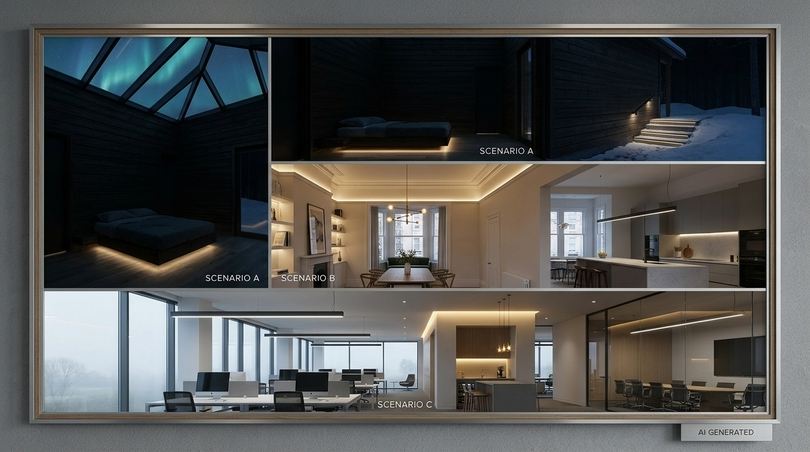
18. Northern lighting glossary
Clear vocabulary helps teams communicate. The glossary below defines the terms used throughout this guide, in the way they are used in Northern lighting practice.
| Term | Definition |
|---|---|
| Northern lighting | A layered, warm, glare-free, indirect and controllable approach to artificial lighting that compensates for scarce daylight, typical of the Nordic countries and increasingly adopted elsewhere. |
| Aurora borealis (northern lights) | Natural light display in the upper atmosphere caused by solar particles colliding with oxygen and nitrogen, visible mainly near the auroral oval. |
| Auroral oval | The ring-shaped zone around the geomagnetic pole where the aurora occurs most frequently. |
| Kp index | A scale from 0 to 9 describing global geomagnetic activity; higher values mean the aurora may be visible further from the poles. |
| CCT | Correlated colour temperature, in kelvin; describes whether white light looks warm or cool. |
| CRI (Ra), R9 | Colour rendering index and its value for saturated red; measures colour fidelity. |
| COB LED strip | Chip-on-board strip with densely packed chips under a continuous phosphor, producing dot-free light. |
| SMD LED strip | Strip with surface-mounted LED packages spaced along the PCB. |
| Tunable white (CCT strip) | Strip with warm and cool channels whose mix sets the colour temperature. |
| Dim-to-warm | Behaviour where colour temperature falls as light is dimmed, imitating incandescent and candle light. |
| Melanopic EDI | Metric from CIE S 026:2018 describing the non-visual, circadian effect of light. |
| UGR | Unified glare rating; lower values mean less discomfort glare. |
| Luminance | Brightness of a surface as seen by the eye (cd/m²); key to visual comfort. |
| Illuminance | Amount of light falling on a surface (lux). |
| IP rating | Ingress protection rating defined by IEC 60529. |
| Skyglow | Brightening of the night sky caused by artificial light scattered in the atmosphere. |
| Hygge / koselig / mys | Danish, Norwegian and Swedish words describing cosy, convivial atmospheres in which warm light plays a central role. |
| Voltage drop | Loss of voltage along a strip or cable, causing reduced brightness at the far end of long runs. |
19. Frequently asked questions about Northern lighting
These are the questions architects, lighting designers and construction companies ask most often about Northern lighting, along with the related questions people search about the northern lights. Click each question to expand the answer.
What is Northern lighting in interior design?Northern lighting is a Nordic approach to artificial light that compensates for short winter days. It uses many small, warm (2200-3000K), glare-free sources, indirect linear LED on walls and ceilings, CRI Ra>90 and deep dimming. The aim is comfort and atmosphere rather than maximum brightness, with light layered in ambient, task, accent and decorative levels. |
Which colour temperature is best for Northern lighting?For living rooms, bedrooms and hospitality, 2700K is the reference, with 2200K-2500K for evening and night scenes. Kitchens and bathrooms often use 3000K, while offices and schools use 3500K-4000K or tunable white 2700-6500K. Outdoors near dark-sky areas, stay at 2700K or below and never exceed 3000K. |
Why do Scandinavians prefer warm, indirect light?Because daylight is scarce for months and arrives at very low angles, people spend long hours under artificial light. Warm, indirect light is comfortable, avoids glare, makes light-coloured Nordic interiors glow evenly and supports a social, relaxed evening culture known as hygge in Danish. Strict energy codes also favour efficient LED with dimming and controls. |
Are LED strips suitable for professional Northern lighting projects?Yes, when specified correctly. High-CRI COB or SMD strips mounted in aluminium profiles with opal diffusers provide uniform, dot-free, glare-free light, good heat dissipation and long life. Choose 24V for most interiors, respect maximum run lengths, plan intermediate feeds and keep drivers accessible. Integrated drywall, concrete and tiling profiles make the light part of the architecture. |
What are the northern lights?The northern lights, or aurora borealis, are natural light displays caused by charged solar particles colliding with oxygen and nitrogen high in the atmosphere, mostly between 100 and 300 km. Green is produced by oxygen at lower altitudes, rare red by oxygen higher up, and blue-violet edges by nitrogen. They are most frequent around the auroral oval. |
Where can you see the northern lights in Europe and the UK?The best places to see northern lights are Northern Norway (Tromsø, Lofoten), Swedish Lapland (Abisko), Finnish Lapland and Iceland, from roughly September to March. In the UK, Shetland, Orkney and northern Scotland offer the best chances; northern England and Wales see them during stronger storms. Dark, clear skies away from artificial light are essential. |
How can I check the northern lights forecast for the UK?Use AuroraWatch UK from Lancaster University for magnetometer-based alerts, and the Met Office space weather forecast for a four-day outlook including the aurora. NOAA’s Space Weather Prediction Center shows the predicted auroral oval. Then check the local cloud forecast and find a location shielded from artificial lights, facing the northern horizon. |
How does outdoor lighting affect seeing the northern lights?Artificial light causes skyglow and glare that can hide a faint aurora completely, especially in the UK where displays are often weak. Lighting that is useful, targeted, low, controlled and warm, as promoted by DarkSky International, protects the view. Shielded, downward IP67 strips at 2700K or below, with timers and sensors, are a good solution. |
How do I create an aurora-inspired lighting scene indoors?Install an RGB+CCT LED strip in a concealed cove or suspended profile with an opal diffuser. Program a white default at 2700K, then an aurora scene with dominant green at low intensity, slow 20-60 second fades towards blue-violet and occasional faint red. Keep other lights off and use DALI or DMX for smooth transitions. |
How does Northern lighting differ from Mediterranean lighting?Mediterranean architecture manages abundant daylight and heat, and interiors are often lit by a central ceiling fixture, sometimes with cooler white. Northern lighting compensates for scarce daylight with warm, layered, indirect light on walls and ceilings, many low sources and deep dimming. Today the two traditions are converging through concealed linear LED and high CRI. |
20. Why Northern lighting is the future of residential and hospitality lighting
Northern lighting began as a response to an extreme environment: weeks of polar night, a sun that barely rises above the horizon, and months spent indoors. From that constraint, Nordic designers created a coherent philosophy built on warm colour, high colour rendering, indirect light, layering, darkness as a design material and intelligent control. Today Northern lighting is no longer a regional style; it is a reference model for comfortable, efficient and human-centred lighting in any climate with dark winters, from Scotland to Northern Italy.
For architects, lighting designers and light designers, Northern lighting provides a vocabulary and a set of measurable parameters. For construction companies, it is a concrete business opportunity: integrated linear LED systems raise perceived value, reduce callbacks when correctly detailed, and respond to growing client demand for “Scandinavian” atmospheres, luxury lighting in the UK and aurora-oriented hospitality projects. And outdoors, the same principles help keep the night sky dark enough for the northern lights to be seen.
The tools are available. COB strips at 2700K with CRI Ra>90, tunable 2700-6500K strips, IP67 strips for exterior details and a complete range of drywall, concrete, tiling, suspension and furniture profiles make it possible to deliver Northern lighting with precision on every site.
Ready to specify your next Northern lighting project? Explore the Lighting Line LED strips and aluminium profiles, download the LED strip catalogue and the profiles catalogue, or contact the Lighting Line technical team for support in choosing the right combination of strip, profile and diffuser for your project.