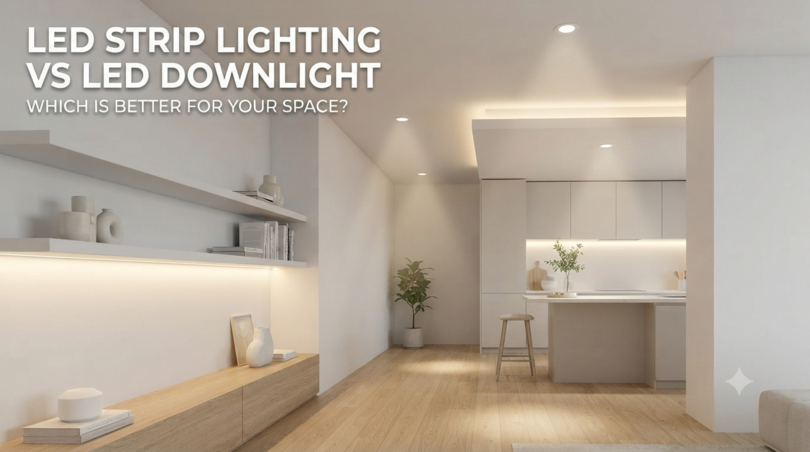
Choosing between a led downlight and led strip lighting is one of the most consequential decisions in any lighting plan, and it is a decision that is very easy to get wrong. The two technologies solve different problems: one produces a controlled cone of light from a single point, the other produces a continuous, linear glow that can run for meters along a ceiling, wall or floor. Get the choice right and a room feels calm, layered and considered; get it wrong and even the most expensive furniture and finishes will look flat under the wrong kind of light.This guide walks through exactly how led strip lighting and led downlight fixtures work, where each one belongs, the mistakes that installers and homeowners make most often, and how architects use both together to shape atmosphere rather than simply illuminate a floor plan. Wherever it is useful, we link directly to the LED strip lighting collection at Lighting Line so you can see the exact specifications, IP ratings and colour temperatures referenced throughout the article.It is worth being upfront about why this particular comparison deserves such a detailed treatment rather than a quick, superficial answer.
Lighting is one of the few elements of an interior that is experienced constantly, whether or not it is ever consciously noticed, and the format of the light source, point versus line, has a direct, measurable effect on how a space is perceived: how tall a ceiling feels, how flattering a mirror is to stand in front of, how safe a staircase feels underfoot at night. Led downlight and led strip lighting both solve real, legitimate problems, and the sections that follow are structured so that a reader can either work through the whole comparison in depth or jump directly to the specific room, mistake or technical question that matters most to their own project using the table of contents below.
Throughout the sections that follow, you will notice the same core idea returning again and again from slightly different angles: a downlight is a point, a strip is a line, and almost every practical, financial and creative difference between the two products flows directly from that single geometric fact. Keeping this one distinction in mind while reading each section, whether it covers installation, cost, colour temperature or a specific room, makes the reasoning behind every recommendation far easier to follow and, more importantly, far easier to apply confidently to a project that looks nothing like the exact examples used here.
In this article…
- 1. What is LED strip lighting? Understanding the technology
- 2. What is LED downlighting?
- 3. LED downlight vs LED strip lighting: the core differences
- 4. The numbers behind the trend: LED lighting market data
- 5. Which spaces suit LED downlights vs LED strip lighting?
- 6. Common mistakes when choosing between downlights and LED strip lighting
- 7. Combining LED downlights and LED strip lighting in the same room
- 8. Designing with light: a guide for architects and interior designers
- 9. Smart control, dimming protocols and compatibility
- 10. Sustainability and energy impact
- 11. Sample lighting specifications: three real-world room layouts
- 12. Technical deep dive: voltage, consistency and measuring your run
- 13. Maintenance, lifespan and total cost of ownership
- 14. A practical buying checklist
- 15. Regulatory, safety and certification considerations
- 16. Why specify lighting line LED strip lighting
- 17. Essential accessories: end caps, connectors and mounting brackets
- 18. LED strip lighting vs rope light vs neon flex
- 19. A short case study: downlight-only vs layered lighting
- 20. Frequently asked questions
- 21. Conclusion
1. What is LED strip lighting? Understanding the technology
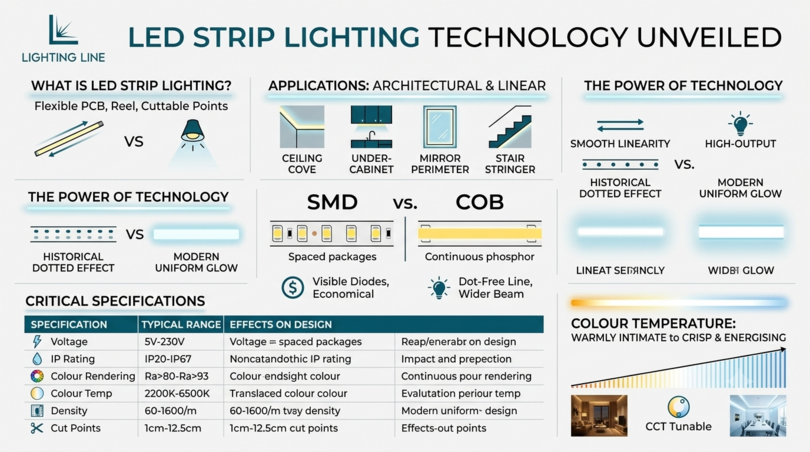
Before comparing two products, it helps to understand what each one actually is, because the word “downlight” and the phrase “led strip lighting” describe two fundamentally different approaches to putting light into a room. LED strip lighting is a continuous run of small light-emitting diodes mounted on a flexible printed circuit board, supplied on reels that are typically five or ten metres long and can be cut to length at marked points along the tape. Rather than lighting a room from a single fixed point, as a downlight does, a strip creates a line of light that can trace the edge of a ceiling, the underside of a kitchen cabinet, the perimeter of a mirror, or the full length of a staircase stringer. That single structural difference is the reason the two products end up serving such different purposes, even though both are, at the component level, simply arrays of LEDs.
The appeal of led strip lighting lies in its flexibility, both literal and design-related. Because the strip itself is thin, adhesive-backed, cuttable and low-voltage, it can be routed into places a rigid fixture could never reach: inside a recessed aluminium channel above a wardrobe, along a plinth at floor level, inside a glass shelf, or around the inside edge of a coffered ceiling. This is why lighting designers increasingly refer to strip lighting as “architectural” or “linear” lighting rather than simply a decorative accessory, and why the category has grown so quickly across both residential and commercial projects over the past decade.
Part of that growth is also simply a matter of manufacturing maturity. Early LED strip products, particularly the very first generations of SMD tape to reach the market, suffered from inconsistent colour output, limited lifespan and a visibly dotted appearance that made them unsuitable for anything beyond simple decorative use. The current generation of led strip lighting, including the COB and high-CRI SMD ranges referenced throughout this guide, addresses all three of those historical weaknesses directly, which is the main reason architects and specifiers who were once cautious about the category now treat it as a mainstream, dependable choice for serious architectural work rather than a budget alternative to more established fixture types.
SMD vs COB LED strips: what is the difference?
Not all led strips are built the same way, and the distinction between the two dominant technologies, SMD and COB, is one of the first things any architect or installer should understand before specifying a product. SMD (Surface Mounted Device) LED strips place individual, evenly spaced diode packages directly onto the circuit board. Each diode is visible as a small point of light, and depending on the density of diodes per metre, this can either be barely noticeable or, at lower densities, create a visible “dotting” effect when viewed directly or through a diffuser that sits too far from the strip.
COB (Chip-on-Board) LED strips take a different approach: instead of discrete diode packages, dozens of tiny LED chips are mounted directly onto the board and covered with a single continuous phosphor layer, producing what the industry calls a “dot-free” line of light with a notably wider beam angle of around 180 degrees. The COB LED strip range from Lighting Line is built specifically for architectural applications where the light source itself must disappear and only the glow remains visible, such as recessed ceiling coves, shelf edges and trimless plaster channels. For projects where a slightly more economical, highly configurable strip is preferable, and where the strip will sit inside a diffused profile rather than being viewed edge-on, the SMD LED strip range offers a wide choice of densities, from standard spacing up to high-output variants with hundreds of LEDs per metre.
In practical terms: choose COB led strip lighting when the strip will be visible or lightly diffused and a perfectly smooth line is non-negotiable, such as a cove detail in a hallway ceiling. Choose an SMD led strip when the tape will sit behind a deeper diffuser, inside furniture, or where budget and total light output per metre matter more than absolute uniformity.
Voltage, IP rating, CRI and colour temperature explained
Specifying led strip lighting correctly means understanding four technical properties that determine how a strip will perform once installed, and getting any one of them wrong is the single most common reason a lighting project underdelivers on its promise. The table below summarises the specifications that matter most and what they mean in practice.
| Specification | Typical range | What it affects |
|---|---|---|
| Voltage | 5V, 12V, 24V, 48V, 230V | Cable run length, driver size and safety in wet zones |
| IP rating | IP20 (indoor, dry), IP65 (splash-proof silicone), IP67 (submersible silicone) | Suitability for bathrooms, kitchens and outdoor areas |
| Colour rendering index (CRI) | CRI Ra>80, Ra>85, Ra>90, Ra>93 | How accurately materials, skin tones and finishes appear under the light |
| Colour temperature | 2200K to 6500K, plus RGB, CCT and RGB+CCT tunable options | Whether the space feels warm and intimate or crisp and energising |
| LED density | 60 to 1600 LEDs per metre depending on model | Light output per metre and the smoothness of the line |
| Cut points | Every 1cm to 12.5cm depending on model | How precisely the strip can be sized to fit a given space |
Voltage is the first decision to make, and it is largely dictated by the length of the run and where the power supply will sit. Low-voltage systems at 12V or 24V are the standard choice for most residential and architectural work because they are safer to handle during installation and easier to dim smoothly; 24V is generally preferred over 12V for longer continuous runs because it suffers less voltage drop, which in turn reduces the risk of the far end of a long strip appearing dimmer or warmer than the end nearest the driver.
IP rating is not optional information to skim past, it is a safety requirement. An IP20-rated strip is designed for dry indoor use only, such as inside a living room cove or a display cabinet. Anything installed in a bathroom, above a kitchen sink, in a shower niche, or outdoors needs at minimum an IP65 silicone-coated led strip, and fully submersible applications such as pond edging or exterior step lighting call for IP67.
Colour rendering index, or CRI, describes how faithfully a light source reveals the true colours of what it illuminates compared with natural daylight, on a scale that tops out at 100. A strip with a CRI of Ra>90 or higher, such as several models in Lighting Line’s COB range, is considered the professional standard for kitchens, retail displays and any space where colour accuracy genuinely matters, while Ra>80 is acceptable for purely decorative or accent applications where absolute colour fidelity is less critical.
Finally, colour temperature, measured in Kelvin, is what most people notice first even if they do not know the term for it. Warm white in the 2200K to 3000K range reads as cosy and residential, neutral white around 4000K feels clean and functional, and cool white from 5000K to 6500K is closer to daylight and typically reserved for task-heavy or commercial environments. CCT (tunable white) strips allow the colour temperature to be adjusted after installation, which is increasingly popular with architects who want a single strip to serve both a warm evening mood and a brighter, cooler daytime setting without installing two separate systems.
2. What is LED downlighting?
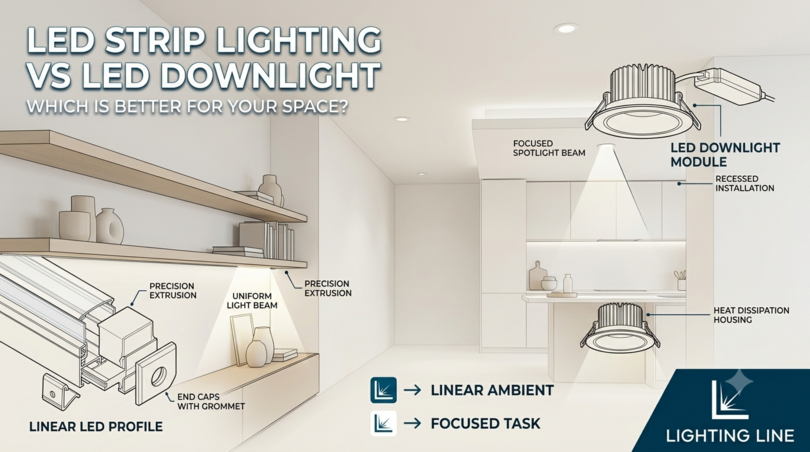
A led downlight is a fixture designed to sit flush with, or project slightly below, a ceiling and direct a defined cone of light straight downward onto the floor or surface beneath it. Unlike a strip, which distributes light along a line, a downlight is a point source, and this single characteristic shapes every design decision that follows: how many fixtures a room needs, how far apart they should be spaced, and how they interact with furniture, worktops and walking paths below. Downlights have been the default choice for general room illumination for decades, and for good reason, because a well-spaced grid of downlights delivers even, predictable, shadow-free light across an entire floor area with minimal visual clutter on the ceiling itself.
Modern led downlight fixtures have moved a long way from the halogen downlights of the 1990s and 2000s. Today’s units run cooler, last far longer, and are available with adjustable beam angles, colour temperature switching, and dimming compatibility as standard rather than as a premium add-on. This evolution has kept the downlight relevant even as linear and strip-based lighting has grown in popularity, because the two formats genuinely complement rather than compete with each other in most well-designed spaces.
Recessed, surface-mounted and adjustable downlights
The word “downlight” actually covers several distinct fixture types, and knowing which one is being discussed matters when comparing costs and installation requirements against led strip lighting. Recessed downlights are installed inside a hole cut into the ceiling so that only the trim and lens are visible from below, giving the cleanest possible ceiling line, this is the most common choice in new-build and renovation projects where there is enough void space above the ceiling to house the fixture body and its heat sink. Surface-mounted downlights sit proud of the ceiling rather than recessed into it, which makes them the practical choice for concrete ceilings, older buildings without a false ceiling void, or any retrofit where cutting into the structure is not possible. Adjustable or gimbal downlights allow the beam to be tilted after installation, typically by 20 to 30 degrees, which is useful for washing light across a vertical surface such as artwork or a feature wall rather than sending it straight down.
LED panel downlights: a distinct category
A related but distinct product is the led panel downlight, a slim, typically square or rectangular fixture that uses edge-lit LED technology behind a flat diffuser to produce a soft, even wash of light across its entire surface rather than a single beam. LED panel downlights are especially common in offices, commercial ceilings with a suspended grid, and kitchens where a broad, glare-free spread of light is preferred over multiple small points. While a panel downlight and a recessed downlight both fall under the wider “downlighting” umbrella, a panel spreads light across a larger visible area of the ceiling, whereas a conventional recessed downlight concentrates it through a much smaller aperture, and this distinction is worth keeping in mind when a specification calls for a panel rather than a standard downlight.
In every one of these formats, the underlying logic is the same: a fixed point in the ceiling produces a cone or wash of light below it. This is precisely the property that led strip lighting does not share, and it is the reason the two products are so often compared rather than simply chosen on price or brand preference alone.
3. LED downlight vs LED strip lighting: the core differences
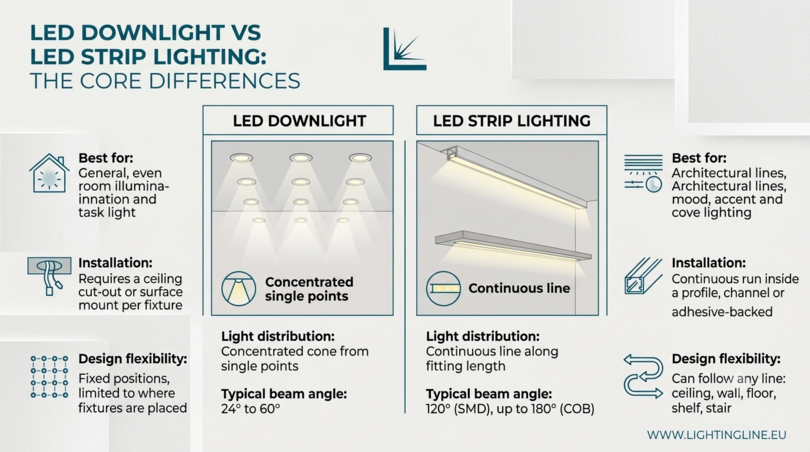
With both technologies defined, the real question this article set out to answer can finally be addressed directly: how does a led downlight actually compare with led strip lighting once the two are placed side by side in the same room, under the same budget, and against the same design brief? The honest answer is that neither product is universally “better”; each one wins decisively on certain criteria and loses just as decisively on others, and the right choice depends entirely on what the space needs to do. The comparison table below sets out the five criteria that matter most in almost every real-world specification decision, and each is then explored in full underneath.
| Criterion | LED downlight | LED strip lighting |
|---|---|---|
| Light distribution | Concentrated cone from a single point | Continuous line along the fitting length |
| Typical beam angle | 24° to 60°, occasionally wider | 120° standard, up to 180° on COB strips |
| Best for | General, even room illumination and task light | Architectural lines, mood, accent and cove lighting |
| Installation | Requires a ceiling cut-out or surface mount per fixture | Continuous run inside a profile, channel or adhesive-backed |
| Design flexibility | Fixed positions, limited to where fixtures are placed | Can follow any line: ceiling, wall, floor, shelf, stair |
| Typical running cost | Low, comparable wattage per lumen to modern strips | Low, and easier to zone and dim in sections |
Light distribution and beam angle
The most fundamental difference between the two products is also the simplest to visualise: a led downlight throws a cone of light downward from a fixed point, typically with a beam angle between 24 and 60 degrees, which is why a room lit only with downlights needs several fixtures spaced evenly across the ceiling to avoid dark patches between pools of light. Led strip lighting, by contrast, produces a continuous line of illumination with a much wider spread, typically around 120 degrees for standard SMD strips and up to a full 180 degrees for COB strips, meaning the light wraps around the fitting rather than projecting a narrow beam. This is precisely why a single length of strip can evenly wash an entire wall or ceiling edge, something that would require a whole row of closely spaced downlights to achieve with a point-source fixture.
The practical consequence is that downlights excel at delivering functional, even light across a horizontal surface such as a floor or worktop, while led strip lighting excels at defining edges, tracing architectural lines and creating a soft, indirect glow that has no single obvious source. Neither beam pattern is objectively superior; they are simply suited to different jobs, which is the recurring theme throughout this entire comparison.
Installation complexity
Installing led downlights is, in most cases, a series of individual, repeated operations: a hole is cut for each fixture, cabling is run to each position, and each downlight is wired into a circuit, typically in parallel. This is a well-understood, standardised process for any qualified electrician, but it does mean that changing the layout later, adding an extra fixture, or moving a downlight a few centimetres to clear a joist, involves cutting new holes and patching old ones.
Led strip lighting installs differently: rather than multiple discrete cut-outs, a single continuous channel, profile or adhesive run is planned along the intended line, and the strip itself is then cut to length at the marked cutting points before being fitted into an aluminium profile or directly onto a clean, dry surface. Because the strip is flexible and supplied on a reel, it is considerably easier to route around corners, into recesses or along non-straight paths than an equivalent number of individually wired point fixtures would be. That said, led strip lighting introduces its own set of installation considerations, chiefly around planning driver placement for the correct voltage, choosing a profile that manages heat properly over long runs, and ensuring any joins or connectors are accessible rather than sealed permanently behind plaster.
Design flexibility and customisation
This is the category where led strip lighting has the clearest structural advantage over any downlight. Because the strip is continuous and cuttable, it can be shaped to fit almost any geometry: a rectangular cove around the perimeter of a ceiling, a diagonal line following a staircase stringer, a full loop around a bathroom mirror, or a hidden channel beneath a floating shelf. A downlight, by definition, can only ever be a series of individual points, no matter how carefully those points are arranged. For architects and interior designers whose brief specifically calls for a distinctive, non-standard visual signature, rather than simply “enough light to see by,” this flexibility is often the deciding factor. It is also worth noting that led strip lighting is available in tunable white, static colour temperature and full RGB or RGB+CCT variants, giving a single product family far more creative range than the fixed colour temperature typical of most downlights.
Energy efficiency and running costs
Both technologies are LED-based, so both benefit from the same fundamental efficiency advantage over older lighting: LEDs convert a far higher proportion of the electricity they consume into visible light rather than wasted heat, which is why the wider LED lighting category has become the default choice across residential and commercial construction. Comparing a downlight directly against a strip on efficiency alone is somewhat misleading, however, because they are rarely used to do exactly the same job. A more useful way to think about running costs is in terms of control: led strip lighting is straightforward to split into independently switched and dimmed zones along its length, and because a single strip circuit can replace what would otherwise be several downlights wired together, it is often easier to fine-tune exactly how much light is used at any given time, which supports genuine energy savings in day-to-day use rather than just on the fixture’s rated wattage.
Upfront cost and total cost of ownership
On a like-for-like basis, a metre of good quality led strip lighting is often more economical to purchase than the equivalent number of downlights needed to achieve comparable coverage over the same length, particularly once the cost of the aluminium profile, driver and installation labour for multiple ceiling cut-outs is factored in for the downlight option. Downlights, however, tend to require less in the way of accessories: a driver, a fixture and a ceiling cut-out is a simpler bill of materials than a strip, profile, diffuser, driver and connectors. The fairest way to compare the two financially is over the full lifetime of the installation rather than the shelf price alone, and that total cost of ownership is explored in more depth later in this guide.
Visual impact and perceived room size
A less technical, but genuinely important, difference between the two products is their effect on how large or tall a room feels to someone standing inside it. A grid of led downlight fixtures reads visually as a series of small, evenly spaced punctuations on the ceiling plane; it is a familiar, neutral treatment that rarely draws attention to the ceiling one way or the other. Led strip lighting run around a ceiling perimeter, by contrast, has a well-documented tendency to make a room feel larger and taller than it actually is, because indirect light bounced off the ceiling and upper walls softens the perceived boundary of the room rather than sharply defining it with shadow, an effect lighting designers frequently rely on in smaller rooms, low-ceiling apartments and windowless interior spaces where a sense of openness is otherwise difficult to achieve. This is one of the clearest, most immediately visible reasons a design brief calling for a distinctive or more spacious-feeling interior so often leans toward strip lighting rather than a conventional downlight grid.
4. The numbers behind the trend: LED lighting market data
None of the design arguments above happen in a vacuum, and it is worth pausing to look at how quickly the wider LED lighting category, including led strip lighting specifically, has grown in recent years, because the scale of that growth explains why architects and homeowners are now treating linear lighting as a standard design tool rather than a niche accessory. Market research firms have tracked consistent, accelerating demand for LED-based lighting across residential, commercial and architectural projects worldwide.
| Metric | Reported figure | Source |
|---|---|---|
| Global LED lighting market value, 2025 | Approximately USD 107 billion | Grand view research |
| Projected global market value by 2033 | Approximately USD 197 billion, at roughly 8% annual growth | Grand view research |
| Indoor LED lighting market, 2025 to 2026 | Growth from roughly USD 44 billion to USD 50 billion | Market study reported via Yahoo Finance |
| Consumers who state a preference for LED lighting | Over 70%, citing longevity and lower environmental impact | Market research future |
| Region with the largest share of the LED lighting market | Asia Pacific, at roughly 40% of global revenue | Grand view research |
Two findings from this research are especially relevant to anyone weighing up a led downlight against led strip lighting. The first is that residential adoption of LED lighting is consistently identified as one of the fastest-growing segments of the wider market, driven by rising awareness of energy savings and the growing popularity of smart, app-controlled lighting systems. The second is a clear architectural trend documented around major industry events such as Light+Building 2026: manufacturers and designers are converging on what the industry now calls “hidden glow architecture,” where the light source itself is designed to disappear into a trimless recessed profile, leaving only a clean line of glow visible. This trend sits squarely in favour of dot-free, continuous led strip lighting rather than point-source fixtures, precisely because a strip is the only format capable of producing that seamless line in the first place.
It is also worth noting the well-established efficiency case for LED technology generally, downlights and strips included. LEDs are widely reported by energy agencies to use dramatically less electricity than the incandescent and halogen lighting they have replaced, while lasting many times longer before needing replacement, and this remains true whether the LEDs in question are arranged as a point-source downlight or as a continuous strip. The choice between the two formats, in other words, is a design and application decision rather than an efficiency one; both are excellent performers on that front compared with legacy lighting technology.
Market analysts also consistently flag smart, connected lighting as one of the fastest-growing sub-segments of the wider category, driven by rising adoption of app-controlled and voice-controlled home systems. This trend has a direct, practical implication for anyone specifying either product today rather than five years ago: both led downlight and led strip lighting ranges now commonly include tunable colour temperature, dimmable and app-controlled variants as a mainstream option rather than an expensive niche add-on, which materially changes the calculation around future-proofing a lighting specification. For architects and developers, this growth also translates into a straightforward commercial argument: projects specified with genuinely well-considered, high-quality lighting, including well-executed led strip lighting detailing, are increasingly recognised by buyers and tenants as a marker of overall build quality, making the lighting specification itself a meaningful contributor to a project’s perceived value rather than a purely functional line item on a budget.
5. Which spaces suit LED downlights vs LED strip lighting?
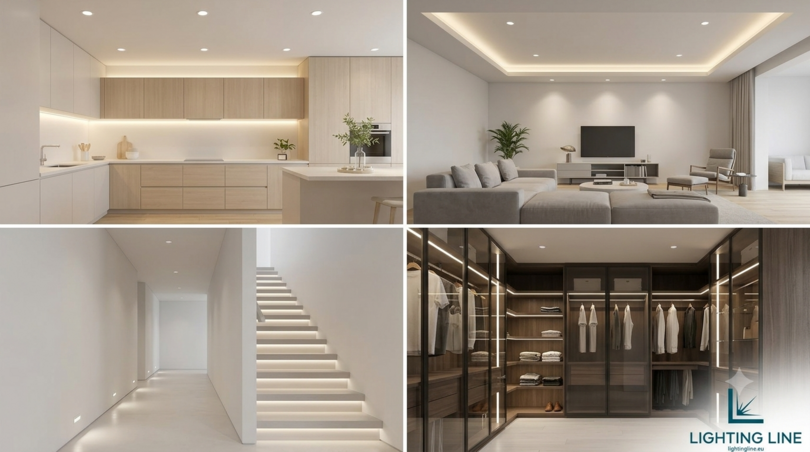
Perhaps the single most useful question to ask before specifying either product is simply: what is this particular space actually for? A home office needs even, glare-free task light, a bathroom needs moisture-safe illumination around a mirror, a staircase needs a safe and legible edge at night. The right answer to “led downlight or led strip lighting” changes from room to room, and in most well-designed homes the final answer is not one or the other but a considered combination of both. The sections below go space by space through the rooms where this decision comes up most often.
Kitchens
Kitchens are arguably the room where the downlight-versus-strip decision matters most, because a kitchen genuinely needs several different kinds of light working together. Overhead led downlights, typically spaced across the ceiling in a grid, provide the general ambient light needed to move safely around the room and see into cupboards. Led strip lighting then takes over for task lighting exactly where it is needed most: mounted under wall cabinets, it throws light directly onto the worktop below without the shadow that an overhead downlight alone would cast across a chopping board as the cook leans over it. A high-CRI strip, ideally CRI Ra>90 or above, is particularly valuable here because it renders the true colour of food accurately, which matters more in a kitchen than almost anywhere else in the home. Many kitchen designers also run a slim led strip lighting channel along the top of wall units or inside a glass-fronted display cabinet, adding a soft secondary glow that complements rather than duplicates the downlights overhead.
Bathrooms
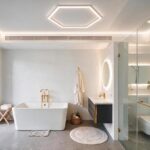
Bathrooms introduce a safety constraint that does not apply in most other rooms: moisture. Any fixture installed in a bathroom’s designated wet zones must carry an appropriate IP rating, and this applies equally to downlights and to strips. Led downlights remain the standard choice for general bathroom ceiling lighting, but led strip lighting has become extremely popular for a specific secondary purpose: framing a mirror or vanity unit with a soft, shadow-free line of light that is genuinely useful for shaving and applying make-up, tasks where a single overhead downlight tends to cast unflattering shadows across the face. For this application, an IP65-rated silicone LED strip, such as those in the Lighting Line strip collection, is the appropriate specification, and a warm-to-neutral colour temperature around 3000K to 4000K tends to feel the most flattering and natural for this kind of close-up task lighting.
Living rooms
Living rooms are where the creative case for led strip lighting is easiest to make, because this is a room built around atmosphere as much as function. A ceiling perimeter cove lit with a continuous run of COB led strip lighting creates a soft, indirect glow that makes the ceiling appear to float, an effect no arrangement of downlights can replicate because downlights are, by their nature, visible fixtures that punctuate the ceiling rather than dissolve into it. That said, downlights still have an important role here for general and task lighting, particularly over reading chairs or a media console, and the most successful living room lighting plans typically layer both: downlights for function, strip lighting for mood, usually on entirely separate dimmable circuits so each can be adjusted independently depending on the time of day or the occasion.
Bedrooms
Bedrooms benefit from the same layered logic as living rooms, but with an even stronger bias toward soft, adjustable light rather than bright, even illumination. Led strip lighting concealed behind a headboard or run along a floating bedside shelf produces a gentle, indirect wash that is comfortable to read or wind down by, without the harsher, more clinical feel of a downlight positioned directly overhead. Tunable white or warm-only strips in the 2200K to 2700K range are particularly well suited to bedrooms, since very warm colour temperatures are associated with relaxation and are less likely to disrupt the body’s natural wind-down process before sleep than cooler, bluer light sources.
Hallways, staircases and floor-level LED strip lighting
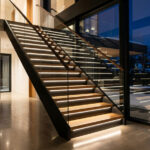
Hallways and staircases are where a specific, growing application of the category comes into its own: floor led strip lighting. Rather than mounting a strip at ceiling height, designers increasingly recess a slim aluminium profile into the skirting board, the underside of a stair tread, or directly into the floor along a walkway, so that the strip provides low-level, glare-free guidance lighting at night without needing to switch on a bright overhead downlight. This approach to floor led strip lighting is especially popular on staircases, where a strip fitted beneath the nosing of each tread clearly defines the edge of every step, meaningfully improving safety for anyone moving through the space after dark, an outcome that a ceiling-mounted downlight several metres above the stairs cannot achieve nearly as effectively. Downlights are still commonly used in hallways for general illumination during the day, but the floor-level strip is what makes the space feel considered and safe after dark.
Offices and commercial interiors
In offices, workshops and other commercial interiors, even and consistent light across the whole working plane usually takes priority over atmosphere, which is why led downlights and led panel downlights remain the dominant choice for general office ceiling lighting, particularly in spaces with a suspended ceiling grid where a panel downlight fits neatly into a standard tile position. Led strip lighting still plays an important supporting role in commercial fit-outs, however, particularly for under-shelf lighting in retail displays, cove lighting in reception areas and hospitality spaces, and accent lighting used to draw attention to a specific product, artwork or architectural feature. Retail and hospitality projects in particular tend to favour high-output COB led strip lighting for its dot-free finish, since a visible line of individual diode points along a shopfront or bar counter can look distinctly less premium than a smooth, continuous glow.
Wardrobes, walk-in closets and display cabinets
Enclosed storage spaces are one of the most practical, everyday applications for led strip lighting, and one that is frequently overlooked when a lighting plan is first drawn up. A led downlight is rarely a realistic option inside a wardrobe or display cabinet simply because there is no ceiling void to recess it into and no natural spacing for multiple fixtures across such a small area. A slim strip of led strip lighting, fitted to the underside of a shelf or along the inside edge of a cabinet frame, solves this neatly, and pairing it with a simple magnetic or PIR motion sensor means the light switches on automatically the moment a door opens, a small but genuinely useful convenience that has made sensor-activated strip lighting one of the most requested additions in modern joinery and wardrobe design. A neutral to warm white in the 3000K to 4000K range, at a modest output, is generally sufficient for this application, since the goal is to see clothing or displayed items clearly rather than to light the room itself.
Outdoor spaces
Outdoors, the choice again comes down to IP rating as much as fixture type. Led downlights rated for external use are common under eaves, soffits and porches, providing general illumination for entrances and patios. Led strip lighting rated IP65 or IP67 is widely used to define the edges of decking, steps, garden paths and water features, again for the same reason it works so well on interior staircases: a continuous line of low-level light is simply better at marking an edge safely than a series of widely spaced point fixtures.
6. Common mistakes when choosing between downlights and LED strip lighting
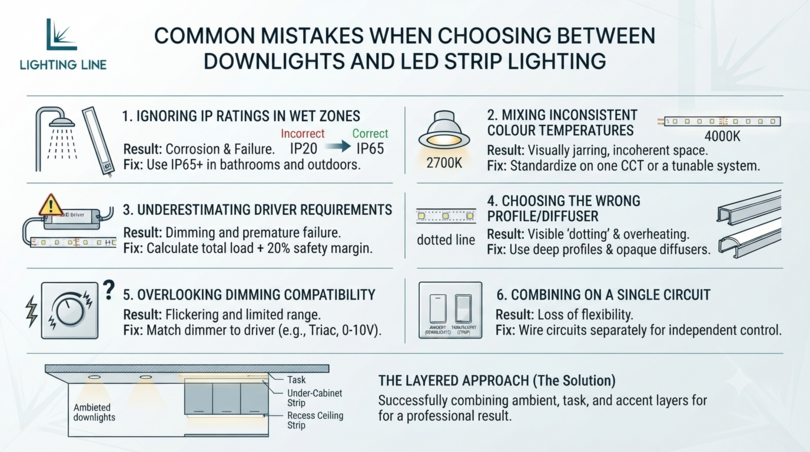
Most disappointing lighting installations are not the result of a badly made product, they are the result of an avoidable specification error made before a single hole was drilled. Whether the final choice is a led downlight, led strip lighting, or a combination of the two, the same handful of mistakes come up again and again in real projects, and each one is entirely preventable once you know to look out for it.
Ignoring IP ratings in wet or damp zones
The single most common and most consequential mistake is installing a standard indoor-rated fixture, whether a downlight or an IP20 strip, in a zone that will be exposed to moisture. Bathrooms are legally divided into zones with different moisture exposure, and the fixtures used near a shower, bath or basin must carry a rating that matches that zone. The same logic applies outdoors: an indoor strip installed along an exterior deck will fail, often within weeks, once condensation or rain reaches the circuit board. The fix is straightforward: always confirm the IP rating required for the specific zone before ordering, and default to at least IP65 for anywhere splashes are possible, choosing directly from a filtered category such as the IP-rated LED strip range at Lighting Line rather than guessing.
Mixing inconsistent colour temperatures in the same room
A remarkably common and entirely avoidable error is combining a led downlight at one colour temperature with led strip lighting at a different one in the same visible space, for example warm white 2700K downlights overhead paired with a cooler 4000K strip under a cabinet. The human eye is extremely sensitive to this kind of inconsistency, and the result is a room that feels subtly “off” even to people who could not explain exactly why. The rule of thumb is simple: pick a single colour temperature, or a tunable CCT system that can be matched across both fixture types, and apply it consistently throughout any space that will be viewed together, reserving colour temperature contrast for situations where a deliberate visual separation between two zones is actually the goal.
Underestimating driver and power supply requirements
Every low-voltage led strip lighting installation needs a driver, or power supply, correctly sized for the total wattage of the strip run, with a reasonable safety margin built in rather than running the driver at its absolute maximum rated load continuously. Undersizing the driver, or running several long strip sections from a single unit that was only ever specified for a shorter run, is one of the most frequent causes of premature strip failure and of visible dimming toward the far end of a long installation. Downlights are somewhat more forgiving here because each fixture typically integrates its own small driver, but a large grid of downlights on a single circuit still needs the same basic sanity check on total load before the system is switched on for the first time.
Choosing the wrong profile or diffuser
An led strip lighting installation is only ever as good as the profile and diffuser it sits inside. A strip mounted without any profile at all is fully exposed, offers no heat management, and will show every individual diode as a distinct point of light. The aluminium profile range at Lighting Line, available in surface, recessed, corner, wall, concrete, suspension, drywall and round formats, exists precisely to solve this problem, both by diffusing the light into a smooth line and by drawing heat away from the LEDs to extend their working life. Choosing a profile that is too shallow for the intended strip, or a diffuser lens that is too clear for a lower-density SMD strip, is a frequent cause of the visible “dotting” effect that makes an otherwise well-specified installation look unfinished.
Overlooking dimming compatibility
Not every driver, dimmer switch and LED product is designed to work together, and mismatched dimming components are a persistent source of flickering, buzzing or a limited dimming range that stops well short of a genuinely low, atmospheric level. This applies equally to led downlight circuits and to led strip lighting runs: before finalising a specification, confirm that the chosen dimmer is explicitly compatible with the driver or built-in LED driver being used, rather than assuming that any dimmer will work with any LED product simply because both are described as “dimmable.”
7. Combining LED downlights and LED strip lighting in the same room
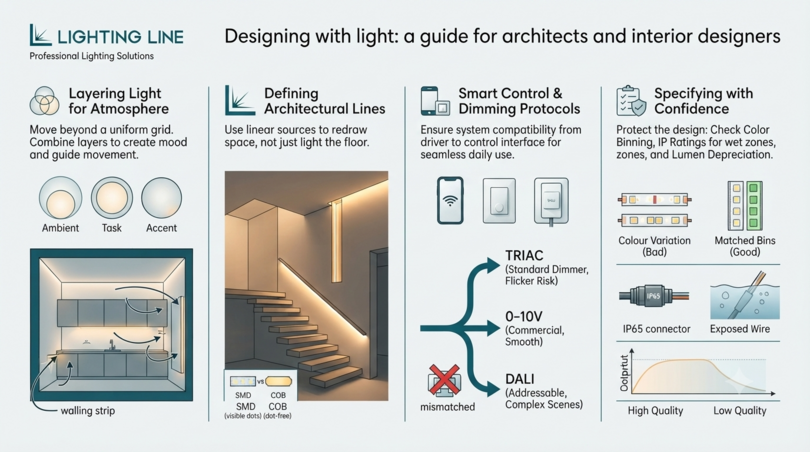
Framing this comparison as a strict either-or choice slightly misrepresents how most successful lighting schemes are actually designed. In practice, the majority of well-lit interiors use led downlight fixtures and led strip lighting together, each handling the part of the job it is naturally best suited to, rather than asking one product to do everything. This layered approach has a name in professional lighting design: it is usually described as combining ambient, task and accent layers, and it is worth understanding briefly even for a residential project of modest scale.
Ambient light is the general, overall illumination that lets a room function safely, and this is almost always provided by downlights, spaced to give even coverage across the floor area. Task light is targeted illumination for a specific activity, such as reading, cooking or applying make-up, and this is frequently, though not exclusively, provided by led strip lighting positioned close to the task itself, under a cabinet, around a mirror, or along a desk. Accent light is used purely for atmosphere and visual interest, drawing the eye toward an architectural feature, a piece of artwork or the edge of a ceiling, and this is where COB led strip lighting in particular tends to outperform any point-source fixture, since its dot-free, wide-angle glow is uniquely good at making a surface appear lit from within rather than lit by something.
The most important practical step in combining the two systems is wiring them onto separate, independently dimmable circuits rather than a single switch. A kitchen with downlights and under-cabinet strip lighting on one shared circuit loses most of its flexibility, because the homeowner cannot brighten the task light for cooking while dimming the ambient light for a relaxed dinner immediately afterward. Keeping the layers separate, even where they share a single wall plate of switches, preserves the full creative and functional range that made specifying both products worthwhile in the first place.
The timing of this decision also matters. In a new-build or full renovation, planning both led downlight positions and led strip lighting channels at first-fix stage, before plasterboard and flooring go in, is dramatically easier and cheaper than retrofitting either into a finished room later, since cabling, profiles and driver locations can all be routed invisibly within the structure itself. In a retrofit or lighter refurbishment where walls and ceilings are staying largely as they are, surface-mounted profiles and plug-in drivers for the strip lighting, combined with any existing downlight positions left largely untouched, is usually the more realistic and cost-effective route, even if it sacrifices a small amount of the completely seamless, trimless finish achievable in new-build work.
8. Designing with light: a guide for architects and interior designers
For architects and interior designers, the choice between a led downlight and led strip lighting is rarely just about lumens and lux levels: it is a tool for shaping how a space is experienced and remembered. A brief that calls for a genuinely distinctive, non-generic result is, almost by definition, a brief that cannot be satisfied by a uniform grid of downlights alone, because that approach is precisely what every developer-standard fit-out already looks like. This section is written specifically for design professionals who need to justify a lighting specification not just on cost or code compliance, but on the atmosphere it creates.
Layering light to build atmosphere
Professional lighting designers rarely think in terms of a single fixture type: they think in terms of layers that work together, and the framework introduced in the previous section, ambient, task and accent light, is the standard vocabulary for this approach. What changes at the architectural level is intent: a residential kitchen uses these layers primarily for function, while a hospitality lobby, a boutique retail space or a signature residential project uses them primarily to construct a mood, a sequence of light and shadow that guides a visitor through the space and communicates the quality of the design before they have consciously registered a single fixture. Led strip lighting is disproportionately useful at this level of design because it is the only format capable of producing a continuous, graduated wash of light rather than a series of discrete points, which is exactly the quality that reads as “considered” rather than “standard” to anyone experiencing the finished space.
A useful discipline for any architect specifying light is to ask, for every layer, whether the fixture itself should be visible or invisible. A pendant light or a decorative downlight trim is often meant to be seen and to contribute its own form to the room. Led strip lighting, on the other hand, is very often most effective when the fixture disappears entirely and only the light itself remains visible, an approach the wider industry has recently taken to calling “hidden glow architecture.” Achieving that disappearing act depends heavily on selecting the correct recessed or trimless profile for the application, which is precisely why Lighting Line’s recessed profile range and drywall profile range are built to sit flush with plasterboard and leave no visible aluminium edge once installed and painted.
Using LED strips to define architectural lines
One of the most reliable techniques available to any architect wanting to create a genuinely unique ambience is to use led strip lighting to draw attention to, or entirely redraw, the architectural lines of a space rather than simply lighting the floor area beneath it. A continuous cove line around a ceiling perimeter can make a standard-height room feel taller by drawing the eye upward and outward. A vertical strip recessed into a corner profile can visually separate two volumes of a large open-plan space without a physical wall. A strip run along the underside of a floating staircase, cantilevered shelf or kitchen island can make a heavy, solid element appear to hover, an effect achievable only with a linear light source and entirely impossible to replicate with point-source downlights.
This is also where the choice between SMD and COB led strip lighting becomes a genuine design decision rather than a technical footnote. Where the strip will be viewed directly, edge-on, as part of a deliberately exposed detail, the dot-free finish of a COB strip is almost always the correct specification, because any visible dotting from a lower-density SMD product will undermine the clean, seamless line the architectural detail is meant to achieve. Where the strip sits behind a deep diffuser or inside furniture where it will never be seen edge-on, a well-specified SMD strip offers excellent value without compromising the finished result. Ultimately, the goal for any architect using led strip lighting to create a distinctive ambience is the same: let the light do the work of defining the space, and let the fixture itself remain invisible.
9. Smart control, dimming protocols and compatibility
Market research consistently points to smart, app-controlled and connected lighting as one of the fastest-growing parts of the wider LED category, and this is just as true for led strip lighting as it is for the led downlight fixtures beside it on a ceiling plan. Choosing the right control protocol is not a cosmetic afterthought: it directly determines whether a system feels seamless in daily use or becomes a persistent source of flicker, buzzing and frustration. This section sets out the main dimming and control standards a designer or homeowner is likely to encounter.
TRIAC dimming, sometimes described as leading-edge or trailing-edge dimming, is the most common method used with standard household dimmer switches originally designed for mains-voltage halogen lighting. It can work well with both led downlight fixtures and mains-compatible led strip lighting drivers, provided the dimmer and the driver are explicitly listed as compatible with each other, since mismatched TRIAC pairings are one of the most frequent causes of visible flicker at low dimming levels.
0-10V dimming is widely used in commercial and larger residential installations because it offers smoother, more reliable control across a wide dimming range and is less prone to the compatibility issues that affect TRIAC systems, though it requires a dedicated low-voltage control cable run alongside the main power cable, which is easier to plan for at first fit than to retrofit later.
DALI (Digital Addressable Lighting Interface) takes this further by allowing every fixture on a circuit, whether a led downlight or a section of led strip lighting, to be individually addressed, grouped and scheduled through a central controller, which is why DALI has become the default standard for larger commercial and hospitality projects where scenes need to be programmed and adjusted long after the initial installation is complete.
Finally, RF remote, Bluetooth and WiFi-based control has become the most accessible option for residential retrofits, allowing colour temperature, brightness and, on RGB and RGB+CCT products, full colour changes to be adjusted from a smartphone app or voice assistant without any additional control wiring at all. This is often the simplest route to smart control for a homeowner adding led strip lighting to an existing room, since the intelligence sits inside the driver or a small in-line receiver rather than requiring new cabling throughout the property.
Whichever protocol is chosen, the golden rule established earlier in this guide bears repeating here: confirm compatibility between the specific dimmer or controller, the driver, and the LED product itself before installation, rather than relying on generic “dimmable” or “smart” labelling to guarantee a smooth result.
Buying without checking colour binning
Even within a single stated colour temperature, such as 3000K, individual production batches of LEDs can vary slightly in their exact tone, a phenomenon the manufacturing industry calls colour binning. Ordering additional led strip lighting to extend an existing installation months or years later, without checking that the new length comes from a comparable bin, can produce a visible, uneven join where the new section meets the old one, even though both are technically labelled with the same Kelvin value. The safest approach for any project likely to be extended later is to order a small amount of spare strip at the time of the original installation, or to note the exact product code so a closely matched batch can be requested later.
Forgetting end caps and IP-rated connectors in wet zones
An IP65 or IP67 led strip lighting product is only as waterproof as its weakest point, and that weak point is very often an unsealed cut end or a standard, non-rated connector used to join two lengths together. Fitting the correct silicone end caps and IP-rated connectors, rather than leaving a cut end exposed or reusing an indoor-rated connector outdoors, is essential to preserving the water resistance the strip was specified for in the first place; skipping this detail is a common reason an otherwise correctly rated installation still fails prematurely in a bathroom or garden.
Ignoring lumen depreciation over time
All LED products, whether a led downlight or a length of led strip lighting, gradually produce slightly less light over many thousands of hours of use, a gradual process known as lumen depreciation. Reputable manufacturers publish an expected lifetime figure based on the point at which output falls to a defined percentage of its original level, and specifying a product with a properly documented lifetime rating, rather than the cheapest available option with no stated figure, is a simple way to ensure a space still looks as intended several years after installation rather than gradually and imperceptibly dimming.
10. Sustainability and energy impact
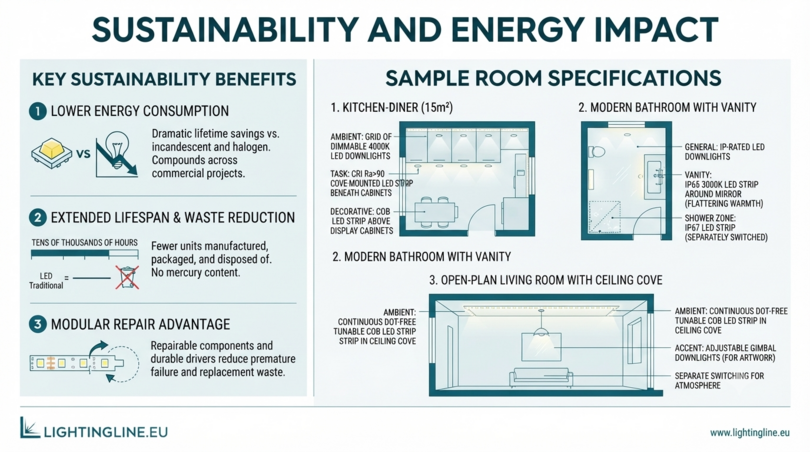
Beyond the immediate running-cost savings already discussed, both led downlight fixtures and led strip lighting contribute to a broader sustainability case that is increasingly important to architects, developers and environmentally conscious homeowners alike. LED technology as a whole is widely recognised by energy authorities for its dramatically lower energy consumption compared with incandescent and halogen lighting, and this efficiency advantage compounds across a building’s entire lifetime, particularly in projects with dozens or hundreds of individual fixtures such as offices, hotels and retail developments.
Longevity is itself a sustainability feature, not just a convenience one. Because both led downlight fixtures and led strip lighting are rated for tens of thousands of hours of operation, far beyond the lifespan of the halogen and fluorescent products they have replaced, fewer units need to be manufactured, packaged, shipped and eventually disposed of over the lifetime of a building. LED products also avoid the mercury content found in fluorescent tubes and compact fluorescent lamps, simplifying end-of-life disposal and reducing the environmental risk associated with breakage during handling or eventual landfill disposal.
For architects working on projects that need to demonstrate a genuine sustainability credential, specifying high-efficiency, high-CRI led strip lighting alongside well-placed led downlight fixtures, rather than defaulting to the cheapest available product regardless of efficiency rating, is a straightforward way to support both the immediate energy performance of a building and its longer-term environmental footprint.
There is also a maintenance-related sustainability benefit worth mentioning here, building on the modular repair advantage described later in this guide: because a length of led strip lighting can often be partially repaired or extended rather than replaced in full, and because a well-chosen driver and profile combination reduces the likelihood of premature failure in the first place, a correctly specified strip installation tends to generate less replacement waste over its working life than a poorly matched, mismatched or undersized system that fails early and needs to be torn out and redone.
11. Sample lighting specifications: three real-world room layouts
Reading about beam angles and IP ratings in the abstract only goes so far, so this section walks through three realistic room specifications, translating everything covered so far into the kind of concrete decisions an architect, installer or confident homeowner would actually make on a real project.
A 15m² kitchen-diner
The ambient layer for this space would typically use four to six led downlight fixtures arranged in a grid across the kitchen area, on a dedicated dimmable circuit, at a neutral 4000K colour temperature to keep food preparation areas looking crisp and true to colour. The task layer would add a run of SMD led strip lighting, CRI Ra>90, fitted inside a recessed profile beneath the wall cabinets and wired to its own dimmer switch, giving direct, shadow-free light across the worktop. A secondary decorative touch would run a slim strip of COB led strip lighting along the top of any glass-fronted display cabinets, on a third, independent circuit, purely for evening ambience once cooking is finished.
A modern bathroom with vanity
General ceiling illumination here would come from two or three led downlight fixtures rated for the relevant bathroom zone. The vanity mirror would be framed with an IP65 led strip lighting run at 3000K, chosen specifically for its flattering warmth during close-up grooming tasks, mounted inside a recessed or surface profile around the mirror’s perimeter rather than left exposed. Where the shower or bath sits in a zone requiring a higher rating, an IP67 product would be specified for any strip in that immediate area, with the mirror strip and general downlights kept on separate switches so the vanity light can be used independently, for example during an early morning routine when the main ceiling lights are unnecessary.
An open-plan living room with a ceiling cove
This layout leans more heavily on led strip lighting for atmosphere. A continuous run of dot-free COB led strip lighting, tunable between warm and neutral white, would sit inside a recessed cove profile around the full perimeter of the ceiling, creating the soft, floating effect described earlier in this guide. A small number of led downlight fixtures, or an adjustable gimbal downlight aimed at a specific piece of artwork, would supplement this with functional task and accent light exactly where it is needed, for example over a reading chair or console table, again wired independently so the cove lighting alone can be used on its own for evening relaxation without switching on brighter general lighting.
12. Technical deep dive: voltage, consistency and measuring your run
The sections above cover what any buyer needs to know to make a confident decision between a led downlight and led strip lighting. For architects, installers and particularly hands-on homeowners who want to go one level deeper, this section addresses three technical questions that come up repeatedly once a project moves from concept to actual order: which voltage to choose for a long run, how to keep colour consistent across an installation, and how to measure a space correctly before placing an order.
Choosing between 12V and 24V for long runs
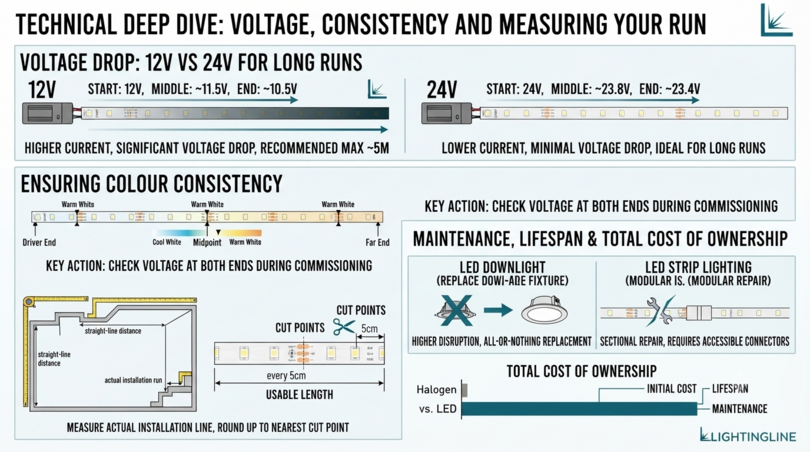
Both 12V and 24V are common low-voltage standards for led strip lighting, and the choice between them matters most as the length of a single continuous run increases. Every strip experiences a small amount of voltage drop along its length, meaning the end of the run furthest from the driver receives slightly less voltage, and therefore produces slightly less light, than the end closest to it. Because 24V systems carry the same power at half the current of an equivalent 12V system, they experience proportionally less voltage drop over distance, which is why 24V led strip lighting is generally the preferred specification for continuous runs beyond around five metres, while 12V remains a perfectly capable choice for shorter sections such as under a single kitchen cabinet or around a small mirror. For very long architectural runs, feeding the strip from both ends, or from multiple points along its length, is a further technique used to keep brightness and colour consistent from one end to the other.
Colour consistency across an installation
Beyond the binning issue discussed earlier, colour consistency across a large installation also depends on keeping voltage stable along the run, since a strip running at a lower voltage than intended, whether from an undersized driver or excessive cable run length, can shift subtly warmer or dimmer than the same product operating at its rated voltage. For any project where led strip lighting will be viewed as one continuous, uninterrupted line, such as a full-perimeter ceiling cove, it is worth confirming with the installer that voltage has been checked at both ends of the run during commissioning, not just at the point where the driver connects.
How to measure and order the right length
Ordering the correct length of led strip lighting starts with measuring the actual installation line, not the straight-line distance across a room, since a run that follows a perimeter, turns a corner, or steps up and down a staircase will always be longer than it first appears on a floor plan. It is equally important to check the strip’s cut points, since led strip lighting can only be trimmed at specific marked intervals, typically every one to five centimetres depending on the product, so the final usable length may need to be rounded up slightly to the nearest valid cut point rather than an exact arbitrary measurement. Ordering a small amount of additional length beyond the minimum required, particularly for a project that may later be extended, is a low-cost way to avoid a mismatched colour bin further down the line, as discussed above.
13. Maintenance, lifespan and total cost of ownership
Purchase price is only the first number in the real cost of any lighting system, and comparing a led downlight against led strip lighting purely on shelf price, without accounting for lifespan, maintenance and replacement cost, gives an incomplete and often misleading picture. Both product categories share the general LED advantage of a long working life measured in tens of thousands of hours rather than the roughly one to two thousand hours typical of an older halogen downlight, but the practicalities of maintaining each one differ in ways worth understanding before a final specification is agreed.
Led downlights are typically replaced as a complete unit when they eventually reach end of life, since the LED module, driver and housing are usually integrated into a single fixture. This makes maintenance conceptually simple: identify the failed fixture, replace it, and the job is done, though it does mean the entire unit is discarded even if only the driver, rather than the LEDs themselves, has failed. Led strip lighting maintenance works differently: because a strip is supplied as a continuous run, a fault at one point does not necessarily mean the whole length needs replacing, and a well-designed installation with accessible connectors allows a damaged section to be cut out and a new length spliced in without disturbing the rest of the run. This modularity is a genuine practical advantage of strip systems in commercial and architectural projects where minimising disruption during maintenance matters.
Where led strip lighting does require more careful long-term planning is around driver replacement and colour consistency. Because a single driver can power a long run, a driver failure affects the entire section it serves rather than a single point, which is why oversizing the driver slightly and using multiple smaller drivers across a very long installation, rather than one large unit, is generally the more resilient approach for anything beyond a short domestic run. It is also worth noting that, over very long timeframes, minor colour shift can occur in any LED product as phosphors age, and sourcing any future replacement or extension from the same product line and batch, where possible, helps keep a consistent appearance across an installation that may be expanded years after the original work.
When all of these factors are weighed together, the fairest conclusion is that both led downlight and led strip lighting products, when specified correctly for their environment and paired with an appropriately rated driver, offer a genuinely low total cost of ownership compared with older lighting technologies, and the small additional planning required for strip systems is a reasonable trade-off for the design flexibility and modular maintenance benefits they offer in return.
14. A practical buying checklist
After working through beam angles, IP ratings, colour temperature and installation logistics, it helps to condense everything above into a short, practical checklist that can be run through room by room before placing an order. Use the questions below to decide, with confidence, whether a given space calls for a led downlight, led strip lighting, or both working together.
Before you specify, confirm the following:
1. What is this light actually for? Decide whether the space needs general ambient coverage, focused task light, pure accent and mood lighting, or a combination of all three, and assign each need to the fixture type best suited to it rather than defaulting to whichever product was used last time.
2. What IP rating does the zone require? Check whether the installation location is dry, occasionally damp, or fully wet or exposed to weather, and select at minimum an IP65 product for anywhere splashes are possible, moving up to IP67 for submersible or fully exterior applications, always confirming against the specific bathroom zone or outdoor exposure involved.
3. Does the colour temperature match the rest of the room? Confirm that any new led strip lighting matches the colour temperature of existing or planned downlights in the same visible space, or specify a tunable CCT system across both if a variable mood is genuinely required.
4. Is the driver correctly sized? Calculate the total wattage of the intended strip run, or the combined load of a downlight circuit, and choose a driver rated with a sensible safety margin above that figure rather than at its absolute maximum.
5. Does the strip need a profile, and which one? Decide whether the installation calls for a surface, recessed, corner, wall, concrete, suspension, drywall or round profile, and browse the full aluminium profile range to match the physical constraints of the ceiling, wall or joinery involved.
6. SMD or COB? If the strip will be viewed directly or through a light diffuser, favour a dot-free COB strip while if it sits behind furniture or a deep diffuser, a well-specified SMD strip will usually offer better value for the same result.
7. Is dimming genuinely compatible, not just theoretically possible? Confirm the specific dimmer, driver and LED product are certified to work together before installation, rather than assuming compatibility from generic “dimmable” labelling alone.
8. Have you planned for future maintenance? Choose accessible connectors and profile joints wherever possible, and keep a note of the exact product code ordered so that any future extension or repair can be colour-matched precisely, an approach made straightforward by browsing the complete LED strip lighting range at Lighting Line directly by specification.
15. Regulatory, safety and certification considerations
Every point made so far in this guide assumes the underlying installation is safe and compliant, and it is worth stating that assumption explicitly rather than leaving it implied, because both led downlight fixtures and led strip lighting are, ultimately, electrical products connected to a building’s mains supply. Understanding the basic regulatory framework around each is not optional detail for architects, contractors or serious homeowners but it is the foundation everything else in this guide is built on.
In most European markets, mains-voltage electrical work, including the final connection of any downlight circuit or LED strip driver to the household supply, should be carried out or signed off by a suitably qualified electrician, and any fixture used in a bathroom must meet both the correct IP rating for its zone and any applicable local wiring regulations for that room. This is particularly relevant to led strip lighting projects that are otherwise straightforward for a confident DIY installer to plan and fit, since the low-voltage strip and profile work can often be handled without professional help, while the final connection to a driver wired into the mains supply typically should not.
CE marking, and the equivalent conformity marks used in other regions, indicate that a product has been assessed against the relevant electrical safety and electromagnetic compatibility standards for the market it is sold into. When comparing led downlight and led strip lighting products from different suppliers, checking for this marking, alongside a clearly stated IP rating and a documented lumen output and lifetime figure, is a straightforward way to filter out lower-quality products before they ever reach an installation. Reputable European manufacturers and distributors, including the products catalogued directly on Lighting Line’s LED strip lighting pages, present this specification data upfront rather than requiring a buyer to request it separately, which is itself a useful signal of a supplier worth working with for a professional project.
Finally, fire safety and building regulations in some jurisdictions place specific requirements on recessed downlights that penetrate a fire-rated ceiling, typically requiring a fire-rated hood or cap around the fixture to maintain the ceiling’s fire resistance rating. This consideration applies specifically to led downlight installations rather than to surface-run led strip lighting, since a strip fitted inside a surface-mounted or recessed channel does not usually penetrate a fire-rated structure in the same way a recessed downlight cut-out does, though any project involving a fire-rated ceiling should always be checked against current local regulations before work begins.
16. Why specify lighting line LED strip lighting
Everything covered so far in this guide applies to the category as a whole, regardless of brand, but it is worth being direct about why Lighting Line’s own range is built specifically to make the decisions described above easier rather than harder. The full LED strip lighting catalogue is organised around exactly the specifications that matter most in a real project: water protection, voltage, power consumption per metre, LEDs per metre, LED model, light colour, strip width, cut point, length and colour rendering, all filterable directly on the category page rather than buried inside individual product descriptions.
The range is split cleanly into two families that mirror the SMD and COB distinction explained earlier in this guide. The SMD collection offers a wide spread of LED densities and power outputs for cost-effective, high-performance strip lighting behind a diffuser or inside furniture, while the COB collection is built for architectural applications where a completely dot-free, wide-angle line of light is the entire point of the specification. Within both families, options span IP20, IP65 and IP67 water protection, 5V, 12V, 24V, 48V and 230V systems, colour temperatures from a very warm 2200K through to a crisp 6500K, plus RGB, CCT and RGB+CCT tunable variants, and colour rendering options up to CRI Ra>93 for projects where true colour accuracy is non-negotiable.
Lighting Line’s product design draws on Italian design heritage, reflected in the aesthetic and technical detailing of the aluminium profile ranges that accompany the LED strips themselves, giving architects and installers a genuinely coordinated system rather than a strip sourced from one supplier and a profile from another that was never designed to match it. For any reader who has followed this guide through the technical specifications, the room-by-room recommendations and the common mistakes to avoid, the most direct next step is simply to browse the full LED strip lighting range and filter by the exact IP rating, voltage and colour temperature identified as the right fit for the project at hand.
This structure serves three overlapping audiences equally well. Architects and interior designers can filter directly by CRI, colour temperature and LED density to specify exactly the visual result a project brief calls for, without wading through irrelevant listings. Electrical contractors and installers benefit from the same filtering applied to voltage, power consumption per metre and cut point, making it straightforward to confirm compatibility with a driver already chosen for a job before ordering. Retailers and trade buyers sourcing led strip lighting at volume can filter by length and packaging format to plan stock accurately across the SMD and COB ranges. Whichever category a reader falls into, the underlying goal of this guide has been the same throughout: to make the decision between a led downlight and led strip lighting a considered, informed one, rather than a guess made under time pressure at the last stage of a project.
17. Essential accessories: end caps, connectors and mounting brackets
No led strip lighting installation is genuinely complete with the strip alone, and the small accessories that finish an installation are just as important to the final result as the strip itself, even though they rarely get the same attention during planning. End caps seal the cut end of a strip, both for a tidy visual finish and, critically, to preserve the IP rating of a silicone-coated product in any wet or damp location: Lighting Line’s end cap range is available in surface, recessed, corner, wall, suspension, drywall, round and tiling formats to match every profile in the wider catalogue.
Connectors allow two lengths of strip to be joined, or a strip to be connected to its power supply, without soldering, which is particularly useful when a run needs to turn a corner or when a section may need to be removed for future maintenance. The dedicated PCB LED strip connector range is designed to match the exact width and pitch of Lighting Line’s own strips, avoiding the loose, unreliable connections that can result from mixing connectors and strips from different manufacturers.
Finally, mounting brackets secure the aluminium profile itself to a ceiling, wall or piece of furniture, and the correct bracket depends on the profile format chosen, whether surface, recessed, corner, wall, concrete, suspension, drywall or baseboard. Browsing the mounting bracket range alongside the profile selection at the planning stage, rather than as an afterthought once the strip has already arrived, avoids a last-minute delay waiting for the correct fixing hardware.
Treating these three accessory categories as part of the core specification, rather than as generic hardware to be sourced from whatever is locally available, is one of the simplest ways to protect the investment made in the led strip lighting itself. A premium strip fitted with an incompatible connector, an unsealed end cap in a wet zone, or a bracket that cannot properly support the weight of a deep profile will underperform regardless of how good the strip’s own specification sheet looks on paper, which is precisely why Lighting Line designs its end caps, connectors and brackets to match its own profile and strip dimensions directly rather than relying on generic third-party hardware.
18. LED strip lighting vs rope light vs neon flex: avoiding confusion
One further point of confusion worth clearing up before concluding this guide is the difference between led strip lighting and two visually similar but technically distinct products: rope light and neon flex. Rope light traditionally refers to a round, tube-shaped string of small incandescent or, more recently, LED bulbs encased in a flexible PVC sleeve, most commonly seen in festive and outdoor decorative applications rather than architectural interiors; it is generally lower in output and less precise in colour temperature control than a purpose-built strip. Neon flex is a more modern development, using a continuous run of LEDs inside an extruded, translucent silicone tube shaped to mimic the soft, continuous glow of traditional glass neon signage, and it has become popular for signage, logos and decorative lettering rather than general architectural illumination.
Led strip lighting, as defined throughout this guide, sits apart from both of these products: it is a flat, adhesive-backed, cuttable circuit board designed specifically to be installed inside an aluminium profile for architectural and functional lighting, offering far greater control over colour temperature, CRI, IP rating and dimming than rope light, and a broader range of practical mounting and diffusion options than neon flex. Readers who came across the terms “rope light” or “neon flex” while researching this category, expecting them to be simple synonyms for strip lighting, should treat them as related but functionally distinct products rather than interchangeable terms.
19. A short case study: downlight-only vs layered lighting
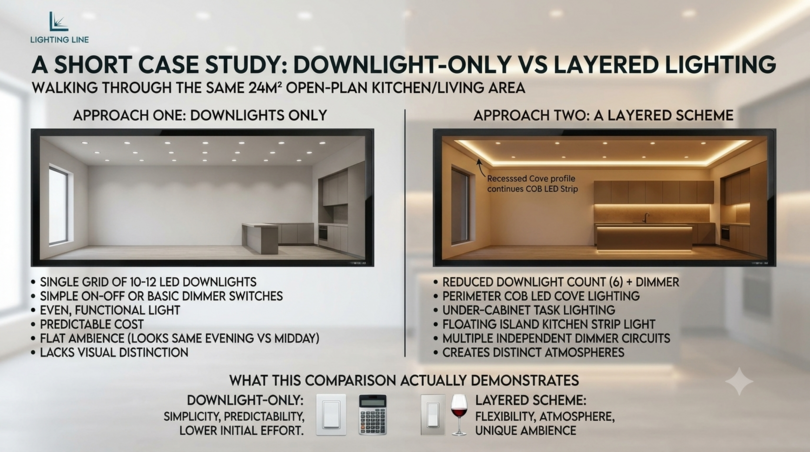
Abstract comparisons are useful, but nothing makes the practical difference between these two approaches clearer than walking through the same room twice, once lit the conventional way and once lit using the layered approach recommended throughout this guide. Consider a fairly typical 24 square metre open-plan kitchen and living area, the kind found in countless apartments and new-build homes across Europe.
Approach one: downlights only
The conventional, and still very common, approach is to specify a single grid of led downlights across the entire ceiling, perhaps ten to twelve fixtures spaced evenly, all wired to one or two simple on-off or basic dimmer switches. This delivers exactly what it promises: even, adequate, functional light across the whole floor area, at a predictable and easily quoted cost, installed quickly by an electrician who cuts each hole, runs the cable and fits each fixture in a single, repeatable operation. The room is bright enough to cook, clean and socialise in, and for many households this is entirely sufficient. What this approach does not deliver is any sense of atmosphere or visual distinction: switch the lights on in the evening and the room looks, functionally, identical to how it looked at midday, simply darker outside the windows. There is no ability to create a softer mood for a dinner party without either turning the whole room down to a dim, slightly flat compromise or leaving it uncomfortably bright.
Approach two: a layered scheme
The alternative approach, and the one favoured throughout this guide, reduces the downlight count to perhaps six or seven fixtures on their own dimmer, covering only the general ambient need, and redirects the saved budget into three additional elements: a continuous run of COB led strip lighting inside a recessed cove profile around the living area ceiling perimeter, a length of led strip lighting beneath the kitchen wall cabinets for task light, and a slim strip along the underside of a floating kitchen island, each on its own independent dimmer switch. The upfront specification is marginally more complex, involving a driver for each strip circuit and a profile choice for each application, but the finished result is a room capable of at least four distinct, genuinely different atmospheres from the same fixed installation: full brightness for cleaning and general activity, task-focused light for cooking with the cove dimmed low, a soft, cove-only evening setting for relaxing, and a dramatic, island-strip-only mood for entertaining once the sun goes down.
What this comparison actually demonstrates
Neither approach is wrong, and the downlight-only scheme remains a perfectly reasonable choice for a budget-conscious project or a space where atmosphere is simply not a priority for the people living in it. What the comparison demonstrates is the genuine trade-off this entire guide has been describing in the abstract: a downlight-only scheme optimises for simplicity, predictability and lower initial planning effort, while a layered scheme built around led strip lighting optimises for flexibility, atmosphere and the kind of distinctive result that a design-conscious client, or an architect working to a brief that explicitly calls for unique ambience, is very unlikely to get from downlights alone. The additional planning and slightly higher accessory cost of the layered approach is, in most real projects, a modest price for a dramatically wider range of usable atmospheres from the same physical room.
20. Frequently asked questions
The questions below collect the queries that come up most often once a reader has decided to move forward with either a led downlight, led strip lighting, or a combination of both. Each answer is intentionally direct, expanding on points already covered in more depth earlier in this guide.
What is the main difference between a LED downlight and LED strip lighting?A LED downlight is a point-source fixture that projects a defined cone of light downward from a single position, typically recessed into or mounted on a ceiling. LED strip lighting is a continuous, flexible run of LEDs that produces a line of light rather than a single point, allowing it to follow edges, coves, shelves and other architectural lines that a downlight cannot reach in the same way. |
Can LED strip lighting fully replace downlights in a kitchen?It can, but it rarely delivers the best result on its own. Most well-designed kitchens use downlights for general ambient light across the whole floor area and LED strip lighting for targeted task light under wall cabinets, with each layer wired independently so both can be adjusted separately depending on the activity. |
Is LED strip lighting bright enough to light a living room on its own?A high-output strip can provide meaningful ambient light, particularly when run around a ceiling cove, but most living rooms still benefit from a small number of downlights for functional tasks such as reading. LED strip lighting is generally strongest as the mood and accent layer rather than the sole source of general illumination. |
What IP rating do I need for LED strip lighting in a bathroom?At minimum, choose an IP65 silicone-coated strip for any area exposed to splashes, and IP67 for zones directly exposed to water such as inside a shower enclosure. The exact requirement depends on the specific bathroom zone the strip will occupy, so always check local zone regulations before ordering. |
How long does LED strip lighting typically last compared with a LED downlight?Both product categories are generally rated for tens of thousands of hours of operation when specified and installed correctly, far exceeding the lifespan of halogen or fluorescent alternatives. Actual lifespan for either product depends heavily on driver sizing, ambient heat management and the quality of the profile or housing used. |
Can LED downlights and LED strip lighting be combined in the same room?Yes, and in most professionally designed spaces this is exactly what happens. Downlights typically handle ambient and task light, while LED strip lighting handles accent and mood lighting along architectural lines, with each layer kept on a separate switch or dimmer for full flexibility. |
Should I choose 12V or 24V LED strip lighting?24V is generally preferable for continuous runs longer than around five metres because it suffers less voltage drop over distance, keeping brightness and colour more consistent from one end of the run to the other. 12V remains a practical choice for shorter sections such as under a single cabinet. |
What is the difference between SMD and COB LED strip lighting?SMD strips use individually visible diode packages spaced along the board, while COB strips use a continuous phosphor layer over closely packed chips to produce a dot-free line of light with a wider beam angle. COB is generally preferred where the strip will be viewed directly or lightly diffused. |
Do I need an aluminium profile for LED strip lighting?In almost all cases, yes. A profile diffuses the light into a smooth, even line, manages heat to extend the strip’s working life, and gives the finished installation a professional appearance rather than an exposed circuit board with visible individual diodes. |
Is LED strip lighting more energy-efficient than LED downlights?Both are LED-based and share the same fundamental efficiency advantage over legacy lighting technology. The more meaningful difference is in control: LED strip lighting is generally easier to zone and dim precisely, which supports genuine energy savings through more considered day-to-day use. |
What colour temperature should I choose for LED strip lighting?Warm white in the 2200K to 3000K range suits relaxed, residential spaces such as bedrooms and living rooms, neutral white around 4000K suits kitchens and task-focused areas, and cooler white from 5000K upward suits commercial or highly functional environments. Match the colour temperature to any downlights in the same visible space. |
What is a LED panel downlight and how does it differ from a recessed downlight?A LED panel downlight is a slim, edge-lit fixture that spreads light evenly across its entire flat surface, commonly used in offices and suspended ceiling grids. A standard recessed downlight concentrates light through a much smaller aperture, producing a more defined cone rather than a broad, even wash. |
Can architects use LED strip lighting to create a unique architectural feature?Yes, this is one of the primary reasons architects specify strip lighting over downlights for signature projects. A continuous line of light can trace a ceiling perimeter, define a floating shelf or staircase, or separate two zones of an open-plan space, effects that a series of individual point fixtures cannot achieve in the same way. |
What is floor LED strip lighting used for?Floor LED strip lighting is typically recessed into a skirting board, stair tread or floor-level channel to provide low-level, glare-free guidance lighting at night, commonly used on staircases and hallways to clearly define edges and improve safety without switching on brighter overhead lighting. |
How do I stop LED strip lighting from looking dotty?Choose a higher LED density strip or a COB product for a dot-free finish, and always install the strip inside a properly specified aluminium profile with an appropriate diffuser lens, since the profile and diffuser combination is usually what determines whether individual diode points remain visible. |
What CRI rating should I look for in LED strip lighting?For kitchens, retail displays and any space where colour accuracy matters, look for a CRI of Ra>90 or higher. For purely decorative or accent applications where absolute colour fidelity is less important, Ra>80 is generally acceptable. |
Can LED strip lighting be dimmed, and does it need a special dimmer?Most LED strip lighting can be dimmed, but the dimmer, driver and strip must be explicitly confirmed as compatible with each other. Mismatched components are the most common cause of flickering, buzzing or a limited dimming range that does not reach a genuinely low level. |
What is the difference between LED strip lighting and neon flex?LED strip lighting is a flat, cuttable circuit board designed to sit inside an aluminium profile for architectural and functional lighting. Neon flex is a rounded, silicone-encased product designed to mimic the look of traditional glass neon, and is typically used for signage and decorative lettering rather than general illumination. |
How do I calculate how many downlights I need for a room?A common starting point is to divide the fixture’s beam spread at the intended mounting height so that adjacent pools of light overlap slightly rather than leaving dark gaps between fixtures, then adjust the total count based on the room’s overall size and the amount of ambient light required for its function. |
Is LED strip lighting difficult to install myself?A short, low-voltage run with a plug-in driver is a realistic DIY project for a confident homeowner. Longer runs, integration with mains wiring, dimmer compatibility, and any installation in a bathroom or outdoor wet zone are best handled by a qualified electrician to ensure both safety and a correctly rated result. |
Are “lighting strip LED” and “LED strip lighting” the same product?Yes. Searches and product listings use several different word orders, including lighting strip LED, LED lighting strip and strip lighting LED, but all of these describe the same flexible, cuttable, low-voltage LED tape covered throughout this guide. The wording varies by region and by supplier, not by the underlying product. |
How deep does an aluminium profile need to be for LED strip lighting?It depends on the strip’s power output and the diffuser style chosen, but as a general rule a deeper profile dissipates heat more effectively and allows a softer, more evenly diffused line of light, while a shallow, trimless profile prioritises a minimal visual footprint over maximum heat dissipation. Always check the profile depth against the specific strip’s rated power consumption per metre before ordering. |
22. Led strip lighting: the single most effective tool
The question this guide set out to answer, whether a led downlight or led strip lighting is the better choice, ultimately resists a single universal answer, and by this point that should feel like a reasonable conclusion rather than an unsatisfying one. A downlight remains the most reliable way to deliver even, functional, general illumination across a floor area, and nothing about the rise of linear lighting changes that basic fact. Led strip lighting, on the other hand, has earned its growing popularity precisely because it can do something no arrangement of point-source fixtures ever could: trace a line, define an edge, and make a light source disappear entirely so that only its glow remains, an effect increasingly described across the industry as architectural “hidden glow” design.
For most rooms, the strongest result comes from treating this not as a competition between two products but as a partnership between them, layering ambient downlighting with task and accent strip lighting, each on its own independently controllable circuit, so the space can shift from bright and functional to soft and atmospheric depending on the time of day and the occasion. For architects and interior designers specifically tasked with creating a genuinely distinctive environment, led strip lighting is very often the single most effective tool available for turning a standard floor plan into a space with real visual signature, provided it is specified correctly: the right SMD or COB technology, the right IP rating for the environment, a properly matched aluminium profile, and a driver and dimming system confirmed to work together from the outset.
The most reliable next step, whichever direction a specific project takes, is to work from real product data rather than guesswork. The complete LED strip lighting collection at Lighting Line can be filtered directly by IP rating, voltage, power consumption, LED density, colour temperature, strip width, cut point, length and colour rendering, making it straightforward to move from the recommendations in this guide to an exact product specification for kitchens, bathrooms, living spaces, staircases and every other application covered above.
For architects and designers in particular, the underlying message of this entire guide can be reduced to a single working principle: use a led downlight when a space needs even, dependable, general illumination, and reach for led strip lighting the moment the brief calls for something a client will actually remember, a line of light that defines an edge, dissolves a ceiling boundary, or makes a heavy architectural element appear to float. Very few single decisions in an interior fit-out carry as much influence over the finished atmosphere of a space for as modest a cost, which is exactly why this comparison deserved the depth given to it throughout this guide rather than a quick, one-line answer.
This article was developed with the support of artificial intelligence and subsequently reviewed, corrected, and validated by the LightingLine.eu technical team, which guarantees its reliability and compliance with official sources.