Choosing the right LED strip is no longer a matter of picking “the brightest one on the shelf”. Today’s professional and residential lighting projects demand a precise balance between luminous efficacy, colour rendering, IP protection, LED chip technology and long-term reliability. In this guide we take ten real, currently available LED strips from the Lighting Line catalogue and break down, model by model, exactly what they do best, where they should be installed, and why a designer, electrician or homeowner would choose one over another.
Whether you are lighting a kitchen island, a hotel corridor, an outdoor pergola or a retail display, the difference between an average strip and a high performance LED strip is measured in lumens per watt, in CRI accuracy, in flicker behaviour and in how many years the product keeps its promised output. We go through all of it, with technical tables, market data and a full buying guide, so that by the end of this article you will know exactly which of these ten strips is right for your next project.
We selected the ten models that best represent the range of use cases a buyer is likely to face: decorative, architectural, outdoor, hospitality, retail and continuous-run industrial installations.
In this article…
The high-performance LED strip market: data and trends
The LED strip category is one of the fastest-growing segments of the professional and consumer lighting industry, driven by the transition from traditional linear fluorescent and halogen systems to flexible, low-profile LED solutions.
This shift in buyer behaviour has pushed manufacturers to compete less on price per metre and more on measurable performance data: luminous efficacy expressed in lm/W, colour rendering index (CRI), LM-80 lumen maintenance certification, IP protection class and energy label. A strip that simply “lights up” is no longer enough for architects, lighting designers or even demanding homeowners who compare products the way they would compare a refrigerator’s energy class.
| Keyword / Category | Search Intent | Relative Demand | Opportunity Level |
|---|---|---|---|
| LED strip lights (general) | Informational | Very high | High |
| RGB / colour changing LED strips | Transactional | High | Very high |
| Waterproof / outdoor LED strips | Transactional | Medium-high | High |
| Dimmable LED strips | Transactional | Medium | High |
| COB LED strips | Informational | Medium | High |
| Kitchen LED strip lighting | Transactional | Medium | Very high |
| 24V LED strips | Informational | Medium | High |
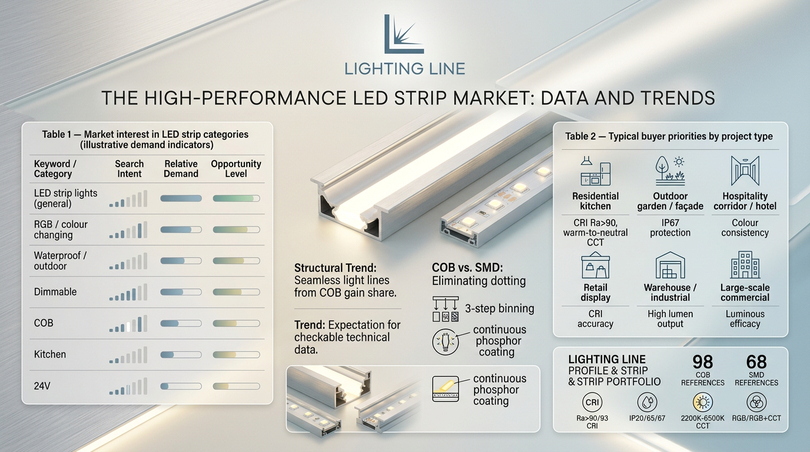
Two structural trends stand out in 2026. First, COB (Chip-on-Board) LED strips are steadily gaining market share against traditional SMD strips because they eliminate the visible “dotting” effect and deliver a smoother, more homogeneous light line: a feature increasingly requested in architectural and hospitality projects where the light source itself must disappear into a channel or coving. Second, buyers are paying much closer attention to colour consistency and CRI, because poorly binned LEDs across a long continuous run can create visible colour shifts that are unacceptable in retail, museum or high-end residential lighting.
A third, quieter trend running alongside these two is the growing expectation that a lighting product should ship with genuine, checkable technical documentation rather than marketing adjectives. Ten years ago, a specification sheet listing little more than “warm white, 5 metres, 12V” was the norm. Today, the specification tables used throughout this article (LED density, exact wattage per metre, documented CRI, IP class, cutting interval and EU energy class) represent the baseline level of detail that a professional buyer now expects before committing to an order, and increasingly the level of detail residential buyers expect too, as awareness of how much these figures affect real-world performance has spread well beyond the professional specifier community.
Lighting Line has built its LED strip catalogue directly around these two trends, offering 68 SMD references and 98 COB references, spanning IP20, IP65 and IP67 protection, 12V, 24V and 48V systems, CRI Ra>80, Ra>90 and Ra>93, and colour temperatures from 2200K to 6500K plus RGB, RGB+CCT and tunable CCT options. The ten strips reviewed below were chosen specifically because they cover this entire spectrum of technical needs.
It is also worth understanding why buyers increasingly search by technical attribute rather than by generic product name. A decade ago, “LED strip lights” was a single, largely undifferentiated category. Today, search behaviour shows buyers actively filtering by voltage (“12v led strips”), by protection class (“waterproof led strip lighting”), by control type (“dimmable led strips”, “smart led strips”) and by application (“led strip lighting kitchen”, “led strips for bathroom”). This is a direct consequence of the category maturing: as more homeowners and professionals have lived with a first-generation, low-CRI, IP20 strip that yellowed, flickered or failed within a couple of years, the entire market has become more literate about specification. That literacy is precisely what this article is designed to serve — not a generic “top 10” list, but a specification-first breakdown that lets a genuinely informed buyer match the right product to the right brief on the first attempt.
Colour consistency across a single project is another area where the market has raised its expectations substantially. Binning (the process by which manufacturers sort LED chips into narrow colour-temperature and brightness tolerance bands before mounting them onto a strip) used to be treated as a back-of-house manufacturing detail. It is now a genuine purchase criterion, because a strip that mixes chips from different bins will show visible warm and cool patches along its length once installed, an effect that is unacceptable in retail shelf lighting, hospitality corridors and any space with mirrors or reflective surfaces that make inconsistency obvious. All the SMD strips reviewed in this article use documented 3-step binning, and all the COB strips use continuous phosphor coating precisely to minimise this risk.
| Project type | Primary specification priority | Secondary priority |
|---|---|---|
| Residential kitchen | CRI Ra>90, warm-to-neutral CCT | Dimmability, low glare |
| Outdoor garden / façade | IP67 protection | Dot-free COB light line |
| Hospitality corridor / hotel | Colour consistency, CRI Ra>90 | Long continuous runs, low maintenance |
| Retail display | CRI accuracy, dot-free light line | Dimmability, RGB/RGBW accents |
| Warehouse / industrial | High lumen output (W/m) | Durability, LM-80 certification |
| Large-scale commercial rollout | Luminous efficacy (lm/W), long reels | Total installed cost per metre |
These priorities rarely align perfectly with a single product, which is exactly why professional specifiers keep a shortlist of several strips for different rooms and applications within the same project rather than forcing one SKU to do every job. The ten strips selected for this article map directly onto the six project types shown in Table 2.
LED strips vs traditional linear lighting solutions
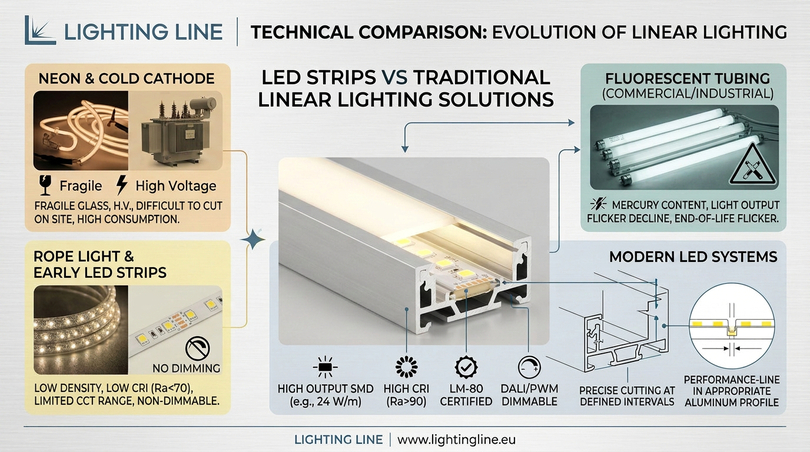
Before COB and high-density SMD strips reached their current level of maturity, linear lighting effects were most commonly achieved with cold cathode tubing, fibre optic runs, or rope light: each with well-known limitations that modern LED strips were specifically engineered to solve. Understanding these limitations helps explain why the technical specifications discussed throughout this article (CRI, efficacy, IP rating, cutting interval) matter so much more today than they did a decade ago.
Cold cathode and neon-style tubing
Traditional cold cathode and neon tubing require high-voltage transformers, are fragile and difficult to cut to exact length on site, and typically consume considerably more energy per metre of visible light than an equivalent LED strip. They also degrade in colour and brightness far more quickly and cannot easily be dimmed smoothly with modern control systems. Flexible LED strips solved all four problems simultaneously: low-voltage operation, on-site cuttability at defined intervals, dramatically lower running cost, and full compatibility with modern 0–10V, DALI and PWM dimming systems.
Rope light and first-generation LED strips
Early rope light and first-generation LED strips from the 2000s and early 2010s were typically low-density, low-CRI (often below Ra>70), non-dimmable and available only in a narrow range of fixed colour temperatures. They also frequently lacked any documented lumen maintenance testing, meaning buyers had no reliable way to predict how quickly the product would dim or yellow over its service life. The modern, LM-80-certified, Ra>80 to Ra>90, precisely binned strips reviewed in this article represent multiple full generations of improvement over that first wave of LED strip products, which is precisely why so many buyers who tried LED strips a decade ago and were disappointed are surprised by how far the category has advanced.
Fluorescent tubing in commercial and industrial settings
In warehouse, retail and industrial contexts specifically, fluorescent tubing has historically been the default linear light source, valued for its relatively even light distribution along a run. However, fluorescent tubes suffer from mercury content requiring special disposal, gradual light output decline well before end of life, sensitivity to cold-start temperatures, and flicker at end of lamp life that is a genuine occupational concern. A correctly specified high-output LED strip such as the 24 W/m Performance-line SMD reviewed in section 3.8, mounted in an appropriate aluminium profile, now routinely matches or exceeds fluorescent light output per metre while eliminating mercury content, cold-start issues and end-of-life flicker entirely.
How we selected these 10 LED strips
With 166 different LED strip references live in the Lighting Line catalogue, no single article can review every SKU in useful depth. Instead, we applied a simple but rigorous selection method designed to give you one clearly justified strip for every major use case you are likely to encounter, rather than ten strips that all solve the same problem in slightly different ways.
We looked at four variables for every candidate: chip technology (SMD 2835 vs COB), IP protection class (IP20 indoor, IP65 splash-resistant, IP67 fully submersible-rated), colour performance (CRI Ra>80 vs Ra>90, fixed CCT vs tunable CCT vs RGB) and power density / luminous output (from entry-level 6 W/m decorative strips to 24 W/m high-output performance strips). The result is a list of ten strips where each one is the clear best answer to a specific, real installation brief: outdoor pergola lighting, kitchen coving, hospitality corridors, retail shelving, tunable-white living rooms and long continuous industrial runs.
We deliberately avoided a common mistake in “top 10” product content: cramming the list with near-duplicate products that differ only by colour temperature. Instead, every strip on this list earns its place by solving a distinct technical problem that the other nine do not solve as well. This is why, for example, two of the ten entries are COB strips at the same 2700K colour temperature and similar LED density: they are not duplicates, because one is optimised purely for luminous efficacy while the other adds current-control circuitry specifically for flicker-sensitive environments. A buyer choosing between them is not choosing “which one is better” but “which specific problem am I solving”.
Finally, every specification quoted in this article (LED density, wattage per metre, CRI, IP rating, cutting interval, energy class) is taken directly from the official Lighting Line product catalogue rather than estimated or generalised from a chip manufacturer’s datasheet. This matters because retail-level LED strip marketing frequently rounds, omits or inflates specifications; a strip advertised loosely as “high CRI” without a number, or “waterproof” without an IP class, tells a buyer almost nothing. Every claim in the ten reviews below is traceable to a documented catalogue attribute.
Why source LED strips from a specialist manufacturer
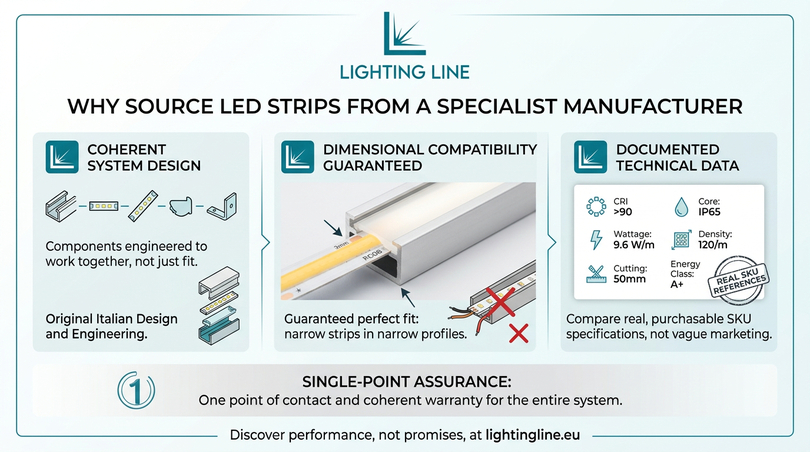
The gap between a generic, unbranded LED strip sourced from an anonymous marketplace listing and a strip produced by a specialist manufacturer that also designs its own aluminium profiles, end caps and mounting brackets is rarely visible on a spec sheet, but it shows up in the field within the first year of operation. Lighting Line specialises specifically in the manufacturing and supply of aluminium profiles and LED strips, with a catalogue built around original Italian design and engineered so that every strip, profile, end cap and mounting bracket is designed to work together as a coherent system rather than as separately sourced components that happen to fit.
This matters in three concrete ways for a buyer. First, dimensional compatibility is guaranteed: a 3 mm PCB COB strip is designed to sit correctly inside the corresponding narrow-channel profile without gaps or fouling, something that is far from guaranteed when mixing a strip from one supplier with a profile from another. Second, documented technical data is available for every SKU, including LED density, exact wattage, cutting interval, CRI, energy class and IP rating, rather than the vague marketing language common on unbranded strip listings. Third, because the same manufacturer supplies the strip, the profile, the end caps and the mounting brackets, a specifier or installer has a single point of contact and a single, coherent warranty conversation if any component of the system underperforms, rather than trying to establish fault between three or four different unrelated suppliers.
These structural advantages are precisely why this article evaluates real, currently listed catalogue references with real SKUs and real specification data, rather than a generic, unattributable “top 10” written without reference to any specific, purchasable product.
The 10 best high-performance LED strips from Lighting Line
Below you will find the ten strips in detail. Each entry includes the exact technical specification sheet as listed in the official Lighting Line catalogue, a breakdown of the ideal installation contexts, and an explanation of why this specific strip outperforms generic alternatives for that use case.
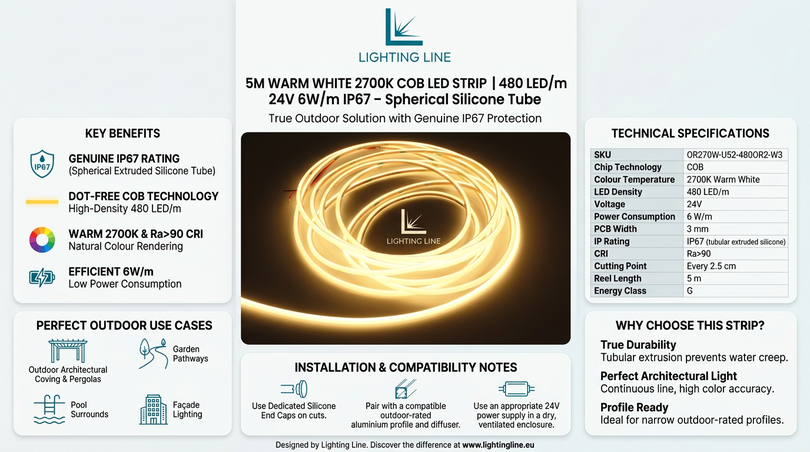
5m warm white 2700K COB LED strip 480 LED/m 24V 6W/m IP67 – Spherical silicone tube
This is Lighting Line’s dedicated outdoor and wet-area COB strip, built around a spherical extruded silicone tube that gives it a genuine IP67 rating: meaning it is protected against dust ingress and can withstand temporary immersion in water, not just occasional splashing. It combines a warm, cosy 2700K colour temperature with the dot-free light line that only COB technology can deliver, at a very efficient 6 W/m.
Technical specifications
| Parameter | Value |
|---|---|
| SKU | OR270W-U52-480OR2-W3 |
| Chip technology | COB |
| Colour temperature | 2700K Warm White |
| LED density | 480 LED/m |
| Voltage | 24V |
| Power consumption | 6 W/m |
| PCB width | 3 mm |
| IP rating | IP67 (tubular extruded silicone) |
| CRI | Ra>90 |
| Cutting point | Every 2.5 cm |
| Reel length | 5 m |
| Energy class | G |
Best use cases
Outdoor architectural coving, pergolas, garden pathways, pool surrounds and façade lighting are the natural home for this strip. Because the silicone jacket is fully tubular and extruded rather than simply coated, water cannot creep along the copper traces even at cut points once properly end-capped — a common failure point with cheaper “IP65-only” outdoor strips. The narrow 3 mm PCB also makes it easy to hide inside slim aluminium profiles designed for outdoor coving, keeping the light source completely invisible during the day.
Why choose this strip
If your project genuinely needs to survive rain, irrigation spray, or occasional direct water contact, this is the strip to specify. The 480 LED/m density with COB phosphor coating produces a perfectly continuous line of warm light with zero visible dotting, which is exactly what outdoor architectural lighting requires: nobody wants to see individual LED points along a garden wall at night. The Ra>90 CRI also means planting, stone and timber surfaces render with much more natural colour than a typical Ra>80 outdoor strip.
Installation and compatibility notes
Because the silicone jacket is a fully tubular extrusion rather than a coated surface, cut ends must always be sealed with the manufacturer’s dedicated silicone end caps before the strip is exposed to any moisture: an unsealed cut end is the single most common cause of premature failure on outdoor IP67 strips. Pair this strip with an outdoor-rated aluminium profile carrying its own IP65 or IP67 diffuser cover wherever it crosses a walkway, and always use an outdoor-rated, appropriately fused 24V power supply mounted in a dry, ventilated enclosure rather than exposed to the elements alongside the strip itself.
Market positioning
Within Lighting Line’s own 98-strong COB range, this model sits at the entry point of the outdoor-rated tier: it delivers genuine IP67 protection and Ra>90 colour accuracy without the higher power draw and correspondingly larger driver requirement of the 15.5 W/m outdoor-capable alternatives further up the range. For most residential garden and pathway briefs, this balance of protection, colour quality and modest 6 W/m power draw represents the most cost-efficient way to achieve professional-grade outdoor COB lighting.
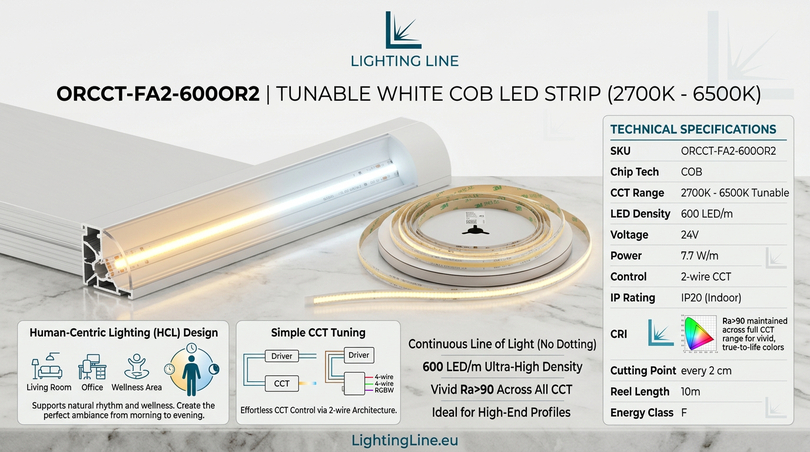
COB LED strip 10m CCT 2700–6500K CRI>90 600 LED/m 24V 7.7W/m – Tunable white
This is Lighting Line’s flagship tunable white COB strip: a single product that can shift its colour temperature live, from a relaxing 2700K in the evening to an energising 6500K during the day, using the two-cable CCT control architecture. At 600 LED/m it is one of the densest COB strips in the entire catalogue.
Technical specifications
| Parameter | Value |
|---|---|
| SKU | ORCCT-FA2-600OR2 |
| Chip technology | COB |
| Colour temperature | CCT tunable 2700K–6500K |
| LED density | 600 LED/m |
| Voltage | 24V |
| Power consumption | 7.7 W/m |
| Control | 2 cables, CCT dimmable |
| IP rating | IP20 (indoor) |
| CRI | Ra>90 |
| Cutting point | Every 2 cm |
| Reel length | 10 m |
| Energy class | F |
Best use cases
Living rooms, bedrooms, offices, wellness and spa areas, and any human-centric lighting (HCL) project benefit enormously from this strip. Tunable white lighting is increasingly specified in circadian-friendly design, where the colour temperature follows or supports the occupants’ natural rhythm: cooler and brighter during work hours, warmer and dimmer in the evening. The two-cable CCT control keeps wiring simple compared with older four-wire RGBW tunable systems.
Why choose this strip
Very few COB strips in this density (600 LED/m) offer full CCT tunability while maintaining Ra>90 colour accuracy across the entire 2700–6500K range. Many competing tunable products lose CRI quality at the extremes of their range: this strip is engineered to hold rendering accuracy consistently. It is the correct specification whenever a client says “I want the light to change through the day” rather than committing to one fixed colour temperature.
Installation and compatibility notes
This strip requires a dedicated two-channel CCT driver and a CCT-compatible controller: a standard single-channel dimmer will only control overall brightness and cannot access the tunable colour range, so confirm control system compatibility before specifying this product for a smart-home or building-management-integrated project. Because it is IP20, it is intended strictly for dry indoor installation inside a profile; keep the 2 cm cutting interval in mind when planning exact segment lengths for fitted joinery, as this is one of the finest cutting tolerances in the entire range.
Market positioning
Tunable CCT products are still a relatively small slice of most manufacturers’ catalogues compared with fixed-CCT and RGB offerings, largely because holding CRI accuracy consistently across a wide colour-temperature sweep is technically demanding. At 600 LED/m with documented Ra>90 performance across the full 2700–6500K range, this strip sits well above the typical tunable-white product, which more commonly compromises to Ra>80 or narrows its usable range to protect colour consistency.
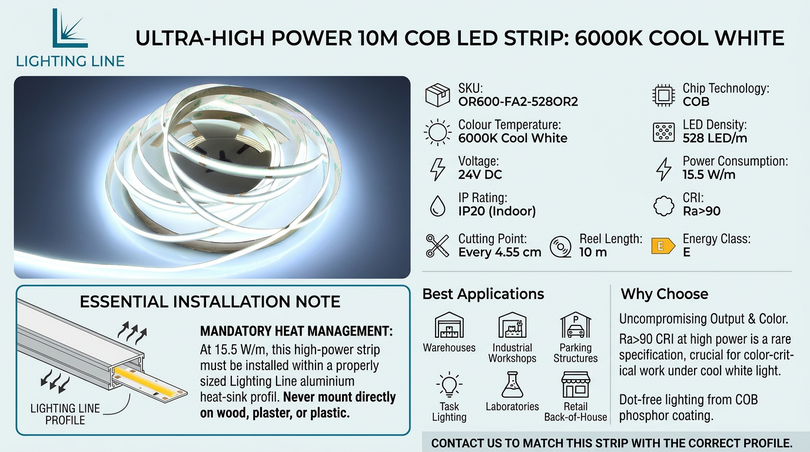
COB LED strip 10m cool white 6000K CRI>90 528 LED/m 24V 15.5W/m – High-power
When a project needs raw output rather than subtlety, this is the strip. At 15.5 W/m it is one of the most powerful COB strips Lighting Line offers, paired with a crisp 6000K cool white and Ra>90 colour rendering that keeps whites looking genuinely white rather than blue-tinted.
Technical Specifications
| Parameter | Value |
|---|---|
| SKU | OR600-FA2-528OR2 |
| Chip technology | COB |
| Colour temperature | 6000K Cool White |
| LED density | 528 LED/m |
| Voltage | 24V |
| Power consumption | 15.5 W/m |
| IP rating | IP20 (indoor) |
| CRI | Ra>90 |
| Cutting point | Every 4.55 cm |
| Reel length | 10 m |
| Energy class | E |
Best use cases
Warehouses, industrial workshops, parking structures, workshops and task-lighting applications where high lux levels are the priority. It is also a strong choice for retail back-of-house areas, laboratories, and any space where visual acuity and alertness matter more than mood. The high LED density combined with COB phosphor coating means this level of output is delivered without the harsh, glaring dot pattern you would get from an equally powerful high-density SMD strip.
Why choose this strip
Cool white strips at this power level often sacrifice colour rendering to hit high lumen output cheaply. This strip does not: the Ra>90 rating at 6000K is genuinely difficult to achieve at scale and matters enormously in any space where colour-critical work happens under cool white light — inspection lines, print rooms, kitchens with white cabinetry that must not look sickly blue.
Installation and compatibility notes
At 15.5 W/m this is one of the hottest-running strips in this list, so thermal management is non-negotiable: always mount it inside a properly sized aluminium heat-sink profile with adequate cross-section, never directly onto wood, plaster or plastic trunking. Because the cutting interval is a wider 4.55 cm, plan segment lengths carefully around this spacing during the design phase, particularly for fitted joinery where a few millimetres either way affects the final trim.
Market positioning
High-output cool white COB strips at Ra>90 occupy a genuinely narrow segment of the market, since most manufacturers reserve their highest-CRI COB tooling for warmer, more residentially-oriented colour temperatures. This strip’s combination of 15.5 W/m output, 528 LED/m density and Ra>90 rendering at a full 6000K makes it a comparatively rare specification, particularly valuable for colour-critical industrial and technical applications that would otherwise have to compromise on either brightness or rendering accuracy.
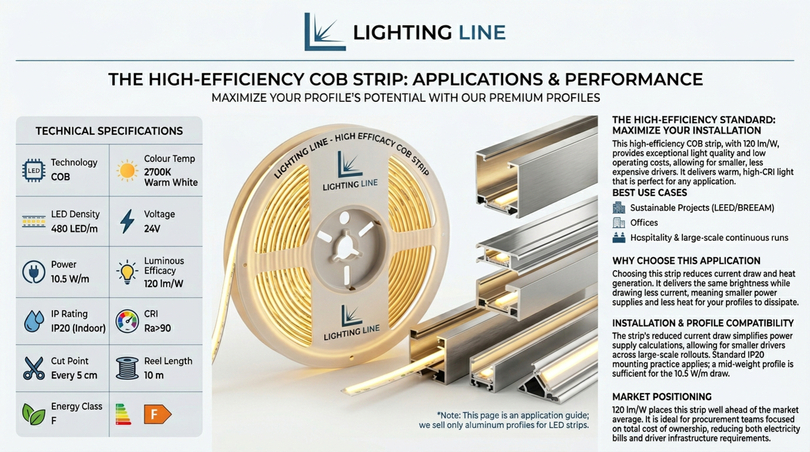
COB LED strip 10m warm white 2700K CRI>90 480 LED/m 24V 10.5W/m – 120 lm/W efficiency
This model is built around one number: 120 lm/W, an efficacy figure that places it firmly in the high-efficiency tier of the entire LED strip market. It proves that warm, high-CRI light does not have to come at the cost of energy consumption.
Technical specifications
| Parameter | Value |
|---|---|
| SKU | OR270-FA2-480OR2 |
| Chip technology | COB |
| Colour temperature | 2700K Warm White |
| LED density | 480 LED/m |
| Voltage | 24V |
| Power consumption | 10.5 W/m |
| Luminous efficacy | 120 lm/W |
| IP rating | IP20 (indoor) |
| CRI | Ra>90 |
| Cutting point | Every 5 cm |
| Reel length | 10 m |
| Energy class | F |
Best use cases
Sustainable building projects, offices pursuing LEED/BREEAM credits, hospitality refurbishments and any large-scale continuous-run installation where total running cost over years of operation matters as much as upfront price. Hotel corridors and retail chains with hundreds of metres of installed strip see the efficacy advantage compound quickly on the electricity bill.
Why choose this strip
Efficacy is the single most underrated spec on a LED strip datasheet. A strip delivering 120 lm/W instead of a more typical 90–100 lm/W produces the same visual brightness while drawing meaningfully less current: which also means smaller, cheaper power supplies and less heat to dissipate through the aluminium profile. For any large commercial rollout, this is the strip that makes the total cost of ownership calculation work in your favour.
Installation and compatibility notes
Because this strip draws less current per metre of installed light output than most equivalents, power supply sizing calculations can be smaller and cheaper across a large rollout — recalculate your driver schedule rather than reusing sizing from a previous, less efficient project, or you will end up needlessly over-specifying the power infrastructure. Standard IP20 indoor mounting practice applies; a mid-weight aluminium profile is normally sufficient given the moderate 10.5 W/m draw.
Market positioning
120 lm/W places this strip firmly ahead of the typical 90–100 lm/W efficacy band that most warm-white COB products on the market settle into. For procurement teams evaluating total cost of ownership across a multi-year contract rather than simple upfront unit price, this efficacy advantage is frequently the deciding factor, since it directly reduces both the electricity bill and the driver infrastructure required across a large-scale rollout.
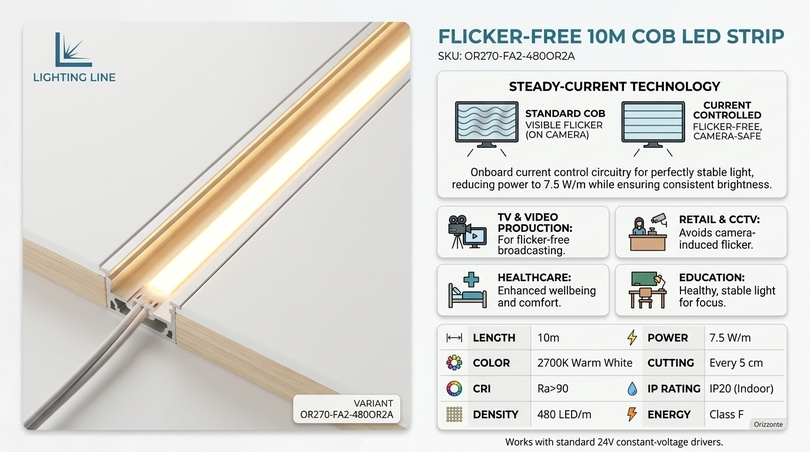
COB LED strip 10m warm white 2700K CRI>90 480 LED/m 24V 7.5W/m – With current control (flicker-free)
This variant shares the same warm 2700K, Ra>90 colour package as strip 3.4, but adds onboard current control circuitry, reducing power draw to 7.5 W/m while stabilising the current delivered to each LED segment. The practical result is a strip with significantly reduced flicker and more consistent brightness along its full length.
Technical specifications
| Parameter | Value |
|---|---|
| SKU | OR270-FA2-480OR2A |
| Chip technology | COB with current control |
| Colour temperature | 2700K warm white |
| LED density | 480 LED/m |
| Voltage | 24V |
| Power consumption | 7.5 W/m |
| IP rating | IP20 (indoor) |
| CRI | Ra>90 |
| Cutting point | Every 5 cm |
| Reel length | 10 m |
| Energy class | F |
Best use cases
Camera-facing environments such as TV studios, video content rooms, photography studios and retail spaces with heavy CCTV coverage benefit the most from current-controlled strips, because unstable current is the root cause of visible flicker on camera sensors even when it is invisible to the naked eye. It is equally valuable in healthcare and educational settings where flicker sensitivity is a genuine occupant wellbeing concern.
Why choose this strip
Current control is a feature most budget strips skip entirely, because it adds a small cost to the PCB. For any installation where the light will be filmed, photographed, or used for long occupied hours, the flicker-free current-controlled design is a meaningful upgrade that a standard COB strip cannot match, even at the same colour temperature and CRI.
Installation and compatibility notes
This strip works with standard 24V constant-voltage drivers: the current-control circuitry is built into the strip itself, so no special driver or controller purchase is required to benefit from the flicker reduction. It is otherwise installed exactly like the standard 480 LED/m COB strip in section 3.4, sharing the same 5 cm cutting interval and IP20 indoor-only rating.
Market positioning
Onboard current-control circuitry is a relatively uncommon inclusion at this price tier — most manufacturers reserve stabilised current delivery for premium architectural product lines priced well above standard COB strips. Offering it as a direct variant of the standard 480 LED/m, Ra>90, 2700K COB strip gives buyers a straightforward upgrade path whenever a flicker-sensitive brief emerges mid-project, without having to source a completely different product family.
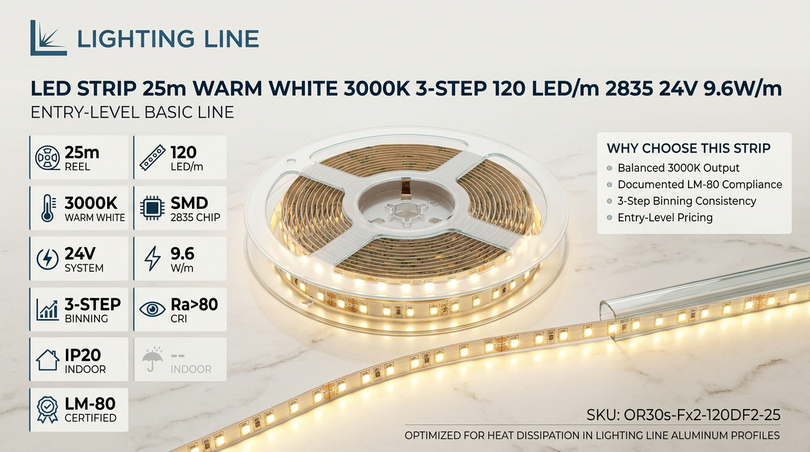
LED strip 25m warm white 3000K 3-step 120 LED/m 2835 24V 9.6W/m – Entry-level basic line
This is Lighting Line’s Basic product line, built on the industry-standard SMD 2835 chip, and it is the strip most buyers will reach for on decorative and short-term or budget-driven projects. At 120 LED/m and 9.6 W/m it offers a balanced, warm 3000K output at an accessible price point across a full 25-metre reel.
Technical specifications
| Parameter | Value |
|---|---|
| SKU | OR30s-Fx2-120DF2-25 |
| Chip technology | SMD 2835 |
| Colour temperature | 3000K Warm White (3-step binning) |
| LED density | 120 LED/m |
| Voltage | 24V |
| Power consumption | 9.6 W/m |
| IP rating | IP20 (indoor) |
| CRI | Ra>80 |
| Certification | LM-80 compliant |
| Cutting point | Every 5 cm |
| Reel length | 25 m |
| Energy class | F |
Best use cases
Decorative lighting, temporary installations, shop-fitting on a budget, event lighting and furniture backlighting are the ideal territory for this strip. It is also the entry point for anyone testing a design concept before committing to a higher-spec, higher-CRI product for the final rollout.
Why choose this strip
Not every application needs Ra>90 colour rendering or COB smoothness — sometimes the brief is simply “warm, reliable, LM-80 certified light at the best possible price per metre”. This strip’s 3-step binning keeps colour consistency reasonable across a 25-metre reel, which matters when you are cutting many short segments from the same roll for multiple fixtures on one job.
Installation and compatibility notes
As an IP20 product this strip must stay in fully dry indoor locations; it is compatible with standard 24V constant-voltage drivers and the widest range of generic clip and solder connectors on the market, making replacement parts easy to source years after the original installation. At 9.6 W/m, a lightweight aluminium profile is generally adequate for heat dissipation.
Market positioning
This is deliberately Lighting Line’s Basic product line rather than its Performance tier, and it is positioned to compete directly against the generic, unbranded 2835 strips that dominate marketplace search results on price alone. The advantage here is documented LM-80 compliance and 3-step binning consistency across a full 25 m reel: attributes that generic marketplace listings frequently omit entirely, even when the underlying chip looks similar on paper.
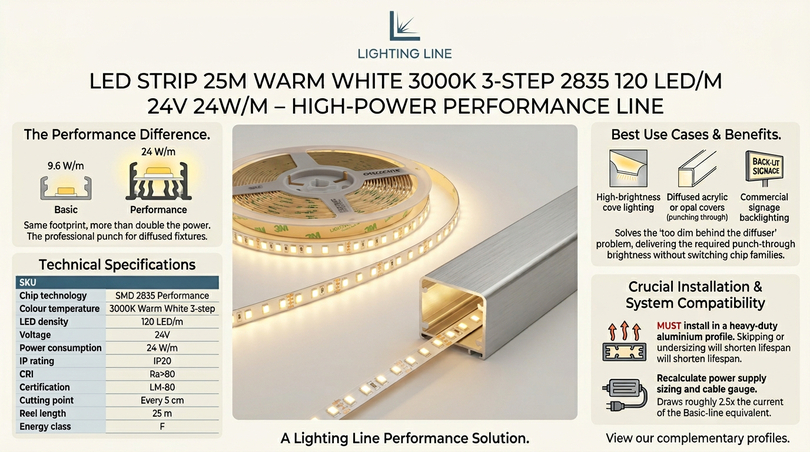
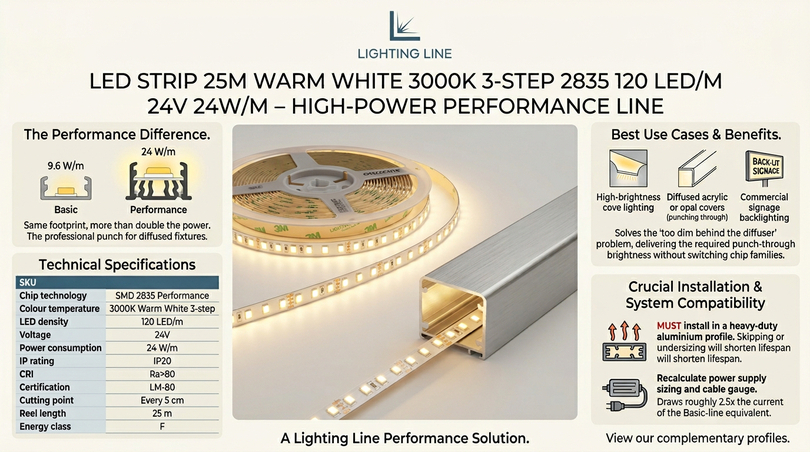
LED strip 25m warm white 3000K 3-Step 2835 120 LED/m 24V 24W/m – High-power performance line
Same chip, same colour temperature, same 120 LED/m density as strip 3.6: but built on Lighting Line’s Performance product line, delivering a full 24 W/m, two and a half times the power draw and light output of the Basic version.
Technical specifications
| Parameter | Value |
|---|---|
| SKU | OR30s-Fx2-1208F2-25 |
| Chip technology | SMD 2835 (Performance line) |
| Colour temperature | 3000K Warm White (3-step binning) |
| LED density | 120 LED/m |
| Voltage | 24V |
| Power consumption | 24 W/m |
| IP rating | IP20 (indoor) |
| CRI | Ra>80 |
| Certification | LM-80 compliant |
| Cutting point | Every 5 cm |
| Reel length | 25 m |
| Energy class | F |
Best use cases
High-brightness cove lighting, commercial signage backlighting, and any project requiring strong output through diffused acrylic or opal covers where light must travel through a diffuser and still read as bright. Because more current runs through the same 2835 chip footprint, this strip is also frequently used behind thicker or more opaque diffusion material than the Basic line could adequately punch through.
Why choose this strip
When a designer specifies a diffused linear fixture and the mock-up looks too dim once the diffuser is added, the fix is rarely a different diffuser — it’s more W/m from the same chip family. This Performance-line strip solves that problem directly, delivering the extra lumen output needed to punch through diffusion without switching to a completely different, more expensive chip technology.
Installation and compatibility notes
At 24 W/m this strip runs considerably hotter than the Basic line and must be installed in a heavy-duty aluminium profile with sufficient thermal mass; skipping the profile or using an undersized one will noticeably shorten lifespan. Because it draws roughly two and a half times the current of the Basic-line equivalent, recalculate power supply sizing and cable gauge accordingly rather than reusing a driver schedule designed for the 9.6 W/m version.
Market positioning
The Performance line exists specifically to answer the most common complaint about entry-level strips: “it looked bright on the sample but too dim once installed behind the diffuser”. Rather than switching an entire project to a more expensive COB specification purely to solve a brightness shortfall, this strip lets a designer stay within the familiar, cost-effective SMD 2835 family while still achieving the punch-through brightness a diffused fixture actually needs.
LED strip 50m warm white 2700K 3-step 2835 120 LED/m 24V 24W/m – Continuous industrial reel
This is functionally the same high-power Performance-line chip as strip 3.7, but supplied on a 50-metre continuous reel and tuned to a slightly warmer 2700K. It exists specifically to reduce the number of joints, connectors and power-injection points on very large installations.
Technical specifications
| Parameter | Value |
|---|---|
| SKU | OR27s-FE2-1208F2 |
| Chip technology | SMD 2835 (Performance line) |
| Colour temperature | 2700K warm white (3-step binning) |
| LED density | 120 LED/m |
| Voltage | 24V |
| Power consumption | 24 W/m |
| IP rating | IP20 (indoor) |
| CRI | Ra>80 |
| Certification | LM-80 compliant |
| Cutting point | Every 5 cm |
| Reel length | 50 m |
| Energy class | F |
Best use cases
Large retail chains, warehouse racking, long corridors, car park lighting and any procurement-driven project measured in hundreds or thousands of metres is where a 50 m reel earns its place. Fewer reel changes mean fewer soldered or connectorised joints, which directly reduces the number of potential failure points across a large installation and speeds up on-site labour.
Why choose this strip
Procurement teams buying at scale should think in terms of installed cost per metre, not just product cost per metre. A 50 m reel halves the number of reel-to-reel connections compared with buying 25 m reels, which reduces both material cost (fewer connectors) and labour cost (fewer splice points to make, test and hide). For big-box retail and logistics projects, this is consistently the more economical long-term choice.
Installation and compatibility notes
Even on a continuous 50 m reel, voltage drop still requires power injection at regular intervals — plan feed points roughly every 5 metres along the run at this wattage rather than relying on a single feed at one end, or the far end of the reel will visibly dim and warm-shift compared with the near end. Always specify a heavy-duty aluminium profile given the 24 W/m draw, matching the thermal management approach used for the 25 m Performance-line strip in section 3.7.
Market positioning
Very few competitors in the general market offer a genuinely continuous 50 m Performance-line reel at this power density — most alternatives top out at 25 m and require a splice to reach comparable coverage. For procurement-led projects where the line-item cost of connectors and installation labour matters as much as the strip’s own unit price, this longer reel format is a distinct competitive advantage rather than simply a convenience.
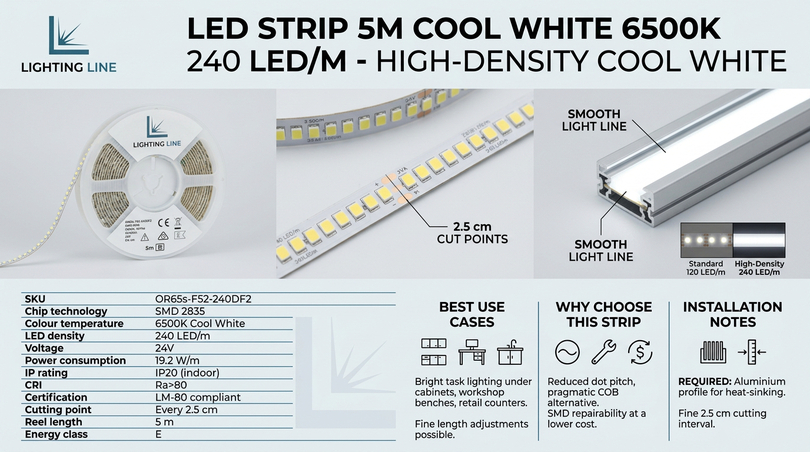
LED strip 5m cool white 6500K 3-Step 240 LED/m 2835 24V 19.2W/m – High-density cool white
This strip doubles the LED density of the standard 120 LED/m products to 240 LED/m, at a crisp daylight 6500K. The tighter LED spacing produces a noticeably smoother, more even light line, closing much of the visual gap between SMD and COB technology while retaining the lower cost and easier repairability of a standard chip-based strip.
Technical specifications
| Parameter | Value |
|---|---|
| SKU | OR65s-F52-240DF2 |
| Chip technology | SMD 2835 (Performance line) |
| Colour temperature | 6500K Cool White (3-step binning) |
| LED density | 240 LED/m |
| Voltage | 24V |
| Power consumption | 19.2 W/m |
| IP rating | IP20 (indoor) |
| CRI | Ra>80 |
| Certification | LM-80 compliant |
| Cutting point | Every 2.5 cm |
| Reel length | 5 m |
| Energy class | E |
Best use cases
Bright task lighting under kitchen cabinets, workshop benches, garages, technical rooms and retail counters where daylight-quality cool white illumination and a smooth light line both matter, but a full COB upgrade is not justified by the budget. The frequent 2.5 cm cutting point also allows very fine length adjustments for tight built-in furniture applications.
Why choose this strip
Doubling LED density from 120 to 240 per metre is the most direct way to reduce the visible “dot pitch” of an SMD strip without switching chip technology entirely. For clients who want near-COB smoothness with SMD-level repairability and cost, this high-density cool white strip is the pragmatic middle ground.
Installation and compatibility notes
The fine 2.5 cm cutting interval combined with 240 LED/m density makes this strip particularly well suited to short, precisely-sized segments under cabinetry, where exact fit matters more than on a long architectural run. At 19.2 W/m it runs warm for its 5 m format, so an aluminium profile with reasonable heat-sinking capacity is strongly recommended even for short under-cabinet runs.
Market positioning
High-density 240 LED/m SMD strips sit in a genuinely useful middle tier between standard 120 LED/m SMD products and full COB strips, offering a visibly smoother light line than the former at a materially lower price than the latter. For projects where budget rules out COB entirely but the client has explicitly complained about visible dotting on a previous, lower-density installation, this is consistently the correct upsell recommendation.
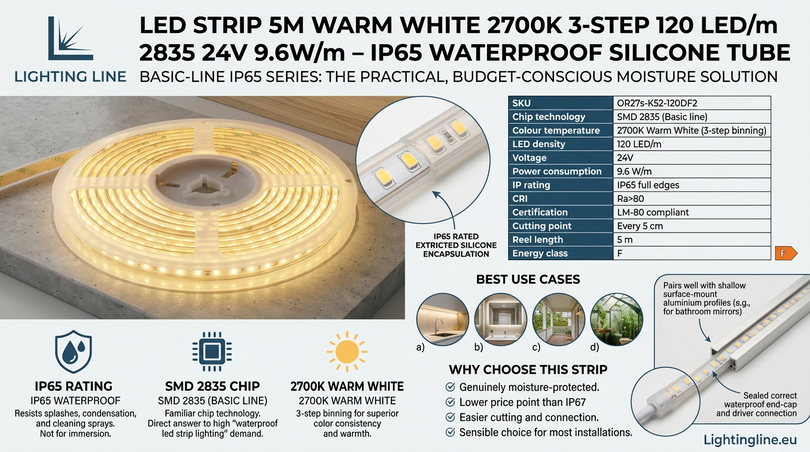
LED strip 5m warm white 2700K 3-step 120 LED/m 2835 24V 9.6W/m – IP65 waterproof silicone tube
This model takes the familiar Basic-line 2835 chip and encapsulates it in a full-edge extruded silicone tube rated IP65, making it splash- and moisture-resistant without the added cost of a full IP67 COB system. It is the practical, budget-conscious answer to “I need it near water, but not underwater”.
Technical specifications
| Parameter | Value |
|---|---|
| SKU | OR27s-K52-120DF2 |
| Chip technology | SMD 2835 (Basic line) |
| Colour temperature | 2700K Warm White (3-step binning) |
| LED density | 120 LED/m |
| Voltage | 24V |
| Power consumption | 9.6 W/m |
| IP rating | IP65 (extruded silicone tube, full edges) |
| CRI | Ra>80 |
| Certification | LM-80 compliant |
| Cutting point | Every 5 cm |
| Reel length | 5 m |
| Energy class | F |
Best use cases
Bathrooms, kitchens near sinks, covered outdoor porches, greenhouses and humid utility rooms are the sweet spot for an IP65 strip. It is not designed for direct water immersion or permanent outdoor exposure to heavy rain — for that, the IP67 COB strip in section 3.1 is the correct choice — but it comfortably resists splashes, condensation and cleaning-spray moisture.
Why choose this strip
Many buyers over-specify and pay for full IP67 protection when their actual risk is occasional splashing rather than submersion. This IP65 strip delivers genuine moisture protection at a lower price point and with the easier cutting and connector options of a standard SMD strip, making it the sensible choice for the vast majority of “wet room adjacent” residential and light-commercial installations.
Installation and compatibility notes
As with any IP65 or IP67 product, cut ends must be sealed with the correct waterproof end caps before exposure to moisture — this strip’s protection rating applies to the intact silicone tube, not to an unsealed cut point. It pairs well with a shallow surface-mount aluminium profile for bathroom mirror lighting or under-sink accent lighting, and uses the same 24V constant-voltage driver family as the rest of the SMD 2835 range reviewed in this article.
Market positioning
IP65 SMD strips fill the gap between fully unprotected IP20 indoor strips and the higher-cost IP67 COB tier, and this specific model is Lighting Line’s direct answer to the very high search volume around “waterproof led strip lighting” and “led strips for bathroom” queries. It gives buyers genuine, tested moisture protection without pushing the project budget toward a full outdoor-grade COB specification that the actual installation environment does not require.
Side-by-side comparison table
The table below puts all ten strips next to each other so you can compare technology, protection class and power output at a glance before making your final decision.
| # | Strip | Chip | CCT | LED/m | W/m | CRI | IP Rating | Length |
|---|---|---|---|---|---|---|---|---|
| 1 | Outdoor spherical COB | COB | 2700K | 480 | 6 | Ra>90 | IP67 | 5m |
| 2 | Tunable CCT COB | COB | 2700–6500K | 600 | 7.7 | Ra>90 | IP20 | 10m |
| 3 | High-power cool white COB | COB | 6000K | 528 | 15.5 | Ra>90 | IP20 | 10m |
| 4 | 120 lm/W efficient COB | COB | 2700K | 480 | 10.5 | Ra>90 | IP20 | 10m |
| 5 | Current-controlled COB | COB | 2700K | 480 | 7.5 | Ra>90 | IP20 | 10m |
| 6 | Basic SMD 2835 | SMD | 3000K | 120 | 9.6 | Ra>80 | IP20 | 25m |
| 7 | Performance SMD 2835 | SMD | 3000K | 120 | 24 | Ra>80 | IP20 | 25m |
| 8 | Continuous reel SMD 2835 | SMD | 2700K | 120 | 24 | Ra>80 | IP20 | 50m |
| 9 | High-density SMD 2835 | SMD | 6500K | 240 | 19.2 | Ra>80 | IP20 | 5m |
| 10 | IP65 waterproof SMD 2835 | SMD | 2700K | 120 | 9.6 | Ra>80 | IP65 | 5m |
Lighting Line vs generic marketplace LED strips
A significant share of LED strip purchases still happen through generic online marketplace listings with minimal technical documentation, driven almost entirely by upfront price per metre. Understanding where these generic listings typically fall short clarifies why a specialist catalogue with fully documented specifications represents a meaningfully different buying proposition rather than simply a more expensive version of the same product.
Specification transparency
Generic marketplace listings frequently advertise a colour temperature and a length without disclosing LED density, CRI, cutting interval or energy class at all. Every specification table in this article includes all of these attributes for every one of the ten strips reviewed, sourced directly from the manufacturer’s own catalogue rather than inferred from a marketplace product photo or a vague listing description.
System compatibility
A specialist manufacturer that also produces matching profiles, end caps and mounting brackets can guarantee dimensional compatibility between the strip’s PCB width and the channel it will sit inside. Generic marketplace strips are frequently sold with no corresponding profile range at all, leaving the buyer to source a compatible aluminium channel separately and hope the fit and diffusion characteristics work as intended: a risk that simply does not exist when strip and profile come from the same coordinated catalogue.
Binning consistency across a bulk order
Because generic marketplace strips are frequently sourced from whichever factory run happens to be available at the time of a given order, colour consistency between two separate bulk orders of the “same” product, months apart, is not guaranteed. A specialist manufacturer with documented 3-step binning practices, such as those referenced throughout the SMD strip specifications in this article, gives buyers a meaningfully higher likelihood of consistent colour appearance across multiple orders placed over the life of a multi-phase project.
Warranty and accountability
When a generic marketplace strip fails, establishing a clear line of accountability between the marketplace seller, the underlying factory and any importer or reseller in between can be genuinely difficult, particularly for smaller residential purchases. Sourcing directly from a manufacturer’s own catalogue, with a single documented SKU and a single point of contact, removes this ambiguity and is a large part of why the warranty considerations discussed in section 5.8 are meaningful only when the supply chain behind the product is itself traceable and accountable.
None of this means every generic marketplace listing is unreliable, or that every specialist-catalogue product is automatically superior on every metric: price-sensitive, low-stakes decorative projects can be served perfectly well by a basic marketplace strip. The point is narrower and more practical: for any project where colour consistency, documented lifespan, correct IP protection or long-term accountability genuinely matter to the outcome, the additional specification transparency and system compatibility offered by a coordinated manufacturer catalogue is not a marketing nicety but a measurable risk reduction, and this article has been written throughout with exactly that distinction in mind.
Real-world application scenarios
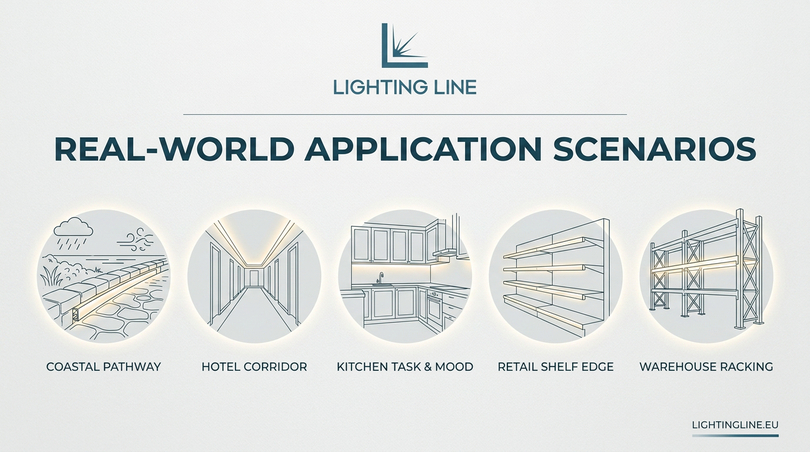
To make the specification advice above more concrete, this section walks through five realistic project briefs and explains which of the ten strips and why a specifier would land on for each one.
Scenario A: a coastal villa garden pathway
The brief calls for warm, inviting path lighting embedded in a stone border, exposed to rain, irrigation overspray and occasional standing water after storms. The IP67 spherical COB strip is the only strip on this list rated for that level of water exposure, and its 2700K warm white with Ra>90 rendering keeps natural stone and planting looking accurate rather than washed out. Every cut end along the path must be sealed with waterproof end caps, and the driver should be housed in a dry technical room rather than a garden-facing enclosure. Given the coastal setting, salt-air corrosion resistance of the end caps and connectors is also worth confirming separately, since salt exposure accelerates corrosion on any metal contact points even inside a nominally sealed enclosure.
Scenario B: a boutique hotel corridor refurbishment
Two hundred metres of continuous cove lighting need to run at consistent colour and brightness for a decade of nightly operation, with electricity cost a genuine line item in the operating budget. The 120 lm/W COB strip is the correct specification: its high efficacy reduces the driver count and running cost across two hundred metres, while its Ra>90 rendering keeps corridor artwork and carpet tones looking rich rather than flat. Across a refurbishment of this scale, the efficiency advantage alone can materially change the electrical infrastructure sizing for the whole floor, potentially avoiding an otherwise-necessary electrical capacity upgrade.
Scenario C: a residential kitchen with mixed task and mood lighting
The homeowner wants bright, functional light under the wall cabinets during cooking, and a softer, warmer wash for evening entertaining, ideally controlled from one wall switch or app. The tunable CCT COB strip answers both needs from a single product, provided it is paired with a CCT-compatible driver and controller a. For the sink and worktop splashback area specifically, pairing this with the IP65 strip in a secondary, separately switched circuit is a sensible refinement if that zone sees frequent water exposure.
Scenario D: a high-turnover retail shopfit
A retail chain needs to fit out dozens of stores quickly and economically, with shelf-edge lighting that looks clean without individual dots showing through frosted acrylic trim, but without the budget for COB strips at every single store. The high-density 240 LED/m SMD delivers most of the visual smoothness of COB at SMD pricing, making it the practical compromise for a large multi-site rollout. Standardising on one strip specification across every store location also simplifies spare-parts stocking and staff training for basic in-store maintenance.
Scenario E: a warehouse racking upgrade
Facilities management wants to replace failing fluorescent tubes along hundreds of metres of racking with something brighter, more reliable and faster to install. The 50 m continuous SMD reel fminimises the number of joints across a very long run, while its 24 W/m output comfortably matches or exceeds the light levels the old fluorescent fittings provided. Because warehouse racking runs are typically installed by an internal facilities team rather than a specialist electrician, the reduced connector count of the 50 m format also meaningfully lowers the on-site labour and error risk compared with piecing together the same length from multiple shorter reels.
Which LED strip should you choose?
There is no single “best” LED strip: there is only the best strip for your specific installation constraints. If you need outdoor, water-exposed lighting, the IP67 spherical COB strip is the clear answer. If your project is about mood and daily rhythm, the tunable CCT COB strip built exactly for that brief. For raw industrial output, the 15.5 W/m cool white COB strip wins. For sustainability-driven commercial rollouts, the 120 lm/W efficient COB strip pays for itself in reduced running costs. And for budget-conscious decorative or large-scale continuous runs, the SMD 2835 Basic and Performance lines (including the 50 m continuous reel) remain the most practical, cost-effective choice.
Throughout this guide we have deliberately avoided treating any single specification in isolation. A high CRI number means little if the strip is installed without adequate heat-sinking and loses colour consistency within two years. An impressive lm/W efficacy figure means little if the wrong voltage is chosen and the far end of a long run dims visibly below the near end. And an IP67 rating means nothing at all if a cut end is left unsealed on site. The strip is only one half of the specification decision: correct installation, matched profiles, correctly sized drivers and appropriate control systems are the other half, and this article has tried to give equal weight to both, precisely because in the field it is very often the installation half of that equation, not the product itself, that determines whether a lighting scheme still performs as intended years after the ribbon was first cut.
This article was developed with the support of artificial intelligence and subsequently reviewed, corrected, and validated by the LightingLine.eu technical team, which guarantees its reliability and compliance with official sources.