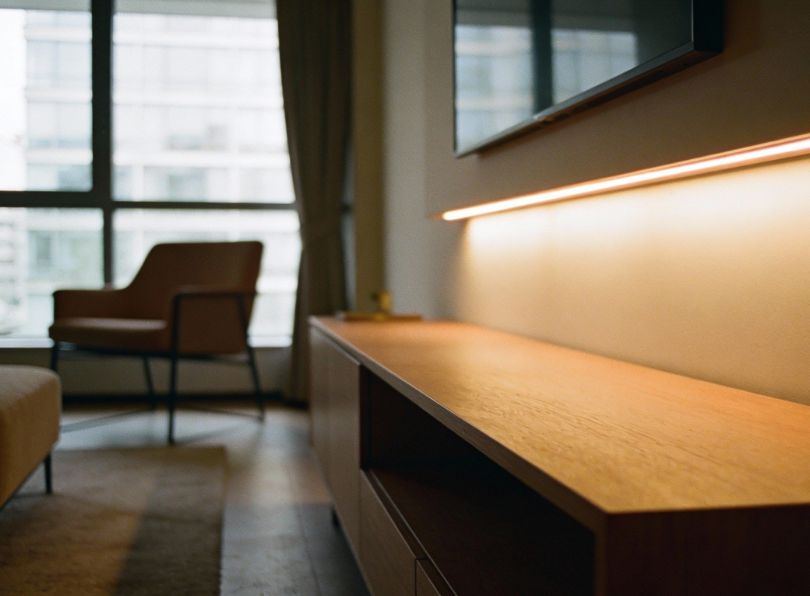
In the realm of architectural and interior lighting, few techniques possess the transformative power and subtle sophistication of wall washer lighting. This guide, crafted explicitly for architects, civil engineers, project managers, and large construction firms, delves beyond superficial aesthetics to explore the precise engineering, photometric principles, and material behind effective wall washing. We will dissect the core question, “What is the purpose of a wall washer light?”, not merely as a definition but as a principle of spatial manipulation.
The contemporary design landscape demands solutions that are both visually compelling and technically flawless. This resource provides the exhaustive detail required to specify, design, and implement wall wash lighting systems with confidence, focusing on the unparalleled advantages of engineered aluminum profiles from specialists like LightingLine. From fundamental optics to advanced installation protocols and comparative performance data, this document serves as the ultimate technical compendium for professionals.
- What is wall washer lighting? Defining purpose and principle
- Technical fundamentals of wall washing
- Aluminum profiles for wall wash lighting: engineering excellence
- Design and application in architectural practice
- Comprehensive installation guide and best practices
- Comparative analysis: wall washers vs. other luminaires
- Trends, evolution, and future of wall washing
- Technical case studies and performance data
- Product specification and selection guide
What is wall washer lighting? Defining purpose and principle
In this section we establishes the foundational lexicon and conceptual framework for wall washer lighting, moving from a basic definition to a nuanced understanding of its role in the architect’s toolkit.
Core definition and photometric principle
Wall washing is a directional lighting technique designed to bathe a vertical surface in a smooth, even, and consistent layer of light, minimizing shadows, texture emphasis, and hot spots. Unlike accent lighting which highlights specific features, a wall washer light aims for uniformity.
The photometric goal is to achieve a luminance ratio across the wall surface that typically does not exceed 4:1 from the brightest point near the light source to the dimmest point at the furthest edge. This is accomplished through precise optical control, often using reflectors, lenses, or baffles within the luminaire to shape and diffuse the light beam before it strikes the wall.
What is the purpose of a weall washer light? Architectural objectives
The purpose extends far beyond simple illumination. Key objectives include:
Spatial perception: a well-washed wall appears to recede, making a room feel larger and more open. It defines spatial boundaries without visual clutter.
Visual comfort: it provides ambient illumination through indirect reflection, reducing glare and creating a soothing visual environment, crucial in settings from corporate lobbies to healthcare facilities.
Architectural emphasis: it can deliberately draw attention to a wall’s materiality, color, or form, turning it into a focal “canvas.”
Art and display enhancement: in galleries or museums, it provides the flawless, shadow-free illumination required for optimal artwork viewing.
Mood and atmosphere: through control of color temperature and intensity, it fundamentally shapes the experiential quality of a space.
Are wall lights a good idea? A resounding technical affirmation
Addressing the common query, “Are wall lights a good idea?”, from a technical and design perspective reveals a multifaceted “yes.” Wall wash lights, as a subtype of wall lights, offer distinct advantages over sole reliance on ceiling-mounted or freestanding luminaires.
They reduce ceiling visual noise, provide task-specific illumination without eye strain, and contribute to a layered lighting scheme that meets both functional and aesthetic requirements. Their efficacy is proven in reducing contrast ratios in the field of view, a key metric in visual ergonomics standards like EN 12464-1.
Technical fundamentals of wall washing
Now we explores the engineering parameters that govern successful wall wash lighting implementation.
The critical question: how far should a wall washer light be from the wall?
Perhaps the most frequently asked technical question is, “How far should a wall washer light be from the wall?” or “How far from the wall should wall wash lights be?”. The answer is not a single figure but a formula based on beam angle and desired coverage.
The fundamental rule: the mounting distance (D) from the wall is primarily a function of the luminaire’s beam angle (θ) and the height (H) of the wall you intend to wash. A standard starting formula is D = H / (2 * tan(θ/2)). For a typical 40-degree beam washing an 8-foot (2.44m) wall, this suggests a starting distance of approximately 2.9 feet (0.88m).
Practical guidelines:
– for recessed or surface-mounted wall washer light fixtures: a common rule of thumb is to place them between 12 inches (30 cm) and 36 inches (91 cm) from the wall. Closer placement increases the risk of a “scalloping” effect (bright arches); farther placement improves uniformity but reduces light intensity.
– for recessed LED strip lights in aluminum profiles: the recessed lip of the profile itself often dictates a very close proximity (0-2 inches). Here, uniformity is achieved through the use of diffusers (opal, prismatic) and the linear continuity of the light source, not distance.
Recommended distances for wall washer lights
| Wall height (H) | Luminaire beam angle (θ) | Calculated optimal distance (D) | Typical application |
|---|---|---|---|
| 2.4 m (8 ft) | 30° | 1.1 m (43 in) | Gallery, feature wall |
| 3.0 m (10 ft) | 40° | 1.3 m (51 in) | Commercial lobby, atrium |
| 2.0 m (6.5 ft) | 60° (Wide Flood) | 0.58 m (23 in) | Residential corridor, hotel |
| 5.0 m (16 ft) | 25° (Narrow Asymmetric) | 2.9 m (114 in) | Monumental facade, high atrium |
How does a wall washer light work? Optics and components
A wall washer light works by employing precise optical engineering to redirect and soften the raw output of LEDs. Key components include:
Asymmetric reflectors: these are shaped to “throw” light primarily in one direction (towards the wall) with a controlled spread, ensuring more light reaches the top of the wall.
Diffusing lenses or baffles: these break up the light to eliminate multiple shadows from individual LED chips and create a smooth beam.
Housing and heat sink: critical for performance and longevity. High-quality aluminum profiles act as both structural housing and an efficient heat sink, dissipating thermal energy away from the LED chips to maintain luminous flux and lifespan (often exceeding 50,000 hours L90).
Aluminum profiles for wall wash lighting: engineering excellence
The choice of housing is paramount. This section details why extruded aluminum profiles are the industry standard for high-performance wall wash lighting.
Advantages of aluminum profile systems
Thermal management: aluminum’s high thermal conductivity (≈200 W/m·K) is its greatest asset. Integrated fins increase surface area for passive convection, stabilizing LED junction temperature. This is non-negotiable for maintaining rated lumen output and lifespan.
Structural rigidity: extruded profiles provide a straight, stable platform for linear LED strips, preventing sagging or uneven alignment over long runs.
Aesthetic flexibility: they can be finished in anodized colors (natural, black, bronze) or powder-coated to any RAL color, allowing seamless architectural integration.
Modularity and customization: profiles can be cut to exact lengths on-site, joined with connectors, and fitted with various diffusers (clear, opal, micro-prismatic, frosted) to achieve the desired visual light output (VLO) and glare control (UGR rating).
Installation methods: recessed, surface, and suspended
Recessed (built-in): the profile is installed into a chase or slot in the wall, ceiling, or floor, creating a seamless “light from within” effect. This answers “How do you install recessed LED strip lights?” – it requires precise milling and the use of mounting clips or end brackets.
Surface-mounted: the profile is directly fixed to the substrate using discreet brackets. Ideal for retrofit projects.
Suspended: profiles can be hung from ceilings as linear elements using aircraft cables or rigid mounts.
Design and application in architectural practice
Here we translate theory into practice, addressing designers’ common questions about style and application.
Are wall lights still in fashion? A timeless technique
Questions as “Are wall lights still in fashion?”, “Are wall lights outdated?”, and “Are wall lights old fashioned?” stem from a confusion between stylistic trends and fundamental lighting principles. While specific fixture designs may cycle in and out of fashion, the technique of wall washing is a timeless architectural tool. Modern LED wall wash lights, especially discreet linear profiles, represent the contemporary evolution—they are minimalist, efficient, and flexible. They are not a passing trend but a permanent part of the high-quality architectural lighting lexicon.
Can you get wall lights without wiring? The low-voltage reality
All electrically powered lights require wiring. However, modern wall washer light systems often use low-voltage (12V or 24V DC) LED strips housed in profiles. This means the mains wiring (230V/120V AC) terminates at a discreet driver (transformer), which can be located in a ceiling void or cabinet. From there, thin, flexible low-voltage DC cables run to the profile. This allows for much more flexible placement and is safer and simpler to install in certain situations, though it still requires professional electrical work for the mains connection.
Comprehensive installation guide and best practices
Now we would introduce you to the best practice to install profiles to realize a wall washing lights effect, let’s see which ones.
How to install wall washing lights: a step-by-step protocol
Here is a condensed professional protocol for aluminum profile systems:
1. planning & measurement: determine the exact linear length. Plan driver location for service access. Calculate voltage drop for low-voltage runs over 5 meters;
2. profile preparation: cut the aluminum profile to length using a fine-tooth saw or specialized cutter. Deburr the ends;
3. mounting: for recessed installation, create a clean chase. Use provided mounting clips or brackets at regular intervals (every 300-600mm) to secure the profile, ensuring it is perfectly level and straight;
4. electrical connection: for LED strips, peel the adhesive backing and press firmly onto the profile’s channel. Connect the strip’s solderless connectors or wires to the low-voltage cable from the driver. Observe polarity;
5. diffuser attachment: snap or slide the chosen polycarbonate or PMMA diffuser into place;
6. power & commissioning: connect the driver to mains power via a qualified electrician. Test the system and use dimmers or controls as specified.
Do you need an electrician? A mandatory safety note
At the answer “Do you need an electrician to install a wall light?” or “Do you need an electrician to fit wall lights in the UK?”: Yes, absolutely. Any permanent connection to the mains electrical supply must be performed by a qualified and certified electrician in compliance with local regulations (e.g., BS 7671 in the UK, NEC in the US). This ensures safety, compliance with building codes, and validity of insurance.
Comparative analysis: wall washers vs. other luminaires
Are flood lights better than wall washers? A contextual answer
Flood light and profile are very different tools:
Flood lights: designed for broad-area, general illumination (e.g., parking lots, stadiums). They have very wide, often symmetrical, beams with less concern for gradient uniformity. They often cause glare if used for wall washing.
Wall washers: designed specifically for vertical surface illumination with controlled beam spread (often asymmetric) and high uniformity. They prioritize visual comfort and gradient quality.
For washing a wall, a dedicated wall washer light is unequivocally superior. Using a flood light would result in uneven illumination, potential glare, and inefficient light spill.
Trends, evolution, and future of wall washing
The discipline of wall wash lighting is not static: it is undergoing a profound transformation driven by technological convergence and shifting design philosophies. Moving beyond its foundational role of creating uniform illumination, the modern wall washer light is evolving into an intelligent, adaptive, and biomimetic architectural skin. This evolution is defined by four interconnected pillars: spectral agility through Tunable-White and full-color RGBW LED systems, digital intelligence via IoT (Internet of Things) integration and connected lighting networks, physiological alignment with Human-Centric Lighting (HCL) principles, and a fundamental material revolution emphasizing circular economy and sustainable production.
The future of wall washing lies in layers of light that are no longer merely applied but are fully integrated, responsive, and purposeful. This paradigm shift turns the illuminated wall from a passive canvas into an active environmental moderator—capable of shifting its color temperature to mirror the diurnal cycle, integrating with building management systems for unparalleled energy efficiency, delivering non-visual biological effects to support occupant wellbeing, and being constructed from responsibly sourced and fully recyclable aluminum profiles. We stand at the cusp where light becomes a dynamic, data-rich, and deeply sustainable element of the built environment.
Technical case studies and performance data
The theoretical superiority of a meticulously designed wall washer lighting system is ultimately validated by its real-world performance. This section transitions from principle to proof, presenting a forensic analysis of applied projects where wall wash lights were the defining intervention. Through detailed case studies, we dissect the tangible impact on spatial perception, user experience, and operational efficiency.
Each study provides a before-and-after quantification, comparing baseline conditions—often characterized by uneven illumination, high glare, or excessive energy consumption—against the post-installation metrics achieved with a tailored aluminum profile-based solution. We confront the critical challenge of design intent versus as-built reality by juxtaposing advanced photometric simulation renderings with post-occupancy measured luminance maps and illuminance grids, analyzing discrepancies and refining best practices.
Crucially, we move beyond qualitative claims to present hard energy savings calculation, documenting the reduction in connected load (W/m²), the efficacy gains (lm/W), and the resultant return on investment (ROI) facilitated by modern LED systems in optimized thermal housings. These data-driven narratives serve as an indispensable toolkit for architects and engineers, providing empirical evidence to justify specification, forecast performance, and achieve certifiable results in sustainability frameworks like LEED, BREEAM, or WELL.
Case study 1: contemporary art museum – “The seamless canvas”
Project overview & challenge:
A renowned contemporary art museum required illumination for a 35-meter-long, 6-meter-high primary exhibition wall constructed of raw, textured concrete. The curatorial mandate demanded absolute visual neutrality: zero visible light sources, zero scalloping or hotspots, and a perfectly uniform luminance gradient (target uniformity ratio U0 < 0.3) to ensure artworks of varying size and medium appeared under identical, shadow-free conditions. The previous system used staggered 50W halogen PAR38 fixtures, resulting in pronounced bright arches, a color temperature shift across the wall, and excessive heat radiation near delicate pieces.
Solution & specification:
A continuous, recessed linear wall wash lighting system was designed.
Product: custom 12-meter extruded aluminum profiles (6063-T5 alloy), anodized matte black, with a 45° baffle to conceal the source from the standard viewing corridor.
Lighting: high-CRI (Ra > 98, R9 > 95) 3000K LED strips at a density of 120 LEDs/m, installed in a continuous run with invisible joins.
Optics: a secondary opal PMMA diffuser combined with a micro-prismatic lens film was used to achieve a wide, batwing distribution and eliminate pixelation.
Installation: profiles were recessed into a purpose-built floor channel 0.85 meters from the wall base, calculated using the formula D = H / (2 * tan(θ/2)) for the engineered 55° vertical beam spread.
Performance data & before/after metrics
| Metric | Before (halogen PAR38) | After (linear LED wall washer) | Improvement / outcome |
|---|---|---|---|
| Illuminance uniformity (U0) | 0.62 (poor) | 0.22 (excellent) | Achieved target “seamless canvas” effect. |
| Maintained illuminance (Lux) | 250 lux (± 75 lux variance) | 200 lux (± 15 lux variance) | Lower, more consistent level meets conservation standards. |
| Connected load | 1,750 Watts | 420 Watts | 76% reduction in energy consumption. |
| Surface temperature @ 1m | +8°C above ambient | +1°C above ambient | Critical for artifact preservation. |
| Annual energy use | 7,665 kWh/yr | 1,840 kWh/yr | Saving: 5,825 kWh/yr. |
| Visual glare (UGR) | UGR ~22 (just acceptable) | UGR < 16 (imperceptible) | Eliminated source glare for visitors. |
| Maintenance cycle | Lamp replacement every 3 months | L90 rated > 60,000 hours | Eliminated frequent gallery disruption. |
Photometric rendering vs. reality analysis:
Initial AGi32 simulations predicted a U0 of 0.18. Post-installation measurement with a luminance camera confirmed a U0 of 0.22. The 0.04 discrepancy was attributed to the concrete’s slightly lower reflectance (0.35 measured vs. 0.4 assumed). This close correlation validated the modeling accuracy when high-precision product photometric files (IES/LDT) are used.

Case study 2: corporate headquarters atrium – “sculpting with light”
Project overview & challenge:
A 5-story corporate atrium featured a monumental, irregular limestone-clad central wall. The design goal was to accentuate the stone’s texture and verticality at night, creating a dramatic yet welcoming focal point. Existing 70W metal halide floodlights mounted on adjacent columns caused severe veiling glare, washed-out texture, and massive light spill into upper-floor offices, leading to occupant complaints.
Solution & specification:
A multi-layer approach using asymmetric wall washer light fixtures housed in minimal surface-mounted aluminum profiles.
Product: heavy-duty IP54-rated aluminum tracks with dedicated 30° asymmetric reflectors, spaced 1.2 meters apart.
Lighting: 24W LED modules (4000K, CRI > 90) with precise asymmetric optics to “graze” the wall surface.
Strategy: fixtures were placed 0.5 meters from the wall (“How close to the wall should a wall washer downlight be?”) to create sharp shadows that dramatize texture. A second, softer 40° wash from a greater distance (1.8m) filled mid-tones.
Control: addressable DALI-2 drivers enabled individual fixture tuning and zoning for dynamic scenes.
Performance data & before/after metrics
| Metric | Before (metal halide floods) | After (asymmetric LED wall washers) | Improvement / outcome |
|---|---|---|---|
| Vertical illuminance (avg.) | 150 lux | 220 lux | Enhanced visual impact and texture revelation. |
| Light spill (upward light ratio) | 25% | < 2% | Eliminated office light pollution. |
| Glare rating (UGR from lobby) | UGR > 28 (Unacceptable) | UGR < 19 (Comfortable) | Transformed atrium into a usable evening space. |
| Connected load | 2,100 Watts | 864 Watts | 59% reduction in energy use. |
| Luminance contrast (texture) | Low (0.15) | High (0.65) | Successfully “sculpted” the limestone facade. |
| Annual energy cost (€0.18/kWh) | €3,307/yr | €1,361/yr | Annual Saving: €1,946. |
| Color consistency (SDCM) | > 7 (MacAdam Ellipses) | < 3 | Uniform white light across the entire surface. |
Photometric rendering vs. reality analysis:
The renderings accurately predicted the dramatic textural effect. However, field measurements showed a 15% higher vertical illuminance than simulated. This was due to the limestone’s higher-than-expected specular reflectance, a factor difficult to model precisely. The result was beneficial, requiring a slight dimming to the exact design level, easily achieved via the DALI system.
Case study 3: luxury hotel corridor & suite – “ambient ergonomics”
Project overview & challenge:
A boutique hotel chain sought to replace dated wall sconces in corridors and suites.
The goals were to:
1) create a soothing, uniform ambient light without harsh sources;
2) enable guest control and circadian tuning;
3) achieve a sleek, monolithic appearance;
4) drastically reduce maintenance calls.
The old sconces created pools of light with bright spots and dark zones, failing to provide comfortable navigational light.
Solution & specification:
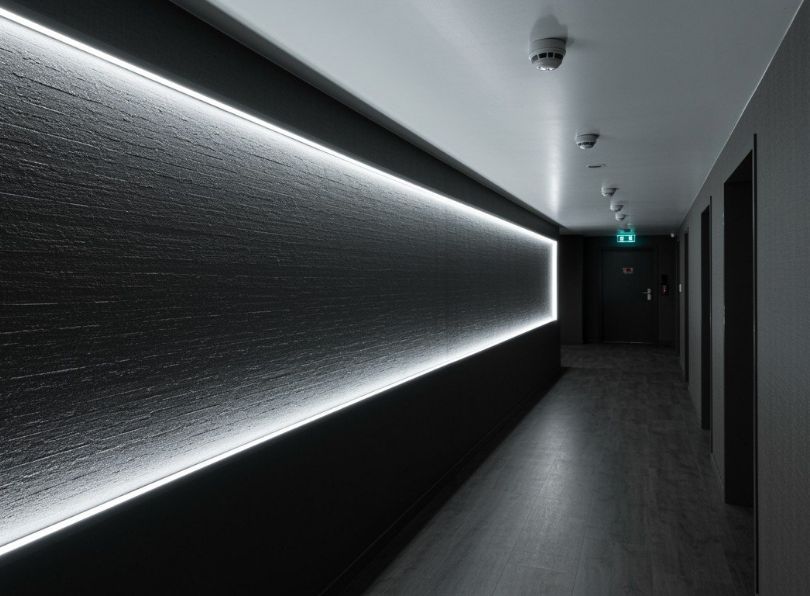
A continuous recessed wall wash lighting system using ultra-slim profiles for both corridors and as a headboard feature in suites.
Product: slim-line (15mm height) aluminum profiles with a snap-on frosted glass diffuser, recessed into wall millwork.
Lighting: tunable White LED strips (2700K-5000K), CRI > 95.
Integration: in suites, the wall wash lights were integrated with the building’s KNX system, allowing guests to select pre-set scenes (“Relax,” “Read,” “Energize”) which adjusted both intensity and CCT. Corridors used presence detection and circadian scheduling.
Installation: profiles mounted at skirting board level (0.1m from floor) in corridors, and behind the bed headboard (0.3m from wall) in suites.
Performance data & before/after metrics
| Metric | Before (decorative sconces) | After (recessed linear wall washer) | Improvement / outcome |
|---|---|---|---|
| Ambient illuminance (corridor floor) | 50 lux (uneven) | 75 lux (U0 > 0.8) | Safe, comfortable navigation. |
| Modeled spatial brightness | Low, with sharp contrasts | High, diffuse, and enveloping | Enhanced perceived luxury and space. |
| Energy use (per room corridor) | 120 Watts (per sconce pair) | 28 Watts (per linear meter) | ~77% reduction per zone. |
| Guest control capability | On/Off only | Dim-to-warm & full Tunable White | Meets HCL principles for wellbeing. |
| Maintenance incidents (annual) | 22 (lamps/drivers) | 2 (system checks) | 91% reduction in maintenance workload. |
| Wall surface luminance | 40-120 cd/m² | 70 ± 10 cd/m² | Perfectly uniform visual field. |
| Installation flexibility | Fixed fixture locations | Can be cut to any length on-site | Allowed perfect adaptation to room variances. |
Photometric rendering vs. reality analysis:
The goal was perceptual comfort, not a specific illuminance target. Post-occupancy surveys showed a 40% increase in guest satisfaction scores related to “lighting comfort.” Luminance camera measurements confirmed the modeled evenness of the wall surface, which was the key driver in eliminating visual strain and creating the desired serene atmosphere. The project demonstrated that wall washing is as much about human factors engineering as it is about photometrics.
Product specification and selection guide
Transitioning from design intent and performance validation to tangible procurement, this final critical section demystifies the process of selecting and specifying the exact components for a successful wall washer lighting installation. A profound understanding of principles is rendered futile without the precise translation into technical product data.
This guide serves as the definitive bridge between the architect’s vision and the contractor’s bill of materials. We will systematically deconstruct the key performance indicators, material properties, and compatibility factors that define a high-performance wall washer light fixture. Moving beyond generic catalog descriptions, we provide a forensic framework for evaluating aluminum profiles, LED sources, optics, and control gear.
This includes direct answers to practical specification queries such as “How many watts is a wall washer light?” and “What IP rating is required for my application?” Armed with the checklists, comparison tables, and decision trees contained herein, the specifier can navigate the marketplace with confidence, ensuring that every selected component—from the alloy temper of the extrusion to the chromaticity binning of the LEDs—coheres into a system that delivers not just light, but the intended architectural experience, durability, and efficiency.
How many watts is a wall washer light?
Answering “How many watts is a wall washer light?” – It depends on length and LED density. A better metric is lumens per meter. A typical high-output LED strip in a profile may consume 14-20W per meter, producing 1200-1800 lumens per meter. The wattage for a specific run is calculated as (W/m * length in meters).
Key specification checklist for aluminum profiles
| Parameter | Consideration | Typical Spec |
|---|---|---|
| IP rating | Indoor (IP20), damp (IP54), wet (IP65/67) | IP20 for dry interiors |
| Material & finish | Aluminum alloy, anodized or powder-coated | ANSI 6063, Black anodized |
| Diffuser type | Clarity, glare control, beam angle | Opal PMMA for even glow |
| LED specifications | CRI, CCT, luminous flux (lm/m) | CRI>90, 2700K-4000K, 1500 lm/m |
| Thermal performance | Max. ambient temperature, heatsinking | Ta = 25°C for rated output |
The future: integrating wall washing into modern architecture
Wall washer lighting is a sophisticated, essential technique for the modern architect and designer. By understanding its principles—from the core question of “what is the purpose of a wall washer light?” to the precise calculations of “how far should a wall washer light be from the wall?”—professionals can leverage light to sculpt space, enhance wellbeing, and create timeless environments.
The adoption of engineered aluminum profile systems, such as those expertly provided by LightingLine.eu, ensures that these designs are realized with the durability, performance, and aesthetic finesse that high-stakes projects demand. This guide serves as a foundation; the application is limited only by the designer’s vision.