
Museum lighting is simultaneously one of the most technically demanding and aesthetically consequential disciplines in architectural illumination. Unlike offices or retail spaces where lighting primarily serves visibility and comfort, museum lighting must achieve multiple critical objectives at once: it must reveal the true colours, textures and material qualities of artworks with absolute fidelity; it must create emotional and narrative atmosphere guiding visitors through an interpretive journey, it must protect sensitive objects from photochemical and thermal damage; and it must accomplish all this while managing energy, maintenance and operational costs across institutions whose missions span centuries.
A single Rembrandt oil painting, a Tang Dynasty silk textile, a Renaissance watercolour or an Early Modern manuscript represents irreplaceable cultural heritage. The light that illuminates these works for today’s visitors is simultaneously, molecule by molecule, contributing to their eventual decay. The role of museum lighting design is to optimise this fundamental tension, giving maximum visual pleasure to the living while protecting what history has entrusted to us for generations yet to come. This article is the definitive professional reference for museum directors, architects, exhibition lighting designers, engineers and curators, covering every dimension of museum lighting from conservation physics to cutting-edge led product specification.
In this article…
- Why museum lighting is critical in museums and galleries
- International museum lighting standards
- Led technology in museum lighting
- Colour rendering: CRI, R9 and the sunlike spectrum
- Colour temperature: 2700K vs 3000K vs tunable white
- UGR glare control
- Led profiles for museums and galleries
- Showcase and display case integration
- DALI-2, DMX512 and wireless control systems
- Conservation: protecting artworks from light
- Exhibition lighting design principles
- Types of museum lighting
- Museum track lighting
- Energy efficiency and sustainability
- Smart and interactive lighting
- Museum lighting for home collections
- Recommended products
- Frequently asked questions
- Museum lighting: a multidisciplinary approach
Why museum lighting is critical in museums and galleries
Light is not merely the medium through which artworks are seen, it is itself a curatorial and interpretive instrument of the first order. The way a painting, sculpture, jewel or fossil is illuminated determines, to a profound degree, what the viewer perceives, feels and understands. Poor museum lighting does not simply make works harder to see: it actively distorts them with flattening tonal range, falsifying colours, eliminating the textural relief essential to understanding technique and materiality, and destroying the atmosphere that gives gallery spaces their distinctive emotional character.
Visitor experience: the evidence base
Empirical research consistently confirms that lighting quality is among the top three determinants of visitor satisfaction, alongside gallery layout and object selection. A 2019 Getty Conservation Institute study found that visitors in optimally lit galleries reported 34% higher satisfaction scores and spent on average 47% more time in front of individual works. A 2021 IES study documented that visitors consistently rated high-CRI environments (Ra ≥95) as more engaging and more likely to motivate a return visit even without being informed of the technical difference. High-CRI lighting activates a broader range of cone photoreceptors, increasing perceived contrast, saturation and fine detail while directional accent creates the modelling that reveals three-dimensional form, flicker-free illumination reduces eye fatigue and calibrated ambient levels create the contrast hierarchy that directs attention with quiet authority.
Conservation: every photon has a cost
Every photon striking an artwork carries energy and that energy has irreversible consequences. The photochemical degradation of organic materials (fading pigments, yellowing paper, embrittled textiles) is a direct function of illuminance and cumulative exposure. UV radiation, present in sunlight, fluorescent tubes and metal halide lamps, is particularly destructive due to its high photon energy. Modern museum led strips produce zero UV by design, eliminating the most acute conservation risk entirely. Their minimal infrared output also eliminates the thermal stress (warping, cracking, delamination) that plagued the halogen era. And their precision dimmability enables rigorous annual lux-hour budget management impossible with analogue technology.
Institutional reputation and loan eligibility
Photography and social media documentation depends critically on lighting quality: high-CRI, flicker-free led produces beautiful, accurate images and substandard lighting produces distorted photographs that reflect poorly on institutional standards. More critically, major lending institutions routinely audit lighting conditions before approving loans. The 2022 ICOM Environmental Guidelines survey found 89% of major lenders had declined loan requests due to inadequate lighting with insufficient UGR control (67%), CRI below Ra 90 (54%) and absent UV documentation (51%) most frequently cited. Upgrading to museum-grade led lighting directly expands loan programme eligibility.
International museum lighting standards
Professional museum lighting operates within a rigorous framework of international standards and best-practice guidelines. Non-compliance risks conservation damage, institutional liability, loss of accreditation and exclusion from loan programmes. The primary documents governing museum lighting practice worldwide are:
- CIE 157:2004 — Control of damage to museum objects by optical radiation. The foundational conservation standard: sensitivity categories, lux limits, annual lux-hour budgets and spectral damage weighting functions.
- EN 12464-1 — European standard for lighting of work places. UGR limits (≤19 for museums; ≤16 for fine viewing), illuminance and uniformity requirements.
- EN 15757 — Conservation of cultural property. Detailed optical radiation management guidance for museums, archives and libraries.
- PAS 198:2012 (BSI) — Managing environmental conditions for cultural collections. Widely adopted internationally for both permanent and temporary exhibition environments.
- IES RP-30 — Recommended practice for museum and art gallery lighting. Comprehensive North American practitioner guidance.
- ICOM Ethical Guidelines — Environmental stewardship provisions effectively mandatory for institutional accreditation and international loan programme participation.
| Category | Objects | Max illuminance | Max annual exposure | Min CRI | UV limit |
|---|---|---|---|---|---|
| A — Highly sensitive | Watercolours, textiles, photographs, prints, tapestries, dyed leather | 50 lux | 15,000 lux-h/year | Ra ≥90 | Zero UV |
| B — Sensitive | Oil paintings, tempera, undyed leather, horn, bone, ivory, lacquer | 150–200 lux | 30,000–45,000 lux-h/year | Ra ≥90 | ≤10 µW/lm |
| C — Insensitive | Stone, ceramics, glass, metals, minerals, fired enamels | Up to 300+ lux | No annual limit | Ra ≥90 | ≤75 µW/lm |
| D — Mixed/Complex | Composite objects, mixed-media, polychrome wood | Most sensitive component governs | Most sensitive component governs | Ra ≥95 | Zero UV recommended |
The 3-lighting rule, the 4 C’s and the 5-7 ratio
Beyond formal standards, three conceptual frameworks structure professional museum lighting design.
The 3-lighting rule: every museum space requires of
- Ambient — foundational general illumination;
- Accent — directed object highlighting;
- Task — functional lighting for labels, kiosks and service points.
The 4 C’s of lighting: colour (CRI fidelity), contrast (highlight-shadow ratio), control (precision dimming and scene management) and conservation (photodegradation minimisation).
The 5-7 ratio rule: accent lighting on artworks should be 5 to 7 times brighter than the ambient wall/floor illuminance, creating drama and focus without eye-straining contrast that prevents comfortable viewing-zone adaptation.
Led technology in modern museum lighting
The adoption of led technology is the most transformative development in museum and gallery lighting in the modern era. Third and fourth-generation museum-grade led systems now outperform every predecessor technology on all metrics relevant to professional exhibition applications, while delivering 80%+ energy savings, zero UV emission and dramatically extended service life. Do museums use led lights? The answer is unequivocally yes and the reasons are compelling on every dimension simultaneously.
| Parameter | Halogen | Fluorescent | Metal halide | Standard led | Museum led (sunlike) |
|---|---|---|---|---|---|
| CRI Ra | 97–100 | 70–90 | 75–96 | 80–95 | >97 |
| R9 (deep red) | ~98 | 30–60 | 50–85 | 40–85 | >95 |
| UV output | High | Medium-High | High | Zero | Zero |
| IR / thermal on object | Very High | Low | Medium | Very Low | Negligible |
| Efficacy (lm/W) | 12–25 | 60–90 | 65–115 | 100–160 | 130–200 |
| Dimming | Good (analogue) | Poor–Fair | Poor | Good (digital) | Excellent: DALI-2, 0.1–100% |
| Flicker | None | Significant | Significant | Possible | None (>16kHz PWM) |
| Service life (hours) | 2,000–4,000 | 8,000–15,000 | 6,000–20,000 | 25,000–50,000 | 50,000+ L70/B10 |
| Energy saving vs halogen | — | ~65% | ~70% | ~78% | ~82–85% |
led strips in aluminium profiles have opened entirely new possibilities for museum design. Their linear form integrates invisibly into display case frames, ceiling coves, wall recesses and custom exhibition furniture — creating light that appears to emanate from the architecture itself. COB technology delivers perfectly uniform, dot-free linear illumination essential for showcase integration. Thermal stability, ensured by aluminium profile mounting, maintains consistent colour performance and reduces lumen depreciation across multi-year exhibitions.
Colour rendering: CRI, R9 and the sunlike spectrum
Colour rendering is the single most important technical parameter in museum lighting. A great painting seen under low-CRI light is not merely a worse experience, it is a fundamentally inaccurate one. Colour relationships, highlight luminosity, shadow depth, flesh-tone subtlety all are distorted when the light source cannot reproduce the full chromatic spectrum. CRI Ra (average of R1–R8 reference colours) has important limitations for museum specification: the eight test stimuli are desaturated pastels that exclude the highly saturated hues common in artistic pigments. Museum specifications must always include R9 (deep saturated red), target R9 ≥90, alongside Ra ≥95.
Sunlike led technology (Seoul Semiconductor / Toshiba) uses a violet 405nm pump chip with complete multi-phosphor conversion, producing a smooth continuous spectrum with no blue spike, achieving Ra >97, R9 >95, IES TM-30 Rf ≥95 and Rg 98–102. The blue-spike elimination also reduces photodegradation risk for indigo and blue-light-sensitive organic dyes. This is the new international standard for fine art museum lighting.
Recommended: sunlike led strip
CRI Ra>97, R9>95. Sun-like spectrum with absolute chromatic fidelity for paintings, textiles, manuscripts and metalwork. Available in 2700K, 3000K, 4000K and tunable white. The benchmark led strip for fine art museum and gallery display.
| Index | Colour stimulus | Art / museum relevance | Museum target |
|---|---|---|---|
| Ra (R1–R8 avg) | Standard Munsell pastels | General chromatic accuracy | Ra ≥95 |
| R9 | Deep saturated red | Vermilion, crimson, madder, alizarin; portrait flesh tones in figurative art | R9 ≥90 |
| R10 | Deep yellow-orange | Cadmium yellow, ochre, gold leaf | R10 ≥90 |
| R12 | Deep blue | Ultramarine, cobalt, Prussian blue, azurite | R12 ≥90 |
| R13 | Caucasian skin tone | Portrait painting, figurative sculpture, classical marble | R13 ≥95 |
| R15 | East Asian skin tone | Japanese, Chinese and Korean figurative art and ceramics | R15 ≥95 |
Colour Temperature: 2700K vs 3000K vs Tunable White
Colour temperature is one of the most debated decisions in museum lighting design. Unlike CRI (higher is always better), CCT involves genuine aesthetic and interpretive choices. 2700K produces warm, amber-tinged light resembling late afternoon sun or the halogen sources that dominated European museums until recently are preferred for Old Master paintings, medieval manuscripts, Renaissance and Baroque works, gold and bronze artefacts, historical textiles and natural history specimens. It enhances ochre and umber pigments, intensifies gold surfaces and creates the solemnity appropriate to collections of great age.
3000K is the versatile museum standard: slightly cooler, suited to Impressionist and modern works, mixed collections and spaces with significant white architectural surfaces. 3500K–4000K is preferred for contemporary art, photography and mixed-media, matching the studio and gallery conditions under which most contemporary work is made. Tunable white systems (2700K–6500K) provide maximum curatorial flexibility, but require careful CCT documentation for conservation photography consistency.
Recommended: circadian light care strip
Full tunable white with dynamic CCT adjustment for biophilic museum design and staff circadian health. Programmed via Skydance WT-DMX-S Tuya WiFi master for automated biorhythm cycling.
| Collection / context | Recommended CCT | Rationale |
|---|---|---|
| Old Master paintings (15th–18th c.) | 2700K–3000K | Warm light; enhances ochres, umbers and gold leaf |
| Impressionist and Post-Impressionist | 3000K–3500K | Slightly cooler; enhances luminous blues and violets |
| Contemporary art (post-1960) | 3500K–4000K | Matches studio and commercial gallery conventions |
| Photography and digital prints | 3500K–5000K | Closer to photographic print evaluation standards D50/D65 |
| Archaeological artefacts | 2700K–3500K | Enhances metal patinas, ceramic glazes, organic materials |
| Mixed or touring exhibitions | Tunable 2700K–4000K | Maximum flexibility across diverse works and media |
UGR glare control
Glare is one of the most insidious enemies of the museum visitor experience. It causes squinting, reduced visual acuity, headaches and fatigue during extended gallery visits. In glass-fronted display cases, reflected glare from incorrectly positioned sources makes interior objects virtually invisible, a fundamental failure of the institution’s communicative purpose. UGR (Unified Glare Rating, CIE 117:1995 / EN 12464-1) is the international metric for quantifying this discomfort: for museums, the target is UGR ≤19 in general galleries and UGR ≤16 for display case and fine-viewing contexts.
| UGR value | Perception | Museum application |
|---|---|---|
| <13 | Excellent — imperceptible | Fine art display cases, premium close viewing |
| 13–16 | Good — acceptable | Standard gallery display, EN 12464-1 fine viewing recommendation |
| 16–19 | Moderate discomfort | General circulation, EN 12464-1 general museum recommendation |
| >19 | Uncomfortable | Not acceptable for any public gallery or display case environment |
The primary tool for UGR control in led strip installations is the aluminium profile with appropriate diffuser or optical cover. Opaque (FM) diffusers provide maximum glare reduction — a uniform luminous surface with no visible chip pattern. Satin (FS) diffusers balance efficiency with hotspot reduction: the preferred choice for most museum display applications. Precision lens covers (60° or 90°) direct light precisely onto target surfaces while minimising spill. The 30° vertical angle rule for picture lighting positions the luminaire outside the specular reflection zone for typical standing viewers, eliminating the varnish hot spot that obliterates surface detail and colour at typical viewing distances.
Recommended: RD-03-FM2 opaque diffuser for museum UGR control
Maximum UGR reduction for museum and gallery strip lighting applications. Creates a smooth, uniform luminous surface, no chip pattern visible. Compatible with RE01-03 recessed profile series; achieves UGR ≤13–16 for fine art display environments.

Led profiles for museum and gallery lighting
The aluminium led profile is the engineered interface between led strip and architectural space determining how light integrates into the building, how uniformly it is distributed, how effectively glare is managed, and how efficiently heat is dissipated from the led chips. In museum applications, profile selection directly affects conservation quality, visual performance and architectural integration. All professional museum-grade profiles are fabricated from extruded aluminium (alloy 6063-T5 or equivalent), whose exceptional thermal conductivity(160–205 W/m·K) reduces led junction operating temperature — extending service life, improving colour stability and minimising residual thermal radiation directed toward sensitive objects.
Surface-mounted profiles are most versatile, used in coves, behind pelmets and within display furniture where the profile body is concealed. Recessed profiles embedded flush with ceiling, wall or display case surfaces create the most architecturally refined integration, essential in heritage buildings where visible modern hardware would be inappropriate. Corner profiles at 45° create controlled grazing light across vertical surfaces, ideal for archaeological reliefs, carved stonework, embossed leather and highly textured paintings where three-dimensional surface quality is the primary subject of display.
Recommended: RE01-03 recessed aluminium profile series
Flush architectural integration for premium museum and gallery environments. Accommodates single and double-row led strips; compatible with FM, FS and lens diffusers; provides inherent UGR benefit through recessed geometry acting as a partial louver.
Ultra-slim profiles: the showcase revolution
Display cases demand the most specialised profile engineering: minimal spatial footprint, invisible integration, uniform output and effective thermal management. The SL07-05 ultra-slim profile at only 7mm total height is the definitive solution. Its dimensions allow integration into shelf edges as thin as 8–10mm, display case inner frames and the structural members of bespoke exhibition furniture. Despite its extraordinary compactness, it accommodates professional COB and SMD led strips and accepts satin or opal diffuser covers for uniform, glare-controlled showcase illumination.
Recommended: SL07-05 ultra-slim profile
7mm height — invisible within case structures while delivering professional linear illumination. Combined with COB led strips (zero dot effect) and satin diffuser: the complete professional showcase system.
| Application | Profile Format | Key Requirement | Recommended Product |
|---|---|---|---|
| Ceiling cove / perimeter ambient | Surface or recessed | High output, FM/FS diffuser | RE01-03 + RD-03-FM2 |
| Display wall wash / grazing | Corner 45° or recessed wall | Uniform distribution, UGR ≤16 | Corner series + FS diffuser |
| Showcase shelf edge | Ultra-slim (≤10mm height) | COB strip, zero dot effect | PR-SL07-05 + F52-400-480OR2-W8 |
| Display case perimeter frame | Recessed or ultra-slim | Invisible integration, thermal coupling to frame | RE01-03 or PR-SL07-05 |
| Sculpture pedestal / plinth | Corner 45° | Low grazing, 360° coverage option | 45° corner series |
| Architectural coffer / recess | Recessed shallow | Flush, minimal depth requirement | RE01-03 |
Showcase and display case integration
Showcase and vitrine lighting is one of the most technically demanding challenges in museum practice. Constraints are severe: minimal spatial footprint; zero visible glare on glass at all viewing angles; exceptional colour rendering at close viewing distances (30–60cm); minimal thermal contribution to the sealed case microclimate; and, increasingly, interactive response to visitor presence for conservation and energy management. The combination of COB led strips, ultra-slim aluminium profiles, precision diffusers and interactive sensors addresses all these requirements in a single integrated system.
COB technology: eliminating the dot effect
Standard SMD led strips produce visible discrete point sources at the close viewing distances typical of display cases, a distracting “beaded” effect that undermines display quality and professional presentation. COB (Chip on Board) technology completely eliminates this by mounting 320, 480 or up to 600 chips per metre onto a continuous substrate encapsulated in a single phosphor layer, a perfectly uniform, dot-free luminous line visible from any angle and at any viewing distance.
Recommended: COB led strip — F52-400-480OR2-W8
480 chips/metre. Perfectly continuous, dot-free light line. CRI Ra ≥95. Ideal for glass display cases and vitrines at any close viewing distance. Combined with SL07-05 profile and satin diffuser: the complete professional showcase illumination system.
Managing glass reflections
Any light source visible from the exterior of a glass case at standard viewing angles creates a specular reflection that obscures the interior object. The solution requires systematic geometric design: position led strips at the front edge of the top shelf, angled slightly backward so reflections fall above the viewer’s typical eye level, use profile geometry and diffusers to limit the visible luminous angle through the glass; and specify anti-reflective coated case glass (reducing specular reflectance from ~8% to ~0.3% per surface) for the most demanding installations.
Interactive showcase lighting: conservation by design
Interactive sensor integration transforms showcase lighting into an active conservation tool. Rather than maintaining full display illuminance throughout opening hours, accumulating unnecessary photon exposure on sensitive objects, interactive systems activate lighting only when a visitor is present, reducing to a conservation standby level otherwise. This approach reduces annual object lux-hour exposure by 40–80%, dramatically extending the sustainable display period for highly sensitive Category A materials. Hand-sweep sensors (EB) detect visitor proximity; door sensors (ED) activate case lighting when curators open the case for access.
Recommended:hand sweep sensor + door sensor
IR proximity activation of showcase led lighting. Adjustable trigger distance (20–80cm), fade-on time and standby level. Integrates with DALI or PWM drivers. Combined with COB strip + SL07-05 profile + Skydance DALI-2 decoder: the complete professional interactive showcase system for conservation-grade museum display.
DALI-2, DMX512 and wireless control systems
The control system is the nerve centre of professional museum lighting. Even the most precisely specified led and profile installation fails to deliver its full conservation and experiential potential without accurate, reliable control of intensity, colour temperature, scene configuration, scheduling and lux-hour logging. In museum practice, the control architecture is the instrument through which all conservation parameters are actually implemented and managed in daily operation.
Flicker-free operation: an absolute requirement
led flicker at frequencies below ~1,500 Hz causes subliminal stress, reduced visual acuity and headaches during extended exposure (IEEE PAR 1789, IEA Flicker Research). In museums it also degrades photography and videography: cameras at typical shutter speeds capture different power cycle phases as visible banding or uneven exposure, unacceptable in an era when visitor photography, press documentation and conservation imaging are essential institutional functions. Professional museum drivers must operate at high PWM frequencies: 16kHz (DA4-L) or 32kHz (DA4-D), well above any perceptual or photographic artefact threshold.
DALI-2: the professional museum control standard
DALI-2 (IEC 62386) is the de facto standard for precision lighting control in museum and cultural building applications. Its capabilities directly address museum operational requirements: individual device addressability, ultra-low dimming to 0.1%, 16-scene programming for instant recall of calibrated configurations, two-way communication and lux-hour logging for automated conservation documentation, sensor integration on the same bus, and BMS gateway compatibility for unified facility management. DALI-2 is not merely a convenience, it is the enabling technology for precision annual lux-hour budget management.
Recommended: Skydance DA4-L / DA4-D DALI-2 decoders
DA4-L: 4-channel DALI-2, dimming 0.1–100%, PWM ≤16kHz, standard museum gallery control. DA4-D: 4-channel DALI-2, PWM ≤32kHz, maximum flicker-free performance for photography-intensive galleries. Both fully DALI-2 compliant with BMS gateway support.
DMX512/RDM: scenographic and dynamic exhibition control
For temporary exhibitions, immersive installations and theatrical lighting effects, DMX512 provides 512 independently controllable channels per universe with 16-bit (65,536-level) resolution and real-time continuous variation, enabling the ultra-smooth, precisely timed scene transitions required for the most demanding museum lighting scenography. RDM bidirectional management adds fault reporting and device configuration, making DMX/RDM practical for permanent museum installations as well as touring exhibitions.
Recommended: Skydance D4-L / D12A DMX Decoders
D4-L (4-channel) and D12A (12-channel): DMX512/RDM, 16-bit dimming resolution, high-frequency operation. Professional choice for temporary exhibitions, immersive installations and complex multi-zone scenographic museum lighting control.
Wireless control: Casambi for historic museum buildings
In heritage museum buildings where new control cabling through listed masonry or ornamental plasterwork is impossible or prohibited, Casambi wireless mesh control provides a complete professional alternative. Casambi-compatible controllers deliver all the scene programming, dimming precision and individual addressability of wired DALI, managed via smartphone/tablet application, without any dedicated control wiring infrastructure. Essential for museum refurbishments in listed historic buildings and temporary exhibition fit-outs where cable installation is impractical.
Recommended: Skydance CB5 Casambi Controller / WT-DMX-S Tuya WiFi Master
CB5: full wireless Casambi mesh, museum-grade dimming, no data cabling required. WT-DMX-S: Tuya WiFi + DMX master for automated biorhythm/circadian CCT and intensity scheduling. Both ideal for historic building installations and temporary exhibitions.

Conservation: protecting artworks from light damage
Conservation from light damage is the dimension that most fundamentally distinguishes museum lighting from all other architectural applications. Photochemical reactions (fading, yellowing, embrittlement) are driven by photon energy and are cumulative and irreversible. UV photons carry the most destructive energy; the blue spike of conventional leds also carries disproportionate photodegradation potential for certain organic dyes. Modern Sunlike led strips eliminate both UV and the blue spike, providing a quantifiable conservation improvement beyond their superior CRI. Annual lux-hour budget management (CIE 157), tracked through DALI-2 lux-hour logging, allows conservative display practice without sacrificing visual quality for today’s visitors.
| Category | Max annual lux-hours | Display hrs/year (250 days) | Avg lux implied | Max instantaneous lux |
|---|---|---|---|---|
| A — Highly sensitive | 15,000 | 2,500 | 6 lux avg | 50 lux max |
| B — Sensitive | 30,000–45,000 | 2,500 | 12–18 lux avg | 150–200 lux max |
| C/B — Moderate | 75,000–150,000 | 2,500 | 30–60 lux avg | 200–300 lux max |
| C — Insensitive | No limit | Unrestricted | Per EN 12464-1 | No limit |
Exhibition lighting design principles
Great exhibition lighting creates an experience that serves the institution’s communicative and educational mission. Technical compliance is necessary but not sufficient. The finest museum lighting transforms passive looking into active, emotionally resonant experience, revealing qualities the visitor might otherwise miss and guiding interpretation through the eloquent language of light and shadow. Every successful gallery has a lighting hierarchy: major works receive the highest accent illuminance, secondary works are moderately lit, circulation and architectural surfaces form a lower-intensity background that supports rather than competes with the displayed objects. This hierarchy must reinforce and amplify the curatorial argument, established through close collaboration between the lighting designer and the curatorial team.
The professional workflow:
- conservation audit — classify all objects, establish lux limits and annual budgets per zone;
- architectural survey;
- curatorial brief;
- lighting concept — ambient strategy, accent positions and 5:1–7:1 ratios, CCT schedule, control zones;
- photometric simulation (DIALux, AGi32, Relux);
- product specification;
- professional installation with conservation protocols;
- commissioning and on-site lux calibration with calibrated photometer;
- conservation documentation — formal record of installed lux, CCT and control settings;
- ongoing DALI-2 lux-hour monitoring and proactive maintenance.
| Exhibition type | Lighting approach | CCT | UGR target | Control priority |
|---|---|---|---|---|
| Old Master / classical paintings | Directional accent 30° + low recessed ambient | 2700K–3000K | ≤16 | Scene stability, DALI lux logging |
| Contemporary art (painting/sculpture) | Ambient-forward + selective accent | 3000K–4000K | ≤19 | Flexible CCT and scene control |
| Photography exhibition | Diffuse ambient dominant; minimal directional | 3500K–4500K | ≤16 | Precise CCT, dimming to 1 lux precision |
| Archaeological artefacts | COB showcase + selective accent | 2700K–3500K | ≤13 (cases) | Interactive sensors + annual lux budget |
| Textiles and costume | Low-level diffuse; showcase COB perimeter | 2700K–3000K | ≤13 | Strict annual lux budget, sensor automation |
| Immersive / digital art | Dynamic, colour-tunable, theatrical effects | Full tunable range | Variable per scene | Full DMX real-time control |
Types of museum lighting: ambient, accent and task
Museum lighting is always designed in three distinct functional layers.
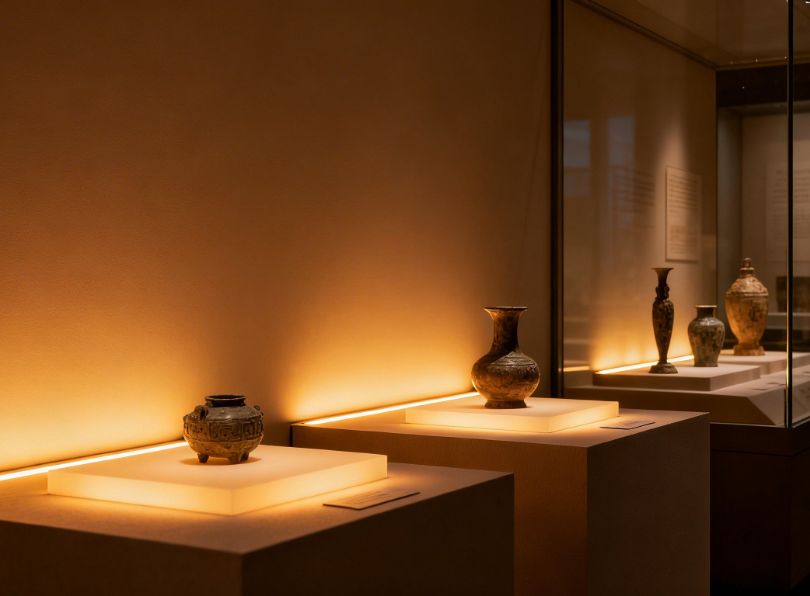
Ambient lighting establishes the foundational illumination of the space, deliberately kept low (30–80 lux) in fine art galleries to preserve the visual contrast between accented artworks and their setting. Provided by recessed ceiling led profiles, cove strips or pendant systems, all dimmable on DALI-2, separately zoned from accent circuits.
Accent lighting is the active, expressive centre: it directs attention, creates modelling that reveals three-dimensional form and surface texture, and establishes the perceptual hierarchy guiding the visitor through the curatorial narrative. Delivered by track led spotlights for directional object illumination and led strip profiles for wall wash, case perimeter and sculpture plinth lighting. Key parameters: beam angle 15°–35°; accent-to-ambient ratio 5:1–7:1; 30° vertical incidence on paintings; CRI Ra ≥95, R9 ≥90.
Task lighting serves practical functions: label reading (100–200 lux), interactive kiosks, reception and conservation preparation areas, always separately zoned to avoid distracting from adjacent gallery viewing.
Museum track lighting and directional systems
Museum track lighting remains, alongside led strip profiles, one of the two primary architectural lighting technologies for galleries, most effectively deployed in combination. Track systems provide the critical advantage of repositionability: luminaires can be moved, aimed and refocused without electrical work, adapting instantly to changing exhibition layouts. European museums typically use mains-voltage 230V track for maximum output range while 48V DC low-voltage track is the emerging premium format, repositionable live, excellent EMC compatibility and minimal luminaire profiles preferred in contemporary museum interiors. DALI-integrated track enables individual spotlight addressing from the BMS with lux-hour logging per position. The most sophisticated installations combine track spots for directional object accent with led strip profiles for ambient, cove and case illumination on shared DALI-2 or DMX control, a complementary pairing that produces a richer, more conservation-appropriate environment than either system alone.
Energy efficiency and sustainability
Museums are among the most energy-intensive building types per unit floor area, historically making them significant energy consumers. The led transition has transformed this profile. Premium museum led strips achieve 130–200 lm/W vs 12–25 lm/W for halogen, an immediate 80–85% reduction in lighting electricity consumption. Extended service life (50,000+ hours vs 2,000–4,000 for halogen) eliminates the frequent re-lamping that dominated maintenance budgets and required conservation protocols. DALI-2-controlled occupancy detection and interactive showcase sensors further reduce operating hours and energy automatically.
Smart and interactive lighting technologies
The digitalisation of led control has enabled smart museum systems that adapt in real time to visitor presence, conservation requirements and building management parameters. Occupancy-based dynamic lighting reduces output in unoccupied zones and creates the impression of lighting responding to the visitor’s presence. Daylight integration systems maintain constant total illuminance (natural + artificial) at key display positions, ensuring conservation compliance while creating naturalistic atmospheric variation. Biorhythm and circadian programming via Tuya WiFi masters automatically shifts CCT and intensity through the day: energising cool morning profiles, neutral afternoon quality, warm evening intimacy — supporting staff wellbeing, enriching visitor experience and optimising energy consumption through intelligent scheduling.
Museum lighting for home and private collections
Museum lighting principles apply equally to private collections, high-end residential art display and hospitality environments. The core specification is identical: CRI Ra ≥95 (ideally Sunlike Ra >97) for faithful colour rendering, flicker-free dimmable drivers, aluminium profiles for integration and thermal management, UGR control for glazed works. What changes is the scale and complexity of the control system. Practical guidance for private art collectors: 150–300 lux on paintings in good condition, 50–100 lux for works on paper and photographs, CCT 2700K–3000K for classical works, 3000K–3500K for modern and contemporary, always use dimmable drivers, verify no glass reflections from multiple viewing positions, consider anti-reflective case glass and Sunlike led strips for the most valued works in the collection.
Recommended products for museum lighting
The following curated selection o products covers every requirement from ultra-high-CRI strip technology through showcase profiles to professional control systems. All products include full technical data sheets, photometric files and professional installation support.
| Product | Technology | CRI | CCT | Application | Key feature |
|---|---|---|---|---|---|
| F52-40s-x1288H2/13 (sunlike) | Sunlike violet pump | Ra>97, R9>95 | 2700K / 3000K / 4000K | Fine art, Old Masters, decorative arts | Maximum chromatic fidelity, no blue spike |
| F52-400-480OR2-W8 (COB) | COB 480 chips/m | Ra ≥95 | 2700K–4000K | Display cases, vitrines, showcases | Zero dot effect, perfectly continuous line |
| Circadian light | Tunable white | Ra ≥90 | 2700K–6500K tunable | Biophilic galleries, staff wellbeing, flexible CCT | Full circadian spectrum cycling |
| Product | Type / protocol | Key specification | Primary application |
|---|---|---|---|
| SL07-05 | Ultra-slim profile (7mm) | Fits shelf edges ≥8mm; FS/FM diffuser | Showcase and vitrine shelf edge integration |
| RE01-03 | Recessed aluminium profile | Flush installation; single/double row | Ceiling, wall, case perimeter, architectural coves |
| RD-03-FM2 | Opaque diffuser cover | Maximum UGR reduction; profile-compatible | Ambient and case lighting UGR control |
| Skydance DA4-L | DALI-2 decoder | 0.1–100% dimming; PWM ≤16kHz | Gallery DALI control; permanent collections |
| Skydance DA4-D | DALI-2 decoder | 0.1–100% dimming; PWM ≤32kHz | Photography-intensive galleries; max flicker-free |
| Skydance D4-L | DMX512/RDM | 4 channels; 16-bit resolution | Temporary exhibitions; immersive installations |
| Skydance D12A | DMX512/RDM | 12 channels; 16-bit resolution | Complex multi-zone scenographic control |
| Skydance CB5 | Casambi Bluetooth mesh | 0.1–100%; no data cabling | Historic buildings; wireless museum control |
| Skydance WT-DMX-S | Tuya WiFi + DMX | Full control; CCT time-scheduling | Biorhythm / circadian automated programming |
| Skydance EB-V(C) | IR hand-sweep sensor | 20–80cm adjustable trigger | Interactive showcase visitor-activated lighting |
Your frequently asked questions…
Do museums use led lights?Yes. The vast majority of modern museums have adopted led for zero UV emission, negligible IR output, CRI Ra>97 with Sunlike technology, 80%+ energy savings over halogen, flicker-free DALI-2 dimming from 0.1% and service lives exceeding 50,000 hours. Legacy halogen, fluorescent and metal halide systems are now essentially obsolete in professional museum and gallery contexts. |
How do you light a museum or exhibition?The professional workflow: (1) Conservation audit — classify objects, establish lux and lux-hour limits per zone. (2) Architectural survey. (3) Curatorial brief — narrative, hierarchy, atmosphere. (4) Lighting concept — ambient, accent and task layers, CCT schedule. (5) Photometric simulation (DIALux/AGi32). (6) Product specification. (7) Professional installation with conservation protocols. (8) Commissioning and on-site lux calibration. (9) Conservation documentation. (10) Ongoing DALI-2 lux-hour monitoring. |
What colour temperature is best for museum lighting?2700K–3000K for Old Masters, historical artefacts and warm classical collections. 3000K–3500K for Impressionist, modern and mixed collections. 3500K–4000K for contemporary art, photography and mixed-media. Tunable white (2700K–6500K) provides maximum flexibility for diverse or rotating collections. |
Should I use 2700K or 3000K for art?2700K for Old Master paintings, gold leaf, antique furniture and warm-toned classical works — it enhances ochre, umber and gold and creates the solemnity appropriate to historical collections. 3000K for Impressionist, modern and mixed collections — slightly cooler but still warm enough to flatter a wide range. For maximum flexibility across a diverse collection, specify a tunable white system. |
What is UGR and why does it matter in museums?UGR (Unified Glare Rating, EN 12464-1) quantifies discomfort glare from luminaires. Museums target UGR ≤19 for general galleries and UGR ≤16 for display cases. High glare distracts visitors, causes eye fatigue and in glass cases makes objects virtually invisible. led profiles with opal (FM) or satin (FS) diffusers are the primary tool for achieving museum UGR targets. |
What CRI is required for museum lighting?Minimum Ra ≥90; Ra ≥95 strongly preferred for fine art; Sunlike led achieves Ra>97 with R9>95 — the highest standard available in any led strip technology. R9 (deep saturated red) must always be specified alongside Ra for art applications: professional museum target is R9 ≥90. |
What is the lux level for museum lighting?Highly sensitive works (watercolours, textiles, photographs): max 50 lux, 15,000 lux-hours/year. Sensitive works (oil paintings): 50–200 lux, 30,000–45,000 lux-hours/year. Insensitive objects (stone, ceramics, metals): up to 300 lux, no annual limit. DALI-2 control with integrated lux-hour logging enables precision budget management and automated conservation documentation. |
What are the lighting standards for museums?CIE 157:2004 (optical radiation damage), EN 12464-1 (workplaces), EN 15757 (conservation of cultural property), PAS 198:2012 (environmental conditions for cultural collections), IES RP-30 (museum and art gallery practice) and ICOM ethical guidelines. Together these define lux limits, annual exposure budgets, UV/IR requirements, minimum CRI values and UGR targets for professional museum environments. |
What is the angle of museum lighting for paintings?The professional standard is 30° from vertical: light strikes the canvas at 30° from perpendicular to its surface. This position creates good surface modelling while keeping the source outside the specular reflection zone for typical standing viewers, eliminating the varnish hot spot that obliterates colour and surface detail. Steeper angles (45°–60°) are used for highly textured or relief works. |
What is the 3 lighting rule in museum design?Three essential layers: (1) Ambient — foundational general illumination establishing the atmospheric baseline; (2) Accent — directed lighting of specific artworks and objects creating hierarchy and focus; (3) Task — functional lighting for labels, interactive stations, reception and service points. The balance between these three layers defines the atmospheric quality and visitor experience of the gallery. |
What are the 4 C’s of lighting?Colour (high-CRI chromatic accuracy for faithful object rendering), Contrast (highlight-shadow ratio creating depth, drama and three-dimensionality), Control (precision dimming, scene management and lux-hour scheduling) and Conservation (minimising photodegradation through UV exclusion, lux budgets and thermal management). In museum lighting all four must be balanced simultaneously. |
Why are museums often dimly lit?Low light levels are a conservation imperative. Photons drive irreversible photochemical reactions — fading pigments, embrittling paper and textiles, degrading organic binding media — that are cumulative and permanent. By limiting lux levels and annual lux-hour budgets, conservators protect collections for future generations. Modern led systems allow this balance to be achieved without compromising the visual richness and emotional impact of the visitor experience. |
Why aren’t camera flashes allowed in museums?Flash photography is prohibited primarily for conservation: a single flash delivers an intense UV-containing radiation pulse; a popular work may receive hundreds of flashes per day. Cumulative exposure causes measurable, irreversible photodegradation over time. Secondary reasons: visitor experience disruption and physical risk near artworks. Modern smartphone cameras produce excellent results under proper museum led lighting without flash. |
Can led strips be used inside display cases?Yes — they are the preferred technology for professional museum showcases. Ultra-slim profiles (PR-SL07-05, 7mm) with COB led strips (perfectly uniform, no dot effect, CRI ≥95) provide conservation-quality illumination in the most constrained showcase environments. Interactive hand-sweep sensors (EB-V(C)) reduce annual object lux-hour exposure by 40–80%. Complete system: Sunlike/COB strip + PR-SL07-05 + satin diffuser + EB sensor + Skydance DALI-2 driver. |
What is museum-grade lighting?Museum-grade lighting meets: CRI Ra ≥95 (ideally Ra>97 Sunlike), zero UV emission, flicker-free PWM ≥16kHz, DALI-2 or DMX dimming 0.1–100%, UGR ≤16 for display cases, MacAdam Step ≤2 colour stability and L70/B10 service life ≥50,000 hours. led strips in aluminium profiles with professional control and diffuser systems constitute the core of modern museum-grade illumination. |
What is the best lighting for art galleries and exhibitions?The professional standard combines: Sunlike CRI Ra>97 led strips in aluminium profiles for ambient, cove and showcase lighting; museum-grade track led spotlights for directional accent at 30° vertical; DALI-2 precision control with lux-hour logging; UGR ≤16–19 throughout; CCT matched to the collection (2700K–4000K). All referenced products are available at catalogue.lightingline.eu. |

Museum lighting: a multidisciplinary approach
Museum lighting stands at the convergence of conservation science, optical engineering, architectural design and human perceptual psychology. It demands from its practitioners an unusually broad competence: fluency in photophysics and pigment chemistry, mastery of lighting simulation and control engineering, sensitivity to art history and curatorial narrative and command of a rapidly evolving led technology landscape that is genuinely transforming what is achievable in cultural building illumination.
The technological revolution in museum lighting led systems, driven by Sunlike ultra-high-CRI strip technology, DALI-2 precision control with lux-hour logging, COB showcase integration and interactive sensor platforms, has transformed the possibilities available to every type of institution, from major national museums to small regional galleries and private collections. A well-specified led strip and profile system can simultaneously deliver better colour rendering than any predecessor technology, eliminate all UV and infrared conservation risks, reduce energy consumption by 80%+ and provide the precision control to manage both conservation budgets and visitor experience objectives with equal and unprecedented rigour.
Museum lighting is, in the deepest sense, an act of professional and cultural stewardship, serving artworks entrusted to institutions by history, the visitors who seek understanding and inspiration in their presence, and the generations who will inherit both the collections and the institutions that care for them. Getting it right matters profoundly and the technology to get it right has never been better as today.