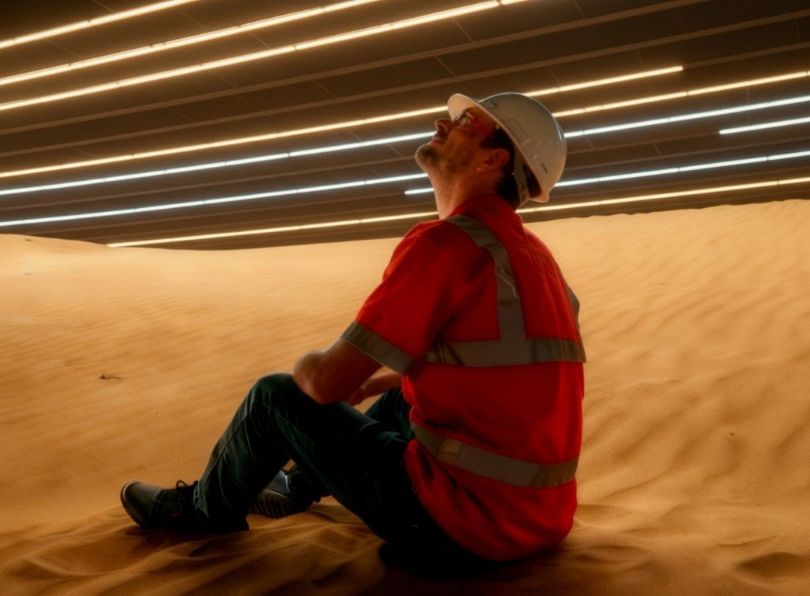
LED profiles MENA high temperature are borned beacause The Middle East and North Africa (MENA) region presents a unique confluence of extreme environmental stressors and stringent, multi-layered regulatory frameworks, fundamentally different from the conditions envisioned by standard European or North American LED lighting specifications.
For lighting designers, architects, M&E engineers, and purchasing professionals, designing linear LED solutions that can withstand high ambient temperatures, regularly exceeding 50°C, pervasive fine sand ingress from high winds, aggressive coastal salt corrosion, and exceptionally intense ultraviolet radiation, while meeting GCC, SASO, and EQM certification requirements, is not just a matter of procurement.
It is a technical necessity that determines whether a lighting system will operate reliably for its expected lifespan or fail prematurely, resulting in significant financial and reputational costs. LightingLine.eu, as your technical partner for extreme environments, offers precision aluminum LED profiles for extreme Gulf climates and fully IP65 IP67 IP68 certified LED strips for desert climates, specifically developed to meet these challenges.
In this article…
- LED profiles MENA high temperature and MENA microclimate
- Thermal management: LED extrusion for high ambient temperature profiles
- Sand ingress and IP ratings: IP65, IP67, IP68 in desert climate
- Corrosion resistance: LED profile for coastal Gulf & Red Sea
- Regional certification: GCC, SASO, EQM — technical deep dive
- Specifying LED profiles Middle East: a step-by-step protocol
- Conclusion & engineering summary
LED profiles MENA high temperature and MENA microclimate
The term “hot and dusty” is an almost reductive description of the environment in which LED lighting systems must operate in the Middle East and North Africa. The MENA region spans over 11 million square kilometers of dramatically different terrain, weather, and building environments:
- the hyperhumid coastal plains of the Persian Gulf, where Kuwait City regularly records summer temperatures above 50°C with relative humidity levels of 60–90%
- the arid continental highlands of Nejd in central Saudi Arabia, where Riyadh records summer highs of 46–50°C but significantly lower humidity
- the desert city of Amman, perched 777 meters above sea level with noticeably cooler summer nights, to the below-sea-level heat trap of the Jordan Valley
- the sub-Saharan fringe of the Sahel, where North Africa meets the Sahara, to the temperate, Atlantic-influenced coast of Casablanca.
Each of these sub-environments imposes a distinct pattern of stressors on LED lighting systems, and a specific approach calibrated for Dubai will not necessarily be adequate for Kuwait City, let alone Salah or Aswan.
What does unite the MENA region for the LED specifier, however, is the shared requirement to step decisively outside the assumptions of European standards-based specification. The IEC 60598 series, the EN 60598 luminaire standards, the CE marking framework, and the performance test conditions embedded in IES LM-80 and TM-21 lifetime projections are all calibrated for ambient temperatures of 25 °C or, at most, 40 °C. In the MENA region, these reference conditions are not merely elevated — they can be surpassed by 25–30 °C in the most extreme locations. Standard-grade LED strips, drivers, and profile assemblies that comfortably achieve their rated L70 >50,000-hour lifetime in a Berlin office ceiling will fail in a fraction of that time when installed in an exposed exterior cove on a Riyadh hotel façade if thermal management, ingress protection, and corrosion resistance have not been specifically engineered for the site conditions.
55 °C
80 °C
3,500+
IP6X
From a thermal perspective, ambient temperatures in the Gulf routinely exceed 50 °C in shaded air conditions during the peak summer months of June through September. Ground surface temperatures on exposed paving, the microclimate directly relevant to in-ground and low-level LED profiles, can reach 70–80 °C. When solar irradiance adds its direct radiant loading to an aluminium profile mounted on a westward-facing wall in Abu Dhabi, the local temperature around the profile body can easily reach 65–70 °C, even when the shade air temperature is only 45 °C. This solar irradiance effect (the combination of direct beam radiation, diffuse sky radiation, and ground-reflected radiation converging on an exposed surface) is frequently omitted from simplified thermal calculations and represents one of the most common reasons for premature LED failure on MENA projects where profiles have been selected based on air temperature alone rather than total thermal load.
From a particulate perspective, sand ingress protection LED profiles must be designed to counteract two distinct but related hazards. The first is coarse wind-blown sand (grain sizes of 250 µm to 2 mm) which acts primarily as an abrasive and can scratch diffuser surfaces, erode powder-coat finishes, and physically block drainage apertures. The second, and more technically insidious, is the ultra-fine respirable dust that accompanies every desert wind event and sandstorm: PM10 particles below 10 µm in diameter that remain airborne for days after a shamal event and can penetrate virtually any gap not specifically sealed against their passage. This fine dust, which in Gulf coastal regions carries a cocktail of silica, gypsum, calcium carbonate and sodium chloride, is simultaneously an abrasive, a thermal insulator when deposited on LED and heatsink surfaces, and an electrochemically active corrosive agent when it combines with condensation moisture on PCB conductor surfaces.
In coastal installations (the Doha Corniche, Dubai Marina, Abu Dhabi Corniche, Jeddah’s Corniche road, Bahrain’s waterfront developments) saline aerosol from the Arabian Gulf (with its unusually high salinity of 40–42 ppt, compared to the global ocean average of 35 ppt) creates a persistently corrosive marine atmosphere. ISO 9223 classifies the corrosivity of this environment as C4 (high) to C5 (very high), meaning that untreated aluminium, zinc-plated steel fixings, and standard industrial powder coatings will exhibit visible corrosion within 2–5 years without appropriate specification. Coupled with UV irradiance of 2,000–2,400 kWh/m²/year, more than double European values, which attacks polymeric diffusers, sealing gaskets, and adhesive backing tapes at an accelerated rate, the MENA coastal environment creates a compound degradation challenge that demands a fully integrated systems engineering approach to specification.
LightingLine.eu’s extruded profiles are designed with high ambient temperature LED strip 55°C continuous rating as the design baseline, not as an exceptional performance specification. This distinction, between products that merely survive a brief temperature test at 55 °C and products whose long-term lumen maintenance, IP integrity, and structural performance have been validated at continuous 55 °C ambient operation, is the fundamental differentiator for reliable MENA specification.
Thermal management: LED extrusion for high ambient temperature profiles
At the heart of LED system longevity in the extreme environments of the MENA region is the ability of the aluminum LED profile to function as an effective passive heat exchanger, conducting thermal energy from the LED strip’s PCB substrate, through the profile body, and into the surrounding air at a rate sufficient to maintain the LED junction temperature below the threshold beyond which lumen depreciation, color shift, and eventual catastrophic failure are accelerated beyond acceptable limits. This thermal management function is not secondary to the profile’s role: it is its primary engineering purpose in high ambient temperature applications, and every aspect of the profile’s design (alloy selection, cross-section geometry, wall thickness, surface treatment, and mounting orientation) must be evaluated through the lens of heat dissipation performance rather than purely aesthetic or mechanical criteria.
The governing principle of LED lifetime is junction temperature (Tj), the temperature at the semiconductor p-n junction where photons and waste heat are generated in equal measure. The Arrhenius relationship, which describes the exponential dependence of chemical reaction rates on temperature, governs the phosphor and encapsulant degradation mechanisms that produce lumen depreciation: for every 10 °C rise in Tj above the nominal operating temperature, the rate of degradation approximately doubles, and with it the effective rate of lifetime consumption. A LED strip operating at Tj = 85 °C in a well-designed European application might achieve L70 lifetimes of 40,000–50,000 hours. The same strip operating at Tj = 105 °C — a perfectly achievable outcome in an under-specified MENA application at 45 °C ambient — may have an L70 lifetime of 8,000–15,000 hours. This is not a product failure; it is the mathematically inevitable consequence of inadequate thermal management in a high ambient temperature environment.
The thermal resistance chain from LED junction to ambient air — expressed as Rth_total in °C/W — is the quantitative design parameter that links ambient temperature, strip power density, and junction temperature. The complete chain is:
Where Ta is the effective ambient temperature at the profile installation location (which, as discussed in Section 1, may be significantly higher than the meteorological shade temperature due to solar loading and microclimate effects), P_heat is the heat power generated by the LED strip per unit length (approximately 70% of total electrical input power for typical white LED strips); and each Rth term represents a thermal resistance component in the heat flow path. The specifier’s practical levers are Rth_pcb-profile (improved by using a metal-core PCB strip and a high-quality thermal interface material, and by ensuring full contact between strip and profile base) and Rth_profile-air (reduced by specifying a heavier-section profile, ensuring adequate air circulation around the profile, and specifying an anodised or dark-coloured surface finish to maximise radiative emission).
The thermal conductivity of the aluminium alloy is the material foundation of the heatsink’s performance. LightingLine.eu specifies alloy 6063-T5 as the standard for all profiles in its MENA-targeted extreme environment range, with 6061-T6 available for profiles requiring higher structural strength at the cost of a modest reduction in thermal conductivity. The 6063 alloy offers thermal conductivity of approximately 200 W/m·K, roughly 500 times that of still air, meaning that heat generated by the LED strip is conducted through the aluminium body at a rate that is effectively instantaneous compared to the convective and radiative heat transfer from the profile surface to the surrounding air, which is the true bottleneck in the thermal chain. This in turn means that the surface-to-air thermal resistance (Rth_profile-air) is the dominant parameter in the chain for well-designed assemblies, and that profile geometry — the area, orientation and emissivity of the surface exposed to air — is the primary design lever available to the specifier once a high-quality alloy has been selected.
Critically, for MENA exterior profiles, LightingLine.eu specifies a minimum wall thickness of 2.5 mm across the full extruded cross-section, and 3.0 mm minimum for profiles in coastal marine or structurally demanding applications (stair nosings, in-ground units, profiles spanning unsupported lengths greater than 1.5 m). This wall thickness specification serves both thermal and structural purposes: thicker walls increase the cross-sectional mass (and thus thermal mass and conduction capacity), resist the minor seismic events and wind-induced vibration loading common in MENA territories, and provide an adequate base metal depth for quality anodising without risk of breakthrough or uneven coating in the anodising bath.
Thermal simulation data (reference 3,000 mA/m LED strip at Ta = 45 °C)
The following table presents thermal resistance and maximum ambient temperature data for three extreme-environment profiles, based on a validated CFD thermal simulation for a horizontal ceiling installation with a 30 mm air gap above the profile, with a reference strip input power of 12 W/m (representative of a high-quality 2835 SMD strip at 3,000 mA/m). The maximum ambient temperature values represent the ambient site temperature where Tj remains at or below 85°C, the standard LM-80 high-temperature test point, at which premium strips can project an L70 life of 30,000–50,000 hours. For Tj ≤ 75°C (highest comfort margin), subtract approximately 8–10°C from the maximum ambient values.
| Cross-section (mm) | Mass (g/m) | Alloy / Temper | Thermal resistance Rth (°C/W per metre) | Max. ambient Ta for Tj ≤ 85 °C | Max. ambient Ta for L70 ≥ 50k h |
|---|---|---|---|---|---|
| 30 × 16 | ~185 g/m | 6063-T5 | 2.1 °C/W | 57 °C | 50 °C |
| 45 × 12 | ~310 g/m | 6063-T5 | 1.65 °C/W | 62 °C | 55 °C |
| 25 × 25 (square) | ~240 g/m | 6063-T5 | 1.9 °C/W | 55 °C | 48 °C |
It is important to note that the Rth values in the table are validated for the reference installation geometry: different orientations (vertical wall mounting, down-firing ceiling recess), different air gap sizes, and different levels of dust accumulation on the profile surface will alter the actual Rth.
A further critical consideration for MENA thermal management is the selection of the thermal interface material (TIM) between the LED strip PCB and the profile base. Standard LED strip self-adhesive backing tapes have a thermal impedance of 0.5–2.5 °C·cm²/W — a thermal bottleneck that adds meaningfully to the total Rth at high power densities. Upgrading to a dedicated thermal gap pad (0.1–0.3 °C·cm²/W) can reduce junction temperature by 3–8 °C at typical strip power densities, which at Ta = 50 °C translates directly into 20–40% additional L70 lifetime. This upgrade, costing a fraction of the profile and strip cost, is a standard recommendation for all LightingLine.eu MENA project specifications above 10 W/m strip power density.
Sand ingress and IP ratings: IP65, IP67, IP68 in desert climate
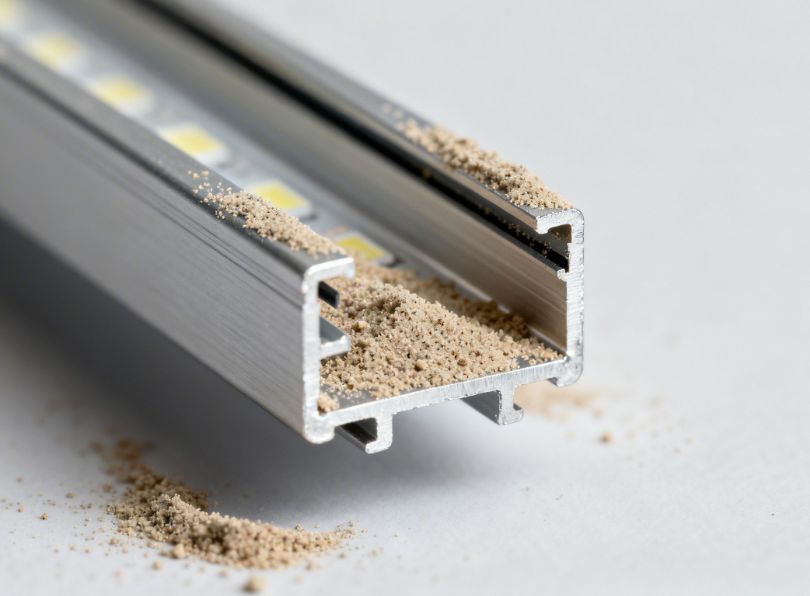
Sand ingress protection LED profiles demand far more than the presence of a rubber gasket between diffuser and profile body. The IEC 60529 standard defines IP6X as “dust-tight” meaning no ingress of dust whatsoever under the standard test conditions. However, in the dynamic high-velocity conditions of a Gulf shamal sandstorm, fine particulate matter can be driven into gaps by positive wind pressure, transported along surfaces by electrostatic attraction (desert sand particles acquire significant electrostatic charge during sandstorm events through triboelectric mechanisms, dramatically enhancing their ability to penetrate narrow gaps), and drawn into apparently sealed enclosures by the thermal breathing effect the cyclic inhalation and exhalation of air through micro-gaps that occurs as the profile heats and cools through its diurnal temperature cycle. An assembly that achieves IP6X under the static, low-pressure conditions of the standard test chamber may not maintain the same protection under sustained real-world shamal conditions.
Dual-hardness silicone gaskets, which combine a soft inner sealing lip that perfectly conforms to surface irregularities with a stiffer outer structural seal, provide excellent dust and water exclusion at the diffuser-profile interface, with a compliance and resilience that single-hardness gaskets cannot match. Labyrinth sealing geometries at the terminals and cable entry points create a tortuous path that passive particle migration cannot follow without the aid of active pressure differential. The terminals are specified with a compression-fit design (positive interference between the terminal and the profile body achieved through a controlled pressure fit) complemented by a bead of silicone sealant applied during installation, eliminating the air gap that threaded or clip-on terminals inevitably leave around their perimeter. For applications of dustproof LED aluminum profiles in the most extreme conditions, such as road installations in open desert areas, construction sites, and petrochemical plants, there are also profiles with electrostatic discharge (ESD) connection devices that reduce the accumulation of charge on the profile surface by limiting the electrostatic attraction of fine sand and dust particles to the diffuser surface and gasket areas.
The parallel requirement of IP65, IP67, and IP68 protection for LED strips in desert climates, that is that the strip assembly within the profile also provide an adequate level of environmental protection, is often overlooked in specifications that focus on the profile’s IP rating and assume the profile provides full protection for a bare IP20 strip. In reality, condensation within the profiles (due to diurnal temperature cycles), exposure to dust during construction prior to installing the profile end caps, and the cumulative effect of gasket degradation over years of UV exposure and thermal cycling create pathways through which environmental contamination can reach the strip. For outdoor applications in the MENA region, a minimum IP65 rating (protective silicone coating or silicone sleeve) is recommended for LED strips within any outdoor profile assembly, and IP67 for any application where occasional moisture infiltration into the profile cavity is likely.
| Protection class | Test parameter — Dust | Test parameter — Water | Typical MENA application |
|---|---|---|---|
| IP5X | Dust-protected: limited ingress, function preserved | N/A (dust only) | Indoor / well-protected sheltered exterior |
| IP6X | Dust-tight: zero talcum powder ingress (8 h test) | N/A (dust only) | Desert roadsides, open construction sites, desert villages |
| IP65 | Dust-tight (IP6X) | Low-pressure water jets from any direction | Standard MENA exterior: façades, canopies, parking structures |
| IP66 | Dust-tight (IP6X) | Powerful water jets (100 L/min, 3 m) from any direction | High-pressure cleaning areas; Gulf summer rain events, car washes |
| IP67 | Dust-tight (IP6X) | Temporary immersion 1 m / 30 min | In-ground path lighting; fountain surrounds, coastal intertidal zones |
| IP68 | Dust-tight (IP6X) | Continuous immersion, manufacturer-specified depth (LightingLine: up to 3 m) | Underwater pool / fountain luminaires, permanently submerged landscape profiles |
For extreme shamal sandstorm conditions in the Arabian Peninsula — where wind-driven sand at velocities of 40–80 km/h can create sustained positive pressure differentials across enclosure gaps, are reccommended always specifying IP6X with LED strip IP65 IP67 IP68 desert climate encapsulated strips inside: silicone nano-coating (IP54 protection at strip level) as a minimum, silicone sleeve (IP65/IP67) as the preferred specification, and fully potted silicone-resin construction (IP68) for the most exposed applications. Silicone is strongly preferred over polyurethane resin for potted strip applications in MENA, because silicone retains its mechanical properties and adhesion to −60 °C to +200 °C continuously, whereas PU resins begin to soften above 80–90 °C — potentially releasing from the LED packages during peak Gulf summer conditions.
MENA-rated strips are subjected to 1,000 hours of continuous operation at 55 °C ambient must be combined with dust chamber testing per IEC 60068-2-68 (dust and sand test) using talcum powder at 2 kg/m³ concentration under negative pressure for 8 hours. This combined thermal and dust challenge, unlike the ambient-temperature-only or dust-only tests applied to standard European product qualification, provides a meaningful validation of performance under the simultaneous stresses that characterize real MENA operational conditions.
For waterproof LED profile MENA region applications in ablution facilities, ornamental fountains, coastal promenade in-ground lighting, and pool surrounds, the IP68 Marine-Shield and Submersion-GL series are available with continuously submerged operation ratings to 3 m water column depth. The LED strip assemblies within these profiles use silicone resin potting rather than PU resin, IP68-rated silicone end caps with double-O-ring compression seals, and stainless steel (Grade 316L) fastener hardware throughout, combining dust-tight, immersion-proof, and marine-atmosphere-resistant performance in a single fully integrated product.
Corrosion resistance: LED profile for coastal Gulf & Red Sea
Corrosion resistance of LED profiles along the Gulf Coast is one of the most important and frequently underspecified performance requirements for outdoor LED lighting projects in the MENA region. Corrosion is a particularly insidious failure mechanism because, unlike thermal or photometric degradation, which produces immediately visible symptoms (reduction in light output, color change), corrosion progresses invisibly beneath surfaces, within sealed cavities, and under sealant beads for months or years before its consequences become apparent. Once rust spots, structural weakening, or PCB failures attributable to corrosion become visible, the damage is typically irreversible, and the remediation costs, which include access scaffolding, profile replacement, and complete LED strip and driver replacement, significantly exceed the incremental cost of a proper corrosion resistance specification that would have prevented the damage in the first place.
The corrosivity of the coastal Gulf atmosphere is classified under ISO 9223 as C4 (high) to C5 (very high), depending on specific distance from shore, prevailing wind direction, season, and local industrial emission sources. The dominant corrosion mechanisms in this environment are: pitting corrosion of aluminium, initiated at surface defects by chloride ions from sea-spray aerosol penetrating the natural oxide layer; galvanic corrosion at bimetallic junctions, particularly the extremely common and entirely avoidable case of zinc-plated steel fixing screws installed into aluminium profiles in a coastal atmosphere (the galvanic potential difference drives accelerated dissolution of the steel at an electrochemical rate proportional to the chloride concentration of the condensed electrolyte bridging the two metals) and crevice corrosion developing under gaskets, behind profile-to-wall bonding silicone, and at any location where a narrow gap traps condensate and restricts oxygen replenishment, creating the highly corrosive oxygen-depleted electrolyte typical of crevice conditions.
The primary defence against pitting and atmospheric corrosion of aluminium profiles in coastal Gulf environments is anodising, the electrochemical conversion of the aluminium surface to aluminium oxide, producing a controlled, hard, adherent and electrically insulating protective layer that simultaneously provides the profile’s final decorative finish. Standard-grade sulphuric acid anodising to 10 µm depth, while adequate for interior and non-coastal exterior applications, is insufficient for coastal Gulf and Red Sea environments. It is recommended and supplies all MENA coastal-environment profiles with AA20 anodising (20 µm anodised layer depth) as the minimum specification, and AA25 hard anodising (25 µm) for the most demanding C4/C5 corrosivity category applications, with a hot nickel acetate or hot water sealing treatment applied to close the porous anodised layer and dramatically reduce chloride-ion penetration. This AA25 sealed finish achieves salt-spray resistance exceeding 1,000 hours in ISO 9227 testing with no pitting initiation, corresponding to a real-world service life of 10–15 years in C4 coastal conditions before meaningful surface degradation.
For installations in the extreme marine splash zone as harbour edges, offshore platforms, waterfront promenades within 50 m of the sea, and desalination plant perimeters (where saline process-water vapour creates corrosivity levels approaching C5-M marine category) a marine-shield profile family, which combines AA25 hard anodising with an additional post-anodise epoxy sealing coat to provide a multi-layer barrier system against chloride penetration. Marine-shield profiles undergo 1,000 hours of neutral salt-spray testing per ASTM B117 with zero pitting recorded in the extruded aluminium body, a performance threshold that standard anodised profiles at AA15 or AA20 do not consistently achieve. This is critical for LED lighting specification arid climate and coastal projects near desalination plants or with sustained high humidity above 90% RH.
Surface finish selection also affects corrosion performance at the practical level of colour and appearance. Standard mill-finish (bare extruded) aluminium, which is sometimes specified as a cost-saving measure on interior profiles, rapidly develops an uncontrolled and aesthetically poor natural oxide patina in saline coastal air and should never be specified for MENA exterior use. White polyester powder coat, which is by far the most common decorative finish for LED profiles, offers good corrosion protection in interior and non-coastal environments but has limited long-term durability in coastal Gulf conditions unless the powder coat formulation is specifically rated for marine atmospheric service. Marine-grade PVDF (polyvinylidene fluoride) fluoropolymer powder coatings, which are used in architectural cladding systems in coastal environments, provide the superior corrosion and UV resistance required for the most demanding coastal MENA projects.
| Surface treatment | Thickness / depth | Salt-spray resistance (ISO 9227) | UV resistance | ISO 9223 corrosivity class suitability | MENA coastal recommendation |
|---|---|---|---|---|---|
| Mill finish (bare aluminium) | N/A | < 100 h | Good | C1–C2 | ✗ Not acceptable for any exterior |
| Standard anodising AA10 | 10 µm | 200–500 h | Good | C2–C3 | Interior / sheltered non-coastal only |
| Anodising AA20, sealed | 20 µm | 500–1,000 h | Very Good | C3–C4 | ✔ Standard MENA exterior (non-splash zone) |
| Hard anodising AA25, sealed | 25 µm | 1,000–3,000 h | Excellent | C4 | ✔ Coastal Gulf; standard marine atmosphere |
| Marine-Shield (AA25 + epoxy sealing) | 25 µm + 15 µm epoxy | 3,000–5,000 h (ASTM B117) | Excellent | C4–C5 | ✔✔ Splash zone; desalination plant; offshore |
| Marine-grade PVDF powder coat | 60–80 µm | 3,000–5,000 h | Outstanding (25+ yr) | C4–C5 | ✔✔ Premium coastal façades; architectural cladding-matched |
A frequently overlooked aspect of corrosion specification for LED profiles is the fastener system. In MENA coastal environments, zinc-plated or bright steel screws and brackets installed to secure aluminium profiles to building structures will begin to rust visibly within 12–24 months, generating rust staining on the profile and substrate surface that is extremely difficult to remove and that produces galvanic acceleration of corrosion in the aluminium at the fastener holes. Mandatory specification for all coastal MENA exterior LED profile installations is Grade 316L austenitic stainless steel for all screws, bolts, washers, clips, and mounting brackets, with neoprene or EPDM isolation washers at the interface between dissimilar metals where bimetallic contact is unavoidable. This specification adds a modest cost premium (typically 8–15% of total material cost for the hardware components alone) that is trivially justified by the elimination of the most common and most visible corrosion failure mode on MENA lighting projects.
Regional certification: GCC, SASO, EQM — technical deep dive
Compliance with regional certification requirements in the MENA LED lighting market is not monolithic, and approaching it as such is a common and costly error. The regulatory landscape is a multi-layer architecture of regional, national, emirate-level and project-specific requirements that must be navigated with precision, particularly for suppliers importing European-manufactured LED profiles and strip assemblies into GCC markets for the first time, or for specifiers who need to write specification clauses that are commercially enforceable through customs clearance and project materials submittals processes.
GCC certification LED lighting: the certification mark issued under the Gulf Cooperation Council Standardization Organization (GSO) Conformity and Evaluation Assurance Programme (CEAP), provides the regional baseline. The GSO CEAP programme requires that products covered by GSO Technical Regulations (which include LED modules, LED drivers, and complete luminaires) obtain a Certificate of Conformity from a GSO-accredited Conformity Assessment Body (CAB) before being imported into or sold in any of the six GCC member states (Saudi Arabia, UAE, Kuwait, Qatar, Bahrain, Oman). The technical basis for GCC certification of LED lighting products is a suite of GSO-adopted IEC standards, GSO IEC 62031 (LED modules safety), GSO IEC 62717 (LED modules performance), GSO IEC 60598-1 (luminaires general requirements), GSO IEC 62384 (LED drivers performance), and GSO CISPR 15 (EMC) being the most directly relevant , supplemented by GSO 35-2 (Minimum Energy Performance Standards), which mandates minimum luminous efficacy thresholds and power factor requirements. The GCC CEAP certificate (colloquially known as the “Gulf Mark” or “G-mark”) is in principle a single certificate that should enable import clearance in all six GCC states; in practice, as described below, individual countries impose additional national requirements on top of the GCC baseline.
SASO LED lighting Saudi Arabia: the certification framework administered by the Saudi Standards, Metrology and Quality Organization, is operationally the most complex and most strictly enforced national certification requirement in the GCC region, reflecting both Saudi Arabia’s position as by far the largest single GCC market and the substantial investment SASO has made since 2019 in building the SABER electronic certification platform. SASO mandates that LED drivers must operate at 55 °C ambient with no derating of output power — a requirement that goes significantly beyond the standard IEC 62384 test conditions and that directly eliminates a large fraction of the European market’s mainstream driver products, which are rated to only 40–45 °C case temperature without derating. This 55 °C driver ambient requirement effectively makes the selection of MENA-validated, high-temperature-rated constant-current drivers (such as Meanwell HLG series or equivalent, with tc_max ≥ 75 °C) mandatory for Saudi market compliance — not merely a prudent engineering choice. The SABER Product Conformity Certificate (PCC), which must be registered on the SABER online platform before any regulated product can be cleared through Saudi customs, requires full technical documentation including LM-80 test data, IEC 60598-1 compliance evidence, and energy efficiency declaration in a format accepted by SASO’s review team.
EQM certification LED profiles, the Emirates Quality Mark administered by ESMA (Emirates Authority for Standardization and Metrology) in the UAE, operates as a voluntary but commercially quasi-mandatory certification programme that has achieved near-universal specification by major project consultants and clients in Dubai and Abu Dhabi. The EQM programme goes beyond the GCC CEAP baseline in several respects important to LED profile and strip specification: it requires third-party factory audits of the manufacturing facility (verifying that production quality controls are in place to ensure ongoing conformity of manufactured products to the tested and certified type), it imposes fire retardancy requirements on profile materials used in public interior applications (requiring that aluminium profile extrusions and their polymer diffusers meet specific fire spread and smoke emission criteria per relevant BS or EN standards), and it mandates independent testing at an ESMA-accredited laboratory rather than accepting manufacturer self-declaration of conformity. For Qatar specifically, the QS Mark (administered by QOSM) has similar requirements and is enforced through Kahramaa (Qatar’s electricity and water utility and technical regulator) specifications on all Qatar infrastructure and construction projects.
| Certification | Administering body | Region / Market | Key requirement for LED profiles and strips | Mandatory vs. voluntary |
|---|---|---|---|---|
| GCC Mark (G-mark / GSO CEAP) | GSO (GCC Standardization Organization) | All 6 GCC states | IEC 60598-1, IEC 62031, IEC 62384, CISPR 15, GSO 35-2 efficacy minimums; 50 °C ambient test | Mandatory (regulated products) |
| SASO / SABER (Saudi) | SASO (Saudi Standards, Metrology and Quality Organization) | Saudi Arabia | IEC 60598-1 + Saudi annex, driver 55 °C no-derating; no Pb/Cd in paint; SABER PCC registered | Mandatory (customs enforced) |
| EQM (UAE Emirates Quality Mark) | ESMA (Emirates Authority for Standardization and Metrology) | UAE (Dubai, Abu Dhabi, all emirates) | UAE.S standards, factory audit, fire retardancy for public interiors; independent lab testing | Voluntary (de facto mandatory in major projects) |
| QS Mark (Qatar) | QOSM / Kahramaa | Qatar | Kahramaa Regulations, fire spread index, third-party factory inspection, Qatar Construction Specifications | Mandatory for public/Kahramaa projects |
| CE Mark (Europe) | EU Notified Bodies | European Union / accepted in NA | IEC 60598-1, EN 62031, CISPR 15, RoHS 2; DoC required | Mandatory (EU), reference standard in Morocco, Tunisia, Egypt |
Specifying LED profiles Middle East: a step-by-step protocol
The specification of LED profiles in the Middle East requires an integrated, site-specific engineering approach, consisting of a structured sequence of decisions, each influenced by the conclusions of the previous phase. It is designed as a practical working methodology for M&E consultants, lighting designers, and specifiers working on projects in the MENA region.
Step 1: characterise the micro-environment
Before selecting any product, document the specific environmental conditions at the installation location with the precision required for thermal and ingress protection calculations. The relevant parameters are: the maximum site ambient temperature (using the appropriate national design reference from the applicable building code or GCC standard — 45 °C for most Gulf states, 50 °C for Kuwait, adjusted upward for solar-exposed or confined locations), the effective microclimate temperature at the profile location (adding 3–8 °C for solar loading on exposed surfaces, 5–10 °C for enclosed coves and voids, and deducting 5–8 °C for air-conditioned interior applications), the ISO 9223 atmospheric corrosivity category (C2–C5, based on distance from the sea, local humidity, and industrial emission sources), the applicable IP zone classification for particulate and water exposure; and any project-specific explosion protection or fire retardancy requirements.
Step 2: select the aluminium profile with adequate thermal cross-section
Using the thermal resistance data in Section 2 (or LightingLine.eu’s application-specific thermal simulation service for non-standard geometries), select a profile from the Gulf range of extreme temperature aluminum LED profiles with an Rth_profile-air value that, combined with the selected TIM’s PCB-profile thermal resistance, will maintain Tj ≤ 85°C under the worst-case ambient conditions identified in Step 1. Apply installation geometry correction factors for air gap orientation and dimensions. If the required profile mass exceeds 500 g/m (indicating very high power density or a combination of extreme ambient temperatures), assess whether active cooling (forced convection via integrated fans or liquid cooling) is technically justified. Specify the anodizing depth and surface treatment appropriate to the corrosivity category identified in Step 1.
Step 3: select the LED strip for MENA conditions
Match the LED strip North Africa extreme environment or Gulf application to a strip product that has been validated for the thermal, IP and photometric requirements simultaneously. For MENA applications, the following strip specification criteria are non-negotiable: MCPCB substrate (metal-core PCB) as standard for any strip above 8 W/m, explicit Ta rating ≥ 50 °C (with documented thermal test basis, not merely a manufacturer’s claim), LM-80 test data available at ≥ 85 °C junction temperature, with TM-21 L70 projection ≥ 30,000 hours at that temperature, IP rating appropriate to the ingress zone (IP65 minimum for any MENA exterior strip within a sealed profile, IP67 or IP68 for the most exposed or wash-down applications), and CCT and CRI consistent with the photometric specification for the space or application.
Step 4: specify end caps, mounting clips and accessories with compatible IP and corrosion protection
The system IP rating is only as good as its weakest component. End caps must be pressure-fit with silicone gaskets and specified in UV-stabilised HDPE or stainless steel, not standard nylon, which becomes brittle in MENA UV conditions within 3–5 years. Mounting clips must be 316L stainless steel for all exterior and coastal applications, with slotted holes on at least 60% of clips per profile length to accommodate thermal expansion (3–5 mm expansion at each profile joint for a 3 m extrusion over the full Gulf diurnal temperature range). Cable glands must be IP68-rated (even for IP65 profile assemblies, to ensure margin), in stainless steel or UV-stabilised nylon, with a silicone secondary sealant bead applied after installation. Diffusers must be UV-stabilised PMMA as the standard specification for MENA exterior profiles, with glass diffusers as the premium option for the highest-value applications where zero yellowing over 15+ years is required.
Step 5: verify sand ingress protection via independent test reports
Require the supplier to provide third-party test reports (from an ISO/IEC 17025 accredited laboratory) demonstrating IP6X dust-tight performance for all exterior MENA profiles. Do not accept manufacturer’s self-declaration or CE mark alone as evidence of IP6X performance, the CE mark does not specifically require IP testing by an independent laboratory, and self-declared IP ratings are frequently overstated for LED profile products. For the most demanding applications (desert roadside, construction plant, industrial perimeter), additionally request evidence of testing to IEC 60068-2-68 (dust and sand test) at conditions relevant to MENA desert environments. LightingLine.eu provides full independent test reports for all IP-rated products in the MENA extreme environment range as standard documentation.
Step 6: verify certification for the assembled system
Check GCC certification LED lighting (or SASO/SABER, EQM/ESMA, QS/Kahramaa as appropriate to the project country) for the assembled luminaire system (profile + strip + driver + accessories) as a complete product, not only for the individual components. When the profile and strip are assembled and supplied as a complete luminaire, IEC 60598-1 treats the assembly as a luminaire and requires system-level type testing rather than component-level compliance alone. Ensure the supplier’s certification documentation covers the specific product configuration as specified (strip type, power density, CCT, diffuser type, end cap model) and not merely a generic product family. LightingLine.eu maintains GCC and SASO technical files for pre-defined profile + strip + driver configurations that are the most commonly specified for MENA projects, with project-specific configuration documentation available on request.
LED profiles MENA high temperature: a crucial choice
Successful lighting projects in the Middle East and North Africa region demand a decisive and permanent shift from generic temperate-climate specification thinking to an arid-climate, coastal-marine and extreme-heat engineering mindset. The technical requirements for LED profiles and strips in MENA environments are not incremental refinements on European specification practice, they represent a qualitatively different engineering problem in which every element of the system, from LED package selection and PCB substrate material through to surface treatment chemistry, gasket compound specification, fixing hardware grade and certification documentation pathway, must be evaluated against conditions that are profoundly more demanding than those assumed by standard European product development and qualification frameworks.
LED profiles MENA high temperature must integrate effective passive thermal management, through adequate cross-sectional aluminium mass, optimised alloy selection, quality thermal interface materials, and correctly designed installation geometry, with true IP6X dust protection validated by independent testing against conditions that reflect the dynamic loading of Gulf sandstorm events rather than merely the static conditions of a standard IEC 60529 test chamber. They must provide the corrosion resistance of a marine-grade material system, hard-anodised aluminium at AA25 depth, sealed diffusers in UV-stabilised PMMA or glass, Grade 316L stainless steel fastener systems, and silicone rubber sealing throughout, to maintain structural integrity and aesthetic appearance over a 15-to-20-year design life in C4/C5 coastal Gulf atmospheric corrosivity. And they must carry the specific regional certifications, GCC certification LED lighting for the Gulf baseline, SASO LED lighting Saudi Arabia through the SABER platform for the Kingdom’s market, and EQM certification LED profiles for UAE project compliance, that are the gatekeeping requirements for market access and project materials approval in the world’s most active construction market.
The practical guidance in this article — from the thermal resistance chain calculation in Section 2 through the six-step specification protocol in Section 6 and the product selection tables in Section 7 — provides the analytical and procedural framework for specifications that will withstand MENA conditions physically, comply with MENA regulatory requirements legally, and deliver the illuminance, colour quality and system lifetime specified contractually. Always reference LED profile corrosion resistance coastal Gulf and LED strip North Africa extreme environment in your bill of quantities as specific technical criteria, not as generic descriptions, to ensure that the materials supplied to site match the region’s demands, the certification requirements of the import authority, and the quality expectations of the specifying consultant and end client. LightingLine.eu integrates all of these requirements in every product in the MENA extreme range, and maintains the engineering and certification infrastructure to support MENA projects from initial specification through customs clearance and on-site commissioning.