Commercial lighting is the backbone of functionality, safety, and brand expression in retail stores, offices, industrial buildings, and hospitality facilities. Unlike residential lighting, commercial applications require strict regulatory compliance, greater efficiency, and integration with building management systems.
For professionals such as electrical engineers or facility managers, specifying commercial lighting fixtures is not just about photometric performance, but also about lifecycle costs, mechanical robustness, and compliance with international standards.
This guide focuses on LED profiles that protect LED strips and ensure thermal management, optical control, and mechanical stability. Whether illuminating a 30×40 cm workshop or a luxury retail store, correctly specifying LED profiles prevents premature failures and ensures the desired lighting effect.
In this article…
- Commercial lighting LED profiles: the key component for commercial strip installations
- Tender documents for commercial LED profiles: technical clauses
- Bill of Quantities (BOQ) templates for commercial LED profiles
- Compliance checklist: from FCC to UK kitchen regulations
- Do LED lights need FCC certification?
- Commercial lighting cost
- Case study for a 30×40 shop
- Is 3000K or 4000K better for the office?
- What are the types of lighting fixtures?
- Commercial vs. residential lighting: the differences
- Special areas: kitchen and retail
- The best light for commercial buildings
- Why LEDs? Efficiency and 277V systems
- The most efficient commercial lighting
- Commercial lighting design for different professionals
- Future trends: smart commercial lighting and IoT integration
- Why choose a specific profile for commercial lighting
Technical functions and materials science
A commercial LED profile performs four critical functions:
- thermal management (heat dissipation): LED strips generate heat at solder points. Without a heatsink, the junction temperature (Tj) increases, accelerating lumen depreciation (LM-80 data shows that a 10°C reduction can double LED lifespan). The 6063-T5 aluminum alloy, with its high thermal conductivity (~200 W/m·K), acts as a passive heatsink, drawing heat away from the LEDs;
- mechanical protection: profiles protect delicate LED strips and soldered joints from physical damage during installation, cleaning, and operation. The aluminum body provides impact resistance, often rated from IK06 to IK10 depending on wall thickness (1.2 mm to 2.0 mm);
- optical control: diffusers (opal, semi-transparent, micro-prismatic) eliminate the “dotted” effect of individual LEDs, providing a continuous, uniform line of light. They also control glare (UGR), essential for environments such as offices and retail stores;
- electrical safety: profiles house low-voltage strips (24V or 48V DC), separating them from accidental contact and containing any electrical faults. Ingress Protection (IP) ratings are achieved by adding gaskets and end caps.
Material specifications and finishes
The industry standard is extruded aluminum alloy 6063-T5. During specification, engineers must verify tempering and wall thickness. A profile with wall thickness less than 1.2 mm may deform under load or provide insufficient thermal dissipation for high-output commercial LED strips (e.g., 20W/m or more).
| Finish type | Characteristics | Typical application |
|---|---|---|
| Anodized (matte or satin) | Electrochemical process, higher corrosion resistance, durable, maintains thermal properties. Color: silver or black. | Stores, offices, visible architectural elements (Sara’s preference). |
| Powder coating (RAL) | Polyester paint, wide range of colors (RAL 9003, 9010, etc.), good protection but adds a slight thermal barrier. | Branded environments, ceilings with color matching (Elena’s retail projects). |
| Raw (untreated) | Untreated, lower cost, prone to oxidation. Not recommended for commercial use. | Temporary or hidden installations only. |
Diffuser optics: controlling light distribution
The choice of diffuser directly affects visual comfort and the efficiency of commercial lighting fixtures. For the architect and store owner, the appearance of the light source matters as much as the quantity of light.
| Diffuser type | Material | Transmission rate | Effect / UGR | Ideal for |
|---|---|---|---|---|
| Clear | PC or PMMA | >90% | Visible LED points, high glare, maximum intensity. | Indirect lighting, niches, hidden sources. |
| Opal (milky white) | PMMA (high stability) | 75-85% | Uniform glow, softens dots, UGR 19-22. | General ambient lighting in stores, backlighting. |
| Micro-prismatic | Optical PC | 75-80% | Precise beam control, reduces glare, UGR <16. | Offices, workstations (Luca’s priority). |
| Satin/semi-transparent | PC | 85-88% | Semi-hidden diodes, some sparkle. | Display cases, accent lines. |
Ingress Protection (IP) and impact resistance (IK) ratings for commercial environments
The facility manager must ensure that specified products can withstand the environment. A standard office (IP40) is different from a commercial kitchen (IP65, grease-resistant) or an outdoor canopy (IP66, IK08).
- IP40: protected against solid objects >1mm. Suitable for dry interiors (offices, store shelving);
- IP54: dust-protected and splash-resistant. Suitable for covered workshops, warehouses with light dust;
- IP65/IP66: dust-tight and protected against water jets. Mandatory for commercial kitchens, food industry, and outdoor ceilings;
- IP67: temporary immersion. For fountains or areas subject to high-pressure washing;
- IK rating: from IK07 (0.5J) to IK10 (20J) for impact resistance. For warehouses with forklifts, specify IK08 or higher.
Mounting methods and integration
The mounting method determines the mechanical design of the profile and installation cost. For large-scale tenders, clarify the required type:
- Surface mounting: most common for renovations. Profiles with mounting clips or track. Quick installation.
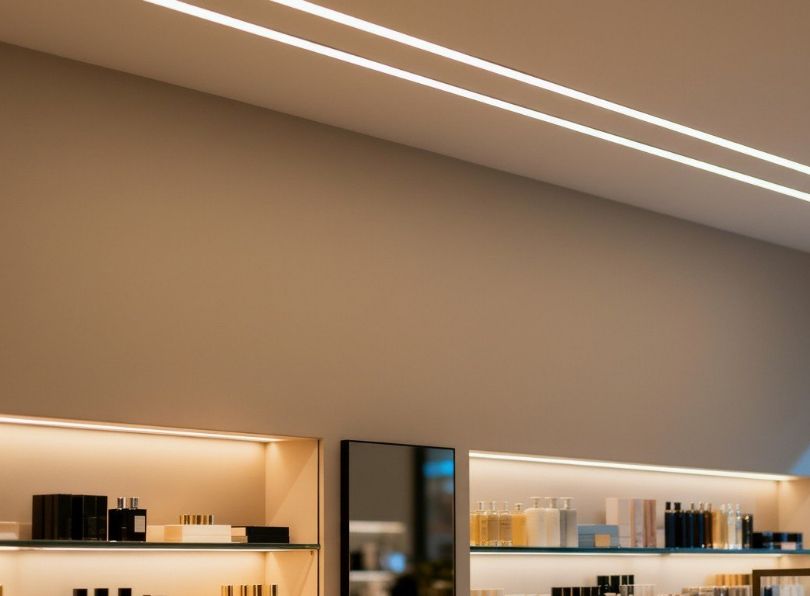
- Recessed (drywall): profiles with flanges for drywall, integrated into the wall. Creates a “line of light” flush with the ceiling. Preferred by Sara for minimalist design.
- Suspended (pendant): profiles with cable kits. Used in industrial environments or stores with high ceilings for direct/indirect lighting.
- Corner / wallwash: asymmetric profiles for uniform wall illumination (store perimeter).
- Floor / step: Heavy-duty profiles, IP67, IK10 for pedestrian pathways.
Pre-wired LED modules vs. strips assembled on-site
To reduce on-site labor and potential errors, we recommend pre-wired profiles cut to size with factory-soldered connectors. This means faster installation and fewer service interventions. Strips assembled on-site (coils cut on location) are cheaper in material costs, but involve higher labor costs and the risk of poor soldering. Specifications should clearly distinguish between:
- pre-wired modules: plug-and-play, consistent quality, higher material costs, reduced installation time;
- assembled on-site: lower material costs, higher labor, risk of errors due to voltage drop, require qualified electricians.
During specification, it is advisable to request that pre-wired modules include a wiring diagram and be tested for continuity before shipment.
System integration: profiles with smart controls
Modern commercial lighting requires integration: profiles must accommodate sensors and connectivity. It is best to look for profiles with:
- integrated compartments for sensors (motion/daylight);
- separate channels for wiring to keep low-voltage control cables (DALI, 0-10V) separate from mains power;
- compatibility with wireless modules (Casambi, Zigbee) for retail flexibility.
Summary for designers: when drafting a tender for commercial lighting fixtures based on LED profiles, it is necessary to specify the aluminum alloy, wall thickness, finish, diffuser type, IP/IK rating, mounting method, and whether the LED strip is pre-wired. This level of detail ensures that all bidders quote on an equal basis and that the final installation meets the client’s performance and longevity expectations.
As a reliable supplier of commercial lighting, LightingLine.eu provides complete datasheets for every profile system, supporting engineers, architects, and facility managers in their projects.
Tender documents for commercial LED profiles: technical clauses
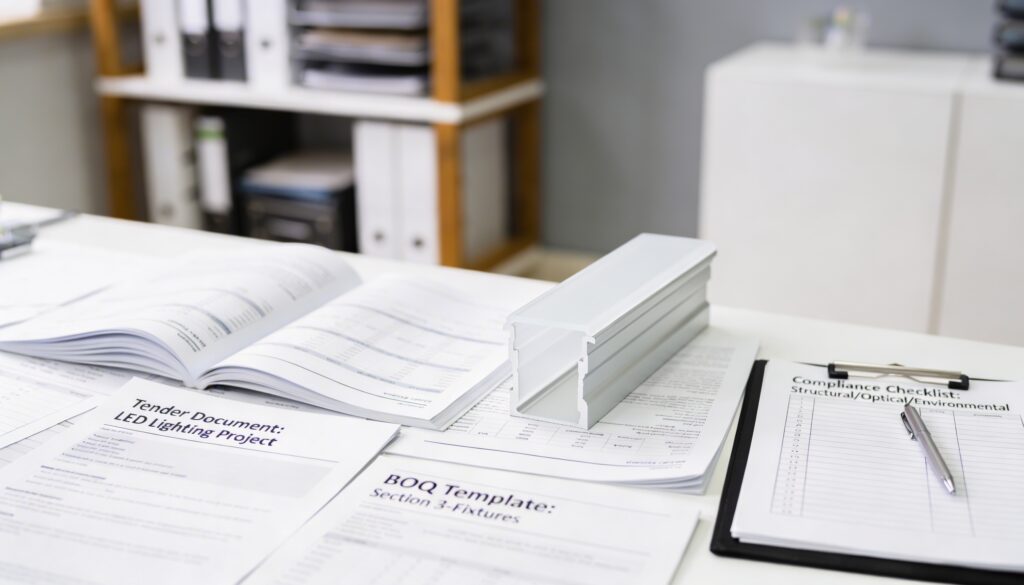
A tender for large-scale commercial lighting must include performance specifications, not just product names. Below is a template table for tender clauses.
| Clause ID | Technical requirement | Compliance criterion |
|---|---|---|
| LED-01 | LED strip efficacy ≥ 150 lm/W @ 3000K CRI90 | LM80 report + in-situ photometric test |
| PRO-02 | Aluminum profile: 6063-T5, wall thickness ≥ 1 mm | Material certificate + micrometer check |
| OPT-03 | Diffuser: opal PMMA, transmission >75% UGR<19 | UGR calculation report |
| ELE-04 | Driver: DALI-2 dimmable, THD <10%, PF >0.95 | DALI Certificate, harmonic test |
| SAF-05 | FCC Title 47 CFR Part 15 (for USA projects) / CE-EMC | FCC ID or DoC (see §6) |
Tender documents must also define warranty (≥5 years), acceptable CCT tolerance (MacAdam ≤3 SDCM), and delivery terms. For commercial lighting fixtures integrated into profiles, include IES files for lighting design software.
Bill of Quantities (BOQ) templates for commercial LED profile systems
A Bill of Quantities (BOQ) for a commercial LED installation should separate profile, LED strip, driver, accessories, and installation. Example template (simplified for a 500 m² retail store).
| Item | Description | Unit | Qty | Unit price (€) |
|---|---|---|---|---|
| 1.1 | Surface-mounted LED profile 2m, anodized, with opal diffuser (IP40) | pcs | 250 | 28.50 |
| 1.2 | LED strip 24V DC, 14W/m, 3000K CRI90, 2000lm/m | m | 500 | 19.90 |
| 1.3 | DALI constant voltage driver 200W (IP20) | pcs | 30 | 89.00 |
| 1.4 | Mounting clips, end caps, connectors (kit per profile) | set | 250 | 3.20 |
| 1.5 | Installation labor (electrician, profile assembly) | h | 180 | 65.00 |
Note: always add 5-10% spare for future maintenance. For large tenders, BOQs for commercial lighting must include voltage drop calculations and cable sizing.
Compliance checklist: from FCC to UK kitchen regulations
| Regulation / Standard | Applicable region | Requirement for LED profiles |
|---|---|---|
| FCC Part 15 (Class A or B) | USA | Ensure commercial LEDs do not cause harmful interference. Mandatory for all electronic devices sold in the USA (detailed in §6). |
| UL 1598 / UL 2108 | USA/Canada | Safety for lighting fixtures and low-voltage lighting systems. |
| IEC 60598 (EN 60598) | EU/UK | General safety and testing for commercial lighting fixtures. |
| UK Building Regulations Part L | UK | Efficiency requirements (lumens/W, controls) for commercial kitchens, etc. |
| LM-79 / LM-80 | International | Photometric measurement and lumen maintenance of LEDs. |
| DLC (DesignLights Consortium) | USA/Canada | Premium efficiency for rebate eligibility. |
Do LED lights need FCC certification?
United States: FCC (mandatory)
Regulation: FCC Title 47 CFR Part 15 (Class A for commercial/industrial use, Class B for residential use);
Scope: all digital devices (LED drivers, controllers) with switching frequencies >9 kHz;
Compliance pathway: Supplier’s Declaration of Conformity (SDoC) for most fixtures; Certification (FCC ID) for intentional radiators (Wi-Fi/Bluetooth);
Penalty for non-compliance: shipment holds, fines up to $10,000/day, product seizure;
Checklist: request SDoC + test report; for wireless controls, verify FCC ID on the product.
European Union (including Italy, France, Germany, Spain, etc.): CE (mandatory)
Regulation: CE marking includes:
- Low Voltage Directive (LVD) 2014/35/EU: electrical safety (IEC/EN 60598 series).
- EMC Directive (Electromagnetic Compatibility) 2014/30/EU: emissions (EN 55015) and immunity (EN 61547).
- RoHS (Restriction of Hazardous Substances) 2011/65/EU: limits lead, mercury, etc.
- ErP Directive (Energy-related Products) (EU) 2019/2020: efficiency requirements (minimum efficacy, standby consumption).
Key difference from FCC: the EU requires both emission and immunity testing. A product may be FCC-compliant but fail EU immunity tests (e.g., electrostatic discharge).
For Italy/EU: the “CE mark” is the only legal route. Technical documentation must be retained for 10 years.
Checklist: verify that the DoC (Declaration of Conformity) includes all applicable directives; request EN 60598 and EN 55015 test reports.
United Kingdom (England, Scotland, Wales, Northern Ireland): UKCA (mandatory) + UK specifics
Regulation: UKCA marking (UK Conformity Assessed) mirrors EU directives but with UK statutory instruments:
- Electrical Equipment (Safety) Regulations 2016 (S.I. 2016/1101).
- Electromagnetic Compatibility Regulations 2016 (S.I. 2016/1091).
- The Ecodesign for Energy-Related Products and Energy Information Regulations 2021.
Additional requirement for commercial kitchens: lighting in food preparation areas must comply with UK Food Standards Agency guidelines (enclosed diffusers, shatterproof – often IP65/IP66). Building Regulations Part L (England) impose minimum efficacy (80 lm/W) and presence detection in certain areas.
For UK multi-site facilities, verify both UKCA and any local authority building control requirements.
Australia and New Zealand: RCM (mandatory)
Regulation: RCM (Regulatory Compliance Mark) covers electrical safety and EMC according to:
- AS/NZS 60598 series (safety).
- AS/NZS CISPR 15 (EMC emissions).
Efficiency: Minimum Energy Performance Standards (MEPS) apply to certain lighting types; verify GEMS (Greenhouse and Energy Minimum Standards) requirements.
Checklist: RCM is mandatory for supply in Australia/NZ. Test reports must reference AS/NZS standards, not just IEC.
United Arab Emirates (UAE) and Gulf Cooperation Council (GCC): ECAS / EQM (Mandatory)
Regulation:
- ECAS (Emirates Conformity Assessment Scheme): mandatory for safety and EMC (based on IEC/EN standards + Gulf standards).
- EQM (Emirates Quality Mark): for products covered by technical regulations.
- GCC Low Voltage Directive (LVD): applicable in all Gulf states (Bahrain, Kuwait, Oman, Qatar, Saudi Arabia, UAE).
Climate note: Dubai Municipality and other authorities often require higher IP ratings for fixtures in outdoor/humid areas due to humidity and dust (IP65 minimum for many applications).
For UAE projects, ensure the supplier provides the ECAS certificate and that the product is registered in the “RASES” system.
Asia: diverse landscape (China CCC, Japan PSE, Korea KC, Singapore)
China (CCC): Chinese Compulsory Certification (CCC) is mandatory for many lighting products (including LED drivers) sold in China. Requires in-country testing and factory inspection.
Japan (PSE): The Electrical Appliances and Materials Safety Act (DENAN) requires PSE marking for specified products. EMC compliance via VCCI (Voluntary Control Council for Interference) is de facto mandatory.
Korea (KC): KC mark (Korea Certification) is mandatory for safety and EMC. LED lighting must comply with KS (Korean Industrial Standards) or IEC-based standards.
Singapore (Safety Mark): Controlled goods (including LED lighting) require Safety Mark registration with Enterprise Singapore. Testing per IEC 60598 series.
Checklist: never assume IEC/CE reports are sufficient. Each country has national deviations and registration processes.
Comparative summary table for global compliance
| Market / Region | Mandatory marking | Key standards/regulations | Commercial-specific notes |
|---|---|---|---|
| USA | FCC (SDoC or ID) | 47 CFR Part 15 (Class A/B) | Class A for industrial, Class B for retail/public. |
| European Union | CE | LVD (EN 60598), EMC (EN 55015, EN 61547), ErP, RoHS | Immunity tests required, UGR <19 for offices. |
| United Kingdom | UKCA | UK S.I. 2016/1101 (safety), S.I. 2016/1091 (EMC), Part L (efficiency) | Kitchen regulation: IP65 + shatterproof (Food Standards Agency). |
| Australia/NZ | RCM | AS/NZS 60598, AS/NZS CISPR 15, GEMS MEPS | MEPS for certain fixtures, testing for high ambient temperatures. |
| UAE / GCC | ECAS / EQ | GCC LVD (IEC-based), UAE.S standards | Dubai: DM approval often requires IP65 for outdoor/humid. |
| China | CCC | GB 7000 series (safety), GB/T 17743 (EMC) | Factory inspection mandatory, GB standards deviate from IEC. |
| Japan | PSE (safety) | DENAN Act, JIS C 8105, VCCI (EMC) | Diamond PSE mark for specified products, VCCI compliance expected. |
| Korea | KC | KC 60598, KC 61547, KS standards | KC certification requires Korean agent, combined EMC and safety. |
| Singapore | Safety Mark | IEC 60598 + national variations | Registered under Consumer Protection (Safety Requirements). |
Practical implications for global sourcing
For a facility manager managing multinational portfolios and for a project manager, a unified strategy is needed:
- Dual-certified products: specify LED profiles pre-certified for multiple markets (e.g., CE + UKCA + FCC + RCM). This reduces qualification costs and lead times;
- Regional deviations: even with common IEC standards, national deviations exist (e.g., Japanese PSE requires unique testing for grid frequencies);
- Documentation package: always request a compliance matrix showing which standards are met and certificates from accredited bodies (not just self-declarations);
- Local representation: some markets (China, Korea, UAE) require a locally registered agent for certification. Ensure the supplier provides this or partners with local entities.
Commercial lighting cost
There are four questions regarding this point that we need to consider.
How much does it cost to install commercial lighting? For LED profile systems, installation costs range from 40 to 120 euros per linear meter (including materials and labor), depending on complexity, mounting height, and integration with controls.
How much does commercial lighting cost? (overall project) typically 80–250 €/m² for retail, 50–120 €/m² for warehouses.
How much does it cost to replace a commercial lighting fixture? Replacing an existing fluorescent troffer with an LED profile retrofit costs 90 to 180 euros per fixture (labor + materials), with ROI often <3 years thanks to energy savings. Operating cost: LED profiles consume 50-70% less than fluorescents. For a facility manager using commercial LEDs with remote monitoring, maintenance visits are reduced.
How is commercial lighting implemented? Professionally: start with a lighting design (DIALux/Relux), select appropriate commercial lighting fixtures (profiles with correct CCT/CRI), then proceed with tender, installation, and commissioning. Cost factors: accessibility, control system complexity, and certification requirements.
Case study for a 30×40 shop
Basic calculation: illuminance targets (EN 12464-1 / IESNA)
A 30×40 foot workshop equals 1,200 ft² or approximately 111.5 m². Required illuminance depends on activities performed:
- rough work (e.g., material storage, large assembly): 200-300 lux (20-30 fc);
- medium assembly / general workshop: 300-500 lux (30-50 fc);
- precision work (detailed carpentry, inspection): 750-1000 lux (75-100 fc);
Assuming a mixed-use workshop with medium assembly as the main activity, we target 300 lux maintained (average) on the work plane (0.8 m from floor).
Total lumens required (simplified): Illuminance (lux) × Area (m²) = 300 × 111.5 = 33,450 lumens. This is the net luminous flux reaching the work plane.
With LED efficacy of 130 lm/W: Installed power ≈ 33,450 / 130 = 257W. However, this does not account for light losses due to fixture efficiency, dirt accumulation, and room geometry.
Accounting for losses: Utilization Factor and Maintenance Factor
In real installations, not all lumens emitted by LED strips reach the work plane. Engineers use the Utilization Factor (UF) and Light Loss Factor (LLF).
- UF (dependent on room index and reflectance): for a 30×40 ft workshop with typical ceiling height (5-6 m) and light-colored walls/ceiling, UF ≈ 0.6 to 0.7.
- LLF (accounting for LED depreciation and dirt): assuming LED L70 >50,000 hours and clean environment, LLF ≈ 0.8.
Initial lumens required from LED strips: 33,450 / (UF × LLF) = 33,450 / (0.65 × 0.8) = 33,450 / 0.52 ≈ 64,300 lumens.
At 130 lm/W: installed power ≈ 64,300 / 130 = 495W. This is a more realistic figure for specification.
Fixture selection: high-bay vs. suspended linear profiles
For a workshop with 5-6 m ceiling height, two options are viable:
| Fixture type | Typical output | Beam angle | Advantages | Considerations |
|---|---|---|---|---|
| LED high-bay linear profile (suspended or surface) | 8,000 – 15,000 lm per 4-5 ft fixture | 90°-120° (wide distribution) | High intensity, fewer fixtures, good for high ceilings, often with reflectors. | Can create hard shadows; requires careful spacing for uniformity. |
| Suspended linear LED profiles (continuous rows) | 3,000 – 5,000 lm per 4 ft section | 120° (with opal diffuser) | Uniform lighting, lower glare, can be linked in series for continuous lines. | More fixtures needed; may require intermediate suspension points. |
Recommendation for Luca: for a 30×40 workshop with 5 m ceiling height, use 8-10 LED high-bay linear profiles (each 12,000-15,000 lm) in a 2-row arrangement. For Sara (architect) seeking aesthetic integration, suspended profiles with opal diffusers can create a cleaner ceiling plane.
Layout design: spacing and uniformity
To achieve good uniformity (typically U0 ≥ 0.6 for workshops), the spacing-to-mounting-height ratio (SHR) must be respected. For wide-beam profiles (120°), SHR ≈ 1.5. With a mounting height of 5 m (above work plane), maximum spacing between rows = 1.5 × 5 = 7.5 m. For a width of 30 ft (9.1 m), two rows (one at 1/4 and one at 3/4 of the width) provide adequate coverage.
Example layout (using 4 ft profiles):
- two continuous rows, each 40 ft long (12.2 m);
- each row consists of 6 x 4 ft profiles (24 profiles total);
- if each profile delivers 4,000 lm, total installed lumens = 24 × 4,000 = 96,000 lm (initial). After losses, this yields approximately 300 lux maintained.
For the facility manager this modular layout simplifies maintenance; individual profiles can be replaced without interrupting the entire row.
Task lighting: benches and detailed areas
General ambient lighting at 300 lux is insufficient for detailed tasks such as wiring, fine carpentry, or inspection. How do you light a workshop for detailed work? Integrate with task lighting:
- under-shelf LED strips: mounted under cabinets or shelves above workbenches, providing 500-1000 lux directly on the work surface. Choose CRI >90 for color-critical tasks;
- adjustable work lights: articulated arm LED fixtures with focused beams;
- magnetic-mount profiles: flexible LED strips in small profiles that can be repositioned.
For a retail entrepreneur converting a workshop into a studio, these work zones can be designed with dimmable drivers to adapt to different uses.
Color temperature and CRI
For workshops, 4000K (neutral white) is the standard recommendation. It provides a crisp, active environment without being too cold. For tasks requiring color discrimination (e.g., electrical wiring), specify CRI ≥80 as minimum; for finishes or inspection, CRI ≥90 with R9 >50. The store owner might prefer 4000K for consistency with other spaces.
Thermal considerations for LED profiles in workshops
Workshops can have high ambient temperatures (especially in summer or if uninsulated). LED performance and lifespan are temperature-sensitive. When specifying commercial LED profiles:
- ensure the profile’s heatsink capacity matches the LED strip density. For 20 W/m or more, use profiles with deeper fins and greater surface area;
- request thermal simulation data (Tc point temperature) at expected ambient temperature (e.g., 40°C);
- consider active cooling (fans) only for very high-output applications; passive cooling is preferred for reliability.
Controls and energy savings
Giovanni’s priority: reduce operating costs. For a workshop, specify:
- occupancy sensors (PIR or microwave): Zones can be turned off when not in use. Typical savings 30-50%;
- daylight harvesting: If the workshop has skylights or windows, dimming LED rows near the perimeter saves energy;
- high/low switch: Allow users to select 50% output for non-critical tasks.
Compliance with global standards
Depending on project location, additional requirements apply:
- EU/UK: EN 12464-1 specifies illuminance (300-500 lux for workshops) and UGR limits (UGR <25 for industry);
- USA: IESNA RP-7 recommends similar levels; OSHA safety requirements for illuminated walkways;
- UAE: high ambient temperature testing (50°C) may be required for driver certification.
Materials list for a 30×40 workshop
| Item | Description | Quantity |
|---|---|---|
| 1 | 4 ft LED high-bay profile, 12,000 lm, 4000K CRI80, 120° beam, IP65 | 10 |
| 2 | Suspension kit (adjustable cables) for high-bay | 10 |
| 3 | LED driver (constant current, 0-10V dimmable) per fixture | 10 |
| 4 | Under-shelf LED profile kit (2 ft, 2000 lm, 4000K CRI90) for workbench | 4 |
| 5 | Occupancy sensor (ceiling mount, 360°) | 2 |
| 6 | Control panel (manual override + dimming) | 1 |
This case study transforms the simple question “how many lumens” into a complete specification addressing photometric performance, layout, thermal management, controls, and compliance. This level of detail ensures that commercial lighting for a 30×40 workshop delivers safety, efficiency, and usability.
Is 3000K or 4000K better for the office?
The choice between 3000K and 4000K for office commercial lighting is not merely aesthetic: it affects occupant alertness, visual performance, and even energy consumption. For the electrical engineer, architect, and facility manager, understanding the physiological and technical nuances of Correlated Color Temperature (CCT) is essential for optimally specifying commercial lighting fixtures. This section provides a deep dive into the science, standards, and application of color temperature in office environments.
The circadian perspective: melanopic lux and alertness
Recent research in photobiology has established that light influences the human circadian system through intrinsically photosensitive retinal ganglion cells (ipRGCs), which are most sensitive to short-wavelength (blue-rich) light around 480 nm. This is quantified as melanopic lux or Equivalent Melanopic Lux (EML).
- 4000K (neutral white): typically has a higher melanopic ratio (typically 0.8-1.0 relative to photopic lux). Suppresses melatonin and promotes alertness, making it suitable for morning and midday office hours;
- 3000K (warm white): lower melanopic content (ratio ~0.5-0.6). Less stimulating and more conducive to relaxation in late afternoon or break areas.
Consider zoning: 4000K in open-plan work areas, 3000K in lounge/break zones. For deep-plan offices, tunable white systems (2700K-5000K) enable dynamic adjustment to support circadian rhythms throughout the day.
Visual performance and color rendering
CCT interacts with Color Rendering Index (CRI) and the spectral power distribution of LEDs. For office tasks involving color discrimination (e.g., graphic design, electrical wiring), both CCT and CRI matter.
| CCT | Typical CRI range | Perception | Office application |
|---|---|---|---|
| 2700K – 3000K | 80-95 | Warm, cozy, relaxing | Reception, lounges, quiet rooms |
| 3500K – 4000K | 80-90 (standard) / 90+ (premium) | Neutral, crisp, professional | Open-plan offices, meeting rooms, corridors |
| 5000K – 6500K | 70-85 | Cool, clinical, high alertness | Technical drawing, inspection (limited use) |
For general office areas, specify 3500K-4000K with CRI ≥80 as baseline. For areas where color accuracy is important (e.g., design studios), require CRI ≥90 and R9 >50.
Glare reduction: UGR and its relationship with CCT
What type of lighting is best for an office space? Beyond CCT, glare control is critical. The Unified Glare Rating (UGR) quantifies discomfort glare from fixtures. For office tasks involving VDT screens, EN 12464-1 and CIBSE recommend UGR ≤19.
- Recessed LED profiles with micro-prismatic diffusers: achieve UGR <16 by cutting high-angle light, regardless of CCT.
- Direct/indirect distribution: suspended profiles emitting light upward (to illuminate ceiling) and downward (onto work plane) reduce contrast and glare.
- Note: CCT itself does not directly affect UGR, but warmer CCTs (3000K) are sometimes perceived as less glaring due to lower blue content. However, this is subjective and does not replace proper optical design.
Specify low-UGR LED profiles with a CCT of 3500K-4000K balances visual comfort with circadian stimulation.
Tunable white systems: the future of office lighting
For premium office projects, tunable white LED profiles (also called color-tuning or circadian) offer the flexibility to adjust CCT from 2700K to 5000K (or more) dynamically. Benefits:
- human-centric lighting: mimic natural daylight progression (cool in morning, warm in evening) to support occupant wellbeing;
- adaptability: spaces can be reconfigured for different tasks without changing fixtures;
- BMS integration: tunable white systems can be controlled via DALI or wireless protocols, responding to time of day or occupancy.
Tunable white systems have higher upfront cost (drivers, controllers) and require commissioning. However, they future-proof the installation and can contribute to points for WELL Building Standard certification.
Energy efficiency implications
At equal lumens, LED efficacy (lm/W) can vary slightly with CCT due to phosphor conversion losses. Typically:
- 5000K LEDs are slightly more efficient (less phosphor conversion);
- 3000K LEDs require more phosphor, reducing efficacy by 5-10% compared to 5000K;
- 4000K LEDs offer a good balance of efficacy (typically 130-160 lm/W) and visual comfort.
For energy-conscious projects, 4000K LED profiles provide maximum efficacy while maintaining a neutral appearance suitable for most office tasks.
Global standards and recommendations
| Standard / Guideline | Recommended CCT for offices | Additional requirements |
|---|---|---|
| EN 12464-1 (Europe) | Not specified, but correlated color appearance: “intermediate” (3300-5300K) for work areas | UGR ≤19, CRI ≥80, maintained illuminance 500 lux |
| CIBSE LG7 (UK) | 3500K – 4000K for general offices, 3000K for break rooms | Avoid extreme CCTs; consider user preferences |
| IESNA (USA) | 3000K – 5000K depending on task and atmosphere | RP-1 recommends 3500K as a good compromise |
| WELL Building Standard | Encourages tunable white lighting or melanopic ratio ≥0.6 at certain times | Credits available for circadian lighting design |
Psychological and perceptual factors
Environmental psychology studies indicate that occupants often prefer warmer CCTs (3000K) in social spaces and cooler CCTs (4000K) in task-oriented areas. However, preference is cultural and individual. For multinational projects (Luca’s scope), consider:
- Northern Europe: preference for cooler CCTs (4000K) due to less natural light;
- Southern Europe / Middle East: may prefer warmer tones (3000K) in air-conditioned interiors to contrast with outdoor heat.
Use 3500K as a “neutral” baseline that satisfies most occupants and introduce tunable white lighting in key zones (e.g., meeting rooms) for flexibility.
Practical specification for LED profiles in offices
When drafting a tender for office commercial lighting with LED profiles, include the following:
- CCT: 3500K ±150K (or 4000K ±150K) with MacAdam ≤3 SDCM (to ensure color consistency between profiles);
- CRI: Ra ≥80 (general), Ra ≥90 (premium zones);
- UGR: fixture UGR ≤19 (preferably <16) per EN 12464-1, verified by table or UGR report;
- distribution: direct/indirect or direct with low-glare diffuser (micro-prismatic);
- control: DALI-2 dimmable drivers to enable future upgrades to tunable white, if desired.
Summary: 3000K vs 4000K decision matrix for offices
| Criterion | 3000K | 4000K | Tunable white (2700K-5000K) |
|---|---|---|---|
| Circadian stimulation | Low | Moderate-high | Adjustable (optimal) |
| Visual comfort (glare perception) | Softer | Crisp, may highlight dust | Adaptable |
| Task performance (detail) | Adequate | Better for contrast | Optimal if adjusted |
| Energy efficiency | Slightly lower | Higher | Similar to 4000K at peak |
| Cost | Standard | Standard | Higher (driver + control) |
In conclusion, for most office environments, 3500K-4000K LED profiles with high CRI and low UGR represent the optimal balance between visual performance, occupant wellbeing, and energy efficiency. This technical understanding ensures that specified commercial lighting meets both human needs and regulatory requirements. LightingLine.eu offers a comprehensive range of office-optimized LED profiles with certified UGR tables and optionally with tunable white functionality.
What are the types of lighting fixtures?
The four functional types of lighting fixtures
These categories describe the purpose of the light, not the physical fixture type. In commercial lighting, a single fixture can serve multiple functions (e.g., a recessed LED profile providing both ambient and task light).
| Type | Purpose | Typical commercial applications | LED profile examples |
|---|---|---|---|
| Ambient / general | Provides overall illumination for safe movement and visual orientation. Typically uniform and shadow-free. | Open-plan offices, store aisles, lobbies, warehouses. | Recessed or surface-mounted linear profiles with opal diffusers; suspended direct/indirect profiles. |
| Task | Focused light on a specific work area to support visual tasks (reading, assembly, food prep). Higher illuminance (500-1000 lux). | Workstations, lab benches, kitchen prep areas, checkout counters. | Under-cabinet LED profiles, adjustable linear work lights, desks with integrated profiles. |
| Accent | Highlights objects, architecture, or displays. Creates visual interest and drama. Typically contrast ratio 3:1 to 5:1. | Merchandise displays in stores, art galleries, feature walls, signage. | Asymmetric wallwash profiles, track-mounted spot profiles, miniaturized profile systems. |
| Decorative | Serves as a visual element itself; contributes to aesthetics and atmosphere. Light output is secondary. | Hotel lobbies, luxury retail, restaurants, executive offices. | Pendant profiles with sculptural forms, cove lighting profiles, backlit panels. |
Classification by mounting method in commercial applications
In commercial lighting, the physical installation method is critical for specifying mechanical fixings, maintenance access, and integration with building services. Common mounting types for LED profiles include:
- recessed (drywall / suspended ceilings): flush with ceiling or wall surface. Requires precise coordination with ceiling grid or drywall. Preferred by architects for minimalist aesthetics;
- surface mounting: fixed directly to ceiling or wall. Easiest for renovations. Common in workshops, warehouses, and service areas;
- track mounting: profiles with adapters that clip onto electrified track systems. Offers flexibility in retail for repositioning;
- suspended (pendant): hung from ceiling via cables or rods. Used for direct/indirect lighting in high ceilings or for architectural statements;
- recessed / architectural cove: hidden within architectural elements (niches, coves) to provide indirect ambient light. Requires careful optical design;
- floor / in-ground: heavy-duty, walkable profiles for pathway marking or accents (IP67, IK10).
Commercial vs. residential lighting: the differences
What is the difference between commercial and residential lighting? While functional types overlap, the underlying engineering and compliance regimes are fundamentally different.
| Parameter | Commercial lighting | Residential lighting |
|---|---|---|
| Operating hours | Typically 10-24 hours/day, 365 days/year. Fixtures must be rated for continuous operation (L70 >50,000h). | Intermittent use (2-6 hours/day). Lower stress on components. |
| Driver quality and durability | High-quality electrolytic capacitors (105°C), surge protection (2-4 kV), THD <10%, PF >0.90. Often field-replaceable. | Basic drivers, may have higher THD (up to 20%), lower surge immunity. Often integrated (non-replaceable). |
| Thermal management | Robust aluminum profiles with sufficient heat dissipation for high ambient temperatures (e.g., 40°C+). Thermal simulation data required. | Basic profiles or no profiles; assumes lower ambient temperatures and shorter on-times. |
| Safety certifications | Mandatory: UL/ETL (USA), CE/ENEC (EU), UKCA (UK), CCC (China), etc. Often requires rigorous third-party testing. | May have basic safety marks, but application varies. Often self-certified. |
| EMC compliance | FCC Part 15 (USA) or EN 55015 (EU) mandatory. Ensures no interference with sensitive equipment (e.g., medical, communications). | Often overlooked; can cause interference with Wi-Fi or radio. |
| Optical performance | UGR ratings required (e.g., <19 for offices). IES files mandatory for lighting design software. Consistent color (MacAdam ≤3 SDCM). | UGR rarely specified. Color variation acceptable (≤5 SDCM). |
| Controls integration | DALI-2, 0-10V, DMX or wireless protocols (Bluetooth mesh, Zigbee) for BMS integration. Occupancy/daylight sensors standard. | Simple on/off, phase-cut dimming (triac). Smart home integration optional. |
| Mechanical durability | IK classes (impact resistance) often required (IK06 to IK10). Corrosion-resistant finishes for kitchens, outdoors. | Minimal impact requirements. |
| Warranty | Typical 5 years (minimum). Often 10 years for premium products. | 1-3 years typical. |
| Cost structure | Higher upfront cost, but lifecycle cost (energy + maintenance) is the key metric. ROI analysis common. | Lower upfront cost; aesthetics and style drive purchasing decisions. |
Why these differences matter for designers
For the engineer: specifying residential-grade LED profiles in a commercial building risks premature failures, voided warranties, and non-compliance with local codes (e.g., California Title 24, AS/NZS 60598). Always verify commercial certifications.
For the facility manager: commercial-grade fixtures with replaceable drivers and modular profiles reduce total cost of ownership. Standardizing on a single commercial lighting supplier like LightingLine.eu ensures spare parts availability and consistent performance across multiple sites.
For the architect: commercial lighting today offers extensive aesthetic options (slim profiles, colored finishes, tunable white) without compromising technical performance. You can achieve design goals while meeting commercial standards.
For store owners: while residential fixtures may seem cheaper initially, they will not withstand the 12+ hours of daily operation in a retail environment. Investing in true commercial lighting fixtures protects your brand image and reduces disruptions.
Key points for tender documents
When specifying LED profiles for any project, clearly declare:
- functional type(s) required (ambient, task, accent, decorative);
- mounting method (recessed, surface, suspension, etc.);
- commercial-grade requirements: driver longevity, thermal performance, certifications (UL/CE/FCC/UKCA/etc.) and warranty;
- photometric performance: UGR, CRI, CCT tolerance, IES files;
- environmental protection: IP/IK ratings per location.
By understanding the four functional types and the fundamental engineering gap between commercial and residential lighting, designers can ensure that chosen commercial lighting delivers safety, efficiency, and longevity.
Special areas: kitchen and retail
There are some special areas such as kitchens, retail environments, or industrial spaces that require specific lighting.
Lights used in commercial kitchens
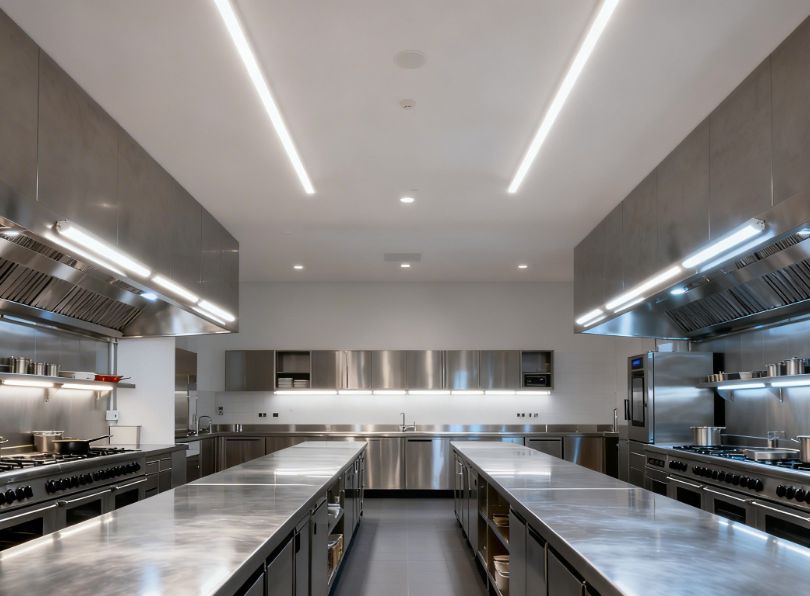
What lights are used in a commercial kitchen? This is a critical question. Commercial kitchens present one of the most hostile environments for commercial lighting: high temperatures, steam, grease, cleaning chemicals, and impact risks. Specifying the wrong fixtures leads to frequent failures, safety hazards, and health code violations. This section provides a complete technical guide to LED profiles for commercial kitchens, with a focus on UK regulations and global best practices.
Fundamental requirements: IP ratings, materials, and hygiene
A lighting fixture for commercial kitchen must withstand:
- moisture and steam: from dishwashers, kettles, and cooking processes;
- grease and oil: airborne particles that accumulate on surfaces;
- high-pressure cleaning: daily washing with detergents and hot water;
- impact: from mobile equipment, pots, and pans;
- temperature swings: from cold storage to grill zones.
Therefore, the minimum specification for any commercial lighting fixture in a kitchen is:
- IP65 or IP66: dust-tight and protected against low or high-pressure water jets. For areas directly above cooking lines, IP66 with high-temperature gaskets is recommended;
- IK08 or higher: impact resistance (5 joules) to withstand accidental knocks;
- Smooth, non-porous surfaces: to prevent bacterial growth and enable easy cleaning. No crevices where grease can accumulate;
- Corrosion-resistant materials: stainless steel or powder-coated aluminum with anti-corrosion treatment (e.g., anodized plus epoxy);
- Shatterproof diffuser: polycarbonate (PC) is preferred over glass or acrylic to prevent contamination from broken glass. Must be retained by a locking mechanism.
LED profile systems for kitchens: design features
Linear LED profiles are the preferred solution for commercial kitchens because of:
- seamless, washable design: profiles with silicone-sealed end caps and continuous mounting channels eliminate gaps;
- uniform illumination: opal polycarbonate diffusers provide even light without shadows that could hide dirt;
- modularity: easy to replace individual sections if damaged;
- integration with emergency lighting: profiles can house emergency LED modules for safety code compliance.
Specify profiles with rounded, smooth profile (no sharp edges) and a sloped top to prevent grease accumulation. The diffuser should be secured with stainless steel clips or tamper-proof screws to prevent accidental opening during cleaning.
Photometric performance: CCT, CRI, and illuminance
What type of lighting is best for a commercial kitchen? From a visual task perspective:
- CCT: 4000K is most common, provides clean, neutral light that aids food inspection. Some chefs prefer 5000K for better color discrimination, but 4000K is a good compromise. 3000K is too warm and might mask spoilage;
- CRI: Minimum CRI ≥80 is required by most health codes. For premium kitchens or areas where food presentation is critical (e.g., open kitchens in restaurants), specify CRI ≥90 with R9 >50 (red rendering) to make meats and vegetables look appetizing;
- Illuminance: EN 12464-1 (Europe) and CIBSE LG7 (UK) recommend:
- food preparation areas: 500 lux (maintained);
- cooking and service areas: 300-500 lux;
- washing areas: 300 lux;
- storage (dry pantries): 100-200 lux.
UK regulation: detailed analysis
What are the regulations for lighting in a commercial kitchen in the United Kingdom? Compliance involves multiple overlapping requirements:
| Regulation / Standard | Key lighting requirement | Implication for LED profiles |
|---|---|---|
| UK Building Regulations Part L (Conservation of Fuel and Power) | – Minimum efficacy: 80 lm/W (for new builds/renovations). – Automatic controls: Presence detection in areas with intermittent use (storage, corridors). – Daylight harvesting not typically applicable in kitchens. | Select LED profiles with high-efficacy strips (≥130 lm/W). Specify occupancy sensors for non-production areas. |
| Food Standards Agency (FSA) / EHO Guidelines | – Lights must be enclosed to prevent glass contamination in case of breakage. – Fixtures must be washable and not harbor pests. – Adequate lighting for working in hygienic conditions. | Mandatory use of shatterproof polycarbonate diffusers (not glass). Profiles must have sealed ends and smooth external surfaces. |
| BS 7671 (IET Wiring Regulations) | – Requirements for IP ratings in different zones (similar to bathrooms but adapted for kitchens). – Emergency lighting in commercial kitchens (BS 5266). | Specify IP65 as minimum. Integrate emergency LED modules into profiles or provide separate emergency fixtures. |
| CIBSE SLL Code for Lighting | – Recommends UGR <25 for kitchen work areas (to reduce glare on stainless steel). – Color rendering: Ra ≥80. | Select diffusers with controlled glare (opal or micro-prismatic) to achieve UGR <25. |
International regulation: EU, USA, UAE, Asia
For multinational projects (Luca’s scope), consider these additional requirements:
- European Union (EN 60598-1, EN 62471): similar to UK but with CE marking. Additional requirement for photobiological safety (EN 62471) to ensure no blue light hazard;
- United States (UL 1598, UL 8750, NSF/ANSI 2): UL 1598 covers wet location fixtures. NSF/ANSI 2 is critical for food equipment: fixtures must be certified for “splash” and “non-food zones” if used in food preparation areas. Many health departments require NSF certification;
- UAE / Dubai Municipality: high ambient temperature testing (50°C) required. DM approval often imposes IP65 for all kitchen areas, regardless of zone;
- Singapore / Malaysia (SS 531, MS IEC 60598): follow IEC standards but may require tropicalization testing (resistance to humidity and fungi).
Material selection: polycarbonate vs. PMMA diffusers
In commercial kitchens, polycarbonate (PC) is the only safe choice for diffusers:
| Material | Advantages | Disadvantages in kitchen |
|---|---|---|
| Polycarbonate (PC) | High impact resistance (shatterproof), withstands high temperatures (up to 115°C), chemically resistant to many detergents. | Can yellow over time if UV-stabilized version not specified; slightly lower light transmission (85-90%). |
| PMMA (Acrylic) | Excellent optical clarity, high transmission (92-95%). | Brittle, can shatter (similar to glass), not suitable for high temperatures, can crack with chemical detergents. Not recommended for kitchens. |
Installation and maintenance considerations
Ease of maintenance is critical:
- tool-free access: profiles with clip-on diffusers (secured with silicone gaskets) enable quick cleaning or LED replacement without tools;
- sealed end caps: ensure end caps are secured with screws and gaskets, not just snap-fit, to maintain IP rating after multiple cleanings;
- cable entry: use IP-rated cable glands (nickel-plated brass) to prevent moisture ingress at wiring points;
- spare parts: keep spare diffusers and end caps in stock, as these may degrade faster than the LED module in hostile environments.
Example specification for tender documents
Here is an example specification for commercial kitchen lighting:
– fixture type: linear LED profile, surface-mounted or suspended;
– ingress protection: IP65 minimum (IP66 preferred above cooking lines);
– impact resistance: IK08 minimum;
– diffuser: opal polycarbonate, UV-stabilized, shatterproof, secured with stainless steel clips or tamper-proof screws;
– housing: extruded aluminum 6063-T5, with anti-corrosion polyester powder coating (min 80µm) or anodized finish;
– gaskets: silicone, high-temperature resistant (up to 150°C);
– CCT: 4000K (±150K, MacAdam ≤3 SDCM);
– CRI: Ra ≥80 (general) or Ra ≥90 with R9>50 (for open kitchens);
– efficacy: ≥120 lm/W (complete fixture);
– driver: constant current, DALI-2 dimmable (if control required), THD <10%, PF >0.95, 2kV surge protection;
– compliance: CE/UKCA (EU/UK), UL/NSF (USA if applicable), with test reports;
– warranty: 5 years minimum.
Best lighting for commercial kitchen
What is the best lighting for a commercial kitchen? Based on the above, the optimal solution is a sealed LED profile system with polycarbonate diffuser, IP65+ rating, 4000K CCT, CRI≥80, and anti-corrosion finish. For UK projects, ensure compliance with Part L (efficacy and controls) and FSA guidelines (enclosed diffusers). For USA projects, seek NSF certification.
Best lighting for retail
The layered approach: ambient, accent, task, and perimeter
Professional retail lighting design always employs multiple layers. Each layer has a distinct purpose and requires different commercial lighting fixtures.
| Layer | Purpose | Typical illuminance / ratio | Recommended LED profile solution |
|---|---|---|---|
| Ambient (general) | Provides overall illumination for safe movement and spatial orientation. Sets baseline light level. | 100-300 lux (depending on store type). | Recessed or surface-mounted linear LED profiles with opal diffusers; cove profiles for indirect light; suspended direct/indirect profiles. |
| Accent | Draws attention to specific products or displays. Creates visual hierarchy and drama. Typically contrast ratio 3:1 to 15:1. | Accent illuminance 3-5 times ambient level. | Track-mounted spot profiles with interchangeable optics; adjustable miniaturized profiles; barn door projectors for precise shapes. |
| Perimeter (wallwash) | Illuminates vertical surfaces (walls, shelving) to make space feel larger and highlight wall-mounted merchandise. | Vertical illuminance ≥70% of horizontal ambient. | Asymmetric LED wallwash profiles (recessed or surface) with precision optics to create uniform vertical illumination. |
| Task (checkouts, fitting rooms) | Provides focused light for specific activities (payment, trying on clothes). | 500 lux (checkouts), 300-500 lux (fitting rooms). | Under-counter profiles at checkout; profiles integrated into fitting room mirrors with high CRI. |
What is commercial display lighting?
Commercial display lighting refers to specialized lighting used to showcase merchandise in a retail environment. Its key characteristics are:
- high color rendering (CRI ≥90, often ≥95): to make products look vibrant and true-to-life;
- precise beam control: spots, barn door projectors, or linear profiles with lenses to direct light exactly where needed;
- adjustability: fixtures that can be repositioned as displays change (track systems, adjustable brackets);
- high contrast: creating pools of light that separate products from background.
For a boutique, display lighting might mean 3000K spots on mannequins and 3500K wallwashers on shelves, all with CRI ≥95 to make fabrics and colors pop.
Color temperature and CRI by retail segment
Which lighting is best for retail? Optimal CCT and CRI vary significantly by merchandise type.
| Retail segment | Recommended CCT | Minimum CRI | Special considerations |
|---|---|---|---|
| Fashion / Apparel | 3000K – 3500K (warm to neutral) | CRI ≥90 (≥95 for premium) | High R9 (red rendering) essential for fabrics. Accent lighting on mannequins with narrow beams. |
| Grocery / Supermarket | 4000K (fresh food), 3000K (bakery/deli) | CRI ≥80 (general), ≥90 (fresh produce) | High R9 for meat and produce. Tunable white in deli counters for different times of day. |
| Jewelry / Watches | 3500K – 4500K (to make diamonds sparkle) | CRI ≥95 | Very high R9 and R12 (blue). Use very narrow spot optics (10°-15°) to create sparkle. |
| Furniture / Home goods | 3000K – 3500K | CRI ≥85 | Wide beam distribution to simulate home environment. Wallwashing to show texture. |
| Electronics | 4000K – 5000K | CRI ≥80 | Avoid glare on screens; use low-UGR profiles. Accent on product details. |
| Cosmetics / Perfumery | 3500K – 4000K | CRI ≥95 | Excellent color rendering for makeup matching. Uniform, shadow-free lighting at checkout. |
The role of LED profiles in retail lighting
LED profiles are extremely versatile in retail. They can be used across all layers:
- ambient: recessed linear profiles create clean, uninterrupted lines in the ceiling, contributing to a modern aesthetic;
- perimeter wallwashing: asymmetric profiles (e.g., 30°-60° distribution) mounted near ceiling or in coves evenly illuminate vertical displays;
- shelf integration: miniaturized profiles (10×10 mm) can be integrated into shelf edges to highlight products from within;
- display cases: ultra-slim profiles (6 mm height) fit inside jewelry or collectible display cases;
- accent with interchangeable optics: advanced LED profile systems now offer snap-on lenses (15°, 30°, 45°, 60°) that can be changed in the field, enabling Marco to reconfigure accent lighting as merchandise changes. This is a game-changer for retail flexibility.
Interchangeable optics: the new frontier for retail profiles
Our commercial LED profile systems enable snap-on lenses for beam control. This technology allows a single profile to serve multiple purposes:
- base profile: houses the LED strip and has a universal channel for lens attachment;
- interchangeable lenses:
- opal diffuser: For ambient light (wide distribution, UGR control);
- clear lens with 30° or 60° optic: for accent lighting on specific products;
- asymmetric lens: for wallwashing;
- linear spread lens: for illuminating long counters or displays.
This means the same track-mounted or recessed housing can be reused when store layout changes, without replacing entire fixtures. This simplifies specification and reduces inventory complexity.
Controls and energy efficiency in retail
Both the facility manager and entrepreneur are interested in energy efficiency. Retail lighting can account for 30-50% of electrical consumption. Key strategies:
- DALI dimming: ambient lighting can be dimmed during low-traffic hours (e.g., cleaning, early morning). Accent lighting remains at full power to maintain visual appeal;
- scene setting: different light scenes for day, evening, and special events. For example, warmer, softer light for evening shopping;
- daylight harvesting: in stores with windows or skylights, photosensors dim perimeter lighting when daylight is sufficient;
- occupancy sensors in service areas: stockrooms and corridors can be equipped with motion sensors to save energy.
Retail profiles are compatible with all major control protocols (DALI-2, 0-10V, DMX, Bluetooth mesh).
Exterior retail lighting: facades and signage
What is the best light for commercial building exteriors? For retail, the exterior is the first impression. LED profiles are ideal for:
- facade washing: asymmetric profiles mounted at building base or roofline to graze texture (brick, stone, cladding). Use 3000K-3500K for warm materials, 4000K for modern glass/steel;
- signage illumination: waterproof profiles (IP67) integrated into channel letters or backlit signs;
- canopy lighting: recessed profiles in canopies to illuminate entrances and walkways (IP65, wide distribution);
- pathways and landscape: in-ground profiles for pedestrian paths, bollards, or step lighting (IK10, IP67).
Psychological and behavioral effects
Beyond technical specifications, lighting influences shopper behavior:
- Warm CCT (3000K): encourages relaxation, browsing, and perception of luxury. Suitable for high-end fashion, wine shops;
- Cool CCT (4000K+): increases alertness, perception of cleanliness, and can speed decision-making. Used in supermarkets, pharmacies, convenience stores;
- high contrast (accent): directs gaze and creates visual interest. Customers spend more time looking at well-lit displays;
- vertical illumination: makes space feel larger and more inviting. Customers are drawn to well-lit walls.
Sample specification for retail lighting in tender documents
For tender documents for retail lighting:
– type: recessed linear LED profile, flush with ceiling finish;
– diffuser: opal PMMA or polycarbonate, UGR <19;
– CCT: 3500K (±150K, MacAdam ≤3 SDCM);
– CRI: Ra ≥90 (R9 >50);
– light output: 2000-2500 lm per meter (adjustable via driver);
– driver: DALI-2 dimmable, constant current, THD <10%, PF >0.95;
– housing: extruded aluminum 6063-T5, powder-coated RAL 9010 (or as specified by architect);
– compliance: CE/UKCA (EU/UK), UL (USA if required);
– accessories: snap-on lens kit (optional for future reconfiguration);
– warranty: 5 years.
The best retail lighting is layered, flexible, and human-centric
What is the best lighting for commercial retail? There is no single answer; it depends on brand, merchandise, and customer experience goals. However, common threads are:
- a layered approach combining ambient, accent, perimeter, and task;
- high color rendering (CRI ≥90) with CCT appropriate for merchandise;
- flexible, adjustable fixtures (track systems, interchangeable optics) to adapt to display changes;
- high-efficiency controls (DALI, scene setting) to reduce operating costs;
- integration with architecture (recessed profiles, cove lighting) for a clean, modern look.
LightingLine.eu offers a comprehensive range of LED profiles and optical accessories specifically designed for retail, supported by photometric data and certified to global standards. Whether someone needs to light a boutique or is opening a new supermarket, our team provides technical support to realize the vision.
What is the best commercial lighting?
This is the most frequent question from engineers, facility managers, store owners, and architects. The answer, however, is never unique but depends entirely on the application, priority performance metrics, and regulatory environment. This section provides a comprehensive framework for selecting optimal commercial lighting fixtures, with specific recommendations from the LightingLine.eu portfolio, supported by technical data on efficiency, longevity, and compliance.
The “one-size-fits-all” misconception in commercial lighting
Unlike residential lighting, where aesthetics often trump performance, commercial lighting must balance multiple, often competing objectives:
- photometric performance: illuminance, uniformity, glare control (UGR), color rendering (CRI);
- energy efficiency: lumens per watt, standby consumption, controls compatibility;
- longevity and service life: L70/B50 ratings, driver lifespan, environmental resistance (IP/IK);
- compliance: FCC (USA), CE (EU), UKCA (UK), CCC (China), etc;
- lifecycle cost: upfront investment vs. energy savings and maintenance intervals.
Therefore, the “best” lighting is the one that optimally meets the specific requirements of the space. Below, we break down recommendations by application.
Best commercial lighting by application
| Application | Primary requirements | Recommended LED profile solution | Key technical specifications |
|---|---|---|---|
| Offices (open-plan, private) | Glare control (UGR <19), high efficacy, circadian support, uniform environment. | Micro-prismatic recessed LED profiles or suspended direct/indirect profiles. | – UGR <16 – CCT 3500K-4000K – CRI ≥80 – DALI-2 dimming – L70 >60,000h |
| Industrial / Warehouses | High output, durability, wide beam, impact resistance, high mounting heights. | LED high-bay profiles with aluminum reflector (narrow or wide distribution). | – 10,000-20,000 lm per 4 ft – Beam: 90°-120° – IK08 minimum – Efficacy >150 lm/W – Optional motion sensors |
| Retail (fashion, boutique) | High CRI, color consistency, flexibility, accent capability. | Tunable white LED profiles (2700K-5000K) with CRI≥97 + track-mounted spot profiles. | – CRI ≥97 (R9 >90) – Tunable white (DALI DT8) – Interchangeable optics (snap-on lenses) – UGR <19 for ambient |
| Retail (grocery) | High R9 for fresh food, uniform illumination on shelves, energy efficiency. | Linear profiles with high-CRI strips (CRI≥90, R9>50) + asymmetric wallwash for perimeter. | – CCT 4000K (fresh) / 3000K (deli) – R9 >50 (R9 >90 for premium) – IP65 for refrigerated areas |
| Commercial kitchens | IP65+, shatterproof, high CRI, washable, corrosion-resistant. | Sealed LED profiles with polycarbonate diffuser, silicone gaskets, anti-corrosion finish. | – IP65/IP66 – IK08 – Polycarbonate diffuser (shatterproof) – CRI ≥80 (≥90 for open kitchens) – 4000K |
| Healthcare / Hospitals | High CRI, low glare, washability, circadian support, antimicrobial options. | Sealed, smooth profiles with antimicrobial powder coating + tunable white for patient rooms. | – IP54/IP65 – Antimicrobial finish (optional) – UGR <19 – Tunable white 2700K-5000K |
| Exterior / Facade | Weather-resistant (IP66+), asymmetric distribution, corrosion resistance. | Asymmetric wallwash profiles, in-ground profiles, or linear grazers. | – IP66/IP67 – IK10 – Asymmetric optics (10°-60°) – 3000K-4000K |
What is the most efficient commercial lighting?
The current frontier is achieving >200 lumens per watt at system level (including driver losses). This requires:
- maximum-efficacy LED chips: state-of-the-art mid-power LEDs (e.g., 3030 or 2835 packages) achieving 220-230 lm/W at chip level (at 25°C, low current);
- optimized thermal management: LED profiles with ample heatsink surface area to keep junction temperature low. Every 10°C reduction can increase LED efficacy by 2-3% and extend lifespan;
- high-transmission diffusers: micro-prismatic or specially formulated diffusers that transmit >90% of light while controlling glare (vs. standard opal at 75-80%);
- efficient drivers: driver efficiency >95% (loss <5%) with low standby consumption (<0.5W);
- direct-lit configuration: eliminating light guides or reflectors that absorb light. “Direct-lit” LED profiles where LEDs face directly toward the diffuser (with appropriate spacing to avoid pixelation) achieve higher efficiency than edge-lit designs.
The UltraEfficiency series achieves up to 210 lm/W (system efficacy) using 230 lm/W LEDs, thermally optimized profiles, and high-transmission micro-prismatic diffusers. For Giovanni, this translates to 30-40% energy savings compared to standard LED profiles.
What makes a light commercial-grade? The engineering behind durability and compliance
Distinguishing between “residential-grade” and true commercial-grade lighting is critical. Here are the technical differentiators:
| Component / Feature | Commercial-grade requirement | Why it matters |
|---|---|---|
| Driver | – Rated lifespan: ≥50,000 hours at specified Tc (case temperature). – Electrolytic capacitors: 105°C, 10,000h+ – THD <10% (total harmonic distortion) – Power factor >0.95 – Surge protection: 2kV (differential), 4kV (common mode) – Field-replaceable design | Ensures long life in continuous operation, reduces harmonic pollution on grid, protects from grid surges, and enables maintenance without replacing entire fixture. |
| LED strip / module | – LM-80 test data for specific LED used – TM-21 projection: L70 >60,000h minimum – Bin consistency: MacAdam ≤3 SDCM – CRI and R9 guaranteed (not just typical) | Predictable lumen maintenance, color consistency across large installations, and accurate color rendering for retail/critical tasks. |
| Thermal management | – Aluminum profile with sufficient cross-section and fins – Thermal simulation at expected ambient temperature (e.g., 40°C) – Clearly marked and measured Tc point | Prevents premature LED degradation. Poor thermal design can reduce LED lifespan by 50% or more. |
| Mechanical construction | – Housing: 6063-T5 aluminum, minimum 1.5 mm wall thickness – Impact protection rating: IK06 to IK10 as required – Corrosion protection: anodized or powder-coated (minimum 80µm) | Ensures fixture can withstand installation stresses and environmental conditions (humidity, chemicals). |
| EMI/EMC compliance | – FCC Part 15 (Class A or B) for USA projects – EN 55015 (emissions) and EN 61547 (immunity) for EU/UK – Test reports from accredited labs | Prevents interference with sensitive equipment (Wi-Fi, medical, communications). Mandatory for legal market access. |
| Warranty | 5 years minimum (parts and labor), backed by financial guarantee. | Demonstrates manufacturer confidence and protects facility owner’s investment. |
The role of smart controls in the “best” commercial lighting
The most efficient LED profile is wasted if it runs at full power when spaces are unoccupied. The true best commercial lighting integrates seamlessly with building management systems. Key control features:
- DALI-2 (Digital Addressable Lighting Interface): the open standard for commercial lighting control. Enables individual addressing, scene setting, and feedback;
- occupancy and daylight sensors: integrated into profiles or connected via BMS. Presence detection can save 30-50% energy in intermittently used areas (corridors, restrooms, stockrooms);
- wireless mesh (Bluetooth, Zigbee): for retrofits or spaces where wiring is difficult. Enables centralized control without new cables;
- constant light output (CLO): driver compensates for LED lumen depreciation over time, maintaining design illuminance and saving energy in early years.
Total cost of ownership (TCO)
For the facility manager, the best lighting minimizes total cost of ownership over 10-15 years. TCO includes:
- upfront cost: fixtures, installation, commissioning;
- energy cost: kWh consumption × electricity rate × hours of use;
- maintenance cost: driver replacement, cleaning, labor;
- replacement cost: fixture replacement at end of life.
A high-efficacy LED profile (e.g., 180 lm/W vs. 120 lm/W) may have 20% higher upfront cost but can pay back the difference in 1-2 years through energy savings, and then continue saving for a decade. Similarly, a field-replaceable driver (commercial-grade) increases upfront cost but avoids replacing the entire fixture if the driver fails.
Summary: selecting the best commercial lighting for your project
There is no single best product, but there is a better process: define application requirements, prioritize performance metrics, verify compliance, and evaluate total cost of ownership. LightingLine.eu supports designers with:
- complete photometric data (IES files, UGR tables);
- LM-80/TM-21 reports for LED strips;
- driver specifications with Tc point and lifespan data;
- certifications for all major global markets (FCC, CE, UKCA, etc.);
- customizable profiles with interchangeable optics for retail flexibility.
Whether someone needs an ultra-high-efficiency solution for a warehouse, others requiring tunable white profiles for a boutique, or someone seeking durable, low-maintenance fixtures for a multi-site portfolio, LightingLine.eu provides the technical depth and product range to deliver the best commercial lighting for the job.
Why is it better to use LED lamps in a commercial lighting system? Why 277V commercial lighting?
Quantifiable advantages of LEDs in commercial applications
LED technology has revolutionized commercial lighting through superior performance across multiple parameters. Below is a comparative analysis with traditional sources still present in many retrofit projects.
| Parameter | LED (typical commercial-grade) | Fluorescent (T5/T8) | Metal Halide / HID | Advantage for commercial |
|---|---|---|---|---|
| Lifespan (L70) | 50,000 – 100,000+ hours | 15,000 – 30,000 hours | 10,000 – 20,000 hours | Drastically reduced maintenance costs for Giovanni. In a 24/7 operation, LED lasts 5-10 years vs. 1-2 years for fluorescent. |
| System efficacy (lm/W) | 120 – 210 lm/W (and improving) | 60 – 100 lm/W (including driver losses) | 50 – 90 lm/W (including ballast) | 30-70% energy savings for Marco and Elena. Faster ROI, lower carbon footprint. |
| Instant on / no restrike | Full light immediately (<1 sec) | Flicker at startup, delayed full output when cold | 5-20 minute warm-up; cannot restrike immediately | Critical for spaces with occupancy sensors (warehouses, corridors). No waiting for light. |
| Dimmability / controllability | Excellent (0-100% with suitable driver, no color shift) | Limited (requires dimmable ballast, narrow range, color shifts) | Poor (requires special ballasts, color shift) | Enables daylight harvesting, scene setting, and energy optimization (Elena’s retail flexibility). |
| Environment / hazardous materials | Mercury-free, RoHS compliant | Contains mercury (requires special disposal) | May contain mercury or other hazardous gases | Simplifies disposal and meets sustainability goals (WELL, LEED). |
| Optical control | Precise beam control via lenses, low UGR achievable | Omnidirectional, requires reflectors (losses) | Arc tube difficult to control precisely | Better glare control for offices (Sara’s priority), more efficient accent lighting. |
| Low-temperature performance | Improves when cold (cold storage, exterior) | Output drops when cold, may not start | Output drops, longer warm-up | Ideal for refrigerated warehouses, outdoor canopies. |
Why 277V commercial lighting? The North American standard
Why is commercial lighting at 277V? In the United States and Canada, commercial and industrial buildings often use a 480/277V three-phase four-wire electrical distribution system. This differs from residential 120/240V. Here is the technical rationale:
- voltage selection: 277V is the phase-to-neutral voltage derived from a 480V wye three-phase system (480V / √3 = 277V);
- why 277V for lighting? Higher voltage allows delivering the same power with lower current (P = V × I). Lower current means:
- reduced copper losses (I²R): less energy wasted as heat in wiring;
- smaller conductor sizes: smaller gauge cables can be used, reducing material costs;
- greater circuit capacity: more fixtures can be connected per circuit (typically a 20A breaker at 277V can handle ~5.5 kVA, sufficient for 40-50 LED profiles).
- historical context: fluorescent ballasts were readily available for 277V and the practice continued with LEDs.
Ensure specified LED drivers have universal input (120-277V) or are specifically rated for 277V. Most quality LED drivers for commercial applications are auto-sensing from 120V to 277V (and some up to 347V for Canadian applications).
European and global voltage standards: 230V and extra-low voltage systems
In Europe, the standard for commercial lighting is 230V phase-to-neutral (400V three-phase). However, a significant difference is the widespread use of safety extra-low voltage (SELV) systems, particularly 24V DC, for LED profiles.
- Why 24V DC in Europe?
- safety: 24V is SELV (Safety Extra-Low Voltage), reducing electric shock risk. This is crucial for installations in accessible areas (retail displays, under-cabinets) and allows installation by non-electricians in some jurisdictions (always follow local codes);
- flexibility: 24V LED strips can be cut and extended on-site with minimal risk. Constant voltage (CV) systems are simpler for linear installations;
- dimming: PWM (pulse-width modulation) dimming at 24V is simple and flicker-free with appropriate controllers;
- Constant Current (CC) vs. Constant Voltage (CV):
- constant voltage (24V DC): most common for LED profiles. Multiple strips can be connected in parallel. Requires careful voltage drop calculation for runs >10m;
- constant current (e.g., 350mA, 700mA): used for high-power applications and long runs without voltage drop. Often used in linear modules for industrial or office applications.
Standardize on 24V DC systems with centralized drivers in an electrical panel for easy maintenance. This also enables integration of backup batteries for emergency lighting.
North America vs. Europe comparison
| Parameter | North America (USA/Canada) | Europe (EU/UK) |
|---|---|---|
| Primary lighting voltage | 277V (phase-neutral from 480/277V system) | 230V (phase-neutral from 400/230V system) |
| Common LED driver input | Universal 120-277V (or 347V for Canada) | 220-240V AC (or 24V DC via external driver) |
| Low-voltage trend | 24V DC systems exist but are less common; more integrated 277V drivers. | 24V DC very common for profiles, strips, and architectural lighting. |
| Driver location | Often integrated in fixture or remote. | Often remote (centralized) for 24V systems, or integrated for 230V. |
| Wiring considerations | Higher voltage, lower current → longer circuits, smaller cables. | 24V requires thicker cables and careful voltage drop planning for runs >10m. |
Practical implications for LED profile specification
When specifying LED profiles for a global project (or a project in a specific region), consider:
- for USA projects (Luca): specify drivers with 277V input capability. Ensure FCC Part 15 compliance. If using 24V DC strips, ensure driver has 120-277V AC input and 24V DC output, and is located in an accessible place;
- for EU/UK projects (Luca, Giovanni): decide between integrated 230V drivers (simpler wiring, no external driver) and 24V systems (safer, more flexible for cutting). For large-scale linear installations, 24V systems with centralized drivers are often preferred for maintenance;
- for international mixed-use projects: specify LED profiles with field-selectable drivers or universal input drivers that can accept 120-277V AC or 230V AC, and provide both 24V DC and constant current options.
The future: PoE (Power over Ethernet) and DC networks
Emerging trends include Power over Ethernet (PoE) for lighting, which uses 48V DC to power and control fixtures over standard network cables. This is gaining traction in smart buildings (offices) but is currently limited to lower-power profiles. For industrial and high-output applications, 277V AC or 230V AC remain dominant. LightingLine.eu offers PoE-compatible profiles for future-proof office projects.
Why is it better to use LED lamps?
The data is unequivocal: longer life, higher efficacy, better controllability, and environmental benefits. Why 277V commercial lighting? It is an efficient legacy system in North America that reduces wiring costs and losses. For Europe, 24V DC systems offer safety and flexibility. Understanding these fundamentals enables informed decisions that optimize performance, cost, and compliance. LightingLine.eu provides LED profiles with a wide range of driver options to fit any global project.
What type of lighting is best for a factory? LED high-bay profiles (150-200 lm/W) with occupancy sensors.
What type of lighting system is used for plant and industrial lighting? Typically 0-10V or DALI dimmable for flexibility.
Future trends: smart commercial lighting and IoT integration
Why choose a specific profile for commercial lighting
Here is the final paragraph transformed into a technical and strategic conclusion, synthesizing the entire article and reinforcing LightingLine.eu’s positioning as a technical partner for professionals. I have integrated references to key themes (FCC, CCT, costs, architectural integration) and a targeted call-to-action for the different professional figures.
The convergence of technical and commercial imperatives
In this article we have explored the multifaceted nature of commercial lighting specification:
- compliance is non-negotiable: from FCC certification in the USA to UK kitchen regulations and EU-wide CE requirements, the profile and its components must be tested and documented. A profile without proper certification risks project delays, fines, and safety hazards;
- cost analysis must be holistic: how much does commercial lighting cost? The answer lies not just in €/m² of installation, but in total cost of ownership, energy consumption (driven by efficacy), maintenance intervals (driven by thermal management), and replacement frequency (driven by driver quality). A cheaper profile with poor thermal design will cost far more over a decade;
- human-centric factors drive value: the debate between 3000K and 4000K for offices is not aesthetic: it affects occupant alertness and wellbeing. Diffuser choice (opal vs. micro-prismatic) determines UGR and visual comfort. For retail, CRI and R9 directly impact sales by making merchandise appealing;
- integration with architecture and controls: the pursuit of seamless design requires profiles that recess perfectly into drywall or integrate into furniture. The need for remote monitoring requires profiles with compatible drivers (DALI-2, wireless).
The consequences of a wrong choice
Specifying an inappropriate or low-quality LED profile can lead to:
- premature failure: inadequate heat dissipation causes LED chip degradation, leading to dark spots and reduced output within 1-2 years;
- color inconsistency: poor bin control (LED selection) causes visible color differences between adjacent profiles, ruining aesthetics (Marco’s retail display looks unprofessional);
- glare and discomfort: wrong diffuser choice causes UGR >22, leading to employee complaints and reduced productivity in offices;
- non-compliance penalties: lack of FCC or CE marks can lead to shipment seizures, rework costs, and legal liability;
- higher operating costs: lower efficacy means higher energy bills year after year, a hidden cost that outweighs any upfront savings.
Final recommendations for designers
When preparing the tender document, bill of quantities, or compliance checklist, remember:
- start from the application: define tasks, environment, and user needs. Use the tables in this guide to match application to profile type;
- verify compliance upfront: request certifications and test reports during the tender phase, not after installation;
- calculate total cost, not upfront price: use efficacy (lm/W) and lifespan data to model energy and maintenance costs over 10 years;
- demand optical data: UGR tables, beam angles, and IES files are essential for lighting design software: do not accept “typical” values;
- collaborate with a supplier, not just a vendor: choose a partner like LightingLine.eu that provides technical support, customization, and long-term warranty.
LED profile specification is the intersection of engineering, architecture, compliance, and economics. By applying the technical depth covered in this article, from FCC certification and cost per m², to CCT selection and IP ratings, you ensure that your commercial lighting project delivers on its promises: safety, efficiency, beauty, and value.