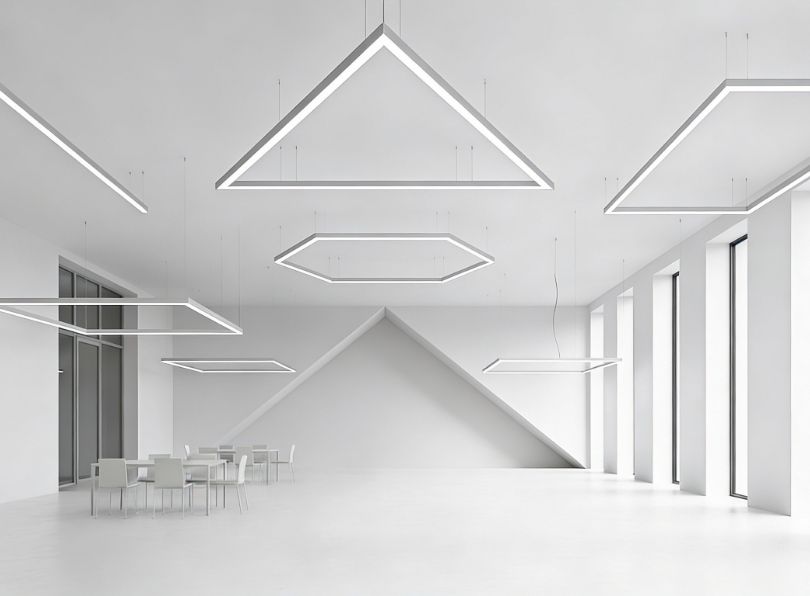
In the evolving landscape of architectural lighting, geometric chandelier has undergone a profound transformation, shifting from ornate crystal assemblies to sophisticated, structurally expressive compositions of light and form. For architects, engineers, and large-scale construction firms, the modern geometric chandelier represents not merely a fixture, but an integral architectural element—a statement of spatial intent crafted from precision-engineered components.
This guide delves into the methodology of creating these lighting sculptures using technical aluminum profile systems, such as those offered by LightingLine.eu. We will explore the prevailing trends of 2026, decode the essential rules of thumb for scale and placement, and provide a granular, technical framework for constructing chandeliers based on primary geometric shapes: squares, hexagons, and triangles, utilizing both suspended and ceiling-mounted profiles. This is a masterclass in merging aesthetic vision with engineering rigor.
In this article…
- Geometric chandelier: the evolution & relevance, are chandeliers still in style?
- Fundamental principles: the rule of thumb for chandeliers
- 2026 trend forecast: the dominance of architectural geometry
- Obsolete forms: what chandeliers are out of style?
- Semantics & specification: chandelier vs. hanging light
- Precision placement: the rule for hanging a chandelier
- Cost analysis: why are modern chandeliers so expensive?
- The designer’s toolkit: aluminum profile systems from LightingLine.eu
- Construction methodology: the square frame chandelier
- Construction methodology: the hexagonal grid chandelier
- Construction methodology: the triangular tensegrity chandelier
- Integration & controls: completing the lighting system
- Case study: a corporate atrium installation
- The future is in modular, architectural and geometric chandelier
Geometric chandelier: the evolution & relevance, are chandeliers still in style?
The question, “Are chandeliers still in style?“, is one that resonates in many initial client meetings. The answer is a resounding and nuanced yes. The traditional, multi-tiered crystal chandelier of the Baroque and Rococo eras has ceded its dominance, but the chandelier as a concept—a central, suspended lighting ensemble—has not only persisted but flourished. Its function has evolved from pure opulence to a fusion of ambient illumination, sculptural focal point, and spatial definer.
In contemporary architecture, a chandelier is often the exclamation point in a volume, articulating the height, scale, and character of an atrium, lobby, dining area, or even a refined residential space. The modern chandelier is less about refraction and more about form, less about ornament and more about structure. This shift aligns perfectly with the architectural zeitgeist that values honesty of materials, geometric clarity, and custom, site-specific design. The chandelier is no longer a bought object but a designed system.
From classic to contemporary: a brief historical shift
The journey from candle-bearing wooden beams to LED-integrated aluminum extrusions is a story of technological and aesthetic progress. The 20th century saw the democratization of the chandelier through materials like brass and glass, but often retained ornate detailing. The late 20th and early 21st centuries introduced minimalism, with designers like Poul Henningsen and Ingo Maurer exploring abstract forms. Today, the cutting edge is defined by architectural integration, parametric design, and smart lighting. The chandelier is conceived as part of the building’s fabric, not an afterthought. This is where aluminum profile systems become revolutionary, offering the building blocks for such integration.
The professional’s perspective: why specifying a custom chandelier matters
For architects and specifiers, off-the-shelf lighting often falls short of addressing the unique parameters of a project—be it an unusual ceiling structure, a specific brand aesthetic, or a need for unparalleled scale. A custom geometric chandelier built from profiles solves this. It allows for control over every dimension, lumen output, color temperature, and even future reconfigurability. It turns a procurement challenge into a design opportunity, adding significant value to the project and demonstrating a high level of technical and aesthetic coordination to the client.
Fundamental principles: the rule of thumb for chandeliers
Before delving into construction, one must master the foundational guidelines that ensure a chandelier is proportionally and functionally correct. “What is the rule of thumb for chandeliers?” is, therefore, a critical starting point. These rules are not arbitrary but born from ergonomics, visual harmony, and lighting engineering principles.
Dimensional scaling: diameter and height
The primary rule involves scaling the fixture to the room. A classic formula for determining the appropriate diameter (in inches) is to add the room’s length and width (in feet) and convert that sum to inches.
For a 12′ x 18′ dining room, 12+18=30, suggesting a chandelier roughly 30 inches in diameter. For metric planning, a similar approach uses the sum of length and width in meters, converted to centimeters, then multiplied by a factor of 1.2. For a 4m x 6m room, 4+6=10, 10 * 1.2 = 12, suggesting a diameter of about 120cm. Height is equally crucial: in rooms with standard 8-foot (2.44m) ceilings, the chandelier’s height should not exceed 24-30 inches (60-76cm).
For each additional foot of ceiling height, you can add 2-3 inches (5-7.5cm) to the fixture’s height. For grand atriums, the fixture becomes a volume-filling element, and these rules expand proportionally.
Table: chandelier sizing guidelines
| Room type / area | Diameter calculation | Height guideline | Clearance minimum |
|---|---|---|---|
| Dining room (over table) | 1/2 to 2/3 of table width | 30-36″ (76-91cm) above table | 30″ (76cm) from tabletop to bottom |
| Foyer / entry (no furniture below) | (Length(ft) + Width(ft)) = Diameter(in) | Allow 7′ (2.13m) floor clearance | Bottom at least 7′ from floor |
| Living room / atrium (open space) | Scale to volume, not just floor area | Can be 1/5 to 1/4 of room height | Maintain human traffic flow |
| Bedroom (over foot of bed) | Keep narrower than bed width | 80-84″ (203-213cm) from floor | No obstruction when standing |
Weight and structural support assessment
A rule often overlooked in the pursuit of aesthetics is the absolute necessity of verifying structural support. A custom aluminum chandelier, while lighter than solid crystal, can still be substantial in size. The combined weight of profiles, connectors, LEDs, drivers, and diffusers must be calculated accurately. The chosen mounting point—whether a standard electrical box, a reinforced plywood backer, or a dedicated steel support frame—must be rated for 1.5 to 2 times the fixture’s total dynamic weight (accounting for potential sway). Collaboration with the project’s structural engineer during the design phase is non-negotiable for large-scale installations.
2026 trend forecast: the dominance of architectural geometry
Looking forward, “What is the trend in chandeliers in 2026?” The trajectory is clear: towards increased architectural synthesis, sustainable materiality, and intelligent, adaptive systems. Geometry is the dominant language, but its application is becoming more complex and integrated.
The rise of the “structural luminaire”
In 2026, the line between building structure and lighting fixture continues to blur. Chandeliers are designed to echo or extend architectural motifs—beams, trusses, facades. Aluminum profiles are ideal for this trend due to their inherent structural integrity. A chandelier may not just hang from the ceiling but appear to grow from it, using ceiling-mounted track systems that seamlessly transition into suspended elements. The trend is towards monochromatic, material-honest finishes: brushed aluminum, dark bronze, and matte black dominate, moving away from faux finishes. The “silver chandelier” in this context refers not to color but to the raw, anodized, or lightly brushed finish of aluminum itself—a cool, technical, and premium aesthetic.
Modularity and reconfigurability
Sustainability mandates designing for adaptability, not obsolescence. The leading trend is modular chandelier systems built from standardized components. Using a system like LightingLine.eu’s profiles and connectors, a chandelier can be assembled, disassembled, and reconfigured for a new space or a new aesthetic preference. This is a powerful selling point for corporate and hospitality clients who may refresh interiors every 5-7 years. The geometry becomes a kit of parts: hexagons can be added, arms extended, or the entire form compressed or expanded.
Integrated smart lighting and human-centric design
The 2026 chandelier is a smart node. Beyond dimming, it integrates circadian rhythm tuning, shifting color temperature from cool, alertness-promoting light in the morning to warm, relaxing light in the evening. This is achieved through tunable-white LED strips installed within the aluminum profiles. Motion sensors and data connectivity for predictive maintenance (notifying when an LED driver may be nearing end-of-life) are becoming expected features in high-spec projects. The geometric form houses this advanced technology cleanly and unobtrusively.
Obsolete forms: what chandeliers are out of style?
Understanding what to avoid is as important as knowing what to embrace. “What chandeliers are out of style?” While personal taste always varies, from a professional architectural specification standpoint, certain styles are increasingly difficult to justify.
Heavily faux-finished pieces (e.g., brass pretending to be antique gold with intentional “wear”) are seen as inauthentic. Overly busy, small-scale crystal arrangements that create visual “noise” without architectural presence are declining. Tiered drum shades in generic fabrics often read as dated, especially in commercial spaces. The common thread among outdated styles is a lack of architectural dialogue and material honesty. They are objects placed in a space, not elements born from it. The modern geometric chandelier, in contrast, derives its power from its clarity of form and truth to materials.
Semantics & specification: chandelier vs. hanging light
In specifications, precision in terminology is critical. “What is the difference between a chandelier and a hanging light?” This is a frequent point of clarification in project documents.
Traditionally, a chandelier is a branched lighting fixture, often designed for multiple light sources, intended as a central decorative feature. A pendant or hanging light is typically a single-light source fixture, often simpler and sometimes used in multiples or clusters. However, in contemporary practice, the distinction has blurred. A linear arrangement of three cylindrical pendants might be specified as a “linear pendant cluster,” while a complex geometric form with a single, integrated LED light engine could be called a “modern chandelier.” The key differentiator in specification is often scale, intent, and complexity. For the purposes of this guide and the systems discussed, we use “chandelier” to describe any substantial, multi-element, architecturally-scaled suspended lighting structure, regardless of the number of discrete electrical points.
Precision placement: the rule for hanging a chandelier
I you are asking “What is the rule for hanging a chandelier?“, this involves both height from the floor and centering within the space.
Over a dining table: the bottom of the chandelier should be 30 to 36 inches (76 to 91 cm) above the tabletop. This prevents glare for seated people while ensuring the light pool adequately illuminates the surface. The fixture should be centered on the table, not necessarily on the room.
In a foyer or hallway: the bottom should be at least 7 feet (2.13 meters) from the floor to allow safe passage. In two-story foyers, center the fixture within the visible volume, often aligning it with a second-floor balcony railing or a significant architectural feature. Over a
Staircase: this is a complex scenario requiring careful measurement to ensure the fixture hangs clear of the stair slope and any potential headroom issues. A mock-up or detailed BIM model is essential.
For the geometric chandeliers we are designing, an additional rule applies: consider the sight lines from all critical vantage points. A hexagonal chandelier may have a preferred orientation when viewed from the main entrance. The hanging hardware (cables, rods) should be considered part of the design, not hidden but integrated—perhaps using matching aluminum suspension rods from the same system.
Cost analysis: why are modern chandeliers so expensive?
Clients often ask, “Why are chandeliers so expensive?” A custom geometric chandelier built from technical aluminum profiles represents a significant investment, and justifying this cost is part of the architect’s role.
Design & engineering costs: this is not an off-the-shelf product. It involves hours of design, prototyping, structural calculation, and lighting plan integration.
Material quality: high-grade aluminum extrusions (like 6063-T5 or T6 alloy) have precise tolerances, consistent finishing, and superior structural properties. They are more expensive than stamped or rolled metal.
Fabrication & assembly: precision cutting, milling for connectors, and meticulous hand-assembly of dozens or hundreds of parts is labor-intensive.
Integrated technology: high-CRI, tunable LED strips, quality constant-current drivers, and smart control systems are costly components.
Certification & safety: UL, CE, or other regional certification for the entire assembly adds cost for testing and compliance. 6. Installation complexity: installing a large, custom piece often requires specialized lifts, electricians, and coordination with other trades.
When presenting a design, frame it as a permanent architectural installation that adds value to the property, reduces long-term maintenance (via LED longevity), and provides a unique, brand-defining feature that cannot be replicated elsewhere.
The designer’s toolkit: aluminum profile systems from LightingLine.eu
This is the core technical section. Building a geometric chandelier requires a robust, flexible, and well-designed component system. LightingLine.eu provides precisely that: an extensive range of aluminum profiles and specialized connectors that transform raw extrusion into a designer’s construction kit.
Profile types: suspended vs. ceiling-mounted
Suspended profiles (e.g., “S” series): these are designed to hang from cables or rods. They typically have channels on multiple sides for inserting LED strips and attaching diffusers. They are the “beams” or “arms” of your chandelier. Their ends are prepared for connection via specific joint pieces.
Ceiling-mounted profiles (e.g., “C” or “Track” series): these are designed to be fixed directly to the ceiling structure, often serving as both the mounting base and the visible element from which other parts descend. They can create a “framework on the ceiling” from which geometric shapes are suspended, offering a layered, deeply integrated look.
The heart of the system: specialized connectors
This is where geometry is born. LightingLine.eu offers a range of injection-molded or machined aluminum connectors that allow profiles to be joined at specific angles.
- 90-degree corner connectors: for squares and rectangles. Internal connectors slip into the profile ends, creating clean, seamless corners without visible screws.
- 120-degree connectors: the essential component for hexagons and triangular grids. Three profiles meet at a point with perfect 120-degree angles.
- 60-degree & 30-degree connectors: for complex triangular compositions and star shapes.
- Center hub connectors (spider connectors): allow multiple profiles (6, 8, or more) to radiate from a single central point, creating radial or spherical forms.
- T-connectors and X-connectors: for creating grids and intersecting lines within the form.
The selection of the correct connector is the single most important step in translating a geometric concept into a buildable assembly.
Diffusers, end caps, and accessories
To complete the system:
Diffusers (opal, clear, or micro-prismatic) snap into the profile channels to soften and direct light.
End caps provide a finished look to open profile ends.
Suspension kits include adjustable cables or rigid rods with ceiling mounts.
LED strip channels are integrated into the profiles or available as separate inserts to securely house and thermally manage the LED tape.
Construction methodology: the square frame chandelier
We now apply the toolkit to specific shapes. Let’s start with the square—a deceptively simple form that offers immense architectural presence when scaled and layered.
Design concept and spatial application
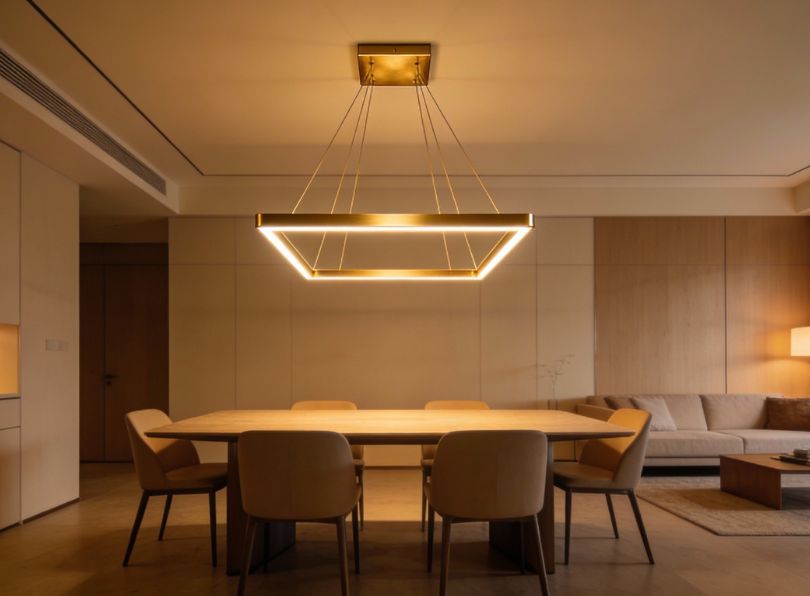
A square or cubic chandelier brings order and stability. It works exceptionally well over square dining tables, in minimalist lobbies, or as a series of framed “windows” of light in a long corridor. The design can be a single flat square, a cube (3D square), or a series of nested squares at different heights.
Bill of materials and assembly sequence
Materials:
1. Suspended profile (e.g., 20mm x 20mm) – cut to four equal lengths for one square.
2. Four internal 90-degree corner connectors.
3. Four suspension cables with ceiling plates.
4. LED strip (e.g., 24V, 2700K-4000K Tunable, high CRI).
5. Opal diffuser strip.
6. End caps (optional, if not connecting further).
Assembly:
1. Cut profiles: precision cut all four profiles to identical length using a fine-tooth saw or preferably a calibrated chop saw for perfect 90-degree ends.
2. Insert connectors: press a 90-degree connector firmly into the channel at each end of all four profiles. A rubber mallet may be used gently.
3. Form the square: connect the profiles via the connectors to form a closed square. Ensure all faces are flush.
4. Integrate lighting: peel and stick the LED strip into the dedicated channel on the inside face of the profile. Route the LED wire out through a small drilled hole in one profile, or use a profile with a wire exit slot.
5. Attach diffuser: snap the opal diffuser strip into place over the LED channel.
6. Suspend: attach suspension cables to four points on the square (at each corner or at midpoints on each side). Use the appropriate suspension clamps for the profile. Level the square carefully during hanging.
For a 3D cube: repeat the process to create six squares (though often the top square is omitted or used as the mounting frame). Use 90-degree connectors in three axes. This requires careful planning of wire management through the vertical profiles.
Construction methodology: the hexagonal grid chandelier
The hexagon is nature’s most efficient tiling shape (the honeycomb) and brings a dynamic, yet balanced, energy to a space. A hexagonal chandelier feels both organic and highly structured.
Design concept: modular tiling and growth
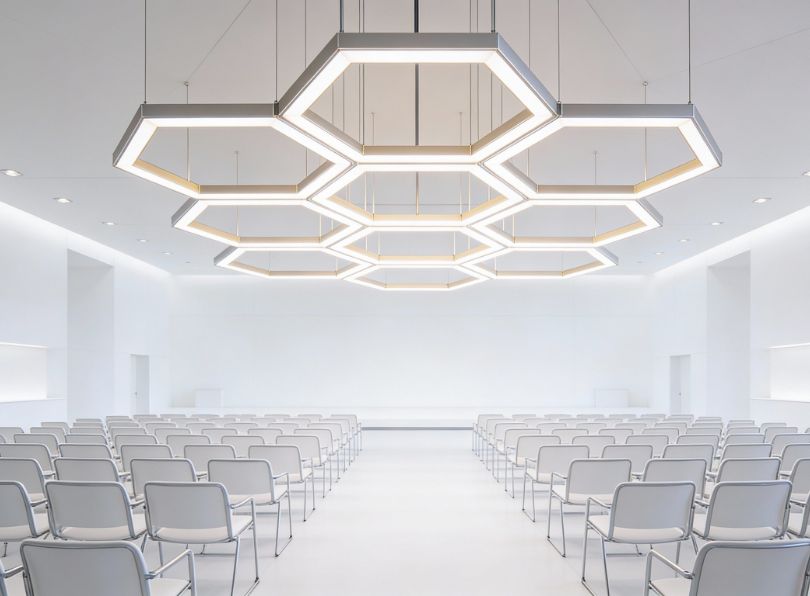
The power of the hexagon lies in its ability to tessellate. A chandelier can be a single, large hexagon, a “honeycomb” cluster of multiple hexagons, or a linear chain. This makes it perfect for covering large, irregular areas like reception desks or conference tables. The 120-degree angle is inherently less rigid than 90 degrees, offering a softer, more inviting geometry.
The critical role of the 120-degree connector
At each vertex of a hexagon, three profiles meet. Therefore, you need a connector that accommodates three arms at 120 degrees. LightingLine.eu’s 120-degree connector is a precision mold that accepts the ends of three profiles, locking them into the perfect geometry. Calculating the side length of your hexagon determines the overall size. The distance between parallel sides (the “flat-to-flat” distance) is Side Length * √3. For a desired flat-to-flat distance of 120cm, the side length is 120 / √3 ≈ 69.3cm.
Table: hexagon chandelier dimensions
| Number of Hexagons | Side Length (cm) | Flat-to-Flat per Hex (cm) | Total Cluster Width (approx. cm) | Number of 120° Connectors Needed |
|---|---|---|---|---|
| Single | 50 | 86.6 | 86.6 | 6 |
| Cluster of 7 (1 central + 6 around) | 30 | 52.0 | 156.0 | 30 |
| Linear Run of 3 | 40 | 69.3 | 208.0 (long dimension) | 14 |
Assembly strategy for a multi-hexagon cluster
1. Pre-cut all profiles: cut hundreds of profile pieces to the exact same length. Consistency is paramount.
2. Sub-assembly: build one hexagon at a time on a flat surface. Insert connectors into profile ends and join.
3. Cluster integration: as you build adjacent hexagons, they will share common profiles and connectors. This is where the system’s precision ensures all connections align.
4. Wiring: plan the LED circuiting so that each hexagon or group of hexagons is on a separate channel if desired. Run wires through the hollow profiles, exiting at designated points to a central driver location.
5. Suspension: use multiple suspension points distributed across the cluster to prevent sagging. The grid itself, if well-connected, will have good rigidity.
Construction methodology: the triangular tensegrity chandelier
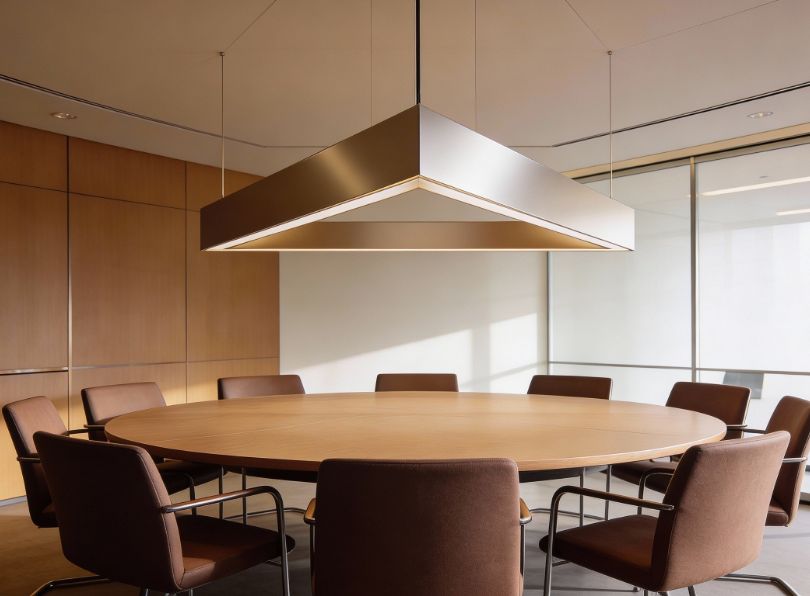
The triangle is the structurally purest shape. A chandelier based on triangles can achieve a striking appearance of lightness and tension, even suggesting tensegrity principles where elements appear to float.
Design concept: structural purity and dynamic angles
Triangular chandeliers are inherently rigid. They can be oriented flat (a 2D triangle), as a tetrahedron (3D triangle), or as a complex space frame. They are ideal for creating directional lighting effects, as one side of the triangle can be dedicated to light output while the others remain dark or illuminated differently.
Utilizing 60-degree and 30-degree connectors
For an equilateral triangle, you need 60-degree internal angles. However, connectors are typically for the external join. Three profiles meeting at a point in an equilateral triangle actually use 120-degree connectors (as the external angle is 120). For creating a star of David or more complex triangulated grids, 60-degree and 30-degree connectors become essential to join profiles at acute angles. This requires the most meticulous planning and potentially custom connector solutions from the manufacturer.
Creating the illusion of floating elements (tensegrity lite)
A dramatic effect can be achieved by using stainless steel aircraft cable as tension members alongside rigid aluminum compression members (the profiles). For example, a horizontal triangular frame of aluminum can be suspended from three points, and within it, a smaller inverted triangle appears to hang magically, connected only by nearly invisible tension cables running from the vertices of one to the vertices of the other. The aluminum profiles provide the rigid structure, while the cables do the hanging work. This is an advanced application requiring precise cable tensioning and load calculation.
Integration & controls: completing the lighting system
A chandelier is not just form; it is a functional lighting system. Its integration into the building’s electrical and control infrastructure is key.
Electrical infrastructure and thermal management
Wiring: use low-voltage, Class II (SELV) wiring for the LED strips inside the profiles. The drivers (power supplies) should be located in an accessible, ventilated area—a ceiling void, electrical closet, or even within a dedicated compartment in a large chandelier’s central hub. Thermal management: aluminum profiles are excellent heat sinks. Ensure the LED strips are in direct contact with the profile (using thermal tape or clips) to dissipate heat, maximizing LED lifespan and maintaining light output. This is a major advantage over wooden or plastic chandelier structures.
Control systems: from basic dimming to full IoT integration
Specify a control system commensurate with the project. Options range from a simple wall dimmer for residential use to a full DALI-2 or KNX system for commercial buildings, allowing individual addressability of different sections of the chandelier (e.g., the perimeter vs. the center), color tuning, and scheduling. The 2026 trend is toward wireless, app-based control that also provides energy usage data.
Case study: a corporate atrium installation
Project: the headquarters of a tech firm, featuring a 5-story atrium with a central staircase.
Challenge: create a lighting centerpiece that reflects the company’s innovative culture, provides ample ambient light, and does not obstruct sight lines.
Solution: a massive, floating hexagonal grid chandelier, 8 meters in diameter, composed of over 150 aluminum profiles forming a honeycomb of 37 hexagons. The profiles are brushed aluminum finish. LED strips within provide a base 3000K warm white light, tunable to a cool 5000K for daytime energizing. The grid is suspended from six nearly invisible points anchored to the atrium’s steel structure.
Outcome: the chandelier defines the space without overwhelming it. It appears as an abstract cloud of geometry, becoming the iconic visual identity of the atrium. The aluminum construction ensured lightweight, safe installation and provides passive cooling for the high-output LEDs.
The future is in modular, architectural and geometric chandelier
The geometric chandelier, especially when realized through engineered aluminum profile systems, represents the pinnacle of where architectural lighting is headed. It answers the professional’s need for customization, technical performance, and aesthetic rigor. It aligns with the 2026 trends of material honesty, smart integration, and sustainable design.
By mastering the components, connectors, and rules outlined in this guide, architects, designers, and builders can confidently specify and create breathtaking lighting installations that are truly integral to their architecture. The question is no longer “Are chandeliers in style?” but “What geometric form will define my space?”