In the world of architectural and interior lighting, the chandelier stands as a timeless centerpiece, evolving from a symbol of opulence to a sophisticated tool for modern design. Today’s chandeliers are no longer just sources of light; they are sculptural statements, spatial organizers, and technological hubs that define the character of a room. For architects and interior designers, specifying the right chandelier involves a complex interplay of aesthetics, engineering, material science, and user experience.
This is where the innovative use of round aluminium profiles creates a paradigm shift, offering unparalleled versatility, precision, and a distinctly contemporary aesthetic. This comprehensive guide delves deep into every facet of modern chandelier design, with a specialized focus on harnessing the potential of round aluminium extrusions to create lighting masterpieces that are as intelligent as they are beautiful.
In this article…
- What is a chandelier? Definition and evolution
- Is the chandelier still in style? A resounding yes
- Exploring different styles of chandeliers
- Chandelier trends 2025: the future is circular and integrated
- Defining modern chandeliers: form, function, and technology
- How to choose a modern chandelier: a designer’s checklist
- What makes a light a chandelier? Technical and aesthetic criteria
- Is a chandelier good for lighting? Efficacy and ambiance
- Is an LED chandelier worth it? Analyzing ROI and performance
- How to choose the right chandelier: a comprehensive framework
- Is it easy to install a new chandelier? A practical guide
- Can you replace a ceiling light with a chandelier? Technical considerations
- Can my ceiling support a chandelier? Structural assessment
- What are the benefits of chandeliers? Beyond illumination
- Round aluminium profiles: the architect’s material for modern chandeliers
- Designing your chandelier: a step-by-step process with round profiles
- Case studies and applications
- Lighting the future with intelligent design
What is a chandelier? Definition and evolution
The term “chandelier” originates from the Latin “candelabrum,” meaning candlestick. Historically, it described a branched decorative light fixture designed for overhead ceiling mounting, traditionally holding candles and later, incandescent bulbs. The classic definition emphasizes multiple arms or points of light emanating from a central body.
However, the modern interpretation has expanded significantly. A contemporary chandelier is defined more by its intent and impact than its form. It serves as a primary decorative and functional focal point in a space, often with a significant dimensional presence. It provides ambient or general illumination while making a strong architectural or artistic statement.
The architectural evolution of the chandelier
From the crystal palaces of the Baroque era to the minimalist rings of today, the chandelier’s evolution mirrors architectural history itself. The move from candle to gas to electric light changed its technical requirements, while movements like Modernism stripped away ornamentation in favor of form following function. The late 20th and early 21st centuries saw chandeliers become more abstract and integrated.
Today, with the advent of LED technology and advanced materials like high-precision aluminium profiles, the chandelier is undergoing its most radical transformation. It is becoming a customizable, modular, and intelligent architectural component, where the framework itself—often a sleek, round aluminium profile—is both the structure and the aesthetic, seamlessly housing linear LED strips that create lines or circles of pure, diffused light.
Is the chandelier still in style? A resounding yes
Far from being a relic of the past, the chandelier is experiencing a renaissance in contemporary design. Its staying power lies in its unique ability to command a space and anchor a design scheme. While ornate, traditional styles remain popular in specific contexts (luxury hospitality, classic residences), the surge in popularity is overwhelmingly driven by modern and contemporary interpretations.
These designs align perfectly with current architectural trends that favor clean lines, geometric purity, and a blend of industrial and refined elements. A chandelier crafted from a round aluminium profile epitomizes this trend: it is at once industrial (in its honest use of metal) and refined (in its perfect circular form and seamless light emission).
The modern chandelier as a necessary design element
In open-plan living and commercial spaces, which can often feel vast and unstructured, a well-designed chandelier creates a visual anchor and defines functional zones. Over a dining table, in a hotel lobby, or in a corporate atrium, it tells people where to focus. The style is no longer about demonstrating wealth through crystal but about demonstrating taste through innovation, material integrity, and sculptural presence. The use of materials like aluminium speaks directly to a modern sensibility that values longevity, sustainability, and technical precision.
Exploring different styles of chandeliers
Understanding chandelier styles is crucial for making an informed specification. The style should harmonize with, or intentionally contrast against, the overarching architectural language of the space.
| Style category | Key characteristics | Typical materials | Best suited for | Relation to round aluminium profiles |
|---|---|---|---|---|
| Traditional / classic | Ornate details, multiple tiers, crystal/prism embellishments, candle-style bulbs, symmetrical forms. | Crystal, brass, wrought iron, glass. | Formal dining rooms, grand lobbies, period homes. | Low. The aesthetic is opposed to the minimalist nature of aluminium. |
| Modern | Clean lines, geometric shapes (spheres, cylinders, cubes), minimal ornamentation, often monochromatic. | Polished chrome, nickel, painted metal, glass. | Contemporary homes, offices, galleries. | High. Round profiles create perfect circles and curves, ideal for modern geometry. |
| Industrial | Utilitarian, raw finishes, exposed bulbs, mechanical-looking components. | Raw iron, aged brass, copper, concrete. | Lofts, restaurants, creative studios. | Medium-high. Aluminium’s metallic look fits, but its finish is often too “precise” for raw industrial; can be paired with other elements. |
| Contemporary / artistic | Avant-garde, sculptural, often asymmetric, uses light as an artistic medium. | Mixed media: metal, acrylic, fabric, wood. | Statement spaces, art installations, high-end retail. | Very high. Profiles are perfect for creating custom, sculptural forms and unique light shapes. |
| Minimalist | Extreme simplicity, “less is more,” often a single bold form or line of light. | Brushed metals, white finishes, clear glass. | Minimalist interiors, spas, tech offices. | Highest. A simple circle or ring of light from a round profile is the epitome of minimalist lighting. |
The table above demonstrates that round aluminium profiles are most powerfully aligned with modern, contemporary, and minimalist styles. Their inherent characteristics—precision, a clean aesthetic, and adaptability—make them the ideal building block for these design languages. A chandelier built from these profiles doesn’t just hold lights; it becomes an architectural line or volume drawn in light and metal.
Chandelier trends 2026: the future is circular and integrated
As we look towards 2026, several key trends are shaping the future of chandelier design, all of which align seamlessly with the capabilities of round aluminium profiles.
1. Organic geometry and fluid forms
While sharp angles remain, there is a strong movement towards soft geometry, circles, ovals, and flowing, organic shapes. This trend reflects a desire for more calming, harmonious interiors. Round aluminium profiles are the perfect vehicle for this trend. They can be fabricated into perfect circles, sweeping arcs, or interconnected rings that create a sense of movement and softness overhead. The continuous, diffused light from an LED strip within the profile enhances this fluidity, creating a “halo” or “line of light” effect without visible dots or breaks.
2. Integrated architectural lighting
The line between fixed architecture and furniture is blurring. Chandeliers are no longer just “fixtures” but integrated architectural elements. Designers are creating chandeliers that echo the lines of the room, follow the curve of a staircase, or mirror the shape of a central table. The modular nature of aluminium profile systems allows for this custom, site-specific design. Profiles can be cut, joined, and configured to respond directly to the unique dimensions and flow of a space, making the chandelier a bespoke part of the building’s language.
3. Sustainable and responsible design
Material choice is under greater scrutiny. Aluminium is inherently sustainable: it is highly durable, corrosion-resistant, and 100% recyclable without loss of quality. Specifying a chandelier built from aluminium profiles is a responsible choice. Coupled with long-life, energy-efficient LED technology, it creates a lighting solution with a minimal lifetime environmental impact. This combination of longevity and efficiency is a cornerstone of modern sustainable design practice.
4. Smart and human-centric lighting
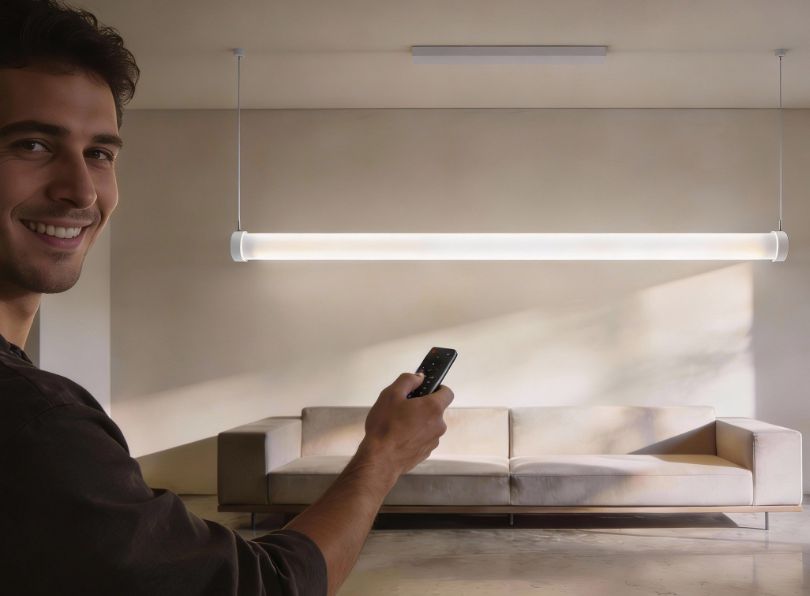
The chandelier is becoming an intelligent hub. Integrated LED systems within aluminium profiles can easily be connected to smart drivers and control systems. This allows for tunable white light (changing color temperature from warm to cool throughout the day) or even full-color RGB capabilities, all controllable via app, voice, or automated circadian rhythms. The aluminium profile acts as an excellent heat sink, ensuring these advanced LED systems run coolly and maintain their long lifespan, which can exceed 50,000 hours.
Defining modern chandeliers: form, function, and technology
A modern chandelier is distinguished by a fundamental philosophy: honesty of materials, clarity of form, and integration of technology. It rejects superfluous decoration in favor of expressing its structure and function as its primary aesthetic.
Key defining elements:
- sculptural form: the shape itself is the decoration. It may be a dramatic geometric statement or a subtle, refined presence.
- material focus: materials are chosen for their inherent properties and are often left in a natural or lightly finished state (e.g., brushed aluminium, clear anodized finish).
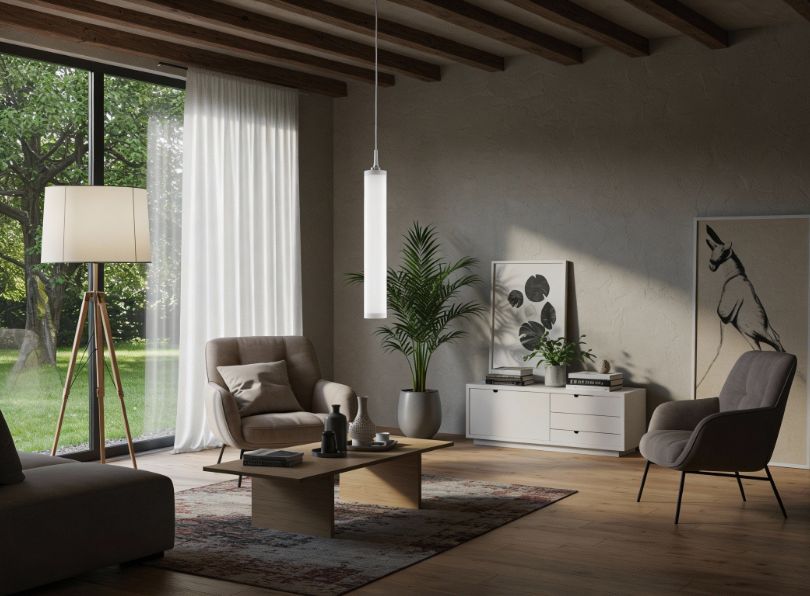
- integrated light source: the light source is often concealed or seamlessly incorporated. Linear LED strips hidden within a profile, emitting a soft, even glow, are a hallmark.
- modularity and customization: many modern designs allow for customization in size, configuration, or even shape to fit specific spatial requirements.
A round aluminium profile chandelier is the archetype of this definition. The aluminium provides the honest, structural form. The round shape is a pure, universal geometric statement. The LED strip inside provides efficient, high-quality light. And the system’s nature allows for endless customization in diameter, number of rings, and mounting configuration.
How to choose a modern chandelier: a designer’s checklist
Selecting the perfect modern chandelier is a multi-variable problem. This checklist ensures all critical factors are considered.
- Space analysis & scale:
- room dimensions: calculate an appropriate diameter. A common rule is (Room length + Room width in feet) = Approximate chandelier diameter in inches. For metric: (Room length + width in meters) x 10 = diameter in cm;
- ceiling height: determine drop length. In rooms with standard 8-9 ft ceilings, the bottom should be 30-36 inches above the table surface. Higher ceilings allow for more dramatic drops;
- visual weight: assess the “heaviness” of the design. A solid ring of aluminium feels lighter and more open than a crystal cluster.
- Functional lighting needs:
- primary purpose: is it for ambient glow, task lighting over a table, or pure decoration?
- required lumens: calculate the needed brightness. For dining areas, aim for 30-40 lumens per square foot focused on the table;
- light quality: choose LED color temperature (2700K for warm, cozy; 3000K for neutral; 4000K for crisp and alert).
- Technical integration:
- existing wiring: check junction box location and weight rating;
- controls: plan for dimming (ensure LED driver and dimmer are compatible) and smart integration;
- heat management: verify the fixture design adequately dissipates heat, a key strength of aluminium profiles.
What makes a light a chandelier? Technical and aesthetic criteria
Not every ceiling light is a chandelier. The distinction lies in specific criteria that combine physical attributes with design intent.
| Feature | Standard ceiling light / pendant | Chandelier | Example with round aluminium profile |
|---|---|---|---|
| Scale & presence | Often modest, designed to blend or provide general light without dominating. | Significant visual presence, acts as a focal point. | A large-diameter ring light commands attention and defines the space below it. |
| Complexity of form | Simple, singular form (one shade, one globe, one disc). | Multi-armed, layered, or complex geometric composition. Can be a single complex shape. | Multiple concentric rings of different diameters, or a 3D spherical structure made from interlocking circles. |
| Primary function | Primarily utilitarian: to provide light. | Dual function: to provide light AND to serve as a decorative art object. | The ring is a beautiful sculptural object when off; when on, it emits a mesmerizing circle of light. |
| Mounting & installation | Typically simple, close-to-ceiling or short-drop pendant. | Often involves more complex mounting, potentially heavier, may require structural support. | A large custom ring may require multiple suspension points or a central reinforced mounting plate. |
Therefore, a custom-built light fixture using round aluminium profiles becomes a chandelier when its design transcends mere utility. When it is scaled to become a room’s centerpiece, when its form (a perfect circle or an elegant spiral) is intended to be admired as much as its light, and when its installation is a considered architectural decision, it firmly belongs in the chandelier category.
Is a chandelier good for lighting? Efficacy and ambiance
This is a critical technical question. The answer is a qualified yes, if designed correctly. Historically, chandeliers with incandescent bulbs could create glare and uneven shadows. Modern chandeliers, especially those using LED strips within aluminium profiles, solve these issues and offer exceptional lighting quality.
Advantages for lighting quality:
- Excellent ambient light distribution: a large chandelier, especially one with upward-facing light components or a diffuse glow, bounces light off ceilings and walls to create soft, even ambient illumination that reduces harsh contrasts.
- Reduced glare: linear LED strips housed in a profile with a diffuser (opal polycarbonate is common) create a continuous, glare-free line of light. The aluminium body itself shields the light source from direct viewing at certain angles.
- Task lighting potential: when hung over a dining table or kitchen island, a chandelier with sufficient lumen output and downward light component provides perfect task lighting. The even spread from a ring light minimizes shadows on the surface below.
Technical note: the aluminium profile acts as an effective thermal management system. By drawing heat away from the LED chips, it prevents lumen depreciation (the gradual dimming of LEDs over time due to heat). This ensures the chandelier maintains its designed brightness and color temperature for its entire lifespan, which is a direct benefit to lighting quality and consistency.
Is an LED chandelier worth it? Analyzing ROI and performance
For professional specifiers, value is measured in performance, longevity, and total cost of ownership, not just initial purchase price.
Total cost of ownership (10 yrs) : high (energy + 10+ bulb replacements + labor), low (minimal energy + no replacements).LED wins overwhelmingly. The ROI is clear, especially in commercial applications.
| Consideration | Traditional bulb chandelier | LED-integrated chandelier (with aluminium profile) | Analysis & winner |
|---|---|---|---|
| Energy efficiency | Low. Incandescent/halogen bulbs are 80-90% less efficient. | Very high. LEDs convert most energy to light, not heat. | LED wins decisively. For commercial projects, this reduces operational costs significantly. |
| Lifespan | 1,000 – 2,000 hours for incandescent. | 30,000 – 50,000+ hours (over 15 years of typical use). | LED wins. Drastically reduces maintenance and replacement costs/labor. |
| Light quality & control | Often limited dimming, fixed color temperature. | Fully dimmable, options for tunable white or color. Perfect for human-centric lighting design. | LED wins. Enables advanced lighting scenes and adaptability. |
| Durability & heat | Bulbs are fragile. Fixture can get very hot. | Solid-state LEDs are robust. Aluminium dissipates heat, keeping fixture cool. | LED wins. Safer and more durable, especially in public spaces. |
| Initial cost | Often lower for the fixture itself (bulbs separate). | Higher initial investment due to integrated LED technology. | Traditional wins on sticker price only. |
The conclusion for architects and designers is clear: specifying an LED-integrated chandelier, particularly one built with a purpose-designed aluminium profile system, is a professionally responsible choice. It delivers superior performance, enables creative control, and provides the client with long-term economic and environmental benefits. The slightly higher initial cost is an investment in quality and sustainability.
How to choose the right chandelier: a comprehensive framework
Moving beyond the checklist, here is a detailed framework for the specification process.
Step 1: programmatic and contextual analysis
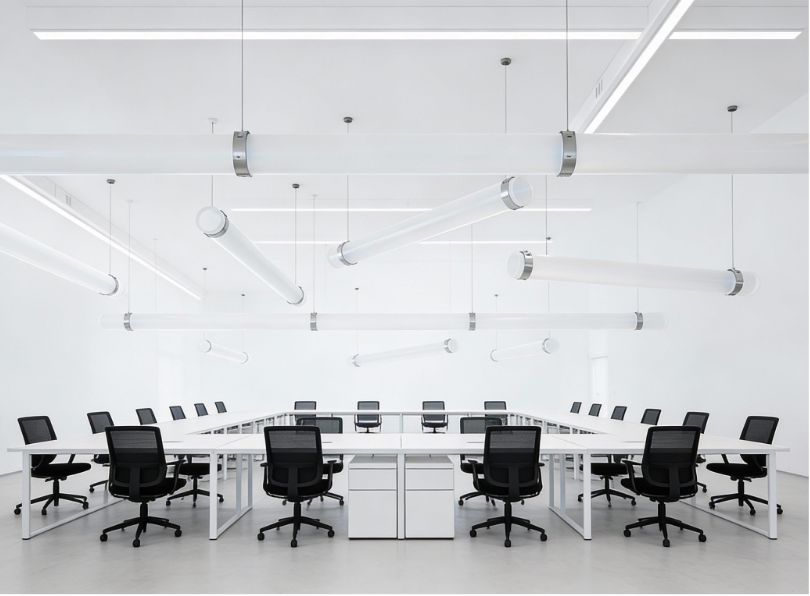
Begin with the “why” and “where.” What is the narrative of the space? Is it a serene boutique hotel lobby, a dynamic tech company cafeteria, or a formal private dining room? The chandelier should reinforce this narrative. For a serene space, a single, large, softly glowing tube of light may be ideal. For a dynamic space, a cluster of intersecting tubes at different heights could add energy.
Step 2: spatial and dimensional programming
This is the technical sizing. Use the formulas mentioned, but also consider:
- furniture plan: the chandelier should relate directly to the furniture below, particularly dining tables, reception desks, or conference tables. It should be centered and its width should be roughly 1/2 to 2/3 the width of the table;
- sight lines: consider the view from key entry points and seating areas. Will the chandelier block views or create a beautiful framing element?
- volume: in double-height spaces, the chandelier can fill the volume. A tiered or multi-level configuration using profiles of varying diameters can articulate the vertical space.
Step 3: material and finish specification
With round aluminium profiles, you are typically specifying:
- alloy and finish: standard anodized finishes (clear, black, bronze) are highly durable and scratch-resistant. Powder-coated finishes offer a wider color palette (matte white, custom colors) but may be slightly less durable;
- diffuser type: milky white opal polycarbonate for maximum light diffusion and a seamless “neon-like” effect. Clear or micro-prismatic covers for a more defined view of the LED strip, creating a sharper line of light;
- accessories: specify end caps, suspension cables/rods, and mounting hardware that match the design intent—minimalist flat end caps, or more decorative finials?
Step 4: technical and performance specification
This is the non-negotiable engineering heart of the project.
- LED strip specifications: chip type (SMD2835, COB), lumens per meter, Color Rendering Index (CRI >90 is essential for architectural quality), color temperature, IP rating (IP20 for indoor, IP65+ if in a humid environment like a spa).
- Driver specification: constant current or constant voltage? Dimmable protocol (DALI, 0-10V, Triac)? Driver location (remote in ceiling vs. integrated)? Ensure adequate wattage and voltage.
- Thermal analysis: while the profile acts as a heat sink, verify that the selected LED strip’s wattage is within the thermal dissipation capacity of the specific profile size and mounting condition.
Is it easy to install a new chandelier? A practical guide
The ease of installation varies dramatically between a simple, off-the-shelf pendant and a large, custom chandelier. For a custom round-profile chandelier, installation is a professional task but can be streamlined with good design.
Factors making installation easier
- Modular design: a chandelier fabricated from standard profile lengths, joined with purpose-made connectors, can be assembled on-site. This is far easier than maneuvering a single, large, pre-assembled piece through doors and into place.
- Clear instructions & mounting templates: quality suppliers provide detailed assembly diagrams and paper templates for marking ceiling mounting points, or on-line instructions to help customers.
- Pre-wired segments: if sections of the LED strip are pre-connected to cables within the profile at the factory, it reduces on-site electrical work and error.
Factors requiring professional expertise:
- Weight & structural support: determining the need for and installing a reinforced ceiling block or multiple anchor points.
- Electrical integration: connecting to existing wiring, ensuring proper grounding, installing and configuring the LED driver and dimmer.
- Final balancing and alignment: ensuring a large ring is perfectly level and all suspension cables are tensioned correctly.
For architects, the key is to design for installability. Work with your fabricator or supplier to create a design that breaks down into manageable components, with a clear electrical plan. This ensures the installation is a predictable, efficient process for the contractor.
What are the benefits of chandeliers? Beyond illumination
The benefits of a well-designed chandelier, particularly a modern LED type using round profiles, extend far beyond providing light.
Energy and maintenance efficiency: reduces operating costs and hassle.The LED+Aluminium system is the pinnacle of efficiency, with minimal energy use and near-zero maintenance.
| Benefit category | Description | Specific advantage of round aluminium profile design |
|---|---|---|
| Architectural impact & focal point | Creates an immediate visual hierarchy and center of interest in a room. | The pure geometric form (circle, spiral) creates a strong, calming focal point that organizes the space. |
| Enhanced spatial perception | Can make a room feel taller, larger, or more intimate. | A large, low-hung ring can define a cozy conversation area within a larger open space. |
| Superior ambient light quality | Provides soft, shadow-reducing general illumination. | The 360-degree diffused glow from a ring light creates exceptionally even, comfortable ambient light. |
| Customization and uniqueness | Allows for a bespoke design tailored to the exact space. | Profiles can be cut to any diameter, allowing for a perfect fit and one-of-a-kind design. |
| Durability and longevity | A high-quality fixture is a long-term investment. | Aluminium is corrosion-resistant and robust. Combined with long-life LEDs, it offers decades of service. |
| Increased property value | A striking, high-quality lighting feature is a valued asset. | Signals a commitment to modern, sustainable, and thoughtful design, appealing to discerning buyers or tenants. |
Round aluminium profiles: the architect’s material for modern chandeliers
This section delves into the core material that enables this modern lighting revolution. Round aluminium profiles are not just tubes; they are precision-engineered systems designed specifically for integrated LED lighting.
Material science and advantages
Aluminium alloy (typically 6063 or 6060): chosen for its excellent balance of strength, extrudability, and corrosion resistance. It is lightweight yet structurally sound, allowing for large spans without excessive weight. Its thermal conductivity (~200 W/m·K) is the key feature, making it a natural and passive heat sink for LED strips, which is critical for performance and longevity.
Profile anatomy and design variations
A standard round profile for LED strips is a purpose-built channel. Key components include:
- main body/channel: houses the LED strip. It has a flat base for adhesive mounting of the strip;
- diffuser slot: a continuous groove that accepts a snap-in diffuser cover (opal, clear, prismatic);
- mounting flanges: often include integrated lips or grooves for attaching the profile to surfaces or suspension systems discreetly.
Technical specifications table
| Profile characteristic | Typical options / ranges | Design implication |
|---|---|---|
| Diameter / size | Common external diameters: 20mm, 25mm, 30mm, 40mm, 50mm+. | Larger diameters house wider, brighter LED strips and offer greater heat dissipation for high-power applications. |
| Material thickness | 1.0mm – 2.0mm wall thickness. | Thicker walls increase rigidity and heat sink mass, important for long unsupported spans. |
| Finish | Mill (natural silver), Anodized (Clear, Black, Bronze), Powder Coat (any RAL color). | Anodizing is durable and maintains thermal properties. Powder coating adds color but adds a thin insulating layer. |
| IP rating (with diffuser) | IP20 (indoor) to IP65 (dust-tight, protected against water jets). | Determines suitability for bathrooms, kitchens, or covered outdoor areas. |
| Bending radius | Profiles are straight extruded. Circles are created by cold bending or segmenting and joining. | Cold bending requires specialized machinery and has a minimum radius limit based on diameter and thickness. Segmenting is more common for custom circles. |
Designing your chandelier: a step-by-step process with round profiles
Here is a practical workflow for taking a chandelier from concept to installed reality using round aluminium profiles.
Phase 1: concept and schematic design
Start with sketches and mood boards. Define the primary form language: a single ring, concentric rings, a spiral, a cluster of orbs? Use physical models or 3D software to study scale and proportion in the context of the room model. At this stage, select the general profile size based on the desired visual thickness of the “line of light.”
Phase 2: design development and detailing
Create precise technical drawings.
- Determine diameter(s): based on spatial calculations.
- Plan the joints: how will the circle be closed? An invisible welded and polished joint is ideal for a seamless look. Alternatively, use a mechanical connector sleeve hidden inside the profile.
- Design the mounting system: will it hang from a single central point (requires a rigid ring to prevent twisting) or from multiple points (3 or 4 cables for stability)? Design the mounting plate or suspension hardware.
- Plan the electrical layout: Where will the LED strip start/end? Where will the power supply cables enter the profile? Design a discreet access point, often at a suspension point.
Phase 3: technical specification and sourcing
Create a full specification package for fabrication:
- bill of materials: list all profile lengths, cut angles, finish codes, diffuser types, end caps, connectors;
- LED & electrical schedule: specify the exact LED strip part number, required length, driver model, and dimmer;
- assembly instructions: provide detailed diagrams for the fabricator/installer.
Critical coordination point: the LED strip length must be calculated based on the inner circumference of the profile, not the outer. Account for a small gap at the joint. Always order the LED strip on a reel and have the fabricator install it after the profile is formed into its final shape to avoid damaging the strips during bending.
Phase 4: fabrication, installation, and commissioning
Oversee or coordinate the final steps.
- Fabrication: a specialist metal shop will cut, bend (if applicable), join, finish, and pre-assemble components.
- Pre-installation: verify ceiling support is in place. Dry-fit the mounting hardware.
- Installation: mount the fixture, connect electrical components, secure all elements.
- Commissioning: power on, test dimming and controls, adjust the height or level if necessary. This final step ensures the design vision is fully realized in light.
Case studies and applications
Application 1: minimalist dining ring. A private residence with a 12-foot long oak dining table. A single 140cm diameter ring, using a 30mm matt black anodized profile with an opal diffuser, is suspended 80cm above the table surface. It provides perfect, glare-free task lighting for dinner parties while acting as a dramatic sculptural counterpoint to the natural wood.
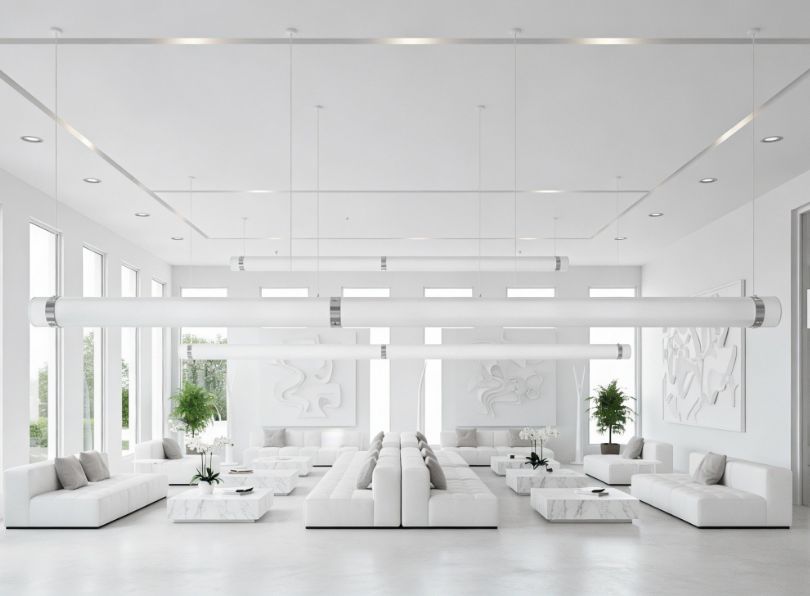
Application 2: dynamic hotel lobby cluster. A boutique hotel features a double-height lobby. Three rings of varying diameters (200cm, 150cm, 100cm) in a clear anodized finish are suspended at different heights, appearing to float within the volume. Integrated tunable-white LEDs allow the color temperature to shift from a bright, welcoming 4000K during the day to a warm, intimate 2700K in the evening, dynamically changing the mood of the space.
Application 3: corporate staircase sculpture. In a tech company headquarters, a custom helical “double helix” form, fabricated from round profiles, spirals up through a central atrium staircase. The light serves as both wayfinding and an artistic representation of the company’s innovative ethos.
Lighting the future with modern round chandelier
The modern chandelier, especially when conceived with round aluminium profiles, represents the perfect synthesis of art and technology in architectural lighting. It moves beyond decoration to become an integral, intelligent, and expressive component of the built environment. For the architect or designer, mastering this medium unlocks a powerful tool.
It allows for the creation of truly bespoke, site-specific lighting that delivers outstanding functional performance, exceptional energy efficiency, and a timeless aesthetic. By understanding the material properties, technical requirements, and design principles outlined in this guide, you are equipped to specify and create luminous masterpieces that will define spaces for decades to come.
The future of architectural lighting is not just about light: it’s about form, material honesty, and human experience — and the round aluminium profile chandelier sits at the very heart of this future.