In this article…
- What are facade lights? Definition, scope and strategic relevance
- Types of facade lighting: from linear led to architectural spotlighting
- The principles of facade lighting design
- Led technology for facades: efficiency, spectrum and durability
- Waterproof led profiles: the core infrastructure of exterior linear lighting
- How to light a building facade: step-by-step design process
- How to install facade lighting: technical guide and wiring schemes
- Planning permission and regulations for exterior lights
- Cost of facade lighting: budgets, ROI and value impact
- Energy efficiency, sustainability and environmental impact
- Smart control systems for facade lights
- Facade lights for residential buildings: houses and villas
- Facade lighting for commercial and public buildings
- Hotel facade lighting: creating atmosphere and identity
- Maintenance and long-term management
- Trends in facade lighting 2024–2026
- Case studies: exemplary facade lighting projects
- Lightingline.eu solutions
- Frequently asked questions
- Facade Lights: loook at the future on lighting building
What are facade lights? Definition, scope and strategic relevance
The term facade lights refers to a broad and highly specialised category of exterior facade lights systems designed to illuminate, enhance, delineate or dynamically animate the outer skin of a building, its facade. The facade, in architectural terms, is the principal face or front of a building, though in contemporary lighting practice the term extends to all exterior elevations including side walls, rear elevations, rooflines, eaves, parapets, columns, cornices and structural features that together constitute the building envelope. Facade lighting is not merely decorative: it is a strategic tool that integrates aesthetics, functionality, safety, branding and energy management into a unified exterior presence.
What makes facade lights categorically different from standard outdoor luminaires is their orientation toward the building surface itself, rather than toward the surrounding landscape or street environment. A conventional street light illuminates the ground plane; a facade light illuminates the vertical plane of the building. This fundamental distinction drives all subsequent decisions about optics, fixture typology, mounting position, beam angle, light intensity, colour temperature and control strategy. Understanding what facade lights are, and what they are not, is the foundational step in any exterior lighting project.
The growing importance of facade lights in contemporary architecture reflects a broader cultural and economic shift: buildings are no longer evaluated solely by their daytime appearance. The nocturnal identity of a building, how it presents itself to the city, to passers-by, to clients, to residents, has become a critical component of architectural quality, commercial value and urban experience. In competitive real estate markets, in the hospitality sector, in retail and in civic architecture, the quality of facade lights design directly influences perception, footfall, revenue and brand equity. Equally, for residential properties, well-designed facade lights are among the highest-return investments in exterior finishing.
The facade as a lighting canvas
Every building facade is a unique composition of materials, textures, proportions and geometries. Stone, brick, concrete, glass, aluminium cladding, timber, render, each responds to light in a profoundly different way. Facade lights must be selected and positioned with the specific material characteristics of the building surface in mind. A rough stone wall will scatter and absorb light, creating dramatic texture and shadow, a smooth glass curtain wall will reflect and refract it, producing a more luminous, even effect. Polished metal will create specular reflections; timber will absorb more, giving warmer, more intimate results.
The concept of the facade as a lighting canvas was formalised in architectural facade lights theory in the 1980s and 1990s, largely through the work of lighting designers such as Rogier van der Heide, Gustavo Avilés and the teams at international practices such as L’Observatoire International and Speirs + Major. Their work established that building facade lights illumination is not simply a technical exercise in lux levels and fixture placement, but a compositional and artistic discipline with its own grammar, vocabulary and aesthetic codes.
Today, the vocabulary of facade lights has expanded to include:
- static monochromatic illumination, the use of a single white or near-white light source at a fixed intensity to reveal architectural form
- tunable white systems, led systems that vary colour temperature from warm (2700K) to cool (6500K) to adapt to time of day, season or event
- RGBW dynamic lighting, full-colour programmable systems capable of dramatic chromatic transformations, used in landmark buildings, entertainment venues and flagship retail
- linear led integration, the embedding of led strip lights within architectural profiles, reveals, recesses and structural joints, creating continuous lines of light that emphasise the geometry of the building
- projection and gobo lighting, projecting patterns or images onto facade surfaces, increasingly replaced by higher-resolution led matrix systems
Market data and strategic context
The global facade lighting market has experienced robust and consistent growth over the past decade. According to market research published by MarketsandMarkets (2023), the architectural facade lights market, of which facade lighting is a primary segment, was valued at approximately USD 9.8 billion in 2022 and is projected to reach USD 14.2 billion by 2027, at a CAGR of 7.7%. Led technology is the dominant driver of this growth, accounting for over 78% of all new facade facade lights installations in Europe as of 2023.
| Year | Market value (USD billion) | LED share (%) | CAGR | Key driver |
|---|---|---|---|---|
| 2020 | 8.1 | 68% | — | Energy efficiency mandates |
| 2021 | 8.6 | 71% | 6.2% | Post-pandemic construction restart |
| 2022 | 9.8 | 78% | 14.0% | Smart city initiatives, hospitality recovery |
| 2023 (est.) | 10.5 | 82% | 7.1% | Net zero targets, renovation wave |
| 2025 (proj.) | 12.1 | 88% | 7.5% | IoT integration, dynamic facade demand |
| 2027 (proj.) | 14.2 | 92% | 7.7% | Circular economy, human-centric design |
Within Europe specifically, the adoption of led facade lighting has been accelerated by the EU’s Ecodesign Regulation (EU) 2019/2020, the Energy Performance of Buildings Directive (EPBD) recast, and national-level incentive schemes such as the Italian Superbonus and its successors, the French MaPrimeRénov’, and the UK’s Social Housing Decarbonisation Fund. These instruments have shifted the economic calculus decisively in favour of high-efficiency led systems, making led facade lighting not only environmentally superior but also financially advantageous in most European contexts.
Who uses facade lighting?
The professional ecosystem around facade lighting is broad and cross-disciplinary. The following stakeholder groups each bring distinct priorities and questions to the discipline:
Architects and lighting designers are principally concerned with the aesthetic integration of facade lights into the overall architectural composition. They seek solutions that are unobtrusive by day, invisible or minimally visible and transformative by night. They work with detailed photometric calculations, rendered simulations and mock-up tests to validate design intent before committing to a specification.
Electrical and energy engineers focus on load calculations, power supply sizing, cable routing, circuit protection, control system integration and life-cycle energy performance. For them, the key metrics are luminous efficacy (lm/W), system power density (W/m²), control compatibility (DALI, 0-10V, DMX) and compliance with energy standards such as EN 12464-2 for outdoor workplaces and local equivalents.
Construction companies and building contractors are primarily interested in installation efficiency, product availability, ease of mounting and system reliability. They value products with clear installation documentation, standard mounting hardware and long warranty periods. The adoption of pre-assembled facade lights led profile systems has greatly simplified the facade lights installation of facade lights in new construction.
Facility managers take a long-term operational view. Their priorities are maintenance intervals, lamp replacement (or in the case of led, module replacement), control system accessibility, energy monitoring capability and the ability to adapt the facade lights system over time without major capital expenditure.
Hotel and hospitality operators are among the most sophisticated commissioners of facade lights. A hotel’s nocturnal image is a direct expression of its brand identity. The quality of facade illumination influences guest perception before they even enter the building, shapes reviews and social media imagery, and differentiates the property in a competitive marketplace.
Residential property owners whether private individuals or real estate developers, are motivated by kerb appeal, security, energy savings and property value. For this group, simplicity of installation and operation is paramount, but aesthetic sophistication is increasingly demanded, particularly at the premium end of the residential market.
Types of facade lighting: from linear led to architectural spotlighting
The diversity of facade lights and facade lighting systems available today reflects the enormous variety of architectural contexts in which they are deployed. No single product category satisfies all requirements; the art and science of facade lights design lies precisely in the intelligent selection, combination and calibration of different lighting typologies to achieve the desired result. Understanding the characteristics, strengths and limitations of each type of facade light is fundamental to making the right specification decisions.
The major categories of exterior facade lighting can be classified according to their primary function, optical system and mounting strategy. Each category has been transformed by the led revolution of the past two decades, moving from relatively crude and energy-intensive solutions to highly efficient, precisely controllable, long-lasting systems capable of extraordinary optical performance.
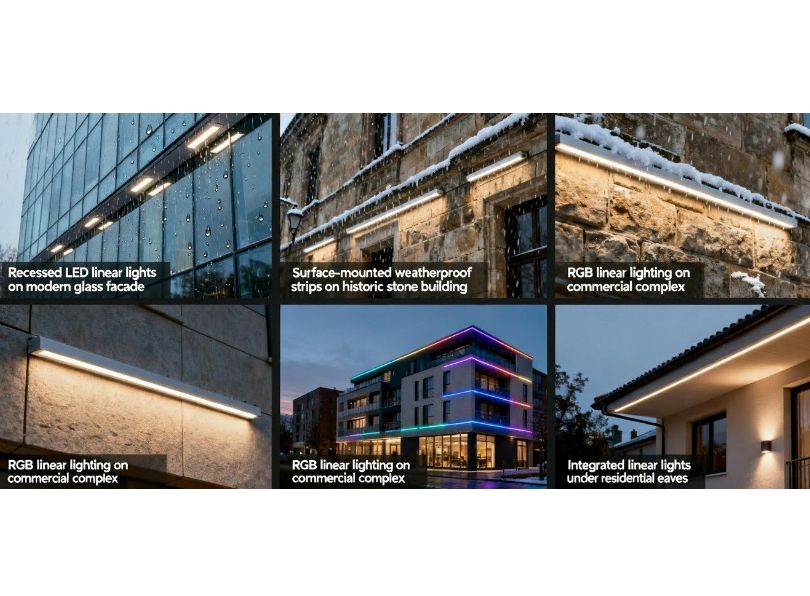
Linear led strip lighting in waterproof profiles
Linear led strip lighting, housed in weather-resistant aluminium extrusion profiles, has become one of the most versatile and widely adopted solutions for facade lights and facade lighting in both residential and commercial contexts. The principle is elegantly simple: a flexible or rigid led strip, a printed circuit board bearing an array of led chips at regular intervals, is housed within an aluminium profile that serves simultaneously as a mechanical support, a heat sink and an optical housing. A diffuser cover, typically in frosted polycarbonate or PMMA, distributes the light uniformly along the length of the profile.
The key advantage of led strip profiles for facade applications is the ability to create continuous, uninterrupted lines of light at any length and in any geometry, following the architectural features of the facade, window reveals, eaves, copings, columns, recesses, steps and terraces — with precision and elegance. Unlike point-source spotlights, which illuminate specific areas, linear led profiles create a luminous line that defines and articulates architectural form, drawing the eye along the geometry of the building.
For outdoor facade applications, the aluminium profile must incorporate a weatherproofing system that achieves at least IP65, and ideally IP67 or IP68 in more demanding conditions. At Lightingline.eu, the range of waterproof LED profilesincludes solutions for every facade application, from shallow surface-mounting profiles for window reveals to deep recessed profiles for architectural integration in facade cladding systems.
| Profile type | Cross-section | IP rating | Best application | Diffuser options |
|---|---|---|---|---|
| Surface mounting (flat) | Flat, low-profile | IP65–IP67 | Window sills, wall bases, eaves | Frosted, opal, clear |
| Recessed (flush) | Deep U-channel | IP65–IP68 | Floor reveals, embedded wall joints | Frosted, anti-glare |
| Corner / angled | 45° triangular | IP65 | Column edges, reveal corners | Frosted, opal |
| Slim pendant / linear | Narrow rectangular | IP65–IP67 | Canopies, overhangs, covered facades | Diffused, frosted |
| High-power heatsink | Deep with fins | IP65 | High-output applications, tall facades | Clear, frosted |
| Waterproof sealed tube | Round / oval tube | IP67–IP68 | Immersed features, water walls, pool edges | Clear silicone |
Uplighting and ground-mounted facade lighting
Uplighting refers to the placement of luminaires at or near ground level, directing light upward to illuminate the facade from below. This technique is particularly effective for tall buildings, columns, trees adjacent to the facade, monumental entrances and decorative architectural features such as pilasters, friezes and keystones. The upward direction of light creates a strong vertical emphasis, making the building appear taller and more imposing.
Ground-mounted upfacade lights fixtures for facade applications must meet stringent requirements for weather resistance, mechanical robustness (particularly resistance to impact and foot traffic for in-ground luminaires), and thermal management (ground-embedded fixtures cannot dissipate heat through convection in the same way as surface-mounted units). IP67 or IP68 ratings are standard for in-ground fixtures; IK ratings (impact resistance) of IK08 to IK10 are typically specified.
The optical design of upfacade lights fixtures used for building facade lights illumination differs significantly from those used for landscape or tree lighting. Asymmetric beam distributions are commonly specified to maximise wall illumination at height while minimising glare at eye level. The photometric design of the luminaire determines the beam spread (narrow spot to wide flood), the cut-off angle (to control upward light escape and light pollution) and the uniformity ratio across the illuminated surface.
Wall grazing
Wall grazing is one of the most technically demanding and aesthetically rewarding facade lighting techniques. It involves placing a light source very close to the wall surface — typically 150–300 mm — and directing the beam at a near-tangential angle across the facade. This technique causes the light to skim across the surface, dramatically revealing texture, relief and material character in a way that no other lighting technique can achieve. Rough stone, brick coursework, board-formed concrete, rusticated render and timber cladding all respond magnificently to wall grazing, which transforms the material into a rich play of light and shadow.
Wall grazing is particularly valued in heritage building facade lights illumination, where the preservation of material character is as important as the visual impact of the facade lights. It is also used in contemporary residential architecture to highlight the textural interest of natural stone walls, exposed brick garden walls and handmade render finishes. The fixture must be positioned with extraordinary precision, small variations in distance and angle produce dramatically different results.
Wall washing
Wall washing is the complementary technique to wall grazing: where grazing emphasises texture by raking light across the surface, wall washing produces a smooth, even distribution of light across the facade plane, minimising shadow and creating a sense of luminous uniformity. Wall washing is the preferred technique for smooth, reflective or regularly coloured facades, glass, polished metal, light-coloured render and similar materials, where texture is absent or intentionally minimised.
The facade lights fixtures used for wall washing are typically positioned at a greater distance from the surface than those used for grazing, with wider beam distributions to ensure evenness of illumination. For tall buildings, multiple rows of wall wash fixtures may be required to maintain vertical uniformity across the full height of the facade. The calculation of wall wash uniformity, typically expressed as the ratio of minimum to maximum illuminance (Emin/Emax), is a key performance metric, with ratios of 1:3 or better considered good practice for architectural wall washing.
Facade spotlighting and accent lighting
Spotlighting and accent lighting refers to the use of focused, directed luminaires to highlight specific architectural elements of the facade, entrance portals, decorative sculptures, carved details, coats of arms, signage, feature columns, balcony balustrades and similar elements. Accent lighting creates hierarchy and focal points within the facade composition, guiding the observer’s eye through the building’s architectural narrative.
The key photometric requirement for facade accent lighting is a narrow, precise beam with a well-defined edge and minimal spill light. Adjustable luminaires, which can be aimed, focused and rotated after installation, are strongly preferred for accent applications, since the exact positioning of the beam relative to the feature being highlighted requires fine adjustment that is impossible to predict with precision during the facade lights design phase.
Dynamic and RGBW facade lighting
Dynamic facade lights systems, using led sources capable of producing variable colour temperature, variable intensity or full RGB colour mixing, represent the most expressive tier of facade lights and facade lighting technology. RGBW (Red, Green, Blue, White) led systems can produce virtually any colour within the visible spectrum, allowing the facade to be transformed through an infinite range of chromatic effects. Dynamic systems are used for landmark buildings, hotels, entertainment venues, stadiums, retail flagships and civic celebrations.
The control infrastructure for dynamic facade lighting is considerably more complex than for static systems, requiring purpose-built control systems (typically DMX512 or Art-Net protocols for colour effects, DALI-2 for dimming and tunable white) and dedicated control software for programming sequences, scenes and timed events. The power supply infrastructure must be sized for the peak load of the full system, which can be substantially higher than the average operating load.
Despite their expressive power, dynamic RGBW systems must be deployed with sensitivity to urban context, neighbouring buildings and residents, and the potential for light pollution and sky glow. Responsible dynamic lighting design always incorporates controls that limit intensity and colour saturation, curfew functions and light pollution management features.
The principles of facade lighting design
the facade lights design of exterior facade lighting is governed by a coherent set of principles that distinguish professional, architecturally integrated solutions from improvised or decorative afterthoughts. These principles span aesthetic, functional, technical and environmental dimensions, and their intelligent application is what separates exemplary facade lights projects from mediocre ones. For architects, lighting designers, engineers and all professionals working in the building industry, a thorough understanding of these principles is the foundation of successful facade lights design.
The International Commission on Illumination (CIE) and the Illuminating Engineering Society (IES) have developed extensive technical guidance on exterior lighting, much of which applies directly to facade lighting. European standard EN 13201 covers road lighting, while EN 12464-2 addresses outdoor workplaces, neither directly governs purely aesthetic facade lighting, which falls largely into the domain of good professional practice rather than prescriptive regulation in most jurisdictions. However, the principles articulated in these standards, uniformity, glare control, light pollution limitation and energy efficiency, are universally applicable.
The four C’s of architectural lighting
In professional lighting design discourse, the discipline is often structured around the “four C’s”: Contrast, Composition, Colour and Control. These four axes provide a systematic framework for thinking about facade lights design.
Contrast refers to the luminance ratio between the illuminated building and its surroundings. In night-time conditions, the human visual system perceives objects primarily through relative luminance differences rather than absolute luminance levels. A facade that is ten times brighter than its surroundings will be perceived as equally prominent as one that is a hundred times brighter if the relative contrast is maintained. Effective facade lights design always considers the ambient luminance of the surroundings, a building in a dark rural setting requires much less installed power to appear dramatically illuminated than one surrounded by the bright ambient light of a commercial urban environment.
Composition refers to the spatial organisation of light and shadow across the facade plane. Like a painter composing a canvas, the facade lights designer works with areas of highlight and shadow to create a coherent nocturnal composition that reveals, articulates and enhances the architectural form. The best facade lighting compositions are those that feel natural and inevitable, as if the building itself is radiating light, rather than being lit from outside.
Colour refers not only to the colour temperature of the light sources (warm 2700K versus neutral 4000K versus cool 6500K) but also to the way light interacts with the colour of the building materials. A warm amber light on warm terracotta brickwork will appear harmonious; the same light on cool grey concrete may appear slightly muddy. Conversely, a cooler white light (4000K) tends to appear more accurate on neutral and cool-toned materials, while sometimes making warm-toned materials appear washed out or pallid. The selection of colour temperature must always be considered in relation to the material palette of the specific facade being lit.
Control refers to the ability to modulate the facade lights system over time, through dimming, scheduling, scene setting, dynamic colour change and integration with building management systems. Even the simplest residential facade lights system benefits from basic timing and dimming control: reducing intensity after midnight, for example, can save 30–40% of energy consumption over the lifetime of the facade lights system while significantly reducing light pollution.
Lighting hierarchy and focal points
Every successful facade lights design establishes a clear hierarchy of illuminated elements. Not every part of the facade should receive the same level of light, such an approach would produce visual monotony and waste energy. Instead, a well-designed facade lights scheme creates a hierarchy of highlight, mid-tone and shadow that guides the observer’s eye through the building’s architectural composition.
The primary level of the hierarchy, the highest luminance, is typically assigned to the most architecturally significant elements: the entrance portal, a major cornice, a landmark tower element, a distinctive material feature or a prominent sign. These focal points attract attention first and establish the building’s identity in the observer’s perception.
The secondary level, moderate luminance, covers the main body of the facade, providing context for the primary focal points and revealing the overall form of the building. The tertiary level, low luminance or deliberate shadow, corresponds to recesses, reveals, overhangs and other elements where darkness serves to articulate form rather than obscure it.
Glare control
Glare is among the most significant quality criteria in exterior lighting, and its management in facade lights design is complex because the viewing geometry varies enormously: passers-by at street level, occupants of adjacent buildings, drivers at varying distances and heights, and the building’s own occupants all experience the facade lights from different angles. Glare that is imperceptible from one viewpoint may be intensely uncomfortable from another.
The principal tools for glare control in facade lights include:
- precise beam control (narrow distribution angles, well-defined cut-off)
- adequate source shielding (baffles, louvres, deep recesses)
- minimisation of upward light component (particularly important for roofline lighting)
- appropriate luminance levels (avoiding sources that are excessively bright relative to the adapted luminance of the observer’s visual system)
- selection of diffuse rather than specular optical systems where appropriate
The UK Institution of Lighting Professionals (ILP) and CIE Publication 150 (Guide on the limitation of the effects of obtrusive light) provide detailed quantitative guidance on glare limitation for exterior lighting, expressed as maximum luminous intensity values in specific directions, classified by environmental zone (E1 rural/dark to E4 urban/bright).
The 5:7 lighting rule in practice
The so-called “5:7 rule” (or “5’7″ rule” in its American formulation, referring to the average eye height of approximately 1.7m) is a practical heuristic used in interior and exterior lighting design to ensure that light sources are positioned either well above or well below the natural eye level, avoiding sources that create direct glare at the viewing angle most commonly occupied by observers. In facade lighting, this translates to a preference for locating luminaires either at high level (above 2.5m) or recessed below surfaces such as window sills, ground planes or stair treads, rather than at intermediate heights where they are most likely to produce direct glare.
Light pollution and dark-sky considerations
Light pollution, the misdirection of artificial light into the sky or toward neighbouring properties, is an increasingly significant environmental and regulatory concern for facade lights design. The International Dark-Sky Association (IDA) and European national equivalents have established guidelines and, in some regions, legally binding limits on upward light emission, sky glow and light trespass for exterior facade lights installations.
For facade lighting, the primary light pollution risks are upward spill from poorly shielded uplighters, excessive luminance from large illuminated wall areas, and blue-shifted light sources (above 3000K) which contribute disproportionately to sky glow. Best practice in facade lights design now routinely incorporates full-cutoff luminaire specifications, warm colour temperatures (2700–3000K) and curfew dimming schedules that reduce intensity after midnight.
| Zone | Description | Max intensity pre-curfew (cd) | Max intensity post-curfew (cd) | Typical context |
|---|---|---|---|---|
| E1 | Intrinsically dark | 2,500 | 0 | National parks, remote rural |
| E2 | Low ambient brightness | 7,500 | 500 | Rural residential, outer suburbs |
| E3 | Medium ambient brightness | 10,000 | 1,000 | Urban residential, town centres |
| E4 | High ambient brightness | 25,000 | 2,500 | City centres, commercial districts |
Led technology for facades: efficiency, spectrum and durability
The ascendancy of led (Light Emitting Diode) technology as the dominant light source for facade lights and facade lighting and building facade lights illumination is one of the most significant developments in the history of artificial lighting. In less than twenty years, led has moved from a niche technology used in signal and indicator applications to the universally dominant light source for virtually every professional lighting application. For exterior facade lighting specifically, the advantages of led over all predecessor technologies, tungsten halogen, metal halide, fluorescent, are so comprehensive that the choice of led is, in most contemporary applications, not a question at all. The real decisions concern which type of led product, what optical system, what control compatibility and what specific performance parameters are required.
Understanding the technical parameters of led technology for facade applications enables more precise specification, better system integration and more accurate prediction of long-term performance. This section explores the key technical characteristics of leds for exterior facade use, with particular reference to the types of led strips and modules used in waterproof profile systems.
Luminous efficacy: the core efficiency metric
Luminous efficacy is the ratio of luminous flux (lumens) produced by a light source to the electrical power it consumes (watts), expressed in lumens per watt (lm/W). This metric is the single most important indicator of energy efficiency for any light source, and its evolution in led technology has been extraordinary. In 2010, commercially available led products for architectural applications typically delivered 60–80 lm/W at the facade lights system level, by 2023, high-quality led strips and modules for facade applications routinely achieve 120–180 lm/W at the product level, with premium products exceeding 200 lm/W.
| Light source | Typical efficacy (lm/W) | Typical lifespan (hours) | Colour rendering (CRI) | Dimming |
|---|---|---|---|---|
| Tungsten halogen | 12–22 | 2,000–4,000 | 100 | Excellent (analogue) |
| Metal halide (HID) | 65–115 | 6,000–20,000 | 65–95 | Limited (5:1 max) |
| High-pressure sodium | 80–150 | 24,000 | 20–25 | Very limited |
| Fluorescent (T5/T8) | 60–104 | 8,000–20,000 | 70–95 | Good (with ballast) |
| Led (standard, 2023) | 120–180 | 50,000–100,000 | 80–98 | Excellent (0–100%) |
| Led (premium, 2023) | 180–220+ | 50,000–100,000+ | 90–98 (R9>50) | Excellent, flicker-free |
Colour temperature and spectral quality for facade applications
Colour temperature, expressed in Kelvin (K), describes the spectral composition of white light, from warm amber-white (2700K) through neutral white (4000K) to cool blue-white (6500K). The choice of colour temperature for facade lights and facade lighting profoundly affects the perceived character of the building and its materials, and must be made with reference to both the material palette and the urban context.
Warm white (2700–3000K) is the most widely specified colour temperature for residential facade lighting, heritage buildings, hotels and any context where a welcoming, intimate or classical atmosphere is sought. Warm white enhances the appearance of terracotta, brick, warm stone (limestone, sandstone, travertine), timber and copper-toned metals. It is also the most environmentally responsible choice, as warm white LEDs contain a lower proportion of blue light, reducing their contribution to sky glow and circadian disruption.
Neutral white (3500–4000K) is commonly used for commercial buildings, contemporary architecture in concrete or steel, and contexts where a clean, professional, high-visibility appearance is required. It renders colours more accurately than warm white (particularly blues and greens) while maintaining a pleasant visual quality.
Cool white (5000–6500K) is used in industrial, technical and some contemporary retail contexts where maximum visual acuity and a “modern” aesthetic are prioritised. It is generally not recommended for residential facade lighting or heritage contexts, and its contribution to blue-spectrum light pollution is significantly higher than warm or neutral white.
The colour rendering index (CRI), a measure of how accurately a light source renders the colours of the objects it illuminates, relative to a reference source — is particularly important for facade lights of buildings with coloured or polychromatic materials. A CRI of 80 or above is the minimum acceptable for architectural facade lighting, CRI 90+ is recommended where accurate colour rendering is architecturally significant. The R9 value (rendering of saturated red) is a specific sub-index of particular importance for warm materials and is increasingly specified for premium facade lighting.
Led strip specifications for exterior facade applications
Led strips used in waterproof profiles for facade applications must meet a specific set of performance requirements that differ from those used in interior applications. The following parameters are particularly critical:
Led density (Leds/m) determines the smoothness and uniformity of light output along the facade lights strip. For facade applications where the facade lights strip is visible and where a continuous line of light is desired, higher densities (60, 120, 144 Leds/m or more) are required to avoid the “dotted” appearance that lower-density strips produce, even behind frosted diffusers. For applications where the facade lights strip is fully concealed within an architectural recess, lower densities may be acceptable.
Wattage per metre (W/m) determines the light output and the power supply requirements. For facade applications, strips typically range from 4.8 W/m (low output, subtle accent) to 24 W/m or more (high output, bright architectural statement). The wattage must be matched to the desired light level and the length of run, which determines the total system power load.
Maximum run length is a critical parameter for facade applications, where runs can be very long, tens of metres on a large building. Led strips suffer from voltage drop along their length, which causes the Leds at the far end of a long run to receive less voltage than those at the supply end, resulting in visible dimming and colour shift. This is managed by using higher-quality strips with lower resistance conductors, by supplying power from both ends of the facade lights strip, or by using constant-current supply systems.
Waterproofing class (IP rating) for the facade lights strip itself, noting that the facade lights strip and the profile in which it is housed may have different IP ratings, and the facade lights system IP rating is determined by the lower of the two, must be appropriate for the level of moisture exposure. In many facade applications, the profile provides the primary weatherproofing and a non-waterproof strip (IP20) can be used inside it, however, for applications where water ingress into the profile is possible (particularly in recessed floor or threshold details), a waterproof strip (IP65–IP68) is required.
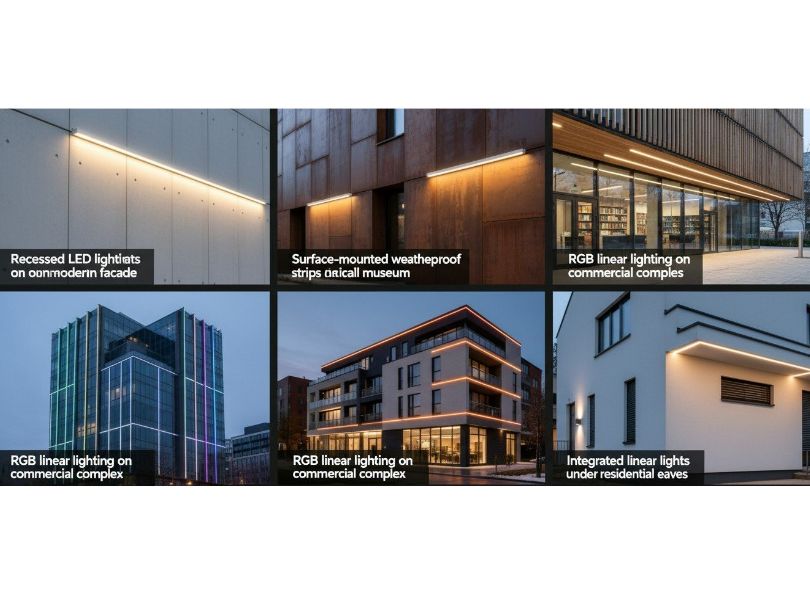
Led lifespan and lumen maintenance
Led lifespan is typically expressed as L70B50: the number of operating hours at which 50% of a sample of Leds (B50) will have decreased to 70% of their initial lumen output (L70). For high-quality Leds used in facade applications, L70B50 values of 50,000 to 100,000 hours are common. At a typical operating schedule of 4,000 hours per year (approximately 11 hours per night), this corresponds to a lifespan of 12 to 25 years — far exceeding any predecessor technology.
However, it is important to note that led lifespan is strongly influenced by operating temperature. Leds operating at elevated junction temperatures due to inadequate heat sinking degrade much more rapidly than those operating within their specified thermal envelope. This is one of the key reasons why the quality of the aluminium profile housing is so important in facade lights: a well-designed aluminium extrusion provides an effective thermal pathway from the LED strip to the ambient air, maintaining junction temperatures well below the thermal limit and maximising lifespan.
Waterproof led profiles: the core infrastructure of exterior linear lighting
The aluminium led profile, also known as an led extrusion, led channel, led housing or led track, is the structural and functional core of any exterior linear facade lights system. Without the right profile, even the best LED strip delivers suboptimal results: inadequate heat management shortens lifespan, inadequate weatherproofing allows moisture ingress, poor diffuser quality produces hot-spot glare, and incorrect mounting systems compromise installation integrity. Understanding the full range of waterproof led profiles available for facade applications is essential for any professional working in this field.
At Lightingline.eu, the development and supply of professional waterproof LED profiles for exterior applications is a core specialism. The Lightingline catalogue encompasses a comprehensive range of aluminium profiles engineered for facade, perimeter, roofline, window, threshold, stair and landscape lighting applications, each designed to meet the demanding performance requirements of professional exterior use.
Aluminium extrusion: material properties and thermal performance
Aluminium is the material of choice for led profiles for several compelling reasons. Its high thermal conductivity (approximately 200 W/m·K for common alloys, compared to 50 W/m·K for steel) enables rapid and efficient transfer of heat from the led junctionthrough the facade lights strip PCB into the profile body and thence to the surrounding air. Its low density (2,700 kg/m³) makes it practical for long linear runs. Its excellent corrosion resistance, particularly when anodised or powder-coated, ensures durability in outdoor environments, including coastal settings with salt-laden air. Its malleability under extrusion allows the production of highly complex cross-sectional geometries that can simultaneously serve as structural support, thermal heat sink, optical housing and mounting channel.
The wall thickness of the aluminium extrusion is a critical determinant of thermal performance and mechanical strength. For facade applications involving high-output LED strips (above 12 W/m), profiles with minimum 1.5 mm wall thickness are recommended; for strips above 20 W/m, profiles with 2.0 mm or greater wall thickness, or with additional heat-sink fins, are required to maintain safe operating temperatures. The mass of the aluminium per metre is directly proportional to its thermal capacity and heat-spreading capability.
IP rating system for exterior profiles
The IP (Ingress Protection) rating system, defined in IEC standard 60529, classifies the degree of protection provided by electrical enclosures against solid particles and water ingress. For facade lighting profiles, the relevant IP ratings are:
| IP code | Dust protection | Water protection | Typical application |
|---|---|---|---|
| IP44 | Particles >1mm excluded | Splashing water (any direction) | Protected exterior under canopy |
| IP54 | Dust-limited ingress | Splashing water | Sheltered facade features |
| IP65 | Fully dustproof | Water jets (any direction) | Standard exterior facade, all elevations |
| IP66 | Fully dustproof | Powerful water jets | Exposed coastal facades, high-pressure wash areas |
| IP67 | Fully dustproof | Immersion up to 1m for 30 min | Ground-level details, floor recesses, areas subject to flooding |
| IP68 | Fully dustproof | Immersion beyond 1m (specified) | Underwater, pool edges, water features on facades |
For the vast majority of facade lights applications — surface-mounted linear profiles on exterior walls, under eaves, along window reveals, at parapet level and on columns, an IP65 rating provides adequate protection. IP67 or IP68 is required only for profiles that may be submerged or that are installed in floor-level recesses where water accumulation is possible.
Weatherproofing mechanisms in facade profiles
The weatherproofing of a facade facade lights LED profile system involves multiple elements working together:
Profile body: the aluminium extrusion itself, which forms the primary mechanical housing and the heat sink. The internal channel accepts the led strip and provides the electrical containment;
Diffuser cover: typically produced in UV-stabilised polycarbonate (PC) or polymethyl methacrylate (PMMA/acrylic), the diffuser cover seals the open face of the profile channel. For outdoor profiles, the diffuser must be mechanically secured against wind loads and thermal expansion/contraction cycles, and the seal between the diffuser and the profile body is typically achieved through a press-fit, snap-fit or screw-retained system combined with a continuous EPDM or silicone gasket.
End caps: the open ends of the aluminium extrusion must be sealed with purpose-designed end caps. For IP65 profiles, these end caps are typically moulded nylon or polycarbonate components with integrated cable entry glands or sealed blind caps. The end caps are often the weakest point in a facade profile’s weatherproofing system, and their correct installation, ensuring a complete and permanent seal, is critical to long-term weatherproofing integrity.
Cable entry points: all cable entry points (for power feed and control signal cables) must be sealed with waterproof cable glands or pre-moulded silicone seals. The cross-sectional area of the gland must be appropriate for the cable diameter, and the gland nut must be tightened to the specified torque.
Surface finish: the external surface of the aluminium profile must be protected against atmospheric corrosion. Anodising (electrochemical oxidation producing a hard, adherent aluminium oxide layer) and polyester powder coating are the two standard surface protection systems. For coastal environments with high chloride exposure, marine-grade anodising or PVDF (polyvinylidene fluoride) coating systems are recommended.
Mounting systems for facade profiles
The mounting of facade led profiles onto building surfaces requires careful consideration of the substrate type (masonry, concrete, timber, metal cladding, glass), the structural requirements (dead load of the profile, wind load on the diffuser and profile body, thermal movement), and the aesthetic requirements (visible or concealed fixings).
The principal mounting methods for facade profiles include:
Direct screw fixing: the aluminium profile is drilled or slotted at regular intervals and fixed to the facade with stainless steel screws into plugged masonry or directly into structural substrates. This is the simplest and most robust mounting method, but it leaves visible fixings and requires the wall to be structurally sound at the fixing points.
Clip-and-rail systems: a separate aluminium rail or mounting bracket is fixed to the facade first, and the profile then clips onto the rail. This allows the profile to be installed and removed without disturbing the fixings, which is advantageous for maintenance access. It also decouples the thermal expansion of the profile from the fixing points, reducing stress in very long runs.
Adhesive bonding: for smooth, clean substrate surfaces (glass, coated metal), high-strength structural adhesive — typically modified silicone or acrylic — can be used to bond the profile directly to the facade. This method produces the cleanest visual result (no visible fixings) but requires a carefully prepared surface, adequate curing time and careful consideration of thermal movement.
Recessed installation: for the highest level of integration, profiles are installed in pre-formed recesses in the facade — machined into stone coping, cast into concrete, or formed into curtain wall framing systems. The profile is concealed flush with the facade surface, with only the diffuser visible (or the profile face, in open-faced systems). This is the most architecturally sophisticated solution and requires the closest coordination between the facade lights designer and the building designer at an early stage.
How to light a building facade: step-by-step design process
The process of designing a facade lights scheme, whether for a residential house, a commercial building, a hotel or a public institution, follows a structured methodology that ensures both the aesthetic and technical objectives of the facade lights project are met. Skipping steps or improvising during the facade lights design process is one of the most common causes of expensive errors, unsatisfactory results and wasted investment in facade lights projects. A rigorous design process, on the other hand, delivers results that are architecturally integrated, technically reliable, energy efficient and operationally satisfying.
The following methodology represents best professional practice in facade lights design, drawing on the IES Exterior Lighting Design process, CIBSE Lighting Guide LG6 (The Outdoor Environment), and the accumulated expertise of Lightingline.eu’s specialist team.
Step 1 — Site analysis and brief development
Every facade lights project begins with a thorough analysis of the site and a clear articulation of the facade lights project brief. Site analysis involves both a daytime survey (to understand the architecture, materials, geometry and context of the building) and ideally a night-time survey (to understand the existing ambient light environment, identify neighbouring light sources, assess potential glare risks and evaluate the contrast background against which the building will be seen).
Key site analysis questions include:
- what are the principal viewing directions and distances? – The key viewpoints determine the required light levels and beam geometry;
- what is the ambient luminance level of the surroundings? – This determines the contrast requirement;
- what are the dominant facade materials and their reflectance values? – High-reflectance light stone requires much less installed power than dark-coloured brick or timber;
- are there any constraints on fixture mounting positions? – Structural limitations, building regulations, conservation area restrictions;
- what power supplies are available, and where can they be routed? – Transformer positions, distribution board locations, conduit routes;
- what are the environmental zone designation and light pollution limits? – CIE zones E1–E4 as previously described.
The facade lights project brief should define the objectives of the facade lights scheme in both qualitative terms (atmosphere, identity, character, hierarchy) and quantitative terms (minimum illuminance levels, uniformity ratios, target colour temperature, dimming requirements, control integration requirements).
Step 2 — Concept design
Based on the site analysis and brief, the facade lights designer develops a concept design that articulates the overall lighting strategy for the facade. This typically includes:
- a lighting hierarchy plan — identifying which elements of the facade will be at each level of the illumination hierarchy;
- a technical typology map — identifying which lighting technique (uplighting, grazing, washing, linear led, spotlighting) will be used for each element;
- preliminary product selection — identifying candidate fixtures and led profiles;
- preliminary energy calculations — estimating total installed load and annual energy consumption;
- a schematic control strategy — defining scenes, schedules and dimming requirements.
Step 3 — Photometric design and calculation
Photometric calculations using specialist lighting design software (AGI32, DIALux, Relux or equivalent) validate the concept design against the quantitative targets established in the brief. The calculations model the three-dimensional geometry of the building, the reflectance of the facade materials, the photometric distribution of the specified luminaires and the positions and aiming angles of each fixture.
The outputs of the photometric calculation include illuminance plans (lux distributions on each facade surface), luminance maps (the perceived brightness distribution as seen from specified viewpoints), and energy calculations (total installed load in watts and annual consumption in kWh). These outputs allow the facade lights designer to verify that the facade lights design meets the stated objectives, identify areas that are over- or under-lit, and refine fixture positions and aiming before any physical installation takes place.
Step 4 — Technical design and specifications
Following photometric validation, the technical design develops the full specification of the facade lights system, including:
- complete fixture schedules with product codes, quantities, mounting positions, aiming angles and photometric data references;
- power supply specifications — transformer type, rating, location and mounting details;
- cable routing drawings — showing the routes of all power and control cables from the distribution board to each fixture;
- circuit protection specifications — MCBs, RCDs, SPDs (surge protection devices);
- control system specification — controller type, interface, programming requirements, integration with BMS;
- maintenance and access provisions;
Step 5 — Installation and commissioning
the facade lights installation of facade lights requires coordination between multiple trades: electrical contractors (cabling, power supplies, circuit protection), builders or facade contractors (mounting, recessing, sealing) and, in complex projects, control system specialists (programming, commissioning, system integration). The commissioning phase, in which the installed system is tested, adjusted and programmed to achieve the facade lights design intent, is as important as the facade lights installation itself and should never be omitted or abbreviated.
During commissioning, each luminaire is verified for correct operation, correct aiming and correct beam angle. Dimming and control functions are tested. The overall visual impression of the facade from all key viewpoints is assessed against the facade lights design intent, and adjustments are made as required. A post-commissioning record, including as-built drawings, fixture schedules, control system programming records and O&M manuals, is prepared for handover to the client or facility manager.

How to install facade lighting: technical guide and wiring schemes
The facade lights installation of facade lights, particularly led strip systems in waterproof aluminium profiles, involves a combination of general electrical installation practice and specialised knowledge of led system requirements. Errors in led facade facade lights installation are disproportionately common and disproportionately expensive to remedy, because the facade lights fixtures are often in difficult-to-access locations on the building exterior, the wiring is concealed within the building fabric, and the thermal and weatherproofing integrity of the facade lights system depends on every element being correctly installed. This section provides a comprehensive technical guide to the facade lights installation of led facade facade lights systems, including essential wiring principles.
Safety requirements for exterior electrical installations
All exterior electrical installations, including facade lighting, must comply with the applicable national electrical installation standard. In Europe, this is typically the harmonised series EN 60364 (Electrical Installations of Buildings), which is implemented in different countries as follows:
| Country | Standard designation | Governing body |
|---|---|---|
| Italy | CEI 64-8 | Comitato Elettrotecnico Italiano (CEI) |
| Germany | DIN VDE 0100 | Verband der Elektrotechnik (VDE) |
| France | NFC 15-100 | Union Technique de l’Electricité (UTE) |
| UK | BS 7671 (18th Edition) | Institution of Engineering and Technology (IET) |
| Spain | REBT (Reglamento Electrotécnico de Baja Tensión) | Ministerio de Industria |
| EU (harmonised) | EN 60364 series | CENELEC |
All exterior lighting electrical work must be carried out by a qualified and competent electrician. In Italy, this means an installer with appropriate CEI qualification, in the UK, a Part P-registered electrician or a member of an approved body such as NICEIC or SELECT, in Germany, a Meister or qualified Elektrofachkraft.
The key safety requirements specific to exterior LED facade facade lights installations include:
- all circuits must be protected by a Residual Current Device (RCD/RCCB) with a rated residual current of 30 mA or less;
- overcurrent protection (MCB) must be correctly rated for the cable cross-section and total load;
- surge protection devices (SPDs) are strongly recommended for all exterior LED circuits, particularly in areas with elevated lightning risk;
- all cables in outdoor locations must be rated for outdoor use — minimum installation cable UV00 or NYY-J type, or armoured cable SWA where mechanical protection is required;
- all junction boxes, connection points and cable entry glands in outdoor locations must have an appropriate IP rating;
- extra-Low Voltage (ELV) systems (12V or 24V DC, as commonly used for LED strips) installed outdoors must comply with SELV (Safety Extra-Low Voltage) or PELV requirements.
Led strip system wiring: fundamental principles
LED strip systems for facade applications are almost universally supplied at low voltage, either 12V DC or 24V DC, via a DC power supply (driver) that converts the mains AC supply (230V AC in Europe) to the required output voltage. The low-voltage DC system offers important safety advantages in outdoor environments: even in the event of insulation failure, the maximum shock hazard is limited to the SELV voltage range, which is inherently safe under normal conditions.
The selection and sizing of the led driver is one of the most critical aspects of facade facade lights installation. An undersized driver will overheat and fail prematurely; an incorrectly specified driver will not be compatible with the control system; a driver without adequate protection against the outdoor environment will fail due to moisture, temperature extremes or electrical transients.
Driver sizing calculation
The total wattage of the led strips connected to a single driver must not exceed 80% of the driver’s rated output power. This derating factor accounts for power supply losses, ambient temperature effects and system stability. The calculation is:
Required driver power (W) = Total strip wattage (W) ÷ 0.80
Example: a facade lighting run of 10 metres using a 12 W/m led strip has a total strip wattage of 120 W. The minimum driver rating is 120 ÷ 0.80 = 150 W. the facade lights designer would specify a 150W or 200W driver depending on available product ratings.
Voltage drop calculation
Voltage drop along the low-voltage DC supply cables to the led strip is a critical parameter that affects the uniformity of light output along the facade lights strip run. Excessive voltage drop causes the leds at the far end of the run to be dimmer and potentially shifted in colour compared to those at the supply end. The voltage drop is calculated using Ohm’s law:
Voltage drop (V) = Current (A) × Cable resistance per metre (Ω/m) × Cable length (m) × 2
The factor of 2 accounts for both the live and return conductors. As a rule of thumb, voltage drop should not exceed 3% of the supply voltage for LED strip runs: 0.36V for 12V systems, 0.72V for 24V systems. This is one of the reasons why 24V systems are preferred for longer facade runs: the same power is carried at half the current of a 12V system, reducing voltage drop by a factor of four for the same cable cross-section.
| Strip power (W/m) | 1.5 mm² cable | 2.5 mm² cable | 4.0 mm² cable | 6.0 mm² cable |
|---|---|---|---|---|
| 4.8 W/m | Up to 18 m | Up to 30 m | Up to 48 m | Up to 72 m |
| 9.6 W/m | Up to 9 m | Up to 15 m | Up to 24 m | Up to 36 m |
| 14.4 W/m | Up to 6 m | Up to 10 m | Up to 16 m | Up to 24 m |
| 19.2 W/m | Up to 4.5 m | Up to 7.5 m | Up to 12 m | Up to 18 m |
| 24.0 W/m | Up to 3.6 m | Up to 6 m | Up to 9.6 m | Up to 14.4 m |
Note: values assume ambient temperature 25°C and copper conductors. Reduce by 15% for ambient temperature 40°C. For longer runs, supply from both ends or use amplifiers/repeaters.
Schematic wiring diagram for a standard facade led strip system
The following describes the standard wiring scheme for a single-colour facade led strip system with a wall-mounted or cabinet-mounted led driver and optional dimming control:
MAINS SUPPLY (230V AC)
      │
      ▼
┌─────────────┐
│  DB / MCB   │  (Distribution Board with 10A MCB + 30mA RCD)
└──────┬──────┘
       │ 230V AC (via 1.5mm² T+E or flex, outdoor rated)
       ▼
┌─────────────────┐
│   LED DRIVER    │  (e.g. 24V DC, 150W, IP67, dimmable 0-10V)
│  [Transformer]  │
└──────┬──────────┘
       │ 24V DC (via 2.5mm² outdoor DC cable)
       ▼
┌──────────────┐
│  JUNCTION    │  (IP65/IP67 weatherproof junction box)
│    BOX       │──────────────┐
└──────────────┘              │
       │                      │
       ▼                      ▼
 LED STRIP (Run A)       LED STRIP (Run B)
 in Waterproof           in Waterproof
 Aluminium Profile       Aluminium Profile
 (IP65 system)           (IP65 system)

Optional: 0-10V dimmer or DALI controller between DB and Driver
Optional: PIR sensor or astronomical clock timer in DB
Wiring for dimmable systems
When the facade lights system includes dimming capability, which is strongly recommended for all professional installations, the wiring scheme must accommodate the dimming control signal. The principal dimming protocols for led driver control in facade applications are:
0–10V analogue dimming: a separate low-voltage control cable (typically 0.5 mm² shielded pair) runs from the dimmer controller to the driver’s 0–10V input. 0V corresponds to minimum brightness (or off), 10V to full brightness. This is a simple, reliable and widely compatible protocol, suitable for most residential and commercial facade lights applications;
DALI (Digital Addressable Lighting Interface): a two-wire digital control bus (DALI line) connects a DALI controller to one or more DALI-compatible LED drivers. Each DALI driver has a unique address and can be individually controlled, dimmed, switched and queried, from the DALI controller. DALI offers superior flexibility, diagnostic capability and scene control compared to analogue systems, making it the preferred choice for larger and more complex facade facade lights installations;
DMX512: a digital serial protocol originally developed for stage lighting, now widely used in dynamic and RGBW facade facade lights systems. DMX allows independent control of up to 512 individual channels per universe, enabling complex colour-changing and dynamic effects across large numbers of individually addressable fixtures. For large-scale dynamic facade projects, multiple DMX universes are typically required, managed by a specialist facade lights control system.
Wireless control (RF, Bluetooth, Zigbee, Wi-Fi): an increasing number of led drivers and control systems for residential facade lighting incorporate wireless control, eliminating the need for a dedicated control cable. Wireless systems offer significant installation cost savings and enable simple post-installation adjustment of scenes and schedules via smartphone app. However, they are less reliable than wired systems in environments with electromagnetic interference, and their long-term compatibility with control devices must be carefully evaluated.
Installation of waterproof profiles: step-by-step
The facade lights installation of waterproof aluminium led profiles for facade applications follows a logical sequence that ensures weatherproofing integrity, correct led operation and a professional visual result:
Step 1 — Mark out and prepare fixing positions: using the facade lights installation drawings, mark the position of each profile on the facade. Check that the marked positions are consistent with the photometric design (beam angles, fixture-to-surface distances). Where profiles are to be fixed to masonry, drill and plug fixing holes with appropriate-diameter wall anchors for the substrate type. All holes should be cleaned of dust and debris before plugging.
Step 2 — Install cable conduit and pull cable: before mounting the facade lights profiles, install all conduit runs and pull through the power supply and control cables. In surface-mounted installations, conduit is typically concealed within the profile channel or routed through a separate trunking below the profile. In recessed installations, conduit is embedded in the building fabric. All conduit entries and cable glands must be correctly sealed.
Step 3 — Mount the profile body: fix the aluminium profile body to the facade using the specified mounting method (screws, clips or adhesive). Check alignment and level. For long runs (over 3 m), allow for thermal expansion by using slotted fixing holes or expansion joints at regular intervals (typically every 3–5 m). The profile body should be fixed at intervals not exceeding 500 mm to prevent sag under self-weight.
Step 4 — Install the led strip: cut the led strip to length at the marked cut points (cutting between solder pads, not through leds or resistors). Apply the facade lights strip to the base of the profile channel using the self-adhesive backing. Ensure the facade lights strip is firmly adhered and that there are no air gaps between the facade lights strip PCB and the aluminium base (air gaps act as thermal insulators and reduce heat transfer efficiency). For high-output strips (above 12 W/m), additional thermal adhesive tape or paste may be specified.
Step 5 — Make electrical connections: connect the led strip to the supply cable using the specified connection method, typically waterproof wire-to-strip connectors for the facade lights strip feed point, and through-profile glands for the cable entry. Ensure polarity is correct (led strips are polarity-sensitive: reverse polarity will prevent operation and may damage the facade lights strip). Test the circuit before closing the profile.
Step 6 — Install end caps and diffuser cover: apply end caps to both ends of the profile, ensuring any cable entries are correctly grommetted and sealed. Clip or slide the diffuser cover into the profile channel. For IP65+ profiles, verify that the gasket between the diffuser and the profile body is correctly seated and continuous. The diffuser cover and end caps must be completely and permanently sealed for the facade lights system IP rating to be achieved.
Step 7 — Test and commission: power on the circuit and verify that the led strip illuminates correctly across its full length. Check for hot spots, dark spots, colour inconsistencies and any evidence of moisture ingress. Test all dimming and control functions. Inspect all cable entries and seals for correct installation.
Planning permission and regulations for exterior lights
One of the most frequently asked questions by property owners, architects and contractors contemplating a facade lights project is: do you need planning permission for outside lights? The answer, as with most planning questions, is “it depends,” and it depends on several factors including the type of building, the nature of the facade lights installation, the local planning context and the applicable national or regional planning regulations. This section provides a comprehensive overview of the planning and regulatory framework for exterior facade lighting across Europe and the UK, with guidance on when permission is required, what consent is needed and how to obtain it.
Permitted development rights for exterior lighting
In the United Kingdom, most domestic exterior facade lights installations benefit from “permitted development” rights, meaning they can be installed without formal planning permission from the local planning authority, provided they meet certain conditions. These conditions are set out in the Town and Country Planning (General Permitted Development) (England) Order 2015 (as amended) and its equivalents in Scotland, Wales and Northern Ireland.
For standard domestic facade lights, wall-mounted PIR-activated security lights, perimeter lighting, window lighting and similar, permitted development rights typically apply provided that:
- the light does not cause an unacceptable nuisance to neighbours (in terms of glare, light trespass or visual impact);
- the building is not listed (a listed building — one of particular architectural or historic interest — requires listed building consent for any works, internal or external, that affect its character);
- the property is not in a Conservation Area where additional restrictions may apply;
- the facade lights installation does not alter the external appearance of the building in a way that materially affects its character.
For commercial buildings, the situation is generally more restrictive. External lighting on commercial premises almost always requires planning permission, as it is considered to affect the amenity of neighbouring properties and the character of the area. A planning application for exterior lighting must typically be accompanied by a lighting design report demonstrating compliance with the Institute of Lighting Professionals (ILP) Technical Note 02 (Guidance on Obtrusive Light) or equivalent national guidance.
Listed building consent for external lighting
Listed buildings, whether Grade I, Grade II* or Grade II in England, or equivalent categories in other countries, require listed building consent for any works that affect their character as a building of special architectural or historic interest. This includes external facade lights installations, even if they involve no structural alteration. Installing facade lights on a listed building without listed building consent is a criminal offence in the UK, and enforcement action can require removal of the facade lights at the owner’s expense.
Applications for listed building consent for exterior lighting must typically include:
- drawings showing the position and appearance of all proposed fixtures
- product information including photographs of the proposed fixtures by day
- a lighting report demonstrating that the lighting enhances rather than harms the special interest of the building
- evidence that fixings and cable routes will not damage the historic fabric of the building
Conservation officers are generally more receptive to facade lighting proposals that use small, unobtrusive fixtures (miniaturised led profiles, concealed uplighters), warm colour temperatures (2700–3000K), and levels of illumination that reveal and celebrate the architecture without overwhelming it or creating a theme-park atmosphere.
Regulatory framework in Italy
In Italy, the regulatory framework for exterior building facade lights is governed by a combination of national planning law (Testo Unico dell’Edilizia, D.P.R. 380/2001), regional environmental regulations, and municipal planning regulations (Piano Regolatore Generale and its derivatives). The Italian Regional Laws on Light Pollution (Leggi regionali contro l’inquinamento luminoso) impose specific requirements on the facade lights design of exterior lighting to minimise light pollution, with the most stringent requirements applicable in regions that have enacted specific legislation (Lombardia, Veneto, Toscana, Piemonte and others).
Under Italian building law, most exterior facade lights installations fall into the category of “manutenzione ordinaria” (ordinary maintenance) or “manutenzione straordinaria” (extraordinary maintenance) and do not require formal planning permission (permesso di costruire) unless they involve structural alterations or affect the external appearance of the building in a way that the local municipality considers to require SCIA (Segnalazione Certificata di Inizio Attività) or permesso di costruire. However, buildings subject to cultural heritage protection (Codice dei Beni Culturali, D.Lgs. 42/2004) require authorisation from the Soprintendenza before any external works, including lighting, can be carried out.
Environmental regulations and light pollution
Environmental regulations relating to light pollution are an increasingly significant aspect of the regulatory framework for facade lights, particularly for large-scale commercial and institutional installations. The EU does not have a specific directive on light pollution, but national regulations in several member states impose limits on sky glow, light trespass and obtrusive light from exterior facade lights installations.
| Building Type | UK | Italy | Germany | France |
|---|---|---|---|---|
| Standard domestic residence | Usually permitted development | Manutenzione ordinaria (no permit required) | Usually no permit (Baurecht §68 exemption) | Déclaration préalable may be needed in some zones |
| Listed/Heritage building | Listed building consent required | Soprintendenza authorisation required | Denkmalschutzbehörde approval required | Architecte des bâtiments de France approval |
| Commercial building | Planning permission usually required | SCIA or permesso di costruire may be needed | Baugenehmigung may be required | Permis de construire may be required |
| Building in Conservation Area | Conservation Area Consent / Prior notification | Check Piano Regolatore | Check Erhaltungssatzung | Check PLU Zone de Protection |
| Hotel / hospitality | Planning permission usually required | SCIA usually required | Baugenehmigung | Permis de construire (large scale) |
Cost of facade lighting: budgets, ROI and value impact
The financial dimension of facade lights is one of the most practically significant areas of inquiry for any building owner, developer or facilities manager. Understanding the true cost of facade lights — not only the initial installation cost but also the ongoing operational cost, the maintenance cost and, critically, the return on investment through energy savings, increased property value and reduced security costs — is essential for making well-informed investment decisions. This section provides comprehensive guidance on all financial aspects of facade lights, from budget planning and product cost to whole-life cost analysis and property value impact.
Installation cost breakdown
The total installed cost of a facade lights system consists of several components, each of which varies significantly depending on project scale, complexity, product specification and local labour rates:
| Cost component | Residential (small) | Residential (large) | Commercial (medium) | Commercial (large) |
|---|---|---|---|---|
| LED profiles & strips | €150–€500 | €500–€2,000 | €2,000–€10,000 | €10,000–€60,000 |
| LED drivers/power supplies | €50–€200 | €200–€600 | €600–€3,000 | €3,000–€15,000 |
| Cable, conduit, fixings | €80–€250 | €250–€800 | €800–€4,000 | €4,000–€20,000 |
| Control system | €0–€300 | €300–€1,500 | €1,500–€8,000 | €8,000–€50,000 |
| Installation labour | €300–€800 | €800–€3,000 | €3,000–€15,000 | €15,000–€80,000 |
| Commissioning & programming | €0–€200 | €200–€500 | €500–€3,000 | €3,000–€20,000 |
| Lighting design fees | €0–€500 | €500–€2,000 | €2,000–€10,000 | €10,000–€50,000 |
| Total (indicative) | €580–€2,750 | €2,750–€10,400 | €10,400–€53,000 | €53,000–€295,000 |
These cost ranges are indicative only and may vary significantly depending on regional labour rates, project access conditions, the complexity of cable routing, the facade lights specification level of the facade lights products and the extent of control system integration. Led strip systems in waterproof profiles offer the most cost-effective solution for continuous linear facade illumination, delivering high light output and excellent uniformity at a lower installed cost than equivalent linear fluorescent or metal halide systems.
Operating cost and energy savings
One of the most compelling financial arguments for led facade lighting is the dramatic reduction in operating cost compared to legacy technologies. The following comparison illustrates the annual operating cost difference between a metal halide facade lights system (typical of commercial installations before 2010) and an equivalent led system:
| Parameter | Metal halide system | Led system | Led saving |
|---|---|---|---|
| Installed wattage | 1,000 W | 350 W (equiv. output) | — |
| Operating hours/year | 4,000 h | 4,000 h | — |
| Annual consumption | 4,000 kWh | 1,400 kWh | 2,600 kWh |
| Energy cost (€0.25/kWh) | €1,000/year | €350/year | €650/year |
| Lamp replacement (annual) | €200–€400/year | €0 (50,000 h life) | €200–€400/year |
| Maintenance labour | €300–€500/year | €50–€100/year | €250–€400/year |
| Total annual saving | — | — | €1,100–€1,450/year |
At these savings rates, the additional capital cost of an led system relative to a legacy system is typically recovered within 2–4 years, after which the savings accrue to the building owner’s bottom line for the remaining lifetime of the facade lights system. This payback profile makes led facade lighting one of the most financially attractive energy efficiency investments available to building owners and facility managers.
Impact of facade lighting on property value
Multiple independent studies in residential and commercial real estate have documented a positive relationship between exterior lighting quality and property value. The precise magnitude of the uplift varies by property type, market and lighting quality, but the direction of the effect is consistent:
A 2022 survey by the American Society of Landscape Architects (ASLA) found that professionally designed exterior lighting, including facade lights, increased residential property values by an average of 11.8% in the study sample. A European residential real estate survey by Knight Frank (2021) found that “kerb appeal”, including exterior lighting, was cited as a significant factor in purchase decisions by 64% of buyers, and was estimated to influence asking prices by 5–15% in competitive markets.
For commercial properties, the effect is even more pronounced in sectors where nighttime presence is commercially critical. Hotels with high-quality facade lighting consistently score higher in online guest ratings (TripAdvisor, Booking.com) than equivalent properties without exterior illumination, and command premium nightly rates accordingly. Retail flagships with dynamic facade lights schemes report measurable increases in footfall during illuminated periods.
Research indicates that well-designed facade lighting can increase residential property value by 10–20% and hotel occupancy rates by 5–8%.
Cost of facade lighting design services
Professional lighting design services for facade projects are typically priced on one of three bases: percentage of construction cost (typically 1.5–3% for lighting-specialist involvement in a facade project), fixed fee (agreed at the outset based on project scope) or time charge (day rate typically €800–€2,500 per day for an experienced lighting designer in Western Europe, depending on specialism and market).
For smaller residential projects, the cost of a full professional lighting design service may not be proportionate to the facade lights project value, and a competent electrical contractor with led product knowledge may be adequate. For commercial, hospitality and public building projects, however, the investment in professional facade lights design typically returns many times its cost through better product specification, reduced installation errors, energy savings and superior aesthetic results.
Energy efficiency, sustainability and environmental impact
The environmental impact of facade lights, and specifically the potential for led technology to dramatically reduce that impact, is one of the most compelling dimensions of this field for architects, engineers and building owners who are committed to sustainable practice. Building illumination accounts for a significant proportion of total building energy consumption, and the adoption of high-efficiency led systems with intelligent control offers one of the most straightforward and cost-effective routes to reducing both energy consumption and carbon emissions from the built environment.
Energy consumption and carbon impact of lighting buildings
Lighting is responsible for approximately 15–17% of global electricity consumption, according to the International Energy Agency (IEA, 2022). Within the building sector, exterior lighting (including facade lighting, street lighting, car park lighting and landscape lighting) accounts for a significant subset of this total. In Europe, the EU Lighting Market Report (2023) estimated that exterior lighting consumed approximately 95 TWh per year, representing approximately 3.5% of total EU electricity consumption and generating approximately 38 million tonnes of CO₂ equivalent annually.
The transition from metal halide and other legacy sources to led has already delivered substantial energy savings. The IEA estimates that led penetration in professional exterior lighting applications in the EU reached approximately 68% in 2022 (by installed luminaire count), saving an estimated 22 TWh per year compared to the pre-led baseline. Full transition to led across all remaining exterior lighting applications in the EU is estimated to save a further 15–20 TWh per year, equivalent to the annual electricity consumption of approximately 5 million European households.
The EU ecodesign regulation and its impact on facade lighting
The EU’s Ecodesign Regulation for light sources (Regulation (EU) 2019/2020, which came into effect in September 2021) has dramatically reshaped the market for exterior facade lights products by banning the sale of the most inefficient light sources (including most halogen lamps and many fluorescent products) and setting minimum efficiency requirements for led and other sources.
For facade lighting specifically, the key requirements of the Ecodesign Regulation that affect product selection include:
- minimum luminous efficacy for led modules and luminaires (expressed in lm/W, minimum values increasing over time)
- minimum colour rendering requirements (CRI ≥ 80 for most general-purpose applications)
- maximum flicker and stroboscopic effect requirements (ensuring led products do not produce perceptible flicker)
- minimum lifespan declarations (L70B50 ≥ 25,000 hours for led products)
- information requirements (comprehensive technical data on product packaging and documentation)
Light pollution and ecological impact
Light pollution, the excess or misdirected artificial light that brightens the night sky, disrupts ecosystems and degrades the human experience of darkness, is an environmental concern of growing significance. Facade lighting, by its nature, adds to the overall light emission of the built environment, and responsible facade lights design must balance the legitimate functional and aesthetic purposes of building facade lights illumination against its contribution to light pollution.
The ecological impacts of light pollution are well-documented. Nocturnal animals, including many species of birds, bats, insects and marine organisms, are adversely affected by artificial light at night (ALAN). Migratory birds are attracted to illuminated building facades and at risk of collision. Insects congregate around light sources, disrupting local food chains. The blue-wavelength component of white LED light is particularly disruptive to melatonin production in mammals, including humans, with implications for sleep quality and health.
Best practice in facade lights design for environmental responsibility includes:
- selecting the warmest colour temperature consistent with the facade lights design intent (2700–3000K rather than 4000K or above);
- using full-cutoff luminaires that eliminate upward light emission;
- specifying adaptive controls that reduce intensity progressively through the night (50% at midnight, 30% at 01:00, off at 02:00 in many contexts);
- avoiding RGBW systems in environmentally sensitive areas or near bird migration corridors;
- commissioning a pre-design light pollution impact assessment for large-scale commercial projects.
Life-cycle assessment of led facade / facade lights systems
A rigorous life-cycle assessment (LCA) of an led facade lights system considers all environmental impacts over the product’s full life, from raw material extraction and manufacturing, through operation, to end-of-life disposal or recycling. When compared to any predecessor technology on a full LCA basis, led facade facade lights systems show consistently lower environmental impact across all principal impact categories: global warming potential (GWP), acidification, eutrophication and resource depletion.
The aluminium extrusion profiles used in led facade facade lights systems have a high recyclability, aluminium is one of the most recycled materials in the construction industry, with recycling rates above 90% in Europe. At end of life, aluminium profiles can be returned to the aluminium smelting cycle with only 5% of the energy required for primary production. Led strips (containing copper, silver and rare earth phosphors) require more careful end-of-life management, and several European manufacturers have established take-back and recycling programmes for end-of-life led products.
Smart control systems for facade lights
The integration of intelligent control systems with facade facade lights installations has moved from a luxury feature to a mainstream expectation in all but the simplest residential applications. Smart control delivers energy savings, operational convenience, design flexibility and the ability to create dynamic, responsive lighting environments that would be impossible with conventional switched-only systems. For architects and engineers specifying facade facade lights systems, understanding the principal control technologies and their respective capabilities, limitations and costs is essential.
Astronomical clock and timer control
The most basic level of facade facade lights control is provided by an astronomical clock or programmable timer that switches the facade lights system on at dusk and off at dawn (astronomical clock) or at preset times (programmable timer). Astronomical clocks automatically adjust switch-on and switch-off times as sunrise and sunset times vary through the year, eliminating the need for manual adjustment and ensuring the lights are never on during daylight hours.
For energy management, programmable timers can include intermediate switching or dimming events, for example, reducing facade light output to 50% at midnight and switching off entirely at 02:00. This simple measure can reduce annual energy consumption of a facade lights system by 25–40% without any user intervention after initial programming.
DALI-2 control systems
DALI-2 (Digital Addressable Lighting Interface, second generation) is the most sophisticated wired facade lights control protocol currently available for professional facade lights applications. DALI-2 extends the original DALI standard with additional mandatory performance requirements for both devices (LED drivers, sensors, switches) and controllers, ensuring interoperability between products from different manufacturers.
DALI-2 enables:
- individual dimming of every DALI-addressed LED driver to any level between 0.1% and 100%
- group and scene control, pre-programmed lighting states for different times or occasions
- automated reporting, each DALI device reports its status, energy consumption and any faults to the controller
- integration with daylight sensors, occupancy sensors and building management systems
- emergency lighting functions (DALI-2 Part 202)
IoT-connected facade lighting
The integration of facade lights with the Internet of Things (IoT) represents the current frontier of smart exterior facade lights control. IoT-connected facade facade lights systems communicate with a cloud-based management platform via the building’s IP network (Ethernet, Wi-Fi or cellular), enabling remote monitoring, control and diagnostics from any internet-connected device.
IoT connectivity transforms the operational management of facade lights from a set-and-forget function to a live, responsive, data-driven system. Facility managers can monitor real-time energy consumption, receive automated fault alerts (identifying which specific driver or fixture has failed), adjust scenes and schedules remotely, and generate detailed energy reports for sustainability reporting purposes.
For hotel operators, IoT-connected facade lighting enables the coordination of exterior building facade lights illumination with events, seasons and marketing campaigns, adjusting colours and intensities for seasonal celebrations, corporate events, sporting tournaments and other occasions, without the need for a programmer to attend the site. For retail facilities, IoT control allows the facade lights to be integrated with promotional campaigns and adjusted to reflect changing brand communications.
Human-centric lighting considerations for facades
Human-centric lighting (HCL) — the science of designing lighting that supports human health, wellbeing and circadian rhythms, is a growing influence on facade lights design, particularly for residential, healthcare and hospitality applications. The principal HCL consideration for facade lights is the colour temperature of the light source and its variation over the course of the night: warm-toned light (2700–3000K) in the evening and night hours minimises circadian disruption for building occupants and neighbouring residents, while cooler colour temperatures (above 4000K) during operational daytime hours can provide greater visual acuity and alertness for commercial activities.
Tunable white led systems, which can vary colour temperature across a range (typically 2700K–6500K) under control, enable facade lights designers to address HCL considerations explicitly, providing warmer illumination in the evening and progressively reducing intensity and warming colour temperature as the night progresses.
Facade lights for residential buildings: houses and villas
The residential sector represents the largest volume market for facade lights, encompassing an enormous range of building types, architectural styles, budgets and owner expectations. From a modest wall-mounted security light to an architecturally integrated facade lights led profile system that transforms a luxury villa’s nocturnal identity, the residential facade lighting market encompasses products and solutions for every need and every budget. This section addresses the specific requirements, common applications and best practice recommendations for facade lights in residential buildings.
The function of facade lights in residential buildings
In a residential context, facade lights serve multiple overlapping functions:
Security and safety: adequately lit approaches, entrances and perimeters deter intruders and prevent accidents. Motion-activated (PIR) facade lights are the most common residential security facade lights product, providing instant bright illumination when triggered by movement. Research by the Home Office (UK, 2019) indicates that good exterior lighting is among the most cost-effective deterrents against opportunistic burglary, reducing the risk by 20–30% in well-lit areas compared to unlit equivalents.
Kerb appeal and aesthetic identity: the appearance of a house at night is increasingly important to homeowners and prospective buyers. A well-lit facade communicates care, investment and pride of ownership. In competitive residential property markets, kerb appeal has a measurable impact on property value and time-on-market.
Wayfinding and access: illuminating steps, paths, door numbers and entrance features ensures safe access to the property after dark. For properties with complex approaches (long driveways, terraced gardens, multiple entrance routes) systematic facade and pathway lighting is a functional necessity.
Ambience and lifestyle: premium residential facade lighting (using linear led profiles in architectural recesses, carefully positioned uplighters on textured walls, and warm accent lighting on planting and landscape features) creates an atmospheric nocturnal environment that extends the enjoyment of the property into the evening hours.
How to light a house facade
The approach to lighting a house facade combines the general principles of facade lights design (hierarchy, contrast, glare control) with the specific characteristics of residential architecture. The following principles apply to most residential facade lights projects:
Identify the principal architectural features: every house has defining architectural elements (a porch, a prominent entrance door, a bay window, a gable end, an interesting material texture) that deserve to be highlighted. Begin by identifying these features and making them the primary focus of the facade lights design.
Choose warm colour temperature: for virtually all residential facade applications, a warm white colour temperature (2700–3000K) is recommended. Warm white enhances the appearance of traditional materials (brick, stone, render, timber), creates a welcoming and domestic atmosphere, and avoids the “clinical” appearance of cooler whites.
Use linear led profiles for geometric definition: if the house has strong horizontal or vertical lines (eaves, ridge lines, window reveals, balcony edges) linear led profiles in these locations create a refined, contemporary nocturnal composition. The profile should be chosen for invisibility by day (compact, in a colour matching the adjacent surface) and effectiveness by night (appropriate lumen output, frosted diffuser for uniform appearance).
Control glare from ground-level fixtures: ground-level uplighters and path lights must be carefully positioned and shielded to prevent direct glare at eye level for people approaching the house on foot. The use of low-profile uplighters recessed into pathways or planted borders, with anti-glare shields or cowls, is recommended.
Install timer or sensor control: all residential facade lights should be controlled by a timer, astronomical clock or PIR sensor to prevent unnecessary nighttime energy consumption and light pollution. A simple dusk-to-dawn astronomical clock combined with a curfew timer (switching off or dimming to 20% after midnight) is the minimum recommended control provision for all residential facade lighting.
Typical residential facade lighting budget guide
| Project type | Description | Typical budget (EUR) | Key products |
|---|---|---|---|
| Basic security lighting | 1–2 PIR wall lights, entrance light | €150–€500 | Wall-mounted led fixtures, PIR sensors |
| Entrance enhancement | Door canopy downlighters, door side uplighters, step lights | €500–€1,500 | Recessed downlights, led step inserts, small uplighters |
| Linear profile system | Led profiles at eaves, window reveals, base of facade | €1,000–€4,000 | IP65 led profiles, led drivers, astronomical clock |
| Comprehensive residential | Full facade + landscaping integration, sensor control | €4,000–€12,000 | Led profiles, uplighters, driver system, DALI control |
| Premium villa lighting | Fully integrated architectural solution, smart control | €12,000–€40,000+ | Custom profiles, dynamic drivers, IoT system, professional design |
Facade lighting for commercial and public buildings
Commercial and public buildings present the most demanding and technically complex facade lighting challenges. The scale of the building envelope, the diversity of stakeholders (owners, tenants, planners, conservation bodies, neighbours, the public), the commercial and reputational stakes, and the regulatory requirements all contribute to a level of complexity far exceeding that of residential projects. Excellence in commercial facade lighting requires a multidisciplinary design process, sophisticated product specification and meticulous installation and commissioning.
Facade lighting for office and retail buildings
Office and retail buildings use facade lighting to communicate corporate identity, attract customers and tenants, and compete effectively in markets where the nighttime appearance of a building is a direct commercial asset. The most common facade lighting strategies for commercial buildings include:
Architectural illumination of the building envelope: systematic uplighting or wall washing of the primary elevation(s) to create a bright, visible and identifiable nocturnal presence. For glass curtain wall buildings, this typically involves internal perimeter lighting (Led profiles at each floor plate edge, visible through the glass skin) complemented by external accent lighting on solid elements.
Signage integration: facade lighting must be carefully coordinated with illuminated signage to ensure a coherent visual composition. Backlit or edge-lit letter signage, halo-lit brand marks and illuminated reception areas all contribute to the overall facade lighting composition and must be integrated into the facade lights control system.
Entrance illumination: the entrance of a commercial building is the most important single element in its facade lighting composition. A well-lit entrance (generous in scale, warm in colour temperature, with a clear lighting hierarchy that draws the observer toward the door) communicates welcome and accessibility, critical values for any public-facing commercial facility.
Institutional and cultural buildings
Museums, universities, civic centres, places of worship and other institutional buildings present specific challenges for facade lights design. These buildings typically have high architectural quality and historical significance, requiring particularly sensitive and considered lighting approaches. The guiding principle for institutional facade lighting is that the light should serve the architecture, not overwhelm it.
Successful institutional facade lighting typically uses relatively low illuminance levels (5–30 lux on the primary elevation rather than the 50–150 lux that might be used on a commercial billboard building), warm colour temperatures (2700–3000K), and precisely controlled beam optics that highlight architectural details without flooding the entire surface uniformly. The effect is of a building that glows with inner warmth rather than being assaulted by external floodlighting.
For heritage and historic buildings, the requirement to avoid damaging fixing into the historic fabric imposes additional constraints on mounting strategy. The use of floor-mounted uplighters on the public realm immediately in front of the building, or the integration of lighting within dedicated landscape elements (trees, planters, benches), can achieve effective facade illumination while preserving the building’s physical integrity.
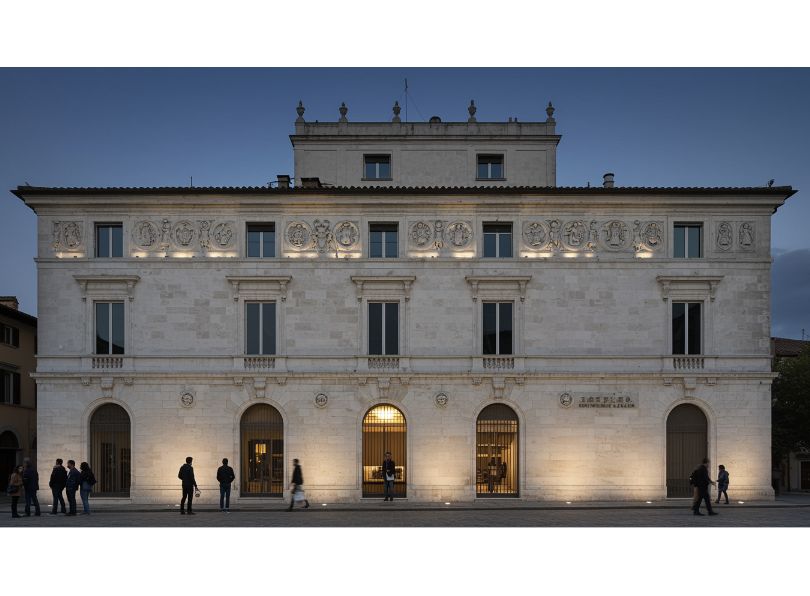
Hotel facade lighting: creating atmosphere and identity
The hotel industry is one of the most sophisticated commissioners of facade lights, and for good reason: the nocturnal presence of a hotel is a direct expression of its brand identity, its market positioning and its customer proposition. A guest’s first impression of a hotel is formed before they enter the building, in the approach on foot or by car, in the photographs that appear on booking platforms, and in the social media imagery that guests and reviewers create. The quality of the hotel’s facade lighting is a primary determinant of this first impression, and its investment value extends far beyond simple aesthetics.
The commercial case for hotel facade lighting
The business case for investing in high-quality hotel facade lighting is supported by several converging data points. A 2023 analysis by Hospitality Net reviewed TripAdvisor and Booking.com data for 500 comparable European hotels and found a statistically significant correlation between reviewer descriptions of “beautiful exterior,” “great at night” and “impressive entrance” and overall property scores, with properties scoring above average on these descriptors achieving room rates 8.5–14% higher than comparators in the same market segment and category.
A separate study by JLL Hotels & Hospitality (2022) found that hotels that underwent facade lighting upgrades (typically from fluorescent or metal halide systems to led) reported average RevPAR (Revenue Per Available Room) improvements of 4.2% in the 12 months following the upgrade, attributable in part to improved online imagery and in part to the premium positioning effect of a more polished exterior appearance.
Strategies for hotel facade lighting
The following facade lighting strategies are commonly deployed in premium hotel projects:
warm accent of architectural features: columns, cornices, balcony balustrades, window frames and entrance canopies illuminated with precision led spotlights or linear profiles at 2700–3000K. The warmth of the light communicates luxury and welcome;
dynamic colour accent for special occasions: a secondary layer of RGBW facade lighting, typically in recessed profiles or concealed ground-mounted fixtures, enables the hotel to dress the facade for seasonal events, corporate functions, national celebrations and brand campaigns without the cost and disruption of temporary lighting rigs.
entrance canopy illumination: the hotel entrance canopy is the single most important element in the facade composition and deserves the most careful and generous lighting treatment. A combination of downlighting (for bright, welcoming vertical surface illumination), architectural detail lighting (for the underside of the canopy) and perimeter linear lighting (for definition of the canopy edge) typically produces the most impressive result.
integration with landscape and water features: many hotel properties include formal landscape features (clipped hedges, topiary, ornamental trees, water features, sculpture) adjacent to the building facade. The integration of facade lights with landscape lighting in a coherent overall composition extends the visual impact of the facade lights scheme and creates a richer nocturnal environment for arriving guests.
Maintenance and long-term management of facade lighting
The long-term performance of a facade facade lights installation depends as much on the quality of its maintenance programme as on the quality of the initial design and installation. An led facade lights system that is not properly maintained will experience progressive degradation in both light output and visual quality, ultimately reaching a state where it fails to achieve its design intent and must be replaced at significant cost. Conversely, a well-maintained led system can deliver its design performance for 20 years or more, providing excellent return on the initial investment.
Maintenance requirements for led facade systems
The maintenance requirements for led facade facade lights systems are substantially lower than those for legacy systems, primarily because led sources do not require lamp replacement during their design life. The principal maintenance activities for an led facade system are:
Periodic cleaning: dust, grime, bird droppings, pollen and atmospheric deposits accumulate on diffuser covers and fixture surfaces, reducing light output and, in severe cases, causing heat build-up that accelerates LED degradation. For most facade applications, annual cleaning of all diffuser surfaces is recommended; in polluted urban environments or coastal locations, more frequent cleaning (every 6 months) may be required. The Maintenance Factor (MF) used in lighting calculations accounts for lumen depreciation due to dirt; typical values range from 0.67 (dirty urban environment, 1 year between cleans) to 0.83 (clean environment, annual cleaning).
Electrical inspection: an annual electrical inspection should verify the integrity of all cable connections, cable glands, junction boxes and circuit protection devices. Any signs of moisture ingress, corrosion or overheating at connection points should be investigated and remedied immediately.
Control system inspection: the control system (timers, dimmers, DALI controllers, sensors) should be inspected annually for correct operation. Timer settings should be checked and updated to reflect any changes in operational requirements. Sensor sensitivity and delay settings should be verified.
Driver monitoring: led drivers are the component most likely to fail in an led facade system. Most high-quality drivers include indicator leds or BACnet/Modbus/DALI reporting functions that signal fault conditions; where these are available, integration with the building management system for automated fault reporting is strongly recommended. Without automated monitoring, a regular manual inspection of all drivers (checking for normal temperature, correct output voltage and any fault indicators) should be included in the maintenance programme.
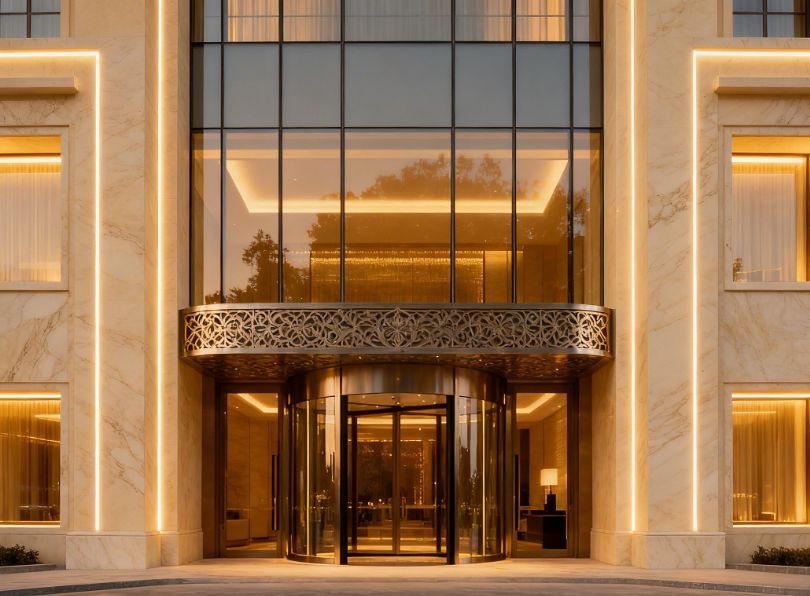
Planned replacement strategy
Despite the long design life of led systems, it is essential to plan for the eventual replacement of components (primarily led drivers and, in older systems, led strips) well in advance of actual failure. The failure of a key component without a replacement strategy in place can result in extended periods of darkness that compromise security, aesthetics and commercial value.
A planned replacement strategy should identify the expected replacement intervals for all major components (based on the manufacturer’s L70 and B10/B50 data), establish a spares holding policy (particularly for products that may be discontinued by the time replacement is required), and budget for replacement costs in the long-term capital expenditure plan.
Trends in facade lighting 2024–2026
The facade lighting industry is in a state of rapid evolution, driven by advances in led technology, digital control systems, smart building integration and shifting aesthetic preferences. Understanding the key trends shaping the market enables architects, engineers and building owners to make forward-looking specification decisions that will remain relevant and valuable over the lifetime of their installations.
Ultra-high efficacy led systems
The drive toward ever-higher luminous efficacy in led products continues unabated. Laboratory demonstrations of led efficacy above 300 lm/W have been reported by leading manufacturers, and commercial products exceeding 200 lm/W at the module level are becoming available. For facade lighting, this translates to further reductions in installed wattage for equivalent light output, smaller power supply requirements and reduced infrastructure costs.
Tunable white and dynamic white systems
Tunable white led systems, capable of adjusting colour temperature across a range from warm (2700K) to cool (6500K), are increasingly specified for facade lights in hospitality, cultural and premium residential applications. The ability to vary the colour temperature of the facade lights in response to time of day, season or operational context adds a new dimension of flexibility to the facade lights palette and enables building owners to adapt their exterior lighting character to different occasions without physical changes to the facade lights installation.
Wireless and app-controlled facade systems
The smartphone has become the universal remote control for domestic technology, and facade lights is no exception. An increasing range of led drivers and control systems for residential and small commercial facade applications now incorporate Bluetooth, Wi-Fi or Zigbee connectivity, enabling direct control via dedicated apps without the need for a wired control infrastructure. Wireless control significantly reduces installation cost and complexity, making sophisticated scene control and scheduling available to a much wider range of projects and budgets than was previously possible.
Circadian-aware facade lighting
Growing awareness of the health and environmental impacts of blue-rich light at night is driving a move toward circadian-aware facade lights design, in which colour temperature and blue-spectrum content are actively managed to minimise disruption to both human health and ecological systems. In 2024, the European Commission’s Scientific Committee on Health, Environmental and Emerging Risks (SCHEER) issued updated guidance on artificial light at night that is expected to influence future regulation of exterior lighting in EU member states.
Biological and insect-friendly lighting
A notable emerging trend in ecologically sensitive contexts is the facade lights specification of “insect-friendly” or “wildlife-friendly” led products for facade applications, products that minimise the blue and UV spectral components that are most attractive to night-flying insects, and which use spectral distributions shifted toward the amber and red end of the visible spectrum. these facade lights products are particularly relevant for buildings in rural and semi-rural contexts, near nature reserves, or where the client has explicit sustainability commitments that extend to ecological impact.
Circular economy approaches to facade lighting
The principles of the circular economy (designing products for durability, repair, reuse and recycling) are increasingly influencing facade facade lights product development. Several manufacturers now offer facade facade lights led profile systems designed for disassembly, with ledstrips and drivers that can be replaced individually without requiring replacement of the entire system. Aluminium extrusion profiles, which can be recycled indefinitely without degradation of material properties, are ideally suited to a circular economy approach, and the adoption of standardised modular systems that enable component-level replacement is a growing trend in the professional facade lighting market.
Case studies: exemplary facade lighting projects
Examining real-world facade lights projects, their design objectives, technical solutions and outcomes, provides the most direct and practical insight into the possibilities of building facade lights illumination. The following case studies represent a range of building types, scales and contexts, illustrating the application of the principles and technologies discussed throughout this guide. Each case study highlights specific technical decisions and their consequences, providing actionable reference points for professionals planning their own facade lights projects.
Case Study: heritage hotel renovation
Project context: the renovation of a 19th-century palazzo in a historic city centre, converted to a boutique hotel. The building is listed under Italian cultural heritage law (Codice dei Beni Culturali), imposing strict constraints on the manner and extent of any external intervention.
Design objectives: to create a warm, elegant nocturnal presence for the hotel that celebrated the period architecture, attracted the attention of guests arriving by taxi or on foot through the historic street network, and differentiated the property from its competitors while satisfying the Soprintendenza’s requirements for minimal physical intervention on the historic fabric.
Technical solution: the lighting design team specified a combination of three techniques:
- low-profile ground-mounted led uplighters installed in the paved area in front of the building, providing asymmetric wall-wash illumination of the entire principal elevation at approximately 30 lux average, using 2700K warm white at IP67 for street-level robustness
- miniaturised led profiles installed within the window reveals of the piano nobile (principal floor), creating a delicate horizontal line of warm light that emphasised the horizontal stratification of the facade without requiring any drilling into the historic masonry
- a single high-precision led spotlight, carefully positioned to illuminate the hotel’s carved stone coat-of-arms above the entrance portal, at approximately 150 lux average on the feature, creating the primary focal point of the nocturnal composition
The facade lights scheme was approved by the Soprintendenza at first application, praised for its sensitivity and restraint. Post-installation, the hotel’s online review scores rose by 0.3 points on a 10-point scale, with multiple reviewers specifically mentioning the exterior appearance. the facade lights project was featured in a leading Italian architecture and design magazine.
Case study: contemporary residential villa
Project context: a new-build contemporary villa in a coastal Tuscan setting, featuring a facade of white render, local stone copings and extensive glazing, surrounded by a formal Mediterranean garden. The owner, a high-net-worth private individual with a sophisticated aesthetic, requested an exterior lighting scheme that would “make the house look as beautiful by night as it does by day.”
Technical solution: a fully integrated facade lights led profile system was designed, incorporating:
- IP65 aluminium led profiles in concealed reveals at eaves level, soffit level and at the base of the facade wall, providing continuous warm white (2700K) linear illumination that defined the architectural geometry of the house;
- ground-recessed uplighters (IP67) in the gravel areas adjacent to the facade, providing gentle asymmetric wall wash at approximately 15 lux to reveal the texture of the stone copings and render;
- in-ground step lights (IP67) for all external stairways and terraces;
- tunable white led strips (2700K–4000K) in the entrance canopy, allowing the colour temperature to be adjusted for daytime entertaining versus evening reception;
- a DALI control system with smartphone integration, enabling the owner to adjust scenes, schedules and intensities remotely.
The finished scheme was described by the architect as “transforming the house into a lantern, glowing from within rather than lit from without.” The facade lights led profile system performed faultlessly through three years of Mediterranean climate exposure (high summer temperatures, heavy winter rainfall, occasional coastal storms) without any maintenance interventions beyond the annual cleaning of diffuser surfaces.
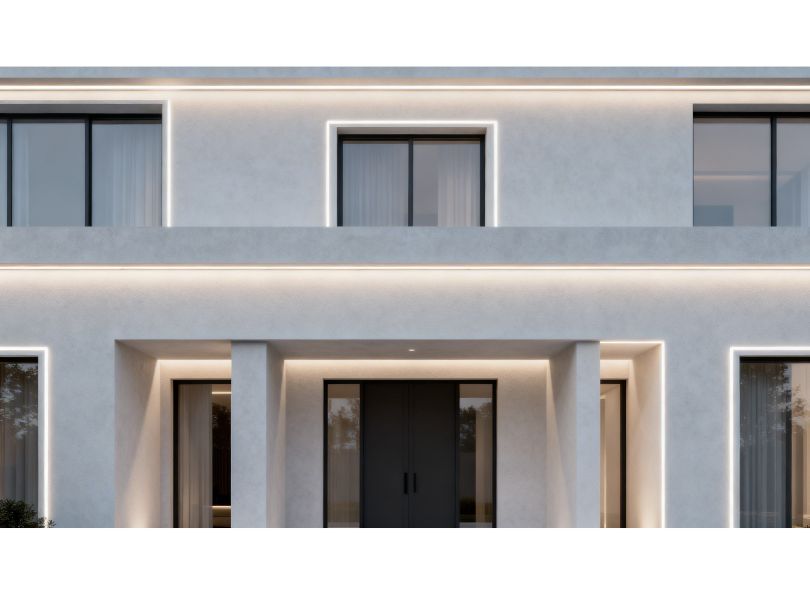
Case study: commercial office building
Project context: a speculative Grade A office development in a competitive London commercial district, seeking to maximise tenant attraction and establish a strong corporate identity through exterior design, including lighting.
Technical solution: a sophisticated multi-layer facade lights scheme was developed:
- internal perimeter LED profiles (IP65) at each floor plate edge, installed within the curtain wall framing system, providing a luminous horizontal banding effect visible through the glass skin of the building, creating the impression of a tower filled with light
- external led spotlights on the canopy structure above the entrance plaza, providing high-brightness welcome illumination (500 lux on the entrance surface) with the building’s primary tenant signage integrated into the lighting composition
- RGBW led strips in the base of the facade (at ground level, concealed behind a stainless steel mesh screen) providing the ability to introduce colour into the composition for corporate events, seasonal campaigns and civic celebrations
- a full DALI-2 control system integrated with the building’s BACnet BMS, enabling automated scheduling, energy monitoring and emergency lighting integration
The building achieved full occupancy within 18 months of completion (above the market average for comparable new developments in the area. Multiple tenants cited the building’s design) explicitly including its exterior lighting as a factor in their leasing decision. Annual energy consumption for the facade lights system was 85% lower than an equivalent metal halide system of comparable light output.
Product selection guide: Lightingline.eu solutions for facade lighting
Lightingline.eu is a specialist supplier of waterproof led profiles and led strip systems for professional exterior and facade lights applications. The range is designed and manufactured to meet the demanding performance requirements of architects, electrical engineers, building contractors and lighting designers working on facade and exterior linear lighting projects of all scales and typologies. The Lightingline product portfolio addresses every stage of the facade lights design and installation process, from initial product selection through technical specification and installation support to long-term operational maintenance.
Waterproof led profile system overview
The Lightingline range of waterproof led profiles for facade applications is structured around a family of aluminium extrusions in standard cross-sectional geometries, each available in multiple lengths and surface finishes, and each compatible with a coordinated family of diffusers, end caps, mounting accessories and led strip products.
| Profile family | IP rating | Max strip power | Diffuser options | Finish options |
|---|---|---|---|---|
| LL-Surface-IP65 | IP65 | Up to 20 W/m | Frosted, opal, clear | Silver anodised, black, white, custom RAL |
| LL-Recess-IP65 | IP65 | Up to 20 W/m | Frosted, anti-glare | Silver anodised, black, white |
| LL-Corner-IP20 | IP20 | Up to 14.4 W/m | Frosted, opal | Silver anodised, black |
| LL-Floor-IP67 | IP67 | Up to 14.4 W/m | Frosted, anti-glare | Silver anodised, black |
| LL-Tube-IP68 | IP68 | Up to 12 W/m | Clear silicone | Clear, frosted silicone |
Led strip products for facade applications
The led strip range at Lightingline.eu covers single-colour (white), tunable white (CCT), RGB and RGBW variants, in densities from 30 to 240 leds/m and power densities from 4.8 to 24 W/m, for 12V and 24V supply systems. All strips intended for use in outdoor profiles are available with a non-waterproof version (for use within sealed IP65+ profiles) and a self-waterproofed version (IP65–IP67 strip, for use in profiles where moisture entry into the profile channel is possible).
Key selection criteria for led strips for facade applications, as offered in the Lightingline range, include:
- colour temperature: 2700K, 3000K, 4000K, 6500K and tunable white (2700–6500K) variants;
- CRI: standard (CRI≥80) and high-CRI (CRI≥90, R9≥50) variants;
- led density: 30, 60, 120, 144, 240 LEDs/m for varying uniformity requirements;
- power density: 4.8, 7.2, 9.6, 12.0, 14.4, 19.2, 24.0 W/m;
- control compatibility: standard on/off, PWM dimming, 0-10V dimming, DALI, DMX, RF wireless.
Led drivers and power supplies
The choice of led driver is as important as the choice of led strip for facade lights performance and reliability as:
- standard IP20 constant voltage drivers (24V DC, 15W–320W) for use in protected enclosures;
- outdoor IP65/IP67 constant voltage drivers (24V DC, 30W–200W) for direct installation in exterior junction boxes or weatherproof enclosures;
- dimmable drivers with 0-10V interface for integration with analogue dimming controls;
- DALI-2 compatible dimmable drivers for professional building control integration;
- triac/PHASE dimmable drivers for residential trailing-edge dimmer compatibility.
Your questions…
There are a lot of most commonly asked questions about facade lighting from all professional and consumer stakeholder groups. Now we would try to answer.
What are facade lights?
Facade lights are exterior facade lights systems specifically designed to illuminate the outer surfaces of a building, the facade, using weather-resistant fixtures including led strip profiles, linear luminaires, wall-mounted fixtures, ground-level uplighters and spotlights. They serve both aesthetic functions (enhancing building character, identity and architectural beauty) and functional functions (safety, security, wayfinding, brand identity). Modern facade lights are almost universally led-based, offering long lifespan, high energy efficiency and precise optical control.
Do you need planning permission for outside lights?
For most residential properties in the EU and UK, standard domestic facade lights do not require planning permission, provided they meet conditions relating to light trespass, nuisance and the character of the building. However, listed buildings and buildings in Conservation Areas always require specific consent before any external lights are installed. Commercial building facade lighting almost always requires planning permission. Always consult your local planning authority before proceeding with any commercial or heritage property facade facade lights installation.
Do you need listed building consent for external lighting?
Yes. In the UK, any works to a listed building that affect its character, including the facade lights installation of external lighting, require listed building consent from the local planning authority. This applies regardless of whether the works are structural or non-structural. In Italy, equivalent authorisation from the Soprintendenza is required for buildings subject to cultural heritage protection. Failure to obtain listed building consent is a criminal offence in the UK.
How much does facade lighting cost?
The cost of facade lights varies enormously depending on building size, system complexity and product specification. As a general guide: a simple residential entrance facade lights system costs €150–€500, a comprehensive residential facade linear led system costs €1,000–€12,000, a commercial building facade lights system costs €10,000–€300,000+. The best way to establish a realistic budget for your project is to consult a qualified lighting designer and obtain quotations from suppliers.
Does facade lighting increase property value?
Yes. Research consistently shows that well-designed exterior lighting, including facade lights, increases residential property value by 10–20% and improves commercial property attractiveness, with measurable effects on rental rates and occupancy for hotels and retail properties. The return on investment is further enhanced by the energy savings that modern led facade systems deliver relative to unlit or legacy-lit properties.
How do I install facade lighting?
Facade facade lights installation involves marking out fixture positions, installing cable conduit and pulling cables, fixing luminaire bodies or profile mounts to the facade, installing led strips within profiles, making electrical connections, installing diffusers and end caps, and commissioning. All electrical work must be carried out by a qualified electrician in compliance with the applicable national electrical installation standard (EN 60364 series in Europe, BS 7671 in the UK). For detailed guidance, see Section 7 of this guide.
What IP rating do I need for outdoor facade lights?
For standard outdoor facade applications (exposed to rain but not to immersion), IP65 is the minimum recommended rating. For recessed floor-level details or fixtures subject to high-pressure washing, IP67 is recommended. For underwater or semi-submerged applications, IP68 is required. All Lightingline.eu waterproof led profiles for facade applications are available in IP65, IP67 and IP68 variants.
What colour temperature should I use for facade lights?
For most residential and heritage building applications, warm white (2700–3000K) is recommended, as it enhances the appearance of traditional materials (stone, brick, render, timber) and creates a welcoming atmosphere. For contemporary commercial buildings, neutral white (3500–4000K) is commonly used. Cool white (5000–6500K) is rarely appropriate for facade lights in any context, due to its higher contribution to light pollution and its less flattering effect on most building materials.
What are the different types of facade lights?
The principal types of facade lights are: linear led strip lighting in waterproof profiles, uplighting (from ground or low-level positions), downlighting (from elevated positions), wall grazing (near-tangential to reveal surface texture), wall washing (even diffuse illumination of facade surface), accent spotlighting (for architectural features), and dynamic RGBW systems (for colour-changing effects). Most facade lights schemes use a combination of two or more of these techniques.
What is the rate of facade lights / what is the cost per square metre?
The installed cost of facade lights per square metre of illuminated facade surface varies widely depending on the facade lights system type. As an indicative range: led profile perimeter lighting (illuminating reveals and edges rather than the full surface) costs €30–€100/m run installed; wall washing to cover a full facade surface costs €20–€80/m² installed at lower specification levels, rising to €100–€300/m² for high-specification commercial installations with full control systems and dimming.
What are the main types of architectural facade lights?
The four conventional categories of architectural facade lights are:
- ambient / general lighting: providing overall background illumination;
- task lighting: providing focused illumination for specific activities;
- accent lighting: highlighting specific architectural features or objects; and
- decorative lighting: serving primarily ornamental rather than functional purposes.
In facade lighting, all four categories may be present, though accent and decorative lighting are the most architecturally distinctive.
What is the 5:7 lighting rule?
The “5:7” or “5’7″ rule is a practical heuristic in lighting design that recommends positioning light sources either well above or well below the typical eye level of approximately 1.7m (5’7”), to minimise direct glare. In facade lighting, this translates to mounting luminaires at high level (above 2.5m) or at very low level (below 0.5m), avoiding the intermediate range where direct glare is most problematic.
What are the 4 C’s of lighting?
The four C’s of lighting are:
- Contrast: the relationship between bright and dark areas that creates visual interest and hierarchy;
- Composition: the spatial organisation of light and shadow across the illuminated surface;
- Colour: the colour temperature and spectral quality of the light source and its interaction with building materials;
- Control: the ability to modulate the facade lights system over time through dimming, scheduling and scene setting.
Is there a difference between interior and exterior lights?
Yes, there are fundamental differences between interior and exterior light fixtures. Exterior fixtures must be weatherproof (IP65 minimum for exposed outdoor use), UV-resistant (materials must not degrade under sunlight), thermally robust (operating in ambient temperatures from -20°C to +50°C or beyond), mechanically strong (resistant to wind loads), and corrosion-resistant (particularly in coastal or industrial environments). Interior fixtures are designed for controlled environments and are not suitable for outdoor use unless specifically rated for the purpose.
What lights are best for showing off the outside of your home?
The most effective and versatile solution for residential facade lighting is a combination of:
- linear LED profiles in waterproof aluminium housings (IP65) installed at eaves, window reveals and feature edges for architectural definition;
- small ground-recessed or border uplighters for wall accent.
Choose 2700K warm white for the most flattering and welcoming result.
What is a facade on a house?
In architectural terms, the facade of a house is its principal exterior face or elevation, typically the front face, facing the street or primary approach. The word derives from the French “façade” and ultimately from the Italian “facciata” (face). In everyday usage, the term is sometimes extended to all exterior elevations of a building, and in lighting design it commonly refers to any exterior vertical surface of the building that is to be illuminated.
How do you light a DJ facade?
A DJ facade (also called a DJ booth facade or DJ front panel) is illuminated very differently from a building facade. DJ facades typically use pixel-mapped led panels, POI (Point Of Interest) led elements, or led strip matrices behind translucent acrylic panels to create dynamic, colour-changing, music-reactive visual effects. For professional DJ facade lighting, the same waterproof led strips and RGBW DMX-controlled products used in architectural facade lighting can be adapted, with a DMX controller providing synchronisation with the music.
Facade Lights: loook at the future on lighting building
We have explored the full breadth of the facade lights discipline, from fundamental definitions and design principles to technical product specifications, installation methodology, regulatory frameworks, cost analysis and future trends. The conclusion that emerges from this exploration is clear: facade lighting has moved from a peripheral concern to a central strategic priority in the facade lights design, management and commercial positioning of buildings of all types and scales.
The technological transformation of the past two decades (the rise of led, the development of sophisticated weatherproof aluminium profile systems, the integration of digital control and IoT connectivity, the dramatic improvement in energy efficiency and product lifespan) has removed most of the traditional barriers to high-quality facade lighting. What was once the preserve of landmark buildings with substantial budgets is now accessible to any residential property owner, any commercial tenant and any facility manager who chooses to invest in it. the facade lights products are available, the facade lights installation knowledge is established, and the financial case ( through energy savings, property value uplift and operational benefits) is compelling.
The challenge now is not whether to invest in facade lights, but how to invest in it wisely: selecting the right products, specifying the right system configuration, complying with the applicable regulations, and working with competent installation partners who understand the technical requirements of exterior facade lights led systems. This guide has sought to provide the knowledge necessary to meet that challenge confidently and effectively.
The buildings of our cities tell their stories by night as much as by day. With the right facade lights when well chosen, well installed and well controlled every building can tell its story beautifully.
This article was developed with the support of artificial intelligence and subsequently reviewed, corrected, and validated by the LightingLine.eu technical team, which guarantees its reliability and compliance with official sources.