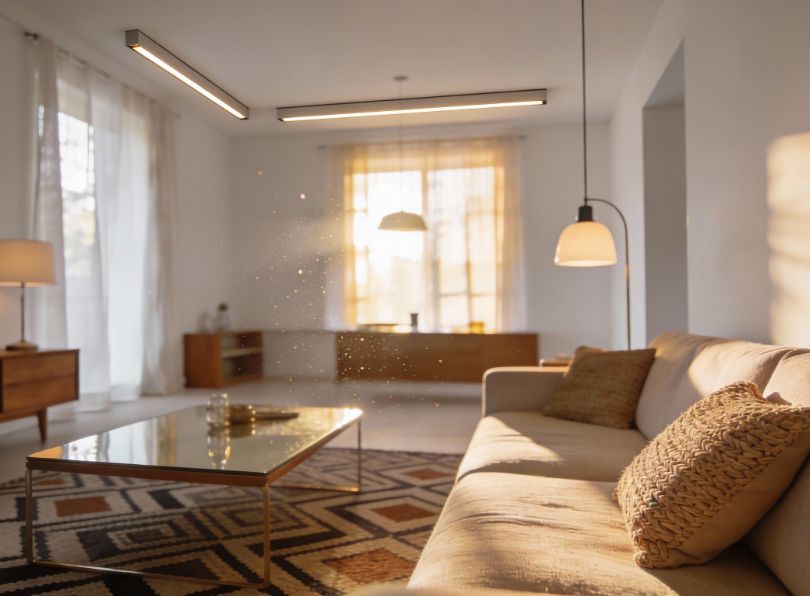
Ceiling lightings sit at the exact point where engineering meets atmosphere. Get them right and a room feels taller, calmer and more intentional: get them wrong and even the best furniture and finishes look flat.
This guide is built for the people who actually specify, sell, design and install ceiling lightings every day (architects balancing compliance and aesthetics, interior designers layering ambience, showroom owners curating what to stock, contractors pricing large installations, and students building their first lighting plan) and it walks through every stage of the decision: what ceiling lightings actually are today, the types available, the materials and technology behind them, how LED strips have changed what a ceiling can do, room-by-room recommendations, sizing and installation rules, real cost ranges, and where the category is heading in 2026.
Along the way we link out to Lighting Line’s own LED strip catalogue, because a growing share of the ceiling lightings discussed here (recessed coves, trimless profiles, perimeter details, floating ceiling effects) are built around a strip and an aluminium profile rather than a boxed fixture. If you specify, resell or install ceiling lighting professionally, that distinction matters more each year.
In this guide
- What are ceiling lightings, exactly?
- Types of ceiling lightings: from flush mounts to LED profiles
- Materials and design: what changes in practice
- Technology: LED, dimmers, sensors and smart control
- LED strips for ceilings: the technology reshaping the category
- Choosing ceiling lightings room by room
- How to choose the right ceiling light: a step-by-step method
- Installation, safety and regulations
- Ceiling lighting costs: what actually drives the price
- 2026 trends in ceiling lightings
- Specifying ceiling lightings for commercial and residential projects
- Frequently asked questions
- Partnering with Lighting Line for your ceiling lighting project
1. What are ceiling lightings, exactly?
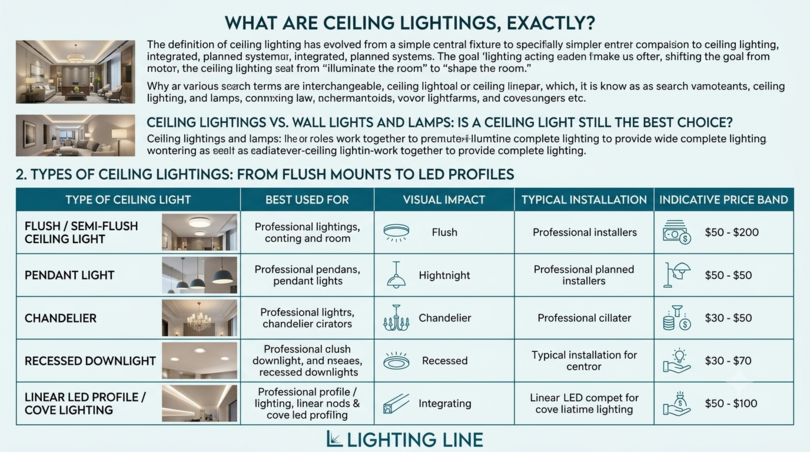
Ten years ago, “ceiling lightings” meant a single central rose with a shade, a chandelier for the dining room, and not much else. That definition is outdated. Today, ceiling lightings describe any planned lighting system where the light source, its housing and its control gear are built into, onto or across the ceiling plane: a category that stretches from a £20 flush-fit ceiling light bought to replace a broken fitting, to a fully custom, plaster-in aluminium profile running the length of a corridor with tunable-white LED strip inside it.
What has actually changed is not the location of the light (it is still, obviously, the ceiling) but the intent behind it. A modern ceiling light fixture is expected to do at least one of these jobs, and often several at once: provide general ambient light for the room, define a zone within an open-plan space, hide its own hardware so attention stays on the architecture, and integrate with dimmers, sensors or a smart home system rather than working as an isolated on/off point. The goal has shifted from “illuminate the room” to “shape the room.”
This wider definition is why the category now includes so many overlapping terms that mean almost the same thing to a shopper but slightly different things to a specifier: ceiling light fittings, ceiling light fixtures, overhead lighting, roof lighting, in-ceiling lighting, and light fittings ceiling are all used more or less interchangeably in everyday search and everyday conversation, while terms like recessed lighting, cove lighting and linear LED profiles describe a more specific, architecturally integrated subset of the same family.
Ceiling lightings vs. wall lights and lamps: is a ceiling light still the best choice?
A question worth answering directly, because it comes up constantly from both homeowners and professionals: are lamps or wall lights ever a better choice than a ceiling light? The honest answer is that they solve different problems. Ceiling lightings remain the most efficient way to deliver even, shadow-free ambient light across an entire room from a single circuit, which is precisely why almost every functional lighting plan still uses a ceiling fixture, a recessed downlight run, or a linear LED profile as its base layer. Table lamps and wall lights are then added on top for task lighting, mood, and the softer pools of light that a single central source cannot provide on its own. Wall lights remain firmly in fashion for exactly this reason: they complement ceiling lightings rather than compete with them, and the two are almost always specified together in any serious interior design brief.
2. Types of ceiling lightings: from flush mounts to LED profiles
Walk into any lighting showroom, browse any online catalogue, or open any architect’s specification sheet, and ceiling lightings will fall into a handful of recognisable families. Knowing which family suits which room and which budget is the first real decision in any project, so this section breaks each type down by how it mounts, what it is best used for, and what it typically costs to buy and install.
Flush and semi-flush ceiling lights
A flush ceiling light sits directly against the ceiling surface with no visible drop, which makes it the default choice for rooms with low or standard ceiling heights, hallways, and anywhere a pendant would hang too low to walk under comfortably. A semi-flush ceiling light uses a very short stem or chain (usually under 15cm) to lift the fixture slightly away from the surface, adding a small amount of visual depth without sacrificing headroom. Both are sold in enormous variety, from simple opal-glass flush fittings at the affordable end to designer flush fittings with fabric, brass or crystal detailing at the premium end, which is exactly why “cheap ceiling lights” and “luxury ceiling lights” sit side by side as two of the most searched terms in the category.
Pendant lights and chandeliers
Pendant lights and chandeliers hang from the ceiling on a cord, chain or rod, and are chosen specifically because they are meant to be seen rather than hidden. A single statement pendant over a dining table or kitchen island, or a cluster of smaller pendants over a living room seating area, is one of the most reliable ways to give a room a focal point. Chandeliers extend the same idea with multiple light sources and, usually, more elaborate materials (crystal, blown glass, sculptural metal) and remain the fixture of choice wherever the brief calls for a genuine design statement rather than pure function.
Recessed downlights and spotlights
Recessed downlights (often searched as spotlights in ceiling, or simply as recessed lighting) sit inside the ceiling void so that only the trim and the light output are visible. They are the standard specification for kitchens, bathrooms and any space where a clean, minimal ceiling is the priority, because a well-planned grid of downlights delivers even task lighting without a single visible fixture competing with the architecture. Their main limitation is inflexibility once installed: moving a downlight means cutting a new hole and patching the old one, so downlight layouts need to be planned carefully before installation, not adjusted afterwards.
Linear LED profiles and cove lighting
The newest and fastest-growing category is the linear LED profile: an aluminium channel, either recessed into the ceiling, surface-mounted, or suspended, that houses a continuous run of LED strip behind a diffuser. Rather than a series of individual points of light, a linear profile produces one continuous, shadow-free line: the effect architects describe as “the invisible line of light.” Cove lighting, where a profile is hidden behind a ceiling recess or bulkhead and aimed upward, uses the same underlying components to bounce a soft, indirect glow off the ceiling itself. This is the category where Lighting Line’s own aluminium profile rangeand LED strip collection are most directly relevant, and we come back to it in detail in Section 5.
| Type of ceiling light | Best used for | Visual impact | Typical installation | Indicative price band |
|---|---|---|---|---|
| Flush / semi-flush ceiling light | Bedrooms, hallways, low ceilings | Discreet to moderate | DIY-friendly on existing wiring | Low to medium |
| Pendant light | Kitchen islands, dining tables | High, decorative | DIY-friendly on existing wiring | Low to high (design-dependent) |
| Chandelier | Living rooms, entrance halls, dining rooms | Very high, statement piece | May require reinforced ceiling fixing | Medium to very high |
| Recessed downlight | Kitchens, bathrooms, corridors | Minimal, seamless ceiling | Electrician required for new positions | Low per unit, higher in quantity |
| Linear LED profile / cove lighting | Living rooms, offices, hospitality, feature ceilings | High, architectural | Electrician and, for recessed types, ceiling contractor | Medium to high, scales with length |
3. Materials and design: what changes in practice
The material behind a ceiling light fixture affects far more than how it looks in a catalogue photo. It determines how the fixture ages, how it handles heat, how heavy it is to hang safely, and how easily it can be customised for a non-standard project. This section looks at what genuinely changes, room by room and project by project, when the material choice changes.
Glass, metal, fabric and plastic
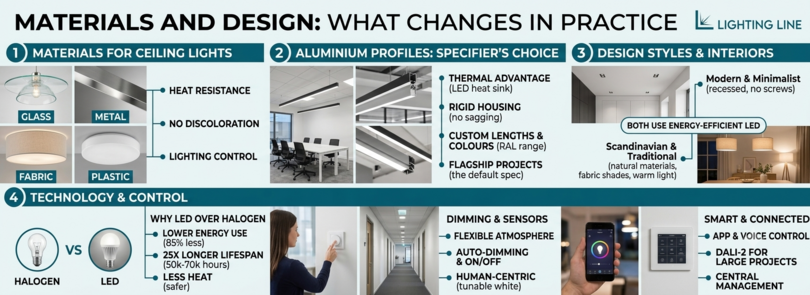
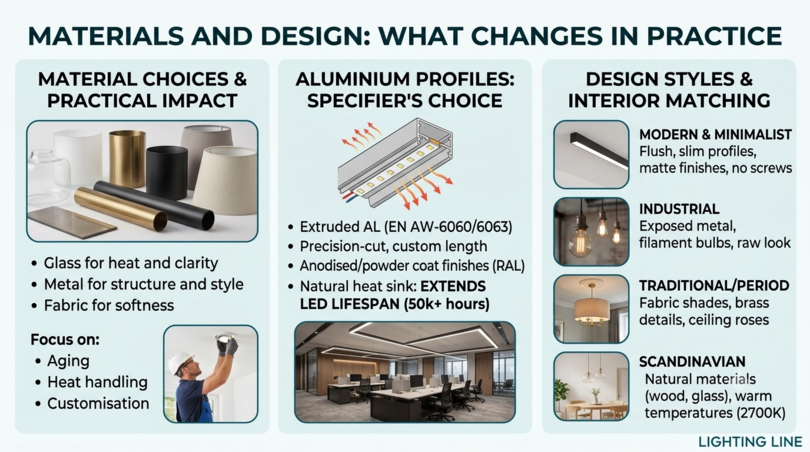
Glass diffusers and shades remain the most common choice for both flush fittings and pendants because glass handles heat well, does not discolour over time, and can be frosted, ribbed, opal or clear to control exactly how much of the light source is visible. Metal is used both structurally (as the frame or body of almost every fixture) and decoratively, with finishes like brushed brass, matte black, chrome and copper driving most of what shows up under searches for coloured or designer ceiling lights. Fabric shades soften and warm the light output and are common on pendant and semi-flush designs aimed at bedrooms and living rooms. Plastic and polycarbonate diffusers are the practical, low-cost option used heavily in recessed downlights and utility ceiling lighting, valued for being lightweight, shatter-resistant and inexpensive to replace.
Aluminium profiles: the specifier’s material of choice
For architectural and linear applications, aluminium has become the standard housing material, and for reasons that go well beyond appearance. Aluminium profiles for ceiling lighting are produced by extrusion, typically from EN AW-6060 or EN AW-6063 alloy, then precision-cut and finished with anodising or powder coating. Aluminium’s real advantage is thermal, not aesthetic: it acts as a natural heat sink, drawing heat away from the LED chips inside the profile, which is the single biggest factor in whether an LED strip actually reaches its rated 50,000-hour-plus lifespan or fails early from heat stress. On top of that, an extruded profile gives a straight, rigid housing that will not sag over a long run, can be ordered in continuous custom lengths rather than fixed unit sizes, and finishes in a wide RAL colour range to match any interior scheme: which is exactly why bespoke aluminium profiles, rather than off-the-shelf light fittings, are now the default specification on flagship commercial and high-end residential projects.
Design styles: matching the fixture to the interior
Design language moves in parallel with material choice. Modern and minimalist interiors favour flush profiles with a slim, near-invisible aperture, matte black or white finishes, and an absence of visible screws or brackets. Industrial-style interiors lean into exposed hardware, matte black metal, and filament-style bulbs left partly visible. Traditional and period interiors still call for ceiling roses, fabric shades and brass detailing, particularly in period-property renovations where planning or conservation guidance limits what can change. Scandinavian-influenced schemes mix natural materials (wood, woven fibre, opal glass) with warm colour temperatures around 2700K to keep the look calm rather than clinical. None of these styles are mutually exclusive with LED technology: a traditional-looking fitting and a cutting-edge linear LED profile can both run on exactly the same energy-efficient light source, which is one of the most useful things to communicate to a client who assumes “LED” automatically means “cold and modern-looking.”
4. Technology: LED, dimmers, sensors and smart control
The single biggest technology shift in ceiling lightings over the past decade has been the near-total replacement of halogen and compact fluorescent sources with LED. This section sets out exactly why that happened, then looks at the control layer — dimming, sensors, and smart systems — that now sits on top of almost every serious specification.
Why LED has replaced halogen and fluorescent
The case for LED ceiling lighting is now overwhelmingly economic, not just environmental. A traditional 50W halogen downlight run for five hours a day costs roughly £15 a year in electricity; a 7W LED equivalent producing comparable light output costs around £2 a year over the same use pattern. Lifespan tells the same story from a different angle: a halogen lamp typically lasts 1,000 to 2,000 hours before failure, while a well-specified LED source reaches 50,000 to 70,000 hours, meaning it can run for well over a decade of normal domestic use before it needs replacing at all.
| Parameter | Traditional halogen downlight | Integrated LED ceiling lighting | Practical advantage |
|---|---|---|---|
| Luminous efficacy | Around 20 lm/W | 100–150 lm/W | Roughly 85% lower energy use for equivalent brightness |
| Typical lifespan | 1,000–2,000 hours | 50,000–70,000 hours | 25 times longer before replacement |
| Heat output | High, can be a comfort and fire-risk factor | Low, managed by the housing/profile | Safer, reduces air-conditioning load |
| Design flexibility | Fixed shape, fixed cut-out size | Continuous runs, custom shapes, dimmable and tunable | Enables architectural, not just functional, lighting |
| 10-year running cost (typical room) | High — frequent bulb replacement plus energy | Low — minimal maintenance, low energy draw | Substantial lifetime saving |
Dimming, motion sensors and human-centric lighting
Dimmable ceiling lighting is no longer a premium extra; it is close to a baseline expectation, particularly in living rooms and bedrooms where the same fixture needs to work as bright, functional light during the day and a soft background glow in the evening. Motion and daylight sensors add a second layer of practicality, automatically switching or dimming ceiling lights in corridors, stairwells, utility rooms and offices based on occupancy and available natural light, which cuts running costs further without asking anyone to remember to flip a switch. The most advanced layer, human-centric lighting, uses tunable-white LED sources that shift colour temperature and intensity through the day to mirror natural daylight, a feature increasingly specified in offices and healthcare settings to support circadian rhythm and alertness.
Smart and connected ceiling lighting
Smart ceiling lights and smart LED strips connect to a home or building’s control system over Wi-Fi, Zigbee, Bluetooth Mesh or, in commercial settings, a DALI-2 protocol, allowing scenes, schedules and remote control from an app or voice assistant. For a straightforward domestic ceiling light, this typically adds modest cost for a genuine gain in daily convenience. For architectural linear lighting across a large building, DALI-2 control is close to essential, because it lets a facilities team adjust, zone and monitor hundreds of metres of LED profile from a single interface rather than treating every run as an isolated circuit.
5. LED strips for ceilings: the technology reshaping the category
If there is one shift that separates a genuinely modern ceiling lighting scheme from a dated one, it is this: the light source is no longer a bulb sitting inside a fixture, it is a continuous strip of LEDs running inside a profile. This section explains how that works, what the real options are, and where to find them.
Why designers keep choosing strip-and-profile systems over fixtures
A boxed ceiling light fixture is, by definition, a point source: however good it looks, it is one bright spot on an otherwise dark ceiling. An LED strip inside an aluminium profile produces a continuous line of light instead, which can trace the perimeter of a room, define a coffered ceiling detail, wash light gently up a wall from a hidden cove, or create the “floating ceiling” effect where a suspended panel appears to hover on a thin ring of light. The line, not the point, is what reads as architectural rather than domestic — it is the single biggest visual difference between a builder-grade room and a professionally lit one, and it is achievable at a much lower cost than most people assume once the strip and profile are chosen correctly.
SMD vs. COB: choosing the right LED strip
Lighting Line’s own LED strip range splits into two core families, and the difference matters for ceiling applications specifically.SMD strips use individually visible surface-mounted LED chips spaced along the strip, which is cost-effective and highly flexible for cutting to length. COB strips pack the LEDs far more densely and cover them with a continuous phosphor layer, producing a genuinely dot-free line of light with a wider 180-degree beam angle: the difference is immediately visible behind a frosted diffuser, where SMD can still show faint dots at close range and COB does not. For a fully recessed, close-viewing-distance ceiling detail, COB is usually the better specification; for longer runs viewed from further away, a good SMD strip is often the more economical choice without any visible compromise.
Specifying by voltage, IP rating and colour temperature
Three technical decisions come up on almost every ceiling project. Voltage: 24V strips are now the most common choice for ceiling runs because they suffer less voltage drop over long lengths than 12V, meaning more even brightness from one end of the run to the other. IP rating: standard IP20 strips are correct for dry interior ceilings, but bathrooms, kitchens near hobs, and any exterior soffit lighting need an IP65 or IP67 silicone-sleeved strip instead, both are available across Lighting Line’s SMD and COB ranges. Colour temperature: 2700–3000K reads as warm and residential, 4000K is a neutral, practical choice for kitchens and offices, and CCT (colour-temperature-changing) strips let a single installation move between warm and cool as needed, which is increasingly requested on flagship projects that want flexibility built in rather than fixed at installation.
From strip to finished ceiling: the role of the profile
A bare LED strip is never fixed directly to a ceiling. It sits inside an aluminium profile, which does three jobs at once: it protects and supports the strip physically, it draws heat away from the LEDs to protect their lifespan, and it holds the diffuser that turns individual LED points into one soft, even line. Recessed profilesplaster into the ceiling for a completely flush, seamless finish, surface profilesmount directly onto the ceiling face for a faster, retrofit-friendly installation, suspension profiles hang from wires or rods for feature pendant-style linear runs and corner profileshandle the junction between ceiling and wall for cove and coving details. Choosing strip and profile together, rather than separately, is the single most reliable way to avoid the two most common mistakes in linear ceiling lighting: visible hot spots from an underpowered profile, and a strip that fails early because its housing could not dissipate enough heat.
6. Choosing ceiling lightings room by room
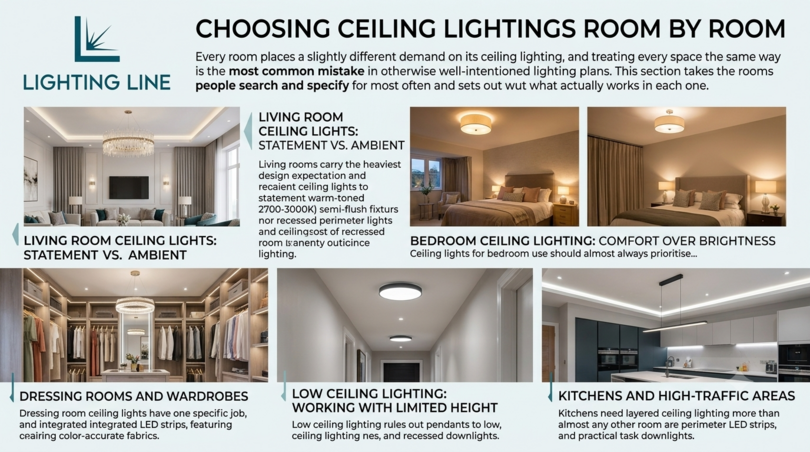
Every room places a slightly different demand on its ceiling lighting, and treating every space the same way is the most common mistake in otherwise well-intentioned lighting plans. This section takes the rooms people search and specify for most often and sets out what actually works in each one.
Living room ceiling lights: statement vs. ambient
Living rooms carry the heaviest design expectation of any room in the house, which is why living room ceiling lights split cleanly into two strategies. The first is a statement fixture — a chandelier, a sculptural pendant cluster, a large-scale designer flush fitting — used as the visual anchor of the room, almost always dimmable and almost always supplemented by lamps and wall lights for evening use. The second is a fully integrated approach using recessed downlights or a perimeter LED profile so the ceiling itself stays visually quiet and the room’s furniture and art take the attention instead. Neither approach is more correct than the other; the choice depends entirely on whether the room wants the ceiling to be a feature or a backdrop.
Bedroom ceiling lighting: comfort over brightness
Ceiling lights for bedroom use should almost always prioritise warmth and dimmability over raw brightness. A single bright, cool-white central fitting is the single most common lighting mistake in bedrooms, because it makes the space feel clinical rather than restful. A warm 2700–3000K flush or semi-flush fixture on a dimmer, paired with bedside lamps for reading, consistently outperforms a single bright ceiling light in how comfortable a bedroom actually feels to sleep in.
Dressing rooms and wardrobes
Dressing room ceiling lights have one specific job that other rooms do not: rendering colour and fabric accurately enough to choose an outfit with confidence. A neutral 4000K source with a high colour rendering index (CRI 90 or above) is far more useful here than the warm, atmospheric light that suits a living room or bedroom, and a continuous LED strip along the wardrobe’s upper edge or inside open shelving consistently outperforms a single central fitting for this specific task.
Low ceiling lighting: working with limited height
Low ceiling lighting rules out pendants and chandeliers in any space where headroom is already tight, which pushes the decision firmly toward flush fittings, recessed downlights, or a slim surface-mounted LED profile with a low visual profile. The good news is that low ceilings are not a design compromise: a well-planned run of recessed downlights or a slim perimeter LED profile, both of which sit almost flush to the surface, often reads as more deliberate and more contemporary than a pendant would have in the same space.
Kitchens and high-traffic areas
Kitchens need layered ceiling lighting more than almost any other room: bright, even, shadow-free downlights for the working areas, supplemented by a pendant or two over an island purely for character, and increasingly an LED strip concealed under wall units or along a ceiling perimeter to soften the space once cooking is finished for the day. IP-rated fittings become relevant here too, particularly for any ceiling lighting positioned close to hobs or extraction, where heat and grease exposure rule out standard indoor-rated fixtures.
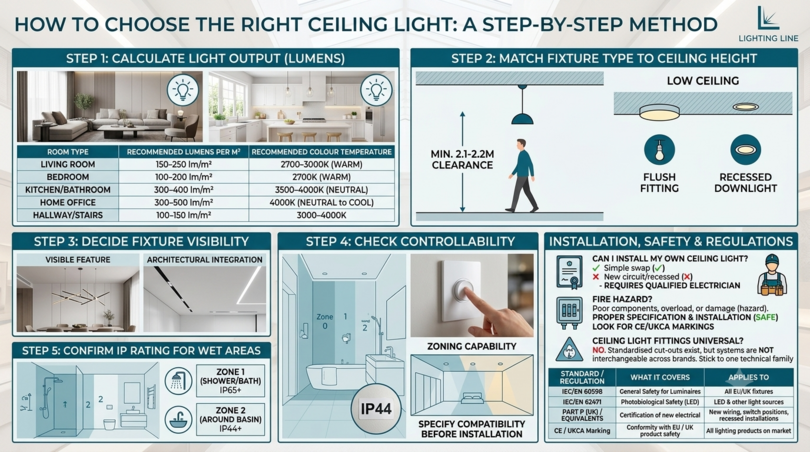
7. How to choose the right ceiling light: a step-by-step method
Most people choosing a ceiling light start with style and work backwards, which is understandable but leads to rooms that look right in a photograph and feel wrong to actually live or work in. The more reliable method starts with function and lets style follow. Here is the sequence professionals actually use.
Step 1: calculate the light output the room needs
Every room has a rough lumen requirement based on its floor area and function. Living rooms and bedrooms generally need 150–300 lumens per square metre of ambient light; kitchens and bathrooms need considerably more, typically 300–400 lumens per square metre, because they combine ambient and task requirements in the same space.
| Room type | Recommended lumens per m² | Recommended colour temperature |
|---|---|---|
| Living room | 150–250 lm/m² | 2700–3000K (warm) |
| Bedroom | 100–200 lm/m² | 2700K (warm) |
| Kitchen (task areas) | 300–400 lm/m² | 3500–4000K (neutral) |
| Bathroom | 300–400 lm/m² | 3500–4000K (neutral) |
| Home office | 300–500 lm/m² | 4000K (neutral to cool) |
| Hallway / stairs | 100–150 lm/m² | 3000–4000K |
Step 2: match the fixture type to the ceiling height and function
A pendant needs at least 2.1–2.2m of clearance beneath it to avoid becoming a hazard, which immediately rules it out for many low-ceilinged rooms and hallways. If headroom is limited, move to flush fittings, recessed downlights, or a slim LED profile instead of forcing a pendant into a space that cannot comfortably accommodate one.
Step 3: decide how much of the fixture should be visible
This is really a design-philosophy question: should the ceiling light be a visible feature (chandelier, pendant, decorative flush fitting) or should it disappear into the architecture (recessed downlights, trimless LED profiles)? Both are valid, and many well-designed rooms use one approach for a focal point and the other for the surrounding general lighting.
Step 4: check controllability before buying
Confirm the fixture is compatible with a dimmer if dimming matters, and check whether it can be zoned separately from other lighting in the same room. It is far cheaper to specify this correctly before installation than to retrofit dimming or zoning afterwards.
Step 5: confirm IP rating for bathrooms and kitchens
UK and EU regulations divide bathrooms into zones based on proximity to water, and each zone has a minimum required IP rating. Buying a standard indoor-rated ceiling light for a bathroom zone that requires IP44 or higher is one of the most common and most easily avoided specification errors.
8. Installation, safety and regulations
Ceiling lighting sits at the intersection of design and electrical safety, and the rules here are not optional extras — they determine whether an installation is legal, insurable and safe.
Can I install my own ceiling light?
A simple like-for-like fixture swap on existing wiring is generally within reach for a competent, careful person. However, any new circuit, new switch position, or work that involves cutting into the ceiling structure crosses into work that must be carried out or certified by a qualified electrician under UK Part P building regulations, or the equivalent national wiring regulations elsewhere in the EU. Recessed lighting installations, in particular, almost always require professional involvement because they combine electrical work with structural cutting into the ceiling void.
Are ceiling lights a fire hazard?
Any electrical fitting carries some risk if it is poorly made, poorly installed, or overloaded, but a properly specified and correctly installed ceiling light is not inherently a fire risk. The real hazards come from non-compliant components, overloaded circuits, or damaged cabling from a poor installation. Compliant systems must meet IEC/EN 60598 for luminaire safety and IEC/EN 62471 for photobiological safety, and carry CE marking in the EU or UKCA marking in the UK.
Are ceiling light fittings universal?
No, and this is worth clarifying because it causes real confusion at the point of purchase. Some retrofit downlights share standardised cut-out sizes, but ceiling light fixtures more broadly are not interchangeable across brands, and aluminium profile-based systems are specific to the manufacturer’s own end caps, brackets and connectors. Within a single manufacturer’s range, however, components are standardised, which is exactly why specifiers are advised to source end caps, mounting brackets and profiles from a single technical family rather than mixing suppliers.
| Standard / regulation | What it covers | Applies to |
|---|---|---|
| IEC/EN 60598 | General safety requirements for luminaires | All ceiling light fixtures sold in the EU/UK |
| IEC/EN 62471 | Photobiological safety of lamps and lamp systems | LED and other high-intensity light sources |
| Part P (UK) / national equivalents (EU) | Certification of new electrical circuits | New wiring, new switch positions, recessed installations |
| CE / UKCA marking | Conformity with EU / UK product safety law | All lighting products placed on the market |
9. Ceiling lighting costs: what actually drives the price
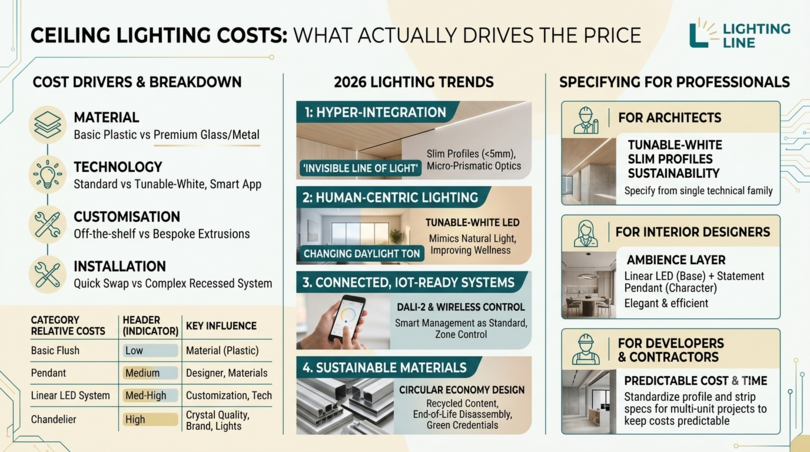
Ceiling light prices range from a few pounds for a basic plastic diffuser fitting to several thousand for a bespoke chandelier or a fully custom aluminium profile system, and the gap between those two numbers is explained by a small number of consistent factors rather than by randomness or brand markup alone.
The main cost drivers
Material is usually the single biggest factor: plastic and basic metal fittings sit at the low end, glass and better-finished metal sit in the middle, and crystal, brass, and bespoke anodised aluminium sit at the top. Technology matters almost as much: a basic non-dimmable LED downlight costs little more than the halogen it replaced, while a tunable-white, app-controlled linear system costs considerably more upfront but recovers the difference over its lifetime through lower energy and maintenance costs. Customisation is the factor most specific to architectural projects: an off-the-shelf profile in a standard length and finish is inexpensive relative to a bespoke profile designed and extruded for one specific project, but the bespoke option is often the only way to achieve a genuinely seamless architectural result. Installation labour varies enormously by fixture type: a flush fitting swap is a short, low-cost job, while a recessed profile ceiling running through multiple rooms involves considerably more electrician and, often, plasterer time.
| Category | Typical retail price band (fixture only) | What influences the price most |
|---|---|---|
| Basic flush ceiling light | Low | Material, glass vs plastic diffuser |
| Pendant light | Low to high | Designer brand, materials, size |
| Chandelier | Medium to very high | Number of lights, crystal/glass quality, brand |
| Recessed downlight (per unit) | Low | Dimmability, CRI, fire rating; cost scales with quantity needed |
| Linear LED profile + strip (per metre) | Medium | Standard vs. bespoke profile, strip type (SMD vs. COB), IP rating |
For anyone buying at scale — a retailer stocking a range, or a contractor pricing a multi-unit development — the most reliable way to control cost without compromising quality is to standardise on a small number of profile types and strip specifications across a project rather than sourcing a different bespoke solution for every room, which is exactly how larger commercial specifications keep both cost and lead times predictable.
10. 2026 trends in ceiling lightings
The direction of the category is visible every year at the major lighting trade fairs — Euroluce in Milan, Light + Building in Frankfurt, and the LED professional Symposium in Austria — and four trends stand out clearly heading into 2026.
Hyper-integration and the “invisible line of light”
Profiles keep getting slimmer, with sub-5mm visible apertures now achievable, and micro-prismatic optics that hide the LED source entirely until it is switched on. The design goal is a ceiling that reveals a clean line of light with no visible hardware at all.
Human-centric and tunable-white lighting
Tunable-white LED strips that automatically shift colour temperature through the day, mimicking natural daylight, have moved from a niche wellness feature into a mainstream specification in offices, healthcare and increasingly high-end residential projects.
Connected, IoT-ready systems as standard
DALI-2 and wireless control (Zigbee, Bluetooth Mesh) are becoming the default rather than the premium option, because building management integration and granular, zone-by-zone control are now expected on any project above a certain scale.
Sustainable materials and circular design
Recycled aluminium content and end-of-life disassembly are increasingly part of the specification conversation, not just the energy-efficiency numbers, as clients and regulations both push toward measurable circular-economy credentials.
11. Specifying ceiling lightings for commercial and residential projects
The questions that matter most about ceiling lightings change depending on who is asking, so this section speaks directly to the professionals most often specifying, selling and installing them.
For architects
The trends that matter most in practice are tunable-white human-centric lighting, ever-slimmer aluminium profiles, and materials with genuine circular-economy credentials. Low-energy integration is now simpler than it sounds: specifying LED strip and profile systems from a single technical family, rather than mixing components across suppliers, keeps thermal performance predictable and compliance documentation straightforward across an entire project.
For interior designers
The most elegant and sustainable route is almost always a linear LED profile used as the ambient base layer, with a statement pendant or chandelier layered on top for character. This combination lets a living room or bedroom scheme look considered rather than default, while keeping the running-cost and lifespan advantages of LED throughout.
For furniture and lighting retailers
Demand is moving steadily from single boxed fixtures toward flexible strip-and-profile systems that a store can present as a build-your-own solution — strip, profile, end caps and driver sold together. Differentiating on this kind of technical completeness, rather than competing purely on the price of a single fixture, is proving to be the more resilient retail strategy.
For building contractors and developers
At project scale, the priority is predictable energy performance, durability, and installation time. Standardising on a small number of profile and strip specifications across every unit in a development, rather than treating each room as a bespoke job, is what keeps both delivery times and total cost under control across a multi-unit build.
For students and emerging designers
The most useful habit to build early is thinking in systems rather than single fixtures: strip plus profile plus diffuser plus driver, each chosen to work together, rather than treating a ceiling light as one product bought off a shelf. It is also the fastest way to develop a real, professional-level understanding of how architectural lighting is actually specified.
12. Frequently asked questions
These are the questions architects, designers, retailers, contractors and homeowners actually ask most often about ceiling lightings, consolidated to avoid repeating the same answer under slightly different wording. Click any question to expand the answer.
What is a flush ceiling light?A flush ceiling light is a fixture that sits directly against the ceiling surface with no visible gap or drop, making it the standard choice for low ceilings, hallways and any room where a hanging pendant would reduce headroom too much. |
What is the difference between a ceiling light and a pendant light?A ceiling light is the general term for any fixture mounted on or in the ceiling. A pendant light is a specific type of ceiling light that hangs down on a cord, chain or rod, chosen when the fixture is meant to be a visible decorative feature rather than a discreet source of ambient light. |
What is the difference between a downlight and a ceiling light?A downlight is a specific type of ceiling light recessed into the ceiling void so only the trim is visible, used mainly for even, shadow-free task lighting. “Ceiling light” is the broader category that also includes flush fittings, pendants, chandeliers and linear LED profiles. |
Can I change a ceiling light myself?A simple like-for-like swap on existing wiring is generally manageable for a careful, competent person. Any new circuit, new switch position, or recessed installation that involves cutting into the ceiling should be carried out or certified by a qualified electrician under Part P (UK) or the equivalent national regulations. |
Do you need an electrician to fit a ceiling light?Not always for a basic fixture replacement, but yes for any new wiring, new circuit, or recessed lighting installation. Recessed downlights and linear LED profile ceilings almost always require a qualified electrician because they combine electrical work with structural work on the ceiling. |
How much does it cost to have a ceiling light installed?A straightforward like-for-like replacement is typically a short, low-cost callout job. New circuits, new switch positions, or a full recessed downlight or LED profile installation cost considerably more, since they involve more electrician time and, often, plastering work. Always get a fixed quote for the specific job rather than relying on a general average, since prices vary by region and property. |
Are LED ceiling lights worth it, and are they cheaper to run?Yes. LED ceiling lights typically use 80–90% less energy than the halogen equivalents they replace and last 25 times longer, so the higher purchase price is recovered quickly through lower running and replacement costs, with most commercial projects seeing a return on investment in under two years. |
Are LED ceiling lights good for a living room?Yes. Warm 2700–3000K, high-CRI LED sources dim smoothly without flicker and suit living room ambience well, whether delivered through a central fixture, a recessed downlight layout, or a perimeter LED profile used as ambient background lighting. |
Are ceiling lights a fire hazard?A properly specified and correctly installed ceiling light is not an inherent fire risk. The real hazards come from non-compliant components, overloaded circuits, or cabling damaged during a poor installation. Compliant products meet IEC/EN 60598 and carry CE or UKCA marking. |
Are ceiling light fittings universal?No. Some retrofit downlights share standard cut-out sizes, but fixtures and aluminium profile systems are generally specific to their manufacturer’s own end caps, brackets and connectors. Components are standardised within a single manufacturer’s range, which is why sourcing a whole system from one technical family is the safest approach. |
What is a ceiling rose and do I still need one?A ceiling rose is the circular fitting that covers the wiring connection point where a pendant or fixture attaches to the ceiling. Many modern flush fittings and LED profiles integrate this connection into the fixture itself, but a ceiling rose is still required wherever a traditional pendant or chandelier is being hung. |
What is the difference between SMD and COB LED strips for ceilings?SMD strips use individually spaced LED chips and are cost-effective and flexible; COB strips pack the LEDs far more densely under a continuous phosphor layer, producing a genuinely dot-free line of light with a wider beam angle, which usually makes COB the better choice for close-viewing recessed ceiling details. |
What IP rating do I need for a bathroom ceiling light?It depends on the zone. Areas directly above a bath or shower need a higher-rated fitting (commonly IP65), while the wider bathroom ceiling typically needs at least IP44. Always check the specific zone requirement before buying, since installing a standard indoor-rated fitting in the wrong zone is a common and easily avoided error. |
What is the best type of ceiling light for a low ceiling?Flush fittings, recessed downlights and slim surface-mounted LED profiles all work well in low-ceilinged rooms, since none of them reduce headroom the way a pendant or chandelier would. |
What is the current trend in ceiling lighting?Heading into 2026, the clearest trends are ever-slimmer, near-invisible LED profiles, tunable human-centric white lighting, DALI-2 and wireless smart control as a default rather than a premium extra, and a growing focus on recycled aluminium and circular-economy credentials. |
Are smart ceiling lights worth it?For most households, yes, for the convenience of scenes, schedules and remote control, and the modest added cost is easy to recover for anyone who already values dimming and zoning. For commercial and architectural projects, DALI-2 or wireless control is close to essential once a project reaches a certain scale. |
Are wall lights still in fashion alongside ceiling lights?Yes. Wall lights are not a competing alternative to ceiling lightings, they are a complementary layer, adding softer, secondary light that a single central ceiling source cannot provide on its own. The two are routinely specified together in any considered lighting plan. |
What is the difference between ceiling light fittings and ceiling light fixtures?In everyday use the two terms are interchangeable and both refer to the complete ceiling light product. Some specifiers use “fitting” more narrowly for the mounting hardware and “fixture” for the finished product as a whole, but this distinction is not consistently applied across the industry. |
13. Partnering with Lighting Line for your ceiling lighting project
Ceiling lightings have moved a long way from a single central fitting and a shade. The category now runs from an affordable flush fitting bought to solve a simple problem, through statement pendants and chandeliers chosen purely for design impact, to fully architectural linear LED systems that disappear into the ceiling and shape a room’s atmosphere without ever being seen themselves. Getting the right result means starting from function (light output, ceiling height, IP rating) and only then choosing the style, whether that style is a visible design statement or a seamless, invisible line of light.
For the architectural end of that spectrum, Lighting Line supplies the aluminium profiles and LED strips that make continuous, integrated ceiling lighting possible:SMD and COB LED stripsin a wide range of colour temperatures, IP ratings and voltages, paired with recessed, surface and suspension profiles designed to work together as a single, thermally reliable system rather than a collection of mismatched parts. Whether the project is a single-room renovation or a full commercial fit-out, our team can help specify the right strip-and-profile combination, supply technical data sheets, and support the installation from first sketch to finished ceiling. Get in touch with Lighting Line to discuss your ceiling lighting project.
This article was developed with the support of artificial intelligence and subsequently reviewed, corrected, and validated by the LightingLine.eu technical team, which guarantees its reliability and compliance with official sources.